What you'll build
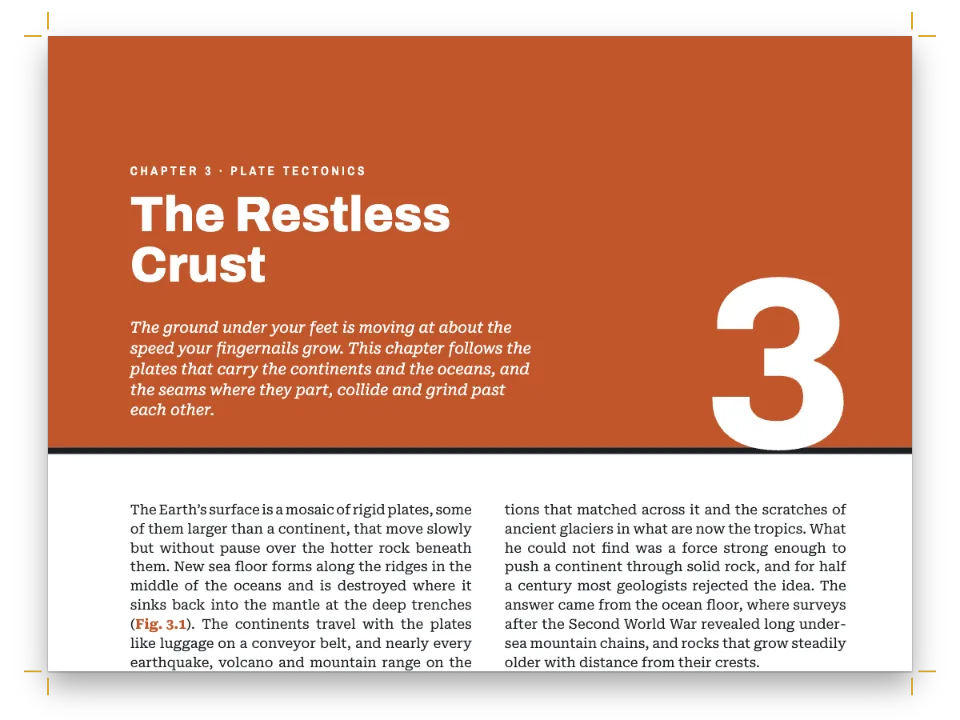
A Beekeeper’s Year is a small handbook in four chapters, one per season. It opens with Autumn, since the beekeeper’s year begins when the last honey comes off. Each chapter is a separate Markdown file with no page, chapter or figure number in it. buildBundle carries those counts from each file to the next and sets the chapters, with a fifth file for the cover and contents, as one book of eleven pages. Every chapter opens on a right-hand page under a corner of honeycomb that holds its number. The contents page, on the verso facing Autumn, mirrors that opener with its title flush against the spine, and lists each chapter’s folio. One brood frame, drawn in code, appears once in each chapter as Figures 1.1 to 4.1. Page 6 stays blank because Winter fills a single page and Spring has to open on a recto.
This recipe answers
- How do I lay out a multi-chapter book so page, figure and chapter numbers continue across chapters?
- How do I add a table of contents that updates itself (leaders, page numbers, authors, part rows)?
- How do I force a page or column break, and start every chapter on a right-hand page?
- How do I hide running heads on openers and blank pages, or paint a blank verso in the part colour?
The short answer
// buildBundle lays the documents out in order with one config and carries state from each to
// the next: the pages already set (so parity goes on), the folio, the chapter and figure counts.
const book = () => buildBundle({ chapters, config: config(), resources });
const config = () => ({ // a factory: the engine caches resolved configs per object
  headings: { ...display, levels: [
    // Every chapter opens on a recto: after a chapter that ends on one, the next document
    // starts with a blank verso of its own. Restated, because any headings object drops
    // the H1 break (gotcha: headings-drop-h1-break).
    { level: 1, breakBefore: { enabled: true, parity: 'odd' },
      // '{1}' puts the number in the PDF bookmarks ('1 Autumn'); the contents and
      // {chapterNumber} count the chapters in order either way.
      numberingTemplate: '{1}', advancedDesign: opener,
      span: 'page' }, // a page-wide opener, painted unclipped: the comb reaches the top edge
    subhead,
  ] },
  // The cover and the contents are headings that take no number, no contents entry and no
  // running heads, so Autumn is still chapter 1. Both inherit span 'page', which starts
  // each on a page of its own, and parity 'odd', which the contents turn off: it would
  // leave page 2 blank (gotcha: style-inherits-break).
  headingStyles: [
    { id: 'cover', numbered: false, toc: false, advancedDesign: cover, ...bare },
    { id: 'contents', numbered: false, toc: false, breakBefore: { enabled: false },
      advancedDesign: contentsOpener, ...bare },
  ],
  // Figures number {h1}.{n} and the counters carry on (Winter's is 2.1). The types are passed
  // only because config.locale does not turn Figure into Figura (gotcha: resource-types-locale).
  resourceTypes: defaultResourceTypes(LANG),
  // :::toc in the first document lists the whole book with the folio each chapter lands on:
  // buildBundle lays the book out again (three passes at most) until those folios settle.
  toc: contents,
  locale: t({ en: 'en-us', es: 'es' }), // hyphenation, by exact code (gotcha: hyphenation-locales)
  colorPalette, page, layout: { layoutType: 'single' }, bodyText, captionStyle, calloutStyles,
  header, footer, // the look: above, and in the regions below
});
Five Markdown documents, one book: buildBundle and the rules they share
Ingredients
- Features
- Books built chapter by chapterTable of contentsChapters that open on a rectoNumbered captionsCitations that place figuresNumbered headingsHeading stylesUnnumbered chaptersRunning heads per sectionRunning heads and foliosHeads by page roleDesigned openersHeading attributesPictures in page designsMirrored marginsFloated boxesPDF exportPDF bookmarksFigure and Table in your languageCovers, title pages and colophons
- Also uses
- Callout boxesFull-width chapter bandPaper colourFonts embedded in the PDFCustom resource typesFigures and tables as resourcesLine breaks in titles
- Type
- Andada Pro, Rozha One, Figtree (SIL OFL 1.1)
- Assets
- None: every picture is drawn in code
Method
#1 · One file per chapter
// Nothing in a chapter says where it lands: buildBundle works that out from the order.
const chapters = [front, autumn, winter, spring, summer].map((markdown) => ({ markdown }));
Each season is its own document, so you can rewrite one chapter without opening the others. The first document holds the frontmatter, the cover and the contents. In Postext 1.4.1 the later documents inherit none of its metadata, and the PDF reads its title and author from the first document only.
#2 · Rules that carry across documents
This step’s code is the short answer above. buildBundle lays the documents out in order with one shared config and passes each one a continuation from those before it: the number of physical pages already set, so parity, mirrored margins and odd and even running heads carry on; the next folio; and the chapter and figure counters. With parity: 'odd', a chapter that follows one ending on a recto starts with a blank verso, and that blank belongs to its own document (break before). The cover and the contents are heading styles with numbered: false, so Autumn is still chapter 1. Both inherit span: 'page' from the chapter level, which puts each on a page of its own without a :::pagebreak. The contents style turns off the inherited parity, which would otherwise leave page 2 blank.
#3 · Contents for the whole book
const contents = {
  levels: [
    // The numbers sit ~0.7 mm high in Postext 1.4.1: they are centred on the line
    // (gotcha: toc-number-baseline).
    { level: 1, fontFamily: 'Rozha One', fontSize: pt(16), lineHeight: pt(18),
      numberFontFamily: 'Figtree', numberFontSize: pt(11), numberFontWeight: 700,
      numberColor: col('accent'), numberWidth: mm(7), numberGap: mm(4), marginTop: pt(8) },
    // Sections: 9.3 pt in the muted colour, indented 11 mm (number 7 + gap 4) to the titles.
    { level: 2, fontSize: pt(9.3), lineHeight: pt(13.5), indent: mm(11), color: col('muted') },
  ],
  pageNumber: { fontFamily: 'Figtree', fontSize: pt(8.5), fontWeight: 600, width: mm(7) },
  leader: { char: '. ', gap: mm(2) },
  // A second line under each chapter, from its {months="…"} heading attribute.
  subtitle: { enabled: true, attr: 'months', fontFamily: 'Andada Pro', fontSize: pt(9),
    color: col('muted') }, // italic by default
};
:::toc sits in the first document but lists the chapters and sections of the whole book. buildBundle lays the book out, collects every heading with the page label it got, and lays the book out again with that outline until the labels stop moving, three passes at most (table of contents). The months under each title come from a heading attribute, {months="…"}, which the opener prints too.
#4 · One opener, mirrored for the contents
const corner = (id, edge) => ({ kind: 'image', id, resourceId: id,
  placement: { anchor: { to: 'bleed', edge }, size: { width: mm(CORNER.width) } } });
const months = { kind: 'text', id: 'months', content: '{attr.months}', ...label,
  color: col('accent'), placement: at('top-left', 0, 14, 'container') };
const title = { kind: 'text', id: 'title', content: '{titleText}', ...display, fontSize: pt(42),
  lineHeight: 1.05, align: 'left', overflow: 'wrap', placement: below('months', 1.5, 100) };
const opener = { enabled: true, minHeight: mm(52), slot: { elements: [
  corner('cells', 'top-right'),
  // The number's box is centred on its cell. Comb and number both hang from the bleed's top
  // right, so a bleed (page.cutLines) moves them together.
  { kind: 'text', id: 'number', content: '{chapterNumber}', ...display, fontSize: pt(40),
    lineHeight: 1, align: 'center', placement: { size: { width: mm(NUMBER.box) },
      ...at('top-right', NUMBER_CELL.x + NUMBER.box / 2 - CORNER.width,
        NUMBER_CELL.y - NUMBER.rise, 'bleed') } },
  months, title,
  { kind: 'text', id: 'lead', content: '{attr.lead}', fontFamily: 'Andada Pro', italic: true,
    fontSize: pt(11.5), lineHeight: 1.35, color: col('ink'), align: 'left', overflow: 'wrap',
    placement: below('title', 3, 88) },
] } };
// The contents mirror it on the verso: the comb in the outer corner, the book's subtitle and
// the title set flush right against the spine, on the same lines as Autumn's across the spread.
const flushRight = (element, placement) => ({ ...element, align: 'right',
  placement: { ...placement, size: { width: 'fill' } } });
const contentsOpener = { ...opener, minHeight: mm(40), slot: { elements: [
  corner('comb', 'top-left'),
  flushRight({ ...months, content: '{subtitle}' }, months.placement),
  flushRight(title, below('months', 1.5)),
] } };
{chapterNumber} counts on from the documents laid out before, so Spring’s opener prints 3 although its file holds no number. The number’s box is computed from the centre of its comb cell, and number and comb both hang from the top right corner of the bleed, so changing the trim or adding a bleed for print moves them together. On the contents page the kicker, read from {subtitle}, and the title are set flush right against the spine, and the comb moves to the verso’s outer corner. Its title then sits at the same height as Autumn’s on the facing page.
#5 · Running heads in every document
const head = (id, content, parity, placement, extra = {}) => ({
  kind: 'text', id, content, parity, pages: 'body', // never on openers or blank pages
  ...label, color: col('muted'), placement, ...extra,
});
const folio = { fontSize: pt(8.5), fontWeight: 700, color: col('accent') };
// In Postext 1.4.1 {title} is blank from the second document on (Autumn included): only the
// first one has frontmatter (gotcha: bundle-metadata). So the verso writes the title out.
const BOOK_TITLE = t({ en: 'A Beekeeper’s Year', es: 'Un año de colmenar' });
const header = { elements: [
  head('verso-folio', '{pageNumber}', 'even', at('top-left', MARGIN.outer, HEAD.y), folio),
  head('verso-title', BOOK_TITLE, 'even', at('top-left', MARGIN.outer + HEAD.gap, HEAD.y)),
  // {chapterTitle} and {pageNumber} are worked out page by page, in every document.
  head('recto-title', '{chapterTitle}', 'odd',
    at('top-right', -(MARGIN.outer + HEAD.gap), HEAD.y)),
  head('recto-folio', '{pageNumber}', 'odd', at('top-right', -MARGIN.outer, HEAD.y), folio),
] };
// Openers carry a drop folio instead, 8 mm under the text block.
const footer = { elements: [head('drop-folio', '{pageNumber}', 'all',
  at('top', 0, 8, 'container'), { pages: 'opener', fontWeight: 700 })] };
Only the first document has frontmatter, so in Postext 1.4.1 {title} prints nothing in every later document, Autumn included. The verso head therefore has the book’s title typed in as plain text. {chapterTitle} and {pageNumber} are resolved page by page and print in every document; page 11, the one right-hand body page, carries SUMMER beside its folio. pages: 'body' keeps every head off the openers and the blank page.
#6 · Spreads on screen, one PDF for the book
const text = chapters.map((chapter) => chapter.markdown).join('\n');
await loadFonts(FONTS, text);
const art = { cover: coverArt(), cells: cornerArt(true), comb: cornerArt(false) };
for (const [season, plan] of Object.entries(SEASONS)) art[`${season}-frame`] = frameArt(plan);
for (const [id, markup] of Object.entries(art)) await loadSvg(`${id}.svg`, markup);
const docs = await buildWithFonts(book, text); // one VDTDocument per Markdown document
showPages(docs, { title: BOOK_TITLE });
// renderToPdf takes the array: one file for the book, with a bookmark per chapter.
offerPdf(() => renderToPdf(docs, { fontProvider: fontsourceProvider, resourceBytes: imageBytes }),
  `${RECIPE}.pdf`);
buildBundle returns an array of documents, one per Markdown file. showPages pairs the pages by pageIndexOffset + page.index, so page 1 stands alone as a recto and pages 2 and 3, 4 and 5 and so on face each other. renderToPdf takes the same array and writes one file with the book’s page labels and a bookmark for every chapter and section.
The whole recipe
// ═══ Postext Cookbook · Nº 007 · One book from separate chapters ══════════════════════════ // https://postext.dev/en/cookbook/book-from-chapters // Code: MIT · Text: original (CC BY 4.0) · Drawings: generated in code (CC BY 4.0) // Fonts: Andada Pro, Rozha One, Figtree (SIL OFL 1.1) · Needs postext ≥ 1.4.1 // A handbook in four seasons written as five Markdown documents, laid out by buildBundle as // one book: parity, folios, chapter and figure numbers and the contents run straight through. import { buildBundle, renderPageToCanvas, clearMeasurementCache, registerResourceImage, defaultResourceTypes, } from 'https://esm.sh/postext'; import { renderToPdf, decompressWoff2 } from 'https://esm.sh/postext-pdf'; const LANG = 'en'; // @lang: the language of the sample document ('en' | 'es') const RECIPE = 'book-from-chapters'; // ─── 1 · Design ───────────────────────────────────────────────────────────── const palette = { // every colour in the config links to one of these, so the book can be retinted ink: '#2a2218', // text and display type honey: '#d99a1e', // the drawings only: the cover and the comb cells accent: '#7a4e12', // the text accent (7:1 on paper): numbers, labels, subheads; main-color too pollen: '#c4692b', comb: '#f7e7c4', rule: '#d8c8a8', // figures: pollen, wax, wood and walls muted: '#6e634f', paper: '#fffdf7', // running heads, colophon, contents sections; the page }; const col = (id) => ({ hex: palette[id], model: 'hex', paletteId: id }); const colorPalette = [ ...Object.entries(palette).map(([id, hex]) => ({ id, name: id, value: { hex, model: 'hex' } })), // The engine's defaults link to 'main-color': point it at the accent, so nothing prints blue. { id: 'main-color', name: 'accent (defaults)', value: { hex: palette.accent, model: 'hex' } }, ]; // The geometry, in mm. The drawings, the opener and the running heads are derived from it. const TRIM = { width: 150, height: 200 }; // a small handbook const MARGIN = { top: 22, bottom: 22, inner: 19, outer: 15 }; // mirrored const MEASURE = TRIM.width - MARGIN.inner - MARGIN.outer; // the text width: 116 mm const SQRT3 = Math.sqrt(3); // comb cells of radius r sit √3·r apart, their rows 1.5·r apart const CORNER = { width: 84, height: 70, r: 9.5 }; // the openers' comb, and its cell radius const NUMBER_CELL = { x: 4 * SQRT3 * CORNER.r, y: 2 * 1.5 * CORNER.r }; // row 2, cell 4 // The chapter number's box: 20 mm wide, its top 8 mm above the cell's centre, which is where // a 40 pt Rozha One figure sits optically centred in the cell. const NUMBER = { box: 20, rise: 8 }; const FRAME = { width: MEASURE, height: 50 }; // the brood frame figures, at the text width const HEAD = { y: 12, gap: 8 }; // running heads 12 mm from the top edge, 8 mm folio to text const LEAD = 14.2; // body leading in pt: the baseline grid // The look: a small handbook, mirrored, justified Andada Pro on the grid; Rozha One titles. const page = { // mirror: left is the inner margin, right the outer sizePreset: 'custom', width: mm(TRIM.width), height: mm(TRIM.height), dpi: 150, backgroundColor: col('paper'), margins: { top: mm(MARGIN.top), bottom: mm(MARGIN.bottom), left: mm(MARGIN.inner), right: mm(MARGIN.outer), mirror: true }, }; const bodyText = { // justified, hyphenated, optimal line breaks and widow control: by default fontFamily: 'Andada Pro', fontSize: pt(10.4), lineHeight: pt(LEAD), color: col('ink'), boldColor: col('ink'), italicColor: col('ink'), referenceColor: col('ink'), firstLineIndent: mm(4.5), indentAfterHeading: false, // Spaces stretch to 1.7× at most (the default is 2): the line breaker then takes the // hyphens it would otherwise avoid, and no line gapes. maxWordSpacing: 1.7, }; const display = { fontFamily: 'Rozha One', fontWeight: 400, color: col('ink') }; // titles // Subheads: the line box itself is a line and a half deep, so the gap to the text under it // is the same everywhere. A margin above would not do it: it drops at the head of a page. const subhead = { level: 2, fontFamily: 'Andada Pro', fontWeight: 700, fontSize: pt(12.5), lineHeight: pt(LEAD * 1.5), color: col('accent'), marginTop: pt(LEAD), marginBottom: pt(0) }; const captionStyle = { fontFamily: 'Figtree', fontSize: pt(7.6), gap: mm(2.5), labelColor: col('accent') }; // The colophon floats to the foot of the last page: a box with no background, placed // 'bottom'. One statement per paragraph, because a no-break space would not keep // "CC BY 4.0" on one line (gotcha: nbsp-breaks). const calloutStyles = [{ id: 'colophon', placement: 'bottom', backgroundEnabled: false, padding: { top: pt(0), right: pt(0), bottom: pt(0), left: pt(0) }, marginBottom: pt(0), body: { fontFamily: 'Figtree', fontSize: pt(7), lineHeight: pt(10), color: col('muted'), textAlign: 'left', firstLineIndent: pt(0) } }]; // #region answer: five Markdown documents, one book: buildBundle and the rules they share // buildBundle lays the documents out in order with one config and carries state from each to // the next: the pages already set (so parity goes on), the folio, the chapter and figure counts. const book = () => buildBundle({ chapters, config: config(), resources }); const config = () => ({ // a factory: the engine caches resolved configs per object headings: { ...display, levels: [ // Every chapter opens on a recto: after a chapter that ends on one, the next document // starts with a blank verso of its own. Restated, because any headings object drops // the H1 break (gotcha: headings-drop-h1-break). { level: 1, breakBefore: { enabled: true, parity: 'odd' }, // '{1}' puts the number in the PDF bookmarks ('1 Autumn'); the contents and // {chapterNumber} count the chapters in order either way. numberingTemplate: '{1}', advancedDesign: opener, span: 'page' }, // a page-wide opener, painted unclipped: the comb reaches the top edge subhead, ] }, // The cover and the contents are headings that take no number, no contents entry and no // running heads, so Autumn is still chapter 1. Both inherit span 'page', which starts // each on a page of its own, and parity 'odd', which the contents turn off: it would // leave page 2 blank (gotcha: style-inherits-break). headingStyles: [ { id: 'cover', numbered: false, toc: false, advancedDesign: cover, ...bare }, { id: 'contents', numbered: false, toc: false, breakBefore: { enabled: false }, advancedDesign: contentsOpener, ...bare }, ], // Figures number {h1}.{n} and the counters carry on (Winter's is 2.1). The types are passed // only because config.locale does not turn Figure into Figura (gotcha: resource-types-locale). resourceTypes: defaultResourceTypes(LANG), // :::toc in the first document lists the whole book with the folio each chapter lands on: // buildBundle lays the book out again (three passes at most) until those folios settle. toc: contents, locale: t({ en: 'en-us', es: 'es' }), // hyphenation, by exact code (gotcha: hyphenation-locales) colorPalette, page, layout: { layoutType: 'single' }, bodyText, captionStyle, calloutStyles, header, footer, // the look: above, and in the regions below }); // #endregion const bare = { header: { elements: [] }, footer: { elements: [] } }; // no running heads // #region art: honeycomb drawn in code, seeded so that every run draws the same cells let seed = 2026; // Mulberry32, a tiny seeded PRNG: never Math.random() in a recipe const rand = () => { let r = Math.imul((seed = (seed + 0x6d2b79f5) | 0) ^ (seed >>> 15), 1 | seed); r = (r + Math.imul(r ^ (r >>> 7), 61 | r)) ^ r; return ((r ^ (r >>> 14)) >>> 0) / 4294967296; }; const paint = (id, opacity = 1) => `fill="${palette[id]}" fill-opacity="${opacity}"`; // A w × h mm sheet (10 px per mm) of hexagonal cells of radius r; cell(x, y) paints each one. function comb(w, h, r, cell, under = '') { let svg = `<svg xmlns="http://www.w3.org/2000/svg" width="${w * 10}" height="${h * 10}" ` + `viewBox="0 0 ${w} ${h}">${under}`; for (let row = 0, y = 0; y < h + r; y = ++row * 1.5 * r) { for (let x = (row % 2) * SQRT3 / 2 * r; x < w + 2 * r; x += SQRT3 * r) { const corner = (a) => `${(x + 0.88 * r * Math.sin(a)).toFixed(2)} ` + (y - 0.88 * r * Math.cos(a)).toFixed(2); const hexagon = [0, 1, 2, 3, 4, 5].map((i) => corner(i * Math.PI / 3)).join('L'); const fill = cell(x, y); if (fill) svg += `<path d="M${hexagon}Z" ${fill}/>`; } } return `${svg}</svg>`; } // Comb that thins out with the distance d from a corner: solid cells with some open ones up to // d = 0.78, faint open cells up to 1, nothing beyond. const fade = (d, full, open, k = 1) => (d > 1 ? '' : d > 0.78 ? paint(open, 0.14 * k) : rand() < 0.3 ? paint(open, 0.28 * k) : paint(full, (d < 0.5 ? 0.95 : 0.6) * k)); const coverArt = () => comb(TRIM.width, TRIM.height, 7.5, (x, y) => fade(Math.hypot( (TRIM.width - x) / TRIM.width, y / (TRIM.height - 10)) + rand() * 0.22, 'comb', 'accent'), `<rect width="${TRIM.width}" height="${TRIM.height}" ${paint('honey')}/>`); // A paler cluster from the outer top corner; on a recto the cell under the number is solid. const cornerArt = (recto) => comb(CORNER.width, CORNER.height, CORNER.r, (x, y) => (recto && Math.hypot(x - NUMBER_CELL.x, y - NUMBER_CELL.y) < 1 ? paint('honey') : fade(Math.hypot(((recto ? CORNER.width : 0) - x) / (CORNER.width - 4), y / (CORNER.height - 6)) + rand() * 0.25, 'honey', 'honey', 0.85))); // One brood frame through the year. Per season: the brood nest (centre v, half-width, // half-height, what fills it) and where the honey sits, on a frame that runs −1…1 each way. const SEASONS = { autumn: [0.5, 0.3, 0.42, 'accent', () => true], winter: [0.4, 0.42, 0.62, 'ink', (u, v) => v < 0.25 - 0.4 * (1 - u * u)], // ink: the cluster spring: [0.2, 0.62, 0.8, 'accent', (u, v) => v < -0.3 && Math.abs(u) > 0.45], summer: [0.45, 0.5, 0.6, 'accent', (u, v) => v < 0.35 || Math.abs(u) > 0.7], }; function frameArt([cv, ru, rv, nest, honey]) { const { width: w, height: h } = FRAME; // a top bar with 4 mm lugs, slim side bars const wood = `<path d="M0 0H${w}V4.5H${w - 4}V${h}H4V4.5H0Z" ${paint('rule')}/>` + `<rect x="6.5" y="4.5" width="${w - 13}" height="${h - 7}" ${paint('rule', 0.5)}/>`; return comb(w, h, 2.5, (x, y) => { const [u, v] = [(x - w / 2) / (w / 2 - 7.5), (y - h / 2 - 1) / (h / 2 - 4)]; const d = Math.hypot(u / ru, (v - cv) / rv) + rand() * 0.12; if (x < 7 || x > w - 7 || y < 6 || y > h - 3.5) return ''; return paint(d < 1 ? nest : d < 1.3 && nest === 'accent' ? 'pollen' : honey(u, v) ? 'honey' : 'comb', d < 1 && nest === 'ink' ? 0.8 : 1); }, wood); } // #endregion // The cover: comb over a honey page, the title low on the inner side where the comb runs out. const label = { fontFamily: 'Figtree', fontSize: pt(7.5), fontWeight: 600, letterSpacing: pt(1.4), textTransform: 'uppercase' }; const at = (edge, x, y, to = 'page') => ({ anchor: { to, edge }, offset: { x: mm(x), y: mm(y) } }); const below = (id, y, width) => ({ ...at('below', 0, y, `#${id}`), ...(width && { size: { width: mm(width) } }) }); // No minHeight: the contents heading, which inherits span 'page', starts the next page. const cover = { enabled: true, slot: { elements: [ { kind: 'image', id: 'art', resourceId: 'cover', placement: { anchor: { to: 'bleed', edge: 'top-left' }, size: { width: 'fill' } } }, { kind: 'text', id: 'kicker', content: '{subtitle}', ...label, fontSize: pt(8.5), color: col('ink'), placement: at('top-left', 17, 116) }, // A design text's lineHeight is a multiple (gotcha: design-lineheight-multiple). { kind: 'text', id: 'title', content: '{titleText}', ...display, fontSize: pt(54), lineHeight: 0.98, align: 'left', overflow: 'wrap', placement: below('kicker', 4, 125) }, { kind: 'rule', id: 'rule', direction: 'horizontal', thickness: pt(2), color: col('ink'), placement: { ...below('title', 6), size: { width: mm(16) } } }, { kind: 'text', id: 'author', content: '{author}', ...label, fontSize: pt(9), fontWeight: 700, color: col('ink'), placement: below('rule', 5) }, ] } }; // #region opener: each chapter's opener: the number in a honey cell, months, title and lead const corner = (id, edge) => ({ kind: 'image', id, resourceId: id, placement: { anchor: { to: 'bleed', edge }, size: { width: mm(CORNER.width) } } }); const months = { kind: 'text', id: 'months', content: '{attr.months}', ...label, color: col('accent'), placement: at('top-left', 0, 14, 'container') }; const title = { kind: 'text', id: 'title', content: '{titleText}', ...display, fontSize: pt(42), lineHeight: 1.05, align: 'left', overflow: 'wrap', placement: below('months', 1.5, 100) }; const opener = { enabled: true, minHeight: mm(52), slot: { elements: [ corner('cells', 'top-right'), // The number's box is centred on its cell. Comb and number both hang from the bleed's top // right, so a bleed (page.cutLines) moves them together. { kind: 'text', id: 'number', content: '{chapterNumber}', ...display, fontSize: pt(40), lineHeight: 1, align: 'center', placement: { size: { width: mm(NUMBER.box) }, ...at('top-right', NUMBER_CELL.x + NUMBER.box / 2 - CORNER.width, NUMBER_CELL.y - NUMBER.rise, 'bleed') } }, months, title, { kind: 'text', id: 'lead', content: '{attr.lead}', fontFamily: 'Andada Pro', italic: true, fontSize: pt(11.5), lineHeight: 1.35, color: col('ink'), align: 'left', overflow: 'wrap', placement: below('title', 3, 88) }, ] } }; // The contents mirror it on the verso: the comb in the outer corner, the book's subtitle and // the title set flush right against the spine, on the same lines as Autumn's across the spread. const flushRight = (element, placement) => ({ ...element, align: 'right', placement: { ...placement, size: { width: 'fill' } } }); const contentsOpener = { ...opener, minHeight: mm(40), slot: { elements: [ corner('comb', 'top-left'), flushRight({ ...months, content: '{subtitle}' }, months.placement), flushRight(title, below('months', 1.5)), ] } }; // #endregion // #region contents: what :::toc prints: numbers in the accent, dotted leaders, folios const contents = { levels: [ // The numbers sit ~0.7 mm high in Postext 1.4.1: they are centred on the line // (gotcha: toc-number-baseline). { level: 1, fontFamily: 'Rozha One', fontSize: pt(16), lineHeight: pt(18), numberFontFamily: 'Figtree', numberFontSize: pt(11), numberFontWeight: 700, numberColor: col('accent'), numberWidth: mm(7), numberGap: mm(4), marginTop: pt(8) }, // Sections: 9.3 pt in the muted colour, indented 11 mm (number 7 + gap 4) to the titles. { level: 2, fontSize: pt(9.3), lineHeight: pt(13.5), indent: mm(11), color: col('muted') }, ], pageNumber: { fontFamily: 'Figtree', fontSize: pt(8.5), fontWeight: 600, width: mm(7) }, leader: { char: '. ', gap: mm(2) }, // A second line under each chapter, from its {months="…"} heading attribute. subtitle: { enabled: true, attr: 'months', fontFamily: 'Andada Pro', fontSize: pt(9), color: col('muted') }, // italic by default }; // #endregion // #region running-heads: the book on the verso, the chapter on the recto, folios outside const head = (id, content, parity, placement, extra = {}) => ({ kind: 'text', id, content, parity, pages: 'body', // never on openers or blank pages ...label, color: col('muted'), placement, ...extra, }); const folio = { fontSize: pt(8.5), fontWeight: 700, color: col('accent') }; // In Postext 1.4.1 {title} is blank from the second document on (Autumn included): only the // first one has frontmatter (gotcha: bundle-metadata). So the verso writes the title out. const BOOK_TITLE = t({ en: 'A Beekeeper’s Year', es: 'Un año de colmenar' }); const header = { elements: [ head('verso-folio', '{pageNumber}', 'even', at('top-left', MARGIN.outer, HEAD.y), folio), head('verso-title', BOOK_TITLE, 'even', at('top-left', MARGIN.outer + HEAD.gap, HEAD.y)), // {chapterTitle} and {pageNumber} are worked out page by page, in every document. head('recto-title', '{chapterTitle}', 'odd', at('top-right', -(MARGIN.outer + HEAD.gap), HEAD.y)), head('recto-folio', '{pageNumber}', 'odd', at('top-right', -MARGIN.outer, HEAD.y), folio), ] }; // Openers carry a drop folio instead, 8 mm under the text block. const footer = { elements: [head('drop-folio', '{pageNumber}', 'all', at('top', 0, 8, 'container'), { pages: 'opener', fontWeight: 700 })] }; // #endregion // ─── 2 · Content ──────────────────────────────────────────────────────────── const front = String.raw`---Markdown sample · 10 lines · content.en.md
title: "A Beekeeper’s Year" subtitle: "A handbook in four seasons" author: "Clara Ibarrola" --- # A Beekeeper’s \\ Year {style="cover"} # Contents {style="contents"} :::toc`; // frontmatter, cover and contents (content.<lang>.md) const autumn = String.raw`# Autumn {months="September · October · November" lead="The beekeeper’s year begins when the last honey comes off. What you do in the next eight weeks decides whether there is a colony to wake in March."}Markdown sample · 16 lines · content.autumn.en.md
Most calendars start in January, and most beekeeping books in spring, with the first warm day and the first bees on the crocuses. This one starts in September, because that is where the bees start. The colony that flies next April is being raised now: the workers born in autumn live five or six months instead of five or six weeks, and they are the ones that carry the colony through the winter. A colony that goes into October with a young queen, twenty kilos of stores and few mites will usually come out strong in spring. ## Taking the harvest Take the last supers off by the end of August, when at least four fifths of each frame is capped. Clear the bees with a board the evening before and lift the boxes early, before the robbers are up. Leave the brood box alone; the honey in it is the bees’ winter food. Then weigh what is left. A colony in a single brood box needs about twenty kilos of stores to see out a winter like ours, which means frames like the one in :ref{id="autumn-frame"}, capped honey from the top bar almost to the bottom one. If the hive is lighter than that, feed. ## Stores for winter Feed thick syrup, two kilos of sugar to a litre of water, in a feeder over the crownboard, and feed it fast: the bees must take it down, dry it and cap it while the days are still warm enough to fly. By the middle of October it is too late for syrup, and what they have then is what they will eat. A hive that covers fewer than five frames at the end of September seldom lasts the winter on its own. Unite it with a stronger one over a sheet of newspaper: the bees chew through the paper in a day or two and mix without fighting. Treat for varroa as soon as the supers are off, before the winter bees are raised. Narrow the entrance to one bee’s width against wasps, and fit a mouse guard before the first frost. Then close the hive, and do not open it again until the first warm day of spring.`; // content.autumn.<lang>.md, and so on const winter = String.raw`# Winter {months="December · January · February" lead="Below fourteen degrees the bees draw together into a ball on the comb and live on their autumn stores."}Markdown sample · 2 lines · content.winter.en.md
The cluster in :ref{id="winter-frame"} is how the colony gets through the cold. The bees on the outside pack tight, heads in, and hold the heat in; those inside shiver their flight muscles to keep the core warm, and the whole ball moves slowly up the frames as it eats. Do not open the hive. Once a month, heft it from the back to feel the weight and clear the dead bees from the entrance.`; const spring = String.raw`# Spring {months="March · April · May" lead="The colony wakes before you do. Wait for the first warm afternoon to open the hive and see what the winter has left behind."}Markdown sample · 14 lines · content.spring.en.md
On a still day above fifteen degrees, when the bees are flying freely and coming home with pollen, you can open the hive for the first time. Work quickly and quietly, with a little smoke at the entrance, and ask only three questions: is there a laying queen, is there enough food, and is there room? Keep the visit to ten minutes at most, and close up before the brood can chill. ## The first inspection Look for eggs rather than for the queen. Eggs in the cells mean she was there within the last three days, and an egg standing upright on the base of the cell was laid yesterday. A good frame at the end of April looks like :ref{id="spring-frame"}: a solid oval of capped brood with few gaps, a band of pollen round it and the last of the winter honey in the upper corners. Patchy brood, or eggs laid two and three to a cell, means trouble with the queen; find out now, while there is still time to replace her. If the frames are light, feed. More colonies starve in March and April than in the depth of winter, because the brood is growing fast and the flowers are not yet out. Give a light colony a frame of stores from a strong one, or a block of fondant over the feed hole; syrup can wait for warmer nights. ## Room to grow By May the colony can double in a few weeks. When the bees cover seven or eight frames of the brood box, add a super, and add the next one before the first is full. A crowded colony prepares to swarm, and from now until July you should look through the brood box every seven days for queen cells. Spring is also the time to renew the comb. Early in the season, move three or four of the darkest frames to the edge of the brood box; once the queen has left them, take them out and put in frames of fresh foundation. With nectar coming in, the bees draw new comb eagerly, and in three years every frame in the box has been replaced.`; const summer = String.raw`# Summer {months="June · July · August" lead="The colony is at its largest and the main flow is on. Miss a week in June and the bees may swarm into the apple tree."}Markdown sample · 32 lines · content.summer.en.md
In summer the brood box fills with honey from the top down, as :ref{id="summer-frame"} shows, and the supers fill after it. Add supers before the bees need them and look through the brood box for queen cells every week. Leave full frames on the hive until they are capped. In June a missed week can cost you half the colony and most of the crop, so write down what you find at every visit. ## Swarm season Swarming is how a colony reproduces. When the old queen leaves with half the workers, the bees that stay raise a new one, and you have two colonies where you had one, or one colony and a cluster of bees hanging from the nearest branch. The signs are queen cells along the bottom of the frames, a crowded brood box and a queen who has slimmed down to fly. If you find queen cells with larvae in them and the old queen is still at home, make an artificial swarm. Move the old queen to a new box on the old site with one frame of brood, and move the parent colony, with its queen cells, a metre or two away. The flying bees return to the old site and to their queen, and the colony behaves as if it had already swarmed. Within ten days or so a new queen emerges in the parent box, and within a month she is laying. ## The main flow In a good year the flow comes in late June and July, from lime, bramble and clover, and a strong colony can bring in two or three kilos of nectar a day. The supers fill faster than you expect, so keep adding them. Harvest when the frames are capped and the honey no longer shakes out of the cells: it is ripe below eighteen per cent water. Take the supers off at the end of July or in August, clearing the bees as the first chapter describes, and carry the boxes indoors before the robbers find them. ## From comb to jar Uncap the frames over a tray with a knife or a fork, spin them in the extractor, and run the honey through a coarse sieve and then a fine one. Leave it in a settling tank for two or three days in a warm room: the wax and the air bubbles rise, you skim the froth off the top, and what runs from the tap at the bottom is clear. Jar it then, and label each batch with the month and the flowers it came from. Honey keeps for years if it is dry, but it draws water from the air, so seal the jars and store them somewhere cool and dark. Most of it sets in time: spring honey from oilseed rape turns solid within weeks, lime honey stays runny for months, and neither has gone off. A jar that has set runs clear again in a warm water bath, never above forty degrees. Put the wet frames back on the hives in the evening, when the robbers have stopped flying, and let the bees clean them. By September the workers have driven the drones out and the colony is shrinking; the next jobs, feeding and treating for varroa, are in the first chapter. :::callout{type="colophon"} Set in Andada Pro, Rozha One and Figtree (SIL Open Font License). Text and drawings: original, CC BY 4.0. The front matter and the four seasons are five Markdown documents; Postext sets them as one book. An imaginary handbook by an imaginary author. :::`; // #region chapters: five Markdown documents in reading order: the front matter, then a year // Nothing in a chapter says where it lands: buildBundle works that out from the order. const chapters = [front, autumn, winter, spring, summer].map((markdown) => ({ markdown })); // #endregion const svg = (id, [width, height], caption) => ({ id, typeId: 'figure', kind: 'svg', createdAt: 0, updatedAt: 0, caption, altText: caption, svg: { fileId: `${id}.svg`, width: width * 10, height: height * 10 } }); // as comb() draws const CAPTIONS = t({ en: { autumn: 'A frame in October: honey (gold) round the last brood (brown) and pollen (russet).', winter: 'The same frame in January: the cluster (dark) eats its way up from empty comb (pale).', spring: 'The same frame in late April: brood across the middle, the winter honey nearly gone.', summer: 'The same frame in July: an arch of new honey presses down on the brood.', }, es: { autumn: 'Un cuadro en octubre: la miel (dorada) rodea la última cría (marrón) ' + 'y el polen (rojizo).', winter: 'El mismo cuadro en enero: el racimo (oscuro) deja la cera vacía (clara) y sube.', spring: 'El mismo cuadro a finales de abril: cría en el centro; queda poca miel del invierno.', summer: 'El mismo cuadro en julio: un arco de miel nueva aprieta la cría hacia abajo.', } }); const resources = [svg('cover', [TRIM.width, TRIM.height]), svg('cells', [CORNER.width, CORNER.height]), svg('comb', [CORNER.width, CORNER.height]), ...Object.keys(SEASONS).map((season) => svg(`${season}-frame`, [FRAME.width, FRAME.height], CAPTIONS[season]))]; // ─── 3 · Fonts ────────────────────────────────────────────────────────────── // Every face the design uses, loaded before the first build (gotcha: fonts-first). // Rozha One ships one face: renderToPdf still asks for its bold and italic, which the kit's // provider snaps to that face (gotcha: pdf-provider-all-styles). const FONTS = { // text, display and labels 'Andada Pro': ['400', '400i', '700'], 'Rozha One': ['400'], Figtree: ['400', '600', '700'], }; // ─── 4 · Build & show ─────────────────────────────────────────────────────── // #region build: draw, lay the book out, show it as spreads, offer one PDF of all chapters const text = chapters.map((chapter) => chapter.markdown).join('\n'); await loadFonts(FONTS, text); const art = { cover: coverArt(), cells: cornerArt(true), comb: cornerArt(false) }; for (const [season, plan] of Object.entries(SEASONS)) art[`${season}-frame`] = frameArt(plan); for (const [id, markup] of Object.entries(art)) await loadSvg(`${id}.svg`, markup); const docs = await buildWithFonts(book, text); // one VDTDocument per Markdown document showPages(docs, { title: BOOK_TITLE }); // renderToPdf takes the array: one file for the book, with a bookmark per chapter. offerPdf(() => renderToPdf(docs, { fontProvider: fontsourceProvider, resourceBytes: imageBytes }), `${RECIPE}.pdf`); // #endregionKit · core, fonts, viewer, pdf, images: the same in every recipe · 310 lines
// ─── Kit ── helpers shared by every Cookbook recipe · postext.dev/cookbook ───── // ─── Kit · core v1 ── the same in every recipe · postext.dev/cookbook ───────── function mm(value) { return { value, unit: 'mm' }; } function pt(value) { return { value, unit: 'pt' }; } function em(value) { return { value, unit: 'em' }; } /** The sample language's string: t({ en: 'Figure', es: 'Figura' }). */ function t(strings) { return strings[LANG] ?? Object.values(strings)[0]; } /** A file in this recipe's assets folder, served from the Postext repo by jsDelivr. */ function asset(file) { return `https://cdn.jsdelivr.net/gh/drnachio/postext@main/cookbook/${RECIPE}/assets/${file}`; } // ─── Kit · fonts v1 ── the same in every recipe · postext.dev/cookbook ──────── // Postext measures text with the faces the browser has loaded, and caches the // widths, so every face must be ready before the first build. Faces come from // Fontsource: the same static files the PDF embeds, so screen and PDF agree. /** faces = { 'Family Name': ['400', '400i', '700'] }. `text` is the sample: * letters beyond Latin-1 (č, ł, ő…) also load the latin-ext files. With * `optional`, a face Fontsource does not ship is skipped instead of failing. * Resolves to the number of faces added. */ async function loadFonts(faces, text = '', { optional = false } = {}) { kitStatus('Loading fonts…'); const ranges = { latin: 'U+0000-00FF,U+0131,U+0152-0153,U+02BB-02BC,U+02C6,U+02DA,U+02DC,U+0304,U+0308,U+0329,' + 'U+2000-206F,U+20AC,U+2122,U+2191,U+2193,U+2212,U+2215,U+FEFF,U+FFFD', 'latin-ext': 'U+0100-02BA,U+02BD-02C5,U+02C7-02CC,U+02CE-02D7,U+02DD-02FF,U+0304,U+0308,U+0329,' + 'U+1D00-1DBF,U+1E00-1E9F,U+1EF2-1EFF,U+2020,U+20A0-20AB,U+20AD-20C0,U+2113,U+2C60-2C7F,U+A720-A7FF', }; const subsets = /[Ā-˿Ḁ-ỿ]/.test(text) ? ['latin', 'latin-ext'] : ['latin']; const jobs = []; let added = 0; for (const [family, specs] of Object.entries(faces)) { const id = fontsourceId(family); const meta = optional ? await fontsourceMeta(family) : null; for (const spec of new Set(specs)) { const weight = parseInt(spec, 10); const style = spec.endsWith('i') ? 'italic' : 'normal'; if (hasFace(family, weight, style)) continue; if (optional && !(meta?.weights.includes(weight) && meta.styles.includes(style))) continue; for (const subset of subsets) { const url = `https://cdn.jsdelivr.net/npm/@fontsource/${id}@5/files/${id}-${subset}-${weight}-${style}.woff2`; const face = new FontFace(family, `url(${url}) format('woff2')`, { weight: String(weight), style, unicodeRange: ranges[subset] }); jobs.push(face.load().then((ready) => { document.fonts.add(ready); added++; }, () => { if (subset === 'latin' && !optional) throw new Error(`Fontsource has no ${family} ${weight} ${style}`); })); } } } await Promise.all(jobs).catch((error) => { kitFail(error); throw error; }); return added; } /** Runs `build` (a buildDocument or buildBundle call) and checks the faces * the pages use. A regular face missing from FONTS is loaded with a warning; * bold and italic variants are loaded when the family ships them. Then the * measurement caches are cleared and the build runs again. */ async function buildWithFonts(build, text = '') { const tried = new Set(); for (let round = 0; round < 3; round++) { kitStatus('Laying out…'); await new Promise(requestAnimationFrame); // let the status paint first const result = await Promise.resolve().then(build).catch((error) => { kitFail(error); throw error; }); const wanted = { base: {}, variants: {} }; for (const { font, base } of [result].flat().flatMap(fontStringsOf)) { const { family, weight, style } = parseFont(font); const key = `${family}|${weight}|${style}`; if (tried.has(key) || hasFace(family, weight, style)) continue; tried.add(key); (wanted[base ? 'base' : 'variants'][family] ??= []).push(`${weight}${style === 'italic' ? 'i' : ''}`); } if (Object.keys(wanted.base).length) { console.warn(`[cookbook] FONTS does not list ${JSON.stringify(wanted.base)}: loading them.`); } const added = await loadFonts(wanted.base, text) + await loadFonts(wanted.variants, text, { optional: true }); if (added === 0) return result; clearMeasurementCache(); } throw new Error('The fonts did not settle after three builds.'); } /** Every font string of the layout. `base` marks a block's own face; its * bold, italic and bold-italic variants are listed whether or not used. */ function fontStringsOf(doc) { const found = new Map(); const walk = (node) => { if (!node || typeof node !== 'object') return; if (Array.isArray(node)) { node.forEach(walk); return; } for (const [key, value] of Object.entries(node)) { if (typeof value === 'string' && /fontString$/i.test(key)) { found.set(value, found.get(value) || key === 'fontString'); } else if (value && typeof value === 'object') walk(value); } }; walk(doc.pages); walk(doc.blocks); return [...found].map(([font, base]) => ({ font, base })); } /** '700 37.5px Open Sans' / 'italic 400 13px "Source Serif 4"' → { family, weight, style }. * A string with no weight ('95.8px Young Serif', from a design text) is 400. */ function parseFont(font) { const m = /^(?:(italic|oblique)\s+)?(?:small-caps\s+)?(?:(\d+|bold|normal)\s+)?[\d.]+px\s+(.+)$/.exec(font.trim()); if (!m) throw new Error(`Unexpected font string: ${font}`); const weight = m[2] === 'bold' ? 700 : !m[2] || m[2] === 'normal' ? 400 : Number(m[2]); return { family: m[3].replace(/^["']|["']$/g, ''), weight, style: m[1] ? 'italic' : 'normal' }; } /** True when a loaded FontFace covers exactly this family, weight and style * (document.fonts.check() is also true for families nobody declared). */ function hasFace(family, weight, style) { for (const face of document.fonts) { if (face.status !== 'loaded' || face.style !== style) continue; if (face.family.replace(/^["']|["']$/g, '') !== family) continue; const [low, high = low] = face.weight.split(' ').map(Number); if (weight >= low && weight <= high) return true; } return false; } /** Fontsource's id for a family: 'Source Serif 4' → 'source-serif-4'. */ function fontsourceId(family) { return family.toLowerCase().replace(/\s+/g, '-'); } /** The weights and styles a family ships ({ weights: [400, 700], styles: ['normal', 'italic'] }), or null. */ function fontsourceMeta(family) { fontsourceMeta.cache ??= new Map(); const id = fontsourceId(family); if (!fontsourceMeta.cache.has(id)) { fontsourceMeta.cache.set(id, fetch(`https://api.fontsource.org/v1/fonts/${id}`) .then((res) => (res.ok ? res.json() : null), () => null)); } return fontsourceMeta.cache.get(id); } // ─── Kit · viewer v1 ── the same in every recipe · postext.dev/cookbook ─────── /** Shows the pages as facing spreads on a dark desk: the first page is a * recto on its own, then verso | recto pairs, as in a bound book. Pages * are painted when they scroll near the screen. */ function showPages(docs, { title, width = 460 } = {}) { const root = viewer(title); const pages = [docs].flat().flatMap((doc) => doc.pages.map((page) => ({ doc, page, n: (doc.pageIndexOffset ?? 0) + page.index }))); const spreads = []; let verso = null; for (const p of pages) { if (p.n % 2 === 1) { if (verso) spreads.push([verso, null]); verso = p; } else { spreads.push([verso, p]); verso = null; } } if (verso) spreads.push([verso, null]); const density = Math.min(window.devicePixelRatio || 1, 2); showPages.painter?.disconnect(); const painter = new IntersectionObserver((entries) => { for (const { isIntersecting, target } of entries) { if (!isIntersecting) continue; painter.unobserve(target); const { doc, page } = target.postext; renderPageToCanvas(page, doc, target, { scale: (width * density) / page.width }); } }, { rootMargin: '800px' }); showPages.painter = painter; root.replaceChildren(...spreads.map((pair) => { const spread = document.createElement('div'); spread.className = 'pt-spread'; for (const p of pair) { const figure = document.createElement('figure'); if (p) { const label = p.page.pageLabel || String(p.n + 1); const canvas = document.createElement('canvas'); canvas.postext = p; canvas.style.aspectRatio = `${p.page.width} / ${p.page.height}`; canvas.setAttribute('role', 'img'); canvas.setAttribute('aria-label', `Page ${label}`); const folio = document.createElement('figcaption'); folio.textContent = label; figure.append(canvas, folio); painter.observe(canvas); } else figure.className = 'pt-blank'; spread.append(figure); } return spread; })); kitStatus(`${pages.length} ${pages.length === 1 ? 'page' : 'pages'}`); document.documentElement.dataset.postext = 'ready'; return pages.length; } /** The desk, the bar and the error reporting, created once. */ function viewer(title) { if (!document.getElementById('pt-kit')) { document.head.insertAdjacentHTML('beforeend', `<style id="pt-kit"> :root { color-scheme: dark; } body { margin: 0; background: #0e1014; color: #b9bcc4; font: 13px/1.45 system-ui, sans-serif; } #pt-bar { position: sticky; top: 0; z-index: 1; display: flex; flex-wrap: wrap; align-items: center; gap: 6px 16px; padding: 10px 16px; background: rgb(14 16 20 / .92); backdrop-filter: blur(6px); border-bottom: 1px solid #23262d; } #pt-bar strong { color: #f4f1ea; font-weight: 600; } #pt-actions { display: flex; gap: 12px; margin-left: auto; } #pt-actions a, #pt-actions button { color: #d8a21a; font: inherit; background: none; border: 0; padding: 0; cursor: pointer; } #pages { display: grid; justify-items: center; gap: 48px; padding: 32px 16px 72px; } .pt-spread { display: flex; } .pt-spread figure { margin: 0; width: min(460px, 44vw); } .pt-spread canvas { display: block; width: 100%; background: #fff; box-shadow: 0 1px 2px rgb(0 0 0 / .5), 0 22px 44px -16px rgb(0 0 0 / .8); } .pt-spread figure:first-child canvas { box-shadow: inset -14px 0 14px -14px rgb(0 0 0 / .18), 0 1px 2px rgb(0 0 0 / .5), 0 22px 44px -16px rgb(0 0 0 / .8); } .pt-spread figcaption { margin-top: 10px; text-align: center; font: 600 10px/1 system-ui, sans-serif; letter-spacing: .18em; text-transform: uppercase; color: #6c7079; } .pt-blank { visibility: hidden; } @media (max-width: 760px) { .pt-spread { flex-direction: column; gap: 32px; } .pt-spread figure { width: min(460px, 92vw); } .pt-blank { display: none; } } </style>`); document.body.insertAdjacentHTML('afterbegin', '<header id="pt-bar"><strong id="pt-title"></strong><span id="pt-status" role="status"></span><span id="pt-actions"></span></header>'); document.getElementById('pt-title').textContent = document.title || 'Postext'; addEventListener('error', (event) => kitFail(event.error ?? event.message)); addEventListener('unhandledrejection', (event) => kitFail(event.reason)); } if (title) document.getElementById('pt-title').textContent = title; return document.getElementById('pages') ?? document.body.appendChild(Object.assign(document.createElement('main'), { id: 'pages' })); } function kitStatus(text) { viewer(); document.getElementById('pt-status').textContent = text; } function kitFail(error) { document.documentElement.dataset.postext = 'error'; kitStatus(`Error: ${error?.message ?? error}`); } // ─── Kit · pdf v1 ── the same in every recipe that exports a PDF ────────────── /** postext-pdf embeds TrueType bytes. Fetch the Fontsource file the screen * used, snapping to a weight the family ships and falling back to upright * when it has no italic: the PDF asks for every face a block could use. */ async function fontsourceProvider(family, weight, style) { const id = fontsourceId(family); const meta = await fontsourceMeta(family); const weights = meta?.weights?.length ? meta.weights : [400, 700]; const w = weights.reduce((a, b) => (Math.abs(b - weight) < Math.abs(a - weight) ? b : a)); const s = style === 'italic' && meta && !meta.styles.includes('italic') ? 'normal' : style; const res = await fetch(`https://cdn.jsdelivr.net/npm/@fontsource/${id}@5/files/${id}-latin-${w}-${s}.woff2`); if (!res.ok) throw new Error(`Fontsource has no ${family} ${w} ${s} (${res.status})`); return decompressWoff2(new Uint8Array(await res.arrayBuffer())); } /** A "Build the PDF" button in the bar. Once built: "Open the PDF" (a new * tab, since CodePen's preview frame cannot show PDFs) and a download link. */ function offerPdf(makePdf, filename) { viewer(); const button = Object.assign(document.createElement('button'), { type: 'button', textContent: 'Build the PDF' }); button.dataset.postextPdf = filename; button.addEventListener('click', async () => { button.disabled = true; button.textContent = 'Building the PDF…'; try { const bytes = await makePdf(); const url = URL.createObjectURL(new Blob([bytes], { type: 'application/pdf' })); const size = `${Math.max(1, Math.round(bytes.length / 1024))} KB`; button.replaceWith( Object.assign(document.createElement('a'), { href: url, target: '_blank', rel: 'noopener', textContent: 'Open the PDF ↗' }), Object.assign(document.createElement('a'), { href: url, download: filename, textContent: `Download ${filename} · ${size}` })); } catch (error) { button.disabled = false; button.textContent = 'Build the PDF'; kitFail(error); } }); document.getElementById('pt-actions').append(button); } // ─── Kit · images v1 ── recipes with pictures · postext.dev/cookbook ────────── /** Registers a photo or PNG for the canvas and keeps its bytes for the PDF. * fetch → ImageBitmap never taints the canvas (a plain cross-origin <img> would). */ async function loadImage(fileId, url) { const res = await fetch(url); if (!res.ok) throw new Error(`Image not found (${res.status}): ${url}`); const bytes = new Uint8Array(await res.arrayBuffer()); registerResourceImage(fileId, await createImageBitmap(new Blob([bytes]))); (loadImage.bytes ??= new Map()).set(fileId, bytes); } /** Registers SVG markup (drawn in code, or fetched) as a vector image. */ async function loadSvg(fileId, svg) { const img = new Image(); img.src = `data:image/svg+xml;charset=utf-8,${encodeURIComponent(svg)}`; await img.decode(); registerResourceImage(fileId, img); (loadImage.bytes ??= new Map()).set(fileId, new TextEncoder().encode(svg)); } /** renderToPdf({ resourceBytes: imageBytes }) */ function imageBytes(fileId) { return loadImage.bytes?.get(fileId); } /** renderToHtml({ resourceImageUrl: imageUrl }) */ function imageUrl(fileId) { const bytes = imageBytes(fileId); if (!bytes) return undefined; imageUrl.urls ??= new Map(); if (!imageUrl.urls.has(fileId)) { const type = /\.svg$/i.test(fileId) ? 'image/svg+xml' : /\.png$/i.test(fileId) ? 'image/png' : 'image/jpeg'; imageUrl.urls.set(fileId, URL.createObjectURL(new Blob([bytes], { type }))); } return imageUrl.urls.get(fileId); } // ─── /Kit ───────────────────────────────────────────────────────────────────────
The composed script.js runs as it is: paste it into any page’s module script, or open the recipe on CodePen. Recipe folder on GitHub ↗
Variations
#Print one chapter with its book folios
Pass a single document to renderToPdf to proof Spring on its own, still numbered 6 to 8 as in the book. The blank page 6 comes with it, because a blank verso in front of an opener belongs to the chapter that opens after it.
-offerPdf(() => renderToPdf(docs, { fontProvider: fontsourceProvider, resourceBytes: imageBytes }),
+offerPdf(() => renderToPdf(docs[3], { fontProvider: fontsourceProvider, resourceBytes: imageBytes }),#Number the figures straight through the book
A figure counter that never resets numbers the four frames 1 to 4 across the documents instead of 1.1 to 4.1.
-  resourceTypes: defaultResourceTypes(LANG),
+  resourceTypes: defaultResourceTypes(LANG)
+ .map((type) => ({ ...type, numberingTemplate: '{n}', resetOn: 'never' })),Pitfalls
Pitfall
Any headings object switches off the H1 page break
By default an H1 breaks to a recto (always-odd), but passing any headings object resets that default, so chapters run on and span: 'page' does nothing. Restate headings.levels[0].breakBefore: { enabled: true, parity } in every config. Chapters that open on a recto →
Pitfall
buildBundle passes no metadata between chapters; {totalPages} is per chapter
buildBundle passes no metadata from one chapter to the next: {title}, {author} and the rest come only from a chapter's own frontmatter, so every chapter without one prints them blank (and the Sandbox drops the frontmatter of every chapter after the first), and {totalPages} counts the pages of each chapter. Write the book title literally in the running heads. Books built chapter by chapter →
Pitfall
A heading style inherits its level's page break
A headingStyles entry takes every field it leaves out from its heading level, breakBefore included. A contents page or a colophon styled on an H1 after a :::pagebreak inherits parity 'odd' and lands behind a blank page. Give such a style breakBefore: { enabled: false }. Heading styles →
Pitfall
A :ref to an earlier chapter's figure places it again
Under buildBundle in postext 1.4.1, a :ref to a figure first cited in an earlier chapter prints the right number but floats the figure a second time in the later chapter, where it counts as a first reference. Refer back in words (the October frame, figure 1.1). Books built chapter by chapter →
Pitfall
A design text's lineHeight is a multiple, never a dimension
In a design slot, a text element's lineHeight multiplies its font size (lineHeight: 1.05). In postext 1.4.1 a dimension such as pt(15) is not rejected: the opener's height measures as NaN, the room it reserves, minHeight included, is dropped without a warning and the text runs under the title. Text, rules and boxes in page designs →
Pitfall
Page 1 is a recto: plan pages with physical numbers
Page 1 is a right-hand page and page 2 the first verso, so plan spreads with physical page numbers: an opener on an even page faces the odd page after it. Page and column breaks →
Pitfall
Localise Figure/Table with defaultResourceTypes(locale)
The config's locale sets hyphenation, not captions: without resourceTypes the built-in types say Figure and Table in English. Pass resourceTypes: defaultResourceTypes('es') for Spanish; for any other language, write the names yourself in resourceTypes. Figure and Table in your language →
Pitfall
Only 8 locales hyphenate, by exact code
Hyphenation ships for en-us, es, fr, de, it, pt, ca and nl, matched exactly: 'es-ES' or any other language silently falls back to American English. Hyphenation and document language →
Pitfall
The PDF asks for every weight and style of every family
renderToPdf asks the font provider for the bold, italic and bold-italic faces of every family a block could use, even ones never printed, and a single rejection stops the export. The provider must snap to the nearest weight the family ships and fall back to upright when there is no italic. Fonts embedded in the PDF →
Pitfall
A no-break space still breaks the line
In postext 1.4.1 the line breaker treats U+00A0 as an ordinary space, so 0.08 %, 2.006 s or Section 2 can split across two lines. Close the pair up (0.08%) or reword the sentence. Escapes and literal characters →
Pitfall
Load every face before layout
Layout measures text with the faces the browser has loaded and caches the widths, so a face that arrives after the first build leaves wrong line breaks and a PDF that no longer matches the screen. Load every weight and style first, and call clearMeasurementCache() before rebuilding when one arrives late. Fonts before layout →
Pitfall
Contents numbers sit a little above the entry's baseline
In postext 1.4.1 :::toc paints each entry's number centred on the line instead of on the text's baseline, so the chapter numbers ride slightly high beside their titles, about 0.7 mm next to a 16 pt title, whatever face or size you give them. No toc option moves them yet, so look at the contents page at full size before you print. Table of contents →
Sandbox check · chapterFrontmatterIgnored
Chapter frontmatter ignored
Why. Only the first chapter's frontmatter counts; a later chapter starts with a frontmatter block that is dropped.
Fix. Keep the book's metadata in chapter one, and use heading attributes for per-chapter values. Docs →
- At the head of a page, and under a figure that heads one, a subhead loses its
marginTop. A subhead that takes its space from the margin stands one line above its text in those two places and a line and a half above it everywhere else. Here the space is in the subhead's own line:lineHeightis a line and a half and the margin one line, so every subhead in the book stands the same distance above its text. - By default a justified line may stretch its spaces to twice their width, and the line breaker prefers that to a hyphen. At that default the English edition had no hyphens at all, and lines whose spaces were nearly twice the normal width sat next to lines squeezed to 0.7.
maxWordSpacing: 1.7makes the breaker hyphenate instead. After changing it, check the last line of every paragraph: a tighter limit can leave a single word there, and rewording a few words of the paragraph fixes it.
Credits
- Recipe
- Ignacio Ferro
- Text
- Original prose, CC BY 4.0
- Fonts
- Andada Pro (SIL OFL 1.1) · Rozha One (SIL OFL 1.1) · Figtree (SIL OFL 1.1)