What you'll build
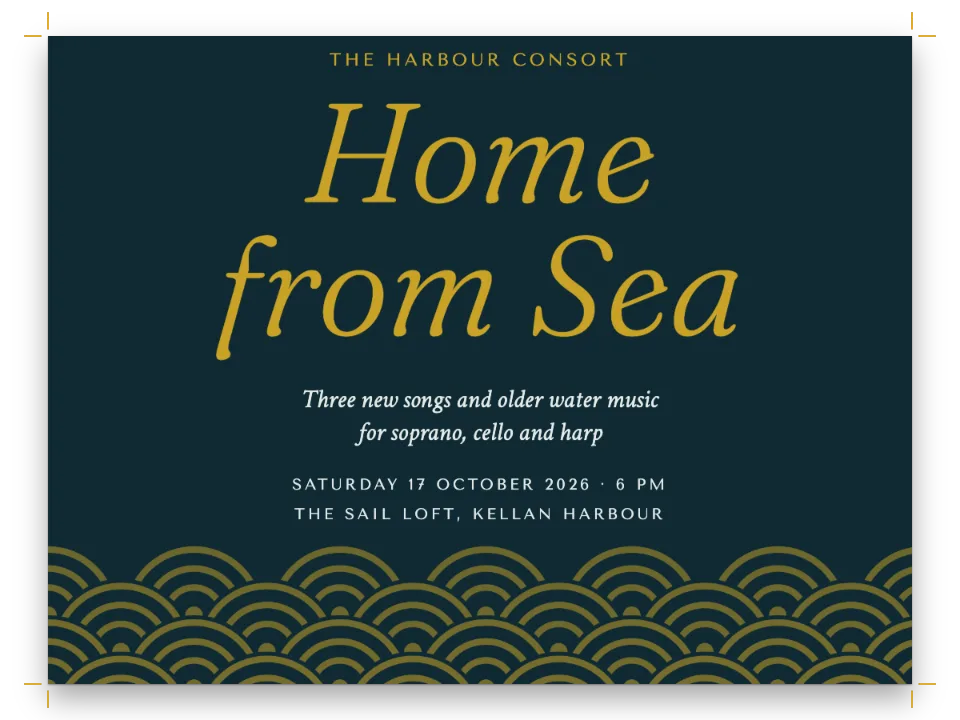
End-of-course certificates for the Quoin Room, a fictional letterpress workshop in Providence: one US Letter page per student. The Spanish edition sets them as A4 diplomas for La Cuña, a workshop in Zaragoza. A teal band filled with cream guilloche lenses frames the sheet, with a cream rosette at each corner; both are drawn in code from sine curves and hypotrochoids. Under a title in tracked capitals, the student's name is set in 48 pt Pinyon Script above a gold rule, and the citation is centred in Rosarivo. A red seal with two ribbon tails sits between the signature lines, with a one-line imprint below. Because one heading style draws the whole page, each student is one Markdown heading, and the PDF holds the class with a bookmark per name.
This recipe answers
- How do I add a watermark, a background tint or a decorative image on every page?
- How do I set unnumbered artwork: ornaments, vignettes, logos?
- How do I pin a badge or sticker to a fixed position on the page?
- How do I export a real PDF in the browser with the fonts embedded?
The short answer
const certificate = () => ({ // a function: it uses the elements defined below
  id: 'certificate',
  // Section geometry, for this style's pages only: a narrower measure, and a text area that
  // ends at the seal, so a citation too long for the page moves on instead of running under it.
  margins: { left: mm(SIDE), right: mm(SIDE), bottom: mm(H - SIGN) },
  // Header and footer elements paint over the page and reserve nothing (gotcha:
  // header-paints-over-text), so the frame, the seal and the signatures go there. In the
  // opener the signature lines would count towards its height, and a design that reaches
  // below the text area loses the whole reservation (gotcha: opener-reserves-anchored).
  header: { elements: [frame, serial] },
  footer: { elements: signatures },
  // The citation starts 18 lines of the 17 pt grid under the top margin, 140 mm down (19
  // lines, 146 mm, on A4): an opener's height rounds up to whole lines, and without
  // marginBottom: 0 the level's 0.5 em under a heading would add a line. minHeight is a
  // floor: the title block alone would start the citation at 128 mm (134 mm on A4).
  advancedDesign: { enabled: true, minHeight: mm(y(106)), slot: { elements: title } },
  marginBottom: mm(0),
});
// Hook-up: headingStyles: [certificate()], and in the Markdown one heading per student:
// # Imogen Achterberg {style="certificate" serial="26-031"}
One heading style draws the whole certificate
Ingredients
- Features
- Running heads per sectionPictures in page designsDesigned openersAnchoring design elementsText, rules and boxes in page designsHeading stylesSection geometryHeading attributesPaper colourSemantic colour paletteFigures and tables as resourcesDocument metadataPages on a canvasPDF exportFonts embedded in the PDFPDF bookmarks
- Type
- Rosarivo, Pinyon Script, Aboreto (SIL OFL 1.1)
- Assets
- None: every picture is drawn in code
Method
#1 · Let one heading style draw the page
The style itself is the short answer above. A heading style governs the pages of its section (heading styles): its header and footer replace the document's, which are empty here, its margins set the text area and its advancedDesign draws the opener. An opener's height rounds up to whole lines of the 17 pt body grid. A minHeight of 106 mm becomes 18 lines, so the citation starts 140 mm from the top edge; on A4, y() makes it 112.7 mm, or 19 lines, and the citation starts at 146 mm. The title block alone would start the citation at 128 mm (134 mm on A4). Without marginBottom: 0, the default 0.5 em under a heading would push the same 106 mm to 19 lines.
#2 · Hang the frame from the page in the header
const frame = { kind: 'image', id: 'frame', resourceId: 'guilloche',
  placement: { anchor: { to: 'page', edge: 'top-left' }, // the trim box
    size: { width: 'fill', height: 'fill' } } }; // the SVG has the page's proportions
const serial = { kind: 'text', id: 'serial', ...caps, fontSize: pt(8.5), letterSpacing: pt(1.6),
  content: t({ en: 'No. {attr.serial}', es: 'N.º {attr.serial}' }), // from the heading line
  color: col('seal'), align: 'right', placement: at('top-right', space(1.6) - MARGIN, 29) };
const PX = 10; // declared pixels per mm: an SVG resource only needs the right proportions
const svg = (id, w, h, altText) => ({ id, typeId: 'figure', kind: 'svg', createdAt: 0,
  updatedAt: 0, altText, svg: { fileId: `${id}.svg`, width: w * PX, height: h * PX } });
const resources = [
  svg('guilloche', W, H, t({ en: 'A teal guilloche border with cream rosettes at the corners.',
    es: 'Una orla de guilloché verde azulado con rosetas color crema en las esquinas.' })),
  svg('seal', SEAL.w, SEAL.h, t({ en: 'A red seal with a serrated edge and two ribbon tails.',
    es: 'Un sello rojo de borde dentado con dos cintas.' })),
];
An image element draws a resource at the size of its placement (image elements): anchored to the page's top-left corner with both sides 'fill', the guilloche covers the trim box, and the SVG, declared with the page's proportions, fills it without stretching. The header paints it over page.backgroundColor and reserves no room, so the margins alone keep the text at least 32 mm from the trim, inside the inner rule at 26 mm. A watermark placed in the header would print over the words, because the header is painted after the text. In a header, {attr.serial} reads the attribute of the heading whose section the page belongs to, so each certificate prints its own number.
#3 · Keep only the title block in the opener
const centred = (top, tracking = 0) => at('top', space(tracking) / 2, y(top));
const title = [
  { kind: 'text', id: 'kicker', ...caps, fontSize: pt(9.5), letterSpacing: pt(2.4),
    content: t({ en: 'The Quoin Room · Letterpress workshop',
      es: 'La Cuña · Taller de tipografía' }),
    placement: centred(39, 2.4) },
  { kind: 'text', id: 'title', content: t({ en: 'Certificate', es: 'Diploma' }), ...caps,
    fontSize: pt(46), lineHeight: 1, letterSpacing: pt(3), placement: centred(48, 3) },
  { kind: 'text', id: 'of', content: t({ en: 'of completion', es: 'de aprovechamiento' }),
    ...caps, fontSize: pt(11), letterSpacing: pt(4), placement: centred(68, 4) },
  { kind: 'text', id: 'lead', content: t({ en: 'This certifies that', es: 'Se otorga a' }),
    fontFamily: 'Rosarivo', italic: true, fontSize: pt(13), color: col('muted'),
    placement: centred(90) },
  { kind: 'text', id: 'name', content: '{titleText}', fontFamily: 'Pinyon Script',
    fontSize: pt(48), lineHeight: 1.25, // a multiple (gotcha: design-lineheight-multiple)
    color: col('ink'), align: 'center', overflow: 'wrap', // a long name wraps, never ends in '…'
    placement: { ...centred(97), size: { width: mm(W - 2 * MARGIN) } } },
  { kind: 'rule', id: 'underline', direction: 'horizontal', thickness: pt(0.75),
    color: col('gold'), placement: { anchor: { to: '#name', edge: 'below' },
      offset: { x: mm(18), y: mm(5) }, size: { width: mm(W - 2 * MARGIN - 36) } } },
];
Each line is anchored to the page's 'top' edge, which centres it, with a y measured from the trim, so the block keeps its place whatever the margins; y() stretches those positions from Letter to A4. The name is the heading's own text, read through {titleText}, so the PDF bookmarks and tags carry it. With overflow: 'wrap' a long name takes a second line; the default would cut it short with an ellipsis. centred() shifts each tracked line right by half its tracking. Without it, each one sits that far left of the page's centre: 0.4 mm for the kicker, 0.5 mm for Certificate and 0.7 mm for of completion.
#4 · Hang the seal and the signatures from one edge
const SIGNED = t({ en: [['Harriet Colfax', 'Master printer'], ['Samuel Okoro', 'Course tutor']],
  es: [['Pilar Ansón', 'Directora del taller'], ['Julián Oteo', 'Profesor del curso']] });
// mm: each signature line stops 3 mm short of the seal (56 on Letter, 53 on A4)
const LINE = (W - 2 * MARGIN - 2 * SEAL.r) / 2 - 3;
const under = (id, gap, x = 0) => ({ anchor: { to: `#${id}`, edge: 'below' },
  offset: { x: mm(x), y: mm(gap) }, size: { width: mm(LINE) } });
const signatures = [
  { kind: 'image', id: 'seal', resourceId: 'seal',
    placement: { ...at('top', 0, SIGN), size: { width: mm(SEAL.w) } } },
  ...SIGNED.flatMap(([who, role], i) => [
    { kind: 'rule', id: `line${i}`, direction: 'horizontal', thickness: pt(0.6), color: col('rule'),
      placement: { ...at('top-left', i ? W - MARGIN - LINE : MARGIN, SIGN + 23),
        size: { width: mm(LINE) } } },
    { kind: 'text', id: `who${i}`, content: who, fontFamily: 'Rosarivo', fontSize: pt(10.5),
      color: col('ink'), align: 'center', placement: under(`line${i}`, 1.6) },
    { kind: 'text', id: `role${i}`, content: role, ...caps, fontSize: pt(7.5),
      letterSpacing: pt(1.4), color: col('muted'), align: 'center',
      placement: under(`who${i}`, 0.6, space(1.4) / 2) },
  ]),
  { kind: 'text', id: 'imprint', fontFamily: 'Rosarivo', italic: true, fontSize: pt(7),
    content: t({ en: 'Printed at the Quoin Room · set in Rosarivo, Pinyon Script and Aboreto',
      es: 'Impreso en La Cuña · compuesto en Rosarivo, Pinyon Script y Aboreto' }),
    color: col('muted'), placement: at('top', 0, SIGN + 50) },
];
Everything in the footer is measured from SIGN, the seal's top edge, and the style's bottom margin ends the text area at the same edge, so a citation too long for the page moves on to the next one instead of running under the seal. Moved into the opener, the lines and the names would count towards its height (span and advanced design); since they reach below the text area, 1.4.1 would drop the whole reservation and start the citation 7.6 mm under the top margin, on top of the title. LINE takes the width between the page margins, subtracts the seal's 34 mm disc, halves the rest and takes off 3 mm, so each line stops 3 mm short of the seal on both trims (56 mm long on Letter, 53 mm on A4). Each name and role is a text element as wide as its line, which centres it under the line.
#5 · Merge the class list into headings
// Name and serial: {titleText} and {attr.serial} in the designs (gotcha: attr-values).
const CLASS = t({
  en: [['Imogen Achterberg', '26-031'], ['Tomás Okafor', '26-032'], ['Ruth Adair', '26-033']],
  es: [['Lucía Beltrán Ochoa', '26-017'], ['Íñigo Sarasola', '26-018'], ['Ana Rius', '26-019']],
});
const merged = CLASS.map(([name, serial]) =>
  `# ${name} {style="certificate" serial="${serial}"}\n\n${markdown}`).join('\n\n');
const metadata = { // the PDF's title and author
  title: t({ en: 'Certificates of completion, fall 2026',
    es: 'Diplomas del curso de otoño de 2026' }),
  author: t({ en: 'The Quoin Room', es: 'La Cuña' }) };
Each row becomes a # heading that names the style and carries the serial as an attribute (heading attributes), followed by the wording from content.en.md, so three rows give three pages. Level 1's breakBefore with parity 'any' starts each heading on a new page with no blank page between certificates; the style inherits it.
#6 · Build one PDF for the whole class
// The PDF also asks for bold and bold italic Rosarivo, which the family does not ship: the
// kit's provider snaps each request to the nearest face (gotcha: pdf-provider-all-styles).
offerPdf(() => renderToPdf(doc, { fontProvider: fontsourceProvider, resourceBytes: imageBytes }),
  `${RECIPE}.pdf`); // bookmarks: one per heading, so one per student
document.querySelector('[data-postext-pdf]').textContent = t({ en: 'Class list → one PDF',
  es: 'Toda la clase en un PDF' });
The class is one document, so renderToPdf writes a single three-page file with a bookmark per heading, each named after a student. renderToPdf also takes an array of documents, such as the chapters of a book, but a document per student means one buildDocument call for each. As headings, the whole class is laid out in one build, and the viewer shows all three certificates from that build. Besides the four faces the pages print, the PDF asks for bold and bold italic Rosarivo, which Fontsource does not ship: the kit's font provider snaps each request to the nearest face the family has (why a font provider?).
The whole recipe
// ═══ Postext Cookbook · Nº 063 · Certificate with a guilloche border ═══════════════ // https://postext.dev/en/cookbook/certificate-single-page // Code: MIT · Text: original (CC BY 4.0) · Guilloche and seal: generated in code (CC BY 4.0) // Fonts: Rosarivo, Pinyon Script, Aboreto (SIL OFL 1.1) · Needs postext ≥ 1.4.1 // End-of-course certificates, one page per student, drawn by one heading style, in one PDF. import { buildDocument, renderPageToCanvas, clearMeasurementCache, registerResourceImage, } from 'https://esm.sh/postext'; import { renderToPdf, decompressWoff2 } from 'https://esm.sh/postext-pdf'; const LANG = 'en'; // @lang: the language of the sample document ('en' | 'es') const RECIPE = 'certificate-single-page'; // ─── 1 · Design ───────────────────────────────────────────────────────────── const palette = { ink: '#1f2a2e', // text and the student's name teal: '#1f5f5b', // the frame, the title lines gold: '#b08d57', // hairlines and the rule under the name; never text (2.9:1 on paper) seal: '#8d2c2c', // the seal and the serial number rule: '#8f8878', // signature lines muted: '#6d6a60', // the lead-in, the signatories' roles, the imprint paper: '#fbf8ef', // the sheet }; const col = (id) => ({ hex: palette[id], model: 'hex', paletteId: id }); const colorPalette = Object.entries(palette) .map(([id, hex]) => ({ id, name: id, value: { hex, model: 'hex' } })); const [W, H] = t({ en: [215.9, 279.4], es: [210, 297] }); // US Letter; A4 for the Spanish diploma const MARGIN = 32; // mm on every side, inside the frame's inner rule (26 mm in) const SIDE = 50; // mm: the certificate's side margins, a 116 mm measure (110 on A4) // Positions are drawn on US Letter and stretched to A4: y(90) is 90 mm down on Letter. const y = (mm) => (mm * H) / 279.4; const SIGN = y(194); // mm from the top: the seal's top edge, where the text area ends const SEAL = { w: 40, h: 45, r: 17 }; // mm: the seal with its ribbon tails, and its disc's radius const at = (edge, x, top) => ({ anchor: { to: 'page', edge }, offset: { x: mm(x), y: mm(top) } }); // A tracked line is measured with a letter space after its last letter, so a centred one // sits half a space left and a right-set one stops a space short: space() gives it in mm. const space = (tracking) => (tracking * 25.4) / 72; const caps = { fontFamily: 'Aboreto', textTransform: 'uppercase', color: col('teal') }; // #region answer: one heading style draws the whole certificate const certificate = () => ({ // a function: it uses the elements defined below id: 'certificate', // Section geometry, for this style's pages only: a narrower measure, and a text area that // ends at the seal, so a citation too long for the page moves on instead of running under it. margins: { left: mm(SIDE), right: mm(SIDE), bottom: mm(H - SIGN) }, // Header and footer elements paint over the page and reserve nothing (gotcha: // header-paints-over-text), so the frame, the seal and the signatures go there. In the // opener the signature lines would count towards its height, and a design that reaches // below the text area loses the whole reservation (gotcha: opener-reserves-anchored). header: { elements: [frame, serial] }, footer: { elements: signatures }, // The citation starts 18 lines of the 17 pt grid under the top margin, 140 mm down (19 // lines, 146 mm, on A4): an opener's height rounds up to whole lines, and without // marginBottom: 0 the level's 0.5 em under a heading would add a line. minHeight is a // floor: the title block alone would start the citation at 128 mm (134 mm on A4). advancedDesign: { enabled: true, minHeight: mm(y(106)), slot: { elements: title } }, marginBottom: mm(0), }); // Hook-up: headingStyles: [certificate()], and in the Markdown one heading per student: // # Imogen Achterberg {style="certificate" serial="26-031"} // #endregion // #region frame: the guilloche is an SVG resource, drawn by an image element in the header const frame = { kind: 'image', id: 'frame', resourceId: 'guilloche', placement: { anchor: { to: 'page', edge: 'top-left' }, // the trim box size: { width: 'fill', height: 'fill' } } }; // the SVG has the page's proportions const serial = { kind: 'text', id: 'serial', ...caps, fontSize: pt(8.5), letterSpacing: pt(1.6), content: t({ en: 'No. {attr.serial}', es: 'N.º {attr.serial}' }), // from the heading line color: col('seal'), align: 'right', placement: at('top-right', space(1.6) - MARGIN, 29) }; const PX = 10; // declared pixels per mm: an SVG resource only needs the right proportions const svg = (id, w, h, altText) => ({ id, typeId: 'figure', kind: 'svg', createdAt: 0, updatedAt: 0, altText, svg: { fileId: `${id}.svg`, width: w * PX, height: h * PX } }); const resources = [ svg('guilloche', W, H, t({ en: 'A teal guilloche border with cream rosettes at the corners.', es: 'Una orla de guilloché verde azulado con rosetas color crema en las esquinas.' })), svg('seal', SEAL.w, SEAL.h, t({ en: 'A red seal with a serrated edge and two ribbon tails.', es: 'Un sello rojo de borde dentado con dos cintas.' })), ]; // #endregion // #region title: the opener holds the title block; the name is the heading's own text const centred = (top, tracking = 0) => at('top', space(tracking) / 2, y(top)); const title = [ { kind: 'text', id: 'kicker', ...caps, fontSize: pt(9.5), letterSpacing: pt(2.4), content: t({ en: 'The Quoin Room · Letterpress workshop', es: 'La Cuña · Taller de tipografía' }), placement: centred(39, 2.4) }, { kind: 'text', id: 'title', content: t({ en: 'Certificate', es: 'Diploma' }), ...caps, fontSize: pt(46), lineHeight: 1, letterSpacing: pt(3), placement: centred(48, 3) }, { kind: 'text', id: 'of', content: t({ en: 'of completion', es: 'de aprovechamiento' }), ...caps, fontSize: pt(11), letterSpacing: pt(4), placement: centred(68, 4) }, { kind: 'text', id: 'lead', content: t({ en: 'This certifies that', es: 'Se otorga a' }), fontFamily: 'Rosarivo', italic: true, fontSize: pt(13), color: col('muted'), placement: centred(90) }, { kind: 'text', id: 'name', content: '{titleText}', fontFamily: 'Pinyon Script', fontSize: pt(48), lineHeight: 1.25, // a multiple (gotcha: design-lineheight-multiple) color: col('ink'), align: 'center', overflow: 'wrap', // a long name wraps, never ends in '…' placement: { ...centred(97), size: { width: mm(W - 2 * MARGIN) } } }, { kind: 'rule', id: 'underline', direction: 'horizontal', thickness: pt(0.75), color: col('gold'), placement: { anchor: { to: '#name', edge: 'below' }, offset: { x: mm(18), y: mm(5) }, size: { width: mm(W - 2 * MARGIN - 36) } } }, ]; // #endregion // #region signatures: seal, signature lines, names and roles, hung from the seal's top edge const SIGNED = t({ en: [['Harriet Colfax', 'Master printer'], ['Samuel Okoro', 'Course tutor']], es: [['Pilar Ansón', 'Directora del taller'], ['Julián Oteo', 'Profesor del curso']] }); // mm: each signature line stops 3 mm short of the seal (56 on Letter, 53 on A4) const LINE = (W - 2 * MARGIN - 2 * SEAL.r) / 2 - 3; const under = (id, gap, x = 0) => ({ anchor: { to: `#${id}`, edge: 'below' }, offset: { x: mm(x), y: mm(gap) }, size: { width: mm(LINE) } }); const signatures = [ { kind: 'image', id: 'seal', resourceId: 'seal', placement: { ...at('top', 0, SIGN), size: { width: mm(SEAL.w) } } }, ...SIGNED.flatMap(([who, role], i) => [ { kind: 'rule', id: `line${i}`, direction: 'horizontal', thickness: pt(0.6), color: col('rule'), placement: { ...at('top-left', i ? W - MARGIN - LINE : MARGIN, SIGN + 23), size: { width: mm(LINE) } } }, { kind: 'text', id: `who${i}`, content: who, fontFamily: 'Rosarivo', fontSize: pt(10.5), color: col('ink'), align: 'center', placement: under(`line${i}`, 1.6) }, { kind: 'text', id: `role${i}`, content: role, ...caps, fontSize: pt(7.5), letterSpacing: pt(1.4), color: col('muted'), align: 'center', placement: under(`who${i}`, 0.6, space(1.4) / 2) }, ]), { kind: 'text', id: 'imprint', fontFamily: 'Rosarivo', italic: true, fontSize: pt(7), content: t({ en: 'Printed at the Quoin Room · set in Rosarivo, Pinyon Script and Aboreto', es: 'Impreso en La Cuña · compuesto en Rosarivo, Pinyon Script y Aboreto' }), color: col('muted'), placement: at('top', 0, SIGN + 50) }, ]; // #endregion const config = () => ({ // a factory: configs are cached by identity (gotcha: config-cache-identity) locale: t({ en: 'en-us', es: 'es' }), // the PDF's /Lang; centred text is never hyphenated colorPalette, page: { width: mm(W), height: mm(H), dpi: 150, backgroundColor: col('paper'), margins: { top: mm(MARGIN), bottom: mm(MARGIN), left: mm(MARGIN), right: mm(MARGIN) } }, layout: { layoutType: 'single' }, bodyText: { fontFamily: 'Rosarivo', fontSize: pt(11.5), lineHeight: pt(17), color: col('ink'), // Ink for the italic (the course title, the date line) and for any bold you add to the // wording; referenceColor falls back to boldColor. boldColor: col('ink'), italicColor: col('ink'), // Centred lines get no runt check (gotcha: ragged-runts): the wording was fitted by hand. textAlign: 'center', firstLineIndent: pt(0), paragraphSpacing: true, }, // The design replaces the heading's own text, which the PDF still tags and bookmarks: set it // in a face the pages load, regular, since Rosarivo has no bold. headings: { fontFamily: 'Rosarivo', fontWeight: 400, // One page per student, no blank backs; the style inherits it (gotcha: headings-drop-h1-break). levels: [{ level: 1, breakBefore: { enabled: true, parity: 'any' } }] }, headingStyles: [certificate()], header: { elements: [] }, // no page-wide furniture: the certificate style sets its own footer: { elements: [] }, }); // ─── 2 · Content ──────────────────────────────────────────────────────────── const markdown = String.raw`has completed *Hand Composition and Platen Printing*, a course of forty-eight hours in the fall term of 2026, and as a final piece has set by hand and printed a broadside of their own design in an edition of forty copies.Markdown sample · 2 lines · content.en.md
*Given at Providence, Rhode Island, on December 4, 2026.*`; // content.<lang>.md: the wording every certificate shares // #region merge: the class list becomes one styled heading per student // Name and serial: {titleText} and {attr.serial} in the designs (gotcha: attr-values). const CLASS = t({ en: [['Imogen Achterberg', '26-031'], ['Tomás Okafor', '26-032'], ['Ruth Adair', '26-033']], es: [['Lucía Beltrán Ochoa', '26-017'], ['Íñigo Sarasola', '26-018'], ['Ana Rius', '26-019']], }); const merged = CLASS.map(([name, serial]) => `# ${name} {style="certificate" serial="${serial}"}\n\n${markdown}`).join('\n\n'); const metadata = { // the PDF's title and author title: t({ en: 'Certificates of completion, fall 2026', es: 'Diplomas del curso de otoño de 2026' }), author: t({ en: 'The Quoin Room', es: 'La Cuña' }) }; // #endregion // #region art: the guilloche frame and the seal, drawn as SVG paths // Strokes and fills only: no <marker>, filter or mask, so the PDF keeps both drawings vector // (gotcha: svg-no-marker-filters), and no text, which could not see the web fonts (gotcha: // svg-no-webfonts). No random numbers, so every build draws the same curves. const TAU = 2 * Math.PI; const r2 = (v) => Math.round(v * 100) / 100; // A polyline in relative moves, about a tenth smaller than in absolute coordinates. const polyline = (pts, close = false) => `M${r2(pts[0][0])} ${r2(pts[0][1])}l${pts.slice(1) .map(([x, y], i) => `${r2(x - pts[i][0])} ${r2(y - pts[i][1])}`).join(' ')}${close ? 'z' : ''}`; const gcd = (a, b) => (b ? gcd(b, a % b) : a); // A hypotrochoid: the path of a pen at distance d from the centre of a circle of radius r // rolling inside one of radius R, scaled to `radius` mm. It closes after r / gcd(R, r) turns. function spiro(R, r, d, radius, steps = 1400) { const k = radius / (R - r + d); return polyline(Array.from({ length: steps + 1 }, (_, i) => { const a = (i / steps) * TAU * (r / gcd(R, r)); return [((R - r) * Math.cos(a) + d * Math.cos(((R - r) / r) * a)) * k, ((R - r) * Math.sin(a) - d * Math.sin(((R - r) / r) * a)) * k]; }), true); } // One lens of the border, `len` mm long and up to `half` mm either side of its axis: strands // that cross at a steady rate, under an envelope that pinches them together at both ends. const lens = (len, half, count, color) => Array.from({ length: count }, (_, k) => `<path stroke="${color}" d="${polyline(Array.from({ length: 97 }, (_, i) => { const s = (i / 96) * len; const envelope = 0.56 - 0.44 * Math.cos((TAU * s) / len); return [s, half * envelope * Math.sin((2 * TAU * s) / len + (TAU * k) / count)]; }))}"/>`).join(''); const BAND = [11, 23]; // the teal band, mm in from the trim; the lenses run along its middle const MID = (BAND[0] + BAND[1]) / 2; function guillocheSvg() { // Each side holds a whole number of lenses about 24 mm long: one tile per side length. const tiles = [['h', W - 2 * MID], ['v', H - 2 * MID]].map(([id, run]) => { const n = Math.round(run / 24); return { id, n, len: run / n, def: `<g id="${id}" stroke-width="0.2">` + `${lens(run / n, 5.4, 11, palette.paper)}${lens(run / n, 2.6, 3, palette.gold)}</g>` }; }); const use = (id, x, y, turn) => `<use href="#${id}" transform="translate(${r2(x)} ${r2(y)})` + ` rotate(${turn})"/>`; const uses = tiles.flatMap(({ id, n, len }) => Array.from({ length: n }, (_, i) => MID + i * len) .flatMap((p) => (id === 'h' ? [use(id, p, MID, 0), use(id, p, H - MID, 0)] : [use(id, MID, p, 90), use(id, W - MID, p, 90)]))); const ring = (inset, color, width) => `<rect x="${inset}" y="${inset}"` + ` width="${r2(W - 2 * inset)}" height="${r2(H - 2 * inset)}" stroke="${color}"` + ` stroke-width="${width}"/>`; const box = (inset) => `M${inset} ${inset}h${r2(W - 2 * inset)}v${r2(H - 2 * inset)}` + `h${r2(2 * inset - W)}z`; // A cream medallion on the teal band, so each corner reads as a disc at thumbnail size. const rosette = `<g id="rosette"><circle r="10" fill="${palette.paper}" stroke="${palette.gold}"` + ` stroke-width="0.6"/><circle r="9.1" stroke="${palette.teal}" stroke-width="0.25"/>` + `<path d="${spiro(30, 13, 9, 8.2)}" stroke="${palette.teal}" stroke-width="0.16"/>` + `<circle r="1.4" fill="${palette.gold}"/></g>`; const corners = [[MID, MID], [W - MID, MID], [MID, H - MID], [W - MID, H - MID]] .map(([x, y]) => use('rosette', x, y, 0)); return `<svg xmlns="http://www.w3.org/2000/svg" width="${r2(W * PX)}" height="${r2(H * PX)}"` + ` viewBox="0 0 ${W} ${H}"><defs>${tiles.map((tile) => tile.def).join('')}${rosette}</defs>` + `<g fill="none" stroke-linecap="round" stroke-linejoin="round">${ring(9, palette.gold, 0.35)}` + `<path fill="${palette.teal}" fill-rule="evenodd" d="${box(BAND[0])}${box(BAND[1])}"/>` + `${uses.join('')}${ring(25, palette.gold, 0.6)}${ring(26.2, palette.teal, 0.2)}` + `${corners.join('')}</g></svg>`; } function sealSvg() { const [cx, cy, R] = [SEAL.w / 2, 19, SEAL.r]; const teeth = Array.from({ length: 144 }, (_, i) => [ cx + (i % 2 ? R : R - 1.3) * Math.cos((i / 144) * TAU), cy + (i % 2 ? R : R - 1.3) * Math.sin((i / 144) * TAU)]); // Two ribbon tails behind the seal, notched at the ends; the far one a shade darker. const tail = (s) => polyline([[cx + s * 3, cy], [cx + s * 12, cy + 24], [cx + s * 9, cy + 21.6], [cx + s * 6, cy + 25.5], [cx - s * 3, cy + 3]], true); return `<svg xmlns="http://www.w3.org/2000/svg" width="${SEAL.w * PX}" height="${SEAL.h * PX}"` + ` viewBox="0 0 ${SEAL.w} ${SEAL.h}"><path d="${tail(-1)}" fill="#6f2323"/>` + `<path d="${tail(1)}" fill="${palette.seal}"/>` + `<path d="${polyline(teeth, true)}" fill="${palette.seal}"/>` + `<g fill="none" stroke="${palette.paper}" stroke-linecap="round">` + `<circle cx="${cx}" cy="${cy}" r="${R - 3}" stroke-width="0.35"/>` + `<circle cx="${cx}" cy="${cy}" r="${R - 3.8}" stroke-width="0.15"/>` + `<path transform="translate(${cx} ${cy})" d="${spiro(24, 11, 9, R - 5)}"` + ' stroke-width="0.14"/>' + `</g><circle cx="${cx}" cy="${cy}" r="1.3" fill="${palette.paper}"/></svg>`; } // #endregion // ─── 3 · Fonts ────────────────────────────────────────────────────────────── // Loaded from Fontsource before the first build: layout measures with them (gotcha: fonts-first) const FONTS = { Rosarivo: ['400', '400i'], 'Pinyon Script': ['400'], Aboreto: ['400'] }; // ─── 4 · Build & show ─────────────────────────────────────────────────────── await loadFonts(FONTS, merged); await loadSvg('guilloche.svg', guillocheSvg()); await loadSvg('seal.svg', sealSvg()); const doc = await buildWithFonts(() => buildDocument({ markdown: merged, metadata, resources }, config()), merged); showPages(doc, { title: t({ en: 'Certificate with a guilloche border', es: 'Diploma con orla de guilloché' }) }); // #region pdf: one document with a page per student, so one PDF holds the whole class // The PDF also asks for bold and bold italic Rosarivo, which the family does not ship: the // kit's provider snaps each request to the nearest face (gotcha: pdf-provider-all-styles). offerPdf(() => renderToPdf(doc, { fontProvider: fontsourceProvider, resourceBytes: imageBytes }), `${RECIPE}.pdf`); // bookmarks: one per heading, so one per student document.querySelector('[data-postext-pdf]').textContent = t({ en: 'Class list → one PDF', es: 'Toda la clase en un PDF' }); // #endregionKit · core, fonts, viewer, pdf, images: the same in every recipe · 310 lines
// ─── Kit ── helpers shared by every Cookbook recipe · postext.dev/cookbook ───── // ─── Kit · core v1 ── the same in every recipe · postext.dev/cookbook ───────── function mm(value) { return { value, unit: 'mm' }; } function pt(value) { return { value, unit: 'pt' }; } function em(value) { return { value, unit: 'em' }; } /** The sample language's string: t({ en: 'Figure', es: 'Figura' }). */ function t(strings) { return strings[LANG] ?? Object.values(strings)[0]; } /** A file in this recipe's assets folder, served from the Postext repo by jsDelivr. */ function asset(file) { return `https://cdn.jsdelivr.net/gh/drnachio/postext@main/cookbook/${RECIPE}/assets/${file}`; } // ─── Kit · fonts v1 ── the same in every recipe · postext.dev/cookbook ──────── // Postext measures text with the faces the browser has loaded, and caches the // widths, so every face must be ready before the first build. Faces come from // Fontsource: the same static files the PDF embeds, so screen and PDF agree. /** faces = { 'Family Name': ['400', '400i', '700'] }. `text` is the sample: * letters beyond Latin-1 (č, ł, ő…) also load the latin-ext files. With * `optional`, a face Fontsource does not ship is skipped instead of failing. * Resolves to the number of faces added. */ async function loadFonts(faces, text = '', { optional = false } = {}) { kitStatus('Loading fonts…'); const ranges = { latin: 'U+0000-00FF,U+0131,U+0152-0153,U+02BB-02BC,U+02C6,U+02DA,U+02DC,U+0304,U+0308,U+0329,' + 'U+2000-206F,U+20AC,U+2122,U+2191,U+2193,U+2212,U+2215,U+FEFF,U+FFFD', 'latin-ext': 'U+0100-02BA,U+02BD-02C5,U+02C7-02CC,U+02CE-02D7,U+02DD-02FF,U+0304,U+0308,U+0329,' + 'U+1D00-1DBF,U+1E00-1E9F,U+1EF2-1EFF,U+2020,U+20A0-20AB,U+20AD-20C0,U+2113,U+2C60-2C7F,U+A720-A7FF', }; const subsets = /[Ā-˿Ḁ-ỿ]/.test(text) ? ['latin', 'latin-ext'] : ['latin']; const jobs = []; let added = 0; for (const [family, specs] of Object.entries(faces)) { const id = fontsourceId(family); const meta = optional ? await fontsourceMeta(family) : null; for (const spec of new Set(specs)) { const weight = parseInt(spec, 10); const style = spec.endsWith('i') ? 'italic' : 'normal'; if (hasFace(family, weight, style)) continue; if (optional && !(meta?.weights.includes(weight) && meta.styles.includes(style))) continue; for (const subset of subsets) { const url = `https://cdn.jsdelivr.net/npm/@fontsource/${id}@5/files/${id}-${subset}-${weight}-${style}.woff2`; const face = new FontFace(family, `url(${url}) format('woff2')`, { weight: String(weight), style, unicodeRange: ranges[subset] }); jobs.push(face.load().then((ready) => { document.fonts.add(ready); added++; }, () => { if (subset === 'latin' && !optional) throw new Error(`Fontsource has no ${family} ${weight} ${style}`); })); } } } await Promise.all(jobs).catch((error) => { kitFail(error); throw error; }); return added; } /** Runs `build` (a buildDocument or buildBundle call) and checks the faces * the pages use. A regular face missing from FONTS is loaded with a warning; * bold and italic variants are loaded when the family ships them. Then the * measurement caches are cleared and the build runs again. */ async function buildWithFonts(build, text = '') { const tried = new Set(); for (let round = 0; round < 3; round++) { kitStatus('Laying out…'); await new Promise(requestAnimationFrame); // let the status paint first const result = await Promise.resolve().then(build).catch((error) => { kitFail(error); throw error; }); const wanted = { base: {}, variants: {} }; for (const { font, base } of [result].flat().flatMap(fontStringsOf)) { const { family, weight, style } = parseFont(font); const key = `${family}|${weight}|${style}`; if (tried.has(key) || hasFace(family, weight, style)) continue; tried.add(key); (wanted[base ? 'base' : 'variants'][family] ??= []).push(`${weight}${style === 'italic' ? 'i' : ''}`); } if (Object.keys(wanted.base).length) { console.warn(`[cookbook] FONTS does not list ${JSON.stringify(wanted.base)}: loading them.`); } const added = await loadFonts(wanted.base, text) + await loadFonts(wanted.variants, text, { optional: true }); if (added === 0) return result; clearMeasurementCache(); } throw new Error('The fonts did not settle after three builds.'); } /** Every font string of the layout. `base` marks a block's own face; its * bold, italic and bold-italic variants are listed whether or not used. */ function fontStringsOf(doc) { const found = new Map(); const walk = (node) => { if (!node || typeof node !== 'object') return; if (Array.isArray(node)) { node.forEach(walk); return; } for (const [key, value] of Object.entries(node)) { if (typeof value === 'string' && /fontString$/i.test(key)) { found.set(value, found.get(value) || key === 'fontString'); } else if (value && typeof value === 'object') walk(value); } }; walk(doc.pages); walk(doc.blocks); return [...found].map(([font, base]) => ({ font, base })); } /** '700 37.5px Open Sans' / 'italic 400 13px "Source Serif 4"' → { family, weight, style }. * A string with no weight ('95.8px Young Serif', from a design text) is 400. */ function parseFont(font) { const m = /^(?:(italic|oblique)\s+)?(?:small-caps\s+)?(?:(\d+|bold|normal)\s+)?[\d.]+px\s+(.+)$/.exec(font.trim()); if (!m) throw new Error(`Unexpected font string: ${font}`); const weight = m[2] === 'bold' ? 700 : !m[2] || m[2] === 'normal' ? 400 : Number(m[2]); return { family: m[3].replace(/^["']|["']$/g, ''), weight, style: m[1] ? 'italic' : 'normal' }; } /** True when a loaded FontFace covers exactly this family, weight and style * (document.fonts.check() is also true for families nobody declared). */ function hasFace(family, weight, style) { for (const face of document.fonts) { if (face.status !== 'loaded' || face.style !== style) continue; if (face.family.replace(/^["']|["']$/g, '') !== family) continue; const [low, high = low] = face.weight.split(' ').map(Number); if (weight >= low && weight <= high) return true; } return false; } /** Fontsource's id for a family: 'Source Serif 4' → 'source-serif-4'. */ function fontsourceId(family) { return family.toLowerCase().replace(/\s+/g, '-'); } /** The weights and styles a family ships ({ weights: [400, 700], styles: ['normal', 'italic'] }), or null. */ function fontsourceMeta(family) { fontsourceMeta.cache ??= new Map(); const id = fontsourceId(family); if (!fontsourceMeta.cache.has(id)) { fontsourceMeta.cache.set(id, fetch(`https://api.fontsource.org/v1/fonts/${id}`) .then((res) => (res.ok ? res.json() : null), () => null)); } return fontsourceMeta.cache.get(id); } // ─── Kit · viewer v1 ── the same in every recipe · postext.dev/cookbook ─────── /** Shows the pages as facing spreads on a dark desk: the first page is a * recto on its own, then verso | recto pairs, as in a bound book. Pages * are painted when they scroll near the screen. */ function showPages(docs, { title, width = 460 } = {}) { const root = viewer(title); const pages = [docs].flat().flatMap((doc) => doc.pages.map((page) => ({ doc, page, n: (doc.pageIndexOffset ?? 0) + page.index }))); const spreads = []; let verso = null; for (const p of pages) { if (p.n % 2 === 1) { if (verso) spreads.push([verso, null]); verso = p; } else { spreads.push([verso, p]); verso = null; } } if (verso) spreads.push([verso, null]); const density = Math.min(window.devicePixelRatio || 1, 2); showPages.painter?.disconnect(); const painter = new IntersectionObserver((entries) => { for (const { isIntersecting, target } of entries) { if (!isIntersecting) continue; painter.unobserve(target); const { doc, page } = target.postext; renderPageToCanvas(page, doc, target, { scale: (width * density) / page.width }); } }, { rootMargin: '800px' }); showPages.painter = painter; root.replaceChildren(...spreads.map((pair) => { const spread = document.createElement('div'); spread.className = 'pt-spread'; for (const p of pair) { const figure = document.createElement('figure'); if (p) { const label = p.page.pageLabel || String(p.n + 1); const canvas = document.createElement('canvas'); canvas.postext = p; canvas.style.aspectRatio = `${p.page.width} / ${p.page.height}`; canvas.setAttribute('role', 'img'); canvas.setAttribute('aria-label', `Page ${label}`); const folio = document.createElement('figcaption'); folio.textContent = label; figure.append(canvas, folio); painter.observe(canvas); } else figure.className = 'pt-blank'; spread.append(figure); } return spread; })); kitStatus(`${pages.length} ${pages.length === 1 ? 'page' : 'pages'}`); document.documentElement.dataset.postext = 'ready'; return pages.length; } /** The desk, the bar and the error reporting, created once. */ function viewer(title) { if (!document.getElementById('pt-kit')) { document.head.insertAdjacentHTML('beforeend', `<style id="pt-kit"> :root { color-scheme: dark; } body { margin: 0; background: #0e1014; color: #b9bcc4; font: 13px/1.45 system-ui, sans-serif; } #pt-bar { position: sticky; top: 0; z-index: 1; display: flex; flex-wrap: wrap; align-items: center; gap: 6px 16px; padding: 10px 16px; background: rgb(14 16 20 / .92); backdrop-filter: blur(6px); border-bottom: 1px solid #23262d; } #pt-bar strong { color: #f4f1ea; font-weight: 600; } #pt-actions { display: flex; gap: 12px; margin-left: auto; } #pt-actions a, #pt-actions button { color: #d8a21a; font: inherit; background: none; border: 0; padding: 0; cursor: pointer; } #pages { display: grid; justify-items: center; gap: 48px; padding: 32px 16px 72px; } .pt-spread { display: flex; } .pt-spread figure { margin: 0; width: min(460px, 44vw); } .pt-spread canvas { display: block; width: 100%; background: #fff; box-shadow: 0 1px 2px rgb(0 0 0 / .5), 0 22px 44px -16px rgb(0 0 0 / .8); } .pt-spread figure:first-child canvas { box-shadow: inset -14px 0 14px -14px rgb(0 0 0 / .18), 0 1px 2px rgb(0 0 0 / .5), 0 22px 44px -16px rgb(0 0 0 / .8); } .pt-spread figcaption { margin-top: 10px; text-align: center; font: 600 10px/1 system-ui, sans-serif; letter-spacing: .18em; text-transform: uppercase; color: #6c7079; } .pt-blank { visibility: hidden; } @media (max-width: 760px) { .pt-spread { flex-direction: column; gap: 32px; } .pt-spread figure { width: min(460px, 92vw); } .pt-blank { display: none; } } </style>`); document.body.insertAdjacentHTML('afterbegin', '<header id="pt-bar"><strong id="pt-title"></strong><span id="pt-status" role="status"></span><span id="pt-actions"></span></header>'); document.getElementById('pt-title').textContent = document.title || 'Postext'; addEventListener('error', (event) => kitFail(event.error ?? event.message)); addEventListener('unhandledrejection', (event) => kitFail(event.reason)); } if (title) document.getElementById('pt-title').textContent = title; return document.getElementById('pages') ?? document.body.appendChild(Object.assign(document.createElement('main'), { id: 'pages' })); } function kitStatus(text) { viewer(); document.getElementById('pt-status').textContent = text; } function kitFail(error) { document.documentElement.dataset.postext = 'error'; kitStatus(`Error: ${error?.message ?? error}`); } // ─── Kit · pdf v1 ── the same in every recipe that exports a PDF ────────────── /** postext-pdf embeds TrueType bytes. Fetch the Fontsource file the screen * used, snapping to a weight the family ships and falling back to upright * when it has no italic: the PDF asks for every face a block could use. */ async function fontsourceProvider(family, weight, style) { const id = fontsourceId(family); const meta = await fontsourceMeta(family); const weights = meta?.weights?.length ? meta.weights : [400, 700]; const w = weights.reduce((a, b) => (Math.abs(b - weight) < Math.abs(a - weight) ? b : a)); const s = style === 'italic' && meta && !meta.styles.includes('italic') ? 'normal' : style; const res = await fetch(`https://cdn.jsdelivr.net/npm/@fontsource/${id}@5/files/${id}-latin-${w}-${s}.woff2`); if (!res.ok) throw new Error(`Fontsource has no ${family} ${w} ${s} (${res.status})`); return decompressWoff2(new Uint8Array(await res.arrayBuffer())); } /** A "Build the PDF" button in the bar. Once built: "Open the PDF" (a new * tab, since CodePen's preview frame cannot show PDFs) and a download link. */ function offerPdf(makePdf, filename) { viewer(); const button = Object.assign(document.createElement('button'), { type: 'button', textContent: 'Build the PDF' }); button.dataset.postextPdf = filename; button.addEventListener('click', async () => { button.disabled = true; button.textContent = 'Building the PDF…'; try { const bytes = await makePdf(); const url = URL.createObjectURL(new Blob([bytes], { type: 'application/pdf' })); const size = `${Math.max(1, Math.round(bytes.length / 1024))} KB`; button.replaceWith( Object.assign(document.createElement('a'), { href: url, target: '_blank', rel: 'noopener', textContent: 'Open the PDF ↗' }), Object.assign(document.createElement('a'), { href: url, download: filename, textContent: `Download ${filename} · ${size}` })); } catch (error) { button.disabled = false; button.textContent = 'Build the PDF'; kitFail(error); } }); document.getElementById('pt-actions').append(button); } // ─── Kit · images v1 ── recipes with pictures · postext.dev/cookbook ────────── /** Registers a photo or PNG for the canvas and keeps its bytes for the PDF. * fetch → ImageBitmap never taints the canvas (a plain cross-origin <img> would). */ async function loadImage(fileId, url) { const res = await fetch(url); if (!res.ok) throw new Error(`Image not found (${res.status}): ${url}`); const bytes = new Uint8Array(await res.arrayBuffer()); registerResourceImage(fileId, await createImageBitmap(new Blob([bytes]))); (loadImage.bytes ??= new Map()).set(fileId, bytes); } /** Registers SVG markup (drawn in code, or fetched) as a vector image. */ async function loadSvg(fileId, svg) { const img = new Image(); img.src = `data:image/svg+xml;charset=utf-8,${encodeURIComponent(svg)}`; await img.decode(); registerResourceImage(fileId, img); (loadImage.bytes ??= new Map()).set(fileId, new TextEncoder().encode(svg)); } /** renderToPdf({ resourceBytes: imageBytes }) */ function imageBytes(fileId) { return loadImage.bytes?.get(fileId); } /** renderToHtml({ resourceImageUrl: imageUrl }) */ function imageUrl(fileId) { const bytes = imageBytes(fileId); if (!bytes) return undefined; imageUrl.urls ??= new Map(); if (!imageUrl.urls.has(fileId)) { const type = /\.svg$/i.test(fileId) ? 'image/svg+xml' : /\.png$/i.test(fileId) ? 'image/png' : 'image/jpeg'; imageUrl.urls.set(fileId, URL.createObjectURL(new Blob([bytes], { type }))); } return imageUrl.urls.get(fileId); } // ─── /Kit ───────────────────────────────────────────────────────────────────────
The composed script.js runs as it is: paste it into any page’s module script, or open the recipe on CodePen. Recipe folder on GitHub ↗
Variations
#Print a PDF per student
One button per student builds that certificate as a document of its own, with a fresh config(), and names the file after the serial number; each file weighs about 245 KB.
-offerPdf(() => renderToPdf(doc, { fontProvider: fontsourceProvider, resourceBytes: imageBytes }),
-  `${RECIPE}.pdf`); // bookmarks: one per heading, so one per student
-document.querySelector('[data-postext-pdf]').textContent = t({ en: 'Class list → one PDF',
-  es: 'Toda la clase en un PDF' });
+for (const [name, serial] of CLASS) {
+  offerPdf(() => renderToPdf(buildDocument({ markdown:
+    `# ${name} {style="certificate" serial="${serial}"}\n\n${markdown}`, metadata, resources },
+    config()), { fontProvider: fontsourceProvider, resourceBytes: imageBytes }), `${serial}.pdf`);
+  document.querySelector(`[data-postext-pdf="${serial}.pdf"]`).textContent = name;
+}#Print the frame and the title in navy
The SVG art and the config read the same palette object, so changing one entry recolours the band, the rosette patterns and the title lines.
-  teal: '#1f5f5b', // the frame, the title lines
+ teal: '#2b3a67', // the frame, the title linesPitfalls
Pitfall
An opener reserves height down to its lowest page-anchored element
An advanced-design opener reserves the height of its lowest element, and page- or bleed-anchored elements below the heading count too, so decoration at the foot of the page pushes the text to the next page. Keep such decoration above the heading, move it to a header or footer slot, or set the reservation with minHeight. Designed openers →
Pitfall
Header and footer elements paint over text
Header and footer elements are painted over the page and the text area does not make room for them. Keep them within the margins, which are what reserve their space. Running heads and folios →
Pitfall
Any headings object switches off the H1 page break
By default an H1 breaks to a recto (always-odd), but passing any headings object resets that default, so chapters run on and span: 'page' does nothing. Restate headings.levels[0].breakBefore: { enabled: true, parity } in every config. Chapters that open on a recto →
Pitfall
Attribute values: no { or }; single-quote a value with "
An attribute value ends at the closing brace, so it cannot hold { or }. A value that contains a double quote goes in single quotes; a dollar sign is fine. Heading attributes →
Pitfall
A design text's lineHeight is a multiple, never a dimension
In a design slot, a text element's lineHeight multiplies its font size (lineHeight: 1.05). In postext 1.4.1 a dimension such as pt(15) is not rejected: the opener's height measures as NaN, the room it reserves, minHeight included, is dropped without a warning and the text runs under the title. Text, rules and boxes in page designs →
Pitfall
Ragged text is never checked for runts
optimalLineBreaking, avoidRunts, runtPenalty and runtMinCharacters act on the Knuth–Plass line breaker, which postext 1.4.1 runs for justified text only. A ragged paragraph is broken line by line and can end on one short word whatever those settings say. Read the last lines of ragged text and reword a paragraph that ends on a runt. Widows, orphans and runts →
Pitfall
Text inside an SVG <img> cannot use web fonts
An SVG is drawn as an image, and an image has no access to the page's web fonts, so its labels fall back to a system face. Outline the text, embed an @font-face subset in the SVG, or move the labels to the caption. Figures and tables as resources →
Pitfall
No <marker> or filters in SVG art (raster fallback)
An SVG figure stays vector in the PDF only without <marker>, filters and masks; otherwise it falls back to a raster, and deeply nested filters can blank it in Chrome. Draw arrowheads as paths. Figures and tables as resources →
Pitfall
The PDF asks for every weight and style of every family
renderToPdf asks the font provider for the bold, italic and bold-italic faces of every family a block could use, even ones never printed, and a single rejection stops the export. The provider must snap to the nearest weight the family ships and fall back to upright when there is no italic. Fonts embedded in the PDF →
Pitfall
A config is cached by identity: build a fresh object
The engine caches resolved configs by object identity, so changing a config in place and building again reuses the old result. Build a fresh object for every build, which is why a recipe's config is a factory: config(). Pages on a canvas →
Pitfall
Load every face before layout
Layout measures text with the faces the browser has loaded and caches the widths, so a face that arrives after the first build leaves wrong line breaks and a PDF that no longer matches the screen. Load every weight and style first, and call clearMeasurementCache() before rebuilding when one arrives late. Fonts before layout →
- In 1.4.1 a centred design text with
letterSpacingsits half a letter space left of its anchor, and a right-set one ends a whole space short, because its width includes the tracking after its last letter.space()moves the tracked lines back. - postext-pdf 1.4.1 writes an SVG into the content stream of every page that draws it, with no shared copy: the frame adds about 210 KB to each page, so the three-page PDF weighs 694 KB (58 KB without the frame) and a class of thirty would weigh about 6.6 MB.
Credits
- Recipe
- Ignacio Ferro
- Text
- Original prose, CC BY 4.0
- Fonts
- Rosarivo (SIL OFL 1.1) · Pinyon Script (SIL OFL 1.1) · Aboreto (SIL OFL 1.1)