In short
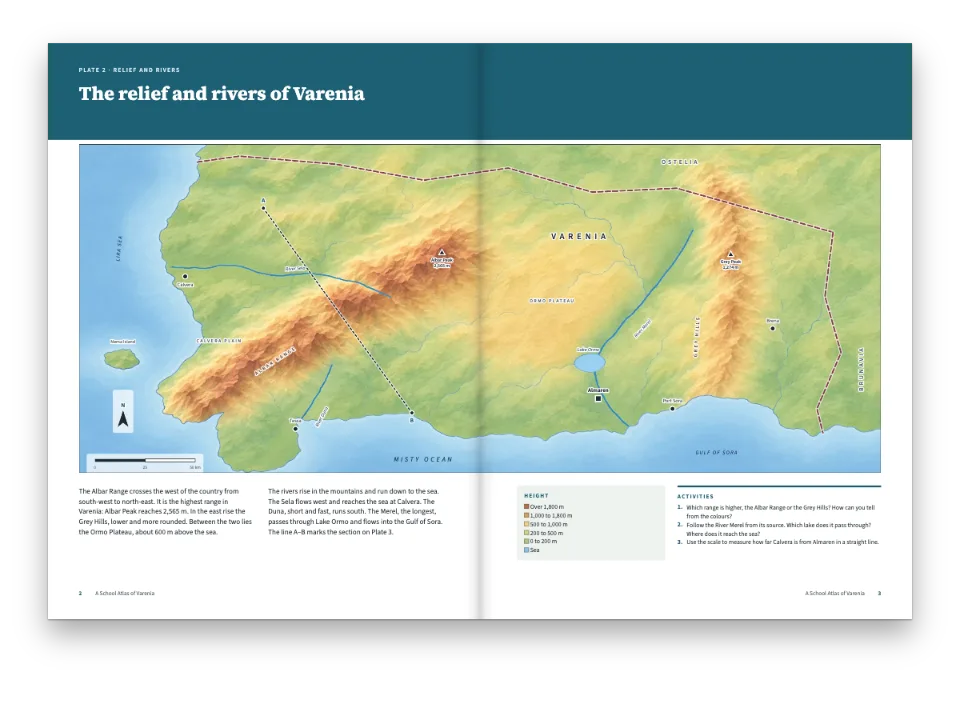
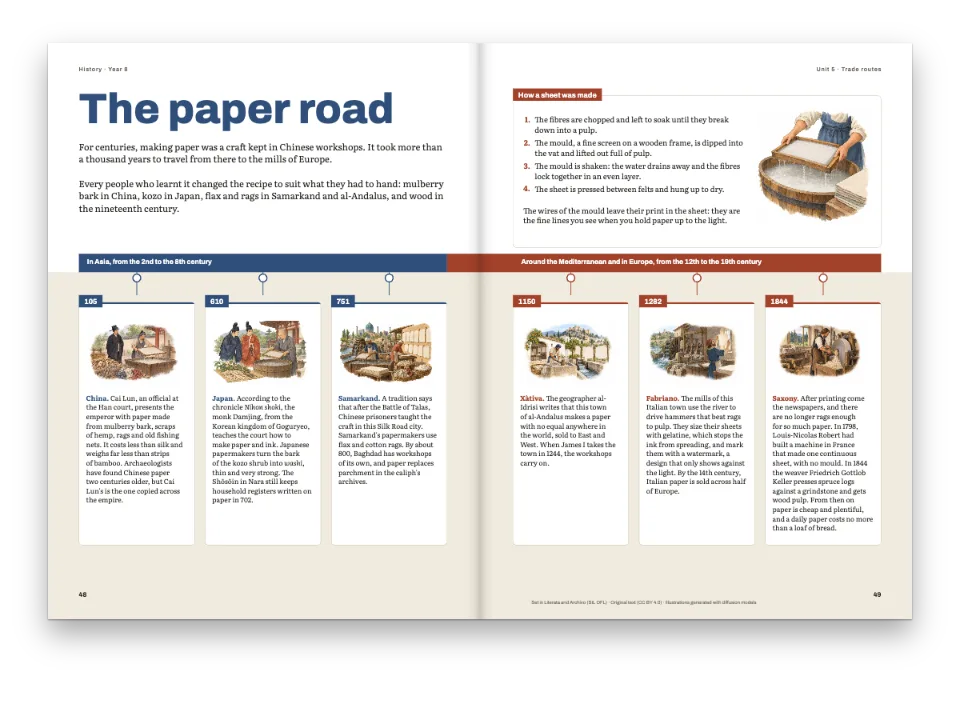
A school textbook unit about a river, nine pages long. Each topic is a double page on a coloured ground with a title tab, text, pictures and boxes. The map has no word painted on it: its names come from the text.
What you'll build
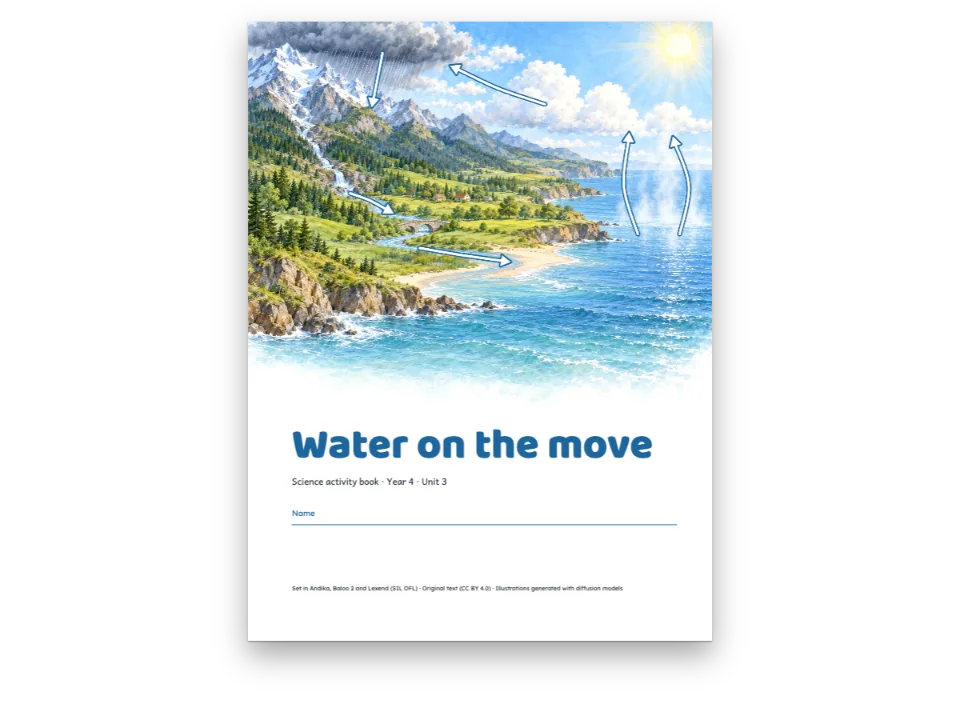
Nine pages of Our river, unit 4 of an invented Year 3 social science book, on a 210 × 280 mm page, in Spanish, Catalan and English. A painted valley opens the unit, a contents page lists two parts, and three topics follow as double pages, each on its own ground: water blue, field green, sun sand. Every topic has a tab with its number and title, text in two columns and boxes with tabs that grow with their text. The second topic is one painted map across both pages, with the river, the villages and the three courses named on it from the Markdown. The three texts differ in length by a fifth or more and settle in the same templates: a box takes the height its words need and pushes the next one down, and the map is set a little smaller before any text is.
This recipe answers
- How do I set a textbook unit in three languages from the same page templates, when each language's text has a different length?
- How do I make the boxes of a page grow with their text and push the boxes below them down?
- How do I put the names on a map from the text, so a translation changes the words and not the drawing?
The short answer
// Ground, title tab and number are decoration anchored to the title frame, so the tab is as
// tall as the title needs. A topic extends the base and changes its colours and adds frames.
const ground = (f) => ({ kind: 'box', id: 'ground', decorative: true,
  placement: { ...at('bleed', 'top-left'), size: { width: 'fill', height: 'fill' } },
  style: { backgroundColor: col(`${f}-ground`) } });
const titleTab = (f, x = TAB) => ({ kind: 'box', id: 'tab', decorative: true,
  placement: { ...at('#titulo', 'top-left', -x), // the tab reaches out to the margin
    size: { width: mm(HALF), height: { to: '#titulo', edge: 'bottom' } } },
  style: { backgroundColor: col(f), borderRadius: mm(4) } });
const badge = (f) => ({ kind: 'text', id: 'number', content: '{attr.numero}', fontFamily: DISPLAY,
  fontSize: pt(22), fontWeight: 700, color: col(f), align: 'center',
  box: { backgroundColor: col('paper'), borderRadius: mm(6) },
  placement: { ...at('#titulo', 'top-left', 5 - TAB, 2.4),
    size: { width: mm(12), height: mm(12) } } });
const TAB = 22; // mm of the tab left of the title: the badge stands there, outside the frame
const title = { name: 'titulo', takes: 'h1', style: 'titulo', width: mm(HALF - TAB),
  placement: at('container', 'top-left', TAB) };

const base = {
  id: 'tema', spread: true, gutter: mm(12),
  decoration: { elements: [ground('agua'), titleTab('agua'), badge('agua')] },
  frames: [title, { name: 'texto', flow: true, columns: 2, columnGap: mm(7), width: mm(HALF),
    fit: { minScale: 0.9 } }],
  groups: [{ name: 'izquierda', kind: 'stack', gap: mm(6), frames: ['titulo', 'texto'] }],
};
const topic = (id, f, more) => ({ id, extends: 'tema',
  decoration: { elements: [{ id: 'ground', style: { backgroundColor: col(`${f}-ground`) } },
    { id: 'tab', style: { backgroundColor: col(f), borderRadius: mm(4) } },
    { id: 'number', color: col(f) }] },
  ...more });
const box = (name, style, minHeight, more) => ({ name, style, width: mm(HALF),
  minHeight: mm(minHeight), ...more });
const answer = (name, lines) => ({ name, optional: true, style: 'respuesta', width: mm(HALF),
  height: mm(LINE * lines), minHeight: mm(LINE * lines),
  rules: { every: mm(LINE), color: col('rule'), width: pt(0.75) } });
// A picture that sits at the corner of a box and pushes its text aside.
const corner = (name) => ({ name: `${name}-foto`, layer: 2, width: mm(56), exclude: 'push',
  placement: at(`#${name}`, 'top-right', -5, 8) });
One base template and a family of topics that extend it
Ingredients
- Features
- Composed pagesFrames that grow in a groupNumbered box tabsLabels on a pictureTable of contentsSpread templatesCallout boxesText, rules and boxes in page designsPictures in page designsAnchoring design elementsDecoration anchored to framesMirrored marginsRunning heads and foliosHeading stylesSemantic colour paletteFigures and tables as resourcesPages on a canvasPDF export
- Also uses
- Frames that push text, by box or contourHeading attributesDesigned openersPart divider pagesFonts embedded in the PDFCustom resource typesUnnumbered chapters
- Type
- Nunito, Fredoka (SIL OFL 1.1)
- Assets
arroyo-720.jpgcascada-720.jpglimpieza-720.jpgmapa-1900.jpgmolino-720.jpgnacimiento-720.jpgpiraguas-720.jpgportada-1400.jpgriego-720.jpg- The valley of the River Aldara, painted from the mountains to the sea, with two children watching the water. (Generated With Diffusion Models, original)
- The painted map of the valley, from the spring to the port, with no lettering: the names are labels set from the Markdown. (Generated With Diffusion Models, original)
- A spring between mossy rocks. (Generated With Diffusion Models, original)
- A mountain stream over round stones. (Generated With Diffusion Models, original)
- A small waterfall into a green pool. (Generated With Diffusion Models, original)
- A farmer opening the gate of an irrigation canal. (Generated With Diffusion Models, original)
- An old stone watermill with its wheel. (Generated With Diffusion Models, original)
- Children paddling canoes on a calm river. (Generated With Diffusion Models, original)
- Children and a teacher picking up litter on a river bank. (Generated With Diffusion Models, original)
Method
#1 · Build the boxes with extends
// Three steps of `extends`: the box (shape, type, tab), a family's colours on it, then the kind.
const tab = (f) => ({ position: 'top-left', background: col(f), color: col('paper'),
  fontFamily: DISPLAY, fontSize: pt(12), fontWeight: 600, height: mm(7), paddingX: mm(3.2),
  offset: mm(7), inset: mm(5), rule: { enabled: false, color: col(f) } });
const boxText = { fontFamily: TEXT, fontSize: pt(12), lineHeight: pt(17.5), color: col('ink'),
  boldColor: col('ink'), italicColor: col('ink'), firstLineIndent: pt(0), textAlign: 'left',
  paragraphSpacing: true };
const none = { top: mm(0), right: mm(0), bottom: mm(0), left: mm(0) }; // no padding
const calloutStyles = [
  { id: 'caja', backgroundEnabled: true, background: col('paper'), borderRadius: mm(3),
    border: { enabled: false }, padding: { top: mm(3.4), right: mm(5), bottom: mm(4), left: mm(5) },
    body: boxText, lists: { color: col('ink'), gap: mm(2), itemSpacing: mm(1.6) } },
  ...Object.keys(FAMILIES).flatMap((f) => [
    { id: `caja-${f}`, extends: 'caja', label: tab(f), lists: { color: col(f) } },
    { id: `dato-${f}`, extends: `caja-${f}`, background: col(`${f}-tint`) },
    { id: `palabras-${f}`, extends: `caja-${f}`,
      border: { enabled: true, color: col(f), width: pt(1.4) } },
    { id: `actividad-${f}`, extends: `caja-${f}`,
      stripe: { enabled: true, side: 'left', width: pt(4), color: col(f) } },
  ]),
  // Plain frames: the title (its tab is decoration), a picture's card and an answer space.
  { id: 'titulo', extends: 'caja', backgroundEnabled: false,
    padding: { top: mm(2.6), right: mm(6), bottom: mm(3.2), left: mm(0) } },
  { id: 'titulo-plano', extends: 'titulo', padding: { left: mm(8) } },
  { id: 'portada', extends: 'caja-agua', background: col('agua'), borderRadius: mm(4),
    padding: { top: mm(2.6), right: mm(8), bottom: mm(3.6), left: mm(8) } },
  { id: 'foto', extends: 'caja', borderRadius: mm(2),
    padding: { top: mm(1.8), right: mm(1.8), bottom: mm(2.2), left: mm(1.8) } },
  { id: 'respuesta', extends: 'caja', padding: none },
  { id: 'colofon', extends: 'caja', backgroundEnabled: false, padding: none,
    body: { ...boxText, fontSize: pt(8), lineHeight: pt(11), color: col('muted') } },
];
A box style is made in three steps. caja holds the shape, the type and the geometry of the tab; caja-agua, caja-campo and caja-sol add a family's colour to the tab and the bullets; dato-, palabras- and actividad- set the kind: a tinted box, an outlined one or one with a stripe. A new family is three colours in FAMILIES, and no style is written twice.
#2 · Let every topic extend one base template
// Ground, title tab and number are decoration anchored to the title frame, so the tab is as
// tall as the title needs. A topic extends the base and changes its colours and adds frames.
const ground = (f) => ({ kind: 'box', id: 'ground', decorative: true,
  placement: { ...at('bleed', 'top-left'), size: { width: 'fill', height: 'fill' } },
  style: { backgroundColor: col(`${f}-ground`) } });
const titleTab = (f, x = TAB) => ({ kind: 'box', id: 'tab', decorative: true,
  placement: { ...at('#titulo', 'top-left', -x), // the tab reaches out to the margin
    size: { width: mm(HALF), height: { to: '#titulo', edge: 'bottom' } } },
  style: { backgroundColor: col(f), borderRadius: mm(4) } });
const badge = (f) => ({ kind: 'text', id: 'number', content: '{attr.numero}', fontFamily: DISPLAY,
  fontSize: pt(22), fontWeight: 700, color: col(f), align: 'center',
  box: { backgroundColor: col('paper'), borderRadius: mm(6) },
  placement: { ...at('#titulo', 'top-left', 5 - TAB, 2.4),
    size: { width: mm(12), height: mm(12) } } });
const TAB = 22; // mm of the tab left of the title: the badge stands there, outside the frame
const title = { name: 'titulo', takes: 'h1', style: 'titulo', width: mm(HALF - TAB),
  placement: at('container', 'top-left', TAB) };

const base = {
  id: 'tema', spread: true, gutter: mm(12),
  decoration: { elements: [ground('agua'), titleTab('agua'), badge('agua')] },
  frames: [title, { name: 'texto', flow: true, columns: 2, columnGap: mm(7), width: mm(HALF),
    fit: { minScale: 0.9 } }],
  groups: [{ name: 'izquierda', kind: 'stack', gap: mm(6), frames: ['titulo', 'texto'] }],
};
const topic = (id, f, more) => ({ id, extends: 'tema',
  decoration: { elements: [{ id: 'ground', style: { backgroundColor: col(`${f}-ground`) } },
    { id: 'tab', style: { backgroundColor: col(f), borderRadius: mm(4) } },
    { id: 'number', color: col(f) }] },
  ...more });
const box = (name, style, minHeight, more) => ({ name, style, width: mm(HALF),
  minHeight: mm(minHeight), ...more });
const answer = (name, lines) => ({ name, optional: true, style: 'respuesta', width: mm(HALF),
  height: mm(LINE * lines), minHeight: mm(LINE * lines),
  rules: { every: mm(LINE), color: col('rule'), width: pt(0.75) } });
// A picture that sits at the corner of a box and pushes its text aside.
const corner = (name) => ({ name: `${name}-foto`, layer: 2, width: mm(56), exclude: 'push',
  placement: at(`#${name}`, 'top-right', -5, 8) });
The base is a spread: a ground to the bleed, a title tab with its number, and a text in two columns. A topic extends it (extends: 'tema'), changes the colours of three decoration elements by their id and adds its own frames. The tab and the number are decoration anchored to the title frame, so the tab is as tall as the title the language needs, and the number stands left of the frame, where nothing covers it.
#3 · Let the groups share the room
Each topic has two groups. The left page is a stack: title, text, then the strip of pictures or the map. The right page is another stack of boxes, or a row of three boxes that share its width. A frame is as tall as its words, never less than its minHeight, so the Spanish text pushes everything under it down and no position in the template changes. When a page runs short, the reflow ladder takes space back, then sets the map and the pictures smaller, and the text last, down to 90 %. pnpm cookbook bench runs the three editions again with the text 30 % longer.
#4 · Put the names on the map from the text
// An anchor is a point of the painting (fractions of its width and height) and a label style;
// every language's ::label lines use the same anchors.
const halo = { color: col('paper'), width: pt(1.8) };
const labelStyles = [
  { id: 'sierra', fontFamily: DISPLAY, fontSize: pt(13), fontWeight: 600, color: col('ink'),
    textTransform: 'uppercase', letterSpacing: 0.14, halo },
  { id: 'agua', fontFamily: TEXT, fontSize: pt(11), fontWeight: 700, fontStyle: 'italic',
    color: { hex: '#0b3a5c', model: 'hex' }, halo },
  { id: 'mar', fontFamily: TEXT, fontSize: pt(12), fontWeight: 700, fontStyle: 'italic',
    color: col('paper'), halo: { color: { hex: '#0b3a5c', model: 'hex' }, width: pt(1.8) } },
  { id: 'pueblo', fontFamily: DISPLAY, fontSize: pt(12), fontWeight: 600, color: col('ink'), halo },
  { id: 'curso', fontFamily: DISPLAY, fontSize: pt(10.5), fontWeight: 600, color: col('paper'),
    textTransform: 'uppercase', letterSpacing: 0.08, background: col('campo'),
    padding: mm(1.6) },
];
const ANCHORS = [
  { id: 'sierra', x: 0.21, y: 0.055, style: 'sierra' },
  { id: 'nacimiento', x: 0.065, y: 0.115, style: 'agua', align: 'start' },
  { id: 'fontalba', x: 0.135, y: 0.255, style: 'pueblo', verticalAlign: 'top' },
  { id: 'embalse', x: 0.31, y: 0.155, style: 'agua', width: 0.12 },
  { id: 'molinar', x: 0.505, y: 0.35, style: 'pueblo', verticalAlign: 'bottom' },
  { id: 'aldamar', x: 0.845, y: 0.505, style: 'pueblo', verticalAlign: 'bottom' },
  { id: 'mar', x: 0.965, y: 0.28, style: 'mar' },
  { id: 'rio', x: 0.61, y: 0.715, style: 'agua', rotate: -3 },
  { id: 'alto', x: 0.17, y: 0.45, style: 'curso' },
  { id: 'medio', x: 0.4, y: 0.77, style: 'curso' },
  { id: 'bajo', x: 0.74, y: 0.865, style: 'curso' },
];
The map is a painting with no letter on it. Each place is an anchor of the picture, a point in fractions of its width and height with a label style, and each edition writes its own ::label lines at those anchors. Penalta Reservoir, Pantà de Penyalta and Embalse de Peñalta stand at the same place, and a longer name breaks inside the anchor's width.
#5 · Keep each part of the contents together
// The heading style paints the title tab; the entries come from the headings and the parts.
const indiceOpener = { enabled: true, minHeight: mm(26), slot: { elements: [
  { kind: 'box', id: 'tab', decorative: true,
    placement: { ...at('container', 'top-left'), size: { width: mm(HALF), height: mm(18) } },
    style: { backgroundColor: col('agua'), borderRadius: mm(4) } },
  { kind: 'text', id: 'title', content: '{titleText}', fontFamily: DISPLAY, fontSize: pt(28),
    fontWeight: 600, color: col('paper'), align: 'left',
    placement: { ...at('container', 'top-left', 8, 3.2), size: { width: mm(HALF - 12) } } },
] } };
const toc = {
  levels: [
    { level: 1, fontFamily: DISPLAY, fontSize: pt(15), lineHeight: pt(22), fontWeight: 500,
      color: col('ink'), numberFontWeight: 600, numberColor: col('agua'), numberWidth: mm(9),
      marginTop: pt(4) },
    { level: 2, fontFamily: TEXT, fontSize: pt(11.5), lineHeight: pt(18), indent: mm(9),
      color: col('ink') },
  ],
  pageNumber: { fontFamily: DISPLAY, fontWeight: 500, width: mm(9), color: col('agua') },
  leader: { char: '.', gap: mm(1.5) },
  parts: { height: pt(34), marginTop: pt(12), marginBottom: pt(4), design: { elements: [
    { kind: 'box', id: 'band', decorative: true,
      placement: { ...at('container', 'top-left'), size: { width: 'fill', height: 'fill' } },
      style: { backgroundColor: col('paper'), borderRadius: mm(3) } },
    { kind: 'text', id: 'letter', content: '{number}', fontFamily: DISPLAY, fontSize: pt(16),
      fontWeight: 700, color: col('paper'), align: 'center',
      box: { backgroundColor: col('agua'), borderRadius: mm(4) },
      placement: { ...at('container', 'left', 2, 0), size: { width: mm(8), height: mm(8) } } },
    { kind: 'text', id: 'name', content: '{titleText}', fontFamily: DISPLAY, fontSize: pt(13),
      fontWeight: 600, color: col('agua'), placement: at('container', 'left', 14, 0) },
  ] } },
};
:::toc{keep="part" levels="1-2"} lists the topics and their sections and keeps each part row with its entries. A :::part fence with parts.page: false is only a row of the contents and a section for the running heads: it adds no divider page. The contents are a flow page and not a frame, because a :::toc inside a frame loses its part rows.
The whole recipe
// ═══ Postext Cookbook · Nº 156 · A children's textbook unit in three languages ═══ // https://postext.dev/en/cookbook/children-textbook-pages // Code: MIT · Text: original (CC BY 4.0) · Pictures: generated with diffusion models // Fonts: Nunito, Fredoka (SIL OFL 1.1) · Needs postext ≥ 1.40.0 import { buildDocumentWithFonts, renderPageToCanvas, registerResourceImage, } from 'https://esm.sh/postext'; import { renderToPdf, decompressWoff2 } from 'https://esm.sh/postext-pdf'; const LANG = 'en'; // @lang: the language of the sample document ('es' | 'en' | 'ca') const RECIPE = 'children-textbook-pages'; // ─── 1 · Design ───────────────────────────────────────────────────────────── // #region palette: one ink and three families (water, field, sun), each with an accent, a tint // for its boxes and a ground for its pages const FAMILIES = { agua: { main: '#1b6aa0', tint: '#e1f0fa', ground: '#d3e8f6' }, campo: { main: '#336f27', tint: '#e5f1dc', ground: '#d9ebcb' }, sol: { main: '#9a5209', tint: '#fcefd2', ground: '#f8e6b8' }, }; const palette = { ink: '#1d2f3f', muted: '#4f6272', rule: '#7e98ab', paper: '#ffffff' }; for (const [f, c] of Object.entries(FAMILIES)) { Object.assign(palette, { [f]: c.main, [`${f}-tint`]: c.tint, [`${f}-ground`]: c.ground }); } const col = (id) => ({ hex: palette[id], model: 'hex', paletteId: id }); const colorPalette = [ ...Object.entries(palette).map(([id, hex]) => ({ id, name: id, value: { hex, model: 'hex' } })), { id: 'main-color', name: 'water (defaults)', value: { hex: palette.agua, model: 'hex' } }, ]; // #endregion const [TEXT, DISPLAY] = ['Nunito', 'Fredoka']; const PAGE = { w: 210, h: 280, top: 18, bottom: 18, inner: 14, outer: 12 }; // mm, mirrored const HALF = PAGE.w - PAGE.inner - PAGE.outer; // one page's type area: 184 mm const SHEET = 2 * HALF + 2 * PAGE.inner; // a spread's content area: 396 mm const RIGHT = HALF + 2 * PAGE.inner; // where the right page's type area starts on the sheet const LINE = 8; // mm between two answer lines const at = (to, edge, x = 0, y = 0) => ({ anchor: { to, edge }, offset: { x: mm(x), y: mm(y) } }); const onRight = at('container', 'top-left', RIGHT); // every frame of the right page's stack // #region boxes: callout styles that extend each other // Three steps of `extends`: the box (shape, type, tab), a family's colours on it, then the kind. const tab = (f) => ({ position: 'top-left', background: col(f), color: col('paper'), fontFamily: DISPLAY, fontSize: pt(12), fontWeight: 600, height: mm(7), paddingX: mm(3.2), offset: mm(7), inset: mm(5), rule: { enabled: false, color: col(f) } }); const boxText = { fontFamily: TEXT, fontSize: pt(12), lineHeight: pt(17.5), color: col('ink'), boldColor: col('ink'), italicColor: col('ink'), firstLineIndent: pt(0), textAlign: 'left', paragraphSpacing: true }; const none = { top: mm(0), right: mm(0), bottom: mm(0), left: mm(0) }; // no padding const calloutStyles = [ { id: 'caja', backgroundEnabled: true, background: col('paper'), borderRadius: mm(3), border: { enabled: false }, padding: { top: mm(3.4), right: mm(5), bottom: mm(4), left: mm(5) }, body: boxText, lists: { color: col('ink'), gap: mm(2), itemSpacing: mm(1.6) } }, ...Object.keys(FAMILIES).flatMap((f) => [ { id: `caja-${f}`, extends: 'caja', label: tab(f), lists: { color: col(f) } }, { id: `dato-${f}`, extends: `caja-${f}`, background: col(`${f}-tint`) }, { id: `palabras-${f}`, extends: `caja-${f}`, border: { enabled: true, color: col(f), width: pt(1.4) } }, { id: `actividad-${f}`, extends: `caja-${f}`, stripe: { enabled: true, side: 'left', width: pt(4), color: col(f) } }, ]), // Plain frames: the title (its tab is decoration), a picture's card and an answer space. { id: 'titulo', extends: 'caja', backgroundEnabled: false, padding: { top: mm(2.6), right: mm(6), bottom: mm(3.2), left: mm(0) } }, { id: 'titulo-plano', extends: 'titulo', padding: { left: mm(8) } }, { id: 'portada', extends: 'caja-agua', background: col('agua'), borderRadius: mm(4), padding: { top: mm(2.6), right: mm(8), bottom: mm(3.6), left: mm(8) } }, { id: 'foto', extends: 'caja', borderRadius: mm(2), padding: { top: mm(1.8), right: mm(1.8), bottom: mm(2.2), left: mm(1.8) } }, { id: 'respuesta', extends: 'caja', padding: none }, { id: 'colofon', extends: 'caja', backgroundEnabled: false, padding: none, body: { ...boxText, fontSize: pt(8), lineHeight: pt(11), color: col('muted') } }, ]; // #endregion // #region answer: one base template and a family of topics that extend it // Ground, title tab and number are decoration anchored to the title frame, so the tab is as // tall as the title needs. A topic extends the base and changes its colours and adds frames. const ground = (f) => ({ kind: 'box', id: 'ground', decorative: true, placement: { ...at('bleed', 'top-left'), size: { width: 'fill', height: 'fill' } }, style: { backgroundColor: col(`${f}-ground`) } }); const titleTab = (f, x = TAB) => ({ kind: 'box', id: 'tab', decorative: true, placement: { ...at('#titulo', 'top-left', -x), // the tab reaches out to the margin size: { width: mm(HALF), height: { to: '#titulo', edge: 'bottom' } } }, style: { backgroundColor: col(f), borderRadius: mm(4) } }); const badge = (f) => ({ kind: 'text', id: 'number', content: '{attr.numero}', fontFamily: DISPLAY, fontSize: pt(22), fontWeight: 700, color: col(f), align: 'center', box: { backgroundColor: col('paper'), borderRadius: mm(6) }, placement: { ...at('#titulo', 'top-left', 5 - TAB, 2.4), size: { width: mm(12), height: mm(12) } } }); const TAB = 22; // mm of the tab left of the title: the badge stands there, outside the frame const title = { name: 'titulo', takes: 'h1', style: 'titulo', width: mm(HALF - TAB), placement: at('container', 'top-left', TAB) }; const base = { id: 'tema', spread: true, gutter: mm(12), decoration: { elements: [ground('agua'), titleTab('agua'), badge('agua')] }, frames: [title, { name: 'texto', flow: true, columns: 2, columnGap: mm(7), width: mm(HALF), fit: { minScale: 0.9 } }], groups: [{ name: 'izquierda', kind: 'stack', gap: mm(6), frames: ['titulo', 'texto'] }], }; const topic = (id, f, more) => ({ id, extends: 'tema', decoration: { elements: [{ id: 'ground', style: { backgroundColor: col(`${f}-ground`) } }, { id: 'tab', style: { backgroundColor: col(f), borderRadius: mm(4) } }, { id: 'number', color: col(f) }] }, ...more }); const box = (name, style, minHeight, more) => ({ name, style, width: mm(HALF), minHeight: mm(minHeight), ...more }); const answer = (name, lines) => ({ name, optional: true, style: 'respuesta', width: mm(HALF), height: mm(LINE * lines), minHeight: mm(LINE * lines), rules: { every: mm(LINE), color: col('rule'), width: pt(0.75) } }); // A picture that sits at the corner of a box and pushes its text aside. const corner = (name) => ({ name: `${name}-foto`, layer: 2, width: mm(56), exclude: 'push', placement: at(`#${name}`, 'top-right', -5, 8) }); // #endregion const questions = [1, 2, 3].flatMap((n) => [box(`pregunta-${n}`, 'dato-agua', 14), answer(`respuesta-${n}`, 3)]); const pageTemplates = [ base, // Water: text, a strip of three pictures and a box; three boxes grow down the right page. topic('tema-agua', 'agua', { frames: [ ...[1, 2, 3].map((n) => ({ name: `foto-${n}`, style: 'foto', width: mm((HALF - 10) / 3), ...(n === 1 && { placement: at('#texto', 'below', 0, 8) }) })), box('probar', 'palabras-agua', 46, { placement: at('#foto-1', 'below', 0, 10) }), { ...box('sabias', 'dato-agua', 40), placement: onRight }, { ...box('palabras', 'palabras-agua', 62), placement: onRight }, { ...box('actividades', 'actividad-agua', 58), placement: onRight }, ], groups: [ { name: 'fotos', kind: 'row', gap: mm(5), frames: ['foto-1', 'foto-2', 'foto-3'] }, { name: 'derecha', kind: 'stack', gap: mm(12), frames: ['sabias', 'palabras', 'actividades'] }, ], }), // Field: one map across the spread; under it a text, and three boxes that share a width. topic('tema-campo', 'campo', { frames: [ { name: 'mapa', crossGutter: true, width: mm(SHEET) }, box('actividad', 'actividad-campo', 24), ...[1, 2, 3].map((n) => ({ name: `curso-${n}`, style: 'dato-campo', width: mm(56), minHeight: mm(46), shrink: 1, ...(n === 1 && { placement: at('#mapa', 'below', RIGHT, 6) }) })), ], groups: [ { name: 'izquierda', kind: 'stack', gap: mm(6), frames: ['titulo', 'mapa', 'texto', 'actividad'] }, { name: 'cursos', kind: 'row', gap: mm(6), frames: ['curso-1', 'curso-2', 'curso-3'] }, ], }), // Sun: boxes with a picture at their corner that pushes the text aside. topic('tema-sol', 'sol', { frames: [ box('cuidar', 'palabras-sol', 64, { padding: { right: mm(64) } }), corner('cuidar'), box('turno', 'actividad-sol', 40), ...[1, 2, 3].flatMap((n) => [ box(`uso-${n}`, 'dato-sol', 66, { padding: { right: mm(64) }, placement: onRight }), corner(`uso-${n}`), ]), ], groups: [ { name: 'izquierda', kind: 'stack', gap: mm(12), frames: ['titulo', 'texto', 'cuidar', 'turno'] }, { name: 'derecha', kind: 'stack', gap: mm(12), frames: ['uso-1', 'uso-2', 'uso-3'] }, ], }), // Before the unit: questions, each with room to write. { id: 'saberes', header: false, decoration: { elements: [titleTab('agua', 0)] }, frames: [{ ...title, style: 'titulo-plano', width: mm(HALF), placement: at('container', 'top-left') }, { name: 'texto', flow: true, width: mm(HALF) }, ...questions], groups: [{ name: 'pagina', kind: 'stack', gap: mm(7), frames: ['titulo', 'texto', ...questions.map((q) => q.name)] }] }, // The opener: a painting to the bleed, the title over its foot. { id: 'unidad', header: false, footer: false, decoration: { elements: [ { kind: 'image', id: 'portada', resourceId: 'portada', decorative: true, placement: { ...at('bleed', 'top-left'), size: { width: 'fill', height: mm(157.5) } } }, { kind: 'text', id: 'kicker', content: '{attr.unidad}', fontFamily: DISPLAY, fontSize: pt(11), fontWeight: 600, letterSpacing: pt(1), textTransform: 'uppercase', color: col('agua'), box: { backgroundColor: col('paper'), borderRadius: mm(2) }, placement: { ...at('#titulo', 'top-left', 0, -9), size: { height: mm(7) } } }, ] }, frames: [ { name: 'titulo', takes: 'h1', style: 'portada', width: mm(120), placement: at('container', 'top-left', 0, 104) }, { name: 'texto', flow: true, width: mm(160) }, box('aprenderas', 'dato-agua', 36), { name: 'colofon', style: 'colofon', width: mm(HALF), placement: at('container', 'bottom-left') }, ], groups: [{ name: 'pagina', kind: 'stack', gap: mm(7), frames: ['titulo', 'texto', 'aprenderas'] }] }, ]; const head = (id, content, parity, edge, x) => ({ kind: 'text', id, content, parity, fontFamily: TEXT, fontSize: pt(8), fontWeight: 700, letterSpacing: pt(1), color: col('muted'), textTransform: 'uppercase', placement: at('page', edge, x, 9) }); const folio = (id, parity, edge, x) => ({ kind: 'text', id, content: '{pageNumber}', parity, fontFamily: DISPLAY, fontSize: pt(11), fontWeight: 600, color: col('paper'), align: 'center', box: { backgroundColor: col('agua'), borderRadius: mm(4) }, placement: { ...at('page', edge, x, -8), size: { width: mm(8), height: mm(8) } } }); // #region contents: a flow page, because a :::toc cannot be laid out inside a frame yet // The heading style paints the title tab; the entries come from the headings and the parts. const indiceOpener = { enabled: true, minHeight: mm(26), slot: { elements: [ { kind: 'box', id: 'tab', decorative: true, placement: { ...at('container', 'top-left'), size: { width: mm(HALF), height: mm(18) } }, style: { backgroundColor: col('agua'), borderRadius: mm(4) } }, { kind: 'text', id: 'title', content: '{titleText}', fontFamily: DISPLAY, fontSize: pt(28), fontWeight: 600, color: col('paper'), align: 'left', placement: { ...at('container', 'top-left', 8, 3.2), size: { width: mm(HALF - 12) } } }, ] } }; const toc = { levels: [ { level: 1, fontFamily: DISPLAY, fontSize: pt(15), lineHeight: pt(22), fontWeight: 500, color: col('ink'), numberFontWeight: 600, numberColor: col('agua'), numberWidth: mm(9), marginTop: pt(4) }, { level: 2, fontFamily: TEXT, fontSize: pt(11.5), lineHeight: pt(18), indent: mm(9), color: col('ink') }, ], pageNumber: { fontFamily: DISPLAY, fontWeight: 500, width: mm(9), color: col('agua') }, leader: { char: '.', gap: mm(1.5) }, parts: { height: pt(34), marginTop: pt(12), marginBottom: pt(4), design: { elements: [ { kind: 'box', id: 'band', decorative: true, placement: { ...at('container', 'top-left'), size: { width: 'fill', height: 'fill' } }, style: { backgroundColor: col('paper'), borderRadius: mm(3) } }, { kind: 'text', id: 'letter', content: '{number}', fontFamily: DISPLAY, fontSize: pt(16), fontWeight: 700, color: col('paper'), align: 'center', box: { backgroundColor: col('agua'), borderRadius: mm(4) }, placement: { ...at('container', 'left', 2, 0), size: { width: mm(8), height: mm(8) } } }, { kind: 'text', id: 'name', content: '{titleText}', fontFamily: DISPLAY, fontSize: pt(13), fontWeight: 600, color: col('agua'), placement: at('container', 'left', 14, 0) }, ] } }, }; // #endregion // #region art-labels: the map's label styles and anchors; the words are in the Markdown // An anchor is a point of the painting (fractions of its width and height) and a label style; // every language's ::label lines use the same anchors. const halo = { color: col('paper'), width: pt(1.8) }; const labelStyles = [ { id: 'sierra', fontFamily: DISPLAY, fontSize: pt(13), fontWeight: 600, color: col('ink'), textTransform: 'uppercase', letterSpacing: 0.14, halo }, { id: 'agua', fontFamily: TEXT, fontSize: pt(11), fontWeight: 700, fontStyle: 'italic', color: { hex: '#0b3a5c', model: 'hex' }, halo }, { id: 'mar', fontFamily: TEXT, fontSize: pt(12), fontWeight: 700, fontStyle: 'italic', color: col('paper'), halo: { color: { hex: '#0b3a5c', model: 'hex' }, width: pt(1.8) } }, { id: 'pueblo', fontFamily: DISPLAY, fontSize: pt(12), fontWeight: 600, color: col('ink'), halo }, { id: 'curso', fontFamily: DISPLAY, fontSize: pt(10.5), fontWeight: 600, color: col('paper'), textTransform: 'uppercase', letterSpacing: 0.08, background: col('campo'), padding: mm(1.6) }, ]; const ANCHORS = [ { id: 'sierra', x: 0.21, y: 0.055, style: 'sierra' }, { id: 'nacimiento', x: 0.065, y: 0.115, style: 'agua', align: 'start' }, { id: 'fontalba', x: 0.135, y: 0.255, style: 'pueblo', verticalAlign: 'top' }, { id: 'embalse', x: 0.31, y: 0.155, style: 'agua', width: 0.12 }, { id: 'molinar', x: 0.505, y: 0.35, style: 'pueblo', verticalAlign: 'bottom' }, { id: 'aldamar', x: 0.845, y: 0.505, style: 'pueblo', verticalAlign: 'bottom' }, { id: 'mar', x: 0.965, y: 0.28, style: 'mar' }, { id: 'rio', x: 0.61, y: 0.715, style: 'agua', rotate: -3 }, { id: 'alto', x: 0.17, y: 0.45, style: 'curso' }, { id: 'medio', x: 0.4, y: 0.77, style: 'curso' }, { id: 'bajo', x: 0.74, y: 0.865, style: 'curso' }, ]; // #endregion const config = { locale: t({ es: 'es', en: 'en-gb', ca: 'ca' }), resourceTypes: [{ id: 'dibujo', name: t({ es: 'Dibujo', en: 'Picture', ca: 'Dibuix' }), shortLabel: '', numberingTemplate: '', resetOn: 'never', counterFormat: 'decimal', captionPrefix: '', defaultPlacement: { position: 'here' } }], colorPalette, page: { sizePreset: 'custom', width: mm(PAGE.w), height: mm(PAGE.h), dpi: 150, margins: { top: mm(PAGE.top), bottom: mm(PAGE.bottom), left: mm(PAGE.inner), right: mm(PAGE.outer), mirror: true } }, layout: { layoutType: 'single' }, bodyText: { fontFamily: TEXT, fontSize: pt(12), lineHeight: pt(17.5), color: col('ink'), boldColor: col('ink'), italicColor: col('ink'), referenceColor: col('ink'), textAlign: 'left', firstLineIndent: pt(0), paragraphSpacing: true, hyphenation: { enabled: true }, optimalLineBreaking: true, avoidWidows: true, avoidOrphans: true, avoidRunts: true }, headings: { fontFamily: DISPLAY, fontWeight: 600, color: col('ink'), levels: [ { level: 1, fontSize: pt(28), lineHeight: pt(32), color: col('paper'), marginTop: pt(0), marginBottom: pt(0), breakBefore: { enabled: false } }, { level: 2, fontSize: pt(15), lineHeight: pt(19), marginTop: pt(9), marginBottom: pt(3) }, ] }, // Headings that are not entries of the unit: no number, no row in the contents. headingStyles: [ { id: 'portada', numbered: false, toc: false, fontSize: pt(46), lineHeight: pt(48) }, { id: 'previo', numbered: false, toc: false }, { id: 'indice', numbered: false, toc: false, fontSize: pt(28), advancedDesign: indiceOpener }, ], toc, parts: { page: false }, // a part is a row of the contents, with no divider page unorderedLists: { bulletChar: '•', color: col('agua'), fontWeight: 700, itemSpacing: pt(3) }, orderedLists: { numberFormat: 'arabic', fontFamily: DISPLAY, fontWeight: 600, color: col('agua'), itemSpacing: pt(4) }, labelStyles, captionStyle: { fontFamily: TEXT, fontSize: pt(9), color: col('ink'), descriptionItalic: true, gap: pt(4) }, calloutStyles, header: { elements: [ head('materia', '{subtitle}', 'even', 'top-left', PAGE.outer), head('unidad', '{title}', 'odd', 'top-right', -PAGE.outer), ] }, footer: { elements: [folio('folio-par', 'even', 'bottom-left', PAGE.outer), folio('folio-impar', 'odd', 'bottom-right', -PAGE.outer)] }, pageTemplates, }; // ─── 2 · Content ──────────────────────────────────────────────────────────── const markdown = String.raw`---Markdown sample · 188 lines · content.en.md
title: "Our river" subtitle: "Social science · Year 3" --- ::::page{template="unidad" unidad="Unit 4 · Social science"} # Our river {style="portada"} Every town you know stands near water. This unit follows one river, the Aldara, from the snow where it starts to the sea where it ends. You will find out where a river is born, how it changes on its way down, and how the people of Fontalba, Molinar and Aldamar live beside it. :::frame{slot="aprenderas" label="You will learn"} - How a spring becomes a stream, and a stream becomes a river. - What the upper, middle and lower course of a river are. - How people use river water, and how to look after it. ::: :::frame{slot="colofon"} Set in Nunito and Fredoka (SIL OFL) · Original text (CC BY 4.0) · Illustrations generated with diffusion models ::: :::: # In this unit {style="indice"} :::toc{keep="part" levels="1-2"} :::figure{resource="rio"} ::alt[Painted map of the valley of the River Aldara, from the snowy mountains to the sea.] ::caption[The River Aldara from its spring to the sea. The map is on pages 6 and 7.] ::: ::::page{template="saberes"} # What do you know about rivers? {style="previo"} Before you start, think about the rivers you have seen. Write your ideas on the lines. At the end of the unit, come back to them and see what has changed. :::frame{slot="pregunta-1" label="Think 1"} Where do you think a river starts? ::: :::frame{slot="pregunta-2" label="Think 2"} What do people use a river for? ::: :::frame{slot="pregunta-3" label="Think 3"} Which animals and plants live in or beside a river? ::: :::: :::part{number="A" title="A river from the mountains to the sea"} ::: ::::page{template="tema-agua" spread numero="1"} # Where a river is born Rain and snow fall on the mountains. Some of the water runs down the slopes and some soaks into the ground. Underground it moves slowly, until it meets rock it cannot cross. Then it comes out into the open. A place where water comes out of the ground is called a **spring**. ## From spring to stream A spring gives only a trickle. The trickle runs downhill and meets other trickles, and together they make a **stream**. On a steep slope a stream runs fast. It rolls pebbles along and wears them smooth. When streams meet, they make a bigger one. The River Aldara begins like this, in the snow of the White Range, 1,850 metres above the sea. :::figure{resource="nacimiento" slot="foto-1"} ::alt[Clear water trickling out between mossy rocks.] ::caption[A spring. The water has been underground for months.] ::: :::figure{resource="arroyo" slot="foto-2"} ::alt[A stream tumbling over round stones.] ::caption[A stream, steep and fast, with pebbles worn smooth.] ::: :::figure{resource="cascada" slot="foto-3"} ::alt[A small waterfall falling into a green pool.] ::caption[A waterfall, where the stream drops over a step of rock.] ::: :::frame{slot="probar" label="Try it"} Hold a wet sponge over a tray and squeeze it gently. Where does the water come out? Watch how it drips and then runs. That is how a spring feeds a stream. ::: :::frame{slot="sabias" label="Did you know?"} At its spring, the Aldara is a trickle you could step over. After 94 kilometres it is as wide as a football pitch is long. ::: :::frame{slot="palabras" label="Words to learn"} **Spring:** a place where water comes out of the ground. **Stream:** a small river that runs fast down a slope. **Tributary:** a stream that flows into a bigger river. **Bank:** the land along the side of a river. ::: :::frame{slot="actividades" label="Activities"} 1. Look at the three pictures. Which one shows a spring? How can you tell? 2. Why does a stream run faster in the mountains than in the valley? 3. Which of the four words in the box can you see in the pictures? ::: :::: ::::page{template="tema-campo" spread numero="2"} # From the mountains to the sea The River Aldara is 94 kilometres long. It starts in the White Range, crosses a valley and a plain, and reaches the sea at Aldamar. Geographers split a river into three parts. Each part is called a **course**, and each one looks different. :::figure{resource="mapa" slot="mapa"} ::alt[A painted map of the valley: snowy mountains and a spring at the left, the village of Fontalba, a reservoir with a dam, the town of Molinar with its bridge and mill, farm fields, the river bending across a plain, and the port of Aldamar by the sea at the right.] ::label[White Range]{at="sierra"} ::label[Spring]{at="nacimiento"} ::label[Fontalba]{at="fontalba"} ::label[Penalta Reservoir]{at="embalse"} ::label[Molinar]{at="molinar"} ::label[Aldamar]{at="aldamar"} ::label[Sea]{at="mar"} ::label[River Aldara]{at="rio"} ::label[Upper course]{at="alto"} ::label[Middle course]{at="medio"} ::label[Lower course]{at="bajo"} ::: :::frame{slot="actividad" label="Look at the map"} Follow the river with your finger from the spring to the sea. Which town is nearest to the sea? ::: :::frame{slot="curso-1" label="Upper course"} The slope is steep. The water is cold, clear and fast, and it cuts into the rock. Fontalba stands here. ::: :::frame{slot="curso-2" label="Middle course"} The valley is wider and the river slows down. Farmers water their fields, and Molinar grew around a bridge and a mill. ::: :::frame{slot="curso-3" label="Lower course"} The land is almost flat. The river is wide and slow, and it bends in great loops. At Aldamar it flows into the sea. ::: :::: :::part{number="B" title="People and the river"} ::: ::::page{template="tema-sol" spread numero="3"} # People and the river People have always settled near rivers. They need water to drink, to wash and to grow food. A river also gives fish, a road for boats and the push that turns a wheel. ## Looking after the river A river stays clean only if we keep it clean. Rubbish, oil and dirty water make the river sick, and the fish and plants that live in it suffer. Everything that goes down a drain or a street ends up in a river or in the sea. :::frame{slot="cuidar" label="We look after our river"} - We put rubbish in the bin, never in the water. - We use water carefully and turn off the tap. - We keep to the paths and leave plants and animals alone. - We help to clean the bank when the school organises it. ::: :::frame{slot="turno" label="Your turn"} 1. Draw a poster with three rules to keep our river clean. 2. Ask at home: where does the water from your tap come from? ::: :::figure{resource="limpieza" slot="cuidar-foto"} ::alt[Children with gloves and paper bags picking up litter on a river bank.] ::: :::frame{slot="uso-1" label="1 · Water for the fields"} In the middle course, farmers open small canals so the river water runs between the rows. Without it, tomatoes and lettuces would not grow in summer. A single canal can carry water for many kilometres. ::: :::figure{resource="riego" slot="uso-1-foto"} ::alt[A farmer lifting a gate in an irrigation canal in a field of vegetables.] ::: :::frame{slot="uso-2" label="2 · Mills"} Long ago the falling water turned the wheel of the mill at Molinar. The wheel moved the stones that ground wheat into flour for the whole valley. Today the old mill is a small museum. ::: :::figure{resource="molino" slot="uso-2-foto"} ::alt[An old stone mill with a big wooden wheel beside a river.] ::: :::frame{slot="uso-3" label="3 · Sport and play"} Now the calm lower course is a place for canoes. On summer mornings children from Aldamar learn to paddle with a monitor, and everyone wears a life jacket. ::: :::figure{resource="piraguas" slot="uso-3-foto"} ::alt[Children in life jackets paddling two canoes on a calm river.] ::: ::::`; // content.<lang>.md, inlined by the Cookbook // #region art: nine paintings (JPEGs in assets/), the pictures of the unit // Painted with a diffusion model in a coloured-pencil and watercolour manner, cut to the shape // of the frames that show them and declared with their pixels. Nothing is written on them: the // names on the map are ::label lines of the Markdown, standing at the anchors below. const ART = { portada: ['portada-1400.jpg', 1400, 1021, 165], mapa: ['mapa-1900.jpg', 1900, 730, 122], ...Object.fromEntries(['nacimiento', 'arroyo', 'cascada', 'riego', 'molino', 'piraguas', 'limpieza'].map((id) => [id, [`${id}-720.jpg`, 720, 540, 330]])) }; const resources = await Promise.all(Object.entries(ART).map(async ([id, [fileId, w, h, ppi]]) => { await loadImage(fileId, asset(fileId)); return { id, typeId: 'dibujo', kind: 'bitmap', caption: '', altText: '', createdAt: 0, updatedAt: 0, bitmap: { fileId, format: 'jpeg', width: w, height: h, resolution: ppi }, ...(id === 'mapa' && { anchors: ANCHORS }) }; })); // The map again with no anchors, small, under the contents. resources.push({ ...resources.find((r) => r.id === 'mapa'), id: 'rio', anchors: [] }); // #endregion // ─── 3 · Fonts ────────────────────────────────────────────────────────────── const FONTS = { Nunito: ['400', '400i', '700'], Fredoka: ['500', '600', '700'] }; // ─── 4 · Build & show ─────────────────────────────────────────────────────── const doc = await buildDocumentWithFonts({ markdown, resources }, config, kitFonts(FONTS)); showPages(doc, { title: t({ es: 'Nuestro río', en: 'Our river', ca: 'El nostre riu' }) }); offerPdf(() => renderToPdf(doc, { fontProvider: fontsourceProvider, resourceBytes: imageBytes }), `${RECIPE}.pdf`);Kit · core, fonts, viewer, pdf, images: the same in every recipe · 315 lines
// ─── Kit ── helpers shared by every Cookbook recipe · postext.dev/cookbook ───── // ─── Kit · core v1 ── the same in every recipe · postext.dev/cookbook function mm(value) { return { value, unit: 'mm' }; } function pt(value) { return { value, unit: 'pt' }; } function em(value) { return { value, unit: 'em' }; } /** The sample language's string: t({ en: 'Figure', es: 'Figura' }). */ function t(strings) { return strings[LANG] ?? Object.values(strings)[0]; } /** A file in this recipe's assets folder, served from the Postext repo by jsDelivr. */ function asset(file) { return `https://cdn.jsdelivr.net/gh/drnachio/postext@main/cookbook/${RECIPE}/assets/${file}`; } // ─── Kit · fonts v3 ── the same in every recipe · postext.dev/cookbook // Postext loads the faces a config asks for before layout (prepareFonts, // buildDocumentWithFonts) and asks the kit for the files: Fontsource's, the // files the PDF embeds too. /** The options of buildDocumentWithFonts / prepareFonts / withLoadedFonts: * the Fontsource resolver, and the faces of FONTS loaded with the ones the * config names. FONTS = { 'Family Name': ['400', '400i', '700'] }. */ function kitFonts(FONTS = {}) { const faces = Object.entries(FONTS).flatMap(([family, specs]) => specs.map((spec) => ({ family, weight: parseInt(spec, 10), style: spec.endsWith('i') ? 'italic' : 'normal' }))); return { resolve: fontsourceResolver, faces }; } /** A face's Fontsource files, in a fixed order: latin, then latin-ext and greek * when `text` needs them and the family ships them (kitSubsetsFor), each with * its unicode-range. Null for a weight or slant Fontsource does not ship. */ async function fontsourceResolver(family, weight, style, { text = '' } = {}) { const id = fontsourceId(family); const meta = await fontsourceMeta(family); if (meta && !(meta.weights.includes(weight) && meta.styles.includes(style))) return null; kitStatus('Loading fonts…'); const at = await fontsourceAt(id); return ['latin', ...kitSubsetsFor(text, meta)].map((subset) => ({ source: `${at}files/${id}-${subset}-${weight}-${style}.woff2`, unicodeRange: kitRanges()[subset], })); } /** The unicode-range of each Fontsource file the kit loads (a function: the * kit is inlined after the pen's code, which runs before a const would be set). */ function kitRanges() { return { latin: 'U+0000-00FF,U+0131,U+0152-0153,U+02BB-02BC,U+02C6,U+02DA,U+02DC,U+0304,U+0308,U+0329,' + 'U+2000-206F,U+20AC,U+2122,U+2191,U+2193,U+2212,U+2215,U+FEFF,U+FFFD', 'latin-ext': 'U+0100-02BA,U+02BD-02C5,U+02C7-02CC,U+02CE-02D7,U+02DD-02FF,U+0304,U+0308,U+0329,' + 'U+1D00-1DBF,U+1E00-1E9F,U+1EF2-1EFF,U+2020,U+20A0-20AB,U+20AD-20C0,U+2113,U+2C60-2C7F,U+A720-A7FF', greek: 'U+0370-03FF', }; } /** For the cjk, arabic and comics blocks, which add their own files: the * faces of `faces` = { 'Family Name': ['400', '400i', '700'] }. `text` is the sample: * č ł † α χ also load latin-ext and greek files (kitSubsetsFor). With * `optional`, a face Fontsource does not ship is skipped instead of failing. * The files are added once all have loaded, in the order asked (latin, then * latin-ext, then greek), whatever order they arrive in: the last one added * wins a character two files hold. Resolves to the number of faces added. */ async function loadFonts(faces, text = '', { optional = false } = {}) { kitStatus('Loading fonts…'); const ranges = kitRanges(); const jobs = []; for (const [family, specs] of Object.entries(faces)) { const id = fontsourceId(family); const todo = [...new Set(specs)].map((spec) => [parseInt(spec, 10), spec.endsWith('i') ? 'italic' : 'normal']) .filter(([weight, style]) => !hasFace(family, weight, style)); // before any await const at = fontsourceAt(id); const meta = optional || /[^\0-ÿ]/u.test(text) ? await fontsourceMeta(family) : null; const subsets = ['latin', ...kitSubsetsFor(text, meta)]; for (const [weight, style] of todo) { if (optional && !(meta?.weights.includes(weight) && meta.styles.includes(style))) continue; for (const subset of subsets) { const url = `${await at}files/${id}-${subset}-${weight}-${style}.woff2`; const face = new FontFace(family, `url(${url}) format('woff2')`, { weight: String(weight), style, unicodeRange: ranges[subset] }); jobs.push(face.load().catch(() => { if (subset === 'latin' && !optional) throw new Error(`Fontsource has no ${family} ${weight} ${style}`); })); } } } const ready = await Promise.all(jobs).catch((error) => { kitFail(error); throw error; }); return ready.filter((face) => face && document.fonts.add(face)).length; } /** A loaded FontFace covers this family, weight and style (fonts.check() would * also say yes for families nobody declared). */ function hasFace(family, weight, style) { for (const face of document.fonts) { if (face.status !== 'loaded' || face.style !== style) continue; if (face.family.replace(/^["']|["']$/g, '') !== family) continue; const [low, high = low] = face.weight.split(' ').map(Number); if (weight >= low && weight <= high) return true; } return false; } /** The files beyond latin `text` needs that `meta`'s family ships. */ function kitSubsetsFor(text, meta) { return [[/[Ā-˿ᴀ-ᶿḀ-ỿ†ℓⱠ-Ɀ꜠-ꟿ]/u, 'latin-ext'], [/[Ͱ-Ͽ]/u, 'greek']] .filter(([re, x]) => re.test(text) && meta?.subsets?.includes(x)).map(([, x]) => x); } /** Fontsource's id for a family: 'Source Serif 4' → 'source-serif-4'. */ function fontsourceId(family) { return family.toLowerCase().replace(/\s+/g, '-'); } /** A package's folder at the one version @5 names now (#766). */ function fontsourceAt(id, u = `https://cdn.jsdelivr.net/npm/@fontsource/${id}@`) { return (fontsourceAt.c ??= {})[id] ??= fetch(u + '5/package.json').then((r) => r.json()) .then((p) => p.version || 5, () => 5).then((v) => `${u}${v}/`); } /** The family's Fontsource metadata (weights, styles, subsets), or null. */ function fontsourceMeta(family) { fontsourceMeta.cache ??= new Map(); const id = fontsourceId(family); if (!fontsourceMeta.cache.has(id)) { fontsourceMeta.cache.set(id, fetch(`https://api.fontsource.org/v1/fonts/${id}`) .then((res) => (res.ok ? res.json() : null), () => null)); } return fontsourceMeta.cache.get(id); } // ─── Kit · viewer v2 ── the same in every recipe · postext.dev/cookbook /** The pages as spreads on a dark desk, page 1 alone, then verso | recto, * each painted when it scrolls near. Other options go to renderPageToCanvas. */ function showPages(docs, { title, width = 460, ...render } = {}) { const root = viewer(title); const pages = [docs].flat().flatMap((doc) => doc.pages.map((page) => ({ doc, page, n: (doc.pageIndexOffset ?? 0) + page.index }))); const spreads = []; let verso = null; for (const p of pages) { if (p.n % 2 === 1) { if (verso) spreads.push([verso, null]); verso = p; } else { spreads.push([verso, p]); verso = null; } } if (verso) spreads.push([verso, null]); const density = Math.min(window.devicePixelRatio || 1, 2); showPages.painter?.disconnect(); const painter = new IntersectionObserver((entries) => { for (const { isIntersecting, target } of entries) { if (!isIntersecting) continue; painter.unobserve(target); const { doc, page } = target.postext; renderPageToCanvas(page, doc, target, { ...render, scale: (width * density) / page.width }); } }, { rootMargin: '800px' }); showPages.painter = painter; root.replaceChildren(...spreads.map((pair) => { const spread = document.createElement('div'); spread.className = 'pt-spread'; for (const p of pair) { const figure = document.createElement('figure'); if (p) { const label = p.page.pageLabel || String(p.n + 1); const canvas = document.createElement('canvas'); canvas.postext = p; canvas.style.aspectRatio = `${p.page.width} / ${p.page.height}`; canvas.setAttribute('role', 'img'); canvas.setAttribute('aria-label', `Page ${label}`); const folio = document.createElement('figcaption'); folio.textContent = label; figure.append(canvas, folio); painter.observe(canvas); } else figure.className = 'pt-blank'; spread.append(figure); } return spread; })); kitStatus(`${pages.length} ${pages.length === 1 ? 'page' : 'pages'}`); document.documentElement.dataset.postext = 'ready'; return pages.length; } /** The desk, the bar and the error reporting, created once. */ function viewer(title) { if (!document.getElementById('pt-kit')) { document.head.insertAdjacentHTML('beforeend', `<style id="pt-kit"> :root { color-scheme: dark; } body { margin: 0; background: #0e1014; color: #b9bcc4; font: 13px/1.45 system-ui, sans-serif; } #pt-bar { position: sticky; top: 0; z-index: 1; display: flex; flex-wrap: wrap; align-items: center; gap: 6px 16px; padding: 10px 16px; background: rgb(14 16 20 / .92); backdrop-filter: blur(6px); border-bottom: 1px solid #23262d; } #pt-bar strong { color: #f4f1ea; font-weight: 600; } #pt-actions { display: flex; gap: 12px; margin-left: auto; } #pt-actions a, #pt-actions button { color: #d8a21a; font: inherit; background: none; border: 0; padding: 0; cursor: pointer; } #pages { display: grid; justify-items: center; gap: 48px; padding: 32px 16px 72px; } .pt-spread { display: flex; } .pt-spread figure { margin: 0; width: min(460px, 44vw); } .pt-spread canvas { display: block; width: 100%; background: #fff; box-shadow: 0 1px 2px rgb(0 0 0 / .5), 0 22px 44px -16px rgb(0 0 0 / .8); } .pt-spread figure:first-child canvas { box-shadow: inset -14px 0 14px -14px rgb(0 0 0 / .18), 0 1px 2px rgb(0 0 0 / .5), 0 22px 44px -16px rgb(0 0 0 / .8); } .pt-spread figcaption { margin-top: 10px; text-align: center; font: 600 10px/1 system-ui, sans-serif; letter-spacing: .18em; text-transform: uppercase; color: #6c7079; } .pt-blank { visibility: hidden; } @media (max-width: 760px) { .pt-spread { flex-direction: column; gap: 32px; } .pt-spread figure { width: min(460px, 92vw); } .pt-blank { display: none; } } </style>`); document.body.insertAdjacentHTML('afterbegin', '<header id="pt-bar"><strong id="pt-title"></strong><span id="pt-status" role="status"></span><span id="pt-actions"></span></header>'); document.getElementById('pt-title').textContent = document.title || 'Postext'; addEventListener('error', (event) => kitFail(event.error ?? event.message)); addEventListener('unhandledrejection', (event) => kitFail(event.reason)); } if (title) document.getElementById('pt-title').textContent = title; return document.getElementById('pages') ?? document.body.appendChild(Object.assign(document.createElement('main'), { id: 'pages' })); } function kitStatus(text) { viewer(); document.getElementById('pt-status').textContent = text; } function kitFail(error) { document.documentElement.dataset.postext = 'error'; kitStatus(`Error: ${error?.message ?? error}`); } // ─── Kit · pdf v3 ── the same in every recipe that exports a PDF /** The Fontsource files the screen used, as TrueType, with their range and * place: the nearest weight the family ships, upright with no italic; * latin, then what its letters need (kitSubsetsFor). */ async function fontsourceProvider(family, weight, style, request) { const id = fontsourceId(family); const meta = await fontsourceMeta(family); const weights = meta?.weights?.length ? meta.weights : [400, 700]; const w = weights.reduce((a, b) => (Math.abs(b - weight) < Math.abs(a - weight) ? b : a)); const s = style === 'italic' && meta && !meta.styles.includes('italic') ? 'normal' : style; const text = String.fromCodePoint(...(request?.codePoints ?? [])); const files = await Promise.all(['latin', ...kitSubsetsFor(text, meta)].map(async (subset, order) => { const res = await fetch(`${await fontsourceAt(id)}files/${id}-${subset}-${w}-${s}.woff2`); if (!res.ok) throw new Error(`Fontsource has no ${family} ${w} ${s} ${subset}`); return Object.assign(await decompressWoff2(new Uint8Array(await res.arrayBuffer())), { unicodeRange: kitRanges()[subset], order }); })); return files.length === 1 ? files[0] : files; } /** A "Build the PDF" button; then "Open the PDF" (a new tab: CodePen's frame * shows no PDFs) and a download link. */ function offerPdf(makePdf, filename) { viewer(); const button = Object.assign(document.createElement('button'), { type: 'button', textContent: 'Build the PDF' }); button.dataset.postextPdf = filename; button.addEventListener('click', async () => { button.disabled = true; button.textContent = 'Building the PDF…'; try { const bytes = await makePdf(); const url = URL.createObjectURL(new Blob([bytes], { type: 'application/pdf' })); const size = `${Math.max(1, Math.round(bytes.length / 1024))} KB`; button.replaceWith( Object.assign(document.createElement('a'), { href: url, target: '_blank', rel: 'noopener', textContent: 'Open the PDF ↗' }), Object.assign(document.createElement('a'), { href: url, download: filename, textContent: `Download ${filename} · ${size}` })); } catch (error) { button.disabled = false; button.textContent = 'Build the PDF'; kitFail(error); } }); document.getElementById('pt-actions').append(button); } // ─── Kit · images v3 ── recipes with pictures · postext.dev/cookbook /** Registers a photo or PNG for the canvas and keeps its bytes for the PDF. * fetch → ImageBitmap never taints the canvas (a plain cross-origin <img> would). */ async function loadImage(fileId, url) { const res = await fetch(url); if (!res.ok) throw new Error(`Image not found (${res.status}): ${url}`); const bytes = new Uint8Array(await res.arrayBuffer()); registerResourceImage(fileId, await createImageBitmap(new Blob([bytes]))); (loadImage.bytes ??= new Map()).set(fileId, bytes); } /** Registers SVG markup as a vector image, its fonts inside (inlineSvgFonts, ≥ 1.25). * `options` go to registerResourceImage: { singleInk: true } tints it on the canvas. */ async function loadSvg(fileId, svg, options) { if (typeof inlineSvgFonts === 'function') svg = await inlineSvgFonts(svg, svgFaces); const img = new Image(); img.src = `data:image/svg+xml;charset=utf-8,${encodeURIComponent(svg)}`; await img.decode(); registerResourceImage(fileId, img, options); (loadImage.bytes ??= new Map()).set(fileId, new TextEncoder().encode(svg)); } /** A face's Fontsource files: nearest weight; latin + what the SVG sets. */ async function svgFaces(family, weight, style, { codePoints = [] } = {}) { const [id, m] = [fontsourceId(family), await fontsourceMeta(family)]; const w = m?.weights.reduce((a, b) => (Math.abs(b - weight) < Math.abs(a - weight) ? b : a)) ?? weight; const s = m?.styles.includes(style) === false ? 'normal' : style; return Promise.all(['latin', ...kitSubsetsFor(String.fromCodePoint(...codePoints), m)].map(async (x) => new Uint8Array( await (await fetch(`${await fontsourceAt(id)}files/${id}-${x}-${w}-${s}.woff2`)).arrayBuffer()))); } /** renderToPdf({ resourceBytes: imageBytes }) */ function imageBytes(fileId) { return loadImage.bytes?.get(fileId); } /** renderToHtml({ resourceImageUrl: imageUrl }) */ function imageUrl(fileId) { const bytes = imageBytes(fileId); if (!bytes) return undefined; imageUrl.urls ??= new Map(); if (!imageUrl.urls.has(fileId)) { const type = /\.svg$/i.test(fileId) ? 'image/svg+xml' : /\.png$/i.test(fileId) ? 'image/png' : 'image/jpeg'; imageUrl.urls.set(fileId, URL.createObjectURL(new Blob([bytes], { type }))); } return imageUrl.urls.get(fileId); } // ─── /Kit ───────────────────────────────────────────────────────────────────────
The composed script.js runs as it is: paste it into any page’s module script, or open the recipe on CodePen. Recipe folder on GitHub ↗ (opens in a new tab)
Variations
#Add a fourth family
A topic about the sea is a fourth entry in FAMILIES and a template made with topic('tema-mar', 'mar', { frames }). The loop over FAMILIES writes its styles, caja-mar, dato-mar and the rest.
-  sol: { main: '#9a5209', tint: '#fcefd2', ground: '#f8e6b8' },
+  sol: { main: '#9a5209', tint: '#fcefd2', ground: '#f8e6b8' },
+ mar: { main: '#0f5a6b', tint: '#dcf0f2', ground: '#cbe6ea' },#Keep the text at its size
A frame that must not shrink its text takes fit: { shrinkText: false }. A longer text then pushes harder on the frames around it, and the ladder reaches the pictures first.
-  frames: [title, { name: 'texto', flow: true, columns: 2, columnGap: mm(7), width: mm(HALF),
-    fit: { minScale: 0.9 } }],
+  frames: [title, { name: 'texto', flow: true, columns: 2, columnGap: mm(7), width: mm(HALF),
+ fit: { shrinkText: false } }],Pitfalls
Pitfall
A contents list cannot be set inside a frame of a composed page
A :::toc inside a :::frame of a composed page is laid out as the frame's paragraphs: the part rows of toc.parts.design are not drawn and leave an empty line, every entry is followed by the document's paragraph spacing and the heading that titles the contents is listed in it. Set the contents as a flow page instead: a heading style (numbered: false, toc: false) whose advancedDesign paints the title, followed by :::toc{keep="part"} in the running text, where the part rows, the leaders and the keep rule work. Its design stops at the column's margin, so the page's ground colour has to wait for a page the engine lays out as a composed page. Table of contents →
- A name painted into a picture could not change with the language: the map carries no word, and every name is a label.
- A decoration element lying under a frame cannot be clicked in the Sandbox, which is why the number of each topic stands left of its title frame and not inside it.
- Two figures that set the same resource take the words of the first one: the small map on the contents page is the same file under its own resource,
rio, with no anchors.
Credits
- Recipe
- Your Name
- Text
- Our river, a children's textbook unit written for this recipe in Spanish, Catalan and English · Postext Cookbook · CC BY 4.0
- Images
- The valley of the River Aldara, painted from the mountains to the sea, with two children watching the water. · Generated With Diffusion Models · original
- The painted map of the valley, from the spring to the port, with no lettering: the names are labels set from the Markdown. · Generated With Diffusion Models · original
- A spring between mossy rocks. · Generated With Diffusion Models · original
- A mountain stream over round stones. · Generated With Diffusion Models · original
- A small waterfall into a green pool. · Generated With Diffusion Models · original
- A farmer opening the gate of an irrigation canal. · Generated With Diffusion Models · original
- An old stone watermill with its wheel. · Generated With Diffusion Models · original
- Children paddling canoes on a calm river. · Generated With Diffusion Models · original
- Children and a teacher picking up litter on a river bank. · Generated With Diffusion Models · original
- Fonts
- Nunito (SIL OFL 1.1) · Fredoka (SIL OFL 1.1)
Edit this write-up ↗ (opens in a new tab)Recipe folder on GitHub ↗ (opens in a new tab)