In short
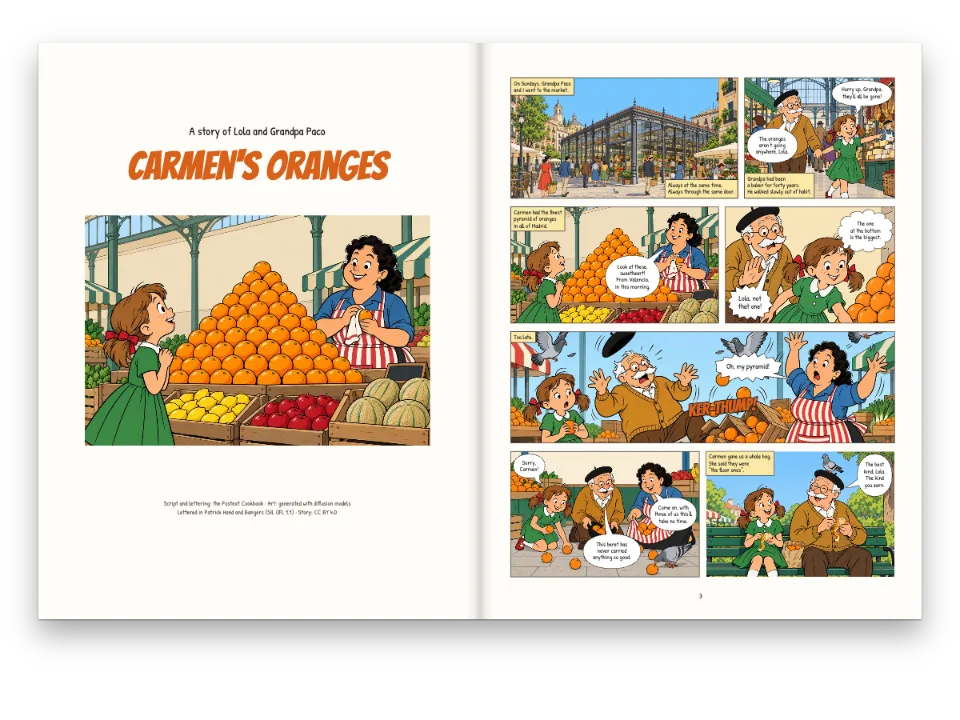
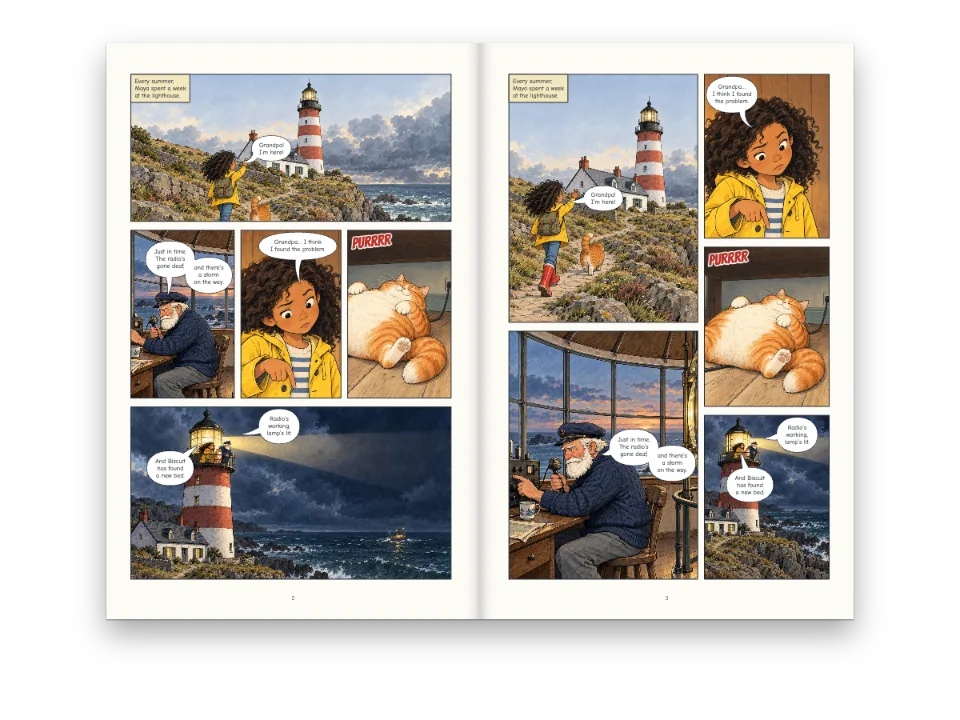
A comic laid out across two facing pages as if they were one: a wide picture of a crowded market runs over the middle of the book, three panels sit under it.
What you'll build
The second story of the album in Nº 152, ¡Abuelo!, told across two facing pages. A December Saturday packs the market; Lola loses her grandfather in the crowd. The top half of the spread is one panorama, 432 mm wide: Lola, tiny, at the far left, Paco searching at the far right, and the aisle of the market running into the fold between them. Under it, three panels: Lola alone among the legs, Paco whistling from a fruit crate, the reunion with his beret in the air. The split is written once for both pages, so the panorama crosses the spine and the gutter of the lower tier falls on the fold. Spanish is the original; the English, Catalan, Chinese, Arabic and Japanese editions letter the same spread.
This recipe answers
- How do I lay one comic page across a double-page spread?
The short answer
// The content writes :::page{spread split="55 / * [25 | 25 | *]"}: one frame from the verso's
// outer margin to the recto's (the inner margins drop out), split as one page. The panorama
// crosses the spine; the line at 50 % of the lower tier is the spine itself, so its gutter
// straddles the fold and no panel is cut by it.
const comics = {
  gutter: { horizontal: mm(5), vertical: mm(4) }, // 2 mm of white on each side of the fold
  panel: { borderWidth: pt(0.75), borderColor: col('ink'), background: col('paper') },
  lettering: { fontFamily: LETTER, fontSize: pt(LATIN ? 9.5 : 8.5), lineHeight: 1.1,
    color: col('ink') },
  runningHeads: true, // folios on both halves
};
// A spread opens on a verso, an even page. Page 1 of a document is a recto, so the engine
// would leave it blank and start on page 2; this episode continues an album at page 2.
const continuation = { pageIndexOffset: 1, pageNumbering: { startAt: 2 } };
One split across two facing pages, opened on a verso
Ingredients
- Features
- Double-page comic spreadsPanel splitsPanel art and cropsSpeakers and anchorsComic pagesComic letteringRe-lettering in other languagesBalloon stylesPanel borders and guttersMirrored marginsSemantic colour palettePages on a canvasPDF export
- Also uses
- Paper colourHeads by page roleFonts embedded in the PDFFigures and tables as resourcesSound effects
- Type
- Patrick Hand, Bangers, Noto Sans SC, ZCOOL KuaiLe, Zen Antique, Dela Gothic One, Playpen Sans Arabic, Lalezar (SIL OFL 1.1)
- Assets
ds1-1900.jpgds2.jpgds3.jpgds4.jpg- Panorama of the crowded market hall: tiny Lola stands lost on the far left; far right, her grandfather searches the crowd. (Generated With Diffusion Models, original)
- Lola, tearful, stands among grown-ups' legs and shopping bags. (Generated With Diffusion Models, original)
- Paco stands on a fruit crate and whistles through his fingers; shoppers turn to look. (Generated With Diffusion Models, original)
- Lola leaps into her grandfather's arms; his beret flies off and the stallholders smile. (Generated With Diffusion Models, original)
Method
#1 · One split over both pages
The code is the short answer above. The whole comic is one directive with the spread flag:
:::page{spread split="55 / * [25 | 25 | *]"}
::panel{art=ds1}
caption: Un sábado de diciembre, el mercado estaba hasta los topes.
lola: ¿Abuelo?
paco{shout}: ¿Lola? ¡Lolaaa!
The frame runs from the verso's outer margin to the recto's; the inner margins drop out. The first tier, 55 % of the height, is a single panel across the spine. In the second, 25 | 25 | * puts its first line at 25 % and its second at 50 %, the spine itself: two square panels on the verso, the reunion on the recto. A spread opens on an even page, and a document's page 1 is a recto, so the build passes continuation: { pageIndexOffset: 1 }: this episode continues the album at page 2, and no blank page comes first.
#2 · A panorama big enough for two pages
// The panorama is 1,900 px wide: across the 432 mm of the spread it prints at about 112 dpi.
const box = ([x, y, width, height]) => ({ x, y, width, height });
const who = (id, x, y, head, face) => ({ id, x, y,
  ...(head && { head: { x: head[0], y: head[1] } }), ...(face && { face: box(face) }) });
const ART = {
  ds1: { width: 1900, height: 633, safeArea: box([.03, .27, .93, .53]),
    alt: t({ en: 'Panorama of the crowded market hall: tiny Lola stands lost on the far left; '
        + 'far right, her grandfather searches the crowd.',
      es: 'Panorámica del mercado lleno de gente: a la izquierda del todo, Lola, '
        + 'diminuta, está perdida; a la derecha del todo, su abuelo la busca entre la multitud.',
      ca: 'Panoràmica del mercat ple de gent: a l’extrem esquerre, la Lola, petitíssima, '
        + 'està perduda; a l’extrem dret, el seu avi la busca entre la gentada.',
      zh: '拥挤的市场全景:最左边,小小的萝拉迷了路;最右边,她的爷爷在人群中寻找她。',
      ar: 'منظر واسع للسوق المزدحم: لولا الصغيرة تائهة في أقصى اليسار، وفي أقصى اليمين '
        + 'جدّها يبحث عنها بين الناس.',
      ja: '人でいっぱいの市場のパノラマ。左端に小さなローラが迷子になって立ち、右端では祖父が人ごみの中を探している。',
      pt: 'Panorama do mercado lotado: na ponta esquerda, a pequena Lola está perdida; na ponta '
        + 'direita, o avô a procura no meio da multidão.' }),
    anchors: [
      who('lola', .065, .58, [.063, .55], [.045, .51, .04, .11]),
      who('paco', .925, .38, [.925, .34], [.9, .3, .05, .12]),
    ],
  },
  ds2: { width: 1152, height: 1152, safeArea: box([.31, .08, .35, .62]),
    alt: t({ en: "Lola, tearful, stands among grown-ups' legs and shopping bags.",
      es: 'Lola, con lágrimas en los ojos, está de pie entre piernas de mayores y bolsas '
        + 'de la compra.',
      ca: 'La Lola, amb llàgrimes als ulls, és dreta entre cames de grans i bosses de la compra.',
      zh: '萝拉含着眼泪,站在大人们的腿和购物袋之间。',
      ar: 'لولا والدموع في عينيها واقفة بين سيقان الكبار وأكياس التسوّق.',
      ja: '涙ぐんだローラが、大人の足と買い物袋のあいだに立っている。',
      pt: 'Lola, com lágrimas nos olhos, está de pé entre pernas de adultos e sacolas '
        + 'de compras.' }),
    anchors: [
      who('lola', .505, .24, [.48, .17], [.4, .1, .18, .19]),
    ],
  },
  ds3: { width: 1000, height: 1000, safeArea: box([.34, .07, .47, .23]),
    alt: t({ en: 'Paco stands on a fruit crate and whistles through his fingers; shoppers '
        + 'turn to look.',
      es: 'Paco, subido a una caja de fruta, silba con los dedos; la gente se vuelve a mirar.',
      ca: 'En Paco, enfilat a una caixa de fruita, xiula amb els dits; la gent es gira a mirar.',
      zh: '帕科站在水果箱上,用手指吹口哨;买东西的人都回过头来看。',
      ar: 'باكو واقف على صندوق فاكهة ويصفّر بأصابعه، والمتسوّقون يلتفتون لينظروا.',
      ja: 'パコが果物の木箱に乗って指笛を吹き、買い物客がふり返る。',
      pt: 'Paco, em cima de um caixote de frutas, assobia com os dedos; as pessoas se viram '
        + 'para olhar.' }),
    anchors: [
      who('paco', .5, .2, [.47, .14], [.38, .08, .17, .16]),
      who('sfx', .62, .17),
    ],
  },
  ds4: { width: 1200, height: 800, safeArea: box([.33, .05, .48, .57]),
    alt: t({ en: "Lola leaps into her grandfather's arms; his beret flies off and the "
        + "stallholders smile.",
      es: 'Lola salta a los brazos de su abuelo; la boina sale volando y los tenderos sonríen.',
      ca: 'La Lola salta als braços del seu avi; la boina surt volant i els paradistes somriuen.',
      zh: '萝拉扑进爷爷怀里;他的贝雷帽飞了出去,摊主们都笑了。',
      ar: 'لولا تقفز إلى ذراعي جدّها، وقبعته تطير، والباعة يبتسمون.',
      ja: 'ローラが祖父の腕に飛びこむ。ベレー帽が飛び、店の人たちがほほえむ。',
      pt: 'Lola pula nos braços do avô; a boina sai voando e os feirantes sorriem.' }),
    anchors: [
      who('lola', .51, .27, [.47, .2], [.42, .14, .13, .19]),
      who('paco', .595, .31, [.62, .22], [.55, .14, .15, .22]),
    ],
    avoid: [box([.67, .06, .13, .22])],
  },

};
The panorama is the only picture printed across the fold, 432 × 144 mm, so it ships at 1,900 px (380 KB); the other three are 1,000–1,200 px. Its safe area is a band across nearly its whole width, and its two speakers stand at the edges, 6 % and 92 % across, far from the spine, where the binding would swallow a balloon. The picture was drawn with the middle free of faces: the aisle of the market runs into the fold.
#3 · The album's balloons
comics.balloonStyles = [
  { id: 'speech', fill: col('balloon'), stroke: col('ink'), strokeWidth: pt(0.6) },
  { id: 'caption', fill: col('cartouche'), stroke: col('ink'), strokeWidth: pt(0.6),
    padding: em(0.45), aspect: 3.4 },
  { id: 'shout', fill: col('balloon'), stroke: col('ink'), burstPoints: 16, fontScale: 1.2 },
  { id: 'whisper', fill: col('balloon'), stroke: col('ink') },
  { id: 'sfx', fontFamily: DISPLAY, color: col('orange'), halo: pt(1.6), haloColor: col('ink'),
    fontScale: 3.2 },
];
comics.cast = [
  { id: 'lola', name: 'Lola' },
  { id: 'paco', name: t({ es: 'el abuelo Paco', en: 'Grandpa Paco', ca: "l'avi Paco",
    zh: '帕科爷爷', ar: 'الجد باكو', ja: 'パコおじいちゃん', pt: 'o vovô Paco' }) },
];
The balloon styles are those of Nº 152: white speech balloons, pale yellow cartouches, a burst for Paco's shout, a dashed outline for Lola's whisper, and the whistle in the album's sound-effect face, Bangers in the Latin editions. cast gives the PDF and the EPUB the names they read before each line.
The whole recipe
// ═══ Postext Cookbook · Nº 154 · One comic page across a double spread ═══════════════ // https://postext.dev/en/cookbook/comic-double-spread // Code: MIT · Story: written for the recipe (CC BY 4.0) · Pictures: generated with diffusion models // Fonts: Patrick Hand, Bangers, the comic faces of each script (OFL) · Needs postext ≥ 1.21.0 // One split tree laid across two facing pages: a panorama runs over the spine, and the // tier under it splits at the spine's gutter. Same album, same lettering as Nº 152. import { buildDocument, renderPageToCanvas, clearMeasurementCache, registerResourceImage, defaultComicFont, defaultComicSfxFont, } from 'https://esm.sh/postext'; import { renderToPdf, decompressWoff2 } from 'https://esm.sh/postext-pdf'; const LANG = 'en'; // @lang: the album's language: 'es' | 'en' | 'ca' | 'zh' | 'ar' | 'ja' | 'pt' const RECIPE = 'comic-double-spread'; // ─── 1 · Design ───────────────────────────────────────────────────────────── // #region palette: the album's flat colours const palette = { ink: '#1d1b19', // outlines, lettering, folios orange: '#d9601a', // the sound effect cartouche: '#fbe8a6', // narration boxes balloon: '#ffffff', muted: '#5f5a54', // the colophon paper: '#fffdf8', }; const col = (id) => ({ hex: palette[id], model: 'hex', paletteId: id }); const colorPalette = [ ...Object.entries(palette).map(([id, hex]) => ({ id, name: id, value: { hex, model: 'hex' } })), { id: 'main-color', name: 'orange (defaults)', value: { hex: palette.orange, model: 'hex' } }, ]; // #endregion const LOCALE = t({ es: 'es', en: 'en-gb', ca: 'ca', zh: 'zh-Hans', ar: 'ar', ja: 'ja', pt: 'pt-BR' }); const LATIN = ['es', 'en', 'ca', 'pt'].includes(LANG); const LETTER = LATIN ? 'Patrick Hand' : defaultComicFont(LOCALE); // mixed-case hand lettering const DISPLAY = defaultComicSfxFont(LOCALE); // Bangers, Dela Gothic One, ZCOOL KuaiLe, Lalezar // #region answer: one split across two facing pages, opened on a verso // The content writes :::page{spread split="55 / * [25 | 25 | *]"}: one frame from the verso's // outer margin to the recto's (the inner margins drop out), split as one page. The panorama // crosses the spine; the line at 50 % of the lower tier is the spine itself, so its gutter // straddles the fold and no panel is cut by it. const comics = { gutter: { horizontal: mm(5), vertical: mm(4) }, // 2 mm of white on each side of the fold panel: { borderWidth: pt(0.75), borderColor: col('ink'), background: col('paper') }, lettering: { fontFamily: LETTER, fontSize: pt(LATIN ? 9.5 : 8.5), lineHeight: 1.1, color: col('ink') }, runningHeads: true, // folios on both halves }; // A spread opens on a verso, an even page. Page 1 of a document is a recto, so the engine // would leave it blank and start on page 2; this episode continues an album at page 2. const continuation = { pageIndexOffset: 1, pageNumbering: { startAt: 2 } }; // #endregion // #region balloons: the album's balloons and cartouches (Nº 152) comics.balloonStyles = [ { id: 'speech', fill: col('balloon'), stroke: col('ink'), strokeWidth: pt(0.6) }, { id: 'caption', fill: col('cartouche'), stroke: col('ink'), strokeWidth: pt(0.6), padding: em(0.45), aspect: 3.4 }, { id: 'shout', fill: col('balloon'), stroke: col('ink'), burstPoints: 16, fontScale: 1.2 }, { id: 'whisper', fill: col('balloon'), stroke: col('ink') }, { id: 'sfx', fontFamily: DISPLAY, color: col('orange'), halo: pt(1.6), haloColor: col('ink'), fontScale: 3.2 }, ]; comics.cast = [ { id: 'lola', name: 'Lola' }, { id: 'paco', name: t({ es: 'el abuelo Paco', en: 'Grandpa Paco', ca: "l'avi Paco", zh: '帕科爷爷', ar: 'الجد باكو', ja: 'パコおじいちゃん', pt: 'o vovô Paco' }) }, ]; // #endregion const COLOPHON = t({ es: 'Rotulado en Patrick Hand y Bangers (SIL OFL) · Dibujo: generado con modelos de difusión', en: 'Lettered in Patrick Hand and Bangers (SIL OFL) · Art: generated with diffusion models', ca: 'Retolat en Patrick Hand i Bangers (SIL OFL) · Dibuix: generat amb models de difusió', zh: '嵌字:Noto Sans SC、ZCOOL KuaiLe(SIL OFL)· 画面:由扩散模型生成', ar: 'الخطوط: Playpen Sans Arabic وLalezar (SIL OFL) · الرسوم: مولّدة بنماذج الانتشار', ja: '写植:Zen Antique、Dela Gothic One(SIL OFL)・ 作画:拡散モデルで生成', pt: 'Letreirado em Patrick Hand e Bangers (SIL OFL) · Arte: gerada com modelos de difusão', }); const foot = (id, content, y, extra) => ({ kind: 'text', id, content, fontFamily: LETTER, align: 'center', pages: 'comic', placement: { anchor: { to: 'page', edge: 'bottom' }, offset: { y: mm(y) } }, ...extra }); const config = () => ({ // a factory: the engine caches resolved configs per object locale: LOCALE, colorPalette, page: { sizePreset: 'custom', width: mm(230), height: mm(300), dpi: 150, // the album of Nº 152 backgroundColor: col('paper'), margins: { top: mm(18), bottom: mm(22), left: mm(16), right: mm(14), mirror: true }, }, layout: { layoutType: 'single' }, bodyText: { fontFamily: LETTER, fontSize: pt(11), lineHeight: pt(15), color: col('ink'), boldColor: col('ink'), italicColor: col('ink'), referenceColor: col('ink') }, headings: { fontFamily: DISPLAY, color: col('orange'), levels: [{ level: 1, breakBefore: { enabled: true, parity: 'any' } }] }, // the H1 break comics, header: { elements: [] }, footer: { elements: [ foot('folio', '{pageNumber}', -13, { fontSize: pt(10), color: col('ink') }), foot('colophon', COLOPHON, -7, { fontSize: pt(7), color: col('muted'), parity: 'odd' }), ] }, }); // ─── 2 · Content ──────────────────────────────────────────────────────────── const markdown = String.raw`:::page{spread split="55 / * [25 | 25 | *]"}Markdown sample · 15 lines · content.en.md
::panel{art=ds1} caption: One Saturday in December, the market was packed to the doors. lola: Grandpa? paco{shout}: Lola? Lolaaa! ::panel{art=ds2} lola{whisper}: Grandpa… where are you? caption{at=bottom-start}: I remembered what he always told me: if you get lost, stay put. ::panel{art=ds3} sfx{at="78% 20%" rotate=-8}: FWEEEET! caption{at=bottom-start}: And that nobody in Madrid whistles like a baker. ::panel{art=ds4} lola: Grandpa! paco: There you are, you rascal! paco: And there goes my beret! :::`; // content.<lang>.md: one :::page{spread} // ─── 3 · Fonts ────────────────────────────────────────────────────────────── const FONTS = { 'Patrick Hand': ['400'], Bangers: ['400'], // Latin editions 'Noto Sans SC': ['400', '700'], 'ZCOOL KuaiLe': ['400'], // Chinese 'Zen Antique': ['400'], 'Dela Gothic One': ['400'], // Japanese 'Playpen Sans Arabic': ['400', '700'], Lalezar: ['400'], // Arabic }; // #region art: the panel manifest: safe areas, speakers' mouths, heads and faces, in fractions // The panorama is 1,900 px wide: across the 432 mm of the spread it prints at about 112 dpi. const box = ([x, y, width, height]) => ({ x, y, width, height }); const who = (id, x, y, head, face) => ({ id, x, y, ...(head && { head: { x: head[0], y: head[1] } }), ...(face && { face: box(face) }) }); const ART = { ds1: { width: 1900, height: 633, safeArea: box([.03, .27, .93, .53]), alt: t({ en: 'Panorama of the crowded market hall: tiny Lola stands lost on the far left; ' + 'far right, her grandfather searches the crowd.', es: 'Panorámica del mercado lleno de gente: a la izquierda del todo, Lola, ' + 'diminuta, está perdida; a la derecha del todo, su abuelo la busca entre la multitud.', ca: 'Panoràmica del mercat ple de gent: a l’extrem esquerre, la Lola, petitíssima, ' + 'està perduda; a l’extrem dret, el seu avi la busca entre la gentada.', zh: '拥挤的市场全景:最左边,小小的萝拉迷了路;最右边,她的爷爷在人群中寻找她。', ar: 'منظر واسع للسوق المزدحم: لولا الصغيرة تائهة في أقصى اليسار، وفي أقصى اليمين ' + 'جدّها يبحث عنها بين الناس.', ja: '人でいっぱいの市場のパノラマ。左端に小さなローラが迷子になって立ち、右端では祖父が人ごみの中を探している。', pt: 'Panorama do mercado lotado: na ponta esquerda, a pequena Lola está perdida; na ponta ' + 'direita, o avô a procura no meio da multidão.' }), anchors: [ who('lola', .065, .58, [.063, .55], [.045, .51, .04, .11]), who('paco', .925, .38, [.925, .34], [.9, .3, .05, .12]), ], }, ds2: { width: 1152, height: 1152, safeArea: box([.31, .08, .35, .62]), alt: t({ en: "Lola, tearful, stands among grown-ups' legs and shopping bags.", es: 'Lola, con lágrimas en los ojos, está de pie entre piernas de mayores y bolsas ' + 'de la compra.', ca: 'La Lola, amb llàgrimes als ulls, és dreta entre cames de grans i bosses de la compra.', zh: '萝拉含着眼泪,站在大人们的腿和购物袋之间。', ar: 'لولا والدموع في عينيها واقفة بين سيقان الكبار وأكياس التسوّق.', ja: '涙ぐんだローラが、大人の足と買い物袋のあいだに立っている。', pt: 'Lola, com lágrimas nos olhos, está de pé entre pernas de adultos e sacolas ' + 'de compras.' }), anchors: [ who('lola', .505, .24, [.48, .17], [.4, .1, .18, .19]), ], }, ds3: { width: 1000, height: 1000, safeArea: box([.34, .07, .47, .23]), alt: t({ en: 'Paco stands on a fruit crate and whistles through his fingers; shoppers ' + 'turn to look.', es: 'Paco, subido a una caja de fruta, silba con los dedos; la gente se vuelve a mirar.', ca: 'En Paco, enfilat a una caixa de fruita, xiula amb els dits; la gent es gira a mirar.', zh: '帕科站在水果箱上,用手指吹口哨;买东西的人都回过头来看。', ar: 'باكو واقف على صندوق فاكهة ويصفّر بأصابعه، والمتسوّقون يلتفتون لينظروا.', ja: 'パコが果物の木箱に乗って指笛を吹き、買い物客がふり返る。', pt: 'Paco, em cima de um caixote de frutas, assobia com os dedos; as pessoas se viram ' + 'para olhar.' }), anchors: [ who('paco', .5, .2, [.47, .14], [.38, .08, .17, .16]), who('sfx', .62, .17), ], }, ds4: { width: 1200, height: 800, safeArea: box([.33, .05, .48, .57]), alt: t({ en: "Lola leaps into her grandfather's arms; his beret flies off and the " + "stallholders smile.", es: 'Lola salta a los brazos de su abuelo; la boina sale volando y los tenderos sonríen.', ca: 'La Lola salta als braços del seu avi; la boina surt volant i els paradistes somriuen.', zh: '萝拉扑进爷爷怀里;他的贝雷帽飞了出去,摊主们都笑了。', ar: 'لولا تقفز إلى ذراعي جدّها، وقبعته تطير، والباعة يبتسمون.', ja: 'ローラが祖父の腕に飛びこむ。ベレー帽が飛び、店の人たちがほほえむ。', pt: 'Lola pula nos braços do avô; a boina sai voando e os feirantes sorriem.' }), anchors: [ who('lola', .51, .27, [.47, .2], [.42, .14, .13, .19]), who('paco', .595, .31, [.62, .22], [.55, .14, .15, .22]), ], avoid: [box([.67, .06, .13, .22])], }, }; // #endregion // ─── 4 · Build & show ─────────────────────────────────────────────────────── const faces = { [LETTER]: FONTS[LETTER], [DISPLAY]: FONTS[DISPLAY] }; // this edition's faces await loadFonts(FONTS, markdown + COLOPHON); // the Latin files of every face await loadCjkFonts(faces, markdown + COLOPHON); await loadArabicFonts(faces, markdown + COLOPHON); await loadComicFonts(faces, markdown + COLOPHON); const resources = await Promise.all([ comicPanel('ds1', asset('ds1-1900.jpg'), ART.ds1), comicPanel('ds2', asset('ds2.jpg'), ART.ds2), comicPanel('ds3', asset('ds3.jpg'), ART.ds3), comicPanel('ds4', asset('ds4.jpg'), ART.ds4), ]); const doc = await buildWithFonts( () => buildDocument({ markdown, resources, continuation }, config()), markdown + COLOPHON); showBook(doc, { title: t({ es: 'Una página de cómic a doble página', en: 'One comic page across a double spread', ca: 'Una pàgina de còmic a doble pàgina', zh: '横跨两页的漫画', ar: 'صفحة قصص مصوّرة على صفحتين متقابلتين', ja: '見開きの漫画', pt: 'Uma página de quadrinhos em página dupla' }) }); offerPdf(() => renderToPdf(doc, { fontProvider: comicPdfProvider, resourceBytes: imageBytes }), `${RECIPE}.pdf`);Kit · core, fonts, viewer, pdf, images, cjk, arabic, comics: the same in every recipe · 722 lines
// ─── Kit ── helpers shared by every Cookbook recipe · postext.dev/cookbook ───── // ─── Kit · core v1 ── the same in every recipe · postext.dev/cookbook function mm(value) { return { value, unit: 'mm' }; } function pt(value) { return { value, unit: 'pt' }; } function em(value) { return { value, unit: 'em' }; } /** The sample language's string: t({ en: 'Figure', es: 'Figura' }). */ function t(strings) { return strings[LANG] ?? Object.values(strings)[0]; } /** A file in this recipe's assets folder, served from the Postext repo by jsDelivr. */ function asset(file) { return `https://cdn.jsdelivr.net/gh/drnachio/postext@main/cookbook/${RECIPE}/assets/${file}`; } // ─── Kit · fonts v2 ── the same in every recipe · postext.dev/cookbook // Postext measures with the loaded faces and caches the widths: load every face // before the first build, from Fontsource, the files the PDF embeds too. /** faces = { 'Family Name': ['400', '400i', '700'] }. `text` is the sample: * č ł † α χ also load latin-ext and greek files (kitSubsetsFor). With * `optional`, a face Fontsource does not ship is skipped instead of failing. * Resolves to the number of faces added. */ async function loadFonts(faces, text = '', { optional = false } = {}) { kitStatus('Loading fonts…'); const ranges = { latin: 'U+0000-00FF,U+0131,U+0152-0153,U+02BB-02BC,U+02C6,U+02DA,U+02DC,U+0304,U+0308,U+0329,' + 'U+2000-206F,U+20AC,U+2122,U+2191,U+2193,U+2212,U+2215,U+FEFF,U+FFFD', 'latin-ext': 'U+0100-02BA,U+02BD-02C5,U+02C7-02CC,U+02CE-02D7,U+02DD-02FF,U+0304,U+0308,U+0329,' + 'U+1D00-1DBF,U+1E00-1E9F,U+1EF2-1EFF,U+2020,U+20A0-20AB,U+20AD-20C0,U+2113,U+2C60-2C7F,U+A720-A7FF', greek: 'U+0370-03FF', }; const jobs = []; let added = 0; for (const [family, specs] of Object.entries(faces)) { const id = fontsourceId(family); const todo = [...new Set(specs)].map((spec) => [parseInt(spec, 10), spec.endsWith('i') ? 'italic' : 'normal']) .filter(([weight, style]) => !hasFace(family, weight, style)); // before any await const meta = optional || /[^\0-ÿ]/u.test(text) ? await fontsourceMeta(family) : null; const subsets = ['latin', ...kitSubsetsFor(text, meta)]; for (const [weight, style] of todo) { if (optional && !(meta?.weights.includes(weight) && meta.styles.includes(style))) continue; for (const subset of subsets) { const url = `https://cdn.jsdelivr.net/npm/@fontsource/${id}@5/files/${id}-${subset}-${weight}-${style}.woff2`; const face = new FontFace(family, `url(${url}) format('woff2')`, { weight: String(weight), style, unicodeRange: ranges[subset] }); jobs.push(face.load().then((ready) => { document.fonts.add(ready); added++; }, () => { if (subset === 'latin' && !optional) throw new Error(`Fontsource has no ${family} ${weight} ${style}`); })); } } } await Promise.all(jobs).catch((error) => { kitFail(error); throw error; }); return added; } /** Runs `build` and loads any face the pages use that FONTS missed (a regular * one with a warning), then clears the measurement cache and builds again. */ async function buildWithFonts(build, text = '') { const tried = new Set(); for (let round = 0; round < 3; round++) { kitStatus('Laying out…'); await new Promise(requestAnimationFrame); // let the status paint first const result = await Promise.resolve().then(build).catch((error) => { kitFail(error); throw error; }); const wanted = { base: {}, variants: {} }; for (const { font, base } of [result].flat().flatMap(fontStringsOf)) { const { family, weight, style } = parseFont(font); const key = `${family}|${weight}|${style}`; if (tried.has(key) || hasFace(family, weight, style)) continue; tried.add(key); (wanted[base ? 'base' : 'variants'][family] ??= []).push(`${weight}${style === 'italic' ? 'i' : ''}`); } if (Object.keys(wanted.base).length) { console.warn(`[cookbook] FONTS does not list ${JSON.stringify(wanted.base)}: loading them.`); } const added = await loadFonts(wanted.base, text) + await loadFonts(wanted.variants, text, { optional: true }); if (added === 0) return result; clearMeasurementCache(); } throw new Error('The fonts did not settle after three builds.'); } /** Every font string of the layout; `base` marks a block's own face. */ function fontStringsOf(doc) { const found = new Map(); const walk = (node) => { if (!node || typeof node !== 'object') return; if (Array.isArray(node)) { node.forEach(walk); return; } for (const [key, value] of Object.entries(node)) { if (typeof value === 'string' && /fontString$/i.test(key)) { found.set(value, found.get(value) || key === 'fontString'); } else if (value && typeof value === 'object') walk(value); } }; walk(doc.pages); walk(doc.blocks); return [...found].map(([font, base]) => ({ font, base })); } /** '700 37.5px Open Sans' / 'italic 400 13px "Source Serif 4"' → { family, weight, style }. * A string with no weight ('95.8px Young Serif', from a design text) is 400. */ function parseFont(font) { const m = /^(?:(italic|oblique)\s+)?(?:small-caps\s+)?(?:(\d+|bold|normal)\s+)?[\d.]+px\s+(.+)$/.exec(font.trim()); if (!m) throw new Error(`Unexpected font string: ${font}`); const weight = m[2] === 'bold' ? 700 : !m[2] || m[2] === 'normal' ? 400 : Number(m[2]); return { family: m[3].replace(/^["']|["']$/g, ''), weight, style: m[1] ? 'italic' : 'normal' }; } /** A loaded FontFace covers this family, weight and style (fonts.check() would * also say yes for families nobody declared). */ function hasFace(family, weight, style) { for (const face of document.fonts) { if (face.status !== 'loaded' || face.style !== style) continue; if (face.family.replace(/^["']|["']$/g, '') !== family) continue; const [low, high = low] = face.weight.split(' ').map(Number); if (weight >= low && weight <= high) return true; } return false; } /** The files beyond latin `text` needs that `meta`'s family ships. */ function kitSubsetsFor(text, meta) { return [[/[Ā-˿ᴀ-ᶿḀ-ỿ†ℓⱠ-Ɀ꜠-ꟿ]/u, 'latin-ext'], [/[Ͱ-Ͽ]/u, 'greek']] .filter(([re, x]) => re.test(text) && meta?.subsets?.includes(x)).map(([, x]) => x); } /** Fontsource's id for a family: 'Source Serif 4' → 'source-serif-4'. */ function fontsourceId(family) { return family.toLowerCase().replace(/\s+/g, '-'); } /** The family's Fontsource metadata (weights, styles, subsets), or null. */ function fontsourceMeta(family) { fontsourceMeta.cache ??= new Map(); const id = fontsourceId(family); if (!fontsourceMeta.cache.has(id)) { fontsourceMeta.cache.set(id, fetch(`https://api.fontsource.org/v1/fonts/${id}`) .then((res) => (res.ok ? res.json() : null), () => null)); } return fontsourceMeta.cache.get(id); } // ─── Kit · viewer v1 ── the same in every recipe · postext.dev/cookbook /** The pages as spreads on a dark desk, page 1 alone, then verso | recto, * each painted when it scrolls near. */ function showPages(docs, { title, width = 460 } = {}) { const root = viewer(title); const pages = [docs].flat().flatMap((doc) => doc.pages.map((page) => ({ doc, page, n: (doc.pageIndexOffset ?? 0) + page.index }))); const spreads = []; let verso = null; for (const p of pages) { if (p.n % 2 === 1) { if (verso) spreads.push([verso, null]); verso = p; } else { spreads.push([verso, p]); verso = null; } } if (verso) spreads.push([verso, null]); const density = Math.min(window.devicePixelRatio || 1, 2); showPages.painter?.disconnect(); const painter = new IntersectionObserver((entries) => { for (const { isIntersecting, target } of entries) { if (!isIntersecting) continue; painter.unobserve(target); const { doc, page } = target.postext; renderPageToCanvas(page, doc, target, { scale: (width * density) / page.width }); } }, { rootMargin: '800px' }); showPages.painter = painter; root.replaceChildren(...spreads.map((pair) => { const spread = document.createElement('div'); spread.className = 'pt-spread'; for (const p of pair) { const figure = document.createElement('figure'); if (p) { const label = p.page.pageLabel || String(p.n + 1); const canvas = document.createElement('canvas'); canvas.postext = p; canvas.style.aspectRatio = `${p.page.width} / ${p.page.height}`; canvas.setAttribute('role', 'img'); canvas.setAttribute('aria-label', `Page ${label}`); const folio = document.createElement('figcaption'); folio.textContent = label; figure.append(canvas, folio); painter.observe(canvas); } else figure.className = 'pt-blank'; spread.append(figure); } return spread; })); kitStatus(`${pages.length} ${pages.length === 1 ? 'page' : 'pages'}`); document.documentElement.dataset.postext = 'ready'; return pages.length; } /** The desk, the bar and the error reporting, created once. */ function viewer(title) { if (!document.getElementById('pt-kit')) { document.head.insertAdjacentHTML('beforeend', `<style id="pt-kit"> :root { color-scheme: dark; } body { margin: 0; background: #0e1014; color: #b9bcc4; font: 13px/1.45 system-ui, sans-serif; } #pt-bar { position: sticky; top: 0; z-index: 1; display: flex; flex-wrap: wrap; align-items: center; gap: 6px 16px; padding: 10px 16px; background: rgb(14 16 20 / .92); backdrop-filter: blur(6px); border-bottom: 1px solid #23262d; } #pt-bar strong { color: #f4f1ea; font-weight: 600; } #pt-actions { display: flex; gap: 12px; margin-left: auto; } #pt-actions a, #pt-actions button { color: #d8a21a; font: inherit; background: none; border: 0; padding: 0; cursor: pointer; } #pages { display: grid; justify-items: center; gap: 48px; padding: 32px 16px 72px; } .pt-spread { display: flex; } .pt-spread figure { margin: 0; width: min(460px, 44vw); } .pt-spread canvas { display: block; width: 100%; background: #fff; box-shadow: 0 1px 2px rgb(0 0 0 / .5), 0 22px 44px -16px rgb(0 0 0 / .8); } .pt-spread figure:first-child canvas { box-shadow: inset -14px 0 14px -14px rgb(0 0 0 / .18), 0 1px 2px rgb(0 0 0 / .5), 0 22px 44px -16px rgb(0 0 0 / .8); } .pt-spread figcaption { margin-top: 10px; text-align: center; font: 600 10px/1 system-ui, sans-serif; letter-spacing: .18em; text-transform: uppercase; color: #6c7079; } .pt-blank { visibility: hidden; } @media (max-width: 760px) { .pt-spread { flex-direction: column; gap: 32px; } .pt-spread figure { width: min(460px, 92vw); } .pt-blank { display: none; } } </style>`); document.body.insertAdjacentHTML('afterbegin', '<header id="pt-bar"><strong id="pt-title"></strong><span id="pt-status" role="status"></span><span id="pt-actions"></span></header>'); document.getElementById('pt-title').textContent = document.title || 'Postext'; addEventListener('error', (event) => kitFail(event.error ?? event.message)); addEventListener('unhandledrejection', (event) => kitFail(event.reason)); } if (title) document.getElementById('pt-title').textContent = title; return document.getElementById('pages') ?? document.body.appendChild(Object.assign(document.createElement('main'), { id: 'pages' })); } function kitStatus(text) { viewer(); document.getElementById('pt-status').textContent = text; } function kitFail(error) { document.documentElement.dataset.postext = 'error'; kitStatus(`Error: ${error?.message ?? error}`); } // ─── Kit · pdf v2 ── the same in every recipe that exports a PDF /** The Fontsource files the screen used, as TrueType: the nearest weight the * family ships, upright if it has no italic; latin, then what the face's * letters need (kitSubsetsFor). */ async function fontsourceProvider(family, weight, style, request) { const id = fontsourceId(family); const meta = await fontsourceMeta(family); const weights = meta?.weights?.length ? meta.weights : [400, 700]; const w = weights.reduce((a, b) => (Math.abs(b - weight) < Math.abs(a - weight) ? b : a)); const s = style === 'italic' && meta && !meta.styles.includes('italic') ? 'normal' : style; const text = String.fromCodePoint(...(request?.codePoints ?? [])); const more = kitSubsetsFor(text, meta); const files = await Promise.all(['latin', ...more].map(async (subset) => { const res = await fetch(`https://cdn.jsdelivr.net/npm/@fontsource/${id}@5/files/${id}-${subset}-${w}-${s}.woff2`); if (!res.ok) throw new Error(`Fontsource has no ${family} ${w} ${s} ${subset}`); return decompressWoff2(new Uint8Array(await res.arrayBuffer())); })); return files.length === 1 ? files[0] : files; } /** A "Build the PDF" button; then "Open the PDF" (a new tab: CodePen's frame * shows no PDFs) and a download link. */ function offerPdf(makePdf, filename) { viewer(); const button = Object.assign(document.createElement('button'), { type: 'button', textContent: 'Build the PDF' }); button.dataset.postextPdf = filename; button.addEventListener('click', async () => { button.disabled = true; button.textContent = 'Building the PDF…'; try { const bytes = await makePdf(); const url = URL.createObjectURL(new Blob([bytes], { type: 'application/pdf' })); const size = `${Math.max(1, Math.round(bytes.length / 1024))} KB`; button.replaceWith( Object.assign(document.createElement('a'), { href: url, target: '_blank', rel: 'noopener', textContent: 'Open the PDF ↗' }), Object.assign(document.createElement('a'), { href: url, download: filename, textContent: `Download ${filename} · ${size}` })); } catch (error) { button.disabled = false; button.textContent = 'Build the PDF'; kitFail(error); } }); document.getElementById('pt-actions').append(button); } // ─── Kit · images v1 ── recipes with pictures · postext.dev/cookbook /** Registers a photo or PNG for the canvas and keeps its bytes for the PDF. * fetch → ImageBitmap never taints the canvas (a plain cross-origin <img> would). */ async function loadImage(fileId, url) { const res = await fetch(url); if (!res.ok) throw new Error(`Image not found (${res.status}): ${url}`); const bytes = new Uint8Array(await res.arrayBuffer()); registerResourceImage(fileId, await createImageBitmap(new Blob([bytes]))); (loadImage.bytes ??= new Map()).set(fileId, bytes); } /** Registers SVG markup (drawn in code, or fetched) as a vector image. */ async function loadSvg(fileId, svg) { const img = new Image(); img.src = `data:image/svg+xml;charset=utf-8,${encodeURIComponent(svg)}`; await img.decode(); registerResourceImage(fileId, img); (loadImage.bytes ??= new Map()).set(fileId, new TextEncoder().encode(svg)); } /** renderToPdf({ resourceBytes: imageBytes }) */ function imageBytes(fileId) { return loadImage.bytes?.get(fileId); } /** renderToHtml({ resourceImageUrl: imageUrl }) */ function imageUrl(fileId) { const bytes = imageBytes(fileId); if (!bytes) return undefined; imageUrl.urls ??= new Map(); if (!imageUrl.urls.has(fileId)) { const type = /\.svg$/i.test(fileId) ? 'image/svg+xml' : /\.png$/i.test(fileId) ? 'image/png' : 'image/jpeg'; imageUrl.urls.set(fileId, URL.createObjectURL(new Blob([bytes], { type }))); } return imageUrl.urls.get(fileId); } // ─── Kit · cjk v1 ── Chinese, Japanese and Korean books · postext.dev/cookbook // Fontsource ships a CJK family as about a hundred files per weight, each // declared in its stylesheet with the unicode-range it covers. The screen // loads the files the sample touches; the PDF gets the same files for the // characters its pages set in each face, and embeds each as a subset. // A book bound on the right (vertical text) is shown with its spreads // mirrored: page 1 alone on the left of the spine, then [3 | 2]. /** The files of a Fontsource face, read from its stylesheet: { url, range, * ranges }, the last declared first (the order the browser tries them in). */ function cjkSlices(family, weight, style) { cjkSlices.cache ??= new Map(); const id = fontsourceId(family); const css = `https://cdn.jsdelivr.net/npm/@fontsource/${id}@5/${weight}${style === 'italic' ? '-italic' : ''}.css`; if (!cjkSlices.cache.has(css)) { cjkSlices.cache.set(css, fetch(css) .then((res) => { if (!res.ok) throw new Error(`Fontsource has no ${family} ${weight} ${style} (${res.status})`); return res.text(); }) .then((text) => [...text.matchAll(/@font-face\s*{([^}]*)}/g)].map(([, rule]) => { const range = /unicode-range:\s*([^;]+);/.exec(rule)?.[1].trim() ?? 'U+0-10FFFF'; const ranges = range.split(',').map((part) => { const [lo, hi = lo] = part.trim().slice(2).split('-'); return [parseInt(lo, 16), parseInt(hi, 16)]; }); return { url: new URL(/url\(([^)]+?\.woff2)\)/.exec(rule)[1], css).href, range, ranges }; }).reverse())); } return cjkSlices.cache.get(css); } /** The file of `slices` that holds code point `cp`, if any. */ function cjkSliceFor(slices, cp) { return slices.find((slice) => slice.ranges.some(([lo, hi]) => cp >= lo && cp <= hi)); } /** Whether Fontsource serves `family` as a Chinese, Japanese or Korean * family (its subsets name the script). Fails when the API does not * answer: a CJK face taken for a Latin one would paint in a system face. */ async function isCjkFamily(family) { const meta = await fontsourceMeta(family); if (!meta) throw new Error(`api.fontsource.org did not describe ${family}: reload to try again`); return !!meta.subsets?.some((subset) => /^(chinese|japanese|korean)/.test(subset)); } /** faces = { 'Noto Serif TC': ['400', '700'] }, as for loadFonts: the * whole FONTS object may be passed, its other families are left to * loadFonts. Adds one FontFace per file of each CJK face with its * unicodeRange, then loads the files `text` touches. `text` is what the * faces set: the sample for the text face; a book in several voices calls * it once per voice (loadCjkFonts({ 'LXGW WenKai TC': ['400'] }, quotes)), * so the heading and quotation faces fetch and check only their own * characters. Fails when a character of `text` is in no file of a face. * List every weight the pages use: a weight left to buildWithFonts gets * the latin file only. With { vertical: true } it also loads each * family's vertical forms (brackets, quotes, pause marks) for the canvas, * which needs loadVerticalAlternates imported from postext. Resolves to * the number of files loaded. */ async function loadCjkFonts(faces, text, { vertical = false } = {}) { kitStatus('Loading fonts…'); let loaded = 0; try { if (vertical && typeof loadVerticalAlternates !== 'function') { throw new Error('loadCjkFonts(…, { vertical: true }) needs loadVerticalAlternates imported from postext'); } for (const [family, specs] of Object.entries(faces)) { if (!(await isCjkFamily(family))) continue; const twin = []; for (const spec of new Set(specs)) { const weight = parseInt(spec, 10); const style = spec.endsWith('i') ? 'italic' : 'normal'; const slices = await cjkSlices(family, weight, style); const missing = [...new Set(text)].filter((ch) => /\S/.test(ch) && !cjkSliceFor(slices, ch.codePointAt(0))); if (missing.length) { throw new Error(`${family} ${spec} has no file for ${missing.slice(0, 12).join(' ')}: ` + `give each face the text it sets (loadCjkFonts({ '${family}': ['${spec}'] }, text))`); } for (const slice of slices) { document.fonts.add(new FontFace(family, `url(${slice.url}) format('woff2')`, { weight: String(weight), style, unicodeRange: slice.range })); twin.push({ source: slice.url, weight: String(weight), style, unicodeRange: slice.range }); } const font = `${style === 'italic' ? 'italic ' : ''}${weight} 16px "${family}"`; loaded += (await document.fonts.load(font, text)).length; if (!document.fonts.check(font, text)) throw new Error(`${family} ${spec} did not load for the sample`); } // The same files under a twin name with the `vert` feature on: the // canvas paints the punctuation of vertical lines with it. if (vertical && twin.length) await loadVerticalAlternates(family, twin); } } catch (error) { kitFail(error); throw error; } return loaded; } /** The PDF font provider for recipes with CJK faces: a family whose * Fontsource subsets are Chinese, Japanese or Korean gets the files that * hold the characters its pages set (`request.codePoints`); any other * family gets the latin file fontsourceProvider fetches (the "pdf" block) * and, when the face sets letters only latin-ext has, that file too. */ async function cjkPdfProvider(family, weight, style, request) { if (!(await isCjkFamily(family))) return cjkLatinPdfFiles(family, weight, style, request); const meta = await fontsourceMeta(family); const weights = meta.weights?.length ? meta.weights : [400, 700]; const w = weights.reduce((a, b) => (Math.abs(b - weight) < Math.abs(a - weight) ? b : a)); const s = style === 'italic' && !meta.styles.includes('italic') ? 'normal' : style; const slices = await cjkSlices(family, w, s); const picked = new Set(); for (const cp of request?.codePoints ?? []) { const slice = cjkSliceFor(slices, cp); if (slice) picked.add(slice); } if (!picked.size) picked.add(slices[0]); return Promise.all(slices.filter((slice) => picked.has(slice)).map(async (slice) => { const res = await fetch(slice.url); if (!res.ok) throw new Error(`Fontsource file ${slice.url} (${res.status})`); return decompressWoff2(new Uint8Array(await res.arrayBuffer())); })); } /** A Latin family set next to the CJK faces: its latin file, then its * latin-ext file when the face sets letters only latin-ext has (ō ū in * Hepburn rōmaji, ǎ in pinyin), the file loadFonts adds on screen for * them. Latin comes first: postext-pdf draws a character from the first * file that has it, as the browser takes a character both files hold from * latin. A face Fontsource ships without latin-ext, or whose file does * not come, gets latin alone, and the PDF names the letters it lacks. */ async function cjkLatinPdfFiles(family, weight, style, request) { const meta = await fontsourceMeta(family); const beyond = [...(request?.codePoints ?? [])].some(cjkLatinExtOnly); if (!beyond || !meta?.subsets?.includes('latin-ext')) return fontsourceProvider(family, weight, style); const weights = meta.weights?.length ? meta.weights : [400, 700]; const w = weights.reduce((a, b) => (Math.abs(b - weight) < Math.abs(a - weight) ? b : a)); const s = style === 'italic' && !meta.styles.includes('italic') ? 'normal' : style; const id = fontsourceId(family); const url = `https://cdn.jsdelivr.net/npm/@fontsource/${id}@5/files/${id}-latin-ext-${w}-${s}.woff2`; const [latin, ext] = await Promise.all([fontsourceProvider(family, weight, style), fetch(url) .then(async (res) => (res.ok ? decompressWoff2(new Uint8Array(await res.arrayBuffer())) : null), () => null)]); return ext ? [latin, ext] : latin; } /** Whether code point `cp` is in Fontsource's latin-ext file and not in * its latin file: Latin Extended-A and -B, IPA, the spacing modifiers and * Latin Extended Additional (loadFonts's test for latin-ext), less the * few latin holds too (ı Œ œ ʻ ʼ ˆ ˚ ˜). */ function cjkLatinExtOnly(cp) { if (!((cp >= 0x100 && cp <= 0x2ff) || (cp >= 0x1e00 && cp <= 0x1eff))) return false; return ![0x131, 0x152, 0x153, 0x2bb, 0x2bc, 0x2c6, 0x2da, 0x2dc].includes(cp); } /** showPages for a book bound on either edge. A right-bound book (the * document says so: doc.binding is 'right' for page.binding 'right' and * for vertical text) lies on the desk as it opens: page 1 alone on the * left of the spine, then [3 | 2], the spine shade on each page's inner * edge. `binding` ('left' | 'right') overrides the document's. */ function showBook(docs, { binding, ...options } = {}) { const count = showPages(docs, options); const right = (binding ?? [docs].flat()[0]?.binding) === 'right'; if (!document.getElementById('pt-kit-cjk')) { // The pages keep direction ltr: a canvas draws text in the direction its // element inherits, and under rtl each run would end where the engine // starts it, its brackets mirrored. document.head.insertAdjacentHTML('beforeend', `<style id="pt-kit-cjk"> .pt-spread[dir="rtl"] canvas { direction: ltr; } .pt-spread[dir="rtl"] figure:first-child canvas { box-shadow: inset 14px 0 14px -14px rgb(0 0 0 / .18), 0 1px 2px rgb(0 0 0 / .5), 0 22px 44px -16px rgb(0 0 0 / .8); } </style>`); } // Each pair stays [verso, recto] in the page; right to left, the verso // sits on the right. Phones stack the pages in reading order either way. for (const spread of document.querySelectorAll('#pages > .pt-spread')) spread.dir = right ? 'rtl' : 'ltr'; document.getElementById('pages').dataset.binding = right ? 'right' : 'left'; return count; } // ─── Kit · arabic v1 ── Arabic-script faces · postext.dev/cookbook // Fontsource ships an Arabic family as one file per subset and weight: the // `arabic` file holds the letters, the harakat, the Arabic-Indic digits, the // Arabic punctuation and the presentation forms; `latin` and `latin-ext` // hold the rest. loadFonts loads the latin files; this block adds the arabic // file of every Arabic family, for the canvas and for the PDF, which shapes // the letters with HarfBuzz from the same bytes. /** The code points of Fontsource's `arabic` subset, as its stylesheets * declare them (the same unicode-range the browser picks the file by). A * function, not a const: the kit is inlined after the recipe's top-level * awaits, and a const read before its line throws, where a function * declaration is hoisted. */ function arabicRange() { return 'U+0600-06FF,U+0750-077F,U+0870-088E,U+0890-0891,U+0897-08E1,U+08E3-08FF,' + 'U+200C-200E,U+2010-2011,U+204F,U+2E41,U+FB50-FDFF,U+FE70-FE74,U+FE76-FEFC,U+102E0-102FB,' + 'U+10E60-10E7E,U+10EC2-10EC4,U+10EFC-10EFF,U+1EE00-1EEFF'; } /** Whether code point `cp` is in the arabic file. */ function inArabicRange(cp) { inArabicRange.ranges ??= arabicRange().split(',').map((part) => { const [lo, hi = lo] = part.slice(2).split('-'); return [parseInt(lo, 16), parseInt(hi, 16)]; }); return inArabicRange.ranges.some(([lo, hi]) => cp >= lo && cp <= hi); } /** Whether Fontsource serves `family` with an `arabic` subset. Fails when * the API does not answer: an Arabic face taken for a Latin one would set * its letters in a system face. */ async function isArabicFamily(family) { const meta = await fontsourceMeta(family); if (!meta) throw new Error(`api.fontsource.org did not describe ${family}: reload to try again`); return !!meta.subsets?.includes('arabic'); } /** The arabic file of a face. */ function arabicFileUrl(family, weight, style) { const id = fontsourceId(family); return `https://cdn.jsdelivr.net/npm/@fontsource/${id}@5/files/${id}-arabic-${weight}-${style}.woff2`; } /** faces = { Amiri: ['400', '700'] }, as for loadFonts, after it: the whole * FONTS object may be passed, its families without an arabic subset are * left alone. Adds the arabic file of every listed weight of each Arabic * family (the latin files come from loadFonts) and loads it. `text` is * the sample: fails when it holds an Arabic-script character the arabic * file does not cover. List every weight the pages set in Arabic: a weight * left to buildWithFonts gets the latin file only, and its Arabic letters * fall back to a system face. Resolves to the number of files loaded. */ async function loadArabicFonts(faces, text = '') { kitStatus('Loading fonts…'); let loaded = 0; try { const outside = [...new Set(text)].filter((ch) => /\p{Script=Arabic}/u.test(ch) && !inArabicRange(ch.codePointAt(0))); if (outside.length) throw new Error(`Fontsource's arabic files have no ${outside.slice(0, 12).join(' ')}`); for (const [family, specs] of Object.entries(faces)) { if (!(await isArabicFamily(family))) continue; for (const spec of new Set(specs)) { const weight = parseInt(spec, 10); const style = spec.endsWith('i') ? 'italic' : 'normal'; const face = new FontFace(family, `url(${arabicFileUrl(family, weight, style)}) format('woff2')`, { weight: String(weight), style, unicodeRange: arabicRange() }); document.fonts.add(await face.load().catch(() => { throw new Error(`Fontsource has no arabic file for ${family} ${weight} ${style}`); })); loaded++; } } } catch (error) { kitFail(error); throw error; } return loaded; } /** The PDF font provider for recipes with Arabic faces: a family with an * arabic subset gets its arabic file when its pages set Arabic letters * (`request.codePoints`), then its latin file, and its latin-ext file for * the letters beyond latin (transliteration: ā ḥ ʿ). The arabic file comes * first: it also holds the space and the brackets, so a line of Arabic is * shaped as one run and not cut at every space. Any other family goes to * fontsourceProvider (the "pdf" block). */ async function arabicPdfProvider(family, weight, style, request) { if (!(await isArabicFamily(family))) return fontsourceProvider(family, weight, style, request); const meta = await fontsourceMeta(family); const weights = meta.weights?.length ? meta.weights : [400, 700]; const w = weights.reduce((a, b) => (Math.abs(b - weight) < Math.abs(a - weight) ? b : a)); const s = style === 'italic' && !meta.styles.includes('italic') ? 'normal' : style; const wanted = [...(request?.codePoints ?? [])]; const id = fontsourceId(family); const urls = []; if (!wanted.length || wanted.some(inArabicRange)) urls.push(arabicFileUrl(family, w, s)); urls.push(`https://cdn.jsdelivr.net/npm/@fontsource/${id}@5/files/${id}-latin-${w}-${s}.woff2`); if (meta.subsets.includes('latin-ext') && wanted.some((cp) => /[Ā-˿Ḁ-ỿ]/u.test(String.fromCodePoint(cp)))) { urls.push(`https://cdn.jsdelivr.net/npm/@fontsource/${id}@5/files/${id}-latin-ext-${w}-${s}.woff2`); } return Promise.all(urls.map(async (url) => { const res = await fetch(url); if (!res.ok) throw new Error(`Fontsource file ${url} (${res.status})`); return decompressWoff2(new Uint8Array(await res.arrayBuffer())); })); } // ─── Kit · comics v1 ── comic pages · postext.dev/cookbook // The engine letters a comic in a face per language (defaultComicFont: // Comic Neue, Zen Antique for Japanese, Noto Sans SC, LXGW WenKai TC, // Playpen Sans Arabic; defaultComicSfxFont: Bangers, Dela Gothic One, // ZCOOL KuaiLe, Lalezar) and asks for the bold of a shout or a sound effect // and the italic of an inner voice. Most of these faces ship one weight and // no italic: this block declares the file Fontsource does ship for those // variants, so the canvas measures and paints the letters the PDF embeds // (the providers snap to the shipped file) and not a bold or a slant the // browser makes up. It also turns the art manifest into panel resources. /** faces = { 'Comic Neue': ['400', '700'], Bangers: ['400'] }, as for * loadFonts, after it (and after loadCjkFonts or loadArabicFonts for the * faces of those scripts); the whole FONTS object may be passed. List in * FONTS only what Fontsource ships (Bangers: ['400']): loadFonts fails on * the rest. For each family, the regular, bold, italic and bold italic it * lacks are declared with its nearest file (the regular for the bold, the * upright for the italic) and loaded for `text`. A CJK face needs the cjk * block; an Arabic face setting Arabic, the arabic block. Resolves to the * number of variants added. */ async function loadComicFonts(faces, text = '') { kitStatus('Loading fonts…'); let added = 0; try { for (const family of Object.keys(faces)) { const meta = await fontsourceMeta(family); if (!meta) throw new Error(`api.fontsource.org did not describe ${family}: reload to try again`); const weights = meta.weights?.length ? meta.weights : [400, 700]; const styles = meta.styles?.length ? meta.styles : ['normal']; for (const [weight, style] of [[400, 'normal'], [700, 'normal'], [400, 'italic'], [700, 'italic']]) { if ((weights.includes(weight) && styles.includes(style)) || hasFace(family, weight, style)) continue; const w = weights.reduce((a, b) => (Math.abs(b - weight) < Math.abs(a - weight) ? b : a)); const s = style === 'italic' && styles.includes('italic') ? 'italic' : 'normal'; for (const { url, range } of await comicFaceFiles(family, w, s, meta, text)) { document.fonts.add(new FontFace(family, `url(${url}) format('woff2')`, { weight: String(weight), style, unicodeRange: range })); } await document.fonts.load(`${style === 'italic' ? 'italic ' : ''}${weight} 16px "${family}"`, text || 'A'); added++; } } } catch (error) { kitFail(error); throw error; } return added; } /** The files of a shipped face ({ url, range }): a CJK face's slices (the * cjk block reads them from its stylesheet), else latin, the latin-ext * and greek files `text` needs, and the arabic file when `text` holds * Arabic. */ async function comicFaceFiles(family, weight, style, meta, text) { if (meta.subsets?.some((subset) => /^(chinese|japanese|korean)/.test(subset))) { if (typeof cjkSlices !== 'function') throw new Error(`${family} is a CJK face: list the cjk kit block`); return (await cjkSlices(family, weight, style)).map(({ url, range }) => ({ url, range })); } const id = fontsourceId(family); const file = (subset) => `https://cdn.jsdelivr.net/npm/@fontsource/${id}@5/files/${id}-${subset}-${weight}-${style}.woff2`; const files = ['latin', ...kitSubsetsFor(text, meta)].map((subset) => ({ url: file(subset), range: comicRange(subset) })); if (meta.subsets?.includes('arabic') && /\p{Script=Arabic}/u.test(text)) { if (typeof arabicRange !== 'function') throw new Error(`${family} sets Arabic: list the arabic kit block`); files.unshift({ url: file('arabic'), range: arabicRange() }); } return files; } /** The unicode-range loadFonts gives a Fontsource file. A function, not a * const: the kit is inlined after the recipe's top-level awaits. */ function comicRange(subset) { return { latin: 'U+0000-00FF,U+0131,U+0152-0153,U+02BB-02BC,U+02C6,U+02DA,U+02DC,U+0304,U+0308,U+0329,' + 'U+2000-206F,U+20AC,U+2122,U+2191,U+2193,U+2212,U+2215,U+FEFF,U+FFFD', 'latin-ext': 'U+0100-02BA,U+02BD-02C5,U+02C7-02CC,U+02CE-02D7,U+02DD-02FF,U+0304,U+0308,U+0329,' + 'U+1D00-1DBF,U+1E00-1E9F,U+1EF2-1EFF,U+2020,U+20A0-20AB,U+20AD-20C0,U+2113,U+2C60-2C7F,U+A720-A7FF', greek: 'U+0370-03FF', }[subset]; } /** The PDF font provider of a comic in any script: a CJK face goes to * cjkPdfProvider, an Arabic face to arabicPdfProvider, any other to * fontsourceProvider (the "pdf" block). Each embeds the shipped weight * and style nearest to the one asked for, the file loadComicFonts * declared for the canvas. */ async function comicPdfProvider(family, weight, style, request) { const subsets = (await fontsourceMeta(family))?.subsets ?? []; if (subsets.some((subset) => /^(chinese|japanese|korean)/.test(subset))) { if (typeof cjkPdfProvider !== 'function') throw new Error(`${family} is a CJK face: list the cjk kit block`); return cjkPdfProvider(family, weight, style, request); } if (subsets.includes('arabic') && typeof arabicPdfProvider === 'function') { return arabicPdfProvider(family, weight, style, request); } return fontsourceProvider(family, weight, style, request); } /** A panel picture as a resource for art= (and pop=): loads `url` * (write asset('lh-arrive.jpg') in the call, so the lint checks the file) * and declares it with `meta`, its entry in the art manifest: * { width, height, alt, safeArea, anchors, avoid }. The safe area is what * every crop keeps, the anchors the speakers' mouths, heads and faces, * the avoid zones what no balloon covers; all in fractions of the picture, * the same in every language. Without width and height, the picture's own * size. Needs the images block. Resolves to the resource. */ async function comicPanel(id, url, meta = {}) { const fileId = decodeURIComponent(url.split('/').pop()); await loadImage(fileId, url); let { width, height } = meta; if (!width || !height) { const bitmap = await createImageBitmap(new Blob([imageBytes(fileId)])); ({ width, height } = bitmap); bitmap.close(); } return { id, typeId: meta.typeId ?? 'figure', kind: 'bitmap', createdAt: 0, updatedAt: 0, bitmap: { fileId, format: /\.png$/i.test(fileId) ? 'png' : 'jpeg', width, height }, ...(meta.alt && { altText: meta.alt }), ...(meta.safeArea && { safeArea: meta.safeArea }), ...(meta.anchors?.length && { anchors: meta.anchors }), ...(meta.avoid?.length && { avoid: meta.avoid }), }; } // ─── /Kit ───────────────────────────────────────────────────────────────────────
The composed script.js runs as it is: paste it into any page’s module script, or open the recipe on CodePen. Recipe folder on GitHub ↗ (opens in a new tab)
Variations
#Start the book with the spread
Drop the continuation and the engine leaves page 1 blank (role blank), so the spread still falls on pages 2 and 3.
-const continuation = { pageIndexOffset: 1, pageNumbering: { startAt: 2 } };
+const continuation = {};Pitfalls
Pitfall
Load every face before layout
Layout measures text with the faces the browser has loaded and caches the widths, so a face that arrives after the first build leaves wrong line breaks and a PDF that no longer matches the screen. Load every weight and style first, and call clearMeasurementCache() before rebuilding when one arrives late. Fonts before layout →
Pitfall
A config is cached by identity: build a fresh object
The engine caches resolved configs by object identity, so changing a config in place and building again reuses the old result. Build a fresh object for every build, which is why a recipe's config is a factory: config(). Pages on a canvas →
- Balloons keep out of an 8 mm band about the spine, pins included: a speaker standing on the fold gets a balloon pushed to one side. Keep the speakers of a panel that crosses the spine away from its middle.
- A balloon keeps off two figures whose faces touch, a hug or a fight, its own speaker's included. In the Japanese and Arabic editions the spread reads from the right, the reunion panel moves to the left page and the flying beret takes its top right corner; Paco's two balloons go over the market beside his head, not over the hug. Mark both faces in the art (
face) so that the engine sees them touch.
Credits
- Recipe
- Ignacio Ferro
- Text
- ¡Abuelo! (Grandpa!), a two-page comic written for this recipe, in six languages · Postext Cookbook · CC BY 4.0
- Images
- Panorama of the crowded market hall: tiny Lola stands lost on the far left; far right, her grandfather searches the crowd. · Generated With Diffusion Models · original
- Lola, tearful, stands among grown-ups' legs and shopping bags. · Generated With Diffusion Models · original
- Paco stands on a fruit crate and whistles through his fingers; shoppers turn to look. · Generated With Diffusion Models · original
- Lola leaps into her grandfather's arms; his beret flies off and the stallholders smile. · Generated With Diffusion Models · original
- Fonts
- Patrick Hand (SIL OFL 1.1) · Bangers (SIL OFL 1.1) · Noto Sans SC (SIL OFL 1.1) · ZCOOL KuaiLe (SIL OFL 1.1) · Zen Antique (SIL OFL 1.1) · Dela Gothic One (SIL OFL 1.1) · Playpen Sans Arabic (SIL OFL 1.1) · Lalezar (SIL OFL 1.1)
Edit this write-up ↗ (opens in a new tab)Recipe folder on GitHub ↗ (opens in a new tab)