In short
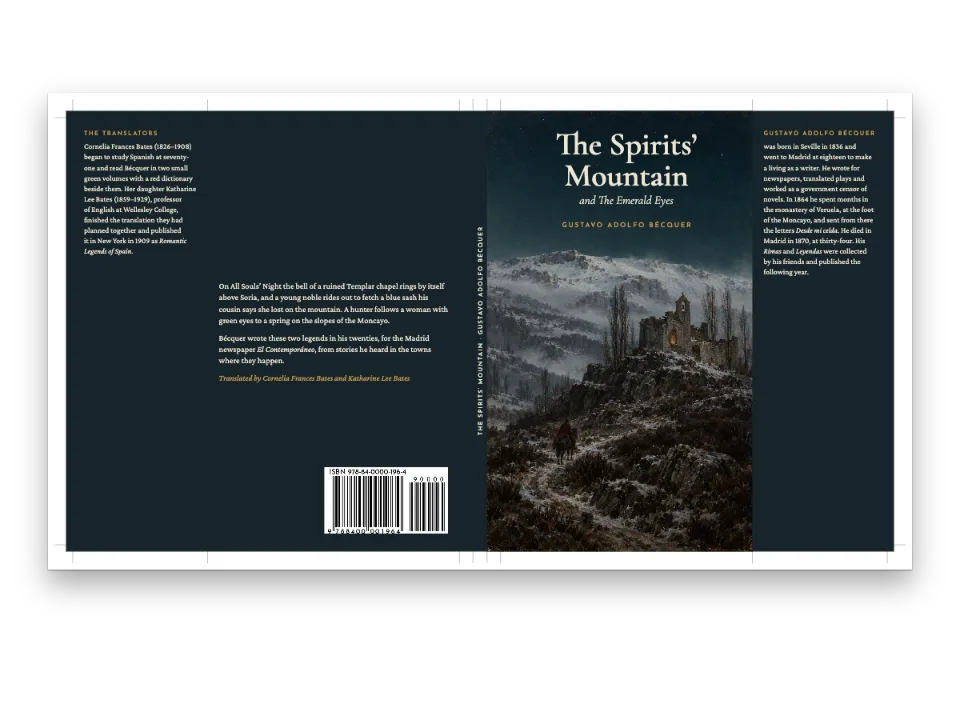
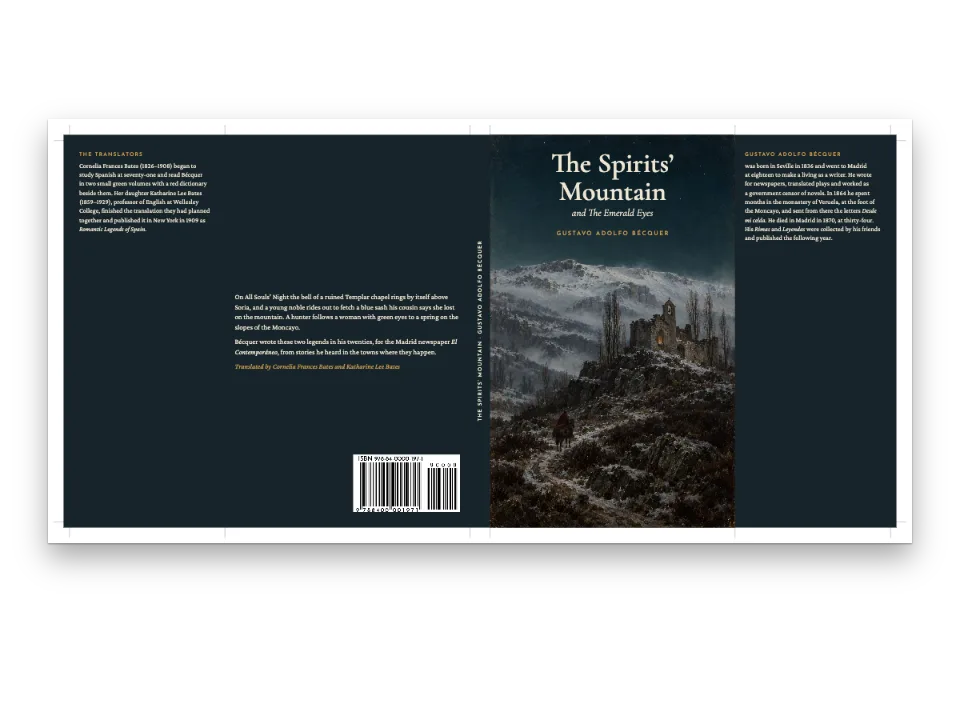
A small book of a Spanish poem and the printer's sheet for its cover. Parts of the cover are finished after printing: a shiny coat on the picture, a gold frame in foil and shapes raised from the board.
What you'll build
Jorge Manrique's Coplas on the death of his father, in Longfellow's translation (the Spanish edition sets the original), as a paperback of 125 × 200 mm, and the cover sheet that goes to the finisher once the four colours are printed. Three finishes are laid on it. A spot gloss varnish covers the painting above and below the title panel. The double frame of the cartouche is stamped in gold foil, and the panel inside it is embossed, so the title stands on a raised field. On the back a lozenge is blind-embossed: no ink, only the board pressed up. Under the book the pen draws the sheet four times: as it prints, with the varnish and foil plates in false colour, under a raking light, and as the Emboss plate a die-maker cuts from. The PDF is PDF/X-4 with a plate for each of them.
This recipe answers
- How do I put spot varnish, foil and an embossed title on a cover, for the printer and the binder?
The short answer
// A slim paperback: PUR perfect binding, the spine from the pages on 120 g/m² wove. The
// spine is under the 6 mm a spine is lettered from by default, so this version letters it
// from 4.5 mm.
const production = {
  bindings: [{ id: 'pur', name: 'PUR perfect binding', style: 'perfect', signature: 16,
    measures: { bleed: 3, spineAllowance: 0.5 } }],
  versions: [{ id: 'paperback', name: t({ en: 'Paperback', es: 'Rústica' }), binding: 'pur',
    isbn: '978-84-0000-199-5', spineText: { minSpine: 4.5 } }],
};
const folio = { paper: { type: 'bookWove', grammage: 120, bulk: 2.2, shade: '#f7f1e3' } };
const cover = {
  background: col('ground'),
  elements: [
    { id: 'art', kind: 'image', zone: 'front', x: 0, y: -3, width: 128, height: 206,
      resourceId: 'river', fit: 'cover' },
    // The title's panel, a shade darker than the ground, and the frame round it. The frame
    // prints nothing in four colours (it has the panel's colour): the foil plate carries it.
    { id: 'panel', kind: 'shape', zone: 'front', x: 14, y: 77, width: CW, height: CH,
      color: col('panel'), path: [{ closed: true, nodes: contour(0, 6) }] },
    { id: 'cartouche', kind: 'shape', zone: 'front', x: 14, y: 77, width: CW, height: CH,
      color: col('panel'), path: cartouche },
  ],
  finishes: [
    // A spot gloss over the painting above and below the panel, 4 mm clear of it, so the
    // varnish never lies on the foil. The back and the spine stay matt.
    ...[[-3, 76], [127, 76]].map(([y, height], i) => ({ id: `gloss-${i + 1}`, process: 'varnish',
      ink: col('varnish'), shape: { box: { zone: 'front', x: 0, y, width: 128, height } } })),
    // Gold foil on the frame, and the whole panel embossed: the title prints on a raised
    // field, the foil stamped round its edge.
    { id: 'gold', process: 'foil', ink: col('foil'), shape: { element: 'cartouche' } },
    { id: 'relief', process: 'emboss', shape: { element: 'panel' } },
    // A blind emboss: no ink and no foil, only the paper raised.
    { id: 'emblem', process: 'emboss', shape: { outline: emblem,
      box: { zone: 'back', x: 52.5, y: 30, width: 20, height: 20 } } },
  ],
  verticalAlign: { front: 'middle', back: 'middle' },
};
// The press file: PDF/X-4. The varnish and the foil are spot inks with a finish, each on
// its plate; the emboss goes on a plate named Emboss, beside the die line.
const print = { standard: 'pdfx4', outputProfile: 'fogra51', convertImages: false };
Three finishes, each over a shape of the cover's design
Ingredients
- Features
- Cover finishes and technical platesPrint cover sheetSpecial inksPrint versions, ISBN and spineCovers, title pages and colophonsHeading stylesDesigned openersText, rules and boxes in page designsDocument metadataParagraph stylesVerse line by lineRunning heads and foliosFigures and tables as resourcesSemantic colour palettePDF exportCMYK and grayscale PDFsPages on a canvas
- Also uses
- Paper, binding, desk and light (Folio)Heading attributesPaper colourHeads by page roleFonts embedded in the PDFRunning heads per sectionSpot inks and the ink tableUnnumbered chapters
- Type
- Alegreya, Alegreya SC, Alegreya Sans SC (SIL OFL 1.1)
- Assets
river-1100.jpg- The cover painting: a river at sunset running to the sea below a ruined castle, in oils (Generated With Diffusion Models, original)
Method
#1 · Each finish follows a shape of the design
The code is the short answer above. A finish names a process, an ink when the process prints one, and a shape: an element of the cover ({ element: 'cartouche' }), a box in one of its zones, or an outline inside a box. The varnish and the foil are spot inks with a finish in the palette, so each gets a plate of its own in the PDF and the preflight lists them. The emboss prints nothing. It goes on a technical plate the press file names Emboss, the one the die-maker works from, and nothing of it is painted on the page.
The varnish is two boxes, one above the panel and one below, each stopping 4 mm short of it, so the varnish never lies on the foil. The back and the spine stay matt. The book is 27 pages on 120 g/m² wove at a bulk of 2.2, 32 pages once bound in 16-page signatures, which gives a spine of 4.7 mm. That is under the 6 mm a spine is lettered from by default, so the version sets spineText.minSpine to 4.5. The ISBN is a sample number, assigned to no book.
#2 · The cartouche is a path of the design, not a picture
// Fractions of its box, so the frame stretches with it. Two rings, each an outer contour and
// an inner one run the other way round: the hole between them stays empty, and the foil and
// the emboss take exactly this outline.
const [CW, CH] = [97, 46]; // the cartouche's box, mm
const K = 0.5523; // a quarter circle as a cubic
function contour(inset, notch) {
  const [tx, ty, rx, ry] = [inset / CW, inset / CH, (notch + inset) / CW, (notch + inset) / CH];
  // Each corner: the point on the edge before it and on the edge after it, a hollow arc
  // between them whose handles leave each edge square.
  const corners = [
    [[1 - rx, ty], [1 - tx, ry], 'h'], [[1 - tx, 1 - ry], [1 - rx, 1 - ty], 'v'],
    [[rx, 1 - ty], [tx, 1 - ry], 'h'], [[tx, ry], [rx, ty], 'v']];
  return corners.flatMap(([[ax, ay], [bx, by], edge]) => [
    { x: ax, y: ay, out: edge === 'h' ? { x: ax, y: ay + K * (by - ay) }
      : { x: ax + K * (bx - ax), y: ay } },
    { x: bx, y: by, in: edge === 'h' ? { x: bx - K * (bx - ax), y: by }
      : { x: bx, y: by - K * (by - ay) } }]);
}
const reversed = (nodes) => nodes.slice().reverse()
  .map(({ x, y, in: i, out: o }) => ({ x, y, ...(o && { in: o }), ...(i && { out: i }) }));
const ring = (outer, inner, notch) => [{ closed: true, nodes: contour(outer, notch) },
  { closed: true, nodes: reversed(contour(inner, notch)) }];
const cartouche = [...ring(0, 1.3, 6), ...ring(2.3, 2.75, 6)];
// The emblem on the back: a lozenge with a lozenge cut out of it, as a saved outline.
const lozenge = (d) => [[0.5, d], [1 - d, 0.5], [0.5, 1 - d], [d, 0.5]].map(([x, y]) => ({ x, y }));
const emblem = [lozenge(0), lozenge(0.24).reverse()];
The foil and the emboss take exactly the outline of the element they name, so the frame has to be a shape whose path the engine knows. A cover path is a list of closed contours whose nodes are fractions of the element's box, with in and out handles for curves. Each hollow corner is a quarter circle turned inwards, drawn as a cubic. A ring is an outer contour plus an inner one run the other way round: with the nonzero rule the hole between them stays empty. Two rings make the double frame. The frame has the panel's colour, so in four colours it prints nothing; the foil plate carries it. The emblem on the back is a saved outline, two lozenges, the smaller one reversed.
#3 · The cover's type
const style = (id, fontFamily, size, lead, color, extra) => ({ id, fontFamily, fontSize: pt(size),
  lineHeight: pt(lead), color, italicColor: color, firstLineIndent: mm(0), textAlign: 'left',
  hyphenation: false, ...extra });
const caps = (tracking) => ({ fontWeight: 700, letterSpacing: pt(tracking) });
const mid = { textAlign: 'center' };
const coverStyles = [
  style('cover-title', 'Alegreya SC', 40, 40, col('cream'), { ...mid, fontWeight: 500 }),
  style('cover-subtitle', 'Alegreya', 13, 17, col('cream'), { ...mid, italic: true }),
  style('cover-author', 'Alegreya Sans SC', 9, 12, col('ochre'), { ...mid, ...caps(1.6),
    marginTop: pt(9) }),
  style('cover-spine', 'Alegreya Sans SC', 7, 8, col('cream'), { ...mid, ...caps(1.1) }),
  style('cover-quote', 'Alegreya', 13, 17, col('ochre'), { ...mid, italic: true,
    marginBottom: pt(16) }),
  style('cover-blurb', 'Alegreya', 10.5, 14.5, col('cream'), { marginBottom: pt(7) }),
  style('cover-note', 'Alegreya Sans SC', 8, 11, col('ochre'), { ...caps(1.2),
    marginTop: pt(4) }),
];
cover-title, cover-subtitle, cover-author and cover-spine are the names buildCover gives the metadata it places; cover-quote, cover-blurb and cover-note are named in the cover Markdown. The front is centred on its height (verticalAlign), which puts the title inside the cartouche whatever the size of its type.
#4 · The book block
const [W, H, TOP, FOOT, INNER, OUTER, LEAD] = [125, 200, 22, 24, 19, 17, 15]; // mm, pt
const at = (to, edge, x, y, size) => ({ anchor: { to, edge }, offset: { x: mm(x), y: mm(y) },
  ...(size && { size }) });
const text = (id, content, look, place) => ({ kind: 'text', id, content, align: 'center',
  overflow: 'wrap', placement: place, ...look });
const face = (fontFamily, size, color, x) => ({ fontFamily, fontSize: pt(size), color, ...x });
const label = (size, color = col('muted')) => face('Alegreya Sans SC', size, color, caps(size / 6));
const sc = (size, extra) => face('Alegreya SC', size, col('ink'), { fontWeight: 500, ...extra });
const none = { header: { elements: [] }, footer: { elements: [] }, numbered: false, toc: false };
const design = (minHeight, elements) => ({ enabled: true, minHeight: mm(minHeight),
  slot: { elements } });
const page = (parity) => ({ breakBefore: { enabled: true, parity } });
const rule = (id, y, to = 'page') => ({ kind: 'rule', id, direction: 'horizontal',
  thickness: pt(0.6), color: col('accent'), placement: at(to, 'top', 0, y, { width: mm(12) }) });
const headingStyles = [
  { ...none, id: 'half-title', advancedDesign: design(60, [
    text('t', '{title}', sc(18), at('page', 'top', 0, 64))]) },
  { ...none, ...page('odd'), id: 'title-page', advancedDesign: design(H - TOP - FOOT, [
    text('t', '{title}', sc(34), at('page', 'top', 0, 50)),
    text('s', '{subtitle}', face('Alegreya', 13, col('ink'), { italic: true }),
      at('page', 'top', 0, 66)),
    rule('r', 76),
    text('a', '{author}', label(8.5, col('accent')), at('page', 'top', 0, 81)),
    text('c', '{attr.credit}', face('Alegreya', 9.5, col('muted'), { italic: true }),
      at('page', 'top', 0, 120, { width: mm(76) })),
    text('i', '{attr.imprint}', label(7.5), at('page', 'bottom', 0, -28)),
  ]) },
  { ...none, ...page('even'), id: 'rights',
    advancedDesign: design(92, [rule('r', 86, 'container')]) },
  // The poem opens on a recto, sunk 46 mm, its title in small capitals over a short rule.
  { ...page('odd'), id: 'poem', toc: false, header: { elements: [] }, advancedDesign: design(46, [
    text('t', '{titleText}', sc(19), at('container', 'top', 0, 18)),
    text('n', '{attr.note}', face('Alegreya', 10.5, col('muted'), { italic: true }),
      at('container', 'top', 0, 28, { width: mm(80) })),
    rule('r', 38, 'container')]) },
  { ...none, ...page('odd'), id: 'colophon', advancedDesign: design(64, [
    rule('r', 56, 'container')]) },
];
const head = (id, content, parity) => text(id, content, { ...label(6.8), parity, pages: 'body' },
  at('page', 'top', 0, 11));
Half title, title page, rights, then the poem from a recto 46 mm down, set as verse that keeps each stanza on one page. The running heads carry the author on the verso and the title on the recto. The colophon closes the book on the last recto.
#5 · The sheet is built from the laid-out pages
const built = buildCover({ config, version: 'paperback', pages: book.pages, markdown: coverText,
  metadata: book.metadata, resources });
if (!('config' in built)) throw new Error(built.issues.map((i) => i.kind).join(', '));
// The barcode's digits name OCR-B, which no font server has: the label face sets them.
for (const [id, bytes] of Object.entries(built.files)) {
  await loadSvg(id, new TextDecoder().decode(bytes)
    .replace(/font-family="[^"]*"/g, 'font-family="Alegreya Sans SC"'));
}
const sheet = await buildDocumentWithFonts(built.content, built.config, kitFonts(FONTS));
buildCover takes the pages, the metadata and the cover Markdown and returns a document for buildDocumentWithFonts, plus the barcode as an SVG. The barcode's digits ask for OCR-B, which no font server has, so the pen sets them in Alegreya Sans SC, already loaded.
#6 · What each plate covers
// 'flat' paints the inks: the foil in its colour, the varnish and the emboss not at all.
// 'map' marks the special plates in false colour over a faded sheet, 'sheen' rakes a light
// across it. The emboss plate is drawn from the page's technical plates, the outlines the
// PDF fills on its Emboss separation.
const leaf = sheet.pages[0];
const scale = 1100 / leaf.width;
const outline = (ctx, paths) => {
  ctx.beginPath();
  for (const c of paths.flat()) {
    if (c.op === 'M') ctx.moveTo(c.x, c.y);
    else if (c.op === 'L') ctx.lineTo(c.x, c.y);
    else if (c.op === 'C') ctx.bezierCurveTo(c.x1, c.y1, c.x2, c.y2, c.x, c.y);
    else if (c.op === 'Q') ctx.quadraticCurveTo(c.x1, c.y1, c.x, c.y);
    else ctx.closePath();
  }
  ctx.fill('nonzero');
};
const VIEWS = [
  ['flat', t({ en: 'As it prints', es: 'Como se imprime' })],
  ['map', t({ en: 'The varnish and foil plates', es: 'Las planchas de barniz y oro' })],
  ['sheen', t({ en: 'Under a raking light', es: 'Con luz rasante' })],
  ['emboss', t({ en: 'The Emboss plate', es: 'La plancha de gofrado' })],
];
const views = document.createElement('section');
views.id = 'finish-views';
views.style.cssText = 'display: grid; grid-template-columns: repeat(2, minmax(0, 560px)); '
  + 'gap: 18px; justify-content: center; padding: 24px max(16px, calc(50% - 520px)); color: #ddd; '
  + 'font: 14px sans-serif';
for (const [mode, name] of VIEWS) {
  const [figure, canvas, caption] = ['figure', 'canvas', 'figcaption']
    .map((tag) => document.createElement(tag));
  figure.style.margin = '0';
  canvas.style.cssText = 'display: block; width: 100%';
  canvas.setAttribute('role', 'img');
  canvas.setAttribute('aria-label', `${t({ en: 'The cover sheet', es: 'El pliego' })}: ${name}`);
  renderPageToCanvas(leaf, sheet, canvas, { scale, finishes: mode === 'emboss' ? 'flat' : mode });
  if (mode === 'emboss') {
    // The die-maker's film: the plate in black on white, the sheet faded under it.
    const ctx = canvas.getContext('2d');
    ctx.setTransform(1, 0, 0, 1, 0, 0);
    ctx.fillStyle = 'rgba(255, 255, 255, 0.86)';
    ctx.fillRect(0, 0, canvas.width, canvas.height);
    ctx.setTransform(scale, 0, 0, scale, 0, 0);
    ctx.fillStyle = '#111';
    outline(ctx, (leaf.plates ?? []).flatMap((p) => p.paths));
  }
  caption.textContent = name;
  figure.append(canvas, caption);
  views.append(figure);
}
// What the preflight reads from the sheet: its spot plates and the reliefs it checks.
const spots = preflightDocument(sheet).find((i) => i.kind === 'spotInks');
const list = document.createElement('p');
list.style.cssText = 'grid-column: 1 / -1; margin: 0; text-align: center';
list.textContent = `${t({ en: 'Plates beside CMYK', es: 'Planchas además de CMYK' })}: `
  + [...(spots?.inks ?? []), ...new Set((leaf.plates ?? [])
    .map((p) => `${p.process[0].toUpperCase()}${p.process.slice(1)}`))].join(' · ');
views.append(list);
document.getElementById('pages').before(views);
renderPageToCanvas has three ways of painting finishes. flat paints the inks as the press lays them: the foil in its colour, the varnish not at all. map fades the sheet and marks each special plate in false colour. sheen rakes a light across the sheet, so the varnish and the foil catch it. The emboss is on none of the three, since it prints nothing; the fourth view draws the page's technical plates (page.plates) in black over a faded sheet, the outlines the PDF fills on its Emboss separation. The line under the views reads the spot inks from preflightDocument and the processes from the plates.
The whole recipe
// ═══ Postext Cookbook · Nº 199 · A cover in foil, spot varnish and emboss ═══════════════
// https://postext.dev/en/cookbook/cover-foil-varnish-emboss
// Code: MIT · Text: Manrique, tr. H. W. Longfellow (public domain) · Art: diffusion models
// Fonts: Alegreya, Alegreya SC, Alegreya Sans SC (SIL OFL 1.1) · Needs postext ≥ 1.92.0
//
// Manrique's Coplas as a slim paperback whose cover goes to the finisher after the press: a
// spot gloss over the painting, a gold-foil cartouche stamped over an emboss of the same
// shape, and a blind emboss on the back. Each finish is a shape of the cover's design; the
// varnish and the foil get spot plates of their own, the emboss a plate that prints nothing.
import { buildDocumentWithFonts, renderPageToCanvas, registerResourceImage, inlineSvgFonts,
  preflightDocument } from 'https://esm.sh/postext';
import { buildCover } from 'https://esm.sh/postext/production';
import { renderToPdf, decompressWoff2 } from 'https://esm.sh/postext-pdf';

const LANG = 'en'; // @lang: the language of the sample document ('en' | 'es')
const RECIPE = 'cover-foil-varnish-emboss';

// ─── 1 · Design ─────────────────────────────────────────────────────────────
// The pages' four colours, then the cover's: a bottle-green ground and its darker panel.
const palette = { ink: '#262320', accent: '#8a3b2a', muted: '#6d655b', paper: '#fbf7ef',
  ground: '#1d2b27', panel: '#15201d', cream: '#efe5cf', ochre: '#c8a15a' };
// The two inks the finisher is asked for: spot colours that each make a plate of their own.
const spot = (hex, name, cmyk, kind) => ({ hex, model: 'spot',
  spot: { name, cmyk, finish: { kind, sheen: 'gloss' } } });
const inks = { foil: spot('#b8963e', 'Gold foil', { c: 0, m: 20, y: 60, k: 25 }, 'foil'),
  varnish: spot('#eef0e6', 'Gloss varnish', { c: 0, m: 0, y: 0, k: 0 }, 'varnish') };
const col = (id) => (inks[id] ? { ...inks[id], paletteId: id }
  : { hex: palette[id], model: 'hex', paletteId: id });
const colorPalette = [
  ...Object.entries(palette).map(([id, hex]) => ({ id, name: id, value: { hex, model: 'hex' } })),
  ...Object.entries(inks).map(([id, value]) => ({ id, name: value.spot.name, value })),
  { id: 'main-color', name: 'accent (defaults)', value: { hex: palette.accent, model: 'hex' } },
];

// #region art: the cartouche, a frame with hollow corners, drawn as a shape of the design
// Fractions of its box, so the frame stretches with it. Two rings, each an outer contour and
// an inner one run the other way round: the hole between them stays empty, and the foil and
// the emboss take exactly this outline.
const [CW, CH] = [97, 46]; // the cartouche's box, mm
const K = 0.5523; // a quarter circle as a cubic
function contour(inset, notch) {
  const [tx, ty, rx, ry] = [inset / CW, inset / CH, (notch + inset) / CW, (notch + inset) / CH];
  // Each corner: the point on the edge before it and on the edge after it, a hollow arc
  // between them whose handles leave each edge square.
  const corners = [
    [[1 - rx, ty], [1 - tx, ry], 'h'], [[1 - tx, 1 - ry], [1 - rx, 1 - ty], 'v'],
    [[rx, 1 - ty], [tx, 1 - ry], 'h'], [[tx, ry], [rx, ty], 'v']];
  return corners.flatMap(([[ax, ay], [bx, by], edge]) => [
The composed script.js runs as it is: paste it into any page’s module script, or open the recipe on CodePen. Recipe folder on GitHub ↗ (opens in a new tab)
Variations
#Deboss the emblem
A deboss presses the shape into the board instead of raising it, and goes on a Deboss plate of its own.
-    { id: 'emblem', process: 'emboss', shape: { outline: emblem,
+ { id: 'emblem', process: 'deboss', shape: { outline: emblem,#Varnish the whole painting
One finish on the painting's element replaces the two boxes. The varnish then runs over the panel and the title as well.
-    ...[[-3, 76], [127, 76]].map(([y, height], i) => ({ id: `gloss-${i + 1}`, process: 'varnish',
-      ink: col('varnish'), shape: { box: { zone: 'front', x: 0, y, width: 128, height } } })),
+ { id: 'gloss', process: 'varnish', ink: col('varnish'), shape: { element: 'art' } },Pitfalls
- An emboss or deboss closer than 3 mm to the trim or to a fold is flagged by the preflight (
reliefTrim,reliefFold): the board cracks there. Keep reliefs off the spine folds. - The emboss is never painted on screen. Check it in the PDF's Emboss separation, or draw
page.platesas the pen does. - A finish laid over a frame of text covers its lines in the views and in the press file alike. Leave some of the text clear of the foil, as the title here sits in the cartouche's hole.
Credits
- Recipe
- Ignacio Ferro
- Text
- Coplas de Manrique, translated by Henry Wadsworth Longfellow (1833), from The Complete Poetical Works of Henry Wadsworth Longfellow (Household Edition, 1902), Project Gutenberg eBook #1365 · Jorge Manrique · public domain
- Coplas por la muerte de su padre, from the first critical edition by R. Foulché-Delbosc (1902), Project Gutenberg eBook #49333, spelling and punctuation modernised · Jorge Manrique · public domain
- Images
- The cover painting: a river at sunset running to the sea below a ruined castle, in oils · Generated With Diffusion Models · original
- Fonts
- Alegreya (SIL OFL 1.1) · Alegreya SC (SIL OFL 1.1) · Alegreya Sans SC (SIL OFL 1.1)
Edit this write-up ↗ (opens in a new tab)Recipe folder on GitHub ↗ (opens in a new tab)