In short
A small hardback of a Poe story whose patterned cover has an oval hole in it. Through the hole you see the face of the portrait printed on the title page beneath.
What you'll build
The Oval Portrait, Edgar Allan Poe's tale of 1842 in the shorter text he printed in 1845, as a ten-page hardback on 130 × 195 mm. The cover is an old damask with an oval window cut through it. Under the cover lies the title page, the portrait itself in its gilded Moorish frame, and the window is placed so its edge falls on the gilt: closed, the book shows the painted face framed twice, once by the gold and once by the cut. The tale follows on cream paper with a drop cap, and the back cover repeats the damask with the copy on a dark panel. The press file carries the window's outline on a plate of its own.
This recipe answers
- How do I cut a window in a cover that frames the title page beneath?
- How do I send the die-maker a die line on its own plate in the PDF?
The short answer
// The window is cut through the first leaf, so the closed book shows page 3 through it.
// Its size is measured on the title-page painting: a little wider than the frame's opening,
// so the cut edge falls on the gilt and the face sits in the middle of the hole.
const dieCuts = {
  shapes: [{ id: 'window', name: t({ en: 'Oval window', es: 'Ventana oval' }),
    shape: 'ellipse', x: mm(26), y: mm(15.7), width: mm(78), height: mm(102) }],
  pages: [{ pages: '1', die: 'window' }], // page 1, the front board
};
One oval die through the cover, in register with the frame beneath
Ingredients
- Features
- Die-cut holesDie line in the PDF3D book viewer (Folio)Heading stylesPictures in page designsText, rules and boxes in page designsDocument metadataParagraph stylesDrop caps in openersBleed and crop marksCMYK and grayscale PDFsPDF exportFigures and tables as resourcesSemantic colour palettePages on a canvas
- Also uses
- Drop caps in body paragraphsPaper, binding, desk and light (Folio)Heading attributesDesigned openersPaper colourHeads by page roleColours per partFonts embedded in the PDFSection geometryRunning heads per sectionUnnumbered chapters
- Type
- EB Garamond, Cormorant Garamond (SIL OFL 1.1)
- Assets
damask.jpgportrait.jpg- Cover and back: a pomegranate damask (Generated With Diffusion Models, original)
- Title page: the oval portrait on a velvet wall (Generated With Diffusion Models, original)
Method
#1 · A window in register with the frame
The code is the short answer above. The window is an ellipse on page 1, placed from the trim's top-left corner. A hole in page 1 looks onto page 3, so measure it on the title-page painting: here the frame's opening and its outer edge were read off the picture in pixels and turned into millimetres, and the window was set a third of the way into the gilt band, so a thin ring of gold shows inside the cut.
#2 · Paintings hung from the trim
// Both paintings are placed in trim millimetres, the same frame the die is measured in. The
// portrait is set a little larger than the page so the frame is centred on it (and on the
// window); the cover type sits on a dark cartouche below the window.
const bleed = (x, y, width, height) => ({ kind: 'image', id: 'painting',
  resourceId: '{attr.picture}', fit: 'cover', placement: at('page', 'top-left', x, y,
    { width: mm(width), height: mm(height) }) });
const sheet = bleed(-BLEED, -BLEED, WIDTH + 2 * BLEED, HEIGHT + 2 * BLEED);
const portrait = bleed(-3.6, -BLEED, 140, 210); // its oval centred at x = WIDTH / 2
const box = (id, y, h) => ({ kind: 'box', id, placement: at('page', 'top-left', 17, y,
  { width: mm(WIDTH - 34), height: mm(h) }), style: { backgroundColor: col('plate'),
  borderColor: col('gold'), borderWidth: pt(0.75) } });
const type = (id, content, y, size, extra = {}) => ({ kind: 'text', id, content,
  fontFamily: DISPLAY, fontSize: pt(size), lineHeight: 1.1, color: col('gold'),
  align: 'center', placement: at('page', 'top-left', 17, y, { width: mm(WIDTH - 34) }),
  ...extra });
const caps = { fontWeight: 600, textTransform: 'uppercase', letterSpacing: pt(2.2) };
const full = (elements) => ({ enabled: true, minHeight: mm(HEIGHT - TOP),
  slot: { elements } });
const bare = { numbered: false, toc: false, header: { elements: [] },
  footer: { elements: [] } };
// A plate's section drops the foot margin, so its design reaches the foot of the page.
const flush = (top = TOP, side = 0) => ({ margins: { top: mm(top), bottom: mm(0),
  left: mm(INNER + side), right: mm(OUTER + side) } });
const dark = { palette: { paper: palette.velvet }, marginTop: pt(0), marginBottom: pt(0) };
const behind = (el) => ({ ...el, reserve: false }); // painted under the section's text
const headingStyles = [
  { id: 'cover', ...bare, ...dark, ...flush(), advancedDesign: full([sheet,
    box('plate', 130, 44), type('title', '{title}', 138, 27, { italic: true, fontWeight: 500 }),
    type('author', '{author}', 159, 9.5, caps)]) },
  { id: 'titlepage', ...bare, ...dark, ...flush(), breakBefore: { enabled: true, parity: 'odd' },
    advancedDesign: full([portrait, type('title', '{title}', 146, 30,
      { italic: true, fontWeight: 500 }), type('author', '{author}', 166, 10, caps)]) },
  { id: 'colophon', ...bare, hidden: true, ...flush(132), breakBefore: { parity: 'any' },
    bodyStyle: { fontSize: pt(9), lineHeight: pt(12.5), color: col('muted'), textAlign: 'left' } },
  { id: 'tale', numbered: false, toc: true, breakBefore: { enabled: true, parity: 'odd' },
    marginTop: mm(30), marginBottom: pt(28),
    dropCap: { lines: 3, fontFamily: DISPLAY, color: col('ink'), gap: mm(1.2) } },
  // The back: the damask again, and the copy set in gold on a cartouche.
  { id: 'back', ...bare, ...dark, ...flush(74, 10), breakBefore: { enabled: true,
    parity: 'even' }, advancedDesign: { enabled: true, slot: { elements: [behind(sheet),
      behind(box('plate', 62, 78))] } } },
];
The die is measured in trim millimetres, so the paintings are too. The damask runs the bleed past the trim on every side; the portrait is set a few millimetres wider than that, so the frame in the picture is centred on the page and on the window. The cover and the title page drop the foot margin, so their designs reach the foot of the page, and each prints its title and author from the frontmatter.
#3 · The die line on its own plate
  print: { standard: 'pdfx4', outputProfile: 'fogra51', convertImages: false,
    dieLine: { output: 'page', ink: 'Die', width: pt(0.5) } },
The PDF prints the cover whole and strokes the window's outline on a Die separation that overprints and is never inked: the die-maker reads the shape from it and the press leaves it out. convertImages: false keeps the paintings as sRGB JPEGs, which PDF/X-4 allows, and the file stays under a megabyte.
#4 · The closed book on the desk
  folio: {
    tilt: 34, yaw: 0,
    paper: { type: 'bookWove', shade: '#f6efe2' },
    binding: { type: 'hardcover', cover: 'pages', coverMaterial: 'paper' },
    surface: { type: 'walnut' },
    lighting: { environment: 'lamp', intensity: 1.15 },
  },
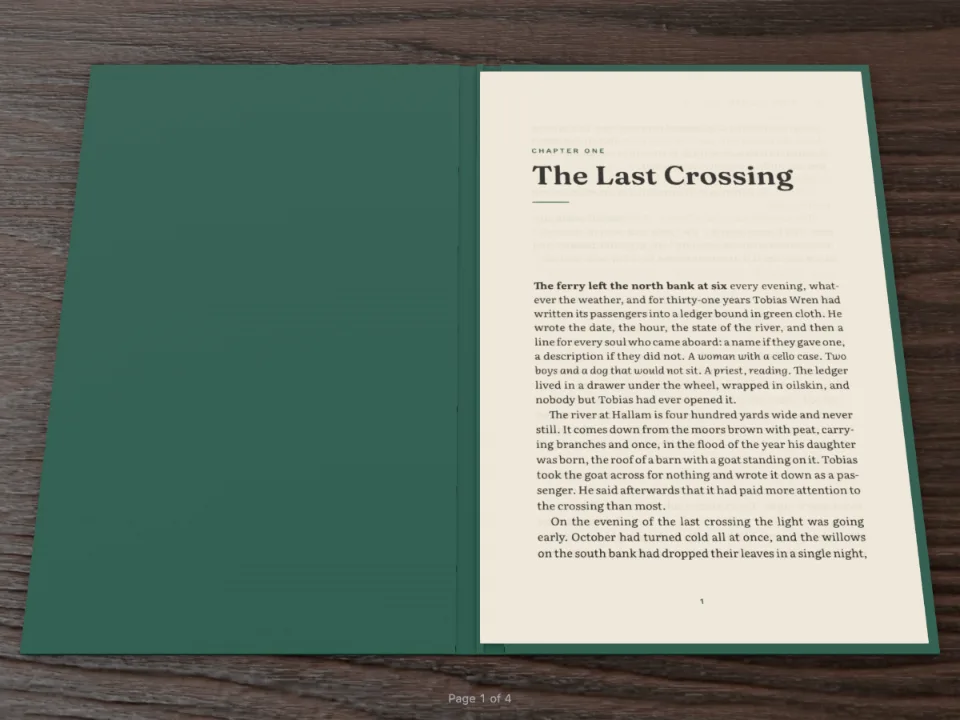
With binding.cover: 'pages' the first page is the front board, so Folio shows the book closed with the face in the window and the cut walls catching the lamp. Turn the cover to see the title page whole.
#5 · The flat cover that looks through
const under = new Map();
const beneath = (i) => {
  if (!under.has(i) && doc.pages[i]) {
    const canvas = document.createElement('canvas');
    under.set(i, canvas);
    renderPageToCanvas(doc.pages[i], doc, canvas, { scale: 1, beneath });
  }
  return under.get(i);
};
On the canvas, beneath hands the renderer page 3 for the cover's window, and the flat cover shows the face too. The inside of the cover has nothing beneath it, so its hole shows the background.
The whole recipe
// ═══ Postext Cookbook · Nº 194 · A window cover that frames the title page ═══════════════
// https://postext.dev/en/cookbook/die-cut-window-cover
// Code: MIT · Text: Poe (PD) · Translation: CC BY 4.0 · Paintings: diffusion models
// Fonts: EB Garamond, Cormorant Garamond (SIL OFL 1.1) · Needs postext ≥ 1.84.0
//
// Poe's tale of a portrait in an oval frame, as a small hardback whose damask cover has an
// oval window cut through it. Closed, the book shows the face of the portrait on the title
// page through the window; the window's edge falls on the gilt of the painted frame.
import {
  buildDocumentWithFonts, renderPageToCanvas, registerResourceImage,
} from 'https://esm.sh/postext';
import { renderToPdf, decompressWoff2 } from 'https://esm.sh/postext-pdf';
import { createFolioFromDocument } from 'https://esm.sh/postext-folio';

const LANG = 'en'; // @lang: the language of the sample document ('en' | 'es')
const RECIPE = 'die-cut-window-cover';

// ─── 1 · Design ─────────────────────────────────────────────────────────────
// #region palette: ink on cream inside; gold on a near-black for the cover and its plates
const palette = {
  ink: '#2b2320', // the text
  paper: '#f6efe2', // a cream book wove
  velvet: '#2a0d10', // the wall behind the portrait, and the endpapers
  plate: '#160c0b', // the cartouches on the damask
  gold: '#d9b36c', // the title type, the colour of the painted frame
  muted: '#6f6158', // the note on the text
};
const col = (id) => ({ hex: palette[id], model: 'hex', paletteId: id });
const colorPalette = [
  ...Object.entries(palette).map(([id, hex]) => ({ id, name: id, value: { hex, model: 'hex' } })),
  { id: 'main-color', name: 'gold (defaults)', value: { hex: palette.gold, model: 'hex' } },
];
// #endregion
const [WIDTH, HEIGHT, BLEED] = [130, 195, 3]; // mm: a small hardback, and its bleed
const [TOP, FOOT, INNER, OUTER] = [18, 24, 16, 19];
const [TEXT, DISPLAY] = ['EB Garamond', 'Cormorant Garamond'];
const at = (to, edge, x = 0, y = 0, size) => ({ anchor: { to, edge },
  offset: { x: mm(x), y: mm(y) }, ...(size && { size }) });

// #region answer: one oval die through the cover, in register with the frame beneath
// The window is cut through the first leaf, so the closed book shows page 3 through it.
// Its size is measured on the title-page painting: a little wider than the frame's opening,
// so the cut edge falls on the gilt and the face sits in the middle of the hole.
const dieCuts = {
  shapes: [{ id: 'window', name: t({ en: 'Oval window', es: 'Ventana oval' }),
    shape: 'ellipse', x: mm(26), y: mm(15.7), width: mm(78), height: mm(102) }],
  pages: [{ pages: '1', die: 'window' }], // page 1, the front board
};
The composed script.js runs as it is: paste it into any page’s module script, or open the recipe on CodePen. Recipe folder on GitHub ↗ (opens in a new tab)
Variations
#Name the plate as the cutter expects
Digital cutting tables look for a spot colour called CutContour, usually magenta, and a hairline.
-    dieLine: { output: 'page', ink: 'Die', width: pt(0.5) } },
+    dieLine: { output: 'page', ink: 'CutContour', cmyk: { c: 0, m: 100, y: 0, k: 0 },
+ width: pt(0.25) } },#A round window
A circle shows the face alone; the frame stays hidden under the cover until it is turned.
-    shape: 'ellipse', x: mm(26), y: mm(15.7), width: mm(78), height: mm(102) }],
+ shape: 'circle', x: mm(32), y: mm(24), width: mm(66), height: mm(66) }],Credits
- Recipe
- Ignacio Ferro
- Text
- The Oval Portrait, in the text of the Broadway Journal (1845), from Project Gutenberg eBook 2147, with Poe’s “rarely” for the eBook’s “merely” · Edgar Allan Poe · public domain
- The Spanish translation, the note on the text and the back-cover copy · Postext Cookbook · CC BY 4.0
- Images
- Cover and back: a pomegranate damask · Generated With Diffusion Models · original
- Title page: the oval portrait on a velvet wall · Generated With Diffusion Models · original
- Fonts
- EB Garamond (SIL OFL 1.1) · Cormorant Garamond (SIL OFL 1.1)
Edit this write-up ↗ (opens in a new tab)Recipe folder on GitHub ↗ (opens in a new tab)