What you'll build
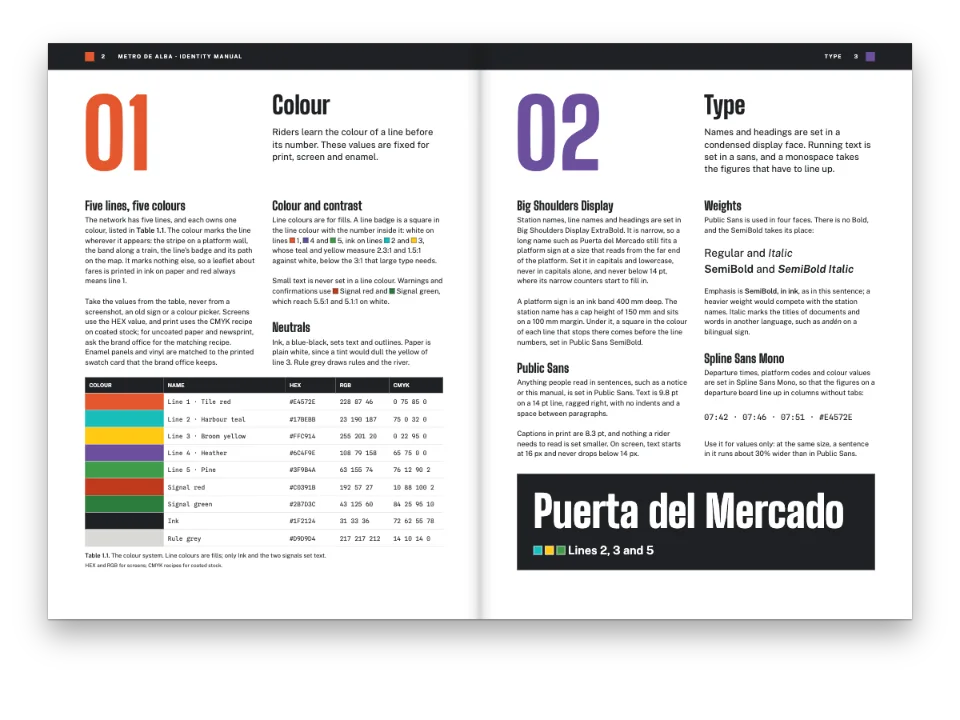
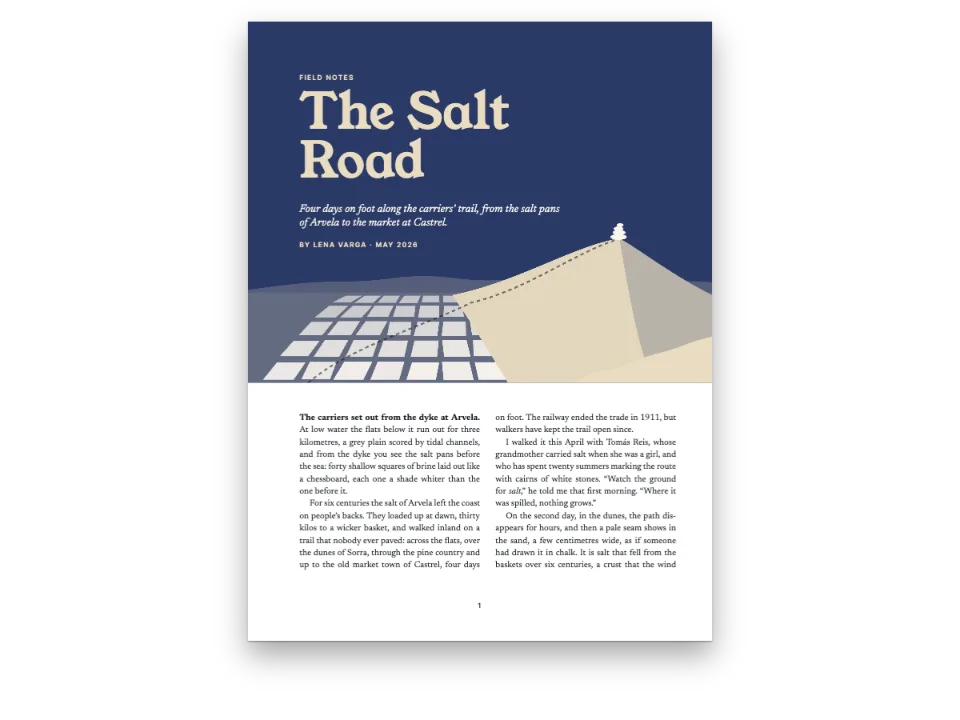
House Specimen Nº 3, from the imaginary Pellow Lane Press, is a four-page type specimen for three faces. On the cover, an ultramarine field holds a white Ag in Noto Serif Display italic at 240 pt and two mono lines that name the three faces; the title sits below the field. Page 2 runs Ysabeau Office down a waterfall from 7 to 14 pt, then sets Spanish, Polish and Czech pangrams whose ż, ř and ů need a second font file. Page 3 is the audit: an IBM Plex Mono table, filled in by the pen, of the ten faces the layout asked for and their sizes. Page 4 sets page 1's first paragraph twice, from the first build and from the last. The first build ran before the fonts had arrived, so its lines end in other places and some run past the measure.
This recipe answers
- Why do my line breaks change, or PDF words overlap, and how do I load fonts correctly?
- How do I use my own brand or licensed fonts in the layout and embed them in the PDF?
- How do I find out what is wrong with my document (warnings, overflow, non-converging layout)?
The short answer
// Every block, table, caption, chip, opener and running head keeps the font string it is set in
// (fontString, headerFontString…) and those of the bold and italics it may use (boldFontString…).
function fontStringsIn(doc) {
  const found = new Map(); // font string → true when something is set in it
  const walk = (node) => {
    if (!node || typeof node !== 'object') return;
    for (const [key, value] of Object.entries(node)) {
      if (typeof value !== 'string' || !/fontString$/i.test(key)) walk(value);
      else found.set(value, found.get(value) || !/(bold|italic)FontString$/i.test(key));
    }
  };
  walk(doc.pages); walk(doc.blocks); // not doc.config: it is large and holds no font strings
  return found;
}
function faceOf(font) { // 'italic 700 22.9px "Source Serif 4"' → { family, weight, style, px }
  const [, italic, weight = '400', px, family] = /^(italic )?(\d+ )?([\d.]+)px (.+)$/.exec(font);
  return { family: family.replaceAll('"', ''), weight: weight.trim(), px: Number(px),
    style: italic ? 'italic' : 'normal' };
}
const nameOf = (face) => `${face.family} ${face.weight} ${face.style}`; // a FontFace works too
async function buildWithLoadedFonts(build, sample) { // → every build, first to last
  const builds = [];
  while (builds.length < 4) {
    builds.push(build()); // the first one measures with whatever faces the browser has
    // fonts.check() says yes to an undeclared family and to a face it can fake, so each face that
    // something is set in needs a FontFace of its own; a bold or italic that is only named loads
    // if declared (a family with no italic has none). load() fetches the files the sample needs.
    const declared = new Set([...document.fonts].map(nameOf)), missing = new Set(), pending = [];
    for (const [font, set] of fontStringsIn(builds.at(-1))) {
      const name = nameOf(faceOf(font));
      if (!declared.has(name)) { if (set) missing.add(name); }
      else if (!document.fonts.check(font, sample)) pending.push(font);
    }
    if (missing.size) throw new Error(`No FontFace for ${[...missing].join(', ')}`);
    if (!pending.length) return builds;
    await Promise.all(pending.map((font) => document.fonts.load(font, sample)));
    clearMeasurementCache(); // the widths measured with a fallback stay cached until cleared
  }
  throw new Error(`The fonts had not settled after ${builds.length} builds.`);
}
Build, collect every font the layout asked for, load it, clear, build again
Ingredients
- Features
- Fonts before layoutBody typePages on a canvasFigures and tables as resourcesFigures exactly hereTables from dataTable styleCaption styleCustom resource typesDesigned openersHeading attributesAnchoring design elementsParagraph stylesInline chipsTrim sizeMirrored marginsSemantic colour paletteRunning heads and foliosHeads by page role
- Type
- Ysabeau Office, Noto Serif Display, IBM Plex Mono (SIL OFL 1.1)
- Assets
- None: every picture is drawn in code
Method
#1 · Declare every file without fetching it
const SUBSETS = { // the characters each file covers, copied from the family's @font-face CSS
  latin: 'U+0000-00FF,U+0131,U+0152-0153,U+02BB-02BC,U+02C6,U+02DA,U+02DC,U+0304,U+0308,U+0329,'
    + 'U+2000-206F,U+20AC,U+2122,U+2191,U+2193,U+2212,U+2215,U+FEFF,U+FFFD',
  'latin-ext': 'U+0100-02BA,U+02BD-02C5,U+02C7-02CC,U+02CE-02D7,U+02DD-02FF,U+0304,U+0308,U+0329,'
    + 'U+1D00-1DBF,U+1E00-1E9F,U+1EF2-1EFF,U+2020,U+20A0-20AB,U+20AD-20C0,U+2113,U+2C60-2C7F,'
    + 'U+A720-A7FF' };
function declareFaces(fonts) { // Fontsource's static files stand in for your own /fonts/ folder
  for (const [family, specs] of Object.entries(fonts)) {
    const id = family.toLowerCase().replaceAll(' ', '-');
    for (const spec of specs) {
      const [weight, style] = [spec.slice(0, 3), spec.endsWith('i') ? 'italic' : 'normal'];
      for (const [subset, unicodeRange] of Object.entries(SUBSETS)) {
        const file = `${id}@5/files/${id}-${subset}-${weight}-${style}.woff2`;
        // Adding a face fetches nothing: the file downloads when a load or a line needs it.
        const url = `https://cdn.jsdelivr.net/npm/@fontsource/${file}`;
        document.fonts.add(new FontFace(family, `url(${url})`, { weight, style, unicodeRange }));
      }
    }
  }
}
A FontFace is one file, as an @font-face rule is, so a face with a latin and a latin-ext file is declared with two FontFace objects that share a family, weight and style and differ in unicodeRange, copied from the family's CSS. Adding them to document.fonts downloads nothing: the browser fetches a file when a load() call or a line of text needs its characters. buildDocument loads no fonts (only loadBundleFonts does, for the files inside a .postext bundle), and customFonts in a config only describes those files, so a page built from Markdown has to declare its own.
#2 · Build, load, clear, build again
kitStatus('Loading fonts…'); // the kit's bar: it also reports any error thrown below
declareFaces(FONTS);
const build = () => buildDocument({ markdown, resources: resources() }, config());
const builds = await buildWithLoadedFonts(build, markdown);
audit = auditOf(builds); // page 3's table
drawProof(builds[0], builds.at(-1)); // page 4's picture
const doc = (await buildWithLoadedFonts(build, markdown)).at(-1); // nothing is left to load
showPages(doc, { title: 'Load every font before layout' });
The first build measures with whatever the browser holds, a fallback face, but its pages already name every font they need. buildWithLoadedFonts, the short answer above, collects those names from each build, loads the faces still missing with the booklet's text as the sample, and builds again until a build finds nothing left to load. That sample also fetches the latin-ext files of the display and mono faces, which set none of those letters; if the download size matters, load each face with its own text only. clearMeasurementCache() takes no argument and empties the widths the first build cached; without it the second build keeps every line break of the first (see Variations).
#3 · Build the audit from the layout
function auditOf(builds) {
  const doc = builds.at(-1), faces = new Map(), declared = new Set([...document.fonts].map(nameOf));
  for (const face of [...fontStringsIn(doc).keys()].map(faceOf)) {
    const name = `${face.weight}${face.style === 'italic' ? ' italic' : ''}`; // '400 italic'
    const key = `${Object.keys(FONTS).indexOf(face.family)} ${name}`; // FONTS order, upright first
    // A face with no file is only named, never set: the browser fakes it if a line asks for it.
    if (!faces.has(key)) faces.set(key, { family: face.family, sizes: new Set(),
      face: declared.has(nameOf(face)) ? name : `${name} · no file` });
    faces.get(key).sizes.add(Math.round((face.px * 72 * 10) / DPI) / 10); // px back to pt
  }
  const rows = [...faces].sort(([a], [b]) => a.localeCompare(b)).map(([, f], i, all) => [
    i && all[i - 1][1].family === f.family ? '' : f.family, // each family named once
    f.face, [...f.sizes].sort((a, b) => a - b).join(' · ')].map((content) => ({ content })));
  const files = [...document.fonts].filter((face) => face.status === 'loaded').length;
  const warnings = doc.warnings?.length || 'no'; // what else to read in a finished layout
  return { rows, note: `Build ${builds.length}: ${rows.length} faces · ${files} files loaded · `
    + `${doc.converged ? 'converged' : 'not converged'} · ${warnings} layout warnings` };
}
The table is the same walk grouped by face, with each size converted from the layout's pixels back to points. Its note reads two more fields of the build it describes: converged, true when the layout's passes settled, and warnings, which in 1.4.1 lists each box that fits no column. Check both before you show or export a page. The table holds more faces than the pages show, because every text block, table and caption names a bold, an italic and a bold italic beside its own face, and renderToPdf asks for all of them. The short answer requires a FontFace of its own for every face something is set in, because document.fonts.check() returns true for an undeclared family and for a bold the browser can fake. A face that is only named loads when it is declared: a family with no italic file passes, and the table would mark its italics no file.
#4 · Keep the first build as evidence
const STRIP = { lines: 8, overrun: 10 }; // page 1's first paragraph; mm shown past the measure
const PROOF = { // px: two strips a lead apart, cut at 300 dpi
  width: Math.round(((MEASURE + STRIP.overrun) / 25.4) * 2 * DPI),
  height: Math.round((((2 * STRIP.lines + 1) * LEAD) / 72) * 2 * DPI) };
const proof = { moved: 0, total: 0 }; // lines of text the first build broke elsewhere, of all
const proofFigure = () => ({ id: 'proof', typeId: 'figure', kind: 'bitmap', createdAt: 0,
  updatedAt: 0, placement: here,
  bitmap: { fileId: 'proof.png', format: 'png', width: PROOF.width, height: PROOF.height },
  caption: 'The first paragraph of page 1 as the first build set it, measured before the fonts '
    + 'had arrived (above), and as the last build set it (below). The first build broke '
    + `${proof.moved} of its ${proof.total} lines of text elsewhere. The rule marks the measure.`,
  altText: `Two strips of the same ${STRIP.lines} lines of text. In the upper strip the lines `
    + 'break in other places and some run past a vertical rule; in the lower one every line '
    + 'stops short of it.' });
function drawProof(first, last) {
  const linesOf = (doc) => doc.blocks.filter((b) => b.type === 'paragraph')
    .map((b) => b.lines.map((l) => l.text));
  const [before, after] = [first, last].map(linesOf);
  proof.total = before.flat().length;
  proof.moved = before.flatMap((lines, i) => lines.filter((t, j) => t !== after[i]?.[j])).length;
  const canvas = Object.assign(document.createElement('canvas'), PROOF);
  const ctx = canvas.getContext('2d');
  const strip = (PROOF.height * STRIP.lines) / (2 * STRIP.lines + 1);
  const edge = Math.round((PROOF.width * MEASURE) / (MEASURE + STRIP.overrun));
  // The renderer clips each column 2 pt past its edge, which would cut the first build's lines
  // at the measure: paint a copy of page 1 whose column reaches across the whole strip.
  const wide = (column) => ({ ...column,
    bbox: { ...column.bbox, width: column.bbox.width + (STRIP.overrun / 25.4) * DPI } });
  [first, last].forEach((doc, i) => {
    const page = document.createElement('canvas');
    renderPageToCanvas({ ...doc.pages[0], columns: doc.pages[0].columns.map(wide) }, doc, page,
      { scale: 2 }); // 300 dpi
    const { x, y } = doc.pages[0].columns[0].blocks.find((b) => b.type === 'paragraph').bbox;
    ctx.drawImage(page, 2 * x, 2 * y, PROOF.width, strip,
      0, i * (PROOF.height - strip), PROOF.width, strip);
  });
  ctx.fillStyle = `${palette.ultramarine}1f`; // a pale wash over the margin past the measure
  ctx.fillRect(edge, 0, PROOF.width - edge, PROOF.height);
  ctx.fillStyle = palette.ultramarine; // a hairline at the measure, and each strip's name
  ctx.fillRect(edge, 0, 2, PROOF.height);
  ctx.font = `700 ${(7 / 72) * 2 * DPI}px "IBM Plex Mono"`; // 7 pt, loaded by now
  ['first', 'last'].forEach((name, i) => // on the last line of each strip
    ctx.fillText(name, edge + 12, (i ? PROOF.height : strip) - 16));
  registerResourceImage('proof.png', canvas);
}
buildWithLoadedFonts returns every build, so the pen can paint the first one again once the real faces are in and compare it line by line with the last; the count in the caption comes from that comparison. A plain line measured in a narrower fallback runs past the measure until the column's clip, 2 pt past its edge, cuts off its last letters, so the pen paints page 1 with a widened column to show the whole overrun. The canvas and postext-pdf draw each run of a justified or mixed-style line where the layout measured it, so a real face wider than the fallback prints over the next word, and the words of a PDF built before its fonts arrived overlap.
#5 · A waterfall on the text's rhythm
const bodyText = () => ({ // one family name, never a CSS stack (gotcha: font-family-one-name)
  fontFamily: TEXT, fontSize: pt(11), lineHeight: pt(LEAD), color: col('ink'),
  boldColor: col('ink'), italicColor: col('ink'), referenceColor: col('ink'),
  textAlign: 'left', firstLineIndent: pt(0), paragraphSpacing: true }); // ragged and spaced
// Every waterfall size and pangram is two leads (31 pt) deep, on the text's 15.5 pt rhythm.
const line = (size) => ({ fontSize: pt(size), lineHeight: pt(2 * LEAD) });
const paragraphStyles = () => [
  ...[7, 8, 9, 10, 11, 12, 14].map((size) => ({ id: `s${size}`, ...line(size) })),
  { id: 'pangram', ...line(13) },
  { id: 'colophon', fontSize: pt(7), lineHeight: pt(10), fontFamily: MONO, color: col('muted') }];
// Size labels: boxless mono chips. A Plex Mono letter is 0.6 em wide, so a one-digit label gets
// half a letter each side and the samples start on one edge.
const tag = { fontFamily: MONO, fontSize: pt(7), color: col('ultramarine'),
  backgroundEnabled: false, borderWidth: pt(0), paddingX: pt(0), gap: mm(2.5) };
const chipStyles = () => [{ id: 'size', ...tag }, { id: 'size-1', ...tag, paddingX: em(0.3) }];
Ysabeau Office sets the text at 11 on 15.5 pt, with a blank line between paragraphs instead of an indent. The text is ragged, so every word space keeps its natural width. Bold, italic and references are set in ink; left alone, they would take the main colour. Every waterfall size and pangram is a paragraph style two leads (31 pt) deep, so the page keeps the text's 15.5 pt rhythm. The size labels are mono chips, and the one-digit sizes get half a letter of padding on each side, so every sample starts on the same edge.
#6 · Three faces on one cover
const Y = { kicker: 14, glyphs: 17, label: FIELD - 12, title: FIELD + 10, // mm from the top edge
  end: FIELD + 42 }; // where the opener ends: under the title, the lead and a line of air
const ITALIC_FOOT = 5; // mm: the italic A's foot reaches this far left of the glyphs' origin
const at = (x, y, width) => ({ anchor: { to: 'page', edge: 'top-left' },
  offset: { x: mm(x), y: mm(y) }, ...(width && { size: { width: mm(width) } }) });
const text = (id, content, style, placement) => ({ kind: 'text', id, content, align: 'left',
  overflow: 'wrap', ...style, placement }); // design text wraps instead of ending in an ellipsis
const cover = () => ({ level: 1, fontSize: pt(30), italic: true, // headings.levels[0]
  breakBefore: { enabled: true, parity: 'odd' }, // restated (gotcha: headings-drop-h1-break)
  span: 'page', // lets the field reach the top edge: in the column it stops at the top margin
  advancedDesign: { enabled: true, minHeight: mm(Y.end - MARGIN.top), // from the top margin
    slot: { elements: [
      { kind: 'box', id: 'field', style: { backgroundColor: col('ultramarine') }, placement: {
        anchor: { to: 'bleed', edge: 'top-left' }, size: { width: 'fill', height: mm(FIELD) } } },
      text('kicker', '{attr.kicker}', { ...label, fontWeight: 700, color: col('paper') },
        at(MARGIN.inner, Y.kicker)),
      // lineHeight multiplies the size (gotcha: design-lineheight-multiple)
      text('glyphs', '{attr.glyphs}', { ...display, fontSize: pt(240), lineHeight: 1,
        color: col('paper') }, at(MARGIN.inner + ITALIC_FOOT, Y.glyphs)),
      text('label', '{attr.label}', { ...label, color: col('mist') }, at(MARGIN.inner, Y.label)),
      text('faces', '{attr.faces}', { ...label, color: col('mist') },
        { anchor: { to: '#label', edge: 'below' }, offset: { y: mm(1.2) } }),
      text('title', '{titleText}', { ...display, fontSize: pt(30), lineHeight: 1.05,
        color: col('ink') }, at(MARGIN.inner, Y.title, PAGE.width - 2 * MARGIN.inner)),
      text('lead', '{attr.lead}', { fontFamily: TEXT, italic: true, fontSize: pt(12),
        lineHeight: 1.35, color: col('ink') }, { anchor: { to: '#title', edge: 'below' },
        offset: { y: mm(3) }, size: { width: mm(MEASURE) } }),
    ] } } });
The cover is the H1 level's design: the letters of the heading's glyphs attribute in the display face at 240 pt, and under them two mono lines that name that face and the text and label faces, as on a type foundry's specimen sheet. span: 'page' lets the bleed-anchored field run off the top edge; kept in the column, the design is clipped at the top margin, which cuts off the head of the field and the kicker. minHeight counts from the top margin and reserves the room down to Y.end, 42 mm below the field; without it the text starts a line higher, tight under the lead.
The whole recipe
// ═══ Postext Cookbook · Nº 026 · Type specimen with every font loaded before layout ═════════ // https://postext.dev/en/cookbook/fonts-before-layout // Code: MIT · Text: original (CC BY 4.0) · Picture: cut from the pen's own first and last builds // Fonts: Ysabeau Office, Noto Serif Display, IBM Plex Mono (SIL OFL 1.1) · Needs postext ≥ 1.4.1 import { buildDocument, renderPageToCanvas, clearMeasurementCache, defaultResourceTypes, registerResourceImage } from 'https://esm.sh/postext'; const LANG = 'en'; // @lang: the language of the sample document ('en' | 'es') const RECIPE = 'fonts-before-layout'; // ─── 1 · Design ───────────────────────────────────────────────────────────── const PAGE = { width: 180, height: 240 }; // mm const MARGIN = { top: 22, bottom: 24, inner: 20, outer: 48 }; // mm: inner is the spine side const MEASURE = PAGE.width - MARGIN.inner - MARGIN.outer; // 112 mm: about 70 letters at 11 pt const FIELD = 122; // mm from the top edge: the ultramarine field of the opener const LEAD = 15.5; // pt: the body leading and the step of every vertical space const DPI = 150; // font strings carry px at this resolution; the audit turns them back into pt const [TEXT, DISPLAY, MONO] = ['Ysabeau Office', 'Noto Serif Display', 'IBM Plex Mono']; const palette = { ink: '#16161a', ultramarine: '#3246d3', mist: '#c9d0f6', // mist: 4.6:1 on rule: '#cfc9bd', muted: '#6b6a70', paper: '#ffffff' }; // ultramarine, for labels on the field // Every colour keeps its palette id beside its hex, because 1.4.1 paints design slots from the // hex (gotcha: palette-skips-designs); main-color catches any default left unstated. const col = (id) => ({ hex: palette[id], model: 'hex', paletteId: id }); const colorPalette = () => Object.entries({ ...palette, 'main-color': palette.ultramarine }) .map(([id, hex]) => ({ id, name: id, value: { hex, model: 'hex' } })); const label = { fontFamily: MONO, fontSize: pt(7.5), letterSpacing: pt(1.2), textTransform: 'uppercase' }; const display = { fontFamily: DISPLAY, fontWeight: 900, italic: true }; // #region type: the text face at 11 on 15.5 pt, and a waterfall of it on two leads a line const bodyText = () => ({ // one family name, never a CSS stack (gotcha: font-family-one-name) fontFamily: TEXT, fontSize: pt(11), lineHeight: pt(LEAD), color: col('ink'), boldColor: col('ink'), italicColor: col('ink'), referenceColor: col('ink'), textAlign: 'left', firstLineIndent: pt(0), paragraphSpacing: true }); // ragged and spaced // Every waterfall size and pangram is two leads (31 pt) deep, on the text's 15.5 pt rhythm. const line = (size) => ({ fontSize: pt(size), lineHeight: pt(2 * LEAD) }); const paragraphStyles = () => [ ...[7, 8, 9, 10, 11, 12, 14].map((size) => ({ id: `s${size}`, ...line(size) })), { id: 'pangram', ...line(13) }, { id: 'colophon', fontSize: pt(7), lineHeight: pt(10), fontFamily: MONO, color: col('muted') }]; // Size labels: boxless mono chips. A Plex Mono letter is 0.6 em wide, so a one-digit label gets // half a letter each side and the samples start on one edge. const tag = { fontFamily: MONO, fontSize: pt(7), color: col('ultramarine'), backgroundEnabled: false, borderWidth: pt(0), paddingX: pt(0), gap: mm(2.5) }; const chipStyles = () => [{ id: 'size', ...tag }, { id: 'size-1', ...tag, paddingX: em(0.3) }]; // #endregion // #region opener: the H1 as a bleed field, the display face at 240 pt, labels naming the faces const Y = { kicker: 14, glyphs: 17, label: FIELD - 12, title: FIELD + 10, // mm from the top edge end: FIELD + 42 }; // where the opener ends: under the title, the lead and a line of air const ITALIC_FOOT = 5; // mm: the italic A's foot reaches this far left of the glyphs' origin const at = (x, y, width) => ({ anchor: { to: 'page', edge: 'top-left' }, offset: { x: mm(x), y: mm(y) }, ...(width && { size: { width: mm(width) } }) }); const text = (id, content, style, placement) => ({ kind: 'text', id, content, align: 'left', overflow: 'wrap', ...style, placement }); // design text wraps instead of ending in an ellipsis const cover = () => ({ level: 1, fontSize: pt(30), italic: true, // headings.levels[0] breakBefore: { enabled: true, parity: 'odd' }, // restated (gotcha: headings-drop-h1-break) span: 'page', // lets the field reach the top edge: in the column it stops at the top margin advancedDesign: { enabled: true, minHeight: mm(Y.end - MARGIN.top), // from the top margin slot: { elements: [ { kind: 'box', id: 'field', style: { backgroundColor: col('ultramarine') }, placement: { anchor: { to: 'bleed', edge: 'top-left' }, size: { width: 'fill', height: mm(FIELD) } } }, text('kicker', '{attr.kicker}', { ...label, fontWeight: 700, color: col('paper') }, at(MARGIN.inner, Y.kicker)), // lineHeight multiplies the size (gotcha: design-lineheight-multiple) text('glyphs', '{attr.glyphs}', { ...display, fontSize: pt(240), lineHeight: 1, color: col('paper') }, at(MARGIN.inner + ITALIC_FOOT, Y.glyphs)), text('label', '{attr.label}', { ...label, color: col('mist') }, at(MARGIN.inner, Y.label)), text('faces', '{attr.faces}', { ...label, color: col('mist') }, { anchor: { to: '#label', edge: 'below' }, offset: { y: mm(1.2) } }), text('title', '{titleText}', { ...display, fontSize: pt(30), lineHeight: 1.05, color: col('ink') }, at(MARGIN.inner, Y.title, PAGE.width - 2 * MARGIN.inner)), text('lead', '{attr.lead}', { fontFamily: TEXT, italic: true, fontSize: pt(12), lineHeight: 1.35, color: col('ink') }, { anchor: { to: '#title', edge: 'below' }, offset: { y: mm(3) }, size: { width: mm(MEASURE) } }), ] } } }); // #endregion // Running heads at the outer edge of the text; a drop folio there too on the opener (a recto). const HEADS = { top: 13, bottom: 12 }; // mm from the top and the bottom edge of the page const head = (id, content, parity, edge, x, pages = 'body') => text(id, content, { parity, pages, fontFamily: MONO, fontSize: pt(7.5), color: col('muted') }, { anchor: { to: 'page', edge }, offset: { x: mm(x), y: mm(edge.startsWith('top') ? HEADS.top : -HEADS.bottom) } }); const header = () => ({ elements: [ head('verso', '{pageNumber} · {title}', 'even', 'top-left', MARGIN.outer), head('recto', '{chapterTitle} · {pageNumber}', 'odd', 'top-right', -MARGIN.outer)] }); const footer = () => ({ elements: [ head('drop-folio', '{pageNumber}', 'all', 'bottom-right', -MARGIN.outer, 'opener')] }); const config = () => ({ // a new object per build (gotcha: config-cache-identity) // "Table 1", not "Table 1.1": the booklet has one chapter. Table captions sit above. resourceTypes: defaultResourceTypes(LANG).map((type) => ({ ...type, numberingTemplate: '{n}', ...(type.id === 'table' && { captionStyle: { position: 'above' } }) })), colorPalette: colorPalette(), layout: { layoutType: 'single' }, page: { width: mm(PAGE.width), height: mm(PAGE.height), dpi: DPI, margins: { top: mm(MARGIN.top), bottom: mm(MARGIN.bottom), left: mm(MARGIN.inner), right: mm(MARGIN.outer), mirror: true } }, bodyText: bodyText(), paragraphStyles: paragraphStyles(), chipStyles: chipStyles(), headings: { fontFamily: DISPLAY, fontWeight: 900, color: col('ink'), levels: [cover(), { level: 2, fontSize: pt(16), lineHeight: pt(2 * LEAD), marginTop: pt(LEAD), marginBottom: pt(0) }] }, tableStyle: { rules: 'horizontal', borderColor: col('rule'), borderWidth: pt(0.5), headerBackground: col('ultramarine'), headerColor: col('paper'), headerFontFamily: MONO, headerFontSize: pt(7.5), bodyFontFamily: MONO, bodyFontSize: pt(7.5), cellPadding: mm(1) }, captionStyle: { fontFamily: MONO, fontSize: pt(7.5), labelColor: col('ultramarine'), note: { color: col('muted') } }, header: header(), footer: footer(), }); // ─── 2 · Content ──────────────────────────────────────────────────────────── // The table and the picture come from the builds themselves (section 4). let audit = { rows: [], note: '' }; const here = { position: 'here' }; // both sit where ::resource puts them const resources = () => [ { id: 'faces', typeId: 'table', kind: 'table', createdAt: 0, updatedAt: 0, placement: here, caption: 'Faces this document asked for, read from its own layout.', note: audit.note, table: { model: { headerRowCount: 1, columnWidths: [3, 2, 5], rows: [ ['Family', 'Face', 'Sizes (pt)'].map((content) => ({ content, isHeader: true })), ...audit.rows] } } }, proofFigure(), // drawn from the builds just below ]; // #region art-proof: page 1's first paragraph from the first build, over the same from the last const STRIP = { lines: 8, overrun: 10 }; // page 1's first paragraph; mm shown past the measure const PROOF = { // px: two strips a lead apart, cut at 300 dpi width: Math.round(((MEASURE + STRIP.overrun) / 25.4) * 2 * DPI), height: Math.round((((2 * STRIP.lines + 1) * LEAD) / 72) * 2 * DPI) }; const proof = { moved: 0, total: 0 }; // lines of text the first build broke elsewhere, of all const proofFigure = () => ({ id: 'proof', typeId: 'figure', kind: 'bitmap', createdAt: 0, updatedAt: 0, placement: here, bitmap: { fileId: 'proof.png', format: 'png', width: PROOF.width, height: PROOF.height }, caption: 'The first paragraph of page 1 as the first build set it, measured before the fonts ' + 'had arrived (above), and as the last build set it (below). The first build broke ' + `${proof.moved} of its ${proof.total} lines of text elsewhere. The rule marks the measure.`, altText: `Two strips of the same ${STRIP.lines} lines of text. In the upper strip the lines ` + 'break in other places and some run past a vertical rule; in the lower one every line ' + 'stops short of it.' }); function drawProof(first, last) { const linesOf = (doc) => doc.blocks.filter((b) => b.type === 'paragraph') .map((b) => b.lines.map((l) => l.text)); const [before, after] = [first, last].map(linesOf); proof.total = before.flat().length; proof.moved = before.flatMap((lines, i) => lines.filter((t, j) => t !== after[i]?.[j])).length; const canvas = Object.assign(document.createElement('canvas'), PROOF); const ctx = canvas.getContext('2d'); const strip = (PROOF.height * STRIP.lines) / (2 * STRIP.lines + 1); const edge = Math.round((PROOF.width * MEASURE) / (MEASURE + STRIP.overrun)); // The renderer clips each column 2 pt past its edge, which would cut the first build's lines // at the measure: paint a copy of page 1 whose column reaches across the whole strip. const wide = (column) => ({ ...column, bbox: { ...column.bbox, width: column.bbox.width + (STRIP.overrun / 25.4) * DPI } }); [first, last].forEach((doc, i) => { const page = document.createElement('canvas'); renderPageToCanvas({ ...doc.pages[0], columns: doc.pages[0].columns.map(wide) }, doc, page, { scale: 2 }); // 300 dpi const { x, y } = doc.pages[0].columns[0].blocks.find((b) => b.type === 'paragraph').bbox; ctx.drawImage(page, 2 * x, 2 * y, PROOF.width, strip, 0, i * (PROOF.height - strip), PROOF.width, strip); }); ctx.fillStyle = `${palette.ultramarine}1f`; // a pale wash over the margin past the measure ctx.fillRect(edge, 0, PROOF.width - edge, PROOF.height); ctx.fillStyle = palette.ultramarine; // a hairline at the measure, and each strip's name ctx.fillRect(edge, 0, 2, PROOF.height); ctx.font = `700 ${(7 / 72) * 2 * DPI}px "IBM Plex Mono"`; // 7 pt, loaded by now ['first', 'last'].forEach((name, i) => // on the last line of each strip ctx.fillText(name, edge + 12, (i ? PROOF.height : strip) - 16)); registerResourceImage('proof.png', canvas); } // #endregion const markdown = String.raw`---Markdown sample · 77 lines · content.en.md
title: "House Specimen" author: "Pellow Lane Press" --- # Three faces, proofed {kicker="Pellow Lane Press · House specimen Nº 3" lead="Our text, display and label faces at work, and proof that each of them had arrived before these lines were set." glyphs="Ag" label="Noto Serif Display 900 italic · 240 pt" faces="Text: Ysabeau Office · Labels: IBM Plex Mono"} A compositor in a metal shop could only set a line in a face that was in the case. Postext measures every word with the fonts the browser holds at that moment and keeps the widths, so a face that arrives a second late leaves the page broken for a fallback, with no warning. These pages were built three times: once to learn which faces the layout asks for, again once all of them had loaded, and a last time to print their list on page 3 and, on page 4, what the first build got wrong. ## Seven sizes of the text face Ysabeau, drawn by Christian Thalmann, carries the letterforms of the Garamond tradition into a low-contrast sans serif. Its Office cut sets tabular lining figures and a level hyphen by default. :::paragraphs{style="s7"} :chip[7 pt]{style="size-1"} Credits and map legends, where small print needs open counters. ::: :::paragraphs{style="s8"} :chip[8 pt]{style="size-1"} Captions and table notes, where the tabular figures keep 1,048 and 2,096 in step. ::: :::paragraphs{style="s9"} :chip[9 pt]{style="size-1"} A reference column set close; the long ascenders keep the lines apart. ::: :::paragraphs{style="s10"} :chip[10 pt]{style="size"} Notes and asides, a size below the text they sit beside. ::: :::paragraphs{style="s11"} :chip[11 pt]{style="size"} The text of this booklet, eleven on fifteen and a half. ::: :::paragraphs{style="s12"} :chip[12 pt]{style="size"} A standfirst, or a first reader for children. ::: :::paragraphs{style="s14"} :chip[14 pt]{style="size"} A heading, or a line on a poster. ::: ## Beyond Latin-1 Spanish needs nothing beyond the latin file of each face. Polish and Czech need more: ż, ł, ř and ů live in a second file, latin-ext, which the browser fetches only when a load or a line asks for those letters. :::paragraphs{style="pangram"} :chip[es]{style="size"} El veloz murciélago hindú comía feliz cardillo y kiwi. :chip[pl]{style="size"} Zażółć gęślą jaźń. :chip[cs]{style="size"} Příliš žluťoučký kůň úpěl ďábelské ódy. ::: :::pagebreak ## The proof The script compiled the table below from the layout. After the first build, it walked the finished pages for every font they had asked for, in the text, headings, chips, tables, captions, opener and running heads. It loaded each face that had not arrived, emptied the measurement cache and built the pages again, then wrote down what it had found. ::resource{id="faces"} Some faces in the table set nothing in this booklet. Beside the face of every block of text, table and caption, Postext names a bold, an italic and a bold italic, whether the text uses them or not, and a PDF export asks for all of them. The script loads each one it has a file for. Before loading anything, the script also checked that every face some text is set in had a file of its own. It could not rely on the browser’s check, which answers yes for a family nobody declared and for any bold it can fake by thickening the regular. :::pagebreak ## What the first build got wrong The first build ran before any of these files had arrived, so the browser measured its words in a fallback face. Drawn in the real faces, its lines no longer fit the measure. ::resource{id="proof"} The fallback widths stay in the measurement cache, and a second build made without emptying it breaks every line where the first one did. :::paragraphs{style="colophon"} Set in Ysabeau Office, Noto Serif Display and IBM Plex Mono (SIL OFL 1.1) · Text: original, CC BY 4.0 · Pellow Lane Press is imaginary. :::`; // content.<lang>.md: every frontmatter value is quoted // ─── 3 · Fonts ────────────────────────────────────────────────────────────── // Every face the layout asks for (page 3 lists them), each declared from two files. const FONTS = { 'Ysabeau Office': ['400', '400i', '700', '700i'], // text, waterfall, pangrams, lead 'Noto Serif Display': ['900', '900i'], // the glyphs, the title, the subheads 'IBM Plex Mono': ['400', '400i', '700', '700i'], // labels, chips, the table, captions }; // #region declare: one FontFace per file, as a stylesheet has one @font-face rule per file const SUBSETS = { // the characters each file covers, copied from the family's @font-face CSS latin: 'U+0000-00FF,U+0131,U+0152-0153,U+02BB-02BC,U+02C6,U+02DA,U+02DC,U+0304,U+0308,U+0329,' + 'U+2000-206F,U+20AC,U+2122,U+2191,U+2193,U+2212,U+2215,U+FEFF,U+FFFD', 'latin-ext': 'U+0100-02BA,U+02BD-02C5,U+02C7-02CC,U+02CE-02D7,U+02DD-02FF,U+0304,U+0308,U+0329,' + 'U+1D00-1DBF,U+1E00-1E9F,U+1EF2-1EFF,U+2020,U+20A0-20AB,U+20AD-20C0,U+2113,U+2C60-2C7F,' + 'U+A720-A7FF' }; function declareFaces(fonts) { // Fontsource's static files stand in for your own /fonts/ folder for (const [family, specs] of Object.entries(fonts)) { const id = family.toLowerCase().replaceAll(' ', '-'); for (const spec of specs) { const [weight, style] = [spec.slice(0, 3), spec.endsWith('i') ? 'italic' : 'normal']; for (const [subset, unicodeRange] of Object.entries(SUBSETS)) { const file = `${id}@5/files/${id}-${subset}-${weight}-${style}.woff2`; // Adding a face fetches nothing: the file downloads when a load or a line needs it. const url = `https://cdn.jsdelivr.net/npm/@fontsource/${file}`; document.fonts.add(new FontFace(family, `url(${url})`, { weight, style, unicodeRange })); } } } } // #endregion // #region answer: build, collect every font the layout asked for, load it, clear, build again // Every block, table, caption, chip, opener and running head keeps the font string it is set in // (fontString, headerFontString…) and those of the bold and italics it may use (boldFontString…). function fontStringsIn(doc) { const found = new Map(); // font string → true when something is set in it const walk = (node) => { if (!node || typeof node !== 'object') return; for (const [key, value] of Object.entries(node)) { if (typeof value !== 'string' || !/fontString$/i.test(key)) walk(value); else found.set(value, found.get(value) || !/(bold|italic)FontString$/i.test(key)); } }; walk(doc.pages); walk(doc.blocks); // not doc.config: it is large and holds no font strings return found; } function faceOf(font) { // 'italic 700 22.9px "Source Serif 4"' → { family, weight, style, px } const [, italic, weight = '400', px, family] = /^(italic )?(\d+ )?([\d.]+)px (.+)$/.exec(font); return { family: family.replaceAll('"', ''), weight: weight.trim(), px: Number(px), style: italic ? 'italic' : 'normal' }; } const nameOf = (face) => `${face.family} ${face.weight} ${face.style}`; // a FontFace works too async function buildWithLoadedFonts(build, sample) { // → every build, first to last const builds = []; while (builds.length < 4) { builds.push(build()); // the first one measures with whatever faces the browser has // fonts.check() says yes to an undeclared family and to a face it can fake, so each face that // something is set in needs a FontFace of its own; a bold or italic that is only named loads // if declared (a family with no italic has none). load() fetches the files the sample needs. const declared = new Set([...document.fonts].map(nameOf)), missing = new Set(), pending = []; for (const [font, set] of fontStringsIn(builds.at(-1))) { const name = nameOf(faceOf(font)); if (!declared.has(name)) { if (set) missing.add(name); } else if (!document.fonts.check(font, sample)) pending.push(font); } if (missing.size) throw new Error(`No FontFace for ${[...missing].join(', ')}`); if (!pending.length) return builds; await Promise.all(pending.map((font) => document.fonts.load(font, sample))); clearMeasurementCache(); // the widths measured with a fallback stay cached until cleared } throw new Error(`The fonts had not settled after ${builds.length} builds.`); } // #endregion // #region audit: page 3's table, one row per face the walk found, with every size it set function auditOf(builds) { const doc = builds.at(-1), faces = new Map(), declared = new Set([...document.fonts].map(nameOf)); for (const face of [...fontStringsIn(doc).keys()].map(faceOf)) { const name = `${face.weight}${face.style === 'italic' ? ' italic' : ''}`; // '400 italic' const key = `${Object.keys(FONTS).indexOf(face.family)} ${name}`; // FONTS order, upright first // A face with no file is only named, never set: the browser fakes it if a line asks for it. if (!faces.has(key)) faces.set(key, { family: face.family, sizes: new Set(), face: declared.has(nameOf(face)) ? name : `${name} · no file` }); faces.get(key).sizes.add(Math.round((face.px * 72 * 10) / DPI) / 10); // px back to pt } const rows = [...faces].sort(([a], [b]) => a.localeCompare(b)).map(([, f], i, all) => [ i && all[i - 1][1].family === f.family ? '' : f.family, // each family named once f.face, [...f.sizes].sort((a, b) => a - b).join(' · ')].map((content) => ({ content }))); const files = [...document.fonts].filter((face) => face.status === 'loaded').length; const warnings = doc.warnings?.length || 'no'; // what else to read in a finished layout return { rows, note: `Build ${builds.length}: ${rows.length} faces · ${files} files loaded · ` + `${doc.converged ? 'converged' : 'not converged'} · ${warnings} layout warnings` }; } // #endregion // ─── 4 · Build & show ─────────────────────────────────────────────────────── // #region build: declare the files, build until the fonts settle, audit, build the last time kitStatus('Loading fonts…'); // the kit's bar: it also reports any error thrown below declareFaces(FONTS); const build = () => buildDocument({ markdown, resources: resources() }, config()); const builds = await buildWithLoadedFonts(build, markdown); audit = auditOf(builds); // page 3's table drawProof(builds[0], builds.at(-1)); // page 4's picture const doc = (await buildWithLoadedFonts(build, markdown)).at(-1); // nothing is left to load showPages(doc, { title: 'Load every font before layout' }); // #endregionKit · core, fonts, viewer: the same in every recipe · 235 lines
// ─── Kit ── helpers shared by every Cookbook recipe · postext.dev/cookbook ───── // ─── Kit · core v1 ── the same in every recipe · postext.dev/cookbook ───────── function mm(value) { return { value, unit: 'mm' }; } function pt(value) { return { value, unit: 'pt' }; } function em(value) { return { value, unit: 'em' }; } /** The sample language's string: t({ en: 'Figure', es: 'Figura' }). */ function t(strings) { return strings[LANG] ?? Object.values(strings)[0]; } /** A file in this recipe's assets folder, served from the Postext repo by jsDelivr. */ function asset(file) { return `https://cdn.jsdelivr.net/gh/drnachio/postext@main/cookbook/${RECIPE}/assets/${file}`; } // ─── Kit · fonts v1 ── the same in every recipe · postext.dev/cookbook ──────── // Postext measures text with the faces the browser has loaded, and caches the // widths, so every face must be ready before the first build. Faces come from // Fontsource: the same static files the PDF embeds, so screen and PDF agree. /** faces = { 'Family Name': ['400', '400i', '700'] }. `text` is the sample: * letters beyond Latin-1 (č, ł, ő…) also load the latin-ext files. With * `optional`, a face Fontsource does not ship is skipped instead of failing. * Resolves to the number of faces added. */ async function loadFonts(faces, text = '', { optional = false } = {}) { kitStatus('Loading fonts…'); const ranges = { latin: 'U+0000-00FF,U+0131,U+0152-0153,U+02BB-02BC,U+02C6,U+02DA,U+02DC,U+0304,U+0308,U+0329,' + 'U+2000-206F,U+20AC,U+2122,U+2191,U+2193,U+2212,U+2215,U+FEFF,U+FFFD', 'latin-ext': 'U+0100-02BA,U+02BD-02C5,U+02C7-02CC,U+02CE-02D7,U+02DD-02FF,U+0304,U+0308,U+0329,' + 'U+1D00-1DBF,U+1E00-1E9F,U+1EF2-1EFF,U+2020,U+20A0-20AB,U+20AD-20C0,U+2113,U+2C60-2C7F,U+A720-A7FF', }; const subsets = /[Ā-˿Ḁ-ỿ]/.test(text) ? ['latin', 'latin-ext'] : ['latin']; const jobs = []; let added = 0; for (const [family, specs] of Object.entries(faces)) { const id = fontsourceId(family); const meta = optional ? await fontsourceMeta(family) : null; for (const spec of new Set(specs)) { const weight = parseInt(spec, 10); const style = spec.endsWith('i') ? 'italic' : 'normal'; if (hasFace(family, weight, style)) continue; if (optional && !(meta?.weights.includes(weight) && meta.styles.includes(style))) continue; for (const subset of subsets) { const url = `https://cdn.jsdelivr.net/npm/@fontsource/${id}@5/files/${id}-${subset}-${weight}-${style}.woff2`; const face = new FontFace(family, `url(${url}) format('woff2')`, { weight: String(weight), style, unicodeRange: ranges[subset] }); jobs.push(face.load().then((ready) => { document.fonts.add(ready); added++; }, () => { if (subset === 'latin' && !optional) throw new Error(`Fontsource has no ${family} ${weight} ${style}`); })); } } } await Promise.all(jobs).catch((error) => { kitFail(error); throw error; }); return added; } /** Runs `build` (a buildDocument or buildBundle call) and checks the faces * the pages use. A regular face missing from FONTS is loaded with a warning; * bold and italic variants are loaded when the family ships them. Then the * measurement caches are cleared and the build runs again. */ async function buildWithFonts(build, text = '') { const tried = new Set(); for (let round = 0; round < 3; round++) { kitStatus('Laying out…'); await new Promise(requestAnimationFrame); // let the status paint first const result = await Promise.resolve().then(build).catch((error) => { kitFail(error); throw error; }); const wanted = { base: {}, variants: {} }; for (const { font, base } of [result].flat().flatMap(fontStringsOf)) { const { family, weight, style } = parseFont(font); const key = `${family}|${weight}|${style}`; if (tried.has(key) || hasFace(family, weight, style)) continue; tried.add(key); (wanted[base ? 'base' : 'variants'][family] ??= []).push(`${weight}${style === 'italic' ? 'i' : ''}`); } if (Object.keys(wanted.base).length) { console.warn(`[cookbook] FONTS does not list ${JSON.stringify(wanted.base)}: loading them.`); } const added = await loadFonts(wanted.base, text) + await loadFonts(wanted.variants, text, { optional: true }); if (added === 0) return result; clearMeasurementCache(); } throw new Error('The fonts did not settle after three builds.'); } /** Every font string of the layout. `base` marks a block's own face; its * bold, italic and bold-italic variants are listed whether or not used. */ function fontStringsOf(doc) { const found = new Map(); const walk = (node) => { if (!node || typeof node !== 'object') return; if (Array.isArray(node)) { node.forEach(walk); return; } for (const [key, value] of Object.entries(node)) { if (typeof value === 'string' && /fontString$/i.test(key)) { found.set(value, found.get(value) || key === 'fontString'); } else if (value && typeof value === 'object') walk(value); } }; walk(doc.pages); walk(doc.blocks); return [...found].map(([font, base]) => ({ font, base })); } /** '700 37.5px Open Sans' / 'italic 400 13px "Source Serif 4"' → { family, weight, style }. * A string with no weight ('95.8px Young Serif', from a design text) is 400. */ function parseFont(font) { const m = /^(?:(italic|oblique)\s+)?(?:small-caps\s+)?(?:(\d+|bold|normal)\s+)?[\d.]+px\s+(.+)$/.exec(font.trim()); if (!m) throw new Error(`Unexpected font string: ${font}`); const weight = m[2] === 'bold' ? 700 : !m[2] || m[2] === 'normal' ? 400 : Number(m[2]); return { family: m[3].replace(/^["']|["']$/g, ''), weight, style: m[1] ? 'italic' : 'normal' }; } /** True when a loaded FontFace covers exactly this family, weight and style * (document.fonts.check() is also true for families nobody declared). */ function hasFace(family, weight, style) { for (const face of document.fonts) { if (face.status !== 'loaded' || face.style !== style) continue; if (face.family.replace(/^["']|["']$/g, '') !== family) continue; const [low, high = low] = face.weight.split(' ').map(Number); if (weight >= low && weight <= high) return true; } return false; } /** Fontsource's id for a family: 'Source Serif 4' → 'source-serif-4'. */ function fontsourceId(family) { return family.toLowerCase().replace(/\s+/g, '-'); } /** The weights and styles a family ships ({ weights: [400, 700], styles: ['normal', 'italic'] }), or null. */ function fontsourceMeta(family) { fontsourceMeta.cache ??= new Map(); const id = fontsourceId(family); if (!fontsourceMeta.cache.has(id)) { fontsourceMeta.cache.set(id, fetch(`https://api.fontsource.org/v1/fonts/${id}`) .then((res) => (res.ok ? res.json() : null), () => null)); } return fontsourceMeta.cache.get(id); } // ─── Kit · viewer v1 ── the same in every recipe · postext.dev/cookbook ─────── /** Shows the pages as facing spreads on a dark desk: the first page is a * recto on its own, then verso | recto pairs, as in a bound book. Pages * are painted when they scroll near the screen. */ function showPages(docs, { title, width = 460 } = {}) { const root = viewer(title); const pages = [docs].flat().flatMap((doc) => doc.pages.map((page) => ({ doc, page, n: (doc.pageIndexOffset ?? 0) + page.index }))); const spreads = []; let verso = null; for (const p of pages) { if (p.n % 2 === 1) { if (verso) spreads.push([verso, null]); verso = p; } else { spreads.push([verso, p]); verso = null; } } if (verso) spreads.push([verso, null]); const density = Math.min(window.devicePixelRatio || 1, 2); showPages.painter?.disconnect(); const painter = new IntersectionObserver((entries) => { for (const { isIntersecting, target } of entries) { if (!isIntersecting) continue; painter.unobserve(target); const { doc, page } = target.postext; renderPageToCanvas(page, doc, target, { scale: (width * density) / page.width }); } }, { rootMargin: '800px' }); showPages.painter = painter; root.replaceChildren(...spreads.map((pair) => { const spread = document.createElement('div'); spread.className = 'pt-spread'; for (const p of pair) { const figure = document.createElement('figure'); if (p) { const label = p.page.pageLabel || String(p.n + 1); const canvas = document.createElement('canvas'); canvas.postext = p; canvas.style.aspectRatio = `${p.page.width} / ${p.page.height}`; canvas.setAttribute('role', 'img'); canvas.setAttribute('aria-label', `Page ${label}`); const folio = document.createElement('figcaption'); folio.textContent = label; figure.append(canvas, folio); painter.observe(canvas); } else figure.className = 'pt-blank'; spread.append(figure); } return spread; })); kitStatus(`${pages.length} ${pages.length === 1 ? 'page' : 'pages'}`); document.documentElement.dataset.postext = 'ready'; return pages.length; } /** The desk, the bar and the error reporting, created once. */ function viewer(title) { if (!document.getElementById('pt-kit')) { document.head.insertAdjacentHTML('beforeend', `<style id="pt-kit"> :root { color-scheme: dark; } body { margin: 0; background: #0e1014; color: #b9bcc4; font: 13px/1.45 system-ui, sans-serif; } #pt-bar { position: sticky; top: 0; z-index: 1; display: flex; flex-wrap: wrap; align-items: center; gap: 6px 16px; padding: 10px 16px; background: rgb(14 16 20 / .92); backdrop-filter: blur(6px); border-bottom: 1px solid #23262d; } #pt-bar strong { color: #f4f1ea; font-weight: 600; } #pt-actions { display: flex; gap: 12px; margin-left: auto; } #pt-actions a, #pt-actions button { color: #d8a21a; font: inherit; background: none; border: 0; padding: 0; cursor: pointer; } #pages { display: grid; justify-items: center; gap: 48px; padding: 32px 16px 72px; } .pt-spread { display: flex; } .pt-spread figure { margin: 0; width: min(460px, 44vw); } .pt-spread canvas { display: block; width: 100%; background: #fff; box-shadow: 0 1px 2px rgb(0 0 0 / .5), 0 22px 44px -16px rgb(0 0 0 / .8); } .pt-spread figure:first-child canvas { box-shadow: inset -14px 0 14px -14px rgb(0 0 0 / .18), 0 1px 2px rgb(0 0 0 / .5), 0 22px 44px -16px rgb(0 0 0 / .8); } .pt-spread figcaption { margin-top: 10px; text-align: center; font: 600 10px/1 system-ui, sans-serif; letter-spacing: .18em; text-transform: uppercase; color: #6c7079; } .pt-blank { visibility: hidden; } @media (max-width: 760px) { .pt-spread { flex-direction: column; gap: 32px; } .pt-spread figure { width: min(460px, 92vw); } .pt-blank { display: none; } } </style>`); document.body.insertAdjacentHTML('afterbegin', '<header id="pt-bar"><strong id="pt-title"></strong><span id="pt-status" role="status"></span><span id="pt-actions"></span></header>'); document.getElementById('pt-title').textContent = document.title || 'Postext'; addEventListener('error', (event) => kitFail(event.error ?? event.message)); addEventListener('unhandledrejection', (event) => kitFail(event.reason)); } if (title) document.getElementById('pt-title').textContent = title; return document.getElementById('pages') ?? document.body.appendChild(Object.assign(document.createElement('main'), { id: 'pages' })); } function kitStatus(text) { viewer(); document.getElementById('pt-status').textContent = text; } function kitFail(error) { document.documentElement.dataset.postext = 'error'; kitStatus(`Error: ${error?.message ?? error}`); } // ─── /Kit ───────────────────────────────────────────────────────────────────────
The composed script.js runs as it is: paste it into any page’s module script, or open the recipe on CodePen. Recipe folder on GitHub ↗
Variations
#Leave the cache alone
The pen still loads every face, but the second build keeps every line break of the first: both strips on page 4 run past the rule, the caption counts 0 lines broken elsewhere, and the words of the mono captions print over each other, each run drawn where the fallback measured it.
-    clearMeasurementCache(); // the widths measured with a fallback stay cached until cleared
+ // clearMeasurementCache();#Forget a face
Leave out the bold of IBM Plex Mono, which sets the kicker and the table header, and the pen throws No FontFace for IBM Plex Mono 700 normal before it shows a page; with document.fonts.check() alone, the browser would have thickened the regular.
-  'IBM Plex Mono': ['400', '400i', '700', '700i'], // labels, chips, the table, captions
+ 'IBM Plex Mono': ['400', '400i', '700i'], // labels, chips, the table, captions#Embed the same faces in a PDF
renderToPdf embeds the bytes its fontProvider returns for each face, and the provider in a real PDF with the same fonts embedded serves Fontsource's latin files, which stop at Latin-1: for this booklet's ż, ł, ř and ů, have it return each face's whole font file from your own folder.
Pitfalls
Pitfall
Load every face before layout
Layout measures text with the faces the browser has loaded and caches the widths, so a face that arrives after the first build leaves wrong line breaks and a PDF that no longer matches the screen. Load every weight and style first, and call clearMeasurementCache() before rebuilding when one arrives late. Fonts before layout →
Pitfall
fontFamily is one family name, never a CSS stack
A stack such as 'Lora, serif' is read as one family that does not exist, so text silently measures with a fallback and canvas, HTML and PDF disagree. Name a single family. Fonts before layout →
Pitfall
Fontsource latin files drop glyphs outside Latin
The PDF provider embeds Fontsource's latin files, which cover Spanish and Western European text but not →, ≈, ✓, ★, Greek or Central European letters; those glyphs go missing in the PDF. Keep PDF text inside the latin range. Fonts embedded in the PDF →
Pitfall
The PDF asks for every weight and style of every family
renderToPdf asks the font provider for the bold, italic and bold-italic faces of every family a block could use, even ones never printed, and a single rejection stops the export. The provider must snap to the nearest weight the family ships and fall back to upright when there is no italic. Fonts embedded in the PDF →
Pitfall
A config is cached by identity: build a fresh object
The engine caches resolved configs by object identity, so changing a config in place and building again reuses the old result. Build a fresh object for every build, which is why a recipe's config is a factory: config(). Pages on a canvas →
Pitfall
Any headings object switches off the H1 page break
By default an H1 breaks to a recto (always-odd), but passing any headings object resets that default, so chapters run on and span: 'page' does nothing. Restate headings.levels[0].breakBefore: { enabled: true, parity } in every config. Chapters that open on a recto →
Pitfall
A swapped palette misses design elements and the reference colour
postext 1.4.1 reads colorPalette into the text styles (body, headings, lists, captions, tables, boxes) but not into the elements of headers, footers, openers and part pages, nor into bodyText.referenceColor: they keep the hex written beside their paletteId. When you swap the palette, for a dark screen edition or a retint, rewrite every linked colour from colorPalette before the build. Semantic colour palette →
Pitfall
A design text's lineHeight is a multiple, never a dimension
In a design slot, a text element's lineHeight multiplies its font size (lineHeight: 1.05). In postext 1.4.1 a dimension such as pt(15) is not rejected: the opener's height measures as NaN, the room it reserves, minHeight included, is dropped without a warning and the text runs under the title. Text, rules and boxes in page designs →
Pitfall
Design text overflow defaults to 'ellipsis-end'
A design text element that does not fit its width ends in an ellipsis by default. Set overflow: 'wrap' for titles that should break onto more lines. Text, rules and boxes in page designs →
Sandbox check · missingFont
Missing font
Why. A family named in the config never loaded in the browser, so text was measured and drawn with a system fallback.
Fix. Fix the family name (one family, no CSS stack) and load every face before the first build; in a pen, list it in FONTS. Docs →
Sandbox check · missingFontVariant
Missing font variant
Why. A custom family has no file for a weight and style the document uses, such as its italic or bold.
Fix. Upload or declare the missing variant, or stop using that weight or style. Docs →
document.fonts.load(font)with no sample text loads only the file that covers a space, the latin one; pass the text, or ż and ř fall back to a system face with no warning.renderPageToCanvasandpostext-pdfclip each column 2 pt past its edge, so a line measured with a narrower fallback loses its last letters and no warning is raised.
Credits
- Recipe
- Ignacio Ferro
- Text
- Original prose, CC BY 4.0
- Fonts
- Ysabeau Office (SIL OFL 1.1) · Noto Serif Display (SIL OFL 1.1) · IBM Plex Mono (SIL OFL 1.1)