En bref
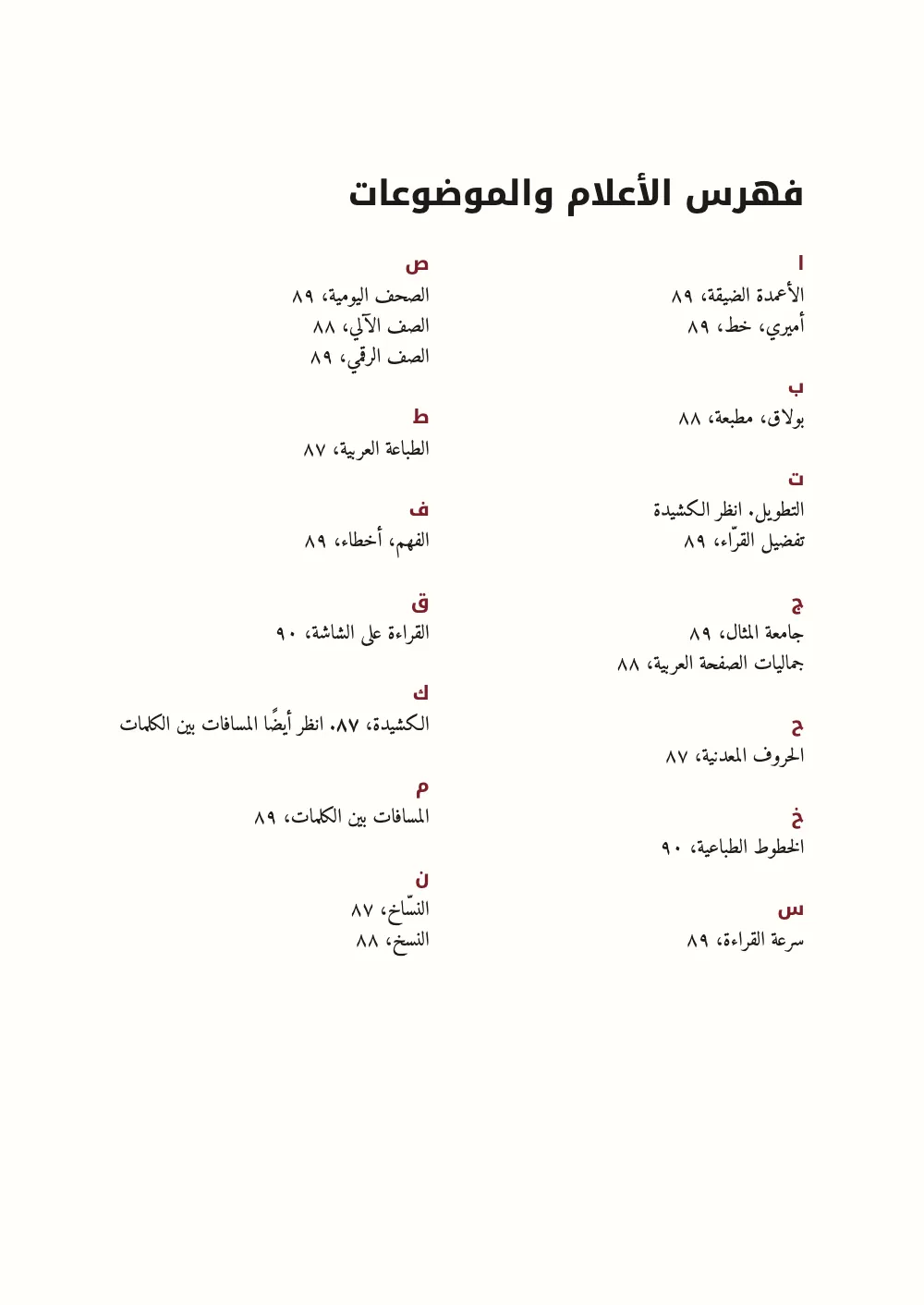
Cinq pages d’une revue savante arabe : l’article, ses notes de bas de page, sa liste de références et un index. L’index range الكشيدة sous ك, comme le font les index arabes, et non sous l’article ال.
Ce que vous allez composer
Cinq pages tirées d’un numéro d’une revue arabe imaginaire, en 17 × 24 cm, à partir de la page 87 : un article qui se demande si la justification par kashida ralentit la lecture, composé en Amiri de 12 pt avec des titres de section en Noto Kufi Arabic. Ses notes se placent au pied de chaque page et sont numérotées « (١) », « (٢) » à partir de un sur chaque page, comme les numérotent les revues arabes ; les citations, écrites [@ayalon2016] dans le Markdown, sont elles aussi des notes, mises en forme par le style de notes Chicago avec la locale CSL arabe. Une liste de références suit, les travaux arabes d’abord, et un index sur deux colonnes clôt l’ensemble. L’index range الكشيدة sous ك et الصحف اليومية sous ص : l’article ال ne compte pas. L’essai d’histoire avec notes Chicago fait la même chose en anglais.
Cette recette répond à
- Comment trier un index arabe sans l’article ال ?
- Comment citer des sources dans un article en arabe, avec notes de bas de page et bibliographie ?
La réponse courte
// Citations are written [@ayalon2016, 45] in the text; a note style puts each one in a
// footnote, numbered with the author's own [^notes]. The CSL locale is Arabic: ص for a page.
registerCitationEngine(createCiteprocEngine({ styles: STYLES, locales: LOCALES }));
const citations = {
  style: 'chicago-notes-bibliography', notes: 'footnote', locale: 'ar',
  bibliography: { fontSize: em(0.9), lineHeight: pt(17), hangingIndent: em(2),
    entrySpacing: pt(2) },
};
const footnotes = {
  markerTemplate: '({n})', // «(١)», in the document's digits
  numbering: 'page', // from (١) again on every page, as Arabic journals number them
  noteNumberPosition: 'inline', // the note opens with (١) on the line, not raised
  fontSize: pt(10), lineHeight: pt(18), spaceBetween: pt(2), // 1.8 ×: tanwīn clears the line
  textAlign: 'start', // ragged from the right: a Latin title would open wide gaps
  separator: { width: 0.3, lineWidth: pt(0.5), color: col('red') }, // on the start side
};
// The index sorts by the word after the article: الكشيدة files under ك, not under ا.
// ignoreArticle is already true for an Arabic index; it is written out to be seen.
const index = {
  ignoreArticle: true,
  fontFamily: TEXT, fontSize: pt(10.5), lineHeight: pt(16), indent: em(1.2),
  main: { bold: true }, // the page that defines the term
  groups: { fontFamily: LABEL, fontSize: pt(10), fontWeight: 700, color: col('red') },
};
Ingrédients
- Fonctionnalités
- L’arabe comme langue du documentIndex trié sans l’articleCitations en noteNotes de bas de pageCitations dans un style bibliographiqueBibliographie tirée des référencesIndexTexte de droite à gauchePolices arabesChiffres des nombres générésTitres numérotésStyles de titreOuvertures composéesTitres courants et foliosEncadrésExport PDF
- Utilise aussi
- Paragraphes dans l’autre sensÉquilibrage des colonnesAttributs de titreCouleur du papierTitres courants selon le rôle de la pageStyles de paragraphePolices intégrées au PDFLivres reliés à droitePages liminaires en chiffres romainsGéométrie de sectionChapitres non numérotés
- Typographie
- Amiri, Noto Kufi Arabic (SIL OFL 1.1)
- Ressources
- Aucune : chaque image est dessinée en code
Préparation
#1 · Notes, citations et index au même endroit
Le code est dans la réponse courte plus haut. Les réglages des notes de bas de page sont les trois que demandent les livres arabes : markerTemplate: '({n})' pour les parenthèses, numbering: 'page' pour recommencer à chaque page, et noteNumberPosition: 'inline' pour que la note s’ouvre sur « (١) » dans sa ligne ; les chiffres sont ceux du document, et le filet se place à droite (notes de bas de page). Les citations partagent la numérotation des notes. citations.locale: 'ar' donne les termes CSL en arabe, comme عدد pour un numéro de fascicule. index.ignoreArticle trie chaque entrée sur le mot qui suit ال et réunit les formes de la hamza : أميري et الأعمدة vont toutes deux sous ا (table des matières et index) ; ce réglage est actif par défaut pour un index arabe et il est écrit ici pour qu’on le voie.
#2 · Un en-tête de revue sans bandeau
const centred = (y, extra = {}) => ({ anchor: { to: 'container', edge: 'top' },
  offset: { y: mm(y) }, size: { width: 'fill' }, ...extra });
const line = (id, content, family, size, colour, y, extra = {}) => ({ kind: 'text', id,
  content, fontFamily: family, fontSize: pt(size), color: col(colour), align: 'center',
  overflow: 'wrap', placement: centred(y), ...extra });
const masthead = { enabled: true, minHeight: mm(70), slot: { elements: [
  line('journal', JOURNAL, LABEL, 9, 'red', 0, { fontWeight: 700 }),
  line('issue', '{attr.issue}', LABEL, 8, 'muted', 6),
  { kind: 'rule', id: 'rule', thickness: pt(0.5), color: col('rule'),
    placement: centred(13) },
  line('title', '{titleText}', TEXT, 22, 'ink', 18, { fontWeight: 700, lineHeight: 1.45 }),
  line('author', '{attr.author}', TEXT, 13, 'ink', 45),
  line('affiliation', '{attr.affiliation}', TEXT, 10, 'muted', 52),
] } };
Le titre de l’article est le titre de niveau 1, dessiné par une maquette : le nom de la revue et le numéro, un filet fin, le titre sur deux lignes centrées et l’autrice. La ligne du numéro est saisie en chiffres arabes orientaux, car l’attribut d’une maquette est le texte de l’auteur et le moteur ne le réécrit pas. La numérotation des pages commence à 87 (page.pageNumbering.startAt) : les folios montrent la place de l’article dans le numéro.
#3 · Des titres courants à partir du coin extérieur
const head = (id, content, parity, edge, x) => ({ kind: 'text', id, content, parity,
  pages: 'body', fontFamily: LABEL, fontSize: pt(7.5), color: col('muted'), align: edge,
  placement: { anchor: { to: 'page', edge: `top-${edge}` }, offset: { x: mm(x), y: mm(13) } } });
const folio = (id, parity, edge, x) => ({ ...head(id, '{pageNumber}', parity, edge, x),
  fontWeight: 700, color: col('red') });
const header = { elements: [
  folio('r-folio', 'even', 'right', -SIDE.outer),
  head('r-head', JOURNAL, 'even', 'right', -(SIDE.outer + 9)),
  head('l-head', 'سلمى الخطيب: أثر الكشيدة في سرعة القراءة', 'odd', 'left', SIDE.outer + 9),
  folio('l-folio', 'odd', 'left', SIDE.outer),
] };
Les pages de droite portent le nom de la revue et celles de gauche l’autrice et un titre abrégé, chacune avec son folio dans le coin extérieur. Les éléments d’en-tête gardent leurs côtés physiques : la page paire, qui est à droite dans cette reliure, s’ancre donc à top-right.
La recette complète
// ═══ Postext Cookbook · Nº 107 · An Arabic research article with notes, citations and an index ═══ // https://postext.dev/en/cookbook/arabic-research-article // Code: MIT · Text: original Arabic prose (CC BY 4.0) · Pictures: none // Fonts: Amiri, Noto Kufi Arabic (SIL OFL 1.1) · Needs postext ≥ 1.26.0 import { buildDocument, withLoadedFonts, renderPageToCanvas, registerCitationEngine, } from 'https://esm.sh/postext'; import { renderToPdf, decompressWoff2 } from 'https://esm.sh/postext-pdf'; import { createCiteprocEngine, STYLES, LOCALES } from 'https://esm.sh/postext-citeproc'; const LANG = 'en'; // @lang: the language of the frame; the article is Arabic in both editions const RECIPE = 'arabic-research-article'; // ─── 1 · Design ───────────────────────────────────────────────────────────── // #region palette: a journal's dark red on a warm white const palette = { ink: '#1d1a19', // text red: '#7d2028', // the accent: the journal's name, section numbers, the notes' rule rose: '#f1e4e1', // the abstract's ground rule: '#c8bcb5', // hairlines muted: '#655d58', // running heads, the colophon paper: '#fffdfa', }; const col = (id) => ({ hex: palette[id], model: 'hex', paletteId: id }); const colorPalette = Object.entries({ ...palette, 'main-color': palette.red }) .map(([id, hex]) => ({ id, name: id, value: { hex, model: 'hex' } })); // #endregion const [TEXT, LABEL] = ['Amiri', 'Noto Kufi Arabic']; const [BODY, LEAD] = [12, 20]; // pt: Amiri, partly vocalised, at 1.67 × the size const TRIM = { width: 170, height: 240 }; // mm: 17 × 24 cm, the Arab journal const SIDE = { inner: 22, outer: 18 }; // mm const JOURNAL = 'مجلة دراسات الكتاب والنشر'; // #region answer: notes «(١)» per page, the citations among them, an index without ال // Citations are written [@ayalon2016, 45] in the text; a note style puts each one in a // footnote, numbered with the author's own [^notes]. The CSL locale is Arabic: ص for a page. registerCitationEngine(createCiteprocEngine({ styles: STYLES, locales: LOCALES })); const citations = { style: 'chicago-notes-bibliography', notes: 'footnote', locale: 'ar', bibliography: { fontSize: em(0.9), lineHeight: pt(17), hangingIndent: em(2), entrySpacing: pt(2) }, }; const footnotes = { markerTemplate: '({n})', // «(١)», in the document's digits numbering: 'page', // from (١) again on every page, as Arabic journals number them noteNumberPosition: 'inline', // the note opens with (١) on the line, not raised fontSize: pt(10), lineHeight: pt(18), spaceBetween: pt(2), // 1.8 ×: tanwīn clears the line textAlign: 'start', // ragged from the right: a Latin title would open wide gaps separator: { width: 0.3, lineWidth: pt(0.5), color: col('red') }, // on the start side }; // The index sorts by the word after the article: الكشيدة files under ك, not under ا. // ignoreArticle is already true for an Arabic index; it is written out to be seen. const index = { ignoreArticle: true, fontFamily: TEXT, fontSize: pt(10.5), lineHeight: pt(16), indent: em(1.2), main: { bold: true }, // the page that defines the term groups: { fontFamily: LABEL, fontSize: pt(10), fontWeight: 700, color: col('red') }, }; // #endregion // #region masthead: the journal's name, the article's title and its author, centred const centred = (y, extra = {}) => ({ anchor: { to: 'container', edge: 'top' }, offset: { y: mm(y) }, size: { width: 'fill' }, ...extra }); const line = (id, content, family, size, colour, y, extra = {}) => ({ kind: 'text', id, content, fontFamily: family, fontSize: pt(size), color: col(colour), align: 'center', overflow: 'wrap', placement: centred(y), ...extra }); const masthead = { enabled: true, minHeight: mm(70), slot: { elements: [ line('journal', JOURNAL, LABEL, 9, 'red', 0, { fontWeight: 700 }), line('issue', '{attr.issue}', LABEL, 8, 'muted', 6), { kind: 'rule', id: 'rule', thickness: pt(0.5), color: col('rule'), placement: centred(13) }, line('title', '{titleText}', TEXT, 22, 'ink', 18, { fontWeight: 700, lineHeight: 1.45 }), line('author', '{attr.author}', TEXT, 13, 'ink', 45), line('affiliation', '{attr.affiliation}', TEXT, 10, 'muted', 52), ] } }; // #endregion // #region heads: the journal on the right-hand page, the author and title on the left const head = (id, content, parity, edge, x) => ({ kind: 'text', id, content, parity, pages: 'body', fontFamily: LABEL, fontSize: pt(7.5), color: col('muted'), align: edge, placement: { anchor: { to: 'page', edge: `top-${edge}` }, offset: { x: mm(x), y: mm(13) } } }); const folio = (id, parity, edge, x) => ({ ...head(id, '{pageNumber}', parity, edge, x), fontWeight: 700, color: col('red') }); const header = { elements: [ folio('r-folio', 'even', 'right', -SIDE.outer), head('r-head', JOURNAL, 'even', 'right', -(SIDE.outer + 9)), head('l-head', 'سلمى الخطيب: أثر الكشيدة في سرعة القراءة', 'odd', 'left', SIDE.outer + 9), folio('l-folio', 'odd', 'left', SIDE.outer), ] }; // #endregion const config = () => ({ locale: 'ar', // written out, never LANG (gotcha: arabic-locale-tag) colorPalette, citations, footnotes, index, page: { width: mm(TRIM.width), height: mm(TRIM.height), dpi: 150, backgroundColor: col('paper'), pageNumbering: { startAt: 87 }, margins: { top: mm(24), bottom: mm(22), left: mm(SIDE.inner), right: mm(SIDE.outer), mirror: true } }, layout: { layoutType: 'single' }, bodyText: { fontFamily: TEXT, fontSize: pt(BODY), lineHeight: pt(LEAD), color: col('ink'), boldColor: col('ink'), italicColor: col('ink'), referenceColor: col('ink'), textAlign: 'justify', firstLineIndent: em(1.5), indentAfterHeading: false, optimalLineBreaking: true, avoidWidows: true, avoidOrphans: true }, headings: { fontFamily: LABEL, fontWeight: 700, color: col('ink'), // No space is added over the heads to fill a page, and no paragraph runs a line long: // what stays on is the level cut of a closing page, for the two columns of the index. balancing: { maxLinesPerHeading: 0, stretchAfterLists: false, stretchAfterFloats: false, looseParagraphs: false, closingBox: 'off' }, levels: [ // The article starts on the page it reaches, left or right, with no blank page before it. { level: 1, breakBefore: { enabled: true, parity: 'any' }, marginTop: pt(0), marginBottom: pt(0), advancedDesign: masthead }, // ١- المقدمة: the section number in the document digits, a hyphen after it. { level: 2, fontSize: pt(12), lineHeight: pt(LEAD), numberingTemplate: '{2}-', numberSeparator: ' ', color: col('red'), marginTop: pt(LEAD), marginBottom: pt(4) }, ] }, headingStyles: [ { id: 'unnumbered', numbered: false }, // the abstract, the references, the index // The index: a title across the page and two columns, the first on the right. { id: 'index', numbered: false, span: 'page', breakBefore: { enabled: true, parity: 'any' }, advancedDesign: { enabled: false }, fontSize: pt(18), lineHeight: pt(30), marginBottom: pt(LEAD), layout: { layoutType: 'double', gutterWidth: mm(8) } }, ], calloutStyles: [{ id: 'abstract', background: col('rose'), padding: { top: mm(3.5), right: mm(5), bottom: mm(3.5), left: mm(5) }, marginTop: pt(0), marginBottom: pt(0), titleStyle: { fontFamily: LABEL, fontSize: pt(9), fontWeight: 700, color: col('red') }, body: { fontSize: pt(10.5), lineHeight: pt(17), firstLineIndent: pt(0) } }], paragraphStyles: [{ id: 'colophon', fontFamily: TEXT, fontSize: pt(9), lineHeight: pt(13), color: col('muted'), textAlign: 'left', firstLineIndent: pt(0), marginTop: pt(LEAD) }], header, footer: { elements: [] }, }); // ─── 2 · Content ──────────────────────────────────────────────────────────── const markdown = String.raw`---Exemple Markdown · 93 lignes · content.en.md
title: "أثر الكشيدة في سرعة قراءة النص العربي المطبوع" --- # أثر الكشيدة في سرعة قراءة النص العربي المطبوع: تجربة على قرّاء جامعيين {issue="المجلد ١٤ · العدد ٣ · خريف ٢٠٢٦" author="سلمى الخطيب" affiliation="قسم علوم المعلومات والنشر، جامعة المثال"} :::callout{type="abstract" title="ملخص"} تبحث هذه الدراسة في أثر ضبط السطور بالكشيدة في سرعة قراءة النص العربي المطبوع وفي فهمه. قرأ ستون طالبًا جامعيًا نصوصًا مضبوطة بثلاث طرق: بالمسافات وحدها، وبالكشيدة وحدها، وبمزيج منهما. ولم تختلف سرعة القراءة اختلافًا ذا دلالة بين الطرق الثلاث، غير أن القرّاء فضّلوا الطريقة المختلطة، وكانت أخطاء الفهم في الكشيدة الكثيفة أعلى قليلًا. ::: ## المقدمة يملأ :index[الطابع]{term="الطباعة العربية"} العربي السطر حتى نهايته بإحدى وسيلتين: أن يوسّع المسافات بين الكلمات، أو أن يمدّ بعض الحروف المتصلة بما يسمّى :index[الكشيدة]{main}:index{term="الكشيدة" seealso="المسافات بين الكلمات"} أو :index[التطويل]{see="الكشيدة"}. والوسيلة الثانية قديمة قِدم الخط نفسه، عرفها :index[النسّاخ] قبل المطبعة، ثم نقلها صانعو :index[الحروف المعدنية] إلى صناديقهم في صورة قطع خاصة تُدسّ بين أجزاء الكلمة.[@nemeth2017] وحين انتقلت الطباعة العربية إلى الحاسوب، صار المدّ عملية آلية يقوم بها البرنامج، وصار السؤال عن مقداره ومواضعه سؤالًا تقنيًا قبل أن يكون جماليًا.[^raqim] [^raqim]: تُبنى قواعد المواضع الجائزة للمدّ في البرامج الحديثة على ما وصفه الخطاطون في خط :index[النسخ]، ولا سيما المنع بعد الكاف واللام، وقبل الحروف المستديرة في آخر الكلمة. ولا يكاد يُختلف في أن الكشيدة جزء من :index[جماليات الصفحة العربية]، لكن أثرها في القراءة لم يُدرس إلا قليلًا. فالدراسات القليلة المتاحة اعتمدت على تقدير القرّاء للنص، لا على قياس قراءتهم له،[@hashimi2019, ٧٧; @attar2021] والمعايير الدولية تكتفي بوصف المواضع التي يجوز فيها المدّ دون أن تحدد مقداره.[@alreq] ويحاول هذا البحث أن يقيس الأثر قياسًا مباشرًا. ## الكشيدة في الطباعة العربية حين أُنشئت :index[مطبعة بولاق]{term="بولاق، مطبعة"} في عشرينيات القرن التاسع عشر، سُبكت حروفها على نماذج من الخط الذي يكتبه النسّاخ، وصار الكتاب المطبوع بعد ذلك بعقود سلعة يقرؤها جمهور واسع.[@ayalon2016] وكان صفّاف الحروف يضبط السطر بقطع من المدّ يدسّها بين أجزاء الكلمة، إلى أن ظهرت آلات :index[الصف الآلي] في القرن العشرين فقلّصت عدد أشكال الحروف تقليصًا كبيرًا.[@nemeth2017] وقد عادت الكشيدة في :index[الصحف اليومية] بعد انتشار :index[الصف الرقمي]، لأنها تسمح بضبط :index[الأعمدة الضيقة] دون أن تتسع المسافات اتساعًا ظاهرًا. غير أن بعض المصممين يرون أن الإكثار منها يجعل الصفحة مضطربة، وأن العين تتعثر بالكلمات الممدودة كما تتعثر بالفجوات الواسعة.[@attar2021, ٥٢] ## منهج التجربة شارك في التجربة ستون طالبًا وطالبة من :index[جامعة المثال]، تتراوح أعمارهم بين ١٩ و٢٦ سنة، وكلهم يقرأ العربية لغةً أولى. وقرأ كل منهم تسعة نصوص قصيرة من المقالات الصحفية، طول كل منها نحو ٣٠٠ كلمة، على صفحات مطبوعة بخط :index[أميري]{term="أميري، خط"} بحجم ١٣ نقطة.[^font] [^font]: اختير خط أميري لأنه يرسم الكشيدة منحنية، كما في الطباعة البولاقية، فيكون الفرق بين الطرق الثلاث أوضح مما هو في الخطوط التي ترسمها خطًا مستقيمًا. وضُبطت النصوص بثلاث طرق: بالمسافات وحدها، وبالكشيدة وحدها مع مسافات ثابتة، وبمزيج يوسّع :index[المسافات بين الكلمات] بمقدار الربع أولًا ثم يمدّ الحروف. وقيس زمن القراءة بالثواني، ثم أجاب القارئ عن خمسة أسئلة في الفهم، وأخيرًا رتّب الطرق الثلاث بحسب تفضيله.:index{term="تفضيل القرّاء"} ## النتائج والمناقشة لم تختلف :index[سرعة القراءة] اختلافًا ذا دلالة بين الطرق الثلاث: كان المتوسط ٢١٤ كلمة في الدقيقة للمسافات، و٢٠٩ للكشيدة، و٢١٧ للطريقة المختلطة. أما :index[أخطاء الفهم]{term="الفهم، أخطاء"} فكانت أعلى قليلًا في الكشيدة وحدها، ولا سيما في السطور التي مُدّت فيها ثلاث كلمات أو أكثر. وفضّل ٣٨ مشاركًا الطريقة المختلطة، و١٤ المسافات وحدها، و٨ الكشيدة وحدها. وهذا يتفق مع ما يذهب إليه الطابعون من أن الكشيدة تحسن قليلًا ولا تحسن كثيرًا،[@hashimi2019, ٨١] ومع ما تقترحه الإرشادات الحديثة من توزيع الفراغ على المسافات والمدّ معًا.[@alreq] ولهذه النتائج حدود واضحة: فالنصوص قصيرة، والقرّاء من فئة عمرية واحدة، والخط واحد. ويحتاج الأمر إلى تجارب على :index[خطوط أخرى]{term="الخطوط الطباعية"}، وعلى :index[القراءة على الشاشة]، حيث يتغير عرض السطر بتغير الجهاز. ## المراجع {style="unnumbered"} :::bibliography{title=""} :::paragraphs{style="colophon" dir=ltr} A specimen article written in Arabic for the Postext Cookbook. The journal, its author, her experiment and the Arabic works by al-Hashimi and al-Attar are invented; the books by Ayalon and Nemeth and the W3C document are real. ::: # فهرس الأعلام والموضوعات {style="index"} :::index :::references{format=csl-yaml} - id: nemeth2017 type: book language: en author: [{family: Nemeth, given: Titus}] title: "Arabic type-making in the machine age: the influence of technology on the form of Arabic type, 1908–1993" publisher: Brill publisher-place: Leiden issued: 2017 - id: ayalon2016 type: book language: en author: [{family: Ayalon, given: Ami}] title: "The Arabic print revolution: cultural production and mass readership" publisher: Cambridge University Press publisher-place: Cambridge issued: 2016 - id: alreq type: webpage language: en author: [{literal: W3C}] title: "Arabic & Persian layout requirements" URL: https://www.w3.org/TR/alreq/ - id: hashimi2019 type: book language: ar author: [{literal: منى الهاشمي}] title: "الحرف العربي على الشاشة: دراسة في المقروئية" publisher: دار المثال publisher-place: بيروت issued: {literal: "٢٠١٩"} - id: attar2021 type: article-journal language: ar author: [{literal: كريم العطار}] title: "التطويل في الصحف اليومية العربية" container-title: مجلة دراسات الكتاب والنشر volume: "٩" issue: "٢" page: "٤٥-٦٨" issued: {literal: "٢٠٢١"} :::`; // content.<lang>.md: the same Arabic article in both // ─── 3 · Fonts ────────────────────────────────────────────────────────────── const FONTS = { // every face the pages use, loaded before the build Amiri: ['400', '700'], // TEXT: the article, notes, references, index; bold emphasis 'Noto Kufi Arabic': ['400', '700'], // LABEL: masthead, section heads, running heads }; // ─── 4 · Build & show ─────────────────────────────────────────────────────── await loadFonts(FONTS, markdown); // Each Arabic face's letters live in a file of their own (gotcha: arabic-fonts-subset). await loadArabicFonts(FONTS, markdown); const doc = await withLoadedFonts(() => buildDocument({ markdown }, config()), { ...kitFonts(FONTS), text: markdown }); showBook(doc, { title: t({ en: 'An Arabic research article', es: 'Un artículo académico árabe' }) }); offerPdf(() => renderToPdf(doc, { fontProvider: arabicPdfProvider }), `${RECIPE}.pdf`);Kit · core, fonts, viewer, pdf, arabic, book : identique dans toutes les recettes · 409 lignes
// ─── Kit ── helpers shared by every Cookbook recipe · postext.dev/cookbook ───── // ─── Kit · core v1 ── the same in every recipe · postext.dev/cookbook function mm(value) { return { value, unit: 'mm' }; } function pt(value) { return { value, unit: 'pt' }; } function em(value) { return { value, unit: 'em' }; } /** The sample language's string: t({ en: 'Figure', es: 'Figura' }). */ function t(strings) { return strings[LANG] ?? Object.values(strings)[0]; } /** A file in this recipe's assets folder, served from the Postext repo by jsDelivr. */ function asset(file) { return `https://cdn.jsdelivr.net/gh/drnachio/postext@main/cookbook/${RECIPE}/assets/${file}`; } // ─── Kit · fonts v3 ── the same in every recipe · postext.dev/cookbook // Postext loads the faces a config asks for before layout (prepareFonts, // buildDocumentWithFonts) and asks the kit for the files: Fontsource's, the // files the PDF embeds too. /** The options of buildDocumentWithFonts / prepareFonts / withLoadedFonts: * the Fontsource resolver, and the faces of FONTS loaded with the ones the * config names. FONTS = { 'Family Name': ['400', '400i', '700'] }. */ function kitFonts(FONTS = {}) { const faces = Object.entries(FONTS).flatMap(([family, specs]) => specs.map((spec) => ({ family, weight: parseInt(spec, 10), style: spec.endsWith('i') ? 'italic' : 'normal' }))); return { resolve: fontsourceResolver, faces }; } /** A face's Fontsource files, in a fixed order: latin, then latin-ext and greek * when `text` needs them and the family ships them (kitSubsetsFor), each with * its unicode-range. Null for a weight or slant Fontsource does not ship. */ async function fontsourceResolver(family, weight, style, { text = '' } = {}) { const id = fontsourceId(family); const meta = await fontsourceMeta(family); if (meta && !(meta.weights.includes(weight) && meta.styles.includes(style))) return null; kitStatus('Loading fonts…'); const at = await fontsourceAt(id); return ['latin', ...kitSubsetsFor(text, meta)].map((subset) => ({ source: `${at}files/${id}-${subset}-${weight}-${style}.woff2`, unicodeRange: kitRanges()[subset], })); } /** The unicode-range of each Fontsource file the kit loads (a function: the * kit is inlined after the pen's code, which runs before a const would be set). */ function kitRanges() { return { latin: 'U+0000-00FF,U+0131,U+0152-0153,U+02BB-02BC,U+02C6,U+02DA,U+02DC,U+0304,U+0308,U+0329,' + 'U+2000-206F,U+20AC,U+2122,U+2191,U+2193,U+2212,U+2215,U+FEFF,U+FFFD', 'latin-ext': 'U+0100-02BA,U+02BD-02C5,U+02C7-02CC,U+02CE-02D7,U+02DD-02FF,U+0304,U+0308,U+0329,' + 'U+1D00-1DBF,U+1E00-1E9F,U+1EF2-1EFF,U+2020,U+20A0-20AB,U+20AD-20C0,U+2113,U+2C60-2C7F,U+A720-A7FF', greek: 'U+0370-03FF', }; } /** For the cjk, arabic and comics blocks, which add their own files: the * faces of `faces` = { 'Family Name': ['400', '400i', '700'] }. `text` is the sample: * č ł † α χ also load latin-ext and greek files (kitSubsetsFor). With * `optional`, a face Fontsource does not ship is skipped instead of failing. * The files are added once all have loaded, in the order asked (latin, then * latin-ext, then greek), whatever order they arrive in: the last one added * wins a character two files hold. Resolves to the number of faces added. */ async function loadFonts(faces, text = '', { optional = false } = {}) { kitStatus('Loading fonts…'); const ranges = kitRanges(); const jobs = []; for (const [family, specs] of Object.entries(faces)) { const id = fontsourceId(family); const todo = [...new Set(specs)].map((spec) => [parseInt(spec, 10), spec.endsWith('i') ? 'italic' : 'normal']) .filter(([weight, style]) => !hasFace(family, weight, style)); // before any await const at = fontsourceAt(id); const meta = optional || /[^\0-ÿ]/u.test(text) ? await fontsourceMeta(family) : null; const subsets = ['latin', ...kitSubsetsFor(text, meta)]; for (const [weight, style] of todo) { if (optional && !(meta?.weights.includes(weight) && meta.styles.includes(style))) continue; for (const subset of subsets) { const url = `${await at}files/${id}-${subset}-${weight}-${style}.woff2`; const face = new FontFace(family, `url(${url}) format('woff2')`, { weight: String(weight), style, unicodeRange: ranges[subset] }); jobs.push(face.load().catch(() => { if (subset === 'latin' && !optional) throw new Error(`Fontsource has no ${family} ${weight} ${style}`); })); } } } const ready = await Promise.all(jobs).catch((error) => { kitFail(error); throw error; }); return ready.filter((face) => face && document.fonts.add(face)).length; } /** A loaded FontFace covers this family, weight and style (fonts.check() would * also say yes for families nobody declared). */ function hasFace(family, weight, style) { for (const face of document.fonts) { if (face.status !== 'loaded' || face.style !== style) continue; if (face.family.replace(/^["']|["']$/g, '') !== family) continue; const [low, high = low] = face.weight.split(' ').map(Number); if (weight >= low && weight <= high) return true; } return false; } /** The files beyond latin `text` needs that `meta`'s family ships. */ function kitSubsetsFor(text, meta) { return [[/[Ā-˿ᴀ-ᶿḀ-ỿ†ℓⱠ-Ɀ꜠-ꟿ]/u, 'latin-ext'], [/[Ͱ-Ͽ]/u, 'greek']] .filter(([re, x]) => re.test(text) && meta?.subsets?.includes(x)).map(([, x]) => x); } /** Fontsource's id for a family: 'Source Serif 4' → 'source-serif-4'. */ function fontsourceId(family) { return family.toLowerCase().replace(/\s+/g, '-'); } /** A package's folder at the one version @5 names now (#766). */ function fontsourceAt(id, u = `https://cdn.jsdelivr.net/npm/@fontsource/${id}@`) { return (fontsourceAt.c ??= {})[id] ??= fetch(u + '5/package.json').then((r) => r.json()) .then((p) => p.version || 5, () => 5).then((v) => `${u}${v}/`); } /** The family's Fontsource metadata (weights, styles, subsets), or null. */ function fontsourceMeta(family) { fontsourceMeta.cache ??= new Map(); const id = fontsourceId(family); if (!fontsourceMeta.cache.has(id)) { fontsourceMeta.cache.set(id, fetch(`https://api.fontsource.org/v1/fonts/${id}`) .then((res) => (res.ok ? res.json() : null), () => null)); } return fontsourceMeta.cache.get(id); } // ─── Kit · viewer v2 ── the same in every recipe · postext.dev/cookbook /** The pages as spreads on a dark desk, page 1 alone, then verso | recto, * each painted when it scrolls near. Other options go to renderPageToCanvas. */ function showPages(docs, { title, width = 460, ...render } = {}) { const root = viewer(title); const pages = [docs].flat().flatMap((doc) => doc.pages.map((page) => ({ doc, page, n: (doc.pageIndexOffset ?? 0) + page.index }))); const spreads = []; let verso = null; for (const p of pages) { if (p.n % 2 === 1) { if (verso) spreads.push([verso, null]); verso = p; } else { spreads.push([verso, p]); verso = null; } } if (verso) spreads.push([verso, null]); const density = Math.min(window.devicePixelRatio || 1, 2); showPages.painter?.disconnect(); const painter = new IntersectionObserver((entries) => { for (const { isIntersecting, target } of entries) { if (!isIntersecting) continue; painter.unobserve(target); const { doc, page } = target.postext; renderPageToCanvas(page, doc, target, { ...render, scale: (width * density) / page.width }); } }, { rootMargin: '800px' }); showPages.painter = painter; root.replaceChildren(...spreads.map((pair) => { const spread = document.createElement('div'); spread.className = 'pt-spread'; for (const p of pair) { const figure = document.createElement('figure'); if (p) { const label = p.page.pageLabel || String(p.n + 1); const canvas = document.createElement('canvas'); canvas.postext = p; canvas.style.aspectRatio = `${p.page.width} / ${p.page.height}`; canvas.setAttribute('role', 'img'); canvas.setAttribute('aria-label', `Page ${label}`); const folio = document.createElement('figcaption'); folio.textContent = label; figure.append(canvas, folio); painter.observe(canvas); } else figure.className = 'pt-blank'; spread.append(figure); } return spread; })); kitStatus(`${pages.length} ${pages.length === 1 ? 'page' : 'pages'}`); document.documentElement.dataset.postext = 'ready'; return pages.length; } /** The desk, the bar and the error reporting, created once. */ function viewer(title) { if (!document.getElementById('pt-kit')) { document.head.insertAdjacentHTML('beforeend', `<style id="pt-kit"> :root { color-scheme: dark; } body { margin: 0; background: #0e1014; color: #b9bcc4; font: 13px/1.45 system-ui, sans-serif; } #pt-bar { position: sticky; top: 0; z-index: 1; display: flex; flex-wrap: wrap; align-items: center; gap: 6px 16px; padding: 10px 16px; background: rgb(14 16 20 / .92); backdrop-filter: blur(6px); border-bottom: 1px solid #23262d; } #pt-bar strong { color: #f4f1ea; font-weight: 600; } #pt-actions { display: flex; gap: 12px; margin-left: auto; } #pt-actions a, #pt-actions button { color: #d8a21a; font: inherit; background: none; border: 0; padding: 0; cursor: pointer; } #pages { display: grid; justify-items: center; gap: 48px; padding: 32px 16px 72px; } .pt-spread { display: flex; } .pt-spread figure { margin: 0; width: min(460px, 44vw); } .pt-spread canvas { display: block; width: 100%; background: #fff; box-shadow: 0 1px 2px rgb(0 0 0 / .5), 0 22px 44px -16px rgb(0 0 0 / .8); } .pt-spread figure:first-child canvas { box-shadow: inset -14px 0 14px -14px rgb(0 0 0 / .18), 0 1px 2px rgb(0 0 0 / .5), 0 22px 44px -16px rgb(0 0 0 / .8); } .pt-spread figcaption { margin-top: 10px; text-align: center; font: 600 10px/1 system-ui, sans-serif; letter-spacing: .18em; text-transform: uppercase; color: #6c7079; } .pt-blank { visibility: hidden; } @media (max-width: 760px) { .pt-spread { flex-direction: column; gap: 32px; } .pt-spread figure { width: min(460px, 92vw); } .pt-blank { display: none; } } </style>`); document.body.insertAdjacentHTML('afterbegin', '<header id="pt-bar"><strong id="pt-title"></strong><span id="pt-status" role="status"></span><span id="pt-actions"></span></header>'); document.getElementById('pt-title').textContent = document.title || 'Postext'; addEventListener('error', (event) => kitFail(event.error ?? event.message)); addEventListener('unhandledrejection', (event) => kitFail(event.reason)); } if (title) document.getElementById('pt-title').textContent = title; return document.getElementById('pages') ?? document.body.appendChild(Object.assign(document.createElement('main'), { id: 'pages' })); } function kitStatus(text) { viewer(); document.getElementById('pt-status').textContent = text; } function kitFail(error) { document.documentElement.dataset.postext = 'error'; kitStatus(`Error: ${error?.message ?? error}`); } // ─── Kit · pdf v3 ── the same in every recipe that exports a PDF /** The Fontsource files the screen used, as TrueType, with their range and * place: the nearest weight the family ships, upright with no italic; * latin, then what its letters need (kitSubsetsFor). */ async function fontsourceProvider(family, weight, style, request) { const id = fontsourceId(family); const meta = await fontsourceMeta(family); const weights = meta?.weights?.length ? meta.weights : [400, 700]; const w = weights.reduce((a, b) => (Math.abs(b - weight) < Math.abs(a - weight) ? b : a)); const s = style === 'italic' && meta && !meta.styles.includes('italic') ? 'normal' : style; const text = String.fromCodePoint(...(request?.codePoints ?? [])); const files = await Promise.all(['latin', ...kitSubsetsFor(text, meta)].map(async (subset, order) => { const res = await fetch(`${await fontsourceAt(id)}files/${id}-${subset}-${w}-${s}.woff2`); if (!res.ok) throw new Error(`Fontsource has no ${family} ${w} ${s} ${subset}`); return Object.assign(await decompressWoff2(new Uint8Array(await res.arrayBuffer())), { unicodeRange: kitRanges()[subset], order }); })); return files.length === 1 ? files[0] : files; } /** A "Build the PDF" button; then "Open the PDF" (a new tab: CodePen's frame * shows no PDFs) and a download link. */ function offerPdf(makePdf, filename) { viewer(); const button = Object.assign(document.createElement('button'), { type: 'button', textContent: 'Build the PDF' }); button.dataset.postextPdf = filename; button.addEventListener('click', async () => { button.disabled = true; button.textContent = 'Building the PDF…'; try { const bytes = await makePdf(); const url = URL.createObjectURL(new Blob([bytes], { type: 'application/pdf' })); const size = `${Math.max(1, Math.round(bytes.length / 1024))} KB`; button.replaceWith( Object.assign(document.createElement('a'), { href: url, target: '_blank', rel: 'noopener', textContent: 'Open the PDF ↗' }), Object.assign(document.createElement('a'), { href: url, download: filename, textContent: `Download ${filename} · ${size}` })); } catch (error) { button.disabled = false; button.textContent = 'Build the PDF'; kitFail(error); } }); document.getElementById('pt-actions').append(button); } // ─── Kit · arabic v2 ── Arabic-script faces · postext.dev/cookbook // Fontsource ships an Arabic family as one file per subset and weight: the // `arabic` file holds the letters, the harakat, the Arabic-Indic digits, the // Arabic punctuation and the presentation forms; `latin` and `latin-ext` // hold the rest. loadFonts loads the latin files; this block adds the arabic // file of every Arabic family, for the canvas and for the PDF, which shapes // the letters with HarfBuzz from the same bytes. /** The code points of Fontsource's `arabic` subset, as its stylesheets * declare them (the same unicode-range the browser picks the file by). A * function, not a const: the kit is inlined after the recipe's top-level * awaits, and a const read before its line throws, where a function * declaration is hoisted. */ function arabicRange() { return 'U+0600-06FF,U+0750-077F,U+0870-088E,U+0890-0891,U+0897-08E1,U+08E3-08FF,' + 'U+200C-200E,U+2010-2011,U+204F,U+2E41,U+FB50-FDFF,U+FE70-FE74,U+FE76-FEFC,U+102E0-102FB,' + 'U+10E60-10E7E,U+10EC2-10EC4,U+10EFC-10EFF,U+1EE00-1EEFF'; } /** Whether code point `cp` is in the arabic file. */ function inArabicRange(cp) { inArabicRange.ranges ??= arabicRange().split(',').map((part) => { const [lo, hi = lo] = part.slice(2).split('-'); return [parseInt(lo, 16), parseInt(hi, 16)]; }); return inArabicRange.ranges.some(([lo, hi]) => cp >= lo && cp <= hi); } /** Whether Fontsource serves `family` with an `arabic` subset. Fails when * the API does not answer: an Arabic face taken for a Latin one would set * its letters in a system face. */ async function isArabicFamily(family) { const meta = await fontsourceMeta(family); if (!meta) throw new Error(`api.fontsource.org did not describe ${family}: reload to try again`); return !!meta.subsets?.includes('arabic'); } /** The arabic file of a face. */ async function arabicFileUrl(family, weight, style) { const id = fontsourceId(family); return `${await fontsourceAt(id)}files/${id}-arabic-${weight}-${style}.woff2`; } /** faces = { Amiri: ['400', '700'] }, as for loadFonts, after it: the whole * FONTS object may be passed, its families without an arabic subset are * left alone. Adds the arabic file of every listed weight of each Arabic * family (the latin files come from loadFonts) and loads it. `text` is * the sample: fails when it holds an Arabic-script character the arabic * file does not cover. List every weight the pages set in Arabic: a weight * left to the engine's later round gets the latin file only, and its Arabic letters * fall back to a system face. Resolves to the number of files loaded. */ async function loadArabicFonts(faces, text = '') { kitStatus('Loading fonts…'); let loaded = 0; try { const outside = [...new Set(text)].filter((ch) => /\p{Script=Arabic}/u.test(ch) && !inArabicRange(ch.codePointAt(0))); if (outside.length) throw new Error(`Fontsource's arabic files have no ${outside.slice(0, 12).join(' ')}`); for (const [family, specs] of Object.entries(faces)) { if (!(await isArabicFamily(family))) continue; for (const spec of new Set(specs)) { const weight = parseInt(spec, 10); const style = spec.endsWith('i') ? 'italic' : 'normal'; const face = new FontFace(family, `url(${await arabicFileUrl(family, weight, style)}) format('woff2')`, { weight: String(weight), style, unicodeRange: arabicRange() }); document.fonts.add(await face.load().catch(() => { throw new Error(`Fontsource has no arabic file for ${family} ${weight} ${style}`); })); loaded++; } } } catch (error) { kitFail(error); throw error; } return loaded; } /** The PDF font provider for recipes with Arabic faces: a family with an * arabic subset gets its arabic file when its pages set Arabic letters * (`request.codePoints`), then its latin file, and its latin-ext file for * the letters beyond latin (transliteration: ā ḥ ʿ), each marked with its * unicode-range and its place in the order the screen added them (latin * and latin-ext by loadFonts, then arabic): the arabic file also has a * space and brackets, which the browser takes from latin, the file whose * range holds them, and postext-pdf follows it. Any other family goes to * fontsourceProvider (the "pdf" block). */ async function arabicPdfProvider(family, weight, style, request) { if (!(await isArabicFamily(family))) return fontsourceProvider(family, weight, style, request); const meta = await fontsourceMeta(family); const weights = meta.weights?.length ? meta.weights : [400, 700]; const w = weights.reduce((a, b) => (Math.abs(b - weight) < Math.abs(a - weight) ? b : a)); const s = style === 'italic' && !meta.styles.includes('italic') ? 'normal' : style; const wanted = [...(request?.codePoints ?? [])]; const id = fontsourceId(family); const subsets = !wanted.length || wanted.some(inArabicRange) ? ['arabic', 'latin'] : ['latin']; if (meta.subsets.includes('latin-ext') && wanted.some((cp) => /[Ā-˿Ḁ-ỿ]/u.test(String.fromCodePoint(cp)))) { subsets.push('latin-ext'); } const at = await fontsourceAt(id); return Promise.all(subsets.map(async (subset) => { const url = `${at}files/${id}-${subset}-${w}-${s}.woff2`; const res = await fetch(url); if (!res.ok) throw new Error(`Fontsource file ${url} (${res.status})`); const bytes = await decompressWoff2(new Uint8Array(await res.arrayBuffer())); return Object.assign(bytes, { unicodeRange: subset === 'arabic' ? arabicRange() : kitRanges()[subset], order: ['latin', 'latin-ext', 'greek', 'arabic'].indexOf(subset) }); })); } // ─── Kit · book v1 ── books bound on either edge · postext.dev/cookbook // A book bound on the right (Arabic, Hebrew or Persian text, vertical // Chinese, or page.binding 'right') opens from what a Latin reader calls // the back: page 1 lies alone on the left of the spine, then [3 | 2]. /** showPages for a book bound on either edge. A right-bound book (the * document says so: doc.binding is 'right' for page.binding 'right', for * text that runs right to left and for vertical text, when the binding is * left to 'auto') lies on the desk as it opens: page 1 alone on the left * of the spine, then [3 | 2], the spine shade on each page's inner edge. * `binding` ('left' | 'right') overrides the document's. */ function showBook(docs, { binding, ...options } = {}) { const count = showPages(docs, options); const right = (binding ?? [docs].flat()[0]?.binding) === 'right'; if (!document.getElementById('pt-kit-book')) { // The pages keep direction ltr, as in a left-bound book: a canvas takes // the direction its element inherits, and under the spread's rtl a run // painted for an ltr canvas would end where the engine starts it. document.head.insertAdjacentHTML('beforeend', `<style id="pt-kit-book"> .pt-spread[dir="rtl"] canvas { direction: ltr; } .pt-spread[dir="rtl"] figure:first-child canvas { box-shadow: inset 14px 0 14px -14px rgb(0 0 0 / .18), 0 1px 2px rgb(0 0 0 / .5), 0 22px 44px -16px rgb(0 0 0 / .8); } </style>`); } // Each pair stays [verso, recto] in the page; right to left, the verso // sits on the right. Phones stack the pages in reading order either way. for (const spread of document.querySelectorAll('#pages > .pt-spread')) spread.dir = right ? 'rtl' : 'ltr'; document.getElementById('pages').dataset.binding = right ? 'right' : 'left'; return count; } // ─── /Kit ───────────────────────────────────────────────────────────────────────
Le script.js composé s’exécute tel quel : collez-le dans le script de module de n’importe quelle page, ou ouvrez la recette sur CodePen. Dossier de la recette sur GitHub ↗ (s’ouvre dans un nouvel onglet)
Variantes
#Numérotez les notes sur tout l’article
Les revues arabes modernes numérotent souvent les notes par article plutôt que par page.
-  numbering: 'page', // from (١) again on every page, as Arabic journals number them
+ numbering: 'chapter',#Citez en auteur-date
-  style: 'chicago-notes-bibliography', notes: 'footnote', locale: 'ar',
+ style: 'apa', locale: 'ar',Erreurs fréquentes
Erreur fréquente
Balisez un livre arabe 'ar', pas avec LANG
Les éditions d’une recette sont en et es, mais un exemple arabe est en arabe dans les deux : `locale: LANG` le composerait de gauche à droite, le relierait à gauche, numéroterait ses pages 1 2 3 et légenderait ses figures Figure ou Figura. Depuis postext 1.30, la balise est aussi la langue dans laquelle le texte est mis en forme (mesuré, peint et incorporé) : sous une balise anglaise ou espagnole, une police comme Markazi Text ne dessine pas les formes arabes de ses guillemets et de ses points, et les lignes se coupent ailleurs. Écrivez la balise vous-même : 'ar' (chiffres arabes orientaux, convention du Machrek), une région comme 'ar-EG' ou 'ar-SA', ou 'ar-MA', 'ar-DZ' ou 'ar-TN' pour une édition maghrébine avec chiffres européens. Une page latine qui ne fait que citer de l’arabe garde sa propre langue. Texte de droite à gauche →
Erreur fréquente
Les polices arabes ont besoin de leur fichier arabic, avec le bloc arabic
Fontsource sert Amiri, Noto Naskh Arabic ou Scheherazade New sous la forme d’un fichier par sous-ensemble, et les lettres arabes se trouvent dans le fichier arabic. loadFonts ne récupère que latin (et latin-ext) : à l’écran, l’arabe vient d’une police système et est mal mesuré, et fontsourceProvider remet ce fichier latin au PDF, qui imprime des cases vides. Listez le bloc arabic du kit, appelez loadArabicFonts(FONTS, markdown) après loadFonts, avec dans FONTS chaque graisse que les pages composent en arabe, et donnez à renderToPdf fontProvider: arabicPdfProvider. Polices arabes →
Erreur fréquente
Un style de titre hérite du saut de page de son niveau
Une entrée headingStyles reprend de son niveau de titre chaque champ qu’elle omet, breakBefore compris. Une page de table des matières ou un colophon mis en forme sur un H1 après un :::pagebreak hérite de la parité 'odd' et atterrit derrière une page blanche. Donnez à un tel style breakBefore: { enabled: false }. Styles de titre →
- La ponctuation qu’écrit un style CSL est celle du style : virgules, points-virgules et guillemets entre les parties d’une note sont latins, comme dans الهاشمي, الحرف العربي. Les dates et les nombres viennent des données : les travaux arabes portent donc
issued: {literal: "٢٠١٩"}et des localisations comme[@hashimi2019, ٧٧]; les travaux latins gardent 0–9. - Une note ou une référence à un travail latin reste un paragraphe de la page arabe, composé à partir de la droite, et se lit de gauche à droite à l’intérieur : le moteur compose la référence comme un isolat, si bien que son URL, ses guillemets et son point final restent là où elle se termine.
Crédits
- Recette
- Ignacio Ferro
- Texte
- A research article written in Arabic for the recipe; its journal, author, experiment and Arabic sources are invented · Postext Cookbook · original
- Polices
- Amiri (SIL OFL 1.1) · Noto Kufi Arabic (SIL OFL 1.1)
Modifier ce texte ↗ (s’ouvre dans un nouvel onglet)Dossier de la recette sur GitHub ↗ (s’ouvre dans un nouvel onglet)