En bref
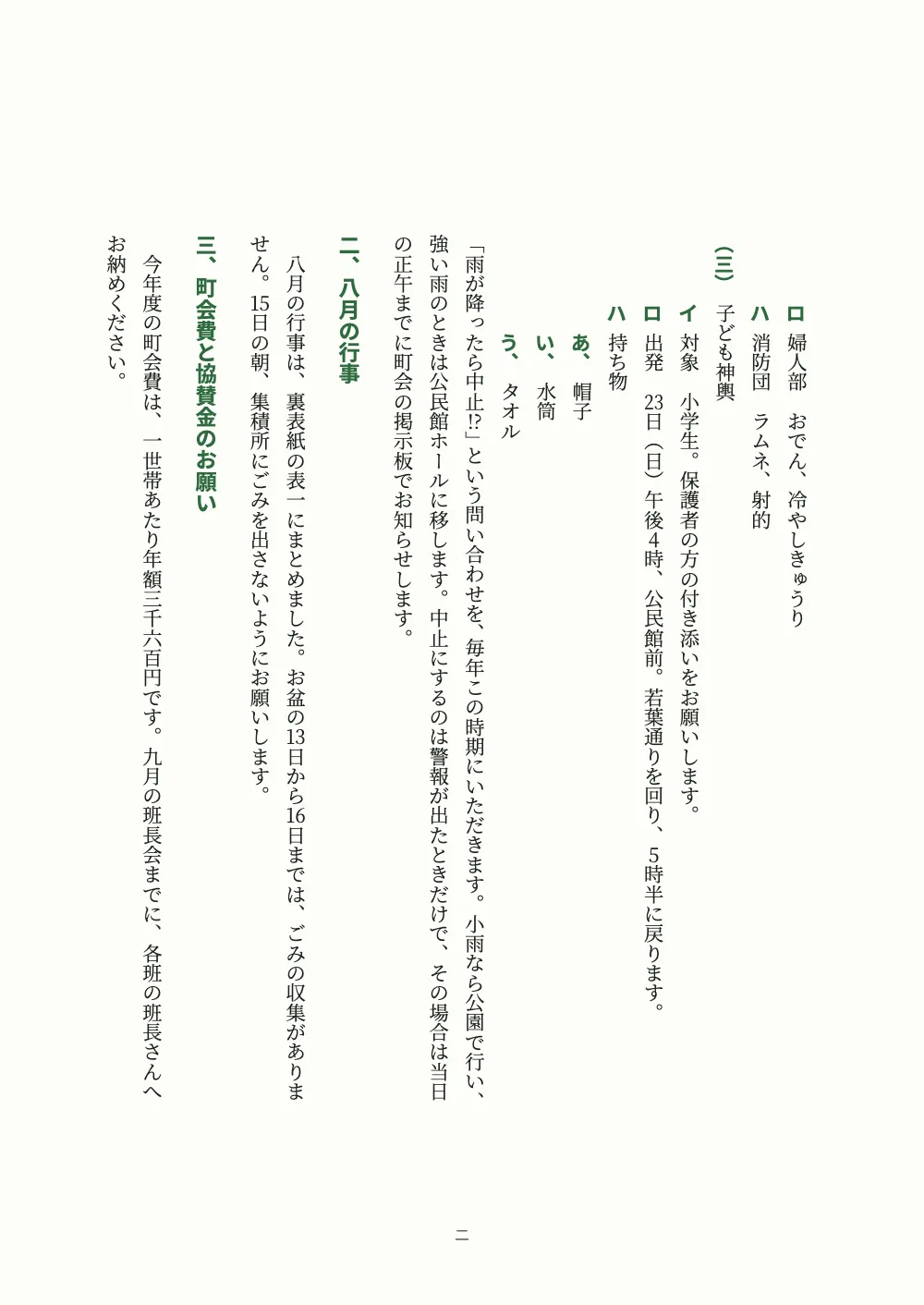
Le bulletin japonais d’une association de quartier, imprimé en lignes de haut en bas. Il montre les différentes façons dont le japonais écrit les nombres, et comment les dates restent lisibles en texte vertical.
Ce que vous allez composer
Quatre pages verticales d’un bulletin de quartier, 東若葉台だより, numéro 第百二十号, sur une page B5 reliée à droite : l’annonce de la fête d’été, le calendrier d’août, les cotisations et un reçu de don, et un bref historique de l’association. L’association est inventée ; ses nombres sont écrits comme les écrit un éditeur japonais. Le numéro, le 第三十二回 de la fête et les 二千四百人 venus sont comptés avec 十 百 千 ; les années s’écrivent chiffre par chiffre, 二〇二六年 et 一九六〇年 ; le montant du reçu est en daiji (大字), 壱萬弐阡, qu’on ne peut pas falsifier d’un trait ; les heures et les dates sont en chiffres arabes, et 22 se tient debout dans une seule case. Les listes vont 一、 → (一) → イ → あ, et le calendrier occupe la dernière page.
Cette recette répond à
- Comment numéroter les chapitres 第一章 en chiffres kanji, ou les éléments de liste あ い う et イ ロ ハ ?
- Pourquoi mon texte japonais sort-il avec les règles chinoises : étiquettes 图, petits kana en début de ligne, kanji sous leurs formes chinoises ?
La réponse courte
// formatNumeral is the counter the engine numbers pages, lists and headings with.
const ISSUE = 120;
const kan = (n) => formatNumeral(n, 'japanese-informal'); // 120 → 百二十: counted
const pos = (n) => formatNumeral(n, 'cjk-decimal'); // 2026 → 二〇二六: digit by digit
const daiji = (n) => formatNumeral(n, 'japanese-formal'); // 12000 → 壱萬弐阡: on money
// {{daiji:12000}} in the text: the amount of a receipt in the hard-to-alter daiji.
const withDaiji = (md) => md.replace(/\{\{daiji:(\d+)\}\}/g, (_, n) => daiji(Number(n)));
const cjk = {
  grid: { enabled: true, charsPerLine: CHARS, linesPerPage: LINES },
  uprightDigits: 2, // 8月22日: one or two Arabic digits stand in one cell (the default)
};
// Sections 一、二、三、, items (一)(二), then イ ロ ハ and あ い う beneath them.
const sectionLevel = { level: 2, numberingTemplate: '{2:一}、', numberSeparator: '',
  fontFamily: GOTHIC, fontWeight: 700, fontSize: pt(12), color: col('leaf'), lineSpan: 2 }; // 二行取り
const level = (n, numberFormat, prefix, separator) => ({ level: n, numberFormat, prefix,
  separator }); // each level starts where the text of the one above starts
const orderedLists = {
  fontFamily: GOTHIC, color: col('leaf'), fontWeight: 700, gap: em(0.5),
  marginTop: pt(0), marginBottom: pt(0), itemSpacing: pt(0),
  levels: [level(1, 'japanese-informal', '(', ')'), level(2, 'katakana-iroha', '', ''),
    level(3, 'hiragana', '', '、')],
};
Ingrédients
- Fonctionnalités
- Numération japonaise et compteurs en kanaNombres droits dans le texte verticalListes numérotéesTexte verticalLivres reliés à droiteGrille de caractèresKana, kanji et rōmajiPolices chinoises, japonaises et coréennesEspacement de la ponctuation japonaise (yakumono)Titres sur plusieurs lignes du texte (gyōdori)Titres numérotésOuvertures composéesStyles de titreStyles de paragrapheEncadrésStyles de tableau nommésTypes de ressource personnalisésCouleur du papierPalette de couleurs sémantiqueExport PDF
- Utilise aussi
- Bibliographies et glossairesCoupure des lignes en chinoisAttributs de titreDes figures exactement iciTitres courants selon le rôle de la pagePolices intégrées au PDFPages liminaires en chiffres romainsChapitres non numérotés
- Typographie
- Noto Serif JP, Noto Sans JP, Zen Maru Gothic (SIL OFL 1.1)
- Ressources
- Aucune : chaque image est dessinée en code
Préparation
#1 · Choisir la graphie selon la place du nombre
Le code est dans la réponse courte plus haut. formatNumeral est le compteur avec lequel le moteur numérote les pages, les listes et les titres, et le pen l’appelle pour les nombres qu’il compose lui-même : japanese-informal compte (120 → 百二十, sans 一 devant 十 百 千), cjk-decimal écrit chiffre par chiffre (2026 → 二〇二六) et japanese-formal donne le daiji d’une somme (12000 → 壱萬弐阡). Un {{daiji:12000}} dans le texte devient le montant du reçu : le chiffre n’est tapé qu’une fois, en chiffres. Les mêmes styles nomment les compteurs : les sections sont {2:一}、, et orderedLists.levels règle (一), puis katakana-iroha (イ ロ ハ), puis hiragana avec 、 (あ、い、う). cjk.uprightDigits: 2 met 8月22日 et 23日 debout sans balisage, et le !? de 「雨が降ったら中止!?」 partage une seule case, comportement japonais par défaut (nombres en texte vertical).
#2 · Placer le titre du bulletin dans une bande le long du bord droit
const BAND = 46; // mm from the right trim edge
const at = (x, y, extra = {}) => ({ anchor: { to: 'page', edge: 'top-left' },
  offset: { x: mm(x), y: mm(y) }, ...extra }); // x down the sheet, y leftward from its right
const onBand = { color: col('paper'), overflow: 'wrap', align: 'left' };
const masthead = {
  id: 'masthead', numbered: false, toc: false, runningChapter: false,
  breakBefore: { enabled: true, parity: 'any' },
  advancedDesign: { enabled: true, minHeight: mm(BAND - 15), slot: { elements: [
    { kind: 'box', id: 'band', style: { backgroundColor: col('leaf') },
      placement: { anchor: { to: 'bleed', edge: 'top-left' }, size: { height: mm(BAND) } } },
    { kind: 'text', id: 'title', content: '{titleText}', ...onBand, fontFamily: ROUND,
      fontWeight: 700, fontSize: pt(36), lineHeight: 1.1, letterSpacing: pt(3),
      placement: at(HEAD, 9) },
    { kind: 'text', id: 'issue', content: `第${kan(ISSUE)}号`, ...onBand, fontFamily: GOTHIC,
      fontWeight: 700, fontSize: pt(12), letterSpacing: pt(2), placement: at(HEAD, 26) },
    { kind: 'text', id: 'date', content: `${pos(2026)}年(令和${kan(8)}年)${kan(8)}月${kan(1)}日発行`,
      ...onBand, fontFamily: GOTHIC, fontSize: pt(10), align: 'right',
      placement: at(HEAD, 26, { size: { width: mm(LINE) } }) },
    { kind: 'text', id: 'publisher', content: '{author}', ...onBand, fontFamily: GOTHIC,
      fontSize: pt(10), align: 'right', placement: at(HEAD, 33, { size: { width: mm(LINE) } }) },
    { kind: 'text', id: 'latin', content: '{attr.latin}', ...onBand, fontFamily: GOTHIC,
      fontSize: pt(7.5), placement: at(HEAD, 40) },
  ] } },
};
Sur une page verticale, le haut du flux est le bord droit de la feuille : une maquette de titre ancrée en haut du fond perdu devient donc une bande le long de ce bord, et sa size.height est sa largeur sur la feuille. Le numéro et la date sont du texte de maquette construit avec kan() et pos(), et la date s’arrête au pied du bloc de texte avec align: 'right'.
#3 · Donner au calendrier sa propre page
const DAYS = { 2: '訓練', 9: '清掃', 13: 'お盆', 18: '練習会', 19: '練習会',
  22: '夏祭り', 23: '夏祭り', 30: '役員会' };
const day = (d) => (d ? { content: `**${d}**\n${DAYS[d] ?? '\u00a0'}`, align: 'center',
  ...(DAYS[d] ? { background: col(d === 22 || d === 23 ? 'blush' : 'tint') } : {}) }
  : { content: '' });
const weeks = []; // 1 August 2026 is a Saturday
for (let d = -5; d <= 31; d += 7) weeks.push([0, 1, 2, 3, 4, 5, 6].map((k) => day(d + k > 0
  && d + k <= 31 ? d + k : 0)));
const calendar = { id: 'calendar', typeId: 'table', kind: 'table', createdAt: 0, updatedAt: 0,
  // An upright table takes every line of the vertical page it stands on (gap:
  // vertical-tables): the calendar is the back page, cited at the end of the text.
  placement: { position: 'top', span: 'page' },
  caption: '八月の行事。13日から16日まではごみの収集がありません。',
  table: { model: { headerRowCount: 1, rows: [[...'日月火水木金土'].map((c) => ({ content: c,
    isHeader: true, align: 'center' })), ...weeks] } } };
const resourceTypes = [{ id: 'table', name: '表', shortLabel: '表', captionPrefix: '表',
  numberingTemplate: '{n}', counterFormat: '一', resetOn: 'never' }]; // 表一, 表二…
Un tableau se tient debout sur une page verticale et se lit horizontalement, comme les livres japonais impriment leurs tableaux ; il occupe toutes les lignes de la page où il se trouve. Le calendrier est cité après le dernier paragraphe, en flottant sur toute la largeur de la page : il devient ainsi la dernière page, et le texte qui le précède remplit ses pages. resourceTypes le numérote avec le jeton 一 (表一), et un document ja compose de lui-même l’étiquette 表一 : étiquette et numéro sans espace, une espace idéographique après.
#4 · Charger chaque voix avec le texte qu’elle compose
const heads = (markdown.match(/^#+ .*$/gm) ?? []).join('');
const gothicText = `${heads}${markdown}第号年月日発行令和${kan(ISSUE)}${pos(2026)}${
  calendar.caption}日月火水木金土${Object.values(DAYS).join('')}領収証(記入例)表一`;
Noto Serif JP compose le texte, Noto Sans JP les titres, les listes, le calendrier et l’étiquette du reçu, et Zen Maru Gothic seulement le titre. Chacun charge les fichiers Fontsource de ses propres caractères, plus les nombres que compose le pen.
La recette complète
// ═══ Postext Cookbook · Nº 129 · Kanji numerals, counters and dates in vertical text ═══ // https://postext.dev/en/cookbook/kanji-numerals-and-dates // Code: MIT · Text: written for the recipe (CC BY 4.0) // Fonts: Noto Serif JP, Noto Sans JP, Zen Maru Gothic (SIL OFL 1.1) · Needs postext ≥ 1.25.0 // A neighbourhood newsletter set vertically: every way Japanese writes a number. import { buildDocument, withLoadedFonts, renderPageToCanvas, loadVerticalAlternates, formatNumeral, } from 'https://esm.sh/postext'; import { renderToPdf, decompressWoff2 } from 'https://esm.sh/postext-pdf'; const LANG = 'en'; // @lang: the language of the frame; the newsletter is Japanese in both const RECIPE = 'kanji-numerals-and-dates'; // ─── 1 · Design ───────────────────────────────────────────────────────────── // #region palette: ink, the green of young leaves, its tint, a festival red and its blush const palette = { ink: '#1f2420', // the text leaf: '#2f6b3f', // masthead band, section numbers (6.4:1 on the paper) tint: '#e4efdf', // the calendar's marked days, the receipt red: '#b4362b', // the receipt's amount blush: '#f4d4cc', // the festival days in the calendar muted: '#5f665f', // folios, the colophon paper: '#fdfdf9', }; const col = (id) => ({ hex: palette[id], model: 'hex', paletteId: id }); const colorPalette = [ ...Object.entries(palette).map(([id, hex]) => ({ id, name: id, value: { hex, model: 'hex' } })), { id: 'main-color', name: 'leaf (defaults)', value: { hex: palette.leaf, model: 'hex' } }, ]; // #endregion const MINCHO = 'Noto Serif JP'; // the text const GOTHIC = 'Noto Sans JP'; // section heads, labels, the calendar const ROUND = 'Zen Maru Gothic'; // the masthead's title const [BODY, LEAD] = [11, 20]; // pt: large print for every age on the street const [CHARS, LINES] = [44, 20]; const PT = 25.4 / 72; // mm in a point const TRIM = { w: 182, h: 257 }; // mm, B5 const LINE = CHARS * BODY * PT; // mm: 170.7, the length of a line const HEAD = 30 + (TRIM.h - 30 - 24 - LINE) / 2; // mm: the head of the type area // #region answer: one number, four spellings, chosen by where it stands // formatNumeral is the counter the engine numbers pages, lists and headings with. const ISSUE = 120; const kan = (n) => formatNumeral(n, 'japanese-informal'); // 120 → 百二十: counted const pos = (n) => formatNumeral(n, 'cjk-decimal'); // 2026 → 二〇二六: digit by digit const daiji = (n) => formatNumeral(n, 'japanese-formal'); // 12000 → 壱萬弐阡: on money // {{daiji:12000}} in the text: the amount of a receipt in the hard-to-alter daiji. const withDaiji = (md) => md.replace(/\{\{daiji:(\d+)\}\}/g, (_, n) => daiji(Number(n))); const cjk = { grid: { enabled: true, charsPerLine: CHARS, linesPerPage: LINES }, uprightDigits: 2, // 8月22日: one or two Arabic digits stand in one cell (the default) }; // Sections 一、二、三、, items (一)(二), then イ ロ ハ and あ い う beneath them. const sectionLevel = { level: 2, numberingTemplate: '{2:一}、', numberSeparator: '', fontFamily: GOTHIC, fontWeight: 700, fontSize: pt(12), color: col('leaf'), lineSpan: 2 }; // 二行取り const level = (n, numberFormat, prefix, separator) => ({ level: n, numberFormat, prefix, separator }); // each level starts where the text of the one above starts const orderedLists = { fontFamily: GOTHIC, color: col('leaf'), fontWeight: 700, gap: em(0.5), marginTop: pt(0), marginBottom: pt(0), itemSpacing: pt(0), levels: [level(1, 'japanese-informal', '(', ')'), level(2, 'katakana-iroha', '', ''), level(3, 'hiragana', '', '、')], }; // #endregion // #region masthead: a green band down the right edge, the issue and the date in kanji const BAND = 46; // mm from the right trim edge const at = (x, y, extra = {}) => ({ anchor: { to: 'page', edge: 'top-left' }, offset: { x: mm(x), y: mm(y) }, ...extra }); // x down the sheet, y leftward from its right const onBand = { color: col('paper'), overflow: 'wrap', align: 'left' }; const masthead = { id: 'masthead', numbered: false, toc: false, runningChapter: false, breakBefore: { enabled: true, parity: 'any' }, advancedDesign: { enabled: true, minHeight: mm(BAND - 15), slot: { elements: [ { kind: 'box', id: 'band', style: { backgroundColor: col('leaf') }, placement: { anchor: { to: 'bleed', edge: 'top-left' }, size: { height: mm(BAND) } } }, { kind: 'text', id: 'title', content: '{titleText}', ...onBand, fontFamily: ROUND, fontWeight: 700, fontSize: pt(36), lineHeight: 1.1, letterSpacing: pt(3), placement: at(HEAD, 9) }, { kind: 'text', id: 'issue', content: `第${kan(ISSUE)}号`, ...onBand, fontFamily: GOTHIC, fontWeight: 700, fontSize: pt(12), letterSpacing: pt(2), placement: at(HEAD, 26) }, { kind: 'text', id: 'date', content: `${pos(2026)}年(令和${kan(8)}年)${kan(8)}月${kan(1)}日発行`, ...onBand, fontFamily: GOTHIC, fontSize: pt(10), align: 'right', placement: at(HEAD, 26, { size: { width: mm(LINE) } }) }, { kind: 'text', id: 'publisher', content: '{author}', ...onBand, fontFamily: GOTHIC, fontSize: pt(10), align: 'right', placement: at(HEAD, 33, { size: { width: mm(LINE) } }) }, { kind: 'text', id: 'latin', content: '{attr.latin}', ...onBand, fontFamily: GOTHIC, fontSize: pt(7.5), placement: at(HEAD, 40) }, ] } }, }; // #endregion // #region calendar: August 2026 as a table, the festival and the duties marked const DAYS = { 2: '訓練', 9: '清掃', 13: 'お盆', 18: '練習会', 19: '練習会', 22: '夏祭り', 23: '夏祭り', 30: '役員会' }; const day = (d) => (d ? { content: `**${d}**\n${DAYS[d] ?? '\u00a0'}`, align: 'center', ...(DAYS[d] ? { background: col(d === 22 || d === 23 ? 'blush' : 'tint') } : {}) } : { content: '' }); const weeks = []; // 1 August 2026 is a Saturday for (let d = -5; d <= 31; d += 7) weeks.push([0, 1, 2, 3, 4, 5, 6].map((k) => day(d + k > 0 && d + k <= 31 ? d + k : 0))); const calendar = { id: 'calendar', typeId: 'table', kind: 'table', createdAt: 0, updatedAt: 0, // An upright table takes every line of the vertical page it stands on (gap: // vertical-tables): the calendar is the back page, cited at the end of the text. placement: { position: 'top', span: 'page' }, caption: '八月の行事。13日から16日まではごみの収集がありません。', table: { model: { headerRowCount: 1, rows: [[...'日月火水木金土'].map((c) => ({ content: c, isHeader: true, align: 'center' })), ...weeks] } } }; const resourceTypes = [{ id: 'table', name: '表', shortLabel: '表', captionPrefix: '表', numberingTemplate: '{n}', counterFormat: '一', resetOn: 'never' }]; // 表一, 表二… // #endregion const config = () => ({ locale: 'ja', // written out, never LANG (gotcha: ja-locale-tag) colorPalette, resourceTypes, page: { sizePreset: 'custom', width: mm(TRIM.w), height: mm(TRIM.h), dpi: 150, backgroundColor: col('paper'), margins: { top: mm(30), bottom: mm(24), left: mm(16), right: mm(18), mirror: true }, pageNumbering: { format: 'japanese-informal' }, }, layout: { layoutType: 'single', writingMode: 'vertical-rl' }, cjk, bodyText: { fontFamily: MINCHO, fontSize: pt(BODY), lineHeight: pt(LEAD), color: col('ink'), boldColor: col('ink'), italicColor: col('ink'), referenceColor: col('ink'), textAlign: 'justify', firstLineIndent: em(1), indentAfterHeading: true, }, headings: { fontFamily: GOTHIC, color: col('ink'), levels: [{ level: 1, breakBefore: { enabled: true, parity: 'any' } }, sectionLevel] }, headingStyles: [masthead], orderedLists, paragraphStyles: [ { id: 'item', firstLineIndent: em(0), indent: em(1), hangingIndent: em(3) }, { id: 'chronicle', firstLineIndent: em(0), hangingIndent: em(14) }, { id: 'colophon', fontFamily: GOTHIC, fontSize: pt(7), color: col('muted'), textAlign: 'left', firstLineIndent: em(0), marginTop: pt(LEAD) }, ], calloutStyles: [{ id: 'receipt', title: '領収証(記入例)', background: col('tint'), padding: { top: mm(4), right: mm(4), bottom: mm(4), left: mm(4) }, marginTop: pt(LEAD / 2), marginBottom: pt(0), // the next heading's 行取り gives it room titleStyle: { fontFamily: GOTHIC, fontSize: pt(12), fontWeight: 700, color: col('leaf') }, body: { fontFamily: MINCHO, color: col('ink'), boldColor: col('red'), textAlign: 'left', firstLineIndent: em(0) } }], tableStyle: { rules: 'horizontal', borderColor: col('leaf'), borderWidth: pt(0.5), headerBackground: col('leaf'), headerColor: col('paper'), headerFontFamily: GOTHIC, headerFontSize: pt(12), bodyFontFamily: GOTHIC, bodyFontSize: pt(11), bodyColor: col('ink'), cellPadding: mm(3.2) }, // 表一 八月の行事: label and number solid, then U+3000 (the ja default) captionStyle: { fontFamily: GOTHIC, fontSize: pt(10), color: col('ink'), labelColor: col('leaf') }, header: { elements: [{ kind: 'text', id: 'folio', content: '{pageNumber}', pages: 'body', fontFamily: GOTHIC, fontSize: pt(8), color: col('muted'), align: 'center', placement: { anchor: { to: 'page', edge: 'bottom' }, offset: { y: mm(-12) } } }] }, footer: { elements: [] }, }); // ─── 2 · Content ──────────────────────────────────────────────────────────── const markdown = withDaiji(String.raw`---Exemple Markdown · 74 lignes · content.en.md
title: "東若葉台だより" author: "東若葉台二丁目町会 広報部" --- # 東若葉台だより {style="masthead" latin="Higashi-Wakabadai News, the newsletter of a neighbourhood association (fiction)"} 暑い日が続いています。今号は夏祭りの案内を中心に、八月の行事、町会費と協賛金のお願い、それに町会の歩みをお届けします。 ## 夏祭りのお知らせ 今年の夏祭りは第三十二回になります。平成七年に公民館の駐車場で始まった小さな盆踊りが、昨年は二日間で延べ二千四百人が訪れる行事になりました。今年も子ども会、婦人部、消防団の皆さんが準備を進めています。 :::paragraphs{style="item"} 日時 8月22日(土)・23日(日) 午後4時から9時まで 会場 若葉台第二公園(雨の場合は公民館ホール) ::: 1. 盆踊り 1. 練習会 8月18日(火)・19日(水)の午後7時から、公民館ホールで行います。浴衣でなくてもかまいません。 2. 本番 両日とも午後6時半から。太鼓は今年も若葉台中学校の和太鼓部が務めます。 2. 屋台 1. 子ども会 焼きそば、かき氷 2. 婦人部 おでん、冷やしきゅうり 3. 消防団 ラムネ、射的 3. 子ども神輿 1. 対象 小学生。保護者の方の付き添いをお願いします。 2. 出発 23日(日)午後4時、公民館前。若葉通りを回り、5時半に戻ります。 3. 持ち物 1. 帽子 2. 水筒 3. タオル 「雨が降ったら中止!?」という問い合わせを、毎年この時期にいただきます。小雨なら公園で行い、強い雨のときは公民館ホールに移します。中止にするのは警報が出たときだけで、その場合は当日の正午までに町会の掲示板でお知らせします。 ## 八月の行事 八月の行事は、裏表紙の表一にまとめました。お盆の13日から16日までは、ごみの収集がありません。15日の朝、集積所にごみを出さないようにお願いします。 ## 町会費と協賛金のお願い 今年度の町会費は、一世帯あたり年額三千六百円です。九月の班長会までに、各班の班長さんへお納めください。 夏祭りには、毎年たくさんの商店と個人の方から協賛金をいただいています。協賛金には領収証をお渡しします。金額は、書き換えを防ぐために大字(だいじ)で書きます。 :::callout{type="receipt"} 若葉台商店会 様 金 **{{daiji:12000}}** 円也 但し 第三十二回夏祭り協賛金として 二〇二六年八月一日 東若葉台二丁目町会 会計 中村 節子 ::: ## 町会の歩み :::paragraphs{style="chronicle"} 一九六〇年(昭和三十五年) 町会ができる。このときの世帯数は八十四。 一九七二年(昭和四十七年) 公民館が完成する。 一九九五年(平成七年) 第一回の夏祭りを公民館の駐車場で開く。 二〇一一年(平成二十三年) 若葉台第二公園に防災倉庫を置く。 二〇二六年(令和八年) 世帯数は三百十二になった。 ::: :::paragraphs{style="colophon"} Set in Noto Serif JP, Noto Sans JP and Zen Maru Gothic (SIL OFL) · The association, its people and its events are fiction written for this recipe, CC BY 4.0 ::: ::resource{id="calendar"}`); // content.<lang>.md, amounts filled in // ─── 3 · Fonts ────────────────────────────────────────────────────────────── const FONTS = { 'Noto Serif JP': ['400', '700'], 'Noto Sans JP': ['400', '700'], 'Zen Maru Gothic': ['700'] }; // #region voices: each face loads the files of the characters it sets const heads = (markdown.match(/^#+ .*$/gm) ?? []).join(''); const gothicText = `${heads}${markdown}第号年月日発行令和${kan(ISSUE)}${pos(2026)}${ calendar.caption}日月火水木金土${Object.values(DAYS).join('')}領収証(記入例)表一`; // #endregion // ─── 4 · Build & show ─────────────────────────────────────────────────────── await loadFonts(FONTS, markdown); await loadCjkFonts({ [MINCHO]: FONTS[MINCHO] }, markdown, { vertical: true }); await loadCjkFonts({ [GOTHIC]: FONTS[GOTHIC] }, gothicText, { vertical: true }); await loadCjkFonts({ [ROUND]: FONTS[ROUND] }, heads, { vertical: true }); const doc = await withLoadedFonts( () => buildDocument({ markdown, resources: [calendar] }, config()), { ...kitFonts(FONTS), text: markdown }); showBook(doc, { title: t({ en: 'A newsletter in kanji numerals', es: 'Un boletín con numerales kanji' }) }); offerPdf(() => renderToPdf(doc, { fontProvider: cjkPdfProvider }), `${RECIPE}.pdf`);Kit · core, fonts, viewer, pdf, cjk : identique dans toutes les recettes · 458 lignes
// ─── Kit ── helpers shared by every Cookbook recipe · postext.dev/cookbook ───── // ─── Kit · core v1 ── the same in every recipe · postext.dev/cookbook function mm(value) { return { value, unit: 'mm' }; } function pt(value) { return { value, unit: 'pt' }; } function em(value) { return { value, unit: 'em' }; } /** The sample language's string: t({ en: 'Figure', es: 'Figura' }). */ function t(strings) { return strings[LANG] ?? Object.values(strings)[0]; } /** A file in this recipe's assets folder, served from the Postext repo by jsDelivr. */ function asset(file) { return `https://cdn.jsdelivr.net/gh/drnachio/postext@main/cookbook/${RECIPE}/assets/${file}`; } // ─── Kit · fonts v3 ── the same in every recipe · postext.dev/cookbook // Postext loads the faces a config asks for before layout (prepareFonts, // buildDocumentWithFonts) and asks the kit for the files: Fontsource's, the // files the PDF embeds too. /** The options of buildDocumentWithFonts / prepareFonts / withLoadedFonts: * the Fontsource resolver, and the faces of FONTS loaded with the ones the * config names. FONTS = { 'Family Name': ['400', '400i', '700'] }. */ function kitFonts(FONTS = {}) { const faces = Object.entries(FONTS).flatMap(([family, specs]) => specs.map((spec) => ({ family, weight: parseInt(spec, 10), style: spec.endsWith('i') ? 'italic' : 'normal' }))); return { resolve: fontsourceResolver, faces }; } /** A face's Fontsource files, in a fixed order: latin, then latin-ext and greek * when `text` needs them and the family ships them (kitSubsetsFor), each with * its unicode-range. Null for a weight or slant Fontsource does not ship. */ async function fontsourceResolver(family, weight, style, { text = '' } = {}) { const id = fontsourceId(family); const meta = await fontsourceMeta(family); if (meta && !(meta.weights.includes(weight) && meta.styles.includes(style))) return null; kitStatus('Loading fonts…'); const at = await fontsourceAt(id); return ['latin', ...kitSubsetsFor(text, meta)].map((subset) => ({ source: `${at}files/${id}-${subset}-${weight}-${style}.woff2`, unicodeRange: kitRanges()[subset], })); } /** The unicode-range of each Fontsource file the kit loads (a function: the * kit is inlined after the pen's code, which runs before a const would be set). */ function kitRanges() { return { latin: 'U+0000-00FF,U+0131,U+0152-0153,U+02BB-02BC,U+02C6,U+02DA,U+02DC,U+0304,U+0308,U+0329,' + 'U+2000-206F,U+20AC,U+2122,U+2191,U+2193,U+2212,U+2215,U+FEFF,U+FFFD', 'latin-ext': 'U+0100-02BA,U+02BD-02C5,U+02C7-02CC,U+02CE-02D7,U+02DD-02FF,U+0304,U+0308,U+0329,' + 'U+1D00-1DBF,U+1E00-1E9F,U+1EF2-1EFF,U+2020,U+20A0-20AB,U+20AD-20C0,U+2113,U+2C60-2C7F,U+A720-A7FF', greek: 'U+0370-03FF', }; } /** For the cjk, arabic and comics blocks, which add their own files: the * faces of `faces` = { 'Family Name': ['400', '400i', '700'] }. `text` is the sample: * č ł † α χ also load latin-ext and greek files (kitSubsetsFor). With * `optional`, a face Fontsource does not ship is skipped instead of failing. * The files are added once all have loaded, in the order asked (latin, then * latin-ext, then greek), whatever order they arrive in: the last one added * wins a character two files hold. Resolves to the number of faces added. */ async function loadFonts(faces, text = '', { optional = false } = {}) { kitStatus('Loading fonts…'); const ranges = kitRanges(); const jobs = []; for (const [family, specs] of Object.entries(faces)) { const id = fontsourceId(family); const todo = [...new Set(specs)].map((spec) => [parseInt(spec, 10), spec.endsWith('i') ? 'italic' : 'normal']) .filter(([weight, style]) => !hasFace(family, weight, style)); // before any await const at = fontsourceAt(id); const meta = optional || /[^\0-ÿ]/u.test(text) ? await fontsourceMeta(family) : null; const subsets = ['latin', ...kitSubsetsFor(text, meta)]; for (const [weight, style] of todo) { if (optional && !(meta?.weights.includes(weight) && meta.styles.includes(style))) continue; for (const subset of subsets) { const url = `${await at}files/${id}-${subset}-${weight}-${style}.woff2`; const face = new FontFace(family, `url(${url}) format('woff2')`, { weight: String(weight), style, unicodeRange: ranges[subset] }); jobs.push(face.load().catch(() => { if (subset === 'latin' && !optional) throw new Error(`Fontsource has no ${family} ${weight} ${style}`); })); } } } const ready = await Promise.all(jobs).catch((error) => { kitFail(error); throw error; }); return ready.filter((face) => face && document.fonts.add(face)).length; } /** A loaded FontFace covers this family, weight and style (fonts.check() would * also say yes for families nobody declared). */ function hasFace(family, weight, style) { for (const face of document.fonts) { if (face.status !== 'loaded' || face.style !== style) continue; if (face.family.replace(/^["']|["']$/g, '') !== family) continue; const [low, high = low] = face.weight.split(' ').map(Number); if (weight >= low && weight <= high) return true; } return false; } /** The files beyond latin `text` needs that `meta`'s family ships. */ function kitSubsetsFor(text, meta) { return [[/[Ā-˿ᴀ-ᶿḀ-ỿ†ℓⱠ-Ɀ꜠-ꟿ]/u, 'latin-ext'], [/[Ͱ-Ͽ]/u, 'greek']] .filter(([re, x]) => re.test(text) && meta?.subsets?.includes(x)).map(([, x]) => x); } /** Fontsource's id for a family: 'Source Serif 4' → 'source-serif-4'. */ function fontsourceId(family) { return family.toLowerCase().replace(/\s+/g, '-'); } /** A package's folder at the one version @5 names now (#766). */ function fontsourceAt(id, u = `https://cdn.jsdelivr.net/npm/@fontsource/${id}@`) { return (fontsourceAt.c ??= {})[id] ??= fetch(u + '5/package.json').then((r) => r.json()) .then((p) => p.version || 5, () => 5).then((v) => `${u}${v}/`); } /** The family's Fontsource metadata (weights, styles, subsets), or null. */ function fontsourceMeta(family) { fontsourceMeta.cache ??= new Map(); const id = fontsourceId(family); if (!fontsourceMeta.cache.has(id)) { fontsourceMeta.cache.set(id, fetch(`https://api.fontsource.org/v1/fonts/${id}`) .then((res) => (res.ok ? res.json() : null), () => null)); } return fontsourceMeta.cache.get(id); } // ─── Kit · viewer v2 ── the same in every recipe · postext.dev/cookbook /** The pages as spreads on a dark desk, page 1 alone, then verso | recto, * each painted when it scrolls near. Other options go to renderPageToCanvas. */ function showPages(docs, { title, width = 460, ...render } = {}) { const root = viewer(title); const pages = [docs].flat().flatMap((doc) => doc.pages.map((page) => ({ doc, page, n: (doc.pageIndexOffset ?? 0) + page.index }))); const spreads = []; let verso = null; for (const p of pages) { if (p.n % 2 === 1) { if (verso) spreads.push([verso, null]); verso = p; } else { spreads.push([verso, p]); verso = null; } } if (verso) spreads.push([verso, null]); const density = Math.min(window.devicePixelRatio || 1, 2); showPages.painter?.disconnect(); const painter = new IntersectionObserver((entries) => { for (const { isIntersecting, target } of entries) { if (!isIntersecting) continue; painter.unobserve(target); const { doc, page } = target.postext; renderPageToCanvas(page, doc, target, { ...render, scale: (width * density) / page.width }); } }, { rootMargin: '800px' }); showPages.painter = painter; root.replaceChildren(...spreads.map((pair) => { const spread = document.createElement('div'); spread.className = 'pt-spread'; for (const p of pair) { const figure = document.createElement('figure'); if (p) { const label = p.page.pageLabel || String(p.n + 1); const canvas = document.createElement('canvas'); canvas.postext = p; canvas.style.aspectRatio = `${p.page.width} / ${p.page.height}`; canvas.setAttribute('role', 'img'); canvas.setAttribute('aria-label', `Page ${label}`); const folio = document.createElement('figcaption'); folio.textContent = label; figure.append(canvas, folio); painter.observe(canvas); } else figure.className = 'pt-blank'; spread.append(figure); } return spread; })); kitStatus(`${pages.length} ${pages.length === 1 ? 'page' : 'pages'}`); document.documentElement.dataset.postext = 'ready'; return pages.length; } /** The desk, the bar and the error reporting, created once. */ function viewer(title) { if (!document.getElementById('pt-kit')) { document.head.insertAdjacentHTML('beforeend', `<style id="pt-kit"> :root { color-scheme: dark; } body { margin: 0; background: #0e1014; color: #b9bcc4; font: 13px/1.45 system-ui, sans-serif; } #pt-bar { position: sticky; top: 0; z-index: 1; display: flex; flex-wrap: wrap; align-items: center; gap: 6px 16px; padding: 10px 16px; background: rgb(14 16 20 / .92); backdrop-filter: blur(6px); border-bottom: 1px solid #23262d; } #pt-bar strong { color: #f4f1ea; font-weight: 600; } #pt-actions { display: flex; gap: 12px; margin-left: auto; } #pt-actions a, #pt-actions button { color: #d8a21a; font: inherit; background: none; border: 0; padding: 0; cursor: pointer; } #pages { display: grid; justify-items: center; gap: 48px; padding: 32px 16px 72px; } .pt-spread { display: flex; } .pt-spread figure { margin: 0; width: min(460px, 44vw); } .pt-spread canvas { display: block; width: 100%; background: #fff; box-shadow: 0 1px 2px rgb(0 0 0 / .5), 0 22px 44px -16px rgb(0 0 0 / .8); } .pt-spread figure:first-child canvas { box-shadow: inset -14px 0 14px -14px rgb(0 0 0 / .18), 0 1px 2px rgb(0 0 0 / .5), 0 22px 44px -16px rgb(0 0 0 / .8); } .pt-spread figcaption { margin-top: 10px; text-align: center; font: 600 10px/1 system-ui, sans-serif; letter-spacing: .18em; text-transform: uppercase; color: #6c7079; } .pt-blank { visibility: hidden; } @media (max-width: 760px) { .pt-spread { flex-direction: column; gap: 32px; } .pt-spread figure { width: min(460px, 92vw); } .pt-blank { display: none; } } </style>`); document.body.insertAdjacentHTML('afterbegin', '<header id="pt-bar"><strong id="pt-title"></strong><span id="pt-status" role="status"></span><span id="pt-actions"></span></header>'); document.getElementById('pt-title').textContent = document.title || 'Postext'; addEventListener('error', (event) => kitFail(event.error ?? event.message)); addEventListener('unhandledrejection', (event) => kitFail(event.reason)); } if (title) document.getElementById('pt-title').textContent = title; return document.getElementById('pages') ?? document.body.appendChild(Object.assign(document.createElement('main'), { id: 'pages' })); } function kitStatus(text) { viewer(); document.getElementById('pt-status').textContent = text; } function kitFail(error) { document.documentElement.dataset.postext = 'error'; kitStatus(`Error: ${error?.message ?? error}`); } // ─── Kit · pdf v3 ── the same in every recipe that exports a PDF /** The Fontsource files the screen used, as TrueType, with their range and * place: the nearest weight the family ships, upright with no italic; * latin, then what its letters need (kitSubsetsFor). */ async function fontsourceProvider(family, weight, style, request) { const id = fontsourceId(family); const meta = await fontsourceMeta(family); const weights = meta?.weights?.length ? meta.weights : [400, 700]; const w = weights.reduce((a, b) => (Math.abs(b - weight) < Math.abs(a - weight) ? b : a)); const s = style === 'italic' && meta && !meta.styles.includes('italic') ? 'normal' : style; const text = String.fromCodePoint(...(request?.codePoints ?? [])); const files = await Promise.all(['latin', ...kitSubsetsFor(text, meta)].map(async (subset, order) => { const res = await fetch(`${await fontsourceAt(id)}files/${id}-${subset}-${w}-${s}.woff2`); if (!res.ok) throw new Error(`Fontsource has no ${family} ${w} ${s} ${subset}`); return Object.assign(await decompressWoff2(new Uint8Array(await res.arrayBuffer())), { unicodeRange: kitRanges()[subset], order }); })); return files.length === 1 ? files[0] : files; } /** A "Build the PDF" button; then "Open the PDF" (a new tab: CodePen's frame * shows no PDFs) and a download link. */ function offerPdf(makePdf, filename) { viewer(); const button = Object.assign(document.createElement('button'), { type: 'button', textContent: 'Build the PDF' }); button.dataset.postextPdf = filename; button.addEventListener('click', async () => { button.disabled = true; button.textContent = 'Building the PDF…'; try { const bytes = await makePdf(); const url = URL.createObjectURL(new Blob([bytes], { type: 'application/pdf' })); const size = `${Math.max(1, Math.round(bytes.length / 1024))} KB`; button.replaceWith( Object.assign(document.createElement('a'), { href: url, target: '_blank', rel: 'noopener', textContent: 'Open the PDF ↗' }), Object.assign(document.createElement('a'), { href: url, download: filename, textContent: `Download ${filename} · ${size}` })); } catch (error) { button.disabled = false; button.textContent = 'Build the PDF'; kitFail(error); } }); document.getElementById('pt-actions').append(button); } // ─── Kit · cjk v2 ── Chinese, Japanese and Korean books · postext.dev/cookbook // Fontsource ships a CJK family as about a hundred files per weight, each // declared in its stylesheet with the unicode-range it covers. The screen // loads the files the sample touches; the PDF gets the same files for the // characters its pages set in each face, and embeds each as a subset. // A book bound on the right (vertical text) is shown with its spreads // mirrored: page 1 alone on the left of the spine, then [3 | 2]. /** The files of a Fontsource face, read from its stylesheet: { url, range, * ranges }, the last declared first (the order the browser tries them in). */ function cjkSlices(family, weight, style) { cjkSlices.cache ??= new Map(); const id = fontsourceId(family); const css = `${id}/${weight}${style === 'italic' ? '-italic' : ''}.css`; if (!cjkSlices.cache.has(css)) { let at; cjkSlices.cache.set(css, fontsourceAt(id).then((a) => fetch(at = a + css.slice(id.length + 1))) .then((res) => { if (!res.ok) throw new Error(`Fontsource has no ${family} ${weight} ${style} (${res.status})`); return res.text(); }) .then((text) => [...text.matchAll(/@font-face\s*{([^}]*)}/g)].map(([, rule]) => { const range = /unicode-range:\s*([^;]+);/.exec(rule)?.[1].trim() ?? 'U+0-10FFFF'; const ranges = range.split(',').map((part) => { const [lo, hi = lo] = part.trim().slice(2).split('-'); return [parseInt(lo, 16), parseInt(hi, 16)]; }); return { url: new URL(/url\(([^)]+?\.woff2)\)/.exec(rule)[1], at).href, range, ranges }; }).reverse())); } return cjkSlices.cache.get(css); } /** The file of `slices` the screen sets code point `cp` in, if any: the * last one loadCjkFonts adds whose range holds it. A numbered file that * repeats a letter of latin is added after latin, and wins it. */ function cjkSliceFor(slices, cp) { const holds = (slice) => slice.ranges.some(([lo, hi]) => cp >= lo && cp <= hi); return slices.reduce((last, slice) => (holds(slice) ? slice : last), undefined); } /** Whether Fontsource serves `family` as a Chinese, Japanese or Korean * family (its subsets name the script). Fails when the API does not * answer: a CJK face taken for a Latin one would paint in a system face. */ async function isCjkFamily(family) { const meta = await fontsourceMeta(family); if (!meta) throw new Error(`api.fontsource.org did not describe ${family}: reload to try again`); return !!meta.subsets?.some((subset) => /^(chinese|japanese|korean)/.test(subset)); } /** faces = { 'Noto Serif TC': ['400', '700'] }, as for loadFonts: the * whole FONTS object may be passed, its other families are left to * loadFonts. Adds one FontFace per file of each CJK face with its * unicodeRange, then loads the files `text` touches. `text` is what the * faces set: the sample for the text face; a book in several voices calls * it once per voice (loadCjkFonts({ 'LXGW WenKai TC': ['400'] }, quotes)), * so the heading and quotation faces fetch and check only their own * characters. Fails when a character of `text` is in no file of a face. * List every weight the pages use: a weight left to the engine's later round * gets the latin file only. With { vertical: true } it also loads each * family's vertical forms (brackets, quotes, pause marks) for the canvas, * which needs loadVerticalAlternates imported from postext. Resolves to * the number of files loaded. */ async function loadCjkFonts(faces, text, { vertical = false } = {}) { kitStatus('Loading fonts…'); let loaded = 0; try { if (vertical && typeof loadVerticalAlternates !== 'function') { throw new Error('loadCjkFonts(…, { vertical: true }) needs loadVerticalAlternates imported from postext'); } for (const [family, specs] of Object.entries(faces)) { if (!(await isCjkFamily(family))) continue; const twin = []; for (const spec of new Set(specs)) { const weight = parseInt(spec, 10); const style = spec.endsWith('i') ? 'italic' : 'normal'; const slices = await cjkSlices(family, weight, style); const missing = [...new Set(text)].filter((ch) => /\S/.test(ch) && !cjkSliceFor(slices, ch.codePointAt(0))); if (missing.length) { throw new Error(`${family} ${spec} has no file for ${missing.slice(0, 12).join(' ')}: ` + `give each face the text it sets (loadCjkFonts({ '${family}': ['${spec}'] }, text))`); } for (const slice of slices) { document.fonts.add(new FontFace(family, `url(${slice.url}) format('woff2')`, { weight: String(weight), style, unicodeRange: slice.range })); twin.push({ source: slice.url, weight: String(weight), style, unicodeRange: slice.range }); } const font = `${style === 'italic' ? 'italic ' : ''}${weight} 16px "${family}"`; loaded += (await document.fonts.load(font, text)).length; if (!document.fonts.check(font, text)) throw new Error(`${family} ${spec} did not load for the sample`); } // The same files under a twin name with the `vert` feature on: the // canvas paints the punctuation of vertical lines with it. if (vertical && twin.length) await loadVerticalAlternates(family, twin); } } catch (error) { kitFail(error); throw error; } return loaded; } /** The PDF font provider for recipes with CJK faces: a family whose * Fontsource subsets are Chinese, Japanese or Korean gets the files the * screen set its pages' characters in (`request.codePoints`), each marked * with its unicode-range and its place in the order loadCjkFonts added * them: postext-pdf sets a character two files hold in the one added * last, as the browser does. Any other family gets the latin file * fontsourceProvider fetches (the "pdf" block) and, when the face sets * letters only latin-ext has, that file too. */ async function cjkPdfProvider(family, weight, style, request) { if (!(await isCjkFamily(family))) return cjkLatinPdfFiles(family, weight, style, request); const meta = await fontsourceMeta(family); const weights = meta.weights?.length ? meta.weights : [400, 700]; const w = weights.reduce((a, b) => (Math.abs(b - weight) < Math.abs(a - weight) ? b : a)); const s = style === 'italic' && !meta.styles.includes('italic') ? 'normal' : style; const slices = await cjkSlices(family, w, s); const picked = new Set(); for (const cp of request?.codePoints ?? []) { const slice = cjkSliceFor(slices, cp); if (slice) picked.add(slice); } if (!picked.size) picked.add(slices[0]); return Promise.all(slices.map(async (slice, order) => { if (!picked.has(slice)) return null; const res = await fetch(slice.url); if (!res.ok) throw new Error(`Fontsource file ${slice.url} (${res.status})`); const bytes = await decompressWoff2(new Uint8Array(await res.arrayBuffer())); return Object.assign(bytes, { unicodeRange: slice.range, order }); })).then((files) => files.filter(Boolean)); } /** A Latin family set next to the CJK faces: its latin file, then its * latin-ext file when the face sets letters only latin-ext has (ō ū in * Hepburn rōmaji, ǎ in pinyin), the file loadFonts adds on screen for * them, each marked with its unicode-range and its place in that order: * the PDF sets a character in the file the browser took it from. A face * Fontsource ships without latin-ext, or whose file does not come, gets * latin alone, and the PDF names the letters it lacks. */ async function cjkLatinPdfFiles(family, weight, style, request) { const meta = await fontsourceMeta(family); const beyond = [...(request?.codePoints ?? [])].some(cjkLatinExtOnly); if (!beyond || !meta?.subsets?.includes('latin-ext')) return fontsourceProvider(family, weight, style); const weights = meta.weights?.length ? meta.weights : [400, 700]; const w = weights.reduce((a, b) => (Math.abs(b - weight) < Math.abs(a - weight) ? b : a)); const s = style === 'italic' && !meta.styles.includes('italic') ? 'normal' : style; const id = fontsourceId(family); const url = `${await fontsourceAt(id)}files/${id}-latin-ext-${w}-${s}.woff2`; const [latin, ext] = await Promise.all([fontsourceProvider(family, weight, style), fetch(url) .then(async (res) => (res.ok ? decompressWoff2(new Uint8Array(await res.arrayBuffer())) : null), () => null)]); const ranges = kitRanges(); return ext ? [Object.assign(latin, { unicodeRange: ranges.latin, order: 0 }), Object.assign(ext, { unicodeRange: ranges['latin-ext'], order: 1 })] : latin; } /** Whether code point `cp` is in Fontsource's latin-ext file and not in * its latin file: Latin Extended-A and -B, IPA, the spacing modifiers and * Latin Extended Additional (loadFonts's test for latin-ext), less the * few latin holds too (ı Œ œ ʻ ʼ ˆ ˚ ˜). */ function cjkLatinExtOnly(cp) { if (!((cp >= 0x100 && cp <= 0x2ff) || (cp >= 0x1e00 && cp <= 0x1eff))) return false; return ![0x131, 0x152, 0x153, 0x2bb, 0x2bc, 0x2c6, 0x2da, 0x2dc].includes(cp); } /** showPages for a book bound on either edge. A right-bound book (the * document says so: doc.binding is 'right' for page.binding 'right' and * for vertical text) lies on the desk as it opens: page 1 alone on the * left of the spine, then [3 | 2], the spine shade on each page's inner * edge. `binding` ('left' | 'right') overrides the document's. */ function showBook(docs, { binding, ...options } = {}) { const count = showPages(docs, options); const right = (binding ?? [docs].flat()[0]?.binding) === 'right'; if (!document.getElementById('pt-kit-cjk')) { // The pages keep direction ltr: a canvas draws text in the direction its // element inherits, and under rtl each run would end where the engine // starts it, its brackets mirrored. document.head.insertAdjacentHTML('beforeend', `<style id="pt-kit-cjk"> .pt-spread[dir="rtl"] canvas { direction: ltr; } .pt-spread[dir="rtl"] figure:first-child canvas { box-shadow: inset 14px 0 14px -14px rgb(0 0 0 / .18), 0 1px 2px rgb(0 0 0 / .5), 0 22px 44px -16px rgb(0 0 0 / .8); } </style>`); } // Each pair stays [verso, recto] in the page; right to left, the verso // sits on the right. Phones stack the pages in reading order either way. for (const spread of document.querySelectorAll('#pages > .pt-spread')) spread.dir = right ? 'rtl' : 'ltr'; document.getElementById('pages').dataset.binding = right ? 'right' : 'left'; return count; } // ─── /Kit ───────────────────────────────────────────────────────────────────────
Le script.js composé s’exécute tel quel : collez-le dans le script de module de n’importe quelle page, ou ouvrez la recette sur CodePen. Dossier de la recette sur GitHub ↗ (s’ouvre dans un nouvel onglet)
Variantes
#Écrire chaque année en la comptant
Certains auteurs préfèrent 二千二十六年 à 二〇二六年 dans le texte courant ; changez le style de pos.
-const pos = (n) => formatNumeral(n, 'cjk-decimal'); // 2026 → 二〇二六: digit by digit
+const pos = (n) => formatNumeral(n, 'japanese-informal'); // 2026 → 二千二十六#Mettre trois chiffres debout
Avec 3, un 100 ou un 365 dans le texte occupe lui aussi une seule case.
-  uprightDigits: 2, // 8月22日: one or two Arabic digits stand in one cell (the default)
+ uprightDigits: 3,Erreurs fréquentes
Erreur fréquente
Balisez un texte japonais 'ja', jamais zh-Hans ni LANG
Les éditions d’une recette sont en et es, mais un exemple japonais est en japonais dans les deux : `locale: LANG` le baliserait en anglais ou en espagnol, et une balise chinoise le composerait selon les règles chinoises (ponctuation Kaiming, petits kana libres de commencer une ligne, 图 pour 図, formes de glyphes chinoises dans le PDF). Depuis postext 1.30, la balise est aussi la langue dans laquelle le texte est mis en forme (mesuré, peint et incorporé) : toute balise autre que 'ja' donne d’autres formes de glyphes que les japonaises (les chinoises sous une balise chinoise) et d’autres coupures de ligne. Écrivez 'ja' : elle choisit la région Japon (coupure des lignes et ponctuation JLReq, points d’emphase sésame, espacement des furigana, étiquettes 図 et 表) et désactive la césure. Le lint fait échouer un texte contenant des kana sous une balise zh ou ko. Coupure des lignes en japonais (kinsoku) →
Erreur fréquente
Composez le japonais dans un caractère japonais
Noto Serif SC et TC ont des kana, mais ils dessinent les kanji sous leurs formes chinoises (直, 骨 et 角 diffèrent) et les kana dans un dessin chinois. Composez le texte en Noto Serif JP ou Shippori Mincho B1 et les titres en Noto Sans JP, chargés avec loadCjkFonts. Les fichiers japonais de Fontsource ne contiennent ni hentaigana ni autres kana historiques (U+1B000–1B16F) : loadCjkFonts échoue sur eux et le PDF imprime des cases. Écrivez donc les kana modernes, ou livrez dans les ressources de la recette un caractère qui les possède. Shippori Mincho n’a pas non plus les voyelles à macron ō et ū : composez le rōmaji dans un caractère latin. Kana, kanji et rōmaji →
Erreur fréquente
Les polices chinoises se chargent par tranches, avec le bloc cjk
Fontsource sert une famille chinoise, japonaise ou coréenne sous la forme d’une centaine de fichiers par graisse, chacun couvrant une plage de caractères. loadFonts ne récupère que le fichier latin : à l’écran, les caractères han viennent d’une police système et sont mal mesurés, et fontsourceProvider remet ce fichier latin au PDF, qui les imprime en cases vides. Listez le bloc cjk du kit, appelez loadCjkFonts(FONTS, markdown) après loadFonts (une fois par voix, avec le texte qu’elle compose, quand le livre utilise plusieurs polices CJK) et donnez à renderToPdf fontProvider: cjkPdfProvider : les deux prennent les fichiers qui contiennent les caractères du texte. Polices chinoises, japonaises et coréennes →
- Le calendrier occupe une page parce qu’un tableau debout prend toutes les lignes d’une page verticale (lacune : tableaux en texte vertical). Un tableau qui doit partager sa page avec du texte demande une page horizontale, ou un dessin SVG placé par une maquette de titre.
- En chinois, le même compteur écrit 一百二十 et 一千零一 ; en japonais, 百二十 et 千一. Écrivez
locale: 'ja', sinon le jeton 一 choisit le style chinois. Le livre de lecture chinois Dates et sigles debout en texte vertical compose ses dates avec le mêmeuprightDigits.
Crédits
- Recette
- Ignacio Ferro
- Texte
- The newsletter of a fictional neighbourhood association, written in Japanese for this recipe · Postext Cookbook · CC BY 4.0
- Polices
- Noto Serif JP (SIL OFL 1.1) · Noto Sans JP (SIL OFL 1.1) · Zen Maru Gothic (SIL OFL 1.1)
Modifier ce texte ↗ (s’ouvre dans un nouvel onglet)Dossier de la recette sur GitHub ↗ (s’ouvre dans un nouvel onglet)