En bref
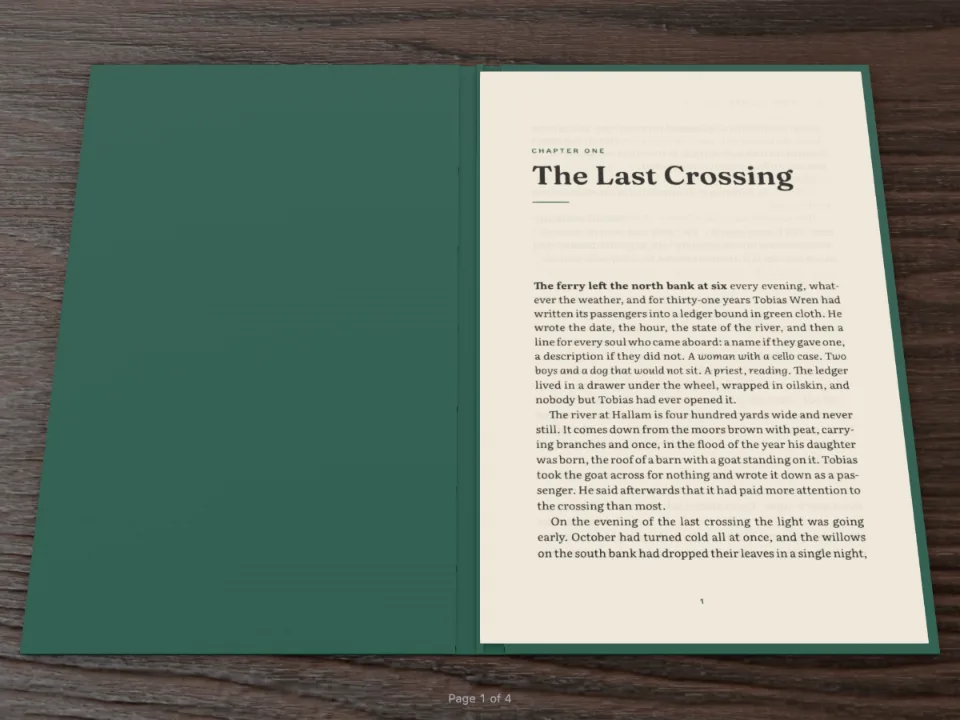
Un petit magazine plié sur un estuaire, avec une couverture épaisse en couleur et du papier journal à l’intérieur. Dans la visionneuse 3D, il repose fermé sur le bureau et s’ouvre comme un vrai.
Ce que vous allez composer
Le numéro 3 de Low Tide, un zine gratuit sur un estuaire : huit pages de 140 × 200 mm, deux feuilles pliées et agrafées dans le pli. La feuille extérieure, pages 1–2 et 7–8, est une carte saumon ; la feuille intérieure, pages 3–6, un papier journal bon marché. La couverture est imprimée dans un seul bleu riso sur la carte nue, sans aplat de couleur propre : sur les pages à plat ci-dessous, elle s’imprime donc sur blanc, et dans Folio elle repose fermée sur le bureau dans la couleur de sa carte jusqu’à ce que vous la tourniez. Les deux papiers sont deux blocs dans le Markdown, et la reliure tient en trois réglages dans config.folio.
Cette recette répond à
- Comment imprimer une couverture, un encart ou un cahier de planches sur un autre papier que le reste du livre ?
- Comment prévisualiser la reliure, la couverture, le papier et l’éclairage d’un livre avant de l’envoyer à l’impression ?
La réponse courte
const stage = document.createElement('section');
stage.id = 'folio';
stage.ariaLabel = 'The zine in 3D';
stage.style.cssText = 'height: min(78vh, 720px); margin: 0 auto; max-width: 1280px';
document.getElementById('pages').before(stage);
// Covers from the pages need an even count: page 8 must fall on a verso to be the back.
if (doc.pages.length % 2) console.warn(`${doc.pages.length} pages: the back cover is missing`);
createFolioFromDocument(stage, doc, {
  appearance: { textureBaseUrl: 'https://postext.dev/folio/textures' },
  onChange: ({ pages }) => kitStatus(pages.map((i) => `p. ${i + 1} on `
    + (doc.pages[i].paper ? 'card' : 'newsprint')).join(' · ')),
});
Ingrédients
- Fonctionnalités
- Un autre papier pour une suite de pagesPapier, reliure, bureau et lumière (Folio)Visionneuse de livre en 3D (Folio)Styles de titreOuvertures composéesAttributs de titreTexte, filets et boîtes dans les maquettes de pageStyles de paragrapheTitres courants selon le rôle de la pagePalette de couleurs sémantiqueMarges en miroirPages sur un canvas
- Typographie
- Newsreader, Bricolage Grotesque (SIL OFL 1.1)
- Ressources
- The tide lines on the cover, drawn in code (Ignacio Ferro, CC BY 4.0)
Préparation
#1 · Encadrer la feuille extérieure
// :::paper{type=cardStock grammage=250 shade=#f2c9b4}   pages 1–2: the front of the sheet
// # Low Tide {style="cover" …}   # In this issue {…}
// :::
// # The dunlin come back …   pages 3–6, outside any fence: folio.paper, the newsprint
// :::paper{type=cardStock grammage=250 shade=#f2c9b4}   pages 7–8: the back of the sheet
// # Join us {…}   # Low Tide {style="back" …}
// :::
const markdown = String.raw`---
title: "Low Tide"
subtitle: "A zine about the estuary"
author: "The Pill Estuary Group"
publishDate: "Issue 3 · Winter 2026"
---

:::paper{type=cardStock grammage=250 shade=#f2c9b4}

# Low Tide {style="cover" issue="Issue 3 · Winter 2026" strap="Mud, birds, boats and the people who watch them"}

# In this issue {style="feature" kicker="Welcome"}

Low Tide is made twice a year by the people who walk the river path at Pill. It is printed on the cheapest paper the printer has, folded by hand at the sailing club, and left in the pub, the post office and the bird hide. Take one. Leave it for somebody else when you have read it.

This winter we follow the dunlin that come back to the mud every October, talk to the last man in the village who still builds wooden boats, and print a tide table for the months when the light goes early. The cover is a heavier card than the pages inside it, so it survives a pocket and a little rain.

:::paragraphs{style="credits"}
**Edited by** Joan Avery and Sam Okonjo · **Drawings** Priya Lal · **Printed** in an edition of 400 copies, two sheets folded and stapled.
:::

:::

# The dunlin come back {style="feature" kicker="Birds"}

They arrive in the second week of October, a few dozen at first and then, within days, a thousand or more, feeding along the tideline in a moving grey band. Dunlin are small, about the size of a starling, with a long bill that droops at the tip. In winter they lose the black belly of their breeding plumage and turn the colour of the mud they feed on, which is why most people who walk the path never notice them until they lift.

When they lift, everybody notices. A flock of dunlin in the air turns as one bird: grey as it banks away from you, white as it turns back and shows its underside. On a clear afternoon at the top of the tide, when the mud is covered and the birds have nowhere left to feed, the flock rises off the saltmarsh and turns over the water for minutes at a time, flashing like a shoal of fish.

They come from the Arctic: from the tundra of northern Russia and Scandinavia, where they breed in the short summer and leave as soon as the young can fly. A dunlin ringed on the mud below the church in 2019 was caught again the following summer on the Taymyr Peninsula, five thousand kilometres away, and back on the same stretch of mud the October after.

Joan has counted them every Sunday morning for eleven winters, from the hide, with a tally counter in her coat pocket. Her highest count was 4,200, in January 2021, after a week of frost on the moors drove birds down from the reservoirs. Her lowest was 380. She does not know why the numbers swing so much from year to year, and nor, she says, does anybody else.

At dusk the flock goes to roost on the shingle spit below the old ferry steps, the last ground the tide leaves dry. From the path you hear them before you see them: a thin, purring trill passed along the flock like a rumour. By March the first of them show black on the belly again, and by the middle of April the mud is quiet.

## How to see them

Come two hours before high water and stand on the slipway by the sailing club. As the tide pushes in, the birds are driven up the mud towards you, closer and closer, until they give up and fly. Bring binoculars, and keep dogs on a lead below the hide: a bird that is flushed off the mud in winter spends energy it cannot afford.

The best days are the spring tides marked in bold in the tide table on page 6, when the water comes right up to the saltmarsh. On a neap tide the birds stay far out and you will want a telescope. If the wind is in the west, stand in the lee of the boat shed; the dunlin will be doing the same on the far side of the creek.

## What else to look for

Among the dunlin there are usually a few ringed plover, rounder and paler, that run and stop where the dunlin walk and probe. Curlew stand alone further out, and the redshank is the one that sees you first and tells the whole estuary. A peregrine has hunted the flock every winter since 2017: when the birds bunch tight and climb, look above them.

# The last boatbuilder {style="feature" kicker="People"}

Dennis Harcombe built his first boat at fourteen, in his father’s shed on Marine Parade, and his last one at seventy-eight. He reckons there were forty in between, give or take, most of them clinker-built dinghies of larch on oak, the kind every family on the river once kept at the bottom of the garden.

“The trick of it,” he says, “is that you never fight the wood. You look at a plank and you see which way it wants to bend, and you let it.” He still steams planks in a length of drainpipe over a camping stove, though these days only to repair other people’s boats.

His shed is the last on the river where you can buy a pair of oars made to measure. He makes them from ash, shaves the looms by hand and charges what he charged in 1990, because, he says, the price was fair then and the oars have not got any better.

When he talks about the river he talks about the mud first: where it shifts, where the channel has moved since he was a boy, where a boat can sit out a tide and where it will be swallowed to the thwarts. He has watched the estuary change for seventy years and does not think it is finished.

# Tide table {style="feature" kicker="December to February"}

High water at Pill, in local time. Add about twenty minutes for the tide to reach the slipway at the sailing club. Spring tides, the biggest of the month, are marked in bold: on those days the mud below the hide is covered completely.

:::paragraphs{style="tides"}
**Sun 6 Dec** 07:42 and 20:05 · **Sat 12 Dec** 12:18 · **Sun 20 Dec** 06:55 and 19:20

**Sun 3 Jan** 06:31 and 18:54 · **Sat 9 Jan** 11:47 · **Sun 17 Jan** 06:10 and 18:36

**Sun 31 Jan** 05:58 and 18:22 · **Sat 6 Feb** 10:59 · **Sun 14 Feb** 05:37 and 18:01
:::

Times are for a still day. A strong westerly holds the water up and brings high tide a little early; a long dry spell on the moors does the opposite. If you are walking out on the mud, go on a falling tide and come back with an hour to spare.

:::paper{type=cardStock grammage=250 shade=#f2c9b4}

# Join us {style="back-matter" kicker="The group"}

We walk the river path on the first Sunday of every month, meeting at the sailing club at ten. Nobody needs to know anything about birds, boats or tides; most of us didn’t when we started. Bring boots.

The next issue comes out in June. If you have something to say about the estuary, a drawing, a memory or a count of anything at all, leave it in the box behind the bar at the Duke of Cornwall, or write to us at the sailing club.

:::paragraphs{style="credits"}
Set in Newsreader and Bricolage Grotesque (SIL Open Font License) · Text: original, CC BY 4.0 · The Pill Estuary Group and the people in this issue are fictional.
:::

# Low Tide {style="back" strap="Free · take one, leave one"}

:::
`; // content.<lang>.md, inlined by the Cookbook
Un livret piqué à cheval est une pile de feuilles pliées : la feuille de couverture porte donc les deux premières et les deux dernières pages. Un bloc contient les pages 1–2, un autre les pages 7–8, et les pages entre les deux restent hors de l’un et de l’autre, sur le papier propre du livre. Chaque bloc commence et se termine sur une nouvelle page, ce dont la couverture et le mot d’accueil ont besoin de toute façon ici.
#2 · Papier journal, agrafes, couvertures prises dans les pages
const folio = {
  tilt: 20,
  // The book's paper: every page outside a :::paper fence, the inner sheet here.
  paper: { type: 'newsprint', grammage: 52 },
  // cover: 'pages' turns page 1 as the front and page 8 (a verso) as the back; on a saddle
  // stitch the cover is a sheet like the others, only heavier (gotcha: folio-cover-pages-even).
  binding: { type: 'saddleStitch', cover: 'pages' },
  surface: { type: 'plain', color: col('ink') },
  lighting: { environment: 'overcast', intensity: 1.1 },
};
folio.paper est le papier journal de chaque page hors d’un bloc. saddleStitch plie les feuilles autour des agrafes, sans dos plat, et cover: 'pages' fait tourner la page 1 et la page 8 comme couvertures. Dans une piqûre à cheval, la couverture tourne comme les autres feuilles, seulement plus raide, et un feuillet de couverture qui nomme son propre support (la carte) est dessiné sur ce support.
#3 · Une couverture en une seule encre
// Eleven tide lines of a seeded length: blue rules across the foot of the cover.
let seed = 0x71de; // Mulberry32: the same lines on every run
const random = () => {
  seed = (seed + 0x6d2b79f5) | 0;
  let x = Math.imul(seed ^ (seed >>> 15), 1 | seed);
  x = (x + Math.imul(x ^ (x >>> 7), 61 | x)) ^ x;
  return ((x ^ (x >>> 14)) >>> 0) / 4294967296;
};
const tideLines = Array.from({ length: 11 }, (_, i) => ({ kind: 'rule', id: `tide-${i}`,
  direction: 'horizontal', thickness: pt(2.2 + i * 0.5), color: col('blue'),
  placement: { ...at('page', 'top-left', 10 + random() * 40, 128 + i * 5.2),
    size: { width: mm(50 + random() * 70) } } }));
const flush = { span: 'page', margins: { top: mm(0), bottom: mm(0), left: mm(0), right: mm(0) },
  footer: { elements: [] } }; // no folio on either cover (the style lasts one page)
const cover = { ...flush, id: 'cover', numbered: false, advancedDesign: { enabled: true,
  minHeight: mm(TRIM_H), slot: { elements: [
    text('issue', '{attr.issue}', caps(7.5), at('page', 'top-left', INNER, 16)),
    text('title', '{titleText}', { fontFamily: SANS, fontWeight: 800, fontSize: pt(70),
      lineHeight: 0.86, letterSpacing: pt(-2), color: col('blue') },
    { ...at('#issue', 'below', -1, 8), size: { width: mm(TRIM_W - INNER - OUTER) } }),
    text('strap', '{attr.strap}', { fontFamily: 'Newsreader', italic: true, fontSize: pt(13),
      lineHeight: 1.25, color: col('ink') },
    { ...at('#title', 'below', 1, 6), size: { width: mm(100) } }),
    ...tideLines,
  ] } } };
const back = { ...flush, id: 'back', numbered: false,
  breakBefore: { enabled: true, parity: 'even' }, advancedDesign: { enabled: true,
    minHeight: mm(TRIM_H), slot: { elements: [
      text('title', '{titleText}', { fontFamily: SANS, fontWeight: 800, fontSize: pt(26),
        letterSpacing: pt(-0.5), color: col('blue'), align: 'center' },
      { ...at('page', 'center', 0, -6), size: { width: mm(100) } }),
      text('strap', '{attr.strap}', { ...caps(7, col('ink')), align: 'center' },
        { ...at('#title', 'below', 0, 3), size: { width: mm(100) } }),
    ] } } };
La couverture est un style de titre aux marges nulles avec une maquette pleine page : la ligne du numéro, le titre en Bricolage Grotesque de 70 pt, le sous-titre en Newsreader italique et onze lignes de marée dont les longueurs viennent d’un générateur à graine fixe, si bien que chaque exécution dessine les mêmes. Rien ne peint le fond de la page : c’est la carte qui le donne.
#4 · Une seule ouverture pour chaque article
const feature = (id) => ({ id, numbered: false, breakBefore: { enabled: true, parity: 'any' },
  marginBottom: pt(LEAD), advancedDesign: { enabled: true, minHeight: mm(30), slot: {
    elements: [
      text('kicker', '{attr.kicker}', caps(7.5), at('container', 'top-left', 0, 1)),
      text('title', '{titleText}', { fontFamily: SANS, fontWeight: 800, fontSize: pt(25),
        lineHeight: 0.98, letterSpacing: pt(-0.4), color: col('ink') },
      { ...at('#kicker', 'below', 0, 2.5), size: { width: 'fill' } }),
      { kind: 'rule', id: 'rule', direction: 'horizontal', thickness: pt(2.5), color: col('blue'),
        placement: { ...at('#title', 'below', 0, 4), size: { width: mm(14) } } },
    ] } } });
const headingStyles = [cover, back, feature('feature'), feature('back-matter')];
Chaque article est un titre de niveau 1 dans le style feature : une nouvelle page, un surtitre tiré de ses attributs, le titre et un court filet bleu. Faire passer les cinq articles par un seul style limite l’intérieur du zine à deux familles de caractères et une seule couleur d’accent.
#5 · L’ouvrir agrafé
Le code est dans la réponse courte plus haut. createFolioFromDocument lit la reliure et les couvertures dans doc.config.folio, et le papier de chaque feuillet dans page.paper. Le pen avertit quand le nombre de pages est impair, car la page 8 ne peut être la quatrième de couverture que si elle tombe sur un verso.
La recette complète
// ═══ Postext Cookbook · Nº 102 · A stapled zine with a card cover sheet ═══════════════ // https://postext.dev/en/cookbook/saddle-stitched-card-cover // Code: MIT · Text: original (CC BY 4.0) · Pictures: drawn in code // Fonts: Newsreader, Bricolage Grotesque (SIL OFL 1.1) · Needs postext ≥ 1.25.0 // // Eight pages, two sheets folded and stapled through the fold. The outer sheet (pages 1–2 and // 7–8) is salmon card, the inner sheet newsprint: two :::paper fences put the card on the // cover pages, and postext-folio draws the book saddle-stitched, closed until you turn the // cover. The flat pages below print on white: only the 3D book knows about paper. import { buildDocumentWithFonts, renderPageToCanvas } from 'https://esm.sh/postext'; import { createFolioFromDocument } from 'https://esm.sh/postext-folio'; const LANG = 'en'; // @lang: the language of the sample document ('en' | 'es') const RECIPE = 'saddle-stitched-card-cover'; // ─── 1 · Design ───────────────────────────────────────────────────────────── // #region palette: two inks of a risograph, and the greys of the newsprint text const palette = { ink: '#1f2124', // the text blue: '#0b6fb3', // the riso blue: titles, the tide lines, kickers muted: '#5d6066', // credits and folios rule: '#b9bcc0', }; const col = (id) => ({ hex: palette[id], model: 'hex', paletteId: id }); const colorPalette = [ ...Object.entries(palette).map(([id, hex]) => ({ id, name: id, value: { hex, model: 'hex' } })), { id: 'main-color', name: 'accent (defaults)', value: { hex: palette.blue, model: 'hex' } }, ]; // #endregion const [TRIM_W, TRIM_H, TOP, BOTTOM, INNER, OUTER] = [140, 200, 20, 22, 17, 15]; // mm const LEAD = 13.6; // pt const SANS = 'Bricolage Grotesque'; const at = (to, edge, x = 0, y = 0) => ({ anchor: { to, edge }, offset: { x: mm(x), y: mm(y) } }); const text = (id, content, look, placement) => ({ kind: 'text', id, content, overflow: 'wrap', align: 'left', placement, ...look }); const caps = (size, color = col('blue')) => ({ fontFamily: SANS, fontSize: pt(size), fontWeight: 700, letterSpacing: pt(size * 0.18), textTransform: 'uppercase', color }); // #region folio: newsprint inside, stapled through the fold, covers taken from the pages const folio = { tilt: 20, // The book's paper: every page outside a :::paper fence, the inner sheet here. paper: { type: 'newsprint', grammage: 52 }, // cover: 'pages' turns page 1 as the front and page 8 (a verso) as the back; on a saddle // stitch the cover is a sheet like the others, only heavier (gotcha: folio-cover-pages-even). binding: { type: 'saddleStitch', cover: 'pages' }, surface: { type: 'plain', color: col('ink') }, lighting: { environment: 'overcast', intensity: 1.1 }, }; // #endregion // #region covers: big type and tide lines on the page; the card colour comes from the paper // Eleven tide lines of a seeded length: blue rules across the foot of the cover. let seed = 0x71de; // Mulberry32: the same lines on every run const random = () => { seed = (seed + 0x6d2b79f5) | 0; let x = Math.imul(seed ^ (seed >>> 15), 1 | seed); x = (x + Math.imul(x ^ (x >>> 7), 61 | x)) ^ x; return ((x ^ (x >>> 14)) >>> 0) / 4294967296; }; const tideLines = Array.from({ length: 11 }, (_, i) => ({ kind: 'rule', id: `tide-${i}`, direction: 'horizontal', thickness: pt(2.2 + i * 0.5), color: col('blue'), placement: { ...at('page', 'top-left', 10 + random() * 40, 128 + i * 5.2), size: { width: mm(50 + random() * 70) } } })); const flush = { span: 'page', margins: { top: mm(0), bottom: mm(0), left: mm(0), right: mm(0) }, footer: { elements: [] } }; // no folio on either cover (the style lasts one page) const cover = { ...flush, id: 'cover', numbered: false, advancedDesign: { enabled: true, minHeight: mm(TRIM_H), slot: { elements: [ text('issue', '{attr.issue}', caps(7.5), at('page', 'top-left', INNER, 16)), text('title', '{titleText}', { fontFamily: SANS, fontWeight: 800, fontSize: pt(70), lineHeight: 0.86, letterSpacing: pt(-2), color: col('blue') }, { ...at('#issue', 'below', -1, 8), size: { width: mm(TRIM_W - INNER - OUTER) } }), text('strap', '{attr.strap}', { fontFamily: 'Newsreader', italic: true, fontSize: pt(13), lineHeight: 1.25, color: col('ink') }, { ...at('#title', 'below', 1, 6), size: { width: mm(100) } }), ...tideLines, ] } } }; const back = { ...flush, id: 'back', numbered: false, breakBefore: { enabled: true, parity: 'even' }, advancedDesign: { enabled: true, minHeight: mm(TRIM_H), slot: { elements: [ text('title', '{titleText}', { fontFamily: SANS, fontWeight: 800, fontSize: pt(26), letterSpacing: pt(-0.5), color: col('blue'), align: 'center' }, { ...at('page', 'center', 0, -6), size: { width: mm(100) } }), text('strap', '{attr.strap}', { ...caps(7, col('ink')), align: 'center' }, { ...at('#title', 'below', 0, 3), size: { width: mm(100) } }), ] } } }; // #endregion // #region features: every piece opens a page with a kicker and a title in the riso blue const feature = (id) => ({ id, numbered: false, breakBefore: { enabled: true, parity: 'any' }, marginBottom: pt(LEAD), advancedDesign: { enabled: true, minHeight: mm(30), slot: { elements: [ text('kicker', '{attr.kicker}', caps(7.5), at('container', 'top-left', 0, 1)), text('title', '{titleText}', { fontFamily: SANS, fontWeight: 800, fontSize: pt(25), lineHeight: 0.98, letterSpacing: pt(-0.4), color: col('ink') }, { ...at('#kicker', 'below', 0, 2.5), size: { width: 'fill' } }), { kind: 'rule', id: 'rule', direction: 'horizontal', thickness: pt(2.5), color: col('blue'), placement: { ...at('#title', 'below', 0, 4), size: { width: mm(14) } } }, ] } } }); const headingStyles = [cover, back, feature('feature'), feature('back-matter')]; // #endregion const config = () => ({ locale: 'en-us', colorPalette, page: { sizePreset: 'custom', width: mm(TRIM_W), height: mm(TRIM_H), dpi: 150, margins: { top: mm(TOP), bottom: mm(BOTTOM), left: mm(INNER), right: mm(OUTER), mirror: true } }, layout: { layoutType: 'single' }, bodyText: { fontFamily: 'Newsreader', fontSize: pt(10), lineHeight: pt(LEAD), color: col('ink'), boldColor: col('ink'), italicColor: col('ink'), referenceColor: col('ink'), textAlign: 'justify', firstLineIndent: mm(4), indentAfterHeading: false, hyphenation: { enabled: true }, optimalLineBreaking: true, avoidWidows: true, avoidOrphans: true, avoidRunts: true }, headings: { fontFamily: SANS, color: col('ink'), fontWeight: 800, levels: [ // parity 'any': a level-1 heading opens the next page, whichever side it falls on. { level: 1, fontSize: pt(25), breakBefore: { enabled: true, parity: 'any' } }, { level: 2, fontSize: pt(10), lineHeight: pt(LEAD), fontWeight: 700, color: col('blue'), marginTop: pt(LEAD), marginBottom: pt(0) }, ] }, headingStyles, paragraphStyles: [ { id: 'credits', fontFamily: SANS, fontSize: pt(7.4), lineHeight: pt(10.4), color: col('muted'), boldColor: col('blue'), textAlign: 'left', firstLineIndent: pt(0), marginTop: pt(LEAD) }, { id: 'tides', fontFamily: SANS, fontSize: pt(8.6), lineHeight: pt(LEAD), boldColor: col('blue'), textAlign: 'left', firstLineIndent: pt(0) }, ], header: { elements: [] }, footer: { elements: [text('folio', '{pageNumber} {title} · {publishDate}', { ...caps(6.5, col('muted')), align: 'center' }, at('page', 'bottom', 0, -11))] }, folio, }); // ─── 2 · Content ──────────────────────────────────────────────────────────── // #region cover-sheet: the outer sheet's four pages in card, the inner sheet on newsprint // :::paper{type=cardStock grammage=250 shade=#f2c9b4} pages 1–2: the front of the sheet // # Low Tide {style="cover" …} # In this issue {…} // ::: // # The dunlin come back … pages 3–6, outside any fence: folio.paper, the newsprint // :::paper{type=cardStock grammage=250 shade=#f2c9b4} pages 7–8: the back of the sheet // # Join us {…} # Low Tide {style="back" …} // ::: const markdown = String.raw`---Exemple Markdown · 83 lignes · content.en.md
title: "Low Tide" subtitle: "A zine about the estuary" author: "The Pill Estuary Group" publishDate: "Issue 3 · Winter 2026" --- :::paper{type=cardStock grammage=250 shade=#f2c9b4} # Low Tide {style="cover" issue="Issue 3 · Winter 2026" strap="Mud, birds, boats and the people who watch them"} # In this issue {style="feature" kicker="Welcome"} Low Tide is made twice a year by the people who walk the river path at Pill. It is printed on the cheapest paper the printer has, folded by hand at the sailing club, and left in the pub, the post office and the bird hide. Take one. Leave it for somebody else when you have read it. This winter we follow the dunlin that come back to the mud every October, talk to the last man in the village who still builds wooden boats, and print a tide table for the months when the light goes early. The cover is a heavier card than the pages inside it, so it survives a pocket and a little rain. :::paragraphs{style="credits"} **Edited by** Joan Avery and Sam Okonjo · **Drawings** Priya Lal · **Printed** in an edition of 400 copies, two sheets folded and stapled. ::: ::: # The dunlin come back {style="feature" kicker="Birds"} They arrive in the second week of October, a few dozen at first and then, within days, a thousand or more, feeding along the tideline in a moving grey band. Dunlin are small, about the size of a starling, with a long bill that droops at the tip. In winter they lose the black belly of their breeding plumage and turn the colour of the mud they feed on, which is why most people who walk the path never notice them until they lift. When they lift, everybody notices. A flock of dunlin in the air turns as one bird: grey as it banks away from you, white as it turns back and shows its underside. On a clear afternoon at the top of the tide, when the mud is covered and the birds have nowhere left to feed, the flock rises off the saltmarsh and turns over the water for minutes at a time, flashing like a shoal of fish. They come from the Arctic: from the tundra of northern Russia and Scandinavia, where they breed in the short summer and leave as soon as the young can fly. A dunlin ringed on the mud below the church in 2019 was caught again the following summer on the Taymyr Peninsula, five thousand kilometres away, and back on the same stretch of mud the October after. Joan has counted them every Sunday morning for eleven winters, from the hide, with a tally counter in her coat pocket. Her highest count was 4,200, in January 2021, after a week of frost on the moors drove birds down from the reservoirs. Her lowest was 380. She does not know why the numbers swing so much from year to year, and nor, she says, does anybody else. At dusk the flock goes to roost on the shingle spit below the old ferry steps, the last ground the tide leaves dry. From the path you hear them before you see them: a thin, purring trill passed along the flock like a rumour. By March the first of them show black on the belly again, and by the middle of April the mud is quiet. ## How to see them Come two hours before high water and stand on the slipway by the sailing club. As the tide pushes in, the birds are driven up the mud towards you, closer and closer, until they give up and fly. Bring binoculars, and keep dogs on a lead below the hide: a bird that is flushed off the mud in winter spends energy it cannot afford. The best days are the spring tides marked in bold in the tide table on page 6, when the water comes right up to the saltmarsh. On a neap tide the birds stay far out and you will want a telescope. If the wind is in the west, stand in the lee of the boat shed; the dunlin will be doing the same on the far side of the creek. ## What else to look for Among the dunlin there are usually a few ringed plover, rounder and paler, that run and stop where the dunlin walk and probe. Curlew stand alone further out, and the redshank is the one that sees you first and tells the whole estuary. A peregrine has hunted the flock every winter since 2017: when the birds bunch tight and climb, look above them. # The last boatbuilder {style="feature" kicker="People"} Dennis Harcombe built his first boat at fourteen, in his father’s shed on Marine Parade, and his last one at seventy-eight. He reckons there were forty in between, give or take, most of them clinker-built dinghies of larch on oak, the kind every family on the river once kept at the bottom of the garden. “The trick of it,” he says, “is that you never fight the wood. You look at a plank and you see which way it wants to bend, and you let it.” He still steams planks in a length of drainpipe over a camping stove, though these days only to repair other people’s boats. His shed is the last on the river where you can buy a pair of oars made to measure. He makes them from ash, shaves the looms by hand and charges what he charged in 1990, because, he says, the price was fair then and the oars have not got any better. When he talks about the river he talks about the mud first: where it shifts, where the channel has moved since he was a boy, where a boat can sit out a tide and where it will be swallowed to the thwarts. He has watched the estuary change for seventy years and does not think it is finished. # Tide table {style="feature" kicker="December to February"} High water at Pill, in local time. Add about twenty minutes for the tide to reach the slipway at the sailing club. Spring tides, the biggest of the month, are marked in bold: on those days the mud below the hide is covered completely. :::paragraphs{style="tides"} **Sun 6 Dec** 07:42 and 20:05 · **Sat 12 Dec** 12:18 · **Sun 20 Dec** 06:55 and 19:20 **Sun 3 Jan** 06:31 and 18:54 · **Sat 9 Jan** 11:47 · **Sun 17 Jan** 06:10 and 18:36 **Sun 31 Jan** 05:58 and 18:22 · **Sat 6 Feb** 10:59 · **Sun 14 Feb** 05:37 and 18:01 ::: Times are for a still day. A strong westerly holds the water up and brings high tide a little early; a long dry spell on the moors does the opposite. If you are walking out on the mud, go on a falling tide and come back with an hour to spare. :::paper{type=cardStock grammage=250 shade=#f2c9b4} # Join us {style="back-matter" kicker="The group"} We walk the river path on the first Sunday of every month, meeting at the sailing club at ten. Nobody needs to know anything about birds, boats or tides; most of us didn’t when we started. Bring boots. The next issue comes out in June. If you have something to say about the estuary, a drawing, a memory or a count of anything at all, leave it in the box behind the bar at the Duke of Cornwall, or write to us at the sailing club. :::paragraphs{style="credits"} Set in Newsreader and Bricolage Grotesque (SIL Open Font License) · Text: original, CC BY 4.0 · The Pill Estuary Group and the people in this issue are fictional. ::: # Low Tide {style="back" strap="Free · take one, leave one"} :::`; // content.<lang>.md, inlined by the Cookbook // #endregion // ─── 3 · Fonts ────────────────────────────────────────────────────────────── const FONTS = { Newsreader: ['400', '400i', '700'], 'Bricolage Grotesque': ['400', '700', '800'], }; // ─── 4 · Build & show ─────────────────────────────────────────────────────── const doc = await buildDocumentWithFonts({ markdown }, config(), kitFonts(FONTS)); showPages(doc, { title: 'Low Tide · a stapled zine in Folio' }); // #region answer: the zine as a stapled booklet, closed on the desk until the cover turns const stage = document.createElement('section'); stage.id = 'folio'; stage.ariaLabel = 'The zine in 3D'; stage.style.cssText = 'height: min(78vh, 720px); margin: 0 auto; max-width: 1280px'; document.getElementById('pages').before(stage); // Covers from the pages need an even count: page 8 must fall on a verso to be the back. if (doc.pages.length % 2) console.warn(`${doc.pages.length} pages: the back cover is missing`); createFolioFromDocument(stage, doc, { appearance: { textureBaseUrl: 'https://postext.dev/folio/textures' }, onChange: ({ pages }) => kitStatus(pages.map((i) => `p. ${i + 1} on ` + (doc.pages[i].paper ? 'card' : 'newsprint')).join(' · ')), }); // #endregionKit · core, fonts, viewer : identique dans toutes les recettes · 224 lignes
// ─── Kit ── helpers shared by every Cookbook recipe · postext.dev/cookbook ───── // ─── Kit · core v1 ── the same in every recipe · postext.dev/cookbook function mm(value) { return { value, unit: 'mm' }; } function pt(value) { return { value, unit: 'pt' }; } function em(value) { return { value, unit: 'em' }; } /** The sample language's string: t({ en: 'Figure', es: 'Figura' }). */ function t(strings) { return strings[LANG] ?? Object.values(strings)[0]; } /** A file in this recipe's assets folder, served from the Postext repo by jsDelivr. */ function asset(file) { return `https://cdn.jsdelivr.net/gh/drnachio/postext@main/cookbook/${RECIPE}/assets/${file}`; } // ─── Kit · fonts v3 ── the same in every recipe · postext.dev/cookbook // Postext loads the faces a config asks for before layout (prepareFonts, // buildDocumentWithFonts) and asks the kit for the files: Fontsource's, the // files the PDF embeds too. /** The options of buildDocumentWithFonts / prepareFonts / withLoadedFonts: * the Fontsource resolver, and the faces of FONTS loaded with the ones the * config names. FONTS = { 'Family Name': ['400', '400i', '700'] }. */ function kitFonts(FONTS = {}) { const faces = Object.entries(FONTS).flatMap(([family, specs]) => specs.map((spec) => ({ family, weight: parseInt(spec, 10), style: spec.endsWith('i') ? 'italic' : 'normal' }))); return { resolve: fontsourceResolver, faces }; } /** A face's Fontsource files, in a fixed order: latin, then latin-ext and greek * when `text` needs them and the family ships them (kitSubsetsFor), each with * its unicode-range. Null for a weight or slant Fontsource does not ship. */ async function fontsourceResolver(family, weight, style, { text = '' } = {}) { const id = fontsourceId(family); const meta = await fontsourceMeta(family); if (meta && !(meta.weights.includes(weight) && meta.styles.includes(style))) return null; kitStatus('Loading fonts…'); const at = await fontsourceAt(id); return ['latin', ...kitSubsetsFor(text, meta)].map((subset) => ({ source: `${at}files/${id}-${subset}-${weight}-${style}.woff2`, unicodeRange: kitRanges()[subset], })); } /** The unicode-range of each Fontsource file the kit loads (a function: the * kit is inlined after the pen's code, which runs before a const would be set). */ function kitRanges() { return { latin: 'U+0000-00FF,U+0131,U+0152-0153,U+02BB-02BC,U+02C6,U+02DA,U+02DC,U+0304,U+0308,U+0329,' + 'U+2000-206F,U+20AC,U+2122,U+2191,U+2193,U+2212,U+2215,U+FEFF,U+FFFD', 'latin-ext': 'U+0100-02BA,U+02BD-02C5,U+02C7-02CC,U+02CE-02D7,U+02DD-02FF,U+0304,U+0308,U+0329,' + 'U+1D00-1DBF,U+1E00-1E9F,U+1EF2-1EFF,U+2020,U+20A0-20AB,U+20AD-20C0,U+2113,U+2C60-2C7F,U+A720-A7FF', greek: 'U+0370-03FF', }; } /** For the cjk, arabic and comics blocks, which add their own files: the * faces of `faces` = { 'Family Name': ['400', '400i', '700'] }. `text` is the sample: * č ł † α χ also load latin-ext and greek files (kitSubsetsFor). With * `optional`, a face Fontsource does not ship is skipped instead of failing. * The files are added once all have loaded, in the order asked (latin, then * latin-ext, then greek), whatever order they arrive in: the last one added * wins a character two files hold. Resolves to the number of faces added. */ async function loadFonts(faces, text = '', { optional = false } = {}) { kitStatus('Loading fonts…'); const ranges = kitRanges(); const jobs = []; for (const [family, specs] of Object.entries(faces)) { const id = fontsourceId(family); const todo = [...new Set(specs)].map((spec) => [parseInt(spec, 10), spec.endsWith('i') ? 'italic' : 'normal']) .filter(([weight, style]) => !hasFace(family, weight, style)); // before any await const at = fontsourceAt(id); const meta = optional || /[^\0-ÿ]/u.test(text) ? await fontsourceMeta(family) : null; const subsets = ['latin', ...kitSubsetsFor(text, meta)]; for (const [weight, style] of todo) { if (optional && !(meta?.weights.includes(weight) && meta.styles.includes(style))) continue; for (const subset of subsets) { const url = `${await at}files/${id}-${subset}-${weight}-${style}.woff2`; const face = new FontFace(family, `url(${url}) format('woff2')`, { weight: String(weight), style, unicodeRange: ranges[subset] }); jobs.push(face.load().catch(() => { if (subset === 'latin' && !optional) throw new Error(`Fontsource has no ${family} ${weight} ${style}`); })); } } } const ready = await Promise.all(jobs).catch((error) => { kitFail(error); throw error; }); return ready.filter((face) => face && document.fonts.add(face)).length; } /** A loaded FontFace covers this family, weight and style (fonts.check() would * also say yes for families nobody declared). */ function hasFace(family, weight, style) { for (const face of document.fonts) { if (face.status !== 'loaded' || face.style !== style) continue; if (face.family.replace(/^["']|["']$/g, '') !== family) continue; const [low, high = low] = face.weight.split(' ').map(Number); if (weight >= low && weight <= high) return true; } return false; } /** The files beyond latin `text` needs that `meta`'s family ships. */ function kitSubsetsFor(text, meta) { return [[/[Ā-˿ᴀ-ᶿḀ-ỿ†ℓⱠ-Ɀ꜠-ꟿ]/u, 'latin-ext'], [/[Ͱ-Ͽ]/u, 'greek']] .filter(([re, x]) => re.test(text) && meta?.subsets?.includes(x)).map(([, x]) => x); } /** Fontsource's id for a family: 'Source Serif 4' → 'source-serif-4'. */ function fontsourceId(family) { return family.toLowerCase().replace(/\s+/g, '-'); } /** A package's folder at the one version @5 names now (#766). */ function fontsourceAt(id, u = `https://cdn.jsdelivr.net/npm/@fontsource/${id}@`) { return (fontsourceAt.c ??= {})[id] ??= fetch(u + '5/package.json').then((r) => r.json()) .then((p) => p.version || 5, () => 5).then((v) => `${u}${v}/`); } /** The family's Fontsource metadata (weights, styles, subsets), or null. */ function fontsourceMeta(family) { fontsourceMeta.cache ??= new Map(); const id = fontsourceId(family); if (!fontsourceMeta.cache.has(id)) { fontsourceMeta.cache.set(id, fetch(`https://api.fontsource.org/v1/fonts/${id}`) .then((res) => (res.ok ? res.json() : null), () => null)); } return fontsourceMeta.cache.get(id); } // ─── Kit · viewer v2 ── the same in every recipe · postext.dev/cookbook /** The pages as spreads on a dark desk, page 1 alone, then verso | recto, * each painted when it scrolls near. Other options go to renderPageToCanvas. */ function showPages(docs, { title, width = 460, ...render } = {}) { const root = viewer(title); const pages = [docs].flat().flatMap((doc) => doc.pages.map((page) => ({ doc, page, n: (doc.pageIndexOffset ?? 0) + page.index }))); const spreads = []; let verso = null; for (const p of pages) { if (p.n % 2 === 1) { if (verso) spreads.push([verso, null]); verso = p; } else { spreads.push([verso, p]); verso = null; } } if (verso) spreads.push([verso, null]); const density = Math.min(window.devicePixelRatio || 1, 2); showPages.painter?.disconnect(); const painter = new IntersectionObserver((entries) => { for (const { isIntersecting, target } of entries) { if (!isIntersecting) continue; painter.unobserve(target); const { doc, page } = target.postext; renderPageToCanvas(page, doc, target, { ...render, scale: (width * density) / page.width }); } }, { rootMargin: '800px' }); showPages.painter = painter; root.replaceChildren(...spreads.map((pair) => { const spread = document.createElement('div'); spread.className = 'pt-spread'; for (const p of pair) { const figure = document.createElement('figure'); if (p) { const label = p.page.pageLabel || String(p.n + 1); const canvas = document.createElement('canvas'); canvas.postext = p; canvas.style.aspectRatio = `${p.page.width} / ${p.page.height}`; canvas.setAttribute('role', 'img'); canvas.setAttribute('aria-label', `Page ${label}`); const folio = document.createElement('figcaption'); folio.textContent = label; figure.append(canvas, folio); painter.observe(canvas); } else figure.className = 'pt-blank'; spread.append(figure); } return spread; })); kitStatus(`${pages.length} ${pages.length === 1 ? 'page' : 'pages'}`); document.documentElement.dataset.postext = 'ready'; return pages.length; } /** The desk, the bar and the error reporting, created once. */ function viewer(title) { if (!document.getElementById('pt-kit')) { document.head.insertAdjacentHTML('beforeend', `<style id="pt-kit"> :root { color-scheme: dark; } body { margin: 0; background: #0e1014; color: #b9bcc4; font: 13px/1.45 system-ui, sans-serif; } #pt-bar { position: sticky; top: 0; z-index: 1; display: flex; flex-wrap: wrap; align-items: center; gap: 6px 16px; padding: 10px 16px; background: rgb(14 16 20 / .92); backdrop-filter: blur(6px); border-bottom: 1px solid #23262d; } #pt-bar strong { color: #f4f1ea; font-weight: 600; } #pt-actions { display: flex; gap: 12px; margin-left: auto; } #pt-actions a, #pt-actions button { color: #d8a21a; font: inherit; background: none; border: 0; padding: 0; cursor: pointer; } #pages { display: grid; justify-items: center; gap: 48px; padding: 32px 16px 72px; } .pt-spread { display: flex; } .pt-spread figure { margin: 0; width: min(460px, 44vw); } .pt-spread canvas { display: block; width: 100%; background: #fff; box-shadow: 0 1px 2px rgb(0 0 0 / .5), 0 22px 44px -16px rgb(0 0 0 / .8); } .pt-spread figure:first-child canvas { box-shadow: inset -14px 0 14px -14px rgb(0 0 0 / .18), 0 1px 2px rgb(0 0 0 / .5), 0 22px 44px -16px rgb(0 0 0 / .8); } .pt-spread figcaption { margin-top: 10px; text-align: center; font: 600 10px/1 system-ui, sans-serif; letter-spacing: .18em; text-transform: uppercase; color: #6c7079; } .pt-blank { visibility: hidden; } @media (max-width: 760px) { .pt-spread { flex-direction: column; gap: 32px; } .pt-spread figure { width: min(460px, 92vw); } .pt-blank { display: none; } } </style>`); document.body.insertAdjacentHTML('afterbegin', '<header id="pt-bar"><strong id="pt-title"></strong><span id="pt-status" role="status"></span><span id="pt-actions"></span></header>'); document.getElementById('pt-title').textContent = document.title || 'Postext'; addEventListener('error', (event) => kitFail(event.error ?? event.message)); addEventListener('unhandledrejection', (event) => kitFail(event.reason)); } if (title) document.getElementById('pt-title').textContent = title; return document.getElementById('pages') ?? document.body.appendChild(Object.assign(document.createElement('main'), { id: 'pages' })); } function kitStatus(text) { viewer(); document.getElementById('pt-status').textContent = text; } function kitFail(error) { document.documentElement.dataset.postext = 'error'; kitStatus(`Error: ${error?.message ?? error}`); } // ─── /Kit ───────────────────────────────────────────────────────────────────────
Le script.js composé s’exécute tel quel : collez-le dans le script de module de n’importe quelle page, ou ouvrez la recette sur CodePen. Dossier de la recette sur GitHub ↗ (s’ouvre dans un nouvel onglet)
Variantes
#Une couverture blanche plus lourde
Modifiez les deux blocs et la feuille de couverture devient une carte blanche de 300 g ; les pages intérieures restent en papier journal.
-:::paper{type=cardStock grammage=250 shade=#f2c9b4}
+:::paper{type=cardStock grammage=300 shade=#fbfaf6}#Un livret simple
Supprimez les blocs et la couverture devient une feuille du papier journal des pages, un peu plus lourde. Le nuancier de papiers fait l’inverse et donne à chaque feuillet son propre support.
Erreurs fréquentes
Erreur fréquente
cover: 'pages' exige un nombre pair de pages pour le plat verso
Avec binding.cover réglé sur 'pages', la première page se tourne comme le plat recto, et la dernière comme le plat verso seulement si elle tombe sur un verso. Un nombre impair de pages laisse au livre une couverture avant sans dos : complétez-le jusqu’à un nombre pair ou gardez la reliure cartonnée. Papier, reliure, bureau et lumière (Folio) →
Erreur fréquente
Une suite de papier commence et finit sur une nouvelle page, et un feuillet prend le papier de son recto
Le texte placé dans :::paper commence sur une nouvelle page, et le texte qui le suit aussi. Un feuillet a deux pages et un seul papier, celui de son recto : une suite qui commence sur un verso imprime cette page sur le papier du feuillet qu’elle partage. Insérez un saut de page là où une suite doit commencer sur un recto. Un autre papier pour une suite de pages →
Erreur fréquente
La visionneuse Folio prend la taille de son conteneur
createFolioFromDocument ajuste le livre à l’élément que vous lui donnez, avec les boutons et le nombre de pages dans ses marges. Un élément sans hauteur (un div vide dans le flux normal) n’affiche rien : donnez-lui une hauteur en CSS. Visionneuse de livre en 3D (Folio) →
Crédits
- Recette
- Ignacio Ferro
- Texte
- Texte original, CC BY 4.0
- Images
- The tide lines on the cover, drawn in code · Ignacio Ferro · CC BY 4.0
- Polices
- Newsreader (SIL OFL 1.1) · Bricolage Grotesque (SIL OFL 1.1)
Modifier ce texte ↗ (s’ouvre dans un nouvel onglet)Dossier de la recette sur GitHub ↗ (s’ouvre dans un nouvel onglet)