En bref
Un chapitre d’un manuel de terrain pour les équipes d’entretien des sentiers, sur l’évacuation de l’eau. On y voit comment donner aux titres sept niveaux, chacun avec son allure, pour que le lecteur voie comment s’emboîtent les parties.
Ce que vous allez composer
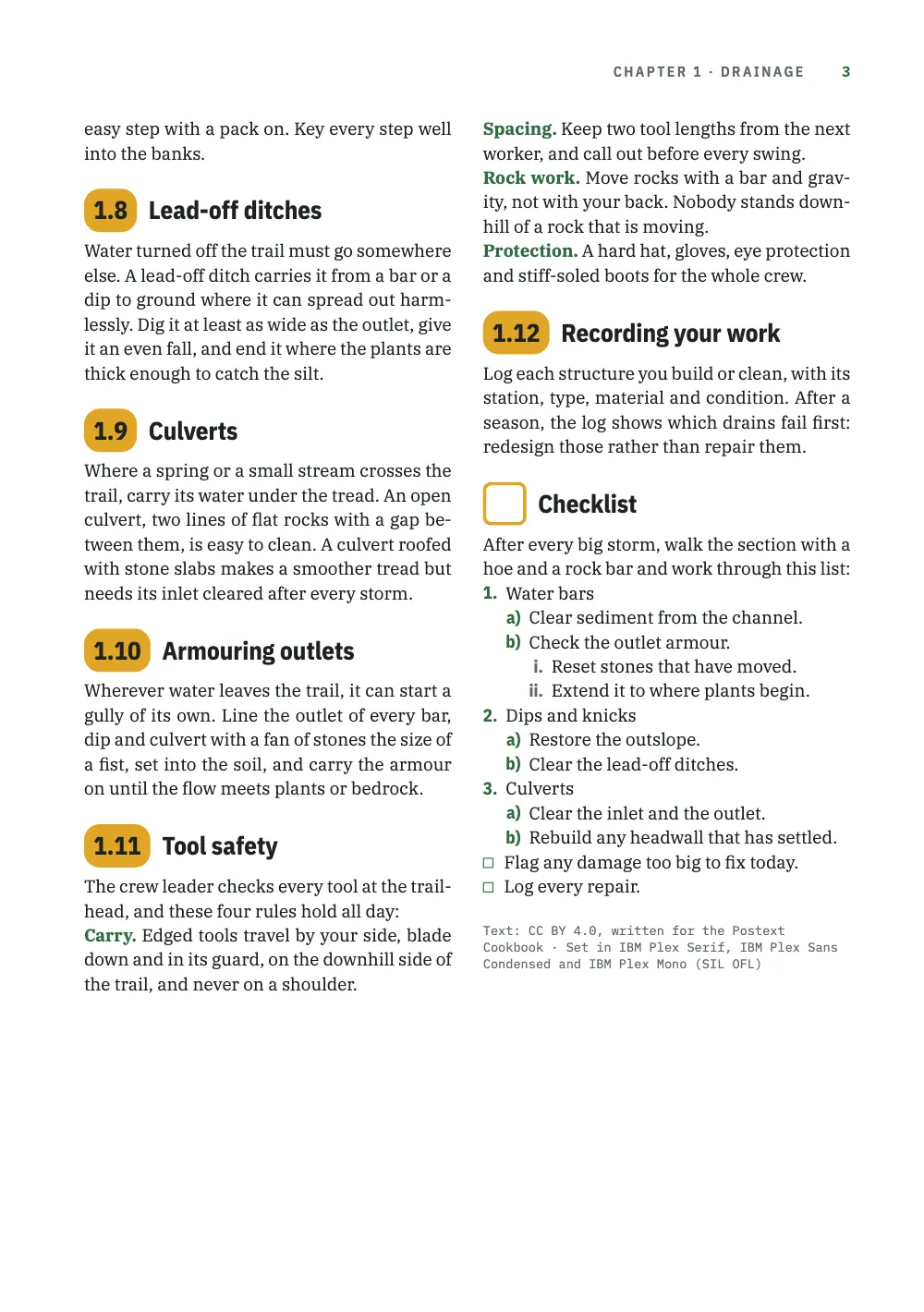
Le chapitre 1 du manuel de terrain d’une équipe d’entretien de sentiers, Drainage, sur trois pages B5 en deux colonnes : IBM Plex Serif pour le texte, IBM Plex Sans Condensed pour les titres et les numéros de section, IBM Plex Mono pour les étiquettes, les folios et les numéros de sous-section. L’ouverture place le numéro du chapitre dans une grande pastille ambre au-dessus du profil altimétrique d’un sentier, où des points ambre marquent douze sites retenus pour de nouveaux renvois d’eau. Des pastilles plus petites numérotent les sections 1.1 à 1.12 et s’élargissent à 1.10. Les titres 1.2.1, 1.5.1 et 1.5.2 sont en capitales interlettrées sous un filet vert. Les niveaux 4 à 6 restent sans numéro et changent plutôt de caractère (italique à empattements, linéale étroite grasse en vert, capitales à chasse fixe), et un septième niveau en italique gris nomme les outils. Les règles de sécurité s’ouvrent sur des termes en ligne en vert. Une liste de contrôle non numérotée, marquée d’un carré évidé, ferme le chapitre avec des listes numérotées 1., a) et i. et deux cases de tâche.
Cette recette répond à
- Comment numéroter les titres (1, 1.1, 1.1.1) et styler chaque niveau différemment ?
- Comment construire à côté du titre un badge numéroté qui s’élargit quand le numéro grandit (9 → 10) ?
- Comment gérer plus de six niveaux de titre ?
- Comment personnaliser les listes : puces par niveau, numérotation (a)/(i), cases à cocher, espacement qui reste sur la grille ?
La réponse courte
const H2 = 13.5; // pt: the number and the title share one size and one line height,
const LH = 1.2; // so, under the same top padding, they share one baseline
// Every section head starts on a grid line, so the 3 pt the pill falls short of two lines
// is the gap the grid snap leaves between the pill and the text under it.
const PILL_H = 2 * LEAD - 3, PAD = (PILL_H - H2 * LH) / 2; // pt
const face = { fontFamily: DISPLAY, fontWeight: 700, fontSize: pt(H2), lineHeight: LH };
const pill = { kind: 'text', id: 'pill', content: '{number}', ...face, color: col('ink'),
  box: { backgroundColor: col('signal'), borderRadius: mm(3), // no width: the pill is its
    padding: { top: pt(PAD), bottom: pt(PAD), left: mm(1.8), right: mm(1.8) } }, // number
  placement: at('container', 'top-left') }; // plus its padding
// 'right-of' hangs the title on the pill's right edge and aligns its lines left, so a long
// title wraps beside the number, never under it.
const sectionTitle = (from) => ({ kind: 'text', id: 'title', content: '{titleText}', ...face,
  color: col('ink'), overflow: 'wrap', box: { padding: { top: pt(PAD) } },
  placement: at(`#${from}`, 'right-of', mm(2.2)) });
// The H1 counter, a point, the H2 counter: 1.1 … 1.12 in the pill. h2 joins headings.levels.
const h2 = { level: 2, numberingTemplate: '{1}.{2}',
  advancedDesign: { enabled: true, slot: { elements: [pill, sectionTitle('pill')] } } };
Ingrédients
- Fonctionnalités
- Titres numérotésTexte, filets et boîtes dans les maquettes de pageAncrer les éléments de maquetteNiveaux de titreStyles de titreChapitres non numérotésOuvertures composéesImages dans les maquettes de pageAttributs de titreStyles de paragrapheGras, italique et leurs couleursListes à puces et listes de contrôleListes numérotéesGrille de ligne de baseVeuves, orphelines et fins de paragraphe trop courtesTitres courants et foliosTitres courants selon le rôle de la pageMarges en miroirPalette de couleurs sémantiqueFigures et tableaux comme ressources
- Utilise aussi
- Bandeau de chapitre sur toute la largeur
- Typographie
- IBM Plex Serif, IBM Plex Sans Condensed, IBM Plex Mono (SIL OFL 1.1)
- Ressources
- Aucune : chaque image est dessinée en code
Préparation
#1 · Mettre le numéro dans une pastille qui grandit avec lui
Le code est dans la réponse courte plus haut. numberingTemplate: '{1}.{2}' réunit les compteurs du chapitre et de la section en 1.1 à 1.12 (réglages par niveau). Un niveau doté d’une maquette avancée n’imprime plus le numéro avant son titre : c’est la maquette qui place elle-même {number}. Il se trouve ici dans un élément de texte avec une box remplie et arrondie, sans largeur : la pastille est donc aussi large que le numéro plus sa marge interne, 10,1 mm pour 1.9 et 12,7 mm pour 1.10. 'right-of' accroche le titre au bord droit de la pastille et aligne ses lignes à gauche, ce qui explique que le long titre de 1.5 passe à la ligne à côté du numéro (placement des éléments). La pastille mesure 3 pt de moins que deux lignes de la grille, et chaque titre de section commence sur une ligne de la grille : ces 3 pt font donc l’écart entre la pastille et le texte qui la suit, que le titre ouvre une colonne ou suive un paragraphe.
#2 · Fileter et interlettrer le troisième niveau
// A rule, a mono number and a tracked title: three elements, so this head is a design.
const small = { fontSize: pt(8.4), lineHeight: LH };
const DROP = 6; // pt: the rule drops this far toward the number, which keeps its grid line
const h3 = { level: 3, numberingTemplate: '{1}.{2}.{3}', // 1.5.1: restarts under every H2
  advancedDesign: { enabled: true, slot: { elements: [
    { kind: 'rule', id: 'rule', direction: 'horizontal', thickness: pt(0.75), color: col('band'),
      placement: { ...at('container', 'top-left', mm(0), pt(DROP)), size: { width: 'fill' } } },
    { kind: 'text', id: 'num', content: '{number}', fontFamily: LABEL, fontWeight: 500, ...small,
      color: col('band'), placement: at('#rule', 'below', mm(0), pt(LEAD - DROP)) },
    { kind: 'text', id: 'title', content: '{titleText}', fontFamily: DISPLAY, fontWeight: 600,
      ...small, letterSpacing: pt(1.35), textTransform: 'uppercase', color: col('ink'),
      overflow: 'wrap', placement: at('#num', 'right-of', mm(2)) },
  ] } } };
Le niveau 3 est lui aussi dessiné par une maquette : un filet vert de 0,75 pt, le numéro en IBM Plex Mono et le titre interlettré à côté. Le troisième compteur de '{1}.{2}.{3}' repart à zéro sous chaque section : 1.2.1 et 1.5.1 finissent donc tous deux par 1. DROP n’abaisse que le filet. Le numéro est placé LEAD - DROP sous lui, ce qui garde numéro et titre une ligne de grille sous le haut du titre, quel que soit DROP. Le filet étant plus près du numéro que du paragraphe précédent, il se lit comme une partie du titre.
#3 · Descendre les niveaux 4 à 6
const headings = { fontFamily: DISPLAY, color: col('ink'), // every head sits on the grid,
  lineHeight: pt(LEAD), marginTop: pt(LEAD), marginBottom: pt(0), // a line above, none below
  levels: [
    // Each chapter opens on a recto.
    { level: 1, span: 'page', breakBefore: { enabled: true, parity: 'odd' },
      numberingTemplate: '{1}', advancedDesign: opener },
    h2, h3,
    // No template below level 3, so no number: each level changes face, colour or case.
    { level: 4, fontFamily: 'IBM Plex Serif', fontWeight: 400, italic: true, fontSize: pt(11) },
    { level: 5, fontSize: pt(9.4), color: col('band') },
    { level: 6, fontFamily: LABEL, fontWeight: 600, fontSize: pt(7.8), textTransform: 'uppercase' },
  ] };
Un niveau sans numberingTemplate n’imprime aucun numéro : à partir du niveau 4, les titres se distinguent donc par le caractère, la couleur ou la casse, un italique à empattements au niveau 4, le caractère de titrage en vert au 5 et des capitales à chasse fixe demi-grasses au 6. La hauteur de ligne et les marges réglées sur headings lui-même s’appliquent à tous les niveaux et placent chaque titre sur la grille, avec une ligne blanche au-dessus et aucune en dessous. Le niveau 1 ouvre chaque chapitre sur un recto, avec parity: 'odd'.
#4 · Faire un septième niveau et une section non numérotée avec des styles
const headingStyles = [
  // Markdown stops at ######: '###### Rock bar {style="level7"}' stays level 6 in the
  // outline and is set in lower case, lighter and grey.
  { id: 'level7', fontFamily: DISPLAY, fontWeight: 500, italic: true, fontSize: pt(8.4),
    textTransform: 'none', color: col('muted') },
  // numbered: false: no number, and the H2 counter does not move. An empty {number} would
  // still paint the amber pill, so the style draws a hollow square in its place.
  { id: 'checklist', numbered: false, advancedDesign: { enabled: true, slot: { elements: [
    { kind: 'box', id: 'box', style: { borderColor: col('signal'), borderWidth: pt(1.8),
      borderRadius: mm(1.5) }, placement: { ...at('container', 'top-left'),
      size: { width: pt(PILL_H), height: pt(PILL_H) } } },
    sectionTitle('box'),
  ] } } },
];
const paragraphStyles = [
  // Run-in heads: the bold term opening each rule prints in the accent, not in body ink.
  { id: 'rules', boldColor: col('band'), firstLineIndent: pt(0) },
  { id: 'colophon', fontFamily: LABEL, fontSize: pt(6.8), lineHeight: pt(9),
    color: col('muted'), textAlign: 'left', firstLineIndent: pt(0), marginTop: pt(LEAD) },
];
Le Markdown s’arrête à ######, et ###### *Rock bar* ne serait qu’un niveau 6 de plus, en italique. Le style de titre 'level7' compose les noms d’outils en italique étroit gris de graisse 500, plus léger que le 600 du niveau 6, et textTransform: 'none' désactive les capitales dont ils hériteraient sinon. Ils se lisent un cran sous l’étiquette à chasse fixe qui les précède, bien qu’en 8,4 pt ils soient plus grands que ses 7,8 pt (styles de titre). numbered: false sort la liste de contrôle du compte : une section placée après elle serait toujours 1.13. Un {number} vide peindrait quand même la pastille ambre : le style apporte donc sa propre maquette, avec un carré évidé à la place de la pastille. Les termes en ligne verts des règles de sécurité viennent du boldColor d’un style de paragraphe.
#5 · Changer les marques de liste selon la profondeur
// Zero margins keep lists on the grid; a '- [ ]' item's bullet becomes taskCheckboxChar, '☐'.
const unorderedLists = { gap: mm(2), marginTop: pt(0), marginBottom: pt(0), color: col('band'),
  levels: [{ level: 2, bulletChar: '–', color: col('sage') }] }; // '•' stays at level 1
// Level 1 keeps the defaults: 'arabic' and a full stop.
const orderedLists = { fontFamily: DISPLAY, color: col('band'), gap: mm(1.6),
  marginTop: pt(0), marginBottom: pt(0), levels: [
    { level: 2, numberFormat: 'lower-alpha', separator: ')' },
    { level: 3, numberFormat: 'lower-roman', color: col('muted') }] };
Chaque profondeur prend sa marque, sa couleur et son séparateur dans levels : la liste de contrôle compte 1., a) et i. (réglages par niveau des listes ordonnées) et les puces passent du vert au vert sauge (réglages par niveau des listes non ordonnées). Le niveau 1 garde le format par défaut, 'arabic'. Les deux éléments - [ ] qui ferment la liste de contrôle impriment taskCheckboxChar, ☐ par défaut, à la place de la puce, dans le vert des puces de premier niveau (extensions des listes de tâches). Avec des marges nulles au-dessus et en dessous, chaque liste reste sur la grille de ligne de base.
#6 · Ouvrir le chapitre sur le profil du sentier
const DEPTH = 96; // mm: the profile's foot, measured from the top of the page
const CLEAR = 6; // mm: the least room between the profile's foot and the text under it
const LEGEND = 7; // mm: how far the legend's top sits above the profile's foot
const big = { ...face, fontSize: pt(54), lineHeight: 1, color: col('ink') };
// The opener reserves height down to the profile's foot; minHeight reaches CLEAR mm past
// it, so the text starts on the first grid line CLEAR mm or more under the picture.
const opener = { enabled: true, minHeight: mm(DEPTH - TOP + CLEAR), slot: { elements: [
  { kind: 'image', id: 'profile', resourceId: 'profile',
    placement: { ...at('page', 'top-left'), size: { width: 'fill' } } },
  { kind: 'text', id: 'num', content: '{number}', ...big, box: { backgroundColor: col('signal'),
    borderRadius: mm(4), padding: { top: pt(4), bottom: pt(4), left: mm(4), right: mm(4) } },
    placement: at('container', 'top-left') },
  { kind: 'text', id: 'title', content: '{titleText}', ...big, box: { padding: { top: pt(4) } },
    placement: at('#num', 'right-of', mm(4)) },
  { kind: 'text', id: 'lead', content: '{attr.lead}', fontFamily: 'IBM Plex Serif', italic: true,
    fontSize: pt(11.5), lineHeight: 1.3, color: col('ink'), align: 'left', overflow: 'wrap',
    placement: { ...at('#num', 'below', mm(0), mm(5)), size: { width: mm(100) } } },
  // The legend is design text over the picture: each edition words it in its heading.
  { kind: 'text', id: 'legend', content: '{attr.profile}', fontFamily: LABEL, fontWeight: 500,
    fontSize: pt(7), color: col('tint'), placement: at('page', 'top-right', mm(-OUTER),
      mm(DEPTH - LEGEND)) },
] } };
Le profil est un élément image de l’ouverture, ancré à la page et aussi large qu’elle. Une figure pleine page flottée en haut et citée en page 1 aurait ouvert la page 2 à la place (éléments image). L’ouverture réserve la hauteur jusqu’au pied de l’image, et minHeight va 6 mm plus bas : le texte commence donc sur la première ligne de grille située au moins 6 mm sous le profil. La légende sur le vert est un texte de maquette, rempli à partir de l’attribut profile du titre. La grande pastille reprend le caractère et le remplissage de la pastille de section, et {number} imprime le numéro propre du chapitre, tiré de numberingTemplate: '{1}'.
La recette complète
// ═══ Postext Cookbook · Nº 018 · Section heads seven levels deep ═════════════════ // https://postext.dev/en/cookbook/section-heads-field-manual // Code: MIT · Text: original (CC BY 4.0) · Picture: drawn in code (MIT) // Fonts: IBM Plex Serif, Sans Condensed, Mono (SIL OFL 1.1) · Needs postext ≥ 1.25.0 import { buildDocumentWithFonts, renderPageToCanvas, registerResourceImage, } from 'https://esm.sh/postext'; const LANG = 'en'; // @lang: the language of the sample document ('en' | 'es') const RECIPE = 'section-heads-field-manual'; // ─── 1 · Design ───────────────────────────────────────────────────────────── const palette = { // forest green for structure, a signal amber for numbers ink: '#1d2320', // text: a green-black band: '#2f6b3f', // the accent: rules, run-in terms, bullets, numbers, folios (6.4:1) signal: '#e0a526', // the number pills, with ink on them (7.3:1) sage: '#7a9e80', // the second bullet and the profile's upper contours tint: '#e9f0e6', // the opener's sky; the legend on the green (5.5:1) muted: '#5f6a62', // running heads, level 7, roman list numbers, the colophon (5.6:1) }; // col(id): a colour linked to its palette entry, in text styles and design slots alike. const col = (id) => ({ hex: palette[id], model: 'hex', paletteId: id }); // Defaults this config does not restate link to 'main-color', so it points at the accent. const colorPalette = Object.entries({ ...palette, 'main-color': palette.band }) .map(([id, hex]) => ({ id, name: id, value: { hex, model: 'hex' } })); const TRIM = { width: 176, height: 250 }; // mm: ISO B5, a common size for field manuals const [TOP, INNER, OUTER] = [22, 16, 14]; // mm: margins; the running heads align to OUTER const LEAD = 13.2; // pt: the body leading, the pitch of the baseline grid const LINES = 44; // grid lines in the text block, so every full column ends on one baseline const [DISPLAY, LABEL] = ['IBM Plex Sans Condensed', 'IBM Plex Mono']; // with the serif text const at = (to, edge, x, y) => ({ anchor: { to, edge }, offset: { x, y } }); // #region answer: section numbers 1.1 … 1.12 in an amber pill that widens with the number const H2 = 13.5; // pt: the number and the title share one size and one line height, const LH = 1.2; // so, under the same top padding, they share one baseline // Every section head starts on a grid line, so the 3 pt the pill falls short of two lines // is the gap the grid snap leaves between the pill and the text under it. const PILL_H = 2 * LEAD - 3, PAD = (PILL_H - H2 * LH) / 2; // pt const face = { fontFamily: DISPLAY, fontWeight: 700, fontSize: pt(H2), lineHeight: LH }; const pill = { kind: 'text', id: 'pill', content: '{number}', ...face, color: col('ink'), box: { backgroundColor: col('signal'), borderRadius: mm(3), // no width: the pill is its padding: { top: pt(PAD), bottom: pt(PAD), left: mm(1.8), right: mm(1.8) } }, // number placement: at('container', 'top-left') }; // plus its padding // 'right-of' hangs the title on the pill's right edge and aligns its lines left, so a long // title wraps beside the number, never under it. const sectionTitle = (from) => ({ kind: 'text', id: 'title', content: '{titleText}', ...face, color: col('ink'), overflow: 'wrap', box: { padding: { top: pt(PAD) } }, placement: at(`#${from}`, 'right-of', mm(2.2)) }); // The H1 counter, a point, the H2 counter: 1.1 … 1.12 in the pill. h2 joins headings.levels. const h2 = { level: 2, numberingTemplate: '{1}.{2}', advancedDesign: { enabled: true, slot: { elements: [pill, sectionTitle('pill')] } } }; // #endregion // #region ruled: level 3, a green rule over the number and a tracked capital title // A rule, a mono number and a tracked title: three elements, so this head is a design. const small = { fontSize: pt(8.4), lineHeight: LH }; const DROP = 6; // pt: the rule drops this far toward the number, which keeps its grid line const h3 = { level: 3, numberingTemplate: '{1}.{2}.{3}', // 1.5.1: restarts under every H2 advancedDesign: { enabled: true, slot: { elements: [ { kind: 'rule', id: 'rule', direction: 'horizontal', thickness: pt(0.75), color: col('band'), placement: { ...at('container', 'top-left', mm(0), pt(DROP)), size: { width: 'fill' } } }, { kind: 'text', id: 'num', content: '{number}', fontFamily: LABEL, fontWeight: 500, ...small, color: col('band'), placement: at('#rule', 'below', mm(0), pt(LEAD - DROP)) }, { kind: 'text', id: 'title', content: '{titleText}', fontFamily: DISPLAY, fontWeight: 600, ...small, letterSpacing: pt(1.35), textTransform: 'uppercase', color: col('ink'), overflow: 'wrap', placement: at('#num', 'right-of', mm(2)) }, ] } } }; // #endregion // #region opener: the chapter number in the section pill, scaled up, over the trail's profile const DEPTH = 96; // mm: the profile's foot, measured from the top of the page const CLEAR = 6; // mm: the least room between the profile's foot and the text under it const LEGEND = 7; // mm: how far the legend's top sits above the profile's foot const big = { ...face, fontSize: pt(54), lineHeight: 1, color: col('ink') }; // The opener reserves height down to the profile's foot; minHeight reaches CLEAR mm past // it, so the text starts on the first grid line CLEAR mm or more under the picture. const opener = { enabled: true, minHeight: mm(DEPTH - TOP + CLEAR), slot: { elements: [ { kind: 'image', id: 'profile', resourceId: 'profile', placement: { ...at('page', 'top-left'), size: { width: 'fill' } } }, { kind: 'text', id: 'num', content: '{number}', ...big, box: { backgroundColor: col('signal'), borderRadius: mm(4), padding: { top: pt(4), bottom: pt(4), left: mm(4), right: mm(4) } }, placement: at('container', 'top-left') }, { kind: 'text', id: 'title', content: '{titleText}', ...big, box: { padding: { top: pt(4) } }, placement: at('#num', 'right-of', mm(4)) }, { kind: 'text', id: 'lead', content: '{attr.lead}', fontFamily: 'IBM Plex Serif', italic: true, fontSize: pt(11.5), lineHeight: 1.3, color: col('ink'), align: 'left', overflow: 'wrap', placement: { ...at('#num', 'below', mm(0), mm(5)), size: { width: mm(100) } } }, // The legend is design text over the picture: each edition words it in its heading. { kind: 'text', id: 'legend', content: '{attr.profile}', fontFamily: LABEL, fontWeight: 500, fontSize: pt(7), color: col('tint'), placement: at('page', 'top-right', mm(-OUTER), mm(DEPTH - LEGEND)) }, ] } }; // #endregion // #region levels: numbers down to 1.1.1, then italic, bold and label faces for 4 to 6 const headings = { fontFamily: DISPLAY, color: col('ink'), // every head sits on the grid, lineHeight: pt(LEAD), marginTop: pt(LEAD), marginBottom: pt(0), // a line above, none below levels: [ // Each chapter opens on a recto. { level: 1, span: 'page', breakBefore: { enabled: true, parity: 'odd' }, numberingTemplate: '{1}', advancedDesign: opener }, h2, h3, // No template below level 3, so no number: each level changes face, colour or case. { level: 4, fontFamily: 'IBM Plex Serif', fontWeight: 400, italic: true, fontSize: pt(11) }, { level: 5, fontSize: pt(9.4), color: col('band') }, { level: 6, fontFamily: LABEL, fontWeight: 600, fontSize: pt(7.8), textTransform: 'uppercase' }, ] }; // #endregion // #region styles: a seventh level and an unnumbered section as heading styles; run-in terms const headingStyles = [ // Markdown stops at ######: '###### Rock bar {style="level7"}' stays level 6 in the // outline and is set in lower case, lighter and grey. { id: 'level7', fontFamily: DISPLAY, fontWeight: 500, italic: true, fontSize: pt(8.4), textTransform: 'none', color: col('muted') }, // numbered: false: no number, and the H2 counter does not move. An empty {number} would // still paint the amber pill, so the style draws a hollow square in its place. { id: 'checklist', numbered: false, advancedDesign: { enabled: true, slot: { elements: [ { kind: 'box', id: 'box', style: { borderColor: col('signal'), borderWidth: pt(1.8), borderRadius: mm(1.5) }, placement: { ...at('container', 'top-left'), size: { width: pt(PILL_H), height: pt(PILL_H) } } }, sectionTitle('box'), ] } } }, ]; const paragraphStyles = [ // Run-in heads: the bold term opening each rule prints in the accent, not in body ink. { id: 'rules', boldColor: col('band'), firstLineIndent: pt(0) }, { id: 'colophon', fontFamily: LABEL, fontSize: pt(6.8), lineHeight: pt(9), color: col('muted'), textAlign: 'left', firstLineIndent: pt(0), marginTop: pt(LEAD) }, ]; // #endregion // #region lists: bullets that fade with depth; numbers 1. then a) then i.; task boxes // Zero margins keep lists on the grid; a '- [ ]' item's bullet becomes taskCheckboxChar, '☐'. const unorderedLists = { gap: mm(2), marginTop: pt(0), marginBottom: pt(0), color: col('band'), levels: [{ level: 2, bulletChar: '–', color: col('sage') }] }; // '•' stays at level 1 // Level 1 keeps the defaults: 'arabic' and a full stop. const orderedLists = { fontFamily: DISPLAY, color: col('band'), gap: mm(1.6), marginTop: pt(0), marginBottom: pt(0), levels: [ { level: 2, numberFormat: 'lower-alpha', separator: ')' }, { level: 3, numberFormat: 'lower-roman', color: col('muted') }] }; // #endregion // Running heads, HEAD mm from the trim: folio and book on versos, chapter and folio on rectos. const HEAD = 12; // mm; an opener keeps only a drop folio, HEAD mm above its foot const FOLIO_GAP = 9; // mm from a folio to the title beside it const runHead = { fontFamily: DISPLAY, fontWeight: 600, fontSize: pt(7.8), letterSpacing: pt(1.2), textTransform: 'uppercase', color: col('muted') }; const folio = { ...runHead, fontFamily: LABEL, color: col('band') }; const head = (id, content, parity, edge, x, style = runHead) => ({ kind: 'text', id, content, parity, pages: 'body', ...style, placement: at('page', edge, mm(x), mm(HEAD)) }); const config = () => ({ locale: t({ en: 'en-us', es: 'es' }), // each edition's hyphenation patterns colorPalette, page: { sizePreset: 'custom', width: mm(TRIM.width), height: mm(TRIM.height), dpi: 150, margins: { top: mm(TOP), bottom: mm(TRIM.height - TOP - (LINES * LEAD * 25.4) / 72), left: mm(INNER), right: mm(OUTER), mirror: true } }, layout: { layoutType: 'double', gutterWidth: mm(6) }, bodyText: { fontFamily: 'IBM Plex Serif', fontSize: pt(9.4), lineHeight: pt(LEAD), color: col('ink'), boldColor: col('ink'), italicColor: col('ink'), referenceColor: col('ink'), textAlign: 'justify', firstLineIndent: mm(4), indentAfterHeading: false, minWordSpacing: 0.85, maxWordSpacing: 1.4 }, // a narrow band: an even grey, line to line headings, headingStyles, paragraphStyles, unorderedLists, orderedLists, header: { elements: [head('v-folio', '{pageNumber}', 'even', 'top-left', OUTER, folio), head('v-book', '{title}', 'even', 'top-left', OUTER + FOLIO_GAP), head('r-chapter', t({ en: 'Chapter {chapterNumber} · {chapterTitle}', es: 'Capítulo {chapterNumber} · {chapterTitle}' }), 'odd', 'top-right', -(OUTER + FOLIO_GAP)), head('r-folio', '{pageNumber}', 'odd', 'top-right', -OUTER, folio), ] }, footer: { elements: [{ kind: 'text', id: 'drop-folio', content: '{pageNumber}', pages: 'opener', ...folio, placement: at('page', 'bottom', mm(0), mm(-HEAD)) }] }, }); // ─── 2 · Content ──────────────────────────────────────────────────────────── const markdown = String.raw`---Exemple Markdown · 132 lignes · content.en.md
title: "Trail Crew Field Manual" subtitle: "Maintenance with hand tools" author: "Postext Cookbook" --- # Drainage {lead="Where and how to build the drains of a trail, from an outsloped tread to a stone culvert." profile="Lookout Ridge Trail, km 0 to 4.2 · twelve sites flagged for new water bars"} In one season, boots pack a new trail until its tread sheds rain like a metal roof, and the rain runs down it, picking up speed and soil. This chapter shows how to turn that water off the trail before it cuts a rut. ## Why water is the enemy The faster water runs, the more soil it carries away, and it runs faster the steeper the grade and the longer the run. A sheet of water that barely moves on a flat tread turns into a cutting stream on a long, steep pitch. Once a rut forms, hikers walk beside it, the tread widens and each storm digs the rut deeper. Drainage breaks the run into short pieces, so the water never gets going. ## Reading the ground Walk the section during a storm if you can, or straight after one. Water will show you where it wants to go. Look for these signs: - silt fans below a steep pitch - puddles that hikers step around, wearing a new path beside them - a rut down the middle of the tread - shallower than a boot sole: reshape it - deeper: it needs a water bar - roots and rocks standing proud of the tread ### Flag before you dig Mark every site with flagging tape before the crew arrives, and record its station in the log: its distance from the trailhead, the grade and the structure you propose. When the section is walked and flagged, a crew leader can plan the day in minutes. ## Outslope first The cheapest drain is a tread that tilts. Shape it to fall by about 5 per cent toward the downhill edge, 3 cm across a tread 60 cm wide, so that water crosses it in a thin sheet instead of running down its length. Rake off the berm of loose soil that builds up along the outer edge, since a berm turns the tread back into a gutter. Check the tilt with a short level across the tread; an outslope too slight to see still sheds water, and a steeper one only turns ankles. ## Grade dips In a grade dip, the grade reverses for a short way: the trail drops, rises again for a few metres, then resumes its climb, and water leaves at the low point. Built into new trail, dips are almost invisible to hikers and need little upkeep. On an old trail you can often carve one with a grub hoe where the grade eases. ## Water bars: turning water off steep tread Where the grade is too steep for a dip, a water bar turns the flow across the tread. It is a line of rock or timber set into the tread at an angle, its top a little above the surface, with an armoured outlet at its lower end. ### Laying out a bar Skew the bar 30 to 45 degrees off the square, so the water keeps enough speed to carry its silt away; a bar laid straight across the tread fills with sediment after the first storm. Space the bars more closely as the grade steepens: on loose soil at 10 per cent, one every 25 or 30 metres, and closer still on a steeper pitch. #### Choosing the spot Place the bar where the water can leave with ease, in a natural hollow on the downhill side. Never let it drain onto a switchback or over a steep drop, where the outflow would cut into the slope below. ### Building a rock bar Dig a trench across the tread at the angle you chose, two thirds as deep as your tallest rock is high. Set the rocks on edge and shoulder to shoulder, with at least two thirds of each one buried, and key the upper end 30 cm into the bank so that water cannot run around it. #### The trench Keep the trench walls vertical and its floor on firm mineral soil. Throw the spoil well downhill, clear of the tread, and keep the best for backfill. On loose soil, widen the trench and line its downhill side with smaller stones, so that the bar rests on something firm. ##### Tools for the trench A grub hoe and a shovel open it, and two steel bars set the rocks. ###### Steel bars Each is about 1.5 m long; the heavier weighs as much as a loaded daypack. Lay them down when not in use, never upright against a tree. ###### Rock bar {style="level7"} The heavy one: a lever to pry rocks loose and walk them into place. Keep your fingers clear of the pivot rock and lift with your legs. ###### Tamping bar {style="level7"} The lighter bar, with a flat tamping foot at one end. Backfill in layers no thicker than a hand and tamp each one hard: the first flow carries off loose fill behind a bar. ## Knicks On flat or rolling tread where puddles gather, a knick drains water with no structure at all. It is a shallow half-moon about 3 metres long, shaved into the tread so its outer edge sits a hand’s depth below the rest. ## Check steps Where the trail climbs a gully and the water cannot be turned aside, slow it down instead. Check steps are low risers of stone or timber set across the tread, each one holding back a level bed of soil, and the water loses speed at every landing. A rise of 15 to 20 cm makes an easy step with a pack on. Key every step well into the banks. ## Lead-off ditches Water turned off the trail must go somewhere else. A lead-off ditch carries it from a bar or a dip to ground where it can spread out harmlessly. Dig it at least as wide as the outlet, give it an even fall, and end it where the plants are thick enough to catch the silt. ## Culverts Where a spring or a small stream crosses the trail, carry its water under the tread. An open culvert, two lines of flat rocks with a gap between them, is easy to clean. A culvert roofed with stone slabs makes a smoother tread but needs its inlet cleared after every storm. ## Armouring outlets Wherever water leaves the trail, it can start a gully of its own. Line the outlet of every bar, dip and culvert with a fan of stones the size of a fist, set into the soil, and carry the armour on until the flow meets plants or bedrock. ## Tool safety The crew leader checks every tool at the trailhead, and these four rules hold all day: :::paragraphs{style="rules"} **Carry.** Edged tools travel by your side, blade down and in its guard, on the downhill side of the trail, and never on a shoulder. **Spacing.** Keep two tool lengths from the next worker, and call out before every swing. **Rock work.** Move rocks with a bar and gravity, not with your back. Nobody stands downhill of a rock that is moving. **Protection.** A hard hat, gloves, eye protection and stiff-soled boots for the whole crew. ::: ## Recording your work Log each structure you build or clean, with its station, type, material and condition. After a season, the log shows which drains fail first: redesign those rather than repair them. ## Checklist {style="checklist"} After every big storm, walk the section with a hoe and a rock bar and work through this list: 1. Water bars 1. Clear sediment from the channel. 2. Check the outlet armour. 1. Reset stones that have moved. 2. Extend it to where plants begin. 2. Dips and knicks 1. Restore the outslope. 2. Clear the lead-off ditches. 3. Culverts 1. Clear the inlet and the outlet. 2. Rebuild any headwall that has settled. - [ ] Flag any damage too big to fix today. - [ ] Log every repair. :::paragraphs{style="colophon"} Text: CC BY 4.0, written for the Postext Cookbook · Set in IBM Plex Serif, IBM Plex Sans Condensed and IBM Plex Mono (SIL OFL) :::`; // content.<lang>.md, inlined by the Cookbook // The profile is a resource that no :ref cites: only the opener's image element draws it. const resources = [{ id: 'profile', typeId: 'figure', kind: 'svg', createdAt: 0, updatedAt: 0, svg: { fileId: 'profile.svg', width: TRIM.width * 10, height: DEPTH * 10 }, altText: t({ en: 'A 376 m climb in 4.2 km; amber dots mark twelve sites flagged for water bars.', es: 'Subida de 376 m en 4,2 km; puntos ámbar en doce sitios balizados para desviadores.' }) }]; // #region art: the trail's elevation profile, drawn in code with a seeded PRNG function profileSvg() { // Survey points, distance (km) and elevation (m): an easy valley, then the climb. const KM = 4.2; const pts = [[0, 1180], [0.8, 1190], [1.5, 1204], [2.1, 1226], [2.6, 1262], [3.0, 1330], [3.35, 1412], [3.7, 1486], [4.0, 1535], [4.2, 1556]]; const Y0 = DEPTH - 12; // mm: where 1180 m sits in the picture const K = 50 / 376; // mm of picture per metre of climb const elev = (d) => { // smoothstep between survey points: monotone, no overshoot const next = pts.findIndex(([x]) => x > d); const i = next < 0 ? pts.length - 2 : Math.max(0, next - 1); const [[x0, e0], [x1, e1]] = [pts[i], pts[i + 1]]; const u = Math.min(1, (d - x0) / (x1 - x0)); return e0 + (e1 - e0) * u * u * (3 - 2 * u); }; let seed = 18; // Mulberry32: the same wobble on every run const rand = () => { seed = (seed + 0x6d2b79f5) | 0; let r = Math.imul(seed ^ (seed >>> 15), 1 | seed); r = (r + Math.imul(r ^ (r >>> 7), 61 | r)) ^ r; return ((r ^ (r >>> 14)) >>> 0) / 4294967296; }; const N = 220; const crest = Array.from({ length: N + 1 }, (_, i) => [(TRIM.width * i) / N, Y0 - (elev((KM * i) / N) - 1180) * K + (rand() - 0.5) * 0.5]); const xy = (list) => list.map(([x, y]) => `${x.toFixed(2)} ${y.toFixed(2)}`).join('L'); // Contour bands every 50 m, from the band green in the valley to sage on the ridge: each // band is the profile clipped between two contours. const mix = (a, b, u) => '#' + [1, 3, 5].map((i) => Math.round(parseInt(a.slice(i, i + 2), 16) * (1 - u) + parseInt(b.slice(i, i + 2), 16) * u).toString(16).padStart(2, '0')).join(''); const bands = Array.from({ length: 8 }, (_, k) => { const floor = Y0 - k * 50 * K; const top = crest.map(([x, y]) => [x, Math.min(floor, Math.max(y, floor - 50 * K))]); return `<path d="M0 ${floor}L${xy(top)}L${TRIM.width} ${floor}Z" ` + `fill="${mix(palette.band, palette.sage, k / 7)}"/>`; }).join(''); // The twelve flagged sites, placed one per 32 m of climb: they crowd where it steepens. const dots = Array.from({ length: 12 }, (_, k) => { const target = 1180 + 32 * (k + 0.5); let [lo, hi] = [0, KM]; for (let it = 0; it < 40; it++) { const mid = (lo + hi) / 2; if (elev(mid) < target) lo = mid; else hi = mid; } return `<circle cx="${((TRIM.width * lo) / KM).toFixed(2)}" ` + `cy="${(Y0 - (target - 1180) * K).toFixed(2)}" r="1.9" fill="${palette.signal}" ` + `stroke="${palette.ink}" stroke-width="0.35"/>`; }).join(''); return `<svg xmlns="http://www.w3.org/2000/svg" width="${TRIM.width * 10}" ` + `height="${DEPTH * 10}" viewBox="0 0 ${TRIM.width} ${DEPTH}">` + `<rect width="${TRIM.width}" height="${DEPTH}" fill="${palette.tint}"/>` + `<path d="M0 ${DEPTH}L${xy(crest)}L${TRIM.width} ${DEPTH}Z" fill="${palette.band}"/>` + `${bands}<path d="M${xy(crest)}" fill="none" stroke="${palette.ink}" ` + `stroke-width="0.7" stroke-linejoin="round"/>${dots}</svg>`; } // #endregion // ─── 3 · Fonts ────────────────────────────────────────────────────────────── // Every face the pages paint, loaded before the first build. const FONTS = { 'IBM Plex Serif': ['400', '400i', '700'], 'IBM Plex Sans Condensed': ['500i', '600', '700'], 'IBM Plex Mono': ['400', '500', '600'] }; // ─── 4 · Build & show ─────────────────────────────────────────────────────── await loadSvg('profile.svg', profileSvg()); const doc = await buildDocumentWithFonts({ markdown, resources }, config(), kitFonts(FONTS)); showPages(doc, { title: t({ en: 'Section heads seven levels deep', es: 'Títulos de sección hasta siete niveles' }) });Kit · core, fonts, viewer, images : identique dans toutes les recettes · 270 lignes
// ─── Kit ── helpers shared by every Cookbook recipe · postext.dev/cookbook ───── // ─── Kit · core v1 ── the same in every recipe · postext.dev/cookbook function mm(value) { return { value, unit: 'mm' }; } function pt(value) { return { value, unit: 'pt' }; } function em(value) { return { value, unit: 'em' }; } /** The sample language's string: t({ en: 'Figure', es: 'Figura' }). */ function t(strings) { return strings[LANG] ?? Object.values(strings)[0]; } /** A file in this recipe's assets folder, served from the Postext repo by jsDelivr. */ function asset(file) { return `https://cdn.jsdelivr.net/gh/drnachio/postext@main/cookbook/${RECIPE}/assets/${file}`; } // ─── Kit · fonts v3 ── the same in every recipe · postext.dev/cookbook // Postext loads the faces a config asks for before layout (prepareFonts, // buildDocumentWithFonts) and asks the kit for the files: Fontsource's, the // files the PDF embeds too. /** The options of buildDocumentWithFonts / prepareFonts / withLoadedFonts: * the Fontsource resolver, and the faces of FONTS loaded with the ones the * config names. FONTS = { 'Family Name': ['400', '400i', '700'] }. */ function kitFonts(FONTS = {}) { const faces = Object.entries(FONTS).flatMap(([family, specs]) => specs.map((spec) => ({ family, weight: parseInt(spec, 10), style: spec.endsWith('i') ? 'italic' : 'normal' }))); return { resolve: fontsourceResolver, faces }; } /** A face's Fontsource files, in a fixed order: latin, then latin-ext and greek * when `text` needs them and the family ships them (kitSubsetsFor), each with * its unicode-range. Null for a weight or slant Fontsource does not ship. */ async function fontsourceResolver(family, weight, style, { text = '' } = {}) { const id = fontsourceId(family); const meta = await fontsourceMeta(family); if (meta && !(meta.weights.includes(weight) && meta.styles.includes(style))) return null; kitStatus('Loading fonts…'); const at = await fontsourceAt(id); return ['latin', ...kitSubsetsFor(text, meta)].map((subset) => ({ source: `${at}files/${id}-${subset}-${weight}-${style}.woff2`, unicodeRange: kitRanges()[subset], })); } /** The unicode-range of each Fontsource file the kit loads (a function: the * kit is inlined after the pen's code, which runs before a const would be set). */ function kitRanges() { return { latin: 'U+0000-00FF,U+0131,U+0152-0153,U+02BB-02BC,U+02C6,U+02DA,U+02DC,U+0304,U+0308,U+0329,' + 'U+2000-206F,U+20AC,U+2122,U+2191,U+2193,U+2212,U+2215,U+FEFF,U+FFFD', 'latin-ext': 'U+0100-02BA,U+02BD-02C5,U+02C7-02CC,U+02CE-02D7,U+02DD-02FF,U+0304,U+0308,U+0329,' + 'U+1D00-1DBF,U+1E00-1E9F,U+1EF2-1EFF,U+2020,U+20A0-20AB,U+20AD-20C0,U+2113,U+2C60-2C7F,U+A720-A7FF', greek: 'U+0370-03FF', }; } /** For the cjk, arabic and comics blocks, which add their own files: the * faces of `faces` = { 'Family Name': ['400', '400i', '700'] }. `text` is the sample: * č ł † α χ also load latin-ext and greek files (kitSubsetsFor). With * `optional`, a face Fontsource does not ship is skipped instead of failing. * The files are added once all have loaded, in the order asked (latin, then * latin-ext, then greek), whatever order they arrive in: the last one added * wins a character two files hold. Resolves to the number of faces added. */ async function loadFonts(faces, text = '', { optional = false } = {}) { kitStatus('Loading fonts…'); const ranges = kitRanges(); const jobs = []; for (const [family, specs] of Object.entries(faces)) { const id = fontsourceId(family); const todo = [...new Set(specs)].map((spec) => [parseInt(spec, 10), spec.endsWith('i') ? 'italic' : 'normal']) .filter(([weight, style]) => !hasFace(family, weight, style)); // before any await const at = fontsourceAt(id); const meta = optional || /[^\0-ÿ]/u.test(text) ? await fontsourceMeta(family) : null; const subsets = ['latin', ...kitSubsetsFor(text, meta)]; for (const [weight, style] of todo) { if (optional && !(meta?.weights.includes(weight) && meta.styles.includes(style))) continue; for (const subset of subsets) { const url = `${await at}files/${id}-${subset}-${weight}-${style}.woff2`; const face = new FontFace(family, `url(${url}) format('woff2')`, { weight: String(weight), style, unicodeRange: ranges[subset] }); jobs.push(face.load().catch(() => { if (subset === 'latin' && !optional) throw new Error(`Fontsource has no ${family} ${weight} ${style}`); })); } } } const ready = await Promise.all(jobs).catch((error) => { kitFail(error); throw error; }); return ready.filter((face) => face && document.fonts.add(face)).length; } /** A loaded FontFace covers this family, weight and style (fonts.check() would * also say yes for families nobody declared). */ function hasFace(family, weight, style) { for (const face of document.fonts) { if (face.status !== 'loaded' || face.style !== style) continue; if (face.family.replace(/^["']|["']$/g, '') !== family) continue; const [low, high = low] = face.weight.split(' ').map(Number); if (weight >= low && weight <= high) return true; } return false; } /** The files beyond latin `text` needs that `meta`'s family ships. */ function kitSubsetsFor(text, meta) { return [[/[Ā-˿ᴀ-ᶿḀ-ỿ†ℓⱠ-Ɀ꜠-ꟿ]/u, 'latin-ext'], [/[Ͱ-Ͽ]/u, 'greek']] .filter(([re, x]) => re.test(text) && meta?.subsets?.includes(x)).map(([, x]) => x); } /** Fontsource's id for a family: 'Source Serif 4' → 'source-serif-4'. */ function fontsourceId(family) { return family.toLowerCase().replace(/\s+/g, '-'); } /** A package's folder at the one version @5 names now (#766). */ function fontsourceAt(id, u = `https://cdn.jsdelivr.net/npm/@fontsource/${id}@`) { return (fontsourceAt.c ??= {})[id] ??= fetch(u + '5/package.json').then((r) => r.json()) .then((p) => p.version || 5, () => 5).then((v) => `${u}${v}/`); } /** The family's Fontsource metadata (weights, styles, subsets), or null. */ function fontsourceMeta(family) { fontsourceMeta.cache ??= new Map(); const id = fontsourceId(family); if (!fontsourceMeta.cache.has(id)) { fontsourceMeta.cache.set(id, fetch(`https://api.fontsource.org/v1/fonts/${id}`) .then((res) => (res.ok ? res.json() : null), () => null)); } return fontsourceMeta.cache.get(id); } // ─── Kit · viewer v2 ── the same in every recipe · postext.dev/cookbook /** The pages as spreads on a dark desk, page 1 alone, then verso | recto, * each painted when it scrolls near. Other options go to renderPageToCanvas. */ function showPages(docs, { title, width = 460, ...render } = {}) { const root = viewer(title); const pages = [docs].flat().flatMap((doc) => doc.pages.map((page) => ({ doc, page, n: (doc.pageIndexOffset ?? 0) + page.index }))); const spreads = []; let verso = null; for (const p of pages) { if (p.n % 2 === 1) { if (verso) spreads.push([verso, null]); verso = p; } else { spreads.push([verso, p]); verso = null; } } if (verso) spreads.push([verso, null]); const density = Math.min(window.devicePixelRatio || 1, 2); showPages.painter?.disconnect(); const painter = new IntersectionObserver((entries) => { for (const { isIntersecting, target } of entries) { if (!isIntersecting) continue; painter.unobserve(target); const { doc, page } = target.postext; renderPageToCanvas(page, doc, target, { ...render, scale: (width * density) / page.width }); } }, { rootMargin: '800px' }); showPages.painter = painter; root.replaceChildren(...spreads.map((pair) => { const spread = document.createElement('div'); spread.className = 'pt-spread'; for (const p of pair) { const figure = document.createElement('figure'); if (p) { const label = p.page.pageLabel || String(p.n + 1); const canvas = document.createElement('canvas'); canvas.postext = p; canvas.style.aspectRatio = `${p.page.width} / ${p.page.height}`; canvas.setAttribute('role', 'img'); canvas.setAttribute('aria-label', `Page ${label}`); const folio = document.createElement('figcaption'); folio.textContent = label; figure.append(canvas, folio); painter.observe(canvas); } else figure.className = 'pt-blank'; spread.append(figure); } return spread; })); kitStatus(`${pages.length} ${pages.length === 1 ? 'page' : 'pages'}`); document.documentElement.dataset.postext = 'ready'; return pages.length; } /** The desk, the bar and the error reporting, created once. */ function viewer(title) { if (!document.getElementById('pt-kit')) { document.head.insertAdjacentHTML('beforeend', `<style id="pt-kit"> :root { color-scheme: dark; } body { margin: 0; background: #0e1014; color: #b9bcc4; font: 13px/1.45 system-ui, sans-serif; } #pt-bar { position: sticky; top: 0; z-index: 1; display: flex; flex-wrap: wrap; align-items: center; gap: 6px 16px; padding: 10px 16px; background: rgb(14 16 20 / .92); backdrop-filter: blur(6px); border-bottom: 1px solid #23262d; } #pt-bar strong { color: #f4f1ea; font-weight: 600; } #pt-actions { display: flex; gap: 12px; margin-left: auto; } #pt-actions a, #pt-actions button { color: #d8a21a; font: inherit; background: none; border: 0; padding: 0; cursor: pointer; } #pages { display: grid; justify-items: center; gap: 48px; padding: 32px 16px 72px; } .pt-spread { display: flex; } .pt-spread figure { margin: 0; width: min(460px, 44vw); } .pt-spread canvas { display: block; width: 100%; background: #fff; box-shadow: 0 1px 2px rgb(0 0 0 / .5), 0 22px 44px -16px rgb(0 0 0 / .8); } .pt-spread figure:first-child canvas { box-shadow: inset -14px 0 14px -14px rgb(0 0 0 / .18), 0 1px 2px rgb(0 0 0 / .5), 0 22px 44px -16px rgb(0 0 0 / .8); } .pt-spread figcaption { margin-top: 10px; text-align: center; font: 600 10px/1 system-ui, sans-serif; letter-spacing: .18em; text-transform: uppercase; color: #6c7079; } .pt-blank { visibility: hidden; } @media (max-width: 760px) { .pt-spread { flex-direction: column; gap: 32px; } .pt-spread figure { width: min(460px, 92vw); } .pt-blank { display: none; } } </style>`); document.body.insertAdjacentHTML('afterbegin', '<header id="pt-bar"><strong id="pt-title"></strong><span id="pt-status" role="status"></span><span id="pt-actions"></span></header>'); document.getElementById('pt-title').textContent = document.title || 'Postext'; addEventListener('error', (event) => kitFail(event.error ?? event.message)); addEventListener('unhandledrejection', (event) => kitFail(event.reason)); } if (title) document.getElementById('pt-title').textContent = title; return document.getElementById('pages') ?? document.body.appendChild(Object.assign(document.createElement('main'), { id: 'pages' })); } function kitStatus(text) { viewer(); document.getElementById('pt-status').textContent = text; } function kitFail(error) { document.documentElement.dataset.postext = 'error'; kitStatus(`Error: ${error?.message ?? error}`); } // ─── Kit · images v3 ── recipes with pictures · postext.dev/cookbook /** Registers a photo or PNG for the canvas and keeps its bytes for the PDF. * fetch → ImageBitmap never taints the canvas (a plain cross-origin <img> would). */ async function loadImage(fileId, url) { const res = await fetch(url); if (!res.ok) throw new Error(`Image not found (${res.status}): ${url}`); const bytes = new Uint8Array(await res.arrayBuffer()); registerResourceImage(fileId, await createImageBitmap(new Blob([bytes]))); (loadImage.bytes ??= new Map()).set(fileId, bytes); } /** Registers SVG markup as a vector image, its fonts inside (inlineSvgFonts, ≥ 1.25). * `options` go to registerResourceImage: { singleInk: true } tints it on the canvas. */ async function loadSvg(fileId, svg, options) { if (typeof inlineSvgFonts === 'function') svg = await inlineSvgFonts(svg, svgFaces); const img = new Image(); img.src = `data:image/svg+xml;charset=utf-8,${encodeURIComponent(svg)}`; await img.decode(); registerResourceImage(fileId, img, options); (loadImage.bytes ??= new Map()).set(fileId, new TextEncoder().encode(svg)); } /** A face's Fontsource files: nearest weight; latin + what the SVG sets. */ async function svgFaces(family, weight, style, { codePoints = [] } = {}) { const [id, m] = [fontsourceId(family), await fontsourceMeta(family)]; const w = m?.weights.reduce((a, b) => (Math.abs(b - weight) < Math.abs(a - weight) ? b : a)) ?? weight; const s = m?.styles.includes(style) === false ? 'normal' : style; return Promise.all(['latin', ...kitSubsetsFor(String.fromCodePoint(...codePoints), m)].map(async (x) => new Uint8Array( await (await fetch(`${await fontsourceAt(id)}files/${id}-${x}-${w}-${s}.woff2`)).arrayBuffer()))); } /** renderToPdf({ resourceBytes: imageBytes }) */ function imageBytes(fileId) { return loadImage.bytes?.get(fileId); } /** renderToHtml({ resourceImageUrl: imageUrl }) */ function imageUrl(fileId) { const bytes = imageBytes(fileId); if (!bytes) return undefined; imageUrl.urls ??= new Map(); if (!imageUrl.urls.has(fileId)) { const type = /\.svg$/i.test(fileId) ? 'image/svg+xml' : /\.png$/i.test(fileId) ? 'image/png' : 'image/jpeg'; imageUrl.urls.set(fileId, URL.createObjectURL(new Blob([bytes], { type }))); } return imageUrl.urls.get(fileId); } // ─── /Kit ───────────────────────────────────────────────────────────────────────
Le script.js composé s’exécute tel quel : collez-le dans le script de module de n’importe quelle page, ou ouvrez la recette sur CodePen. Dossier de la recette sur GitHub ↗ (s’ouvre dans un nouvel onglet)
Variantes
#Retirer le numéro du chapitre des pastilles
Retirez le compteur du chapitre du modèle et les pastilles affichent 1 à 12, en s’élargissant à 10 ; le niveau 3 imprime 1.5.1 tant que son propre modèle n’abandonne pas aussi {1}.
-const h2 = { level: 2, numberingTemplate: '{1}.{2}',
+const h2 = { level: 2, numberingTemplate: '{2}',#Donner à toutes les pastilles la même largeur
Une largeur fixe, celle de 1.10, centre chaque numéro dans une pastille égale et aligne les titres sur une même colonne.
-  placement: at('container', 'top-left') }; // plus its padding
+ placement: { ...at('container', 'top-left'), size: { width: mm(12.7) } } };Erreurs fréquentes
Erreur fréquente
Un flottant 'top' va à la page qui suit sa citation, sauf s’il peut ouvrir la page qui le cite
Par défaut, un flottant ne passe jamais au-dessus de son propre renvoi : un flottant 'top' sur toute la largeur cité en page N ouvre donc la page N+1. Réglez placement.citingPage: true sur la ressource ou sur le defaultPlacement de son type (ou layout.floatsAtCitingPage pour tout le livre, depuis postext 1.25) et il ouvre plutôt la page N, le texte au-dessus du renvoi descendant sous lui, quand il tient dans layout.maxTopFraction et que la ligne qui le cite reste sur cette page. Il n’ouvre jamais la première page d’un chapitre ni une page qui suit un saut forcé : là, il ouvre toujours la page suivante, et 'auto' ou 'bottom' peut prendre le pied de la page qui le cite. Placement des figures →
Vérification du Sandbox · headingHierarchy
Saut dans la hiérarchie des titres
Pourquoi. Un titre saute un niveau, comme un H1 suivi directement d’un H3.
Correction. Utilisez le niveau immédiatement inférieur, ou modifiez le style du niveau voulu au lieu d’en sauter un. Docs →
- Le septième niveau est un titre de niveau 6 doté du style
level7: aucun titre de l’exemple ne descend donc de plus d’un niveau sous le titre qui le précède. The trench, Tools for the trench, STEEL BARS et Rock bar se suivent en 4, 5, 6, 6. L’avertissement du Sandbox « Saut dans la hiérarchie des titres » signale exactement ce genre de saut : il n’apparaît donc jamais sur ce chapitre.
Crédits
- Recette
- Ignacio Ferro
- Texte
- Texte original, CC BY 4.0
- Polices
- IBM Plex Serif (SIL OFL 1.1) · IBM Plex Sans Condensed (SIL OFL 1.1) · IBM Plex Mono (SIL OFL 1.1)
Modifier ce texte ↗ (s’ouvre dans un nouvel onglet)Dossier de la recette sur GitHub ↗ (s’ouvre dans un nouvel onglet)