En bref
Les premières pages d’une édition italienne de Pinocchio pour enfants. Chaque chapitre s’ouvre sur sa propre image aux couleurs douces et un court résumé de ce qui s’y passe.
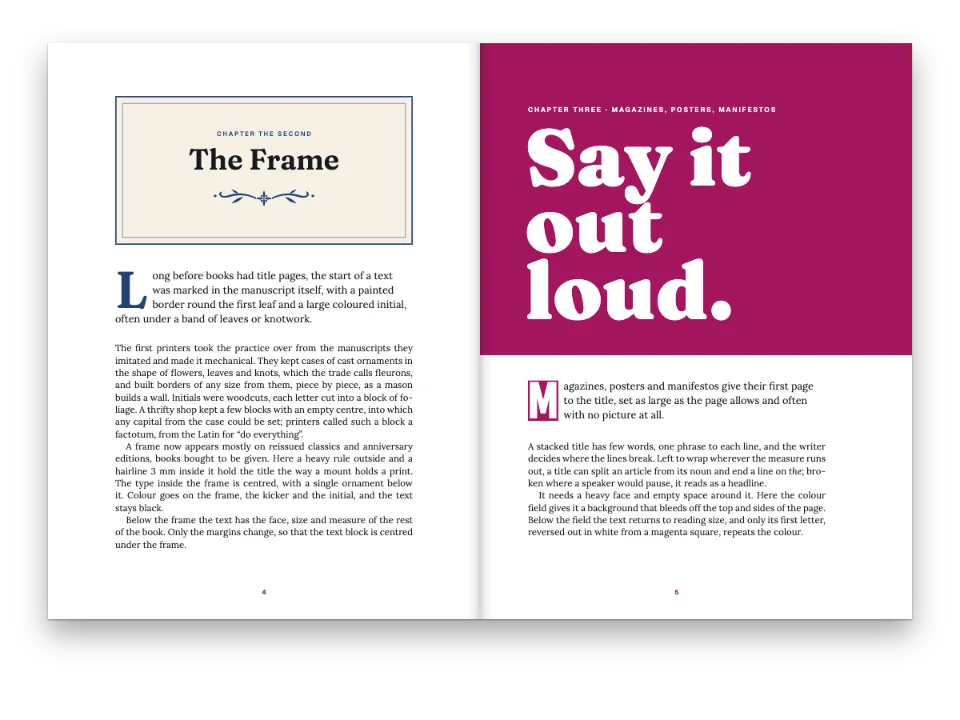
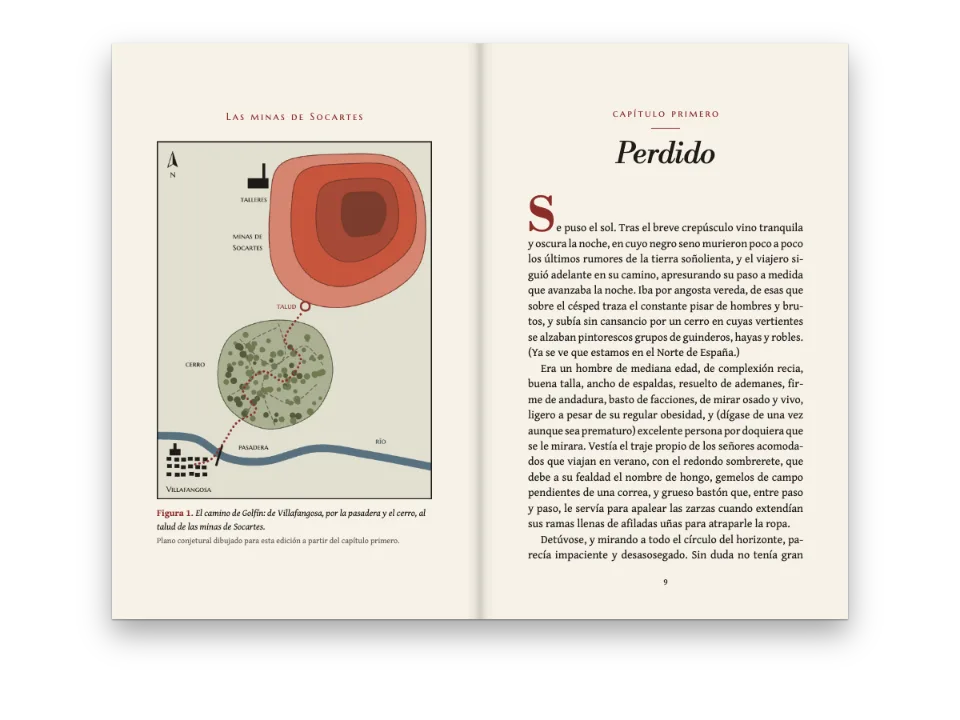
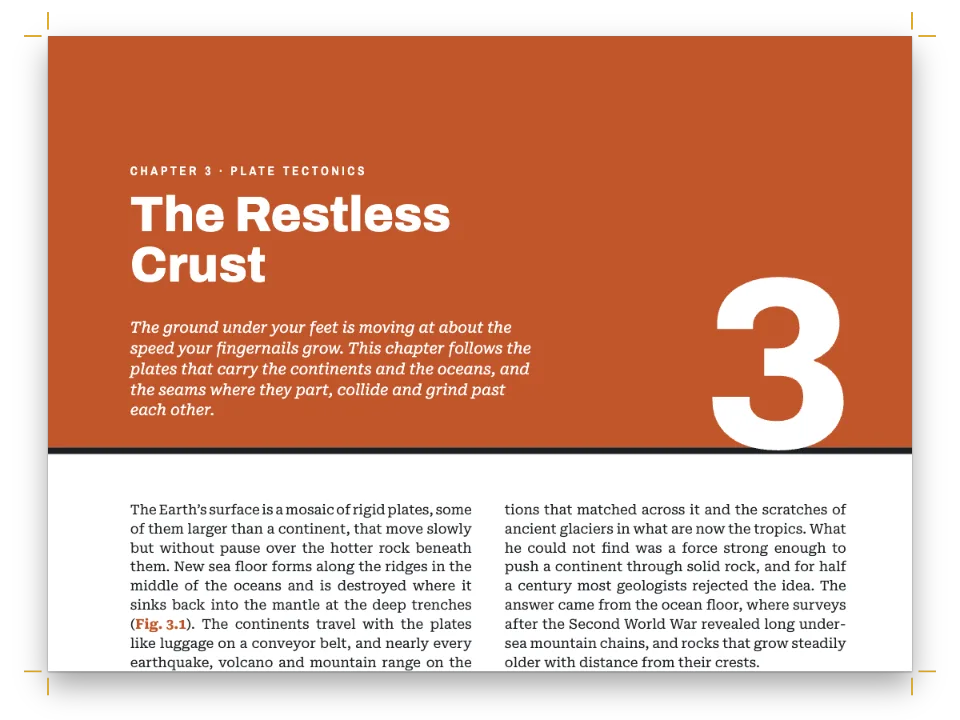
Ce que vous allez composer
Les premières pages d’une édition italienne pour enfants de Le avventure di Pinocchio de Collodi, composée en Averia Serif Libre 13 sur 19 pt sur une page de 190 × 240 mm. Une page de titre au verso fait face au chapitre I : une aquarelle des collines toscanes, où une charrette à âne apporte du bois à l’atelier d’un menuisier, au-dessus du titre en Fredericka the Great. Chaque chapitre s’ouvre sous une vignette à l’aquarelle qui se fond dans le papier (Maestro Ciliegia, la hache levée au-dessus de la bûche qui parle, pour le chapitre I ; Geppetto, dans sa perruque jaune, qui prend la bûche, pour le chapitre II), puis viennent la ligne de chapitre et le sommaire de Collodi en italique centré. Les quatre images ont été générées par des modèles de diffusion à partir d’une même description de style et de la palette de la page. Les titres courants ne s’impriment qu’en pages 8 et 9, les deux sans ouverture. Les folios sont posés dans des disques couleur bois, et deux cerises ferment le chapitre I sans légende ni numéro.
Cette recette répond à
- Comment donner à chaque chapitre sa propre photo, sa propre couleur ou sa propre variante d’ouverture ?
- Comment composer des illustrations non numérotées : ornements, vignettes, logos ?
- Comment ajouter à une ouverture une ligne d’auteur, un chapeau ou une attaque avec lettrine ?
- Comment masquer les titres courants sur les ouvertures et les pages blanches, ou peindre un verso blanc dans la couleur de la partie ?
La réponse courte
// # Capitolo I {style="capitolo" vignetta="ceppo" summary="Come andò che Maestro Ciliegia…"}
// resourceId takes placeholders like a design text: '{attr.vignetta}' draws the resource the
// heading names, so every chapter shares one style.
const VIGNETTE = { width: 84, height: 56 }; // mm, centred at the head of the text block
const SUMMARY = 124; // mm: the summary's measure, narrower than the text's
const opener = { enabled: true,
  // A floor for the height the opener reserves, in whole lines, so the text under chapter I's
  // two-line summary starts on the same grid line as the text under chapter II's three lines.
  minHeight: pt(14 * LEAD),
  slot: { elements: [
    { kind: 'image', id: 'vignette', resourceId: '{attr.vignetta}',
      placement: at('container', 'top', 0, 0,
        { width: mm(VIGNETTE.width), height: mm(VIGNETTE.height) }) },
    // The chapter line 6 mm under the picture's foot, the summary 5 mm under the chapter line.
    text('chapter', '{titleText}', DISPLAY, 24, at('container', 'top-left', 0,
      VIGNETTE.height + 6, { width: mm(MEASURE) }), { ...caps(2.4), lineHeight: 1 }),
    text('summary', '{attr.summary}', TEXT, 12.5, at('#chapter', 'below',
      (MEASURE - SUMMARY) / 2, 5, { width: mm(SUMMARY) }), { italic: true, lineHeight: 1.38 }),
  ] },
};
const chapter = { id: 'capitolo', advancedDesign: opener };
Ingrédients
- Fonctionnalités
- Ouvertures composéesImages dans les maquettes de pageTitres courants et foliosStyles de titreAttributs de titreChapitres qui commencent en belle pageTexte, filets et boîtes dans les maquettes de pageTitres courants selon le rôle de la pageTypes de ressource personnalisésDes figures exactement iciFigures et tableaux comme ressourcesCésure et langue du documentMarges en miroirPalette de couleurs sémantiquePages sur un canvas
- Typographie
- Averia Serif Libre, Fredericka the Great, Quicksand (SIL OFL 1.1)
- Ressources
ceppo-1200.jpgciliegie-600.jpgfrontespizio-1400.jpgpolenta-1200.jpg- The frontispiece: Tuscan hills, a hill village and a donkey cart of firewood on its way to the carpenter’s workshop (Generated With Diffusion Models, original)
- Chapter I’s vignette: Maestro Ciliegia, axe raised over the talking log (Generated With Diffusion Models, original)
- Chapter II’s vignette: Geppetto in his yellow wig receives the log, beside a pot of polenta (Generated With Diffusion Models, original)
- The cherry tailpiece (Generated With Diffusion Models, original)
Préparation
#1 · Un style de titre, une vignette nommée sur chaque titre
Le code de cette étape est la réponse courte. Le resourceId d’un élément image accepte les mêmes variables qu’un texte de maquette : '{attr.vignetta}' dessine donc la ressource que nomme le titre, comme {attr.summary} imprime son sommaire. Les deux chapitres partagent le style capitolo et nomment leur image sur la ligne du titre : # Capitolo II {style="capitolo" vignetta="polenta" summary="…"}. Un troisième chapitre demande une ressource et un titre de plus, pas un autre style (éléments image). La ligne de chapitre est placée depuis le haut du conteneur, 6 mm sous la boîte de la vignette, et le sommaire est suspendu 5 mm en dessous ; l’ouverture réserve la place jusqu’à la dernière ligne du sommaire. Avec minHeight comme plancher de 14 lignes, le texte du chapitre I commence sur la même ligne que celui du chapitre II, dont le sommaire compte une ligne de plus ; sans lui, le texte du chapitre I commence 6,7 mm plus haut (largeur et maquette avancée).
#2 · Charger les peintures comme ressources bitmap
const PICTURES = { // id: [file, width, height, alt text in the book's language]
  frontespizio: ['frontespizio-1400.jpg', 1400, 1105, 'Colline toscane con cipressi e un borgo; '
    + 'un contadino guida un asinello con un carretto di legna verso la bottega di un falegname.'],
  ceppo: ['ceppo-1200.jpg', 1200, 800, 'Maestro Ciliegia, con la scure alzata sopra un pezzo di '
    + 'legno sul banco, si guarda intorno spaventato.'],
  polenta: ['polenta-1200.jpg', 1200, 800, 'Geppetto, con la parrucca gialla, riceve il pezzo di '
    + 'legno da Maestro Ciliegia; accanto, un paiolo di polenta fumante.'],
  ciliegie: ['ciliegie-600.jpg', 600, 626, 'Due ciliegie rosse su un picciolo, con una foglia.'],
};
const resources = Object.entries(PICTURES).map(([id, [fileId, w, h, altText]]) => ({
  id, typeId: 'fregio', kind: 'bitmap', createdAt: 0, updatedAt: 0, altText,
  bitmap: { fileId, format: 'jpeg', width: w, height: h } }));
Chaque image est un JPEG du dossier assets/ de la recette, déclaré à sa taille en pixels : la mise en page ne lit que ces tailles, et le canvas peint ce que loadImage() a enregistré sous chaque identifiant de fichier au moment où il dessine la page. Les vignettes et les cerises ont été générées sur fond blanc, puis multipliées par la couleur du papier #fffaf0 : leurs marges s’impriment comme la page et les images n’ont aucun bord visible. Le frontispice est recadré en 190:150, la forme de son champ, si bien que l’image ajustée remplit le champ sans bande de papier. Le paysage et les vignettes sont peints par des éléments image des maquettes, les cerises par ::resource{id="ciliegie"} dans le Markdown.
#3 · Faire de la page de titre un style de titre
const SKY = 150; // mm from the top edge: the foot of the painted field
// # Pinocchio {style="frontespizio" kicker="Le avventure di"}; subtitle and author come from
// the frontmatter. Every element hangs from the page, so the field runs off three edges.
const frontispiece = {
  id: 'frontespizio',
  footer: { elements: [] }, // no folio; the running heads already skip openers
  advancedDesign: { enabled: true, slot: { elements: [ // array order is paint order
    { kind: 'image', id: 'landscape', resourceId: 'frontespizio', // cut to the field's 190:150
      placement: at('page', 'top-left', 0, 0, { width: 'fill', height: mm(SKY) }) },
    text('kicker', '{attr.kicker}', LABEL, 11, at('page', 'top', 0, SKY + 11),
      { ...caps(2.6), fontWeight: 700 }),
    text('title', '{titleText}', DISPLAY, 70, at('page', 'top', 0, SKY + 17),
      { lineHeight: 1, color: col('bark') }),
    text('subtitle', '{subtitle}', TEXT, 15, at('page', 'top', 0, SKY + 44), { italic: true }),
    text('author', '{author}', LABEL, 9, at('page', 'top', 0, SKY + 58),
      { ...caps(2), fontWeight: 600 }),
  ] } },
};
La page de titre est le premier titre du Markdown, # Pinocchio {style="frontespizio" kicker="Le avventure di"}, et son style peint tout ce qui est sur la page : le paysage, sur 150 mm de haut depuis le bord supérieur, puis le surtitre tiré de l’attribut, le titre, et le sous-titre et l’auteur tirés du frontmatter. Chaque élément est accroché à la page, pas au bloc de texte : la peinture atteint le bord supérieur et les deux côtés de la feuille, alors que le titre lui-même reste dans l’unique colonne du livre. Le footer vide supprime le disque du folio qu’impriment les ouvertures de chapitre, et pages: 'body' écarte déjà les titres courants de la page (styles de titre).
#4 · Titres courants sur les pages de texte, folios dans des disques
// The excerpt opens on book page 6, a verso, so the title page faces chapter I.
const continuation = { pageIndexOffset: 5, pageNumbering: { startAt: 6 } };
const SHIFT = (INNER - OUTER) / 2; // mm: the text block's centre sits off the page's centre
const head = (id, content, parity, x) => text(id, content, LABEL, 8,
  at('page', 'top', x, 12), { ...caps(1.8), fontWeight: 600, parity, pages: 'body' });
const DISC = 7.4; // mm: the folio's disc
// A fixed square with a radius of half its side is a circle; the figures sit in its middle.
// lineHeight 1.17: the baseline falls at 0.8 of the line, 0.94 em down, so Quicksand's
// figures (0.70 em tall) leave 0.23 em above and below them, and 'middle' centres that line.
const disc = (id, parity, pages, edge, x) => text(id, '{pageNumber}', LABEL, 8.5,
  at('page', edge, x, -(BOTTOM - DISC) / 2, { width: mm(DISC), height: mm(DISC) }),
  { fontWeight: 700, color: col('paper'), lineHeight: 1.17, verticalAlign: 'middle', parity,
    pages, box: { backgroundColor: col('wood'), borderRadius: mm(DISC / 2) } });
const header = { elements: [
  head('verso-title', '{title}', 'even', -SHIFT), // the book on the left-hand page
  head('recto-chapter', '{chapterTitle}', 'odd', SHIFT), // the chapter on the right
] };
const footer = { elements: [
  disc('verso-folio', 'even', 'body', 'bottom-left', OUTER),
  disc('recto-folio', 'odd', 'body', 'bottom-right', -OUTER),
  disc('opener-folio', 'all', 'opener', 'bottom', 0), // a chapter opens on either side
] };
continuation numérote l’extrait à partir de la page 6 du livre, un verso : la page de titre fait face au chapitre I et le premier folio imprimé est 7. pages: 'body' écarte les titres courants de la page de titre et des deux ouvertures : ils ne s’impriment qu’en pages 8 et 9, le titre du livre au verso et celui du chapitre au recto (éléments texte). Le folio est un texte de maquette dans un carré fixe de 7,4 mm dont le rayon d’angle vaut la moitié du côté, ce qui en fait un cercle ; verticalAlign: 'middle' et la hauteur de ligne calculée dans le commentaire y centrent les chiffres. Les chiffres couleur papier ont un rapport de contraste de 4,98:1 sur le bois. Les étiquettes en approche ne demandent aucun décalage : l’approche après la dernière lettre d’une ligne est exclue quand la ligne est centrée.
#5 · Fermer le chapitre par un cul-de-lampe sans numéro
// No caption prefix and no caption, so the cherries that close chapter I print with no
// label or number. The pictures the design slots paint are of this type too.
const resourceTypes = [{ id: 'fregio', name: 'Fregio', namePlural: 'Fregi', shortLabel: 'Fregio',
  captionPrefix: '', numberingTemplate: '{n}', resetOn: 'never', counterFormat: 'decimal',
  defaultPlacement: { position: 'here', width: 0.16, align: 'center' } }];
Un type de ressource imprime son captionPrefix et son numéro avant la légende. Avec un préfixe vide et sans légende, rien ne s’imprime sous les cerises ; avec captionPrefix: 'Fregio', la même ressource imprime Fregio 1. sous le dessin et gagne 10 mm de hauteur (types de ressources). Le defaultPlacement du type place chaque ressource là où se trouve sa ligne ::resource, large d’un sixième de la justification et centrée : le Markdown n’a besoin que de ::resource{id="ciliegie"} après le dernier paragraphe du chapitre. Les autres images partagent le type, mais aucun :ref ni ::resource ne les nomme : elles ne sont jamais placées ni comptées.
La recette complète
// ═══ Postext Cookbook · Nº 066 · Storybook chapters with vignettes and summaries ═══ // https://postext.dev/en/cookbook/storybook-chapter-vignettes // Code: MIT · Text: C. Collodi, 1883 (PD, Gutenberg #52484) · Pictures: diffusion models // Fonts: Averia Serif Libre, Fredericka the Great, Quicksand (SIL OFL 1.1) · Needs postext ≥ 1.25.0 import { buildDocumentWithFonts, renderPageToCanvas, registerResourceImage, } from 'https://esm.sh/postext'; const LANG = 'en'; // @lang: the language of the sample document (the sample is Italian in both) const RECIPE = 'storybook-chapter-vignettes'; // ─── 1 · Design ───────────────────────────────────────────────────────────── const palette = { // every colour in the config comes from here; the pictures were painted to it ink: '#2b2118', // text: a brown near-black paper: '#fffaf0', // a warm book paper, which the vignettes' margins were tinted to bark: '#6b4224', // chapter lines, running heads, the title wood: '#9a5f30', // the folio discs }; // col(id): a colour linked to its palette entry, with the entry's hex beside the id. const col = (id) => ({ hex: palette[id], model: 'hex', paletteId: id }); const colorPalette = [ ...Object.entries(palette).map(([id, hex]) => ({ id, name: id, value: { hex, model: 'hex' } })), // The defaults linked to main-color, bold among them, print in bark instead of blue. { id: 'main-color', name: 'bark (defaults)', value: { hex: palette.bark, model: 'hex' } }, ]; // Text and summaries; the book's title and the chapter lines; running heads and folios. const [TEXT, DISPLAY, LABEL] = ['Averia Serif Libre', 'Fredericka the Great', 'Quicksand']; const TRIM = { width: 190, height: 240 }; // mm const [TOP, INNER, OUTER] = [22, 22, 20]; // mm; mirrored, so the spine margin swaps sides const MEASURE = TRIM.width - INNER - OUTER; // 148 mm const [BODY, LEAD, LINES] = [13, 19, 29]; // pt, pt, and whole lines in the text block const BOTTOM = TRIM.height - TOP - (LINES * LEAD * 25.4) / 72; // mm: 23.6 // Design-slot shorthands: a placement from an anchor's edge (mm), and a design text. const at = (to, edge, x = 0, y = 0, size) => ({ anchor: { to, edge }, offset: { x: mm(x), y: mm(y) }, ...(size && { size }) }); const text = (id, content, fontFamily, size, placement, extra = {}) => ({ kind: 'text', id, content, fontFamily, fontSize: pt(size), color: col('ink'), align: 'center', overflow: 'wrap', // a long line wraps in every slot, the running heads too placement, ...extra }); const caps = (tracking) => ({ textTransform: 'uppercase', letterSpacing: pt(tracking), color: col('bark') }); // #region answer: one opener for every chapter: the vignette the heading names, then its summary // # Capitolo I {style="capitolo" vignetta="ceppo" summary="Come andò che Maestro Ciliegia…"} // resourceId takes placeholders like a design text: '{attr.vignetta}' draws the resource the // heading names, so every chapter shares one style. const VIGNETTE = { width: 84, height: 56 }; // mm, centred at the head of the text block const SUMMARY = 124; // mm: the summary's measure, narrower than the text's const opener = { enabled: true, // A floor for the height the opener reserves, in whole lines, so the text under chapter I's // two-line summary starts on the same grid line as the text under chapter II's three lines. minHeight: pt(14 * LEAD), slot: { elements: [ { kind: 'image', id: 'vignette', resourceId: '{attr.vignetta}', placement: at('container', 'top', 0, 0, { width: mm(VIGNETTE.width), height: mm(VIGNETTE.height) }) }, // The chapter line 6 mm under the picture's foot, the summary 5 mm under the chapter line. text('chapter', '{titleText}', DISPLAY, 24, at('container', 'top-left', 0, VIGNETTE.height + 6, { width: mm(MEASURE) }), { ...caps(2.4), lineHeight: 1 }), text('summary', '{attr.summary}', TEXT, 12.5, at('#chapter', 'below', (MEASURE - SUMMARY) / 2, 5, { width: mm(SUMMARY) }), { italic: true, lineHeight: 1.38 }), ] }, }; const chapter = { id: 'capitolo', advancedDesign: opener }; // #endregion // #region frontispiece: the title page as a heading style: a painted field, then the title const SKY = 150; // mm from the top edge: the foot of the painted field // # Pinocchio {style="frontespizio" kicker="Le avventure di"}; subtitle and author come from // the frontmatter. Every element hangs from the page, so the field runs off three edges. const frontispiece = { id: 'frontespizio', footer: { elements: [] }, // no folio; the running heads already skip openers advancedDesign: { enabled: true, slot: { elements: [ // array order is paint order { kind: 'image', id: 'landscape', resourceId: 'frontespizio', // cut to the field's 190:150 placement: at('page', 'top-left', 0, 0, { width: 'fill', height: mm(SKY) }) }, text('kicker', '{attr.kicker}', LABEL, 11, at('page', 'top', 0, SKY + 11), { ...caps(2.6), fontWeight: 700 }), text('title', '{titleText}', DISPLAY, 70, at('page', 'top', 0, SKY + 17), { lineHeight: 1, color: col('bark') }), text('subtitle', '{subtitle}', TEXT, 15, at('page', 'top', 0, SKY + 44), { italic: true }), text('author', '{author}', LABEL, 9, at('page', 'top', 0, SKY + 58), { ...caps(2), fontWeight: 600 }), ] } }, }; // #endregion // #region folios: running heads on body pages only, folios in wood-coloured discs // The excerpt opens on book page 6, a verso, so the title page faces chapter I. const continuation = { pageIndexOffset: 5, pageNumbering: { startAt: 6 } }; const SHIFT = (INNER - OUTER) / 2; // mm: the text block's centre sits off the page's centre const head = (id, content, parity, x) => text(id, content, LABEL, 8, at('page', 'top', x, 12), { ...caps(1.8), fontWeight: 600, parity, pages: 'body' }); const DISC = 7.4; // mm: the folio's disc // A fixed square with a radius of half its side is a circle; the figures sit in its middle. // lineHeight 1.17: the baseline falls at 0.8 of the line, 0.94 em down, so Quicksand's // figures (0.70 em tall) leave 0.23 em above and below them, and 'middle' centres that line. const disc = (id, parity, pages, edge, x) => text(id, '{pageNumber}', LABEL, 8.5, at('page', edge, x, -(BOTTOM - DISC) / 2, { width: mm(DISC), height: mm(DISC) }), { fontWeight: 700, color: col('paper'), lineHeight: 1.17, verticalAlign: 'middle', parity, pages, box: { backgroundColor: col('wood'), borderRadius: mm(DISC / 2) } }); const header = { elements: [ head('verso-title', '{title}', 'even', -SHIFT), // the book on the left-hand page head('recto-chapter', '{chapterTitle}', 'odd', SHIFT), // the chapter on the right ] }; const footer = { elements: [ disc('verso-folio', 'even', 'body', 'bottom-left', OUTER), disc('recto-folio', 'odd', 'body', 'bottom-right', -OUTER), disc('opener-folio', 'all', 'opener', 'bottom', 0), // a chapter opens on either side ] }; // #endregion // #region tailpiece: an unnumbered resource type, set where ::resource stands // No caption prefix and no caption, so the cherries that close chapter I print with no // label or number. The pictures the design slots paint are of this type too. const resourceTypes = [{ id: 'fregio', name: 'Fregio', namePlural: 'Fregi', shortLabel: 'Fregio', captionPrefix: '', numberingTemplate: '{n}', resetOn: 'never', counterFormat: 'decimal', defaultPlacement: { position: 'here', width: 0.16, align: 'center' } }]; // #endregion // #region pictures: four paintings, declared at their pixel size under the file ids they load as const PICTURES = { // id: [file, width, height, alt text in the book's language] frontespizio: ['frontespizio-1400.jpg', 1400, 1105, 'Colline toscane con cipressi e un borgo; ' + 'un contadino guida un asinello con un carretto di legna verso la bottega di un falegname.'], ceppo: ['ceppo-1200.jpg', 1200, 800, 'Maestro Ciliegia, con la scure alzata sopra un pezzo di ' + 'legno sul banco, si guarda intorno spaventato.'], polenta: ['polenta-1200.jpg', 1200, 800, 'Geppetto, con la parrucca gialla, riceve il pezzo di ' + 'legno da Maestro Ciliegia; accanto, un paiolo di polenta fumante.'], ciliegie: ['ciliegie-600.jpg', 600, 626, 'Due ciliegie rosse su un picciolo, con una foglia.'], }; const resources = Object.entries(PICTURES).map(([id, [fileId, w, h, altText]]) => ({ id, typeId: 'fregio', kind: 'bitmap', createdAt: 0, updatedAt: 0, altText, bitmap: { fileId, format: 'jpeg', width: w, height: h } })); // #endregion const config = () => ({ locale: 'it', // Italian hyphenation resourceTypes, colorPalette, header, footer, layout: { layoutType: 'single' }, page: { width: mm(TRIM.width), height: mm(TRIM.height), dpi: 150, backgroundColor: col('paper'), margins: { top: mm(TOP), bottom: mm(BOTTOM), left: mm(INNER), right: mm(OUTER), mirror: true } }, bodyText: { fontFamily: TEXT, fontSize: pt(BODY), lineHeight: pt(LEAD), color: col('ink'), italicColor: col('ink'), // *ohi* in ink, not in the defaults' bark referenceColor: col('ink'), // the book cites nothing; a :ref added later prints in ink too firstLineIndent: mm(5), indentAfterHeading: false, // Word spaces from 0.8 to 1.45 of the face's own, and up to 8 ‰ of tracking for a line // that would pass either limit. The default maximum of 2 lets 14 lines stretch past // 1.45×; 1.45 alone left three, to 1.58×, beside lines squeezed towards the default 0.6. minWordSpacing: 0.8, maxWordSpacing: 1.45, maxJustifyTracking: 8, }, headings: { fontFamily: DISPLAY, fontWeight: 400, // the designs paint the titles: no Open Sans to load // Every chapter on a new page, on either side, so chapter II opens on a verso. levels: [{ level: 1, breakBefore: { enabled: true, parity: 'any' } }], }, headingStyles: [frontispiece, chapter], paragraphStyles: [{ id: 'colofon', fontFamily: LABEL, fontSize: pt(7.5), lineHeight: pt(11), color: col('bark'), textAlign: 'center', firstLineIndent: pt(0), marginTop: pt(LEAD) }], }); // ─── 2 · Content ──────────────────────────────────────────────────────────── const markdown = String.raw`---Exemple Markdown · 74 lignes · content.en.md
title: "Le avventure di Pinocchio" subtitle: "Storia di un burattino" author: "Carlo Collodi" --- # Pinocchio {style="frontespizio" kicker="Le avventure di"} # Capitolo I {style="capitolo" vignetta="ceppo" summary="Come andò che Maestro Ciliegia, falegname, trovò un pezzo di legno che piangeva e rideva come un bambino."} — C’era una volta… — Un re! — diranno subito i miei piccoli lettori. — No, ragazzi, avete sbagliato. C’era una volta un pezzo di legno. Non era un legno di lusso, ma un semplice pezzo da catasta, di quelli che d’inverno si mettono nelle stufe e nei caminetti per accendere il fuoco e per riscaldare le stanze. Non so come andasse, ma il fatto gli è che un bel giorno questo pezzo di legno capitò nella bottega di un vecchio falegname, il quale aveva nome mastr’Antonio, se non che tutti lo chiamavano maestro Ciliegia, per via della punta del suo naso, che era sempre lustra e paonazza, come una ciliegia matura. Appena maestro Ciliegia ebbe visto quel pezzo di legno, si rallegrò tutto; e dandosi una fregatina di mani per la contentezza, borbottò a mezza voce: — Questo legno è capitato a tempo; voglio servirmene per fare una gamba di tavolino. — Detto fatto, prese subito l’ascia arrotata per cominciare a levargli la scorza e a digrossarlo; ma quando fu lì per lasciare andare la prima asciata, rimase col braccio sospeso in aria, perchè sentì una vocina sottile sottile, che disse raccomandandosi: — Non mi picchiar tanto forte! — Figuratevi come rimase quel buon vecchio di maestro Ciliegia! Girò gli occhi smarriti intorno alla stanza per vedere di dove mai poteva essere uscita quella vocina, e non vide nessuno! Guardò sotto il banco, e nessuno: guardò dentro un armadio che stava sempre chiuso, e nessuno; guardò nel corbello dei trucioli e della segatura, e nessuno; aprì l’uscio di bottega per dare un’occhiata anche sulla strada, e nessuno. O dunque?… — Ho capito; — disse allora ridendo e grattandosi la parrucca — si vede che quella vocina me la son figurata io. Rimettiamoci a lavorare. — E ripresa l’ascia in mano, tirò giù un solennissimo colpo sul pezzo di legno. — Ohi! tu m’hai fatto male! — gridò rammaricandosi la solita vocina. Questa volta maestro Ciliegia restò di stucco, cogli occhi fuori del capo per la paura, colla bocca spalancata e colla lingua giù ciondoloni fino al mento, come un mascherone da fontana. Appena riebbe l’uso della parola, cominciò a dire tremando e balbettando dallo spavento: — Ma di dove sarà uscita questa vocina che ha detto ohi?… Eppure qui non c’è anima viva. Che sia per caso questo pezzo di legno che abbia imparato a piangere e a lamentarsi come un bambino? Io non lo posso credere. Questo legno eccolo qui; è un pezzo di legno da caminetto, come tutti gli altri, e a buttarlo sul fuoco, c’è da far bollire una pentola di fagioli… O dunque? Che ci sia nascosto dentro qualcuno? Se c’è nascosto qualcuno, tanto peggio per lui. Ora l’accomodo io! — E così dicendo, agguantò con tutt’e due le mani quel povero pezzo di legno, e si pose a sbatacchiarlo senza carità contro le pareti della stanza. Poi si messe in ascolto, per sentire se c’era qualche vocina che si lamentasse. Aspettò due minuti, e nulla; cinque minuti, e nulla; dieci minuti, e nulla! — Ho capito — disse allora sforzandosi di ridere e arruffandosi la parrucca — si vede che quella vocina che ha detto *ohi*, me la son figurata io! Rimettiamoci a lavorare. — E perchè gli era entrato addosso una gran paura, si provò a canterellare per farsi un po’ di coraggio. Intanto, posata da una parte l’ascia, prese in mano la pialla, per piallare e tirare a pulimento il pezzo di legno; ma nel mentre che lo piallava in su e in giù, sentì la solita vocina che gli disse ridendo: — Smetti! tu mi fai il pizzicorino sul corpo! — Questa volta il povero maestro Ciliegia cadde giù come fulminato. Quando riaprì gli occhi, si trovò seduto per terra. Il suo viso pareva trasfigurito, e perfino la punta del naso, di paonazza come era quasi sempre, gli era diventata turchina dalla gran paura. ::resource{id="ciliegie"} # Capitolo II {style="capitolo" vignetta="polenta" summary="Maestro Ciliegia regala il pezzo di legno al suo amico Geppetto, il quale lo prende per fabbricarsi un burattino maraviglioso, che sappia ballare, tirar di scherma e fare i salti mortali."} In quel punto fu bussato alla porta. — Passate pure, — disse il falegname, senza aver la forza di rizzarsi in piedi. Allora entrò in bottega un vecchietto tutto arzillo, il quale aveva nome Geppetto; ma i ragazzi del vicinato, quando lo volevano far montare su tutte le furie, lo chiamavano col soprannome di Polendina, a motivo della sua parrucca gialla, che somigliava moltissimo alla polendina di granturco. Geppetto era bizzosissimo. Guai a chiamarlo Polendina! Diventava subito una bestia, e non c’era più verso di tenerlo. :::paragraphs{style="colofon"} Composto in Averia Serif Libre, Fredericka the Great e Quicksand (SIL Open Font License). Testo di Carlo Collodi (1883) secondo l’edizione Bemporad del 1902, Project Gutenberg n. 52484. Illustrazioni generate con modelli di diffusione. :::`; // content.<lang>.md: Collodi's Italian in both editions // ─── 3 · Fonts ────────────────────────────────────────────────────────────── const FONTS = { 'Averia Serif Libre': ['400', '400i'], 'Fredericka the Great': ['400'], Quicksand: ['400', '600', '700'] }; // every face, loaded before layout // ─── 4 · Build & show ─────────────────────────────────────────────────────── // A design slot or ::resource names a resource, the resource a file id: load each file. await Promise.all(Object.values(PICTURES).map(([file]) => loadImage(file, asset(file)))); const doc = await buildDocumentWithFonts({ markdown, resources, continuation }, config(), kitFonts(FONTS)); showPages(doc, { title: 'Le avventure di Pinocchio' });Kit · core, fonts, viewer, images : identique dans toutes les recettes · 270 lignes
// ─── Kit ── helpers shared by every Cookbook recipe · postext.dev/cookbook ───── // ─── Kit · core v1 ── the same in every recipe · postext.dev/cookbook function mm(value) { return { value, unit: 'mm' }; } function pt(value) { return { value, unit: 'pt' }; } function em(value) { return { value, unit: 'em' }; } /** The sample language's string: t({ en: 'Figure', es: 'Figura' }). */ function t(strings) { return strings[LANG] ?? Object.values(strings)[0]; } /** A file in this recipe's assets folder, served from the Postext repo by jsDelivr. */ function asset(file) { return `https://cdn.jsdelivr.net/gh/drnachio/postext@main/cookbook/${RECIPE}/assets/${file}`; } // ─── Kit · fonts v3 ── the same in every recipe · postext.dev/cookbook // Postext loads the faces a config asks for before layout (prepareFonts, // buildDocumentWithFonts) and asks the kit for the files: Fontsource's, the // files the PDF embeds too. /** The options of buildDocumentWithFonts / prepareFonts / withLoadedFonts: * the Fontsource resolver, and the faces of FONTS loaded with the ones the * config names. FONTS = { 'Family Name': ['400', '400i', '700'] }. */ function kitFonts(FONTS = {}) { const faces = Object.entries(FONTS).flatMap(([family, specs]) => specs.map((spec) => ({ family, weight: parseInt(spec, 10), style: spec.endsWith('i') ? 'italic' : 'normal' }))); return { resolve: fontsourceResolver, faces }; } /** A face's Fontsource files, in a fixed order: latin, then latin-ext and greek * when `text` needs them and the family ships them (kitSubsetsFor), each with * its unicode-range. Null for a weight or slant Fontsource does not ship. */ async function fontsourceResolver(family, weight, style, { text = '' } = {}) { const id = fontsourceId(family); const meta = await fontsourceMeta(family); if (meta && !(meta.weights.includes(weight) && meta.styles.includes(style))) return null; kitStatus('Loading fonts…'); const at = await fontsourceAt(id); return ['latin', ...kitSubsetsFor(text, meta)].map((subset) => ({ source: `${at}files/${id}-${subset}-${weight}-${style}.woff2`, unicodeRange: kitRanges()[subset], })); } /** The unicode-range of each Fontsource file the kit loads (a function: the * kit is inlined after the pen's code, which runs before a const would be set). */ function kitRanges() { return { latin: 'U+0000-00FF,U+0131,U+0152-0153,U+02BB-02BC,U+02C6,U+02DA,U+02DC,U+0304,U+0308,U+0329,' + 'U+2000-206F,U+20AC,U+2122,U+2191,U+2193,U+2212,U+2215,U+FEFF,U+FFFD', 'latin-ext': 'U+0100-02BA,U+02BD-02C5,U+02C7-02CC,U+02CE-02D7,U+02DD-02FF,U+0304,U+0308,U+0329,' + 'U+1D00-1DBF,U+1E00-1E9F,U+1EF2-1EFF,U+2020,U+20A0-20AB,U+20AD-20C0,U+2113,U+2C60-2C7F,U+A720-A7FF', greek: 'U+0370-03FF', }; } /** For the cjk, arabic and comics blocks, which add their own files: the * faces of `faces` = { 'Family Name': ['400', '400i', '700'] }. `text` is the sample: * č ł † α χ also load latin-ext and greek files (kitSubsetsFor). With * `optional`, a face Fontsource does not ship is skipped instead of failing. * The files are added once all have loaded, in the order asked (latin, then * latin-ext, then greek), whatever order they arrive in: the last one added * wins a character two files hold. Resolves to the number of faces added. */ async function loadFonts(faces, text = '', { optional = false } = {}) { kitStatus('Loading fonts…'); const ranges = kitRanges(); const jobs = []; for (const [family, specs] of Object.entries(faces)) { const id = fontsourceId(family); const todo = [...new Set(specs)].map((spec) => [parseInt(spec, 10), spec.endsWith('i') ? 'italic' : 'normal']) .filter(([weight, style]) => !hasFace(family, weight, style)); // before any await const at = fontsourceAt(id); const meta = optional || /[^\0-ÿ]/u.test(text) ? await fontsourceMeta(family) : null; const subsets = ['latin', ...kitSubsetsFor(text, meta)]; for (const [weight, style] of todo) { if (optional && !(meta?.weights.includes(weight) && meta.styles.includes(style))) continue; for (const subset of subsets) { const url = `${await at}files/${id}-${subset}-${weight}-${style}.woff2`; const face = new FontFace(family, `url(${url}) format('woff2')`, { weight: String(weight), style, unicodeRange: ranges[subset] }); jobs.push(face.load().catch(() => { if (subset === 'latin' && !optional) throw new Error(`Fontsource has no ${family} ${weight} ${style}`); })); } } } const ready = await Promise.all(jobs).catch((error) => { kitFail(error); throw error; }); return ready.filter((face) => face && document.fonts.add(face)).length; } /** A loaded FontFace covers this family, weight and style (fonts.check() would * also say yes for families nobody declared). */ function hasFace(family, weight, style) { for (const face of document.fonts) { if (face.status !== 'loaded' || face.style !== style) continue; if (face.family.replace(/^["']|["']$/g, '') !== family) continue; const [low, high = low] = face.weight.split(' ').map(Number); if (weight >= low && weight <= high) return true; } return false; } /** The files beyond latin `text` needs that `meta`'s family ships. */ function kitSubsetsFor(text, meta) { return [[/[Ā-˿ᴀ-ᶿḀ-ỿ†ℓⱠ-Ɀ꜠-ꟿ]/u, 'latin-ext'], [/[Ͱ-Ͽ]/u, 'greek']] .filter(([re, x]) => re.test(text) && meta?.subsets?.includes(x)).map(([, x]) => x); } /** Fontsource's id for a family: 'Source Serif 4' → 'source-serif-4'. */ function fontsourceId(family) { return family.toLowerCase().replace(/\s+/g, '-'); } /** A package's folder at the one version @5 names now (#766). */ function fontsourceAt(id, u = `https://cdn.jsdelivr.net/npm/@fontsource/${id}@`) { return (fontsourceAt.c ??= {})[id] ??= fetch(u + '5/package.json').then((r) => r.json()) .then((p) => p.version || 5, () => 5).then((v) => `${u}${v}/`); } /** The family's Fontsource metadata (weights, styles, subsets), or null. */ function fontsourceMeta(family) { fontsourceMeta.cache ??= new Map(); const id = fontsourceId(family); if (!fontsourceMeta.cache.has(id)) { fontsourceMeta.cache.set(id, fetch(`https://api.fontsource.org/v1/fonts/${id}`) .then((res) => (res.ok ? res.json() : null), () => null)); } return fontsourceMeta.cache.get(id); } // ─── Kit · viewer v2 ── the same in every recipe · postext.dev/cookbook /** The pages as spreads on a dark desk, page 1 alone, then verso | recto, * each painted when it scrolls near. Other options go to renderPageToCanvas. */ function showPages(docs, { title, width = 460, ...render } = {}) { const root = viewer(title); const pages = [docs].flat().flatMap((doc) => doc.pages.map((page) => ({ doc, page, n: (doc.pageIndexOffset ?? 0) + page.index }))); const spreads = []; let verso = null; for (const p of pages) { if (p.n % 2 === 1) { if (verso) spreads.push([verso, null]); verso = p; } else { spreads.push([verso, p]); verso = null; } } if (verso) spreads.push([verso, null]); const density = Math.min(window.devicePixelRatio || 1, 2); showPages.painter?.disconnect(); const painter = new IntersectionObserver((entries) => { for (const { isIntersecting, target } of entries) { if (!isIntersecting) continue; painter.unobserve(target); const { doc, page } = target.postext; renderPageToCanvas(page, doc, target, { ...render, scale: (width * density) / page.width }); } }, { rootMargin: '800px' }); showPages.painter = painter; root.replaceChildren(...spreads.map((pair) => { const spread = document.createElement('div'); spread.className = 'pt-spread'; for (const p of pair) { const figure = document.createElement('figure'); if (p) { const label = p.page.pageLabel || String(p.n + 1); const canvas = document.createElement('canvas'); canvas.postext = p; canvas.style.aspectRatio = `${p.page.width} / ${p.page.height}`; canvas.setAttribute('role', 'img'); canvas.setAttribute('aria-label', `Page ${label}`); const folio = document.createElement('figcaption'); folio.textContent = label; figure.append(canvas, folio); painter.observe(canvas); } else figure.className = 'pt-blank'; spread.append(figure); } return spread; })); kitStatus(`${pages.length} ${pages.length === 1 ? 'page' : 'pages'}`); document.documentElement.dataset.postext = 'ready'; return pages.length; } /** The desk, the bar and the error reporting, created once. */ function viewer(title) { if (!document.getElementById('pt-kit')) { document.head.insertAdjacentHTML('beforeend', `<style id="pt-kit"> :root { color-scheme: dark; } body { margin: 0; background: #0e1014; color: #b9bcc4; font: 13px/1.45 system-ui, sans-serif; } #pt-bar { position: sticky; top: 0; z-index: 1; display: flex; flex-wrap: wrap; align-items: center; gap: 6px 16px; padding: 10px 16px; background: rgb(14 16 20 / .92); backdrop-filter: blur(6px); border-bottom: 1px solid #23262d; } #pt-bar strong { color: #f4f1ea; font-weight: 600; } #pt-actions { display: flex; gap: 12px; margin-left: auto; } #pt-actions a, #pt-actions button { color: #d8a21a; font: inherit; background: none; border: 0; padding: 0; cursor: pointer; } #pages { display: grid; justify-items: center; gap: 48px; padding: 32px 16px 72px; } .pt-spread { display: flex; } .pt-spread figure { margin: 0; width: min(460px, 44vw); } .pt-spread canvas { display: block; width: 100%; background: #fff; box-shadow: 0 1px 2px rgb(0 0 0 / .5), 0 22px 44px -16px rgb(0 0 0 / .8); } .pt-spread figure:first-child canvas { box-shadow: inset -14px 0 14px -14px rgb(0 0 0 / .18), 0 1px 2px rgb(0 0 0 / .5), 0 22px 44px -16px rgb(0 0 0 / .8); } .pt-spread figcaption { margin-top: 10px; text-align: center; font: 600 10px/1 system-ui, sans-serif; letter-spacing: .18em; text-transform: uppercase; color: #6c7079; } .pt-blank { visibility: hidden; } @media (max-width: 760px) { .pt-spread { flex-direction: column; gap: 32px; } .pt-spread figure { width: min(460px, 92vw); } .pt-blank { display: none; } } </style>`); document.body.insertAdjacentHTML('afterbegin', '<header id="pt-bar"><strong id="pt-title"></strong><span id="pt-status" role="status"></span><span id="pt-actions"></span></header>'); document.getElementById('pt-title').textContent = document.title || 'Postext'; addEventListener('error', (event) => kitFail(event.error ?? event.message)); addEventListener('unhandledrejection', (event) => kitFail(event.reason)); } if (title) document.getElementById('pt-title').textContent = title; return document.getElementById('pages') ?? document.body.appendChild(Object.assign(document.createElement('main'), { id: 'pages' })); } function kitStatus(text) { viewer(); document.getElementById('pt-status').textContent = text; } function kitFail(error) { document.documentElement.dataset.postext = 'error'; kitStatus(`Error: ${error?.message ?? error}`); } // ─── Kit · images v3 ── recipes with pictures · postext.dev/cookbook /** Registers a photo or PNG for the canvas and keeps its bytes for the PDF. * fetch → ImageBitmap never taints the canvas (a plain cross-origin <img> would). */ async function loadImage(fileId, url) { const res = await fetch(url); if (!res.ok) throw new Error(`Image not found (${res.status}): ${url}`); const bytes = new Uint8Array(await res.arrayBuffer()); registerResourceImage(fileId, await createImageBitmap(new Blob([bytes]))); (loadImage.bytes ??= new Map()).set(fileId, bytes); } /** Registers SVG markup as a vector image, its fonts inside (inlineSvgFonts, ≥ 1.25). * `options` go to registerResourceImage: { singleInk: true } tints it on the canvas. */ async function loadSvg(fileId, svg, options) { if (typeof inlineSvgFonts === 'function') svg = await inlineSvgFonts(svg, svgFaces); const img = new Image(); img.src = `data:image/svg+xml;charset=utf-8,${encodeURIComponent(svg)}`; await img.decode(); registerResourceImage(fileId, img, options); (loadImage.bytes ??= new Map()).set(fileId, new TextEncoder().encode(svg)); } /** A face's Fontsource files: nearest weight; latin + what the SVG sets. */ async function svgFaces(family, weight, style, { codePoints = [] } = {}) { const [id, m] = [fontsourceId(family), await fontsourceMeta(family)]; const w = m?.weights.reduce((a, b) => (Math.abs(b - weight) < Math.abs(a - weight) ? b : a)) ?? weight; const s = m?.styles.includes(style) === false ? 'normal' : style; return Promise.all(['latin', ...kitSubsetsFor(String.fromCodePoint(...codePoints), m)].map(async (x) => new Uint8Array( await (await fetch(`${await fontsourceAt(id)}files/${id}-${x}-${w}-${s}.woff2`)).arrayBuffer()))); } /** renderToPdf({ resourceBytes: imageBytes }) */ function imageBytes(fileId) { return loadImage.bytes?.get(fileId); } /** renderToHtml({ resourceImageUrl: imageUrl }) */ function imageUrl(fileId) { const bytes = imageBytes(fileId); if (!bytes) return undefined; imageUrl.urls ??= new Map(); if (!imageUrl.urls.has(fileId)) { const type = /\.svg$/i.test(fileId) ? 'image/svg+xml' : /\.png$/i.test(fileId) ? 'image/png' : 'image/jpeg'; imageUrl.urls.set(fileId, URL.createObjectURL(new Blob([bytes], { type }))); } return imageUrl.urls.get(fileId); } // ─── /Kit ───────────────────────────────────────────────────────────────────────
Le script.js composé s’exécute tel quel : collez-le dans le script de module de n’importe quelle page, ou ouvrez la recette sur CodePen. Dossier de la recette sur GitHub ↗ (s’ouvre dans un nouvel onglet)
Variantes
#Ouvrir chaque chapitre sur un recto
Avec 'odd', le chapitre II passe en page 11 et la page 10 reste blanche ; la page de titre désactive son propre saut, car elle hérite de celui du niveau et passerait sinon en page 7 après une page 6 blanche.
@@ the frontispiece style @@
   id: 'frontespizio',
+  breakBefore: { enabled: false },
@@ headings, in config() @@
-    levels: [{ level: 1, breakBefore: { enabled: true, parity: 'any' } }],
+ levels: [{ level: 1, breakBefore: { enabled: true, parity: 'odd' } }],Erreurs fréquentes
Erreur fréquente
Valeurs d’attribut : pas de { ni de } ; une valeur avec " entre apostrophes simples
Une valeur d’attribut s’arrête à l’accolade fermante : elle ne peut donc contenir ni { ni }. Une valeur qui contient un guillemet double se met entre apostrophes simples ; un signe dollar ne pose pas de problème. Attributs de titre →
- Dans le Markdown, une espace insécable (U+00A0) lie chaque tiret de dialogue de Collodi à son mot, pour qu’un tiret fermant n’ouvre jamais une ligne ; deux autres gardent di legno et in piedi ensemble en fin de paragraphe. Ces liaisons tiennent aussi dans un paragraphe avec du gras ou de l’italique, comme celui qui contient ohi en page 9, qui en compte quatre.
Crédits
- Recette
- Ignacio Ferro
- Texte
- Le avventure di Pinocchio (1883): chapter I and the opening of chapter II with Collodi’s chapter summaries, from the 1902 Bemporad edition, with typographic apostrophes, dashes and ellipses; chapter I’s summary has the comma after “falegname” that the edition’s table of contents prints and its chapter head leaves out · Carlo Collodi · domaine public
- Images
- The frontispiece: Tuscan hills, a hill village and a donkey cart of firewood on its way to the carpenter’s workshop · Generated With Diffusion Models · original
- Chapter I’s vignette: Maestro Ciliegia, axe raised over the talking log · Generated With Diffusion Models · original
- Chapter II’s vignette: Geppetto in his yellow wig receives the log, beside a pot of polenta · Generated With Diffusion Models · original
- The cherry tailpiece · Generated With Diffusion Models · original
- Polices
- Averia Serif Libre (SIL OFL 1.1) · Fredericka the Great (SIL OFL 1.1) · Quicksand (SIL OFL 1.1)
Modifier ce texte ↗ (s’ouvre dans un nouvel onglet)Dossier de la recette sur GitHub ↗ (s’ouvre dans un nouvel onglet)