En bref
Un chapitre de manuel de physique avec une large colonne de texte et une étroite près du bord extérieur. La colonne étroite reçoit les schémas et de courtes notes, à côté du texte auquel ils se rapportent.
Ce que vous allez composer
Le chapitre 4 de Lever and Lens, un manuel d’initiation à la physique sur une page de 210 × 275 mm. Le texte courant court sur une seule large colonne et n’entre jamais dans la marge extérieure, un couloir de 53 mm. Le numéro du chapitre, un 4 vert, se place dans ce couloir au niveau du titre, et les objectifs d’apprentissage vont dessous. Les tracés de rayons s’empilent depuis le haut du couloir, et les mots clés vont dans des gloses vert menthe à côté des passages qui les définissent. Les figures qui restent dans la colonne de texte, sur des fonds sombres ou clairs, ont leur légende dans la marge, au niveau du pied de la figure. Seul le panneau du prisme traverse les deux colonnes. Les marges sont en miroir : le couloir est du côté de la tranche sur chaque page, à droite sur un recto et à gauche sur un verso.
Cette recette répond à
- Comment faire une mise en page en colonne et demie, avec une colonne de texte large et une colonne latérale étroite ?
- Comment composer des notes marginales ou des gloses à côté du paragraphe qu’elles commentent ?
- Comment ajouter une figure avec une légende numérotée et la citer dans le texte (« voir fig. 3.2 ») ?
- Comment choisir où va une figure : en haut de page, sur les deux colonnes, exactement ici ou dans la marge ?
- Comment composer une légende à côté d’une figure, ou au-dessus d’un tableau sur une barre de légende ?
- Comment numéroter les titres (1, 1.1, 1.1.1) et styler chaque niveau différemment ?
La réponse courte
const layout = {
  layoutType: 'oneAndHalf', // a wide main column and a narrow side column
  sideColumnPercent: 30, // of the 176 mm content width: a 52.8 mm channel
  sideColumnRole: 'floats', // no body text: side figures, side captions and side boxes only
  sideColumnSide: 'outer', // right on a recto, left on a verso (the margins are mirrored)
  gutterWidth: mm(7), // the text column keeps the rest: 176 − 52.8 − 7 = 116 mm
};
// A figure placed with span 'side' stacks in the channel from the head of the page that cites it,
// under the numeral on a chapter's first page.
const side = { span: 'side' };
// A figure left in the text column (the default span) sets its caption in the channel beside
// it; page-wide floats ignore captionSide and keep theirs underneath.
const resourceTypes = defaultResourceTypes(LANG).map((type) => (type.id !== 'figure' ? type
  : { ...type, defaultPlacement: { captionSide: true } })); // the built-in types, in LANG
// A box fenced :::callout{type="term" span="side"} leaves the flow and lands in the channel at the
// height the text has reached: fence each gloss before the paragraph it should stand beside.
Ingrédients
- Fonctionnalités
- Colonne marginale pour les flottantsLégendes latéralesNotes marginalesColonne et demieMarges en miroirDes citations qui placent les figuresPlacement des figuresLégendes numérotéesFigures et tableaux comme ressourcesFigure et Tableau dans votre langueOuvertures composéesAncrer les éléments de maquetteAttributs de titreTitres numérotésStyles de titreChapitres qui commencent en belle pageEncadrésTitres courants et foliosTitres courants selon le rôle de la pagePalette de couleurs sémantique
- Utilise aussi
- Styles de paragrapheTypes de ressource personnalisésExposants et indicesChapitres non numérotés
- Typographie
- Merriweather, Merriweather Sans (SIL OFL 1.1)
- Ressources
- Aucune : chaque image est dessinée en code
Préparation
#1 · Donner la marge aux flottants
Le code de cette étape est la réponse courte plus haut. Dans une mise en page à colonne et demie, sideColumnPercent: 30 donne à la colonne latérale 30 % des 176 mm de largeur utile (52,8 mm), et la colonne de texte garde ce qui reste après la gouttière de 7 mm (116 mm, environ 75 caractères de Merriweather en 9,3 pt). sideColumnRole: 'floats' tient le texte courant hors de la colonne latérale, et sideColumnSide: 'outer' la place du côté extérieur, que les marges en miroir changent d’une page à l’autre. Les figures y vont avec span: 'side'. Un encadré avec span="side" sur son bloc quitte le flux et va dans le couloir à la hauteur atteinte par le texte : chaque glose commence donc au niveau du bloc qui suit son bloc d’ouverture.
#2 · Laisser la citation placer chaque figure
const drawings = new Map(); // fileId → SVG markup, registered before the build
const figure = (id, { width, height, markup }, placement) => {
  drawings.set(`${id}.svg`, markup);
  return { id, typeId: 'figure', kind: 'svg', createdAt: 0, updatedAt: 0, caption: t(captions[id]),
    altText: t(captions[id]), // read aloud in HTML and tagged PDF; the canvas does not use it
    svg: { fileId: `${id}.svg`, width, height }, ...(placement && { placement }) };
};
const resources = [ // no placement: a main-column float, its caption in the channel
  figure('burning-glass', burningGlass()),
  figure('refraction', refraction(), side),
  figure('critical-angle', criticalAngle(), side),
  figure('fibre', fibre()),
  figure('prism', prism(), { span: 'page', position: 'top' }), // across text column and channel
  figure('principal-rays', principalRays()),
  figure('diverging', diverging(), side),
];
Le premier :ref vers une figure la numérote et la place là où l’indique son placement. Une figure span: 'side' s’empile depuis le haut du couloir sur la page qui la cite, aussi bas que soit la citation, et passe à la page suivante quand le reste du couloir est trop court. Les figures 4.2 et 4.3, toutes deux citées en page 88, s’empilent dans le couloir de cette page avec la glose sur l’angle critique entre elles. Le prisme est un flottant top pleine largeur cité en page 88, et un flottant ne monte jamais au-dessus de sa citation : il ouvre donc la page 89 sur les deux colonnes. Les figures 4.1, 4.4 et 4.6 restent dans la colonne de texte et prennent captionSide dans le defaultPlacement du type figure. Elles prennent l’emplacement du bas de la colonne : chaque légende se place donc au niveau du pied de sa figure ; dans un emplacement du haut, elle s’alignerait sur le haut de la figure.
#3 · Ouvrir le chapitre dans la marge
// Every element counts toward the opener's depth, the page-anchored numeral too (gotcha:
// opener-reserves-anchored). minHeight fixes that depth at nine lines of the grid, room for a
// one-line title, the rule and a four-line standfirst (41.2 mm), so the text starts on the same
// line in every such chapter, however short its standfirst and even with a smaller numeral. Kicker
// and numeral (40.6 mm) reach the ninth line too; a deeper opener grows past it, line by line.
const [KICKER, NUMERAL] = [8, 104]; // pt
const opener = {
  enabled: true,
  minHeight: pt(LEAD * 9), // 42.9 mm: the text starts on the eleventh line, after marginBottom
  slot: {
    elements: [
      { kind: 'text', id: 'title', content: '{titleText}', fontFamily: SANS, fontWeight: 800,
        fontSize: pt(32), lineHeight: 1.05, color: col('ink'), align: 'left', overflow: 'wrap',
        placement: { anchor: { to: 'container', edge: 'top-left' }, size: { width: 'fill' } } },
      { kind: 'rule', id: 'rule', direction: 'horizontal', thickness: pt(1), color: col('accent'),
        placement: { anchor: { to: '#title', edge: 'below' }, offset: { y: mm(4) },
          size: { width: 'fill' } } },
      { kind: 'text', id: 'lead', content: '{attr.lead}', fontFamily: SERIF, italic: true,
        fontSize: pt(10.5), lineHeight: 1.45, color: col('ink'), align: 'left', overflow: 'wrap',
        placement: { anchor: { to: '#rule', edge: 'below' }, offset: { y: mm(3.5) },
          size: { width: 'fill' } } },
      // The kicker hangs from the page's top-right corner, not from the heading: the channel lies
      // outside the heading's column, and on the right only on a recto (so chapters open on one).
      // The numeral hangs from the kicker.
      { kind: 'text', id: 'kicker', content: t({ en: 'Chapter', es: 'Capítulo' }), ...label,
        fontSize: pt(KICKER), align: 'left', placement: { anchor: { to: 'page', edge: 'top-right' },
          offset: { x: mm(-OUTER), y: mm(TOP) }, size: { width: mm(CHANNEL) } } },
      { kind: 'text', id: 'numeral', content: '{chapterNumber}', fontFamily: SANS, fontWeight: 800,
        fontSize: pt(NUMERAL), lineHeight: 1, color: col('accent'), align: 'left',
        placement: { anchor: { to: '#kicker', edge: 'below' }, offset: { y: mm(0.5) },
          size: { width: mm(CHANNEL) } } },
    ],
  },
};
Le titre de niveau 1 reste dans la colonne de texte, où un emplacement de maquette empile son texte, le filet et le chapeau ; le surtitre est suspendu à l’angle supérieur droit de la page et le chiffre au surtitre, tous deux de la largeur du couloir. minHeight fixe l’ouverture à neuf lignes de grille (42,9 mm), assez pour un titre d’une ligne, le filet et un chapeau de quatre lignes : un chapeau plus court ne fait donc pas remonter le texte. Le surtitre et le chiffre de 104 pt finissent 40,6 mm sous la marge de tête, à l’intérieur de ces neuf lignes : ils ne font pas non plus descendre le texte. Le couloir n’est à droite que sur un recto : le H1 saute donc à une page impaire. Le bloc des objectifs est placé après le premier paragraphe, et aucune figure marginale n’est citée avant lui : il se place donc sous le chiffre (voir Erreurs fréquentes).
#4 · Garder les folios sur le bord du couloir
const [HEAD_Y, FOOT_Y, HEAD_GAP] = [12.5, -12, 9]; // mm from the top and bottom trim; folio to head
// A text on the physical page: edge picks the corner, x and y are its offsets in mm.
const head = ({ edge, x, y = HEAD_Y, ...text }) => ({
  kind: 'text', pages: 'body', ...label, color: col('muted'), ...text,
  placement: { anchor: { to: 'page', edge }, offset: { x: mm(x), y: mm(y) } },
});
const folio = { content: '{pageNumber}', fontSize: pt(8.5), letterSpacing: pt(0),
  color: col('accent') };
const verso = { parity: 'even', edge: 'top-left' }; // x counts in from the left edge
const recto = { parity: 'odd', edge: 'top-right' }; // x counts back from the right edge
const header = { elements: [
  head({ id: 'verso-folio', ...verso, ...folio, x: OUTER }),
  head({ id: 'verso-title', ...verso, content: '{title}', x: OUTER + HEAD_GAP }),
  head({ id: 'recto-title', ...recto, x: -(OUTER + HEAD_GAP),
    content: t({ en: 'Chapter {chapterNumber} · {chapterTitle}',
      es: 'Capítulo {chapterNumber} · {chapterTitle}' }) }),
  head({ id: 'recto-folio', ...recto, ...folio, x: -OUTER }),
] };
// A chapter's first page, always a recto, carries a drop folio at the foot of the channel instead.
const footer = { elements: [
  head({ id: 'drop-folio', ...recto, ...folio, pages: 'opener', edge: 'bottom-right', x: -OUTER,
    y: FOOT_Y }),
] };
Chaque élément est ancré à la page physique et filtré par parity : folio et titre courant se placent sur le même bord que le couloir des deux côtés de la double page. pages: 'body' les écarte de l’ouverture, qui reçoit à la place un folio en pied au bas du couloir.
#5 · Faire commencer le livre au chapitre 4
const continuation = { pageNumbering: { startAt: 87 }, // odd, like page 1: a recto
  headings: { h1: 3, h2: 0, h3: 0, h4: 0, h5: 0, h6: 0 } }; // the next # is chapter 4
const doc = await buildDocumentWithFonts({ markdown, resources, continuation }, config(),
  kitFonts(FONTS));
showPages(doc, { title: t({ en: 'Textbook with a margin column',
  es: 'Libro de texto con columna al margen' }) });
Ces pages sont le chapitre 4 d’un livre plus long. La continuation règle le compteur de chapitres sur 3 : {chapterNumber} imprime donc 4, et le numberingTemplate: '{1}.{2}' du niveau 2 numérote les sections de 4.1 à 4.3 ; les figures vont de 4.1 à 4.7. ## Questions {style="plain"} prend une entrée de headingStyles avec numbered: false : ce titre n’a pas de numéro. Les folios commencent à 87 parce que la première page est un recto, et qu’un recto porte un folio impair.
#6 · Nommer les couleurs une seule fois
const palette = {
  ink: '#1a222d', // text, and the dark panels of figures 4.1, 4.4 and 4.5
  accent: '#17774f', // the only accent colour: numerals, folios, section headings, labels
  ray: '#f2a516', // light rays in every diagram
  glass: '#cfe6dd', // glass in the diagrams
  tint: '#edf5f1', // the key-term glosses and the light plate of a construction diagram
  muted: '#5b6863', // running heads, the normals in the diagrams, the colophon
  paper: '#ffffff',
};
// A colour carries its id and its hex. The diagrams read `palette` as well, so retint the
// chapter by editing it: the text, the designs and the drawings change together.
const col = (id) => ({ hex: palette[id], model: 'hex', paletteId: id });
const colorPalette = [
  ...Object.entries(palette).map(([id, hex]) => ({ id, name: id, value: { hex, model: 'hex' } })),
  // The engine's defaults link to 'main-color': point it at the accent, so nothing prints blue.
  { id: 'main-color', name: 'accent (defaults)', value: { hex: palette.accent, model: 'hex' } },
];
Chaque couleur de la configuration renvoie à une entrée de la palette et porte aussi sa valeur hexadécimale, que col() copie depuis le même objet. Pour changer la teinte du chapitre, modifiez palette : les schémas lisent le même objet, si bien que leur verre, leurs rayons, leurs fonds sombres et leur plaque claire changent avec les chiffres, les étiquettes et les gloses. main-color pointe vers la couleur d’accent : toute couleur par défaut des styles de texte que la configuration laisse vide s’imprime en vert, et non dans le bleu du moteur.
La recette complète
// ═══ Postext Cookbook · Nº 001 · Textbook with a margin column ═══════════════════ // https://postext.dev/en/cookbook/textbook-margin-column // Code: MIT · Text: original (CC BY 4.0) · Diagrams: generated in code (CC BY 4.0) // Fonts: Merriweather, Merriweather Sans (SIL OFL 1.1) · Needs postext ≥ 1.25.0 // A chapter of a physics textbook in the column-and-a-half layout: the body text keeps to // the main column, and the outer margin is a channel for diagrams, captions and glosses. import { buildDocumentWithFonts, renderPageToCanvas, registerResourceImage, defaultResourceTypes, } from 'https://esm.sh/postext'; const LANG = 'en'; // @lang: the language of the sample document ('en' | 'es') const RECIPE = 'textbook-margin-column'; // ─── 1 · Design ───────────────────────────────────────────────────────────── // #region palette: semantic colours, each linked by id and written out in hex const palette = { ink: '#1a222d', // text, and the dark panels of figures 4.1, 4.4 and 4.5 accent: '#17774f', // the only accent colour: numerals, folios, section headings, labels ray: '#f2a516', // light rays in every diagram glass: '#cfe6dd', // glass in the diagrams tint: '#edf5f1', // the key-term glosses and the light plate of a construction diagram muted: '#5b6863', // running heads, the normals in the diagrams, the colophon paper: '#ffffff', }; // A colour carries its id and its hex. The diagrams read `palette` as well, so retint the // chapter by editing it: the text, the designs and the drawings change together. const col = (id) => ({ hex: palette[id], model: 'hex', paletteId: id }); const colorPalette = [ ...Object.entries(palette).map(([id, hex]) => ({ id, name: id, value: { hex, model: 'hex' } })), // The engine's defaults link to 'main-color': point it at the accent, so nothing prints blue. { id: 'main-color', name: 'accent (defaults)', value: { hex: palette.accent, model: 'hex' } }, ]; // #endregion // The page in mm, named once: the channel, the opener and the running heads derive from it. const [TRIM_W, TRIM_H] = [210, 275]; const [TOP, BOTTOM, INNER, OUTER] = [24, 22, 20, 14]; // inner and outer swap on a verso const LEAD = 13.5; // body leading in pt const [SERIF, SANS] = ['Merriweather', 'Merriweather Sans']; // #region answer: a float-only channel on the outer edge, and what goes into it const layout = { layoutType: 'oneAndHalf', // a wide main column and a narrow side column sideColumnPercent: 30, // of the 176 mm content width: a 52.8 mm channel sideColumnRole: 'floats', // no body text: side figures, side captions and side boxes only sideColumnSide: 'outer', // right on a recto, left on a verso (the margins are mirrored) gutterWidth: mm(7), // the text column keeps the rest: 176 − 52.8 − 7 = 116 mm }; // A figure placed with span 'side' stacks in the channel from the head of the page that cites it, // under the numeral on a chapter's first page. const side = { span: 'side' }; // A figure left in the text column (the default span) sets its caption in the channel beside // it; page-wide floats ignore captionSide and keep theirs underneath. const resourceTypes = defaultResourceTypes(LANG).map((type) => (type.id !== 'figure' ? type : { ...type, defaultPlacement: { captionSide: true } })); // the built-in types, in LANG // A box fenced :::callout{type="term" span="side"} leaves the flow and lands in the channel at the // height the text has reached: fence each gloss before the paragraph it should stand beside. // #endregion // The channel's width, the measure of everything the opener and the heads set in it: 52.8 mm. const CHANNEL = ((TRIM_W - INNER - OUTER) * layout.sideColumnPercent) / 100; // The channel's own type, and the two boxes that stand in it. const label = { fontFamily: SANS, fontSize: pt(7.5), fontWeight: 700, letterSpacing: pt(1.2), textTransform: 'uppercase', color: col('accent') }; // A box's text takes the body's ink for text, bold and italic; only face, size and setting change. const note = { fontFamily: SANS, fontSize: pt(8), lineHeight: pt(11.25), textAlign: 'left', firstLineIndent: pt(0) }; const calloutStyles = [ { id: 'panel', backgroundEnabled: false, // objectives and key ideas; each fence names its title padding: { top: mm(2.6), right: pt(0), bottom: pt(0), left: pt(0) }, stripe: { enabled: true, side: 'top', width: pt(2.5), color: col('accent') }, titleStyle: { ...label, gap: mm(2) }, body: note, marginTop: pt(0), marginBottom: pt(LEAD), lists: { color: col('accent'), indent: mm(3), itemSpacing: pt(3) } }, { id: 'term', title: t({ en: 'Key term', es: 'Término clave' }), background: col('tint'), padding: { top: mm(2.6), right: mm(3), bottom: mm(3), left: mm(3) }, titleStyle: { ...label, gap: mm(1.2) }, body: note, marginTop: pt(0), marginBottom: pt(LEAD) }, ]; // #region opener: the title in the main column, the chapter number standing in the channel // Every element counts toward the opener's depth, the page-anchored numeral too (gotcha: // opener-reserves-anchored). minHeight fixes that depth at nine lines of the grid, room for a // one-line title, the rule and a four-line standfirst (41.2 mm), so the text starts on the same // line in every such chapter, however short its standfirst and even with a smaller numeral. Kicker // and numeral (40.6 mm) reach the ninth line too; a deeper opener grows past it, line by line. const [KICKER, NUMERAL] = [8, 104]; // pt const opener = { enabled: true, minHeight: pt(LEAD * 9), // 42.9 mm: the text starts on the eleventh line, after marginBottom slot: { elements: [ { kind: 'text', id: 'title', content: '{titleText}', fontFamily: SANS, fontWeight: 800, fontSize: pt(32), lineHeight: 1.05, color: col('ink'), align: 'left', overflow: 'wrap', placement: { anchor: { to: 'container', edge: 'top-left' }, size: { width: 'fill' } } }, { kind: 'rule', id: 'rule', direction: 'horizontal', thickness: pt(1), color: col('accent'), placement: { anchor: { to: '#title', edge: 'below' }, offset: { y: mm(4) }, size: { width: 'fill' } } }, { kind: 'text', id: 'lead', content: '{attr.lead}', fontFamily: SERIF, italic: true, fontSize: pt(10.5), lineHeight: 1.45, color: col('ink'), align: 'left', overflow: 'wrap', placement: { anchor: { to: '#rule', edge: 'below' }, offset: { y: mm(3.5) }, size: { width: 'fill' } } }, // The kicker hangs from the page's top-right corner, not from the heading: the channel lies // outside the heading's column, and on the right only on a recto (so chapters open on one). // The numeral hangs from the kicker. { kind: 'text', id: 'kicker', content: t({ en: 'Chapter', es: 'Capítulo' }), ...label, fontSize: pt(KICKER), align: 'left', placement: { anchor: { to: 'page', edge: 'top-right' }, offset: { x: mm(-OUTER), y: mm(TOP) }, size: { width: mm(CHANNEL) } } }, { kind: 'text', id: 'numeral', content: '{chapterNumber}', fontFamily: SANS, fontWeight: 800, fontSize: pt(NUMERAL), lineHeight: 1, color: col('accent'), align: 'left', placement: { anchor: { to: '#kicker', edge: 'below' }, offset: { y: mm(0.5) }, size: { width: mm(CHANNEL) } } }, ], }, }; // #endregion // #region heads: book title on the verso, chapter on the recto, folios on the outer edge const [HEAD_Y, FOOT_Y, HEAD_GAP] = [12.5, -12, 9]; // mm from the top and bottom trim; folio to head // A text on the physical page: edge picks the corner, x and y are its offsets in mm. const head = ({ edge, x, y = HEAD_Y, ...text }) => ({ kind: 'text', pages: 'body', ...label, color: col('muted'), ...text, placement: { anchor: { to: 'page', edge }, offset: { x: mm(x), y: mm(y) } }, }); const folio = { content: '{pageNumber}', fontSize: pt(8.5), letterSpacing: pt(0), color: col('accent') }; const verso = { parity: 'even', edge: 'top-left' }; // x counts in from the left edge const recto = { parity: 'odd', edge: 'top-right' }; // x counts back from the right edge const header = { elements: [ head({ id: 'verso-folio', ...verso, ...folio, x: OUTER }), head({ id: 'verso-title', ...verso, content: '{title}', x: OUTER + HEAD_GAP }), head({ id: 'recto-title', ...recto, x: -(OUTER + HEAD_GAP), content: t({ en: 'Chapter {chapterNumber} · {chapterTitle}', es: 'Capítulo {chapterNumber} · {chapterTitle}' }) }), head({ id: 'recto-folio', ...recto, ...folio, x: -OUTER }), ] }; // A chapter's first page, always a recto, carries a drop folio at the foot of the channel instead. const footer = { elements: [ head({ id: 'drop-folio', ...recto, ...folio, pages: 'opener', edge: 'bottom-right', x: -OUTER, y: FOOT_Y }), ] }; // #endregion const config = () => ({ locale: t({ en: 'en-us', es: 'es' }), // each edition's hyphenation patterns resourceTypes, colorPalette, page: { width: mm(TRIM_W), height: mm(TRIM_H), dpi: 150, margins: { top: mm(TOP), bottom: mm(BOTTOM), left: mm(INNER), right: mm(OUTER), mirror: true } }, // left: recto's inner layout, bodyText: { // hyphenation, optimal line breaking and widow control are on by default fontFamily: SERIF, fontWeight: 300, fontSize: pt(9.3), lineHeight: pt(LEAD), color: col('ink'), boldColor: col('ink'), italicColor: col('ink'), referenceColor: col('accent'), referenceBold: false, textAlign: 'justify', firstLineIndent: mm(4), indentAfterHeading: false }, headings: { fontFamily: SANS, color: col('ink'), fontWeight: 800, levels: [ // 'odd': kicker, numeral and drop folio sit at the right edge, the outer one only on a recto. // The heading stays in the main column; its design draws it. { level: 1, breakBefore: { enabled: true, parity: 'odd' }, marginBottom: pt(LEAD), advancedDesign: opener }, { level: 2, fontSize: pt(13), lineHeight: pt(LEAD), numberingTemplate: '{1}.{2}', color: col('accent'), marginTop: pt(LEAD * 1.5), marginBottom: pt(0) }, ], }, headingStyles: [{ id: 'plain', numbered: false }], // ## Questions {style="plain"} orderedLists: { numberFormat: 'arabic', // the default, written out: 'decimal' prints 'undefined' fontFamily: SANS, fontWeight: 800, color: col('accent'), marginTop: pt(0), marginBottom: pt(0) }, calloutStyles, captionStyle: { fontFamily: SANS, fontSize: pt(7.6), labelColor: col('accent'), gap: mm(2) }, paragraphStyles: [{ id: 'aside', firstLineIndent: pt(0), marginTop: pt(LEAD * 0.5) }, { id: 'colophon', fontFamily: SANS, fontSize: pt(6.8), lineHeight: pt(9), color: col('muted'), textAlign: 'left', firstLineIndent: pt(0), marginTop: pt(LEAD) }], header, footer, }); // ─── 2 · Content ──────────────────────────────────────────────────────────── const markdown = String.raw`---Exemple Markdown · 87 lignes · content.en.md
title: "Lever and Lens" subtitle: "An Introductory Course" --- # Light and Lenses {lead="Light changes direction where it passes from air into glass or water, by an amount set by the two materials and the angle at which it arrives. Lenses use that change to form images, and a prism shows that it differs slightly from colour to colour."} Hold a magnifying glass in sunshine and you can gather the light of the Sun into a spot bright enough to scorch paper (:ref{id="burning-glass" case="lower"}). :::callout{type="panel" span="side" title="In this chapter"} - Explain refraction in terms of a change in the speed of light. - Use the refractive index and Snell’s law to predict how far a ray bends. - Trace the principal rays through converging and diverging lenses. - Describe dispersion and explain how a prism makes a spectrum. ::: The lens gathers all the light that falls on it into a few square millimetres. Each ray changes direction at the two curved surfaces, and the curves are ground so that all the rays arrive at the same point. That change of direction is called *refraction*, and every lens depends on it: the camera in your phone, a pair of reading glasses, the microscope in your school laboratory and the eye itself, where the cornea and the lens focus an image on the retina. To understand any of them you need two ideas. The first is that light travels more slowly in glass or water than in air. The second is that a beam that meets a surface at an angle crosses it one edge at a time. :::callout{type="term" span="side"} **Refractive index** *n*: the speed of light in a vacuum divided by its speed in the material. It has no units. Water 1.33, crown glass 1.52, diamond 2.42. ::: ## Refraction In a vacuum light travels at almost exactly 300,000 kilometres per second. In air it is only a fraction slower, but in water it covers about 225,000 km each second, and in ordinary glass about 200,000 km. The ratio of the speed in a vacuum to the speed in a material is that material’s *refractive index*, written *n*: the more slowly light travels in a material, the higher its index. A line of marchers shows why a change of speed makes light change direction. Suppose the line crosses at an angle from a paved square onto a muddy field. Those at one end of it reach the mud first and slow down, while those at the other end are still walking at full speed, so the whole line swings round and heads off in a new direction. A beam of light does the same as it enters glass and bends *towards the normal*, the line drawn at right angles to the surface (:ref{id="refraction" case="lower"}). Leaving a parallel-sided block, it speeds up again and bends back by the same amount. How far the ray bends depends on the two refractive indices and on the angle at which it arrives. The rule was found by the Dutch mathematician Willebrord Snell in 1621 and is known as *Snell’s law*: *n*~1~ sin *i* = *n*~2~ sin *r*, where *i* is the angle of incidence and *r* the angle of refraction, both measured from the normal. A ray that strikes glass at 40° from the normal is refracted so that sin *r* = sin 40° ÷ 1.52 = 0.42, an angle of 25°, so the ray has turned 15° towards the normal. A ray that arrives along the normal, at an angle of 0°, does not bend at all. :::callout{type="term" span="side"} **Critical angle** *c*: the angle of incidence inside the denser material above which no light gets out: sin *c* = 1 ÷ *n*. About 41° for crown glass, 49° for water. ::: Reverse the ray, so that it passes from glass into air, and it bends away from the normal. As the angle inside the glass grows, the ray leaving the surface swings closer and closer to the surface itself, until at the *critical angle* it skims along it. Beyond that angle no light escapes: all of it is reflected back into the glass (:ref{id="critical-angle" case="lower"}). This *total internal reflection* returns more light than the best mirror. Total internal reflection carries telephone calls and internet traffic across the oceans. An optical fibre is a thread of very pure glass, thinner than a hair, inside a sleeve of glass with a slightly lower refractive index. Light sent into one end strikes the boundary at more than the critical angle each time, so it zigzags along the fibre for tens of kilometres with almost no loss (:ref{id="fibre" case="lower"}). The same effect makes a cut diamond sparkle: its critical angle is only 24°, so light that enters the stone is reflected round inside it several times before it finds a way out. ## Dispersion So far we have treated the refractive index as a single number, but it depends on colour. In glass, violet light travels a little more slowly than red light, so it is refracted a little more: the index of crown glass is 1.51 for red light and 1.53 for violet. The difference is small, but a prism makes it visible (:ref{id="prism" case="lower"}). Its two faces are tilted towards each other, so the bending at the second face adds to the bending at the first instead of undoing it, and each colour leaves at its own angle. In 1666 Isaac Newton let a beam of sunlight into a darkened room through a hole in a shutter and passed it through a prism. He saw a band of colour on the far wall, from red to violet, and he showed that a second prism, turned the other way, gathered the colours back into white. He concluded that white light is a mixture of every colour and that the prism only sorts them. This spreading of light into its colours is called *dispersion*, and the band of colour it produces is a *spectrum*. :::callout{type="term" span="side"} **Dispersion**: the spreading of white light into its colours, because the refractive index of a material is slightly different for each colour. ::: A rainbow is sunlight dispersed by raindrops. Each falling drop refracts the light as it enters, reflects it once from the back of the drop and refracts it again on the way out. Red light leaves at about 42° from the direction of the sunlight and violet at about 40°, so every drop sends one colour to your eye and the drops together draw an arc. :::callout{type="term" span="side"} **Focal length** *f*: the distance from the centre of a lens to its principal focus. The power of the lens in dioptres is 1 ÷ *f*, with *f* in metres. ::: ## Lenses A lens is a piece of glass or plastic whose curved faces bend light towards its axis or away from it. A *converging* lens is thicker in the middle than at the edges. Rays that arrive parallel to its axis are bent towards the axis and meet at a point behind the lens, the *principal focus* F (:ref{id="principal-rays" case="lower"}). The distance from the centre of the lens to F is the *focal length* *f*. A fatter, more strongly curved lens bends light more and has a shorter focal length. To find where a lens forms an image, draw three rays from the tip of the object, chosen because their paths are known in advance. A ray parallel to the axis leaves through the focus. A ray through the centre of the lens goes straight on. A ray through the focus in front of the lens leaves parallel to the axis. The image of the tip forms where they cross, and any two of them are enough to find it. When the object is more than two focal lengths from a converging lens, as in a camera, the image is *real*, *inverted* and smaller than the object. Real means that light from the object reaches the image itself, so it can be caught on a screen or a sensor. Move the object closer and the image grows and moves away from the lens. Bring it inside the focal length and the rays leaving the lens no longer meet at all. They spread out, and your eye traces them back to a larger, upright, *virtual* image on the same side as the object. That is how a magnifying glass works. A *diverging* lens is thinner in the middle than at the edges, and it spreads parallel rays apart as if they came from a focus in front of the lens (:ref{id="diverging" case="lower"}), so the image it forms is always virtual, upright and smaller than the object. Short-sighted eyes focus light in front of the retina, and a diverging lens in a pair of glasses moves the image back onto the retina. Long-sighted eyes need the opposite, a converging lens. Chapter 5 follows light into the eye, where the cornea does most of the focusing and the lens adjusts it for near or distant objects. It then turns to the microscope and the telescope, which extend what the eye can see. :::callout{type="panel" span="side" title="Key ideas"} - Light travels more slowly in glass and water than in air; the refractive index *n* measures how much. - A ray entering a denser material bends towards the normal, as Snell’s law describes. - Past the critical angle, light inside glass or water is totally reflected. - A converging lens forms real or virtual images; a diverging lens forms only virtual ones. ::: ## Questions {style="plain"} 1. A ray of light passes from air into water (*n* = 1.33) at 50° from the normal. Find the angle of refraction. 2. A straw standing in a glass of water seems to bend at the water’s surface. Use a ray diagram to explain why. 3. Why does a cut diamond sparkle? Find its critical angle (*n* = 2.42). 4. A reading lens has a power of +2.5 dioptres. What is its focal length? 5. An object sits just inside the focal length of a converging lens. Draw the principal rays and describe the image. :::paragraphs{style="aside"} *Answers to the numerical questions are at the back of the book.* ::: :::paragraphs{style="colophon"} Set in Merriweather and Merriweather Sans (SIL OFL 1.1) · Text and diagrams: original, CC BY 4.0 :::`; // content.<lang>.md, inlined by the Cookbook // The diagrams are drawn without lettering: their captions carry the labels. const captions = { 'burning-glass': { en: 'A burning glass. A converging lens bends parallel rays of sunlight so that they all ' + 'meet at one point, the focus, where a card begins to scorch.', es: 'Una lupa al sol. Una lente convergente desvía los rayos paralelos de luz para que ' + 'coincidan en un punto, el foco, donde una cartulina empieza a quemarse.' }, 'refraction': { en: 'Entering glass, a ray bends towards the normal (dashed): the angle of refraction (green) ' + 'is less than the angle of incidence (amber).', es: 'Al entrar en el vidrio, el rayo se acerca a la normal (a trazos): el ángulo de refracción ' + '(verde) es menor que el de incidencia (ámbar).' }, 'critical-angle': { en: 'Rays aimed at the centre of a semicircular block. At 25° the ray escapes, bent away ' + 'from the normal; at 58°, past the critical angle, all of it is reflected.', es: 'Rayos dirigidos al centro de un bloque semicircular. A 25° el rayo sale, alejándose de ' + 'la normal; a 58°, pasado el ángulo límite, se refleja por completo.' }, 'fibre': { en: 'An optical fibre. Light meets the wall of the core at more than the critical angle, ' + 'so it is totally reflected each time and cannot leak out.', es: 'Una fibra óptica. La luz incide en la pared del núcleo con un ángulo mayor que el límite, ' + 'así que se refleja por completo cada vez y no puede escaparse por el camino.' }, 'prism': { en: 'Dispersion. The prism bends every colour towards its base, red least and violet most ' + '(the spread is exaggerated).', es: 'Dispersión. El prisma desvía todos los colores hacia su base: el rojo, menos, y el ' + 'violeta, más (la separación está exagerada).' }, 'principal-rays': { en: 'The three principal rays from the tip of an object beyond 2F meet at the tip of a real, ' + 'inverted, smaller image (green). Dots mark the foci F; open circles, the points 2F.', es: 'Los tres rayos principales que parten de la punta de un objeto situado más allá de 2F se ' + 'cortan en la punta de una imagen real, invertida y menor (verde). Los puntos marcan los ' + 'focos F, y los círculos, los puntos 2F.' }, 'diverging': { en: 'A diverging lens. Parallel rays leave as if they came from the focus in front of the ' + 'lens (dashed lines), so the image is virtual.', es: 'Una lente divergente. Los rayos paralelos salen como si vinieran del foco situado delante ' + 'de la lente (líneas a trazos), así que la imagen es virtual.' }, }; // #region art: seven diagrams drawn in code: amber rays, green glass, no text const f1 = (n) => Math.round(n * 10) / 10; const pts = (list) => list.map(([x, y]) => `${f1(x)} ${f1(y)}`).join('L'); const svg = (width, height, body) => ({ width, height, markup: '<svg ' + `xmlns="http://www.w3.org/2000/svg" width="${width}" height="${height}" ` + `viewBox="0 0 ${width} ${height}">${body}</svg>` }); const stroke = (list, color, width, extra = '') => `<path d="M${pts(list)}" fill="none" ` + `stroke="${color}" stroke-width="${width}" stroke-linecap="round" stroke-linejoin="round"` + `${extra}/>`; const shape = (d, fill, extra = '') => `<path d="${d}" fill="${fill}"${extra}/>`; const deg = (a) => (a * Math.PI) / 180; // degrees to radians // An arrowhead is a path, never a <marker> (gotcha: svg-no-marker-filters). const tip = ([x, y], [dx, dy], color, s = 12) => { const l = Math.hypot(dx, dy); const [u, v] = [dx / l, dy / l]; return shape(`M${pts([[x + u * s, y + v * s], [x - v * s * 0.5, y + u * s * 0.5], [x + v * s * 0.5, y - u * s * 0.5]])}Z`, color); }; // A ray through its points, with an arrowhead halfway along the first segment. const ray = (list, color = palette.ray, width = 3, at = 0.5) => { const [[x0, y0], [x1, y1]] = list; return stroke(list, color, width) + tip([x0 + (x1 - x0) * at, y0 + (y1 - y0) * at], [x1 - x0, y1 - y0], color, width * 4); }; const dot = (x, y, r, fill, extra = '') => `<circle cx="${f1(x)}" cy="${f1(y)}" r="${r}" ` + `fill="${fill}"${extra}/>`; const lens = (x, top, bottom, bulge, fill, line, width = 2.5, extra = '') => { const mid = (top + bottom) / 2; return shape(`M${x} ${top}Q${x + bulge} ${mid} ${x} ${bottom}Q${x - bulge} ${mid} ${x} ${top}Z`, fill, ` stroke="${line}" stroke-width="${width}"${extra}`); }; // 4.1 · A burning glass on a dark panel: the Sun, seven parallel rays, the focus on a card. function burningGlass() { const [W, H, LX, FX, AX] = [1162, 540, 470, 900, 270]; const ys = [120, 170, 220, 270, 320, 370, 420]; const cone = `M${LX} ${ys[0]}L${FX} ${AX}L${LX} ${ys[6]}Z`; return svg(W, H, `<rect width="${W}" height="${H}" fill="${palette.ink}"/>` + shape(cone, palette.ray, ' fill-opacity=".1"') + dot(-60, AX, 200, palette.ray) + dot(-60, AX, 150, palette.paper, ' fill-opacity=".2"') + ys.map((y) => ray([[200, y], [LX, y], [FX, AX]], palette.ray, 3, 0.55)).join('') + lens(LX, 60, 480, 80, palette.glass, palette.paper, 3, ' fill-opacity=".3"') + [34, 22, 13].map((r, i) => dot(FX, AX, r, palette.ray, ` fill-opacity="${0.12 + i * 0.14}"`)) .join('') + dot(FX, AX, 6, palette.paper) + shape(`M${FX + 2} 150H${FX + 12}V390H${FX + 2}Z`, palette.paper, ' fill-opacity=".85"')); } // 4.2 · Refraction at an air-glass boundary: the ray bends towards the normal. function refraction() { const [W, H, X, Y, L] = [528, 360, 250, 172, 250]; const [si, ci] = [Math.sin(deg(50)), Math.cos(deg(50))]; const sr = si / 1.52; const cr = Math.sqrt(1 - sr * sr); const wedge = (dy, ux, uy, color) => shape(`M${X} ${Y}L${X} ${Y + dy}A80 80 0 0 0 ` + `${f1(X + ux * 80)} ${f1(Y + uy * 80)}Z`, color, ' fill-opacity=".45"'); return svg(W, H, shape(`M0 ${Y}H${W}V${H}H0Z`, palette.glass) + stroke([[0, Y], [W, Y]], palette.ink, 2.5) + stroke([[X, 14], [X, H - 14]], palette.muted, 2, ' stroke-dasharray="10 8"') + wedge(-80, -si, -ci, palette.ray) + wedge(80, sr, cr, palette.accent) + ray([[X - si * L, Y - ci * L], [X, Y], [X + sr * 205, Y + cr * 205]])); } // 4.3 · A semicircular block: a shallow ray escapes, a steep one is totally reflected. function criticalAngle() { const [W, H, X, Y, R] = [528, 372, 264, 110, 250]; const inside = (a, len) => [X - Math.sin(deg(a)) * len, Y + Math.cos(deg(a)) * len]; const out = Math.asin(1.52 * Math.sin(deg(25))); return svg(W, H, shape(`M${X - R} ${Y}A${R} ${R} 0 0 0 ${X + R} ${Y}Z`, palette.glass, ` stroke="${palette.ink}" stroke-width="2.5"`) + stroke([[X, 10], [X, Y + R - 10]], palette.muted, 2, ' stroke-dasharray="10 8"') + ray([inside(25, R - 8), [X, Y], [X + Math.sin(out) * 150, Y - Math.cos(out) * 150]]) + ray([inside(58, R - 8), [X, Y], [X + Math.sin(deg(58)) * (R - 8), Y + Math.cos(deg(58)) * (R - 8)]], palette.accent, 3, 0.45)); } // 4.4 · An optical fibre on a dark panel: light zigzags along the core, reflected at each wall. function fibre() { const [W, H, CORE_TOP, CORE_BOT, END] = [1162, 360, 140, 220, 1080]; const zig = [[20, 96], [70, 180]]; // from the source into the core, then wall to wall for (let x = 145, i = 0; x < END; x += 150, i++) zig.push([x, i % 2 ? CORE_TOP : CORE_BOT]); const [lx, ly] = zig.at(-1); const exit = [END, ly + ((ly === CORE_BOT ? CORE_TOP : CORE_BOT) - ly) * ((END - lx) / 150)]; const glow = ([x, y], radii) => radii.map((r, i) => dot(x, y, r, palette.ray, ` fill-opacity="${0.2 + (i * 0.6) / radii.length}"`)).join(''); return svg(W, H, `<rect width="${W}" height="${H}" fill="${palette.ink}"/>` + shape(`M70 100H${END}V260H70Z`, palette.glass, ' fill-opacity=".14"') // the cladding + shape(`M70 ${CORE_TOP}H${END}V${CORE_BOT}H70Z`, palette.glass, ' fill-opacity=".3"') + [100, 260].map((y) => stroke([[70, y], [END, y]], palette.paper, 2, ' stroke-opacity=".35"')) .join('') + [-70, 0, 70].map((dy) => stroke([exit, [W, exit[1] + dy]], palette.ray, 3, ' stroke-opacity=".8"')).join('') + glow(exit, [26, 15]) + glow(zig[0], [30, 18, 9]) + ray([...zig, exit], palette.ray, 3.5, 0.5) + zig.slice(2, 6).map((p, i) => tip([(p[0] + zig[i + 3][0]) / 2, (p[1] + zig[i + 3][1]) / 2], [zig[i + 3][0] - p[0], zig[i + 3][1] - p[1]], palette.ray, 14)).join('')); } // 4.5 · Dispersion on a dark panel: a white beam crosses a prism at minimum deviation, and each // colour leaves bent towards the base, red least and violet most (the spread is exaggerated). function prism() { const [W, H, SX, BEAM] = [1760, 720, 1690, 8]; // the panel, the screen's x, half the beam const hues = ['#e5484d', '#f0892a', '#f5cf3a', '#58b86b', '#3b8fd0', '#4f5ab8', '#7c4fb8']; const [A, B, C] = [[800, 75], [580, 485], [1020, 485]]; // apex, base left, base right const along = (p, d, t) => [p[0] + d[0] * t, p[1] + d[1] * t]; const into = (q, r) => { // the unit normal of the face q→r that points into the glass const l = Math.hypot(r[0] - q[0], r[1] - q[1]); return [(q[1] - r[1]) / l, (r[0] - q[0]) / l]; }; // Snell's law with vectors: m is the face normal against the ray, eta = n before ÷ n after. const refract = (d, m, eta) => { const c = -(d[0] * m[0] + d[1] * m[1]); return along([eta * d[0], eta * d[1]], m, eta * c - Math.sqrt(1 - eta * eta * (1 - c * c))); }; const meet = (p, d, [q, r]) => { // where the ray from p along d crosses the line q–r const [ex, ey] = [r[0] - q[0], r[1] - q[1]]; return along(p, d, ((q[0] - p[0]) * ey - (q[1] - p[1]) * ex) / (d[0] * ey - d[1] * ex)); }; // At minimum deviation the beam crosses the glass parallel to the base: it rises to the first // face at half the deviation of the middle colour (n = 1.52), and every colour falls after. const half = Math.atan2(C[0] - A[0], C[1] - A[1]); // half the apex angle const lift = Math.asin(1.52 * Math.sin(half)) - half; const d0 = [Math.cos(lift), -Math.sin(lift)]; const across = [Math.sin(lift), Math.cos(lift)]; // square to the beam, downwards const mid = along(A, [B[0] - A[0], B[1] - A[1]], 0.5); // the beam meets the first face halfway const slit = along(mid, d0, (70 - mid[0]) / d0[0]); const edge = (s) => along(slit, across, s * BEAM); // s = -1: the beam's upper edge; 1: lower const [top, bottom] = [meet(edge(-1), d0, [B, A]), meet(edge(1), d0, [B, A])]; // The seven bands' eight edges, red (0) to violet (7), each refracted with its own index. const edges = Array.from({ length: 8 }, (_, k) => { const n = 1.46 + k * 0.02; const p = along(top, [bottom[0] - top[0], bottom[1] - top[1]], k / 7); const inside = refract(d0, into(A, B), 1 / n); const out = meet(p, inside, [A, C]); return [p, out, meet(out, refract(inside, into(A, C), n), [[SX, 0], [SX, H]])]; }); const ys = edges.map(([, , hit]) => hit[1]); const jaw = (from, to) => shape(`M${pts([edge(from), edge(to), along(edge(to), d0, -30), along(edge(from), d0, -30)])}Z`, palette.muted); return svg(W, H, `<rect width="${W}" height="${H}" fill="${palette.ink}"/>` + jaw(-1.3, -7.5) + jaw(1.3, 7.5) // the slit + shape(`M${pts([edge(-1), top, bottom, edge(1)])}Z`, palette.paper, ' fill-opacity=".95"') + shape(`M${pts([top, edges[0][1], edges[7][1], bottom])}Z`, palette.paper, ' fill-opacity=".45"') + hues.map((hue, i) => shape(`M${pts([edges[i][1], edges[i][2], edges[i + 1][2], edges[i + 1][1]])}Z`, hue, ' fill-opacity=".85"')).join('') + shape(`M${pts([A, B, C])}Z`, palette.glass, ` fill-opacity=".16" stroke="${palette.paper}" ` + 'stroke-opacity=".75" stroke-width="3" stroke-linejoin="round"') + shape(`M${pts([A, [A[0] + 40, B[1]], C])}Z`, palette.paper, ' fill-opacity=".07"') // a facet + shape(`M${SX} ${f1(Math.min(...ys) - 10)}H${SX + 16}V${f1(Math.max(...ys) + 10)}H${SX}Z`, palette.paper, ' fill-opacity=".25"') // the screen + tip(along(slit, d0, 260), d0, palette.ink, 16)); } // 4.6 · The three principal rays of a converging lens meet at the tip of a real image. function principalRays() { const [W, H, AX, LX, F] = [1162, 470, 235, 581, 200]; const [ox, oy] = [121, 95]; // the object's tip, beyond 2F const v = 1 / (1 / F - 1 / (LX - ox)); // the lens formula gives the image distance const [ix, iy] = [LX + v, AX + (AX - oy) * (v / (LX - ox))]; const along = (p, q, x) => [x, p[1] + ((q[1] - p[1]) * (x - p[0])) / (q[0] - p[0])]; const hit = along([ox, oy], [LX - F, AX], LX); // where the ray through F meets the lens const arrow = (x, y, color) => stroke([[x, AX], [x, y + Math.sign(AX - y) * 18]], color, 5) + tip([x, y + Math.sign(AX - y) * 20], [0, y - AX], color, 20); return svg(W, H, `<rect width="${W}" height="${H}" fill="${palette.tint}"/>` // a light plate + stroke([[0, AX], [W, AX]], palette.muted, 1.5) + lens(LX, 30, 440, 70, palette.glass, palette.ink) + [LX - 2 * F, LX + 2 * F].map((x) => dot(x, AX, 6, palette.paper, ` stroke="${palette.ink}" stroke-width="2.5"`)).join('') + [LX - F, LX + F].map((x) => dot(x, AX, 7, palette.ink)).join('') + ray([[ox, oy], [LX, oy], along([LX, oy], [LX + F, AX], 1110)], palette.ray, 3, 0.45) + ray([[ox, oy], along([ox, oy], [LX, AX], 1110)], palette.ray, 3, 0.28) + ray([[ox, oy], hit, [1110, hit[1]]], palette.ray, 3, 0.6) // through F, then parallel + arrow(ox, oy, palette.ink) + arrow(ix, iy, palette.accent) + dot(ix, iy, 7, palette.ray)); } // 4.7 · A diverging lens spreads parallel rays as if they came from the focus in front of it. function diverging() { const [W, H, AX, LX, F, OUT] = [528, 380, 190, 300, 150, 185]; // A ray leaves the lens along the line from the virtual focus, and every one runs OUT px. const away = (y) => { const l = Math.hypot(F, y - AX); return [LX + (F * OUT) / l, y + ((y - AX) * OUT) / l]; }; return svg(W, H, stroke([[0, AX], [W, AX]], palette.muted, 1.5) + shape(`M${LX - 26} 40H${LX + 26}Q${LX + 4} ${AX} ${LX + 26} 340H${LX - 26}Q${LX - 4} ${AX} ` + `${LX - 26} 40Z`, palette.glass, ` stroke="${palette.ink}" stroke-width="2.5"`) + dot(LX - F, AX, 7, palette.ink) + [105, 150, 230, 275].map((y) => stroke([[LX - F, AX], [LX, y]], palette.muted, 1.5, ' stroke-dasharray="8 7"') + ray([[20, y], [LX, y], away(y)], palette.ray, 3, 0.55)).join('') + ray([[20, AX], [LX + OUT, AX]], palette.ray, 3, 0.3)); } // #endregion // #region figures: where each diagram goes, set by its placement and its first citation const drawings = new Map(); // fileId → SVG markup, registered before the build const figure = (id, { width, height, markup }, placement) => { drawings.set(`${id}.svg`, markup); return { id, typeId: 'figure', kind: 'svg', createdAt: 0, updatedAt: 0, caption: t(captions[id]), altText: t(captions[id]), // read aloud in HTML and tagged PDF; the canvas does not use it svg: { fileId: `${id}.svg`, width, height }, ...(placement && { placement }) }; }; const resources = [ // no placement: a main-column float, its caption in the channel figure('burning-glass', burningGlass()), figure('refraction', refraction(), side), figure('critical-angle', criticalAngle(), side), figure('fibre', fibre()), figure('prism', prism(), { span: 'page', position: 'top' }), // across text column and channel figure('principal-rays', principalRays()), figure('diverging', diverging(), side), ]; // #endregion // ─── 3 · Fonts ────────────────────────────────────────────────────────────── const FONTS = { // text, display and label faces, loaded before the build Merriweather: ['300', '300i', '400i', '700'], 'Merriweather Sans': ['300', '300i', '700', '800'], }; // ─── 4 · Build & show ─────────────────────────────────────────────────────── await Promise.all([...drawings].map(([fileId, markup]) => loadSvg(fileId, markup))); // #region build: chapter 4 of a longer book, so the counters start where chapter 3 ended const continuation = { pageNumbering: { startAt: 87 }, // odd, like page 1: a recto headings: { h1: 3, h2: 0, h3: 0, h4: 0, h5: 0, h6: 0 } }; // the next # is chapter 4 const doc = await buildDocumentWithFonts({ markdown, resources, continuation }, config(), kitFonts(FONTS)); showPages(doc, { title: t({ en: 'Textbook with a margin column', es: 'Libro de texto con columna al margen' }) }); // #endregionKit · core, fonts, viewer, images : identique dans toutes les recettes · 270 lignes
// ─── Kit ── helpers shared by every Cookbook recipe · postext.dev/cookbook ───── // ─── Kit · core v1 ── the same in every recipe · postext.dev/cookbook function mm(value) { return { value, unit: 'mm' }; } function pt(value) { return { value, unit: 'pt' }; } function em(value) { return { value, unit: 'em' }; } /** The sample language's string: t({ en: 'Figure', es: 'Figura' }). */ function t(strings) { return strings[LANG] ?? Object.values(strings)[0]; } /** A file in this recipe's assets folder, served from the Postext repo by jsDelivr. */ function asset(file) { return `https://cdn.jsdelivr.net/gh/drnachio/postext@main/cookbook/${RECIPE}/assets/${file}`; } // ─── Kit · fonts v3 ── the same in every recipe · postext.dev/cookbook // Postext loads the faces a config asks for before layout (prepareFonts, // buildDocumentWithFonts) and asks the kit for the files: Fontsource's, the // files the PDF embeds too. /** The options of buildDocumentWithFonts / prepareFonts / withLoadedFonts: * the Fontsource resolver, and the faces of FONTS loaded with the ones the * config names. FONTS = { 'Family Name': ['400', '400i', '700'] }. */ function kitFonts(FONTS = {}) { const faces = Object.entries(FONTS).flatMap(([family, specs]) => specs.map((spec) => ({ family, weight: parseInt(spec, 10), style: spec.endsWith('i') ? 'italic' : 'normal' }))); return { resolve: fontsourceResolver, faces }; } /** A face's Fontsource files, in a fixed order: latin, then latin-ext and greek * when `text` needs them and the family ships them (kitSubsetsFor), each with * its unicode-range. Null for a weight or slant Fontsource does not ship. */ async function fontsourceResolver(family, weight, style, { text = '' } = {}) { const id = fontsourceId(family); const meta = await fontsourceMeta(family); if (meta && !(meta.weights.includes(weight) && meta.styles.includes(style))) return null; kitStatus('Loading fonts…'); const at = await fontsourceAt(id); return ['latin', ...kitSubsetsFor(text, meta)].map((subset) => ({ source: `${at}files/${id}-${subset}-${weight}-${style}.woff2`, unicodeRange: kitRanges()[subset], })); } /** The unicode-range of each Fontsource file the kit loads (a function: the * kit is inlined after the pen's code, which runs before a const would be set). */ function kitRanges() { return { latin: 'U+0000-00FF,U+0131,U+0152-0153,U+02BB-02BC,U+02C6,U+02DA,U+02DC,U+0304,U+0308,U+0329,' + 'U+2000-206F,U+20AC,U+2122,U+2191,U+2193,U+2212,U+2215,U+FEFF,U+FFFD', 'latin-ext': 'U+0100-02BA,U+02BD-02C5,U+02C7-02CC,U+02CE-02D7,U+02DD-02FF,U+0304,U+0308,U+0329,' + 'U+1D00-1DBF,U+1E00-1E9F,U+1EF2-1EFF,U+2020,U+20A0-20AB,U+20AD-20C0,U+2113,U+2C60-2C7F,U+A720-A7FF', greek: 'U+0370-03FF', }; } /** For the cjk, arabic and comics blocks, which add their own files: the * faces of `faces` = { 'Family Name': ['400', '400i', '700'] }. `text` is the sample: * č ł † α χ also load latin-ext and greek files (kitSubsetsFor). With * `optional`, a face Fontsource does not ship is skipped instead of failing. * The files are added once all have loaded, in the order asked (latin, then * latin-ext, then greek), whatever order they arrive in: the last one added * wins a character two files hold. Resolves to the number of faces added. */ async function loadFonts(faces, text = '', { optional = false } = {}) { kitStatus('Loading fonts…'); const ranges = kitRanges(); const jobs = []; for (const [family, specs] of Object.entries(faces)) { const id = fontsourceId(family); const todo = [...new Set(specs)].map((spec) => [parseInt(spec, 10), spec.endsWith('i') ? 'italic' : 'normal']) .filter(([weight, style]) => !hasFace(family, weight, style)); // before any await const at = fontsourceAt(id); const meta = optional || /[^\0-ÿ]/u.test(text) ? await fontsourceMeta(family) : null; const subsets = ['latin', ...kitSubsetsFor(text, meta)]; for (const [weight, style] of todo) { if (optional && !(meta?.weights.includes(weight) && meta.styles.includes(style))) continue; for (const subset of subsets) { const url = `${await at}files/${id}-${subset}-${weight}-${style}.woff2`; const face = new FontFace(family, `url(${url}) format('woff2')`, { weight: String(weight), style, unicodeRange: ranges[subset] }); jobs.push(face.load().catch(() => { if (subset === 'latin' && !optional) throw new Error(`Fontsource has no ${family} ${weight} ${style}`); })); } } } const ready = await Promise.all(jobs).catch((error) => { kitFail(error); throw error; }); return ready.filter((face) => face && document.fonts.add(face)).length; } /** A loaded FontFace covers this family, weight and style (fonts.check() would * also say yes for families nobody declared). */ function hasFace(family, weight, style) { for (const face of document.fonts) { if (face.status !== 'loaded' || face.style !== style) continue; if (face.family.replace(/^["']|["']$/g, '') !== family) continue; const [low, high = low] = face.weight.split(' ').map(Number); if (weight >= low && weight <= high) return true; } return false; } /** The files beyond latin `text` needs that `meta`'s family ships. */ function kitSubsetsFor(text, meta) { return [[/[Ā-˿ᴀ-ᶿḀ-ỿ†ℓⱠ-Ɀ꜠-ꟿ]/u, 'latin-ext'], [/[Ͱ-Ͽ]/u, 'greek']] .filter(([re, x]) => re.test(text) && meta?.subsets?.includes(x)).map(([, x]) => x); } /** Fontsource's id for a family: 'Source Serif 4' → 'source-serif-4'. */ function fontsourceId(family) { return family.toLowerCase().replace(/\s+/g, '-'); } /** A package's folder at the one version @5 names now (#766). */ function fontsourceAt(id, u = `https://cdn.jsdelivr.net/npm/@fontsource/${id}@`) { return (fontsourceAt.c ??= {})[id] ??= fetch(u + '5/package.json').then((r) => r.json()) .then((p) => p.version || 5, () => 5).then((v) => `${u}${v}/`); } /** The family's Fontsource metadata (weights, styles, subsets), or null. */ function fontsourceMeta(family) { fontsourceMeta.cache ??= new Map(); const id = fontsourceId(family); if (!fontsourceMeta.cache.has(id)) { fontsourceMeta.cache.set(id, fetch(`https://api.fontsource.org/v1/fonts/${id}`) .then((res) => (res.ok ? res.json() : null), () => null)); } return fontsourceMeta.cache.get(id); } // ─── Kit · viewer v2 ── the same in every recipe · postext.dev/cookbook /** The pages as spreads on a dark desk, page 1 alone, then verso | recto, * each painted when it scrolls near. Other options go to renderPageToCanvas. */ function showPages(docs, { title, width = 460, ...render } = {}) { const root = viewer(title); const pages = [docs].flat().flatMap((doc) => doc.pages.map((page) => ({ doc, page, n: (doc.pageIndexOffset ?? 0) + page.index }))); const spreads = []; let verso = null; for (const p of pages) { if (p.n % 2 === 1) { if (verso) spreads.push([verso, null]); verso = p; } else { spreads.push([verso, p]); verso = null; } } if (verso) spreads.push([verso, null]); const density = Math.min(window.devicePixelRatio || 1, 2); showPages.painter?.disconnect(); const painter = new IntersectionObserver((entries) => { for (const { isIntersecting, target } of entries) { if (!isIntersecting) continue; painter.unobserve(target); const { doc, page } = target.postext; renderPageToCanvas(page, doc, target, { ...render, scale: (width * density) / page.width }); } }, { rootMargin: '800px' }); showPages.painter = painter; root.replaceChildren(...spreads.map((pair) => { const spread = document.createElement('div'); spread.className = 'pt-spread'; for (const p of pair) { const figure = document.createElement('figure'); if (p) { const label = p.page.pageLabel || String(p.n + 1); const canvas = document.createElement('canvas'); canvas.postext = p; canvas.style.aspectRatio = `${p.page.width} / ${p.page.height}`; canvas.setAttribute('role', 'img'); canvas.setAttribute('aria-label', `Page ${label}`); const folio = document.createElement('figcaption'); folio.textContent = label; figure.append(canvas, folio); painter.observe(canvas); } else figure.className = 'pt-blank'; spread.append(figure); } return spread; })); kitStatus(`${pages.length} ${pages.length === 1 ? 'page' : 'pages'}`); document.documentElement.dataset.postext = 'ready'; return pages.length; } /** The desk, the bar and the error reporting, created once. */ function viewer(title) { if (!document.getElementById('pt-kit')) { document.head.insertAdjacentHTML('beforeend', `<style id="pt-kit"> :root { color-scheme: dark; } body { margin: 0; background: #0e1014; color: #b9bcc4; font: 13px/1.45 system-ui, sans-serif; } #pt-bar { position: sticky; top: 0; z-index: 1; display: flex; flex-wrap: wrap; align-items: center; gap: 6px 16px; padding: 10px 16px; background: rgb(14 16 20 / .92); backdrop-filter: blur(6px); border-bottom: 1px solid #23262d; } #pt-bar strong { color: #f4f1ea; font-weight: 600; } #pt-actions { display: flex; gap: 12px; margin-left: auto; } #pt-actions a, #pt-actions button { color: #d8a21a; font: inherit; background: none; border: 0; padding: 0; cursor: pointer; } #pages { display: grid; justify-items: center; gap: 48px; padding: 32px 16px 72px; } .pt-spread { display: flex; } .pt-spread figure { margin: 0; width: min(460px, 44vw); } .pt-spread canvas { display: block; width: 100%; background: #fff; box-shadow: 0 1px 2px rgb(0 0 0 / .5), 0 22px 44px -16px rgb(0 0 0 / .8); } .pt-spread figure:first-child canvas { box-shadow: inset -14px 0 14px -14px rgb(0 0 0 / .18), 0 1px 2px rgb(0 0 0 / .5), 0 22px 44px -16px rgb(0 0 0 / .8); } .pt-spread figcaption { margin-top: 10px; text-align: center; font: 600 10px/1 system-ui, sans-serif; letter-spacing: .18em; text-transform: uppercase; color: #6c7079; } .pt-blank { visibility: hidden; } @media (max-width: 760px) { .pt-spread { flex-direction: column; gap: 32px; } .pt-spread figure { width: min(460px, 92vw); } .pt-blank { display: none; } } </style>`); document.body.insertAdjacentHTML('afterbegin', '<header id="pt-bar"><strong id="pt-title"></strong><span id="pt-status" role="status"></span><span id="pt-actions"></span></header>'); document.getElementById('pt-title').textContent = document.title || 'Postext'; addEventListener('error', (event) => kitFail(event.error ?? event.message)); addEventListener('unhandledrejection', (event) => kitFail(event.reason)); } if (title) document.getElementById('pt-title').textContent = title; return document.getElementById('pages') ?? document.body.appendChild(Object.assign(document.createElement('main'), { id: 'pages' })); } function kitStatus(text) { viewer(); document.getElementById('pt-status').textContent = text; } function kitFail(error) { document.documentElement.dataset.postext = 'error'; kitStatus(`Error: ${error?.message ?? error}`); } // ─── Kit · images v3 ── recipes with pictures · postext.dev/cookbook /** Registers a photo or PNG for the canvas and keeps its bytes for the PDF. * fetch → ImageBitmap never taints the canvas (a plain cross-origin <img> would). */ async function loadImage(fileId, url) { const res = await fetch(url); if (!res.ok) throw new Error(`Image not found (${res.status}): ${url}`); const bytes = new Uint8Array(await res.arrayBuffer()); registerResourceImage(fileId, await createImageBitmap(new Blob([bytes]))); (loadImage.bytes ??= new Map()).set(fileId, bytes); } /** Registers SVG markup as a vector image, its fonts inside (inlineSvgFonts, ≥ 1.25). * `options` go to registerResourceImage: { singleInk: true } tints it on the canvas. */ async function loadSvg(fileId, svg, options) { if (typeof inlineSvgFonts === 'function') svg = await inlineSvgFonts(svg, svgFaces); const img = new Image(); img.src = `data:image/svg+xml;charset=utf-8,${encodeURIComponent(svg)}`; await img.decode(); registerResourceImage(fileId, img, options); (loadImage.bytes ??= new Map()).set(fileId, new TextEncoder().encode(svg)); } /** A face's Fontsource files: nearest weight; latin + what the SVG sets. */ async function svgFaces(family, weight, style, { codePoints = [] } = {}) { const [id, m] = [fontsourceId(family), await fontsourceMeta(family)]; const w = m?.weights.reduce((a, b) => (Math.abs(b - weight) < Math.abs(a - weight) ? b : a)) ?? weight; const s = m?.styles.includes(style) === false ? 'normal' : style; return Promise.all(['latin', ...kitSubsetsFor(String.fromCodePoint(...codePoints), m)].map(async (x) => new Uint8Array( await (await fetch(`${await fontsourceAt(id)}files/${id}-${x}-${w}-${s}.woff2`)).arrayBuffer()))); } /** renderToPdf({ resourceBytes: imageBytes }) */ function imageBytes(fileId) { return loadImage.bytes?.get(fileId); } /** renderToHtml({ resourceImageUrl: imageUrl }) */ function imageUrl(fileId) { const bytes = imageBytes(fileId); if (!bytes) return undefined; imageUrl.urls ??= new Map(); if (!imageUrl.urls.has(fileId)) { const type = /\.svg$/i.test(fileId) ? 'image/svg+xml' : /\.png$/i.test(fileId) ? 'image/png' : 'image/jpeg'; imageUrl.urls.set(fileId, URL.createObjectURL(new Blob([bytes], { type }))); } return imageUrl.urls.get(fileId); } // ─── /Kit ───────────────────────────────────────────────────────────────────────
Le script.js composé s’exécute tel quel : collez-le dans le script de module de n’importe quelle page, ou ouvrez la recette sur CodePen. Dossier de la recette sur GitHub ↗ (s’ouvre dans un nouvel onglet)
Variantes
#Garder les légendes sous les figures
Avec les réglages par défaut du type figure, les légendes des figures 4.1, 4.4 et 4.6 prennent des lignes à la colonne de texte, et le couloir ne contient que des schémas et des gloses.
-const resourceTypes = defaultResourceTypes(LANG).map((type) => (type.id !== 'figure' ? type
-  : { ...type, defaultPlacement: { captionSide: true } })); // the built-in types, in LANG
+const resourceTypes = defaultResourceTypes(LANG); // what the engine uses when none are set#Mettre le couloir à droite de chaque page
Pour un document lu page par page à l’écran, cessez de mettre les marges en miroir et déplacez le folio et le titre courant du verso vers le bord droit ; les chapitres peuvent alors s’ouvrir sur n’importe quelle page.
-  sideColumnSide: 'outer', // right on a recto, left on a verso (the margins are mirrored)
+  sideColumnSide: 'right', // what 'outer' means anyway once the margins stop mirroring
-    bottom: mm(BOTTOM), left: mm(INNER), right: mm(OUTER), mirror: true } }, // left: recto's inner
+    bottom: mm(BOTTOM), left: mm(INNER), right: mm(OUTER), mirror: false } },
-      { level: 1, breakBefore: { enabled: true, parity: 'odd' }, marginBottom: pt(LEAD),
+      { level: 1, breakBefore: { enabled: true, parity: 'any' }, marginBottom: pt(LEAD),
-const verso = { parity: 'even', edge: 'top-left' }; // x counts in from the left edge
+const verso = { parity: 'even', edge: 'top-right' };
-  head({ id: 'verso-folio', ...verso, ...folio, x: OUTER }),
-  head({ id: 'verso-title', ...verso, content: '{title}', x: OUTER + HEAD_GAP }),
+  head({ id: 'verso-folio', ...verso, ...folio, x: -OUTER }),
+  head({ id: 'verso-title', ...verso, content: '{title}', x: -(OUTER + HEAD_GAP) }),
-  head({ id: 'drop-folio', ...recto, ...folio, pages: 'opener', edge: 'bottom-right', x: -OUTER,
+ head({ id: 'drop-folio', ...folio, pages: 'opener', edge: 'bottom-right', x: -OUTER,#Ouvrir le chapitre sous un bandeau de couleur
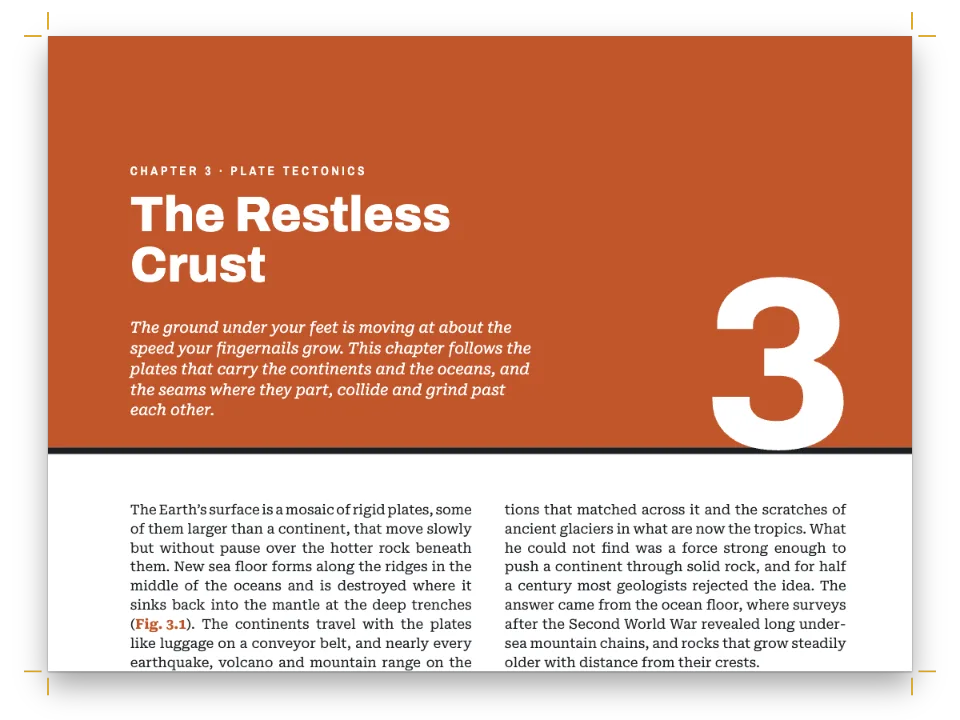
Une ouverture de chapitre sur un bandeau à fond perdu fait déborder un bandeau de couleur en haut de la page et y pose le titre et un numéro de chapitre de 168 pt.
Erreurs fréquentes
Erreur fréquente
Les encadrés latéraux ne flottent jamais : ils attendent la place
Un encadré span: 'side' ne flotte pas : il se place à côté du bloc qu’il suit et, quand le canal de marge est plein, attend la page suivante. Placez chaque glose juste après le paragraphe qu’elle explique. Quand le chapitre se termine avec des encadrés encore en attente, chacun prend la colonne latérale d’une page après le texte, dans l’ordre des blocs, et la construction le signale (afterText) ; jusqu’à postext 1.24, une seule page de ce genre était ouverte et les encadrés restants étaient supprimés sans avertissement. Notes marginales →
Erreur fréquente
Un flottant 'top' va à la page qui suit sa citation, sauf s’il peut ouvrir la page qui le cite
Par défaut, un flottant ne passe jamais au-dessus de son propre renvoi : un flottant 'top' sur toute la largeur cité en page N ouvre donc la page N+1. Réglez placement.citingPage: true sur la ressource ou sur le defaultPlacement de son type (ou layout.floatsAtCitingPage pour tout le livre, depuis postext 1.25) et il ouvre plutôt la page N, le texte au-dessus du renvoi descendant sous lui, quand il tient dans layout.maxTopFraction et que la ligne qui le cite reste sur cette page. Il n’ouvre jamais la première page d’un chapitre ni une page qui suit un saut forcé : là, il ouvre toujours la page suivante, et 'auto' ou 'bottom' peut prendre le pied de la page qui le cite. Placement des figures →
Erreur fréquente
Une ouverture réserve la hauteur jusqu’à son élément ancré à la page le plus bas
Une ouverture en maquette avancée réserve la hauteur de son élément le plus bas, et les éléments ancrés à la page ou au fond perdu sous le titre comptent aussi : un décor au pied de la page repousse donc le texte à la page suivante. Donnez à un tel élément reserve: false (depuis postext 1.5) : il est peint là où il est ancré et ne réserve rien. Les éléments qui suivent le bandeau lui-même (ancrés à son pied, ou de hauteur 'fill') ne fixent jamais sa hauteur. Ouvertures composées →
Erreur fréquente
Pas de <marker> ni de filtres dans les dessins SVG (repli en matriciel)
Une figure SVG ne reste vectorielle dans le PDF que sans <marker>, filtres ni masques ; sinon elle se replie sur une image matricielle, et des filtres profondément imbriqués peuvent la rendre blanche dans Chrome. Dessinez les pointes de flèche comme des tracés. Figures et tableaux comme ressources →
- Les figures et les gloses s’empilent dans le couloir dans l’ordre où le texte les atteint, jamais côte à côte. La glose sur l’angle critique est placée après le paragraphe sur la loi de Snell et avant le paragraphe qui cite la figure 4.3 : en page 88, elle s’empile donc entre les figures 4.2 et 4.3, à côté du paragraphe qui introduit le terme. Placée après cette citation, elle tomberait sous la figure 4.3.
- Sur la première page d’un chapitre, les figures latérales s’empilent sous le surtitre et le chiffre. Une figure citée dans le premier paragraphe prendrait cette place et ferait descendre le bloc des objectifs dans le couloir : ce chapitre cite donc sa première figure marginale après le bloc.
Crédits
- Recette
- Ignacio Ferro
- Texte
- Texte original, CC BY 4.0
- Polices
- Merriweather (SIL OFL 1.1) · Merriweather Sans (SIL OFL 1.1)
Modifier ce texte ↗ (s’ouvre dans un nouvel onglet)Dossier de la recette sur GitHub ↗ (s’ouvre dans un nouvel onglet)