En bref
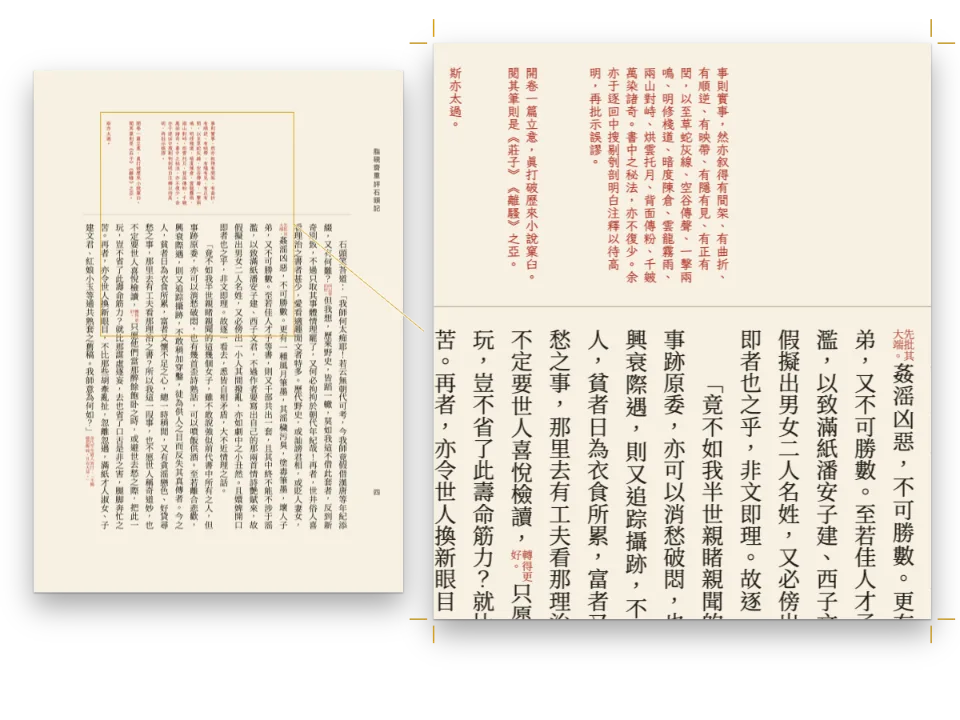
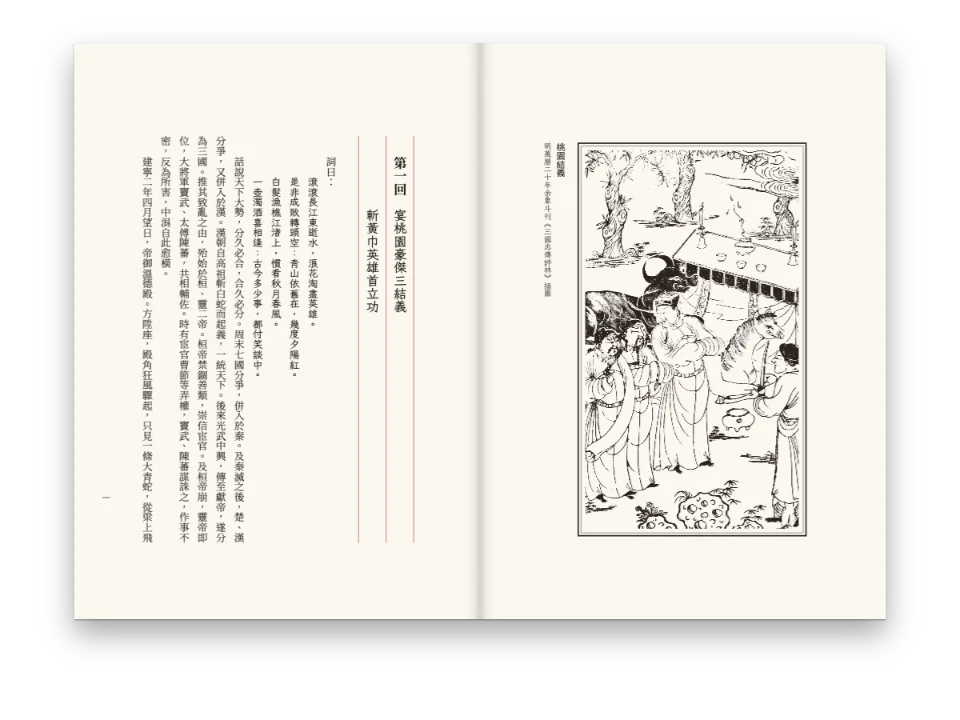
Un classique chinois composé à la manière des anciennes impressions sur bois. Chaque page a une double bordure et de fins traits entre les colonnes, et des notes en petits caractères courent dans les lignes.
Ce que vous allez composer
Trois feuillets du commentaire des Entretiens par Zhu Xi (論語集註), l’ouverture du livre 學而, composés comme les imprimait une planche gravée, après une page de titre. Chaque page est un demi-feuillet de 121 × 213 mm, et chaque double page un feuillet entier, lu à partir de la droite : sur chaque moitié, neuf colonnes de 17 caractères en Noto Serif TC de 20 pt, un double cadre, un filet fin entre chaque paire de colonnes, et sur le pli la bande centrale (版心) avec le titre, une queue de poisson noire, le juan et le numéro du feuillet. Les notes de Zhu Xi se replient sur deux lignes de caractères de 10 pt à l’intérieur de la colonne, après les mots qu’elles expliquent. La marge de tête fait le double de la marge de pied.
Cette recette répond à
- Comment mettre en page un feuillet xylographique, avec un double cadre, un filet entre les colonnes et la bande centrale ?
- Comment définir le bloc de texte en caractères, tant de caractères par ligne et tant de lignes par page ?
- Comment composer un livre chinois à la verticale, relié à droite ?
La réponse courte
// A block printed both halves of a leaf (葉) at once, the centre strip between them. Each
// page here is a half-leaf. Page 1, the title, is a recto: in a book bound on the right it
// stands alone left of the spine, and every spread after it is one leaf, read from the
// right. The grid sets the block's 9 columns of 17 characters; the text has no
// punctuation, so every column ends on its 17th character.
const page = {
  sizePreset: 'custom', width: pt(W), height: pt(H), dpi: 150,
  backgroundColor: col('paper'),
  // left is the inner margin, the half of the centre strip on this side of the fold
  margins: { top: pt(TOP), bottom: pt(BOTTOM), left: pt(HALF), right: pt(OUTER), mirror: true },
};
const layout = { layoutType: 'single', writingMode: 'vertical-rl' }; // bound on the right
const cjk = { grid: { enabled: true, charsPerLine: CHARS, linesPerPage: LINES } };
// Postext numbers pages, not leaves. Each leaf opens with a hidden level-1 heading, which
// prints nothing and starts a right-hand page; the centre strip prints their count.
const leaf = {
  level: 1, hidden: true, numberingTemplate: '{1:一}', // 一, 二, 三
  breakBefore: { enabled: true, parity: 'even' }, // even pages lie on the right in this binding
};
Ingrédients
- Fonctionnalités
- Texte, filets et boîtes dans les maquettes de pageGrille de caractèresTexte verticalWarichu : notes sur deux lignes dans la ligneLivres reliés à droiteStyles de titreTitres courants par sectionChapitres non numérotésAncrer les éléments de maquetteImages dans les maquettes de pageTitres numérotésAttributs de titreNumération chinoisePolices chinoises, japonaises et coréennesStyles de paragrapheMarges en miroirFormat de la pageCouleur du papierPalette de couleurs sémantiqueExport PDF
- Utilise aussi
- Coupure des lignes en chinoisPolices intégrées au PDFFigures et tableaux comme ressources
- Typographie
- Noto Serif TC, LXGW WenKai TC (SIL OFL 1.1)
- Ressources
- Aucune : chaque image est dessinée en code
Préparation
#1 · Un demi-feuillet par page, un feuillet par double page
Le code est dans la réponse courte plus haut. Une planche imprimait un feuillet entier (葉) d’un coup, ses deux moitiés de part et d’autre de la bande centrale ; l’imprimeur pliait la feuille le long de la bande, face imprimée à l’extérieur, et cousait les bords ouverts, si bien que la bande devenait la tranche du livre. Ces pages se présentent comme le feuillet sortait de la planche. Chaque page est un demi-feuillet. Dans un livre relié à droite, la page 1 est seule à gauche du dos et chaque double page suivante associe une page paire à droite et la page impaire qui la suit : avec le titre en page 1, chaque double page contient donc un feuillet. La grille de caractères fixe le 行款 de la planche, neuf colonnes de 17 caractères, et les marges qu’elle laisse sont exactes : la marge intérieure vaut la moitié de la bande.
Postext numérote des pages, pas des feuillets. Chaque feuillet s’ouvre par un titre de niveau 1 masqué : il n’imprime rien et ne prend pas de place, mais son breakBefore avec parity: 'even' fait commencer une page de droite, et son numéro, 一, 二, 三 par numberingTemplate: '{1:一}', est le {chapterNumber} de la bande.
#2 · Couper le texte là où chaque feuillet se termine
Le copiste qui recopiait un texte pour le graveur l’ajustait à la planche, feuillet par feuillet. Le Markdown fait de même : le titre d’un feuillet se place là où se termine la neuvième colonne de la moitié gauche du feuillet précédent, même au milieu d’une phrase ou d’une note. Une note coupée à cet endroit est fermée puis rouverte, et comme chaque colonne replie sa propre part de note sur deux lignes, les lignes sortent comme elles étaient :
子曰巧言令色鮮矣仁:warichu[巧好令善也好其言善其色致飾於]

# 學而

:warichu[外務以悦人則人欲肆而本心之德亡矣…]
La planche n’a pas de ponctuation : aucune règle de coupure des lignes ne déplace un caractère, et chaque colonne se termine sur son 17e caractère. Les coupures de feuillet se comptent une fois pour toutes et ne bougent plus. Les notes de Zhu Xi sont des spans :warichu[…] au demi-corps par défaut, 34 petits caractères par ligne, avec un ○ entre la lecture et la glose comme sur la planche.
#3 · Dessiner la planche à partir des nombres de la grille
// Header elements are placed on the sheet, pt from the page's top left corner. Both halves
// read right to left: a right-hand page (even) from the outer frame to the fold, a
// left-hand page (odd) from the fold to the outer frame.
const at = (x, y) => ({ anchor: { to: 'page', edge: 'top-left' }, offset: { x: pt(x), y: pt(y) } });
// A column of characters stands in the middle of its pitch, so the rules between columns
// fall on whole pitches. The k-th, counted from the right edge of the type area:
const line = (parity, k) =>
  (parity === 'even' ? HALF + LINES * PITCH : W - HALF) - k * PITCH;
const [Y0, Y1] = [TOP - GAP, TOP + CHARS * BODY + GAP]; // the inner frame's top and foot
// A rule is drawn from its x, a box's border inside the box: each is set so that the line
// is centred where it belongs.
const rule = (id, x, parity) => ({ kind: 'rule', id, parity, direction: 'vertical',
  thickness: pt(0.6), color: col('rule'),
  placement: { ...at(x - 0.3, Y0), size: { height: pt(Y1 - Y0) } } });
const frame = (id, [x0, x1], parity) => [[RULES, 1.8], [0, 0.6]].map(([out, t], i) => ({
  kind: 'box', id: `${id}-${i}`, parity, style: { borderColor: col('rule'), borderWidth: pt(t) },
  placement: { ...at(x0 - out - t / 2, Y0 - out - t / 2),
    size: { width: pt(x1 - x0 + 2 * out + t), height: pt(Y1 - Y0 + 2 * out + t) } } }));
// The middle of the strip, where its text stands: the fold, halfway between its two rules.
// Both pages draw the text whole, and each shows its half.
const mid = (parity) => (parity === 'even' ? 0 : W);
const strip = (id, content, parity, y) => ({ kind: 'text', id: `${id}-${parity}`, parity,
  content, writingMode: 'vertical-rl', fontFamily: SONG, fontSize: pt(11), color: col('ink'),
  align: 'left', overflow: 'clip',
  placement: { ...at(mid(parity) - HALF, TOP + y),
    size: { width: pt(2 * HALF), height: pt(CHARS * BODY - y) } } });
// The fish tail (魚尾): a black band with a notch, from one side of the strip to the other.
const FISH = `<svg xmlns="http://www.w3.org/2000/svg" viewBox="0 0 32 18">
  <path d="M0 0H32V13L16 6L0 13Z" fill="${palette.rule}"/></svg>`;
const resources = [{ id: 'fish', typeId: 'figure', kind: 'svg', createdAt: 0, updatedAt: 0,
  svg: { fileId: 'fish.svg', width: 32, height: 18 } }];
const fish = (parity) => ({ kind: 'image', id: `fish-${parity}`, parity, resourceId: 'fish',
  decorative: true, placement: { ...at(mid(parity) - HALF + 0.3, TOP + 3.4 * BODY),
    size: { width: pt(2 * HALF - 0.6), height: 'auto' } } });
const furniture = (parity) => [
  // The frame runs 40 pt past the fold, where the other half of the leaf takes it on.
  ...frame(`frame-${parity}`, parity === 'even' ? [-40, line(parity, 0)]
    : [line(parity, LINES), W + 40], parity),
  // Nine rules: eight between the columns (界行) and the side of the strip.
  ...Array.from({ length: LINES }, (_, i) =>
    rule(`rule-${i}-${parity}`, line(parity, parity === 'even' ? i + 1 : i), parity)),
  strip('book', '{title}', parity, 0.7 * BODY), // 書名, above the fish tail
  fish(parity),
  strip('juan', '卷一', parity, 5.2 * BODY), // 卷次, under it
  strip('leaf', '{chapterNumber}', parity, 11.5 * BODY), // 葉碼, the leaf's number
];
L’en-tête se dessine sur la feuille : le cadre, les filets et la bande se placent donc en points à partir du coin de la page, avec les nombres qui fixent la grille. Un élément filet tous les 29 pt en travers du bloc de texte, une boîte à 4,5 pt autour du texte pour le trait fin et une autre 4,5 pt plus loin pour le trait épais. Chaque colonne de caractères se tient au milieu de son pas, si bien que les filets tombent à mi-chemin entre les colonnes. Le texte de la bande descend la page grâce à des éléments en texte vertical, et la queue de poisson est un élément image SVG, tous deux centrés entre les deux filets de la bande, sur le pli : chaque page montre 17 pt de la bande. Chaque page dessine en entier le texte de la bande et la queue de poisson et montre la partie qui est de son côté ; côte à côte, les parties se rejoignent. Les cadres dépassent le pli pour la même raison.
#4 · Donner à la page de titre son propre style
// A heading style of its own: hidden and unnumbered, so the leaves still count from 一, and
// its header replaces the leaves' furniture on its page. Its attributes hold the byline,
// this edition's note in red and the colophon, the one line that changes with the language.
const CELLS = [0, 2, LINES - 2, LINES]; // the byline, title and note, in pitches from the right
const cell = (i) => [CELLS[i], CELLS[i + 1]];
const column = (id, content, [k0, k1], style) => ({ kind: 'text', id, content,
  writingMode: 'vertical-rl', color: col('ink'), overflow: 'clip', verticalAlign: 'middle',
  placement: { ...at(line('odd', k1), TOP),
    size: { width: pt((k1 - k0) * PITCH), height: pt(CHARS * BODY) } }, ...style });
const titlePage = {
  id: 'title', numbered: false, hidden: true, breakBefore: { enabled: true, parity: 'any' },
  footer: { elements: [] },
  header: { elements: [
    ...frame('title-frame', [line('odd', LINES), line('odd', 0)]),
    rule('title-rule-1', line('odd', CELLS[1])), rule('title-rule-2', line('odd', CELLS[2])),
    column('byline', '{attr.byline}', cell(0), { fontFamily: SONG, fontSize: pt(14),
      align: 'left' }),
    column('book', '{title}', cell(1), { fontFamily: KAI, fontSize: pt(60),
      letterSpacing: pt(20), align: 'center' }),
    column('note', '{attr.note}', cell(2), { fontFamily: KAI, fontSize: pt(11),
      lineHeight: pt(0.6 * PITCH), color: col('vermilion'), align: 'right' }), // 3 in 2 pitches
    { kind: 'text', id: 'colophon', content: '{attr.colophon}', fontFamily: SONG,
      fontSize: pt(6.5), lineHeight: 1.4, color: col('muted'), align: 'left', overflow: 'wrap',
      placement: { ...at(line('odd', LINES) - RULES - 0.9, Y1 + RULES + 16),
        size: { width: pt(LINES * PITCH) } } },
  ] },
};
La page de titre (內封) est un titre de niveau 1 avec un style de titre masqué et non numéroté, si bien que les feuillets comptent toujours à partir de 一. Un style régit les pages de sa section, et son header y remplace celui du document : la page de titre reçoit un cadre fermé découpé en trois colonnes au lieu de l’habillage d’un demi-feuillet. La mention d’auteur, la note de cette édition en Kai rouge et le colophon viennent des attributs du titre ; le colophon est la seule ligne qui change avec la langue de l’édition. \n dans un attribut commence une nouvelle colonne.
#5 · Charger chaque police avec les caractères qu’elle compose
// Song sets the leaves, the strip and its leaf numbers; Kai only the title page's title
// and note (gotcha: cjk-fonts-slices). No punctuation: no vertical forms to load.
const note = markdown.match(/note="([^"]*)"/)?.[1].replaceAll('\\n', '') ?? '';
await loadFonts(FONTS, markdown); // their Latin files: the colophon
await loadCjkFonts({ [SONG]: FONTS[SONG] }, `${markdown}論語集註卷一二三四五六七八九十`);
await loadCjkFonts({ [KAI]: FONTS[KAI] }, `論語集註${note}`);
Fontsource sert chaque police chinoise sous la forme d’une centaine de fichiers par graisse. Le Song compose les feuillets, la bande et les numéros de feuillet : son appel reçoit donc l’exemple et ces caractères ; le Kai ne compose que le titre et la note. La planche n’a pas de ponctuation : aucune des deux polices n’a besoin des formes verticales de loadCjkFonts(…, { vertical: true }).
#6 · Une seule encre sur un papier chaud
const palette = {
  ink: '#1f1b17', // the text, as the block printed it
  rule: '#1f1b17', // the frame, the column rules and the fish tail: the same block, same ink
  vermilion: '#a3301f', // 朱: this edition's note, on the title page; 5.9 : 1 on the paper
  muted: '#6d6358', // the colophon
  paper: '#f2ead8',
};
const col = (id) => ({ hex: palette[id], model: 'hex', paletteId: id });
const colorPalette = [
  ...Object.entries(palette).map(([id, hex]) => ({ id, name: id, value: { hex, model: 'hex' } })),
  { id: 'main-color', name: 'defaults', value: { hex: palette.ink, model: 'hex' } },
];
Le texte et les traits de la planche s’impriment dans un même noir chaud, 14 : 1 sur le papier. Ce sont pourtant deux entrées de palette, ink et rule, si bien que les filets peuvent changer de couleur sans le texte. Le rouge est réservé à ce qu’ajoute cette édition.
La recette complète
// ═══ Postext Cookbook · Nº 085 · A woodblock leaf: double frame, rules and centre strip ═══ // https://postext.dev/en/cookbook/woodblock-leaf // Code: MIT · Text: 論語集註 卷一, 四庫全書 copy, zh.wikisource (CC BY-SA 4.0) · Pictures: none // Fonts: Noto Serif TC, LXGW WenKai TC (SIL OFL 1.1) · Needs postext ≥ 1.25.0 // A title page and three leaves of Zhu Xi's commentary on the Analects, set as a woodblock // printed them: each spread is one leaf, its two halves either side of the centre strip // (版心), the text in a double frame with a rule between every two columns, the commentary // folded into two small rows inside the column. import { buildDocument, withLoadedFonts, renderPageToCanvas, registerResourceImage, } from 'https://esm.sh/postext'; import { renderToPdf, decompressWoff2 } from 'https://esm.sh/postext-pdf'; const LANG = 'en'; // @lang: the language of the colophon; the leaves are Chinese in both const RECIPE = 'woodblock-leaf'; // ─── 1 · Design ───────────────────────────────────────────────────────────── // #region palette: one ink on a warm paper, and a red for the editor's note const palette = { ink: '#1f1b17', // the text, as the block printed it rule: '#1f1b17', // the frame, the column rules and the fish tail: the same block, same ink vermilion: '#a3301f', // 朱: this edition's note, on the title page; 5.9 : 1 on the paper muted: '#6d6358', // the colophon paper: '#f2ead8', }; const col = (id) => ({ hex: palette[id], model: 'hex', paletteId: id }); const colorPalette = [ ...Object.entries(palette).map(([id, hex]) => ({ id, name: id, value: { hex, model: 'hex' } })), { id: 'main-color', name: 'defaults', value: { hex: palette.ink, model: 'hex' } }, ]; // #endregion const [SONG, KAI] = ['Noto Serif TC', 'LXGW WenKai TC']; // 宋: the block's face; 楷: the title // The leaf in points: 半葉九行,行十七字, a 20 pt character on a column pitch of 29 pt. const [BODY, PITCH, CHARS, LINES] = [20, 29, 17, 9]; const HALF = 17; // half the centre strip, from the fold to the column rule beside it const GAP = 4.5; // the text to the inner frame line, as a character to a column rule const RULES = 4.5; // the thin inner frame line to the heavy outer one (文武線) const [HEAD, FOOT, SIDE] = [164, 82, 60]; // paper outside the frame: 天頭 twice 地腳 const TOP = HEAD + RULES + GAP; // the page's margins const BOTTOM = FOOT + RULES + GAP; const OUTER = SIDE + RULES; const W = HALF + LINES * PITCH + OUTER; // a half-leaf, 121 × 213 mm const H = TOP + CHARS * BODY + BOTTOM; // #region answer: a half-leaf to a page, so that every spread is one whole leaf // A block printed both halves of a leaf (葉) at once, the centre strip between them. Each // page here is a half-leaf. Page 1, the title, is a recto: in a book bound on the right it // stands alone left of the spine, and every spread after it is one leaf, read from the // right. The grid sets the block's 9 columns of 17 characters; the text has no // punctuation, so every column ends on its 17th character. const page = { sizePreset: 'custom', width: pt(W), height: pt(H), dpi: 150, backgroundColor: col('paper'), // left is the inner margin, the half of the centre strip on this side of the fold margins: { top: pt(TOP), bottom: pt(BOTTOM), left: pt(HALF), right: pt(OUTER), mirror: true }, }; const layout = { layoutType: 'single', writingMode: 'vertical-rl' }; // bound on the right const cjk = { grid: { enabled: true, charsPerLine: CHARS, linesPerPage: LINES } }; // Postext numbers pages, not leaves. Each leaf opens with a hidden level-1 heading, which // prints nothing and starts a right-hand page; the centre strip prints their count. const leaf = { level: 1, hidden: true, numberingTemplate: '{1:一}', // 一, 二, 三 breakBefore: { enabled: true, parity: 'even' }, // even pages lie on the right in this binding }; // #endregion // #region frame: the double frame, a rule between every two columns, the centre strip // Header elements are placed on the sheet, pt from the page's top left corner. Both halves // read right to left: a right-hand page (even) from the outer frame to the fold, a // left-hand page (odd) from the fold to the outer frame. const at = (x, y) => ({ anchor: { to: 'page', edge: 'top-left' }, offset: { x: pt(x), y: pt(y) } }); // A column of characters stands in the middle of its pitch, so the rules between columns // fall on whole pitches. The k-th, counted from the right edge of the type area: const line = (parity, k) => (parity === 'even' ? HALF + LINES * PITCH : W - HALF) - k * PITCH; const [Y0, Y1] = [TOP - GAP, TOP + CHARS * BODY + GAP]; // the inner frame's top and foot // A rule is drawn from its x, a box's border inside the box: each is set so that the line // is centred where it belongs. const rule = (id, x, parity) => ({ kind: 'rule', id, parity, direction: 'vertical', thickness: pt(0.6), color: col('rule'), placement: { ...at(x - 0.3, Y0), size: { height: pt(Y1 - Y0) } } }); const frame = (id, [x0, x1], parity) => [[RULES, 1.8], [0, 0.6]].map(([out, t], i) => ({ kind: 'box', id: `${id}-${i}`, parity, style: { borderColor: col('rule'), borderWidth: pt(t) }, placement: { ...at(x0 - out - t / 2, Y0 - out - t / 2), size: { width: pt(x1 - x0 + 2 * out + t), height: pt(Y1 - Y0 + 2 * out + t) } } })); // The middle of the strip, where its text stands: the fold, halfway between its two rules. // Both pages draw the text whole, and each shows its half. const mid = (parity) => (parity === 'even' ? 0 : W); const strip = (id, content, parity, y) => ({ kind: 'text', id: `${id}-${parity}`, parity, content, writingMode: 'vertical-rl', fontFamily: SONG, fontSize: pt(11), color: col('ink'), align: 'left', overflow: 'clip', placement: { ...at(mid(parity) - HALF, TOP + y), size: { width: pt(2 * HALF), height: pt(CHARS * BODY - y) } } }); // The fish tail (魚尾): a black band with a notch, from one side of the strip to the other. const FISH = `<svg xmlns="http://www.w3.org/2000/svg" viewBox="0 0 32 18"> <path d="M0 0H32V13L16 6L0 13Z" fill="${palette.rule}"/></svg>`; const resources = [{ id: 'fish', typeId: 'figure', kind: 'svg', createdAt: 0, updatedAt: 0, svg: { fileId: 'fish.svg', width: 32, height: 18 } }]; const fish = (parity) => ({ kind: 'image', id: `fish-${parity}`, parity, resourceId: 'fish', decorative: true, placement: { ...at(mid(parity) - HALF + 0.3, TOP + 3.4 * BODY), size: { width: pt(2 * HALF - 0.6), height: 'auto' } } }); const furniture = (parity) => [ // The frame runs 40 pt past the fold, where the other half of the leaf takes it on. ...frame(`frame-${parity}`, parity === 'even' ? [-40, line(parity, 0)] : [line(parity, LINES), W + 40], parity), // Nine rules: eight between the columns (界行) and the side of the strip. ...Array.from({ length: LINES }, (_, i) => rule(`rule-${i}-${parity}`, line(parity, parity === 'even' ? i + 1 : i), parity)), strip('book', '{title}', parity, 0.7 * BODY), // 書名, above the fish tail fish(parity), strip('juan', '卷一', parity, 5.2 * BODY), // 卷次, under it strip('leaf', '{chapterNumber}', parity, 11.5 * BODY), // 葉碼, the leaf's number ]; // #endregion // #region title: the title page (內封), a half-leaf in a closed frame, three columns // A heading style of its own: hidden and unnumbered, so the leaves still count from 一, and // its header replaces the leaves' furniture on its page. Its attributes hold the byline, // this edition's note in red and the colophon, the one line that changes with the language. const CELLS = [0, 2, LINES - 2, LINES]; // the byline, title and note, in pitches from the right const cell = (i) => [CELLS[i], CELLS[i + 1]]; const column = (id, content, [k0, k1], style) => ({ kind: 'text', id, content, writingMode: 'vertical-rl', color: col('ink'), overflow: 'clip', verticalAlign: 'middle', placement: { ...at(line('odd', k1), TOP), size: { width: pt((k1 - k0) * PITCH), height: pt(CHARS * BODY) } }, ...style }); const titlePage = { id: 'title', numbered: false, hidden: true, breakBefore: { enabled: true, parity: 'any' }, footer: { elements: [] }, header: { elements: [ ...frame('title-frame', [line('odd', LINES), line('odd', 0)]), rule('title-rule-1', line('odd', CELLS[1])), rule('title-rule-2', line('odd', CELLS[2])), column('byline', '{attr.byline}', cell(0), { fontFamily: SONG, fontSize: pt(14), align: 'left' }), column('book', '{title}', cell(1), { fontFamily: KAI, fontSize: pt(60), letterSpacing: pt(20), align: 'center' }), column('note', '{attr.note}', cell(2), { fontFamily: KAI, fontSize: pt(11), lineHeight: pt(0.6 * PITCH), color: col('vermilion'), align: 'right' }), // 3 in 2 pitches { kind: 'text', id: 'colophon', content: '{attr.colophon}', fontFamily: SONG, fontSize: pt(6.5), lineHeight: 1.4, color: col('muted'), align: 'left', overflow: 'wrap', placement: { ...at(line('odd', LINES) - RULES - 0.9, Y1 + RULES + 16), size: { width: pt(LINES * PITCH) } } }, ] }, }; // #endregion const config = () => ({ locale: 'zh-Hant', // written out, never LANG (gotcha: cjk-locale-tag) colorPalette, page, layout, cjk, header: { elements: [...furniture('even'), ...furniture('odd')] }, footer: { elements: [] }, bodyText: { fontFamily: SONG, fontSize: pt(BODY), lineHeight: pt(PITCH), color: col('ink'), boldColor: col('ink'), italicColor: col('ink'), referenceColor: col('ink'), textAlign: 'justify', firstLineIndent: pt(0), indentAfterHeading: false, // 頂格 }, headings: { fontFamily: SONG, fontWeight: 400, color: col('ink'), levels: [leaf] }, headingStyles: [titlePage], // The byline's seven characters (宋 朱子 集註) end at the foot of the column. paragraphStyles: [{ id: 'byline', indent: em(CHARS - 7), firstLineIndent: pt(0), textAlign: 'left' }], }); // ─── 2 · Content ──────────────────────────────────────────────────────────── const markdown = String.raw`---Exemple Markdown · 25 lignes · content.en.md
title: "論語集註" author: "朱熹" --- # 論語集註 {style="title" byline="宋 朱子 集註" note="據四庫全書本錄文\n仿刻本版式重排\n半葉九行行十七字" colophon="Set in Noto Serif TC and LXGW WenKai TC (SIL OFL) · Text: 論語集註, 四庫全書 copy, Wikisource transcription (CC BY-SA 4.0)"} # 學而 論語卷一 :::paragraphs{style="byline"} 宋 朱子 集註 ::: 學而第一:warichu[此為書之首篇故所記多務本之意乃入道之門積德之基學者之先務也凡十六章] 子曰學而時習之不亦說乎:warichu[說悦同○學之為言效也人性皆善而覺有先後後覺者必效先覺之所為乃可以明善而復其初也習鳥數飛也學之不已如鳥數飛也說喜意也既學而又時時習之則所學者熟而中心喜說其進自不能已矣程子曰習重習也時復思繹浹洽於中則說也又曰學者將以行之也時習之則所學者在我故說謝氏曰時習者無時而不習坐如尸坐時習也立如齊立時習也]有朋自遠方來不亦樂乎:warichu[樂音洛○朋同類也自遠方來則近者可知程子曰以善及人而信從者衆故可樂又曰說在心樂主發散在外]人不知而不慍不亦君子乎:warichu[慍紆問反○慍含怒意君子成德之名尹氏曰學在己知不知在人何慍之有程子曰雖樂於及人不見是而無悶乃所謂君子愚謂及人而樂者順而易不知而不慍者逆而難故惟成德者能之然德之所以成亦曰學之正習之熟說之深而不已焉耳○程子曰樂由說而後得非樂不足以語君子]○有子曰其為人也孝弟而好犯上者鮮矣不好犯上而好作亂者未之有也:warichu[弟好皆去聲鮮上聲下同○有子孔子弟子名若善事父母為孝善事兄長為弟犯上謂干犯在上之人鮮少也作亂則為悖逆争鬭之事矣此言人能孝弟則其心和順少好犯上必不好作亂也]君子務本本立而道生孝弟也者其為仁之本與:warichu[與平聲○務專力也本猶根也仁者愛之理心之德也為仁猶曰行仁與者疑辭謙退不敢質言也言君子凡事專用力於根本根本既立則其道自生若上文所謂孝弟乃是為仁之本學者務此則仁道自此而生也○程子曰孝弟順德也故不好犯上豈復有逆理亂常之事德有本本立則其道充大孝弟行於家而後仁愛及於物所謂親親而仁民也故為仁以孝弟為本論性則以仁為孝弟之本或問孝弟為仁之本此是由孝弟可以至仁否曰非也謂行仁自孝弟始孝弟是仁之一事謂之行仁之本則可謂是仁之本則不可蓋仁是性也孝弟是用也性中只有箇仁義禮智四者而已曷嘗有孝弟來然仁主於愛愛莫大於愛親故曰孝弟也者其為仁之本與]○子曰巧言令色鮮矣仁:warichu[巧好令善也好其言善其色致飾於] # 學而 :warichu[外務以悦人則人欲肆而本心之德亡矣聖人詞不迫切專言鮮則絕無可知學者所當深戒也○程子曰知巧言令色之非仁則知仁矣]○曾子曰吾日三省吾身為人謀而不忠乎與朋友交而不信乎傳不習乎:warichu[省悉井反為去聲傳平聲○曾子孔子弟子名參字子輿盡己之謂忠以實之謂信傳謂受之於師習謂熟之於己曾子以此三者日省其身有則改之無則加勉其自治誠切如此可謂得為學之本矣而三者之序則又以忠信為傳習之本也○尹氏曰曾子守約故動必求諸身謝氏曰諸子之學皆出於聖人其後愈遠而愈失其真獨曾子之學專用心於內故傳之無弊觀於子思孟子可見矣惜乎其嘉言善行不盡傳於世也其幸存而未泯者學者其可不盡心乎]○子曰道千乘之國敬事而信節用而愛人使民以時:warichu[道乘皆去聲○道治也千乘諸侯之國其地可出兵車千乘者也敬者主一無適之謂敬事而信者敬其事而信於民也時謂農隙之時言治國之要在此五者亦務本之意也○程子曰此言至淺然當時諸侯果能此亦足以治其國矣聖人言雖至近上下皆通此三言者若推其極堯舜之治亦不過此若常人之言近則淺近而已矣楊氏曰上不敬則下慢不信則下疑下慢而疑事不立矣敬事而信以身先之也易曰節以制度不傷財不害民蓋侈用則傷財傷財必至於害民故愛民必先於節用然使之不以其時則力本者不獲自盡雖有愛人之心而人不被其澤矣然此特論其所存而已未及為政也茍無是心則雖有政不行焉胡氏曰凡此數者又皆以敬為主愚謂五者反復相因各有次第讀者宜細推之]○子曰弟子入則孝出則弟謹而信汎愛衆而親仁行有餘力則以學文:warichu[弟子之弟上聲則弟之弟去聲○謹者行之有常也信者言之有實也汎廣也衆謂衆人親近也仁謂仁者餘力猶言暇日以用也文謂詩書六藝之文○程子曰為弟子之職力有餘則學文不脩其職而先文非為己之學也尹氏曰德行本也文藝末也窮其本末知所先後可以入德矣洪氏曰未有餘力而學文則文滅其質有餘力而不學文則質勝而野愚謂力行而不學文則無以考聖賢之成法識事理之當然而所行或出於私意非但失之於野而已]○子夏曰賢賢易色事父母能竭其力事君能致其身與朋友交言而有信雖曰未學吾必謂之學矣:warichu[子夏孔子弟子姓卜名商賢人之賢而易其好色之心好善有誠也致猶委也委致其身謂不有其身也四者皆人倫之大者而行之必盡其誠學求如是而已故子夏言有能如] # 學而 :warichu[是之人茍非生質之美必其務學之至雖或以為未嘗為學我必謂之已學也○游氏曰三代之學皆所以明人倫也能是四者則於人倫厚矣學之為道何以加此子夏以文學名而其言如此則古人之所謂學者可知矣故學而一篇大抵皆在於務本吳氏曰子夏之言其意善矣然詞氣之閒抑揚太過其流之弊將或至於廢學必若上章夫子之言然後為無弊也]○子曰君子不重則不威學則不固:warichu[重厚重威威嚴固堅固也輕乎外者必不能堅乎內故不厚重則無威嚴而所學亦不堅固也]主忠信:warichu[人不忠信則事皆無實為惡則易為善則難故學者必以是為主焉程子曰人道惟在忠信不誠則無物且出入無時莫知其鄉者人心也若無忠信豈復有物乎]無友不如己者:warichu[無毋通禁止辭也友所以輔仁不如己則無益而有損]過則勿憚改:warichu[勿亦禁止之辭憚畏難也自治不勇則惡日長故有過則當速改不可畏難而苟安也程子曰學問之道無他也知其不善則速改以從善而已○程子曰君子自脩之道當如是也游氏曰君子之道以威重為質而學以成之學之道必以忠信為主而以勝己者輔之然或吝於改過則終無以入德而賢者亦未必樂告以善道故以過勿憚改終焉]○曾子曰慎終追遠民德歸厚矣:warichu[慎終者喪盡其禮追遠者祭盡其誠民德歸厚謂下民化之其德亦歸於厚蓋終者人之所易忽也而能謹之遠者人之所易忘也而能追之厚之道也故以此自為則己之德厚下民化之則其德亦歸於厚也]○子禽問於子貢曰夫子至於是邦也必聞其政求之與抑與之與:warichu[之與之與平聲下同○子禽姓陳名亢子貢姓端木名賜皆孔子弟子或曰亢子貢弟子未知孰是抑反語辭]子貢曰夫子溫良恭儉讓以得之夫子之求之也其諸異乎人之求之與:warichu[溫和厚也良易直也恭莊敬也儉節制也讓謙遜也五者夫子之盛德光輝接於人者也其諸語辭也人他人也言夫子未嘗求之但其德容如是故時君敬信自以其政就而問之耳非若他人必求之而後得也聖人過化存神之妙未易窺測然即此而觀則其德盛禮恭而不願乎外亦可見矣學者所當潛心而勉學也○謝氏曰學者觀於聖人威儀之閒亦可以進德矣若子貢亦可謂善觀聖人矣亦可謂善言德行矣今去聖人千五百年以此五者想見其形容尚能使人興起而况於親炙之者乎張敬夫曰夫子至是邦必聞其政而未有能委國而授之以政者蓋見聖人之儀刑而樂告之者秉彞好德之良心也而私欲害之是以終不能用耳]`; // content.<lang>.md: the same leaves, another colophon // ─── 3 · Fonts ────────────────────────────────────────────────────────────── const FONTS = { 'Noto Serif TC': ['400'], // 宋: the text, the notes, the centre strip, the colophon 'LXGW WenKai TC': ['400'], // 楷: the title page's title and this edition's note }; // ─── 4 · Build & show ─────────────────────────────────────────────────────── // #region voices: each face loads the files of the characters it sets // Song sets the leaves, the strip and its leaf numbers; Kai only the title page's title // and note (gotcha: cjk-fonts-slices). No punctuation: no vertical forms to load. const note = markdown.match(/note="([^"]*)"/)?.[1].replaceAll('\\n', '') ?? ''; await loadFonts(FONTS, markdown); // their Latin files: the colophon await loadCjkFonts({ [SONG]: FONTS[SONG] }, `${markdown}論語集註卷一二三四五六七八九十`); await loadCjkFonts({ [KAI]: FONTS[KAI] }, `論語集註${note}`); // #endregion await loadSvg('fish.svg', FISH); const doc = await withLoadedFonts( () => buildDocument({ markdown, resources }, config()), { ...kitFonts(FONTS), text: markdown }); showBook(doc, { title: t({ en: 'A woodblock leaf: double frame, rules and centre strip', es: 'Una hoja xilográfica: marco doble, filetes y franja central' }) }); offerPdf(() => renderToPdf(doc, { fontProvider: cjkPdfProvider, resourceBytes: imageBytes }), `${RECIPE}.pdf`);Kit · core, fonts, viewer, pdf, images, cjk : identique dans toutes les recettes · 504 lignes
// ─── Kit ── helpers shared by every Cookbook recipe · postext.dev/cookbook ───── // ─── Kit · core v1 ── the same in every recipe · postext.dev/cookbook function mm(value) { return { value, unit: 'mm' }; } function pt(value) { return { value, unit: 'pt' }; } function em(value) { return { value, unit: 'em' }; } /** The sample language's string: t({ en: 'Figure', es: 'Figura' }). */ function t(strings) { return strings[LANG] ?? Object.values(strings)[0]; } /** A file in this recipe's assets folder, served from the Postext repo by jsDelivr. */ function asset(file) { return `https://cdn.jsdelivr.net/gh/drnachio/postext@main/cookbook/${RECIPE}/assets/${file}`; } // ─── Kit · fonts v3 ── the same in every recipe · postext.dev/cookbook // Postext loads the faces a config asks for before layout (prepareFonts, // buildDocumentWithFonts) and asks the kit for the files: Fontsource's, the // files the PDF embeds too. /** The options of buildDocumentWithFonts / prepareFonts / withLoadedFonts: * the Fontsource resolver, and the faces of FONTS loaded with the ones the * config names. FONTS = { 'Family Name': ['400', '400i', '700'] }. */ function kitFonts(FONTS = {}) { const faces = Object.entries(FONTS).flatMap(([family, specs]) => specs.map((spec) => ({ family, weight: parseInt(spec, 10), style: spec.endsWith('i') ? 'italic' : 'normal' }))); return { resolve: fontsourceResolver, faces }; } /** A face's Fontsource files, in a fixed order: latin, then latin-ext and greek * when `text` needs them and the family ships them (kitSubsetsFor), each with * its unicode-range. Null for a weight or slant Fontsource does not ship. */ async function fontsourceResolver(family, weight, style, { text = '' } = {}) { const id = fontsourceId(family); const meta = await fontsourceMeta(family); if (meta && !(meta.weights.includes(weight) && meta.styles.includes(style))) return null; kitStatus('Loading fonts…'); const at = await fontsourceAt(id); return ['latin', ...kitSubsetsFor(text, meta)].map((subset) => ({ source: `${at}files/${id}-${subset}-${weight}-${style}.woff2`, unicodeRange: kitRanges()[subset], })); } /** The unicode-range of each Fontsource file the kit loads (a function: the * kit is inlined after the pen's code, which runs before a const would be set). */ function kitRanges() { return { latin: 'U+0000-00FF,U+0131,U+0152-0153,U+02BB-02BC,U+02C6,U+02DA,U+02DC,U+0304,U+0308,U+0329,' + 'U+2000-206F,U+20AC,U+2122,U+2191,U+2193,U+2212,U+2215,U+FEFF,U+FFFD', 'latin-ext': 'U+0100-02BA,U+02BD-02C5,U+02C7-02CC,U+02CE-02D7,U+02DD-02FF,U+0304,U+0308,U+0329,' + 'U+1D00-1DBF,U+1E00-1E9F,U+1EF2-1EFF,U+2020,U+20A0-20AB,U+20AD-20C0,U+2113,U+2C60-2C7F,U+A720-A7FF', greek: 'U+0370-03FF', }; } /** For the cjk, arabic and comics blocks, which add their own files: the * faces of `faces` = { 'Family Name': ['400', '400i', '700'] }. `text` is the sample: * č ł † α χ also load latin-ext and greek files (kitSubsetsFor). With * `optional`, a face Fontsource does not ship is skipped instead of failing. * The files are added once all have loaded, in the order asked (latin, then * latin-ext, then greek), whatever order they arrive in: the last one added * wins a character two files hold. Resolves to the number of faces added. */ async function loadFonts(faces, text = '', { optional = false } = {}) { kitStatus('Loading fonts…'); const ranges = kitRanges(); const jobs = []; for (const [family, specs] of Object.entries(faces)) { const id = fontsourceId(family); const todo = [...new Set(specs)].map((spec) => [parseInt(spec, 10), spec.endsWith('i') ? 'italic' : 'normal']) .filter(([weight, style]) => !hasFace(family, weight, style)); // before any await const at = fontsourceAt(id); const meta = optional || /[^\0-ÿ]/u.test(text) ? await fontsourceMeta(family) : null; const subsets = ['latin', ...kitSubsetsFor(text, meta)]; for (const [weight, style] of todo) { if (optional && !(meta?.weights.includes(weight) && meta.styles.includes(style))) continue; for (const subset of subsets) { const url = `${await at}files/${id}-${subset}-${weight}-${style}.woff2`; const face = new FontFace(family, `url(${url}) format('woff2')`, { weight: String(weight), style, unicodeRange: ranges[subset] }); jobs.push(face.load().catch(() => { if (subset === 'latin' && !optional) throw new Error(`Fontsource has no ${family} ${weight} ${style}`); })); } } } const ready = await Promise.all(jobs).catch((error) => { kitFail(error); throw error; }); return ready.filter((face) => face && document.fonts.add(face)).length; } /** A loaded FontFace covers this family, weight and style (fonts.check() would * also say yes for families nobody declared). */ function hasFace(family, weight, style) { for (const face of document.fonts) { if (face.status !== 'loaded' || face.style !== style) continue; if (face.family.replace(/^["']|["']$/g, '') !== family) continue; const [low, high = low] = face.weight.split(' ').map(Number); if (weight >= low && weight <= high) return true; } return false; } /** The files beyond latin `text` needs that `meta`'s family ships. */ function kitSubsetsFor(text, meta) { return [[/[Ā-˿ᴀ-ᶿḀ-ỿ†ℓⱠ-Ɀ꜠-ꟿ]/u, 'latin-ext'], [/[Ͱ-Ͽ]/u, 'greek']] .filter(([re, x]) => re.test(text) && meta?.subsets?.includes(x)).map(([, x]) => x); } /** Fontsource's id for a family: 'Source Serif 4' → 'source-serif-4'. */ function fontsourceId(family) { return family.toLowerCase().replace(/\s+/g, '-'); } /** A package's folder at the one version @5 names now (#766). */ function fontsourceAt(id, u = `https://cdn.jsdelivr.net/npm/@fontsource/${id}@`) { return (fontsourceAt.c ??= {})[id] ??= fetch(u + '5/package.json').then((r) => r.json()) .then((p) => p.version || 5, () => 5).then((v) => `${u}${v}/`); } /** The family's Fontsource metadata (weights, styles, subsets), or null. */ function fontsourceMeta(family) { fontsourceMeta.cache ??= new Map(); const id = fontsourceId(family); if (!fontsourceMeta.cache.has(id)) { fontsourceMeta.cache.set(id, fetch(`https://api.fontsource.org/v1/fonts/${id}`) .then((res) => (res.ok ? res.json() : null), () => null)); } return fontsourceMeta.cache.get(id); } // ─── Kit · viewer v2 ── the same in every recipe · postext.dev/cookbook /** The pages as spreads on a dark desk, page 1 alone, then verso | recto, * each painted when it scrolls near. Other options go to renderPageToCanvas. */ function showPages(docs, { title, width = 460, ...render } = {}) { const root = viewer(title); const pages = [docs].flat().flatMap((doc) => doc.pages.map((page) => ({ doc, page, n: (doc.pageIndexOffset ?? 0) + page.index }))); const spreads = []; let verso = null; for (const p of pages) { if (p.n % 2 === 1) { if (verso) spreads.push([verso, null]); verso = p; } else { spreads.push([verso, p]); verso = null; } } if (verso) spreads.push([verso, null]); const density = Math.min(window.devicePixelRatio || 1, 2); showPages.painter?.disconnect(); const painter = new IntersectionObserver((entries) => { for (const { isIntersecting, target } of entries) { if (!isIntersecting) continue; painter.unobserve(target); const { doc, page } = target.postext; renderPageToCanvas(page, doc, target, { ...render, scale: (width * density) / page.width }); } }, { rootMargin: '800px' }); showPages.painter = painter; root.replaceChildren(...spreads.map((pair) => { const spread = document.createElement('div'); spread.className = 'pt-spread'; for (const p of pair) { const figure = document.createElement('figure'); if (p) { const label = p.page.pageLabel || String(p.n + 1); const canvas = document.createElement('canvas'); canvas.postext = p; canvas.style.aspectRatio = `${p.page.width} / ${p.page.height}`; canvas.setAttribute('role', 'img'); canvas.setAttribute('aria-label', `Page ${label}`); const folio = document.createElement('figcaption'); folio.textContent = label; figure.append(canvas, folio); painter.observe(canvas); } else figure.className = 'pt-blank'; spread.append(figure); } return spread; })); kitStatus(`${pages.length} ${pages.length === 1 ? 'page' : 'pages'}`); document.documentElement.dataset.postext = 'ready'; return pages.length; } /** The desk, the bar and the error reporting, created once. */ function viewer(title) { if (!document.getElementById('pt-kit')) { document.head.insertAdjacentHTML('beforeend', `<style id="pt-kit"> :root { color-scheme: dark; } body { margin: 0; background: #0e1014; color: #b9bcc4; font: 13px/1.45 system-ui, sans-serif; } #pt-bar { position: sticky; top: 0; z-index: 1; display: flex; flex-wrap: wrap; align-items: center; gap: 6px 16px; padding: 10px 16px; background: rgb(14 16 20 / .92); backdrop-filter: blur(6px); border-bottom: 1px solid #23262d; } #pt-bar strong { color: #f4f1ea; font-weight: 600; } #pt-actions { display: flex; gap: 12px; margin-left: auto; } #pt-actions a, #pt-actions button { color: #d8a21a; font: inherit; background: none; border: 0; padding: 0; cursor: pointer; } #pages { display: grid; justify-items: center; gap: 48px; padding: 32px 16px 72px; } .pt-spread { display: flex; } .pt-spread figure { margin: 0; width: min(460px, 44vw); } .pt-spread canvas { display: block; width: 100%; background: #fff; box-shadow: 0 1px 2px rgb(0 0 0 / .5), 0 22px 44px -16px rgb(0 0 0 / .8); } .pt-spread figure:first-child canvas { box-shadow: inset -14px 0 14px -14px rgb(0 0 0 / .18), 0 1px 2px rgb(0 0 0 / .5), 0 22px 44px -16px rgb(0 0 0 / .8); } .pt-spread figcaption { margin-top: 10px; text-align: center; font: 600 10px/1 system-ui, sans-serif; letter-spacing: .18em; text-transform: uppercase; color: #6c7079; } .pt-blank { visibility: hidden; } @media (max-width: 760px) { .pt-spread { flex-direction: column; gap: 32px; } .pt-spread figure { width: min(460px, 92vw); } .pt-blank { display: none; } } </style>`); document.body.insertAdjacentHTML('afterbegin', '<header id="pt-bar"><strong id="pt-title"></strong><span id="pt-status" role="status"></span><span id="pt-actions"></span></header>'); document.getElementById('pt-title').textContent = document.title || 'Postext'; addEventListener('error', (event) => kitFail(event.error ?? event.message)); addEventListener('unhandledrejection', (event) => kitFail(event.reason)); } if (title) document.getElementById('pt-title').textContent = title; return document.getElementById('pages') ?? document.body.appendChild(Object.assign(document.createElement('main'), { id: 'pages' })); } function kitStatus(text) { viewer(); document.getElementById('pt-status').textContent = text; } function kitFail(error) { document.documentElement.dataset.postext = 'error'; kitStatus(`Error: ${error?.message ?? error}`); } // ─── Kit · pdf v3 ── the same in every recipe that exports a PDF /** The Fontsource files the screen used, as TrueType, with their range and * place: the nearest weight the family ships, upright with no italic; * latin, then what its letters need (kitSubsetsFor). */ async function fontsourceProvider(family, weight, style, request) { const id = fontsourceId(family); const meta = await fontsourceMeta(family); const weights = meta?.weights?.length ? meta.weights : [400, 700]; const w = weights.reduce((a, b) => (Math.abs(b - weight) < Math.abs(a - weight) ? b : a)); const s = style === 'italic' && meta && !meta.styles.includes('italic') ? 'normal' : style; const text = String.fromCodePoint(...(request?.codePoints ?? [])); const files = await Promise.all(['latin', ...kitSubsetsFor(text, meta)].map(async (subset, order) => { const res = await fetch(`${await fontsourceAt(id)}files/${id}-${subset}-${w}-${s}.woff2`); if (!res.ok) throw new Error(`Fontsource has no ${family} ${w} ${s} ${subset}`); return Object.assign(await decompressWoff2(new Uint8Array(await res.arrayBuffer())), { unicodeRange: kitRanges()[subset], order }); })); return files.length === 1 ? files[0] : files; } /** A "Build the PDF" button; then "Open the PDF" (a new tab: CodePen's frame * shows no PDFs) and a download link. */ function offerPdf(makePdf, filename) { viewer(); const button = Object.assign(document.createElement('button'), { type: 'button', textContent: 'Build the PDF' }); button.dataset.postextPdf = filename; button.addEventListener('click', async () => { button.disabled = true; button.textContent = 'Building the PDF…'; try { const bytes = await makePdf(); const url = URL.createObjectURL(new Blob([bytes], { type: 'application/pdf' })); const size = `${Math.max(1, Math.round(bytes.length / 1024))} KB`; button.replaceWith( Object.assign(document.createElement('a'), { href: url, target: '_blank', rel: 'noopener', textContent: 'Open the PDF ↗' }), Object.assign(document.createElement('a'), { href: url, download: filename, textContent: `Download ${filename} · ${size}` })); } catch (error) { button.disabled = false; button.textContent = 'Build the PDF'; kitFail(error); } }); document.getElementById('pt-actions').append(button); } // ─── Kit · images v3 ── recipes with pictures · postext.dev/cookbook /** Registers a photo or PNG for the canvas and keeps its bytes for the PDF. * fetch → ImageBitmap never taints the canvas (a plain cross-origin <img> would). */ async function loadImage(fileId, url) { const res = await fetch(url); if (!res.ok) throw new Error(`Image not found (${res.status}): ${url}`); const bytes = new Uint8Array(await res.arrayBuffer()); registerResourceImage(fileId, await createImageBitmap(new Blob([bytes]))); (loadImage.bytes ??= new Map()).set(fileId, bytes); } /** Registers SVG markup as a vector image, its fonts inside (inlineSvgFonts, ≥ 1.25). * `options` go to registerResourceImage: { singleInk: true } tints it on the canvas. */ async function loadSvg(fileId, svg, options) { if (typeof inlineSvgFonts === 'function') svg = await inlineSvgFonts(svg, svgFaces); const img = new Image(); img.src = `data:image/svg+xml;charset=utf-8,${encodeURIComponent(svg)}`; await img.decode(); registerResourceImage(fileId, img, options); (loadImage.bytes ??= new Map()).set(fileId, new TextEncoder().encode(svg)); } /** A face's Fontsource files: nearest weight; latin + what the SVG sets. */ async function svgFaces(family, weight, style, { codePoints = [] } = {}) { const [id, m] = [fontsourceId(family), await fontsourceMeta(family)]; const w = m?.weights.reduce((a, b) => (Math.abs(b - weight) < Math.abs(a - weight) ? b : a)) ?? weight; const s = m?.styles.includes(style) === false ? 'normal' : style; return Promise.all(['latin', ...kitSubsetsFor(String.fromCodePoint(...codePoints), m)].map(async (x) => new Uint8Array( await (await fetch(`${await fontsourceAt(id)}files/${id}-${x}-${w}-${s}.woff2`)).arrayBuffer()))); } /** renderToPdf({ resourceBytes: imageBytes }) */ function imageBytes(fileId) { return loadImage.bytes?.get(fileId); } /** renderToHtml({ resourceImageUrl: imageUrl }) */ function imageUrl(fileId) { const bytes = imageBytes(fileId); if (!bytes) return undefined; imageUrl.urls ??= new Map(); if (!imageUrl.urls.has(fileId)) { const type = /\.svg$/i.test(fileId) ? 'image/svg+xml' : /\.png$/i.test(fileId) ? 'image/png' : 'image/jpeg'; imageUrl.urls.set(fileId, URL.createObjectURL(new Blob([bytes], { type }))); } return imageUrl.urls.get(fileId); } // ─── Kit · cjk v2 ── Chinese, Japanese and Korean books · postext.dev/cookbook // Fontsource ships a CJK family as about a hundred files per weight, each // declared in its stylesheet with the unicode-range it covers. The screen // loads the files the sample touches; the PDF gets the same files for the // characters its pages set in each face, and embeds each as a subset. // A book bound on the right (vertical text) is shown with its spreads // mirrored: page 1 alone on the left of the spine, then [3 | 2]. /** The files of a Fontsource face, read from its stylesheet: { url, range, * ranges }, the last declared first (the order the browser tries them in). */ function cjkSlices(family, weight, style) { cjkSlices.cache ??= new Map(); const id = fontsourceId(family); const css = `${id}/${weight}${style === 'italic' ? '-italic' : ''}.css`; if (!cjkSlices.cache.has(css)) { let at; cjkSlices.cache.set(css, fontsourceAt(id).then((a) => fetch(at = a + css.slice(id.length + 1))) .then((res) => { if (!res.ok) throw new Error(`Fontsource has no ${family} ${weight} ${style} (${res.status})`); return res.text(); }) .then((text) => [...text.matchAll(/@font-face\s*{([^}]*)}/g)].map(([, rule]) => { const range = /unicode-range:\s*([^;]+);/.exec(rule)?.[1].trim() ?? 'U+0-10FFFF'; const ranges = range.split(',').map((part) => { const [lo, hi = lo] = part.trim().slice(2).split('-'); return [parseInt(lo, 16), parseInt(hi, 16)]; }); return { url: new URL(/url\(([^)]+?\.woff2)\)/.exec(rule)[1], at).href, range, ranges }; }).reverse())); } return cjkSlices.cache.get(css); } /** The file of `slices` the screen sets code point `cp` in, if any: the * last one loadCjkFonts adds whose range holds it. A numbered file that * repeats a letter of latin is added after latin, and wins it. */ function cjkSliceFor(slices, cp) { const holds = (slice) => slice.ranges.some(([lo, hi]) => cp >= lo && cp <= hi); return slices.reduce((last, slice) => (holds(slice) ? slice : last), undefined); } /** Whether Fontsource serves `family` as a Chinese, Japanese or Korean * family (its subsets name the script). Fails when the API does not * answer: a CJK face taken for a Latin one would paint in a system face. */ async function isCjkFamily(family) { const meta = await fontsourceMeta(family); if (!meta) throw new Error(`api.fontsource.org did not describe ${family}: reload to try again`); return !!meta.subsets?.some((subset) => /^(chinese|japanese|korean)/.test(subset)); } /** faces = { 'Noto Serif TC': ['400', '700'] }, as for loadFonts: the * whole FONTS object may be passed, its other families are left to * loadFonts. Adds one FontFace per file of each CJK face with its * unicodeRange, then loads the files `text` touches. `text` is what the * faces set: the sample for the text face; a book in several voices calls * it once per voice (loadCjkFonts({ 'LXGW WenKai TC': ['400'] }, quotes)), * so the heading and quotation faces fetch and check only their own * characters. Fails when a character of `text` is in no file of a face. * List every weight the pages use: a weight left to the engine's later round * gets the latin file only. With { vertical: true } it also loads each * family's vertical forms (brackets, quotes, pause marks) for the canvas, * which needs loadVerticalAlternates imported from postext. Resolves to * the number of files loaded. */ async function loadCjkFonts(faces, text, { vertical = false } = {}) { kitStatus('Loading fonts…'); let loaded = 0; try { if (vertical && typeof loadVerticalAlternates !== 'function') { throw new Error('loadCjkFonts(…, { vertical: true }) needs loadVerticalAlternates imported from postext'); } for (const [family, specs] of Object.entries(faces)) { if (!(await isCjkFamily(family))) continue; const twin = []; for (const spec of new Set(specs)) { const weight = parseInt(spec, 10); const style = spec.endsWith('i') ? 'italic' : 'normal'; const slices = await cjkSlices(family, weight, style); const missing = [...new Set(text)].filter((ch) => /\S/.test(ch) && !cjkSliceFor(slices, ch.codePointAt(0))); if (missing.length) { throw new Error(`${family} ${spec} has no file for ${missing.slice(0, 12).join(' ')}: ` + `give each face the text it sets (loadCjkFonts({ '${family}': ['${spec}'] }, text))`); } for (const slice of slices) { document.fonts.add(new FontFace(family, `url(${slice.url}) format('woff2')`, { weight: String(weight), style, unicodeRange: slice.range })); twin.push({ source: slice.url, weight: String(weight), style, unicodeRange: slice.range }); } const font = `${style === 'italic' ? 'italic ' : ''}${weight} 16px "${family}"`; loaded += (await document.fonts.load(font, text)).length; if (!document.fonts.check(font, text)) throw new Error(`${family} ${spec} did not load for the sample`); } // The same files under a twin name with the `vert` feature on: the // canvas paints the punctuation of vertical lines with it. if (vertical && twin.length) await loadVerticalAlternates(family, twin); } } catch (error) { kitFail(error); throw error; } return loaded; } /** The PDF font provider for recipes with CJK faces: a family whose * Fontsource subsets are Chinese, Japanese or Korean gets the files the * screen set its pages' characters in (`request.codePoints`), each marked * with its unicode-range and its place in the order loadCjkFonts added * them: postext-pdf sets a character two files hold in the one added * last, as the browser does. Any other family gets the latin file * fontsourceProvider fetches (the "pdf" block) and, when the face sets * letters only latin-ext has, that file too. */ async function cjkPdfProvider(family, weight, style, request) { if (!(await isCjkFamily(family))) return cjkLatinPdfFiles(family, weight, style, request); const meta = await fontsourceMeta(family); const weights = meta.weights?.length ? meta.weights : [400, 700]; const w = weights.reduce((a, b) => (Math.abs(b - weight) < Math.abs(a - weight) ? b : a)); const s = style === 'italic' && !meta.styles.includes('italic') ? 'normal' : style; const slices = await cjkSlices(family, w, s); const picked = new Set(); for (const cp of request?.codePoints ?? []) { const slice = cjkSliceFor(slices, cp); if (slice) picked.add(slice); } if (!picked.size) picked.add(slices[0]); return Promise.all(slices.map(async (slice, order) => { if (!picked.has(slice)) return null; const res = await fetch(slice.url); if (!res.ok) throw new Error(`Fontsource file ${slice.url} (${res.status})`); const bytes = await decompressWoff2(new Uint8Array(await res.arrayBuffer())); return Object.assign(bytes, { unicodeRange: slice.range, order }); })).then((files) => files.filter(Boolean)); } /** A Latin family set next to the CJK faces: its latin file, then its * latin-ext file when the face sets letters only latin-ext has (ō ū in * Hepburn rōmaji, ǎ in pinyin), the file loadFonts adds on screen for * them, each marked with its unicode-range and its place in that order: * the PDF sets a character in the file the browser took it from. A face * Fontsource ships without latin-ext, or whose file does not come, gets * latin alone, and the PDF names the letters it lacks. */ async function cjkLatinPdfFiles(family, weight, style, request) { const meta = await fontsourceMeta(family); const beyond = [...(request?.codePoints ?? [])].some(cjkLatinExtOnly); if (!beyond || !meta?.subsets?.includes('latin-ext')) return fontsourceProvider(family, weight, style); const weights = meta.weights?.length ? meta.weights : [400, 700]; const w = weights.reduce((a, b) => (Math.abs(b - weight) < Math.abs(a - weight) ? b : a)); const s = style === 'italic' && !meta.styles.includes('italic') ? 'normal' : style; const id = fontsourceId(family); const url = `${await fontsourceAt(id)}files/${id}-latin-ext-${w}-${s}.woff2`; const [latin, ext] = await Promise.all([fontsourceProvider(family, weight, style), fetch(url) .then(async (res) => (res.ok ? decompressWoff2(new Uint8Array(await res.arrayBuffer())) : null), () => null)]); const ranges = kitRanges(); return ext ? [Object.assign(latin, { unicodeRange: ranges.latin, order: 0 }), Object.assign(ext, { unicodeRange: ranges['latin-ext'], order: 1 })] : latin; } /** Whether code point `cp` is in Fontsource's latin-ext file and not in * its latin file: Latin Extended-A and -B, IPA, the spacing modifiers and * Latin Extended Additional (loadFonts's test for latin-ext), less the * few latin holds too (ı Œ œ ʻ ʼ ˆ ˚ ˜). */ function cjkLatinExtOnly(cp) { if (!((cp >= 0x100 && cp <= 0x2ff) || (cp >= 0x1e00 && cp <= 0x1eff))) return false; return ![0x131, 0x152, 0x153, 0x2bb, 0x2bc, 0x2c6, 0x2da, 0x2dc].includes(cp); } /** showPages for a book bound on either edge. A right-bound book (the * document says so: doc.binding is 'right' for page.binding 'right' and * for vertical text) lies on the desk as it opens: page 1 alone on the * left of the spine, then [3 | 2], the spine shade on each page's inner * edge. `binding` ('left' | 'right') overrides the document's. */ function showBook(docs, { binding, ...options } = {}) { const count = showPages(docs, options); const right = (binding ?? [docs].flat()[0]?.binding) === 'right'; if (!document.getElementById('pt-kit-cjk')) { // The pages keep direction ltr: a canvas draws text in the direction its // element inherits, and under rtl each run would end where the engine // starts it, its brackets mirrored. document.head.insertAdjacentHTML('beforeend', `<style id="pt-kit-cjk"> .pt-spread[dir="rtl"] canvas { direction: ltr; } .pt-spread[dir="rtl"] figure:first-child canvas { box-shadow: inset 14px 0 14px -14px rgb(0 0 0 / .18), 0 1px 2px rgb(0 0 0 / .5), 0 22px 44px -16px rgb(0 0 0 / .8); } </style>`); } // Each pair stays [verso, recto] in the page; right to left, the verso // sits on the right. Phones stack the pages in reading order either way. for (const spread of document.querySelectorAll('#pages > .pt-spread')) spread.dir = right ? 'rtl' : 'ltr'; document.getElementById('pages').dataset.binding = right ? 'right' : 'left'; return count; } // ─── /Kit ───────────────────────────────────────────────────────────────────────
Le script.js composé s’exécute tel quel : collez-le dans le script de module de n’importe quelle page, ou ouvrez la recette sur CodePen. Dossier de la recette sur GitHub ↗ (s’ouvre dans un nouvel onglet)
Variantes
#Fileter les colonnes en rouge
Les copies faites pour le 四庫全書 étaient écrites sur un papier réglé de rouge (朱絲欄). Changez la couleur des filets ; la queue de poisson la suit.
-  rule: '#1f1b17', // the frame, the column rules and the fish tail: the same block, same ink
+ rule: '#b3412e', // 朱絲欄: red rules under black text#Graver une autre planche
Les planches avaient bien des formats, et 半葉十行,行二十字 est l’un des plus courants. Les cadres, la bande, les trois cases de la page de titre et le retrait de la mention d’auteur sont tous calculés à partir de ces nombres : ils suivent. Les coupures de feuillet du Markdown doivent être recomptées.
-const [BODY, PITCH, CHARS, LINES] = [20, 29, 17, 9];
+const [BODY, PITCH, CHARS, LINES] = [17, 24.5, 20, 10];#Comparer avec une page européenne sur grille
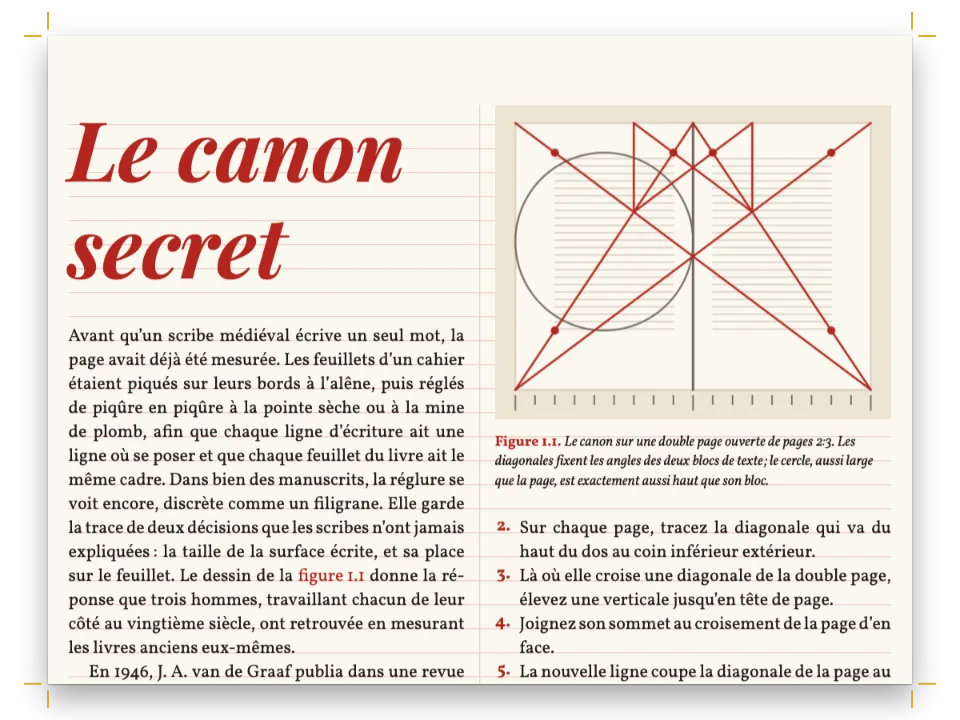
Une page de livre sur une grille de ligne de base construit son bloc de texte à partir d’un nombre de lignes, comme ce feuillet construit le sien à partir de colonnes et de caractères ; le certificat dessine sa bordure dans l’en-tête d’un style de titre, comme le fait ici la page de titre.
Erreurs fréquentes
Erreur fréquente
Balisez le document zh-Hans ou zh-Hant, pas avec LANG
Les éditions d’une recette sont en et es, mais un exemple chinois est en chinois dans les deux : `locale: LANG` le baliserait en anglais ou en espagnol, couperait ses mots latins, nommerait ses figures Figure ou Figura et donnerait au PDF la mauvaise langue. Depuis postext 1.30, la balise est aussi la langue dans laquelle le texte est mis en forme (mesuré, peint et incorporé) : sous une balise anglaise ou espagnole, une police chinoise compose ses chiffres et la ponctuation qu’elle partage avec le texte latin sous d’autres formes, et les lignes se coupent ailleurs. Écrivez la balise vous-même : 'zh-Hans' (conventions de Chine continentale : coupure des lignes GB, ponctuation Kaiming) ou 'zh-Hant' (Taïwan : ponctuation pleine chasse centrée) ; 'zh-HK' pour Hong Kong. Un 'zh' seul se lit comme du chinois simplifié de Chine continentale. Un exemple japonais prend 'ja' (piège ja-locale-tag). Coupure des lignes en chinois →
Erreur fréquente
Les polices chinoises se chargent par tranches, avec le bloc cjk
Fontsource sert une famille chinoise, japonaise ou coréenne sous la forme d’une centaine de fichiers par graisse, chacun couvrant une plage de caractères. loadFonts ne récupère que le fichier latin : à l’écran, les caractères han viennent d’une police système et sont mal mesurés, et fontsourceProvider remet ce fichier latin au PDF, qui les imprime en cases vides. Listez le bloc cjk du kit, appelez loadCjkFonts(FONTS, markdown) après loadFonts (une fois par voix, avec le texte qu’elle compose, quand le livre utilise plusieurs polices CJK) et donnez à renderToPdf fontProvider: cjkPdfProvider : les deux prennent les fichiers qui contiennent les caractères du texte. Polices chinoises, japonaises et coréennes →
Erreur fréquente
Un livre relié à droite montre ses doubles pages avec showBook
Dans un livre relié à droite (texte arabe, hébreu ou persan, chinois vertical, ou page.binding 'right'), la page 1 reste le recto, mais elle se trouve à gauche du dos, et les paires se lisent [3 | 2]. showPages présente tout livre relié à gauche ; showBook, du bloc book (le bloc cjk contient la même fonction), lit doc.binding et inverse les paires. capture.hero désigne toujours une double page dans l’ordre de lecture, [verso, recto] : [2, 3]. Livres reliés à droite →
Erreur fréquente
Les transcriptions traditionnelles contiennent des caractères simplifiés égarés
Les textes copiés depuis Wikisource ou une autre édition web d’un livre en chinois traditionnel contiennent parfois une forme simplifiée (颙 pour 顒 dans 三國演義, chapitre 1), et une police TC comme Noto Serif TC peut ne pas l’avoir. loadCjkFonts arrête le pen en indiquant le caractère dans son message ; sur une page, il s’imprimerait dans une police de substitution. Rétablissez la forme traditionnelle dans l’exemple et indiquez-le dans les crédits. Polices chinoises, japonaises et coréennes →
- Les coupures de feuillet vivent dans le Markdown. Changez le texte, le corps ou le 行款, et un feuillet qui déborde repousse le titre suivant d’une page : les doubles pages ne correspondent plus aux feuillets ; un feuillet trop court laisse des colonnes vides avant le pli. Vérifiez la dernière colonne de chaque page de gauche.
- La transcription du 四庫全書 saisit 巳 aussi bien pour 已 que pour 己 ; cet exemple lit chacun d’après sa phrase. La page demande encore à être relue sur les numérisations, et cela se voit : la remarque de 張敬夫 porte 必開其政 là où les Entretiens qu’il reprend ont 必聞其政, et deux caractères arrivent sous forme d’images du glyphe. L’exemple compose 聞, 傳 et 邦. Vérifiez un passage sur une seconde édition avant de le composer.
- La même transcription contient des formes pour lesquelles Noto Serif TC n’a pas de glyphe (廹 徳 絶 逺 専 内). Cinq d’entre elles tombent dans la plage d’un fichier Fontsource :
loadCjkFontsles laisse donc passer, puis le canvas les dessine dans une police système et postext-pdf imprime une case vide et émet un avertissement. 廹 ne tombe dans la plage d’aucun fichier, etloadCjkFontss’arrête sur une erreur. L’exemple compose 迫 德 絕 遠 專 內.
Crédits
- Recette
- Ignacio Ferro
- Texte
- 論語集註 (Collected Commentaries on the Analects), juan 1, the book 學而 from its opening to the end of its tenth section, in the copy made for the 四庫全書 (Siku quanshu, 1773–1782); Wikisource transcription, revision 523110. 巳 is read as 已 or 己 by its sentence; 開 in 張敬夫's 必開其政 is corrected to 聞, as in the words of the Analects he repeats and in Wikisource's other edition (論語集注卷一, revision 2598582); the two characters the transcription gives as glyph images are set as 傳 (以忠信為傳習之本) and 邦 (夫子至於是邦也); and six variant forms Noto Serif TC does not draw (廹 徳 絶 逺 専 内) are set in their standard forms · Zhu Xi (1130–1200); transcription by Wikisource editors · CC BY-SA 4.0
- The title page, the division into leaves and the note on this edition (據四庫全書本錄文…) · Ignacio Ferro · CC BY 4.0
- Polices
- Noto Serif TC (SIL OFL 1.1) · LXGW WenKai TC (SIL OFL 1.1)
Modifier ce texte ↗ (s’ouvre dans un nouvel onglet)Dossier de la recette sur GitHub ↗ (s’ouvre dans un nouvel onglet)