باختصار
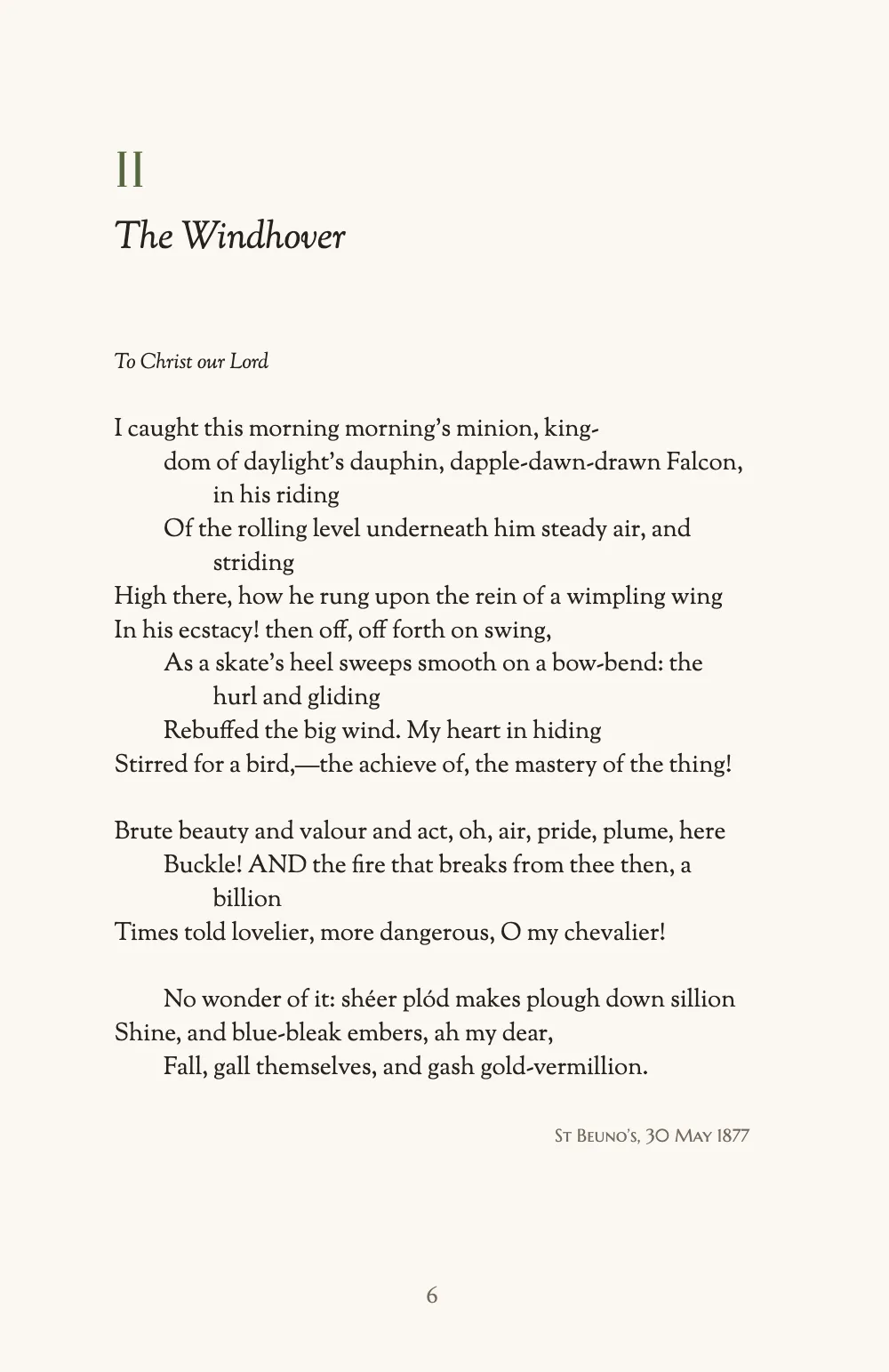
كتيّب صغير من أربع قصائد عن الطبيعة لجيرارد مانلي هوبكنز. يبيّن كيف يبقى كل بيت في سطره، بإزاحات الشاعر الأصلية وسطر فارغ بين المقاطع.
ما الذي ستنضده
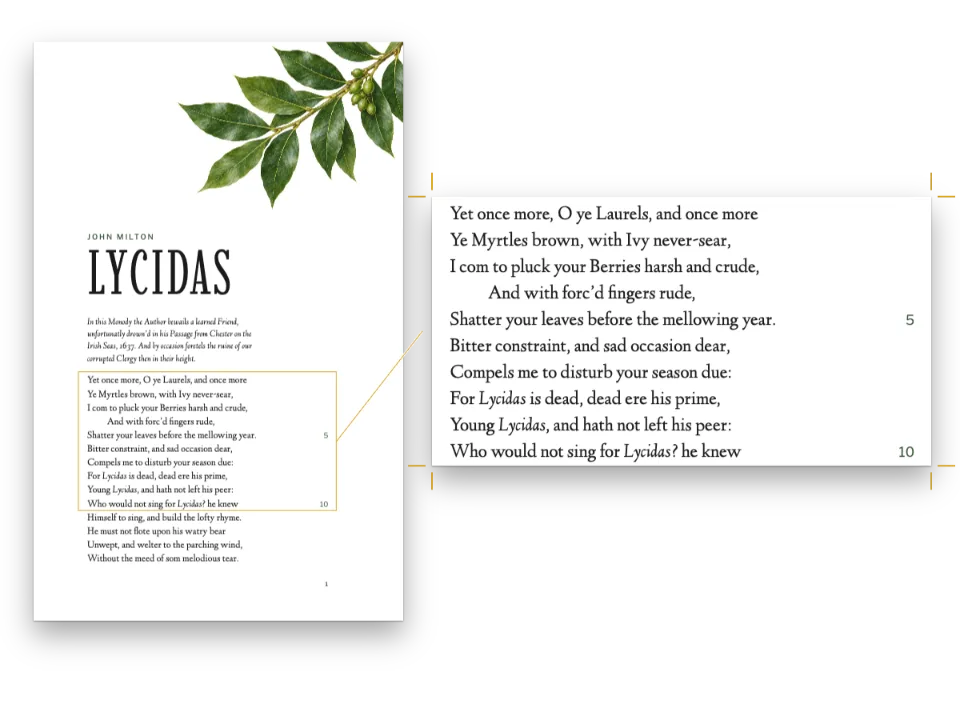
كتيّب من أربع قصائد عن الطبيعة لجيرارد مانلي هوبكنز، 140 × 216 مم، بنص الطبعة الأولى عام 1918. بعد صفحة نصف العنوان تقابل صورةٌ ضوئية لسرخس وغبيراء صفحةَ العنوان المنضدة بخط Italiana. تسرد المحتويات كل قصيدة برقمها وعنوانها المائل، بنقاط متباعدة إلى رقم الصفحة. وتفتتح كل قصيدة صفحة تحت رقم بلون المريمية وعنوانها المائل. كل بيت فقرة، مزاح كما في 1918: تتدرج أبيات Pied Beauty إلى الداخل بحسب القافية، وتنكسر الأبيات الطويلة في The Windhover وتتعلق أسطرها التالية بإزاحة 4 em، ضعف عمق إزاحاتها. بين المقاطع سطر واحد، ولا تُقسم كلمة إلا حيث قسمها هوبكنز. يأتي التاريخ تحت كل قصيدة، محاذى إلى اليمين، ويلي القصيدة الأخيرة غصن غبيراء. وتحمل صفحات القصائد رقم صفحة في الوسط أسفلها.
تجيب هذه الوصفة عن
- كيف أنضد الشعر: سطر لكل بيت، وفراغ بين المقاطع، ومسافة بادئة معلّقة للأسطر الملتفّة، وبلا تقسيم كلمات؟
- كيف أضيف فراغًا رأسيًّا إضافيًّا بين كتلتين، إذا لم تُجدِ الأسطر الفارغة شيئًا؟
- كيف أضيف جدول محتويات يحدّث نفسه (نقاط توجيه، أرقام صفحات، مؤلفون، صفوف الأجزاء)؟
- كيف أنضد نصًّا تصديريًّا أو إهداءً أو توقيعًا أو اقتباسًا بارزًا بعلامة اقتباس كبيرة؟
- كيف أنضد رسومًا غير مرقّمة: زخارف، وحليات، وشعارات؟
الجواب المختصر
// A poem is one :::paragraphs{style="verse"} container with a paragraph per line, so no line
// runs on into the next. An indented line starts with spaces, two to an em, and a :::space
// line leaves one line of the grid between stanzas (blank lines only separate paragraphs):
//   :::paragraphs{style="verse"}
//   The world is charged with the grandeur of God.
//
//       It will flame out, like shining from shook foil;
//
//   :::space
//
//   And for all this, nature is never spent;
//   :::
const verse = {
  id: 'verse',
  textAlign: 'left', // ragged: a line that turns over is not stretched to the measure
  hangingIndent: em(4), // a turned line hangs past the 1 and 2 em indents
  // Verse is never hyphenated; ragged text is not in 1.4.1 either (gotcha: ragged-no-hyphenation).
  hyphenation: false,
};
// A paragraph loses its leading spaces, and hangingIndent overrides firstLineIndent, so in verse
// each pair of leading spaces becomes an em space behind a word joiner, where the trim stops.
const indentVerse = (md) => md.replace(/:::paragraphs\{style="verse"\}\n[\s\S]*?\n:::\n/g,
  (poem) => poem.replace(/^((?: {2})+)(?=\S)/gm, (s) => `\u2060${'\u2003'.repeat(s.length / 2)}`));
// Hook-up: paragraphStyles: [verse, …] and buildDocument({ markdown: indentVerse(markdown) }).
المكونات
- الميزات
- أنماط الفقراتمسافة عمودية صريحةجدول المحتوياتالمسافات البادئة والمحاذاة والتباعد بين الفقراتالهروب والمحارف الحرفيةالعناوين المرقّمةصفحات افتتاح مصمَّمةأنماط العناوينفصول بلا أرقامسمات العنوانالصور في تصاميم الصفحةالأغلفة وصفحات العنوان وبيانات النشرالبيانات الوصفية للمستندترويسات لكل قسمالترويسات وأرقام الصفحاتأنواع موارد مخصّصةأشكال في هذا الموضع بالضبطلوحة ألوان دلاليةالترويسات بحسب دور الصفحة
- الخطوط
- Sorts Mill Goudy, Italiana, Marcellus SC (SIL OFL 1.1)
- الأصول
plate-1120.jpg- The frontispiece photogram of fern and rowan (Generated With Diffusion Models, أصلي)
- The rowan ornament, drawn in code in the page’s palette (Ignacio Ferro, CC BY 4.0)
طريقة التحضير
#1 · البيت فقرة
الشيفرة هي الجواب المختصر أعلاه. يصل Postext أسطر فقرة Markdown في سطر واحد، فتحتاج القصيدة إلى فقرة لكل بيت. يضبط نمط الشعر هذه الفقرات بحافة حرة، لأن ضبطها كان سيمدّ الجزء الأول من البيت المنكسر على عرض السطر كله. ويعلّق باقي البيت بإزاحة 4 em، أبعد من إزاحتي 1 و2 em للأبيات المقفاة، فلا يُقرأ السطر التالي بيتًا مستقلًا (أنماط الفقرات). تفقد الفقرة مسافاتها الأولى، ومسافات em منها، والنمط ذو الإزاحة المعلقة يتجاهل إزاحة السطر الأول. لذا يكتب indentVerse كل زوج من المسافات الأولى مسافةَ em خلف word joiner، وهو حرف بلا عرض يتوقف عنده الاقتطاع. وتحتفظ الأبيات المقفاة معًا بالإزاحة نفسها، كما في 1918. والأسطر الفارغة لا تضيف فراغًا. فكل فاصل بين مقطعين سطر :::space داخل الحاوية، يترك سطرًا واحدًا من الشبكة ويُسقط في أعلى الصفحة (:::space).
#2 · للأسطر المحيطة بالقصيدة أنماط أيضًا
const lineStyles = [
  { id: 'dedication', fontSize: pt(9.5), marginBottom: pt(LEAD) }, // under The Windhover
  { id: 'date', fontFamily: 'Marcellus SC', fontSize: pt(8), color: col('muted'),
    textAlign: 'right', marginTop: pt(LEAD) }, // a line of space above, flush right
];
الإهداء فوق The Windhover والمكان والتاريخ تحت كل قصيدة ليست أبياتًا، لذا فكل منها حاوية :::paragraphs من فقرة واحدة، بنمط خاص بها. لا يضبط أي من النمطين تباعد الأسطر، وهوامشهما سطر واحد (15 pt)، فيبقى الشعر على شبكة المتن. ويُنضَّد التاريخ أسفل القصيدة بسطر، محاذى إلى اليمين، بخط Marcellus SC بحجم 8 pt، وهو خط أرقام الصفحات.
#3 · كل قصيدة تفتتح صفحة تحت رقمها
// '{1:I}' numbers the poems I to IV and {number} prints it (gotcha: heading-number-placeholders).
// The head is HEAD_LINES grid lines (minHeight, no bottom margin), so each poem starts on the same
// line; numeral and title fill 4, or 5 if the title wraps (gotcha: overflow-ellipsis-default).
const HEAD_LINES = 6;
const poemHead = { enabled: true, minHeight: pt(LEAD * HEAD_LINES), slot: { elements: [
  { kind: 'text', id: 'numeral', content: '{number}', fontFamily: 'Italiana', fontSize: pt(22),
    color: col('sage'), align: 'left',
    placement: { anchor: { to: 'container', edge: 'top-left' } } },
  { kind: 'text', id: 'title', content: '{titleText}', fontFamily: 'Sorts Mill Goudy',
    italic: true, fontSize: pt(17), color: col('ink'), align: 'left', overflow: 'wrap',
    placement: { anchor: { to: '#numeral', edge: 'below' }, offset: { y: mm(2) },
      size: { width: 'fill' } } },
] } };
// Parity 'any': the next page, recto or verso (restated: gotcha headings-drop-h1-break).
const poems = { level: 1, numberingTemplate: '{1:I}', advancedDesign: poemHead,
  marginBottom: pt(0), breakBefore: { enabled: true, parity: 'any' } };
بدلًا من نصه يطبع العنوان تصميمًا في العمود. في ذلك التصميم {number} هو العدد بالتنسيق الذي يعطيه numberingTemplate: '{1:I}'، من I إلى IV، و{titleText} هو العنوان (الامتداد والتصميم المتقدم). لا هامش سفليًّا للمستوى، ويجعل minHeight عمق كل رأس ستة خطوط من الشبكة (31.75 مم). يملأ الرقم وعنوان من سطر واحد أربعة منها، ويملأ العنوان الملتف خمسة، فتبدأ كل قصيدة على السطر نفسه من صفحتها. وفي الصفحة 6 يحمل ذلك السطر الإهداء. والزوجية 'any' تنتقل إلى الصفحة التالية، فردية كانت أو زوجية، فلا صفحات فارغة بين القصائد.
#4 · الصفحات التمهيدية مصنوعة من عناوين
// Headings too, each on a page of its own, with no number, contents entry or folio.
// A style restates the break, or inherits the poems' (gotcha: style-inherits-break).
const leaf = { numbered: false, toc: false, span: 'page', footer: { elements: [] },
  breakBefore: { enabled: true, parity: 'any' } };
const onPage = (y, width) => ({ anchor: { to: 'page', edge: 'top' }, offset: { y: mm(y) },
  ...(width && { size: { width: mm(width) } }) }); // centred, y mm below the trim
const face = (id, content, font, size, y, extra = {}) => ({ kind: 'text', id, content,
  fontFamily: font, fontSize: pt(size), color: col('ink'), align: 'center',
  placement: onPage(y), ...extra });
const image = (id, placement) => ({ kind: 'image', id, resourceId: id, placement });
const design = (...elements) => ({ enabled: true, slot: { elements } });
const front = [
  { id: 'half-title', ...leaf,
    advancedDesign: design(face('title', '{titleText}', 'Italiana', 20, 60)) },
  { id: 'plate', ...leaf, advancedDesign: design( // span 'page': a column clips its design
    image('plate', { anchor: { to: 'bleed', edge: 'top-left' }, size: { width: 'fill' } }),
    face('caption', '{attr.caption}', 'Sorts Mill Goudy', 8.5, 203,
      { italic: true, color: col('muted') })) },
  { id: 'title-page', ...leaf, advancedDesign: design(
    face('author', '{author}', 'Marcellus SC', 10, 46, // {author}, {title}: the frontmatter
      { letterSpacing: pt(2.4), textTransform: 'uppercase' }),
    // A multiple of the size, never pt() (gotcha: design-lineheight-multiple).
    face('title', '{title}', 'Italiana', 54, 56, { lineHeight: 1 }),
    face('subtitle', '{subtitle}', 'Sorts Mill Goudy', 13, 80,
      { italic: true, color: col('sage') }),
    image('sprig', onPage(96, 30)),
    face('press', 'The Herbarium Press', 'Marcellus SC', 8.5, 182,
      { letterSpacing: pt(1.8), color: col('muted') })) },
  { id: 'contents', ...leaf, span: 'column', advancedDesign: { enabled: false },
    fontFamily: 'Italiana', fontSize: pt(24), lineHeight: pt(LEAD * 2), marginBottom: pt(LEAD) },
];
يستطيع نمط العنوان أن ينتقل إلى صفحة جديدة ويرسم تصميمًا فيها، لذا فصفحة نصف العنوان والصورة المقابلة وصفحة العنوان عنوانٌ واحد لكل منها، بنمط خاص به. يُبعدها numbered: false عن العدّ، فتبقى القصيدة الأولى I. ويُبعدها toc: false عن المحتويات، ويترك التذييل الفارغ صفحاتها بلا رقم (أنماط العناوين). وتمتد الأنماط عبر الصفحة لأن التصميم داخل العمود يُقص على كتلة النص، فكان سيقص اللوحة الممتدة حتى النزف إلى الهوامش ويقطع تعليقها. يأتي التعليق من سمة caption في العنوان؛ ويأتي المؤلف والعنوان والعنوان الفرعي في صفحة العنوان من البيانات التمهيدية.
#5 · المحتويات تملأ نفسها
// The toc centres each numeral on its line, not on the baseline (gotcha: toc-number-baseline);
// left at the titles' size, these Italiana numerals land on it, where 9 pt ones rode high.
const contents = {
  levels: [{ level: 1, italic: true, marginBottom: pt(LEAD), numberFontFamily: 'Italiana',
    numberFontWeight: 400, numberColor: col('sage'), numberWidth: mm(6), numberGap: mm(3) }],
  pageNumber: { fontFamily: 'Marcellus SC', fontSize: pt(9), color: col('muted'), width: mm(6) },
  leader: { char: '. ', gap: mm(2) }, // spaced dots, right-aligned so they line up
};
يسرد :::toc كل عنوان يسمح له نمطه بالدخول، بالرقم من القالب نفسه وتسمية الصفحة التي يقع فيها العنوان. ويعيد البناء إخراج الكتاب حتى تكفّ تسميات الصفحات عن التغيّر (جدول المحتويات). ولعنوان الصفحة نفسها، Contents، نمط فيه numbered: false؛ ولولاه لكانت Contents القصيدة I. ويضع حرف الإرشاد '. ' مسافة بعد كل نقطة. والنقاط محاذاة إلى اليمين، فتصطف من مدخل إلى الذي يليه، وتُطبع بخط أرقام الصفحات ولونها لأن toc.leader لا إعداد لون له.
#6 · الحلية نوع مورد بلا تسمية
// No caption prefix and no caption: the sprig prints bare, where ::resource{id="sprig"} puts
// it (double quotes: gotcha resource-double-quotes), a fifth of the measure wide, centred.
const ornament = { id: 'ornament', name: 'Ornament', shortLabel: '', captionPrefix: '',
  numberingTemplate: '{n}', resetOn: 'never', counterFormat: 'decimal',
  defaultPlacement: { position: 'here', width: 0.2, align: 'center' } };
الصورة في النص مورد، ولكل مورد نوع. نوع الحلية بادئة تعليقه فارغة والغصن بلا تعليق، فلا تُطبع تحته تسمية مثل «Figure 1» (أنواع الموارد). يضع defaultPlacement الخاص بالنوع الغصنَ حيث يقف ::resource{id="sprig"}، في الوسط وبعرض خُمس السطر، فلا تأخذ الحلية الختامية تحت Inversnaid إلا سطرًا واحدًا من Markdown. ويحل resourceTypes محل القائمة الافتراضية، فلا نوع Figure ولا Table في هذا الكتاب. وللاحتفاظ بهما، انشر defaultResourceTypes() قبل الحلية.
الوصفة كاملة
// ═══ Postext Cookbook · Nº 015 · Poems set line by line ═════════════════════════════ // https://postext.dev/en/cookbook/poetry-collection // Code: MIT · Text: G. M. Hopkins, Poems, 1918 (PD) · Plate: diffusion models · Sprig: code // Fonts: Sorts Mill Goudy, Italiana, Marcellus SC (SIL OFL 1.1) · Needs postext ≥ 1.4.1 import { buildDocument, renderPageToCanvas, clearMeasurementCache, registerResourceImage, } from 'https://esm.sh/postext'; const LANG = 'en'; // @lang: the language of the sample document ('en' | 'es') const RECIPE = 'poetry-collection'; // ─── 1 · Design ───────────────────────────────────────────────────────────── const palette = { // every colour in the config links to one of these ink: '#26221f', // the text: a warm near-black sage: '#56673f', // the one accent: numerals, the subtitle, the ornament's leaves sepia: '#8c5f3a', // used for the rowan berries only muted: '#746a60', // dates, folios, leaders and the colophon paper: '#fbf8f2', // the page }; // The hex travels with the id: designs do not read the palette (gotcha: palette-skips-designs). const col = (id) => ({ hex: palette[id], model: 'hex', paletteId: id }); const colorPalette = [ ...Object.entries(palette).map(([id, hex]) => ({ id, name: id, value: { hex, model: 'hex' } })), // The engine's defaults link to 'main-color': point it at the accent, so nothing prints blue. { id: 'main-color', name: 'accent (defaults)', value: { hex: palette.sage, model: 'hex' } }, ]; const TRIM_W = 140, TRIM_H = 216; // mm: a poetry trim, tall enough for a sonnet's turnovers const LEAD = 15; // pt: the body's leading, the grid every line of verse sits on // #region answer: verse: a paragraph per line, indents kept, turnovers that hang, stanza space // A poem is one :::paragraphs{style="verse"} container with a paragraph per line, so no line // runs on into the next. An indented line starts with spaces, two to an em, and a :::space // line leaves one line of the grid between stanzas (blank lines only separate paragraphs): // :::paragraphs{style="verse"} // The world is charged with the grandeur of God. // // It will flame out, like shining from shook foil; // // :::space // // And for all this, nature is never spent; // ::: const verse = { id: 'verse', textAlign: 'left', // ragged: a line that turns over is not stretched to the measure hangingIndent: em(4), // a turned line hangs past the 1 and 2 em indents // Verse is never hyphenated; ragged text is not in 1.4.1 either (gotcha: ragged-no-hyphenation). hyphenation: false, }; // A paragraph loses its leading spaces, and hangingIndent overrides firstLineIndent, so in verse // each pair of leading spaces becomes an em space behind a word joiner, where the trim stops. const indentVerse = (md) => md.replace(/:::paragraphs\{style="verse"\}\n[\s\S]*?\n:::\n/g, (poem) => poem.replace(/^((?: {2})+)(?=\S)/gm, (s) => `\u2060${'\u2003'.repeat(s.length / 2)}`)); // Hook-up: paragraphStyles: [verse, …] and buildDocument({ markdown: indentVerse(markdown) }). // #endregion // #region lines: the lines around a poem: a dedication above it, a place and a date below const lineStyles = [ { id: 'dedication', fontSize: pt(9.5), marginBottom: pt(LEAD) }, // under The Windhover { id: 'date', fontFamily: 'Marcellus SC', fontSize: pt(8), color: col('muted'), textAlign: 'right', marginTop: pt(LEAD) }, // a line of space above, flush right ]; // #endregion // #region poem-head: every poem opens a page under its numeral and its title // '{1:I}' numbers the poems I to IV and {number} prints it (gotcha: heading-number-placeholders). // The head is HEAD_LINES grid lines (minHeight, no bottom margin), so each poem starts on the same // line; numeral and title fill 4, or 5 if the title wraps (gotcha: overflow-ellipsis-default). const HEAD_LINES = 6; const poemHead = { enabled: true, minHeight: pt(LEAD * HEAD_LINES), slot: { elements: [ { kind: 'text', id: 'numeral', content: '{number}', fontFamily: 'Italiana', fontSize: pt(22), color: col('sage'), align: 'left', placement: { anchor: { to: 'container', edge: 'top-left' } } }, { kind: 'text', id: 'title', content: '{titleText}', fontFamily: 'Sorts Mill Goudy', italic: true, fontSize: pt(17), color: col('ink'), align: 'left', overflow: 'wrap', placement: { anchor: { to: '#numeral', edge: 'below' }, offset: { y: mm(2) }, size: { width: 'fill' } } }, ] } }; // Parity 'any': the next page, recto or verso (restated: gotcha headings-drop-h1-break). const poems = { level: 1, numberingTemplate: '{1:I}', advancedDesign: poemHead, marginBottom: pt(0), breakBefore: { enabled: true, parity: 'any' } }; // #endregion // #region front: the half-title, the frontispiece, the title page and the contents // Headings too, each on a page of its own, with no number, contents entry or folio. // A style restates the break, or inherits the poems' (gotcha: style-inherits-break). const leaf = { numbered: false, toc: false, span: 'page', footer: { elements: [] }, breakBefore: { enabled: true, parity: 'any' } }; const onPage = (y, width) => ({ anchor: { to: 'page', edge: 'top' }, offset: { y: mm(y) }, ...(width && { size: { width: mm(width) } }) }); // centred, y mm below the trim const face = (id, content, font, size, y, extra = {}) => ({ kind: 'text', id, content, fontFamily: font, fontSize: pt(size), color: col('ink'), align: 'center', placement: onPage(y), ...extra }); const image = (id, placement) => ({ kind: 'image', id, resourceId: id, placement }); const design = (...elements) => ({ enabled: true, slot: { elements } }); const front = [ { id: 'half-title', ...leaf, advancedDesign: design(face('title', '{titleText}', 'Italiana', 20, 60)) }, { id: 'plate', ...leaf, advancedDesign: design( // span 'page': a column clips its design image('plate', { anchor: { to: 'bleed', edge: 'top-left' }, size: { width: 'fill' } }), face('caption', '{attr.caption}', 'Sorts Mill Goudy', 8.5, 203, { italic: true, color: col('muted') })) }, { id: 'title-page', ...leaf, advancedDesign: design( face('author', '{author}', 'Marcellus SC', 10, 46, // {author}, {title}: the frontmatter { letterSpacing: pt(2.4), textTransform: 'uppercase' }), // A multiple of the size, never pt() (gotcha: design-lineheight-multiple). face('title', '{title}', 'Italiana', 54, 56, { lineHeight: 1 }), face('subtitle', '{subtitle}', 'Sorts Mill Goudy', 13, 80, { italic: true, color: col('sage') }), image('sprig', onPage(96, 30)), face('press', 'The Herbarium Press', 'Marcellus SC', 8.5, 182, { letterSpacing: pt(1.8), color: col('muted') })) }, { id: 'contents', ...leaf, span: 'column', advancedDesign: { enabled: false }, fontFamily: 'Italiana', fontSize: pt(24), lineHeight: pt(LEAD * 2), marginBottom: pt(LEAD) }, ]; // #endregion // #region contents: what :::toc prints for each poem: numeral, italic title, leader, page // The toc centres each numeral on its line, not on the baseline (gotcha: toc-number-baseline); // left at the titles' size, these Italiana numerals land on it, where 9 pt ones rode high. const contents = { levels: [{ level: 1, italic: true, marginBottom: pt(LEAD), numberFontFamily: 'Italiana', numberFontWeight: 400, numberColor: col('sage'), numberWidth: mm(6), numberGap: mm(3) }], pageNumber: { fontFamily: 'Marcellus SC', fontSize: pt(9), color: col('muted'), width: mm(6) }, leader: { char: '. ', gap: mm(2) }, // spaced dots, right-aligned so they line up }; // #endregion // #region ornament: a resource type for artwork that prints no caption and no label // No caption prefix and no caption: the sprig prints bare, where ::resource{id="sprig"} puts // it (double quotes: gotcha resource-double-quotes), a fifth of the measure wide, centred. const ornament = { id: 'ornament', name: 'Ornament', shortLabel: '', captionPrefix: '', numberingTemplate: '{n}', resetOn: 'never', counterFormat: 'decimal', defaultPlacement: { position: 'here', width: 0.2, align: 'center' } }; // #endregion const proseStyles = [ // the note on the text and the colophon, under the contents { id: 'note', fontSize: pt(9.5), lineHeight: pt(13) }, { id: 'colophon', fontSize: pt(8), lineHeight: pt(11), color: col('muted'), textAlign: 'left', firstLineIndent: pt(0), marginTop: pt(LEAD) }, ]; const folio = (pages) => ({ kind: 'text', id: `folio-${pages}`, content: '{pageNumber}', pages, fontFamily: 'Marcellus SC', fontSize: pt(9), color: col('muted'), align: 'center', placement: { anchor: { to: 'container', edge: 'top' }, offset: { y: mm(10) } } }); const config = () => ({ // a factory: the engine caches resolved configs per object colorPalette, // The list replaces Figure and Table; a book with figures spreads defaultResourceTypes() in. resourceTypes: [ornament], page: { // mirror: left is the inner margin; 150 dpi is for the screen sizePreset: 'custom', width: mm(TRIM_W), height: mm(TRIM_H), dpi: 150, backgroundColor: col('paper'), margins: { top: mm(22), bottom: mm(24), left: mm(22), right: mm(18), mirror: true }, }, layout: { layoutType: 'single' }, bodyText: { // the note's prose: justified, hyphenated (en-us), spaces 0.8–1.6 of normal fontFamily: 'Sorts Mill Goudy', fontSize: pt(11), lineHeight: pt(LEAD), color: col('ink'), boldColor: col('ink'), italicColor: col('ink'), firstLineIndent: mm(4), indentAfterHeading: false, minWordSpacing: 0.8, maxWordSpacing: 1.6, }, headings: { fontFamily: 'Sorts Mill Goudy', fontWeight: 400, color: col('ink'), levels: [poems, { level: 2, fontFamily: 'Marcellus SC', fontSize: pt(9), lineHeight: pt(LEAD), color: col('sage'), marginTop: pt(0), marginBottom: pt(0) }], }, headingStyles: front, toc: contents, paragraphStyles: [verse, ...lineStyles, ...proseStyles], header: { elements: [] }, // no running heads: each poem starts a page under its own title footer: { elements: [folio('opener'), folio('body')] }, // centred; never on a blank page }); // ─── 2 · Content ──────────────────────────────────────────────────────────── const markdown = String.raw`---نموذج Markdown · أسطر: 188 · content.en.md
title: "Pied Beauty" subtitle: "Four poems of the natural world" author: "Gerard Manley Hopkins" --- # Pied Beauty {style="half-title"} # Fern and Rowan {style="plate" caption="Fern and rowan: the ‘flitches of fern’ and the ‘beadbonny ash’ of Inversnaid"} # Pied Beauty {style="title-page"} # Contents {style="contents"} :::toc :::space{lines=2} ## A note on the text :::paragraphs{style="note"} This selection follows the first edition of the poems, edited by Robert Bridges in 1918, nearly thirty years after Hopkins’s death. Its spelling, accents and indents are kept, and lines that rhyme with one another start the same distance in. A line too long for the page is turned over, and the turnover is set deeper than the lines around it, so that it reads as part of the line above. No word is broken unless Hopkins broke it, as he did at the end of the first line of *The Windhover*. Under each poem is the date from Bridges’s notes, with the place when he gives one. ::: :::paragraphs{style="colophon"} Set in Sorts Mill Goudy, Italiana and Marcellus SC (SIL Open Font License). Text from Project Gutenberg eBook 22403, accents and indents from Wikisource. Plate made with diffusion models; ornament drawn for this edition. ::: # God’s Grandeur :::paragraphs{style="verse"} The world is charged with the grandeur of God. It will flame out, like shining from shook foil; It gathers to a greatness, like the ooze of oil Crushed. Why do men then now not reck his rod? Generations have trod, have trod, have trod; And all is seared with trade; bleared, smeared with toil; And wears man’s smudge and shares man’s smell: the soil Is bare now, nor can foot feel, being shod. :::space And for all this, nature is never spent; There lives the dearest freshness deep down things; And though the last lights off the black West went Oh, morning, at the brown brink eastward, springs— Because the Holy Ghost over the bent World broods with warm breast and with ah! bright wings. ::: :::paragraphs{style="date"} 23 February 1877 ::: # The Windhover :::paragraphs{style="dedication"} *To Christ our Lord* ::: :::paragraphs{style="verse"} I caught this morning morning’s minion, king- dom of daylight’s dauphin, dapple-dawn-drawn Falcon, in his riding Of the rolling level underneath him steady air, and striding High there, how he rung upon the rein of a wimpling wing In his ecstacy! then off, off forth on swing, As a skate’s heel sweeps smooth on a bow-bend: the hurl and gliding Rebuffed the big wind. My heart in hiding Stirred for a bird,—the achieve of, the mastery of the thing! :::space Brute beauty and valour and act, oh, air, pride, plume, here Buckle! AND the fire that breaks from thee then, a billion Times told lovelier, more dangerous, O my chevalier! :::space No wonder of it: shéer plód makes plough down sillion Shine, and blue-bleak embers, ah my dear, Fall, gall themselves, and gash gold-vermillion. ::: :::paragraphs{style="date"} St Beuno’s, 30 May 1877 ::: # Pied Beauty :::paragraphs{style="verse"} Glory be to God for dappled things— For skies of couple-colour as a brinded cow; For rose-moles all in stipple upon trout that swim: Fresh-firecoal chestnut-falls; finches’ wings; Landscape plotted and pieced—fold, fallow, and plough; And áll trádes, their gear and tackle and trim. :::space All things counter, original, spare, strange; Whatever is fickle, freckled (who knows how?) With swift, slow; sweet, sour; adazzle, dim; He fathers-forth whose beauty is past change: Praise him. ::: :::paragraphs{style="date"} St Beuno’s, Tremeirchion, summer 1877 ::: # Inversnaid :::paragraphs{style="verse"} This darksome burn, horseback brown, His rollrock highroad roaring down, In coop and in comb the fleece of his foam Flutes and low to the lake falls home. :::space A windpuff-bonnet of fáwn-fróth Turns and twindles over the broth Of a pool so pitchblack, féll-frówning, It rounds and rounds Despair to drowning. :::space Degged with dew, dappled with dew Are the groins of the braes that the brook treads through, Wiry heathpacks, flitches of fern, And the beadbonny ash that sits over the burn. :::space What would the world be, once bereft Of wet and of wildness? Let them be left, O let them be left, wildness and wet; Long live the weeds and the wilderness yet. ::: :::paragraphs{style="date"} 28 September 1881 ::: ::resource{id="sprig"}`; // content.<lang>.md, inlined by the Cookbook // #region art: a rowan sprig for the ornament, drawn in code; the plate is a JPEG in assets/ const f = (n) => n.toFixed(1); const path = (d, fill, a = 1) => `<path d="${d}" fill="${fill}" fill-opacity="${a}"/>`; const ring = (pts) => `M${pts.map(([x, y]) => `${f(x)} ${f(y)}`).join('L')}Z`; const disk = (x, y, r, fill, a = 1) => `<circle cx="${f(x)}" cy="${f(y)}" r="${f(r)}" ` + `fill="${fill}" fill-opacity="${a}"/>`; const PX = 10; // a drawing w × h mm has a viewBox in tenths of a millimetre, w·PX × h·PX const svgOf = (w, h, body) => `<svg xmlns="http://www.w3.org/2000/svg" width="${w * PX}" ` + `height="${h * PX}" viewBox="0 0 ${w * PX} ${h * PX}">${body}</svg>`; // A cubic Bézier and its unit normal at t. const bez = ([p0, p1, p2, p3], t) => { const u = 1 - t; const coord = (i) => u * u * u * p0[i] + 3 * u * u * t * p1[i] + 3 * u * t * t * p2[i] + t * t * t * p3[i]; const dt = (i) => 3 * u * u * (p1[i] - p0[i]) + 6 * u * t * (p2[i] - p1[i]) + 3 * t * t * (p3[i] - p2[i]); const [dx, dy] = [dt(0), dt(1)]; const len = Math.hypot(dx, dy) || 1; return { x: coord(0), y: coord(1), a: Math.atan2(dy, dx), nx: -dy / len, ny: dx / len }; }; // A stalk: the curve drawn as a filled band tapering from w0 to w1. const stalk = (curve, w0, w1) => { const left = []; const right = []; for (let i = 0; i <= 40; i++) { const p = bez(curve, i / 40); const w = (w0 + (w1 - w0) * (i / 40)) / 2; left.push([p.x + p.nx * w, p.y + p.ny * w]); right.unshift([p.x - p.nx * w, p.y - p.ny * w]); } return ring([...left, ...right]); }; // A leaf blade from its base (x, y) along angle a: length l, half-width w, `teeth` serrations. const blade = (x, y, a, l, w, teeth = 0) => { const [c, s] = [Math.cos(a), Math.sin(a)]; const at = (u, v) => [x + u * c - v * s, y + u * s + v * c]; const side = (sign) => Array.from({ length: 25 }, (_, i) => { const t = i / 24; let h = w * Math.sin(Math.PI * t ** 0.85) ** 0.9; if (teeth && t > 0.25) h *= 1 - 0.18 * ((t * teeth) % 1); return at(l * t, sign * h); }); return ring([...side(1), ...side(-1).reverse()]); }; // The ornament: a rowan leaf laid flat, with a bunch of berries at its tip. function sprig() { const [w, h] = [36, 12]; const rib = [[16, 66], [90, 56], [170, 56], [236, 60]]; const d = [stalk(rib, 6, 3)]; for (let j = 0; j < 5; j++) { const q = bez(rib, 0.12 + j * 0.19); const size = 50 - j * 3; for (const sgn of [1, -1]) d.push(blade(q.x, q.y, q.a + sgn * 1.1, size, size * 0.22, 8)); } const tip = bez(rib, 1); d.push(blade(tip.x, tip.y, tip.a, 44, 10.5, 8)); const out = [path(d.join(''), palette.sage)]; for (const [dx, dy, r] of [[34, -16, 9], [44, 2, 10], [30, 14, 9], [52, -12, 8.5], [58, 10, 8], [22, -2, 8]]) { const [bx, by] = [262 + dx, 60 + dy]; out.push(path(stalk([[240, 64], [252, 66], [bx - 10, by + 2], [bx, by]], 2.6, 1.8), palette.sage), disk(bx, by, r, palette.sepia)); } return svgOf(w, h, out.join('')); } await loadSvg('sprig.svg', sprig()); // The frontispiece is a photogram: the whole 140 × 216 mm page, its torn coating and the paper // under it in one JPEG, declared at its pixels. await loadImage('plate-1120.jpg', asset('plate-1120.jpg')); // Nothing cites them: designs show the plate and the sprig, ::resource sets the tailpiece. const svgResource = (id, w, h, altText) => ({ id, typeId: 'ornament', kind: 'svg', altText, createdAt: 0, updatedAt: 0, svg: { fileId: `${id}.svg`, width: w * PX, height: h * PX } }); const resources = [ { id: 'plate', typeId: 'ornament', kind: 'bitmap', createdAt: 0, updatedAt: 0, bitmap: { fileId: 'plate-1120.jpg', format: 'jpeg', width: 1120, height: 1728 }, altText: 'A photogram of a fern frond and a sprig of rowan in berry, left white on a ' + 'brushed sage ground.' }, svgResource('sprig', 36, 12, 'Ornament: a rowan leaf with a bunch of berries.'), ]; // #endregion // ─── 3 · Fonts ────────────────────────────────────────────────────────────── // Loaded before the first build (gotcha: fonts-first). None of the three ships a bold. const FONTS = { 'Sorts Mill Goudy': ['400', '400i'], Italiana: ['400'], 'Marcellus SC': ['400'] }; // ─── 4 · Build & show ─────────────────────────────────────────────────────── await loadFonts(FONTS, markdown); // :::toc lists the page each poem lands on: the build lays out again until those settle. const verses = indentVerse(markdown); // the leading spaces of verse, as em spaces const doc = await buildWithFonts(() => buildDocument({ markdown: verses, resources }, config()), markdown); showPages(doc, { title: 'Pied Beauty · four poems by Gerard Manley Hopkins' });العُدّة · core, fonts, viewer, images: نفسها في كل وصفة · أسطر: 270
// ─── Kit ── helpers shared by every Cookbook recipe · postext.dev/cookbook ───── // ─── Kit · core v1 ── the same in every recipe · postext.dev/cookbook ───────── function mm(value) { return { value, unit: 'mm' }; } function pt(value) { return { value, unit: 'pt' }; } function em(value) { return { value, unit: 'em' }; } /** The sample language's string: t({ en: 'Figure', es: 'Figura' }). */ function t(strings) { return strings[LANG] ?? Object.values(strings)[0]; } /** A file in this recipe's assets folder, served from the Postext repo by jsDelivr. */ function asset(file) { return `https://cdn.jsdelivr.net/gh/drnachio/postext@main/cookbook/${RECIPE}/assets/${file}`; } // ─── Kit · fonts v1 ── the same in every recipe · postext.dev/cookbook ──────── // Postext measures text with the faces the browser has loaded, and caches the // widths, so every face must be ready before the first build. Faces come from // Fontsource: the same static files the PDF embeds, so screen and PDF agree. /** faces = { 'Family Name': ['400', '400i', '700'] }. `text` is the sample: * letters beyond Latin-1 (č, ł, ő…) also load the latin-ext files. With * `optional`, a face Fontsource does not ship is skipped instead of failing. * Resolves to the number of faces added. */ async function loadFonts(faces, text = '', { optional = false } = {}) { kitStatus('Loading fonts…'); const ranges = { latin: 'U+0000-00FF,U+0131,U+0152-0153,U+02BB-02BC,U+02C6,U+02DA,U+02DC,U+0304,U+0308,U+0329,' + 'U+2000-206F,U+20AC,U+2122,U+2191,U+2193,U+2212,U+2215,U+FEFF,U+FFFD', 'latin-ext': 'U+0100-02BA,U+02BD-02C5,U+02C7-02CC,U+02CE-02D7,U+02DD-02FF,U+0304,U+0308,U+0329,' + 'U+1D00-1DBF,U+1E00-1E9F,U+1EF2-1EFF,U+2020,U+20A0-20AB,U+20AD-20C0,U+2113,U+2C60-2C7F,U+A720-A7FF', }; const subsets = /[Ā-˿Ḁ-ỿ]/.test(text) ? ['latin', 'latin-ext'] : ['latin']; const jobs = []; let added = 0; for (const [family, specs] of Object.entries(faces)) { const id = fontsourceId(family); const meta = optional ? await fontsourceMeta(family) : null; for (const spec of new Set(specs)) { const weight = parseInt(spec, 10); const style = spec.endsWith('i') ? 'italic' : 'normal'; if (hasFace(family, weight, style)) continue; if (optional && !(meta?.weights.includes(weight) && meta.styles.includes(style))) continue; for (const subset of subsets) { const url = `https://cdn.jsdelivr.net/npm/@fontsource/${id}@5/files/${id}-${subset}-${weight}-${style}.woff2`; const face = new FontFace(family, `url(${url}) format('woff2')`, { weight: String(weight), style, unicodeRange: ranges[subset] }); jobs.push(face.load().then((ready) => { document.fonts.add(ready); added++; }, () => { if (subset === 'latin' && !optional) throw new Error(`Fontsource has no ${family} ${weight} ${style}`); })); } } } await Promise.all(jobs).catch((error) => { kitFail(error); throw error; }); return added; } /** Runs `build` (a buildDocument or buildBundle call) and checks the faces * the pages use. A regular face missing from FONTS is loaded with a warning; * bold and italic variants are loaded when the family ships them. Then the * measurement caches are cleared and the build runs again. */ async function buildWithFonts(build, text = '') { const tried = new Set(); for (let round = 0; round < 3; round++) { kitStatus('Laying out…'); await new Promise(requestAnimationFrame); // let the status paint first const result = await Promise.resolve().then(build).catch((error) => { kitFail(error); throw error; }); const wanted = { base: {}, variants: {} }; for (const { font, base } of [result].flat().flatMap(fontStringsOf)) { const { family, weight, style } = parseFont(font); const key = `${family}|${weight}|${style}`; if (tried.has(key) || hasFace(family, weight, style)) continue; tried.add(key); (wanted[base ? 'base' : 'variants'][family] ??= []).push(`${weight}${style === 'italic' ? 'i' : ''}`); } if (Object.keys(wanted.base).length) { console.warn(`[cookbook] FONTS does not list ${JSON.stringify(wanted.base)}: loading them.`); } const added = await loadFonts(wanted.base, text) + await loadFonts(wanted.variants, text, { optional: true }); if (added === 0) return result; clearMeasurementCache(); } throw new Error('The fonts did not settle after three builds.'); } /** Every font string of the layout. `base` marks a block's own face; its * bold, italic and bold-italic variants are listed whether or not used. */ function fontStringsOf(doc) { const found = new Map(); const walk = (node) => { if (!node || typeof node !== 'object') return; if (Array.isArray(node)) { node.forEach(walk); return; } for (const [key, value] of Object.entries(node)) { if (typeof value === 'string' && /fontString$/i.test(key)) { found.set(value, found.get(value) || key === 'fontString'); } else if (value && typeof value === 'object') walk(value); } }; walk(doc.pages); walk(doc.blocks); return [...found].map(([font, base]) => ({ font, base })); } /** '700 37.5px Open Sans' / 'italic 400 13px "Source Serif 4"' → { family, weight, style }. * A string with no weight ('95.8px Young Serif', from a design text) is 400. */ function parseFont(font) { const m = /^(?:(italic|oblique)\s+)?(?:small-caps\s+)?(?:(\d+|bold|normal)\s+)?[\d.]+px\s+(.+)$/.exec(font.trim()); if (!m) throw new Error(`Unexpected font string: ${font}`); const weight = m[2] === 'bold' ? 700 : !m[2] || m[2] === 'normal' ? 400 : Number(m[2]); return { family: m[3].replace(/^["']|["']$/g, ''), weight, style: m[1] ? 'italic' : 'normal' }; } /** True when a loaded FontFace covers exactly this family, weight and style * (document.fonts.check() is also true for families nobody declared). */ function hasFace(family, weight, style) { for (const face of document.fonts) { if (face.status !== 'loaded' || face.style !== style) continue; if (face.family.replace(/^["']|["']$/g, '') !== family) continue; const [low, high = low] = face.weight.split(' ').map(Number); if (weight >= low && weight <= high) return true; } return false; } /** Fontsource's id for a family: 'Source Serif 4' → 'source-serif-4'. */ function fontsourceId(family) { return family.toLowerCase().replace(/\s+/g, '-'); } /** The weights and styles a family ships ({ weights: [400, 700], styles: ['normal', 'italic'] }), or null. */ function fontsourceMeta(family) { fontsourceMeta.cache ??= new Map(); const id = fontsourceId(family); if (!fontsourceMeta.cache.has(id)) { fontsourceMeta.cache.set(id, fetch(`https://api.fontsource.org/v1/fonts/${id}`) .then((res) => (res.ok ? res.json() : null), () => null)); } return fontsourceMeta.cache.get(id); } // ─── Kit · viewer v1 ── the same in every recipe · postext.dev/cookbook ─────── /** Shows the pages as facing spreads on a dark desk: the first page is a * recto on its own, then verso | recto pairs, as in a bound book. Pages * are painted when they scroll near the screen. */ function showPages(docs, { title, width = 460 } = {}) { const root = viewer(title); const pages = [docs].flat().flatMap((doc) => doc.pages.map((page) => ({ doc, page, n: (doc.pageIndexOffset ?? 0) + page.index }))); const spreads = []; let verso = null; for (const p of pages) { if (p.n % 2 === 1) { if (verso) spreads.push([verso, null]); verso = p; } else { spreads.push([verso, p]); verso = null; } } if (verso) spreads.push([verso, null]); const density = Math.min(window.devicePixelRatio || 1, 2); showPages.painter?.disconnect(); const painter = new IntersectionObserver((entries) => { for (const { isIntersecting, target } of entries) { if (!isIntersecting) continue; painter.unobserve(target); const { doc, page } = target.postext; renderPageToCanvas(page, doc, target, { scale: (width * density) / page.width }); } }, { rootMargin: '800px' }); showPages.painter = painter; root.replaceChildren(...spreads.map((pair) => { const spread = document.createElement('div'); spread.className = 'pt-spread'; for (const p of pair) { const figure = document.createElement('figure'); if (p) { const label = p.page.pageLabel || String(p.n + 1); const canvas = document.createElement('canvas'); canvas.postext = p; canvas.style.aspectRatio = `${p.page.width} / ${p.page.height}`; canvas.setAttribute('role', 'img'); canvas.setAttribute('aria-label', `Page ${label}`); const folio = document.createElement('figcaption'); folio.textContent = label; figure.append(canvas, folio); painter.observe(canvas); } else figure.className = 'pt-blank'; spread.append(figure); } return spread; })); kitStatus(`${pages.length} ${pages.length === 1 ? 'page' : 'pages'}`); document.documentElement.dataset.postext = 'ready'; return pages.length; } /** The desk, the bar and the error reporting, created once. */ function viewer(title) { if (!document.getElementById('pt-kit')) { document.head.insertAdjacentHTML('beforeend', `<style id="pt-kit"> :root { color-scheme: dark; } body { margin: 0; background: #0e1014; color: #b9bcc4; font: 13px/1.45 system-ui, sans-serif; } #pt-bar { position: sticky; top: 0; z-index: 1; display: flex; flex-wrap: wrap; align-items: center; gap: 6px 16px; padding: 10px 16px; background: rgb(14 16 20 / .92); backdrop-filter: blur(6px); border-bottom: 1px solid #23262d; } #pt-bar strong { color: #f4f1ea; font-weight: 600; } #pt-actions { display: flex; gap: 12px; margin-left: auto; } #pt-actions a, #pt-actions button { color: #d8a21a; font: inherit; background: none; border: 0; padding: 0; cursor: pointer; } #pages { display: grid; justify-items: center; gap: 48px; padding: 32px 16px 72px; } .pt-spread { display: flex; } .pt-spread figure { margin: 0; width: min(460px, 44vw); } .pt-spread canvas { display: block; width: 100%; background: #fff; box-shadow: 0 1px 2px rgb(0 0 0 / .5), 0 22px 44px -16px rgb(0 0 0 / .8); } .pt-spread figure:first-child canvas { box-shadow: inset -14px 0 14px -14px rgb(0 0 0 / .18), 0 1px 2px rgb(0 0 0 / .5), 0 22px 44px -16px rgb(0 0 0 / .8); } .pt-spread figcaption { margin-top: 10px; text-align: center; font: 600 10px/1 system-ui, sans-serif; letter-spacing: .18em; text-transform: uppercase; color: #6c7079; } .pt-blank { visibility: hidden; } @media (max-width: 760px) { .pt-spread { flex-direction: column; gap: 32px; } .pt-spread figure { width: min(460px, 92vw); } .pt-blank { display: none; } } </style>`); document.body.insertAdjacentHTML('afterbegin', '<header id="pt-bar"><strong id="pt-title"></strong><span id="pt-status" role="status"></span><span id="pt-actions"></span></header>'); document.getElementById('pt-title').textContent = document.title || 'Postext'; addEventListener('error', (event) => kitFail(event.error ?? event.message)); addEventListener('unhandledrejection', (event) => kitFail(event.reason)); } if (title) document.getElementById('pt-title').textContent = title; return document.getElementById('pages') ?? document.body.appendChild(Object.assign(document.createElement('main'), { id: 'pages' })); } function kitStatus(text) { viewer(); document.getElementById('pt-status').textContent = text; } function kitFail(error) { document.documentElement.dataset.postext = 'error'; kitStatus(`Error: ${error?.message ?? error}`); } // ─── Kit · images v1 ── recipes with pictures · postext.dev/cookbook ────────── /** Registers a photo or PNG for the canvas and keeps its bytes for the PDF. * fetch → ImageBitmap never taints the canvas (a plain cross-origin <img> would). */ async function loadImage(fileId, url) { const res = await fetch(url); if (!res.ok) throw new Error(`Image not found (${res.status}): ${url}`); const bytes = new Uint8Array(await res.arrayBuffer()); registerResourceImage(fileId, await createImageBitmap(new Blob([bytes]))); (loadImage.bytes ??= new Map()).set(fileId, bytes); } /** Registers SVG markup (drawn in code, or fetched) as a vector image. */ async function loadSvg(fileId, svg) { const img = new Image(); img.src = `data:image/svg+xml;charset=utf-8,${encodeURIComponent(svg)}`; await img.decode(); registerResourceImage(fileId, img); (loadImage.bytes ??= new Map()).set(fileId, new TextEncoder().encode(svg)); } /** renderToPdf({ resourceBytes: imageBytes }) */ function imageBytes(fileId) { return loadImage.bytes?.get(fileId); } /** renderToHtml({ resourceImageUrl: imageUrl }) */ function imageUrl(fileId) { const bytes = imageBytes(fileId); if (!bytes) return undefined; imageUrl.urls ??= new Map(); if (!imageUrl.urls.has(fileId)) { const type = /\.svg$/i.test(fileId) ? 'image/svg+xml' : /\.png$/i.test(fileId) ? 'image/png' : 'image/jpeg'; imageUrl.urls.set(fileId, URL.createObjectURL(new Blob([bytes], { type }))); } return imageUrl.urls.get(fileId); } // ─── /Kit ───────────────────────────────────────────────────────────────────────
يعمل ملف script.js المجمّع كما هو: الصقه في سكربت الوحدة (module) لأي صفحة، أو افتح الوصفة على CodePen. مجلد الوصفة على GitHub ↗ (يفتح في تبويب جديد)
تنويعات
#علّق الأسطر التالية أعمق
الإزاحة المعلقة الأعمق تضع باقي البيت المنكسر أبعد عن الهامش، للقصائد التي تنكسر أبياتها كثيرًا.
-  hangingIndent: em(4), // a turned line hangs past the 1 and 2 em indents
+ hangingIndent: em(6), // a turned line hangs past the 1 and 2 em indents#ابدأ كل بيت عند الهامش
بلا indentVerse يقتطع Postext المسافات الأولى ويبدأ كل بيت محاذى إلى اليسار؛ ولا تبقى معلقة إلا الأسطر التالية.
-const verses = indentVerse(markdown); // the leading spaces of verse, as em spaces
+const verses = markdown; // leading spaces left to the trim#افتتح كل قصيدة على صفحة يمنى
مع الزوجية 'odd' تفتتح كل قصيدة على الصفحة الفردية التالية. ويزيد الكتاب من ثماني صفحات إلى إحدى عشرة، ولا تطبع الصفحات الزوجية الفارغة الثلاث رقم صفحة، لأن أرقام الصفحات مُرشَّحة بحسب دور الصفحة.
 const poems = { level: 1, numberingTemplate: '{1:I}', advancedDesign: poemHead,
-  marginBottom: pt(0), breakBefore: { enabled: true, parity: 'any' } };
+ marginBottom: pt(0), breakBefore: { enabled: true, parity: 'odd' } };#رقّم القصائد بالأرقام
يغيّر نمط العدّاد في القالب الرقمَ في صفحة القصيدة وفي المحتويات معًا.
-const poems = { level: 1, numberingTemplate: '{1:I}', advancedDesign: poemHead,
+const poems = { level: 1, numberingTemplate: '{1}', advancedDesign: poemHead,أخطاء شائعة
خطأ شائع
النص غير المضبوط لا يُقسَّم بالواصلة أبدًا
لا يُطبَّق تقسيم الكلمات بالواصلة إلا على النص المضبوط؛ أما النص ذو الحافة الحرّة فينكسر بين الكلمات، فيصير التفاوت كبيرًا في العمود الضيق غير المضبوط. اضبط المقطع أو وسّع عرض السطر. تقسيم الكلمات ولغة المستند →
خطأ شائع
'1998. ' أو '- ' في أول الفقرة يفتح قائمة
الفقرة التي تبدأ برقم ثم نقطة ثم مسافة، أو بواصلة ثم مسافة، تصير بندًا في قائمة. ضع رابط الكلمات (U+2060) قبل الرقم، واكتب الحوار بالشرطة الطويلة. الهروب والمحارف الحرفية →
خطأ شائع
أرقام جدول المحتويات تقع أعلى قليلًا من خط أساس المُدخل
في postext 1.4.1 يرسم :::toc رقم كل مُدخل متمركزًا على السطر بدل أن يضعه على خط أساس النص، فترتفع أرقام الفصول قليلًا بجانب عناوينها، نحو 0.7 mm بجانب عنوان بمقاس 16 pt، أيًّا كان الخط أو المقاس الذي تعطيه لها. لا يوجد بعدُ خيار في toc يحرّكها، فانظر إلى صفحة المحتويات بمقاسها الكامل قبل الطباعة. جدول المحتويات →
خطأ شائع
{number}/{chapterNumber} يطبعان رقم H1؛ و{numberRoman} للأجزاء فقط
يطبع {number} و{chapterNumber} الرقم المنسَّق للعنوان، أما {numberRoman} و{numberDecimal} وسائر الصيغ الرقمية فلا تُملأ إلا في صفحات الأجزاء. نسّق رقم الفصل في numberingTemplate الخاص به ({1:I}) أو مرّره سمةً. العناوين المرقّمة →
خطأ شائع
يرث نمط العنوان فاصل الصفحة من مستواه
يأخذ مُدخل headingStyles كل حقل يتركه من مستوى عنوانه، بما فيه breakBefore. فصفحة المحتويات أو صفحة بيانات النشر المنسّقة على H1 بعد :::pagebreak ترث الزوجية 'odd' وتقع بعد صفحة فارغة. أعطِ هذا النمط breakBefore: { enabled: false }. أنماط العناوين →
خطأ شائع
أي كائن headings يُلغي فاصل الصفحة قبل H1
ينتقل H1 افتراضيًا إلى صفحة فردية (always-odd)، لكن تمرير أي كائن headings يعيد ضبط هذا الافتراض، فتتوالى الفصول دون فاصل ولا يفعل span: 'page' شيئًا. أعد كتابة headings.levels[0].breakBefore: { enabled: true, parity } في كل إعداد. فصول تبدأ في صفحة فردية →
خطأ شائع
::resource{id="…"} لا يقبل إلا علامتي الاقتباس المزدوجتين
لا يُتعرَّف على التضمين الكتلي إلا بالصيغة ::resource{id="…"} بعلامتي اقتباس مزدوجتين؛ وأي صيغة أخرى تبقى في النص سطرًا ظاهرًا. أشكال في هذا الموضع بالضبط →
خطأ شائع
لوحة الألوان المستبدلة لا تصل إلى عناصر التصميم ولا إلى لون الإحالة
يقرأ postext 1.4.1 الإعداد colorPalette في أنماط النص (المتن والعناوين والقوائم والتعليقات والجداول والإطارات) لكن لا في عناصر الترويسات والتذييلات والافتتاحيات وصفحات الأجزاء، ولا في bodyText.referenceColor: تحتفظ بالقيمة الست عشرية المكتوبة بجانب paletteId الخاص بها. حين تستبدل لوحة الألوان، لنسخة شاشة داكنة أو لإعادة تلوين، أعِد كتابة كل لون مرتبط من colorPalette قبل البناء. لوحة ألوان دلالية →
خطأ شائع
lineHeight لنص التصميم مُضاعِف، لا بُعد أبدًا
في خانة التصميم، يضاعف lineHeight لعنصر النص مقاس خطه (lineHeight: 1.05). في postext 1.4.1 لا يُرفض بُعدٌ مثل pt(15): يُقاس ارتفاع الافتتاحية NaN، ويسقط ما تحجزه من مساحة، بما فيه minHeight، دون تحذير، فيجري النص تحت العنوان. النصوص والخطوط والمربعات في تصاميم الصفحة →
خطأ شائع
فيض نص التصميم افتراضيًا 'ellipsis-end'
عنصر نص التصميم الذي لا يتسع له عرضه ينتهي افتراضيًا بعلامة الحذف. اضبط overflow: 'wrap' للعناوين التي يجب أن تنكسر على أسطر أكثر. النصوص والخطوط والمربعات في تصاميم الصفحة →
خطأ شائع
ضع كل قيمة في الترويسة الأمامية (frontmatter) بين علامتي اقتباس
يقرأ YAML القيمة title: 1984 رقمًا، ويقرأ التاريخ كائن Date، والقيم غير النصية تُطبع فارغة في العناصر النائبة وتترك ملف PDF بلا عنوان. ضع كل قيمة بين علامتي اقتباس: title: "1984". البيانات الوصفية للمستند →
خطأ شائع
حمّل كل أوجه الخط قبل الإخراج
يقيس الإخراج النص بأوجه الخط التي حمّلها المتصفح ويخزّن العروض مؤقتًا، فالوجه الذي يصل بعد البناء الأول يترك فواصل أسطر خاطئة وملف PDF لم يعد يطابق الشاشة. حمّل كل وزن وكل نمط أولًا، واستدعِ clearMeasurementCache() قبل إعادة البناء إذا تأخر وصول أحدها. الخطوط قبل الإخراج →
- اترك سطرًا فارغًا بعد كل بيت. فسطران بلا سطر فارغ بينهما فقرة واحدة، ويعاد تدفق القصيدة كأنها نثر.
- أعطِ نمط الشعر
textAlignخاصًّا به. فنمط الفقرة يرث ضبط المتن، والشعر المضبوط يمدّ الجزء الأول من كل بيت منكسر على عرض السطر. - البيت الذي يبدأ بسنة ونقطة، مثل «1877. »، أو بشرطة ومسافة يصير عنصر قائمة، لأن كل بيت فقرة. ضع قبله word joiner (U+2060)، كما يفعل
indentVerseقبل الإزاحة. - لتنكسر كلمتان معًا، اربطهما بمسافة غير قابلة للكسر (U+00A0)، كما رُبطت the soil وbright wings. في الصفحة 5. يصح ذلك في سطر من نص عادي؛ أما في سطر فيه مائل أو أسود عريض فما زال المحرّك يكسر هناك.
- عنصر التذييل الذي يُترك
pagesفيه على'all'يُطبع في الصفحات الفارغة أيضًا. ورقم الصفحة هنا عنصران، واحد لصفحات الافتتاح وآخر لصفحات المتن، فتبقى الصفحة الزوجية الفارغة فارغة.
الحقوق
- الوصفة
- Ignacio Ferro
- النص
- “God’s Grandeur”, “The Windhover”, “Pied Beauty” and “Inversnaid”, with the places and dates from the editor’s notes, in the first edition of Poems of Gerard Manley Hopkins (1918); accents and indents checked against the proofread Wikisource transcription of that edition · Gerard Manley Hopkins; Robert Bridges (editor) · ملك عام
- The note on the text, the plate’s caption and the colophon · Ignacio Ferro · CC BY 4.0
- الصور
- The frontispiece photogram of fern and rowan · Generated With Diffusion Models · أصلي
- The rowan ornament, drawn in code in the page’s palette · Ignacio Ferro · CC BY 4.0
- الخطوط
- Sorts Mill Goudy (SIL OFL 1.1) · Italiana (SIL OFL 1.1) · Marcellus SC (SIL OFL 1.1)
- الكود
- MIT، مثل Postext
حرّر هذا الشرح ↗ (يفتح في تبويب جديد)مجلد الوصفة على GitHub ↗ (يفتح في تبويب جديد)