باختصار
قائمة قراءات لحلقة دراسية جامعية. يلصق المدرّس الملف الذي يصدّره Zotero، فيطبع Postext الاستشهادات وقائمة تضم أيضًا كتبًا لا يذكرها النص.
ما الذي ستنضده
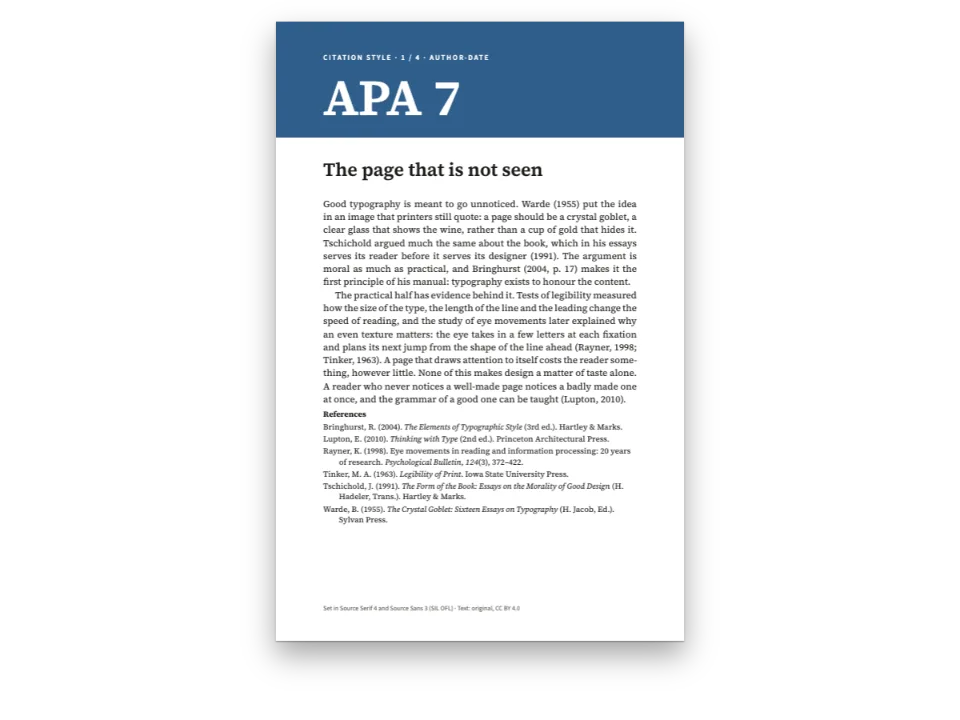
قائمة قراءات لحلقة دراسية مدتها ستة أسابيع في تاريخ العلم وعلم اجتماعه، منضّدة على صفحة بقياس 210 × 280 مم في عمودين. تشغل مساحة خضراء داكنة النصف الأعلى من الصفحة الأولى، وفيها عنوان المقرر بخط Spectral Light بحجم 50 نقطة؛ والنص تحتها دليل منسّق الحلقة إلى كل أسبوع. المراجع هي مجموعة الحلقة في Zotero، مصدَّرة بصيغة BibTeX وملصوقة في المستند من غير المساس بأي سطر: مفاتيح الاستشهاد التي صنعها Zotero، والأقواس المعقوفة حول الحروف الكبيرة، وتشكيلات {\"o}، وmonth = dec، والحقول file وkeywords وurldate. يستشهد النص بثمانية من الأعمال. أما الخمسة الأخرى، وهي قراءات خلفية لا تناقشها الحلقة، فتصل إلى القائمة عبر nocite.
تجيب هذه الوصفة عن
- كيف أستعمل ملف BibTeX مصدَّرًا من Zotero وأدرج أعمالًا لا يستشهد بها النص؟
- كيف أستشهد بالأعمال وأبني قائمة المراجع بأسلوب APA أو IEEE أو أسلوب استشهاد آخر؟
الجواب المختصر
// The works come from a :::references{format=bibtex} block: the Zotero export pasted as it
// is. The text cites some of them; `nocite` in the front matter adds the rest by key, and
// `nocite: "@*"` would add the whole export. citeproc-js writes both in the style named.
registerCitationEngine(createCiteprocEngine({ styles: STYLES, locales: LOCALES }));
const citations = {
  style: 'chicago-author-date', // '(Gieryn 1983)', 'Shapin and Schaffer (1985)'
  link: true, // a citation jumps to its entry
  bibliography: {
    // includeUncited: true is the same as nocite: "@*", set from the design side.
    fontSize: em(0.94), lineHeight: pt(12.4), hangingIndent: mm(5), entrySpacing: pt(3.5),
    doi: 'link', // Zotero's doi field prints as https://doi.org/…; its url field is dropped
  },
};
المكونات
- الميزات
- قائمة المراجع من البيانات المرجعيةالاستشهادات بأسلوب توثيقصفحات افتتاح مصمَّمةسمات العنوانعمود واحد أو عمودانالترويسات وأرقام الصفحاتأنماط الفقراتلوحة ألوان دلالية
- تستخدم أيضًا
- شريط فصل بعرض الصفحةالترويسات بحسب دور الصفحة
- الخطوط
- Spectral, IBM Plex Sans Condensed (SIL OFL 1.1)
- الأصول
- لا شيء: كل صورة مرسومة بالكود
طريقة التحضير
#1 · سمِّ الأسلوب مرة واحدة
الشيفرة هي الجواب المختصر أعلاه. يُسجَّل محرّك الاستشهاد قبل البناء الأول، والأسلوب إعداد واحد: يكتب أسلوب Chicago مؤلف-تاريخ «(Shapin 1984)» مقابل [@shapin_pump_1984]، و«Shapin and Schaffer (1985)» مقابل @shapin_leviathan_1985 داخل الجملة. المفاتيح هي التي بناها Zotero من المؤلف الأول وأول كلمة ذات معنى في العنوان والسنة، فيحتفظ gieryn_boundary-work_1983 بواصلته؛ ويقرأ Postext الواصلة أو الشرطة السفلية داخل المفتاح جزءًا منه.
#2 · الصق الملف المصدَّر كما يكتبه Zotero
آخر كتلة في المستند تحمل الملف المصدَّر، مدخلًا لكل عمل، بإزاحة بمفتاح الجدولة كما يكتبه Zotero:
@article{gieryn_boundary-work_1983,
	title = {Boundary-{Work} and the {Demarcation} of {Science} from {Non}-{Science}: …},
	url = {https://www.jstor.org/stable/2095325},
	doi = {10.2307/2095325},
	urldate = {2026-08-21},
	journal = {American Sociological Review},
	author = {Gieryn, Thomas F.},
	month = dec,
	year = {1983},
	keywords = {demarcation, week 4},
	pages = {781--795},
	file = {JSTOR Full Text PDF:/Users/hps214/Zotero/storage/2HJ8M6PA/Gieryn - 1983 - ….pdf:application/pdf},
}
يُسقط القارئ الأقواس المعقوفة التي تحمي الحروف الكبيرة، ويركّب {\"o} و{\'e} إلى ö وé، ويحوّل -- إلى شرطة متوسطة، ويقرأ month = dec اسم شهر مجردًا. ويصير urldate تاريخ الاطلاع، وlanguage لغة المادة؛ أما file وkeywords وabstract وshorttitle فيتخطاها، فلا يصل إلى الصفحة شيء من قرصك الصلب.
#3 · أدخِل الأعمال التي لا يستشهد بها النص
تسردها البيانات التمهيدية بمفاتيحها:
---
title: "Science as a Social Practice"
nocite: "@fleck_genesis_1979, @merton_sociology_1973, @latour_science_1987, @rheinberger_toward_1997, @lopez_pinero_ciencia_1979"
---
تضم القائمة كل عمل مستشهَد به مع هذه الخمسة، مرتبة معًا بحسب المؤلف كما يطلب أسلوب Chicago؛ ولا شيء يميّز مدخلًا بأنه غير مستشهَد به. يُدرج nocite: "@*" الملف المصدَّر كله، ويفعل bibliography.includeUncited: true الشيء نفسه من الإعدادات، لتصميم يطبع المكتبة كلها دائمًا.
#4 · مساحة خضراء للبطاقة
const BAND = 132; // mm from the trim's top to the band's foot
const onBand = { color: col('paper'), align: 'left', overflow: 'wrap' };
const opener = {
  enabled: true,
  minHeight: mm(BAND - TOP + 9), // the columns start 9 mm under the band
  slot: { elements: [
    { kind: 'box', id: 'band', style: { backgroundColor: col('accent') },
      placement: { anchor: { to: 'page', edge: 'top-left' },
        size: { width: 'fill', height: mm(BAND) } } },
    { kind: 'text', id: 'kicker', content: '{attr.kicker}', ...onBand, fontFamily: LABEL,
      fontSize: pt(8.5), fontWeight: 600, letterSpacing: pt(1.7), textTransform: 'uppercase',
      placement: { anchor: { to: 'container', edge: 'top-left' }, offset: { y: mm(14) } } },
    { kind: 'text', id: 'title', content: '{titleText}', ...onBand, fontFamily: TEXT,
      fontSize: pt(50), fontWeight: 300, lineHeight: 1.02,
      placement: { anchor: { to: '#kicker', edge: 'below' }, offset: { y: mm(7) },
        size: { width: mm(150), height: 'auto' } } },
    { kind: 'rule', id: 'rule', direction: 'horizontal', thickness: pt(1), color: col('tint'),
      placement: { anchor: { to: '#title', edge: 'below' }, offset: { y: mm(7) },
        size: { width: mm(18) } } },
    { kind: 'text', id: 'lead', content: '{attr.lead}', ...onBand, fontFamily: TEXT,
      italic: true, fontSize: pt(13), lineHeight: 1.3, color: col('tint'),
      placement: { anchor: { to: '#rule', edge: 'below' }, offset: { y: mm(6) },
        size: { width: mm(128), height: 'auto' } } },
  ] },
};
الشريط إطار مثبّت إلى حدّ القص، بعمق 132 مم، ويبدأ العمودان تحته بـ9 مم. والعنوان والخط والمقدمة مسلسلة بمراسٍ من نوع below، فيدفع عنوانُ مقرر أطول المقدمةَ إلى الأسفل بدل أن يصطدم بها.
const palette = {
  ink: '#1c211f', accent: '#2d5b48', tint: '#dfe9e2', rule: '#c3cdc6', muted: '#5c6862',
  paper: '#ffffff',
};
const col = (id) => ({ hex: palette[id], model: 'hex', paletteId: id });
const colorPalette = Object.entries({ ...palette, 'main-color': palette.accent })
  .map(([id, hex]) => ({ id, name: id, value: { hex, model: 'hex' } }));
الوصفة كاملة
// ═══ Postext Cookbook · Nº 097 · A reading list from a Zotero BibTeX export ═══════ // https://postext.dev/en/cookbook/zotero-bibtex-nocite // Code: MIT · Text: original (CC BY 4.0) · Pictures: none // Fonts: Spectral, IBM Plex Sans Condensed (SIL OFL 1.1) · Needs postext ≥ 1.12.1 import { buildDocument, renderPageToCanvas, clearMeasurementCache, registerCitationEngine, } from 'https://esm.sh/postext'; import { createCiteprocEngine, STYLES, LOCALES } from 'https://esm.sh/postext-citeproc'; const LANG = 'en'; // @lang: the language of the sample document ('en' | 'es') const RECIPE = 'zotero-bibtex-nocite'; // ─── 1 · Design ───────────────────────────────────────────────────────────── // #region palette: a department green, one tint, everything else in ink const palette = { ink: '#1c211f', accent: '#2d5b48', tint: '#dfe9e2', rule: '#c3cdc6', muted: '#5c6862', paper: '#ffffff', }; const col = (id) => ({ hex: palette[id], model: 'hex', paletteId: id }); const colorPalette = Object.entries({ ...palette, 'main-color': palette.accent }) .map(([id, hex]) => ({ id, name: id, value: { hex, model: 'hex' } })); // #endregion const [TEXT, LABEL] = ['Spectral', 'IBM Plex Sans Condensed']; const LEAD = 13.4; // pt const [TOP, OUTER] = [24, 18]; // mm // #region answer: Chicago author-date, and a list that holds more than the text cites // The works come from a :::references{format=bibtex} block: the Zotero export pasted as it // is. The text cites some of them; `nocite` in the front matter adds the rest by key, and // `nocite: "@*"` would add the whole export. citeproc-js writes both in the style named. registerCitationEngine(createCiteprocEngine({ styles: STYLES, locales: LOCALES })); const citations = { style: 'chicago-author-date', // '(Gieryn 1983)', 'Shapin and Schaffer (1985)' link: true, // a citation jumps to its entry bibliography: { // includeUncited: true is the same as nocite: "@*", set from the design side. fontSize: em(0.94), lineHeight: pt(12.4), hangingIndent: mm(5), entrySpacing: pt(3.5), doi: 'link', // Zotero's doi field prints as https://doi.org/…; its url field is dropped }, }; // #endregion // #region opener: a green field over the top half, the course in white on it const BAND = 132; // mm from the trim's top to the band's foot const onBand = { color: col('paper'), align: 'left', overflow: 'wrap' }; const opener = { enabled: true, minHeight: mm(BAND - TOP + 9), // the columns start 9 mm under the band slot: { elements: [ { kind: 'box', id: 'band', style: { backgroundColor: col('accent') }, placement: { anchor: { to: 'page', edge: 'top-left' }, size: { width: 'fill', height: mm(BAND) } } }, { kind: 'text', id: 'kicker', content: '{attr.kicker}', ...onBand, fontFamily: LABEL, fontSize: pt(8.5), fontWeight: 600, letterSpacing: pt(1.7), textTransform: 'uppercase', placement: { anchor: { to: 'container', edge: 'top-left' }, offset: { y: mm(14) } } }, { kind: 'text', id: 'title', content: '{titleText}', ...onBand, fontFamily: TEXT, fontSize: pt(50), fontWeight: 300, lineHeight: 1.02, placement: { anchor: { to: '#kicker', edge: 'below' }, offset: { y: mm(7) }, size: { width: mm(150), height: 'auto' } } }, { kind: 'rule', id: 'rule', direction: 'horizontal', thickness: pt(1), color: col('tint'), placement: { anchor: { to: '#title', edge: 'below' }, offset: { y: mm(7) }, size: { width: mm(18) } } }, { kind: 'text', id: 'lead', content: '{attr.lead}', ...onBand, fontFamily: TEXT, italic: true, fontSize: pt(13), lineHeight: 1.3, color: col('tint'), placement: { anchor: { to: '#rule', edge: 'below' }, offset: { y: mm(6) }, size: { width: mm(128), height: 'auto' } } }, ] }, }; // #endregion const head = (id, content, parity, edge, x, extra = {}) => ({ kind: 'text', id, content, parity, pages: 'body', fontFamily: LABEL, fontSize: pt(7.5), fontWeight: 600, letterSpacing: pt(1.2), textTransform: 'uppercase', color: col('muted'), placement: { anchor: { to: 'page', edge }, offset: { x: mm(x), y: mm(13) } }, ...extra, }); const folio = { color: col('accent') }; const listName = t({ en: 'HPS 214 · Reading list', es: 'HPS 214 · Lecturas' }); const config = () => ({ // a factory: the engine caches resolved configs per object locale: t({ en: 'en-us', es: 'es' }), colorPalette, citations, page: { sizePreset: 'custom', width: mm(210), height: mm(280), dpi: 150, margins: { top: mm(TOP), bottom: mm(22), left: mm(20), right: mm(OUTER), mirror: true }, }, layout: { layoutType: 'double', gutterWidth: mm(7) }, bodyText: { fontFamily: TEXT, fontSize: pt(9.6), lineHeight: pt(LEAD), color: col('ink'), boldColor: col('ink'), italicColor: col('ink'), referenceColor: col('accent'), textAlign: 'justify', firstLineIndent: mm(4), indentAfterHeading: false, hyphenation: { enabled: true }, optimalLineBreaking: true, avoidWidows: true, avoidOrphans: true, avoidRunts: true, }, headings: { fontFamily: TEXT, color: col('ink'), fontWeight: 600, levels: [ // Restated: any headings object drops the H1 break (gotcha: headings-drop-h1-break). { level: 1, span: 'page', breakBefore: { enabled: true, parity: 'any' }, marginBottom: pt(0), advancedDesign: opener }, { level: 2, fontFamily: LABEL, fontSize: pt(10), lineHeight: pt(LEAD), fontWeight: 600, color: col('accent'), marginTop: pt(LEAD), marginBottom: pt(0), }, ], }, paragraphStyles: [ { id: 'colophon', fontFamily: LABEL, fontSize: pt(7), lineHeight: pt(9.5), color: col('muted'), textAlign: 'left', firstLineIndent: pt(0), marginTop: pt(LEAD) }, ], header: { elements: [ head('verso-folio', '{pageNumber}', 'even', 'top-left', OUTER, folio), head('verso-title', '{title}', 'even', 'top-left', OUTER + 8), head('recto-title', listName, 'odd', 'top-right', -(OUTER + 8)), head('recto-folio', '{pageNumber}', 'odd', 'top-right', -OUTER, folio), ] }, footer: { elements: [] }, }); // ─── 2 · Content ──────────────────────────────────────────────────────────── const markdown = String.raw`---نموذج Markdown · أسطر: 204 · content.en.md
title: "Science as a Social Practice" nocite: "@fleck_genesis_1979, @merton_sociology_1973, @latour_science_1987, @rheinberger_toward_1997, @lopez_pinero_ciencia_1979" --- # Science as a Social Practice {kicker="HPS 214 · Seminar reading list · Autumn term 2026" lead="Six weeks on how scientific knowledge is made, tested and trusted, from the paradigm to the laboratory notebook."} This seminar reads the history and sociology of science as one subject. Its question is how a claim about nature becomes a fact that people who never saw the experiment are willing to rely on. The answers we read come from historians of the seventeenth century, from sociologists who sat in laboratories for two years, and from philosophers who looked at what scientists actually do rather than at what their textbooks say they do. Each week has one set reading, which everyone reads before the seminar, and one or two companion texts for the person introducing the discussion. The set readings are available in the course reader; the others are in the library’s reserve collection. ## Week 1 · Paradigms and normal science We start with the book that made the subject fashionable. Read the first five sections and the Postscript of @kuhn_structure_1970, which Kuhn added for the second edition to answer the charge that “paradigm” meant too many things at once. His preface credits a monograph by Ludwik Fleck, written in 1935 and nearly forgotten until Kuhn mentioned it; it is in the list at the end, and the student introducing the week should read its second chapter. ## Week 2 · Witnessing an experiment The set reading is the first two chapters of @shapin_leviathan_1985, on Robert Boyle’s air-pump and the dispute with Thomas Hobbes over whether an experiment could settle anything. The companion text is the shorter article in which Shapin first described Boyle’s “literary technology”, the way a report written in plain, circumstantial prose turned its readers into witnesses [@shapin_pump_1984]. ## Week 3 · Inside the laboratory Bruno Latour spent two years at the Salk Institute as an observer of a neuroendocrinology laboratory. Read the second and third chapters of @latour_laboratory_1979 and follow how a statement loses its qualifications (“it seems that”, “X has claimed”) as it travels from one paper to the next until it is printed without any. ## Week 4 · Where science ends The demarcation problem asks what separates science from what is not science. Philosophers looked for a criterion; @gieryn_boundary-work_1983 looked at the people who draw the line in practice, and at what they gain by drawing it where they do. Bring an example from the news of the last month. ## Week 5 · Objectivity has a history Read the article first [@daston_image_1992], then the first chapter and the chapter on “trained judgment” in the book it grew into [@daston_objectivity_2007]. The argument is that objectivity, as a virtue of the scientist, appeared in the nineteenth century, and that atlases of skeletons, snowflakes and clouds show it arriving. ## Week 6 · Whom to believe The last week returns to the seventeenth century with a broader question: how did gentlemen-philosophers decide whose reports to accept? Read the first chapter of @shapin_social_1994 and come ready to compare its answer with how you decide whom to believe when you read a paper outside your field. ## Further reading The list below is the seminar’s Zotero collection, exported as BibTeX and set as it came out of Zotero. It includes every work cited above and five that the seminar does not discuss but that you will meet in the essays you read: Fleck’s monograph, Merton’s collected essays on the norms of science, Latour’s later handbook, Rheinberger’s study of experimental systems, and a history of Spanish science in the sixteenth and seventeenth centuries for those who read Spanish. :::bibliography{title=""} :::paragraphs{style="colophon"} Set in Spectral and IBM Plex Sans Condensed (SIL OFL) · Reading list and notes: original, CC BY 4.0 · The works are real; the Zotero file paths and access dates are illustrative. ::: :::references{format=bibtex} @book{kuhn_structure_1970, address = {Chicago}, edition = {2}, title = {The {Structure} of {Scientific} {Revolutions}}, abstract = {Normal science, anomaly and crisis, and the paradigm changes that end them, with the Postscript of 1969.}, language = {en}, publisher = {University of Chicago Press}, author = {Kuhn, Thomas S.}, year = {1970}, keywords = {paradigms, week 1}, file = {Kuhn - 1970 - The Structure of Scientific Revolutions.pdf:/Users/hps214/Zotero/storage/7QW2KD9N/Kuhn - 1970 - The Structure of Scientific Revolutions.pdf:application/pdf}, } @book{fleck_genesis_1979, address = {Chicago}, title = {Genesis and {Development} of a {Scientific} {Fact}}, language = {en}, publisher = {University of Chicago Press}, author = {Fleck, Ludwik}, editor = {Trenn, Thaddeus J. and Merton, Robert K.}, translator = {Bradley, Fred and Trenn, Thaddeus J.}, year = {1979}, keywords = {thought collectives, week 1}, } @book{shapin_leviathan_1985, address = {Princeton, NJ}, title = {Leviathan and the {Air}-{Pump}: {Hobbes}, {Boyle}, and the {Experimental} {Life}}, shorttitle = {Leviathan and the {Air}-{Pump}}, language = {en}, publisher = {Princeton University Press}, author = {Shapin, Steven and Schaffer, Simon}, year = {1985}, keywords = {experiment, week 2}, } @article{shapin_pump_1984, title = {Pump and {Circumstance}: {Robert} {Boyle}'s {Literary} {Technology}}, volume = {14}, shorttitle = {Pump and {Circumstance}}, url = {https://doi.org/10.1177/030631284014004001}, doi = {10.1177/030631284014004001}, language = {en}, number = {4}, urldate = {2026-08-21}, journal = {Social Studies of Science}, author = {Shapin, Steven}, month = nov, year = {1984}, keywords = {literary technology, week 2}, pages = {481--520}, file = {Shapin - 1984 - Pump and Circumstance.pdf:/Users/hps214/Zotero/storage/V3NC8RTE/Shapin - 1984 - Pump and Circumstance.pdf:application/pdf}, } @book{latour_laboratory_1979, address = {Beverly Hills}, title = {Laboratory {Life}: {The} {Social} {Construction} of {Scientific} {Facts}}, shorttitle = {Laboratory {Life}}, language = {en}, publisher = {Sage}, author = {Latour, Bruno and Woolgar, Steve}, year = {1979}, keywords = {ethnography, week 3}, } @book{latour_science_1987, address = {Cambridge, MA}, title = {Science in {Action}: {How} to {Follow} {Scientists} and {Engineers} through {Society}}, shorttitle = {Science in {Action}}, language = {en}, publisher = {Harvard University Press}, author = {Latour, Bruno}, year = {1987}, } @book{rheinberger_toward_1997, address = {Stanford, CA}, title = {Toward a {History} of {Epistemic} {Things}: {Synthesizing} {Proteins} in the {Test} {Tube}}, language = {en}, publisher = {Stanford University Press}, author = {Rheinberger, Hans-J{\"o}rg}, year = {1997}, keywords = {experimental systems}, } @article{gieryn_boundary-work_1983, title = {Boundary-{Work} and the {Demarcation} of {Science} from {Non}-{Science}: {Strains} and {Interests} in {Professional} {Ideologies} of {Scientists}}, volume = {48}, shorttitle = {Boundary-{Work} and the {Demarcation} of {Science} from {Non}-{Science}}, url = {https://www.jstor.org/stable/2095325}, doi = {10.2307/2095325}, language = {en}, number = {6}, urldate = {2026-08-21}, journal = {American Sociological Review}, author = {Gieryn, Thomas F.}, month = dec, year = {1983}, keywords = {demarcation, week 4}, pages = {781--795}, file = {JSTOR Full Text PDF:/Users/hps214/Zotero/storage/2HJ8M6PA/Gieryn - 1983 - Boundary-Work and the Demarcation of Science from Non-Science.pdf:application/pdf}, } @article{daston_image_1992, title = {The {Image} of {Objectivity}}, url = {https://www.jstor.org/stable/2928741}, doi = {10.2307/2928741}, language = {en}, number = {40}, urldate = {2026-08-22}, journal = {Representations}, author = {Daston, Lorraine and Galison, Peter}, year = {1992}, keywords = {objectivity, week 5}, pages = {81--128}, file = {JSTOR Full Text PDF:/Users/hps214/Zotero/storage/F9XK4C2B/Daston and Galison - 1992 - The Image of Objectivity.pdf:application/pdf}, } @book{daston_objectivity_2007, address = {New York}, title = {Objectivity}, language = {en}, publisher = {Zone Books}, author = {Daston, Lorraine and Galison, Peter}, year = {2007}, keywords = {objectivity, week 5}, } @book{shapin_social_1994, address = {Chicago}, series = {Science and {Its} {Conceptual} {Foundations}}, title = {A {Social} {History} of {Truth}: {Civility} and {Science} in {Seventeenth}-{Century} {England}}, language = {en}, publisher = {University of Chicago Press}, author = {Shapin, Steven}, year = {1994}, keywords = {trust, week 6}, } @book{merton_sociology_1973, address = {Chicago}, title = {The {Sociology} of {Science}: {Theoretical} and {Empirical} {Investigations}}, language = {en}, publisher = {University of Chicago Press}, author = {Merton, Robert K.}, editor = {Storer, Norman W.}, year = {1973}, } @book{lopez_pinero_ciencia_1979, address = {Barcelona}, title = {Ciencia y t{\'e}cnica en la sociedad espa{\~n}ola de los siglos {XVI} y {XVII}}, language = {es}, publisher = {Labor}, author = {L{\'o}pez Pi{\~n}ero, Jos{\'e} Mar{\'i}a}, year = {1979}, } :::`; // ─── 3 · Fonts ────────────────────────────────────────────────────────────── const FONTS = { Spectral: ['300', '300i', '400', '400i', '600', '600i'], 'IBM Plex Sans Condensed': ['400', '600'], }; // ─── 4 · Build & show ─────────────────────────────────────────────────────── await loadFonts(FONTS, markdown); const doc = await buildWithFonts(() => buildDocument({ markdown }, config()), markdown); showPages(doc, { title: t({ en: 'A reading list from Zotero', es: 'Lecturas desde Zotero' }) });العُدّة · core, fonts, viewer: نفسها في كل وصفة · أسطر: 235
// ─── Kit ── helpers shared by every Cookbook recipe · postext.dev/cookbook ───── // ─── Kit · core v1 ── the same in every recipe · postext.dev/cookbook ───────── function mm(value) { return { value, unit: 'mm' }; } function pt(value) { return { value, unit: 'pt' }; } function em(value) { return { value, unit: 'em' }; } /** The sample language's string: t({ en: 'Figure', es: 'Figura' }). */ function t(strings) { return strings[LANG] ?? Object.values(strings)[0]; } /** A file in this recipe's assets folder, served from the Postext repo by jsDelivr. */ function asset(file) { return `https://cdn.jsdelivr.net/gh/drnachio/postext@main/cookbook/${RECIPE}/assets/${file}`; } // ─── Kit · fonts v1 ── the same in every recipe · postext.dev/cookbook ──────── // Postext measures text with the faces the browser has loaded, and caches the // widths, so every face must be ready before the first build. Faces come from // Fontsource: the same static files the PDF embeds, so screen and PDF agree. /** faces = { 'Family Name': ['400', '400i', '700'] }. `text` is the sample: * letters beyond Latin-1 (č, ł, ő…) also load the latin-ext files. With * `optional`, a face Fontsource does not ship is skipped instead of failing. * Resolves to the number of faces added. */ async function loadFonts(faces, text = '', { optional = false } = {}) { kitStatus('Loading fonts…'); const ranges = { latin: 'U+0000-00FF,U+0131,U+0152-0153,U+02BB-02BC,U+02C6,U+02DA,U+02DC,U+0304,U+0308,U+0329,' + 'U+2000-206F,U+20AC,U+2122,U+2191,U+2193,U+2212,U+2215,U+FEFF,U+FFFD', 'latin-ext': 'U+0100-02BA,U+02BD-02C5,U+02C7-02CC,U+02CE-02D7,U+02DD-02FF,U+0304,U+0308,U+0329,' + 'U+1D00-1DBF,U+1E00-1E9F,U+1EF2-1EFF,U+2020,U+20A0-20AB,U+20AD-20C0,U+2113,U+2C60-2C7F,U+A720-A7FF', }; const subsets = /[Ā-˿Ḁ-ỿ]/.test(text) ? ['latin', 'latin-ext'] : ['latin']; const jobs = []; let added = 0; for (const [family, specs] of Object.entries(faces)) { const id = fontsourceId(family); const meta = optional ? await fontsourceMeta(family) : null; for (const spec of new Set(specs)) { const weight = parseInt(spec, 10); const style = spec.endsWith('i') ? 'italic' : 'normal'; if (hasFace(family, weight, style)) continue; if (optional && !(meta?.weights.includes(weight) && meta.styles.includes(style))) continue; for (const subset of subsets) { const url = `https://cdn.jsdelivr.net/npm/@fontsource/${id}@5/files/${id}-${subset}-${weight}-${style}.woff2`; const face = new FontFace(family, `url(${url}) format('woff2')`, { weight: String(weight), style, unicodeRange: ranges[subset] }); jobs.push(face.load().then((ready) => { document.fonts.add(ready); added++; }, () => { if (subset === 'latin' && !optional) throw new Error(`Fontsource has no ${family} ${weight} ${style}`); })); } } } await Promise.all(jobs).catch((error) => { kitFail(error); throw error; }); return added; } /** Runs `build` (a buildDocument or buildBundle call) and checks the faces * the pages use. A regular face missing from FONTS is loaded with a warning; * bold and italic variants are loaded when the family ships them. Then the * measurement caches are cleared and the build runs again. */ async function buildWithFonts(build, text = '') { const tried = new Set(); for (let round = 0; round < 3; round++) { kitStatus('Laying out…'); await new Promise(requestAnimationFrame); // let the status paint first const result = await Promise.resolve().then(build).catch((error) => { kitFail(error); throw error; }); const wanted = { base: {}, variants: {} }; for (const { font, base } of [result].flat().flatMap(fontStringsOf)) { const { family, weight, style } = parseFont(font); const key = `${family}|${weight}|${style}`; if (tried.has(key) || hasFace(family, weight, style)) continue; tried.add(key); (wanted[base ? 'base' : 'variants'][family] ??= []).push(`${weight}${style === 'italic' ? 'i' : ''}`); } if (Object.keys(wanted.base).length) { console.warn(`[cookbook] FONTS does not list ${JSON.stringify(wanted.base)}: loading them.`); } const added = await loadFonts(wanted.base, text) + await loadFonts(wanted.variants, text, { optional: true }); if (added === 0) return result; clearMeasurementCache(); } throw new Error('The fonts did not settle after three builds.'); } /** Every font string of the layout. `base` marks a block's own face; its * bold, italic and bold-italic variants are listed whether or not used. */ function fontStringsOf(doc) { const found = new Map(); const walk = (node) => { if (!node || typeof node !== 'object') return; if (Array.isArray(node)) { node.forEach(walk); return; } for (const [key, value] of Object.entries(node)) { if (typeof value === 'string' && /fontString$/i.test(key)) { found.set(value, found.get(value) || key === 'fontString'); } else if (value && typeof value === 'object') walk(value); } }; walk(doc.pages); walk(doc.blocks); return [...found].map(([font, base]) => ({ font, base })); } /** '700 37.5px Open Sans' / 'italic 400 13px "Source Serif 4"' → { family, weight, style }. * A string with no weight ('95.8px Young Serif', from a design text) is 400. */ function parseFont(font) { const m = /^(?:(italic|oblique)\s+)?(?:small-caps\s+)?(?:(\d+|bold|normal)\s+)?[\d.]+px\s+(.+)$/.exec(font.trim()); if (!m) throw new Error(`Unexpected font string: ${font}`); const weight = m[2] === 'bold' ? 700 : !m[2] || m[2] === 'normal' ? 400 : Number(m[2]); return { family: m[3].replace(/^["']|["']$/g, ''), weight, style: m[1] ? 'italic' : 'normal' }; } /** True when a loaded FontFace covers exactly this family, weight and style * (document.fonts.check() is also true for families nobody declared). */ function hasFace(family, weight, style) { for (const face of document.fonts) { if (face.status !== 'loaded' || face.style !== style) continue; if (face.family.replace(/^["']|["']$/g, '') !== family) continue; const [low, high = low] = face.weight.split(' ').map(Number); if (weight >= low && weight <= high) return true; } return false; } /** Fontsource's id for a family: 'Source Serif 4' → 'source-serif-4'. */ function fontsourceId(family) { return family.toLowerCase().replace(/\s+/g, '-'); } /** The weights and styles a family ships ({ weights: [400, 700], styles: ['normal', 'italic'] }), or null. */ function fontsourceMeta(family) { fontsourceMeta.cache ??= new Map(); const id = fontsourceId(family); if (!fontsourceMeta.cache.has(id)) { fontsourceMeta.cache.set(id, fetch(`https://api.fontsource.org/v1/fonts/${id}`) .then((res) => (res.ok ? res.json() : null), () => null)); } return fontsourceMeta.cache.get(id); } // ─── Kit · viewer v1 ── the same in every recipe · postext.dev/cookbook ─────── /** Shows the pages as facing spreads on a dark desk: the first page is a * recto on its own, then verso | recto pairs, as in a bound book. Pages * are painted when they scroll near the screen. */ function showPages(docs, { title, width = 460 } = {}) { const root = viewer(title); const pages = [docs].flat().flatMap((doc) => doc.pages.map((page) => ({ doc, page, n: (doc.pageIndexOffset ?? 0) + page.index }))); const spreads = []; let verso = null; for (const p of pages) { if (p.n % 2 === 1) { if (verso) spreads.push([verso, null]); verso = p; } else { spreads.push([verso, p]); verso = null; } } if (verso) spreads.push([verso, null]); const density = Math.min(window.devicePixelRatio || 1, 2); showPages.painter?.disconnect(); const painter = new IntersectionObserver((entries) => { for (const { isIntersecting, target } of entries) { if (!isIntersecting) continue; painter.unobserve(target); const { doc, page } = target.postext; renderPageToCanvas(page, doc, target, { scale: (width * density) / page.width }); } }, { rootMargin: '800px' }); showPages.painter = painter; root.replaceChildren(...spreads.map((pair) => { const spread = document.createElement('div'); spread.className = 'pt-spread'; for (const p of pair) { const figure = document.createElement('figure'); if (p) { const label = p.page.pageLabel || String(p.n + 1); const canvas = document.createElement('canvas'); canvas.postext = p; canvas.style.aspectRatio = `${p.page.width} / ${p.page.height}`; canvas.setAttribute('role', 'img'); canvas.setAttribute('aria-label', `Page ${label}`); const folio = document.createElement('figcaption'); folio.textContent = label; figure.append(canvas, folio); painter.observe(canvas); } else figure.className = 'pt-blank'; spread.append(figure); } return spread; })); kitStatus(`${pages.length} ${pages.length === 1 ? 'page' : 'pages'}`); document.documentElement.dataset.postext = 'ready'; return pages.length; } /** The desk, the bar and the error reporting, created once. */ function viewer(title) { if (!document.getElementById('pt-kit')) { document.head.insertAdjacentHTML('beforeend', `<style id="pt-kit"> :root { color-scheme: dark; } body { margin: 0; background: #0e1014; color: #b9bcc4; font: 13px/1.45 system-ui, sans-serif; } #pt-bar { position: sticky; top: 0; z-index: 1; display: flex; flex-wrap: wrap; align-items: center; gap: 6px 16px; padding: 10px 16px; background: rgb(14 16 20 / .92); backdrop-filter: blur(6px); border-bottom: 1px solid #23262d; } #pt-bar strong { color: #f4f1ea; font-weight: 600; } #pt-actions { display: flex; gap: 12px; margin-left: auto; } #pt-actions a, #pt-actions button { color: #d8a21a; font: inherit; background: none; border: 0; padding: 0; cursor: pointer; } #pages { display: grid; justify-items: center; gap: 48px; padding: 32px 16px 72px; } .pt-spread { display: flex; } .pt-spread figure { margin: 0; width: min(460px, 44vw); } .pt-spread canvas { display: block; width: 100%; background: #fff; box-shadow: 0 1px 2px rgb(0 0 0 / .5), 0 22px 44px -16px rgb(0 0 0 / .8); } .pt-spread figure:first-child canvas { box-shadow: inset -14px 0 14px -14px rgb(0 0 0 / .18), 0 1px 2px rgb(0 0 0 / .5), 0 22px 44px -16px rgb(0 0 0 / .8); } .pt-spread figcaption { margin-top: 10px; text-align: center; font: 600 10px/1 system-ui, sans-serif; letter-spacing: .18em; text-transform: uppercase; color: #6c7079; } .pt-blank { visibility: hidden; } @media (max-width: 760px) { .pt-spread { flex-direction: column; gap: 32px; } .pt-spread figure { width: min(460px, 92vw); } .pt-blank { display: none; } } </style>`); document.body.insertAdjacentHTML('afterbegin', '<header id="pt-bar"><strong id="pt-title"></strong><span id="pt-status" role="status"></span><span id="pt-actions"></span></header>'); document.getElementById('pt-title').textContent = document.title || 'Postext'; addEventListener('error', (event) => kitFail(event.error ?? event.message)); addEventListener('unhandledrejection', (event) => kitFail(event.reason)); } if (title) document.getElementById('pt-title').textContent = title; return document.getElementById('pages') ?? document.body.appendChild(Object.assign(document.createElement('main'), { id: 'pages' })); } function kitStatus(text) { viewer(); document.getElementById('pt-status').textContent = text; } function kitFail(error) { document.documentElement.dataset.postext = 'error'; kitStatus(`Error: ${error?.message ?? error}`); } // ─── /Kit ───────────────────────────────────────────────────────────────────────
يعمل ملف script.js المجمّع كما هو: الصقه في سكربت الوحدة (module) لأي صفحة، أو افتح الوصفة على CodePen. مجلد الوصفة على GitHub ↗ (يفتح في تبويب جديد)
تنويعات
#أدرج مجموعة Zotero كاملة
حين يكون الملف المصدَّر هو القائمة نفسها، استغنِ عن المفاتيح: يُطبع كل مدخل في الكتلة، مستشهَدًا به أو لا.
-nocite: "@fleck_genesis_1979, @merton_sociology_1973, @latour_science_1987, …"
+nocite: "@*"#غيّر الأسلوب
المفاتيح نفسها تعطي قائمة بأسلوب Harvard (Cite Them Right) من غير أي تغيير آخر.
-  style: 'chicago-author-date', // '(Gieryn 1983)', 'Shapin and Schaffer (1985)'
+ style: 'harvard-cite-them-right',أخطاء شائعة
خطأ شائع
مفتاح nocite الذي لا يطابق شيئًا يُحذف دون تنبيه
المفتاح المُستشهَد به دون مرجع يرفع unknownCitationKey، لكن المفتاح في nocite الذي لا يطابق أي مُدخل يُتخطى دون تحذير. انسخ المفاتيح من ملف التصدير وعُدّ المُدخلات في القائمة. قائمة المراجع من البيانات المرجعية →
خطأ شائع
أي كائن headings يُلغي فاصل الصفحة قبل H1
ينتقل H1 افتراضيًا إلى صفحة فردية (always-odd)، لكن تمرير أي كائن headings يعيد ضبط هذا الافتراض، فتتوالى الفصول دون فاصل ولا يفعل span: 'page' شيئًا. أعد كتابة headings.levels[0].breakBefore: { enabled: true, parity } في كل إعداد. فصول تبدأ في صفحة فردية →
خطأ شائع
حمّل كل أوجه الخط قبل الإخراج
يقيس الإخراج النص بأوجه الخط التي حمّلها المتصفح ويخزّن العروض مؤقتًا، فالوجه الذي يصل بعد البناء الأول يترك فواصل أسطر خاطئة وملف PDF لم يعد يطابق الشاشة. حمّل كل وزن وكل نمط أولًا، واستدعِ clearMeasurementCache() قبل إعادة البناء إذا تأخر وصول أحدها. الخطوط قبل الإخراج →
خطأ شائع
ضع كل قيمة في الترويسة الأمامية (frontmatter) بين علامتي اقتباس
يقرأ YAML القيمة title: 1984 رقمًا، ويقرأ التاريخ كائن Date، والقيم غير النصية تُطبع فارغة في العناصر النائبة وتترك ملف PDF بلا عنوان. ضع كل قيمة بين علامتي اقتباس: title: "1984". البيانات الوصفية للمستند →
خطأ شائع
يُخزَّن الإعداد مؤقتًا بحسب هويته: ابنِ كائنًا جديدًا
يخزّن المحرّك الإعدادات المحسوبة مؤقتًا بحسب هوية الكائن، فتعديل الإعداد في مكانه ثم البناء مجددًا يعيد استخدام النتيجة القديمة. ابنِ كائنًا جديدًا في كل بناء، ولهذا يكون إعداد الوصفة دالة مصنِّعة: config(). صفحات على اللوحة (Canvas) →
- المفتاح في
nociteالذي لا يطابق أي مدخل يُسقَط من غير تحذير. انسخ المفاتيح من الملف المصدَّر بدل أن تكتبها، وعُدّ المداخل على الصفحة. - يبني Zotero المفاتيح من البيانات: صحّح اسم مؤلف أو عنوانًا في Zotero، وقد يغيّر التصدير التالي المفتاح، فينكسر كل استشهاد به. ثبّت المفاتيح قبل كتابة النص: يقرأ Zotero سطرًا
Citation Key: …في حقل Extra للمادة. - يصدّر Zotero بترميز UTF-8 افتراضيًا، والتشكيلات كما هي. وقد صُدّرت الكتلة هنا بخيار الترميز الغربي، الذي يكتب
{\"o}؛ ويقرأ Postext الصيغتين. - تُسقط الطبعة الثامنة عشرة من دليل Chicago مكان النشر، فلا يُطبع الحقل
address، والمقالة التي لها DOI تطبع الـDOI لاurlالخاص بـJSTOR.
الحقوق
- الوصفة
- Ignacio Ferro
- النص
- نص أصلي, CC BY 4.0
- الخطوط
- Spectral (SIL OFL 1.1) · IBM Plex Sans Condensed (SIL OFL 1.1)
- الكود
- MIT، مثل Postext
حرّر هذا الشرح ↗ (يفتح في تبويب جديد)مجلد الوصفة على GitHub ↗ (يفتح في تبويب جديد)