In short
Say how far each painting may reach on its page, inside the margins, to the cut edge or past it, and give a detail its width in millimetres. The pages make themselves.
What you'll build
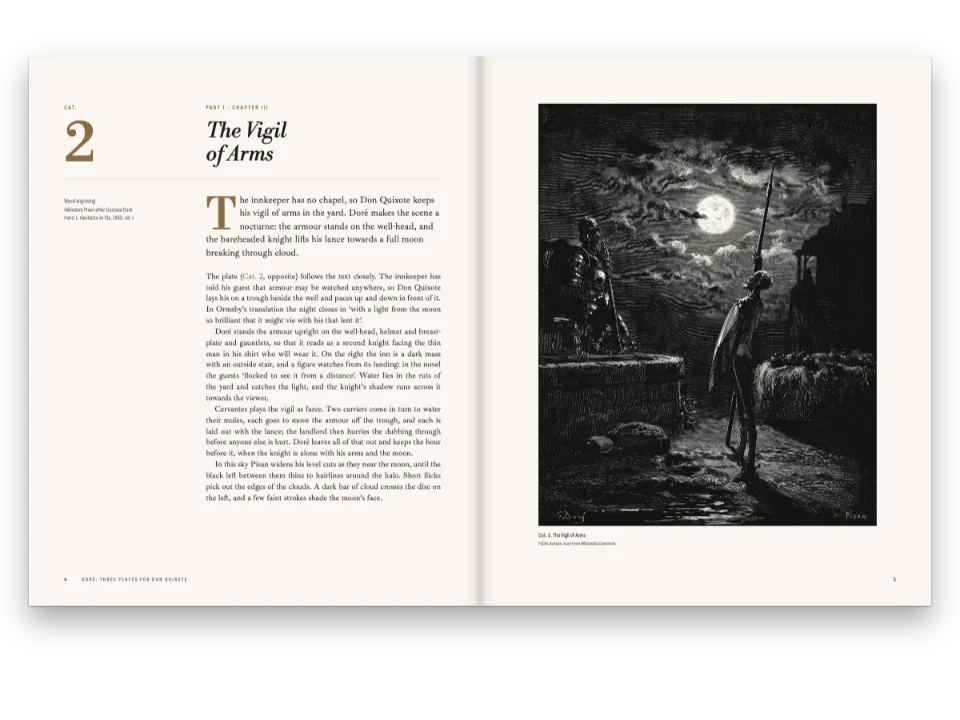
Seven pages of a small exhibition catalogue, 160 × 195 mm, on four interiors by Johannes Vermeer from the Rijksmuseum, the Met and the National Gallery of Art. The essay opens on a recto with a sunk title. Each painting it cites stands alone on the next whole page: The Milkmaid on page 2 inside the margins, under its running head; the Water Pitcher and the Letter face each other on pages 4 and 5, one cut at the trim, the other running into the bleed past the crop marks, both without heads or folios. A detail of the balance prints 60 mm wide on page 7, its caption beside it. The PDF carries the marks, a TrimBox and a BleedBox.
This recipe answers
- How do I print a painting as a full-page plate (inside the margins, to the trim or to the bleed) and a detail at a set width in mm?
- How do I make an art catalogue: entry on the left page, plate on the facing right page?
- How do I make a print-ready PDF with bleed, crop marks, bookmarks, page labels and a colour space?
The short answer
// Every plate stands alone on the first whole page after its citation, as large as the area
// allows. true (or 'content') keeps it inside the margins with its running heads; 'trim'
// covers the page to the cut, 'bleed' to the bleed. Those two crop the picture about its
// centre, put the caption on a band of paper at the foot, and drop the heads and the folio.
const plateType = { id: 'plate', name: t({ en: 'Plate', es: 'Lámina' }),
  shortLabel: t({ en: 'plate', es: 'lámina' }), captionPrefix: t({ en: 'Plate', es: 'Lámina' }),
  numberingTemplate: '{n}', resetOn: 'never', counterFormat: 'decimal',
  defaultPlacement: { plate: true, captionMeasure: 'body' } }; // the caption as wide as it
const REACH = { milkmaid: 'content', pitcher: 'trim', letter: 'bleed', balance: 'content' };
// A width as a length is measured against the slot, not shared out of it: the detail prints
// 60 mm wide in any layout, 1.25 times the 48 mm of canvas it shows. Its caption stands
// beside it in what is left of the column.
const DETAIL = { width: { value: 60, unit: 'mm' }, captionSide: 'inside', align: 'left' };
A plate type, and how far each picture reaches
Ingredients
- Features
- Full-page platesFigure widths in millimetresFigures and tables as resourcesCitations that place figuresCustom resource typesNumbered captionsCaption styleSource and credit linesSide captionsBleed and crop marksHeads by page roleRunning heads and foliosMirrored marginsDesigned openersHeading attributesParagraph stylesSemantic colour palettePDF export
- Type
- Spectral, Cormorant Garamond, Jost (SIL OFL 1.1)
- Assets
balance-1700.jpgbalance-detail-1051.jpgletter-2400.jpgmilkmaid-1800.jpgpitcher-2400.jpg- Plate 1, Johannes Vermeer, The Milkmaid, c. 1660, Rijksmuseum SK-A-2344; the museum’s image reduced to 1,800 px high (Rijksmuseum, Amsterdam, CC0 1.0)
- Plate 2, Johannes Vermeer, Young Woman with a Water Pitcher, c. 1662, The Met 89.15.21; the museum’s image, its unpainted edges cut off, reduced to 2,400 px high (The Metropolitan Museum of Art, New York (Open Access), CC0 1.0)
- Plate 3, Johannes Vermeer, Woman Reading a Letter, c. 1663, Rijksmuseum SK-C-251; the museum’s image reduced to 2,400 px high (Rijksmuseum, Amsterdam, CC0 1.0)
- Plate 4, Johannes Vermeer, Woman Holding a Balance, c. 1664, National Gallery of Art 1942.9.97; the museum’s image reduced to 1,700 px high (National Gallery of Art, Washington (Open Access), CC0 1.0)
- Figure 1, a 48 × 63 mm detail of plate 4 cut from the museum’s full-resolution image and reduced to 800 px wide (National Gallery of Art, Washington (Open Access), CC0 1.0)
Method
#1 · One type for the plates, one reach per painting
The code is the short answer above. The plate type sets plate: true as its default placement, so a painting the essay cites goes to the first page it can have whole and grows to the content area with its caption under it. REACH overrides that per painting: 'trim' and 'bleed' cover the page and crop the picture about its centre, so pick paintings whose shape is close to the page's (these are 0.85 to 0.89 wide for a page of 0.82). captionMeasure: 'body' keeps the caption of an inner plate as wide as the picture.
#2 · Size each file for where it prints
// JPEGs in assets/ at the pixels each needs for 300 ppi where it prints: 2,400 px high for
// the plates that cover the page (195 mm + 2 × 3 mm of bleed is 7.9 in), less for the rest.
const PAINTINGS = {
  milkmaid: [[1617, 1800], { en: 'Johannes Vermeer, *The Milkmaid*, c. 1660',
    es: 'Johannes Vermeer, *La lechera*, h. 1660' }, { en: 'Oil on canvas, 45.5 × 41 cm. '
    + 'Rijksmuseum, Amsterdam, SK-A-2344, purchased with the support of the Vereniging '
    + 'Rembrandt. Public domain.', es: 'Óleo sobre lienzo, 45,5 × 41 cm. Rijksmuseum, '
    + 'Ámsterdam, SK-A-2344, adquirido con el apoyo de la Vereniging Rembrandt. Dominio '
    + 'público.' }, { en: 'A kitchen maid in a yellow bodice and blue apron pours milk from '
    + 'a jug into a bowl beside a basket of bread, under a window on the left.', es: 'Una '
    + 'criada con corpiño amarillo y delantal azul vierte leche de una jarra en un cuenco, '
    + 'junto a un cesto de pan, bajo una ventana a la izquierda.' }],
  pitcher: [[2116, 2400], { en: 'Johannes Vermeer, *Young Woman with a Water Pitcher*, '
    + 'c. 1662', es: 'Johannes Vermeer, *Joven con una jarra de agua*, h. 1662' },
  { en: 'Oil on canvas, 45.7 × 40.6 cm. The Metropolitan Museum of Art, New York, 89.15.21, '
    + 'Marquand Collection, gift of Henry G. Marquand, 1889. Public domain.', es: 'Óleo sobre '
    + 'lienzo, 45,7 × 40,6 cm. The Metropolitan Museum of Art, Nueva York, 89.15.21, '
    + 'colección Marquand, donación de Henry G. Marquand, 1889. Dominio público.' },
  { en: 'A young woman in a white linen hood opens a window with one hand and holds a '
    + 'silver-gilt pitcher in a basin with the other; a map hangs behind her.', es: 'Una joven '
    + 'con toca de lino blanco abre una ventana con una mano y sujeta con la otra una jarra '
    + 'de plata dorada sobre una palangana; detrás cuelga un mapa.' }],
  letter: [[2039, 2400], { en: 'Johannes Vermeer, *Woman Reading a Letter*, c. 1663',
    es: 'Johannes Vermeer, *Mujer leyendo una carta*, h. 1663' }, { en: 'Oil on canvas, '
    + '46.5 × 39 cm. Rijksmuseum, Amsterdam, SK-C-251, on loan from the City of Amsterdam '
    + '(A. van der Hoop Bequest). Public domain.', es: 'Óleo sobre lienzo, 46,5 × 39 cm. '
    + 'Rijksmuseum, Ámsterdam, SK-C-251, en préstamo de la ciudad de Ámsterdam (legado '
    + 'A. van der Hoop). Dominio público.' }, { en: 'A woman in a blue jacket stands reading '
    + 'a letter in front of a map of Holland, between two chairs, lit from the left.',
  es: 'Una mujer con chaqueta azul lee una carta de pie ante un mapa de Holanda, entre dos '
    + 'sillas, con la luz a la izquierda.' }],
  balance: [[1502, 1700], { en: 'Johannes Vermeer, *Woman Holding a Balance*, c. 1664',
    es: 'Johannes Vermeer, *Mujer con una balanza*, h. 1664' }, { en: 'Oil on canvas, '
    + '39.7 × 35.5 cm. National Gallery of Art, Washington, 1942.9.97, Widener Collection. '
    + 'Public domain.', es: 'Óleo sobre lienzo, 39,7 × 35,5 cm. National Gallery of Art, '
    + 'Washington, 1942.9.97, colección Widener. Dominio público.' }, { en: 'A woman stands '
    + 'at a table spread with pearls and coins, holding up a small balance; a painting of the '
    + 'Last Judgment hangs behind her.', es: 'Una mujer, de pie ante una mesa con perlas y '
    + 'monedas, sostiene en alto una pequeña balanza; detrás cuelga un Juicio Final.' }],
  'balance-detail': [[800, 1051], { en: 'Detail of :ref{id="balance"}: the beam and its two '
    + 'empty pans. The 48 mm of canvas it shows print 60 mm wide, 1.25 times their size.',
  es: 'Detalle de la :ref{id="balance"}: el astil y sus dos platillos vacíos. Los 48 mm de '
    + 'lienzo que muestra se imprimen a 60 mm, 1,25 veces su tamaño.' }, { en: 'National '
    + 'Gallery of Art, Washington. Public domain.', es: 'National Gallery of Art, Washington. '
    + 'Dominio público.' }, { en: 'A hand holds a small balance by its loop between thumb '
    + 'and forefinger; both pans hang empty.', es: 'Una mano sostiene una pequeña balanza por '
    + 'el aro entre el pulgar y el índice; los dos platillos cuelgan vacíos.' }],
};
const resources = Object.entries(PAINTINGS).map(([id, [[w, h], caption, note, alt]]) => ({
  id, typeId: REACH[id] ? 'plate' : 'detail', kind: 'bitmap', createdAt: 0, updatedAt: 0,
  bitmap: { fileId: `${id}-${h > w ? h : w}.jpg`, format: 'jpeg', width: w, height: h },
  caption: t(caption), note: t(note), altText: t(alt),
  ...(REACH[id] && { placement: { plate: REACH[id] } }) }));
The preflight counts the crop: a bleed plate here is 201 mm tall with the bleed, so its file needs 2,400 px to reach 300 ppi, and the two plates inside the margins need less. These print at 303 to 348 ppi. page.cutLines in the config gives the sheet its 3 mm of bleed; without it 'bleed' stops at the trim like 'trim'.
#3 · Running heads that leave the full plates alone
// pages: 'body' keeps them off the opener; a plate set to the trim or the bleed takes the
// 'plate' role, which no element here names, so its page prints bare.
const head = (id, content, parity, edge, x, extra = {}) => ({ kind: 'text', id, content,
  parity, pages: 'body', fontFamily: LABEL, fontSize: pt(7.5), color: col('muted'),
  placement: at('page', edge, x, 11), ...caps(7.5), ...extra });
const folio = { color: col('ink'), letterSpacing: pt(0.6) };
const header = { elements: [
  head('verso-folio', '{pageNumber}', 'even', 'top-left', OUTER, folio),
  head('verso-title', '{title}', 'even', 'top-left', OUTER + 8),
  head('recto-title', '{chapterTitle}', 'odd', 'top-right', -(OUTER + 8)),
  head('recto-folio', '{pageNumber}', 'odd', 'top-right', -OUTER, folio),
] };
const footer = { elements: [head('drop-folio', '{pageNumber}', 'all', 'top', 0,
  { ...folio, pages: 'opener', placement: at('container', 'top', 0, 8) })] };
A plate set to the trim or the bleed gives its page the 'plate' role. These heads name pages: 'body', so they print over the inner plates and drop on pages 4 and 5. An element that should print there anyway, a small credit in the corner for instance, names 'plate' in its pages.
#4 · A detail at a size you can state
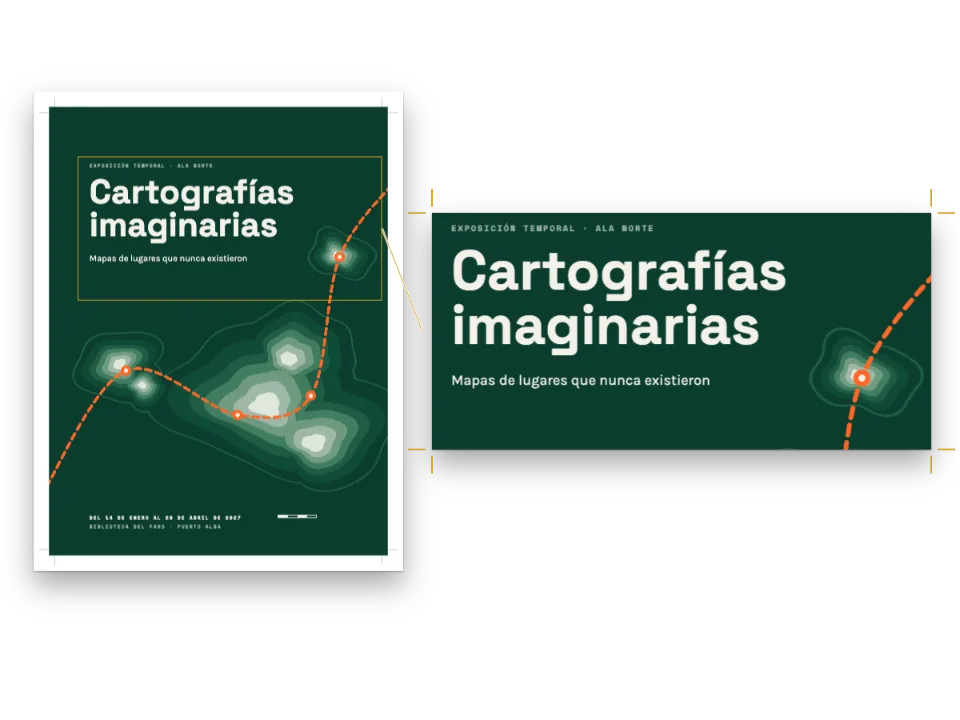
The detail type sets width: { value: 60, unit: 'mm' } with captionSide: 'inside'. A length is measured against its slot rather than shared out of it, so the 48 mm of canvas the crop shows print at 60 mm, 1.25 times their size, in any column or edition, and the caption can say so.
The whole recipe
// ═══ Postext Cookbook · Nº 183 · Art plates to the margins, the trim and the bleed ═════
// https://postext.dev/en/cookbook/art-plates-to-the-bleed
// Code: MIT · Text: original (CC BY 4.0) · Paintings: Rijksmuseum, The Met, NGA (CC0)
// Fonts: Spectral, Cormorant Garamond, Jost (SIL OFL 1.1) · Needs postext ≥ 1.73.0
// An exhibition essay on four interiors by Vermeer. Each painting is a full-page plate: two
// inside the margins, one to the trimmed edge, one out to the bleed. A detail prints 60 mm wide.
import {
  buildDocumentWithFonts, renderPageToCanvas, registerResourceImage,
} from 'https://esm.sh/postext';
import { renderToPdf, decompressWoff2 } from 'https://esm.sh/postext-pdf';

const LANG = 'en'; // @lang: the language of the sample document ('en' | 'es')
const RECIPE = 'art-plates-to-the-bleed';

// ─── 1 · Design ─────────────────────────────────────────────────────────────
// #region palette: a warm paper and ink, and the ultramarine of the Delft jackets
const palette = {
  ink: '#22201c', // text: a warm near-black
  accent: '#2c4a7c', // kicker, caption labels: the blue of the reading woman's jacket
  rule: '#c9bfae', // the opener's hairline
  muted: '#6b6359', // running heads, folios, credit lines
  paper: '#fbf9f4', // the page, and the band under a caption set over a plate
};
const col = (id) => ({ hex: palette[id], model: 'hex', paletteId: id });
const colorPalette = [
  ...Object.entries(palette).map(([id, hex]) => ({ id, name: id, value: { hex, model: 'hex' } })),
  // The engine's defaults link to 'main-color': pointed at the accent, no default blue shows.
  { id: 'main-color', name: 'accent (defaults)', value: { hex: palette.accent, model: 'hex' } },
];
// #endregion
const [TEXT, DISPLAY, LABEL] = ['Spectral', 'Cormorant Garamond', 'Jost'];
const [PAGE_W, PAGE_H, TOP, BOTTOM, INNER, OUTER] = [160, 195, 20, 22, 18, 24]; // mm
const BLEED = 3; // mm of picture past the trim on the bleed plate, and the crop marks' offset
const LEAD = 13.5; // body leading in pt
const at = (to, edge, x, y, size) => ({ anchor: { to, edge }, offset: { x: mm(x), y: mm(y) },
  ...(size && { size }) });
const caps = (size) => ({ fontWeight: 500, textTransform: 'uppercase',
  letterSpacing: pt(size * 0.2) });

// #region answer: a plate type, and how far each picture reaches
// Every plate stands alone on the first whole page after its citation, as large as the area
// allows. true (or 'content') keeps it inside the margins with its running heads; 'trim'
// covers the page to the cut, 'bleed' to the bleed. Those two crop the picture about its
// centre, put the caption on a band of paper at the foot, and drop the heads and the folio.
const plateType = { id: 'plate', name: t({ en: 'Plate', es: 'Lámina' }),
  shortLabel: t({ en: 'plate', es: 'lámina' }), captionPrefix: t({ en: 'Plate', es: 'Lámina' }),
  numberingTemplate: '{n}', resetOn: 'never', counterFormat: 'decimal',
  defaultPlacement: { plate: true, captionMeasure: 'body' } }; // the caption as wide as it
The composed script.js runs as it is: paste it into any page’s module script, or open the recipe on CodePen. Recipe folder on GitHub ↗ (opens in a new tab)
Variations
#Send every plate to the bleed
Give every painting the same reach: each plate then covers its page, without heads or folio, and only the cropping changes.
-const REACH = { milkmaid: 'content', pitcher: 'trim', letter: 'bleed', balance: 'content' };
+const REACH = { milkmaid: 'bleed', pitcher: 'bleed', letter: 'bleed', balance: 'bleed' };#Print the detail at actual size
Cut 60 mm of canvas from the museum file and keep the width: the caption then reads 1:1. At this painting's 1,666 ppi master any detail down to a few millimetres still clears 300 ppi.
Pitfalls
- A plate cited in the same paragraph as another waits for the page after it, since a page already holding a float is passed over, three at most.
ptandmmwidths work;pxandemare not read as a length, and the figure takes its whole slot.- A painting much wider than the page loses its sides on a trim or bleed plate. Keep landscapes inside the margins, where the whole picture shows.
Credits
- Recipe
- Ignacio Ferro
- Text
- The essay, the captions and the note on the plates · Postext Cookbook · CC BY 4.0
- Images
- Plate 1, Johannes Vermeer, The Milkmaid, c. 1660, Rijksmuseum SK-A-2344; the museum’s image reduced to 1,800 px high · Rijksmuseum, Amsterdam · CC0 1.0
- Plate 2, Johannes Vermeer, Young Woman with a Water Pitcher, c. 1662, The Met 89.15.21; the museum’s image, its unpainted edges cut off, reduced to 2,400 px high · The Metropolitan Museum of Art, New York (Open Access) · CC0 1.0
- Plate 3, Johannes Vermeer, Woman Reading a Letter, c. 1663, Rijksmuseum SK-C-251; the museum’s image reduced to 2,400 px high · Rijksmuseum, Amsterdam · CC0 1.0
- Plate 4, Johannes Vermeer, Woman Holding a Balance, c. 1664, National Gallery of Art 1942.9.97; the museum’s image reduced to 1,700 px high · National Gallery of Art, Washington (Open Access) · CC0 1.0
- Figure 1, a 48 × 63 mm detail of plate 4 cut from the museum’s full-resolution image and reduced to 800 px wide · National Gallery of Art, Washington (Open Access) · CC0 1.0
- Fonts
- Spectral (SIL OFL 1.1) · Cormorant Garamond (SIL OFL 1.1) · Jost (SIL OFL 1.1)
Edit this write-up ↗ (opens in a new tab)Recipe folder on GitHub ↗ (opens in a new tab)