In short
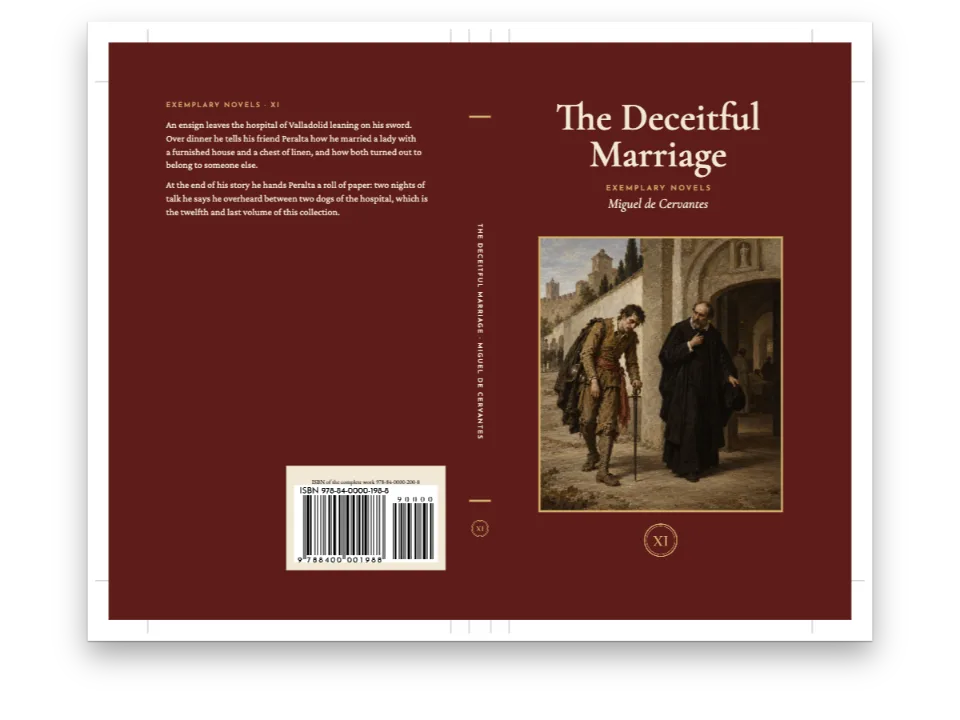
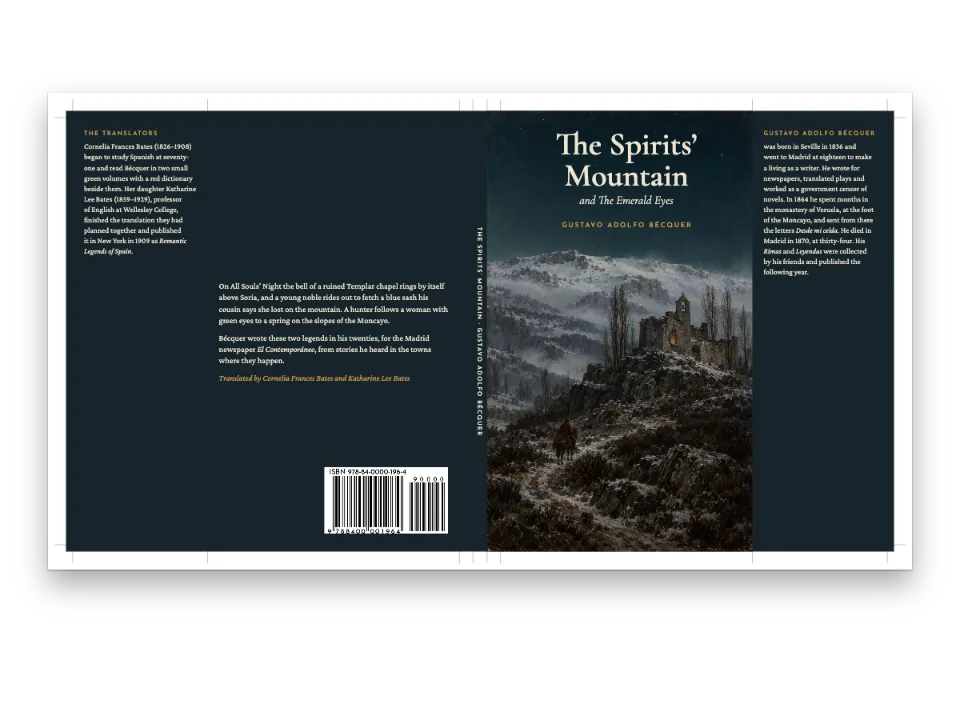
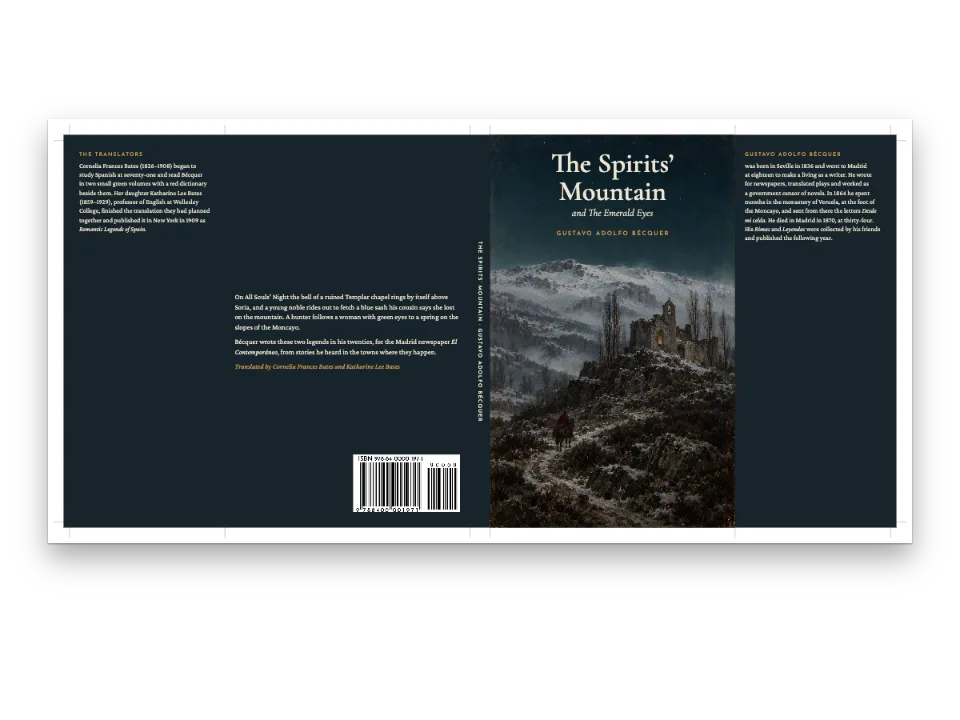
A small book of two stories by Edgar Allan Poe and the printer's sheet for its cover. Each text on the cover is placed under, above or against another, so a longer title moves the rest down and the back text carries on below a quotation.
What you'll build
Two tales by Edgar Allan Poe, "The Masque of the Red Death" and "The Oval Portrait" (the Spanish edition sets Carlos Olivera's translation of 1884), as a paperback of 125 × 195 mm, and its cover sheet. Every text on the cover is a text box without coordinates. On the front the title hangs from the top of the panel, the subtitle hangs under the title and the author stands on the foot. The title runs to two lines in both editions, so its box grows and the subtitle moves down with it. On the back the blurb fills a box of 50 mm, and the lines it cannot hold go on in a second box below a quotation from the tale. Above the pages the pen draws the sheet twice: as it prints, and with each box outlined and the chain marked.
This recipe answers
- How do I place the texts of a cover against each other, so a longer title pushes the rest down and the blurb runs on into a second box?
The short answer
// A box anchored to a zone stands on that point of the zone's safe area; a box anchored to
// another box hangs below it, above it or beside it. With an anchor, `rect` gives only the
// size. The title may grow to 40 mm before its type shrinks, and the blurb sends the lines
// it cannot hold to the box under the quotation.
const size = (width, height) => ({ x: 0, y: 0, width, height });
const textBoxes = [
  // Front: the title from the top of the panel, the subtitle hung under it, the author
  // standing on the foot. Only the title's box grows; the subtitle follows it down.
  { name: 'title', rect: size(100, 14), anchor: { to: 'front', edge: 'top', y: 8 },
    maxHeight: 40 },
  { name: 'subtitle', rect: size(100, 9), anchor: { to: 'title', edge: 'below', y: 2 } },
  { name: 'author', rect: size(100, 8), anchor: { to: 'front', edge: 'bottom', y: -6 } },
  // Back: the blurb, a quotation under it, and the rest of the blurb under the quotation.
  // What the blurb's 50 mm cannot hold goes on in `blurb-end`, cut between lines.
  { name: 'blurb', rect: size(94, 50), anchor: { to: 'back', edge: 'top', y: 6 },
    next: 'blurb-end' },
  { name: 'quote', rect: size(94, 24), anchor: { to: 'blurb', edge: 'below', y: 5 },
    verticalAlign: 'middle' },
  { name: 'blurb-end', rect: size(94, 46), anchor: { to: 'quote', edge: 'below', y: 5 } },
];
const cover = {
  background: col('night'),
  elements: [{ id: 'art', kind: 'image', zone: 'front', x: 0, y: -3, width: 128, height: 201,
    resourceId: 'masque', fit: 'cover' }],
  textBoxes,
};
Six text boxes placed against the panels and against each other
Ingredients
- Features
- Cover text boxesPrint cover sheetThreaded text framesPrint versions, ISBN and spineCovers, title pages and colophonsHeading stylesDesigned openersText, rules and boxes in page designsDocument metadataParagraph stylesRunning heads and foliosFigures and tables as resourcesSemantic colour palettePDF exportPages on a canvas
- Also uses
- Paper, binding, desk and light (Folio)Heading attributesPaper colourHeads by page roleFonts embedded in the PDFRunning heads per sectionUnnumbered chapters
- Type
- EB Garamond, Cinzel (SIL OFL 1.1)
- Assets
masque-1024.jpg- The cover painting: a masked ball in a file of coloured rooms under a Gothic vault, with an ebony clock and a figure in a grave-shroud, in oils (Generated With Diffusion Models, original)
Method
#1 · Each box hangs from a panel or from another box
The code is the short answer above. An anchor names a zone of the sheet or another text box, and a point. On a zone the point is one of the nine of its safe area, and the box puts the same point of its own there: edge: 'top' centres the title on the front and sets its top on the top of the safe area, edge: 'bottom' sets the author's foot on its foot. On a box the point can also be below, above, right-of or left-of. x and y move the box from that point, in mm. With an anchor, rect gives only the box's size, so the boxes keep their places when the spine grows or the book changes format.
#2 · The title grows and takes the subtitle down
const style = (id, fontFamily, size, lead, color, extra) => ({ id, fontFamily, fontSize: pt(size),
  lineHeight: pt(lead), color, italicColor: color, firstLineIndent: mm(0), textAlign: 'left',
  hyphenation: false, ...extra });
const mid = { textAlign: 'center' };
const caps = (tracking) => ({ fontWeight: 600, letterSpacing: pt(tracking) });
const coverStyles = [
  style('cover-title', 'Cinzel', 30, 33, col('bone'), { ...mid, fontWeight: 500 }),
  style('cover-subtitle', 'EB Garamond', 14, 18, col('gold'), { ...mid, italic: true }),
  style('cover-author', 'Cinzel', 10, 13, col('bone'), { ...mid, ...caps(2.2) }),
  style('cover-spine', 'Cinzel', 7, 8, col('bone'), { ...mid, ...caps(1.1) }),
  style('cover-blurb', 'EB Garamond', 10.5, 14.5, col('bone'), { textAlign: 'justify',
    hyphenation: true, firstLineIndent: mm(4) }),
  style('cover-blurb-first', 'EB Garamond', 10.5, 14.5, col('bone'), { textAlign: 'justify',
    hyphenation: true }),
  style('cover-quote', 'EB Garamond', 15, 19, col('gold'), { ...mid, italic: true }),
  style('cover-note', 'Cinzel', 7.5, 11, col('gold'), { ...caps(1.4), marginTop: pt(8) }),
];
The title is set in Cinzel at 30 pt on 33. Its box is 14 mm deep, one line. "The Masque of the Red Death" and "La máscara de la muerte" both need two, so the box grows with its text, up to the 40 mm of maxHeight, and only past that would the type shrink. The subtitle is anchored below the title, 2 mm under it, so it moves down by the depth of the second line. The author is anchored to the foot of the panel and stays where it is.
#3 · The blurb runs on in another box
The blurb box names next: 'blurb-end'. What it cannot hold is cut between lines and continues in that box, which takes no frame of its own in the cover Markdown. The quotation hangs under the blurb, and blurb-end under the quotation, so the three keep their spacing if the blurb box is made deeper. Only when the second box runs short too does the text of the chain shrink, as one, down to 90 % by default (fit.minScale). The line of gold small capitals is the last paragraph of the blurb's frame, so it closes the text in the second box:
:::frame{slot="front"}
:::

:::frame{slot="blurb"}
:::paragraphs{style="cover-blurb-first"}
While a plague empties his country, Prince Prospero shuts himself up …
:::

:::paragraphs{style="cover-note"}
From the Raven Edition of Poe's works
:::
:::
The empty front frame keeps out the title, subtitle and author buildCover would otherwise set on the front from the book's metadata: here the boxes set them.
#4 · A paperback with its spine from the pages
const production = {
  bindings: [{ id: 'pur', name: 'PUR perfect binding', style: 'perfect', signature: 16,
    measures: { bleed: 3, spineAllowance: 0.5 } }],
  versions: [{ id: 'paperback', name: t({ en: 'Paperback', es: 'Rústica' }), binding: 'pur',
    isbn: '978-84-0000-200-8', spineText: { minSpine: 4.5 } }],
};
const folio = { paper: { type: 'bookWove', grammage: 120, bulk: 2.2, shade: '#f8f3e8' } };
PUR perfect binding in 16-page signatures, on 120 g/m² wove at a bulk of 2.2. The book has 21 pages, 32 once bound, so the spine is about 4.7 mm, under the 6 mm a spine is lettered from by default; the version sets spineText.minSpine to 4.5 and the spine carries the title and the author. The ISBN is a sample number, assigned to no book.
#5 · The book block
const [W, H, TOP, FOOT, INNER, OUTER, LEAD] = [125, 195, 21, 23, 18, 16, 14.6]; // mm, pt
const at = (to, edge, x, y, box) => ({ anchor: { to, edge }, offset: { x: mm(x), y: mm(y) },
  ...(box && { size: box }) });
const text = (id, content, look, place) => ({ kind: 'text', id, content, align: 'center',
  overflow: 'wrap', placement: place, ...look });
const face = (fontFamily, size, color, x) => ({ fontFamily, fontSize: pt(size), color, ...x });
const label = (size, color = col('muted')) => face('Cinzel', size, color, caps(size / 6));
const titling = (size, extra) => face('Cinzel', size, col('ink'), { fontWeight: 500, ...extra });
const none = { header: { elements: [] }, footer: { elements: [] }, numbered: false, toc: false };
const design = (minHeight, elements) => ({ enabled: true, minHeight: mm(minHeight),
  slot: { elements } });
const page = (parity) => ({ breakBefore: { enabled: true, parity } });
const rule = (id, y, to = 'page') => ({ kind: 'rule', id, direction: 'horizontal',
  thickness: pt(0.6), color: col('accent'), placement: at(to, 'top', 0, y, { width: mm(12) }) });
const wide = { width: mm(84) };
const headingStyles = [
  { ...none, id: 'half-title', advancedDesign: design(60, [
    text('t', '{title}', titling(12), at('page', 'top', 0, 62, wide))]) },
  // The title runs to two lines at 22 pt in both editions; the subtitle sits under them.
  { ...none, ...page('odd'), id: 'title-page', advancedDesign: design(H - TOP - FOOT, [
    text('t', '{title}', titling(22, { lineHeight: pt(27) }), at('page', 'top', 0, 44, wide)),
    text('s', '{subtitle}', face('EB Garamond', 13, col('ink'), { italic: true }),
      at('page', 'top', 0, 67)),
    rule('r', 77),
    text('a', '{author}', label(8.5, col('accent')), at('page', 'top', 0, 82)),
    text('c', '{attr.credit}', face('EB Garamond', 10, col('muted'), { italic: true }),
      at('page', 'top', 0, 118, { width: mm(76) })),
    text('i', '{attr.imprint}', label(7.5), at('page', 'bottom', 0, -26)),
  ]) },
  { ...none, ...page('even'), id: 'rights',
    advancedDesign: design(90, [rule('r', 84, 'container')]) },
  // Each tale opens on a recto, sunk 50 mm, its title on one line of Cinzel over a short rule.
  { ...page('odd'), id: 'tale', toc: false, header: { elements: [] }, advancedDesign: design(50, [
    text('t', '{titleText}', titling(13.5, { letterSpacing: pt(0.6) }),
      at('container', 'top', 0, 24, { width: mm(W - INNER - OUTER) })),
    rule('r', 40, 'container')]) },
  { ...none, ...page('odd'), id: 'colophon', advancedDesign: design(70, [
    rule('r', 62, 'container')]) },
];
const head = (id, content, parity) => text(id, content, { ...label(6.6), parity, pages: 'body' },
  at('page', 'top', 0, 11));
Half title, title page and rights, then each tale on a recto, sunk 50 mm, under its title in Cinzel and a short red rule. The running heads carry the author on the verso and the tale's title on the recto, and the colophon closes the book on the last recto.
#6 · The sheet is built from the laid-out pages
const built = buildCover({ config, version: 'paperback', pages: book.pages, markdown: coverText,
  metadata: book.metadata, resources });
if (!('config' in built)) throw new Error(built.issues.map((i) => i.kind).join(', '));
// The barcode's digits name OCR-B, which no font server has: the label face sets them.
for (const [id, bytes] of Object.entries(built.files)) {
  await loadSvg(id, new TextDecoder().decode(bytes)
    .replace(/font-family="[^"]*"/g, 'font-family="Cinzel"'));
}
const sheet = await buildDocumentWithFonts(built.content, built.config, kitFonts(FONTS));
buildCover takes the pages, the metadata and the cover Markdown and returns a document whose one page is the sheet. The text boxes become frames of that page, laid out like the frames of a composed page. The barcode's digits ask for OCR-B, which no font server has, so the pen sets them in Cinzel.
#7 · Where each box ended up
// Each text box comes back as a frame of the sheet's composed page, with the rect it was
// given after anchoring and growing, and `continuesTo` when its text goes on elsewhere.
const leaf = sheet.pages[0];
const scale = 1100 / leaf.width;
const names = new Set(textBoxes.map((b) => b.name));
const frames = (leaf.composed?.frames ?? []).filter((f) => names.has(f.name));
const views = document.createElement('section');
views.id = 'box-views';
views.style.cssText = 'display: grid; gap: 18px; '
  + 'grid-template-columns: repeat(auto-fit, minmax(300px, 600px)); justify-content: center; '
  + 'padding: 24px 16px; color: #ddd; font: 14px sans-serif';
for (const [mode, name] of [['flat', t({ en: 'As it prints', es: 'Como se imprime' })],
  ['boxes', t({ en: 'The text boxes', es: 'Las cajas de texto' })]]) {
  const [figure, canvas, caption] = ['figure', 'canvas', 'figcaption']
    .map((tag) => document.createElement(tag));
  figure.style.cssText = 'margin: 0; min-width: 0';
  canvas.setAttribute('role', 'img');
  canvas.setAttribute('aria-label', `${t({ en: 'The cover sheet', es: 'El pliego' })}: ${name}`);
  renderPageToCanvas(leaf, sheet, canvas, { scale });
  if (mode === 'boxes') {
    // Each box outlined and named; a chain drawn from the foot of a box to its next.
    const ctx = canvas.getContext('2d');
    ctx.setTransform(scale, 0, 0, scale, 0, 0);
    ctx.lineWidth = 2 / scale;
    ctx.font = `${13 / scale}px sans-serif`;
    for (const f of frames) {
      const { x, y, width, height } = f.rect;
      ctx.strokeStyle = ctx.fillStyle = '#f2c14e';
      ctx.setLineDash([8 / scale, 5 / scale]);
      ctx.strokeRect(x, y, width, height);
      ctx.setLineDash([]);
      // The name on a dark tab over the box's top-left corner, clear of the text.
      const tab = ctx.measureText(f.name).width + 10 / scale;
      ctx.fillStyle = '#141117';
      ctx.fillRect(x, y - 18 / scale, tab, 18 / scale);
      ctx.fillStyle = '#f2c14e';
      ctx.fillText(f.name, x + 5 / scale, y - 5 / scale);
      const next = frames.find((g) => g.id === f.continuesTo);
      if (next) {
        ctx.strokeStyle = '#ff7a59';
        // Out of the box's foot, down its right side, into the top of the next.
        const side = Math.max(x + width, next.rect.x + next.rect.width) + 14 / scale;
        ctx.beginPath();
        ctx.moveTo(x + width - 20 / scale, y + height);
        ctx.lineTo(side, y + height);
        ctx.lineTo(side, next.rect.y);
        ctx.lineTo(next.rect.x + next.rect.width - 20 / scale, next.rect.y);
        ctx.stroke();
      }
    }
  }
  // After the render, which sizes the canvas in CSS pixels: the column sets its width.
  canvas.style.cssText = 'display: block; width: 100%; height: auto';
  caption.textContent = name;
  figure.append(canvas, caption);
  views.append(figure);
}
document.getElementById('pages').before(views);
The sheet's page comes back with its frames in page.composed.frames, each with the rect the layout gave it after anchoring and growing, and continuesTo when its text goes on in another frame. The second view outlines the six boxes over the sheet and draws the chain from the foot of the blurb to the top of blurb-end.
The whole recipe
// ═══ Postext Cookbook · Nº 200 · Cover text boxes anchored, chained and grown ══════════════
// https://postext.dev/en/cookbook/cover-text-boxes-anchored
// Code: MIT · Text: E. A. Poe, tr. C. Olivera (public domain) · Art: diffusion models
// Fonts: EB Garamond, Cinzel (SIL OFL 1.1) · Needs postext ≥ 1.93.0
//
// Two of Poe's tales as a small paperback, and its cover sheet set from six text boxes.
// None of them has coordinates: each hangs from a panel of the sheet or from another box,
// so a title that runs to two lines takes the subtitle down with it, and the blurb on the
// back runs on under a quotation into a second box.
import { buildDocumentWithFonts, renderPageToCanvas, registerResourceImage, inlineSvgFonts }
  from 'https://esm.sh/postext';
import { buildCover } from 'https://esm.sh/postext/production';
import { renderToPdf, decompressWoff2 } from 'https://esm.sh/postext-pdf';

const LANG = 'en'; // @lang: the language of the sample document ('en' | 'es')
const RECIPE = 'cover-text-boxes-anchored';

// ─── 1 · Design ─────────────────────────────────────────────────────────────
// The pages' four colours, then the cover's: a night ground, bone type, a dull gold.
const palette = { ink: '#231f1c', accent: '#8e2219', muted: '#6a625a', paper: '#faf6ee',
  night: '#141117', bone: '#ece3cf', gold: '#c9a66b' };
const col = (id) => ({ hex: palette[id], model: 'hex', paletteId: id });
const colorPalette = [
  ...Object.entries(palette).map(([id, hex]) => ({ id, name: id, value: { hex, model: 'hex' } })),
  { id: 'main-color', name: 'accent (defaults)', value: { hex: palette.accent, model: 'hex' } },
];

// #region answer: six text boxes placed against the panels and against each other
// A box anchored to a zone stands on that point of the zone's safe area; a box anchored to
// another box hangs below it, above it or beside it. With an anchor, `rect` gives only the
// size. The title may grow to 40 mm before its type shrinks, and the blurb sends the lines
// it cannot hold to the box under the quotation.
const size = (width, height) => ({ x: 0, y: 0, width, height });
const textBoxes = [
  // Front: the title from the top of the panel, the subtitle hung under it, the author
  // standing on the foot. Only the title's box grows; the subtitle follows it down.
  { name: 'title', rect: size(100, 14), anchor: { to: 'front', edge: 'top', y: 8 },
    maxHeight: 40 },
  { name: 'subtitle', rect: size(100, 9), anchor: { to: 'title', edge: 'below', y: 2 } },
  { name: 'author', rect: size(100, 8), anchor: { to: 'front', edge: 'bottom', y: -6 } },
  // Back: the blurb, a quotation under it, and the rest of the blurb under the quotation.
  // What the blurb's 50 mm cannot hold goes on in `blurb-end`, cut between lines.
  { name: 'blurb', rect: size(94, 50), anchor: { to: 'back', edge: 'top', y: 6 },
    next: 'blurb-end' },
  { name: 'quote', rect: size(94, 24), anchor: { to: 'blurb', edge: 'below', y: 5 },
    verticalAlign: 'middle' },
  { name: 'blurb-end', rect: size(94, 46), anchor: { to: 'quote', edge: 'below', y: 5 } },
];
The composed script.js runs as it is: paste it into any page’s module script, or open the recipe on CodePen. Recipe folder on GitHub ↗ (opens in a new tab)
Variations
#Hang the author under the subtitle
The author then follows the title down too, instead of standing on the foot of the panel.
-  { name: 'author', rect: size(100, 8), anchor: { to: 'front', edge: 'bottom', y: -6 } },
+ { name: 'author', rect: size(100, 8), anchor: { to: 'subtitle', edge: 'below', y: 6 } },#Shrink a long title onto one line
Without maxHeight the title box keeps its 14 mm, and the ladder sets the title smaller until it fits: here on one line, at about two thirds of its size.
   { name: 'title', rect: size(100, 14), anchor: { to: 'front', edge: 'top', y: 8 },
-    maxHeight: 40 },
+ fit: { minScale: 0.6 } },Pitfalls
- A box that another box's
nextnames takes the text that box passes on. Give it no frame of its own in the cover Markdown, and end the first box's frame with whatever should close the text, as the note here. - An anchor that names nothing, names the box itself or closes a loop is reported, and the box stands on its
rect. Give every anchored box arectwith a real size. maxHeightdoes not apply to a turned box (rotate), which keeps the size of itsrect.
Credits
- Recipe
- Ignacio Ferro
- Text
- The Masque of the Red Death and The Oval Portrait, from The Works of Edgar Allan Poe (Raven Edition, 1903), Project Gutenberg eBooks #2148 and #2147 · Edgar Allan Poe · public domain
- La máscara de la muerte and El retrato oval, translated by Carlos Olivera, from Novelas y cuentos (Garnier Hermanos, Paris, 1884), as transcribed on Wikisource, spelling and punctuation modernised · Carlos Olivera · public domain
- Images
- The cover painting: a masked ball in a file of coloured rooms under a Gothic vault, with an ebony clock and a figure in a grave-shroud, in oils · Generated With Diffusion Models · original
- Fonts
- EB Garamond (SIL OFL 1.1) · Cinzel (SIL OFL 1.1)
Edit this write-up ↗ (opens in a new tab)Recipe folder on GitHub ↗ (opens in a new tab)