In short
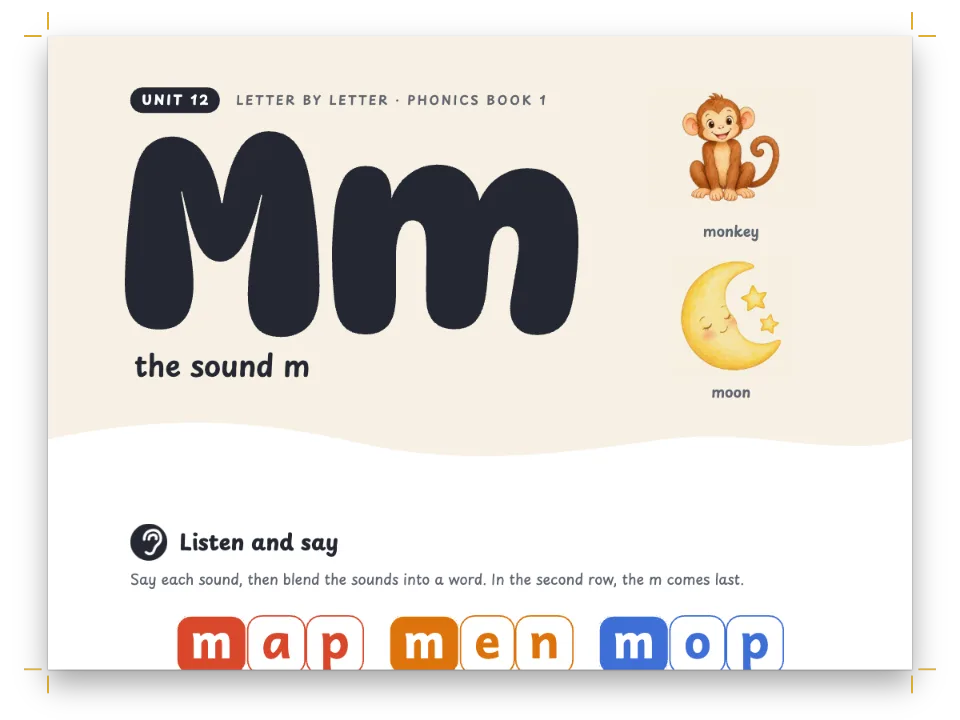
A children's handwriting book made ten times, once per language. Each lesson shows a word written out, then in dots to go over, then empty lines, in the joined letters and lined paper of that country's schools.
What you'll build
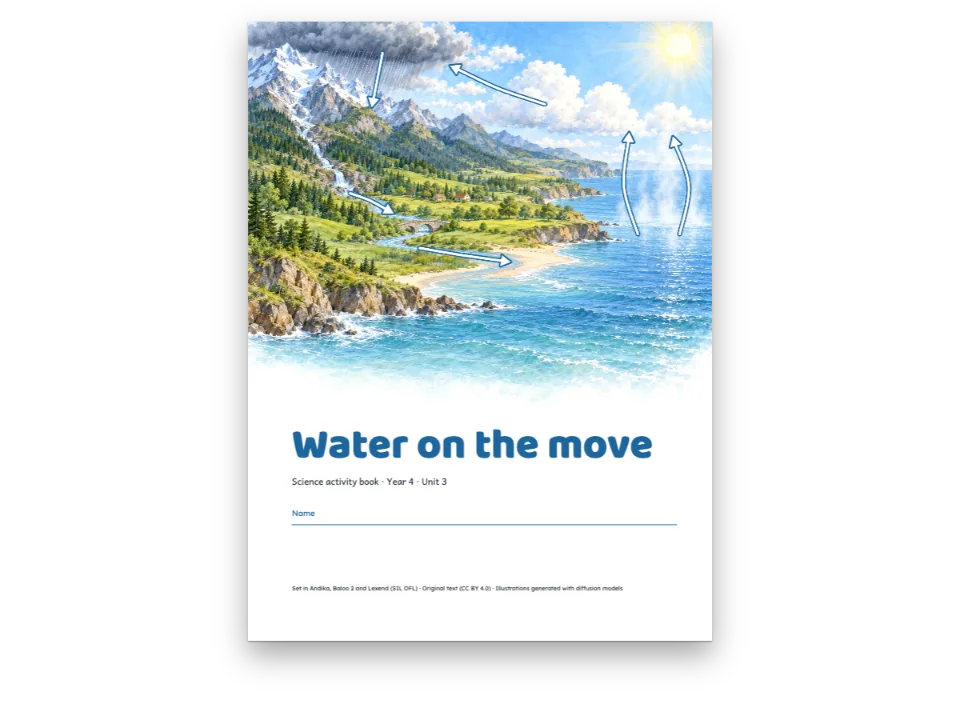
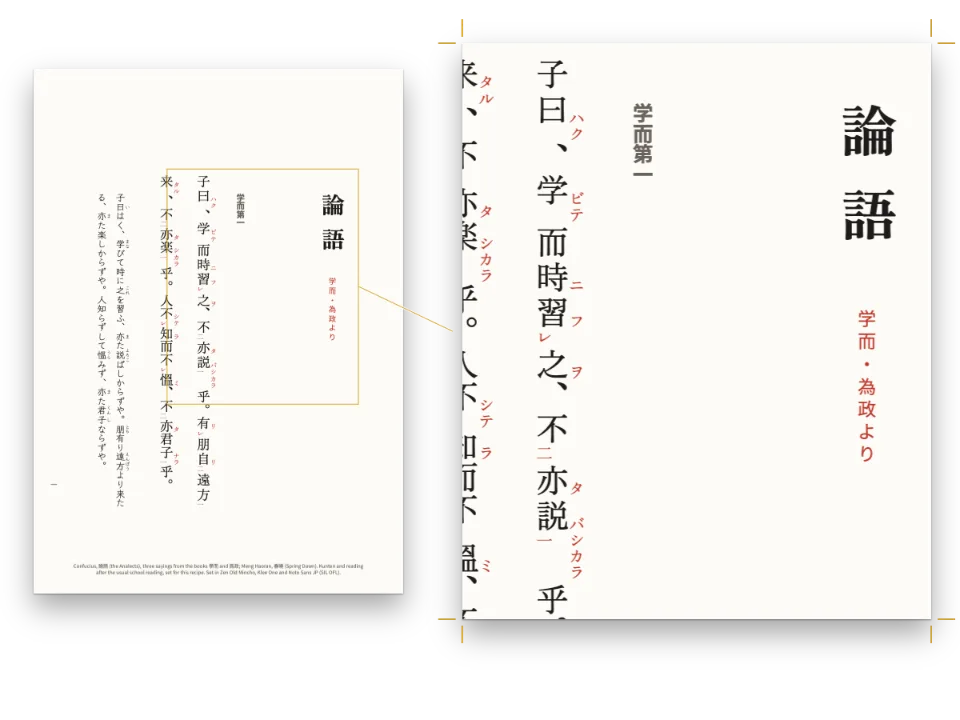
Twelve pages of a first-year handwriting book on A4, in ten editions that are ten different books. Each language gets the joined script its schools teach, from Google's Playwrite families (GB J, ES, FR Trad, DE VA, IT Trad, BR) or Playpen Sans Arabic, on the paper its children write on: the Spanish pauta, French Seyès squares with a red margin, the German Lineatur with its yellow middle band, Brazilian caligrafia lines. The Chinese edition writes in 田字格 squares, where children trace pale red characters (描红), with pinyin on four lines; the Japanese one in マス squares with a dotted cross, tracing in grey (なぞり書き). The lessons follow each spelling: ñ and the silent h in Spanish, l·l in Catalan, ß and capital nouns in German, the particles は, を and へ in Japanese, the four forms of a letter and the letters that do not join in Arabic. Every row goes from a model to dots to nothing. Twenty-nine paintings, generated with a diffusion model, are shared by all editions.
This recipe answers
- How do I make a handwriting workbook: a model, dotted letters to trace and empty lines, on each country's school ruling?
- How do I build a worksheet page: fill-in lines, answer boxes, word banks, checklists?
The short answer
// ### Repasa y escribe {w="nina" model="niña"} draws four rows on the edition's ruling: the
// model and dotted copies, a row of dots, the model and one copy, and an empty row. The
// ruling and the dots are one picture per block ('trazo-' + w, drawn under #region art); the
// models are live text set on its baselines. A design text's baseline falls 0.8 of its line
// below the box top, so a box of line L set at baseline − 0.8 L puts the letters on the line.
const G = CJK ? null : geometry(ED.ruling, ED.u); // rows, baselines and the face's size
const LABEL_H = 7; // mm: the block's label above its ruling
const model = (id, row, extra = {}) => text(id, '{attr.model}', HAND, G.size / 0.3528,
  at('container', 'top-left', 0, LABEL_H + G.base[row] - 0.8 * G.line,
    { width: mm(W) }), { lineHeight: mm(G.line), overflow: 'clip', ...extra });
const wordBlock = (rows, again = true) => ({ enabled: true,
  minHeight: mm(LABEL_H + G.height(rows)), slot: { elements: [label('label'),
    image('trazo', 'trazo-{attr.w}', at('container', 'top-left', 0, LABEL_H,
      box(W, G.height(rows)))),
    model('model-1', 0),
    ...(again ? [model('model-3', 2)] : []), // a sentence is written out once
  ] } });
A practice block: the model in the school face, then dots, then nothing
Ingredients
- Features
- Designed openersHeading attributesPictures in page designsHeading stylesCovers, title pages and colophonsText, rules and boxes in page designsInline chipsCallout boxesSemantic colour paletteHyphenation and document languageHeads by page roleMirrored marginsArabic fontsChinese, Japanese and Korean fontsBooks bound on the rightRight-to-left textKana, kanji and rōmajiPages on a canvasPDF export
- Also uses
- Fonts embedded in the PDFCustom resource typesFigures and tables as resourcesRunning heads per section
- Type
- Andika, Lexend, Playwrite GB J, Playwrite ES, Playwrite FR Trad, Playwrite DE VA, Playwrite IT Trad, Playwrite BR, LXGW WenKai TC, Noto Serif SC, Noto Sans SC, Klee One, Zen Maru Gothic, Playpen Sans Arabic, Noto Naskh Arabic, Baloo Bhaijaan 2 (SIL OFL 1.1)
- Assets
apple-480.jpgbee-480.jpgbird-480.jpgboat-480.jpgbutterfly-480.jpgcake-480.jpgcat-480.jpgcover-1600.jpgdog-480.jpgduck-480.jpgfire-480.jpgfish-480.jpgflower-480.jpggrip-480.jpghouse-480.jpgicecream-480.jpgkey-480.jpgkite-480.jpgmedal-480.jpgmoon-480.jpgmountain-480.jpgowl-480.jpgpenguin-480.jpgshoe-480.jpgspider-480.jpgsun-480.jpgtraces-ar.jsontraces-ca.jsontraces-de.jsontraces-en.jsontraces-es.jsontraces-fr.jsontraces-it.jsontraces-pt.jsontree-480.jpgumbrella-480.jpgwater-480.jpg- Two children writing in notebooks at a school table, a cat asleep on a chair beside them. (Generated With Diffusion Models, original)
- A smiling sun. (Generated With Diffusion Models, original)
- A crescent moon with three stars. (Generated With Diffusion Models, original)
- A ginger cat sitting. (Generated With Diffusion Models, original)
- A brown and white puppy. (Generated With Diffusion Models, original)
- An orange fish with blue stripes. (Generated With Diffusion Models, original)
- A honey bee flying. (Generated With Diffusion Models, original)
- A little black spider on a thread. (Generated With Diffusion Models, original)
- A red apple. (Generated With Diffusion Models, original)
- A golden key. (Generated With Diffusion Models, original)
- A red child's shoe. (Generated With Diffusion Models, original)
- A small house with a red roof. (Generated With Diffusion Models, original)
- A small sailing boat. (Generated With Diffusion Models, original)
- A yellow duckling. (Generated With Diffusion Models, original)
- A colourful kite. (Generated With Diffusion Models, original)
- A birthday cake with three candles. (Generated With Diffusion Models, original)
- A penguin. (Generated With Diffusion Models, original)
- An owl on a branch. (Generated With Diffusion Models, original)
- A red umbrella in the rain. (Generated With Diffusion Models, original)
- An ice-cream cone with two scoops. (Generated With Diffusion Models, original)
- A blue and orange butterfly. (Generated With Diffusion Models, original)
- A leafy tree. (Generated With Diffusion Models, original)
- A snowy mountain. (Generated With Diffusion Models, original)
- A daisy. (Generated With Diffusion Models, original)
- A small blue bird on a twig. (Generated With Diffusion Models, original)
- Splashing water. (Generated With Diffusion Models, original)
- A small campfire. (Generated With Diffusion Models, original)
- A child's hand holding a pencil with the tripod grip. (Generated With Diffusion Models, original)
- A golden star medal with coloured pencils. (Generated With Diffusion Models, original)
- The dotted letters of the en edition, traced along the outlines of Playwrite GB J Thin. (Ignacio Ferro, original)
- The dotted letters of the es edition, traced along the outlines of Playwrite ES Thin. (Ignacio Ferro, original)
- The dotted letters of the ca edition, traced along the outlines of Playwrite ES Thin. (Ignacio Ferro, original)
- The dotted letters of the fr edition, traced along the outlines of Playwrite FR Trad Thin. (Ignacio Ferro, original)
- The dotted letters of the de edition, traced along the outlines of Playwrite DE VA Thin. (Ignacio Ferro, original)
- The dotted letters of the it edition, traced along the outlines of Playwrite IT Trad Thin. (Ignacio Ferro, original)
- The dotted letters of the pt edition, traced along the outlines of Playwrite BR Thin. (Ignacio Ferro, original)
- The dotted letters of the ar edition, traced along the outlines of Playpen Sans Arabic Thin. (Ignacio Ferro, original)
Method
#1 · Give each edition its school script and its paper
// hand: the school model the children copy; ruling: the paper they copy it on; u: its
// x-height in mm (the height of an a), the unit every ruling is drawn in; rise: the room its
// capitals need above a title. The Chinese text is in Song: the Kai face, cut for Hong Kong
// and Taiwan, centres its commas, so it sets only the titles and the squares.
const EDITIONS = {
  en: { hand: 'Playwrite GB J', ruling: 'gb', u: 3.6 },
  es: { hand: 'Playwrite ES', ruling: 'pauta', u: 3.6 },
  ca: { hand: 'Playwrite ES', ruling: 'pauta', u: 3.6 },
  fr: { hand: 'Playwrite FR Trad', ruling: 'seyes', u: 3, rise: 5 },
  de: { hand: 'Playwrite DE VA', ruling: 'lineatur', u: 3.6 },
  it: { hand: 'Playwrite IT Trad', ruling: 'righe', u: 3.6 },
  pt: { hand: 'Playwrite BR', ruling: 'caligrafia', u: 3.2 },
  zh: { hand: 'LXGW WenKai TC', ruling: 'tian', text: 'Noto Serif SC',
    label: 'Noto Sans SC', pinyin: 'Andika', cell: 16 },
  ja: { hand: 'Klee One', ruling: 'masu', text: 'Klee One', label: 'Zen Maru Gothic', cell: 16 },
  ar: { hand: 'Playpen Sans Arabic', ruling: 'satr', u: 3.6,
    text: 'Noto Naskh Arabic', label: 'Baloo Bhaijaan 2' },
};
const ED = { text: 'Andika', label: 'Lexend', rise: 0, ...EDITIONS[LANG] };
const [HAND, TEXT, LABEL] = [ED.hand, ED.text, ED.label];
const CJK = ED.cell !== undefined; // a grid of squares, one character to each
const RTL = LANG === 'ar';
const LW = CJK ? 700 : 600; // the labels' weight: the CJK label faces ship no 600
// Labels in tracked capitals, where the script has capitals.
const caps = (n) => (!CJK && !RTL ? { textTransform: 'uppercase', letterSpacing: pt(n) } : {});
u is the x-height in millimetres, the unit every ruling is drawn in: 3.6 mm for most editions, 3 mm for French, whose Seyès lines are one x-height apart. The Playwrite faces all draw their x-height at half the em, so the model's size is u / 0.5, and the ruling's lines fall where the face's own proportions put its ascenders and descenders. The Chinese text is set in Song (Noto Serif SC): LXGW WenKai TC centres its commas the way Hong Kong and Taiwan print them, so the Kai face sets only the titles and the squares.
#2 · Set the model on the ruling, live
// ### Repasa y escribe {w="nina" model="niña"} draws four rows on the edition's ruling: the
// model and dotted copies, a row of dots, the model and one copy, and an empty row. The
// ruling and the dots are one picture per block ('trazo-' + w, drawn under #region art); the
// models are live text set on its baselines. A design text's baseline falls 0.8 of its line
// below the box top, so a box of line L set at baseline − 0.8 L puts the letters on the line.
const G = CJK ? null : geometry(ED.ruling, ED.u); // rows, baselines and the face's size
const LABEL_H = 7; // mm: the block's label above its ruling
const model = (id, row, extra = {}) => text(id, '{attr.model}', HAND, G.size / 0.3528,
  at('container', 'top-left', 0, LABEL_H + G.base[row] - 0.8 * G.line,
    { width: mm(W) }), { lineHeight: mm(G.line), overflow: 'clip', ...extra });
const wordBlock = (rows, again = true) => ({ enabled: true,
  minHeight: mm(LABEL_H + G.height(rows)), slot: { elements: [label('label'),
    image('trazo', 'trazo-{attr.w}', at('container', 'top-left', 0, LABEL_H,
      box(W, G.height(rows)))),
    model('model-1', 0),
    ...(again ? [model('model-3', 2)] : []), // a sentence is written out once
  ] } });
A practice block is a level-3 heading whose design draws one picture, the ruling with the dotted copies, and sets the model on it as text in the school face. A design text's baseline falls at 0.8 of its line height below the top of its box, so the model's box is placed at the row's baseline minus 0.8 of its line, and the letters stand on the line the ruling draws. The line is ten x-heights tall so that the box's clip falls 2 u below the baseline, deep enough for the tail of a g. The heading's text, Trace and write, becomes the block's label; w names the picture and model the word.
#3 · Draw the dots from the face's own outlines
Postext sets a letter in colour, outlined or pale, but it cannot draw it as a row of dots along its stroke. The dots are drawn before the book is set, from the outlines of each Playwrite family's Thin cut: points every 0.2 x-height along each contour, a point kept only when no other lies within 0.8 of that pitch, so the two sides of a thin stroke give a single row. The dot of an i or an accent stays a small filled shape. Each edition's dots, with the copy's and the model's advances, are in traces-<lang>.json, and the pen lays the copies along the rows: after the model, across a whole row, one after the model, and an empty row last.
#4 · Trace characters in their squares
// ### 写一写 {c1="日" c2="月"}: each character in the first square of its row, three copies to
// trace in the pale red (描红) or grey (なぞり書き) of the next squares, then empty ones. A
// Han or kana character is one em wide, so tracking of (square − em) sets one per square.
const [CELL, EM] = [ED.cell ?? 16, (ED.cell ?? 16) * 0.72]; // mm: the square, its character
const SQUARES = Math.floor(W / CELL);
const row = (n, y, content, x, color) => text(`r${n}-${x}`, content, HAND, EM / 0.3528,
  at('container', 'top-left', x * CELL + (CELL - EM) / 2, y + (CELL - EM) / 2 + EM * 0.06,
    box(W - x * CELL, EM)),
  { lineHeight: mm(EM), letterSpacing: mm(CELL - EM), overflow: 'clip', color: col(color) });
// A sentence (####) takes three rows: written out, traced, and a row to write it alone.
const squareBlock = (rows, sentence) => ({ enabled: true, minHeight: mm(LABEL_H + rows * CELL),
  slot: { elements: [label('label'), image('grid', `squares-${rows}`,
    at('container', 'top-left', 0, LABEL_H, box(SQUARES * CELL, rows * CELL))),
  ...(sentence ? [row(0, LABEL_H, '{attr.model}', 0, 'ink'),
    row(1, LABEL_H + CELL, '{attr.model}', 0, 'trace')] : Array.from({ length: rows }, (_, n) => [
    row(n, LABEL_H + n * CELL, `{attr.c${n + 1}}`, 0, 'ink'),
    row(n, LABEL_H + n * CELL, `{attr.c${n + 1}}{attr.c${n + 1}}{attr.c${n + 1}}`, 1, 'trace'),
  ]).flat()),
  ] } });
// Pinyin on four lines and three spaces (四线三格), ##### {model="bā"}: the syllable, copies
// to trace in the pale red, the syllable again and room after it.
const P = ED.pinyin ? geometry('sixian', 3.6) : null;
const pinyin = (id, n, x, content, color) => text(id, content, ED.pinyin, P.size / 0.3528,
  at('container', 'top-left', x, LABEL_H + P.base[n] - 0.8 * P.line, { width: mm(W - x) }),
  { lineHeight: mm(P.line), overflow: 'clip', color: col(color) });
const copies = Array(5).fill('{attr.model}').join('\u00a0\u00a0\u00a0\u00a0');
const pinyinBlock = P && { enabled: true, minHeight: mm(LABEL_H + P.height(3)),
  slot: { elements: [label('label'),
    image('lines', 'sixian', at('container', 'top-left', 0, LABEL_H,
      box(W, P.height(3)))),
    pinyin('p1', 0, 0, '{attr.model}', 'ink'), pinyin('p1-copies', 0, 36, copies, 'trace'),
    pinyin('p2', 1, 0, copies, 'trace'), pinyin('p3', 2, 0, '{attr.model}', 'ink'),
  ] } };
A Han character or a kana is one em wide, so tracking of the square minus the em sets one character per square, as in a 字帖. The first square of a row holds the character in ink, the next three the same character in the pale red of 描红 (grey in the Japanese edition), and the rest stay empty. A sentence (####) takes three rows: written out, traced, then empty, with the punctuation in a square of its own. The Chinese pinyin rows use the four-line ruling of the Latin editions with Andika, whose single-storey a and g are the ones children learn.
#5 · Mirror nothing for Arabic
The Arabic edition shares every design with the others. A heading design laid in the flow of a right-to-left page is mirrored by the engine, so the letter disc, the model and the dictionary's first picture move to the right by themselves; only the dotted copies, drawn inside a picture, are laid from the right edge in code, and the warm-up waves run from right to left. locale: 'ar' binds the book on the right.
The whole recipe
// ═══ Postext Cookbook · Nº 161 · Handwriting workbook in ten scripts ═══════════════ // https://postext.dev/en/cookbook/handwriting-workbook // Code: MIT · Text: original (CC BY 4.0) · Pictures: generated with diffusion models // Fonts: Playwrite, Playpen Sans Arabic, Klee One and others (SIL OFL) · Needs postext ≥ 1.42.1 import { buildDocument, withLoadedFonts, renderPageToCanvas, registerResourceImage, } from 'https://esm.sh/postext'; import { renderToPdf, decompressWoff2 } from 'https://esm.sh/postext-pdf'; const LANG = 'en'; // @lang: the language of the workbook (en es ca fr de it pt zh ja ar) const RECIPE = 'handwriting-workbook'; // ─── 1 · Design ───────────────────────────────────────────────────────────── // #region palette: a navy ink, one coral accent, the sun and the pale fields of the bands const palette = { ink: '#22304a', // text and the models accent: '#bf4630', // kickers, labels, folios sun: '#f4b73f', // the boxes' stripe tint: '#fdf0da', // opener bands, boxes rule: '#7f9ccc', // the ruling dots: '#4d5b76', // the dotted letters trace: LANG === 'ja' ? '#b4bccb' : '#e7a9a0', // traced over: 描红 in red, なぞり書き in grey paper: '#ffffff', }; const col = (id) => ({ hex: palette[id], model: 'hex', paletteId: id }); const colorPalette = [ ...Object.entries(palette).map(([id, hex]) => ({ id, name: id, value: { hex, model: 'hex' } })), { id: 'main-color', name: 'accent (defaults)', value: { hex: palette.accent, model: 'hex' } }, ]; // #endregion // #region editions: each language its school's script, its ruling and its faces // hand: the school model the children copy; ruling: the paper they copy it on; u: its // x-height in mm (the height of an a), the unit every ruling is drawn in; rise: the room its // capitals need above a title. The Chinese text is in Song: the Kai face, cut for Hong Kong // and Taiwan, centres its commas, so it sets only the titles and the squares. const EDITIONS = { en: { hand: 'Playwrite GB J', ruling: 'gb', u: 3.6 }, es: { hand: 'Playwrite ES', ruling: 'pauta', u: 3.6 }, ca: { hand: 'Playwrite ES', ruling: 'pauta', u: 3.6 }, fr: { hand: 'Playwrite FR Trad', ruling: 'seyes', u: 3, rise: 5 }, de: { hand: 'Playwrite DE VA', ruling: 'lineatur', u: 3.6 }, it: { hand: 'Playwrite IT Trad', ruling: 'righe', u: 3.6 }, pt: { hand: 'Playwrite BR', ruling: 'caligrafia', u: 3.2 }, zh: { hand: 'LXGW WenKai TC', ruling: 'tian', text: 'Noto Serif SC', label: 'Noto Sans SC', pinyin: 'Andika', cell: 16 }, ja: { hand: 'Klee One', ruling: 'masu', text: 'Klee One', label: 'Zen Maru Gothic', cell: 16 }, ar: { hand: 'Playpen Sans Arabic', ruling: 'satr', u: 3.6, text: 'Noto Naskh Arabic', label: 'Baloo Bhaijaan 2' }, }; const ED = { text: 'Andika', label: 'Lexend', rise: 0, ...EDITIONS[LANG] }; const [HAND, TEXT, LABEL] = [ED.hand, ED.text, ED.label]; const CJK = ED.cell !== undefined; // a grid of squares, one character to each const RTL = LANG === 'ar'; const LW = CJK ? 700 : 600; // the labels' weight: the CJK label faces ship no 600 // Labels in tracked capitals, where the script has capitals. const caps = (n) => (!CJK && !RTL ? { textTransform: 'uppercase', letterSpacing: pt(n) } : {}); // #endregion const W = 176; // mm: the type area's width, and every practice block's // A design laid in the flow of a right-to-left page is mirrored by the engine, so 'left' is // the start side in every edition: the Arabic book needs no coordinates of its own. const box = (width, height) => ({ width: mm(width), height: mm(height) }); const at = (to, edge, x = 0, y = 0, size) => ({ anchor: { to, edge }, offset: { x: mm(x), y: mm(y) }, ...(size && { size }) }); const text = (id, content, fontFamily, size, placement, extra = {}) => ({ kind: 'text', id, content, fontFamily, fontSize: pt(size), color: col('ink'), align: 'left', placement, ...extra }); const image = (id, resourceId, placement) => ({ kind: 'image', id, resourceId, placement, decorative: true }); const label = (id) => text(id, '{titleText}', LABEL, 9, at('container', 'top-left'), { fontWeight: LW, color: col('accent'), ...caps(1.2) }); // #region answer: a practice block: the model in the school face, then dots, then nothing // ### Repasa y escribe {w="nina" model="niña"} draws four rows on the edition's ruling: the // model and dotted copies, a row of dots, the model and one copy, and an empty row. The // ruling and the dots are one picture per block ('trazo-' + w, drawn under #region art); the // models are live text set on its baselines. A design text's baseline falls 0.8 of its line // below the box top, so a box of line L set at baseline − 0.8 L puts the letters on the line. const G = CJK ? null : geometry(ED.ruling, ED.u); // rows, baselines and the face's size const LABEL_H = 7; // mm: the block's label above its ruling const model = (id, row, extra = {}) => text(id, '{attr.model}', HAND, G.size / 0.3528, at('container', 'top-left', 0, LABEL_H + G.base[row] - 0.8 * G.line, { width: mm(W) }), { lineHeight: mm(G.line), overflow: 'clip', ...extra }); const wordBlock = (rows, again = true) => ({ enabled: true, minHeight: mm(LABEL_H + G.height(rows)), slot: { elements: [label('label'), image('trazo', 'trazo-{attr.w}', at('container', 'top-left', 0, LABEL_H, box(W, G.height(rows)))), model('model-1', 0), ...(again ? [model('model-3', 2)] : []), // a sentence is written out once ] } }); // #endregion // #region squares: the Chinese and Japanese blocks, a character to a square // ### 写一写 {c1="日" c2="月"}: each character in the first square of its row, three copies to // trace in the pale red (描红) or grey (なぞり書き) of the next squares, then empty ones. A // Han or kana character is one em wide, so tracking of (square − em) sets one per square. const [CELL, EM] = [ED.cell ?? 16, (ED.cell ?? 16) * 0.72]; // mm: the square, its character const SQUARES = Math.floor(W / CELL); const row = (n, y, content, x, color) => text(`r${n}-${x}`, content, HAND, EM / 0.3528, at('container', 'top-left', x * CELL + (CELL - EM) / 2, y + (CELL - EM) / 2 + EM * 0.06, box(W - x * CELL, EM)), { lineHeight: mm(EM), letterSpacing: mm(CELL - EM), overflow: 'clip', color: col(color) }); // A sentence (####) takes three rows: written out, traced, and a row to write it alone. const squareBlock = (rows, sentence) => ({ enabled: true, minHeight: mm(LABEL_H + rows * CELL), slot: { elements: [label('label'), image('grid', `squares-${rows}`, at('container', 'top-left', 0, LABEL_H, box(SQUARES * CELL, rows * CELL))), ...(sentence ? [row(0, LABEL_H, '{attr.model}', 0, 'ink'), row(1, LABEL_H + CELL, '{attr.model}', 0, 'trace')] : Array.from({ length: rows }, (_, n) => [ row(n, LABEL_H + n * CELL, `{attr.c${n + 1}}`, 0, 'ink'), row(n, LABEL_H + n * CELL, `{attr.c${n + 1}}{attr.c${n + 1}}{attr.c${n + 1}}`, 1, 'trace'), ]).flat()), ] } }); // Pinyin on four lines and three spaces (四线三格), ##### {model="bā"}: the syllable, copies // to trace in the pale red, the syllable again and room after it. const P = ED.pinyin ? geometry('sixian', 3.6) : null; const pinyin = (id, n, x, content, color) => text(id, content, ED.pinyin, P.size / 0.3528, at('container', 'top-left', x, LABEL_H + P.base[n] - 0.8 * P.line, { width: mm(W - x) }), { lineHeight: mm(P.line), overflow: 'clip', color: col(color) }); const copies = Array(5).fill('{attr.model}').join('\u00a0\u00a0\u00a0\u00a0'); const pinyinBlock = P && { enabled: true, minHeight: mm(LABEL_H + P.height(3)), slot: { elements: [label('label'), image('lines', 'sixian', at('container', 'top-left', 0, LABEL_H, box(W, P.height(3)))), pinyin('p1', 0, 0, '{attr.model}', 'ink'), pinyin('p1-copies', 0, 36, copies, 'trace'), pinyin('p2', 1, 0, copies, 'trace'), pinyin('p3', 2, 0, '{attr.model}', 'ink'), ] } }; // #endregion // #region opener: a tinted band with the lesson's letters in a disc and its picture const BAND = 40; // mm const opener = { enabled: true, minHeight: mm(BAND + 7), slot: { elements: [ { kind: 'box', id: 'band', decorative: true, style: { backgroundColor: col('tint'), borderRadius: mm(5) }, placement: at('container', 'top-left', 0, 0, box(W, BAND)) }, text('letters', '{attr.letras}', HAND, CJK ? 30 : 26, at('container', 'top-left', 5, 5, box(40, 30)), { align: 'center', verticalAlign: 'middle', color: col('accent'), overflow: 'clip', box: { backgroundColor: col('paper'), borderRadius: mm(15) } }), text('kicker', '{attr.kicker}', LABEL, 9, at('container', 'top-left', 52, 8), { fontWeight: LW, color: col('accent'), ...caps(1.2) }), text('title', '{titleText}', HAND, CJK ? 26 : 24, at('container', 'top-left', 52, 15 + ED.rise, { width: mm(80) }), { lineHeight: 1.25 }), { kind: 'box', id: 'card', decorative: true, style: { backgroundColor: col('paper'), borderRadius: mm(4) }, placement: at('container', 'top-right', -4, 3, box(34, 34)) }, image('picture', '{attr.pic}', at('container', 'top-right', -5, 4, box(32, 32))), ] } }; // #endregion // #region pages: the cover, the certificate and the picture dictionary // The cover: a painted scene to the bleed, the title in the school face, a line for a name. const COVER = 178; // mm from the top edge: the foot of the painting const cover = { id: 'portada', header: { elements: [] }, footer: { elements: [] }, advancedDesign: { enabled: true, slot: { elements: [ image('scene', 'cover', at('page', 'top-left', 0, 0, { width: 'fill', height: mm(COVER) })), text('kicker', '{attr.kicker}', LABEL, 11, at('page', 'top', 0, COVER + 10), { align: 'center', fontWeight: LW, color: col('accent'), ...caps(1.6) }), text('title', '{titleText}', HAND, CJK ? 48 : 46, at('page', 'top', 0, COVER + 18 + ED.rise), { align: 'center', lineHeight: 1.2 }), text('name', '{attr.nombre}', LABEL, 12, at('page', 'top', -W / 2 + 24, COVER + 58), { color: col('ink') }), { kind: 'rule', id: 'name-line', direction: 'horizontal', thickness: pt(1), color: col('rule'), placement: at('page', 'top', 14, COVER + 64, { width: mm(110) }) }, text('colophon', '{attr.colofon}', LABEL, 7, at('page', 'top', 0, 262, { width: mm(W) }), { align: 'center', color: col('dots'), lineHeight: 1.4 }), ] } } }; // The last page: the same frame as a certificate, the child's name and the date to fill in. const diploma = { id: 'diploma', header: { elements: [] }, footer: { elements: [] }, advancedDesign: { enabled: true, minHeight: mm(250), slot: { elements: [ { kind: 'box', id: 'frame', decorative: true, style: { borderColor: col('sun'), borderWidth: pt(5), borderRadius: mm(8), backgroundColor: col('paper') }, placement: at('container', 'top-left', 0, 4, box(W, 244)) }, image('picture', 'medal', at('container', 'top', 0, 22, box(70, 70))), text('title', '{titleText}', HAND, CJK ? 40 : 38, at('container', 'top', 0, 104, { width: mm(W - 20) }), { align: 'center', color: col('accent'), lineHeight: 1.2 }), text('body', '{attr.texto}', TEXT, 15, at('container', 'top', 0, 136, { width: mm(130) }), { align: 'center', lineHeight: 1.45 }), ...[0, 1].map((n) => text(`field-${n}`, `{attr.${['nombre', 'fecha'][n]}}`, LABEL, 11, at('container', 'top-left', 28, 186 + n * 22), { color: col('dots') })), ...[0, 1].map((n) => ({ kind: 'rule', id: `line-${n}`, direction: 'horizontal', thickness: pt(1), color: col('rule'), placement: at('container', 'top-left', 28, 192 + n * 22, { width: mm(W - 56) }) })), ] } } }; // The picture dictionary, ## {p1="cat" w1="gato" …}: four pictures to a row, each word under // its picture in the school face, and a line to copy it on. const SLOT = W / 4; const dictionary = { enabled: true, minHeight: mm(58), slot: { elements: [0, 1, 2, 3].flatMap((n) => [ image(`p${n}`, `{attr.p${n + 1}}`, at('container', 'top-left', n * SLOT + (SLOT - 34) / 2, 0, box(34, 34))), text(`w${n}`, `{attr.w${n + 1}}`, HAND, CJK ? 20 : 17, at('container', 'top-left', n * SLOT, 36, box(SLOT, 10)), { align: 'center', overflow: 'clip' }), { kind: 'rule', id: `l${n}`, direction: 'horizontal', thickness: pt(0.75), color: col('rule'), placement: at('container', 'top-left', n * SLOT + 4, 54, { width: mm(SLOT - 8) }) }, ]) } }; // #endregion // The folio in an accent disc at the outer foot, the book's title beside it. const foot = (parity, edge, side) => [ text(`folio-${parity}`, '{pageNumber}', LABEL, 10, { anchor: { to: 'page', edge }, offset: { x: mm(18 * side), y: mm(-9) }, size: box(8, 8) }, { parity, align: 'center', verticalAlign: 'middle', fontWeight: 700, color: col('paper'), lineHeight: 1.17, box: { backgroundColor: col('accent'), borderRadius: mm(4) } }), text(`title-${parity}`, '{title} · {subtitle}', LABEL, 7.5, { anchor: { to: 'page', edge }, offset: { x: mm(29 * side), y: mm(-11) } }, { parity, color: col('dots'), align: side > 0 ? 'left' : 'right', ...caps(1) }), ]; const config = { // Hyphenation, punctuation, direction and binding follow the edition's language. locale: t({ en: 'en-gb', es: 'es', ca: 'ca', fr: 'fr', de: 'de', it: 'it', pt: 'pt-BR', zh: 'zh-Hans', ja: 'ja', ar: 'ar' }), resourceTypes: [{ id: 'dibujo', name: 'Dibujo', shortLabel: '', captionPrefix: '', numberingTemplate: '', resetOn: 'never', counterFormat: 'decimal', defaultPlacement: { position: 'here' } }], colorPalette, page: { sizePreset: 'custom', width: mm(210), height: mm(297), dpi: 150, margins: { top: mm(16), bottom: mm(22), left: mm(18), right: mm(16), mirror: true } }, layout: { layoutType: 'single' }, bodyText: { fontFamily: TEXT, fontSize: pt(CJK ? 13.5 : 14), lineHeight: pt(RTL ? 25 : 20), color: col('ink'), boldColor: col('ink'), italicColor: col('ink'), referenceColor: col('ink'), textAlign: RTL || CJK ? 'justify' : 'left', firstLineIndent: pt(0), paragraphSpacing: true, hyphenation: { enabled: !CJK && !RTL }, optimalLineBreaking: true, avoidWidows: true, avoidOrphans: true, avoidRunts: true, }, headings: { fontFamily: HAND, color: col('ink'), fontWeight: 400, levels: [ { level: 1, breakBefore: { enabled: true, parity: 'any' }, marginTop: pt(0), marginBottom: mm(3), advancedDesign: opener }, { level: 2, marginTop: mm(3), marginBottom: mm(3), advancedDesign: dictionary }, { level: 3, marginTop: mm(4), marginBottom: mm(2), advancedDesign: CJK ? squareBlock(4) : wordBlock(4) }, { level: 4, marginTop: mm(4), marginBottom: mm(2), advancedDesign: CJK ? squareBlock(3, true) : wordBlock(3, false) }, ...(P ? [{ level: 5, marginTop: mm(4), marginBottom: mm(2), advancedDesign: pinyinBlock }] : []), ], }, headingStyles: [cover, diploma], chipStyles: [ // a blank to write a letter in, and a letter tile { id: 'hueco', fontFamily: LABEL, background: col('paper'), borderColor: col('rule'), borderWidth: pt(1), borderRadius: mm(1.2), paddingX: mm(4), paddingY: em(0.12) }, { id: 'letra', fontFamily: HAND, background: col('tint'), borderColor: col('sun'), borderWidth: pt(1), borderRadius: mm(1.6), paddingX: mm(2), paddingY: em(0.08) }], calloutStyles: [{ id: 'recuerda', background: col('tint'), borderRadius: mm(3), stripe: { enabled: true, side: 'left', width: pt(4), color: col('sun') }, padding: { top: mm(3), right: mm(5), bottom: mm(3.5), left: mm(5) }, titleStyle: { fontFamily: LABEL, fontSize: pt(9), fontWeight: LW, color: col('accent'), ...caps(1.2) }, body: { fontFamily: TEXT, fontSize: pt(12), lineHeight: pt(RTL ? 21 : 17), color: col('ink'), boldColor: col('ink'), italicColor: col('ink'), firstLineIndent: pt(0) } }], header: { elements: [] }, footer: { elements: [...foot('even', 'bottom-left', 1), ...foot('odd', 'bottom-right', -1)] }, }; // ─── 2 · Content ──────────────────────────────────────────────────────────── const markdown = String.raw`---Markdown sample · 134 lines · content.en.md
title: "I Can Write" subtitle: "Handwriting book 1" --- # I can write {style="portada" kicker="Handwriting book · Joined writing" nombre="My name is" colofon="Set in Playwrite GB J, Andika and Lexend (SIL OFL) · Original text (CC BY 4.0) · Pictures generated with diffusion models"} # Warm up {kicker="Before you start" letras="a b c" pic="grip"} Sit up straight with both feet on the floor. Hold your pencil between your thumb and first finger, resting on your middle finger, and do not squeeze. Trace the dots from left to right without lifting your pencil. ### Waves on the sea {w="waves"} ### Loops like a spring {w="loops"} # Round letters {kicker="Lesson 1" letras="c a d" pic="duck"} The letters **c, a, d, g, o** and **q** all start the same way: go up to the top of the middle line and round back like a **c**. Each one ends with a little flick that joins it to the next letter. ### Trace and write {w="cad" model="c a d g o"} ### Trace and write {w="dog" model="dog"} Which letter is missing? :chip[ ]{style="hueco"}at · d:chip[ ]{style="hueco"}g · c:chip[ ]{style="hueco"}t · b:chip[ ]{style="hueco"}d :::callout{type="recuerda" title="Remember"} Start every round letter at the top, at **one o'clock**, and go round anticlockwise. ::: # Sh, ch and th {kicker="Lesson 2" letras="sh ch th" pic="fish"} Two letters can make one sound. **sh** is the sound in fish and shop, **ch** is the sound in chip and lunch, and **th** is the sound in thumb and this. Join the two letters without lifting your pencil. ### Trace and write {w="fish" model="fish"} ### Trace and write {w="chip" model="chip"} sh, ch or th? :chip[ ]{style="hueco"}op · lun:chip[ ]{style="hueco"} · ba:chip[ ]{style="hueco"} · :chip[ ]{style="hueco"}in :::callout{type="recuerda" title="Remember"} The **h** is a tall letter: its loop reaches the top line. ::: # Ck and ng {kicker="Lesson 3" letras="ck ng" pic="kite"} After a short vowel, the sound **k** at the end of a word is spelt **ck**: duck, sock, back. The sound in ring and long is spelt **ng**, and the g hangs below the line. ### Trace and write {w="duck" model="duck"} ### Trace and write {w="ring" model="ring"} Finish the word: so:chip[ ]{style="hueco"} · si:chip[ ]{style="hueco"} · ba:chip[ ]{style="hueco"} · lo:chip[ ]{style="hueco"} :::callout{type="recuerda" title="Remember"} **ck** never starts a word. Cat and kit start with c and k. ::: # Magic e {kicker="Lesson 4" letras="a–e" pic="cake"} An **e** at the end of a word is silent, but it changes the vowel before it: it says its name. **kit** becomes **kite**, **cap** becomes **cape** and **hop** becomes **hope**. ### Trace and write {w="kite" model="kite"} ### Trace and write {w="cake" model="cake"} Add the magic e and read: tap, :chip[tape]{style="letra"} · pin, :chip[pine]{style="letra"} · cub, :chip[cube]{style="letra"} :::callout{type="recuerda" title="Remember"} The magic e joins to the letter before it like any other letter. ::: # Ee, ai and oa {kicker="Lesson 5" letras="ee oa" pic="bee"} Two vowels can work together. **ee** says its name in bee and tree, **ai** in rain and snail, and **oa** in boat and coat. Join the two vowels with a short line along the middle. ### Trace and write {w="bee" model="bee"} ### Trace and write {w="boat" model="boat"} ee, ai or oa? tr:chip[ ]{style="hueco"} · r:chip[ ]{style="hueco"}n · g:chip[ ]{style="hueco"}t · sh:chip[ ]{style="hueco"}p :::callout{type="recuerda" title="Remember"} The join from **o** starts at the top, along the middle line. ::: # Tricky words {kicker="Lesson 6" letras="th" pic="owl"} Some words do not sound the way they are spelt. You learn them by heart: **the**, **said**, **was**, **they**, **you**. Look at the word, say it, cover it and write it. ### Trace and write {w="said" model="said"} ### Trace and write {w="they" model="they"} Copy each word once: the · was · you · said :::callout{type="recuerda" title="Remember"} Look, say, cover, write and check: five steps for every tricky word. ::: # Capital letters {kicker="Lesson 7" letras="A B" pic="house"} Names and the first word of a sentence start with a **capital letter**. Capital letters do not join to the letter after them, so lift your pencil after each one. ### Trace and write {w="anna" model="Anna"} ### Trace and write {w="leeds" model="Leeds"} Write each name with a capital: tom · leeds · may · london :::callout{type="recuerda" title="Remember"} **I** is always a capital when you write about yourself. ::: # My first words {kicker="Picture dictionary" letras="abc" pic="tree"} Read each word and copy it on the line underneath in your best handwriting. ## sun, moon, cat, fish {p1="sun" w1="sun" p2="moon" w2="moon" p3="cat" w3="cat" p4="fish" w4="fish"} ## house, boat, duck, key {p1="house" w1="house" p2="boat" w2="boat" p3="duck" w3="duck" p4="key" w4="key"} ## shoe, apple, bee, tree {p1="shoe" w1="shoe" p2="apple" w2="apple" p3="bee" w3="bee" p4="tree" w4="tree"} # Copy a sentence {kicker="Lesson 8" letras="Aa" pic="butterfly"} A sentence starts with a capital letter and ends with a full stop. Leave a space the size of a small o between words. #### Copy the sentence {w="sentence-1" model="My cat sleeps in the sun."} #### Copy the sentence {w="sentence-2" model="The moon is up at night."} #### Copy the sentence {w="sentence-3" model="I like to write."} # I can write! {style="diploma" texto="You have practised round letters, sh, ch and th, ck and ng, magic e, vowel teams and tricky words. Now you can write your own stories." nombre="Name" fecha="Date"}`; // content.<lang>.md, inlined by the Cookbook // #region art: the edition's ruling drawn in code, the dots from the face's own outlines // Each country's paper, in x-heights (u) above and below the baseline. lines: [height, // weight] pairs; band: a filled band; seyes: the French grid of 1 u squares, a heavy line // every 4 u, verticals every 4 u; Seyès and the Italian page rule a red margin where the // writing starts. function geometry(style, u) { const R = { pauta: { above: 2, below: 1, gap: 1, lines: [[-1, 0.4], [0, 0.9], [1, 0.9], [2, 0.4]] }, gb: { above: 2, below: 1, gap: 0.8, lines: [[-0.8, 0.5], [0, 0.9], [1, 0.5, 'dash'], [1.8, 0.5]] }, lineatur: { above: 2, below: 1, gap: 1, lines: [[-1, 0.6], [0, 0.6], [1, 0.6], [2, 0.6]], band: [0, 1, '#fdf3c7'] }, righe: { above: 2, below: 1, gap: 1, lines: [[-1, 0.4], [0, 0.8], [1, 0.8], [2, 0.4]], margin: true }, caligrafia: { above: 2.4, below: 1.4, gap: 0.8, lines: [[-1.3, 0.4], [0, 0.9], [1, 0.9], [2.3, 0.4]], band: [0, 1, '#e8f0fb'] }, satr: { above: 2, below: 1, gap: 1, lines: [[-1, 0.4], [0, 0.9], [1, 0.5, 'dash'], [2, 0.4]] }, seyes: { above: 4, below: 2, gap: -2, seyes: true }, // a row on every heavy line sixian: { above: 2, below: 1, gap: 1, lines: [[-1, 0.6], [0, 0.9], [1, 0.6], [2, 0.6]] }, }[style]; const pitch = (R.above + R.below + R.gap) * u; const base = [0, 1, 2, 3].map((n) => n * pitch + R.above * u); // The faces set their x-height at half the em, Playpen Sans Arabic its tooth at 0.4. const xh = { satr: 0.4, sixian: 0.508 }[style] ?? 0.5; // Andika's x-height for pinyin // line: a tall box for the models, whose clip falls 2 u under the baseline. return { ...R, u, pitch, base, size: u / xh, line: u * 10, height: (rows) => (rows - 1) * pitch + (R.above + R.below) * u }; } const n2 = (v) => +v.toFixed(2); function ruling(g, rows) { const out = []; const h = g.height(rows); const hline = (y, w, dash) => out.push(`<path d="M0 ${n2(y)}H${W}" stroke="${palette.rule}" ` + `stroke-width="${n2(w * 0.3528)}" stroke-opacity="${w < 0.6 ? 0.55 : 1}"` + `${dash ? ' stroke-dasharray="1.2 1"' : ''}/>`); if (g.seyes) { for (let k = 0; k <= h / g.u + 1e-6; k++) hline(k * g.u, k % 4 === 0 ? 0.9 : 0.35); for (let x = 4 * g.u; x <= W; x += 4 * g.u) out.push(`<path d="M${n2(x)} 0V${n2(h)}" ` + `stroke="${palette.rule}" stroke-width=".12"/>`); out.push(`<path d="M.2 0V${n2(h)}" stroke="#d9534f" stroke-width=".3"/>`); return out.join(''); } for (const b of g.base.slice(0, rows)) { if (g.band) out.push(`<rect x="0" y="${n2(b - g.band[1] * g.u)}" width="${W}" ` + `height="${n2((g.band[1] - g.band[0]) * g.u)}" fill="${g.band[2]}"/>`); for (const [k, w, dash] of g.lines) hline(b - k * g.u, w, dash); } if (g.margin) out.push(`<path d="M.2 0V${n2(h)}" stroke="#d9534f" stroke-width=".3"/>`); return out.join(''); } // The dots of a word: TRACES holds, for each model, the dots along the outlines of the face's // thin cut (one row of dots, the two sides of a stroke merged) as a path of zero-length, // round-capped segments, its advance, and the model's advance in the regular cut, all in mm. function dotted(word, x, y) { const t = TRACES.words[word]; return `<g transform="translate(${n2(x)} ${n2(y)})"><path d="${t.d}" stroke="${palette.dots}" ` + `stroke-width="${TRACES.dot}" stroke-linecap="round" fill="none"/>` + (t.f ? `<path d="${t.f}" fill="${palette.dots}"/>` : '') + '</g>'; } // Warm-up strokes: curves drawn by code, dotted at the same pitch as the letters. const PATTERNS = { // s runs along the stroke; x and y in 2 u, from the baseline up lines: (s) => [Math.floor(s) * 0.5, s % 1], // sticks, each drawn from the foot up waves: (s) => [s * 0.5, (1 - Math.cos(s * Math.PI)) / 4], // waves in the x-height band loops: (s) => [s * 0.5 - 0.2 * Math.sin(2 * Math.PI * s), (1 - Math.cos(2 * Math.PI * s)) / 2], }; function pattern(name, x0, x1, base, u) { const f = PATTERNS[name]; const pts = []; let prev = null; let acc = 0; for (let s = 0; s < 400; s += 0.002) { const [px, py] = f(s); const p = [x0 + px * u * 2, base - py * u * 2]; if (p[0] > x1) break; acc += prev ? Math.hypot(p[0] - prev[0], p[1] - prev[1]) : TRACES.pitch; prev = p; if (acc < TRACES.pitch) continue; pts.push(`M${n2(RTL ? W - p[0] : p[0])} ${n2(p[1])}h.01`); acc = 0; } return `<path d="${pts.join('')}" stroke="${palette.dots}" stroke-width="${TRACES.dot}" ` + 'stroke-linecap="round" fill="none"/>'; } // One block's picture: the ruling, then the dotted copies laid out from the start side. A word // (###): copies after the model, a row of copies, one copy after the model, an empty row. A // sentence (####): one copy under the model, then an empty row. A warm-up pattern: two rows // of it and the start of a third. function traceSvg(g, w, word, sentence) { const rows = sentence ? 3 : 4; const gap = 3 * g.u; const parts = [ruling(g, rows)]; const copies = (row, from, count = 99) => { const t = TRACES.words[word]; for (let x = from, k = 0; x + t.a <= W && k < count; x += t.a + gap, k++) { parts.push(dotted(word, RTL ? W - x - t.a : x, g.base[row])); } }; if (PATTERNS[w]) { [W, W, W * 0.4].forEach((end, row) => parts.push(pattern(w, 2, end - 2, g.base[row], g.u))); } else if (sentence) copies(1, 0, 1); else { const lead = TRACES.words[word].m + gap; copies(0, lead); copies(1, 0); copies(2, lead, 1); } const h = g.height(rows); return `<svg xmlns="http://www.w3.org/2000/svg" width="${W * 10}" height="${n2(h * 10)}" ` + `viewBox="0 0 ${W} ${n2(h)}">${parts.join('')}</svg>`; } // The pictures the practice blocks name: one per block, read off the headings that ask for one, // or the edition's squares and its pinyin lines. async function practicePictures(add) { const svg = (w, h, body) => `<svg xmlns="http://www.w3.org/2000/svg" width="${W * 10}" ` + `height="${n2(h * 10)}" viewBox="0 0 ${w} ${n2(h)}">${body}</svg>`; const blocks = CJK ? [] : markdown.matchAll(/^(#{3,4}) .*?w="([^"]+)"(?: model="([^"]+)")?/gm); for (const [, level, w, word] of blocks) { await loadSvg(`trazo-${w}.svg`, traceSvg(G, w, word ?? '', level === '####')); add(`trazo-${w}`, `trazo-${w}.svg`, 'svg', W * 10, G.height(level === '####' ? 3 : 4) * 10); } if (P) { await loadSvg('sixian.svg', svg(W, P.height(3), ruling(P, 3))); add('sixian', 'sixian.svg', 'svg', W * 10, P.height(3) * 10); } if (CJK) for (const rows of [3, 4]) { await loadSvg(`squares-${rows}.svg`, squaresSvg(rows)); add(`squares-${rows}`, `squares-${rows}.svg`, 'svg', SQUARES * CELL * 10, rows * CELL * 10); } } // The squares: 田字格 in red with a dashed cross, or マス with a dotted cross in grey-blue. function squaresSvg(rows) { const c = CELL; const n = SQUARES; const red = ED.ruling === 'tian'; const ink = red ? '#d0574b' : palette.rule; const cross = Array.from({ length: rows }, (_, r) => Array.from({ length: n }, (_, k) => `M${k * c + c / 2} ${r * c + 0.6}V${r * c + c - 0.6}M${k * c + 0.6} ${r * c + c / 2}` + `H${k * c + c - 0.6}`).join('')).join(''); const grid = Array.from({ length: n + 1 }, (_, k) => `M${k * c} 0V${rows * c}`).join('') + Array.from({ length: rows + 1 }, (_, r) => `M0 ${r * c}H${n * c}`).join(''); return `<svg xmlns="http://www.w3.org/2000/svg" width="${n * c * 10}" height="${rows * c * 10}" ` + `viewBox="0 0 ${n * c} ${rows * c}"><path d="${cross}" fill="none" stroke="${ink}" ` + `stroke-opacity=".55" stroke-width=".2" stroke-dasharray="${red ? '.9 .6' : '.25 .55'}"/>` + `<path d="${grid}" fill="none" stroke="${ink}" stroke-width=".35"/></svg>`; } // #endregion // ─── 3 · Fonts ────────────────────────────────────────────────────────────── const FONTS = { Andika: ['400', '700'], // the text: drawn for children learning to read Lexend: ['400', '600', '700'], // labels, kickers, folios // The school models, one per country: Google's Playwrite families follow each one. 'Playwrite GB J': ['400'], 'Playwrite ES': ['400'], 'Playwrite FR Trad': ['400'], 'Playwrite DE VA': ['400'], 'Playwrite IT Trad': ['400'], 'Playwrite BR': ['400'], 'LXGW WenKai TC': ['400'], // 楷: the Chinese titles and squares 'Noto Serif SC': ['400', '700'], // 宋: the Chinese text 'Noto Sans SC': ['400', '700'], // 黑: Chinese labels 'Klee One': ['400'], // 教科書体: the Japanese text and its squares 'Zen Maru Gothic': ['400', '700'], // Japanese labels 'Playpen Sans Arabic': ['400'], // the Arabic model 'Noto Naskh Arabic': ['400', '700'], // the Arabic text, vocalised 'Baloo Bhaijaan 2': ['400', '600', '700'], // Arabic labels }; // ─── 4 · Build & show ─────────────────────────────────────────────────────── // The edition loads its own faces only: its school face, its text and its labels. const used = [HAND, TEXT, LABEL, ED.pinyin]; for (const family of Object.keys(FONTS)) if (!used.includes(family)) delete FONTS[family]; await loadFonts(FONTS, markdown); await loadCjkFonts(FONTS, markdown); await loadArabicFonts(FONTS, markdown); const TRACES = CJK ? null : await (await fetch({ en: asset('traces-en.json'), es: asset('traces-es.json'), ca: asset('traces-ca.json'), fr: asset('traces-fr.json'), de: asset('traces-de.json'), it: asset('traces-it.json'), pt: asset('traces-pt.json'), ar: asset('traces-ar.json') }[LANG])).json(); const resources = []; // every picture, painted or drawn const add = (id, fileId, kind, width, height, more = {}) => resources.push({ id, kind, typeId: 'dibujo', createdAt: 0, updatedAt: 0, [kind]: { fileId, width, height, ...more } }); // The paintings the edition names (pic="…", p1="…"), from one shared set, at their pixels. const named = new Set(['medal', ...[...markdown.matchAll(/\b(?:pic|p\d)="(\w+)"/g)].map((m) => m[1])]); await Promise.all([['cover', 'cover-1600.jpg', 1600, 1356], ...[...named].map((id) => [id, `${id}-480.jpg`, 480, 480])].map(async ([id, file, w, h]) => { await loadImage(file, asset(file)); add(id, file, 'bitmap', w, h, { format: 'jpeg' }); })); await practicePictures(add); // the rulings, the dots and the squares (#region art) const doc = await withLoadedFonts(() => buildDocument({ markdown, resources }, config), { ...kitFonts(FONTS), text: markdown }); showBook(doc, { title: t({ en: 'Handwriting workbook', es: 'Cuaderno de caligrafía', ca: 'Quadern de cal·ligrafia', fr: 'Cahier d’écriture', de: 'Schreibheft', it: 'Quaderno di scrittura', pt: 'Caderno de caligrafia', zh: '写字练习册', ja: 'かきかたれんしゅうちょう', ar: 'كراسة الخط' }) }); offerPdf(() => renderToPdf(doc, { resourceBytes: imageBytes, fontProvider: { zh: cjkPdfProvider, ja: cjkPdfProvider, ar: arabicPdfProvider }[LANG] ?? fontsourceProvider }), `${RECIPE}-${LANG}.pdf`);Kit · core, fonts, viewer, pdf, images, cjk, arabic: the same in every recipe · 613 lines
// ─── Kit ── helpers shared by every Cookbook recipe · postext.dev/cookbook ───── // ─── Kit · core v1 ── the same in every recipe · postext.dev/cookbook function mm(value) { return { value, unit: 'mm' }; } function pt(value) { return { value, unit: 'pt' }; } function em(value) { return { value, unit: 'em' }; } /** The sample language's string: t({ en: 'Figure', es: 'Figura' }). */ function t(strings) { return strings[LANG] ?? Object.values(strings)[0]; } /** A file in this recipe's assets folder, served from the Postext repo by jsDelivr. */ function asset(file) { return `https://cdn.jsdelivr.net/gh/drnachio/postext@main/cookbook/${RECIPE}/assets/${file}`; } // ─── Kit · fonts v3 ── the same in every recipe · postext.dev/cookbook // Postext loads the faces a config asks for before layout (prepareFonts, // buildDocumentWithFonts) and asks the kit for the files: Fontsource's, the // files the PDF embeds too. /** The options of buildDocumentWithFonts / prepareFonts / withLoadedFonts: * the Fontsource resolver, and the faces of FONTS loaded with the ones the * config names. FONTS = { 'Family Name': ['400', '400i', '700'] }. */ function kitFonts(FONTS = {}) { const faces = Object.entries(FONTS).flatMap(([family, specs]) => specs.map((spec) => ({ family, weight: parseInt(spec, 10), style: spec.endsWith('i') ? 'italic' : 'normal' }))); return { resolve: fontsourceResolver, faces }; } /** A face's Fontsource files, in a fixed order: latin, then latin-ext and greek * when `text` needs them and the family ships them (kitSubsetsFor), each with * its unicode-range. Null for a weight or slant Fontsource does not ship. */ async function fontsourceResolver(family, weight, style, { text = '' } = {}) { const id = fontsourceId(family); const meta = await fontsourceMeta(family); if (meta && !(meta.weights.includes(weight) && meta.styles.includes(style))) return null; kitStatus('Loading fonts…'); const at = await fontsourceAt(id); return ['latin', ...kitSubsetsFor(text, meta)].map((subset) => ({ source: `${at}files/${id}-${subset}-${weight}-${style}.woff2`, unicodeRange: kitRanges()[subset], })); } /** The unicode-range of each Fontsource file the kit loads (a function: the * kit is inlined after the pen's code, which runs before a const would be set). */ function kitRanges() { return { latin: 'U+0000-00FF,U+0131,U+0152-0153,U+02BB-02BC,U+02C6,U+02DA,U+02DC,U+0304,U+0308,U+0329,' + 'U+2000-206F,U+20AC,U+2122,U+2191,U+2193,U+2212,U+2215,U+FEFF,U+FFFD', 'latin-ext': 'U+0100-02BA,U+02BD-02C5,U+02C7-02CC,U+02CE-02D7,U+02DD-02FF,U+0304,U+0308,U+0329,' + 'U+1D00-1DBF,U+1E00-1E9F,U+1EF2-1EFF,U+2020,U+20A0-20AB,U+20AD-20C0,U+2113,U+2C60-2C7F,U+A720-A7FF', greek: 'U+0370-03FF', }; } /** For the cjk, arabic and comics blocks, which add their own files: the * faces of `faces` = { 'Family Name': ['400', '400i', '700'] }. `text` is the sample: * č ł † α χ also load latin-ext and greek files (kitSubsetsFor). With * `optional`, a face Fontsource does not ship is skipped instead of failing. * The files are added once all have loaded, in the order asked (latin, then * latin-ext, then greek), whatever order they arrive in: the last one added * wins a character two files hold. Resolves to the number of faces added. */ async function loadFonts(faces, text = '', { optional = false } = {}) { kitStatus('Loading fonts…'); const ranges = kitRanges(); const jobs = []; for (const [family, specs] of Object.entries(faces)) { const id = fontsourceId(family); const todo = [...new Set(specs)].map((spec) => [parseInt(spec, 10), spec.endsWith('i') ? 'italic' : 'normal']) .filter(([weight, style]) => !hasFace(family, weight, style)); // before any await const at = fontsourceAt(id); const meta = optional || /[^\0-ÿ]/u.test(text) ? await fontsourceMeta(family) : null; const subsets = ['latin', ...kitSubsetsFor(text, meta)]; for (const [weight, style] of todo) { if (optional && !(meta?.weights.includes(weight) && meta.styles.includes(style))) continue; for (const subset of subsets) { const url = `${await at}files/${id}-${subset}-${weight}-${style}.woff2`; const face = new FontFace(family, `url(${url}) format('woff2')`, { weight: String(weight), style, unicodeRange: ranges[subset] }); jobs.push(face.load().catch(() => { if (subset === 'latin' && !optional) throw new Error(`Fontsource has no ${family} ${weight} ${style}`); })); } } } const ready = await Promise.all(jobs).catch((error) => { kitFail(error); throw error; }); return ready.filter((face) => face && document.fonts.add(face)).length; } /** A loaded FontFace covers this family, weight and style (fonts.check() would * also say yes for families nobody declared). */ function hasFace(family, weight, style) { for (const face of document.fonts) { if (face.status !== 'loaded' || face.style !== style) continue; if (face.family.replace(/^["']|["']$/g, '') !== family) continue; const [low, high = low] = face.weight.split(' ').map(Number); if (weight >= low && weight <= high) return true; } return false; } /** The files beyond latin `text` needs that `meta`'s family ships. */ function kitSubsetsFor(text, meta) { return [[/[Ā-˿ᴀ-ᶿḀ-ỿ†ℓⱠ-Ɀ꜠-ꟿ]/u, 'latin-ext'], [/[Ͱ-Ͽ]/u, 'greek']] .filter(([re, x]) => re.test(text) && meta?.subsets?.includes(x)).map(([, x]) => x); } /** Fontsource's id for a family: 'Source Serif 4' → 'source-serif-4'. */ function fontsourceId(family) { return family.toLowerCase().replace(/\s+/g, '-'); } /** A package's folder at the one version @5 names now (#766). */ function fontsourceAt(id, u = `https://cdn.jsdelivr.net/npm/@fontsource/${id}@`) { return (fontsourceAt.c ??= {})[id] ??= fetch(u + '5/package.json').then((r) => r.json()) .then((p) => p.version || 5, () => 5).then((v) => `${u}${v}/`); } /** The family's Fontsource metadata (weights, styles, subsets), or null. */ function fontsourceMeta(family) { fontsourceMeta.cache ??= new Map(); const id = fontsourceId(family); if (!fontsourceMeta.cache.has(id)) { fontsourceMeta.cache.set(id, fetch(`https://api.fontsource.org/v1/fonts/${id}`) .then((res) => (res.ok ? res.json() : null), () => null)); } return fontsourceMeta.cache.get(id); } // ─── Kit · viewer v2 ── the same in every recipe · postext.dev/cookbook /** The pages as spreads on a dark desk, page 1 alone, then verso | recto, * each painted when it scrolls near. Other options go to renderPageToCanvas. */ function showPages(docs, { title, width = 460, ...render } = {}) { const root = viewer(title); const pages = [docs].flat().flatMap((doc) => doc.pages.map((page) => ({ doc, page, n: (doc.pageIndexOffset ?? 0) + page.index }))); const spreads = []; let verso = null; for (const p of pages) { if (p.n % 2 === 1) { if (verso) spreads.push([verso, null]); verso = p; } else { spreads.push([verso, p]); verso = null; } } if (verso) spreads.push([verso, null]); const density = Math.min(window.devicePixelRatio || 1, 2); showPages.painter?.disconnect(); const painter = new IntersectionObserver((entries) => { for (const { isIntersecting, target } of entries) { if (!isIntersecting) continue; painter.unobserve(target); const { doc, page } = target.postext; renderPageToCanvas(page, doc, target, { ...render, scale: (width * density) / page.width }); } }, { rootMargin: '800px' }); showPages.painter = painter; root.replaceChildren(...spreads.map((pair) => { const spread = document.createElement('div'); spread.className = 'pt-spread'; for (const p of pair) { const figure = document.createElement('figure'); if (p) { const label = p.page.pageLabel || String(p.n + 1); const canvas = document.createElement('canvas'); canvas.postext = p; canvas.style.aspectRatio = `${p.page.width} / ${p.page.height}`; canvas.setAttribute('role', 'img'); canvas.setAttribute('aria-label', `Page ${label}`); const folio = document.createElement('figcaption'); folio.textContent = label; figure.append(canvas, folio); painter.observe(canvas); } else figure.className = 'pt-blank'; spread.append(figure); } return spread; })); kitStatus(`${pages.length} ${pages.length === 1 ? 'page' : 'pages'}`); document.documentElement.dataset.postext = 'ready'; return pages.length; } /** The desk, the bar and the error reporting, created once. */ function viewer(title) { if (!document.getElementById('pt-kit')) { document.head.insertAdjacentHTML('beforeend', `<style id="pt-kit"> :root { color-scheme: dark; } body { margin: 0; background: #0e1014; color: #b9bcc4; font: 13px/1.45 system-ui, sans-serif; } #pt-bar { position: sticky; top: 0; z-index: 1; display: flex; flex-wrap: wrap; align-items: center; gap: 6px 16px; padding: 10px 16px; background: rgb(14 16 20 / .92); backdrop-filter: blur(6px); border-bottom: 1px solid #23262d; } #pt-bar strong { color: #f4f1ea; font-weight: 600; } #pt-actions { display: flex; gap: 12px; margin-left: auto; } #pt-actions a, #pt-actions button { color: #d8a21a; font: inherit; background: none; border: 0; padding: 0; cursor: pointer; } #pages { display: grid; justify-items: center; gap: 48px; padding: 32px 16px 72px; } .pt-spread { display: flex; } .pt-spread figure { margin: 0; width: min(460px, 44vw); } .pt-spread canvas { display: block; width: 100%; background: #fff; box-shadow: 0 1px 2px rgb(0 0 0 / .5), 0 22px 44px -16px rgb(0 0 0 / .8); } .pt-spread figure:first-child canvas { box-shadow: inset -14px 0 14px -14px rgb(0 0 0 / .18), 0 1px 2px rgb(0 0 0 / .5), 0 22px 44px -16px rgb(0 0 0 / .8); } .pt-spread figcaption { margin-top: 10px; text-align: center; font: 600 10px/1 system-ui, sans-serif; letter-spacing: .18em; text-transform: uppercase; color: #6c7079; } .pt-blank { visibility: hidden; } @media (max-width: 760px) { .pt-spread { flex-direction: column; gap: 32px; } .pt-spread figure { width: min(460px, 92vw); } .pt-blank { display: none; } } </style>`); document.body.insertAdjacentHTML('afterbegin', '<header id="pt-bar"><strong id="pt-title"></strong><span id="pt-status" role="status"></span><span id="pt-actions"></span></header>'); document.getElementById('pt-title').textContent = document.title || 'Postext'; addEventListener('error', (event) => kitFail(event.error ?? event.message)); addEventListener('unhandledrejection', (event) => kitFail(event.reason)); } if (title) document.getElementById('pt-title').textContent = title; return document.getElementById('pages') ?? document.body.appendChild(Object.assign(document.createElement('main'), { id: 'pages' })); } function kitStatus(text) { viewer(); document.getElementById('pt-status').textContent = text; } function kitFail(error) { document.documentElement.dataset.postext = 'error'; kitStatus(`Error: ${error?.message ?? error}`); } // ─── Kit · pdf v3 ── the same in every recipe that exports a PDF /** The Fontsource files the screen used, as TrueType, with their range and * place: the nearest weight the family ships, upright with no italic; * latin, then what its letters need (kitSubsetsFor). */ async function fontsourceProvider(family, weight, style, request) { const id = fontsourceId(family); const meta = await fontsourceMeta(family); const weights = meta?.weights?.length ? meta.weights : [400, 700]; const w = weights.reduce((a, b) => (Math.abs(b - weight) < Math.abs(a - weight) ? b : a)); const s = style === 'italic' && meta && !meta.styles.includes('italic') ? 'normal' : style; const text = String.fromCodePoint(...(request?.codePoints ?? [])); const files = await Promise.all(['latin', ...kitSubsetsFor(text, meta)].map(async (subset, order) => { const res = await fetch(`${await fontsourceAt(id)}files/${id}-${subset}-${w}-${s}.woff2`); if (!res.ok) throw new Error(`Fontsource has no ${family} ${w} ${s} ${subset}`); return Object.assign(await decompressWoff2(new Uint8Array(await res.arrayBuffer())), { unicodeRange: kitRanges()[subset], order }); })); return files.length === 1 ? files[0] : files; } /** A "Build the PDF" button; then "Open the PDF" (a new tab: CodePen's frame * shows no PDFs) and a download link. */ function offerPdf(makePdf, filename) { viewer(); const button = Object.assign(document.createElement('button'), { type: 'button', textContent: 'Build the PDF' }); button.dataset.postextPdf = filename; button.addEventListener('click', async () => { button.disabled = true; button.textContent = 'Building the PDF…'; try { const bytes = await makePdf(); const url = URL.createObjectURL(new Blob([bytes], { type: 'application/pdf' })); const size = `${Math.max(1, Math.round(bytes.length / 1024))} KB`; button.replaceWith( Object.assign(document.createElement('a'), { href: url, target: '_blank', rel: 'noopener', textContent: 'Open the PDF ↗' }), Object.assign(document.createElement('a'), { href: url, download: filename, textContent: `Download ${filename} · ${size}` })); } catch (error) { button.disabled = false; button.textContent = 'Build the PDF'; kitFail(error); } }); document.getElementById('pt-actions').append(button); } // ─── Kit · images v3 ── recipes with pictures · postext.dev/cookbook /** Registers a photo or PNG for the canvas and keeps its bytes for the PDF. * fetch → ImageBitmap never taints the canvas (a plain cross-origin <img> would). */ async function loadImage(fileId, url) { const res = await fetch(url); if (!res.ok) throw new Error(`Image not found (${res.status}): ${url}`); const bytes = new Uint8Array(await res.arrayBuffer()); registerResourceImage(fileId, await createImageBitmap(new Blob([bytes]))); (loadImage.bytes ??= new Map()).set(fileId, bytes); } /** Registers SVG markup as a vector image, its fonts inside (inlineSvgFonts, ≥ 1.25). * `options` go to registerResourceImage: { singleInk: true } tints it on the canvas. */ async function loadSvg(fileId, svg, options) { if (typeof inlineSvgFonts === 'function') svg = await inlineSvgFonts(svg, svgFaces); const img = new Image(); img.src = `data:image/svg+xml;charset=utf-8,${encodeURIComponent(svg)}`; await img.decode(); registerResourceImage(fileId, img, options); (loadImage.bytes ??= new Map()).set(fileId, new TextEncoder().encode(svg)); } /** A face's Fontsource files: nearest weight; latin + what the SVG sets. */ async function svgFaces(family, weight, style, { codePoints = [] } = {}) { const [id, m] = [fontsourceId(family), await fontsourceMeta(family)]; const w = m?.weights.reduce((a, b) => (Math.abs(b - weight) < Math.abs(a - weight) ? b : a)) ?? weight; const s = m?.styles.includes(style) === false ? 'normal' : style; return Promise.all(['latin', ...kitSubsetsFor(String.fromCodePoint(...codePoints), m)].map(async (x) => new Uint8Array( await (await fetch(`${await fontsourceAt(id)}files/${id}-${x}-${w}-${s}.woff2`)).arrayBuffer()))); } /** renderToPdf({ resourceBytes: imageBytes }) */ function imageBytes(fileId) { return loadImage.bytes?.get(fileId); } /** renderToHtml({ resourceImageUrl: imageUrl }) */ function imageUrl(fileId) { const bytes = imageBytes(fileId); if (!bytes) return undefined; imageUrl.urls ??= new Map(); if (!imageUrl.urls.has(fileId)) { const type = /\.svg$/i.test(fileId) ? 'image/svg+xml' : /\.png$/i.test(fileId) ? 'image/png' : 'image/jpeg'; imageUrl.urls.set(fileId, URL.createObjectURL(new Blob([bytes], { type }))); } return imageUrl.urls.get(fileId); } // ─── Kit · cjk v2 ── Chinese, Japanese and Korean books · postext.dev/cookbook // Fontsource ships a CJK family as about a hundred files per weight, each // declared in its stylesheet with the unicode-range it covers. The screen // loads the files the sample touches; the PDF gets the same files for the // characters its pages set in each face, and embeds each as a subset. // A book bound on the right (vertical text) is shown with its spreads // mirrored: page 1 alone on the left of the spine, then [3 | 2]. /** The files of a Fontsource face, read from its stylesheet: { url, range, * ranges }, the last declared first (the order the browser tries them in). */ function cjkSlices(family, weight, style) { cjkSlices.cache ??= new Map(); const id = fontsourceId(family); const css = `${id}/${weight}${style === 'italic' ? '-italic' : ''}.css`; if (!cjkSlices.cache.has(css)) { let at; cjkSlices.cache.set(css, fontsourceAt(id).then((a) => fetch(at = a + css.slice(id.length + 1))) .then((res) => { if (!res.ok) throw new Error(`Fontsource has no ${family} ${weight} ${style} (${res.status})`); return res.text(); }) .then((text) => [...text.matchAll(/@font-face\s*{([^}]*)}/g)].map(([, rule]) => { const range = /unicode-range:\s*([^;]+);/.exec(rule)?.[1].trim() ?? 'U+0-10FFFF'; const ranges = range.split(',').map((part) => { const [lo, hi = lo] = part.trim().slice(2).split('-'); return [parseInt(lo, 16), parseInt(hi, 16)]; }); return { url: new URL(/url\(([^)]+?\.woff2)\)/.exec(rule)[1], at).href, range, ranges }; }).reverse())); } return cjkSlices.cache.get(css); } /** The file of `slices` the screen sets code point `cp` in, if any: the * last one loadCjkFonts adds whose range holds it. A numbered file that * repeats a letter of latin is added after latin, and wins it. */ function cjkSliceFor(slices, cp) { const holds = (slice) => slice.ranges.some(([lo, hi]) => cp >= lo && cp <= hi); return slices.reduce((last, slice) => (holds(slice) ? slice : last), undefined); } /** Whether Fontsource serves `family` as a Chinese, Japanese or Korean * family (its subsets name the script). Fails when the API does not * answer: a CJK face taken for a Latin one would paint in a system face. */ async function isCjkFamily(family) { const meta = await fontsourceMeta(family); if (!meta) throw new Error(`api.fontsource.org did not describe ${family}: reload to try again`); return !!meta.subsets?.some((subset) => /^(chinese|japanese|korean)/.test(subset)); } /** faces = { 'Noto Serif TC': ['400', '700'] }, as for loadFonts: the * whole FONTS object may be passed, its other families are left to * loadFonts. Adds one FontFace per file of each CJK face with its * unicodeRange, then loads the files `text` touches. `text` is what the * faces set: the sample for the text face; a book in several voices calls * it once per voice (loadCjkFonts({ 'LXGW WenKai TC': ['400'] }, quotes)), * so the heading and quotation faces fetch and check only their own * characters. Fails when a character of `text` is in no file of a face. * List every weight the pages use: a weight left to the engine's later round * gets the latin file only. With { vertical: true } it also loads each * family's vertical forms (brackets, quotes, pause marks) for the canvas, * which needs loadVerticalAlternates imported from postext. Resolves to * the number of files loaded. */ async function loadCjkFonts(faces, text, { vertical = false } = {}) { kitStatus('Loading fonts…'); let loaded = 0; try { if (vertical && typeof loadVerticalAlternates !== 'function') { throw new Error('loadCjkFonts(…, { vertical: true }) needs loadVerticalAlternates imported from postext'); } for (const [family, specs] of Object.entries(faces)) { if (!(await isCjkFamily(family))) continue; const twin = []; for (const spec of new Set(specs)) { const weight = parseInt(spec, 10); const style = spec.endsWith('i') ? 'italic' : 'normal'; const slices = await cjkSlices(family, weight, style); const missing = [...new Set(text)].filter((ch) => /\S/.test(ch) && !cjkSliceFor(slices, ch.codePointAt(0))); if (missing.length) { throw new Error(`${family} ${spec} has no file for ${missing.slice(0, 12).join(' ')}: ` + `give each face the text it sets (loadCjkFonts({ '${family}': ['${spec}'] }, text))`); } for (const slice of slices) { document.fonts.add(new FontFace(family, `url(${slice.url}) format('woff2')`, { weight: String(weight), style, unicodeRange: slice.range })); twin.push({ source: slice.url, weight: String(weight), style, unicodeRange: slice.range }); } const font = `${style === 'italic' ? 'italic ' : ''}${weight} 16px "${family}"`; loaded += (await document.fonts.load(font, text)).length; if (!document.fonts.check(font, text)) throw new Error(`${family} ${spec} did not load for the sample`); } // The same files under a twin name with the `vert` feature on: the // canvas paints the punctuation of vertical lines with it. if (vertical && twin.length) await loadVerticalAlternates(family, twin); } } catch (error) { kitFail(error); throw error; } return loaded; } /** The PDF font provider for recipes with CJK faces: a family whose * Fontsource subsets are Chinese, Japanese or Korean gets the files the * screen set its pages' characters in (`request.codePoints`), each marked * with its unicode-range and its place in the order loadCjkFonts added * them: postext-pdf sets a character two files hold in the one added * last, as the browser does. Any other family gets the latin file * fontsourceProvider fetches (the "pdf" block) and, when the face sets * letters only latin-ext has, that file too. */ async function cjkPdfProvider(family, weight, style, request) { if (!(await isCjkFamily(family))) return cjkLatinPdfFiles(family, weight, style, request); const meta = await fontsourceMeta(family); const weights = meta.weights?.length ? meta.weights : [400, 700]; const w = weights.reduce((a, b) => (Math.abs(b - weight) < Math.abs(a - weight) ? b : a)); const s = style === 'italic' && !meta.styles.includes('italic') ? 'normal' : style; const slices = await cjkSlices(family, w, s); const picked = new Set(); for (const cp of request?.codePoints ?? []) { const slice = cjkSliceFor(slices, cp); if (slice) picked.add(slice); } if (!picked.size) picked.add(slices[0]); return Promise.all(slices.map(async (slice, order) => { if (!picked.has(slice)) return null; const res = await fetch(slice.url); if (!res.ok) throw new Error(`Fontsource file ${slice.url} (${res.status})`); const bytes = await decompressWoff2(new Uint8Array(await res.arrayBuffer())); return Object.assign(bytes, { unicodeRange: slice.range, order }); })).then((files) => files.filter(Boolean)); } /** A Latin family set next to the CJK faces: its latin file, then its * latin-ext file when the face sets letters only latin-ext has (ō ū in * Hepburn rōmaji, ǎ in pinyin), the file loadFonts adds on screen for * them, each marked with its unicode-range and its place in that order: * the PDF sets a character in the file the browser took it from. A face * Fontsource ships without latin-ext, or whose file does not come, gets * latin alone, and the PDF names the letters it lacks. */ async function cjkLatinPdfFiles(family, weight, style, request) { const meta = await fontsourceMeta(family); const beyond = [...(request?.codePoints ?? [])].some(cjkLatinExtOnly); if (!beyond || !meta?.subsets?.includes('latin-ext')) return fontsourceProvider(family, weight, style); const weights = meta.weights?.length ? meta.weights : [400, 700]; const w = weights.reduce((a, b) => (Math.abs(b - weight) < Math.abs(a - weight) ? b : a)); const s = style === 'italic' && !meta.styles.includes('italic') ? 'normal' : style; const id = fontsourceId(family); const url = `${await fontsourceAt(id)}files/${id}-latin-ext-${w}-${s}.woff2`; const [latin, ext] = await Promise.all([fontsourceProvider(family, weight, style), fetch(url) .then(async (res) => (res.ok ? decompressWoff2(new Uint8Array(await res.arrayBuffer())) : null), () => null)]); const ranges = kitRanges(); return ext ? [Object.assign(latin, { unicodeRange: ranges.latin, order: 0 }), Object.assign(ext, { unicodeRange: ranges['latin-ext'], order: 1 })] : latin; } /** Whether code point `cp` is in Fontsource's latin-ext file and not in * its latin file: Latin Extended-A and -B, IPA, the spacing modifiers and * Latin Extended Additional (loadFonts's test for latin-ext), less the * few latin holds too (ı Œ œ ʻ ʼ ˆ ˚ ˜). */ function cjkLatinExtOnly(cp) { if (!((cp >= 0x100 && cp <= 0x2ff) || (cp >= 0x1e00 && cp <= 0x1eff))) return false; return ![0x131, 0x152, 0x153, 0x2bb, 0x2bc, 0x2c6, 0x2da, 0x2dc].includes(cp); } /** showPages for a book bound on either edge. A right-bound book (the * document says so: doc.binding is 'right' for page.binding 'right' and * for vertical text) lies on the desk as it opens: page 1 alone on the * left of the spine, then [3 | 2], the spine shade on each page's inner * edge. `binding` ('left' | 'right') overrides the document's. */ function showBook(docs, { binding, ...options } = {}) { const count = showPages(docs, options); const right = (binding ?? [docs].flat()[0]?.binding) === 'right'; if (!document.getElementById('pt-kit-cjk')) { // The pages keep direction ltr: a canvas draws text in the direction its // element inherits, and under rtl each run would end where the engine // starts it, its brackets mirrored. document.head.insertAdjacentHTML('beforeend', `<style id="pt-kit-cjk"> .pt-spread[dir="rtl"] canvas { direction: ltr; } .pt-spread[dir="rtl"] figure:first-child canvas { box-shadow: inset 14px 0 14px -14px rgb(0 0 0 / .18), 0 1px 2px rgb(0 0 0 / .5), 0 22px 44px -16px rgb(0 0 0 / .8); } </style>`); } // Each pair stays [verso, recto] in the page; right to left, the verso // sits on the right. Phones stack the pages in reading order either way. for (const spread of document.querySelectorAll('#pages > .pt-spread')) spread.dir = right ? 'rtl' : 'ltr'; document.getElementById('pages').dataset.binding = right ? 'right' : 'left'; return count; } // ─── Kit · arabic v2 ── Arabic-script faces · postext.dev/cookbook // Fontsource ships an Arabic family as one file per subset and weight: the // `arabic` file holds the letters, the harakat, the Arabic-Indic digits, the // Arabic punctuation and the presentation forms; `latin` and `latin-ext` // hold the rest. loadFonts loads the latin files; this block adds the arabic // file of every Arabic family, for the canvas and for the PDF, which shapes // the letters with HarfBuzz from the same bytes. /** The code points of Fontsource's `arabic` subset, as its stylesheets * declare them (the same unicode-range the browser picks the file by). A * function, not a const: the kit is inlined after the recipe's top-level * awaits, and a const read before its line throws, where a function * declaration is hoisted. */ function arabicRange() { return 'U+0600-06FF,U+0750-077F,U+0870-088E,U+0890-0891,U+0897-08E1,U+08E3-08FF,' + 'U+200C-200E,U+2010-2011,U+204F,U+2E41,U+FB50-FDFF,U+FE70-FE74,U+FE76-FEFC,U+102E0-102FB,' + 'U+10E60-10E7E,U+10EC2-10EC4,U+10EFC-10EFF,U+1EE00-1EEFF'; } /** Whether code point `cp` is in the arabic file. */ function inArabicRange(cp) { inArabicRange.ranges ??= arabicRange().split(',').map((part) => { const [lo, hi = lo] = part.slice(2).split('-'); return [parseInt(lo, 16), parseInt(hi, 16)]; }); return inArabicRange.ranges.some(([lo, hi]) => cp >= lo && cp <= hi); } /** Whether Fontsource serves `family` with an `arabic` subset. Fails when * the API does not answer: an Arabic face taken for a Latin one would set * its letters in a system face. */ async function isArabicFamily(family) { const meta = await fontsourceMeta(family); if (!meta) throw new Error(`api.fontsource.org did not describe ${family}: reload to try again`); return !!meta.subsets?.includes('arabic'); } /** The arabic file of a face. */ async function arabicFileUrl(family, weight, style) { const id = fontsourceId(family); return `${await fontsourceAt(id)}files/${id}-arabic-${weight}-${style}.woff2`; } /** faces = { Amiri: ['400', '700'] }, as for loadFonts, after it: the whole * FONTS object may be passed, its families without an arabic subset are * left alone. Adds the arabic file of every listed weight of each Arabic * family (the latin files come from loadFonts) and loads it. `text` is * the sample: fails when it holds an Arabic-script character the arabic * file does not cover. List every weight the pages set in Arabic: a weight * left to the engine's later round gets the latin file only, and its Arabic letters * fall back to a system face. Resolves to the number of files loaded. */ async function loadArabicFonts(faces, text = '') { kitStatus('Loading fonts…'); let loaded = 0; try { const outside = [...new Set(text)].filter((ch) => /\p{Script=Arabic}/u.test(ch) && !inArabicRange(ch.codePointAt(0))); if (outside.length) throw new Error(`Fontsource's arabic files have no ${outside.slice(0, 12).join(' ')}`); for (const [family, specs] of Object.entries(faces)) { if (!(await isArabicFamily(family))) continue; for (const spec of new Set(specs)) { const weight = parseInt(spec, 10); const style = spec.endsWith('i') ? 'italic' : 'normal'; const face = new FontFace(family, `url(${await arabicFileUrl(family, weight, style)}) format('woff2')`, { weight: String(weight), style, unicodeRange: arabicRange() }); document.fonts.add(await face.load().catch(() => { throw new Error(`Fontsource has no arabic file for ${family} ${weight} ${style}`); })); loaded++; } } } catch (error) { kitFail(error); throw error; } return loaded; } /** The PDF font provider for recipes with Arabic faces: a family with an * arabic subset gets its arabic file when its pages set Arabic letters * (`request.codePoints`), then its latin file, and its latin-ext file for * the letters beyond latin (transliteration: ā ḥ ʿ), each marked with its * unicode-range and its place in the order the screen added them (latin * and latin-ext by loadFonts, then arabic): the arabic file also has a * space and brackets, which the browser takes from latin, the file whose * range holds them, and postext-pdf follows it. Any other family goes to * fontsourceProvider (the "pdf" block). */ async function arabicPdfProvider(family, weight, style, request) { if (!(await isArabicFamily(family))) return fontsourceProvider(family, weight, style, request); const meta = await fontsourceMeta(family); const weights = meta.weights?.length ? meta.weights : [400, 700]; const w = weights.reduce((a, b) => (Math.abs(b - weight) < Math.abs(a - weight) ? b : a)); const s = style === 'italic' && !meta.styles.includes('italic') ? 'normal' : style; const wanted = [...(request?.codePoints ?? [])]; const id = fontsourceId(family); const subsets = !wanted.length || wanted.some(inArabicRange) ? ['arabic', 'latin'] : ['latin']; if (meta.subsets.includes('latin-ext') && wanted.some((cp) => /[Ā-˿Ḁ-ỿ]/u.test(String.fromCodePoint(cp)))) { subsets.push('latin-ext'); } const at = await fontsourceAt(id); return Promise.all(subsets.map(async (subset) => { const url = `${at}files/${id}-${subset}-${w}-${s}.woff2`; const res = await fetch(url); if (!res.ok) throw new Error(`Fontsource file ${url} (${res.status})`); const bytes = await decompressWoff2(new Uint8Array(await res.arrayBuffer())); return Object.assign(bytes, { unicodeRange: subset === 'arabic' ? arabicRange() : kitRanges()[subset], order: ['latin', 'latin-ext', 'greek', 'arabic'].indexOf(subset) }); })); } // ─── /Kit ───────────────────────────────────────────────────────────────────────
The composed script.js runs as it is: paste it into any page’s module script, or open the recipe on CodePen. Recipe folder on GitHub ↗ (opens in a new tab)
Variations
#Use the US cursive
Playwrite has a family for many school models. For American cursive, change the English face and generate its dots again.
-  en: { hand: 'Playwrite GB J', ruling: 'gb', u: 3.6 },
+ en: { hand: 'Playwrite US Trad', ruling: 'gb', u: 3.6 },#Write on every second Seyès line
Children starting school often write on every other heavy line. Give the French rows a pitch of eight lines.
-    seyes: { above: 4, below: 2, gap: -2, seyes: true }, // a row on every heavy line
+ seyes: { above: 4, below: 2, gap: 2, seyes: true },Pitfalls
- A design text clips at its box. A box as tall as one line cuts the descenders of the model's g and p: give it a tall line and place it from the baseline.
loadCjkFontsloads every face for the whole sample: a Chinese face that lacks a character the text uses anywhere fails the load. Name fonts in Latin letters in a colophon.
Credits
- Recipe
- Ignacio Ferro
- Text
- Original prose, CC BY 4.0
- Images
- Two children writing in notebooks at a school table, a cat asleep on a chair beside them. · Generated With Diffusion Models · original
- A smiling sun. · Generated With Diffusion Models · original
- A crescent moon with three stars. · Generated With Diffusion Models · original
- A ginger cat sitting. · Generated With Diffusion Models · original
- A brown and white puppy. · Generated With Diffusion Models · original
- An orange fish with blue stripes. · Generated With Diffusion Models · original
- A honey bee flying. · Generated With Diffusion Models · original
- A little black spider on a thread. · Generated With Diffusion Models · original
- A red apple. · Generated With Diffusion Models · original
- A golden key. · Generated With Diffusion Models · original
- A red child's shoe. · Generated With Diffusion Models · original
- A small house with a red roof. · Generated With Diffusion Models · original
- A small sailing boat. · Generated With Diffusion Models · original
- A yellow duckling. · Generated With Diffusion Models · original
- A colourful kite. · Generated With Diffusion Models · original
- A birthday cake with three candles. · Generated With Diffusion Models · original
- A penguin. · Generated With Diffusion Models · original
- An owl on a branch. · Generated With Diffusion Models · original
- A red umbrella in the rain. · Generated With Diffusion Models · original
- An ice-cream cone with two scoops. · Generated With Diffusion Models · original
- A blue and orange butterfly. · Generated With Diffusion Models · original
- A leafy tree. · Generated With Diffusion Models · original
- A snowy mountain. · Generated With Diffusion Models · original
- A daisy. · Generated With Diffusion Models · original
- A small blue bird on a twig. · Generated With Diffusion Models · original
- Splashing water. · Generated With Diffusion Models · original
- A small campfire. · Generated With Diffusion Models · original
- A child's hand holding a pencil with the tripod grip. · Generated With Diffusion Models · original
- A golden star medal with coloured pencils. · Generated With Diffusion Models · original
- The dotted letters of the en edition, traced along the outlines of Playwrite GB J Thin. · Ignacio Ferro · original
- The dotted letters of the es edition, traced along the outlines of Playwrite ES Thin. · Ignacio Ferro · original
- The dotted letters of the ca edition, traced along the outlines of Playwrite ES Thin. · Ignacio Ferro · original
- The dotted letters of the fr edition, traced along the outlines of Playwrite FR Trad Thin. · Ignacio Ferro · original
- The dotted letters of the de edition, traced along the outlines of Playwrite DE VA Thin. · Ignacio Ferro · original
- The dotted letters of the it edition, traced along the outlines of Playwrite IT Trad Thin. · Ignacio Ferro · original
- The dotted letters of the pt edition, traced along the outlines of Playwrite BR Thin. · Ignacio Ferro · original
- The dotted letters of the ar edition, traced along the outlines of Playpen Sans Arabic Thin. · Ignacio Ferro · original
- Fonts
- Andika (SIL OFL 1.1) · Lexend (SIL OFL 1.1) · Playwrite GB J (SIL OFL 1.1) · Playwrite ES (SIL OFL 1.1) · Playwrite FR Trad (SIL OFL 1.1) · Playwrite DE VA (SIL OFL 1.1) · Playwrite IT Trad (SIL OFL 1.1) · Playwrite BR (SIL OFL 1.1) · LXGW WenKai TC (SIL OFL 1.1) · Noto Serif SC (SIL OFL 1.1) · Noto Sans SC (SIL OFL 1.1) · Klee One (SIL OFL 1.1) · Zen Maru Gothic (SIL OFL 1.1) · Playpen Sans Arabic (SIL OFL 1.1) · Noto Naskh Arabic (SIL OFL 1.1) · Baloo Bhaijaan 2 (SIL OFL 1.1)
Edit this write-up ↗ (opens in a new tab)Recipe folder on GitHub ↗ (opens in a new tab)