In short
A two-page science and maths worksheet about the water cycle, made ten times. The questions are the same; the numbers, the answer boxes, the lines to write on and the long division look the way each country's schoolbooks print them.
What you'll build
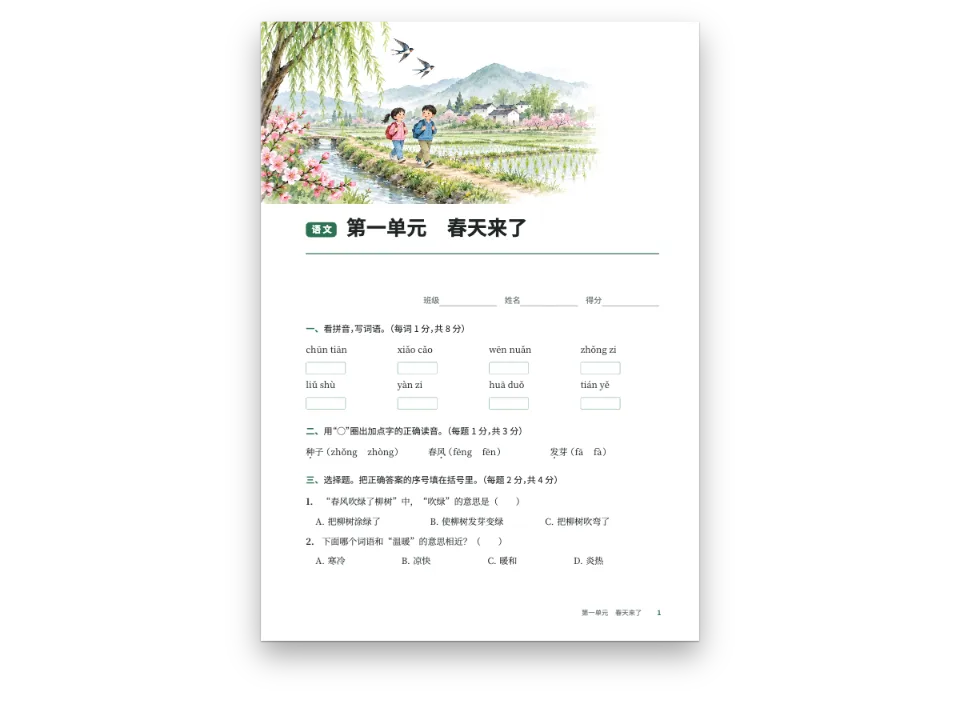
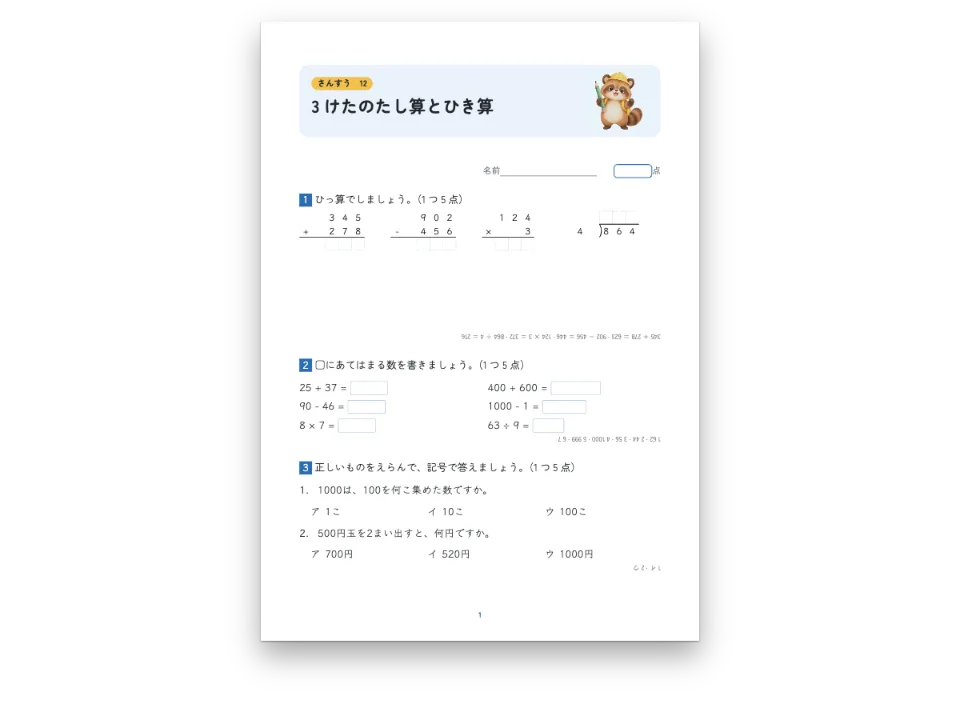
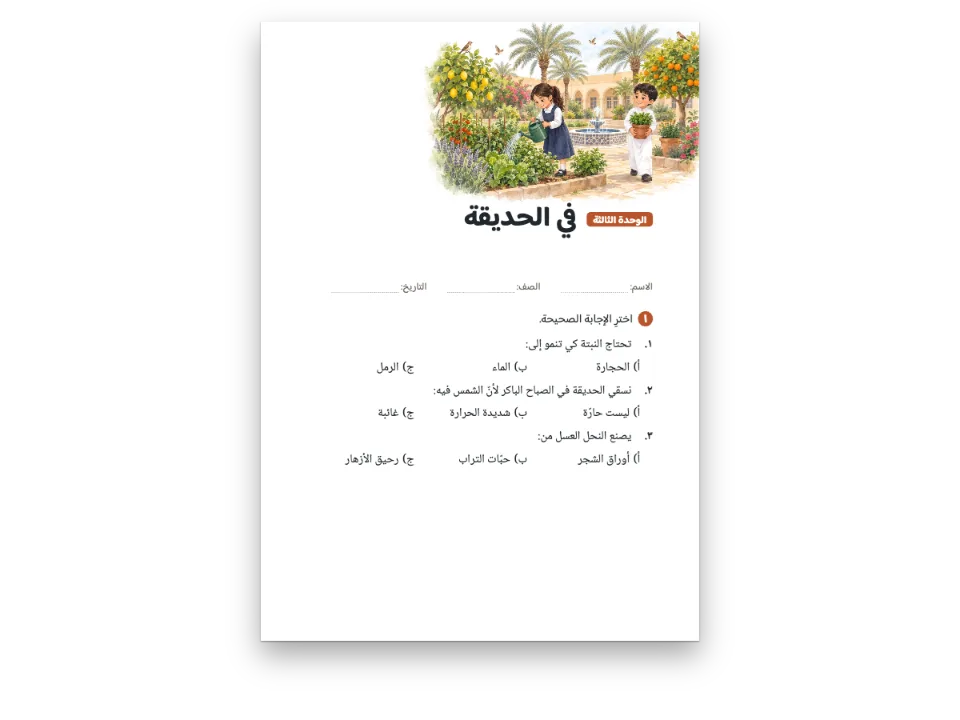
Worksheet 7 of a Year 4 science and maths course, Water on the move, in ten editions. The questions are the same in every language: choose an answer, tick true or false, fill the gaps from a word bank, join words to their meanings, circle a word, divide the water in a tank, explain why to save it. Each edition prints them as its schools do. The Spanish and Catalan sheets put the number in a disc, tick V or F and divide with the divisor in an L to the right of the dividend. The French one uses squares, cases à cocher, dotted blanks and Seyès paper for the answer. The German one writes R and F, Lückentext and 864 : 4 = on one line, the multiplication with a dot. The Brazilian one asks for V or F in brackets. The English one divides under the ⟌ bracket. The Chinese sheet numbers its sections 一、二、, puts ( ) after each stem with A. B. C. in a row, asks for √ or × and ends with 看拼音,写词语 on 田字格 squares. The Japanese one offers ア イ ウ and ○ ×, the Arabic one runs right to left with أ ب ج and صح or خطأ.
This recipe answers
- How do I set the same worksheet the way each country's school books set their exercises?
- How do I set long division the way each country's schools write it?
- How do I set Chinese test questions: a ( ) bracket after the stem and A. B. C. D. options in a row?
The short answer
// The Markdown of every edition has the same seven exercises. What changes is this table:
// how the number prints, how options are labelled and answered, how true/false reads, where
// a blank is written, the paper of the open answer and the layout of long division.
const disc = { shape: 'disc' };
const square = { shape: 'square' };
const bare = { shape: 'none', suffix: '.' };
const TRADITIONS = {
  es: { number: disc, options: { marker: 'none' }, trueFalse: { look: 'boxes' },
    blank: { look: 'line' }, area: { kind: 'lines' }, arithmetic: { division: 'potence' } },
  fr: { number: square, options: { marker: 'box' }, trueFalse: { look: 'boxes' },
    blank: { look: 'dots' }, area: { kind: 'seyes', spacing: mm(8) },
    arithmetic: { division: 'potence' } },
  de: { number: square, options: { marker: 'box' }, trueFalse: { look: 'boxes' },
    blank: { look: 'line' }, area: { kind: 'lines' }, arithmetic: { division: 'inline' } },
  it: { number: { shape: 'rounded' }, options: { marker: 'box' }, trueFalse: { look: 'boxes' },
    blank: { look: 'dots' }, area: { kind: 'lines' }, arithmetic: { division: 'potence' } },
  pt: { number: bare, options: { marker: 'none' }, trueFalse: { look: 'bracket' },
    blank: { look: 'line' }, area: { kind: 'lines' }, arithmetic: { division: 'potence' } },
  en: { number: bare, options: { marker: 'none' }, trueFalse: { look: 'boxes' },
    blank: { look: 'line' }, area: { kind: 'lines' }, arithmetic: { division: 'bracket' } },
  // 一、二、 sections; ( ) after the stem and A. B. C. in a row; √ × in a bracket; 田字格.
  zh: { number: { shape: 'none', format: 'simp-chinese-informal', suffix: '、' },
    options: { labels: 'alpha-upper', suffix: '.', layout: 'row', bracket: true },
    trueFalse: { look: 'bracket' }, blank: { look: 'line' },
    area: { kind: 'tianzige', spacing: mm(13), lines: 1 }, arithmetic: { division: 'bracket' } },
  // ア イ ウ in a row with ( ), ○ × in a bracket, the number in a square.
  ja: { number: square, options: { labels: 'katakana', suffix: '', layout: 'row', bracket: true },
    trueFalse: { look: 'bracket' }, blank: { look: 'line' }, area: { kind: 'lines' },
    arithmetic: { division: 'bracket' } },
  ar: { number: disc, options: { marker: 'none', prefix: '(', suffix: ')' },
    trueFalse: { look: 'boxes' },
    blank: { look: 'dots' }, area: { kind: 'lines' }, arithmetic: { division: 'bracket' } },
};
TRADITIONS.ca = TRADITIONS.es; // Catalan schools set exercises as Spanish ones do
The form of the exercises, as each country's school books set them
Ingredients
- Features
- Exercise stylesOperations in columnsChoice and true or falseExercisesGaps and word banksMatching and sortingOpen questions and writing areasDesigned openersHeading attributesSemantic colour paletteChinese, Japanese and Korean fontsArabic fontsBooks bound on the rightRight-to-left textHyphenation and document languagePages on a canvasPDF export
- Type
- Nunito, Baloo 2, Noto Serif SC, Noto Sans SC, Klee One, Noto Sans JP, Noto Naskh Arabic, Baloo Bhaijaan 2 (SIL OFL 1.1)
- Assets
- None: every picture is drawn in code
Method
#1 · Put each tradition in a table
// The Markdown of every edition has the same seven exercises. What changes is this table:
// how the number prints, how options are labelled and answered, how true/false reads, where
// a blank is written, the paper of the open answer and the layout of long division.
const disc = { shape: 'disc' };
const square = { shape: 'square' };
const bare = { shape: 'none', suffix: '.' };
const TRADITIONS = {
  es: { number: disc, options: { marker: 'none' }, trueFalse: { look: 'boxes' },
    blank: { look: 'line' }, area: { kind: 'lines' }, arithmetic: { division: 'potence' } },
  fr: { number: square, options: { marker: 'box' }, trueFalse: { look: 'boxes' },
    blank: { look: 'dots' }, area: { kind: 'seyes', spacing: mm(8) },
    arithmetic: { division: 'potence' } },
  de: { number: square, options: { marker: 'box' }, trueFalse: { look: 'boxes' },
    blank: { look: 'line' }, area: { kind: 'lines' }, arithmetic: { division: 'inline' } },
  it: { number: { shape: 'rounded' }, options: { marker: 'box' }, trueFalse: { look: 'boxes' },
    blank: { look: 'dots' }, area: { kind: 'lines' }, arithmetic: { division: 'potence' } },
  pt: { number: bare, options: { marker: 'none' }, trueFalse: { look: 'bracket' },
    blank: { look: 'line' }, area: { kind: 'lines' }, arithmetic: { division: 'potence' } },
  en: { number: bare, options: { marker: 'none' }, trueFalse: { look: 'boxes' },
    blank: { look: 'line' }, area: { kind: 'lines' }, arithmetic: { division: 'bracket' } },
  // 一、二、 sections; ( ) after the stem and A. B. C. in a row; √ × in a bracket; 田字格.
  zh: { number: { shape: 'none', format: 'simp-chinese-informal', suffix: '、' },
    options: { labels: 'alpha-upper', suffix: '.', layout: 'row', bracket: true },
    trueFalse: { look: 'bracket' }, blank: { look: 'line' },
    area: { kind: 'tianzige', spacing: mm(13), lines: 1 }, arithmetic: { division: 'bracket' } },
  // ア イ ウ in a row with ( ), ○ × in a bracket, the number in a square.
  ja: { number: square, options: { labels: 'katakana', suffix: '', layout: 'row', bracket: true },
    trueFalse: { look: 'bracket' }, blank: { look: 'line' }, area: { kind: 'lines' },
    arithmetic: { division: 'bracket' } },
  ar: { number: disc, options: { marker: 'none', prefix: '(', suffix: ')' },
    trueFalse: { look: 'boxes' },
    blank: { look: 'dots' }, area: { kind: 'lines' }, arithmetic: { division: 'bracket' } },
};
TRADITIONS.ca = TRADITIONS.es; // Catalan schools set exercises as Spanish ones do
Every edition has the same Markdown: seven :::exercise fences whose answers are in the text (- [x], [[vapour]], - Evaporation -> Water turns into vapour, - 864 ÷ 4). What a country's books do differently is form, so it lives in this table and nowhere else: the number's shape and numerals, the option labels and whether the pupil ticks a box or rings a letter, the true/false look, the blank's look, the writing area and the layout of long division. Catalan takes the Spanish row as it is.
#2 · Lay the tradition over the house style
const T = TRADITIONS[LANG];
const ficha = {
  id: 'ficha', ...T,
  number: { background: col('accent'), color: T.number.shape === 'none' ? col('accent')
    : col('paper'), fontFamily: LABEL, fontWeight: 700, ...T.number },
  // Chinese and Japanese sheets set the instructions in the gothic (黑体, ゴシック).
  instruction: { bold: true, color: col('ink'), ...(LANG === 'zh' || LANG === 'ja'
    ? { fontFamily: LABEL } : {}) },
  blank: { color: col('ink'), weight: pt(0.7), ...T.blank },
  match: { look: 'dots', gap: em(5), color: col('accent') },
  bank: { order: 'alpha' },
  area: { color: col('rule'), spacing: mm(9), weight: pt(0.6), ...T.area },
  grid: { cell: mm(8.5), fontFamily: TEXT, rule: col('rule'), color: col('ink') },
  marginTop: mm(7), marginBottom: mm(1), itemSpacing: em(0.4),
};
One exercise style, ficha, carries what all ten sheets share (the blue of the numbers, the grey rules, the room between exercises), and the edition's row is spread over it. What the row leaves out comes from the language: T F, V F, R F, √ ×, ○ × and صح خطأ are the engine's own words, as are a) b) c), A. B. C., ア イ ウ and أ ب ج, so no edition writes them.
#3 · Give each script its faces
const FACES = {
  zh: { text: 'Noto Serif SC', label: 'Noto Sans SC' },
  ja: { text: 'Klee One', label: 'Noto Sans JP' },
  ar: { text: 'Noto Naskh Arabic', label: 'Baloo Bhaijaan 2' },
}[LANG] ?? { text: 'Nunito', label: 'Baloo 2' };
const [TEXT, LABEL] = [FACES.text, FACES.label];
The Latin editions share Nunito and Baloo 2. The Chinese sheet sets its text in Song and its instructions in Hei; the Japanese one sets the text in Klee One, a textbook face, and the instructions in a gothic; the Arabic one uses Noto Naskh Arabic. Klee One's heaviest cut is 600, so the Japanese edition sets its bold at 600 (boldFontWeight): a 700 would be drawn by the browser and fail the capture.
#4 · Head the sheet with lines for a name
const at = (to, edge, x = 0, y = 0, size) => ({ anchor: { to, edge },
  offset: { x: mm(x), y: mm(y) }, ...(size && { size }) });
const field = (id, attr, x, width) => [
  { kind: 'text', id, content: `{attr.${attr}}`, fontFamily: LABEL, fontSize: pt(10),
    fontWeight: 700, color: col('muted'), align: 'left', placement: at('container', 'top-left',
      x, 28) },
  { kind: 'rule', id: `${id}-line`, direction: 'horizontal', thickness: pt(0.75),
    color: col('rule'), placement: at('container', 'top-left', x + 16, 33, { width: mm(width) }) },
];
const head = { enabled: true, minHeight: mm(38), slot: { elements: [
  { kind: 'box', id: 'band', style: { backgroundColor: col('accent'), borderRadius: mm(3) },
    placement: at('container', 'top-left', 0, 0, { width: 'fill', height: mm(21) }) },
  { kind: 'text', id: 'kicker', content: '{title} · {subtitle}', fontFamily: LABEL,
    fontSize: pt(8.5), fontWeight: 700, color: col('tint'), align: 'left',
    placement: at('container', 'top-left', 6, 3.5) },
  { kind: 'text', id: 'title', content: '{titleText}', fontFamily: LABEL, fontSize: pt(22),
    fontWeight: 700, color: col('paper'), align: 'left', lineHeight: 1.1,
    placement: at('container', 'top-left', 6, 9.5) },
  ...field('name', 'nombre', 0, 96), ...field('date', 'fecha', 120, 40),
] } };
The level-1 heading draws the band, the course from the frontmatter and the title, and two ruled fields whose words come from the heading's attributes (nombre="Name" fecha="Date"), so the German sheet says Datum and the Japanese one 名前 without a string in the code.
The whole recipe
// ═══ Postext Cookbook · Nº 169 · One worksheet in ten school traditions ═════════
// https://postext.dev/en/cookbook/school-traditions-worksheet
// Code: MIT · Text: original (CC BY 4.0) · Pictures: none
// Fonts: Nunito, Baloo 2, Klee One, Noto Naskh Arabic and others (SIL OFL) · Needs postext ≥ 1.59.0
import {
  buildDocument, withLoadedFonts, renderPageToCanvas,
} from 'https://esm.sh/postext';
import { renderToPdf, decompressWoff2 } from 'https://esm.sh/postext-pdf';

const LANG = 'en'; // @lang: the language of the worksheet (en es ca fr de it pt zh ja ar)
const RECIPE = 'school-traditions-worksheet';

// ─── 1 · Design ─────────────────────────────────────────────────────────────
// #region palette: a blue-black ink, one blue accent, a pale tint, grey rules
const palette = {
  ink: '#1d2633', accent: '#2a5d9f', tint: '#e8f0fa', rule: '#a9b6c6', muted: '#5d6878',
  paper: '#ffffff',
};
const col = (id) => ({ hex: palette[id], model: 'hex', paletteId: id });
const colorPalette = [
  ...Object.entries(palette).map(([id, hex]) => ({ id, name: id, value: { hex, model: 'hex' } })),
  { id: 'main-color', name: 'accent (defaults)', value: { hex: palette.accent, model: 'hex' } },
];
// #endregion

// #region faces: Latin editions share two faces; Chinese, Japanese and Arabic their own
const FACES = {
  zh: { text: 'Noto Serif SC', label: 'Noto Sans SC' },
  ja: { text: 'Klee One', label: 'Noto Sans JP' },
  ar: { text: 'Noto Naskh Arabic', label: 'Baloo Bhaijaan 2' },
}[LANG] ?? { text: 'Nunito', label: 'Baloo 2' };
const [TEXT, LABEL] = [FACES.text, FACES.label];
// #endregion

// #region answer: the form of the exercises, as each country's school books set them
// The Markdown of every edition has the same seven exercises. What changes is this table:
// how the number prints, how options are labelled and answered, how true/false reads, where
// a blank is written, the paper of the open answer and the layout of long division.
const disc = { shape: 'disc' };
const square = { shape: 'square' };
const bare = { shape: 'none', suffix: '.' };
const TRADITIONS = {
  es: { number: disc, options: { marker: 'none' }, trueFalse: { look: 'boxes' },
    blank: { look: 'line' }, area: { kind: 'lines' }, arithmetic: { division: 'potence' } },
  fr: { number: square, options: { marker: 'box' }, trueFalse: { look: 'boxes' },
    blank: { look: 'dots' }, area: { kind: 'seyes', spacing: mm(8) },
    arithmetic: { division: 'potence' } },
  de: { number: square, options: { marker: 'box' }, trueFalse: { look: 'boxes' },
The composed script.js runs as it is: paste it into any page’s module script, or open the recipe on CodePen. Recipe folder on GitHub ↗ (opens in a new tab)
Variations
#Print the teacher's copy
Every answer goes into its slot in magenta: the brackets, the boxes, the blanks and the quotient.
   exerciseStyles: [ficha],
+ exercises: { edition: 'teacher' },#Collect the answers at the foot of the sheet
placement: 'after' sets each exercise's key under it; 'inverted' turns it upside down, as puzzle pages do.
+ exercises: { solutions: { placement: 'inverted', layout: 'key' } },Pitfalls
- A face without a 700 cut makes the bold of the stems' numbers a synthesized one. Give such a text face
boldFontWeightwith a weight it ships. - The ○ of the Japanese instructions and the √ of the Chinese ones are only in the CJK faces: set them in a sentence of the CJK text, not in a Latin label.
Credits
- Recipe
- Ignacio Ferro
- Text
- Original prose, CC BY 4.0
- Fonts
- Nunito (SIL OFL 1.1) · Baloo 2 (SIL OFL 1.1) · Noto Serif SC (SIL OFL 1.1) · Noto Sans SC (SIL OFL 1.1) · Klee One (SIL OFL 1.1) · Noto Sans JP (SIL OFL 1.1) · Noto Naskh Arabic (SIL OFL 1.1) · Baloo Bhaijaan 2 (SIL OFL 1.1)
Edit this write-up ↗ (opens in a new tab)Recipe folder on GitHub ↗ (opens in a new tab)