In short
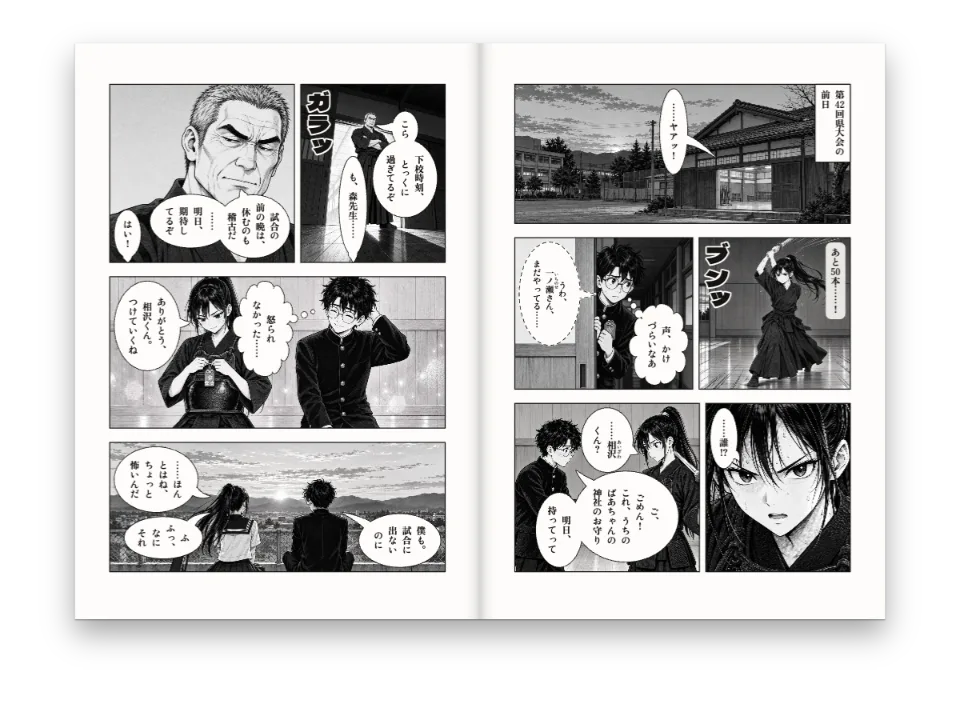
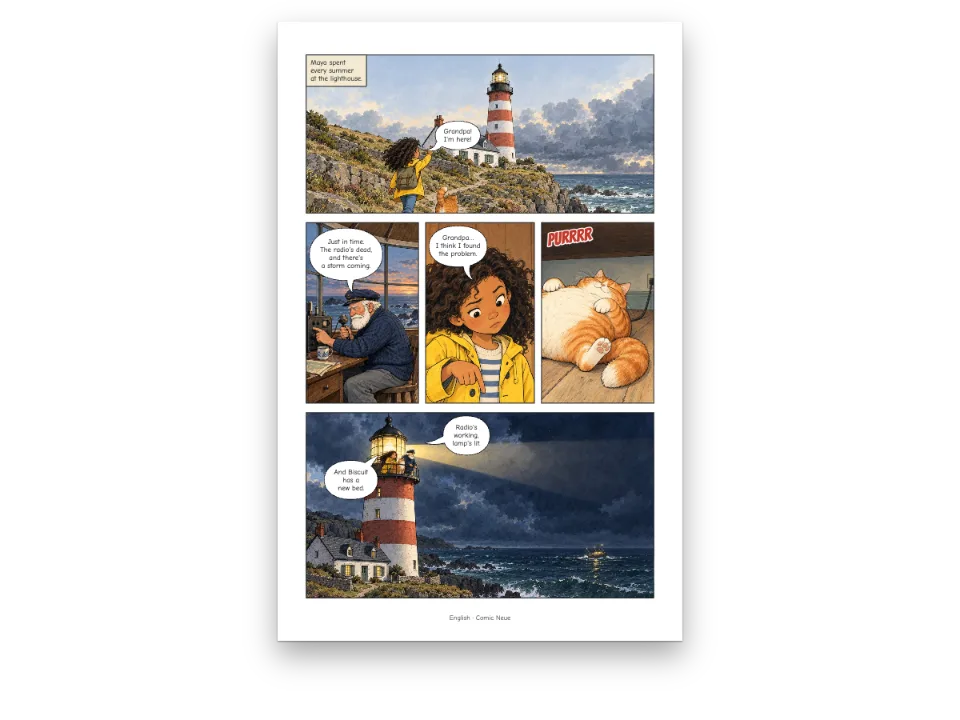
A page of short Japanese comic strips, four panels each, set side by side the way a manga magazine prints them: you read the right-hand strip from top to bottom, then the left one.
What you'll build
A page from a yonkoma anthology, ねこ喫茶まどろみ (Café Doze), written for the recipe and drawn in a soft chibi style: Mugi runs a cat café with a white, a black and a calico cat. Yonkoma, four-panel strips, are the newspaper gag strip turned on its side: four equal panels stacked top to bottom, set up, develop, turn, punchline. A magazine page carries two of them side by side, and because the page opens from the right, the right-hand strip comes first. The page is A5, 148 × 210 mm, with the Japanese original on one side of the spread and the edition in this page's language on the other (English on the Japanese page).
This recipe answers
- How do I set a four-panel yonkoma strip?
The short answer
// content.<lang>.md splits the page `* [* / * / * / *] | * [* / * / * / *]`: two equal
// columns, each cut into four equal panels. The reading direction lays the first column
// out on the right, so the strip that opens the page is the right-hand one, as in a
// yonkoma magazine, and each strip still reads top to bottom. The gutter between the
// strips is wider than the gutters between their panels, so the eye drops down a strip
// before it crosses to the next.
const comics = (lang) => ({
  artDirection: 'rtl', // the right strip first, in every edition
  mirrorArt: false,
  gutter: { horizontal: mm(3), vertical: mm(9) }, // 3 mm between panels, 9 mm between strips
  panel: { borderWidth: pt(0.9), borderColor: col('ink'), background: col('paper') },
  lettering: {
    fontFamily: EDITIONS[lang].faces[0], color: col('ink'),
    fontSize: pt(['ja', 'zh'].includes(lang) ? 8 : 7), // a yonkoma letters smaller than a story
    writingMode: lang === 'zh' ? 'vertical' : 'auto',
    maxColumnChars: 6, // short columns: a yonkoma panel is wider than it is tall
  },
  balloonStyles: balloons(),
});
Two columns of four, read from the right
Ingredients
- Features
- Panel splitsReading direction and manga orderVertical textChinese, Japanese and Korean fontsPanel borders and guttersPanel art and cropsRe-lettering in other languagesSpeakers and anchorsComic pagesComic letteringBalloon stylesSound effectsBooks bound on the rightSemantic colour palettePages on a canvasPDF export
- Type
- Zen Antique, Dela Gothic One, Comic Neue, Bangers, Noto Sans SC, ZCOOL KuaiLe, Playpen Sans Arabic, Lalezar (SIL OFL 1.1)
- Assets
neko-bowls.jpgneko-door.jpgneko-guest.jpgneko-keyboard.jpgneko-laptop.jpgneko-nap.jpgneko-onebowl.jpgneko-toast.jpg- Mugi unlocking the cat café's door, three cats waiting inside (Generated With Diffusion Models, original)
- Mugi setting out food bowls for the cats (Generated With Diffusion Models, original)
- Three cats eating from one bowl (Generated With Diffusion Models, original)
- The cats staring at Mugi's toast (Generated With Diffusion Models, original)
- A tired office worker arriving at the café (Generated With Diffusion Models, original)
- The three cats asleep on one cushion (Generated With Diffusion Models, original)
- The office worker opening his laptop (Generated With Diffusion Models, original)
- The cats sitting on the keyboard, the worker in happy tears (Generated With Diffusion Models, original)
Method
#1 · Split the page into two columns of four
The code is the short answer above. The whole page is one :::page with split="* [* / * / * / *] | * [* / * / * / *]": two equal columns, each cut into four equal tiers. The eight ::panel lines fill the cells in reading order, so the first four belong to the first strip, and with right-to-left reading the first column is laid out on the right (page split). The gutter between the strips is 9 mm and the gutter between panels 3 mm, so the eye goes down a strip before it crosses to the next.
#2 · Title each strip in its first panel
const balloons = () => [
  { id: 'speech', fill: col('paper'), stroke: col('ink'), strokeWidth: pt(0.6), roundness: 2.4 },
  { id: 'shout', fill: col('paper'), stroke: col('ink'), burstPoints: 16 },
  // caption{title}: the strip's title, white on black in the first panel's corner
  { id: 'title', shape: 'rectangle', fill: col('ink'), stroke: col('ink'), color: col('paper'),
    bold: true, tail: 'none', position: 'top-start', butt: true, align: 'center' },
  { id: 'sfx', color: col('ink'), haloColor: col('paper'), fontScale: 1.8 }, // chibi: small effects
];
A yonkoma has a title, and an anthology prints it in a box at the head of the strip. Here the title is a script line, caption{title}: 朝ごはん, and title is a balloon style of its own: white on black, flush against the panel border in the top start corner, which is the top right in this book. It is lettered in each edition like any other line, so the English page reads Breakfast and Therapy in the same boxes.
#3 · Mark the cats as speakers too
const cat = (id, x, y, fx, fy, w = 0.12, h = 0.15) => ({ id, x, y,
  face: { x: fx, y: fy, width: w, height: h } });
const nose = (id, x, y) => ({ id, x, y, head: { x, y: y - 0.04 } }); // cats asleep or eating
const ART = { // fractions of the picture: the same in every language
  door: {
    alt: t({ en: "Mugi unlocks the café's glass door; the white, black and calico cats wait.",
      es: 'Mugi abre la puerta de cristal del café; dentro esperan los tres gatos.',
      ca: 'La Mugi obre la porta de vidre del cafè; a dins esperen els tres gats.',
      zh: '麦打开猫咖的玻璃门,三只猫在里面等着。',
      ar: 'موغي تفتح باب المقهى الزجاجي، والقطط الثلاث تنتظر في الداخل.',
      ja: '猫カフェのガラス戸を開けるむぎ。中で3匹の猫が待っている。',
      fr: 'Mugi ouvre la porte vitrée du café ; à l’intérieur, les trois chats attendent.',
      de: 'Mugi schließt die Glastür des Cafés auf; drinnen warten die drei Katzen.',
      it: 'Mugi apre la porta a vetri del caffè; dentro aspettano i tre gatti.',
      pt: 'Mugi abre a porta de vidro do café; lá dentro, os três gatos esperam.' }),
  safeArea: { x: 0.09, y: 0.19, width: 0.81, height: 0.52 },
  anchors: [{ id: 'mugi', x: 0.205, y: 0.385, head: { x: 0.17, y: 0.25 },
    face: { x: 0.1, y: 0.2, width: 0.2, height: 0.23 } },
  cat('shiro', 0.5, 0.66, 0.44, 0.55, 0.13), cat('kuro', 0.66, 0.62, 0.61, 0.52, 0.12, 0.14),
  cat('mike', 0.83, 0.645, 0.77, 0.53, 0.12, 0.16)] },
  bowls: {
    alt: t({ en: 'Mugi sets out full food bowls in front of the three cats.',
      es: 'Mugi pone cuencos llenos delante de los tres gatos.',
      ca: 'La Mugi posa bols plens de menjar davant dels tres gats.',
      zh: '麦把装满猫粮的碗摆在三只猫面前。',
      ar: 'موغي تضع صحون طعام ممتلئة أمام القطط الثلاث.',
      ja: '3匹の猫の前に、ご飯を盛った器を並べるむぎ。',
      fr: 'Mugi pose des bols pleins de nourriture devant les trois chats.',
      de: 'Mugi stellt den drei Katzen volle Futternäpfe hin.',
      it: 'Mugi mette le ciotole piene di cibo davanti ai tre gatti.',
      pt: 'Mugi põe tigelas cheias de comida na frente dos três gatos.' }),
  safeArea: { x: 0.16, y: 0.26, width: 0.74, height: 0.65 },
  anchors: [{ id: 'mugi', x: 0.27, y: 0.465, head: { x: 0.25, y: 0.3 },
    face: { x: 0.17, y: 0.26, width: 0.16, height: 0.24 } },
  cat('shiro', 0.37, 0.63, 0.31, 0.52, 0.13, 0.16), cat('kuro', 0.6, 0.64, 0.55, 0.52, 0.11, 0.16),
  cat('mike', 0.82, 0.62, 0.76, 0.52, 0.12, 0.14)] },
  onebowl: {
    alt: t({ en: 'All three cats push their heads into the same bowl; the others stay full.',
      es: 'Los tres gatos meten la cabeza en el mismo cuenco; los otros siguen llenos.',
      ca: 'Els tres gats fiquen el cap al mateix bol; els altres continuen plens.',
      zh: '三只猫把头挤进同一个碗里,另外两个碗还满着。',
      ar: 'القطط الثلاث تدسّ رؤوسها في الصحن نفسه، والصحنان الآخران ممتلئان.',
      ja: '3匹そろって同じ器に頭を突っこみ、ほかの器は手つかず。',
      fr: 'Les trois chats plongent la tête dans le même bol ; les autres restent pleins.',
      de: 'Alle drei Katzen stecken den Kopf in denselben Napf; die anderen bleiben voll.',
      it: 'I tre gatti infilano la testa nella stessa ciotola; le altre restano piene.',
      pt: 'Os três gatos enfiam a cabeça na mesma tigela; as outras continuam cheias.' }),
  safeArea: { x: 0.05, y: 0.27, width: 0.88, height: 0.66 },
  anchors: [nose('shiro', 0.33, 0.66), nose('kuro', 0.5, 0.6), nose('mike', 0.66, 0.68),
    { id: 'sfx', x: 0.5, y: 0.3 }] },
  toast: {
    alt: t({ en: 'Mugi bites her toast while the three cats stare at it with shining eyes.',
      es: 'Mugi muerde su tostada mientras los tres gatos la miran con ojos brillantes.',
      ca: 'La Mugi mossega la torrada mentre els tres gats la miren amb ulls brillants.',
      zh: '麦咬着吐司,三只猫眼睛发亮地盯着。',
      ar: 'موغي تقضم خبزها المحمّص والقطط الثلاث تحدّق فيه بعيون لامعة.',
      ja: 'トーストをかじるむぎを、3匹がきらきらした目で見つめる。',
      fr: 'Mugi croque sa tartine tandis que les trois chats la fixent, les yeux brillants.',
      de: 'Mugi beißt in ihren Toast, während die drei Katzen ihn mit leuchtenden Augen '
        + 'anstarren.',
      it: 'Mugi addenta il suo toast e i tre gatti lo fissano con gli occhi che brillano.',
      pt: 'Mugi morde a torrada enquanto os três gatos olham para ela com olhos brilhando.' }),
  safeArea: { x: 0.09, y: 0.22, width: 0.85, height: 0.56 },
  avoid: [{ x: 0.6, y: 0.52, width: 0.15, height: 0.1 }],
  anchors: [{ id: 'mugi', x: 0.8, y: 0.5, head: { x: 0.85, y: 0.32 },
    face: { x: 0.75, y: 0.25, width: 0.2, height: 0.33 } },
  cat('shiro', 0.17, 0.71, 0.1, 0.6, 0.14, 0.16), cat('kuro', 0.32, 0.73, 0.26, 0.62, 0.12, 0.14),
  cat('mike', 0.46, 0.66, 0.4, 0.56, 0.12, 0.14)] },
  guest: {
    alt: t({ en: 'A tired office worker walks in, arms out; Mugi greets him from the counter.',
      es: 'Un oficinista cansado entra con los brazos abiertos; Mugi lo saluda desde la barra.',
      ca: 'Un oficinista cansat entra amb els braços oberts; la Mugi el saluda des de la barra.',
      zh: '一个疲惫的上班族张着双臂走进来,麦在柜台后招呼他。',
      ar: 'موظف متعب يدخل فاتحًا ذراعيه، وموغي ترحّب به من خلف المنضدة.',
      ja: '両手を広げて入ってくる疲れた会社員と、カウンターから迎えるむぎ。',
      fr: 'Un employé de bureau fatigué entre les bras ouverts ; Mugi l’accueille depuis le '
        + 'comptoir.',
      de: 'Ein müder Büroangestellter kommt mit offenen Armen herein; Mugi begrüßt ihn '
        + 'von der Theke aus.',
      it: 'Un impiegato stanco entra a braccia aperte; Mugi lo accoglie dal bancone.',
      pt: 'Um funcionário de escritório cansado entra de braços abertos; Mugi o recebe do '
        + 'balcão.' }),
  safeArea: { x: 0.13, y: 0.14, width: 0.74, height: 0.51 },
  anchors: [{ id: 'kyaku', x: 0.31, y: 0.42, head: { x: 0.28, y: 0.3 },
    face: { x: 0.19, y: 0.22, width: 0.21, height: 0.26 } },
  { id: 'mugi', x: 0.76, y: 0.39, head: { x: 0.76, y: 0.28 },
    face: { x: 0.68, y: 0.2, width: 0.18, height: 0.25 } }] },
  nap: {
    alt: t({ en: 'The three cats asleep in one pile on a round cushion.',
      es: 'Los tres gatos dormidos en un montón sobre un cojín redondo.',
      ca: 'Els tres gats adormits en un munt sobre un coixí rodó.',
      zh: '三只猫挤成一团睡在圆垫子上。',
      ar: 'القطط الثلاث نائمة كومةً واحدة على وسادة مستديرة.',
      ja: '丸いクッションの上で、ひとかたまりになって眠る3匹。',
      fr: 'Les trois chats dorment en tas sur un coussin rond.',
      de: 'Die drei Katzen schlafen auf einem Haufen auf einem runden Kissen.',
      it: 'I tre gatti dormono ammucchiati su un cuscino rotondo.',
      pt: 'Os três gatos dormem amontoados numa almofada redonda.' }),
  safeArea: { x: 0.27, y: 0.21, width: 0.52, height: 0.55 },
  anchors: [nose('shiro', 0.4, 0.42), nose('kuro', 0.41, 0.7), nose('mike', 0.72, 0.58),
    { id: 'sfx', x: 0.3, y: 0.25 }] },
  laptop: {
    alt: t({ en: 'The office worker sighs at a café table and opens his laptop.',
      es: 'El oficinista suspira en una mesa del café y abre el portátil.',
      ca: 'L’oficinista sospira en una taula del cafè i obre el portàtil.',
      zh: '上班族在咖啡桌前叹了口气,打开笔记本电脑。',
      ar: 'الموظف يتنهّد إلى طاولة في المقهى ويفتح حاسوبه.',
      ja: 'カフェのテーブルでため息をつき、ノートパソコンを開く会社員。',
      fr: 'L’employé soupire à une table du café et ouvre son ordinateur portable.',
      de: 'Der Büroangestellte seufzt an einem Cafétisch und klappt seinen Laptop auf.',
      it: 'L’impiegato sospira a un tavolino del caffè e apre il portatile.',
      pt: 'O funcionário suspira numa mesa do café e abre o notebook.' }),
  safeArea: { x: 0.22, y: 0.25, width: 0.56, height: 0.55 },
  anchors: [{ id: 'kyaku', x: 0.45, y: 0.62, head: { x: 0.39, y: 0.4 },
    face: { x: 0.3, y: 0.3, width: 0.22, height: 0.38 } }] },
  keyboard: {
    alt: t({ en: 'The three cats sit on the keyboard; the worker cries tears of joy.',
      es: 'Los tres gatos se sientan en el teclado; el oficinista llora de alegría.',
      ca: 'Els tres gats seuen damunt del teclat; l’oficinista plora d’alegria.',
      zh: '三只猫坐在键盘上,上班族喜极而泣。',
      ar: 'القطط الثلاث تجلس على لوحة المفاتيح، والموظف يبكي من الفرح.',
      ja: 'キーボードの上に座る3匹と、うれし泣きする会社員。',
      fr: 'Les trois chats s’assoient sur le clavier ; l’employé pleure de joie.',
      de: 'Die drei Katzen setzen sich auf die Tastatur; der Angestellte weint vor Freude.',
      it: 'I tre gatti si siedono sulla tastiera; l’impiegato piange di gioia.',
      pt: 'Os três gatos sentam no teclado; o funcionário chora de alegria.' }),
  safeArea: { x: 0.07, y: 0.1, width: 0.81, height: 0.78 },
  anchors: [{ id: 'kyaku', x: 0.29, y: 0.42, head: { x: 0.25, y: 0.2 },
    face: { x: 0.15, y: 0.1, width: 0.27, height: 0.4 } },
  cat('shiro', 0.42, 0.57, 0.36, 0.48, 0.13, 0.14), cat('kuro', 0.59, 0.6, 0.53, 0.5, 0.12, 0.14),
  cat('mike', 0.74, 0.62, 0.68, 0.52, 0.12, 0.14)] },
};
const panels = () => Promise.all([
  comicPanel('door', asset('neko-door.jpg'), ART.door),
  comicPanel('bowls', asset('neko-bowls.jpg'), ART.bowls),
  comicPanel('onebowl', asset('neko-onebowl.jpg'), ART.onebowl),
  comicPanel('toast', asset('neko-toast.jpg'), ART.toast),
  comicPanel('guest', asset('neko-guest.jpg'), ART.guest),
  comicPanel('nap', asset('neko-nap.jpg'), ART.nap),
  comicPanel('laptop', asset('neko-laptop.jpg'), ART.laptop),
  comicPanel('keyboard', asset('neko-keyboard.jpg'), ART.keyboard),
]);
The cats speak, kuro: にゃ, so each picture marks their mouths and faces as it marks Mugi's. Two small helpers keep the list short: cat() for a cat that faces the reader and nose() for one whose face is buried in a bowl or a cushion. In the third panel Mugi is out of the picture, and her line mugi{tail=top} gets a tail to the top edge.
#4 · Load each edition's faces with its words
const SFX = /^sfx[^::\n]*[::](.*)$/gm; // sound-effect lines: the second face sets them
async function loadEdition(lang) {
  const text = TEXT[lang];
  const [face, sfx] = EDITIONS[lang].faces;
  const faces = { [face]: FONTS[face], [sfx]: FONTS[sfx] };
  if (['ja', 'zh'].includes(lang)) { // CJK: only the files that hold these characters
    const effects = [...text.matchAll(SFX)].map((m) => m[1]).join('');
    await loadCjkFonts({ [face]: FONTS[face] }, text.replace(SFX, ''), { vertical: true });
    await loadCjkFonts({ [sfx]: FONTS[sfx] }, effects, { vertical: true });
  }
  if (lang === 'ar') await loadArabicFonts(faces, text);
  await loadComicFonts(faces, text); // the bold and italic the faces do not ship
}
Each face gets the words it sets: Zen Antique the balloons, Dela Gothic One the sound effects (ガツガツ, じーっ, すやぁ, ずしっ). A yonkoma panel is wider than it is tall, so the Japanese columns stop at six characters (maxColumnChars: 6) and the lettering is half a point smaller than in a story page.
#5 · Set the original beside each edition
const FACING = LANG === 'ja' ? 'en' : LANG; // Japanese readers see the English edition
const TEXT = { ja: original, [FACING]: LANG === 'ja' ? english : markdown };
await loadFonts(FONTS, Object.values(TEXT).join('\n'));
const resources = await panels();
const build = async (lang) => { // the same pictures and page; this language's lettering
  await loadEdition(lang);
  return withLoadedFonts(() => buildDocument({ markdown: TEXT[lang], resources,
    continuation: { pageIndexOffset: lang === 'ja' ? 1 : 2 } }, edition(lang)),
    { ...kitFonts(FONTS), text: TEXT[lang] });
};
const docs = [await build('ja'), await build(FACING)];
Each language of the site letters the strips in its own file, facing the Japanese original across the spread; the Japanese page faces the English edition. The order stays right strip first in every language.
The whole recipe
// ═══ Postext Cookbook · Nº 151 · Two yonkoma strips on a page ═════════════════════════
// https://postext.dev/en/cookbook/yonkoma
// Code: MIT · Story: written for the recipe (CC BY 4.0) · Pictures: generated with diffusion models
// Fonts: Zen Antique, Comic Neue and six more (SIL OFL 1.1) · Needs postext ≥ 1.65.0
// A page of a cat-café yonkoma: two four-panel strips side by side, the right one first.
import {
  buildDocument, withLoadedFonts, renderPageToCanvas, registerResourceImage, loadVerticalAlternates,
} from 'https://esm.sh/postext';
import { renderToPdf, decompressWoff2 } from 'https://esm.sh/postext-pdf';

const LANG = 'en'; // @lang: this edition's language; the Japanese original faces it
const RECIPE = 'yonkoma';

// ─── 1 · Design ─────────────────────────────────────────────────────────────
// #region palette: black ink on a warm white, one screen-tone grey
const palette = {
  ink: '#151413', // panel borders, balloon outlines, the lettering
  paper: '#fdfcf9', // the page and the balloons
  tone: '#e8e6e1', // the inner-voice box, a light screen tone
  muted: '#6f6b64',
  accent: '#a8322b', // the cover red (the Folio case in recipe.json)
};
const col = (id) => ({ hex: palette[id], model: 'hex', paletteId: id });
const colorPalette = [
  ...Object.entries(palette).map(([id, hex]) => ({ id, name: id, value: { hex, model: 'hex' } })),
  { id: 'main-color', name: 'ink (defaults)', value: { hex: palette.ink, model: 'hex' } },
];
// #endregion

// The engine's lettering and sound-effect faces per language (defaultComicFont and
// defaultComicSfxFont), written out so FONTS and the PDF know them.
const EDITIONS = {
  ja: { locale: 'ja', faces: ['Zen Antique', 'Dela Gothic One'] },
  en: { locale: 'en-us', faces: ['Comic Neue', 'Bangers'] },
  es: { locale: 'es', faces: ['Comic Neue', 'Bangers'] },
  ca: { locale: 'ca', faces: ['Comic Neue', 'Bangers'] },
  zh: { locale: 'zh-Hans', faces: ['Noto Sans SC', 'ZCOOL KuaiLe'] },
  ar: { locale: 'ar', faces: ['Playpen Sans Arabic', 'Lalezar'] },
  pt: { locale: 'pt-BR', faces: ['Comic Neue', 'Bangers'] },
  fr: { locale: 'fr', faces: ['Comic Neue', 'Bangers'] },
  de: { locale: 'de', faces: ['Comic Neue', 'Bangers'] },
  it: { locale: 'it', faces: ['Comic Neue', 'Bangers'] },
};

// #region answer: two columns of four, read from the right
// content.<lang>.md splits the page `* [* / * / * / *] | * [* / * / * / *]`: two equal
// columns, each cut into four equal panels. The reading direction lays the first column
// out on the right, so the strip that opens the page is the right-hand one, as in a
The composed script.js runs as it is: paste it into any page’s module script, or open the recipe on CodePen. Recipe folder on GitHub ↗ (opens in a new tab)
Pitfalls
Pitfall
Tag a Japanese text 'ja', never zh-Hans or LANG
A recipe's editions are en and es, but a Japanese sample is Japanese in both: `locale: LANG` would tag it English or Spanish, and a Chinese tag would set it by the Chinese rules (Kaiming punctuation, small kana free to start a line, 图 for 図, Chinese glyph forms in the PDF). From postext 1.30 the tag is also the language the text is shaped in (measured, painted and embedded), so any tag but 'ja' gives other glyph forms than the Japanese ones (the Chinese ones under a Chinese tag) and other line breaks. Write 'ja': it picks the Japan region (JLReq line breaking and punctuation, sesame emphasis marks, furigana spacing, 図 and 表 labels) and turns hyphenation off. The lint fails a text with kana under a zh or ko tag. Japanese line breaking (kinsoku) →
Pitfall
Chinese faces load by slices, through the cjk block
Fontsource serves a Chinese, Japanese or Korean family as about a hundred files per weight, each covering a range of characters. loadFonts fetches only the latin file, so on screen the Han characters come from a system face and measure wrong, and fontsourceProvider hands the PDF that latin file, which prints them as empty boxes. List the cjk kit block, call loadCjkFonts(FONTS, markdown) after loadFonts (once per voice, with the text it sets, when the book uses several CJK faces) and give renderToPdf fontProvider: cjkPdfProvider: both take the files that hold the text's characters. Chinese, Japanese and Korean fonts →
- In a small panel a vertical balloon runs out of height before it runs out of width: the engine sets it in more, shorter columns, breaking between words. The office worker's last shout is still too tall for the bottom panel in Japanese, so it is marked
break(kyaku{shout break}): it bursts up through the frame into the panel above instead of covering the cats, and stays out of the page margin. - A large sound effect is kept off faces like a balloon, and its pinned point lies inside the panel's safe area, so every crop keeps it: THUMP sits at
70% 80%, on the cats' paws. The Japanese ずしっ is set vertically and is taller; at that point it covered the calico's face and the build warnedcomicBalloonOverflow, so there it sits at86% 84%, beside her.
Credits
- Recipe
- Ignacio Ferro
- Text
- ねこ喫茶まどろみ (Café Doze), two yonkoma strips written for this recipe, with their English, Spanish, Catalan, Chinese and Arabic letterings · Postext Cookbook · CC BY 4.0
- Images
- Mugi unlocking the cat café's door, three cats waiting inside · Generated With Diffusion Models · original
- Mugi setting out food bowls for the cats · Generated With Diffusion Models · original
- Three cats eating from one bowl · Generated With Diffusion Models · original
- The cats staring at Mugi's toast · Generated With Diffusion Models · original
- A tired office worker arriving at the café · Generated With Diffusion Models · original
- The three cats asleep on one cushion · Generated With Diffusion Models · original
- The office worker opening his laptop · Generated With Diffusion Models · original
- The cats sitting on the keyboard, the worker in happy tears · Generated With Diffusion Models · original
- Fonts
- Zen Antique (SIL OFL 1.1) · Dela Gothic One (SIL OFL 1.1) · Comic Neue (SIL OFL 1.1) · Bangers (SIL OFL 1.1) · Noto Sans SC (SIL OFL 1.1) · ZCOOL KuaiLe (SIL OFL 1.1) · Playpen Sans Arabic (SIL OFL 1.1) · Lalezar (SIL OFL 1.1)
Edit this write-up ↗ (opens in a new tab)Recipe folder on GitHub ↗ (opens in a new tab)