Em poucas palavras
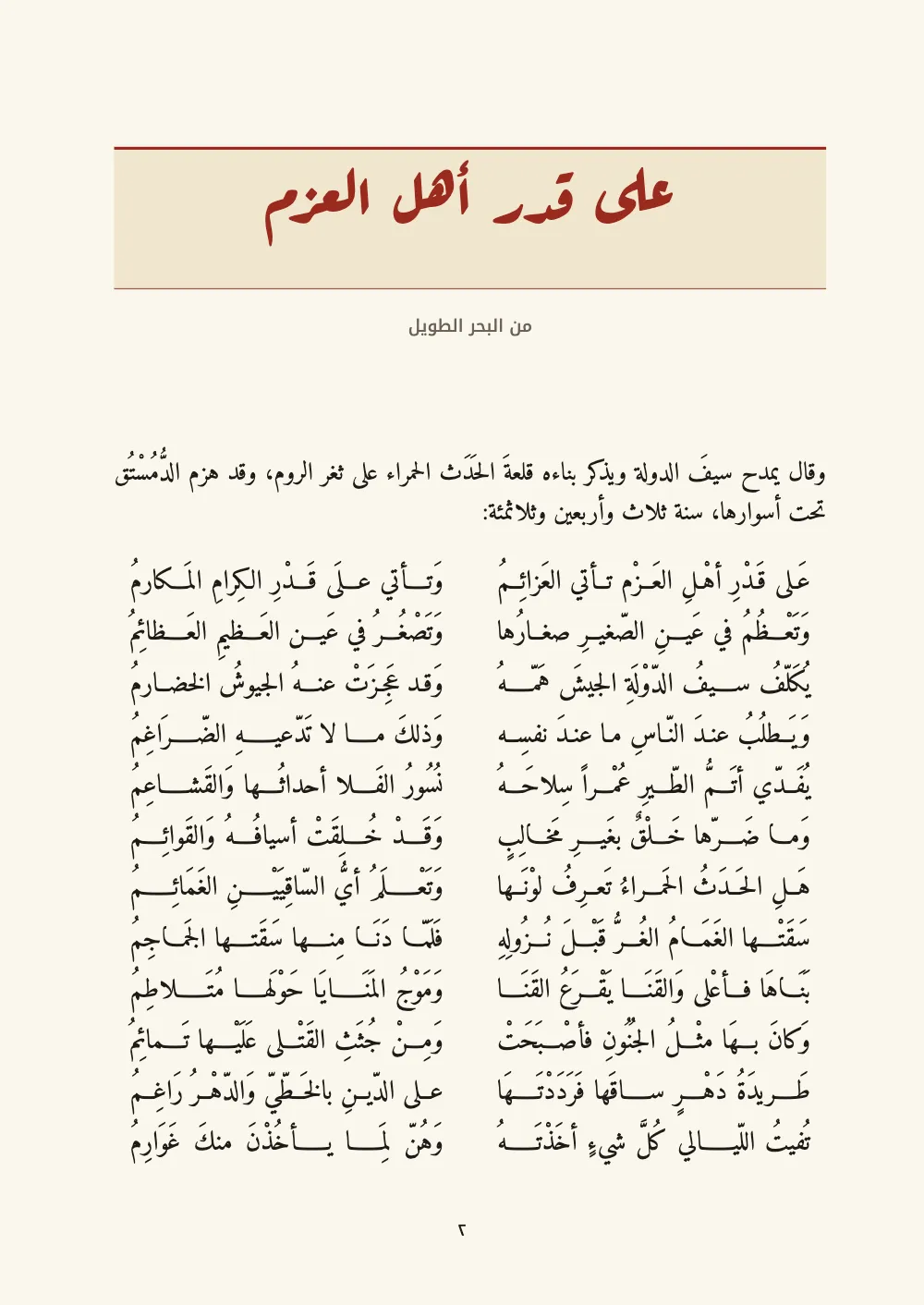
Um poema árabe clássico impresso como nos livros antigos de poesia: cada verso dividido em duas metades lado a lado, esticadas até a mesma largura para que os finais fiquem alinhados ao longo da página.
O que você vai compor
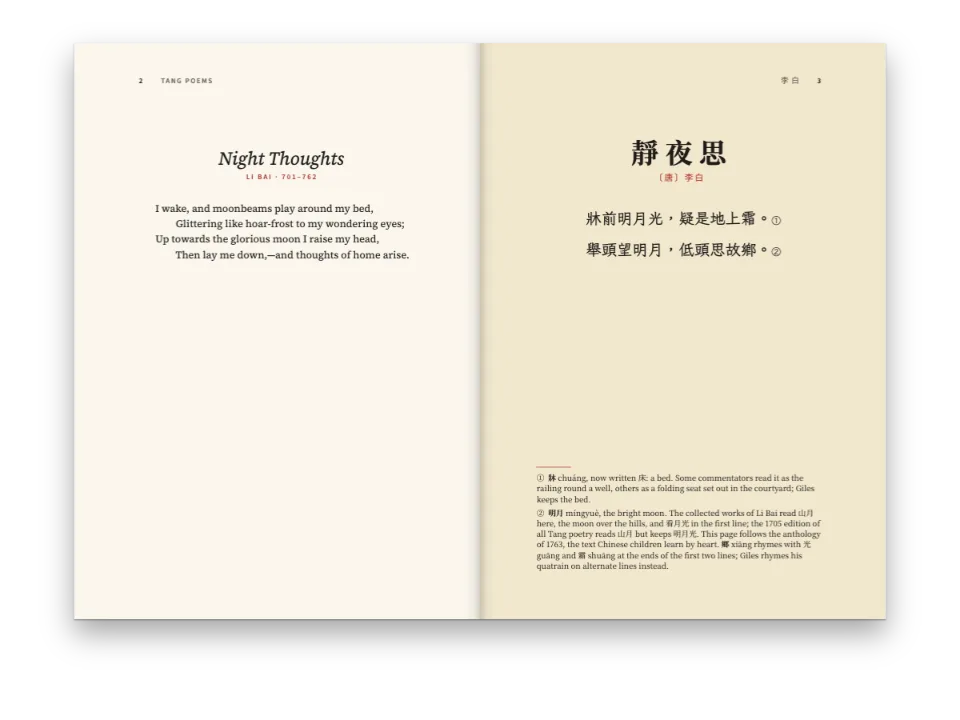
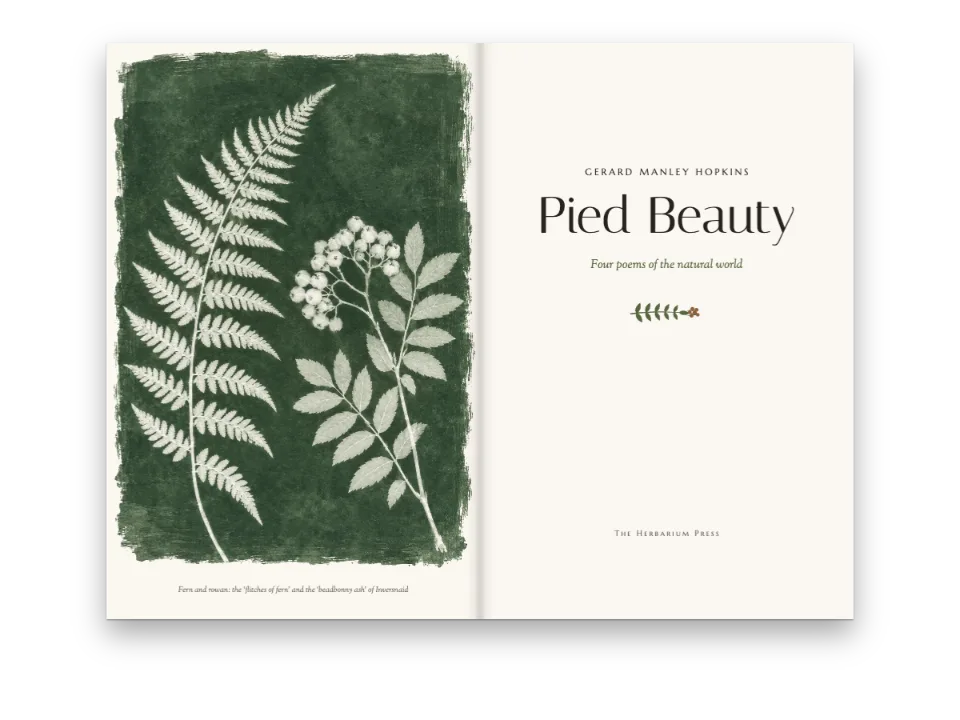
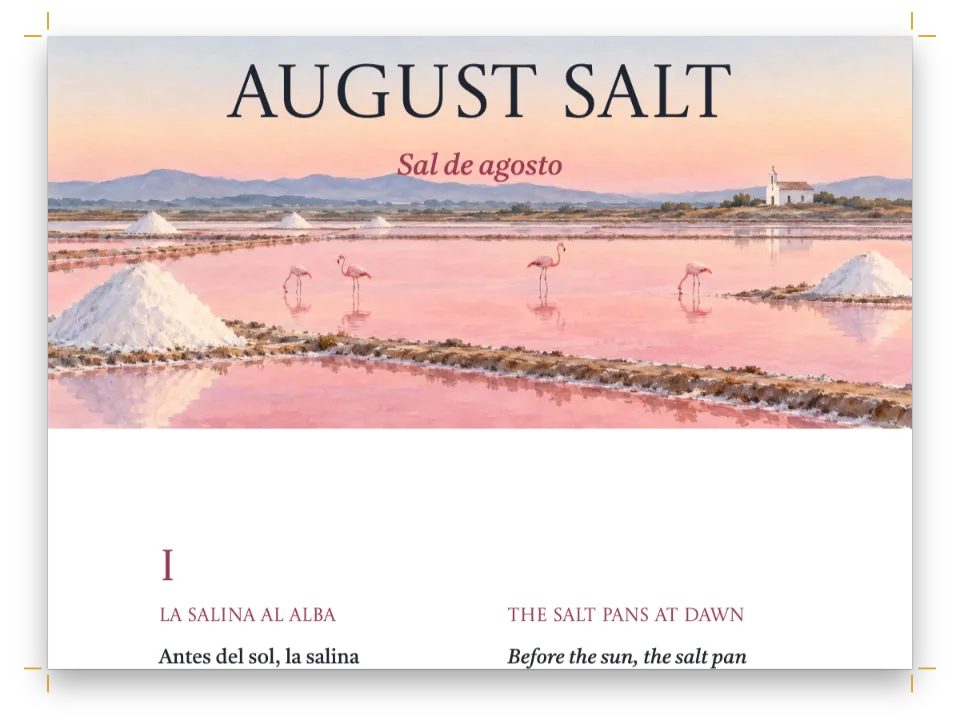
Quatro páginas de um divã, a poesia reunida de al-Mutanabbī, como os impressores do Cairo a compunham um século atrás: um anterrosto com ديوان em ruqʿa vermelho e depois, sob um cabeção com fios vermelhos, a qasida que ele recitou diante de Sayf al-Dawla em 954. Cada um dos quarenta e seis bayts é uma linha de dois hemistíquios, o ṣadr à direita e o ʿajuz à esquerda, os dois esticados com kashidas até a mesma largura, e assim as rimas em ‑mu descem em linha reta pela borda esquerda. O livro é encadernado pela direita, e os fólios contam com algarismos arábico-índicos. Só a nota sobre o texto, no fim, muda com a edição. Poemas Tang diante dos versos em inglês compõe verso chinês clássico na sua própria grade.
Esta receita responde a
- Como componho verso árabe clássico com cada verso dividido em dois hemistíquios?
A resposta curta
// In the Markdown, a :::verse block takes one bayt a line, the ṣadr and the ʿajuz parted
// by ||:
//   :::verse{style="bayt"}
//   عَلى قَدْرِ أهْلِ العَزْم تأتي العَزائِمُ || وَتأتي علَى قَدْرِ الكِرامِ المَكارمُ
//   :::
// The ṣadr goes on the right, the ʿajuz on the left, both stretched to the width of the
// widest half with a gap of 2 em between them. The style gives the poem its face and a
// leading deep enough for the harakat: 1.9 × the size.
const bayt = { id: 'bayt', fontFamily: NASKH, fontSize: pt(14), lineHeight: pt(26.6),
  color: col('ink'), marginTop: pt(LEAD / 2), marginBottom: pt(LEAD) };
// Justified lines lengthen their words with kashidas (tatweel) before they open the
// spaces wide: 'auto' is the default in an Arabic document, written out here to say so.
// A hemistich may stretch a word twice as far as a line of prose does: 1.2 em.
const bodyKashida = { kashida: 'auto', kashidaPatterns: 'naskh', kashidaMaxLength: 0.6 };
Ingredientes
- Funcionalidades
- Verso árabe (bayt em dois hemistíquios)Justificação com kashidaTexto da direita para a esquerdaFontes árabesÁrabe como idioma do documentoLivros encadernados pela direitaAlgarismos dos números geradosAberturas desenhadasAtributos de títuloEstilos de títuloCapas, folhas de rosto e colofõesCabeços e fóliosCabeços por tipo de páginaCor do papelEstilos de parágrafoParágrafos na outra direçãoPaleta de cores semânticaExportação para PDFFontes incorporadas ao PDF
- Também usa
- Cabeços por seção
- Tipografia
- Amiri, Aref Ruqaa, Noto Kufi Arabic (SIL OFL 1.1)
- Materiais
- Nenhum: todas as imagens são desenhadas em código
Preparo
#1 · Um bayt por linha, as duas metades com a mesma largura
O código é a resposta curta logo acima. Dentro de :::verse, cada linha é um bayt, e || separa os dois hemistíquios, então o Markdown se lê como o texto do Wikisource de onde veio (:::verse). O poema mede cada hemistíquio, toma a metade mais larga como largura das duas colunas (até metade da medida menos o vão central) e preenche cada metade até essa largura, primeiro com kashidas e depois com os espaços entre palavras (Verso clássico). O estilo bayt é composto em 14 pt com passo de 26,6 pt, 1,9 vez o corpo, para que as šaddas e as kasras de linhas vizinhas não se encostem (Sinais vocálicos). O formato é de 17 × 24 cm: em 14 × 21 cm, um terço dos bayts não cabia na sua metade da medida de 104 mm e caía num arranjo escalonado, com o ṣadr e o ʿajuz em linhas próprias.
#2 · Uma faixa de cabeção em ruqʿa
const rule = (id, y, thickness) => ({ kind: 'rule', id, direction: 'horizontal',
  thickness: pt(thickness), color: col('rubric'),
  placement: { anchor: { to: 'container', edge: 'top' }, offset: { y: mm(y) },
    size: { width: 'fill' } } });
const opener = {
  enabled: true, minHeight: mm(46),
  slot: { elements: [
    { kind: 'box', id: 'band', reserve: false, style: { backgroundColor: col('tint') },
      placement: { anchor: { to: 'container', edge: 'top' }, offset: { y: mm(4) },
        size: { width: 'fill', height: mm(26) } } },
    rule('band-top', 4, 1.5), rule('band-foot', 30, 0.5),
    { kind: 'text', id: 'title', content: '{titleText}', fontFamily: RUQAA, fontWeight: 700,
      fontSize: pt(34), lineHeight: 1.1, align: 'center', color: col('rubric'),
      placement: { anchor: { to: 'container', edge: 'top' }, offset: { y: mm(7.5) } } },
    { kind: 'text', id: 'metre', content: '{attr.metre}', fontFamily: KUFI, fontWeight: 500,
      fontSize: pt(9), align: 'center', color: col('muted'),
      placement: { anchor: { to: 'container', edge: 'top' }, offset: { y: mm(35) } } },
  ] },
};
O título de nível 1 é desenhado pelo seu design: uma caixa tingida com um fio vermelho em cima e outro embaixo, o título centralizado sobre ela em Aref Ruqaa e, abaixo, o metro, tirado de um atributo do título, {metre="من البحر الطويل"}. Letra de display em ruqʿa não leva kashida, então o título mantém a sua largura natural (Justificação e kashida).
#3 · Cabeços nos lados da folha
// Running heads stay on the sheet's sides: in a book bound on the right the verso (even)
// is the right-hand page, so its outer edge, where the folio goes, is the right one.
const head = (id, content, parity, edge, x, extra = {}) => ({ kind: 'text', id, content,
  parity, pages: 'body', fontFamily: KUFI, fontWeight: 500, fontSize: pt(8.5),
  color: col('muted'), placement: { anchor: { to: 'page', edge }, offset: { x: mm(x), y: mm(12) } },
  ...extra });
const header = { elements: [
  head('verso-folio', '{pageNumber}', 'even', 'top-right', -OUTER, { color: col('ink') }),
  head('verso-book', '{title}', 'even', 'top-right', -(OUTER + 10)),
  head('recto-rhyme', '{subtitle}', 'odd', 'top-left', OUTER + 10),
  head('recto-folio', '{pageNumber}', 'odd', 'top-left', OUTER, { color: col('ink') }),
] };
const footer = { elements: [head('drop-folio', '{pageNumber}', 'all', 'bottom', 0, {
  pages: 'opener', color: col('ink'),
  placement: { anchor: { to: 'page', edge: 'bottom' }, offset: { y: mm(-12) } } })] };
O texto corrido vai da direita para a esquerda, e nele esquerda e direita significam início e fim. Os cabeços continuam físicos. Num livro encadernado pela direita, o verso, uma página par, fica do lado direito da página dupla, então o seu fólio vai no alto à direita e o do reto no alto à esquerda: os dois ficam na borda externa (Ordem das páginas e encadernação à direita). Só a etiqueta locale: 'ar' já define a direção, a encadernação e os algarismos arábico-índicos.
#4 · Um anterrosto sem nada no fluxo
const at = (y) => ({ anchor: { to: 'page', edge: 'top' }, offset: { y: mm(y) } });
const line = (id, content, y, style) => ({ kind: 'text', id, content, align: 'center',
  overflow: 'wrap', color: col('ink'), placement: at(y), ...style });
const titlePage = {
  id: 'title', span: 'page', runningChapter: false,
  breakBefore: { enabled: true, parity: 'any' },
  header: { elements: [] }, footer: { elements: [] },
  advancedDesign: { enabled: true, slot: { elements: [
    line('diwan', 'ديوان', 52, { fontFamily: RUQAA, fontWeight: 700, fontSize: pt(64),
      lineHeight: 1.2, color: col('rubric') }),
    line('poet', '{titleText}', 84, { fontFamily: NASKH, fontWeight: 700, fontSize: pt(20) }),
    { kind: 'rule', id: 'rule', direction: 'horizontal', thickness: pt(0.75),
      color: col('rubric'), placement: { anchor: { to: 'page', edge: 'top' },
        offset: { y: mm(100) }, size: { width: mm(24) } } },
    line('rhyme', '{attr.rhyme}', 106, { fontFamily: KUFI, fontWeight: 500, fontSize: pt(11),
      color: col('rubric') }),
    line('latin', '{attr.latin}', 150, { fontFamily: NASKH, fontSize: pt(9.5),
      color: col('muted'), italic: true }),
  ] } },
};
O anterrosto é um estilo de título com span: 'page' e cabeçalho e rodapé próprios, vazios. O texto do título é o nome do poeta, então a palavra ديوان é texto de design, composta em 64 pt acima dele, e a linha em caracteres latinos sob a rima vem do atributo latin, que cada edição escreve no seu idioma.
A receita completa
// ═══ Postext Cookbook · Nº 110 · A qasida on a diwan page, in two hemistichs ═══════════ // https://postext.dev/en/cookbook/qasida-diwan-page // Code: MIT · Text: al-Mutanabbī, Dīwān, ar.wikisource (PD) · Pictures: none // Fonts: Amiri, Aref Ruqaa, Noto Kufi Arabic (SIL OFL 1.1) · Needs postext ≥ 1.15.0 import { buildDocument, renderPageToCanvas, clearMeasurementCache } from 'https://esm.sh/postext'; import { renderToPdf, decompressWoff2 } from 'https://esm.sh/postext-pdf'; const LANG = 'en'; // @lang: the language of the sample document ('en' | 'es') const RECIPE = 'qasida-diwan-page'; // ─── 1 · Design ───────────────────────────────────────────────────────────── // Black text and red rubrics on a warm paper, as a Cairo diwan of the 1900s prints them. const palette = { ink: '#1f1a16', // text: a warm near-black rubric: '#9a2b1f', // the accent: titles, the metre, the headpiece rules tint: '#f1e6cf', // the headpiece band rule: '#b8a27c', // hairlines muted: '#6b6156', // running heads and the note on the text paper: '#fbf7ee', // a cream paper }; const col = (id) => ({ hex: palette[id], model: 'hex', paletteId: id }); const colorPalette = [ ...Object.entries(palette).map(([id, hex]) => ({ id, name: id, value: { hex, model: 'hex' } })), { id: 'main-color', name: 'rubric (defaults)', value: { hex: palette.rubric, model: 'hex' } }, ]; const NASKH = 'Amiri'; // the text: a Bulaq Naskh const RUQAA = 'Aref Ruqaa'; // display: the titles const KUFI = 'Noto Kufi Arabic'; // labels: metre, running heads, folios const [SIZE, LEAD] = [13, 21]; // pt: the prose, at 1.6 × for a lightly vocalised headnote const [OUTER, TOP] = [18, 23]; // mm: a 17 × 24 cm diwan // #region answer: one bayt a line, both hemistichs stretched to one width // In the Markdown, a :::verse block takes one bayt a line, the ṣadr and the ʿajuz parted // by ||: // :::verse{style="bayt"} // عَلى قَدْرِ أهْلِ العَزْم تأتي العَزائِمُ || وَتأتي علَى قَدْرِ الكِرامِ المَكارمُ // ::: // The ṣadr goes on the right, the ʿajuz on the left, both stretched to the width of the // widest half with a gap of 2 em between them. The style gives the poem its face and a // leading deep enough for the harakat: 1.9 × the size. const bayt = { id: 'bayt', fontFamily: NASKH, fontSize: pt(14), lineHeight: pt(26.6), color: col('ink'), marginTop: pt(LEAD / 2), marginBottom: pt(LEAD) }; // Justified lines lengthen their words with kashidas (tatweel) before they open the // spaces wide: 'auto' is the default in an Arabic document, written out here to say so. // A hemistich may stretch a word twice as far as a line of prose does: 1.2 em. const bodyKashida = { kashida: 'auto', kashidaPatterns: 'naskh', kashidaMaxLength: 0.6 }; // #endregion // #region opener: a headpiece band with the title in Ruqʿa and the metre under it const rule = (id, y, thickness) => ({ kind: 'rule', id, direction: 'horizontal', thickness: pt(thickness), color: col('rubric'), placement: { anchor: { to: 'container', edge: 'top' }, offset: { y: mm(y) }, size: { width: 'fill' } } }); const opener = { enabled: true, minHeight: mm(46), slot: { elements: [ { kind: 'box', id: 'band', reserve: false, style: { backgroundColor: col('tint') }, placement: { anchor: { to: 'container', edge: 'top' }, offset: { y: mm(4) }, size: { width: 'fill', height: mm(26) } } }, rule('band-top', 4, 1.5), rule('band-foot', 30, 0.5), { kind: 'text', id: 'title', content: '{titleText}', fontFamily: RUQAA, fontWeight: 700, fontSize: pt(34), lineHeight: 1.1, align: 'center', color: col('rubric'), placement: { anchor: { to: 'container', edge: 'top' }, offset: { y: mm(7.5) } } }, { kind: 'text', id: 'metre', content: '{attr.metre}', fontFamily: KUFI, fontWeight: 500, fontSize: pt(9), align: 'center', color: col('muted'), placement: { anchor: { to: 'container', edge: 'top' }, offset: { y: mm(35) } } }, ] }, }; // #endregion // #region title: the diwan's half-title, centred on the page const at = (y) => ({ anchor: { to: 'page', edge: 'top' }, offset: { y: mm(y) } }); const line = (id, content, y, style) => ({ kind: 'text', id, content, align: 'center', overflow: 'wrap', color: col('ink'), placement: at(y), ...style }); const titlePage = { id: 'title', span: 'page', runningChapter: false, breakBefore: { enabled: true, parity: 'any' }, header: { elements: [] }, footer: { elements: [] }, advancedDesign: { enabled: true, slot: { elements: [ line('diwan', 'ديوان', 52, { fontFamily: RUQAA, fontWeight: 700, fontSize: pt(64), lineHeight: 1.2, color: col('rubric') }), line('poet', '{titleText}', 84, { fontFamily: NASKH, fontWeight: 700, fontSize: pt(20) }), { kind: 'rule', id: 'rule', direction: 'horizontal', thickness: pt(0.75), color: col('rubric'), placement: { anchor: { to: 'page', edge: 'top' }, offset: { y: mm(100) }, size: { width: mm(24) } } }, line('rhyme', '{attr.rhyme}', 106, { fontFamily: KUFI, fontWeight: 500, fontSize: pt(11), color: col('rubric') }), line('latin', '{attr.latin}', 150, { fontFamily: NASKH, fontSize: pt(9.5), color: col('muted'), italic: true }), ] } }, }; // #endregion // #region heads: the book on the verso, the rhyme on the recto, folios outside // Running heads stay on the sheet's sides: in a book bound on the right the verso (even) // is the right-hand page, so its outer edge, where the folio goes, is the right one. const head = (id, content, parity, edge, x, extra = {}) => ({ kind: 'text', id, content, parity, pages: 'body', fontFamily: KUFI, fontWeight: 500, fontSize: pt(8.5), color: col('muted'), placement: { anchor: { to: 'page', edge }, offset: { x: mm(x), y: mm(12) } }, ...extra }); const header = { elements: [ head('verso-folio', '{pageNumber}', 'even', 'top-right', -OUTER, { color: col('ink') }), head('verso-book', '{title}', 'even', 'top-right', -(OUTER + 10)), head('recto-rhyme', '{subtitle}', 'odd', 'top-left', OUTER + 10), head('recto-folio', '{pageNumber}', 'odd', 'top-left', OUTER, { color: col('ink') }), ] }; const footer = { elements: [head('drop-folio', '{pageNumber}', 'all', 'bottom', 0, { pages: 'opener', color: col('ink'), placement: { anchor: { to: 'page', edge: 'bottom' }, offset: { y: mm(-12) } } })] }; // #endregion const config = () => ({ // a factory: the engine caches resolved configs per object locale: 'ar', // right to left, bound on the right, digits ٠–٩ (gotcha: arabic-locale-tag) colorPalette, page: { width: mm(170), height: mm(240), dpi: 150, backgroundColor: col('paper'), margins: { top: mm(TOP), bottom: mm(22), left: mm(21), right: mm(OUTER), mirror: true } }, layout: { layoutType: 'single' }, bodyText: { fontFamily: NASKH, fontSize: pt(SIZE), lineHeight: pt(LEAD), color: col('ink'), boldColor: col('ink'), italicColor: col('ink'), referenceColor: col('ink'), textAlign: 'justify', firstLineIndent: em(1.5), indentAfterHeading: false, optimalLineBreaking: true, avoidWidows: true, avoidOrphans: true, ...bodyKashida }, // Restated: any headings object drops the H1 break (gotcha: headings-drop-h1-break). headings: { fontFamily: RUQAA, fontWeight: 700, color: col('rubric'), levels: [{ level: 1, fontSize: pt(34), breakBefore: { enabled: true, parity: 'any' }, advancedDesign: opener }] }, headingStyles: [titlePage], paragraphStyles: [bayt, { id: 'note', fontFamily: NASKH, fontSize: pt(9.5), lineHeight: pt(14), color: col('muted'), boldColor: col('ink'), italicColor: col('muted'), textAlign: 'justify', firstLineIndent: pt(0), marginTop: pt(LEAD), hyphenation: { enabled: true, locale: LANG } }, { id: 'colophon', fontFamily: NASKH, fontSize: pt(8), lineHeight: pt(11), color: col('muted'), textAlign: 'left', firstLineIndent: pt(0), marginTop: pt(7) }, ], header, footer, }); // ─── 2 · Content ──────────────────────────────────────────────────────────── const markdown = String.raw`---Amostra em Markdown · 66 linhas · content.en.md
title: "ديوان المتنبي" subtitle: "قافية الميم" --- # أبي الطيّب المتنبّي {style="title" rhyme="قافية الميم" latin="The Dīwān of al-Mutanabbī · poems rhyming in mīm"} # على قدر أهل العزم {metre="من البحر الطويل"} وقال يمدح سيفَ الدولة ويذكر بناءه قلعةَ الحَدَث الحمراء على ثغر الروم، وقد هزم الدُّمُسْتُق تحت أسوارها، سنة ثلاث وأربعين وثلاثمئة: :::verse{style="bayt"} عَلى قَدْرِ أهْلِ العَزْم تأتي العَزائِمُ || وَتأتي علَى قَدْرِ الكِرامِ المَكارمُ وَتَعْظُمُ في عَينِ الصّغيرِ صغارُها || وَتَصْغُرُ في عَين العَظيمِ العَظائِمُ يُكَلّفُ سيفُ الدّوْلَةِ الجيشَ هَمّهُ || وَقد عَجِزَتْ عنهُ الجيوشُ الخضارمُ وَيَطلُبُ عندَ النّاسِ ما عندَ نفسِه || وَذلكَ ما لا تَدّعيهِ الضّرَاغِمُ يُفَدّي أتَمُّ الطّيرِ عُمْراً سِلاحَهُ || نُسُورُ الفَلا أحداثُها وَالقَشاعِمُ وَما ضَرّها خَلْقٌ بغَيرِ مَخالِبٍ || وَقَدْ خُلِقَتْ أسيافُهُ وَالقَوائِمُ هَلِ الحَدَثُ الحَمراءُ تَعرِفُ لوْنَها || وَتَعْلَمُ أيُّ السّاقِيَيْنِ الغَمَائِمُ سَقَتْها الغَمَامُ الغُرُّ قَبْلَ نُزُولِهِ || فَلَمّا دَنَا مِنها سَقَتها الجَماجِمُ بَنَاهَا فأعْلى وَالقَنَا يَقْرَعُ القَنَا || وَمَوْجُ المَنَايَا حَوْلَها مُتَلاطِمُ وَكانَ بهَا مثْلُ الجُنُونِ فأصْبَحَتْ || وَمِنْ جُثَثِ القَتْلى عَلَيْها تَمائِمُ طَريدَةُ دَهْرٍ ساقَها فَرَدَدْتَهَا || على الدّينِ بالخَطّيّ وَالدّهْرُ رَاغِمُ تُفيتُ اللّيالي كُلَّ شيءٍ أخَذْتَهُ || وَهُنّ لِمَا يأخُذْنَ منكَ غَوَارِمُ إذا كانَ ما تَنْوِيهِ فِعْلاً مُضارِعاً || مَضَى قبلَ أنْ تُلقى علَيهِ الجَوازِمُ وكيفَ تُرَجّي الرّومُ والرّوسُ هدمَها || وَذا الطّعْنُ آساسٌ لهَا وَدَعائِمُ وَقَد حاكَمُوهَا وَالمَنَايَا حَوَاكِمٌ || فَما ماتَ مَظلُومٌ وَلا عاشَ ظالِمُ أتَوْكَ يَجُرّونَ الحَديدَ كَأنّمَا || سَرَوْا بِجِيَادٍ ما لَهُنّ قَوَائِمُ إذا بَرَقُوا لم تُعْرَفِ البِيضُ منهُمُ || ثِيابُهُمُ من مِثْلِها وَالعَمَائِمُ خميسٌ بشرْقِ الأرْضِ وَالغرْبِ زَحْفُهُ || وَفي أُذُنِ الجَوْزَاءِ منهُ زَمَازِمُ تَجَمّعَ فيهِ كلُّ لِسْنٍ وَأُمّةٍ || فَمَا يُفْهِمُ الحُدّاثَ إلاّ الترَاجِمُ فَلِلّهِ وَقْتٌ ذَوّبَ الغِشَّ نَارُهُ || فَلَمْ يَبْقَ إلاّ صَارِمٌ أوْ ضُبارِمُ تَقَطّعَ ما لا يَقْطَعُ الدّرْعَ وَالقَنَا || وَفَرّ منَ الفُرْسانِ مَنْ لا يُصادِمُ وَقَفْتَ وَما في المَوْتِ شكٌّ لوَاقِفٍ || كأنّكَ في جَفنِ الرّدَى وهْوَ نائِمُ تَمُرّ بكَ الأبطالُ كَلْمَى هَزيمَةً || وَوَجْهُكَ وَضّاحٌ وَثَغْرُكَ باسِمُ تجاوَزْتَ مِقدارَ الشّجاعَةِ والنُّهَى || إلى قَوْلِ قَوْمٍ أنتَ بالغَيْبِ عالِمُ ضَمَمْتَ جَناحَيهِمْ على القلبِ ضَمّةً || تَمُوتُ الخَوَافي تحتَها وَالقَوَادِمُ بضَرْبٍ أتَى الهاماتِ وَالنّصرُ غَائِبٌ || وَصَارَ إلى اللّبّاتِ وَالنّصرُ قَادِمُ حَقَرْتَ الرُّدَيْنِيّاتِ حتى طَرَحتَها || وَحتى كأنّ السّيفَ للرّمحِ شاتِمُ وَمَنْ طَلَبَ الفَتْحَ الجَليلَ فإنّمَا || مَفاتِيحُهُ البِيضُ الخِفافُ الصّوَارِمُ نَثَرْتَهُمُ فَوْقَ الأُحَيْدِبِ كُلّهِ || كمَا نُثِرَتْ فَوْقَ العَرُوسِ الدّراهمُ تدوسُ بكَ الخيلُ الوكورَ على الذُّرَى || وَقد كثرَتْ حَوْلَ الوُكورِ المَطاعِمُ تَظُنّ فِراخُ الفُتْخِ أنّكَ زُرْتَهَا || بأُمّاتِها وَهْيَ العِتاقُ الصّلادِمُ إذا زَلِقَتْ مَشّيْتَها ببُطونِهَا || كمَا تَتَمَشّى في الصّعيدِ الأراقِمُ أفي كُلّ يَوْمٍ ذا الدُّمُسْتُقُ مُقدِمٌ || قَفَاهُ على الإقْدامِ للوَجْهِ لائِمُ أيُنكِرُ رِيحَ اللّيثِ حتى يَذُوقَهُ || وَقد عَرَفتْ ريحَ اللّيوثِ البَهَائِمُ وَقد فَجَعَتْهُ بابْنِهِ وَابنِ صِهْرِهِ || وَبالصّهْرِ حَمْلاتُ الأميرِ الغَوَاشِمُ مضَى يَشكُرُ الأصْحَابَ في فوْته الظُّبَى || لِمَا شَغَلَتْهَا هامُهُمْ وَالمَعاصِمُ وَيَفْهَمُ صَوْتَ المَشرَفِيّةِ فيهِمِ || على أنّ أصْواتَ السّيوفِ أعَاجِمُ يُسَرّ بمَا أعْطاكَ لا عَنْ جَهَالَةٍ || وَلكِنّ مَغْنُوماً نَجَا منكَ غانِمُ وَلَسْتَ مَليكاً هازِماً لِنَظِيرِهِ || وَلَكِنّكَ التّوْحيدُ للشّرْكِ هَازِمُ تَشَرّفُ عَدْنانٌ بهِ لا رَبيعَةٌ || وَتَفْتَخِرُ الدّنْيا بهِ لا العَوَاصِمُ لَكَ الحَمدُ في الدُّرّ الذي ليَ لَفظُهُ || فإنّكَ مُعْطيهِ وَإنّيَ نَاظِمُ وَإنّي لَتَعْدو بي عَطَايَاكَ في الوَغَى || فَلا أنَا مَذْمُومٌ وَلا أنْتَ نَادِمُ عَلى كُلّ طَيّارٍ إلَيْهَا برِجْلِهِ || إذا وَقَعَتْ في مِسْمَعَيْهِ الغَمَاغِمُ ألا أيّها السّيفُ الذي لَيسَ مُغمَداً || وَلا فيهِ مُرْتابٌ وَلا منْهُ عَاصِمُ هَنيئاً لضَرْبِ الهَامِ وَالمَجْدِ وَالعُلَى || وَرَاجِيكَ وَالإسْلامِ أنّكَ سالِمُ وَلِمْ لا يَقي الرّحمٰنُ حدّيك ما وَقى || وَتَفْليقُهُ هَامَ العِدَى بكَ دائِمُ ::: :::paragraphs{style="note" dir=ltr} **A note on the text.** Abū al-Ṭayyib al-Mutanabbī (915–965) recited this qaṣīda before Sayf al-Dawla, the Ḥamdānid prince of Aleppo, in 954, after the prince had rebuilt the fortress of al-Ḥadath on the Byzantine frontier and driven off the army of the Domestikos Bardas Phokas beneath its walls. It runs to forty-six bayts in the ṭawīl metre, all on one rhyme, the letter mīm. The text is the one ar.wikisource gives, with its vowels; three typing slips are corrected, in bayts 12, 16 and 46. The two lines in prose above the poem are ours. ::: :::paragraphs{style="colophon" dir=ltr} Set in Amiri, Aref Ruqaa and Noto Kufi Arabic (SIL OFL) · Text: al-Mutanabbī, public domain, from ar.wikisource :::`; // content.<lang>.md, inlined by the Cookbook // ─── 3 · Fonts ────────────────────────────────────────────────────────────── const FONTS = { // every face the pages use, loaded before the build (gotcha: fonts-first) Amiri: ['400', '400i', '700'], // NASKH: the poem, the headnote, the poet; the note's Latin 'Aref Ruqaa': ['700'], // RUQAA: ديوان and the title 'Noto Kufi Arabic': ['500'], // KUFI: metre, rhyme, running heads and folios }; // ─── 4 · Build & show ─────────────────────────────────────────────────────── await loadFonts(FONTS, markdown); // The arabic file of each face, which loadFonts leaves out (gotcha: arabic-fonts-subset). await loadArabicFonts(FONTS, markdown); const doc = await buildWithFonts(() => buildDocument({ markdown }, config()), markdown); showBook(doc, { title: t({ en: 'A qasida on a diwan page', es: 'Una casida en una página de diván' }) }); offerPdf(() => renderToPdf(doc, { fontProvider: arabicPdfProvider }), `${RECIPE}.pdf`);Kit · core, fonts, viewer, pdf, arabic, book: igual em todas as receitas · 417 linhas
// ─── Kit ── helpers shared by every Cookbook recipe · postext.dev/cookbook ───── // ─── Kit · core v1 ── the same in every recipe · postext.dev/cookbook function mm(value) { return { value, unit: 'mm' }; } function pt(value) { return { value, unit: 'pt' }; } function em(value) { return { value, unit: 'em' }; } /** The sample language's string: t({ en: 'Figure', es: 'Figura' }). */ function t(strings) { return strings[LANG] ?? Object.values(strings)[0]; } /** A file in this recipe's assets folder, served from the Postext repo by jsDelivr. */ function asset(file) { return `https://cdn.jsdelivr.net/gh/drnachio/postext@main/cookbook/${RECIPE}/assets/${file}`; } // ─── Kit · fonts v2 ── the same in every recipe · postext.dev/cookbook // Postext measures with the loaded faces and caches the widths: load every face // before the first build, from Fontsource, the files the PDF embeds too. /** faces = { 'Family Name': ['400', '400i', '700'] }. `text` is the sample: * č ł † α χ also load latin-ext and greek files (kitSubsetsFor). With * `optional`, a face Fontsource does not ship is skipped instead of failing. * Resolves to the number of faces added. */ async function loadFonts(faces, text = '', { optional = false } = {}) { kitStatus('Loading fonts…'); const ranges = { latin: 'U+0000-00FF,U+0131,U+0152-0153,U+02BB-02BC,U+02C6,U+02DA,U+02DC,U+0304,U+0308,U+0329,' + 'U+2000-206F,U+20AC,U+2122,U+2191,U+2193,U+2212,U+2215,U+FEFF,U+FFFD', 'latin-ext': 'U+0100-02BA,U+02BD-02C5,U+02C7-02CC,U+02CE-02D7,U+02DD-02FF,U+0304,U+0308,U+0329,' + 'U+1D00-1DBF,U+1E00-1E9F,U+1EF2-1EFF,U+2020,U+20A0-20AB,U+20AD-20C0,U+2113,U+2C60-2C7F,U+A720-A7FF', greek: 'U+0370-03FF', }; const jobs = []; let added = 0; for (const [family, specs] of Object.entries(faces)) { const id = fontsourceId(family); const todo = [...new Set(specs)].map((spec) => [parseInt(spec, 10), spec.endsWith('i') ? 'italic' : 'normal']) .filter(([weight, style]) => !hasFace(family, weight, style)); // before any await const meta = optional || /[^\0-ÿ]/u.test(text) ? await fontsourceMeta(family) : null; const subsets = ['latin', ...kitSubsetsFor(text, meta)]; for (const [weight, style] of todo) { if (optional && !(meta?.weights.includes(weight) && meta.styles.includes(style))) continue; for (const subset of subsets) { const url = `https://cdn.jsdelivr.net/npm/@fontsource/${id}@5/files/${id}-${subset}-${weight}-${style}.woff2`; const face = new FontFace(family, `url(${url}) format('woff2')`, { weight: String(weight), style, unicodeRange: ranges[subset] }); jobs.push(face.load().then((ready) => { document.fonts.add(ready); added++; }, () => { if (subset === 'latin' && !optional) throw new Error(`Fontsource has no ${family} ${weight} ${style}`); })); } } } await Promise.all(jobs).catch((error) => { kitFail(error); throw error; }); return added; } /** Runs `build` and loads any face the pages use that FONTS missed (a regular * one with a warning), then clears the measurement cache and builds again. */ async function buildWithFonts(build, text = '') { const tried = new Set(); for (let round = 0; round < 3; round++) { kitStatus('Laying out…'); await new Promise(requestAnimationFrame); // let the status paint first const result = await Promise.resolve().then(build).catch((error) => { kitFail(error); throw error; }); const wanted = { base: {}, variants: {} }; for (const { font, base } of [result].flat().flatMap(fontStringsOf)) { const { family, weight, style } = parseFont(font); const key = `${family}|${weight}|${style}`; if (tried.has(key) || hasFace(family, weight, style)) continue; tried.add(key); (wanted[base ? 'base' : 'variants'][family] ??= []).push(`${weight}${style === 'italic' ? 'i' : ''}`); } if (Object.keys(wanted.base).length) { console.warn(`[cookbook] FONTS does not list ${JSON.stringify(wanted.base)}: loading them.`); } const added = await loadFonts(wanted.base, text) + await loadFonts(wanted.variants, text, { optional: true }); if (added === 0) return result; clearMeasurementCache(); } throw new Error('The fonts did not settle after three builds.'); } /** Every font string of the layout; `base` marks a block's own face. */ function fontStringsOf(doc) { const found = new Map(); const walk = (node) => { if (!node || typeof node !== 'object') return; if (Array.isArray(node)) { node.forEach(walk); return; } for (const [key, value] of Object.entries(node)) { if (typeof value === 'string' && /fontString$/i.test(key)) { found.set(value, found.get(value) || key === 'fontString'); } else if (value && typeof value === 'object') walk(value); } }; walk(doc.pages); walk(doc.blocks); return [...found].map(([font, base]) => ({ font, base })); } /** '700 37.5px Open Sans' / 'italic 400 13px "Source Serif 4"' → { family, weight, style }. * A string with no weight ('95.8px Young Serif', from a design text) is 400. */ function parseFont(font) { const m = /^(?:(italic|oblique)\s+)?(?:small-caps\s+)?(?:(\d+|bold|normal)\s+)?[\d.]+px\s+(.+)$/.exec(font.trim()); if (!m) throw new Error(`Unexpected font string: ${font}`); const weight = m[2] === 'bold' ? 700 : !m[2] || m[2] === 'normal' ? 400 : Number(m[2]); return { family: m[3].replace(/^["']|["']$/g, ''), weight, style: m[1] ? 'italic' : 'normal' }; } /** A loaded FontFace covers this family, weight and style (fonts.check() would * also say yes for families nobody declared). */ function hasFace(family, weight, style) { for (const face of document.fonts) { if (face.status !== 'loaded' || face.style !== style) continue; if (face.family.replace(/^["']|["']$/g, '') !== family) continue; const [low, high = low] = face.weight.split(' ').map(Number); if (weight >= low && weight <= high) return true; } return false; } /** The files beyond latin `text` needs that `meta`'s family ships. */ function kitSubsetsFor(text, meta) { return [[/[Ā-˿ᴀ-ᶿḀ-ỿ†ℓⱠ-Ɀ꜠-ꟿ]/u, 'latin-ext'], [/[Ͱ-Ͽ]/u, 'greek']] .filter(([re, x]) => re.test(text) && meta?.subsets?.includes(x)).map(([, x]) => x); } /** Fontsource's id for a family: 'Source Serif 4' → 'source-serif-4'. */ function fontsourceId(family) { return family.toLowerCase().replace(/\s+/g, '-'); } /** The family's Fontsource metadata (weights, styles, subsets), or null. */ function fontsourceMeta(family) { fontsourceMeta.cache ??= new Map(); const id = fontsourceId(family); if (!fontsourceMeta.cache.has(id)) { fontsourceMeta.cache.set(id, fetch(`https://api.fontsource.org/v1/fonts/${id}`) .then((res) => (res.ok ? res.json() : null), () => null)); } return fontsourceMeta.cache.get(id); } // ─── Kit · viewer v1 ── the same in every recipe · postext.dev/cookbook /** The pages as spreads on a dark desk, page 1 alone, then verso | recto, * each painted when it scrolls near. */ function showPages(docs, { title, width = 460 } = {}) { const root = viewer(title); const pages = [docs].flat().flatMap((doc) => doc.pages.map((page) => ({ doc, page, n: (doc.pageIndexOffset ?? 0) + page.index }))); const spreads = []; let verso = null; for (const p of pages) { if (p.n % 2 === 1) { if (verso) spreads.push([verso, null]); verso = p; } else { spreads.push([verso, p]); verso = null; } } if (verso) spreads.push([verso, null]); const density = Math.min(window.devicePixelRatio || 1, 2); showPages.painter?.disconnect(); const painter = new IntersectionObserver((entries) => { for (const { isIntersecting, target } of entries) { if (!isIntersecting) continue; painter.unobserve(target); const { doc, page } = target.postext; renderPageToCanvas(page, doc, target, { scale: (width * density) / page.width }); } }, { rootMargin: '800px' }); showPages.painter = painter; root.replaceChildren(...spreads.map((pair) => { const spread = document.createElement('div'); spread.className = 'pt-spread'; for (const p of pair) { const figure = document.createElement('figure'); if (p) { const label = p.page.pageLabel || String(p.n + 1); const canvas = document.createElement('canvas'); canvas.postext = p; canvas.style.aspectRatio = `${p.page.width} / ${p.page.height}`; canvas.setAttribute('role', 'img'); canvas.setAttribute('aria-label', `Page ${label}`); const folio = document.createElement('figcaption'); folio.textContent = label; figure.append(canvas, folio); painter.observe(canvas); } else figure.className = 'pt-blank'; spread.append(figure); } return spread; })); kitStatus(`${pages.length} ${pages.length === 1 ? 'page' : 'pages'}`); document.documentElement.dataset.postext = 'ready'; return pages.length; } /** The desk, the bar and the error reporting, created once. */ function viewer(title) { if (!document.getElementById('pt-kit')) { document.head.insertAdjacentHTML('beforeend', `<style id="pt-kit"> :root { color-scheme: dark; } body { margin: 0; background: #0e1014; color: #b9bcc4; font: 13px/1.45 system-ui, sans-serif; } #pt-bar { position: sticky; top: 0; z-index: 1; display: flex; flex-wrap: wrap; align-items: center; gap: 6px 16px; padding: 10px 16px; background: rgb(14 16 20 / .92); backdrop-filter: blur(6px); border-bottom: 1px solid #23262d; } #pt-bar strong { color: #f4f1ea; font-weight: 600; } #pt-actions { display: flex; gap: 12px; margin-left: auto; } #pt-actions a, #pt-actions button { color: #d8a21a; font: inherit; background: none; border: 0; padding: 0; cursor: pointer; } #pages { display: grid; justify-items: center; gap: 48px; padding: 32px 16px 72px; } .pt-spread { display: flex; } .pt-spread figure { margin: 0; width: min(460px, 44vw); } .pt-spread canvas { display: block; width: 100%; background: #fff; box-shadow: 0 1px 2px rgb(0 0 0 / .5), 0 22px 44px -16px rgb(0 0 0 / .8); } .pt-spread figure:first-child canvas { box-shadow: inset -14px 0 14px -14px rgb(0 0 0 / .18), 0 1px 2px rgb(0 0 0 / .5), 0 22px 44px -16px rgb(0 0 0 / .8); } .pt-spread figcaption { margin-top: 10px; text-align: center; font: 600 10px/1 system-ui, sans-serif; letter-spacing: .18em; text-transform: uppercase; color: #6c7079; } .pt-blank { visibility: hidden; } @media (max-width: 760px) { .pt-spread { flex-direction: column; gap: 32px; } .pt-spread figure { width: min(460px, 92vw); } .pt-blank { display: none; } } </style>`); document.body.insertAdjacentHTML('afterbegin', '<header id="pt-bar"><strong id="pt-title"></strong><span id="pt-status" role="status"></span><span id="pt-actions"></span></header>'); document.getElementById('pt-title').textContent = document.title || 'Postext'; addEventListener('error', (event) => kitFail(event.error ?? event.message)); addEventListener('unhandledrejection', (event) => kitFail(event.reason)); } if (title) document.getElementById('pt-title').textContent = title; return document.getElementById('pages') ?? document.body.appendChild(Object.assign(document.createElement('main'), { id: 'pages' })); } function kitStatus(text) { viewer(); document.getElementById('pt-status').textContent = text; } function kitFail(error) { document.documentElement.dataset.postext = 'error'; kitStatus(`Error: ${error?.message ?? error}`); } // ─── Kit · pdf v2 ── the same in every recipe that exports a PDF /** The Fontsource files the screen used, as TrueType: the nearest weight the * family ships, upright if it has no italic; latin, then what the face's * letters need (kitSubsetsFor). */ async function fontsourceProvider(family, weight, style, request) { const id = fontsourceId(family); const meta = await fontsourceMeta(family); const weights = meta?.weights?.length ? meta.weights : [400, 700]; const w = weights.reduce((a, b) => (Math.abs(b - weight) < Math.abs(a - weight) ? b : a)); const s = style === 'italic' && meta && !meta.styles.includes('italic') ? 'normal' : style; const text = String.fromCodePoint(...(request?.codePoints ?? [])); const more = kitSubsetsFor(text, meta); const files = await Promise.all(['latin', ...more].map(async (subset) => { const res = await fetch(`https://cdn.jsdelivr.net/npm/@fontsource/${id}@5/files/${id}-${subset}-${w}-${s}.woff2`); if (!res.ok) throw new Error(`Fontsource has no ${family} ${w} ${s} ${subset}`); return decompressWoff2(new Uint8Array(await res.arrayBuffer())); })); return files.length === 1 ? files[0] : files; } /** A "Build the PDF" button; then "Open the PDF" (a new tab: CodePen's frame * shows no PDFs) and a download link. */ function offerPdf(makePdf, filename) { viewer(); const button = Object.assign(document.createElement('button'), { type: 'button', textContent: 'Build the PDF' }); button.dataset.postextPdf = filename; button.addEventListener('click', async () => { button.disabled = true; button.textContent = 'Building the PDF…'; try { const bytes = await makePdf(); const url = URL.createObjectURL(new Blob([bytes], { type: 'application/pdf' })); const size = `${Math.max(1, Math.round(bytes.length / 1024))} KB`; button.replaceWith( Object.assign(document.createElement('a'), { href: url, target: '_blank', rel: 'noopener', textContent: 'Open the PDF ↗' }), Object.assign(document.createElement('a'), { href: url, download: filename, textContent: `Download ${filename} · ${size}` })); } catch (error) { button.disabled = false; button.textContent = 'Build the PDF'; kitFail(error); } }); document.getElementById('pt-actions').append(button); } // ─── Kit · arabic v1 ── Arabic-script faces · postext.dev/cookbook // Fontsource ships an Arabic family as one file per subset and weight: the // `arabic` file holds the letters, the harakat, the Arabic-Indic digits, the // Arabic punctuation and the presentation forms; `latin` and `latin-ext` // hold the rest. loadFonts loads the latin files; this block adds the arabic // file of every Arabic family, for the canvas and for the PDF, which shapes // the letters with HarfBuzz from the same bytes. /** The code points of Fontsource's `arabic` subset, as its stylesheets * declare them (the same unicode-range the browser picks the file by). A * function, not a const: the kit is inlined after the recipe's top-level * awaits, and a const read before its line throws, where a function * declaration is hoisted. */ function arabicRange() { return 'U+0600-06FF,U+0750-077F,U+0870-088E,U+0890-0891,U+0897-08E1,U+08E3-08FF,' + 'U+200C-200E,U+2010-2011,U+204F,U+2E41,U+FB50-FDFF,U+FE70-FE74,U+FE76-FEFC,U+102E0-102FB,' + 'U+10E60-10E7E,U+10EC2-10EC4,U+10EFC-10EFF,U+1EE00-1EEFF'; } /** Whether code point `cp` is in the arabic file. */ function inArabicRange(cp) { inArabicRange.ranges ??= arabicRange().split(',').map((part) => { const [lo, hi = lo] = part.slice(2).split('-'); return [parseInt(lo, 16), parseInt(hi, 16)]; }); return inArabicRange.ranges.some(([lo, hi]) => cp >= lo && cp <= hi); } /** Whether Fontsource serves `family` with an `arabic` subset. Fails when * the API does not answer: an Arabic face taken for a Latin one would set * its letters in a system face. */ async function isArabicFamily(family) { const meta = await fontsourceMeta(family); if (!meta) throw new Error(`api.fontsource.org did not describe ${family}: reload to try again`); return !!meta.subsets?.includes('arabic'); } /** The arabic file of a face. */ function arabicFileUrl(family, weight, style) { const id = fontsourceId(family); return `https://cdn.jsdelivr.net/npm/@fontsource/${id}@5/files/${id}-arabic-${weight}-${style}.woff2`; } /** faces = { Amiri: ['400', '700'] }, as for loadFonts, after it: the whole * FONTS object may be passed, its families without an arabic subset are * left alone. Adds the arabic file of every listed weight of each Arabic * family (the latin files come from loadFonts) and loads it. `text` is * the sample: fails when it holds an Arabic-script character the arabic * file does not cover. List every weight the pages set in Arabic: a weight * left to buildWithFonts gets the latin file only, and its Arabic letters * fall back to a system face. Resolves to the number of files loaded. */ async function loadArabicFonts(faces, text = '') { kitStatus('Loading fonts…'); let loaded = 0; try { const outside = [...new Set(text)].filter((ch) => /\p{Script=Arabic}/u.test(ch) && !inArabicRange(ch.codePointAt(0))); if (outside.length) throw new Error(`Fontsource's arabic files have no ${outside.slice(0, 12).join(' ')}`); for (const [family, specs] of Object.entries(faces)) { if (!(await isArabicFamily(family))) continue; for (const spec of new Set(specs)) { const weight = parseInt(spec, 10); const style = spec.endsWith('i') ? 'italic' : 'normal'; const face = new FontFace(family, `url(${arabicFileUrl(family, weight, style)}) format('woff2')`, { weight: String(weight), style, unicodeRange: arabicRange() }); document.fonts.add(await face.load().catch(() => { throw new Error(`Fontsource has no arabic file for ${family} ${weight} ${style}`); })); loaded++; } } } catch (error) { kitFail(error); throw error; } return loaded; } /** The PDF font provider for recipes with Arabic faces: a family with an * arabic subset gets its arabic file when its pages set Arabic letters * (`request.codePoints`), then its latin file, and its latin-ext file for * the letters beyond latin (transliteration: ā ḥ ʿ). The arabic file comes * first: it also holds the space and the brackets, so a line of Arabic is * shaped as one run and not cut at every space. Any other family goes to * fontsourceProvider (the "pdf" block). */ async function arabicPdfProvider(family, weight, style, request) { if (!(await isArabicFamily(family))) return fontsourceProvider(family, weight, style, request); const meta = await fontsourceMeta(family); const weights = meta.weights?.length ? meta.weights : [400, 700]; const w = weights.reduce((a, b) => (Math.abs(b - weight) < Math.abs(a - weight) ? b : a)); const s = style === 'italic' && !meta.styles.includes('italic') ? 'normal' : style; const wanted = [...(request?.codePoints ?? [])]; const id = fontsourceId(family); const urls = []; if (!wanted.length || wanted.some(inArabicRange)) urls.push(arabicFileUrl(family, w, s)); urls.push(`https://cdn.jsdelivr.net/npm/@fontsource/${id}@5/files/${id}-latin-${w}-${s}.woff2`); if (meta.subsets.includes('latin-ext') && wanted.some((cp) => /[Ā-˿Ḁ-ỿ]/u.test(String.fromCodePoint(cp)))) { urls.push(`https://cdn.jsdelivr.net/npm/@fontsource/${id}@5/files/${id}-latin-ext-${w}-${s}.woff2`); } return Promise.all(urls.map(async (url) => { const res = await fetch(url); if (!res.ok) throw new Error(`Fontsource file ${url} (${res.status})`); return decompressWoff2(new Uint8Array(await res.arrayBuffer())); })); } // ─── Kit · book v1 ── books bound on either edge · postext.dev/cookbook // A book bound on the right (Arabic, Hebrew or Persian text, vertical // Chinese, or page.binding 'right') opens from what a Latin reader calls // the back: page 1 lies alone on the left of the spine, then [3 | 2]. /** showPages for a book bound on either edge. A right-bound book (the * document says so: doc.binding is 'right' for page.binding 'right', for * text that runs right to left and for vertical text, when the binding is * left to 'auto') lies on the desk as it opens: page 1 alone on the left * of the spine, then [3 | 2], the spine shade on each page's inner edge. * `binding` ('left' | 'right') overrides the document's. */ function showBook(docs, { binding, ...options } = {}) { const count = showPages(docs, options); const right = (binding ?? [docs].flat()[0]?.binding) === 'right'; if (!document.getElementById('pt-kit-book')) { // The pages keep direction ltr, as in a left-bound book: a canvas takes // the direction its element inherits, and under the spread's rtl a run // painted for an ltr canvas would end where the engine starts it. document.head.insertAdjacentHTML('beforeend', `<style id="pt-kit-book"> .pt-spread[dir="rtl"] canvas { direction: ltr; } .pt-spread[dir="rtl"] figure:first-child canvas { box-shadow: inset 14px 0 14px -14px rgb(0 0 0 / .18), 0 1px 2px rgb(0 0 0 / .5), 0 22px 44px -16px rgb(0 0 0 / .8); } </style>`); } // Each pair stays [verso, recto] in the page; right to left, the verso // sits on the right. Phones stack the pages in reading order either way. for (const spread of document.querySelectorAll('#pages > .pt-spread')) spread.dir = right ? 'rtl' : 'ltr'; document.getElementById('pages').dataset.binding = right ? 'right' : 'left'; return count; } // ─── /Kit ───────────────────────────────────────────────────────────────────────
O script.js montado funciona como está: cole-o como script de módulo em qualquer página ou abra a receita no CodePen. Pasta da receita no GitHub ↗ (abre em uma nova aba)
Variações
#Marque o vão com um ornamento
Alguns divãs imprimem uma estrelinha entre os hemistíquios. ornament põe uma marca no meio do vão sem acrescentá-la ao texto.
-:::verse{style="bayt"}
+:::verse{style="bayt" ornament="٭"}#Dê a mesma largura a todos os hemistíquios
Uma width fixa dá às duas colunas a mesma medida em todas as páginas do divã, seja qual for a metade mais larga de cada poema.
-:::verse{style="bayt"}
+:::verse{style="bayt" width=58mm}Erros comuns
Erro comum
Marque um livro árabe como 'ar', não com LANG
As edições de uma receita são en e es, mas uma amostra árabe é árabe nas duas: `locale: LANG` a comporia da esquerda para a direita, a encadernaria pela esquerda, numeraria as suas páginas 1 2 3 e chamaria as suas figuras de Figure ou Figura. Escreva você mesmo a marcação: 'ar' (algarismos arábico-índicos, a convenção do Machrek), uma região como 'ar-EG' ou 'ar-SA', ou 'ar-MA', 'ar-DZ' ou 'ar-TN' para uma edição magrebina com algarismos europeus. Uma página latina que só cita árabe mantém o seu próprio locale. Texto da direita para a esquerda →
Erro comum
Fontes árabes precisam do seu arquivo arabic, pelo bloco arabic
O Fontsource serve Amiri, Noto Naskh Arabic ou Scheherazade New em um arquivo por subconjunto, e as letras árabes estão no arquivo arabic. loadFonts baixa só latin (e latin-ext), então na tela o árabe vem de uma fonte do sistema e é medido errado, e o fontsourceProvider entrega ao PDF esse arquivo latin, que imprime caixas vazias. Inclua o bloco arabic do kit, chame loadArabicFonts(FONTS, markdown) depois de loadFonts, com todos os pesos que as páginas usam em árabe listados em FONTS, e passe a renderToPdf fontProvider: arabicPdfProvider. Fontes árabes →
Erro comum
Qualquer objeto headings desativa a quebra de página do H1
Por padrão, um H1 salta para uma página ímpar (always-odd), mas passar qualquer objeto headings redefine esse padrão, então os capítulos ficam emendados e span: 'page' não faz nada. Declare de novo headings.levels[0].breakBefore: { enabled: true, parity } em toda configuração. Capítulos que abrem em página ímpar →
Erro comum
Carregue todas as fontes antes do layout
O motor de layout mede o texto com as fontes que o navegador carregou e guarda as larguras em cache, então uma fonte que chega depois da primeira composição deixa quebras de linha erradas e um PDF que não corresponde mais à tela. Carregue antes todos os pesos e estilos e chame clearMeasurementCache() antes de recompor quando alguma chegar atrasada. Fontes antes da diagramação →
Créditos
- Receita
- Ignacio Ferro
- Texto
- The qasida ʿAlā qadri ahli l-ʿazmi taʾtī l-ʿazāʾimu, as ar.wikisource gives it (revision 447620), with its vowels · al-Mutanabbī · domínio público
- The headnote in Arabic, the note on the text and the colophon · Postext Cookbook · original
- Fontes
- Amiri (SIL OFL 1.1) · Aref Ruqaa (SIL OFL 1.1) · Noto Kufi Arabic (SIL OFL 1.1)
- Código
- MIT, como o Postext
Editar este texto ↗ (abre em uma nova aba)Pasta da receita no GitHub ↗ (abre em uma nova aba)