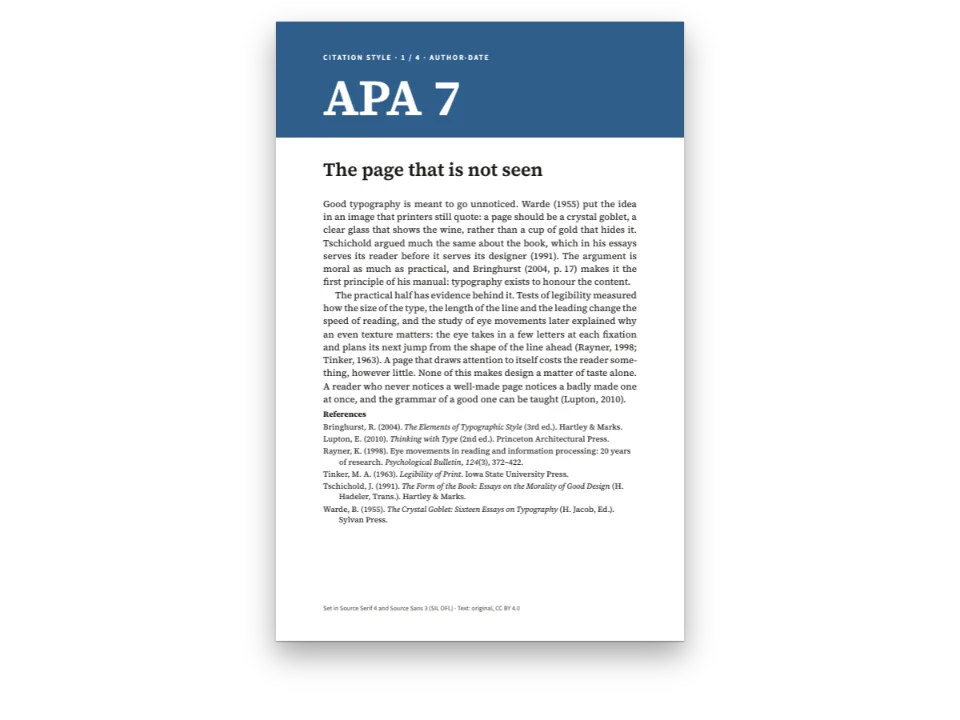
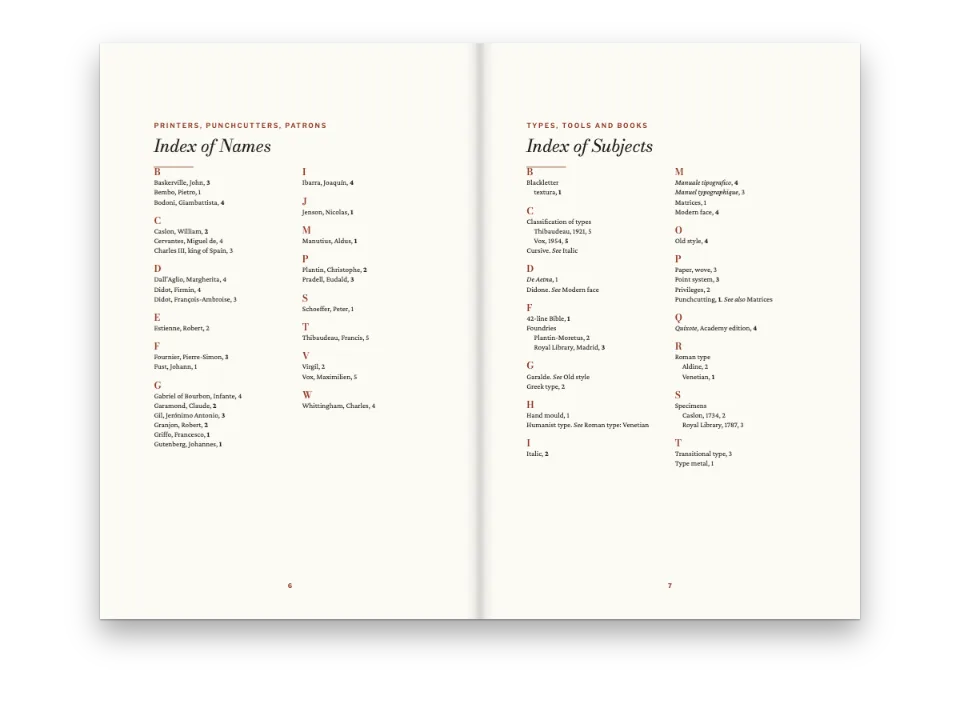
Em poucas palavras
A lista de leituras de um seminário universitário. O professor cola o arquivo que o Zotero exporta; o Postext compõe as citações e uma lista que inclui também livros que o texto não menciona.
O que você vai compor
A lista de leituras de um seminário de seis semanas sobre história e sociologia da ciência, composta numa página de 210 × 280 mm em duas colunas. Um campo verde-escuro ocupa a metade de cima da primeira página, com o título do curso em Spectral Light de 50 pt; o texto abaixo é o guia do professor para cada semana. As referências são a coleção do seminário no Zotero, exportada em BibTeX e colada no documento sem mexer numa linha: as chaves de citação do Zotero, as chaves em volta das maiúsculas, os acentos {\"o}, month = dec e os campos file, keywords e urldate. O texto cita oito das obras. As outras cinco, leituras de fundo que o seminário não discute, entram na lista por nocite.
Esta receita responde a
- Como uso uma exportação BibTeX do Zotero e listo obras que o texto nunca cita?
- Como cito obras e monto a bibliografia em APA, IEEE ou outro estilo de citação?
A resposta curta
// The works come from a :::references{format=bibtex} block: the Zotero export pasted as it
// is. The text cites some of them; `nocite` in the front matter adds the rest by key, and
// `nocite: "@*"` would add the whole export. citeproc-js writes both in the style named.
registerCitationEngine(createCiteprocEngine({ styles: STYLES, locales: LOCALES }));
const citations = {
  style: 'chicago-author-date', // '(Gieryn 1983)', 'Shapin and Schaffer (1985)'
  link: true, // a citation jumps to its entry
  bibliography: {
    // includeUncited: true is the same as nocite: "@*", set from the design side.
    fontSize: em(0.94), lineHeight: pt(12.4), hangingIndent: mm(5), entrySpacing: pt(3.5),
    doi: 'link', // Zotero's doi field prints as https://doi.org/…; its url field is dropped
  },
};
Ingredientes
- Funcionalidades
- Bibliografia a partir das referênciasCitações em um estilo de citaçãoAberturas desenhadasAtributos de títuloUma ou duas colunasCabeços e fóliosEstilos de parágrafoPaleta de cores semântica
- Tipografia
- Spectral, IBM Plex Sans Condensed (SIL OFL 1.1)
- Materiais
- Nenhum: todas as imagens são desenhadas em código
Preparo
#1 · Dar nome ao estilo uma vez
O código é a resposta curta acima. O motor de citações é registrado antes da primeira composição, e o estilo é uma única configuração: o Chicago autor-data escreve “(Shapin 1984)” para [@shapin_pump_1984] e “Shapin and Schaffer (1985)” para @shapin_leviathan_1985 dentro da frase. As chaves são as que o Zotero montou com o primeiro autor, a primeira palavra significativa do título e o ano, então gieryn_boundary-work_1983 mantém o hífen; o Postext lê um hífen ou um sublinhado dentro de uma chave como parte dela.
#2 · Colar a exportação como o Zotero a escreve
O último bloco do documento guarda a exportação, uma entrada por obra, recuada com tabulações como o Zotero a escreve:
@article{gieryn_boundary-work_1983,
	title = {Boundary-{Work} and the {Demarcation} of {Science} from {Non}-{Science}: …},
	url = {https://www.jstor.org/stable/2095325},
	doi = {10.2307/2095325},
	urldate = {2026-08-21},
	journal = {American Sociological Review},
	author = {Gieryn, Thomas F.},
	month = dec,
	year = {1983},
	keywords = {demarcation, week 4},
	pages = {781--795},
	file = {JSTOR Full Text PDF:/Users/hps214/Zotero/storage/2HJ8M6PA/Gieryn - 1983 - ….pdf:application/pdf},
}
O leitor tira as chaves que protegem as maiúsculas, compõe {\"o} e {\'e} em ö e é, transforma -- em meia-risca e lê month = dec como um nome de mês sem chaves. urldate vira a data de acesso, e language a língua da obra; file, keywords, abstract e shorttitle são ignorados, então nada do seu disco chega à página.
#3 · Trazer as obras que o texto não cita
O frontmatter as lista pela chave:
---
title: "Science as a Social Practice"
nocite: "@fleck_genesis_1979, @merton_sociology_1973, @latour_science_1987, @rheinberger_toward_1997, @lopez_pinero_ciencia_1979"
---
A lista traz todas as obras citadas mais estas cinco, ordenadas juntas por autor, como o Chicago pede; nada marca uma entrada como não citada. nocite: "@*" lista a exportação inteira, e bibliography.includeUncited: true faz o mesmo a partir da configuração, para um projeto gráfico que sempre imprime a biblioteca toda.
#4 · Um campo verde para o cartão
const BAND = 132; // mm from the trim's top to the band's foot
const onBand = { color: col('paper'), align: 'left', overflow: 'wrap' };
const opener = {
  enabled: true,
  minHeight: mm(BAND - TOP + 9), // the columns start 9 mm under the band
  slot: { elements: [
    { kind: 'box', id: 'band', style: { backgroundColor: col('accent') },
      placement: { anchor: { to: 'page', edge: 'top-left' },
        size: { width: 'fill', height: mm(BAND) } } },
    { kind: 'text', id: 'kicker', content: '{attr.kicker}', ...onBand, fontFamily: LABEL,
      fontSize: pt(8.5), fontWeight: 600, letterSpacing: pt(1.7), textTransform: 'uppercase',
      placement: { anchor: { to: 'container', edge: 'top-left' }, offset: { y: mm(14) } } },
    { kind: 'text', id: 'title', content: '{titleText}', ...onBand, fontFamily: TEXT,
      fontSize: pt(50), fontWeight: 300, lineHeight: 1.02,
      placement: { anchor: { to: '#kicker', edge: 'below' }, offset: { y: mm(7) },
        size: { width: mm(150), height: 'auto' } } },
    { kind: 'rule', id: 'rule', direction: 'horizontal', thickness: pt(1), color: col('tint'),
      placement: { anchor: { to: '#title', edge: 'below' }, offset: { y: mm(7) },
        size: { width: mm(18) } } },
    { kind: 'text', id: 'lead', content: '{attr.lead}', ...onBand, fontFamily: TEXT,
      italic: true, fontSize: pt(13), lineHeight: 1.3, color: col('tint'),
      placement: { anchor: { to: '#rule', edge: 'below' }, offset: { y: mm(6) },
        size: { width: mm(128), height: 'auto' } } },
  ] },
};
A faixa é uma caixa ancorada no refile, com 132 mm de altura, e as duas colunas começam 9 mm abaixo dela. O título, o fio e o olho são encadeados com âncoras below, de modo que um título de curso mais longo empurra o olho para baixo em vez de bater nele.
const palette = {
  ink: '#1c211f', accent: '#2d5b48', tint: '#dfe9e2', rule: '#c3cdc6', muted: '#5c6862',
  paper: '#ffffff',
};
const col = (id) => ({ hex: palette[id], model: 'hex', paletteId: id });
const colorPalette = Object.entries({ ...palette, 'main-color': palette.accent })
  .map(([id, hex]) => ({ id, name: id, value: { hex, model: 'hex' } }));
A receita completa
// ═══ Postext Cookbook · Nº 097 · A reading list from a Zotero BibTeX export ═══════ // https://postext.dev/en/cookbook/zotero-bibtex-nocite // Code: MIT · Text: original (CC BY 4.0) · Pictures: none // Fonts: Spectral, IBM Plex Sans Condensed (SIL OFL 1.1) · Needs postext ≥ 1.12.1 import { buildDocument, renderPageToCanvas, clearMeasurementCache, registerCitationEngine, } from 'https://esm.sh/postext'; import { createCiteprocEngine, STYLES, LOCALES } from 'https://esm.sh/postext-citeproc'; const LANG = 'en'; // @lang: the language of the sample document ('en' | 'es') const RECIPE = 'zotero-bibtex-nocite'; // ─── 1 · Design ───────────────────────────────────────────────────────────── // #region palette: a department green, one tint, everything else in ink const palette = { ink: '#1c211f', accent: '#2d5b48', tint: '#dfe9e2', rule: '#c3cdc6', muted: '#5c6862', paper: '#ffffff', }; const col = (id) => ({ hex: palette[id], model: 'hex', paletteId: id }); const colorPalette = Object.entries({ ...palette, 'main-color': palette.accent }) .map(([id, hex]) => ({ id, name: id, value: { hex, model: 'hex' } })); // #endregion const [TEXT, LABEL] = ['Spectral', 'IBM Plex Sans Condensed']; const LEAD = 13.4; // pt const [TOP, OUTER] = [24, 18]; // mm // #region answer: Chicago author-date, and a list that holds more than the text cites // The works come from a :::references{format=bibtex} block: the Zotero export pasted as it // is. The text cites some of them; `nocite` in the front matter adds the rest by key, and // `nocite: "@*"` would add the whole export. citeproc-js writes both in the style named. registerCitationEngine(createCiteprocEngine({ styles: STYLES, locales: LOCALES })); const citations = { style: 'chicago-author-date', // '(Gieryn 1983)', 'Shapin and Schaffer (1985)' link: true, // a citation jumps to its entry bibliography: { // includeUncited: true is the same as nocite: "@*", set from the design side. fontSize: em(0.94), lineHeight: pt(12.4), hangingIndent: mm(5), entrySpacing: pt(3.5), doi: 'link', // Zotero's doi field prints as https://doi.org/…; its url field is dropped }, }; // #endregion // #region opener: a green field over the top half, the course in white on it const BAND = 132; // mm from the trim's top to the band's foot const onBand = { color: col('paper'), align: 'left', overflow: 'wrap' }; const opener = { enabled: true, minHeight: mm(BAND - TOP + 9), // the columns start 9 mm under the band slot: { elements: [ { kind: 'box', id: 'band', style: { backgroundColor: col('accent') }, placement: { anchor: { to: 'page', edge: 'top-left' }, size: { width: 'fill', height: mm(BAND) } } }, { kind: 'text', id: 'kicker', content: '{attr.kicker}', ...onBand, fontFamily: LABEL, fontSize: pt(8.5), fontWeight: 600, letterSpacing: pt(1.7), textTransform: 'uppercase', placement: { anchor: { to: 'container', edge: 'top-left' }, offset: { y: mm(14) } } }, { kind: 'text', id: 'title', content: '{titleText}', ...onBand, fontFamily: TEXT, fontSize: pt(50), fontWeight: 300, lineHeight: 1.02, placement: { anchor: { to: '#kicker', edge: 'below' }, offset: { y: mm(7) }, size: { width: mm(150), height: 'auto' } } }, { kind: 'rule', id: 'rule', direction: 'horizontal', thickness: pt(1), color: col('tint'), placement: { anchor: { to: '#title', edge: 'below' }, offset: { y: mm(7) }, size: { width: mm(18) } } }, { kind: 'text', id: 'lead', content: '{attr.lead}', ...onBand, fontFamily: TEXT, italic: true, fontSize: pt(13), lineHeight: 1.3, color: col('tint'), placement: { anchor: { to: '#rule', edge: 'below' }, offset: { y: mm(6) }, size: { width: mm(128), height: 'auto' } } }, ] }, }; // #endregion const head = (id, content, parity, edge, x, extra = {}) => ({ kind: 'text', id, content, parity, pages: 'body', fontFamily: LABEL, fontSize: pt(7.5), fontWeight: 600, letterSpacing: pt(1.2), textTransform: 'uppercase', color: col('muted'), placement: { anchor: { to: 'page', edge }, offset: { x: mm(x), y: mm(13) } }, ...extra, }); const folio = { color: col('accent') }; const listName = t({ en: 'HPS 214 · Reading list', es: 'HPS 214 · Lecturas' }); const config = () => ({ // a factory: the engine caches resolved configs per object locale: t({ en: 'en-us', es: 'es' }), colorPalette, citations, page: { sizePreset: 'custom', width: mm(210), height: mm(280), dpi: 150, margins: { top: mm(TOP), bottom: mm(22), left: mm(20), right: mm(OUTER), mirror: true }, }, layout: { layoutType: 'double', gutterWidth: mm(7) }, bodyText: { fontFamily: TEXT, fontSize: pt(9.6), lineHeight: pt(LEAD), color: col('ink'), boldColor: col('ink'), italicColor: col('ink'), referenceColor: col('accent'), textAlign: 'justify', firstLineIndent: mm(4), indentAfterHeading: false, hyphenation: { enabled: true }, optimalLineBreaking: true, avoidWidows: true, avoidOrphans: true, avoidRunts: true, }, headings: { fontFamily: TEXT, color: col('ink'), fontWeight: 600, levels: [ // Restated: any headings object drops the H1 break (gotcha: headings-drop-h1-break). { level: 1, span: 'page', breakBefore: { enabled: true, parity: 'any' }, marginBottom: pt(0), advancedDesign: opener }, { level: 2, fontFamily: LABEL, fontSize: pt(10), lineHeight: pt(LEAD), fontWeight: 600, color: col('accent'), marginTop: pt(LEAD), marginBottom: pt(0), }, ], }, paragraphStyles: [ { id: 'colophon', fontFamily: LABEL, fontSize: pt(7), lineHeight: pt(9.5), color: col('muted'), textAlign: 'left', firstLineIndent: pt(0), marginTop: pt(LEAD) }, ], header: { elements: [ head('verso-folio', '{pageNumber}', 'even', 'top-left', OUTER, folio), head('verso-title', '{title}', 'even', 'top-left', OUTER + 8), head('recto-title', listName, 'odd', 'top-right', -(OUTER + 8)), head('recto-folio', '{pageNumber}', 'odd', 'top-right', -OUTER, folio), ] }, footer: { elements: [] }, }); // ─── 2 · Content ──────────────────────────────────────────────────────────── const markdown = String.raw`---Amostra em Markdown · 204 linhas · content.en.md
title: "Science as a Social Practice" nocite: "@fleck_genesis_1979, @merton_sociology_1973, @latour_science_1987, @rheinberger_toward_1997, @lopez_pinero_ciencia_1979" --- # Science as a Social Practice {kicker="HPS 214 · Seminar reading list · Autumn term 2026" lead="Six weeks on how scientific knowledge is made, tested and trusted, from the paradigm to the laboratory notebook."} This seminar reads the history and sociology of science as one subject. Its question is how a claim about nature becomes a fact that people who never saw the experiment are willing to rely on. The answers we read come from historians of the seventeenth century, from sociologists who sat in laboratories for two years, and from philosophers who looked at what scientists actually do rather than at what their textbooks say they do. Each week has one set reading, which everyone reads before the seminar, and one or two companion texts for the person introducing the discussion. The set readings are available in the course reader; the others are in the library’s reserve collection. ## Week 1 · Paradigms and normal science We start with the book that made the subject fashionable. Read the first five sections and the Postscript of @kuhn_structure_1970, which Kuhn added for the second edition to answer the charge that “paradigm” meant too many things at once. His preface credits a monograph by Ludwik Fleck, written in 1935 and nearly forgotten until Kuhn mentioned it; it is in the list at the end, and the student introducing the week should read its second chapter. ## Week 2 · Witnessing an experiment The set reading is the first two chapters of @shapin_leviathan_1985, on Robert Boyle’s air-pump and the dispute with Thomas Hobbes over whether an experiment could settle anything. The companion text is the shorter article in which Shapin first described Boyle’s “literary technology”, the way a report written in plain, circumstantial prose turned its readers into witnesses [@shapin_pump_1984]. ## Week 3 · Inside the laboratory Bruno Latour spent two years at the Salk Institute as an observer of a neuroendocrinology laboratory. Read the second and third chapters of @latour_laboratory_1979 and follow how a statement loses its qualifications (“it seems that”, “X has claimed”) as it travels from one paper to the next until it is printed without any. ## Week 4 · Where science ends The demarcation problem asks what separates science from what is not science. Philosophers looked for a criterion; @gieryn_boundary-work_1983 looked at the people who draw the line in practice, and at what they gain by drawing it where they do. Bring an example from the news of the last month. ## Week 5 · Objectivity has a history Read the article first [@daston_image_1992], then the first chapter and the chapter on “trained judgment” in the book it grew into [@daston_objectivity_2007]. The argument is that objectivity, as a virtue of the scientist, appeared in the nineteenth century, and that atlases of skeletons, snowflakes and clouds show it arriving. ## Week 6 · Whom to believe The last week returns to the seventeenth century with a broader question: how did gentlemen-philosophers decide whose reports to accept? Read the first chapter of @shapin_social_1994 and come ready to compare its answer with how you decide whom to believe when you read a paper outside your field. ## Further reading The list below is the seminar’s Zotero collection, exported as BibTeX and set as it came out of Zotero. It includes every work cited above and five that the seminar does not discuss but that you will meet in the essays you read: Fleck’s monograph, Merton’s collected essays on the norms of science, Latour’s later handbook, Rheinberger’s study of experimental systems, and a history of Spanish science in the sixteenth and seventeenth centuries for those who read Spanish. :::bibliography{title=""} :::paragraphs{style="colophon"} Set in Spectral and IBM Plex Sans Condensed (SIL OFL) · Reading list and notes: original, CC BY 4.0 · The works are real; the Zotero file paths and access dates are illustrative. ::: :::references{format=bibtex} @book{kuhn_structure_1970, address = {Chicago}, edition = {2}, title = {The {Structure} of {Scientific} {Revolutions}}, abstract = {Normal science, anomaly and crisis, and the paradigm changes that end them, with the Postscript of 1969.}, language = {en}, publisher = {University of Chicago Press}, author = {Kuhn, Thomas S.}, year = {1970}, keywords = {paradigms, week 1}, file = {Kuhn - 1970 - The Structure of Scientific Revolutions.pdf:/Users/hps214/Zotero/storage/7QW2KD9N/Kuhn - 1970 - The Structure of Scientific Revolutions.pdf:application/pdf}, } @book{fleck_genesis_1979, address = {Chicago}, title = {Genesis and {Development} of a {Scientific} {Fact}}, language = {en}, publisher = {University of Chicago Press}, author = {Fleck, Ludwik}, editor = {Trenn, Thaddeus J. and Merton, Robert K.}, translator = {Bradley, Fred and Trenn, Thaddeus J.}, year = {1979}, keywords = {thought collectives, week 1}, } @book{shapin_leviathan_1985, address = {Princeton, NJ}, title = {Leviathan and the {Air}-{Pump}: {Hobbes}, {Boyle}, and the {Experimental} {Life}}, shorttitle = {Leviathan and the {Air}-{Pump}}, language = {en}, publisher = {Princeton University Press}, author = {Shapin, Steven and Schaffer, Simon}, year = {1985}, keywords = {experiment, week 2}, } @article{shapin_pump_1984, title = {Pump and {Circumstance}: {Robert} {Boyle}'s {Literary} {Technology}}, volume = {14}, shorttitle = {Pump and {Circumstance}}, url = {https://doi.org/10.1177/030631284014004001}, doi = {10.1177/030631284014004001}, language = {en}, number = {4}, urldate = {2026-08-21}, journal = {Social Studies of Science}, author = {Shapin, Steven}, month = nov, year = {1984}, keywords = {literary technology, week 2}, pages = {481--520}, file = {Shapin - 1984 - Pump and Circumstance.pdf:/Users/hps214/Zotero/storage/V3NC8RTE/Shapin - 1984 - Pump and Circumstance.pdf:application/pdf}, } @book{latour_laboratory_1979, address = {Beverly Hills}, title = {Laboratory {Life}: {The} {Social} {Construction} of {Scientific} {Facts}}, shorttitle = {Laboratory {Life}}, language = {en}, publisher = {Sage}, author = {Latour, Bruno and Woolgar, Steve}, year = {1979}, keywords = {ethnography, week 3}, } @book{latour_science_1987, address = {Cambridge, MA}, title = {Science in {Action}: {How} to {Follow} {Scientists} and {Engineers} through {Society}}, shorttitle = {Science in {Action}}, language = {en}, publisher = {Harvard University Press}, author = {Latour, Bruno}, year = {1987}, } @book{rheinberger_toward_1997, address = {Stanford, CA}, title = {Toward a {History} of {Epistemic} {Things}: {Synthesizing} {Proteins} in the {Test} {Tube}}, language = {en}, publisher = {Stanford University Press}, author = {Rheinberger, Hans-J{\"o}rg}, year = {1997}, keywords = {experimental systems}, } @article{gieryn_boundary-work_1983, title = {Boundary-{Work} and the {Demarcation} of {Science} from {Non}-{Science}: {Strains} and {Interests} in {Professional} {Ideologies} of {Scientists}}, volume = {48}, shorttitle = {Boundary-{Work} and the {Demarcation} of {Science} from {Non}-{Science}}, url = {https://www.jstor.org/stable/2095325}, doi = {10.2307/2095325}, language = {en}, number = {6}, urldate = {2026-08-21}, journal = {American Sociological Review}, author = {Gieryn, Thomas F.}, month = dec, year = {1983}, keywords = {demarcation, week 4}, pages = {781--795}, file = {JSTOR Full Text PDF:/Users/hps214/Zotero/storage/2HJ8M6PA/Gieryn - 1983 - Boundary-Work and the Demarcation of Science from Non-Science.pdf:application/pdf}, } @article{daston_image_1992, title = {The {Image} of {Objectivity}}, url = {https://www.jstor.org/stable/2928741}, doi = {10.2307/2928741}, language = {en}, number = {40}, urldate = {2026-08-22}, journal = {Representations}, author = {Daston, Lorraine and Galison, Peter}, year = {1992}, keywords = {objectivity, week 5}, pages = {81--128}, file = {JSTOR Full Text PDF:/Users/hps214/Zotero/storage/F9XK4C2B/Daston and Galison - 1992 - The Image of Objectivity.pdf:application/pdf}, } @book{daston_objectivity_2007, address = {New York}, title = {Objectivity}, language = {en}, publisher = {Zone Books}, author = {Daston, Lorraine and Galison, Peter}, year = {2007}, keywords = {objectivity, week 5}, } @book{shapin_social_1994, address = {Chicago}, series = {Science and {Its} {Conceptual} {Foundations}}, title = {A {Social} {History} of {Truth}: {Civility} and {Science} in {Seventeenth}-{Century} {England}}, language = {en}, publisher = {University of Chicago Press}, author = {Shapin, Steven}, year = {1994}, keywords = {trust, week 6}, } @book{merton_sociology_1973, address = {Chicago}, title = {The {Sociology} of {Science}: {Theoretical} and {Empirical} {Investigations}}, language = {en}, publisher = {University of Chicago Press}, author = {Merton, Robert K.}, editor = {Storer, Norman W.}, year = {1973}, } @book{lopez_pinero_ciencia_1979, address = {Barcelona}, title = {Ciencia y t{\'e}cnica en la sociedad espa{\~n}ola de los siglos {XVI} y {XVII}}, language = {es}, publisher = {Labor}, author = {L{\'o}pez Pi{\~n}ero, Jos{\'e} Mar{\'i}a}, year = {1979}, } :::`; // ─── 3 · Fonts ────────────────────────────────────────────────────────────── const FONTS = { Spectral: ['300', '300i', '400', '400i', '600', '600i'], 'IBM Plex Sans Condensed': ['400', '600'], }; // ─── 4 · Build & show ─────────────────────────────────────────────────────── await loadFonts(FONTS, markdown); const doc = await buildWithFonts(() => buildDocument({ markdown }, config()), markdown); showPages(doc, { title: t({ en: 'A reading list from Zotero', es: 'Lecturas desde Zotero' }) });Kit · core, fonts, viewer: igual em todas as receitas · 236 linhas
// ─── Kit ── helpers shared by every Cookbook recipe · postext.dev/cookbook ───── // ─── Kit · core v1 ── the same in every recipe · postext.dev/cookbook function mm(value) { return { value, unit: 'mm' }; } function pt(value) { return { value, unit: 'pt' }; } function em(value) { return { value, unit: 'em' }; } /** The sample language's string: t({ en: 'Figure', es: 'Figura' }). */ function t(strings) { return strings[LANG] ?? Object.values(strings)[0]; } /** A file in this recipe's assets folder, served from the Postext repo by jsDelivr. */ function asset(file) { return `https://cdn.jsdelivr.net/gh/drnachio/postext@main/cookbook/${RECIPE}/assets/${file}`; } // ─── Kit · fonts v2 ── the same in every recipe · postext.dev/cookbook // Postext measures with the loaded faces and caches the widths: load every face // before the first build, from Fontsource, the files the PDF embeds too. /** faces = { 'Family Name': ['400', '400i', '700'] }. `text` is the sample: * č ł † α χ also load latin-ext and greek files (kitSubsetsFor). With * `optional`, a face Fontsource does not ship is skipped instead of failing. * Resolves to the number of faces added. */ async function loadFonts(faces, text = '', { optional = false } = {}) { kitStatus('Loading fonts…'); const ranges = { latin: 'U+0000-00FF,U+0131,U+0152-0153,U+02BB-02BC,U+02C6,U+02DA,U+02DC,U+0304,U+0308,U+0329,' + 'U+2000-206F,U+20AC,U+2122,U+2191,U+2193,U+2212,U+2215,U+FEFF,U+FFFD', 'latin-ext': 'U+0100-02BA,U+02BD-02C5,U+02C7-02CC,U+02CE-02D7,U+02DD-02FF,U+0304,U+0308,U+0329,' + 'U+1D00-1DBF,U+1E00-1E9F,U+1EF2-1EFF,U+2020,U+20A0-20AB,U+20AD-20C0,U+2113,U+2C60-2C7F,U+A720-A7FF', greek: 'U+0370-03FF', }; const jobs = []; let added = 0; for (const [family, specs] of Object.entries(faces)) { const id = fontsourceId(family); const todo = [...new Set(specs)].map((spec) => [parseInt(spec, 10), spec.endsWith('i') ? 'italic' : 'normal']) .filter(([weight, style]) => !hasFace(family, weight, style)); // before any await const meta = optional || /[^\0-ÿ]/u.test(text) ? await fontsourceMeta(family) : null; const subsets = ['latin', ...kitSubsetsFor(text, meta)]; for (const [weight, style] of todo) { if (optional && !(meta?.weights.includes(weight) && meta.styles.includes(style))) continue; for (const subset of subsets) { const url = `https://cdn.jsdelivr.net/npm/@fontsource/${id}@5/files/${id}-${subset}-${weight}-${style}.woff2`; const face = new FontFace(family, `url(${url}) format('woff2')`, { weight: String(weight), style, unicodeRange: ranges[subset] }); jobs.push(face.load().then((ready) => { document.fonts.add(ready); added++; }, () => { if (subset === 'latin' && !optional) throw new Error(`Fontsource has no ${family} ${weight} ${style}`); })); } } } await Promise.all(jobs).catch((error) => { kitFail(error); throw error; }); return added; } /** Runs `build` and loads any face the pages use that FONTS missed (a regular * one with a warning), then clears the measurement cache and builds again. */ async function buildWithFonts(build, text = '') { const tried = new Set(); for (let round = 0; round < 3; round++) { kitStatus('Laying out…'); await new Promise(requestAnimationFrame); // let the status paint first const result = await Promise.resolve().then(build).catch((error) => { kitFail(error); throw error; }); const wanted = { base: {}, variants: {} }; for (const { font, base } of [result].flat().flatMap(fontStringsOf)) { const { family, weight, style } = parseFont(font); const key = `${family}|${weight}|${style}`; if (tried.has(key) || hasFace(family, weight, style)) continue; tried.add(key); (wanted[base ? 'base' : 'variants'][family] ??= []).push(`${weight}${style === 'italic' ? 'i' : ''}`); } if (Object.keys(wanted.base).length) { console.warn(`[cookbook] FONTS does not list ${JSON.stringify(wanted.base)}: loading them.`); } const added = await loadFonts(wanted.base, text) + await loadFonts(wanted.variants, text, { optional: true }); if (added === 0) return result; clearMeasurementCache(); } throw new Error('The fonts did not settle after three builds.'); } /** Every font string of the layout; `base` marks a block's own face. */ function fontStringsOf(doc) { const found = new Map(); const walk = (node) => { if (!node || typeof node !== 'object') return; if (Array.isArray(node)) { node.forEach(walk); return; } for (const [key, value] of Object.entries(node)) { if (typeof value === 'string' && /fontString$/i.test(key)) { found.set(value, found.get(value) || key === 'fontString'); } else if (value && typeof value === 'object') walk(value); } }; walk(doc.pages); walk(doc.blocks); return [...found].map(([font, base]) => ({ font, base })); } /** '700 37.5px Open Sans' / 'italic 400 13px "Source Serif 4"' → { family, weight, style }. * A string with no weight ('95.8px Young Serif', from a design text) is 400. */ function parseFont(font) { const m = /^(?:(italic|oblique)\s+)?(?:small-caps\s+)?(?:(\d+|bold|normal)\s+)?[\d.]+px\s+(.+)$/.exec(font.trim()); if (!m) throw new Error(`Unexpected font string: ${font}`); const weight = m[2] === 'bold' ? 700 : !m[2] || m[2] === 'normal' ? 400 : Number(m[2]); return { family: m[3].replace(/^["']|["']$/g, ''), weight, style: m[1] ? 'italic' : 'normal' }; } /** A loaded FontFace covers this family, weight and style (fonts.check() would * also say yes for families nobody declared). */ function hasFace(family, weight, style) { for (const face of document.fonts) { if (face.status !== 'loaded' || face.style !== style) continue; if (face.family.replace(/^["']|["']$/g, '') !== family) continue; const [low, high = low] = face.weight.split(' ').map(Number); if (weight >= low && weight <= high) return true; } return false; } /** The files beyond latin `text` needs that `meta`'s family ships. */ function kitSubsetsFor(text, meta) { return [[/[Ā-˿ᴀ-ᶿḀ-ỿ†ℓⱠ-Ɀ꜠-ꟿ]/u, 'latin-ext'], [/[Ͱ-Ͽ]/u, 'greek']] .filter(([re, x]) => re.test(text) && meta?.subsets?.includes(x)).map(([, x]) => x); } /** Fontsource's id for a family: 'Source Serif 4' → 'source-serif-4'. */ function fontsourceId(family) { return family.toLowerCase().replace(/\s+/g, '-'); } /** The family's Fontsource metadata (weights, styles, subsets), or null. */ function fontsourceMeta(family) { fontsourceMeta.cache ??= new Map(); const id = fontsourceId(family); if (!fontsourceMeta.cache.has(id)) { fontsourceMeta.cache.set(id, fetch(`https://api.fontsource.org/v1/fonts/${id}`) .then((res) => (res.ok ? res.json() : null), () => null)); } return fontsourceMeta.cache.get(id); } // ─── Kit · viewer v1 ── the same in every recipe · postext.dev/cookbook /** The pages as spreads on a dark desk, page 1 alone, then verso | recto, * each painted when it scrolls near. */ function showPages(docs, { title, width = 460 } = {}) { const root = viewer(title); const pages = [docs].flat().flatMap((doc) => doc.pages.map((page) => ({ doc, page, n: (doc.pageIndexOffset ?? 0) + page.index }))); const spreads = []; let verso = null; for (const p of pages) { if (p.n % 2 === 1) { if (verso) spreads.push([verso, null]); verso = p; } else { spreads.push([verso, p]); verso = null; } } if (verso) spreads.push([verso, null]); const density = Math.min(window.devicePixelRatio || 1, 2); showPages.painter?.disconnect(); const painter = new IntersectionObserver((entries) => { for (const { isIntersecting, target } of entries) { if (!isIntersecting) continue; painter.unobserve(target); const { doc, page } = target.postext; renderPageToCanvas(page, doc, target, { scale: (width * density) / page.width }); } }, { rootMargin: '800px' }); showPages.painter = painter; root.replaceChildren(...spreads.map((pair) => { const spread = document.createElement('div'); spread.className = 'pt-spread'; for (const p of pair) { const figure = document.createElement('figure'); if (p) { const label = p.page.pageLabel || String(p.n + 1); const canvas = document.createElement('canvas'); canvas.postext = p; canvas.style.aspectRatio = `${p.page.width} / ${p.page.height}`; canvas.setAttribute('role', 'img'); canvas.setAttribute('aria-label', `Page ${label}`); const folio = document.createElement('figcaption'); folio.textContent = label; figure.append(canvas, folio); painter.observe(canvas); } else figure.className = 'pt-blank'; spread.append(figure); } return spread; })); kitStatus(`${pages.length} ${pages.length === 1 ? 'page' : 'pages'}`); document.documentElement.dataset.postext = 'ready'; return pages.length; } /** The desk, the bar and the error reporting, created once. */ function viewer(title) { if (!document.getElementById('pt-kit')) { document.head.insertAdjacentHTML('beforeend', `<style id="pt-kit"> :root { color-scheme: dark; } body { margin: 0; background: #0e1014; color: #b9bcc4; font: 13px/1.45 system-ui, sans-serif; } #pt-bar { position: sticky; top: 0; z-index: 1; display: flex; flex-wrap: wrap; align-items: center; gap: 6px 16px; padding: 10px 16px; background: rgb(14 16 20 / .92); backdrop-filter: blur(6px); border-bottom: 1px solid #23262d; } #pt-bar strong { color: #f4f1ea; font-weight: 600; } #pt-actions { display: flex; gap: 12px; margin-left: auto; } #pt-actions a, #pt-actions button { color: #d8a21a; font: inherit; background: none; border: 0; padding: 0; cursor: pointer; } #pages { display: grid; justify-items: center; gap: 48px; padding: 32px 16px 72px; } .pt-spread { display: flex; } .pt-spread figure { margin: 0; width: min(460px, 44vw); } .pt-spread canvas { display: block; width: 100%; background: #fff; box-shadow: 0 1px 2px rgb(0 0 0 / .5), 0 22px 44px -16px rgb(0 0 0 / .8); } .pt-spread figure:first-child canvas { box-shadow: inset -14px 0 14px -14px rgb(0 0 0 / .18), 0 1px 2px rgb(0 0 0 / .5), 0 22px 44px -16px rgb(0 0 0 / .8); } .pt-spread figcaption { margin-top: 10px; text-align: center; font: 600 10px/1 system-ui, sans-serif; letter-spacing: .18em; text-transform: uppercase; color: #6c7079; } .pt-blank { visibility: hidden; } @media (max-width: 760px) { .pt-spread { flex-direction: column; gap: 32px; } .pt-spread figure { width: min(460px, 92vw); } .pt-blank { display: none; } } </style>`); document.body.insertAdjacentHTML('afterbegin', '<header id="pt-bar"><strong id="pt-title"></strong><span id="pt-status" role="status"></span><span id="pt-actions"></span></header>'); document.getElementById('pt-title').textContent = document.title || 'Postext'; addEventListener('error', (event) => kitFail(event.error ?? event.message)); addEventListener('unhandledrejection', (event) => kitFail(event.reason)); } if (title) document.getElementById('pt-title').textContent = title; return document.getElementById('pages') ?? document.body.appendChild(Object.assign(document.createElement('main'), { id: 'pages' })); } function kitStatus(text) { viewer(); document.getElementById('pt-status').textContent = text; } function kitFail(error) { document.documentElement.dataset.postext = 'error'; kitStatus(`Error: ${error?.message ?? error}`); } // ─── /Kit ───────────────────────────────────────────────────────────────────────
O script.js montado funciona como está: cole-o como script de módulo em qualquer página ou abra a receita no CodePen. Pasta da receita no GitHub ↗ (abre em uma nova aba)
Variações
#Listar a coleção inteira do Zotero
Quando a exportação é a própria lista, dispense as chaves: todas as entradas do bloco são impressas, citadas ou não.
-nocite: "@fleck_genesis_1979, @merton_sociology_1973, @latour_science_1987, …"
+nocite: "@*"#Mudar o estilo
As mesmas chaves dão uma lista Harvard (Cite Them Right) sem nenhuma outra mudança.
-  style: 'chicago-author-date', // '(Gieryn 1983)', 'Shapin and Schaffer (1985)'
+ style: 'harvard-cite-them-right',Erros comuns
Erro comum
Uma chave de nocite que não corresponde a nada é descartada sem aviso
Uma chave citada sem referência gera o aviso unknownCitationKey, mas uma chave em nocite que não corresponde a nenhuma entrada é ignorada sem aviso. Copie as chaves da exportação e conte as entradas da lista. Bibliografia a partir das referências →
Erro comum
Qualquer objeto headings desativa a quebra de página do H1
Por padrão, um H1 salta para uma página ímpar (always-odd), mas passar qualquer objeto headings redefine esse padrão, então os capítulos ficam emendados e span: 'page' não faz nada. Declare de novo headings.levels[0].breakBefore: { enabled: true, parity } em toda configuração. Capítulos que abrem em página ímpar →
Erro comum
Carregue todas as fontes antes do layout
O motor de layout mede o texto com as fontes que o navegador carregou e guarda as larguras em cache, então uma fonte que chega depois da primeira composição deixa quebras de linha erradas e um PDF que não corresponde mais à tela. Carregue antes todos os pesos e estilos e chame clearMeasurementCache() antes de recompor quando alguma chegar atrasada. Fontes antes da diagramação →
Erro comum
Coloque entre aspas cada valor do frontmatter
O YAML lê title: 1984 como número e uma data como objeto Date, e valores que não são strings saem vazios nos placeholders e deixam o PDF sem título. Coloque cada valor entre aspas: title: "1984". Metadados do documento →
Erro comum
A configuração fica em cache pela identidade: crie um objeto novo
O motor guarda em cache as configurações resolvidas pela identidade do objeto, então alterar uma configuração no próprio objeto e compor de novo reaproveita o resultado antigo. Crie um objeto novo a cada composição; por isso a configuração de uma receita é uma função, config(). Páginas em um canvas →
- Uma chave em
nociteque não corresponde a nenhuma entrada é descartada sem aviso. Copie as chaves da exportação em vez de digitá-las, e conte as entradas na página. - O Zotero monta as chaves a partir dos dados: corrija o nome de um autor ou um título no Zotero, e a próxima exportação pode mudar a chave, o que quebra todas as citações dela. Fixe as chaves antes de escrever o texto: o Zotero lê uma linha
Citation Key: …no campo Extra de um item. - O Zotero exporta em UTF-8 por padrão, com os acentos como são. O bloco aqui foi exportado com a opção de codificação Western, que escreve
{\"o}; o Postext lê as duas. - A 18ª edição do Chicago omite o local de publicação, então o campo
addressnão é impresso, e um artigo com DOI mostra o DOI, e não ourldo JSTOR.
Créditos
- Receita
- Ignacio Ferro
- Texto
- Texto original, CC BY 4.0
- Fontes
- Spectral (SIL OFL 1.1) · IBM Plex Sans Condensed (SIL OFL 1.1)
- Código
- MIT, como o Postext
Editar este texto ↗ (abre em uma nova aba)Pasta da receita no GitHub ↗ (abre em uma nova aba)