简单来说
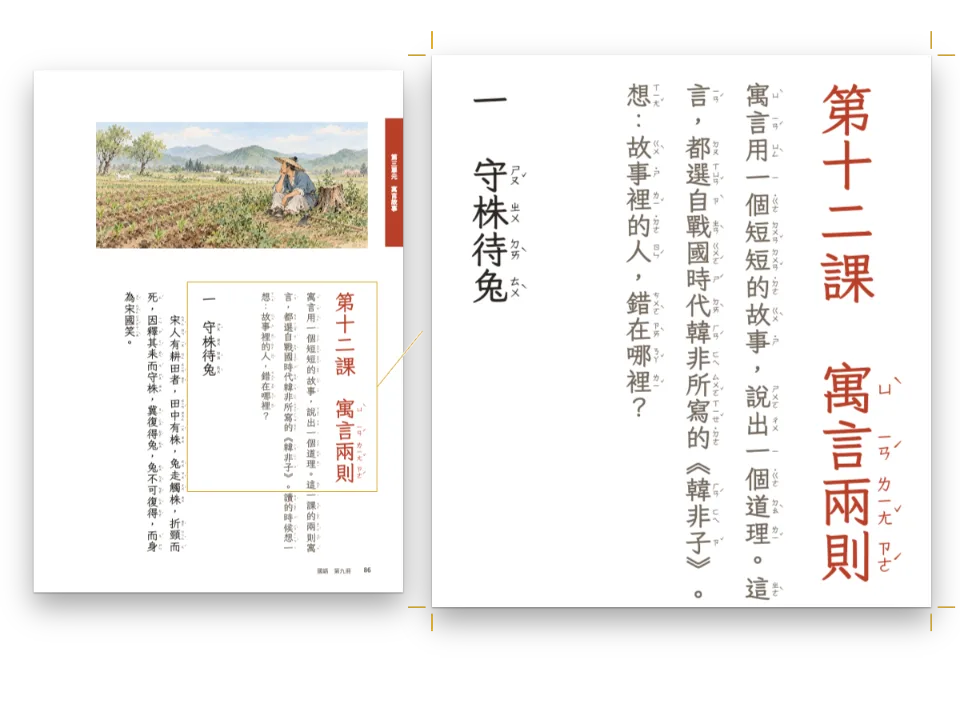
一本给幼儿看的日文图画书,全部用平假名,每组词后留一个空格,换行时从不把一组词拆开,每页上方都有一幅画。
成品一览
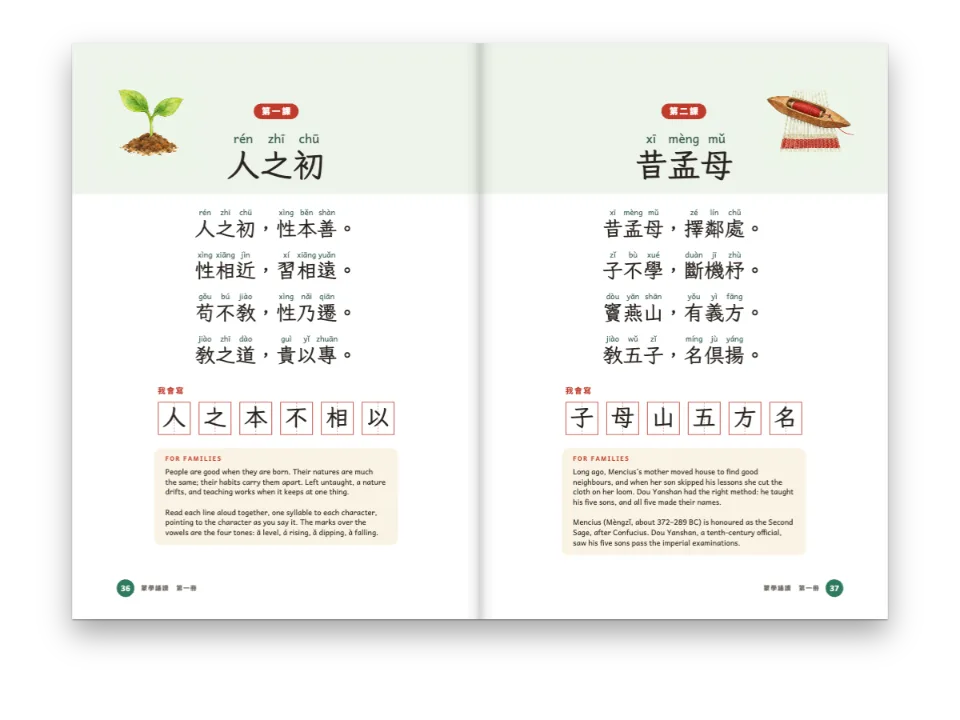
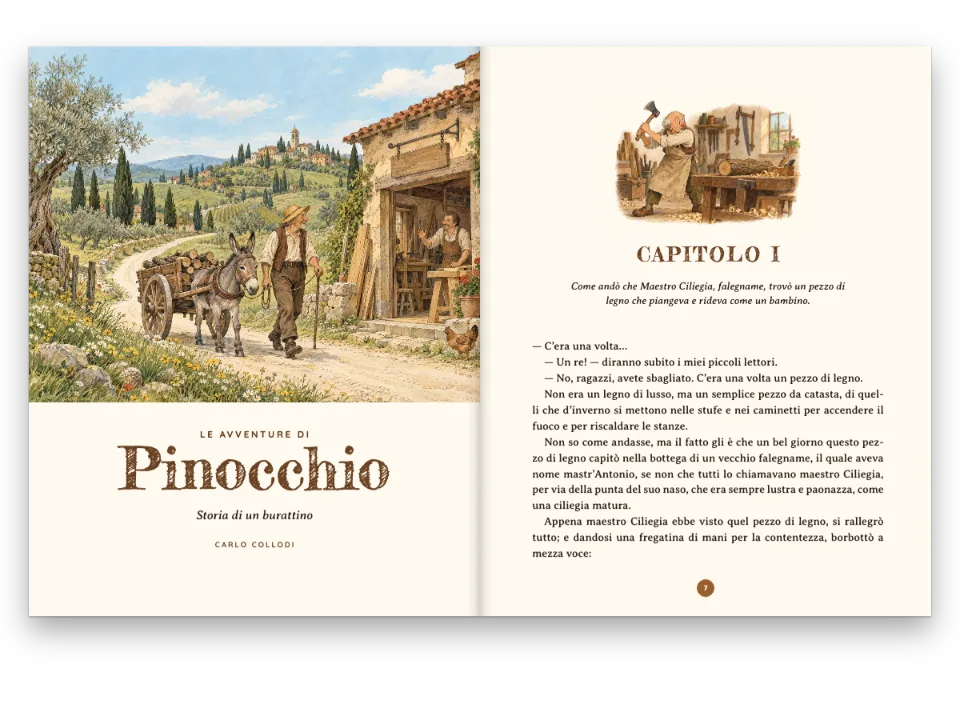
一本十页的图画书《かみの ふね》(纸船),文字为本示例而作,配有十幅画:雨停后,女孩折了一只红色纸船,纸船顺河而下,经过青蛙、苍鹭和月亮,最后到达大海。排法与日本给最小读者的书一样:只用平假名,20 pt的Klee One(一种依照小学教科书字样设计的字体),词组之间留空格,即分かち書き(wakachigaki),让孩子一次读一个词组。页面为横长的260 × 200 mm,竖排,右侧装订:图在上方,下面是每行八个字的短行,纸船随着翻页向左行进。
这道食谱解答
- 怎样给日文图画书按词组加空格(分かち書き),让行只在空格处断开?
- 为什么日文的小假名、ー和闭括号不能出现在行首?怎样选择规则的严格程度?
- 哪些字体能排日文,并在屏幕和PDF中让汉字采用日文字形?
简短回答
// The story is typed with an ordinary space (U+0020) after each phrase (文節). Japanese
// text may break between any two kana, so the space alone does not keep a phrase whole:
// keep-all drops the breaks between two letters and keeps those at a space, after 、。」
// and before 「. Kinsoku still applies.
const phrases = { wordBreak: 'keep-all' }; // cjk.wordBreak
const bodyText = {
  fontFamily: HAND, fontSize: pt(BODY), lineHeight: pt(LEAD), color: col('ink'),
  boldColor: col('ink'), italicColor: col('ink'), referenceColor: col('ink'),
  // Ragged: a justified line would stretch its spaces and its kana to fill the tier.
  textAlign: 'left', firstLineIndent: em(0),
};
用料
- 功能
- 假名、汉字与罗马字竖排日文禁则处理右翻书字符网格中日韩字体一栏半放浮动体的边栏自定义资源类型页面设计中的图片封面、扉页和版权页标题样式标题属性段落样式换页与换栏纸张颜色语义调色板导出PDF嵌入PDF的字体
- 类型
- Klee One, Zen Maru Gothic(SIL OFL 1.1)
- 素材
bridge-1400.jpgcover-1430.jpgdusk-1400.jpgfrog-1400.jpgheron-1400.jpgnight-1400.jpgrain-1400.jpgsea-1400.jpgstream-1400.jpgwindow-1400.jpg- The cover: a red paper boat on a river through green meadows, a clear sky on the right for the title (Generated With Diffusion Models, 原创)
- Mii-chan folding the red paper boat at a low table by the window, after the rain (Generated With Diffusion Models, 原创)
- Mii-chan waving goodbye to the boat on the stream (Generated With Diffusion Models, 原创)
- A frog on a stone talking to the boat (Generated With Diffusion Models, 原创)
- The boat under a wooden footbridge, little fish following it (Generated With Diffusion Models, 原创)
- A white heron on the bank watching the boat on the wide river (Generated With Diffusion Models, 原创)
- Dusk: a pink sky over the river mouth and the sea beyond (Generated With Diffusion Models, 原创)
- Night: the full moon's reflection lighting the boat's way (Generated With Diffusion Models, 原创)
- The boat at sea, greeted by seagulls (Generated With Diffusion Models, 原创)
- Mii-chan at her window, looking towards the distant sea (Generated With Diffusion Models, 原创)
做法
#1 · 让每个词组保持完整
代码见上文的简短回答。日文可以在任意两个假名之间断行,所以词组间的空格只是多留一点空白,并不能阻止行在あか|い之间断开。cjk.wordBreak: 'keep-all'只保留空格处和标点旁的断点,即、。」之后和「之前,与CSS的word-break: keep-all相同,禁则照样有效(东亚排版)。空格是普通的U+0020,在Klee One中宽0.35字,落在行末时会被去掉。U+3000同样是词组之间的断点,但它是一个固定一字宽的字符,会留在行末。
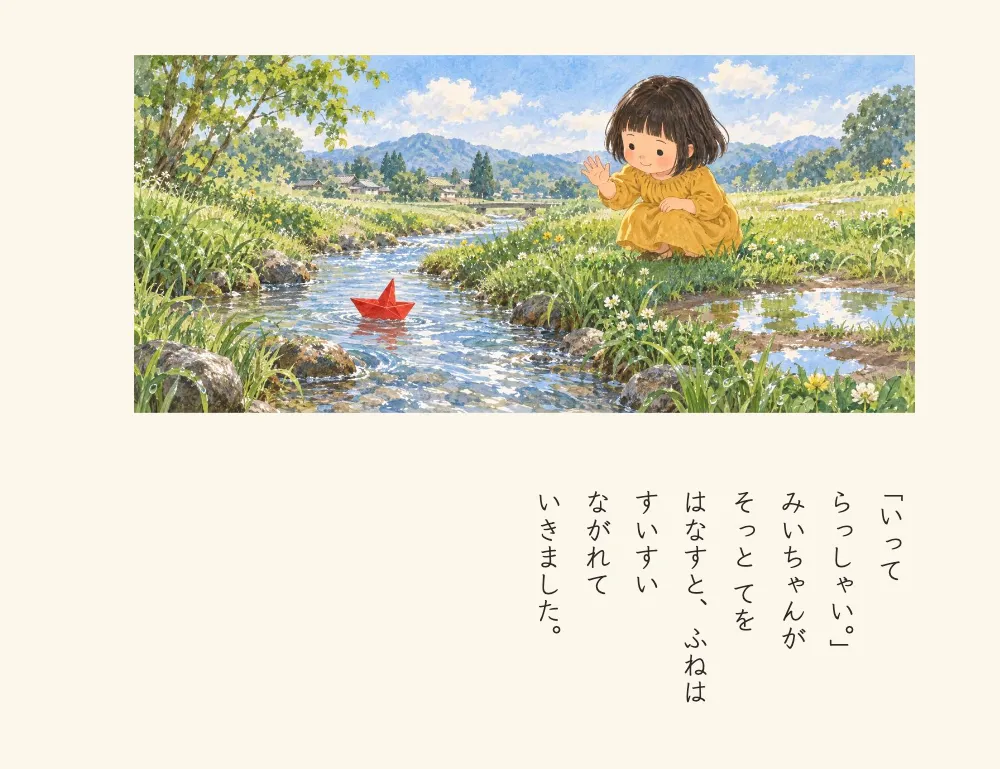
正文不两端对齐。若两端对齐,短行会把空格和假名间距拉开直到层底;图画书让每行停在最后一个词组结束的地方。
#2 · 图放在正文上方的一层
// In vertical text 'left' is the top of the page: the side column is a tier that takes
// the pictures (floats), and the text runs in the tier under it, right to left.
const layout = {
  layoutType: 'oneAndHalf', writingMode: 'vertical-rl', sideColumnRole: 'floats',
  sideColumnSide: 'left', sideColumnPercent: 58, gutterWidth: pt(2 * BODY),
};
const cjk = { ...phrases, grid: { enabled: true, charsPerLine: CHARS, linesPerPage: LINES } };
const resourceTypes = [{ id: 'picture', name: 'え', shortLabel: 'え', numberingTemplate: '{n}',
  resetOn: 'never', counterFormat: 'decimal', captionPrefix: '' }]; // pictures, no captions
在竖排中,'left'指页面的上方,所以侧栏在左的“一栏半”版式就成了上下两层:图浮动到上层(深14字),正文排在下层(8字)。每页用::resource{id="…"}引用自己的图,并以:::pagebreak结束。图的资源类型不带题注前缀,图的宽高比为2.186:1,正是这一层的形状,因此正好排满(竖排)。
#3 · 封面做成整页图
// In the flow frame of a vertical page x runs down the sheet and y leftward from its right
// edge; a box's width runs down the sheet.
const at = (down, across) => ({ anchor: { to: 'page', edge: 'top-left' },
  offset: { x: mm(down), y: mm(across) } });
const cover = {
  id: 'cover', numbered: false, toc: false, span: 'page', header: { elements: [] },
  breakBefore: { enabled: true, parity: 'any' },
  advancedDesign: { enabled: true, minHeight: mm(TRIM.w - 40), slot: { elements: [
    { kind: 'image', id: 'art', resourceId: 'cover', decorative: true,
      placement: { anchor: { to: 'bleed', edge: 'top-left' },
        size: { width: mm(TRIM.h), height: mm(TRIM.w) } } },
    { kind: 'text', id: 'title', content: '{titleText}', fontFamily: ROUND, fontWeight: 700,
      fontSize: pt(60), lineHeight: 1, letterSpacing: pt(6), color: col('boat'),
      placement: at(22, 34) },
    { kind: 'text', id: 'latin', content: '{attr.latin}', fontFamily: ROUND, fontWeight: 700,
      fontSize: pt(9), lineHeight: 1.4, color: col('ink'), placement: at(22, 62) },
  ] } },
};
封面是整页的标题设计:图锚定在出血框,大小与页面相同(在竖排流中它的width沿纸面向下),书名用60 pt的Zen Maru Gothic沿右侧天空竖排。
#4 · 把画作为位图载入
// The scenes have the tier's shape, 612 : 280 (ART); the cover has the page's, 260 : 200.
const PICTURES = { // id: [file, width, height, alt text in the book's language]
  cover: ['cover-1430.jpg', 1430, 1100, 'あおい かわに あかい かみの ふねが うかんで いる。'],
  rain: ['rain-1400.jpg', 1400, 641, 'まどべの ちゃぶだいで、みいちゃんが あかい かみで ふねを おって いる。'],
  stream: ['stream-1400.jpg', 1400, 641, 'みいちゃんが おがわに ふねを ながし、てを ふって いる。'],
  frog: ['frog-1400.jpg', 1400, 641, 'かわの いしの うえの かえるが、ながれて いく ふねに はなしかけて いる。'],
  bridge: ['bridge-1400.jpg', 1400, 641, 'きの はしの したを ふねが くぐり、ちいさな さかなが ついて くる。'],
  heron: ['heron-1400.jpg', 1400, 641, 'ひろい かわの きしで、しろい さぎが ふねを みおくって いる。'],
  dusk: ['dusk-1400.jpg', 1400, 641, 'ももいろの ゆうやけの かわに ふねが うかび、とおくに うみが みえる。'],
  night: ['night-1400.jpg', 1400, 641, 'まんげつが かわに うつり、ひかりの みちの そばを ふねが すすむ。'],
  sea: ['sea-1400.jpg', 1400, 641, 'あおい うみに でた ふねの うえを、かもめが とんで いる。'],
  window: ['window-1400.jpg', 1400, 641, 'みいちゃんが まどから、まちの むこうの うみを みて いる。'],
};
const pictures = Object.entries(PICTURES).map(([id, [fileId, w, h, altText]]) => ({
  id, typeId: 'picture', kind: 'bitmap', createdAt: 0, updatedAt: 0, altText,
  placement: { span: 'side' }, bitmap: { fileId, format: 'jpeg', width: w, height: h } }));
十幅插图是绘画,即示例assets/里的JPEG文件。九个场景按图层的比例612 : 280裁切,封面按页面的比例260 : 200裁切,所以每幅都正好填满图层,不会被裁掉任何部分。每幅都是按像素尺寸声明的bitmap资源,带有用本书语言写的替代文字,排版前按资源的fileId载入文件。宽1,400 px的场景在图层宽度上约以165 dpi印出(资源类型)。
完整食谱
// ═══ Postext Cookbook · Nº 127 · A hiragana picture book, spaced by phrase ══════════
// https://postext.dev/en/cookbook/hiragana-picture-book
// Code: MIT · Story: written for the recipe (CC BY 4.0) · Pictures: generated with diffusion models
// Fonts: Klee One, Zen Maru Gothic (SIL OFL 1.1) · Needs postext ≥ 1.25.0
// A picture book for small readers: hiragana only, a space between phrases, vertical.
import {
  buildDocument, withLoadedFonts, renderPageToCanvas, registerResourceImage, loadVerticalAlternates,
} from 'https://esm.sh/postext';
import { renderToPdf, decompressWoff2 } from 'https://esm.sh/postext-pdf';

const LANG = 'en'; // @lang: the language of the frame; the story is Japanese in both editions
const RECIPE = 'hiragana-picture-book';

// ─── 1 · Design ─────────────────────────────────────────────────────────────
// #region palette: the paper boat's red, river blues, a warm paper
const palette = {
  ink: '#2e2a26', // the text: a soft near-black
  boat: '#cf4430', // the boat, the title (4.6:1 on the paper)
  river: '#5d93ad',
  grass: '#86b665',
  muted: '#6e675f', // the colophon
  paper: '#fbf6ea',
};
const col = (id) => ({ hex: palette[id], model: 'hex', paletteId: id });
const colorPalette = [
  ...Object.entries(palette).map(([id, hex]) => ({ id, name: id, value: { hex, model: 'hex' } })),
  { id: 'main-color', name: 'boat (defaults)', value: { hex: palette.boat, model: 'hex' } },
];
// #endregion

const HAND = 'Klee One'; // 教科書体: the hand a child learns to write kana from
const ROUND = 'Zen Maru Gothic'; // the cover's title
const [BODY, LEAD] = [20, 36]; // pt: large kana, a line gap of 0.8 em
const PT = 25.4 / 72; // mm in a point
const TRIM = { w: 260, h: 200 }; // mm: a landscape picture book (横長)
const [CHARS, PICTURE, LINES] = [8, 14, 17]; // characters: text tier, picture tier; lines
const ART = { w: LINES * LEAD * PT, h: PICTURE * BODY * PT }; // mm: 215.9 × 98.8

// #region answer: わかち書き — a space between phrases, and lines that break only there
// The story is typed with an ordinary space (U+0020) after each phrase (文節). Japanese
// text may break between any two kana, so the space alone does not keep a phrase whole:
// keep-all drops the breaks between two letters and keeps those at a space, after 、。」
// and before 「. Kinsoku still applies.
const phrases = { wordBreak: 'keep-all' }; // cjk.wordBreak
const bodyText = {
  fontFamily: HAND, fontSize: pt(BODY), lineHeight: pt(LEAD), color: col('ink'),
  boldColor: col('ink'), italicColor: col('ink'), referenceColor: col('ink'),
  // Ragged: a justified line would stretch its spaces and its kana to fill the tier.
组合好的script.js可以直接运行:把它粘贴到任何页面的模块脚本中,或在CodePen上打开这道食谱。 GitHub上的食谱文件夹 ↗ (在新标签页中打开)
变化
#两端对齐
两端对齐时,每行都排到层底:先拉开词组间的空格,最多到半字,然后拉开假名之间的间距(JLReq §3.8)。20 pt假名的短行会因此出现很宽的空隙,所以本示例让行尾不齐。
-  textAlign: 'left', firstLineIndent: em(0),
+ textAlign: 'justify', firstLineIndent: em(0),常见问题
易错点
日文文本标记为'ja',不要用zh-Hans或LANG
食谱的版本是en和es,但日文示例在两个版本里都是日文:`locale: LANG`会把它标记为英文或西班牙文,中文标记则会按中文规则排它(开明式标点、小假名可以出现在行首、图代替図、PDF中用中文字形)。postext 1.30起,这个标记也是文字成形所用的语言(测量、绘制和嵌入都按它进行),所以'ja'以外的标记给出的不是日文字形(中文标记给出中文字形),断行的位置也不同。写'ja':它选用日本地区(JLReq断行和标点、芝麻着重号、振假名的分布、図和表标签),并关闭断词。lint会让带假名却标记为zh或ko的文本失败。 日文禁则处理 →
易错点
日文要用日文字体排
Noto Serif SC和TC里有假名,但汉字是中文字形(直、骨、角都不同),假名也是中文字体的设计。正文用Noto Serif JP或Shippori Mincho B1,标题用Noto Sans JP,用loadCjkFonts加载。Fontsource的日文文件里没有变体假名等历史假名(U+1B000–1B16F):loadCjkFonts遇到它们会失败,PDF里印出空框,所以要写现代假名,或者把含有这些字的字体放进食谱的assets。Shippori Mincho也没有带长音符号的ō和ū:罗马字要用拉丁字体排。 假名、汉字与罗马字 →
易错点
中文字体通过cjk块分片加载
Fontsource把一个中文、日文或韩文字体家族按每个字重约一百个文件提供,每个文件覆盖一段字符范围。loadFonts只获取latin文件,所以屏幕上的汉字来自系统字体,测量不准;fontsourceProvider交给PDF的也是这个latin文件,汉字印出来是空框。列出kit中的cjk块,在loadFonts之后调用loadCjkFonts(FONTS, markdown)(书中用到几种CJK字体时,每种字体调用一次,并传入它所排的文字),并给renderToPdf传fontProvider: cjkPdfProvider:两者都会取用包含文中字符的那些文件。 中日韩字体 →
keep-all只保留文本里已有的断点:Postext不会自己找出词组,空格要由作者输入。比一行还长的词组仍会在内部断开,断在禁则允许的最后一个位置。- 中文从不在词间留空格,中文读本右侧注音的竖排读本用注音帮助小读者;日文图画书不用汉字,所以不需要振假名,词组间的空格就起到引导阅读的作用。
致谢
- 文本
- かみの ふね (The Paper Boat), a picture-book story in hiragana written for this recipe · Postext Cookbook · CC BY 4.0
- 图片
- The cover: a red paper boat on a river through green meadows, a clear sky on the right for the title · Generated With Diffusion Models · 原创
- Mii-chan folding the red paper boat at a low table by the window, after the rain · Generated With Diffusion Models · 原创
- Mii-chan waving goodbye to the boat on the stream · Generated With Diffusion Models · 原创
- A frog on a stone talking to the boat · Generated With Diffusion Models · 原创
- The boat under a wooden footbridge, little fish following it · Generated With Diffusion Models · 原创
- A white heron on the bank watching the boat on the wide river · Generated With Diffusion Models · 原创
- Dusk: a pink sky over the river mouth and the sea beyond · Generated With Diffusion Models · 原创
- Night: the full moon's reflection lighting the boat's way · Generated With Diffusion Models · 原创
- The boat at sea, greeted by seagulls · Generated With Diffusion Models · 原创
- Mii-chan at her window, looking towards the distant sea · Generated With Diffusion Models · 原创
- 字体
- Klee One (SIL OFL 1.1) · Zen Maru Gothic (SIL OFL 1.1)