باختصار
دليل أسلوب لشبكة مترو مختلَقة. يبيّن كيف تنزّل خطوط علامة تجارية مرة واحدة وتستعملها في معاينة الصفحات وفي ملف PDF وفي الملف المحفوظ.
ما الذي ستنضده
أربع صفحات من دليل هوية Metro de Alba، مترو متخيَّل من خمسة خطوط. على الغلاف تخرج الخطوط الخمسة من أسفل اليسار على مسار مشترك واحد، ثم تتفرّع نحو اليمين بعد عبور نهر رمادي، تحت الاسم المنضَّد بخط Big Shoulders Display. يبدأ كل قسم تحت شريط بلون الحبر، مع رقم كبير من خانتين بلون أحد الخطوط. في 01 Colour يكون العمود الأول من الجدول هو اللون نفسه؛ وفي 02 Type أسطر عيّنة ولافتة رصيف، ويُختم 03 Usage برسمين مؤطَّرين للخريطة، أحدهما مرسوم وفق القواعد (Do) والآخر مخالف لها (Don't). النص كله منضَّد بستة ملفات خطوط ينزّلها السكربت قبل أول إخراج. يُرسم ملف PDF بالملفات الستة نفسها، ويحمل ملف .postext خمسة منها، لأن خط العناوين موسوم بأنه غير قابل لإعادة التوزيع.
تجيب هذه الوصفة عن
- كيف أستعمل خطوط علامتي التجارية أو خطوطًا مرخّصة في الإخراج وأضمّنها في ملف PDF؟
- كيف أصدّر ملف PDF حقيقيًّا في المتصفح مع تضمين الخطوط؟
- كيف أمنع العناوين والكلمات العريضة والنقاط من الظهور باللون الأزرق؟
- كيف أضيف عيّنات لونية دليلية إلى النص أو التعليقات أو ملاحظات الجداول؟
- كيف أنشئ حزمة .postext من الشيفرة، لأسلّم مستندًا إلى Sandbox أو إلى برنامج آخر؟
الجواب المختصر
// Your licensed files, one per face in FONTS. Fontsource's copies stand in for them here:
// point FONT_URL at your own server (same origin, or one that lets this page in by CORS).
const slug = (family) => family.toLowerCase().replaceAll(' ', '-');
const FONT_URL = ({ family, weight, style }) => `https://cdn.jsdelivr.net/npm/@fontsource/`
  + `${slug(family)}@5/files/${slug(family)}-latin-${weight}-${style}.woff2`;
const brandFaces = () => Object.entries(FONTS).flatMap(([family, specs]) => specs.map((spec) => {
  const weight = parseInt(spec, 10), style = spec.endsWith('i') ? 'italic' : 'normal';
  return { family, weight, style, fileId: `${slug(family)}-${weight}-${style}.woff2` };
}));
const fontFiles = new Map(); // fileId → the WOFF2 bytes, fetched once

// 1 · Layout measures with document.fonts: register every face before the first build.
async function loadBrandFonts() {
  await Promise.all(brandFaces().map(async ({ family, weight, style, fileId }) => {
    const res = await fetch(FONT_URL({ family, weight, style }));
    if (!res.ok) throw new Error(`No file for ${family} ${weight} ${style}`);
    fontFiles.set(fileId, new Uint8Array(await res.arrayBuffer()));
    const face = new FontFace(family, fontFiles.get(fileId), { weight: `${weight}`, style });
    document.fonts.add(await face.load());
  }));
}

// 2 · The PDF embeds the same bytes as TrueType. It also asks for faces no text uses (the
// display face's italic, the monospace's SemiBold): answer with the family's closest file.
// 1.4.1 writes an unused copy of that file for each of them (gotcha: pdf-font-copies).
async function brandFontProvider(family, weight, style) {
  const cost = (f) => (f.style === style ? 0 : 1000) + Math.abs(f.weight - weight);
  const own = brandFaces().filter((f) => f.family === family);
  if (!own.length) throw new Error(`${family} is not one of the brand's fonts`);
  return decompressWoff2(fontFiles.get(own.reduce((a, b) => (cost(b) < cost(a) ? b : a)).fileId));
}

// 3 · The bundle: customFonts names each face's file by its fileId; createBundle packs the bytes
// of every family it may hand on. Layout never reads it (gotcha: custom-fonts-declarative).
const customFonts = () => Object.keys(FONTS).map((name) => ({
  name, redistributable: name !== DISPLAY, // the display face reaches suppliers another way
  variants: brandFaces().filter((f) => f.family === name)
    .map(({ weight, style, fileId }) => ({ weight, style, fileId, format: 'woff2' })),
}));
المكونات
- الميزات
- خطوطك الخاصةلوحة ألوان دلاليةتعبئة الخلاياعيّنات الألوانصفحات افتتاح مصمَّمةالعناوين المرقّمةشريط فصل بعرض الصفحةأنماط الجداول المسمّاةأنماط الفقراتأنواع موارد مخصّصةنمط التعليقموضع الأشكالالنصوص والخطوط والمربعات في تصاميم الصفحةخط المتنعمود واحد أو عمودانالخطوط قبل الإخراجالتصدير إلى PDFحزم .postextصفحات على اللوحة (Canvas)الأشكال والجداول بوصفها موارد
- تستخدم أيضًا
- إطارات التنبيهسمات العنوانأنماط العناوين«شكل» و«جدول» بلغتكألوان لكل جزءالخطوط المضمَّنة في PDFترويسات لكل قسمفصول بلا أرقام
- الخطوط
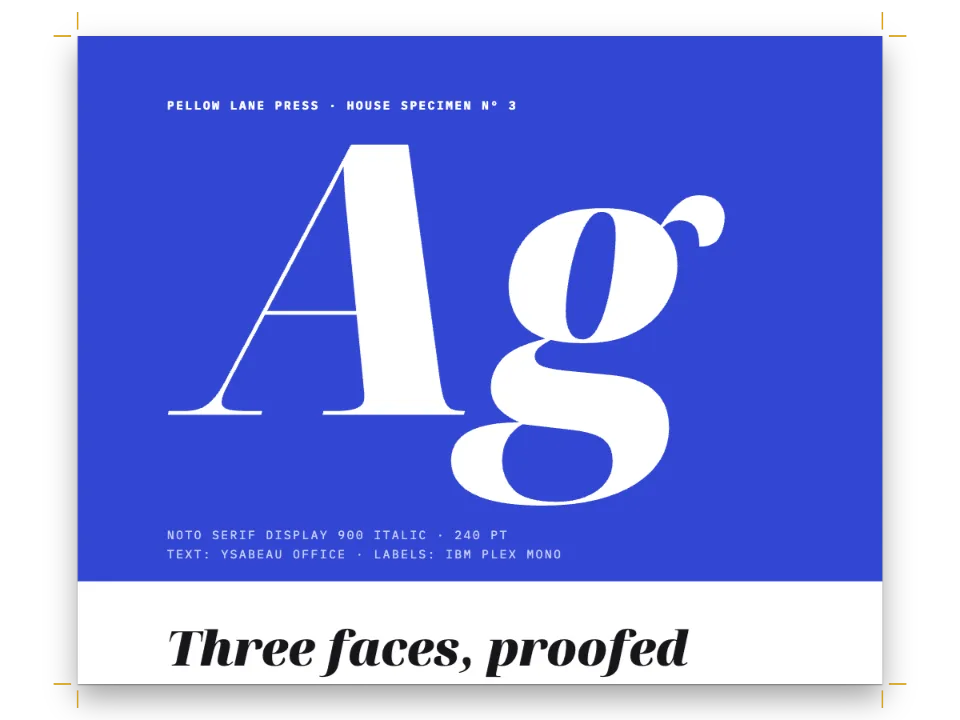
- Public Sans, Big Shoulders Display, Spline Sans Mono (SIL OFL 1.1)
- الأصول
- The network drawing on the cover and the two map examples, drawn in code (Ignacio Ferro, CC BY 4.0)
طريقة التحضير
#1 · سجّل محارف العلامة، وابنِ المستند، وأعطِ ملف PDF البايتات نفسها
await loadBrandFonts(); // the answer, step 1 (gotcha: fonts-first)
for (const [fileId, markup] of Object.entries(ART)) await loadSvg(fileId, markup);
const doc = buildDocument({ markdown, resources }, config());
showPages(doc, { title: 'Metro de Alba · Identity manual' });
offerPdf(() => renderToPdf(doc, { fontProvider: brandFontProvider, resourceBytes: imageBytes }),
  `${RECIPE}.pdf`); // step 2: the provider hands renderToPdf the same files
يقيس الإخراج كل كلمة بالمحارف الموجودة في document.fonts، لذلك تنزّل loadBrandFonts() في الجواب المختصر كل ملف مرة واحدة، وتحتفظ ببايتاته، وتسجّل FontFace مبنيًّا منها قبل تشغيل buildDocument. الدالة loadFonts في عُدّة الوصفات لا تنزّل إلا من Fontsource، أما العلامة فتقدّم ملفاتها من خادمها الخاص. في postext-pdf 1.4.1 تطلب renderToPdf عشرة محارف، أربعة منها لا يستعملها أي نص (المائل من خط العناوين، والمائل وSemiBold وSemiBold المائل من الخط ثابت العرض)، وتجيب brandFontProvider عن كل طلب بأقرب ملف من العائلة نفسها (لماذا مزوّد خطوط؟). لا تستعمل الصفحات إلا الملفات الستة التي قاس بها Canvas، لكن الإصدار 1.4.1 يكتب أيضًا نسخة غير مستعملة من الملف البديل لكل طلب من تلك الطلبات الأربعة.
#2 · نظام الألوان قائمة واحدة
const COLOURS = [ // id, name, screen, print (coated stock)
  ['line-1', 'Line 1 · Tile red', '#e4572e', '0 75 85 0'],
  ['line-2', 'Line 2 · Harbour teal', '#17bebb', '75 0 32 0'],
  ['line-3', 'Line 3 · Broom yellow', '#ffc914', '0 22 95 0'],
  ['line-4', 'Line 4 · Heather', '#6c4f9e', '65 75 0 0'],
  ['line-5', 'Line 5 · Pine', '#3f9b4a', '76 12 90 2'],
  ['signal-red', 'Signal red', '#c0391b', '10 88 100 2'],
  ['signal-green', 'Signal green', '#2b7d3c', '84 25 95 10'],
  ['ink', 'Ink', '#1f2124', '72 62 55 78'],
  ['rule', 'Rule grey', '#d9d9d4', '14 10 14 0'],
];
const palette = { ...Object.fromEntries(COLOURS.map(([id, , hex]) => [id, hex])),
  paper: '#ffffff', section: '#e4572e' }; // section: the line colour of the current section
// col() writes the hex too: 1.4.1 designs read it, not the link (gotcha: palette-skips-designs).
const col = (id) => ({ hex: palette[id], model: 'hex', paletteId: id });
const colorPalette = [...Object.entries(palette), ['main-color', palette.ink]]
  .map(([id, hex]) => ({ id, name: id, value: { hex, model: 'hex' } }));

const rgb = (hex) => [1, 3, 5].map((i) => parseInt(hex.slice(i, i + 2), 16)).join(' ');
const swatchTable = () => COLOURS.reduce( // an empty first cell, filled with the colour itself
  (model, [id], i) => setCellBackground(model, { row: i + 1, col: 0 }, col(id)),
  { headerRowCount: 1, columnWidths: [22, 34, 14, 15, 15], rows: [
    ['COLOUR', 'NAME', 'HEX', 'RGB', 'CMYK'].map((content) => ({ content, isHeader: true })),
    ...COLOURS.map(([, name, hex, cmyk]) =>
      ['', name, hex.toUpperCase(), rgb(hex), cmyk].map((content) => ({ content }))),
  ] });
لأن لوحة الألوان والجدول 1.1 مبنيّان من الصفوف التسعة نفسها، لا يمكن للجدول أن يذكر قيمة لا تستعملها الصفحات. تملأ setCellBackground الخلية الأولى الفارغة في كل صف بلون ذلك الصف، مربوطًا بلوحة الألوان. وفي النص تأخذ :swatch{color="line-2"} معرّفًا من لوحة الألوان وترسم مربعًا محاطًا بلون النص. تحمل main-color قيمة hex للون Ink، فتُطبع العناوين والمقاطع العريضة والمائلة، المربوطة به افتراضيًا، بلون Ink بدل الأزرق الافتراضي للمحرّك. تبقى الإحالات بذلك الأزرق في 1.4.1 أيًّا كانت قيمة main-color؛ والإعداد bodyText.referenceColor: col('ink') يجعلها بلون Ink أيضًا (لوحة الألوان).
#3 · صفحة افتتاح واحدة بثلاثة ألوان للخطوط
// Texts wrap (gotcha: overflow-ellipsis-default); lineHeight is a multiple (gotcha:
// design-lineheight-multiple). The body starts ten grid lines down, in both columns.
const opener = { enabled: true, minHeight: pt(10 * LEAD), slot: { elements: [
  { kind: 'text', id: 'number', content: '{number}', fontFamily: DISPLAY, fontWeight: 800,
    fontSize: pt(130), lineHeight: 1, color: col('section'), align: 'left', overflow: 'wrap',
    // Nudged by eye on the capture: the cap tops of number and title on one line.
    placement: { anchor: { to: 'container', edge: 'top-left' },
      offset: { x: mm(-1.5), y: mm(1.3) } } },
  { kind: 'text', id: 'title', content: '{titleText}', fontFamily: DISPLAY, fontWeight: 800,
    fontSize: pt(34), lineHeight: 1, color: col('ink'), align: 'left', overflow: 'wrap',
    placement: { anchor: { to: 'container', edge: 'top-left' },
      offset: { x: mm(COL + GUTTER), y: mm(1) }, size: { width: mm(COL) } } },
  { kind: 'text', id: 'lead', content: '{attr.lead}', fontFamily: TEXT, fontSize: pt(12.5),
    lineHeight: 1.36, color: col('ink'), align: 'left', overflow: 'wrap',
    placement: { anchor: { to: '#title', edge: 'below' }, offset: { y: mm(3) },
      size: { width: mm(COL) } } },
] } };
// Each section sets `section` to its line's colour; the number and the head square use it.
const section = (id) => ({ id, palette: { section: palette[id] } });
يكتب numberingTemplate: '{1:01}' العدّاد بخانتين، ويطبع {number} الأرقام 01 و02 و03 في صفحة الافتتاح؛ أما عنوان الغلاف فهو numbered: false ولا يأخذ رقمًا. لا تختلف أنماط الأقسام الثلاثة إلا في مدخل لوحة الألوان section، الذي يضبطه كل نمط على لون خطه. الرقم والمربع في الشريط مربوطان بالمدخل section، فيخدم تصميم واحد لصفحة الافتتاح الأقسام الثلاثة. يحجز minHeight عشرة أسطر من شبكة 14 pt لصفحة الافتتاح، فيبدأ نص كل قسم على خط الشبكة نفسه في صفحته.
#4 · Do وDon't نوعان من الأشكال
const example = (id, name, colour) => ({ id, name, shortLabel: name, captionPrefix: name,
  numberingTemplate: '{n}', resetOn: 'never', counterFormat: 'decimal',
  captionStyle: { labelColor: col(colour) } });
const resourceTypes = [...defaultResourceTypes(LANG),
  example('do', 'Do', 'signal-green'), example('dont', 'Don’t', 'signal-red')];
const FOOT = { position: 'bottom' }; // cited in one paragraph: its page's foot, one per column
يمكن لنوع المورد أن يحمل captionStyle جزئيًا، وهذان النوعان لا يضبطان إلا لون التسمية: أخضر Signal للرسم Do وأحمر Signal للرسم Don't (أنواع الموارد). يبلغ تباين لوني الإشارة 5.1:1 و5.5:1 على الأبيض، بينما تبقى الخطوط 1 و2 و3 و5 دون نسبة 4.5:1 التي يحتاجها النص الصغير. يطفو الرسمان كلاهما بالإعداد position: 'bottom' ويُستشهد بهما في الفقرة نفسها، الأولى تحت Drawing the map، فيتقاسمان أسفل الصفحة 4: Do في العمود الأيسر وDon't في العمود الأيمن.
#5 · تحزم الحزمة الخطوط التي يحق لها توزيعها
const pack = Object.assign(document.createElement('button'), { type: 'button',
  textContent: 'Build the .postext' });
pack.addEventListener('click', async () => {
  const { bytes, manifest, warnings } = await createBundle({
    name: 'Metro de Alba identity manual', locale: LANG, markdown, config: config(), resources,
    files: new Map([...Object.entries(ART), ...fontFiles]), // fileId → SVG markup or font bytes
  });
  const size = `${Math.round(bytes.length / 1024)} KB`;
  const packed = `fonts inside: ${manifest.fonts.map((font) => font.name).join(', ')}`;
  kitStatus(['.postext', size, packed, ...warnings].join(' · ')); // warnings: what stayed out
  pack.replaceWith(Object.assign(document.createElement('a'), { download: `${RECIPE}.postext`,
    href: URL.createObjectURL(new Blob([bytes], { type: 'application/zip' })),
    textContent: `Download ${RECIPE}.postext · ${size}` }));
});
document.getElementById('pt-actions').append(pack);
تقرأ createBundle الإعداد config.customFonts، وتبحث عن بايتات كل نسخة من الخط في files بحسب fileId، وتكتبها تحت fonts/ مع مدخل fonts في البيان. تحمل عائلة العناوين redistributable: false، نيابةً عن ترخيص يمنع تسليم الملفات للغير (خط Big Shoulders Display نفسه مرخّص بترخيص OFL). يبقى ملفها خارج الحزمة، وتذكر warnings اسم العائلة. يضم الملف، وحجمه 81 KB، الفصل والإعدادات والرسوم الثلاثة وخمسة ملفات خطوط. لا يقرأ الإخراج customFonts أبدًا؛ فالصفحات تخرج كما هي من دونه (إنشاء حزمة).
الوصفة كاملة
// ═══ Postext Cookbook · Nº 040 · Brand fonts in layout, PDF and bundle ════════════ // https://postext.dev/en/cookbook/brand-fonts-identity-manual // Code: MIT · Text and drawings: original (CC BY 4.0) · Metro de Alba is a fictional network // Fonts: Public Sans, Big Shoulders Display, Spline Sans Mono (SIL OFL 1.1) · Needs postext ≥ 1.4.1 import { buildDocument, renderPageToCanvas, clearMeasurementCache, registerResourceImage, defaultResourceTypes, setCellBackground, createBundle, } from 'https://esm.sh/postext'; import { renderToPdf, decompressWoff2 } from 'https://esm.sh/postext-pdf'; const LANG = 'en'; // @lang: the language of the sample document ('en' | 'es') const RECIPE = 'brand-fonts-identity-manual'; // ─── 1 · Design ───────────────────────────────────────────────────────────── // #region answer: the brand's font files, fetched once for the layout, the PDF and the bundle // Your licensed files, one per face in FONTS. Fontsource's copies stand in for them here: // point FONT_URL at your own server (same origin, or one that lets this page in by CORS). const slug = (family) => family.toLowerCase().replaceAll(' ', '-'); const FONT_URL = ({ family, weight, style }) => `https://cdn.jsdelivr.net/npm/@fontsource/` + `${slug(family)}@5/files/${slug(family)}-latin-${weight}-${style}.woff2`; const brandFaces = () => Object.entries(FONTS).flatMap(([family, specs]) => specs.map((spec) => { const weight = parseInt(spec, 10), style = spec.endsWith('i') ? 'italic' : 'normal'; return { family, weight, style, fileId: `${slug(family)}-${weight}-${style}.woff2` }; })); const fontFiles = new Map(); // fileId → the WOFF2 bytes, fetched once // 1 · Layout measures with document.fonts: register every face before the first build. async function loadBrandFonts() { await Promise.all(brandFaces().map(async ({ family, weight, style, fileId }) => { const res = await fetch(FONT_URL({ family, weight, style })); if (!res.ok) throw new Error(`No file for ${family} ${weight} ${style}`); fontFiles.set(fileId, new Uint8Array(await res.arrayBuffer())); const face = new FontFace(family, fontFiles.get(fileId), { weight: `${weight}`, style }); document.fonts.add(await face.load()); })); } // 2 · The PDF embeds the same bytes as TrueType. It also asks for faces no text uses (the // display face's italic, the monospace's SemiBold): answer with the family's closest file. // 1.4.1 writes an unused copy of that file for each of them (gotcha: pdf-font-copies). async function brandFontProvider(family, weight, style) { const cost = (f) => (f.style === style ? 0 : 1000) + Math.abs(f.weight - weight); const own = brandFaces().filter((f) => f.family === family); if (!own.length) throw new Error(`${family} is not one of the brand's fonts`); return decompressWoff2(fontFiles.get(own.reduce((a, b) => (cost(b) < cost(a) ? b : a)).fileId)); } // 3 · The bundle: customFonts names each face's file by its fileId; createBundle packs the bytes // of every family it may hand on. Layout never reads it (gotcha: custom-fonts-declarative). const customFonts = () => Object.keys(FONTS).map((name) => ({ name, redistributable: name !== DISPLAY, // the display face reaches suppliers another way variants: brandFaces().filter((f) => f.family === name) .map(({ weight, style, fileId }) => ({ weight, style, fileId, format: 'woff2' })), })); // #endregion const TEXT = 'Public Sans', DISPLAY = 'Big Shoulders Display', MONO = 'Spline Sans Mono'; // #region colours: the colour system, from which the palette and Table 1.1 are both built const COLOURS = [ // id, name, screen, print (coated stock) ['line-1', 'Line 1 · Tile red', '#e4572e', '0 75 85 0'], ['line-2', 'Line 2 · Harbour teal', '#17bebb', '75 0 32 0'], ['line-3', 'Line 3 · Broom yellow', '#ffc914', '0 22 95 0'], ['line-4', 'Line 4 · Heather', '#6c4f9e', '65 75 0 0'], ['line-5', 'Line 5 · Pine', '#3f9b4a', '76 12 90 2'], ['signal-red', 'Signal red', '#c0391b', '10 88 100 2'], ['signal-green', 'Signal green', '#2b7d3c', '84 25 95 10'], ['ink', 'Ink', '#1f2124', '72 62 55 78'], ['rule', 'Rule grey', '#d9d9d4', '14 10 14 0'], ]; const palette = { ...Object.fromEntries(COLOURS.map(([id, , hex]) => [id, hex])), paper: '#ffffff', section: '#e4572e' }; // section: the line colour of the current section // col() writes the hex too: 1.4.1 designs read it, not the link (gotcha: palette-skips-designs). const col = (id) => ({ hex: palette[id], model: 'hex', paletteId: id }); const colorPalette = [...Object.entries(palette), ['main-color', palette.ink]] .map(([id, hex]) => ({ id, name: id, value: { hex, model: 'hex' } })); const rgb = (hex) => [1, 3, 5].map((i) => parseInt(hex.slice(i, i + 2), 16)).join(' '); const swatchTable = () => COLOURS.reduce( // an empty first cell, filled with the colour itself (model, [id], i) => setCellBackground(model, { row: i + 1, col: 0 }, col(id)), { headerRowCount: 1, columnWidths: [22, 34, 14, 15, 15], rows: [ ['COLOUR', 'NAME', 'HEX', 'RGB', 'CMYK'].map((content) => ({ content, isHeader: true })), ...COLOURS.map(([, name, hex, cmyk]) => ['', name, hex.toUpperCase(), rgb(hex), cmyk].map((content) => ({ content }))), ] }); // #endregion const PAGE = { width: 210, height: 280 }; // mm const MARGIN = { top: 24, bottom: 22, inner: 18, outer: 18 }; const GUTTER = 8, COL = (PAGE.width - MARGIN.inner - MARGIN.outer - GUTTER) / 2; // 83 mm const BAND = 13, LEAD = 14; // mm: the ink band at the head of each page; pt: the leading // #region sections: a giant zero-padded number in the section's line colour // Texts wrap (gotcha: overflow-ellipsis-default); lineHeight is a multiple (gotcha: // design-lineheight-multiple). The body starts ten grid lines down, in both columns. const opener = { enabled: true, minHeight: pt(10 * LEAD), slot: { elements: [ { kind: 'text', id: 'number', content: '{number}', fontFamily: DISPLAY, fontWeight: 800, fontSize: pt(130), lineHeight: 1, color: col('section'), align: 'left', overflow: 'wrap', // Nudged by eye on the capture: the cap tops of number and title on one line. placement: { anchor: { to: 'container', edge: 'top-left' }, offset: { x: mm(-1.5), y: mm(1.3) } } }, { kind: 'text', id: 'title', content: '{titleText}', fontFamily: DISPLAY, fontWeight: 800, fontSize: pt(34), lineHeight: 1, color: col('ink'), align: 'left', overflow: 'wrap', placement: { anchor: { to: 'container', edge: 'top-left' }, offset: { x: mm(COL + GUTTER), y: mm(1) }, size: { width: mm(COL) } } }, { kind: 'text', id: 'lead', content: '{attr.lead}', fontFamily: TEXT, fontSize: pt(12.5), lineHeight: 1.36, color: col('ink'), align: 'left', overflow: 'wrap', placement: { anchor: { to: '#title', edge: 'below' }, offset: { y: mm(3) }, size: { width: mm(COL) } } }, ] } }; // Each section sets `section` to its line's colour; the number and the head square use it. const section = (id) => ({ id, palette: { section: palette[id] } }); // #endregion // Running heads: an ink band across the head of the page, as on the platform signs. const PT = 25.4 / 72; // mm in a point const HEAD = 7.5, SQUARE = 4.5, STEP = 8; // pt: head size; mm: the square, and the spacing const label = (size, colour) => ({ fontFamily: TEXT, fontSize: pt(size), fontWeight: 600, letterSpacing: pt(size * 0.16), textTransform: 'uppercase', color: col(colour) }); const inBand = (edge, x, height) => ({ anchor: { to: 'page', edge }, offset: { x: mm(x), y: mm((BAND - height) / 2) } }); // centred in the band const head = (id, content, parity, edge, x) => ({ kind: 'text', id, content, parity, lineHeight: 1, ...label(HEAD, 'paper'), placement: inBand(edge, x, HEAD * PT) }); const square = (id, parity, edge, x) => ({ kind: 'box', id, parity, style: { backgroundColor: col('section') }, // the section's line, as on its signs placement: { ...inBand(edge, x, SQUARE), size: { width: mm(SQUARE), height: mm(SQUARE) } } }); const header = { elements: [ { kind: 'box', id: 'band', style: { backgroundColor: col('ink') }, placement: { anchor: { to: 'page', edge: 'top-left' }, size: { width: 'fill', height: mm(BAND) } } }, square('verso-line', 'even', 'top-left', MARGIN.outer), head('verso-folio', '{pageNumber}', 'even', 'top-left', MARGIN.outer + STEP), head('verso-title', '{title} · {subtitle}', 'even', 'top-left', MARGIN.outer + 2 * STEP), square('recto-line', 'odd', 'top-right', -MARGIN.outer), head('recto-folio', '{pageNumber}', 'odd', 'top-right', -(MARGIN.outer + STEP)), head('recto-title', '{chapterTitle}', 'odd', 'top-right', -(MARGIN.outer + 2 * STEP)), ] }; // The cover: the network drawing fills the page; the heading and frontmatter give the texts. const coverText = (id, content, placement, style) => ({ kind: 'text', id, content, placement, overflow: 'wrap', align: 'left', ...style }); const under = (id, gap) => ({ anchor: { to: `#${id}`, edge: 'below' }, offset: { y: mm(gap) }, size: { width: mm(PAGE.width - 2 * MARGIN.outer) } }); const cover = { id: 'cover', numbered: false, span: 'page', header: { elements: [] }, footer: { elements: [] }, advancedDesign: { enabled: true, slot: { elements: [ { kind: 'image', id: 'map', resourceId: 'network', placement: { anchor: { to: 'bleed', edge: 'top-left' }, size: { width: 'fill' } } }, coverText('kicker', '{attr.kicker}', { anchor: { to: 'page', edge: 'top-left' }, offset: { x: mm(MARGIN.outer), y: mm(MARGIN.top - 2) } }, label(8, 'ink')), // At lineHeight 0.86 the capitals rise about 3 mm above the title's box: hence 6.5 mm. coverText('title', '{titleText}', under('kicker', 6.5), { fontFamily: DISPLAY, fontWeight: 800, fontSize: pt(88), lineHeight: 0.86, color: col('ink') }), coverText('subtitle', '{subtitle}', under('title', 3), { fontFamily: TEXT, fontWeight: 600, fontSize: pt(20), lineHeight: 1.2, color: col('ink') }), coverText('edition', '{attr.edition}', under('subtitle', 1.5), { fontFamily: MONO, fontSize: pt(9), lineHeight: 1.3, color: col('ink') }), ] } } }; // #region do-dont: two figure types whose captions carry their own label colour const example = (id, name, colour) => ({ id, name, shortLabel: name, captionPrefix: name, numberingTemplate: '{n}', resetOn: 'never', counterFormat: 'decimal', captionStyle: { labelColor: col(colour) } }); const resourceTypes = [...defaultResourceTypes(LANG), example('do', 'Do', 'signal-green'), example('dont', 'Don’t', 'signal-red')]; const FOOT = { position: 'bottom' }; // cited in one paragraph: its page's foot, one per column // #endregion const config = () => ({ // a factory, never a shared object (gotcha: config-cache-identity) colorPalette, resourceTypes, customFonts: customFonts(), page: { width: mm(PAGE.width), height: mm(PAGE.height), dpi: 150, margins: { top: mm(MARGIN.top), bottom: mm(MARGIN.bottom), left: mm(MARGIN.inner), right: mm(MARGIN.outer), mirror: true } }, layout: { layoutType: 'double', gutterWidth: mm(GUTTER) }, bodyText: { fontFamily: TEXT, fontSize: pt(9.8), lineHeight: pt(LEAD), color: col('ink'), referenceColor: col('ink'), // references skip the palette (gotcha: palette-skips-designs) boldFontWeight: 600, // the brand has no Bold: its SemiBold sets **emphasis** textAlign: 'left', firstLineIndent: mm(0), paragraphSpacing: true }, headings: { fontFamily: DISPLAY, fontWeight: 800, levels: [ // ink: main-color // span: 'page' breaks already; restated in case it goes (gotcha: headings-drop-h1-break) { level: 1, span: 'page', numberingTemplate: '{1:01}', marginBottom: pt(0), breakBefore: { enabled: true, parity: 'any' }, advancedDesign: opener }, { level: 2, fontSize: pt(17), lineHeight: pt(2 * LEAD), marginTop: pt(0), // two lines, marginBottom: pt(0) }, // so a column that opens with one starts on the same line ] }, headingStyles: [cover, section('line-1'), section('line-4'), section('line-5')], paragraphStyles: [ { id: 'specimen', fontSize: pt(15), lineHeight: pt(LEAD * 1.5), marginBottom: pt(LEAD) }, { id: 'specimen-mono', fontFamily: MONO, fontSize: pt(11), lineHeight: pt(LEAD * 1.5), marginBottom: pt(LEAD) }, { id: 'colophon', fontSize: pt(7.5), lineHeight: pt(10.5) }, ], calloutStyles: [ { id: 'sign', span: 'page', placement: 'bottom', background: col('ink'), padding: { top: mm(6), right: mm(8), bottom: mm(6), left: mm(8) }, titleStyle: { fontFamily: DISPLAY, fontWeight: 800, fontSize: pt(60), gap: mm(2), color: col('paper') }, body: { fontSize: pt(16), lineHeight: pt(LEAD * 1.5), color: col('paper'), boldColor: col('paper') } }, ], tableStyles: [ { id: 'swatches', rules: 'horizontal', borderColor: col('rule'), borderWidth: pt(0.5), headerBackground: col('ink'), headerColor: col('paper'), headerFontSize: pt(7.5), bodyFontFamily: MONO, bodyFontSize: pt(8.5), cellPadding: mm(2) }, ], captionStyle: { fontSize: pt(8.3) }, // face and ink from bodyText; the label in SemiBold header, footer: { elements: [] }, // the folio sits in the band }); // ─── 2 · Content ──────────────────────────────────────────────────────────── const markdown = String.raw`---نموذج Markdown · أسطر: 90 · content.en.md
title: "Metro de Alba" subtitle: "Identity manual" author: "Metro de Alba brand office" --- # Metro de Alba {style="cover" kicker="Brand office · Lines and stations" edition="Edition 3 · September 2026"} # Colour {style="line-1" lead="Riders learn the colour of a line before its number. These values are fixed for print, screen and enamel."} ## Five lines, five colours The network has five lines, and each owns one colour, listed in :ref{id="colours" style="full"}. The colour marks the line wherever it appears: the stripe on a platform wall, the band along a train, the line’s badge and its path on the map. It marks nothing else, so a leaflet about fares is printed in ink on paper and red always means line 1. Take the values from the table, never from a screenshot, an old sign or a colour picker. Screens use the HEX value, and print uses the CMYK recipe on coated stock; for uncoated paper and newsprint, ask the brand office for the matching recipe. Enamel panels and vinyl are matched to the printed swatch card that the brand office keeps. ## Colour and contrast Line colours are for fills. A line badge is a square in the line colour with the number inside it: white on lines :swatch{color="line-1"} 1, :swatch{color="line-4"} 4 and :swatch{color="line-5"} 5, ink on lines :swatch{color="line-2"} 2 and :swatch{color="line-3"} 3, whose teal and yellow measure 2.3:1 and 1.5:1 against white, below the 3:1 that large type needs. Small text is never set in a line colour. Warnings and confirmations use :swatch{color="signal-red"} Signal red and :swatch{color="signal-green"} Signal green, which reach 5.5:1 and 5.1:1 on white. ## Neutrals Ink, a blue-black, sets text and outlines. Paper is plain white, since a tint would dull the yellow of line 3. Rule grey draws rules and the river. # Type {style="line-4" lead="Names and headings are set in a condensed display face. Running text is set in a sans, and a monospace takes the figures that have to line up."} ## Big Shoulders Display Station names, line names and headings are set in Big Shoulders Display ExtraBold. It is narrow, so a long name such as Puerta del Mercado still fits a platform sign at a size that reads from the far end of the platform. Set it in capitals and lowercase, never in capitals alone, and never below 14 pt, where its narrow counters start to fill in. A platform sign is an ink band 400 mm deep. The station name has a cap height of 150 mm and sits on a 100 mm margin. Under it, a square in the colour of each line that stops there comes before the line numbers, set in Public Sans SemiBold. :::callout{type="sign" title="Puerta del Mercado"} :swatch{color="line-2"} :swatch{color="line-3"} :swatch{color="line-5"} **Lines 2, 3 and 5** ::: ## Public Sans Anything people read in sentences, such as a notice or this manual, is set in Public Sans. Text is 9.8 pt on a 14 pt line, ragged right, with no indents and a space between paragraphs. Captions in print are 8.3 pt, and nothing a rider needs to read is set smaller. On screen, text starts at 16 px and never drops below 14 px. ## Weights Public Sans is used in four faces. There is no Bold, and the SemiBold takes its place: :::paragraphs{style="specimen"} Regular and *Italic* **SemiBold** and ***SemiBold Italic*** ::: Emphasis is **SemiBold, in ink**, as in this sentence; a heavier weight would compete with the station names. Italic marks the titles of documents and words in another language, such as *andén* on a bilingual sign. ## Spline Sans Mono Departure times, platform codes and colour values are set in Spline Sans Mono, so that the figures on a departure board line up in columns without tabs: :::paragraphs{style="specimen-mono"} 07:42 · 07:46 · 07:51 · #E4572E ::: Use it for values only: at the same size, a sentence in it runs about 30% wider than in Public Sans. # Usage {style="line-5" lead="The network map is the drawing we print most. The rules below apply to every copy of it, printed or on screen."} ## Drawing the map Lines run horizontally, vertically or at 45 degrees, and change direction on a curve three line widths in radius, as in :ref{id="do-grid"}. Lines that share track run side by side at an equal spacing, in the order of their numbers, and bend round one centre. A station is a white dot with an ink rim, and an interchange is a single white capsule drawn across every line that stops there. :ref{id="dont-grid"} breaks each of these rules: free angles, curves of any radius, uneven spacing and stations in the line colour. ## Names on the map Station names are set in Public Sans SemiBold, always horizontal, on the side of the line that has no other line. An interchange carries its name once, beside the capsule. ## Geography Stations are evenly spaced. The one geographical feature on the map is the river, a band of Rule grey. ## Line width and scale The line width sets the scale of the whole drawing: 6 mm on the platform map, 1.5 mm on the pocket map and 4 px on screen at the default zoom. A station dot is 1.4 line widths across with a rim of a quarter of a line width, and a capsule is a dot stretched across the lines it serves. ## Files for suppliers Suppliers receive this manual as a PDF with its typefaces embedded, and as an editable source file that carries Public Sans and Spline Sans Mono. The display face is sent separately from the brand office’s type folder, so that every supplier sets names from the same version of it. Map artwork keeps station names as live text, never as outlines, so that a station renamed by the city can be corrected in every file. :::paragraphs{style="colophon"} Metro de Alba is a fictional network. Set in Public Sans, Big Shoulders Display and Spline Sans Mono, under the SIL Open Font License 1.1. Text and drawings: CC BY 4.0. :::`; // content.<lang>.md, inlined by the Cookbook // Its frontmatter fills {title} · {subtitle} in the band and the PDF's title and author: // every value is quoted (gotcha: quote-frontmatter). const ART = {}; // fileId → SVG markup: registered for the pages, packed into the bundle const drawing = (id, typeId, fileId, [w, h], caption, altText, placement) => ({ id, typeId, kind: 'svg', createdAt: 0, updatedAt: 0, svg: { fileId, width: w * 10, height: h * 10 }, caption, altText, placement }); const resources = [ { id: 'colours', typeId: 'table', kind: 'table', createdAt: 0, updatedAt: 0, placement: { span: 'page' }, caption: 'The colour system. Line colours are fills; only Ink and the two signals set text.', note: 'HEX and RGB for screens; CMYK recipes for coated stock.', table: { styleId: 'swatches', model: swatchTable() } }, drawing('network', 'figure', 'network.svg', [PAGE.width, PAGE.height], '', 'Five coloured metro lines share a track from the lower left, then fan out to the right.'), drawing('do-grid', 'do', 'do-grid.svg', [COL, 43.5], 'Lines at 0°, 45° and 90°, bent together at an even spacing; one capsule for the interchange.', 'Three parallel lines bend at 45 degrees together; white stations with ink rims.', FOOT), drawing('dont-grid', 'dont', 'dont-grid.svg', [COL, 43.5], 'Free angles, mixed radii, uneven spacing and stations drawn in the line colour.', 'The same three lines drawn at free angles with coloured station dots.', FOOT), ]; // #region art: the drawings, made by the rules of section 03 const f = (n) => +n.toFixed(2); const P = ([x, y]) => `${f(x)} ${f(y)}`; const sub = (a, b) => [a[0] - b[0], a[1] - b[1]]; const add = (a, b, k = 1) => [a[0] + b[0] * k, a[1] + b[1] * k]; const unit = (v) => { const l = Math.hypot(v[0], v[1]); return [v[0] / l, v[1] / l]; }; const dotp = (a, b) => a[0] * b[0] + a[1] * b[1]; const left = ([x, y]) => [y, -x]; // the normal on the left of a direction (y runs down) const HEADING = { E: [1, 0], NE: [1, -1], SE: [1, 1], S: [0, 1] }; /** From a point, a run of moves such as ['NE', 40]: 0°, 45° and 90° only. */ const walk = (from, moves) => moves.reduce((pts, [h, len]) => [...pts, add(pts[pts.length - 1], unit(HEADING[h]), len)], [from]); const dirs = (pts, i) => { const a = unit(sub(pts[i], pts[i - 1] ?? pts[i])), b = unit(sub(pts[i + 1] ?? pts[i], pts[i])); return [Number.isNaN(a[0]) ? b : a, Number.isNaN(b[0]) ? a : b]; }; /** A polyline moved d mm to its left, mitred at each bend, so parallel lines stay parallel. */ const shift = (pts, d) => pts.map((p, i) => { const [n1, n2] = dirs(pts, i).map(left); return add(p, add(n1, n2), d / (1 + dotp(n1, n2))); }); /** A path through the points, each bend rounded: radius R, or R ± d for a line d mm off a * shared centre line, so that the bends of parallel lines stay concentric. */ function track(pts, R, offsets = []) { let out = `M${P(pts[0])}`; for (let i = 1; i < pts.length - 1; i++) { const [a, b] = dirs(pts, i); const turn = Math.acos(Math.max(-1, Math.min(1, dotp(a, b)))); const r = R + (offsets[i] ?? 0) * Math.sign(a[0] * b[1] - a[1] * b[0]); const cut = r * Math.tan(turn / 2); out += ` L${P(add(pts[i], a, -cut))} Q${P(pts[i])} ${P(add(pts[i], b, cut))}`; } return `${out} L${P(pts[pts.length - 1])}`; } /** The point `dist` mm along a polyline. */ function along(pts, dist) { for (let i = 1; i < pts.length; i++) { const len = Math.hypot(...sub(pts[i], pts[i - 1])); if (dist <= len) return add(pts[i - 1], unit(sub(pts[i], pts[i - 1])), dist); dist -= len; } return pts[pts.length - 1]; } const stroke = (d, colour, w, cap = 'butt') => `<path d="${d}" fill="none" stroke="${colour}" ` + `stroke-width="${f(w)}" stroke-linecap="${cap}" stroke-linejoin="round"/>`; /** A station: a white dot with an ink rim. An interchange: one capsule from a to b. */ const station = (p, w) => `<circle cx="${f(p[0])}" cy="${f(p[1])}" r="${f(0.7 * w)}" ` + `fill="${palette.paper}" stroke="${palette.ink}" stroke-width="${f(w / 4)}"/>`; const capsule = (a, b, w) => stroke(`M${P(a)} L${P(b)}`, palette.ink, 1.65 * w, 'round') + stroke(`M${P(a)} L${P(b)}`, palette.paper, 1.15 * w, 'round'); // a dot's cross-section const svg = (w, h, body) => `<svg xmlns="http://www.w3.org/2000/svg" width="${w * 10}" ` + `height="${h * 10}" viewBox="0 0 ${w} ${h}"><clipPath id="frame"><rect width="${w}" ` + `height="${h}"/></clipPath><g clip-path="url(#frame)">${body}</g></svg>`; const LINES = ['line-1', 'line-2', 'line-3', 'line-4', 'line-5']; function networkArt(W, H) { const w = 6.5, gap = 9.5, R = 3 * w; // line width, spacing and corner radius, in mm const trunk = walk([-20, 272], [['NE', 100], ['E', 72]]); // shared track from the lower left const offsets = LINES.map((_, i) => (2 - i) * gap); // line 1 on the left, line 5 on the right const branches = [[['E', 8], ['NE', 95], ['E', 60]], [['E', 34], ['NE', 38], ['E', 60]], [['E', 110]], [['E', 26], ['SE', 36], ['E', 60]], [['E', 4], ['SE', 44], ['S', 60]]]; const river = walk([-10, 148], [['E', 40], ['SE', 52], ['S', 120]]); let out = `<rect width="${W}" height="${H}" fill="${palette.paper}"/>` + stroke(track(river, 28), palette.rule, 15); const lines = LINES.map((id, i) => { const own = shift(trunk, offsets[i]); const branch = walk(own[own.length - 1], branches[i]); const d = [...own.map(() => offsets[i]), ...branches[i].map(() => 0)]; out += stroke(track([...own, ...branch.slice(1)], R, d), palette[id], w); return branch; }); const across = (p, dir) => [add(p, left(dir), 2 * gap + 0.05 * w), add(p, left(dir), -2 * gap - 0.05 * w)]; out += capsule(...across(along(trunk, 62), unit(HEADING.NE)), w) + capsule(...across(along(trunk, 158), HEADING.E), w); const stops = [[45, 80], [12, 90], [34, 68], [44, 82], [32, 88]]; // on straights only lines.forEach((branch, i) => { for (const s of stops[i]) out += station(along(branch, s), w); }); return svg(W, H, out); } /** Three lines and their stops, drawn by the rules (good) or against every one of them. */ function gridArt(W, H, good) { const w = 3.6, gap = 5.4, R = 3 * w; const ids = ['line-1', 'line-4', 'line-5']; const dot = (p, id) => `<circle cx="${f(p[0])}" cy="${f(p[1])}" r="${f(0.75 * w)}" ` + `fill="${palette[id]}"/>`; let out = `<rect width="${W}" height="${H}" fill="${palette.paper}"/>`; if (good) { const trunk = walk([-4, 11], [['E', 30], ['SE', 20]]); const lines = [['E', 70], ['E', 70], ['S', 40]].map((move, i) => shift([...trunk, ...walk(trunk[2], [move]).slice(1)], (1 - i) * gap)); lines.forEach((pts, i) => { const shared = (k) => k === 1 || (k === 2 && i < 2); // bends two or three lines share out += stroke(track(pts, R, pts.map((_, k) => (shared(k) ? (1 - i) * gap : 0))), palette[ids[i]], w); }); const hub = along(trunk, 12); // the interchange, on the shared straight out += capsule(add(hub, [0, -gap - 0.05 * w]), add(hub, [0, gap + 0.05 * w]), w); for (const [i, s] of [[0, 72], [1, 84], [2, 52]]) out += station(along(lines[i], s), w); } else { // free angles, radii and spacing; stops as coloured dots, three dots for the hub const lines = [[[-4, 7], [22, 7], [44, 19], [90, 17]], [[-4, 15], [30, 14], [46, 31], [90, 31]], [[-4, 20], [24, 21], [40, 35], [45, 60]]]; lines.forEach((pts, i) => { out += stroke(track(pts, [2, 15, 6][i]), palette[ids[i]], w); }); lines.forEach((pts, i) => { out += dot(along(pts, 12), ids[i]); }); for (const [i, s] of [[0, 72], [1, 84], [2, 58]]) out += dot(along(lines[i], s), ids[i]); } const frame = `<rect x="0.15" y="0.15" width="${W - 0.3}" height="${H - 0.3}" fill="none" ` + `stroke="${palette.rule}" stroke-width="0.3"/>`; // a hairline in Rule grey return svg(W, H, out + frame); } ART['network.svg'] = networkArt(PAGE.width, PAGE.height); ART['do-grid.svg'] = gridArt(COL, 43.5, true); ART['dont-grid.svg'] = gridArt(COL, 43.5, false); // #endregion // ─── 3 · Fonts ────────────────────────────────────────────────────────────── // The brand's files and no others: no Bold (the SemiBold stands in), the display face in // ExtraBold only. The PDF shows Fontsource's names ('PublicSansThin-SemiBold'); yours show theirs. const FONTS = { 'Public Sans': ['400', '400i', '600', '600i'], 'Big Shoulders Display': ['800'], 'Spline Sans Mono': ['400'], }; // ─── 4 · Build & show ─────────────────────────────────────────────────────── // #region build: the brand's faces first, then the pages, then a PDF from the same bytes await loadBrandFonts(); // the answer, step 1 (gotcha: fonts-first) for (const [fileId, markup] of Object.entries(ART)) await loadSvg(fileId, markup); const doc = buildDocument({ markdown, resources }, config()); showPages(doc, { title: 'Metro de Alba · Identity manual' }); offerPdf(() => renderToPdf(doc, { fontProvider: brandFontProvider, resourceBytes: imageBytes }), `${RECIPE}.pdf`); // step 2: the provider hands renderToPdf the same files // #endregion // #region bundle: one .postext file with the text, the design, the drawings and the fonts const pack = Object.assign(document.createElement('button'), { type: 'button', textContent: 'Build the .postext' }); pack.addEventListener('click', async () => { const { bytes, manifest, warnings } = await createBundle({ name: 'Metro de Alba identity manual', locale: LANG, markdown, config: config(), resources, files: new Map([...Object.entries(ART), ...fontFiles]), // fileId → SVG markup or font bytes }); const size = `${Math.round(bytes.length / 1024)} KB`; const packed = `fonts inside: ${manifest.fonts.map((font) => font.name).join(', ')}`; kitStatus(['.postext', size, packed, ...warnings].join(' · ')); // warnings: what stayed out pack.replaceWith(Object.assign(document.createElement('a'), { download: `${RECIPE}.postext`, href: URL.createObjectURL(new Blob([bytes], { type: 'application/zip' })), textContent: `Download ${RECIPE}.postext · ${size}` })); }); document.getElementById('pt-actions').append(pack); // #endregionالعُدّة · core, fonts, viewer, pdf, images: نفسها في كل وصفة · أسطر: 310
// ─── Kit ── helpers shared by every Cookbook recipe · postext.dev/cookbook ───── // ─── Kit · core v1 ── the same in every recipe · postext.dev/cookbook ───────── function mm(value) { return { value, unit: 'mm' }; } function pt(value) { return { value, unit: 'pt' }; } function em(value) { return { value, unit: 'em' }; } /** The sample language's string: t({ en: 'Figure', es: 'Figura' }). */ function t(strings) { return strings[LANG] ?? Object.values(strings)[0]; } /** A file in this recipe's assets folder, served from the Postext repo by jsDelivr. */ function asset(file) { return `https://cdn.jsdelivr.net/gh/drnachio/postext@main/cookbook/${RECIPE}/assets/${file}`; } // ─── Kit · fonts v1 ── the same in every recipe · postext.dev/cookbook ──────── // Postext measures text with the faces the browser has loaded, and caches the // widths, so every face must be ready before the first build. Faces come from // Fontsource: the same static files the PDF embeds, so screen and PDF agree. /** faces = { 'Family Name': ['400', '400i', '700'] }. `text` is the sample: * letters beyond Latin-1 (č, ł, ő…) also load the latin-ext files. With * `optional`, a face Fontsource does not ship is skipped instead of failing. * Resolves to the number of faces added. */ async function loadFonts(faces, text = '', { optional = false } = {}) { kitStatus('Loading fonts…'); const ranges = { latin: 'U+0000-00FF,U+0131,U+0152-0153,U+02BB-02BC,U+02C6,U+02DA,U+02DC,U+0304,U+0308,U+0329,' + 'U+2000-206F,U+20AC,U+2122,U+2191,U+2193,U+2212,U+2215,U+FEFF,U+FFFD', 'latin-ext': 'U+0100-02BA,U+02BD-02C5,U+02C7-02CC,U+02CE-02D7,U+02DD-02FF,U+0304,U+0308,U+0329,' + 'U+1D00-1DBF,U+1E00-1E9F,U+1EF2-1EFF,U+2020,U+20A0-20AB,U+20AD-20C0,U+2113,U+2C60-2C7F,U+A720-A7FF', }; const subsets = /[Ā-˿Ḁ-ỿ]/.test(text) ? ['latin', 'latin-ext'] : ['latin']; const jobs = []; let added = 0; for (const [family, specs] of Object.entries(faces)) { const id = fontsourceId(family); const meta = optional ? await fontsourceMeta(family) : null; for (const spec of new Set(specs)) { const weight = parseInt(spec, 10); const style = spec.endsWith('i') ? 'italic' : 'normal'; if (hasFace(family, weight, style)) continue; if (optional && !(meta?.weights.includes(weight) && meta.styles.includes(style))) continue; for (const subset of subsets) { const url = `https://cdn.jsdelivr.net/npm/@fontsource/${id}@5/files/${id}-${subset}-${weight}-${style}.woff2`; const face = new FontFace(family, `url(${url}) format('woff2')`, { weight: String(weight), style, unicodeRange: ranges[subset] }); jobs.push(face.load().then((ready) => { document.fonts.add(ready); added++; }, () => { if (subset === 'latin' && !optional) throw new Error(`Fontsource has no ${family} ${weight} ${style}`); })); } } } await Promise.all(jobs).catch((error) => { kitFail(error); throw error; }); return added; } /** Runs `build` (a buildDocument or buildBundle call) and checks the faces * the pages use. A regular face missing from FONTS is loaded with a warning; * bold and italic variants are loaded when the family ships them. Then the * measurement caches are cleared and the build runs again. */ async function buildWithFonts(build, text = '') { const tried = new Set(); for (let round = 0; round < 3; round++) { kitStatus('Laying out…'); await new Promise(requestAnimationFrame); // let the status paint first const result = await Promise.resolve().then(build).catch((error) => { kitFail(error); throw error; }); const wanted = { base: {}, variants: {} }; for (const { font, base } of [result].flat().flatMap(fontStringsOf)) { const { family, weight, style } = parseFont(font); const key = `${family}|${weight}|${style}`; if (tried.has(key) || hasFace(family, weight, style)) continue; tried.add(key); (wanted[base ? 'base' : 'variants'][family] ??= []).push(`${weight}${style === 'italic' ? 'i' : ''}`); } if (Object.keys(wanted.base).length) { console.warn(`[cookbook] FONTS does not list ${JSON.stringify(wanted.base)}: loading them.`); } const added = await loadFonts(wanted.base, text) + await loadFonts(wanted.variants, text, { optional: true }); if (added === 0) return result; clearMeasurementCache(); } throw new Error('The fonts did not settle after three builds.'); } /** Every font string of the layout. `base` marks a block's own face; its * bold, italic and bold-italic variants are listed whether or not used. */ function fontStringsOf(doc) { const found = new Map(); const walk = (node) => { if (!node || typeof node !== 'object') return; if (Array.isArray(node)) { node.forEach(walk); return; } for (const [key, value] of Object.entries(node)) { if (typeof value === 'string' && /fontString$/i.test(key)) { found.set(value, found.get(value) || key === 'fontString'); } else if (value && typeof value === 'object') walk(value); } }; walk(doc.pages); walk(doc.blocks); return [...found].map(([font, base]) => ({ font, base })); } /** '700 37.5px Open Sans' / 'italic 400 13px "Source Serif 4"' → { family, weight, style }. * A string with no weight ('95.8px Young Serif', from a design text) is 400. */ function parseFont(font) { const m = /^(?:(italic|oblique)\s+)?(?:small-caps\s+)?(?:(\d+|bold|normal)\s+)?[\d.]+px\s+(.+)$/.exec(font.trim()); if (!m) throw new Error(`Unexpected font string: ${font}`); const weight = m[2] === 'bold' ? 700 : !m[2] || m[2] === 'normal' ? 400 : Number(m[2]); return { family: m[3].replace(/^["']|["']$/g, ''), weight, style: m[1] ? 'italic' : 'normal' }; } /** True when a loaded FontFace covers exactly this family, weight and style * (document.fonts.check() is also true for families nobody declared). */ function hasFace(family, weight, style) { for (const face of document.fonts) { if (face.status !== 'loaded' || face.style !== style) continue; if (face.family.replace(/^["']|["']$/g, '') !== family) continue; const [low, high = low] = face.weight.split(' ').map(Number); if (weight >= low && weight <= high) return true; } return false; } /** Fontsource's id for a family: 'Source Serif 4' → 'source-serif-4'. */ function fontsourceId(family) { return family.toLowerCase().replace(/\s+/g, '-'); } /** The weights and styles a family ships ({ weights: [400, 700], styles: ['normal', 'italic'] }), or null. */ function fontsourceMeta(family) { fontsourceMeta.cache ??= new Map(); const id = fontsourceId(family); if (!fontsourceMeta.cache.has(id)) { fontsourceMeta.cache.set(id, fetch(`https://api.fontsource.org/v1/fonts/${id}`) .then((res) => (res.ok ? res.json() : null), () => null)); } return fontsourceMeta.cache.get(id); } // ─── Kit · viewer v1 ── the same in every recipe · postext.dev/cookbook ─────── /** Shows the pages as facing spreads on a dark desk: the first page is a * recto on its own, then verso | recto pairs, as in a bound book. Pages * are painted when they scroll near the screen. */ function showPages(docs, { title, width = 460 } = {}) { const root = viewer(title); const pages = [docs].flat().flatMap((doc) => doc.pages.map((page) => ({ doc, page, n: (doc.pageIndexOffset ?? 0) + page.index }))); const spreads = []; let verso = null; for (const p of pages) { if (p.n % 2 === 1) { if (verso) spreads.push([verso, null]); verso = p; } else { spreads.push([verso, p]); verso = null; } } if (verso) spreads.push([verso, null]); const density = Math.min(window.devicePixelRatio || 1, 2); showPages.painter?.disconnect(); const painter = new IntersectionObserver((entries) => { for (const { isIntersecting, target } of entries) { if (!isIntersecting) continue; painter.unobserve(target); const { doc, page } = target.postext; renderPageToCanvas(page, doc, target, { scale: (width * density) / page.width }); } }, { rootMargin: '800px' }); showPages.painter = painter; root.replaceChildren(...spreads.map((pair) => { const spread = document.createElement('div'); spread.className = 'pt-spread'; for (const p of pair) { const figure = document.createElement('figure'); if (p) { const label = p.page.pageLabel || String(p.n + 1); const canvas = document.createElement('canvas'); canvas.postext = p; canvas.style.aspectRatio = `${p.page.width} / ${p.page.height}`; canvas.setAttribute('role', 'img'); canvas.setAttribute('aria-label', `Page ${label}`); const folio = document.createElement('figcaption'); folio.textContent = label; figure.append(canvas, folio); painter.observe(canvas); } else figure.className = 'pt-blank'; spread.append(figure); } return spread; })); kitStatus(`${pages.length} ${pages.length === 1 ? 'page' : 'pages'}`); document.documentElement.dataset.postext = 'ready'; return pages.length; } /** The desk, the bar and the error reporting, created once. */ function viewer(title) { if (!document.getElementById('pt-kit')) { document.head.insertAdjacentHTML('beforeend', `<style id="pt-kit"> :root { color-scheme: dark; } body { margin: 0; background: #0e1014; color: #b9bcc4; font: 13px/1.45 system-ui, sans-serif; } #pt-bar { position: sticky; top: 0; z-index: 1; display: flex; flex-wrap: wrap; align-items: center; gap: 6px 16px; padding: 10px 16px; background: rgb(14 16 20 / .92); backdrop-filter: blur(6px); border-bottom: 1px solid #23262d; } #pt-bar strong { color: #f4f1ea; font-weight: 600; } #pt-actions { display: flex; gap: 12px; margin-left: auto; } #pt-actions a, #pt-actions button { color: #d8a21a; font: inherit; background: none; border: 0; padding: 0; cursor: pointer; } #pages { display: grid; justify-items: center; gap: 48px; padding: 32px 16px 72px; } .pt-spread { display: flex; } .pt-spread figure { margin: 0; width: min(460px, 44vw); } .pt-spread canvas { display: block; width: 100%; background: #fff; box-shadow: 0 1px 2px rgb(0 0 0 / .5), 0 22px 44px -16px rgb(0 0 0 / .8); } .pt-spread figure:first-child canvas { box-shadow: inset -14px 0 14px -14px rgb(0 0 0 / .18), 0 1px 2px rgb(0 0 0 / .5), 0 22px 44px -16px rgb(0 0 0 / .8); } .pt-spread figcaption { margin-top: 10px; text-align: center; font: 600 10px/1 system-ui, sans-serif; letter-spacing: .18em; text-transform: uppercase; color: #6c7079; } .pt-blank { visibility: hidden; } @media (max-width: 760px) { .pt-spread { flex-direction: column; gap: 32px; } .pt-spread figure { width: min(460px, 92vw); } .pt-blank { display: none; } } </style>`); document.body.insertAdjacentHTML('afterbegin', '<header id="pt-bar"><strong id="pt-title"></strong><span id="pt-status" role="status"></span><span id="pt-actions"></span></header>'); document.getElementById('pt-title').textContent = document.title || 'Postext'; addEventListener('error', (event) => kitFail(event.error ?? event.message)); addEventListener('unhandledrejection', (event) => kitFail(event.reason)); } if (title) document.getElementById('pt-title').textContent = title; return document.getElementById('pages') ?? document.body.appendChild(Object.assign(document.createElement('main'), { id: 'pages' })); } function kitStatus(text) { viewer(); document.getElementById('pt-status').textContent = text; } function kitFail(error) { document.documentElement.dataset.postext = 'error'; kitStatus(`Error: ${error?.message ?? error}`); } // ─── Kit · pdf v1 ── the same in every recipe that exports a PDF ────────────── /** postext-pdf embeds TrueType bytes. Fetch the Fontsource file the screen * used, snapping to a weight the family ships and falling back to upright * when it has no italic: the PDF asks for every face a block could use. */ async function fontsourceProvider(family, weight, style) { const id = fontsourceId(family); const meta = await fontsourceMeta(family); const weights = meta?.weights?.length ? meta.weights : [400, 700]; const w = weights.reduce((a, b) => (Math.abs(b - weight) < Math.abs(a - weight) ? b : a)); const s = style === 'italic' && meta && !meta.styles.includes('italic') ? 'normal' : style; const res = await fetch(`https://cdn.jsdelivr.net/npm/@fontsource/${id}@5/files/${id}-latin-${w}-${s}.woff2`); if (!res.ok) throw new Error(`Fontsource has no ${family} ${w} ${s} (${res.status})`); return decompressWoff2(new Uint8Array(await res.arrayBuffer())); } /** A "Build the PDF" button in the bar. Once built: "Open the PDF" (a new * tab, since CodePen's preview frame cannot show PDFs) and a download link. */ function offerPdf(makePdf, filename) { viewer(); const button = Object.assign(document.createElement('button'), { type: 'button', textContent: 'Build the PDF' }); button.dataset.postextPdf = filename; button.addEventListener('click', async () => { button.disabled = true; button.textContent = 'Building the PDF…'; try { const bytes = await makePdf(); const url = URL.createObjectURL(new Blob([bytes], { type: 'application/pdf' })); const size = `${Math.max(1, Math.round(bytes.length / 1024))} KB`; button.replaceWith( Object.assign(document.createElement('a'), { href: url, target: '_blank', rel: 'noopener', textContent: 'Open the PDF ↗' }), Object.assign(document.createElement('a'), { href: url, download: filename, textContent: `Download ${filename} · ${size}` })); } catch (error) { button.disabled = false; button.textContent = 'Build the PDF'; kitFail(error); } }); document.getElementById('pt-actions').append(button); } // ─── Kit · images v1 ── recipes with pictures · postext.dev/cookbook ────────── /** Registers a photo or PNG for the canvas and keeps its bytes for the PDF. * fetch → ImageBitmap never taints the canvas (a plain cross-origin <img> would). */ async function loadImage(fileId, url) { const res = await fetch(url); if (!res.ok) throw new Error(`Image not found (${res.status}): ${url}`); const bytes = new Uint8Array(await res.arrayBuffer()); registerResourceImage(fileId, await createImageBitmap(new Blob([bytes]))); (loadImage.bytes ??= new Map()).set(fileId, bytes); } /** Registers SVG markup (drawn in code, or fetched) as a vector image. */ async function loadSvg(fileId, svg) { const img = new Image(); img.src = `data:image/svg+xml;charset=utf-8,${encodeURIComponent(svg)}`; await img.decode(); registerResourceImage(fileId, img); (loadImage.bytes ??= new Map()).set(fileId, new TextEncoder().encode(svg)); } /** renderToPdf({ resourceBytes: imageBytes }) */ function imageBytes(fileId) { return loadImage.bytes?.get(fileId); } /** renderToHtml({ resourceImageUrl: imageUrl }) */ function imageUrl(fileId) { const bytes = imageBytes(fileId); if (!bytes) return undefined; imageUrl.urls ??= new Map(); if (!imageUrl.urls.has(fileId)) { const type = /\.svg$/i.test(fileId) ? 'image/svg+xml' : /\.png$/i.test(fileId) ? 'image/png' : 'image/jpeg'; imageUrl.urls.set(fileId, URL.createObjectURL(new Blob([bytes], { type }))); } return imageUrl.urls.get(fileId); } // ─── /Kit ───────────────────────────────────────────────────────────────────────
يعمل ملف script.js المجمّع كما هو: الصقه في سكربت الوحدة (module) لأي صفحة، أو افتح الوصفة على CodePen. مجلد الوصفة على GitHub ↗ (يفتح في تبويب جديد)
تنويعات
#احزم خط العناوين أيضًا
إذا كان الترخيص يسمح لك بتسليم الملفات للغير، فاحذف العلامة، وستحمل الحزمة العائلات الثلاث في 96 KB.
-  name, redistributable: name !== DISPLAY, // the display face reaches suppliers another way
+ name,#استعمل وزنًا عريضًا حقيقيًا
يضع boldFontWeight: 600 المقاطع العريضة ورؤوس الجداول وتسميات التعليقات بوزن SemiBold، لأن العلامة لا تملك وزن Bold؛ فإن كان لعائلتك وزن Bold فأضف ملفاته إلى FONTS، واحذف الإعداد، وأعد كتابة سطر العيّنة في المثال وعبارته «There is no Bold» التي لن تبقى صحيحة.
-    boldFontWeight: 600, // the brand has no Bold: its SemiBold sets **emphasis**
-  'Public Sans': ['400', '400i', '600', '600i'],
+ 'Public Sans': ['400', '400i', '600', '600i', '700', '700i'],أخطاء شائعة
خطأ شائع
حمّل كل أوجه الخط قبل الإخراج
يقيس الإخراج النص بأوجه الخط التي حمّلها المتصفح ويخزّن العروض مؤقتًا، فالوجه الذي يصل بعد البناء الأول يترك فواصل أسطر خاطئة وملف PDF لم يعد يطابق الشاشة. حمّل كل وزن وكل نمط أولًا، واستدعِ clearMeasurementCache() قبل إعادة البناء إذا تأخر وصول أحدها. الخطوط قبل الإخراج →
خطأ شائع
customFonts لا يحمّل أي خط
لا يفعل config.customFonts إلا أن يسمّي ملفات الخطوط بمعرّف fileId: لا يقرؤه buildDocument ولا مُخرِجات Canvas وHTML وPDF، فالعائلة المذكورة فيه وغير المسجّلة تُقاس وتُرسَم بخط بديل. سجّل كل وجه بنفسك (FontFace من بايتاته) قبل البناء الأول، وأعطِ البايتات نفسها لمزوّد خطوط PDF. يقرأ createBundle القائمة ليحزم الملفات في ملف .postext، ويقرؤها Sandbox ليسجّل الأوجه. خطوطك الخاصة →
خطأ شائع
يطلب PDF كل وزن وكل نمط من كل عائلة
يطلب renderToPdf من مزوّد الخطوط الأوجه العريضة والمائلة والعريضة المائلة لكل عائلة قد تستخدمها أي كتلة، حتى التي لا تُطبع أبدًا، ورفضٌ واحد يوقف التصدير. يجب أن يلجأ المزوّد إلى أقرب وزن توفّره العائلة، وأن يعود إلى الوجه القائم حين لا يوجد وجه مائل. الخطوط المضمَّنة في PDF →
خطأ شائع
العريض أو المائل الذي لا تملكه العائلة يُصطنع على الشاشة، لا في PDF
حين يطلب النص وزنًا أو نمطًا لا توفّره عائلته (ترويسة جدول عريضة بخط تسميات ذي وجه واحد، أو مائل في خط غير مذيَّل بلا وجوه مائلة)، يصطنعه المتصفح في Canvas وفي HTML بتغليظ الوجه القائم أو إمالته على العروض نفسها. أما PDF فلا يضمّن إلا أوجهًا حقيقية، فيُطبع هناك أقرب وجه لدى المزوّد عاديًا. لا تضع في قائمة خطوطك إلا الأوجه التي توفّرها العائلة واضبط كل نمط ليطابقها، مثل tableStyle.headerBold: false. الخطوط المضمَّنة في PDF →
خطأ شائع
ملفات latin من Fontsource تُسقط الحروف خارج اللاتينية
يضمّن مزوّد PDF ملفات latin من Fontsource، وهي تغطي الإسبانية ونصوص أوروبا الغربية لكنها لا تغطي → و≈ و✓ و★ ولا الحروف اليونانية أو حروف أوروبا الوسطى؛ فتغيب تلك الحروف عن PDF. أبقِ نص PDF ضمن نطاق latin. الخطوط المضمَّنة في PDF →
خطأ شائع
يحتفظ PDF بنسخة من الخط لكل وجه يطلبه
يكتب postext-pdf 1.4.1 برنامج خط واحدًا لكل عائلة ووزن ونمط يطلبه من مزوّد الخطوط، حتى حين يجيب المزوّد عن عدد منها بالملف نفسه ولا ترسم أي صفحة بذلك الوجه. لذلك يضيف كل بديل عن مائل أو وزن مفقود نسخة أخرى من الملف الذي يستعيره، غير مستخدمة إذا لم يُطبع أي نص بذلك الوجه. لا يسرد pdffonts إلا الخطوط التي تستخدمها الصفحات، لكن النسخ موجودة في الملف مع ذلك، ولا شيء يفعله مثال CodePen يزيلها. الخطوط المضمَّنة في PDF →
خطأ شائع
لوحة الألوان المستبدلة لا تصل إلى عناصر التصميم ولا إلى لون الإحالة
يقرأ postext 1.4.1 الإعداد colorPalette في أنماط النص (المتن والعناوين والقوائم والتعليقات والجداول والإطارات) لكن لا في عناصر الترويسات والتذييلات والافتتاحيات وصفحات الأجزاء، ولا في bodyText.referenceColor: تحتفظ بالقيمة الست عشرية المكتوبة بجانب paletteId الخاص بها. حين تستبدل لوحة الألوان، لنسخة شاشة داكنة أو لإعادة تلوين، أعِد كتابة كل لون مرتبط من colorPalette قبل البناء. لوحة ألوان دلالية →
خطأ شائع
lineHeight لنص التصميم مُضاعِف، لا بُعد أبدًا
في خانة التصميم، يضاعف lineHeight لعنصر النص مقاس خطه (lineHeight: 1.05). في postext 1.4.1 لا يُرفض بُعدٌ مثل pt(15): يُقاس ارتفاع الافتتاحية NaN، ويسقط ما تحجزه من مساحة، بما فيه minHeight، دون تحذير، فيجري النص تحت العنوان. النصوص والخطوط والمربعات في تصاميم الصفحة →
خطأ شائع
فيض نص التصميم افتراضيًا 'ellipsis-end'
عنصر نص التصميم الذي لا يتسع له عرضه ينتهي افتراضيًا بعلامة الحذف. اضبط overflow: 'wrap' للعناوين التي يجب أن تنكسر على أسطر أكثر. النصوص والخطوط والمربعات في تصاميم الصفحة →
خطأ شائع
يُخزَّن الإعداد مؤقتًا بحسب هويته: ابنِ كائنًا جديدًا
يخزّن المحرّك الإعدادات المحسوبة مؤقتًا بحسب هوية الكائن، فتعديل الإعداد في مكانه ثم البناء مجددًا يعيد استخدام النتيجة القديمة. ابنِ كائنًا جديدًا في كل بناء، ولهذا يكون إعداد الوصفة دالة مصنِّعة: config(). صفحات على اللوحة (Canvas) →
خطأ شائع
ضع كل قيمة في الترويسة الأمامية (frontmatter) بين علامتي اقتباس
يقرأ YAML القيمة title: 1984 رقمًا، ويقرأ التاريخ كائن Date، والقيم غير النصية تُطبع فارغة في العناصر النائبة وتترك ملف PDF بلا عنوان. ضع كل قيمة بين علامتي اقتباس: title: "1984". البيانات الوصفية للمستند →
خطأ شائع
المسافة غير القابلة للكسر تكسر السطر مع ذلك
في postext 1.4.1 يعامل كاسر الأسطر U+00A0 معاملة المسافة العادية، فقد تنقسم 0.08 % أو 2.006 s أو Section 2 على سطرين. ألصق الجزأين (0.08%) أو أعد صياغة الجملة. الهروب والمحارف الحرفية →
مرّر إلى createBundle بايتات كل خط تحت fileId الذي تعطيه إياه customFonts. النسخة التي لا بايتات لها تُستبعد مع تحذير «missing file, skipped»، والعائلة التي تفقد كل نسخها تسقط من البيان.
الحقوق
- الوصفة
- Ignacio Ferro
- النص
- The Metro de Alba identity manual, a fictional network · Ignacio Ferro · CC BY 4.0
- الصور
- The network drawing on the cover and the two map examples, drawn in code · Ignacio Ferro · CC BY 4.0
- الخطوط
- Public Sans (SIL OFL 1.1) · Big Shoulders Display (SIL OFL 1.1) · Spline Sans Mono (SIL OFL 1.1)
- الكود
- MIT، مثل Postext
حرّر هذا الشرح ↗ (يفتح في تبويب جديد)مجلد الوصفة على GitHub ↗ (يفتح في تبويب جديد)