باختصار
طبعة صغيرة لمحاضرة علمية شهيرة عن الشمعة. تُريك كيف تجمع الملاحظات في النهاية، في صفحة خاصة بها في عمودين، بدلًا من وضعها أسفل كل صفحة.
ما الذي ستنضده
المحاضرة الأولى من The Chemical History of a Candle لـ Michael Faraday، منضدة طبعةً صغيرة للقارئ على صفحة 156 × 234 مم. تُفتتح المحاضرة على حقل من السُّخام تقف على حافته السفلى شمعة مشتعلة، وهي صورة مولَّدة بنماذج الانتشار يطابق سوادها السُّخام، ويجري النص في عمود واحد مضبوط من Libre Bodoni. وحيث يضع الكتاب الحواشي السفلية، ترسل أرقام صغيرة مرفوعة بالبرتقالي الداكن القارئَ إلى نهاية المحاضرة. وتأتي الملاحظات بعدها في صفحة خاصة بها، تحت شريط من السُّخام فيه الشمعة مطفأة، في عمودين غير مضبوطين بحرف 8.2 pt، ورقم كل ملاحظة عريض معلّق في المسافة البادئة. ثلاث من الملاحظات الست لـ William Crookes، من طبعة 1908 لنشرته الصادرة عام 1861؛ والثلاث الأخرى جديدة وموقّعة بـ Ed. وينتهي العمودان على السطر نفسه، وتختم بيانات الطبع العمود الثاني.
تجيب هذه الوصفة عن
- كيف أضيف الحواشي السفلية؟
- كيف أنضد قائمة مراجع أو مسردًا (مسافة بادئة معلّقة، حرف أصغر)؟
- كيف أكتب الأرقام العلوية والسفلية والصيغ الكيميائية من دون محرّك الرياضيات الكامل؟
الجواب المختصر
// Use: buildDocument({ markdown: endnotes(markdown) }, config()), with a 'note' paragraph style.
// [^label] in the text → **^n^**, numbered by first citation; bold, so it takes bodyText.boldColor.
// The [^label]: definitions (one line each) print where the first stood, a 'note' paragraph each:
// '**n** text', never '1. text', which would open a numbered list (gotcha: digit-period-list).
function endnotes(markdown, style = 'note') {
const notes = new Map(); // label → text
const HOLE = '\u0000'; // marks where a definition stood: the first becomes the notes
const text = markdown.replace(/^\[\^([^\]\s]+)\]:[ \t]*(.+)\n?/gm,
(_, label, note) => { notes.set(label, note.trim()); return HOLE; });
const cited = []; // labels in order of first citation
const number = (label) => {
if (!notes.has(label)) throw new Error(`The note [^${label}] has no definition`);
if (!cited.includes(label)) cited.push(label);
return cited.indexOf(label) + 1;
};
// Markers side by side share one superscript, [^a][^b] → **^1,2^**, never 12 raised (note 12).
// A word joiner (U+2060, no width) opens each one: after an italic, '*Royal George*' and the
// bold's ** would make '***', which the parser reads as a bold run, and print the asterisks.
const marked = text.replace(/(?:\[\^[^\]\s]+\])+/g, (run) => {
const numbers = [...run.matchAll(/\[\^([^\]\s]+)\]/g)].map(([, label]) => number(label));
return `**^${numbers.join(',')}^**`;
});
const unused = [...notes.keys()].filter((label) => !cited.includes(label));
if (unused.length) console.warn(`Notes never cited: ${unused.join(', ')}`);
const entries = cited.map((label, i) => `**${i + 1}** ${notes.get(label)}`);
const section = `:::paragraphs{style="${style}"}\n${entries.join('\n\n')}\n:::\n`;
return marked.replace(HOLE, () => section).replaceAll(HOLE, ''); // () =>: '$&' stays text
}
المكونات
- الميزات
- النص المرتفع والمنخفضقوائم المراجع ومسارد المصطلحاتهندسة القسمأنماط العناوينموازنة الأعمدةالخط الفاصل بين الأعمدةأنماط الفقراتالهروب والمحارف الحرفيةالغامق والمائل وألوانهمااستشهادات تضع الأشكالتعليقات مرقّمةأنواع موارد مخصّصةنمط التعليقصفحات افتتاح مصمَّمةالصور في تصاميم الصفحةسمات العنوانالترويسات وأرقام الصفحاتهوامش متناظرةلوحة ألوان دلالية
- الخطوط
- Libre Bodoni, Besley, Archivo Narrow (SIL OFL 1.1)
- الأصول
candle-640.jpgsnuffed-600.jpg- The lit candle on the lecture’s opener, a photograph (Generated With Diffusion Models, أصلي)
- The snuffed candle on the notes’ band, a photograph (Generated With Diffusion Models, أصلي)
- Figure 1, the flame as seen and in section, drawn in code in the page’s palette (Ignacio Ferro, CC BY 4.0)
طريقة التحضير
#1 · حوّل الحواشي السفلية إلى تعليقات ختامية قبل البناء
المعالج المسبق هو الجواب المختصر أعلاه. ينضّد Postext ملاحظات [^1] بنفسه (الحواشي السفلية)، أسفل العمود المستشهِد، أو بعد آخر كتلة في الفصل مع placement: 'chapterEnd'. وفي الحالتين تبقى في عمود الفصل، بحرف المتن، تحت خط قصير. أما هذه الطبعة فتعطي الملاحظات عنوانًا وشريطًا وصفحة في عمودين، ونمط العنوان لا يفعل ذلك إلا لعنوان مكتوب في Markdown. لذلك يعيد المثال كتابة Markdown قبل أن يستدعي buildDocument، فلا يرى المحرّك أي [^1]. يرقّم العلامات بترتيب أول استشهاد بها في النص، ويضع التعريفات كلها، بذلك الترتيب، حيث يقف أولها، تحت ## Notes. تبدأ كل ملاحظة بـ **1**، لأن 1. ستفتح قائمة مرقّمة. ويفتتح كل علامة رابط الكلمات (U+2060)؛ ومن دونه كانت ** الخاصة بالعلامة التي تلي *Royal George* ستلتقي بنجمة إغلاق الخط المائل فتصير ***، وتُطبع النجوم.
#2 · احفظ الخط العريض للعلامات
const markers = { boldColor: col('ember'), // **^n^**: a superscript at 58 % of the text size
  referenceBold: false }; // [Fig. 1] follows the bold colour, set roman
يكتب المعالج المسبق كل علامة على صورة **^n^**. تضع علامتا الإقحام الرقم بحجم 58 % من حجم النص، مرفوعًا بمقدار ثلثه (التنسيق داخل السطر)، ويعطيه الخط العريض اللون bodyText.boldColor، وهو متاح لأن Faraday لا يستعمل الخط العريض أبدًا. يحتاج رقم بحجم 5.8 pt إلى تباين 4.5:1 مع الورق، واللهب لا يبلغ إلا 2.6:1، فتأخذ العلامات لون الجمرة الأدكن. وتُطبع الإحالة [Fig. 1] في الصفحة 17 باللون نفسه، بخط قائم، لأن referenceColor يأخذ افتراضيًا لون الخط العريض وreferenceBold: false يُسقط العرض.
#3 · اجعل الملاحظات أصغر، ورقمها في المسافة المعلّقة
const NOTE = 8.2; // pt: the notes' size, about four fifths of the text
// The hang is a bold number and an en space, measured in the notes' face once the fonts are in:
// a bold 5 matches 2, 3 and 6 within 0.02 em (the 4 is 0.05 em wider, the 1 0.14 em narrower).
function hang(label = '5') { // from ten notes on, pass the widest label: hang('10')
  const ctx = new OffscreenCanvas(1, 1).getContext('2d');
  const width = (w, s) => { ctx.font = `${w} 100px "${TEXT}"`; return ctx.measureText(s).width; };
  return em((width(700, label) + width(400, ' ')) / 100);
}
// Ragged, as justifying would stretch the en space (gotcha: ragged-no-hyphenation).
const noteStyles = () => [{ id: 'note', fontSize: pt(NOTE), lineHeight: pt(NOTE * 1.3),
  textAlign: 'left', hangingIndent: hang() },
  // 22 pt above the colophon is copy-fitted: its last line and the first column's share a line.
  { id: 'colophon', fontFamily: LABEL, fontSize: pt(7), lineHeight: pt(9.2), color: col('muted'),
    textAlign: 'left', firstLineIndent: pt(0), marginTop: pt(22) },
];
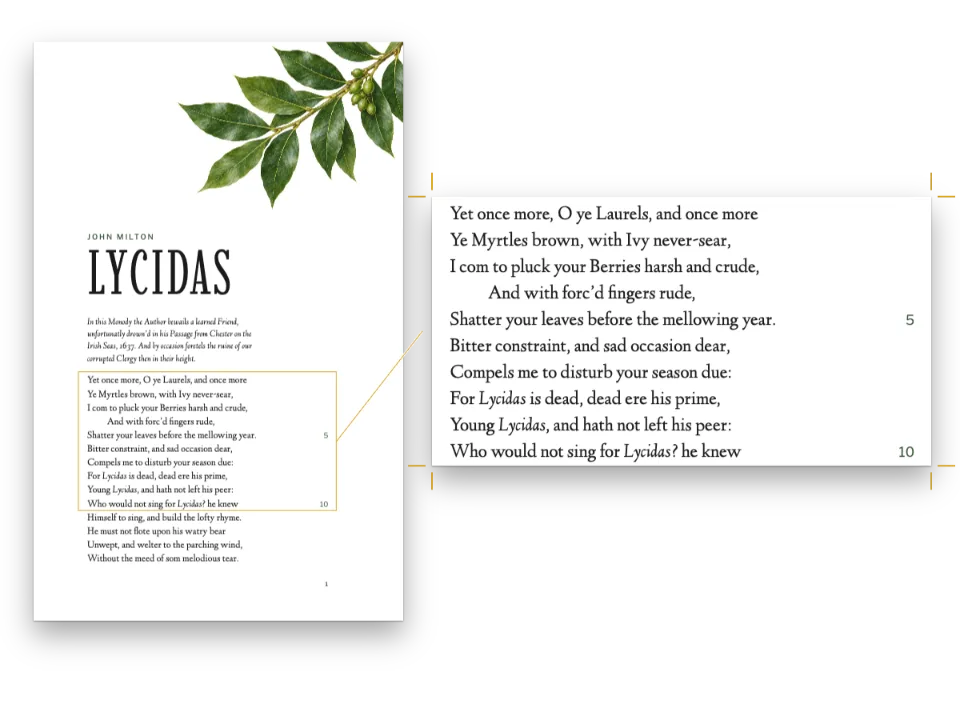
الملاحظات 8.2 pt على تباعد أسطر 10.7 pt، أي نحو أربعة أخماس حجم النص. يقيس المثال قيمة hangingIndent في النمط بحرف Libre Bodoni بعد تحميل الخطوط: الرقم 5 العريض ومسافة en يبلغان معًا 1.12 em، فتصطف أول كلمة في كل ملاحظة مع أسطرها التالية (أنماط الفقرات). ومع وجود الرقم خارجًا في المسافة المعلّقة، لا تحتاج الملاحظات إلى مسافة بينها. وهي غير مضبوطة لأن الضبط سيمطّ مسافة en تلك، ولأن عمودًا مضبوطًا عرضه 55 مم بحرف 8.2 pt يخرج متخلخلًا. وتضع علامات التلدة الأرقام السفلية كما تضع علامات الإقحام الأرقام المرفوعة، كما في C~25~H~52~ في الملاحظة 4 وH~2~O في الملاحظة 5.
#4 · أعطِ الملاحظات صفحة في عمودين
const BAND = 82; // mm from the trim's top: level with the foot of Figure 1 across the spread
// The band sets the reserve too, but the first grid line clear of it lies 3 mm under the soot:
const BAND_GAP = 5; // mm more of minHeight moves the notes down a line
const notesSection = { id: 'notes', // an opener page: the drop folio, no running heads
  breakBefore: { enabled: true, parity: 'any' }, span: 'page', // the next page, either side
  layout: { layoutType: 'double', gutterWidth: mm(6) }, // two columns of about 40 characters
  advancedDesign: { enabled: true, minHeight: mm(BAND - TOP + BAND_GAP), slot: { elements: [
    soot(BAND), art('snuffed', 32, 64, BAND, 12), series,
    text('kicker', '{attr.kicker}', LABEL, 9.5, 'flame', at('container', 'top-left', 0, 16),
      caps(9.5)),
    text('title', '{titleText}', DISPLAY, 52, 'wax', below('kicker', 0.5, 80), display),
    text('intro', '{attr.intro}', LABEL, 8.4, 'rule', below('title', 2.5, 92),
      { lineHeight: 1.3 }),
  ] } } };
يفتح العنوان ## Notes {style="notes" …} قسمًا تأخذ صفحاته تخطيط النمط وتصميمه. يبدأه parity: 'any' في الصفحة التالية، فردية كانت أو زوجية، ويمدّ span: 'page' الشريط عبر العمودين، فيبلغ حدّ القص ويبدأ العمود الثاني تحته (أنماط العناوين). يحدد الشريط المساحة المحجوزة، لكن أول خط شبكة خالٍ منه لا يقع إلا 3 مم تحت السُّخام، فيضيف BAND_GAP إلى minHeight مقدار 5 مم وتبدأ الملاحظات أدنى بسطر. ويُعلَن الخط الرفيع بين العمودين في layout الخاص بالمستند، لأن 1.4.1 لا يرسم columnRule الخاص بنمط العنوان. موازنة الأعمدة مفعّلة افتراضيًا، وتقصّ الصفحة الختامية بحيث ينتهي العمودان على السطر نفسه (موازنة الأعمدة).
#5 · افتتح المحاضرة على حقل من السُّخام
const FIELD = 112; // mm from the trim's top
// The field reaches below the heading, so it sets the reserve (gotcha: opener-reserves-anchored);
// the H1's default bottom margin (0.5 em of 18 pt) rides on it: the text starts a grid line lower.
const opener = { enabled: true,
  slot: { elements: [soot(FIELD), art('candle', 40, 100, FIELD, 10), series,
    text('kicker', '{attr.kicker}', LABEL, 9.5, 'flame', below('series', 17, 60), caps(9.5)),
    text('title', '{titleText}', DISPLAY, 48, 'wax', below('kicker', 1.5, 96), display),
    // 86 mm breaks the subtitle after a dash: no-break spaces do not hold (gotcha: nbsp-breaks)
    text('subtitle', '{attr.subtitle}', DISPLAY, 11.5, 'rule', below('title', 3.5, 86),
      { fontWeight: 500, italic: true, lineHeight: 1.3 }),
    text('byline', '{attr.byline}', LABEL, 7.6, 'rule', below('subtitle', 7, 84), caps(7.6)),
  ] } };
الحقل صندوق مثبّت بالصفحة، والشمعة، وهي عنصر صورة يحمل ملف JPEG، تقف على حافته السفلى. يضبط مستوى العنوان الأول span: 'page' مع أن للمحاضرة عمودًا واحدًا: من دونه يقصّ 1.4.1 التصميم عند أعلى العمود بدل أن يرسمه من حدّ القص. يأتي السطر التمهيدي والعنوان الفرعي وسطر المؤلف من سطر العنوان، # A Candle {kicker="Lecture I" subtitle="…" byline="…"}، فلن تحتاج المحاضرة الثانية إلى شيفرة جديدة. يمتد الحقل تحت العنوان، فيحدد المساحة المحجوزة. ويُضاف إليه الهامش السفلي الافتراضي للعنوان، 0.5 em، فيبدأ النص سطر شبكة واحدًا تحت أول سطر خالٍ من السُّخام. وعرض العنوان الفرعي 86 مم حتى ينكسر بعد شرطة، لأن المسافة غير القابلة للكسر لا تصمد في نص التصميم.
#6 · اللهب على السُّخام، والجمرة على الورق
const palette = {
  ink: '#1f1c19', paper: '#fffdf8', // text and the soot of the fields; a warm white page
  flame: '#e08a1e', ember: '#a9560c', // kickers on soot (6:1); markers and numbers (5.1:1)
  wax: '#f6efe1', rule: '#d4c6ad', // type on soot; hairlines and small type on soot (10:1)
  muted: '#6d6356', blue: '#4f7cae', // running heads, colophon (5.8:1); a flame's blue foot
};
const col = (id) => ({ hex: palette[id], model: 'hex', paletteId: id });
// The engine's defaults link to 'main-color': point it at the ember, so nothing prints blue.
// col() writes the hex too: design slots do not read the palette (gotcha: palette-skips-designs).
const colorPalette = Object.entries({ ...palette, 'main-color': palette.ember })
  .map(([id, hex]) => ({ id, name: id, value: { hex, model: 'hex' } }));
للبرتقالي اللهبي تباين 6:1 على السُّخام، لكنه لا يتجاوز 2.6:1 على الورق. يلوّن السطور التمهيدية على الأشرطة الداكنة والشكل 1؛ وكل ما هو صغير ومطبوع بالبرتقالي على الورق (العلامات، أرقام الملاحظات، تسمية الشكل) يأخذ لون الجمرة الأدكن، بتباين 5.1:1. ويشير main-color إلى الجمرة، فالقيمة الافتراضية التي لا تعيد الإعدادات ذكرها تتبع التصميم بدل أن تُطبع بالأزرق.
الوصفة كاملة
// ═══ Postext Cookbook · Nº 020 · Endnotes on a page of their own, in two columns ═════ // https://postext.dev/en/cookbook/endnotes-instead-of-footnotes // Code: MIT · Text: Faraday, ed. Crookes (PD) · Notes, figure: CC BY 4.0 · Photos: diffusion models // Fonts: Libre Bodoni, Besley, Archivo Narrow (SIL OFL 1.1) · Needs postext ≥ 1.4.1 import { buildDocument, renderPageToCanvas, clearMeasurementCache, registerResourceImage } from 'https://esm.sh/postext'; const LANG = 'en'; // @lang: the language of the sample document ('en' | 'es') const RECIPE = 'endnotes-instead-of-footnotes'; // ─── 1 · Design ───────────────────────────────────────────────────────────── // #region palette: soot, wax and a flame; the ember is the flame dark enough for small type const palette = { ink: '#1f1c19', paper: '#fffdf8', // text and the soot of the fields; a warm white page flame: '#e08a1e', ember: '#a9560c', // kickers on soot (6:1); markers and numbers (5.1:1) wax: '#f6efe1', rule: '#d4c6ad', // type on soot; hairlines and small type on soot (10:1) muted: '#6d6356', blue: '#4f7cae', // running heads, colophon (5.8:1); a flame's blue foot }; const col = (id) => ({ hex: palette[id], model: 'hex', paletteId: id }); // The engine's defaults link to 'main-color': point it at the ember, so nothing prints blue. // col() writes the hex too: design slots do not read the palette (gotcha: palette-skips-designs). const colorPalette = Object.entries({ ...palette, 'main-color': palette.ember }) .map(([id, hex]) => ({ id, name: id, value: { hex, model: 'hex' } })); // #endregion const TEXT = 'Libre Bodoni', DISPLAY = 'Besley', LABEL = 'Archivo Narrow'; // text; titles; labels const TOP = 22, INNER = 18, OUTER = 22; // mm: margins, and a 116 mm measure of 74 characters // #region answer: Markdown footnotes become raised markers and a Notes section // Use: buildDocument({ markdown: endnotes(markdown) }, config()), with a 'note' paragraph style. // [^label] in the text → **^n^**, numbered by first citation; bold, so it takes bodyText.boldColor. // The [^label]: definitions (one line each) print where the first stood, a 'note' paragraph each: // '**n** text', never '1. text', which would open a numbered list (gotcha: digit-period-list). function endnotes(markdown, style = 'note') { const notes = new Map(); // label → text const HOLE = '\u0000'; // marks where a definition stood: the first becomes the notes const text = markdown.replace(/^\[\^([^\]\s]+)\]:[ \t]*(.+)\n?/gm, (_, label, note) => { notes.set(label, note.trim()); return HOLE; }); const cited = []; // labels in order of first citation const number = (label) => { if (!notes.has(label)) throw new Error(`The note [^${label}] has no definition`); if (!cited.includes(label)) cited.push(label); return cited.indexOf(label) + 1; }; // Markers side by side share one superscript, [^a][^b] → **^1,2^**, never 12 raised (note 12). // A word joiner (U+2060, no width) opens each one: after an italic, '*Royal George*' and the // bold's ** would make '***', which the parser reads as a bold run, and print the asterisks. const marked = text.replace(/(?:\[\^[^\]\s]+\])+/g, (run) => { const numbers = [...run.matchAll(/\[\^([^\]\s]+)\]/g)].map(([, label]) => number(label)); return `**^${numbers.join(',')}^**`; }); const unused = [...notes.keys()].filter((label) => !cited.includes(label)); if (unused.length) console.warn(`Notes never cited: ${unused.join(', ')}`); const entries = cited.map((label, i) => `**${i + 1}** ${notes.get(label)}`); const section = `:::paragraphs{style="${style}"}\n${entries.join('\n\n')}\n:::\n`; return marked.replace(HOLE, () => section).replaceAll(HOLE, ''); // () =>: '$&' stays text } // #endregion // #region markers: the lecture has no bold of its own, so the bold colour is free for the markers const markers = { boldColor: col('ember'), // **^n^**: a superscript at 58 % of the text size referenceBold: false }; // [Fig. 1] follows the bold colour, set roman // #endregion // #region notes: 8.2 pt, set ragged, each number hanging in the indent const NOTE = 8.2; // pt: the notes' size, about four fifths of the text // The hang is a bold number and an en space, measured in the notes' face once the fonts are in: // a bold 5 matches 2, 3 and 6 within 0.02 em (the 4 is 0.05 em wider, the 1 0.14 em narrower). function hang(label = '5') { // from ten notes on, pass the widest label: hang('10') const ctx = new OffscreenCanvas(1, 1).getContext('2d'); const width = (w, s) => { ctx.font = `${w} 100px "${TEXT}"`; return ctx.measureText(s).width; }; return em((width(700, label) + width(400, ' ')) / 100); } // Ragged, as justifying would stretch the en space (gotcha: ragged-no-hyphenation). const noteStyles = () => [{ id: 'note', fontSize: pt(NOTE), lineHeight: pt(NOTE * 1.3), textAlign: 'left', hangingIndent: hang() }, // 22 pt above the colophon is copy-fitted: its last line and the first column's share a line. { id: 'colophon', fontFamily: LABEL, fontSize: pt(7), lineHeight: pt(9.2), color: col('muted'), textAlign: 'left', firstLineIndent: pt(0), marginTop: pt(22) }, ]; // #endregion // Design text wraps (it ends in an ellipsis by default: gotcha overflow-ellipsis-default). const text = (id, content, family, size, color, placement, extra) => ({ kind: 'text', id, content, fontFamily: family, fontSize: pt(size), color: col(color), placement, overflow: 'wrap', align: 'left', ...extra }); const caps = (s) => ({ fontWeight: 600, textTransform: 'uppercase', letterSpacing: pt(s * 0.18) }); const display = { fontWeight: 800, lineHeight: 1 }; // the titles, set solid const at = (to, edge, x, y, width) => ({ anchor: { to, edge }, offset: { x: mm(x), y: mm(y) }, ...(width && { size: { width: mm(width) } }) }); const below = (id, y, width) => at(`#${id}`, 'below', 0, y, width); // A field of soot from the trim's top, edge to edge, and a candle standing on its lower edge. const soot = (height) => ({ kind: 'box', id: 'soot', style: { backgroundColor: col('ink') }, placement: { ...at('page', 'top-left', 0, 0), size: { width: 'fill', height: mm(height) } } }); const art = (id, width, height, foot, x) => ({ kind: 'image', id, resourceId: id, placement: at('page', 'top-right', -x, foot - height, width) }); const series = text('series', '{title}', LABEL, 7.6, 'rule', at('container', 'top-left', 0, 4), caps(7.6)); // the book's title, from the frontmatter, heads both bands // #region opener: the lecture opens on a field of soot with a photo of a lit candle const FIELD = 112; // mm from the trim's top // The field reaches below the heading, so it sets the reserve (gotcha: opener-reserves-anchored); // the H1's default bottom margin (0.5 em of 18 pt) rides on it: the text starts a grid line lower. const opener = { enabled: true, slot: { elements: [soot(FIELD), art('candle', 40, 100, FIELD, 10), series, text('kicker', '{attr.kicker}', LABEL, 9.5, 'flame', below('series', 17, 60), caps(9.5)), text('title', '{titleText}', DISPLAY, 48, 'wax', below('kicker', 1.5, 96), display), // 86 mm breaks the subtitle after a dash: no-break spaces do not hold (gotcha: nbsp-breaks) text('subtitle', '{attr.subtitle}', DISPLAY, 11.5, 'rule', below('title', 3.5, 86), { fontWeight: 500, italic: true, lineHeight: 1.3 }), text('byline', '{attr.byline}', LABEL, 7.6, 'rule', below('subtitle', 7, 84), caps(7.6)), ] } }; // #endregion // #region section: the notes open a page of their own, in two columns under a band of soot const BAND = 82; // mm from the trim's top: level with the foot of Figure 1 across the spread // The band sets the reserve too, but the first grid line clear of it lies 3 mm under the soot: const BAND_GAP = 5; // mm more of minHeight moves the notes down a line const notesSection = { id: 'notes', // an opener page: the drop folio, no running heads breakBefore: { enabled: true, parity: 'any' }, span: 'page', // the next page, either side layout: { layoutType: 'double', gutterWidth: mm(6) }, // two columns of about 40 characters advancedDesign: { enabled: true, minHeight: mm(BAND - TOP + BAND_GAP), slot: { elements: [ soot(BAND), art('snuffed', 32, 64, BAND, 12), series, text('kicker', '{attr.kicker}', LABEL, 9.5, 'flame', at('container', 'top-left', 0, 16), caps(9.5)), text('title', '{titleText}', DISPLAY, 52, 'wax', below('kicker', 0.5, 80), display), text('intro', '{attr.intro}', LABEL, 8.4, 'rule', below('title', 2.5, 92), { lineHeight: 1.3 }), ] } } }; // #endregion const head = (id, content, parity, edge, x, extra) => ({ kind: 'text', id, content, parity, pages: 'body', fontFamily: LABEL, fontSize: pt(7.6), color: col('muted'), ...caps(7.6), placement: at('page', edge, x, 13), ...extra }); const folio = { fontFamily: DISPLAY, fontSize: pt(8.6), fontWeight: 700, color: col('ink'), letterSpacing: pt(0) }; // untracked figures const header = { elements: [ // the book on the verso, the lecture on the recto, folios outside head('verso-folio', '{pageNumber}', 'even', 'top-left', OUTER, folio), head('verso-title', '{title}', 'even', 'top-left', OUTER + 9), head('recto-title', '{attr.kicker} · {chapterTitle}', 'odd', 'top-right', -(OUTER + 9)), head('recto-folio', '{pageNumber}', 'odd', 'top-right', -OUTER, folio), ] }; const dropFolio = text('drop', '{pageNumber}', DISPLAY, 8.6, 'ink', at('page', 'bottom', 0, -12), { fontWeight: 700, align: 'center', pages: 'opener' }); // the lecture's and the notes' openers const config = () => ({ // a factory, never a shared object (gotcha: config-cache-identity) colorPalette, header, footer: { elements: [dropFolio] }, page: { width: mm(156), height: mm(234), dpi: 150, // a trade octavo backgroundColor: col('paper'), margins: { top: mm(TOP), bottom: mm(23), left: mm(INNER), right: mm(OUTER), mirror: true } }, // left is the inner margin // Drawn only where a page has two columns: the notes' (gotcha: section-column-rule). layout: { layoutType: 'single', columnRule: { enabled: true, color: col('rule') } }, bodyText: { fontFamily: TEXT, fontSize: pt(10), lineHeight: pt(13.8), color: col('ink'), italicColor: col('ink'), ...markers, firstLineIndent: mm(4.5), indentAfterHeading: false, minWordSpacing: 0.85, maxWordSpacing: 1.8 }, // the loosest lines reach 1.78 under any cap headings: { fontFamily: DISPLAY, color: col('ink'), levels: [ // Break restated (gotcha: headings-drop-h1-break); the span lets the design reach the trim. { level: 1, span: 'page', breakBefore: { enabled: true, parity: 'odd' }, advancedDesign: opener }, ] }, headingStyles: [notesSection], paragraphStyles: noteStyles(), // One figure, numbered through the book: "Figure 1", not the chapter-scoped "Figure 1.1". resourceTypes: [{ id: 'figure', name: 'Figure', shortLabel: 'Fig.', captionPrefix: 'Figure', numberingTemplate: '{n}', resetOn: 'never', counterFormat: 'decimal' }], captionStyle: { fontFamily: LABEL, fontSize: pt(8.2), labelColor: col('ember') }, }); // ─── 2 · Content ──────────────────────────────────────────────────────────── const markdown = String.raw`---نموذج Markdown · أسطر: 36 · content.en.md
title: "The Chemical History of a Candle" author: "Michael Faraday" --- # A Candle {kicker="Lecture I" subtitle="The Flame – Its Sources – Structure – Mobility – Brightness" byline="Michael Faraday · Christmas 1860"} I purpose, in return for the honour you do us by coming to see what are our proceedings here, to bring before you, in the course of these lectures, the Chemical History of a Candle. I have taken this subject on a former occasion;[^christmas] and were it left to my own will, I should prefer to repeat it almost every year—so abundant is the interest that attaches itself to the subject, so wonderful are the varieties of outlet which it offers into the various departments of philosophy. There is not a law under which any part of this universe is governed which does not come into play, and is touched upon in these phenomena. There is no better, there is no more open door by which you can enter into the study of natural philosophy, than by considering the physical phenomena of a candle. I trust, therefore, I shall not disappoint you in choosing this for my subject rather than any newer topic, which could not be better, were it even so good. But we must speak of candles as they are in commerce. Here are a couple of candles commonly called dips. They are made of lengths of cotton cut off, hung up by a loop, dipped into melted tallow, taken out again and cooled, then re-dipped until there is an accumulation of tallow round the cotton. In order that you may have an idea of the various characters of these candles, you see these which I hold in my hand—they are very small, and very curious. They are, or were, the candles used by the miners in coal mines. In olden times the miner had to find his own candles; and it was supposed that a small candle would not so soon set fire to the fire-damp in the coal mines as a large one; and for that reason, as well as for economy’s sake, he had candles made of this sort—20, 30, 40, or 60 to the pound. They have been replaced since then by the steel-mill, and then by the Davy-lamp, and other safety-lamps of various kinds. I have here a candle that was taken out of the *Royal George*[^george], it is said, by Colonel Pasley. It has been sunk in the sea for many years, subject to the action of salt water. It shews you how well candles may be preserved; for though it is cracked about and broken a good deal, yet, when lighted, it goes on burning regularly, and the tallow resumes its natural condition as soon as it is fused. Mr. Field, of Lambeth, has supplied me abundantly with beautiful illustrations of the candle and its materials. I shall therefore now refer to them. And, first, there is the suet—the fat of the ox—Russian tallow, I believe, employed in the manufacture of these dips, which Gay Lussac, or some one who entrusted him with his knowledge, converted into that beautiful substance, stearin, which you see lying beside it. A candle, you know, is not now a greasy thing like an ordinary tallow candle, but a clean thing, and you may almost scrape off and pulverise the drops which fall from it without soiling anything. This is the process he adopted:[^stearin]—The fat or tallow is first boiled with quick-lime, and made into a soap, and then the soap is decomposed by sulphuric acid, which takes away the lime, and leaves the fat re-arranged as stearic acid, whilst a quantity of glycerin is produced at the same time. Glycerin—absolutely a sugar, or a substance similar to sugar—comes out of the tallow in this chemical change. The oil is then pressed out of it; and you see here this series of pressed cakes, shewing how beautifully the impurities are carried out by the oily part as the pressure goes on increasing, and at last you have left that substance which is melted, and cast into candles as here represented. The candle I have in my hand is a stearin candle, made of stearin from tallow in the way I have told you. Then here is a sperm candle, which comes from the purified oil of the spermaceti whale. Here also are yellow bees-wax and refined bees-wax, from which candles are made. Here, too, is that curious substance called paraffin, and some paraffin candles made of paraffin obtained from the bogs of Ireland.[^paraffin] I have here also a substance brought from Japan, since we have forced an entrance into that out-of-the-way place—a sort of wax which a kind friend has sent me, and which forms a new material for the manufacture of candles. There is another condition which you must learn as regards the candle, without which you would not be able fully to understand the philosophy of it, and that is the vaporous condition of the fuel. In order that you may understand that, let me shew you a very pretty, but very common-place experiment. If you blow a candle out cleverly, you will see the vapour rise from it. You have, I know, often smelt the vapour of a blown-out candle—and a very bad smell it is; but if you blow it out cleverly, you will be able to see the vapour into which this solid matter is transformed. I will blow out one of these candles in such a way as not to disturb the air around it, by the continuing action of my breath; and now, if I hold a lighted taper two or three inches from the wick, you will observe a train of fire going through the air till it reaches the candle. I am obliged to be quick and ready, because, if I allow the vapour time to cool, it becomes condensed into a liquid or solid, or the stream of combustible matter gets disturbed. Now, as to the shape or form of the flame. It concerns us much to know about the condition which the matter of the candle finally assumes at the top of the wick—where you have such beauty and brightness as nothing but combustion or flame can produce.[^combustion] You have the glittering beauty of gold and silver, and the still higher lustre of jewels, like the ruby and diamond; but none of these rival the brilliancy and beauty of flame. What diamond can shine like flame? It owes its lustre at night-time to the very flame shining upon it. The flame shines in darkness, but the light which the diamond has is as nothing until the flame shine upon it, when it is brilliant again. The candle alone shines by itself, and for itself, or for those who have arranged the materials. Now, let us look a little at the form of the flame as you see it under the glass shade. It is steady and equal; and its general form is that which is represented in the diagram [:ref{id="flame"}], varying with atmospheric disturbances, and also varying according to the size of the candle. It is a bright oblong—brighter at the top than towards the bottom—with the wick in the middle, and besides the wick in the middle, certain darker parts towards the bottom, where the ignition is not so perfect as in the part above. I can give you here a little further illustration, for the purpose of shewing you how flame goes up or down; according to the current. I have here a flame—it is not a candle-flame—but you can, no doubt, by this time, generalise enough to be able to compare one thing with another. What I am about to do is to change the ascending current that takes the flame upwards into a descending current. This I can easily do by the little apparatus you see before me. The flame, as I have said, is not a candle flame, but it is produced by alcohol, so that it shall not smoke too much. I will also colour the flame with another substance,[^copper] so that you may trace its course; for with the spirit alone you could hardly see well enough to have the opportunity of tracing its direction. By lighting this spirit-of-wine, we have then a flame produced; and you observe that when held in the air, it naturally goes upwards. You understand now easily enough why flames go up under ordinary circumstances—it is because of the draught of air by which the combustion is formed. But now, by blowing the flame down, you see I am enabled to make it go downwards into this little chimney—the direction of the current being changed. Before we have concluded this course of lectures, we shall shew you a lamp in which the flame goes up and the smoke goes down, or the flame goes down and the smoke goes up. You see, then, that we have the power in this way of varying the flame in different directions. It is too bad that we have not got further; but we must not, under any circumstances, keep you beyond your time. It will be a lesson to me in future to hold you more strictly to the philosophy of the thing, than to take up your time so much with these illustrations. ## Notes {style="notes" kicker="Lecture I" intro="The raised numbers in the lecture point here. Notes signed by the editor are new to this edition; the rest are William Crookes’s, from the impression of 1908."} [^christmas]: Faraday first gave this course of six lectures at Christmas 1848. The text printed here is that of his second course, given at the Royal Institution in 1860–61 and published in 1861, edited by William Crookes. *Ed.* [^george]: The *Royal George* sunk at Spithead on the 29th of August, 1782. Colonel Pasley commenced operations for the removal of the wreck by the explosion of gunpowder, in August, 1839. The candle which Professor Faraday exhibited must therefore have been exposed to the action of salt water for upwards of fifty-seven years. [^stearin]: The fat or tallow consists of a chemical combination of fatty acids with glycerine. The lime unites with the palmitic, oleic, and stearic acids, and separates the glycerine. After washing, the insoluble lime soap is decomposed with hot dilute sulphuric acid. The melted fatty acids thus rise as an oil to the surface, when they are decanted. They are again washed and cast into thin plates, which, when cold, are placed between layers of cocoa-nut matting, and submitted to intense hydraulic pressure. In this way the soft oleic acid is squeezed out, whilst the hard palmitic and stearic acids remain. These are further purified by pressure at a higher temperature, and washing in warm dilute sulphuric acid, when they are ready to be made into candles. These acids are harder and whiter than the fats from which they were obtained, whilst at the same time they are cleaner and more combustible. [^paraffin]: Paraffin wax is a mixture of hydrocarbons with 20 to 40 carbon atoms, such as C~25~H~52~. Karl von Reichenbach first isolated it from wood tar in 1830; by 1860 it was distilled for candles from shale, peat and coal. *Ed.* [^combustion]: As it burns, the vapour of the wax combines with oxygen from the air and leaves the flame as water, H~2~O, and carbon dioxide, CO~2~, which Faraday calls “carbonic acid”. He finds the water in Lecture II and the carbonic acid in Lecture V. *Ed.* [^copper]: The alcohol had chloride of copper dissolved in it: this produces a beautiful green flame. :::paragraphs{style="colophon"} Set in Libre Bodoni, Besley and Archivo Narrow, all three under the SIL Open Font License. The text is Michael Faraday’s, as edited by William Crookes in 1861, from the impression of 1908 (Project Gutenberg eBook 14474), abridged; the figure and the editor’s notes are CC BY 4.0. :::`; // content.<lang>.md, inlined by the Cookbook const svgResource = (id, width, height, extra) => ({ id, typeId: 'figure', kind: 'svg', svg: { fileId: `${id}.svg`, width, height }, createdAt: 0, updatedAt: 0, ...extra }); // The candles on the bands are photographs, JPEGs in assets/ cut to their 40 × 100 and 32 × 64 // mm and declared at their pixels; their black was lifted to the soot's ink. Uncited: design only. const photo = (id, bitmap) => ({ id, typeId: 'figure', kind: 'bitmap', bitmap, createdAt: 0, updatedAt: 0 }); const resources = [ photo('candle', { fileId: 'candle-640.jpg', format: 'jpeg', width: 640, height: 1600 }), photo('snuffed', { fileId: 'snuffed-600.jpg', format: 'jpeg', width: 600, height: 1200 }), // Cited on page 17, the 'top' figure heads page 18 (gotcha: top-float-next-page). svgResource('flame', 2320, 1200, { placement: { position: 'top' }, caption: 'A candle flame as ' + 'it looks under a glass shade (left) and in section (right): the dark core of wax vapour ' + 'round the wick, the blue foot where the air first meets it, the bright zone where soot ' + 'glows, and the faint mantle, the hottest part. Heated air rises round it and draws it up.', altText: 'A candle flame, whole and in section, with arrows of rising air' }), ]; // #region art: Figure 1, the flame as seen and in section, in the palette // No words in the drawings: an SVG drawn as an image cannot use web fonts // (gotcha: svg-no-webfonts). Arrowheads are paths (gotcha: svg-no-marker-filters). const n = (v) => +v.toFixed(2); const svg = (w, h, body) => `<svg xmlns="http://www.w3.org/2000/svg" width="${w * 10}" ` + `height="${h * 10}" viewBox="0 0 ${w} ${h}">${body}</svg>`; const shape = (d, fill, extra = '') => `<path d="${d}" fill="${fill}"${extra}/>`; const line = (d, stroke, width, extra = '') => `<path d="${d}" fill="none" stroke="${stroke}" ` + `stroke-width="${width}" stroke-linecap="round" stroke-linejoin="round"${extra}/>`; const dot = (x, y, r, fill, extra = '') => `<circle cx="${n(x)}" cy="${n(y)}" r="${n(r)}" ` + `fill="${fill}"${extra}/>`; const op = (v) => ` fill-opacity="${v}"`; // Light round a flame: a radial gradient from the flame's colour to nothing. const halo = (x, y, r, strength) => `<radialGradient id="h${x}" cx="0.5" cy="0.5" r="0.5">` + `<stop offset="0" stop-color="${palette.flame}" stop-opacity="${strength}"/>` + `<stop offset="0.45" stop-color="${palette.flame}" stop-opacity="${strength * 0.35}"/>` + `<stop offset="1" stop-color="${palette.flame}" stop-opacity="0"/></radialGradient>` + dot(x, y, r, `url(#h${x})`); // A flame from its foot (x, base) up to its tip: round below, drawn out above. function tongue(x, base, top, half) { const h = base - top; return `M${n(x)} ${n(top)}C${n(x + half * 0.3)} ${n(top + h * 0.28)} ${n(x + half)} ` + `${n(top + h * 0.5)} ${n(x + half)} ${n(top + h * 0.74)}` + `C${n(x + half)} ${n(base - h * 0.04)} ` + `${n(x + half * 0.5)} ${n(base)} ${n(x)} ${n(base)}C${n(x - half * 0.5)} ${n(base)} ` + `${n(x - half)} ${n(base - h * 0.04)} ${n(x - half)} ${n(top + h * 0.74)}C${n(x - half)} ` + `${n(top + h * 0.5)} ${n(x - half * 0.3)} ${n(top + h * 0.28)} ${n(x)} ${n(top)}Z`; } // The flame's zones: mantle, bright body, dark core round the wick, blue foot. function flameAt(x, base, top, half, { lit = true, section = false } = {}) { const h = base - top; const P = palette; let out = shape(tongue(x, base + 2, top - h * 0.08, half * 1.22), P.flame, section ? `${op(0.16)} stroke="${P.flame}" stroke-width="0.8"` : op(0.22)); out += shape(tongue(x, base, top, half), P.flame); if (!section) { // as seen: brighter above, darker below out += shape(tongue(x, base - h * 0.22, top + h * 0.1, half * 0.72), P.wax, op(0.55)) + shape(tongue(x, base - h * 0.38, top + h * 0.2, half * 0.42), P.wax, op(0.75)); } out += shape(tongue(x, base, base - h * (section ? 0.5 : 0.36), half * (section ? 0.5 : 0.36)), section ? P.ink : P.ember, op(section ? 0.72 : 0.7)); out += shape(`M${n(x - half * 0.95)} ${n(base - h * 0.1)}Q${n(x)} ${n(base + h * 0.06)} ` + `${n(x + half * 0.95)} ${n(base - h * 0.1)}Q${n(x + half * 0.7)} ${n(base + h * 0.03)} ` + `${n(x)} ${n(base + h * 0.03)}Q${n(x - half * 0.7)} ${n(base + h * 0.03)} ` + `${n(x - half * 0.95)} ${n(base - h * 0.1)}Z`, P.blue, op(lit ? 0.9 : 0)); return out; } // A pillar of wax from y down past the art's foot, with the cup of melted wax on top. function pillar(x, y, half, foot, drip = 0) { const P = palette; const shade = `<linearGradient id="w${x}" x1="0" x2="1" y1="0" y2="0">` // rounded by light + `<stop offset="0" stop-color="${P.rule}"/><stop offset="0.3" stop-color="${P.wax}"/>` + `<stop offset="0.62" stop-color="${P.wax}"/><stop offset="1" stop-color="${P.rule}"/>` + '</linearGradient>'; return shade + `<rect x="${n(x - half)}" y="${n(y)}" width="${n(half * 2)}" ` + `height="${n(foot - y)}" fill="url(#w${x})"/>` + (drip ? shape(`M${n(x - half * 0.78)} ${n(y)}h${n(half * 0.34)}v${n(drip)}a${n(half * 0.17)} ` + `${n(half * 0.17)} 0 0 1-${n(half * 0.34)} 0Z`, P.wax) : '') + `<ellipse cx="${n(x)}" cy="${n(y)}" rx="${n(half)}" ry="${n(half * 0.2)}" ` + `fill="${P.wax}"/>` + `<ellipse cx="${n(x)}" cy="${n(y + half * 0.02)}" rx="${n(half * 0.76)}" ` + `ry="${n(half * 0.13)}" fill="${P.rule}"${op(0.8)}/>`; // the cup of melted wax } const wick = (x, y, len, lean = 2) => line(`M${n(x)} ${n(y)}q${n(lean * 0.3)} ${n(-len * 0.5)} ` + `${n(lean)} ${n(-len)}`, palette.ink, 1.6); // Rising air: a curve from beside the foot to above the tip, and a path arrowhead. function draught(x0, y0, x1, y1, color, width, opacity) { const head = shape(`M${n(x1 - 2.2)} ${n(y1 + 3.2)}L${n(x1)} ${n(y1 - 0.6)}L${n(x1 + 2.2)} ` + `${n(y1 + 3.2)}Z`, color, op(opacity)); return line(`M${n(x0)} ${n(y0)}C${n(x0)} ${n((y0 + y1) / 2)} ${n(x1)} ${n(y0 - (y0 - y1) * 0.6)} ` + `${n(x1)} ${n(y1 + 2)}`, color, width, ` stroke-opacity="${opacity}"`) + head; } function flame() { // Figure 1: 116 × 60 mm, as seen and in section, on soot const P = palette; let out = `<rect width="232" height="120" rx="2" fill="${P.ink}"/>`; out += halo(70, 60, 46, 0.3) + flameAt(70, 92, 24, 11) + pillar(70, 100, 17, 120, 12) + wick(69.5, 101, 12) // then the glass shade, open below, drawn over the candle it stands round + `<path d="M47 112V17a5 5 0 0 1 5-5h36a5 5 0 0 1 5 5v95" fill="${P.wax}"${op(0.05)} ` + `stroke="${P.rule}" stroke-opacity="0.4" stroke-width="0.8"/>` + line('M52 18v88', P.wax, 1.4, ' stroke-opacity="0.18"'); for (const side of [-1, 1]) { // the air the flame heats, rising round it out += draught(160 + side * 32, 108, 160 + side * 10, 14, P.rule, 1, 0.75) + draught(160 + side * 44, 104, 160 + side * 22, 30, P.rule, 1, 0.5); } return svg(232, 120, out + flameAt(160, 92, 24, 11, { section: true }) + pillar(160, 100, 17, 120) + wick(159.5, 101, 12)); } const drawings = { flame }; // #endregion // ─── 3 · Fonts ────────────────────────────────────────────────────────────── // Every face the design uses, loaded before the first build (gotcha: fonts-first). const FONTS = { 'Libre Bodoni': ['400', '400i', '700'], // text and notes (700: the numbers) Besley: ['500i', '700', '800'], 'Archivo Narrow': ['400', '400i', '600', '700'] }; // labels // ─── 4 · Build & show ─────────────────────────────────────────────────────── const source = endnotes(markdown); // the answer, run before the engine sees the text await Promise.all([loadFonts(FONTS, source), ...resources.filter((r) => r.bitmap).map(({ bitmap: b }) => loadImage(b.fileId, asset(b.fileId))), ...Object.entries(drawings).map(([id, draw]) => loadSvg(`${id}.svg`, draw()))]); // The lecture starts on folio 15, a recto, 14 pages into the book (gotcha: parity-page1-recto). const continuation = { pageIndexOffset: 14, pageNumbering: { startAt: 15 } }; const doc = await buildWithFonts( () => buildDocument({ markdown: source, resources, continuation }, config()), source); showPages(doc, { title: 'The Chemical History of a Candle, Lecture I' });العُدّة · core, fonts, viewer, images: نفسها في كل وصفة · أسطر: 270
// ─── Kit ── helpers shared by every Cookbook recipe · postext.dev/cookbook ───── // ─── Kit · core v1 ── the same in every recipe · postext.dev/cookbook ───────── function mm(value) { return { value, unit: 'mm' }; } function pt(value) { return { value, unit: 'pt' }; } function em(value) { return { value, unit: 'em' }; } /** The sample language's string: t({ en: 'Figure', es: 'Figura' }). */ function t(strings) { return strings[LANG] ?? Object.values(strings)[0]; } /** A file in this recipe's assets folder, served from the Postext repo by jsDelivr. */ function asset(file) { return `https://cdn.jsdelivr.net/gh/drnachio/postext@main/cookbook/${RECIPE}/assets/${file}`; } // ─── Kit · fonts v1 ── the same in every recipe · postext.dev/cookbook ──────── // Postext measures text with the faces the browser has loaded, and caches the // widths, so every face must be ready before the first build. Faces come from // Fontsource: the same static files the PDF embeds, so screen and PDF agree. /** faces = { 'Family Name': ['400', '400i', '700'] }. `text` is the sample: * letters beyond Latin-1 (č, ł, ő…) also load the latin-ext files. With * `optional`, a face Fontsource does not ship is skipped instead of failing. * Resolves to the number of faces added. */ async function loadFonts(faces, text = '', { optional = false } = {}) { kitStatus('Loading fonts…'); const ranges = { latin: 'U+0000-00FF,U+0131,U+0152-0153,U+02BB-02BC,U+02C6,U+02DA,U+02DC,U+0304,U+0308,U+0329,' + 'U+2000-206F,U+20AC,U+2122,U+2191,U+2193,U+2212,U+2215,U+FEFF,U+FFFD', 'latin-ext': 'U+0100-02BA,U+02BD-02C5,U+02C7-02CC,U+02CE-02D7,U+02DD-02FF,U+0304,U+0308,U+0329,' + 'U+1D00-1DBF,U+1E00-1E9F,U+1EF2-1EFF,U+2020,U+20A0-20AB,U+20AD-20C0,U+2113,U+2C60-2C7F,U+A720-A7FF', }; const subsets = /[Ā-˿Ḁ-ỿ]/.test(text) ? ['latin', 'latin-ext'] : ['latin']; const jobs = []; let added = 0; for (const [family, specs] of Object.entries(faces)) { const id = fontsourceId(family); const meta = optional ? await fontsourceMeta(family) : null; for (const spec of new Set(specs)) { const weight = parseInt(spec, 10); const style = spec.endsWith('i') ? 'italic' : 'normal'; if (hasFace(family, weight, style)) continue; if (optional && !(meta?.weights.includes(weight) && meta.styles.includes(style))) continue; for (const subset of subsets) { const url = `https://cdn.jsdelivr.net/npm/@fontsource/${id}@5/files/${id}-${subset}-${weight}-${style}.woff2`; const face = new FontFace(family, `url(${url}) format('woff2')`, { weight: String(weight), style, unicodeRange: ranges[subset] }); jobs.push(face.load().then((ready) => { document.fonts.add(ready); added++; }, () => { if (subset === 'latin' && !optional) throw new Error(`Fontsource has no ${family} ${weight} ${style}`); })); } } } await Promise.all(jobs).catch((error) => { kitFail(error); throw error; }); return added; } /** Runs `build` (a buildDocument or buildBundle call) and checks the faces * the pages use. A regular face missing from FONTS is loaded with a warning; * bold and italic variants are loaded when the family ships them. Then the * measurement caches are cleared and the build runs again. */ async function buildWithFonts(build, text = '') { const tried = new Set(); for (let round = 0; round < 3; round++) { kitStatus('Laying out…'); await new Promise(requestAnimationFrame); // let the status paint first const result = await Promise.resolve().then(build).catch((error) => { kitFail(error); throw error; }); const wanted = { base: {}, variants: {} }; for (const { font, base } of [result].flat().flatMap(fontStringsOf)) { const { family, weight, style } = parseFont(font); const key = `${family}|${weight}|${style}`; if (tried.has(key) || hasFace(family, weight, style)) continue; tried.add(key); (wanted[base ? 'base' : 'variants'][family] ??= []).push(`${weight}${style === 'italic' ? 'i' : ''}`); } if (Object.keys(wanted.base).length) { console.warn(`[cookbook] FONTS does not list ${JSON.stringify(wanted.base)}: loading them.`); } const added = await loadFonts(wanted.base, text) + await loadFonts(wanted.variants, text, { optional: true }); if (added === 0) return result; clearMeasurementCache(); } throw new Error('The fonts did not settle after three builds.'); } /** Every font string of the layout. `base` marks a block's own face; its * bold, italic and bold-italic variants are listed whether or not used. */ function fontStringsOf(doc) { const found = new Map(); const walk = (node) => { if (!node || typeof node !== 'object') return; if (Array.isArray(node)) { node.forEach(walk); return; } for (const [key, value] of Object.entries(node)) { if (typeof value === 'string' && /fontString$/i.test(key)) { found.set(value, found.get(value) || key === 'fontString'); } else if (value && typeof value === 'object') walk(value); } }; walk(doc.pages); walk(doc.blocks); return [...found].map(([font, base]) => ({ font, base })); } /** '700 37.5px Open Sans' / 'italic 400 13px "Source Serif 4"' → { family, weight, style }. * A string with no weight ('95.8px Young Serif', from a design text) is 400. */ function parseFont(font) { const m = /^(?:(italic|oblique)\s+)?(?:small-caps\s+)?(?:(\d+|bold|normal)\s+)?[\d.]+px\s+(.+)$/.exec(font.trim()); if (!m) throw new Error(`Unexpected font string: ${font}`); const weight = m[2] === 'bold' ? 700 : !m[2] || m[2] === 'normal' ? 400 : Number(m[2]); return { family: m[3].replace(/^["']|["']$/g, ''), weight, style: m[1] ? 'italic' : 'normal' }; } /** True when a loaded FontFace covers exactly this family, weight and style * (document.fonts.check() is also true for families nobody declared). */ function hasFace(family, weight, style) { for (const face of document.fonts) { if (face.status !== 'loaded' || face.style !== style) continue; if (face.family.replace(/^["']|["']$/g, '') !== family) continue; const [low, high = low] = face.weight.split(' ').map(Number); if (weight >= low && weight <= high) return true; } return false; } /** Fontsource's id for a family: 'Source Serif 4' → 'source-serif-4'. */ function fontsourceId(family) { return family.toLowerCase().replace(/\s+/g, '-'); } /** The weights and styles a family ships ({ weights: [400, 700], styles: ['normal', 'italic'] }), or null. */ function fontsourceMeta(family) { fontsourceMeta.cache ??= new Map(); const id = fontsourceId(family); if (!fontsourceMeta.cache.has(id)) { fontsourceMeta.cache.set(id, fetch(`https://api.fontsource.org/v1/fonts/${id}`) .then((res) => (res.ok ? res.json() : null), () => null)); } return fontsourceMeta.cache.get(id); } // ─── Kit · viewer v1 ── the same in every recipe · postext.dev/cookbook ─────── /** Shows the pages as facing spreads on a dark desk: the first page is a * recto on its own, then verso | recto pairs, as in a bound book. Pages * are painted when they scroll near the screen. */ function showPages(docs, { title, width = 460 } = {}) { const root = viewer(title); const pages = [docs].flat().flatMap((doc) => doc.pages.map((page) => ({ doc, page, n: (doc.pageIndexOffset ?? 0) + page.index }))); const spreads = []; let verso = null; for (const p of pages) { if (p.n % 2 === 1) { if (verso) spreads.push([verso, null]); verso = p; } else { spreads.push([verso, p]); verso = null; } } if (verso) spreads.push([verso, null]); const density = Math.min(window.devicePixelRatio || 1, 2); showPages.painter?.disconnect(); const painter = new IntersectionObserver((entries) => { for (const { isIntersecting, target } of entries) { if (!isIntersecting) continue; painter.unobserve(target); const { doc, page } = target.postext; renderPageToCanvas(page, doc, target, { scale: (width * density) / page.width }); } }, { rootMargin: '800px' }); showPages.painter = painter; root.replaceChildren(...spreads.map((pair) => { const spread = document.createElement('div'); spread.className = 'pt-spread'; for (const p of pair) { const figure = document.createElement('figure'); if (p) { const label = p.page.pageLabel || String(p.n + 1); const canvas = document.createElement('canvas'); canvas.postext = p; canvas.style.aspectRatio = `${p.page.width} / ${p.page.height}`; canvas.setAttribute('role', 'img'); canvas.setAttribute('aria-label', `Page ${label}`); const folio = document.createElement('figcaption'); folio.textContent = label; figure.append(canvas, folio); painter.observe(canvas); } else figure.className = 'pt-blank'; spread.append(figure); } return spread; })); kitStatus(`${pages.length} ${pages.length === 1 ? 'page' : 'pages'}`); document.documentElement.dataset.postext = 'ready'; return pages.length; } /** The desk, the bar and the error reporting, created once. */ function viewer(title) { if (!document.getElementById('pt-kit')) { document.head.insertAdjacentHTML('beforeend', `<style id="pt-kit"> :root { color-scheme: dark; } body { margin: 0; background: #0e1014; color: #b9bcc4; font: 13px/1.45 system-ui, sans-serif; } #pt-bar { position: sticky; top: 0; z-index: 1; display: flex; flex-wrap: wrap; align-items: center; gap: 6px 16px; padding: 10px 16px; background: rgb(14 16 20 / .92); backdrop-filter: blur(6px); border-bottom: 1px solid #23262d; } #pt-bar strong { color: #f4f1ea; font-weight: 600; } #pt-actions { display: flex; gap: 12px; margin-left: auto; } #pt-actions a, #pt-actions button { color: #d8a21a; font: inherit; background: none; border: 0; padding: 0; cursor: pointer; } #pages { display: grid; justify-items: center; gap: 48px; padding: 32px 16px 72px; } .pt-spread { display: flex; } .pt-spread figure { margin: 0; width: min(460px, 44vw); } .pt-spread canvas { display: block; width: 100%; background: #fff; box-shadow: 0 1px 2px rgb(0 0 0 / .5), 0 22px 44px -16px rgb(0 0 0 / .8); } .pt-spread figure:first-child canvas { box-shadow: inset -14px 0 14px -14px rgb(0 0 0 / .18), 0 1px 2px rgb(0 0 0 / .5), 0 22px 44px -16px rgb(0 0 0 / .8); } .pt-spread figcaption { margin-top: 10px; text-align: center; font: 600 10px/1 system-ui, sans-serif; letter-spacing: .18em; text-transform: uppercase; color: #6c7079; } .pt-blank { visibility: hidden; } @media (max-width: 760px) { .pt-spread { flex-direction: column; gap: 32px; } .pt-spread figure { width: min(460px, 92vw); } .pt-blank { display: none; } } </style>`); document.body.insertAdjacentHTML('afterbegin', '<header id="pt-bar"><strong id="pt-title"></strong><span id="pt-status" role="status"></span><span id="pt-actions"></span></header>'); document.getElementById('pt-title').textContent = document.title || 'Postext'; addEventListener('error', (event) => kitFail(event.error ?? event.message)); addEventListener('unhandledrejection', (event) => kitFail(event.reason)); } if (title) document.getElementById('pt-title').textContent = title; return document.getElementById('pages') ?? document.body.appendChild(Object.assign(document.createElement('main'), { id: 'pages' })); } function kitStatus(text) { viewer(); document.getElementById('pt-status').textContent = text; } function kitFail(error) { document.documentElement.dataset.postext = 'error'; kitStatus(`Error: ${error?.message ?? error}`); } // ─── Kit · images v1 ── recipes with pictures · postext.dev/cookbook ────────── /** Registers a photo or PNG for the canvas and keeps its bytes for the PDF. * fetch → ImageBitmap never taints the canvas (a plain cross-origin <img> would). */ async function loadImage(fileId, url) { const res = await fetch(url); if (!res.ok) throw new Error(`Image not found (${res.status}): ${url}`); const bytes = new Uint8Array(await res.arrayBuffer()); registerResourceImage(fileId, await createImageBitmap(new Blob([bytes]))); (loadImage.bytes ??= new Map()).set(fileId, bytes); } /** Registers SVG markup (drawn in code, or fetched) as a vector image. */ async function loadSvg(fileId, svg) { const img = new Image(); img.src = `data:image/svg+xml;charset=utf-8,${encodeURIComponent(svg)}`; await img.decode(); registerResourceImage(fileId, img); (loadImage.bytes ??= new Map()).set(fileId, new TextEncoder().encode(svg)); } /** renderToPdf({ resourceBytes: imageBytes }) */ function imageBytes(fileId) { return loadImage.bytes?.get(fileId); } /** renderToHtml({ resourceImageUrl: imageUrl }) */ function imageUrl(fileId) { const bytes = imageBytes(fileId); if (!bytes) return undefined; imageUrl.urls ??= new Map(); if (!imageUrl.urls.has(fileId)) { const type = /\.svg$/i.test(fileId) ? 'image/svg+xml' : /\.png$/i.test(fileId) ? 'image/png' : 'image/jpeg'; imageUrl.urls.set(fileId, URL.createObjectURL(new Blob([bytes], { type }))); } return imageUrl.urls.get(fileId); } // ─── /Kit ───────────────────────────────────────────────────────────────────────
يعمل ملف script.js المجمّع كما هو: الصقه في سكربت الوحدة (module) لأي صفحة، أو افتح الوصفة على CodePen. مجلد الوصفة على GitHub ↗ (يفتح في تبويب جديد)
تنويعات
#دع Postext ينضّد الملاحظات
احذف endnotes() والعنوان ## Notes، وضع سطرًا فارغًا بين التعريفات (يقرأ المحرّك التعريف حتى السطر الفارغ التالي)، وأضف footnotes: { placement: 'chapterEnd' } إلى الإعدادات. يرقّم المحرّك العلامات ويضع الملاحظات في نهاية المحاضرة، بعد بيانات الطبع، في عمودها الواحد؛ وتنسّق وصفة حواشٍ سفلية أسفل العمود الذي يستشهد بها الملاحظاتِ التي ينضّدها المحرّك.
#علّم الملاحظات بالحبر
إن كان النص يستعمل الخط العريض لتوكيده الخاص، فاطبع العلامات بالحبر، لأن boldColor يلوّن العلامات وكل كلمة عريضة على حدّ سواء.
-const markers = { boldColor: col('ember'), // **^n^**: a superscript at 58 % of the text size
+const markers = { boldColor: col('ink'), // **^n^**: a superscript at 58 % of the text size#دع أعمدة الملاحظات تجري دون تسوية
عطّل موازنة الصفحة الختامية، فيمتلئ العمود الأول حتى أسفله قبل أن يبدأ الثاني.
-  headings: { fontFamily: DISPLAY, color: col('ink'), levels: [
+ headings: { fontFamily: DISPLAY, color: col('ink'), balancing: { trailing: false }, levels: [أخطاء شائعة
خطأ شائع
'1998. ' أو '- ' في أول الفقرة يفتح قائمة
الفقرة التي تبدأ برقم ثم نقطة ثم مسافة، أو بواصلة ثم مسافة، تصير بندًا في قائمة. ضع رابط الكلمات (U+2060) قبل الرقم، واكتب الحوار بالشرطة الطويلة. الهروب والمحارف الحرفية →
خطأ شائع
النص غير المضبوط لا يُقسَّم بالواصلة أبدًا
لا يُطبَّق تقسيم الكلمات بالواصلة إلا على النص المضبوط؛ أما النص ذو الحافة الحرّة فينكسر بين الكلمات، فيصير التفاوت كبيرًا في العمود الضيق غير المضبوط. اضبط المقطع أو وسّع عرض السطر. تقسيم الكلمات ولغة المستند →
خطأ شائع
الخط الفاصل بين الأعمدة في نمط العنوان لا يُرسَم
في postext 1.4.1 يحوّل layout في نمط العنوان قسمه إلى عمودين، لكن المُخرِجات لا تقرأ إلا layout.columnRule الخاص بالمستند، فيُتجاهَل columnRule داخل headingStyles[].layout. صرّح بالخط في layout المستند بدلًا من ذلك: لا يُرسَم إلا حيث يكون في الصفحة أكثر من عمود، فالكتاب ذو العمود الواحد لا يحصل عليه إلا في قسمه ذي العمودين. الخط الفاصل بين الأعمدة →
خطأ شائع
المسافة غير القابلة للكسر تكسر السطر مع ذلك
في postext 1.4.1 يعامل كاسر الأسطر U+00A0 معاملة المسافة العادية، فقد تنقسم 0.08 % أو 2.006 s أو Section 2 على سطرين. ألصق الجزأين (0.08%) أو أعد صياغة الجملة. الهروب والمحارف الحرفية →
خطأ شائع
العنصر العائم 'top' لا يقع أبدًا في صفحة الإحالة إليه
لا يصعد العنصر العائم أبدًا فوق الإحالة إليه، فالعنصر العائم 'top' الممتد بعرض الصفحة والمُحال إليه في الصفحة N يفتتح الصفحة N+1. أحِل إليه في موضع أبكر، أو استخدم الموضع 'auto' أو 'bottom' الذي يمكنه أن يشغل أسفل صفحة الإحالة. موضع الأشكال →
خطأ شائع
لوحة الألوان المستبدلة لا تصل إلى عناصر التصميم ولا إلى لون الإحالة
يقرأ postext 1.4.1 الإعداد colorPalette في أنماط النص (المتن والعناوين والقوائم والتعليقات والجداول والإطارات) لكن لا في عناصر الترويسات والتذييلات والافتتاحيات وصفحات الأجزاء، ولا في bodyText.referenceColor: تحتفظ بالقيمة الست عشرية المكتوبة بجانب paletteId الخاص بها. حين تستبدل لوحة الألوان، لنسخة شاشة داكنة أو لإعادة تلوين، أعِد كتابة كل لون مرتبط من colorPalette قبل البناء. لوحة ألوان دلالية →
خطأ شائع
تحجز الافتتاحية ارتفاعًا يصل إلى أدنى عناصرها المثبّتة على الصفحة
تحجز الافتتاحية ذات التصميم المتقدّم ارتفاع أدنى عناصرها، وتُحتسب كذلك العناصر المثبّتة على الصفحة أو على النزف تحت العنوان، فالزخرفة في أسفل الصفحة تدفع النص إلى الصفحة التالية. أبقِ هذه الزخرفة فوق العنوان، أو انقلها إلى خانة في الترويسة أو التذييل، أو حدّد الحجز بـ minHeight. صفحات افتتاح مصمَّمة →
خطأ شائع
أي كائن headings يُلغي فاصل الصفحة قبل H1
ينتقل H1 افتراضيًا إلى صفحة فردية (always-odd)، لكن تمرير أي كائن headings يعيد ضبط هذا الافتراض، فتتوالى الفصول دون فاصل ولا يفعل span: 'page' شيئًا. أعد كتابة headings.levels[0].breakBefore: { enabled: true, parity } في كل إعداد. فصول تبدأ في صفحة فردية →
خطأ شائع
فيض نص التصميم افتراضيًا 'ellipsis-end'
عنصر نص التصميم الذي لا يتسع له عرضه ينتهي افتراضيًا بعلامة الحذف. اضبط overflow: 'wrap' للعناوين التي يجب أن تنكسر على أسطر أكثر. النصوص والخطوط والمربعات في تصاميم الصفحة →
خطأ شائع
النص داخل SVG في <img> لا يستطيع استخدام خطوط الويب
يُرسَم SVG صورةً، والصورة لا تصل إلى خطوط الويب في الصفحة، فتعود تسمياته إلى خط من النظام. حوّل النص إلى مسارات، أو ضمّن مجموعة فرعية بـ @font-face داخل SVG، أو انقل التسميات إلى التعليق. الأشكال والجداول بوصفها موارد →
خطأ شائع
لا <marker> ولا مرشِّحات في رسوم SVG (وإلا البديل النقطي)
لا يبقى شكل SVG متّجهيًا في PDF إلا إذا خلا من <marker> والمرشِّحات والأقنعة؛ وإلا عاد إلى صورة نقطية، والمرشِّحات المتداخلة بعمق قد تجعله فارغًا في Chrome. ارسم رؤوس الأسهم مسارات. الأشكال والجداول بوصفها موارد →
خطأ شائع
الصفحة 1 فردية: خطّط الصفحات بأرقامها الفعلية
الصفحة 1 صفحة يمنى والصفحة 2 أول صفحة زوجية، فخطّط الصفحتين المتقابلتين بأرقام الصفحات الفعلية: الافتتاحية في صفحة زوجية تقابل الصفحة الفردية التي تليها. فواصل الصفحات والأعمدة →
خطأ شائع
ضع كل قيمة في الترويسة الأمامية (frontmatter) بين علامتي اقتباس
يقرأ YAML القيمة title: 1984 رقمًا، ويقرأ التاريخ كائن Date، والقيم غير النصية تُطبع فارغة في العناصر النائبة وتترك ملف PDF بلا عنوان. ضع كل قيمة بين علامتي اقتباس: title: "1984". البيانات الوصفية للمستند →
خطأ شائع
يُخزَّن الإعداد مؤقتًا بحسب هويته: ابنِ كائنًا جديدًا
يخزّن المحرّك الإعدادات المحسوبة مؤقتًا بحسب هوية الكائن، فتعديل الإعداد في مكانه ثم البناء مجددًا يعيد استخدام النتيجة القديمة. ابنِ كائنًا جديدًا في كل بناء، ولهذا يكون إعداد الوصفة دالة مصنِّعة: config(). صفحات على اللوحة (Canvas) →
خطأ شائع
حمّل كل أوجه الخط قبل الإخراج
يقيس الإخراج النص بأوجه الخط التي حمّلها المتصفح ويخزّن العروض مؤقتًا، فالوجه الذي يصل بعد البناء الأول يترك فواصل أسطر خاطئة وملف PDF لم يعد يطابق الشاشة. حمّل كل وزن وكل نمط أولًا، واستدعِ clearMeasurementCache() قبل إعادة البناء إذا تأخر وصول أحدها. الخطوط قبل الإخراج →
الحقوق
- الوصفة
- Ignacio Ferro
- النص
- The Chemical History of a Candle, Lecture I (abridged), and William Crookes’s notes to it, from the Chatto & Windus impression of 1908 · Michael Faraday; William Crookes · ملك عام
- The notes signed Ed., the colophon and the drawings · Ignacio Ferro · CC BY 4.0
- الصور
- The lit candle on the lecture’s opener, a photograph · Generated With Diffusion Models · أصلي
- The snuffed candle on the notes’ band, a photograph · Generated With Diffusion Models · أصلي
- Figure 1, the flame as seen and in section, drawn in code in the page’s palette · Ignacio Ferro · CC BY 4.0
- الخطوط
- Libre Bodoni (SIL OFL 1.1) · Besley (SIL OFL 1.1) · Archivo Narrow (SIL OFL 1.1)
- الكود
- MIT، مثل Postext
حرّر هذا الشرح ↗ (يفتح في تبويب جديد)مجلد الوصفة على GitHub ↗ (يفتح في تبويب جديد)