باختصار
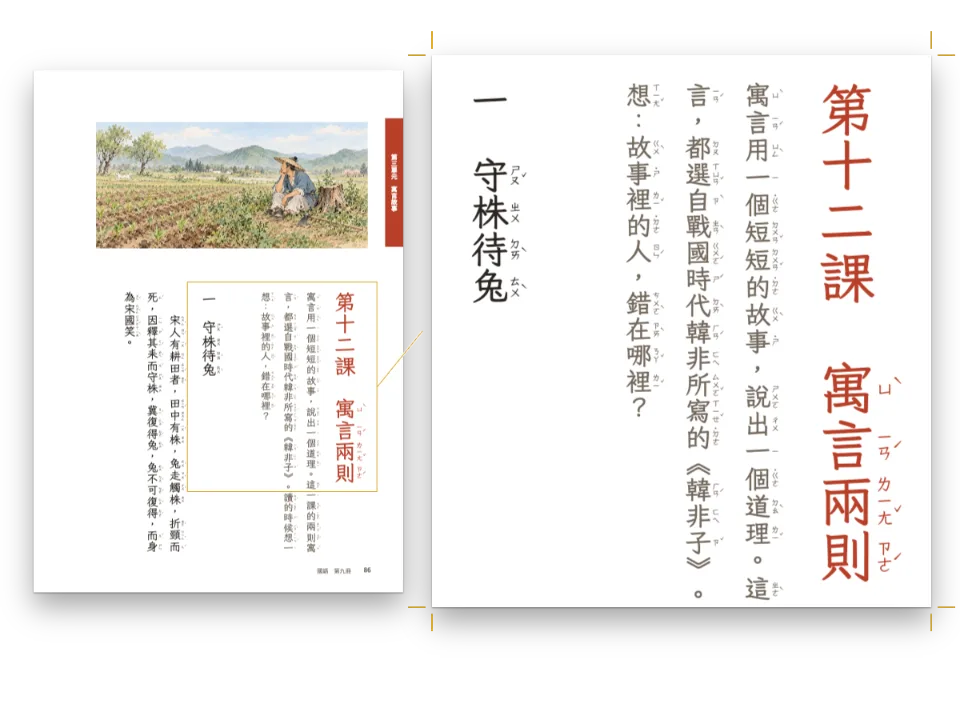
كتاب مصوّر ياباني للأطفال الصغار، كله بالهيراغانا، مع فراغ بعد كل مجموعة كلمات وأسطر لا تقسمها أبدًا، تحت رسم في كل صفحة.
ما الذي ستنضده
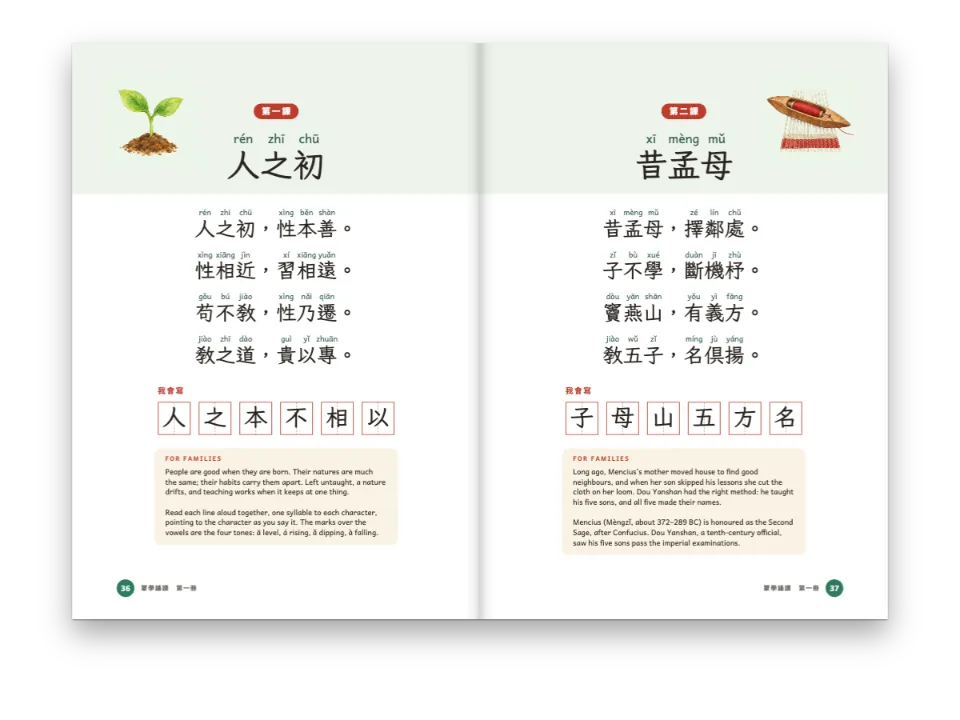
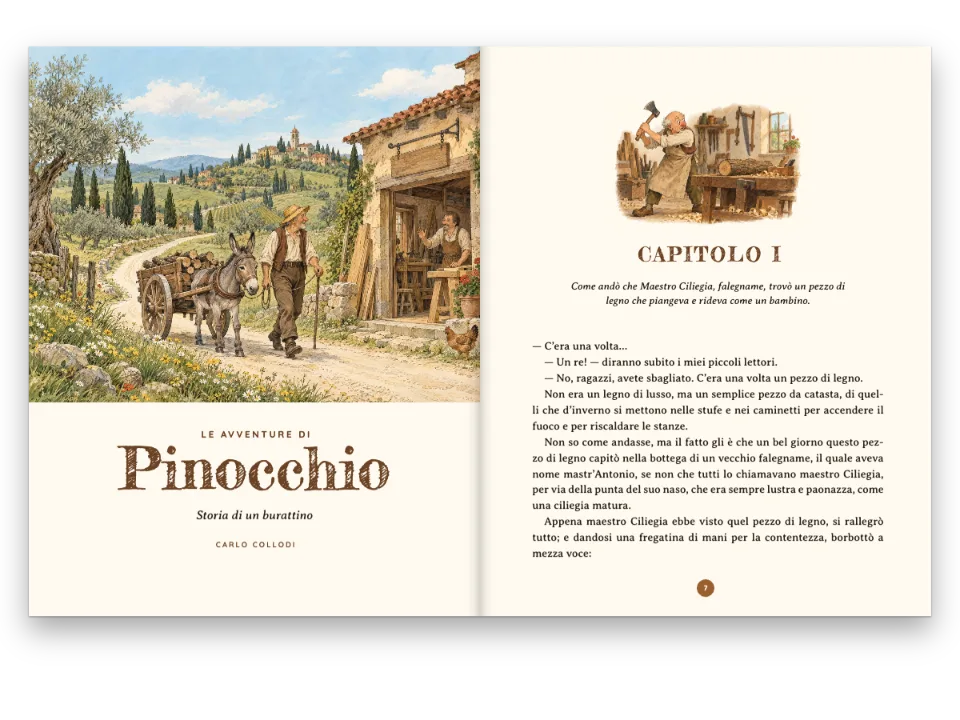
كتاب مصوّر من عشر صفحات، かみの ふね (القارب الورقي)، كُتب ورُسم لهذه الوصفة: بعد المطر تطوي فتاة قاربًا ورقيًا أحمر، فينزل القارب في النهر مارًّا بضفدع ومالك الحزين والقمر حتى يبلغ البحر. نُضّد كما تُنضَّد الكتب اليابانية لأصغر القرّاء: بالهيراغانا وحدها، بحجم 20 pt بخط Klee One المستلهم من خط الكتب المدرسية، وبفراغ بين العبارات، 分かち書き (wakachigaki)، ليقرأ الطفل عبارة عبارة. الصفحات أفقية بقياس 260 × 200 مم، عمودية النص ومجلدة على اليمين: الرسم في الأعلى، وتحته أسطر قصيرة من ثمانية أحرف، والقارب يسير نحو اليسار مع تقليب الصفحات.
تجيب هذه الوصفة عن
- كيف أفصل عبارات كتاب مصوّر ياباني بفراغات (wakachigaki)، بأسطر لا تنكسر إلا عند الفراغات؟
- لماذا لا يجوز أن يبدأ السطر الياباني بكانا صغيرة أو بـ ー أو بقوس مغلق، وكيف أختار درجة صرامة القاعدة؟
- ما الخطوط التي تنضّد اليابانية، بالكانجي في أشكاله اليابانية، على الشاشة وفي PDF؟
الجواب المختصر
// The story is typed with an ordinary space (U+0020) after each phrase (文節). Japanese
// text may break between any two kana, so the space alone does not keep a phrase whole:
// keep-all drops the breaks between two letters and keeps those at a space, after 、。」
// and before 「. Kinsoku still applies.
const phrases = { wordBreak: 'keep-all' }; // cjk.wordBreak
const bodyText = {
  fontFamily: HAND, fontSize: pt(BODY), lineHeight: pt(LEAD), color: col('ink'),
  boldColor: col('ink'), italicColor: col('ink'), referenceColor: col('ink'),
  // Ragged: a justified line would stretch its spaces and its kana to fill the tier.
  textAlign: 'left', firstLineIndent: em(0),
};
المكونات
- الميزات
- الكانا والكانجي والروماجيالنص العموديكسر الأسطر الياباني (kinsoku)كتب مجلّدة من اليمينشبكة المحارفالخطوط الصينية واليابانية والكوريةعمود ونصفعمود هامشي للعناصر العائمةأنواع موارد مخصّصةالصور في تصاميم الصفحةالأغلفة وصفحات العنوان وبيانات النشرأنماط العناوينسمات العنوانأنماط الفقراتفواصل الصفحات والأعمدةلون الورقلوحة ألوان دلاليةالتصدير إلى PDFالخطوط المضمَّنة في PDF
- تستخدم أيضًا
- أشكال في هذا الموضع بالضبطصفحات افتتاح مصمَّمةالأشكال والجداول بوصفها مواردترويسات لكل قسمفصول بلا أرقام
- الخطوط
- Klee One, Zen Maru Gothic (SIL OFL 1.1)
- الأصول
- لا شيء: كل صورة مرسومة بالكود
طريقة التحضير
#1 · أبقِ كل عبارة كاملة
الشيفرة هي الجواب المختصر أعلاه. يمكن أن تنكسر اليابانية بين أي حرفي كانا، فالفراغ بين العبارات يضيف مسافة فقط، ولا يمنع السطر من الانتهاء داخل あか|い. ولا يُبقي cjk.wordBreak: 'keep-all' إلا الكسرات عند الفراغ وبجوار علامات الترقيم، بعد 、。」 أو قبل 「، كما يفعل word-break: keep-all في CSS، وتبقى قواعد الكينسوكو سارية (تنضيد نصوص شرق آسيا). والفراغ هو U+0020 العادي، بعرض 0.35 em في Klee One، ويحذفه السطر إذا وقع في آخره. أما U+3000 فيفصل العبارات أيضًا، لكنه حرف ثابت بعرض em كامل يبقى في آخر السطر.
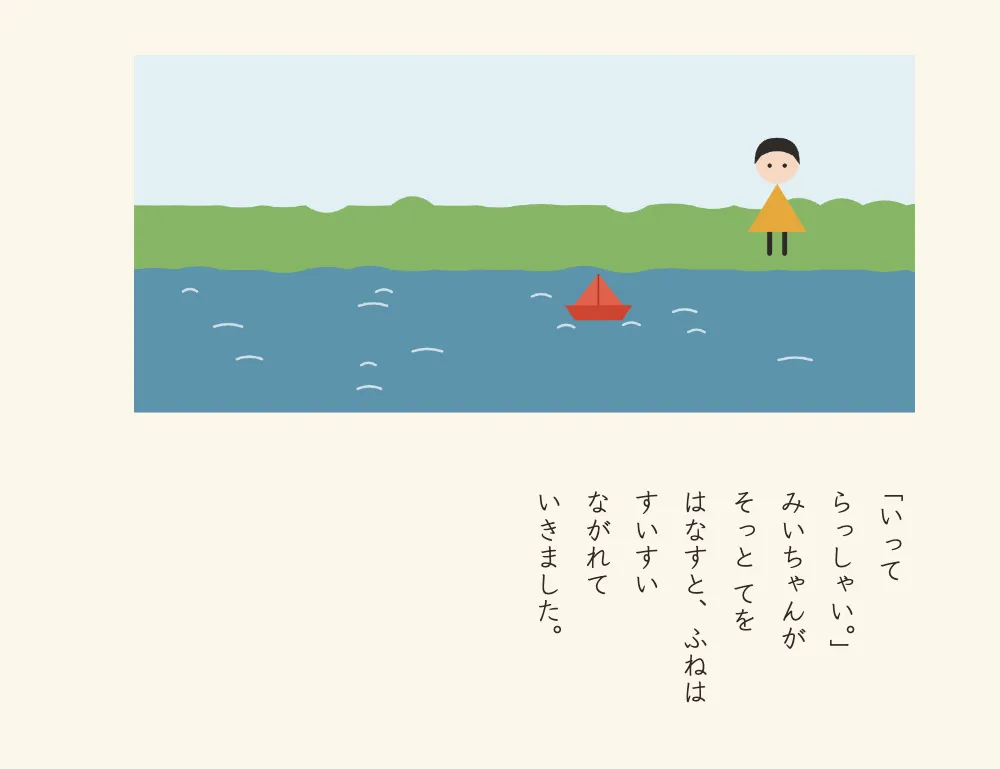
النص غير مضبوط الطرفين. لو ضُبط لمدّ السطر القصير فراغاته والمسافات بين حروفه حتى يبلغ أسفل الطبقة؛ أما الكتاب المصوّر فيترك كل سطر حيث تنتهي آخر عباراته.
#2 · ضع الرسوم في طبقة فوق النص
// In vertical text 'left' is the top of the page: the side column is a tier that takes
// the pictures (floats), and the text runs in the tier under it, right to left.
const layout = {
  layoutType: 'oneAndHalf', writingMode: 'vertical-rl', sideColumnRole: 'floats',
  sideColumnSide: 'left', sideColumnPercent: 58, gutterWidth: pt(2 * BODY),
};
const cjk = { ...phrases, grid: { enabled: true, charsPerLine: CHARS, linesPerPage: LINES } };
const resourceTypes = [{ id: 'picture', name: 'え', shortLabel: 'え', numberingTemplate: '{n}',
  resetOn: 'never', counterFormat: 'decimal', captionPrefix: '' }]; // pictures, no captions
في النص العمودي تعني 'left' أعلى الصفحة، فتخطيط العمود والنصف بعموده الجانبي على اليسار يصير طبقتين: تطفو الرسوم في الطبقة العليا (بعمق 14 حرفًا)، ويجري النص في السفلى (8 أحرف). تستشهد كل صفحة برسمها بـ ::resource{id="…"} وتنتهي بـ :::pagebreak. نوع مورد الرسوم بلا بادئة تعليق، وعرض الرسوم 2.186 مرة قدر ارتفاعها، أي شكل الطبقة، فتملؤها (الكتابة العمودية).
#3 · اجعل الغلاف رسمًا بحجم الصفحة
// In the flow frame of a vertical page x runs down the sheet and y leftward from its right
// edge; a box's width runs down the sheet.
const at = (down, across) => ({ anchor: { to: 'page', edge: 'top-left' },
  offset: { x: mm(down), y: mm(across) } });
const cover = {
  id: 'cover', numbered: false, toc: false, span: 'page', header: { elements: [] },
  breakBefore: { enabled: true, parity: 'any' },
  advancedDesign: { enabled: true, minHeight: mm(TRIM.w - 40), slot: { elements: [
    { kind: 'image', id: 'art', resourceId: 'cover', decorative: true,
      placement: { anchor: { to: 'bleed', edge: 'top-left' },
        size: { width: mm(TRIM.h), height: mm(TRIM.w) } } },
    { kind: 'text', id: 'title', content: '{titleText}', fontFamily: ROUND, fontWeight: 700,
      fontSize: pt(60), lineHeight: 1, letterSpacing: pt(6), color: col('boat'),
      placement: at(22, 34) },
    { kind: 'text', id: 'latin', content: '{attr.latin}', fontFamily: ROUND, fontWeight: 700,
      fontSize: pt(9), lineHeight: 1.4, color: col('ink'), placement: at(22, 62) },
  ] } },
};
الغلاف تصميم عنوان بعرض الصفحة: يُثبَّت الرسم إلى النزف بحجم الصفحة نفسه (في التدفق العمودي يجري width نزولًا على الورقة)، وينزل العنوان في السماء على اليمين بخط Zen Maru Gothic بحجم 60 pt.
#4 · ارسم المشاهد بالشيفرة
const W = 2186; // the art's width in its own units; its height is 1000 (ART is 2.186 : 1)
const COVER = Math.round((W * TRIM.h) / TRIM.w); // 1682: the cover is the page's shape
const P = palette;
function mulberry32(seed) {
  return () => {
    seed = (seed + 0x6d2b79f5) | 0;
    let t = Math.imul(seed ^ (seed >>> 15), 1 | seed);
    t = (t + Math.imul(t ^ (t >>> 7), 61 | t)) ^ t;
    return ((t ^ (t >>> 14)) >>> 0) / 4294967296;
  };
}
const svgDoc = (body, h = 1000, w = W) => `<svg xmlns="http://www.w3.org/2000/svg" `
  + `width="${w}" height="${h}" viewBox="0 0 ${w} ${h}">${body}</svg>`;
const rect = (fill, y = 0, h = 1000, x = 0, w = W) =>
  `<rect x="${x}" y="${y}" width="${w}" height="${h}" fill="${fill}"/>`;
const wave = (y, amp, fill, seed, h = 1000, w = W) => { // a band whose top edge undulates
  const r = mulberry32(seed);
  let d = `M0 ${h} L0 ${y}`;
  for (let x = 0; x <= w; x += 120) d += ` Q${x + 60} ${y + (r() - 0.5) * 2 * amp} ${x + 120} ${y}`;
  return `<path d="${d} L${w} ${h} Z" fill="${fill}"/>`;
};
const ripples = (y0, y1, n, seed, stroke = '#ffffff') => {
  const r = mulberry32(seed);
  return Array.from({ length: n }, () => {
    const x = r() * (W - 160) + 40; const y = y0 + r() * (y1 - y0); const l = 40 + r() * 70;
    return `<path d="M${x} ${y} q${l / 2} -14 ${l} 0" fill="none" stroke="${stroke}" `
      + 'stroke-width="7" stroke-linecap="round" opacity=".7"/>';
  }).join('');
};
const boat = (x, y, s = 1) => `<g transform="translate(${x} ${y}) scale(${s})">`
  + `<path d="M-95 0 L95 0 L66 42 L-66 42 Z" fill="${P.boat}"/>`
  + `<path d="M-70 0 L0 -88 L70 0 Z" fill="#e0624c"/><path d="M0 -88 L0 0" stroke="#a83322" `
  + 'stroke-width="4"/></g>';
const girl = (x, y, s = 1) => `<g transform="translate(${x} ${y}) scale(${s})">`
  + '<path d="M-14 120 L-14 170 M14 120 L14 170" stroke="#2e2a26" stroke-width="9" '
  + 'stroke-linecap="round"/><path d="M0 40 L-55 130 L55 130 Z" fill="#e7a83c"/>'
  + '<circle cx="0" cy="0" r="40" fill="#f6d8c2"/><path d="M-42 4 Q-44 -46 0 -46 Q44 -46 42 4 '
  + 'L30 -12 Q0 -30 -30 -12 Z" fill="#2e2a26"/><circle cx="-14" cy="6" r="4" fill="#2e2a26"/>'
  + '<circle cx="14" cy="6" r="4" fill="#2e2a26"/></g>';
const frog = (x, y, s = 1) => `<g transform="translate(${x} ${y}) scale(${s})">`
  + '<ellipse cx="0" cy="40" rx="130" ry="44" fill="#a9a39a"/>'
  + '<ellipse cx="0" cy="0" rx="62" ry="42" fill="#5f9e47"/><circle cx="-34" cy="-38" r="20" '
  + 'fill="#5f9e47"/><circle cx="34" cy="-38" r="20" fill="#5f9e47"/><circle cx="-34" cy="-40" '
  + 'r="9" fill="#2e2a26"/><circle cx="34" cy="-40" r="9" fill="#2e2a26"/>'
  + '<path d="M-26 6 Q0 22 26 6" fill="none" stroke="#2e2a26" stroke-width="5"/></g>';
const fish = (x, y, s = 1) => `<g transform="translate(${x} ${y}) scale(${s})">`
  + '<ellipse cx="0" cy="0" rx="42" ry="20" fill="#e8893a"/><path d="M38 0 L72 -22 L72 22 Z" '
  + 'fill="#e8893a"/><circle cx="-22" cy="-4" r="5" fill="#2e2a26"/></g>';
const heron = (x, y, s = 1) => `<g transform="translate(${x} ${y}) scale(${s})">`
  + '<path d="M0 60 L0 230" stroke="#6e675f" stroke-width="8"/>'
  + '<ellipse cx="10" cy="40" rx="70" ry="38" fill="#ffffff" stroke="#c9c2b8" stroke-width="4"/>'
  + '<path d="M-48 30 Q-80 -40 -40 -110" fill="none" stroke="#ffffff" stroke-width="20" '
  + 'stroke-linecap="round"/><circle cx="-40" cy="-114" r="20" fill="#ffffff"/>'
  + '<path d="M-58 -116 L-118 -104 L-58 -104 Z" fill="#e3b33c"/><circle cx="-44" cy="-118" '
  + 'r="4" fill="#2e2a26"/></g>';
const gull = (x, y, s = 1) => `<path d="M${x - 50 * s} ${y} q${25 * s} ${-30 * s} ${50 * s} 0 `
  + `q${25 * s} ${-30 * s} ${50 * s} 0" fill="none" stroke="#2e2a26" stroke-width="7" `
  + 'stroke-linecap="round"/>';
const disc = (x, y, r, fill) => `<circle cx="${x}" cy="${y}" r="${r}" fill="${fill}"/>`;
const stars = (n, seed) => {
  const r = mulberry32(seed);
  return Array.from({ length: n }, () => disc(r() * W, r() * 420, 3 + r() * 5, '#f7e7a8')).join('');
};
const hills = (y, fill, seed) => wave(y, 60, fill, seed);
const SCENES = {
  // The cover is the whole page, 260 × 200 mm: 2186 × 1682 units. The sky on the right
  // takes the title.
  cover: svgDoc(rect('#d9ecf2', 0, COVER) + disc(560, 260, 110, '#f6d27a')
    + wave(980, 70, P.grass, 3, COVER) + wave(1180, 24, P.river, 4, COVER)
    + ripples(1250, 1640, 22, 5) + boat(1000, 1330, 2.2), COVER),
  rain: svgDoc(rect('#e6eef0') + ripples(60, 360, 10, 7, '#9fb9c4') + rect('#f1e3c8', 640, 360)
    + `<rect x="760" y="560" width="660" height="90" rx="12" fill="#b07d53"/>`
    + girl(1260, 380, 1.4) + boat(880, 520, 0.9)),
  stream: svgDoc(rect('#e3f0f4') + hills(420, P.grass, 11) + wave(600, 22, P.river, 12)
    + ripples(650, 960, 14, 13) + girl(1800, 300, 1.5) + boat(1300, 700, 1)),
  frog: svgDoc(rect('#e3f0f4') + hills(380, P.grass, 21) + wave(560, 22, P.river, 22)
    + ripples(620, 960, 14, 23) + frog(1480, 600, 1.6) + boat(820, 760, 1)),
  bridge: svgDoc(rect('#e3f0f4') + hills(400, P.grass, 31) + wave(540, 20, P.river, 32)
    + '<path d="M300 560 Q1093 120 1886 560" fill="none" stroke="#9a6b45" stroke-width="60"/>'
    + ripples(600, 960, 12, 33) + boat(1093, 720, 1) + fish(1450, 860, 1.1) + fish(1680, 800, 0.9)
    + fish(1300, 930, 0.8)),
  heron: svgDoc(rect('#e3f0f4') + hills(300, '#a7cc8a', 41) + wave(420, 16, '#7aaec4', 42)
    + ripples(480, 960, 18, 43) + heron(1700, 230, 1.3) + boat(700, 700, 0.8)),
  dusk: svgDoc(rect('#f4c9b5') + disc(500, 520, 110, '#f29a5c') + hills(470, '#c79c87', 51)
    + wave(560, 18, '#c98f8a', 52) + ripples(600, 960, 14, 53, '#f6ddd0') + boat(1300, 760, 0.9)),
  night: svgDoc(rect('#2f3e5c') + stars(40, 61) + disc(1500, 200, 80, '#f7e7a8')
    + hills(470, '#253247', 62) + wave(560, 14, '#3f5878', 63)
    + '<path d="M1460 600 L1540 600 L1580 980 L1420 980 Z" fill="#f7e7a8" opacity=".35"/>'
    + ripples(600, 960, 12, 64, '#8aa3c2') + boat(900, 760, 0.9)),
  sea: svgDoc(rect('#d6ecf4') + disc(1700, 200, 70, '#f6d27a') + wave(420, 8, '#4f88a6', 71)
    + ripples(470, 960, 22, 72) + gull(900, 200, 1.2) + gull(1150, 140, 0.9) + boat(700, 650, 0.8)),
  window: svgDoc(rect('#efe2c8') + rect('#d6ecf4', 90, 640, 420, 1100)
    + rect('#4f88a6', 470, 260, 420, 1100) + boat(1250, 500, 0.4) + `<rect x="420" y="90" `
    + 'width="1100" height="640" fill="none" stroke="#b07d53" stroke-width="40"/><path '
    + 'd="M970 90 L970 730" stroke="#b07d53" stroke-width="24"/>' + rect('#b07d53', 730, 60)
    + girl(1750, 470, 1.6)),
};
المشاهد العشرة رسوم SVG مبنية من أشكال قليلة، القارب والفتاة والضفدع ومالك الحزين، مع مولّد ذي بذرة للأمواج والنجوم، فتتطابق كل الالتقاطات. وهي في PDF رسوم متجهية أيضًا.
الوصفة كاملة
// ═══ Postext Cookbook · Nº 127 · A hiragana picture book, spaced by phrase ══════════ // https://postext.dev/en/cookbook/hiragana-picture-book // Code: MIT · Story and pictures: written and drawn for the recipe (CC BY 4.0) // Fonts: Klee One, Zen Maru Gothic (SIL OFL 1.1) · Needs postext ≥ 1.16.1 // A picture book for small readers: hiragana only, a space between phrases, vertical. import { buildDocument, renderPageToCanvas, clearMeasurementCache, registerResourceImage, loadVerticalAlternates, } from 'https://esm.sh/postext'; import { renderToPdf, decompressWoff2 } from 'https://esm.sh/postext-pdf'; const LANG = 'en'; // @lang: the language of the frame; the story is Japanese in both editions const RECIPE = 'hiragana-picture-book'; // ─── 1 · Design ───────────────────────────────────────────────────────────── // #region palette: the paper boat's red, river blues, a warm paper const palette = { ink: '#2e2a26', // the text: a soft near-black boat: '#cf4430', // the boat, the title (4.6:1 on the paper) river: '#5d93ad', grass: '#86b665', muted: '#6e675f', // the colophon paper: '#fbf6ea', }; const col = (id) => ({ hex: palette[id], model: 'hex', paletteId: id }); const colorPalette = [ ...Object.entries(palette).map(([id, hex]) => ({ id, name: id, value: { hex, model: 'hex' } })), { id: 'main-color', name: 'boat (defaults)', value: { hex: palette.boat, model: 'hex' } }, ]; // #endregion const HAND = 'Klee One'; // 教科書体: the hand a child learns to write kana from const ROUND = 'Zen Maru Gothic'; // the cover's title const [BODY, LEAD] = [20, 36]; // pt: large kana, a line gap of 0.8 em const PT = 25.4 / 72; // mm in a point const TRIM = { w: 260, h: 200 }; // mm: a landscape picture book (横長) const [CHARS, PICTURE, LINES] = [8, 14, 17]; // characters: text tier, picture tier; lines const ART = { w: LINES * LEAD * PT, h: PICTURE * BODY * PT }; // mm: 215.9 × 98.8 // #region answer: わかち書き — a space between phrases, and lines that break only there // The story is typed with an ordinary space (U+0020) after each phrase (文節). Japanese // text may break between any two kana, so the space alone does not keep a phrase whole: // keep-all drops the breaks between two letters and keeps those at a space, after 、。」 // and before 「. Kinsoku still applies. const phrases = { wordBreak: 'keep-all' }; // cjk.wordBreak const bodyText = { fontFamily: HAND, fontSize: pt(BODY), lineHeight: pt(LEAD), color: col('ink'), boldColor: col('ink'), italicColor: col('ink'), referenceColor: col('ink'), // Ragged: a justified line would stretch its spaces and its kana to fill the tier. textAlign: 'left', firstLineIndent: em(0), }; // #endregion // #region layout: the picture tier above, eight characters of text below it // In vertical text 'left' is the top of the page: the side column is a tier that takes // the pictures (floats), and the text runs in the tier under it, right to left. const layout = { layoutType: 'oneAndHalf', writingMode: 'vertical-rl', sideColumnRole: 'floats', sideColumnSide: 'left', sideColumnPercent: 58, gutterWidth: pt(2 * BODY), }; const cjk = { ...phrases, grid: { enabled: true, charsPerLine: CHARS, linesPerPage: LINES } }; const resourceTypes = [{ id: 'picture', name: 'え', shortLabel: 'え', numberingTemplate: '{n}', resetOn: 'never', counterFormat: 'decimal', captionPrefix: '' }]; // pictures, no captions // #endregion // #region cover: the first picture across the page, the title down its sky // In the flow frame of a vertical page x runs down the sheet and y leftward from its right // edge; a box's width runs down the sheet. const at = (down, across) => ({ anchor: { to: 'page', edge: 'top-left' }, offset: { x: mm(down), y: mm(across) } }); const cover = { id: 'cover', numbered: false, toc: false, span: 'page', header: { elements: [] }, breakBefore: { enabled: true, parity: 'any' }, advancedDesign: { enabled: true, minHeight: mm(TRIM.w - 40), slot: { elements: [ { kind: 'image', id: 'art', resourceId: 'cover', decorative: true, placement: { anchor: { to: 'bleed', edge: 'top-left' }, size: { width: mm(TRIM.h), height: mm(TRIM.w) } } }, { kind: 'text', id: 'title', content: '{titleText}', fontFamily: ROUND, fontWeight: 700, fontSize: pt(60), lineHeight: 1, letterSpacing: pt(6), color: col('boat'), placement: at(22, 34) }, { kind: 'text', id: 'latin', content: '{attr.latin}', fontFamily: ROUND, fontWeight: 700, fontSize: pt(9), lineHeight: 1.4, color: col('ink'), placement: at(22, 62) }, ] } }, }; // #endregion const config = () => ({ // a factory: the engine caches resolved configs per object locale: 'ja', // written out, never LANG (gotcha: ja-locale-tag) colorPalette, resourceTypes, page: { sizePreset: 'custom', width: mm(TRIM.w), height: mm(TRIM.h), dpi: 150, backgroundColor: col('paper'), margins: { top: mm(14), bottom: mm(16), left: mm(22), right: mm(22), mirror: true }, }, layout, cjk, bodyText, headings: { fontFamily: ROUND, color: col('boat'), levels: [{ level: 1, breakBefore: { enabled: true, parity: 'any' } }] }, // the H1 break headingStyles: [cover], paragraphStyles: [ { id: 'end', fontFamily: ROUND, fontWeight: 700, color: col('boat'), textAlign: 'right', marginTop: pt(LEAD) }, // おしまい at the foot of its line { id: 'colophon', fontFamily: HAND, fontSize: pt(7.5), lineHeight: pt(LEAD), color: col('muted'), textAlign: 'left', marginTop: pt(LEAD) }, ], header: { elements: [] }, // a picture book has no running heads and no folios footer: { elements: [] }, }); // ─── 2 · Content ──────────────────────────────────────────────────────────── const markdown = String.raw`---نموذج Markdown · أسطر: 65 · content.en.md
title: "かみの ふね" author: "Postext Cookbook" --- # かみの ふね {style="cover" latin="The Paper Boat: a picture book in hiragana"} ::resource{id="rain"} あめが やんだ あさ、みいちゃんは あかい かみで ふねを おりました。 :::pagebreak ::resource{id="stream"} 「いって らっしゃい。」みいちゃんが そっと てを はなすと、ふねは すいすい ながれて いきました。 :::pagebreak ::resource{id="frog"} いしの うえで、かえるが ききました。「どこへ いくの。」「うみまで。」と、ふねは こたえました。 :::pagebreak ::resource{id="bridge"} はしの したを くぐると、ちいさな さかなが ついて きました。ぴちゃん、ぴちゃん。 :::pagebreak ::resource{id="heron"} かわは だんだん ひろく なりました。きしでは さぎが いっぽんあしで みおくって います。 :::pagebreak ::resource{id="dusk"} ゆうがた、そらが ももいろに そまりました。かぜの なかに、うみの においが します。 :::pagebreak ::resource{id="night"} よるに なりました。おつきさまが みずに うつって、ふねの みちを てらして くれました。 :::pagebreak ::resource{id="sea"} あさ、ふねは ひろい うみに でました。かもめが「ようこそ。」と いいました。 :::pagebreak ::resource{id="window"} とおくの まちで、みいちゃんも まどを あけて、うみの ほうを みて いました。 :::paragraphs{style="end"} おしまい ::: :::paragraphs{style="colophon"} Story and pictures written and drawn for this recipe (CC BY 4.0) · Set in Klee One and Zen Maru Gothic (SIL OFL) :::`; // content.<lang>.md, a space after each phrase // ─── 3 · Fonts ────────────────────────────────────────────────────────────── const FONTS = { 'Klee One': ['400'], 'Zen Maru Gothic': ['700'] }; // #region art: ten scenes drawn in code, a seeded hand for the waves and the stars const W = 2186; // the art's width in its own units; its height is 1000 (ART is 2.186 : 1) const COVER = Math.round((W * TRIM.h) / TRIM.w); // 1682: the cover is the page's shape const P = palette; function mulberry32(seed) { return () => { seed = (seed + 0x6d2b79f5) | 0; let t = Math.imul(seed ^ (seed >>> 15), 1 | seed); t = (t + Math.imul(t ^ (t >>> 7), 61 | t)) ^ t; return ((t ^ (t >>> 14)) >>> 0) / 4294967296; }; } const svgDoc = (body, h = 1000, w = W) => `<svg xmlns="http://www.w3.org/2000/svg" ` + `width="${w}" height="${h}" viewBox="0 0 ${w} ${h}">${body}</svg>`; const rect = (fill, y = 0, h = 1000, x = 0, w = W) => `<rect x="${x}" y="${y}" width="${w}" height="${h}" fill="${fill}"/>`; const wave = (y, amp, fill, seed, h = 1000, w = W) => { // a band whose top edge undulates const r = mulberry32(seed); let d = `M0 ${h} L0 ${y}`; for (let x = 0; x <= w; x += 120) d += ` Q${x + 60} ${y + (r() - 0.5) * 2 * amp} ${x + 120} ${y}`; return `<path d="${d} L${w} ${h} Z" fill="${fill}"/>`; }; const ripples = (y0, y1, n, seed, stroke = '#ffffff') => { const r = mulberry32(seed); return Array.from({ length: n }, () => { const x = r() * (W - 160) + 40; const y = y0 + r() * (y1 - y0); const l = 40 + r() * 70; return `<path d="M${x} ${y} q${l / 2} -14 ${l} 0" fill="none" stroke="${stroke}" ` + 'stroke-width="7" stroke-linecap="round" opacity=".7"/>'; }).join(''); }; const boat = (x, y, s = 1) => `<g transform="translate(${x} ${y}) scale(${s})">` + `<path d="M-95 0 L95 0 L66 42 L-66 42 Z" fill="${P.boat}"/>` + `<path d="M-70 0 L0 -88 L70 0 Z" fill="#e0624c"/><path d="M0 -88 L0 0" stroke="#a83322" ` + 'stroke-width="4"/></g>'; const girl = (x, y, s = 1) => `<g transform="translate(${x} ${y}) scale(${s})">` + '<path d="M-14 120 L-14 170 M14 120 L14 170" stroke="#2e2a26" stroke-width="9" ' + 'stroke-linecap="round"/><path d="M0 40 L-55 130 L55 130 Z" fill="#e7a83c"/>' + '<circle cx="0" cy="0" r="40" fill="#f6d8c2"/><path d="M-42 4 Q-44 -46 0 -46 Q44 -46 42 4 ' + 'L30 -12 Q0 -30 -30 -12 Z" fill="#2e2a26"/><circle cx="-14" cy="6" r="4" fill="#2e2a26"/>' + '<circle cx="14" cy="6" r="4" fill="#2e2a26"/></g>'; const frog = (x, y, s = 1) => `<g transform="translate(${x} ${y}) scale(${s})">` + '<ellipse cx="0" cy="40" rx="130" ry="44" fill="#a9a39a"/>' + '<ellipse cx="0" cy="0" rx="62" ry="42" fill="#5f9e47"/><circle cx="-34" cy="-38" r="20" ' + 'fill="#5f9e47"/><circle cx="34" cy="-38" r="20" fill="#5f9e47"/><circle cx="-34" cy="-40" ' + 'r="9" fill="#2e2a26"/><circle cx="34" cy="-40" r="9" fill="#2e2a26"/>' + '<path d="M-26 6 Q0 22 26 6" fill="none" stroke="#2e2a26" stroke-width="5"/></g>'; const fish = (x, y, s = 1) => `<g transform="translate(${x} ${y}) scale(${s})">` + '<ellipse cx="0" cy="0" rx="42" ry="20" fill="#e8893a"/><path d="M38 0 L72 -22 L72 22 Z" ' + 'fill="#e8893a"/><circle cx="-22" cy="-4" r="5" fill="#2e2a26"/></g>'; const heron = (x, y, s = 1) => `<g transform="translate(${x} ${y}) scale(${s})">` + '<path d="M0 60 L0 230" stroke="#6e675f" stroke-width="8"/>' + '<ellipse cx="10" cy="40" rx="70" ry="38" fill="#ffffff" stroke="#c9c2b8" stroke-width="4"/>' + '<path d="M-48 30 Q-80 -40 -40 -110" fill="none" stroke="#ffffff" stroke-width="20" ' + 'stroke-linecap="round"/><circle cx="-40" cy="-114" r="20" fill="#ffffff"/>' + '<path d="M-58 -116 L-118 -104 L-58 -104 Z" fill="#e3b33c"/><circle cx="-44" cy="-118" ' + 'r="4" fill="#2e2a26"/></g>'; const gull = (x, y, s = 1) => `<path d="M${x - 50 * s} ${y} q${25 * s} ${-30 * s} ${50 * s} 0 ` + `q${25 * s} ${-30 * s} ${50 * s} 0" fill="none" stroke="#2e2a26" stroke-width="7" ` + 'stroke-linecap="round"/>'; const disc = (x, y, r, fill) => `<circle cx="${x}" cy="${y}" r="${r}" fill="${fill}"/>`; const stars = (n, seed) => { const r = mulberry32(seed); return Array.from({ length: n }, () => disc(r() * W, r() * 420, 3 + r() * 5, '#f7e7a8')).join(''); }; const hills = (y, fill, seed) => wave(y, 60, fill, seed); const SCENES = { // The cover is the whole page, 260 × 200 mm: 2186 × 1682 units. The sky on the right // takes the title. cover: svgDoc(rect('#d9ecf2', 0, COVER) + disc(560, 260, 110, '#f6d27a') + wave(980, 70, P.grass, 3, COVER) + wave(1180, 24, P.river, 4, COVER) + ripples(1250, 1640, 22, 5) + boat(1000, 1330, 2.2), COVER), rain: svgDoc(rect('#e6eef0') + ripples(60, 360, 10, 7, '#9fb9c4') + rect('#f1e3c8', 640, 360) + `<rect x="760" y="560" width="660" height="90" rx="12" fill="#b07d53"/>` + girl(1260, 380, 1.4) + boat(880, 520, 0.9)), stream: svgDoc(rect('#e3f0f4') + hills(420, P.grass, 11) + wave(600, 22, P.river, 12) + ripples(650, 960, 14, 13) + girl(1800, 300, 1.5) + boat(1300, 700, 1)), frog: svgDoc(rect('#e3f0f4') + hills(380, P.grass, 21) + wave(560, 22, P.river, 22) + ripples(620, 960, 14, 23) + frog(1480, 600, 1.6) + boat(820, 760, 1)), bridge: svgDoc(rect('#e3f0f4') + hills(400, P.grass, 31) + wave(540, 20, P.river, 32) + '<path d="M300 560 Q1093 120 1886 560" fill="none" stroke="#9a6b45" stroke-width="60"/>' + ripples(600, 960, 12, 33) + boat(1093, 720, 1) + fish(1450, 860, 1.1) + fish(1680, 800, 0.9) + fish(1300, 930, 0.8)), heron: svgDoc(rect('#e3f0f4') + hills(300, '#a7cc8a', 41) + wave(420, 16, '#7aaec4', 42) + ripples(480, 960, 18, 43) + heron(1700, 230, 1.3) + boat(700, 700, 0.8)), dusk: svgDoc(rect('#f4c9b5') + disc(500, 520, 110, '#f29a5c') + hills(470, '#c79c87', 51) + wave(560, 18, '#c98f8a', 52) + ripples(600, 960, 14, 53, '#f6ddd0') + boat(1300, 760, 0.9)), night: svgDoc(rect('#2f3e5c') + stars(40, 61) + disc(1500, 200, 80, '#f7e7a8') + hills(470, '#253247', 62) + wave(560, 14, '#3f5878', 63) + '<path d="M1460 600 L1540 600 L1580 980 L1420 980 Z" fill="#f7e7a8" opacity=".35"/>' + ripples(600, 960, 12, 64, '#8aa3c2') + boat(900, 760, 0.9)), sea: svgDoc(rect('#d6ecf4') + disc(1700, 200, 70, '#f6d27a') + wave(420, 8, '#4f88a6', 71) + ripples(470, 960, 22, 72) + gull(900, 200, 1.2) + gull(1150, 140, 0.9) + boat(700, 650, 0.8)), window: svgDoc(rect('#efe2c8') + rect('#d6ecf4', 90, 640, 420, 1100) + rect('#4f88a6', 470, 260, 420, 1100) + boat(1250, 500, 0.4) + `<rect x="420" y="90" ` + 'width="1100" height="640" fill="none" stroke="#b07d53" stroke-width="40"/><path ' + 'd="M970 90 L970 730" stroke="#b07d53" stroke-width="24"/>' + rect('#b07d53', 730, 60) + girl(1750, 470, 1.6)), }; // #endregion const pictures = Object.keys(SCENES).map((id) => ({ id, typeId: 'picture', kind: 'svg', createdAt: 0, updatedAt: 0, placement: { span: 'side' }, svg: { fileId: `${id}.svg`, width: W, height: id === 'cover' ? COVER : 1000 } })); // ─── 4 · Build & show ─────────────────────────────────────────────────────── await loadFonts(FONTS, markdown); await loadCjkFonts({ [HAND]: FONTS[HAND] }, markdown, { vertical: true }); await loadCjkFonts({ [ROUND]: FONTS[ROUND] }, 'かみのふねおしまい', { vertical: true }); await Promise.all(Object.entries(SCENES).map(([id, svg]) => loadSvg(`${id}.svg`, svg))); const doc = await buildWithFonts( () => buildDocument({ markdown, resources: pictures }, config()), markdown); showBook(doc, { title: t({ en: 'A hiragana picture book', es: 'Un libro ilustrado en hiragana' }) }); offerPdf(() => renderToPdf(doc, { fontProvider: cjkPdfProvider, resourceBytes: imageBytes }), `${RECIPE}.pdf`);العُدّة · core, fonts, viewer, pdf, images, cjk: نفسها في كل وصفة · أسطر: 488
// ─── Kit ── helpers shared by every Cookbook recipe · postext.dev/cookbook ───── // ─── Kit · core v1 ── the same in every recipe · postext.dev/cookbook ───────── function mm(value) { return { value, unit: 'mm' }; } function pt(value) { return { value, unit: 'pt' }; } function em(value) { return { value, unit: 'em' }; } /** The sample language's string: t({ en: 'Figure', es: 'Figura' }). */ function t(strings) { return strings[LANG] ?? Object.values(strings)[0]; } /** A file in this recipe's assets folder, served from the Postext repo by jsDelivr. */ function asset(file) { return `https://cdn.jsdelivr.net/gh/drnachio/postext@main/cookbook/${RECIPE}/assets/${file}`; } // ─── Kit · fonts v1 ── the same in every recipe · postext.dev/cookbook ──────── // Postext measures text with the faces the browser has loaded, and caches the // widths, so every face must be ready before the first build. Faces come from // Fontsource: the same static files the PDF embeds, so screen and PDF agree. /** faces = { 'Family Name': ['400', '400i', '700'] }. `text` is the sample: * letters beyond Latin-1 (č, ł, ő…) also load the latin-ext files. With * `optional`, a face Fontsource does not ship is skipped instead of failing. * Resolves to the number of faces added. */ async function loadFonts(faces, text = '', { optional = false } = {}) { kitStatus('Loading fonts…'); const ranges = { latin: 'U+0000-00FF,U+0131,U+0152-0153,U+02BB-02BC,U+02C6,U+02DA,U+02DC,U+0304,U+0308,U+0329,' + 'U+2000-206F,U+20AC,U+2122,U+2191,U+2193,U+2212,U+2215,U+FEFF,U+FFFD', 'latin-ext': 'U+0100-02BA,U+02BD-02C5,U+02C7-02CC,U+02CE-02D7,U+02DD-02FF,U+0304,U+0308,U+0329,' + 'U+1D00-1DBF,U+1E00-1E9F,U+1EF2-1EFF,U+2020,U+20A0-20AB,U+20AD-20C0,U+2113,U+2C60-2C7F,U+A720-A7FF', }; const subsets = /[Ā-˿Ḁ-ỿ]/.test(text) ? ['latin', 'latin-ext'] : ['latin']; const jobs = []; let added = 0; for (const [family, specs] of Object.entries(faces)) { const id = fontsourceId(family); const meta = optional ? await fontsourceMeta(family) : null; for (const spec of new Set(specs)) { const weight = parseInt(spec, 10); const style = spec.endsWith('i') ? 'italic' : 'normal'; if (hasFace(family, weight, style)) continue; if (optional && !(meta?.weights.includes(weight) && meta.styles.includes(style))) continue; for (const subset of subsets) { const url = `https://cdn.jsdelivr.net/npm/@fontsource/${id}@5/files/${id}-${subset}-${weight}-${style}.woff2`; const face = new FontFace(family, `url(${url}) format('woff2')`, { weight: String(weight), style, unicodeRange: ranges[subset] }); jobs.push(face.load().then((ready) => { document.fonts.add(ready); added++; }, () => { if (subset === 'latin' && !optional) throw new Error(`Fontsource has no ${family} ${weight} ${style}`); })); } } } await Promise.all(jobs).catch((error) => { kitFail(error); throw error; }); return added; } /** Runs `build` (a buildDocument or buildBundle call) and checks the faces * the pages use. A regular face missing from FONTS is loaded with a warning; * bold and italic variants are loaded when the family ships them. Then the * measurement caches are cleared and the build runs again. */ async function buildWithFonts(build, text = '') { const tried = new Set(); for (let round = 0; round < 3; round++) { kitStatus('Laying out…'); await new Promise(requestAnimationFrame); // let the status paint first const result = await Promise.resolve().then(build).catch((error) => { kitFail(error); throw error; }); const wanted = { base: {}, variants: {} }; for (const { font, base } of [result].flat().flatMap(fontStringsOf)) { const { family, weight, style } = parseFont(font); const key = `${family}|${weight}|${style}`; if (tried.has(key) || hasFace(family, weight, style)) continue; tried.add(key); (wanted[base ? 'base' : 'variants'][family] ??= []).push(`${weight}${style === 'italic' ? 'i' : ''}`); } if (Object.keys(wanted.base).length) { console.warn(`[cookbook] FONTS does not list ${JSON.stringify(wanted.base)}: loading them.`); } const added = await loadFonts(wanted.base, text) + await loadFonts(wanted.variants, text, { optional: true }); if (added === 0) return result; clearMeasurementCache(); } throw new Error('The fonts did not settle after three builds.'); } /** Every font string of the layout. `base` marks a block's own face; its * bold, italic and bold-italic variants are listed whether or not used. */ function fontStringsOf(doc) { const found = new Map(); const walk = (node) => { if (!node || typeof node !== 'object') return; if (Array.isArray(node)) { node.forEach(walk); return; } for (const [key, value] of Object.entries(node)) { if (typeof value === 'string' && /fontString$/i.test(key)) { found.set(value, found.get(value) || key === 'fontString'); } else if (value && typeof value === 'object') walk(value); } }; walk(doc.pages); walk(doc.blocks); return [...found].map(([font, base]) => ({ font, base })); } /** '700 37.5px Open Sans' / 'italic 400 13px "Source Serif 4"' → { family, weight, style }. * A string with no weight ('95.8px Young Serif', from a design text) is 400. */ function parseFont(font) { const m = /^(?:(italic|oblique)\s+)?(?:small-caps\s+)?(?:(\d+|bold|normal)\s+)?[\d.]+px\s+(.+)$/.exec(font.trim()); if (!m) throw new Error(`Unexpected font string: ${font}`); const weight = m[2] === 'bold' ? 700 : !m[2] || m[2] === 'normal' ? 400 : Number(m[2]); return { family: m[3].replace(/^["']|["']$/g, ''), weight, style: m[1] ? 'italic' : 'normal' }; } /** True when a loaded FontFace covers exactly this family, weight and style * (document.fonts.check() is also true for families nobody declared). */ function hasFace(family, weight, style) { for (const face of document.fonts) { if (face.status !== 'loaded' || face.style !== style) continue; if (face.family.replace(/^["']|["']$/g, '') !== family) continue; const [low, high = low] = face.weight.split(' ').map(Number); if (weight >= low && weight <= high) return true; } return false; } /** Fontsource's id for a family: 'Source Serif 4' → 'source-serif-4'. */ function fontsourceId(family) { return family.toLowerCase().replace(/\s+/g, '-'); } /** The weights and styles a family ships ({ weights: [400, 700], styles: ['normal', 'italic'] }), or null. */ function fontsourceMeta(family) { fontsourceMeta.cache ??= new Map(); const id = fontsourceId(family); if (!fontsourceMeta.cache.has(id)) { fontsourceMeta.cache.set(id, fetch(`https://api.fontsource.org/v1/fonts/${id}`) .then((res) => (res.ok ? res.json() : null), () => null)); } return fontsourceMeta.cache.get(id); } // ─── Kit · viewer v1 ── the same in every recipe · postext.dev/cookbook ─────── /** Shows the pages as facing spreads on a dark desk: the first page is a * recto on its own, then verso | recto pairs, as in a bound book. Pages * are painted when they scroll near the screen. */ function showPages(docs, { title, width = 460 } = {}) { const root = viewer(title); const pages = [docs].flat().flatMap((doc) => doc.pages.map((page) => ({ doc, page, n: (doc.pageIndexOffset ?? 0) + page.index }))); const spreads = []; let verso = null; for (const p of pages) { if (p.n % 2 === 1) { if (verso) spreads.push([verso, null]); verso = p; } else { spreads.push([verso, p]); verso = null; } } if (verso) spreads.push([verso, null]); const density = Math.min(window.devicePixelRatio || 1, 2); showPages.painter?.disconnect(); const painter = new IntersectionObserver((entries) => { for (const { isIntersecting, target } of entries) { if (!isIntersecting) continue; painter.unobserve(target); const { doc, page } = target.postext; renderPageToCanvas(page, doc, target, { scale: (width * density) / page.width }); } }, { rootMargin: '800px' }); showPages.painter = painter; root.replaceChildren(...spreads.map((pair) => { const spread = document.createElement('div'); spread.className = 'pt-spread'; for (const p of pair) { const figure = document.createElement('figure'); if (p) { const label = p.page.pageLabel || String(p.n + 1); const canvas = document.createElement('canvas'); canvas.postext = p; canvas.style.aspectRatio = `${p.page.width} / ${p.page.height}`; canvas.setAttribute('role', 'img'); canvas.setAttribute('aria-label', `Page ${label}`); const folio = document.createElement('figcaption'); folio.textContent = label; figure.append(canvas, folio); painter.observe(canvas); } else figure.className = 'pt-blank'; spread.append(figure); } return spread; })); kitStatus(`${pages.length} ${pages.length === 1 ? 'page' : 'pages'}`); document.documentElement.dataset.postext = 'ready'; return pages.length; } /** The desk, the bar and the error reporting, created once. */ function viewer(title) { if (!document.getElementById('pt-kit')) { document.head.insertAdjacentHTML('beforeend', `<style id="pt-kit"> :root { color-scheme: dark; } body { margin: 0; background: #0e1014; color: #b9bcc4; font: 13px/1.45 system-ui, sans-serif; } #pt-bar { position: sticky; top: 0; z-index: 1; display: flex; flex-wrap: wrap; align-items: center; gap: 6px 16px; padding: 10px 16px; background: rgb(14 16 20 / .92); backdrop-filter: blur(6px); border-bottom: 1px solid #23262d; } #pt-bar strong { color: #f4f1ea; font-weight: 600; } #pt-actions { display: flex; gap: 12px; margin-left: auto; } #pt-actions a, #pt-actions button { color: #d8a21a; font: inherit; background: none; border: 0; padding: 0; cursor: pointer; } #pages { display: grid; justify-items: center; gap: 48px; padding: 32px 16px 72px; } .pt-spread { display: flex; } .pt-spread figure { margin: 0; width: min(460px, 44vw); } .pt-spread canvas { display: block; width: 100%; background: #fff; box-shadow: 0 1px 2px rgb(0 0 0 / .5), 0 22px 44px -16px rgb(0 0 0 / .8); } .pt-spread figure:first-child canvas { box-shadow: inset -14px 0 14px -14px rgb(0 0 0 / .18), 0 1px 2px rgb(0 0 0 / .5), 0 22px 44px -16px rgb(0 0 0 / .8); } .pt-spread figcaption { margin-top: 10px; text-align: center; font: 600 10px/1 system-ui, sans-serif; letter-spacing: .18em; text-transform: uppercase; color: #6c7079; } .pt-blank { visibility: hidden; } @media (max-width: 760px) { .pt-spread { flex-direction: column; gap: 32px; } .pt-spread figure { width: min(460px, 92vw); } .pt-blank { display: none; } } </style>`); document.body.insertAdjacentHTML('afterbegin', '<header id="pt-bar"><strong id="pt-title"></strong><span id="pt-status" role="status"></span><span id="pt-actions"></span></header>'); document.getElementById('pt-title').textContent = document.title || 'Postext'; addEventListener('error', (event) => kitFail(event.error ?? event.message)); addEventListener('unhandledrejection', (event) => kitFail(event.reason)); } if (title) document.getElementById('pt-title').textContent = title; return document.getElementById('pages') ?? document.body.appendChild(Object.assign(document.createElement('main'), { id: 'pages' })); } function kitStatus(text) { viewer(); document.getElementById('pt-status').textContent = text; } function kitFail(error) { document.documentElement.dataset.postext = 'error'; kitStatus(`Error: ${error?.message ?? error}`); } // ─── Kit · pdf v1 ── the same in every recipe that exports a PDF ────────────── /** postext-pdf embeds TrueType bytes. Fetch the Fontsource file the screen * used, snapping to a weight the family ships and falling back to upright * when it has no italic: the PDF asks for every face a block could use. */ async function fontsourceProvider(family, weight, style) { const id = fontsourceId(family); const meta = await fontsourceMeta(family); const weights = meta?.weights?.length ? meta.weights : [400, 700]; const w = weights.reduce((a, b) => (Math.abs(b - weight) < Math.abs(a - weight) ? b : a)); const s = style === 'italic' && meta && !meta.styles.includes('italic') ? 'normal' : style; const res = await fetch(`https://cdn.jsdelivr.net/npm/@fontsource/${id}@5/files/${id}-latin-${w}-${s}.woff2`); if (!res.ok) throw new Error(`Fontsource has no ${family} ${w} ${s} (${res.status})`); return decompressWoff2(new Uint8Array(await res.arrayBuffer())); } /** A "Build the PDF" button in the bar. Once built: "Open the PDF" (a new * tab, since CodePen's preview frame cannot show PDFs) and a download link. */ function offerPdf(makePdf, filename) { viewer(); const button = Object.assign(document.createElement('button'), { type: 'button', textContent: 'Build the PDF' }); button.dataset.postextPdf = filename; button.addEventListener('click', async () => { button.disabled = true; button.textContent = 'Building the PDF…'; try { const bytes = await makePdf(); const url = URL.createObjectURL(new Blob([bytes], { type: 'application/pdf' })); const size = `${Math.max(1, Math.round(bytes.length / 1024))} KB`; button.replaceWith( Object.assign(document.createElement('a'), { href: url, target: '_blank', rel: 'noopener', textContent: 'Open the PDF ↗' }), Object.assign(document.createElement('a'), { href: url, download: filename, textContent: `Download ${filename} · ${size}` })); } catch (error) { button.disabled = false; button.textContent = 'Build the PDF'; kitFail(error); } }); document.getElementById('pt-actions').append(button); } // ─── Kit · images v1 ── recipes with pictures · postext.dev/cookbook ────────── /** Registers a photo or PNG for the canvas and keeps its bytes for the PDF. * fetch → ImageBitmap never taints the canvas (a plain cross-origin <img> would). */ async function loadImage(fileId, url) { const res = await fetch(url); if (!res.ok) throw new Error(`Image not found (${res.status}): ${url}`); const bytes = new Uint8Array(await res.arrayBuffer()); registerResourceImage(fileId, await createImageBitmap(new Blob([bytes]))); (loadImage.bytes ??= new Map()).set(fileId, bytes); } /** Registers SVG markup (drawn in code, or fetched) as a vector image. */ async function loadSvg(fileId, svg) { const img = new Image(); img.src = `data:image/svg+xml;charset=utf-8,${encodeURIComponent(svg)}`; await img.decode(); registerResourceImage(fileId, img); (loadImage.bytes ??= new Map()).set(fileId, new TextEncoder().encode(svg)); } /** renderToPdf({ resourceBytes: imageBytes }) */ function imageBytes(fileId) { return loadImage.bytes?.get(fileId); } /** renderToHtml({ resourceImageUrl: imageUrl }) */ function imageUrl(fileId) { const bytes = imageBytes(fileId); if (!bytes) return undefined; imageUrl.urls ??= new Map(); if (!imageUrl.urls.has(fileId)) { const type = /\.svg$/i.test(fileId) ? 'image/svg+xml' : /\.png$/i.test(fileId) ? 'image/png' : 'image/jpeg'; imageUrl.urls.set(fileId, URL.createObjectURL(new Blob([bytes], { type }))); } return imageUrl.urls.get(fileId); } // ─── Kit · cjk v1 ── Chinese, Japanese and Korean books · postext.dev/cookbook ─ // Fontsource ships a CJK family as about a hundred files per weight, each // declared in its stylesheet with the unicode-range it covers. The screen // loads the files the sample touches; the PDF gets the same files for the // characters its pages set in each face, and embeds each as a subset. // A book bound on the right (vertical text) is shown with its spreads // mirrored: page 1 alone on the left of the spine, then [3 | 2]. /** The files of a Fontsource face, read from its stylesheet: { url, range, * ranges }, the last declared first (the order the browser tries them in). */ function cjkSlices(family, weight, style) { cjkSlices.cache ??= new Map(); const id = fontsourceId(family); const css = `https://cdn.jsdelivr.net/npm/@fontsource/${id}@5/${weight}${style === 'italic' ? '-italic' : ''}.css`; if (!cjkSlices.cache.has(css)) { cjkSlices.cache.set(css, fetch(css) .then((res) => { if (!res.ok) throw new Error(`Fontsource has no ${family} ${weight} ${style} (${res.status})`); return res.text(); }) .then((text) => [...text.matchAll(/@font-face\s*{([^}]*)}/g)].map(([, rule]) => { const range = /unicode-range:\s*([^;]+);/.exec(rule)?.[1].trim() ?? 'U+0-10FFFF'; const ranges = range.split(',').map((part) => { const [lo, hi = lo] = part.trim().slice(2).split('-'); return [parseInt(lo, 16), parseInt(hi, 16)]; }); return { url: new URL(/url\(([^)]+?\.woff2)\)/.exec(rule)[1], css).href, range, ranges }; }).reverse())); } return cjkSlices.cache.get(css); } /** The file of `slices` that holds code point `cp`, if any. */ function cjkSliceFor(slices, cp) { return slices.find((slice) => slice.ranges.some(([lo, hi]) => cp >= lo && cp <= hi)); } /** Whether Fontsource serves `family` as a Chinese, Japanese or Korean * family (its subsets name the script). Fails when the API does not * answer: a CJK face taken for a Latin one would paint in a system face. */ async function isCjkFamily(family) { const meta = await fontsourceMeta(family); if (!meta) throw new Error(`api.fontsource.org did not describe ${family}: reload to try again`); return !!meta.subsets?.some((subset) => /^(chinese|japanese|korean)/.test(subset)); } /** faces = { 'Noto Serif TC': ['400', '700'] }, as for loadFonts: the * whole FONTS object may be passed, its other families are left to * loadFonts. Adds one FontFace per file of each CJK face with its * unicodeRange, then loads the files `text` touches. `text` is what the * faces set: the sample for the text face; a book in several voices calls * it once per voice (loadCjkFonts({ 'LXGW WenKai TC': ['400'] }, quotes)), * so the heading and quotation faces fetch and check only their own * characters. Fails when a character of `text` is in no file of a face. * List every weight the pages use: a weight left to buildWithFonts gets * the latin file only. With { vertical: true } it also loads each * family's vertical forms (brackets, quotes, pause marks) for the canvas, * which needs loadVerticalAlternates imported from postext. Resolves to * the number of files loaded. */ async function loadCjkFonts(faces, text, { vertical = false } = {}) { kitStatus('Loading fonts…'); let loaded = 0; try { if (vertical && typeof loadVerticalAlternates !== 'function') { throw new Error('loadCjkFonts(…, { vertical: true }) needs loadVerticalAlternates imported from postext'); } for (const [family, specs] of Object.entries(faces)) { if (!(await isCjkFamily(family))) continue; const twin = []; for (const spec of new Set(specs)) { const weight = parseInt(spec, 10); const style = spec.endsWith('i') ? 'italic' : 'normal'; const slices = await cjkSlices(family, weight, style); const missing = [...new Set(text)].filter((ch) => /\S/.test(ch) && !cjkSliceFor(slices, ch.codePointAt(0))); if (missing.length) { throw new Error(`${family} ${spec} has no file for ${missing.slice(0, 12).join(' ')}: ` + `give each face the text it sets (loadCjkFonts({ '${family}': ['${spec}'] }, text))`); } for (const slice of slices) { document.fonts.add(new FontFace(family, `url(${slice.url}) format('woff2')`, { weight: String(weight), style, unicodeRange: slice.range })); twin.push({ source: slice.url, weight: String(weight), style, unicodeRange: slice.range }); } const font = `${style === 'italic' ? 'italic ' : ''}${weight} 16px "${family}"`; loaded += (await document.fonts.load(font, text)).length; if (!document.fonts.check(font, text)) throw new Error(`${family} ${spec} did not load for the sample`); } // The same files under a twin name with the `vert` feature on: the // canvas paints the punctuation of vertical lines with it. if (vertical && twin.length) await loadVerticalAlternates(family, twin); } } catch (error) { kitFail(error); throw error; } return loaded; } /** The PDF font provider for recipes with CJK faces: a family whose * Fontsource subsets are Chinese, Japanese or Korean gets the files that * hold the characters its pages set (`request.codePoints`); any other * family gets the latin file fontsourceProvider fetches (the "pdf" block) * and, when the face sets letters only latin-ext has, that file too. */ async function cjkPdfProvider(family, weight, style, request) { if (!(await isCjkFamily(family))) return cjkLatinPdfFiles(family, weight, style, request); const meta = await fontsourceMeta(family); const weights = meta.weights?.length ? meta.weights : [400, 700]; const w = weights.reduce((a, b) => (Math.abs(b - weight) < Math.abs(a - weight) ? b : a)); const s = style === 'italic' && !meta.styles.includes('italic') ? 'normal' : style; const slices = await cjkSlices(family, w, s); const picked = new Set(); for (const cp of request?.codePoints ?? []) { const slice = cjkSliceFor(slices, cp); if (slice) picked.add(slice); } if (!picked.size) picked.add(slices[0]); return Promise.all(slices.filter((slice) => picked.has(slice)).map(async (slice) => { const res = await fetch(slice.url); if (!res.ok) throw new Error(`Fontsource file ${slice.url} (${res.status})`); return decompressWoff2(new Uint8Array(await res.arrayBuffer())); })); } /** A Latin family set next to the CJK faces: its latin file, then its * latin-ext file when the face sets letters only latin-ext has (ō ū in * Hepburn rōmaji, ǎ in pinyin), the file loadFonts adds on screen for * them. Latin comes first: postext-pdf draws a character from the first * file that has it, as the browser takes a character both files hold from * latin. A face Fontsource ships without latin-ext, or whose file does * not come, gets latin alone, and the PDF names the letters it lacks. */ async function cjkLatinPdfFiles(family, weight, style, request) { const meta = await fontsourceMeta(family); const beyond = [...(request?.codePoints ?? [])].some(cjkLatinExtOnly); if (!beyond || !meta?.subsets?.includes('latin-ext')) return fontsourceProvider(family, weight, style); const weights = meta.weights?.length ? meta.weights : [400, 700]; const w = weights.reduce((a, b) => (Math.abs(b - weight) < Math.abs(a - weight) ? b : a)); const s = style === 'italic' && !meta.styles.includes('italic') ? 'normal' : style; const id = fontsourceId(family); const url = `https://cdn.jsdelivr.net/npm/@fontsource/${id}@5/files/${id}-latin-ext-${w}-${s}.woff2`; const [latin, ext] = await Promise.all([fontsourceProvider(family, weight, style), fetch(url) .then(async (res) => (res.ok ? decompressWoff2(new Uint8Array(await res.arrayBuffer())) : null), () => null)]); return ext ? [latin, ext] : latin; } /** Whether code point `cp` is in Fontsource's latin-ext file and not in * its latin file: Latin Extended-A and -B, IPA, the spacing modifiers and * Latin Extended Additional (loadFonts's test for latin-ext), less the * few latin holds too (ı Œ œ ʻ ʼ ˆ ˚ ˜). */ function cjkLatinExtOnly(cp) { if (!((cp >= 0x100 && cp <= 0x2ff) || (cp >= 0x1e00 && cp <= 0x1eff))) return false; return ![0x131, 0x152, 0x153, 0x2bb, 0x2bc, 0x2c6, 0x2da, 0x2dc].includes(cp); } /** showPages for a book bound on either edge. A right-bound book (the * document says so: doc.binding is 'right' for page.binding 'right' and * for vertical text) lies on the desk as it opens: page 1 alone on the * left of the spine, then [3 | 2], the spine shade on each page's inner * edge. `binding` ('left' | 'right') overrides the document's. */ function showBook(docs, { binding, ...options } = {}) { const count = showPages(docs, options); const right = (binding ?? [docs].flat()[0]?.binding) === 'right'; if (!document.getElementById('pt-kit-cjk')) { // The pages keep direction ltr: a canvas draws text in the direction its // element inherits, and under rtl each run would end where the engine // starts it, its brackets mirrored. document.head.insertAdjacentHTML('beforeend', `<style id="pt-kit-cjk"> .pt-spread[dir="rtl"] canvas { direction: ltr; } .pt-spread[dir="rtl"] figure:first-child canvas { box-shadow: inset 14px 0 14px -14px rgb(0 0 0 / .18), 0 1px 2px rgb(0 0 0 / .5), 0 22px 44px -16px rgb(0 0 0 / .8); } </style>`); } // Each pair stays [verso, recto] in the page; right to left, the verso // sits on the right. Phones stack the pages in reading order either way. for (const spread of document.querySelectorAll('#pages > .pt-spread')) spread.dir = right ? 'rtl' : 'ltr'; document.getElementById('pages').dataset.binding = right ? 'right' : 'left'; return count; } // ─── /Kit ───────────────────────────────────────────────────────────────────────
يعمل ملف script.js المجمّع كما هو: الصقه في سكربت الوحدة (module) لأي صفحة، أو افتح الوصفة على CodePen. مجلد الوصفة على GitHub ↗ (يفتح في تبويب جديد)
تنويعات
#اضبط طرفي الأسطر
إذا ضُبط الطرفان بلغ كل سطر أسفل الطبقة: تتمدد الفراغات بين العبارات أولًا، حتى نصف em، ثم المسافات بين حروف الكانا (JLReq §3.8). عندئذ تظهر في السطر القصير من كانا 20 pt فجوات واسعة، ولهذا تترك الوصفة أسطرها غير مضبوطة.
-  textAlign: 'left', firstLineIndent: em(0),
+ textAlign: 'justify', firstLineIndent: em(0),أخطاء شائعة
خطأ شائع
اوسم النص الياباني بـ 'ja'، لا بـ zh-Hans ولا بـ LANG
نسختا الوصفة هما en وes، لكن المثال الياباني ياباني في كلتيهما: `locale: LANG` سيسمه بالإنجليزية أو الإسبانية، والوسم الصيني سينضّده بالقواعد الصينية (ترقيم Kaiming، وكانا صغيرة يجوز أن تبدأ بها الأسطر، و图 بدل 図، وأشكال صينية للحروف في PDF). اكتب 'ja': يختار منطقة اليابان (كسر الأسطر والترقيم وفق JLReq، ونقاط السمسم، وتوزيع الفوريغانا، وتسميتي 図 و表) ويوقف تقسيم الكلمات. ويُفشل الفحصُ نصًّا فيه كانا موسومًا بـ zh أو ko. كسر الأسطر الياباني (kinsoku) →
خطأ شائع
انضد اليابانية بخط ياباني
في Noto Serif SC وTC كانا، لكنهما ترسمان الكانجي بأشكال صينية (يختلف 直 و骨 و角) والكانا بتصميم صيني. انضد النص بـ Noto Serif JP أو Shippori Mincho B1 والعناوين بـ Noto Sans JP، محمَّلة بـ loadCjkFonts. لا تحوي ملفات Fontsource اليابانية الهينتايغانا ولا غيرها من الكانا التاريخية (U+1B000–1B16F): يفشل loadCjkFonts عندها ويطبع PDF مربعات، فاكتب الكانا الحديثة أو ضع في أصول الوصفة خطًّا يحويها. ولا يحوي Shippori Mincho أيضًا الصائتين ō وū بالمدّة: انضد الروماجي بخط لاتيني. الكانا والكانجي والروماجي →
خطأ شائع
الخطوط الصينية تُحمَّل شرائح، عبر الكتلة cjk
يقدّم Fontsource العائلة الصينية أو اليابانية أو الكورية في نحو مئة ملف لكل وزن، يغطي كل منها نطاقًا من الحروف. لا يجلب loadFonts إلا ملف latin، فتأتي حروف الهان على الشاشة من خط النظام وتُقاس خطأً، ويسلّم fontsourceProvider ملف latin ذاك إلى PDF، فيطبعها مربعات فارغة. اذكر كتلة الأدوات cjk، واستدعِ loadCjkFonts(FONTS, markdown) بعد loadFonts (مرة لكل صوت، مع النص الذي يضعه، حين يستخدم الكتاب عدة خطوط CJK)، وأعطِ renderToPdf القيمة fontProvider: cjkPdfProvider: كلاهما يأخذ الملفات التي تحتوي حروف النص. الخطوط الصينية واليابانية والكورية →
خطأ شائع
أي كائن headings يُلغي فاصل الصفحة قبل H1
ينتقل H1 افتراضيًا إلى صفحة فردية (always-odd)، لكن تمرير أي كائن headings يعيد ضبط هذا الافتراض، فتتوالى الفصول دون فاصل ولا يفعل span: 'page' شيئًا. أعد كتابة headings.levels[0].breakBefore: { enabled: true, parity } في كل إعداد. فصول تبدأ في صفحة فردية →
خطأ شائع
يُخزَّن الإعداد مؤقتًا بحسب هويته: ابنِ كائنًا جديدًا
يخزّن المحرّك الإعدادات المحسوبة مؤقتًا بحسب هوية الكائن، فتعديل الإعداد في مكانه ثم البناء مجددًا يعيد استخدام النتيجة القديمة. ابنِ كائنًا جديدًا في كل بناء، ولهذا يكون إعداد الوصفة دالة مصنِّعة: config(). صفحات على اللوحة (Canvas) →
خطأ شائع
حمّل كل أوجه الخط قبل الإخراج
يقيس الإخراج النص بأوجه الخط التي حمّلها المتصفح ويخزّن العروض مؤقتًا، فالوجه الذي يصل بعد البناء الأول يترك فواصل أسطر خاطئة وملف PDF لم يعد يطابق الشاشة. حمّل كل وزن وكل نمط أولًا، واستدعِ clearMeasurementCache() قبل إعادة البناء إذا تأخر وصول أحدها. الخطوط قبل الإخراج →
- لا يُبقي
keep-allإلا الكسرات الموجودة في النص: لا يبحث Postext عن العبارات بنفسه، فالفراغات يكتبها المؤلف. والعبارة الأطول من السطر تنكسر من داخلها، في آخر موضع تسمح به قواعد الكينسوكو. - لا تفصل الصينية كلماتها أبدًا، ويساعد القارئ الصيني قارئ عمودي مع الـ zhuyin على اليمين قرّاءه الصغار بقراءات فوق الحروف؛ أما الكتاب المصوّر الياباني فلا يستعمل الكانجي، فلا يحتاج إلى الفوريغانا، وفراغات العبارات هي التي تقود القراءة.
الحقوق
- الوصفة
- Ignacio Ferro
- النص
- かみの ふね (The Paper Boat), a picture-book story in hiragana written for this recipe · Postext Cookbook · CC BY 4.0
- الخطوط
- Klee One (SIL OFL 1.1) · Zen Maru Gothic (SIL OFL 1.1)
- الكود
- MIT، مثل Postext
حرّر هذا الشرح ↗ (يفتح في تبويب جديد)مجلد الوصفة على GitHub ↗ (يفتح في تبويب جديد)