باختصار
فصل من كتاب صيني منضَّد في أعمدة من الأعلى إلى الأسفل. يُذكر كل مصدر في حاشية صغيرة من سطرين داخل العمود، وتُسرد الأعمال المستشهد بها في آخره.
ما الذي ستنضده
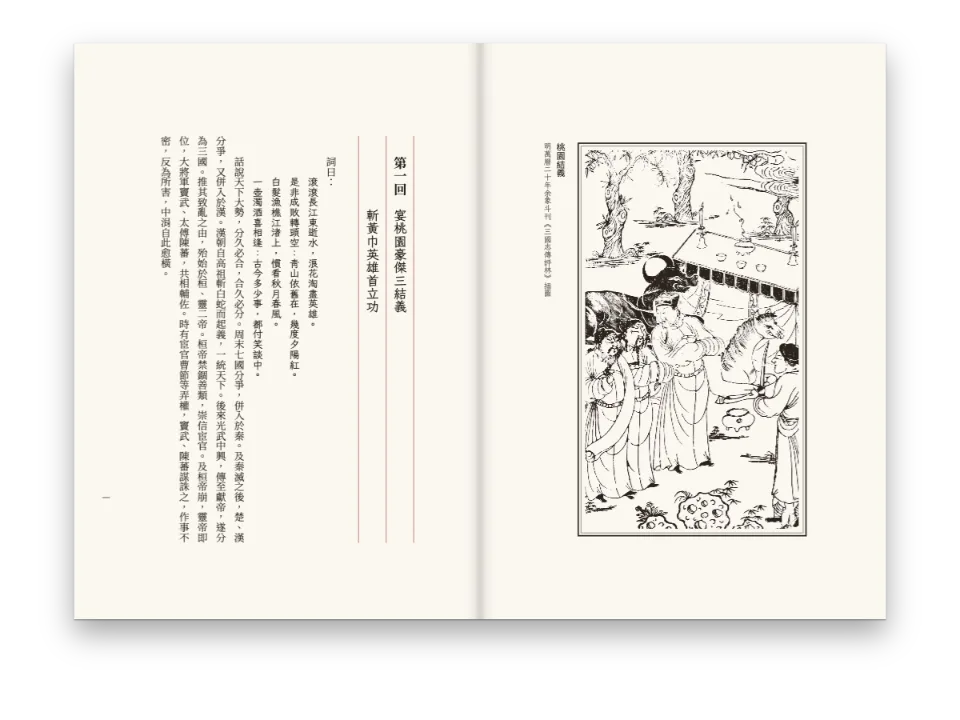
نهاية فصل من كتاب متخيَّل عن الطباعة الصينية، 版刻叢談 («أحاديث في الطباعة بالقوالب الخشبية»)، منضَّد بالحروف التقليدية، من الأعلى إلى الأسفل في أعمدة تُقرأ من اليمين، على صفحة 大32開 بقياس 140 × 203 مم مجلَّدة من اليمين. يتناول الفصل تخطيط طبعات عهد Song، ويستشهد بخمسة أعمال حقيقية. كل استشهاد مضبوط كما ضبطت الكتب الصينية الشروح قرونًا: 夾注، حاشية في صفين بنصف حجم النص، داخل العمود الذي يقع فيه الاستشهاد. والحاشية التي لا يتسع لها ما بقي من العمود تكمل في رأس العمود التالي، وإحداها تكمل عبر قلب الصفحة. تتبع الحواشي صيغة الحواشي في GB/T 7714—2015، المعيار المعتمد في البر الصيني للمراجع، وينتهي الفصل بقائمة مرقّمة بالأعمال التي يستشهد بها، والإنجليزية منها مُدارة على جانبها. والفصل نفسه بحواشٍ في أسفل الصفحة يُضبط مثل رقم 071.
تجيب هذه الوصفة عن
- كيف أستشهد وفق المعيار الصيني GB/T 7714، في النص العمودي أيضًا؟
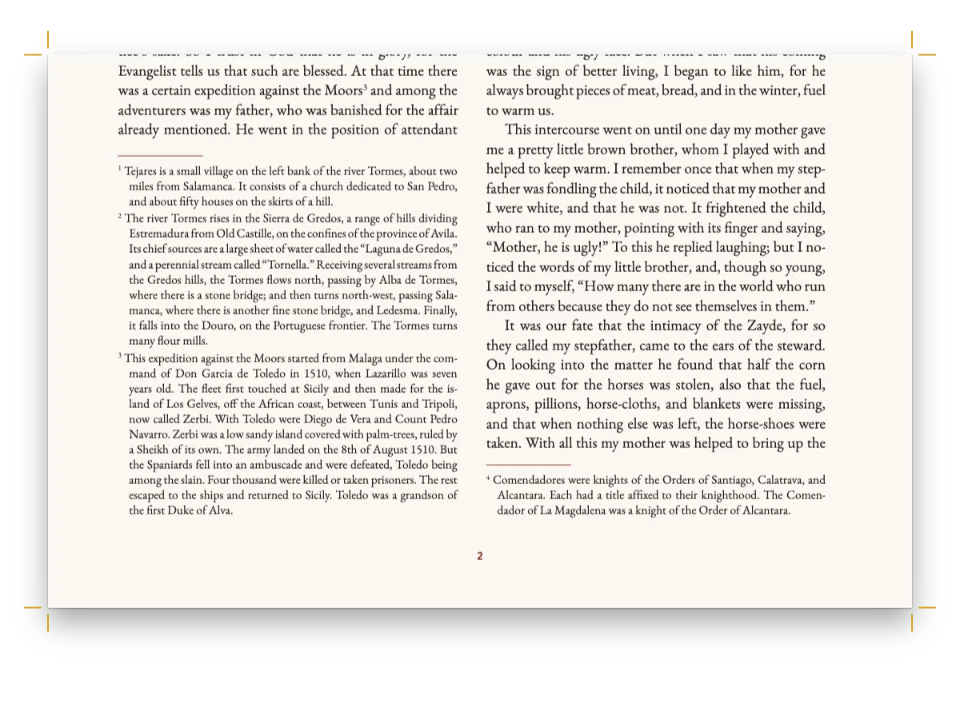
- كيف أنضد الاستشهادات حواشي سفلية، بأسلوب Chicago، مع صيغ مختصرة للاستشهادات اللاحقة؟
الجواب المختصر
// The GB/T 7714 note style turns each citation into a note. notes: 'warichu' sets the note
// in the column where the citation stands, in two rows at half the text size, the right
// row read first; a note longer than what is left of the column goes on in the next one.
// The list at the chapter's end comes from :::bibliography{scope=chapter}, numbered in
// the order the works are cited. Latin words turn sideways in the notes and in the list.
registerCitationEngine(createCiteprocEngine({ styles: STYLES, locales: LOCALES }));
const citations = {
  style: 'china-national-standard-gb-t-7714-2015-note',
  notes: 'warichu', // 夾注; 'footnote' sets the same notes at the foot of the page
  bibliography: { fontSize: em(0.9), entrySpacing: pt(0) },
};
const cjk = {
  grid: { enabled: true, charsPerLine: 36, linesPerPage: 15 },
  warichu: { fontSize: em(0.5), color: col('ink') }, // no brackets: the half size sets it off
};
المكونات
- الميزات
- الاستشهادات في الحواشيالاستشهادات بأسلوب توثيقWarichu: تعليقات بسطرين داخل السطرقائمة المراجع من البيانات المرجعيةالنص العموديكتب مجلّدة من اليمينشبكة المحارفالأرقام الصينيةعروض علامات الترقيم الصينيةالخطوط الصينية واليابانية والكوريةصفحات افتتاح مصمَّمةالعناوين المرقّمةالترويسات وأرقام الصفحاتالترويسات بحسب دور الصفحةهوامش متناظرةلوحة ألوان دلاليةالتصدير إلى PDF
- تستخدم أيضًا
- تقسيم الأسطر في النص الصينيموازنة الأعمدةسمات العنوانلون الورقالخطوط المضمَّنة في PDFترقيم روماني للصفحات التمهيدية
- الخطوط
- Noto Serif SC, Noto Sans SC, LXGW WenKai TC (SIL OFL 1.1)
- الأصول
- لا شيء: كل صورة مرسومة بالكود
طريقة التحضير
#1 · نمط حواشٍ يُضبط داخل السطر
الشيفرة في الجواب المختصر أعلاه. نمط الحواشي في GB/T 7714 (china-national-standard-gb-t-7714-2015-note) نمط حواشٍ: كل استشهاد يصير حاشية تسمّي العمل كاملًا (الاستشهادات). افتراضيًا يرسل نمط الحواشي حواشيه إلى أسفل الصفحة. أما notes: 'warichu' فيُبقي كل حاشية في العمود، مضبوطة warichu: صفان بحجم cjk.warichu.fontSize، نصف حجم النص، في وسط العمود، والصف الأيمن يُقرأ أولًا (العلامات وruby وwarichu). وMarkdown هو نفسه في أي نمط، [@su1999] بعد الكلمات التي يسندها، وتأخذ الحاشية مكان الاستشهاد، قبل 。 التي تنهي الجملة.
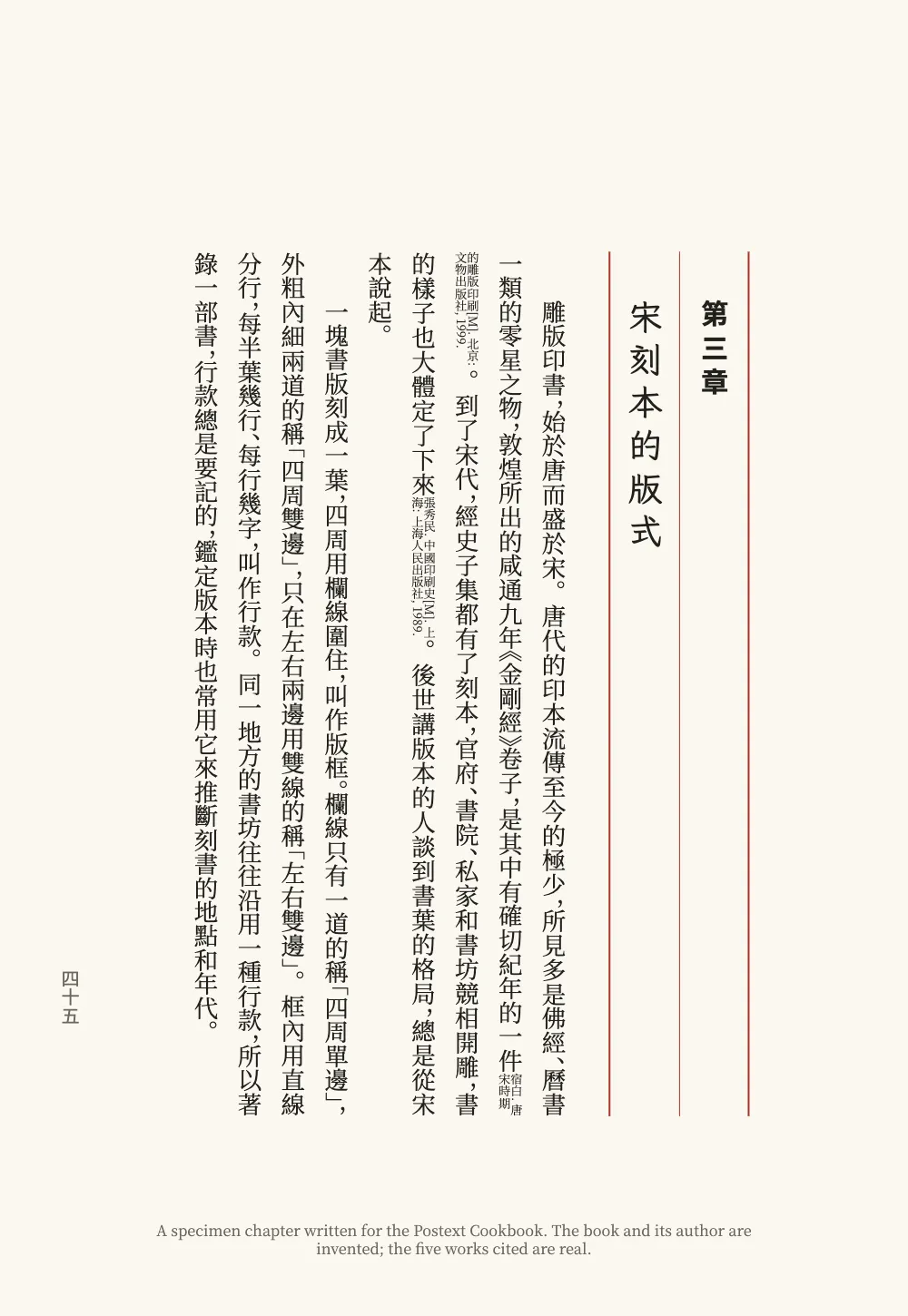
تُملأ الصفوف جزءًا جزءًا. في أسفل العمود الثالث لا تتسع المساحة إلا لـ 宿白. 唐宋時期، فتُقسم إلى صفين من ثلاث خلايا وأربع؛ وتملأ بقية الحاشية رأس العمود التالي، في صفين أيضًا. وفي الصفحة 2 تبدأ حاشية Twitchett في أسفل العمود الأخير، ويقلب القارئ الصفحة ليكملها.
#2 · الأعمال المستشهد بها في آخر الفصل
يضع :::bibliography{title="本章引用書目" scope=chapter} القائمة حيث يقع، ولا يسرد إلا الأعمال التي يستشهد بها هذا الفصل (قائمة المراجع). تأتي المراجع من كتلة BibTeX. يحمل كل مدخل langid، chinese أو english، يقرؤه النمط لغةً للعمل، والأسماء المكتوبة بالحروف الصينية تبقى كاملة. القائمة مرقّمة بترتيب أول استشهاد، والأعمدة المتابعة لكل مدخل تبدأ تحت تسميته.
#3 · الحروف التقليدية على قواعد البر الصيني
يطلب locale: 'zh-Hant-CN' الحروف التقليدية مضبوطة على قواعد البر الصيني، كما يضبط ناشرو بكين وشانغهاي الدراسات الكلاسيكية: الفاصلة والنقطة تقعان في الزاوية العليا اليمنى من خليتهما، والكتاب العمودي يُجلَّد من اليمين. والاستشهادات تتبع هذا الوسم: الكتابة التقليدية تختار لغة CSL المسمّاة zh-TW، فتكون الكلمات التي يضيفها النمط بالحروف التقليدية أيضًا. يرسم Noto Serif SC الحروف التقليدية بأشكالها في البر الصيني، وهذا يناسب هذه الطبعة؛ أما LXGW WenKai TC، وهو خط تايواني، فلا يضبط إلا عنوان الفصل، الخالي من علامات الترقيم (تشرح الأرقام في النص العمودي ما يحدث للأرقام).
في الحواشي والقائمة يدور العنوان اللاتيني والسنة ذات الأرقام الأربعة على جانبهما ويجريان نزولًا مع العمود. أما الرقم القصير المجاور لنص صيني، مثل 1 في تسمية، فيقف قائمًا في خليته.
#4 · صفحة الافتتاح بين الخطوط
// In the flow frame x runs down the column and y across the page, right to left, so a
// 'horizontal' rule is a vertical line on the sheet: three of them rule the two columns.
const [TITLE, PITCH] = [15, 1.6 * LEAD]; // pt: the title's size and its column pitch
const rule = (n) => ({ kind: 'rule', id: `rule-${n}`, direction: 'horizontal',
  thickness: pt(n === 1 ? 0.4 : 0.8), color: col('vermilion'),
  placement: { anchor: { to: 'container', edge: 'top-left' },
    offset: { y: pt(LEAD + n * PITCH) }, size: { width: 'fill' } } });
// A line of PITCH in column n (0, 1), its characters centred between two rules.
const title = (id, content, n, family, size, weight) => ({ kind: 'text', id, content,
  fontFamily: family, fontWeight: weight, fontSize: pt(size), lineHeight: PITCH / size,
  color: col('ink'), letterSpacing: pt(size * 0.25), align: 'left',
  placement: { anchor: { to: 'container', edge: 'top-left' },
    offset: { x: pt(2 * BODY), y: pt(LEAD + n * PITCH) } } }); // two characters down
const opener = { enabled: true, minHeight: cols(5), slot: { elements: [
  rule(0), rule(1), rule(2),
  title('number', '{number}', 0, HEI, 12, 700), // 第三章 in the first column, in 黑
  title('title', '{titleText}', 1, KAI, TITLE, 400), // the title in the second, in 楷
] } };
في الصفحة العمودية يُخرج تصميم العنوان في إطار المجرى: x يجري نزولًا مع العمود وy عرضًا عبر الصفحة من حافتها اليمنى، فالخط 'horizontal' خط عمودي على الورقة. ثلاثة خطوط تحيط بعمودين بينهما 30.4 pt. يقف 第三章 في الأول بخط Hei العريض، والعنوان في الثاني بخط Kai (الامتداد والتصميم المتقدم). يأتي رقم الفصل من startAt=3 على العنوان ومن القالب 第{1:一}章، وأرقام الصفحات من pageNumbering: trad-chinese-informal بدءًا من 45. والترويسات وأرقام الصفحات تنزل على الحافة الأمامية كما في رقم 075 (عناصر النص العمودي).
const palette = {
  ink: '#22201c', vermilion: '#a8352a', muted: '#6d665d', paper: '#fbf8f1',
};
const col = (id) => ({ hex: palette[id], model: 'hex', paletteId: id });
const colorPalette = Object.entries({ ...palette, 'main-color': palette.vermilion })
  .map(([id, hex]) => ({ id, name: id, value: { hex, model: 'hex' } }));
الوصفة كاملة
// ═══ Postext Cookbook · Nº 091 · Vertical Chinese with citations in inline notes ══════ // https://postext.dev/en/cookbook/vertical-book-with-jiazhu-citations // Code: MIT · Text: original (CC BY 4.0) · Pictures: none // Fonts: Noto Serif SC, Noto Sans SC, LXGW WenKai TC (SIL OFL 1.1) · Needs postext ≥ 1.12.0 import { buildDocument, renderPageToCanvas, clearMeasurementCache, registerCitationEngine, loadVerticalAlternates, } from 'https://esm.sh/postext'; import { renderToPdf, decompressWoff2 } from 'https://esm.sh/postext-pdf'; import { createCiteprocEngine, STYLES, LOCALES } from 'https://esm.sh/postext-citeproc'; const LANG = 'en'; // @lang: the language of the frame; the chapter is Chinese in both editions const RECIPE = 'vertical-book-with-jiazhu-citations'; // ─── 1 · Design ───────────────────────────────────────────────────────────── // #region palette: black ink, one vermilion for the opener's rules, the paper of the page const palette = { ink: '#22201c', vermilion: '#a8352a', muted: '#6d665d', paper: '#fbf8f1', }; const col = (id) => ({ hex: palette[id], model: 'hex', paletteId: id }); const colorPalette = Object.entries({ ...palette, 'main-color': palette.vermilion }) .map(([id, hex]) => ({ id, name: id, value: { hex, model: 'hex' } })); // #endregion const [SONG, HEI, KAI] = ['Noto Serif SC', 'Noto Sans SC', 'LXGW WenKai TC']; // 宋, 黑, 楷 const [BODY, LEAD] = [10.5, 19]; // pt: 五號 on a column pitch of 1.8 em const cols = (n) => pt(n * LEAD); // n columns across the page // #region answer: a note style set as 夾注, two half-size rows inside the column // The GB/T 7714 note style turns each citation into a note. notes: 'warichu' sets the note // in the column where the citation stands, in two rows at half the text size, the right // row read first; a note longer than what is left of the column goes on in the next one. // The list at the chapter's end comes from :::bibliography{scope=chapter}, numbered in // the order the works are cited. Latin words turn sideways in the notes and in the list. registerCitationEngine(createCiteprocEngine({ styles: STYLES, locales: LOCALES })); const citations = { style: 'china-national-standard-gb-t-7714-2015-note', notes: 'warichu', // 夾注; 'footnote' sets the same notes at the foot of the page bibliography: { fontSize: em(0.9), entrySpacing: pt(0) }, }; const cjk = { grid: { enabled: true, charsPerLine: 36, linesPerPage: 15 }, warichu: { fontSize: em(0.5), color: col('ink') }, // no brackets: the half size sets it off }; // #endregion // #region opener: 第三章 and the title in two ruled columns, the text after a blank one // In the flow frame x runs down the column and y across the page, right to left, so a // 'horizontal' rule is a vertical line on the sheet: three of them rule the two columns. const [TITLE, PITCH] = [15, 1.6 * LEAD]; // pt: the title's size and its column pitch const rule = (n) => ({ kind: 'rule', id: `rule-${n}`, direction: 'horizontal', thickness: pt(n === 1 ? 0.4 : 0.8), color: col('vermilion'), placement: { anchor: { to: 'container', edge: 'top-left' }, offset: { y: pt(LEAD + n * PITCH) }, size: { width: 'fill' } } }); // A line of PITCH in column n (0, 1), its characters centred between two rules. const title = (id, content, n, family, size, weight) => ({ kind: 'text', id, content, fontFamily: family, fontWeight: weight, fontSize: pt(size), lineHeight: PITCH / size, color: col('ink'), letterSpacing: pt(size * 0.25), align: 'left', placement: { anchor: { to: 'container', edge: 'top-left' }, offset: { x: pt(2 * BODY), y: pt(LEAD + n * PITCH) } } }); // two characters down const opener = { enabled: true, minHeight: cols(5), slot: { elements: [ rule(0), rule(1), rule(2), title('number', '{number}', 0, HEI, 12, 700), // 第三章 in the first column, in 黑 title('title', '{titleText}', 1, KAI, TITLE, 400), // the title in the second, in 楷 ] } }; // #endregion // The fore-edge: the book's title or the chapter's down the outer margin, the folio low. const foreEdge = (id, content, parity, edge, y, pages) => ({ kind: 'text', id, content, parity, pages, writingMode: 'vertical-rl', fontFamily: HEI, fontSize: pt(8), color: col('muted'), overflow: 'clip', placement: { anchor: { to: 'outer', edge }, offset: { y: em(y) } }, }); const header = { elements: [ foreEdge('book', '{title}', 'even', 'top', 4, 'body'), foreEdge('chapter', '{chapterNumber} {chapterTitle}', 'odd', 'top', 4, 'body'), foreEdge('folio', '{pageNumber}', 'all', 'bottom', -5, 'all'), // Across the foot of the opening page, in the edition's language: what is invented. { kind: 'text', id: 'imprint', content: '{subtitle}', pages: 'opener', fontFamily: SONG, fontSize: pt(6.5), color: col('muted'), align: 'center', overflow: 'wrap', placement: { anchor: { to: 'page', edge: 'bottom' }, offset: { y: mm(-9) }, size: { width: mm(100) } } }, ] }; const config = () => ({ // a factory: the engine caches resolved configs per object // Traditional characters to the mainland's rules, as Beijing and Shanghai publishers set // classical scholarship (gotcha: cjk-locale-tag). The citations follow it: zh-TW terms. locale: 'zh-Hant-CN', colorPalette, citations, cjk, page: { sizePreset: 'custom', width: mm(140), height: mm(203), dpi: 150, // 大32開 backgroundColor: col('paper'), margins: { top: mm(34), bottom: mm(26), left: mm(15), right: mm(19), mirror: true }, pageNumbering: { format: 'trad-chinese-informal', startAt: 45 } }, // 四十五 layout: { layoutType: 'single', writingMode: 'vertical-rl' }, // bound on the right bodyText: { fontFamily: SONG, fontSize: pt(BODY), lineHeight: pt(LEAD), color: col('ink'), boldColor: col('ink'), italicColor: col('ink'), referenceColor: col('ink'), textAlign: 'justify', firstLineIndent: em(2), indentAfterHeading: true, }, headings: { fontFamily: SONG, fontWeight: 700, color: col('ink'), balancing: { enabled: false }, // the columns stay on the grid levels: [{ level: 1, numberingTemplate: '第{1:一}章', numberSeparator: ' ', breakBefore: { enabled: true, parity: 'odd' }, // gotcha: headings-drop-h1-break marginBottom: pt(0), advancedDesign: opener }] }, header, footer: { elements: [] }, }); // ─── 2 · Content ──────────────────────────────────────────────────────────── const markdown = String.raw`---نموذج Markdown · أسطر: 28 · content.en.md
title: "版刻叢談" author: "沈硯秋" subtitle: "A specimen chapter written for the Postext Cookbook. The book and its author are invented; the five works cited are real." --- # 宋刻本的版式 {startAt=3} 雕版印書,始於唐而盛於宋。唐代的印本流傳至今的極少,所見多是佛經、曆書一類的零星之物,敦煌所出的咸通九年《金剛經》卷子,是其中有確切紀年的一件[@su1999]。到了宋代,經史子集都有了刻本,官府、書院、私家和書坊競相開雕,書的樣子也大體定了下來[@zhang1989]。後世講版本的人談到書葉的格局,總是從宋本說起。 一塊書版刻成一葉,四周用欄線圍住,叫作版框。欄線只有一道的稱「四周單邊」,外粗內細兩道的稱「四周雙邊」,只在左右兩邊用雙線的稱「左右雙邊」。框內用直線分行,每半葉幾行、每行幾字,叫作行款。同一地方的書坊往往沿用一種行款,所以著錄一部書,行款總是要記的,鑑定版本時也常用它來推斷刻書的地點和年代。 版框正中留出窄窄的一行,不刻正文,是為版心。印好的紙沿這一行對折,版心便落在書口上,翻檢時一眼可見。版心裏刻書名、卷次和葉碼,有時還刻上刻工的姓名和這一版的字數,那是當年計算工錢用的。版心上下各有一個形如魚尾的標記,叫作魚尾;魚尾到欄線之間若刻一道黑線,叫作黑口,空著不刻的叫作白口。 大體說來,浙江一帶的官刻和家刻,字體方整,多作白口、左右雙邊;福建建陽的坊刻,字體瘦勁,版式緊湊,常在框外左上角加一個小方格,刻上篇名,稱為書耳,便於讀者翻檢[@huang2005]。坊刻的書要賣得出去,處處替讀者打算,這一點從版式上也看得出來。 書末或目錄之後,常有一塊刻記,寫明何人於何年在何處刊行,有時兼作書坊的廣告,叫作牌記。牌記的形制有長方的,也有鐘形、亞字形的。後人鑑定版本,牌記是最直接的依據,可也最容易被書賈挖改作偽,所以不能單憑牌記下斷語,還要和行款、字體、紙墨、避諱字一起看。 西方學者系統地研究中國的雕版書,是二十世紀的事。Carter的專著第一次把中國印刷術的發明及其西傳完整地介紹給英語讀者[@carter1925];Twitchett則從書業和讀者的角度,討論中古時期的印刷與出版[@twitchett1983]。兩書所談雖不限於版式,卻都把宋代看作雕版書定型的時代,和中國學者的看法相合。 :::bibliography{title="本章引用書目" scope=chapter} :::references{format=bibtex} @book{su1999, author = {宿白}, title = {唐宋時期的雕版印刷}, publisher = {文物出版社}, address = {北京}, year = 1999, langid = {chinese}} @book{zhang1989, author = {張秀民}, title = {中國印刷史}, publisher = {上海人民出版社}, address = {上海}, year = 1989, langid = {chinese}} @book{huang2005, author = {黃永年}, title = {古籍版本學}, publisher = {江蘇教育出版社}, address = {南京}, year = 2005, langid = {chinese}} @book{carter1925, author = {Carter, Thomas Francis}, title = {The invention of printing in China and its spread westward}, publisher = {Columbia University Press}, address = {New York}, year = 1925, langid = {english}} @book{twitchett1983, author = {Twitchett, Denis}, title = {Printing and publishing in medieval China}, publisher = {Frederic C. Beil}, address = {New York}, year = 1983, langid = {english}} :::`; // content.<lang>.md: the same Chinese text in both // ─── 3 · Fonts ────────────────────────────────────────────────────────────── const FONTS = { // every face the pages use, loaded before the build (gotcha: fonts-first) 'Noto Serif SC': ['400', '700'], // SONG: the text, notes, list, imprint; the list's title 'Noto Sans SC': ['400', '700'], // HEI: the fore-edge heads and folios; 第三章 'LXGW WenKai TC': ['400'], // KAI: the chapter's title }; // ─── 4 · Build & show ─────────────────────────────────────────────────────── // Each voice loads the files of what it sets; the Song also what the style writes. const heading = markdown.match(/^# (.*?)(?: \{.*\})?$/m)[1]; // the title, no attributes const book = markdown.match(/^title: "(.*)"/m)[1]; // 版刻叢談, the head of the even pages const numerals = '第章一二三四五六七八九十'; await loadFonts(FONTS, markdown); await loadCjkFonts({ [SONG]: ['400'] }, `${markdown}卷等頁`, { vertical: true }); await loadCjkFonts({ [HEI]: ['400'] }, `${heading}${book}${numerals}`, { vertical: true }); await loadCjkFonts({ [SONG]: ['700'] }, markdown.match(/bibliography\{title="([^"]*)"/)[1], { vertical: true }); await loadCjkFonts({ [HEI]: ['700'] }, numerals); await loadCjkFonts({ [KAI]: ['400'] }, heading); const doc = await buildWithFonts(() => buildDocument({ markdown }, config()), markdown); showBook(doc, { title: t({ en: 'Vertical Chinese with citations in inline notes', es: 'Chino vertical con citas en notas dentro del renglón' }) }); offerPdf(() => renderToPdf(doc, { fontProvider: cjkPdfProvider }), `${RECIPE}.pdf`);العُدّة · core, fonts, viewer, pdf, cjk: نفسها في كل وصفة · أسطر: 422
// ─── Kit ── helpers shared by every Cookbook recipe · postext.dev/cookbook ───── // ─── Kit · core v1 ── the same in every recipe · postext.dev/cookbook ───────── function mm(value) { return { value, unit: 'mm' }; } function pt(value) { return { value, unit: 'pt' }; } function em(value) { return { value, unit: 'em' }; } /** The sample language's string: t({ en: 'Figure', es: 'Figura' }). */ function t(strings) { return strings[LANG] ?? Object.values(strings)[0]; } /** A file in this recipe's assets folder, served from the Postext repo by jsDelivr. */ function asset(file) { return `https://cdn.jsdelivr.net/gh/drnachio/postext@main/cookbook/${RECIPE}/assets/${file}`; } // ─── Kit · fonts v1 ── the same in every recipe · postext.dev/cookbook ──────── // Postext measures text with the faces the browser has loaded, and caches the // widths, so every face must be ready before the first build. Faces come from // Fontsource: the same static files the PDF embeds, so screen and PDF agree. /** faces = { 'Family Name': ['400', '400i', '700'] }. `text` is the sample: * letters beyond Latin-1 (č, ł, ő…) also load the latin-ext files. With * `optional`, a face Fontsource does not ship is skipped instead of failing. * Resolves to the number of faces added. */ async function loadFonts(faces, text = '', { optional = false } = {}) { kitStatus('Loading fonts…'); const ranges = { latin: 'U+0000-00FF,U+0131,U+0152-0153,U+02BB-02BC,U+02C6,U+02DA,U+02DC,U+0304,U+0308,U+0329,' + 'U+2000-206F,U+20AC,U+2122,U+2191,U+2193,U+2212,U+2215,U+FEFF,U+FFFD', 'latin-ext': 'U+0100-02BA,U+02BD-02C5,U+02C7-02CC,U+02CE-02D7,U+02DD-02FF,U+0304,U+0308,U+0329,' + 'U+1D00-1DBF,U+1E00-1E9F,U+1EF2-1EFF,U+2020,U+20A0-20AB,U+20AD-20C0,U+2113,U+2C60-2C7F,U+A720-A7FF', }; const subsets = /[Ā-˿Ḁ-ỿ]/.test(text) ? ['latin', 'latin-ext'] : ['latin']; const jobs = []; let added = 0; for (const [family, specs] of Object.entries(faces)) { const id = fontsourceId(family); const meta = optional ? await fontsourceMeta(family) : null; for (const spec of new Set(specs)) { const weight = parseInt(spec, 10); const style = spec.endsWith('i') ? 'italic' : 'normal'; if (hasFace(family, weight, style)) continue; if (optional && !(meta?.weights.includes(weight) && meta.styles.includes(style))) continue; for (const subset of subsets) { const url = `https://cdn.jsdelivr.net/npm/@fontsource/${id}@5/files/${id}-${subset}-${weight}-${style}.woff2`; const face = new FontFace(family, `url(${url}) format('woff2')`, { weight: String(weight), style, unicodeRange: ranges[subset] }); jobs.push(face.load().then((ready) => { document.fonts.add(ready); added++; }, () => { if (subset === 'latin' && !optional) throw new Error(`Fontsource has no ${family} ${weight} ${style}`); })); } } } await Promise.all(jobs).catch((error) => { kitFail(error); throw error; }); return added; } /** Runs `build` (a buildDocument or buildBundle call) and checks the faces * the pages use. A regular face missing from FONTS is loaded with a warning; * bold and italic variants are loaded when the family ships them. Then the * measurement caches are cleared and the build runs again. */ async function buildWithFonts(build, text = '') { const tried = new Set(); for (let round = 0; round < 3; round++) { kitStatus('Laying out…'); await new Promise(requestAnimationFrame); // let the status paint first const result = await Promise.resolve().then(build).catch((error) => { kitFail(error); throw error; }); const wanted = { base: {}, variants: {} }; for (const { font, base } of [result].flat().flatMap(fontStringsOf)) { const { family, weight, style } = parseFont(font); const key = `${family}|${weight}|${style}`; if (tried.has(key) || hasFace(family, weight, style)) continue; tried.add(key); (wanted[base ? 'base' : 'variants'][family] ??= []).push(`${weight}${style === 'italic' ? 'i' : ''}`); } if (Object.keys(wanted.base).length) { console.warn(`[cookbook] FONTS does not list ${JSON.stringify(wanted.base)}: loading them.`); } const added = await loadFonts(wanted.base, text) + await loadFonts(wanted.variants, text, { optional: true }); if (added === 0) return result; clearMeasurementCache(); } throw new Error('The fonts did not settle after three builds.'); } /** Every font string of the layout. `base` marks a block's own face; its * bold, italic and bold-italic variants are listed whether or not used. */ function fontStringsOf(doc) { const found = new Map(); const walk = (node) => { if (!node || typeof node !== 'object') return; if (Array.isArray(node)) { node.forEach(walk); return; } for (const [key, value] of Object.entries(node)) { if (typeof value === 'string' && /fontString$/i.test(key)) { found.set(value, found.get(value) || key === 'fontString'); } else if (value && typeof value === 'object') walk(value); } }; walk(doc.pages); walk(doc.blocks); return [...found].map(([font, base]) => ({ font, base })); } /** '700 37.5px Open Sans' / 'italic 400 13px "Source Serif 4"' → { family, weight, style }. * A string with no weight ('95.8px Young Serif', from a design text) is 400. */ function parseFont(font) { const m = /^(?:(italic|oblique)\s+)?(?:small-caps\s+)?(?:(\d+|bold|normal)\s+)?[\d.]+px\s+(.+)$/.exec(font.trim()); if (!m) throw new Error(`Unexpected font string: ${font}`); const weight = m[2] === 'bold' ? 700 : !m[2] || m[2] === 'normal' ? 400 : Number(m[2]); return { family: m[3].replace(/^["']|["']$/g, ''), weight, style: m[1] ? 'italic' : 'normal' }; } /** True when a loaded FontFace covers exactly this family, weight and style * (document.fonts.check() is also true for families nobody declared). */ function hasFace(family, weight, style) { for (const face of document.fonts) { if (face.status !== 'loaded' || face.style !== style) continue; if (face.family.replace(/^["']|["']$/g, '') !== family) continue; const [low, high = low] = face.weight.split(' ').map(Number); if (weight >= low && weight <= high) return true; } return false; } /** Fontsource's id for a family: 'Source Serif 4' → 'source-serif-4'. */ function fontsourceId(family) { return family.toLowerCase().replace(/\s+/g, '-'); } /** The weights and styles a family ships ({ weights: [400, 700], styles: ['normal', 'italic'] }), or null. */ function fontsourceMeta(family) { fontsourceMeta.cache ??= new Map(); const id = fontsourceId(family); if (!fontsourceMeta.cache.has(id)) { fontsourceMeta.cache.set(id, fetch(`https://api.fontsource.org/v1/fonts/${id}`) .then((res) => (res.ok ? res.json() : null), () => null)); } return fontsourceMeta.cache.get(id); } // ─── Kit · viewer v1 ── the same in every recipe · postext.dev/cookbook ─────── /** Shows the pages as facing spreads on a dark desk: the first page is a * recto on its own, then verso | recto pairs, as in a bound book. Pages * are painted when they scroll near the screen. */ function showPages(docs, { title, width = 460 } = {}) { const root = viewer(title); const pages = [docs].flat().flatMap((doc) => doc.pages.map((page) => ({ doc, page, n: (doc.pageIndexOffset ?? 0) + page.index }))); const spreads = []; let verso = null; for (const p of pages) { if (p.n % 2 === 1) { if (verso) spreads.push([verso, null]); verso = p; } else { spreads.push([verso, p]); verso = null; } } if (verso) spreads.push([verso, null]); const density = Math.min(window.devicePixelRatio || 1, 2); showPages.painter?.disconnect(); const painter = new IntersectionObserver((entries) => { for (const { isIntersecting, target } of entries) { if (!isIntersecting) continue; painter.unobserve(target); const { doc, page } = target.postext; renderPageToCanvas(page, doc, target, { scale: (width * density) / page.width }); } }, { rootMargin: '800px' }); showPages.painter = painter; root.replaceChildren(...spreads.map((pair) => { const spread = document.createElement('div'); spread.className = 'pt-spread'; for (const p of pair) { const figure = document.createElement('figure'); if (p) { const label = p.page.pageLabel || String(p.n + 1); const canvas = document.createElement('canvas'); canvas.postext = p; canvas.style.aspectRatio = `${p.page.width} / ${p.page.height}`; canvas.setAttribute('role', 'img'); canvas.setAttribute('aria-label', `Page ${label}`); const folio = document.createElement('figcaption'); folio.textContent = label; figure.append(canvas, folio); painter.observe(canvas); } else figure.className = 'pt-blank'; spread.append(figure); } return spread; })); kitStatus(`${pages.length} ${pages.length === 1 ? 'page' : 'pages'}`); document.documentElement.dataset.postext = 'ready'; return pages.length; } /** The desk, the bar and the error reporting, created once. */ function viewer(title) { if (!document.getElementById('pt-kit')) { document.head.insertAdjacentHTML('beforeend', `<style id="pt-kit"> :root { color-scheme: dark; } body { margin: 0; background: #0e1014; color: #b9bcc4; font: 13px/1.45 system-ui, sans-serif; } #pt-bar { position: sticky; top: 0; z-index: 1; display: flex; flex-wrap: wrap; align-items: center; gap: 6px 16px; padding: 10px 16px; background: rgb(14 16 20 / .92); backdrop-filter: blur(6px); border-bottom: 1px solid #23262d; } #pt-bar strong { color: #f4f1ea; font-weight: 600; } #pt-actions { display: flex; gap: 12px; margin-left: auto; } #pt-actions a, #pt-actions button { color: #d8a21a; font: inherit; background: none; border: 0; padding: 0; cursor: pointer; } #pages { display: grid; justify-items: center; gap: 48px; padding: 32px 16px 72px; } .pt-spread { display: flex; } .pt-spread figure { margin: 0; width: min(460px, 44vw); } .pt-spread canvas { display: block; width: 100%; background: #fff; box-shadow: 0 1px 2px rgb(0 0 0 / .5), 0 22px 44px -16px rgb(0 0 0 / .8); } .pt-spread figure:first-child canvas { box-shadow: inset -14px 0 14px -14px rgb(0 0 0 / .18), 0 1px 2px rgb(0 0 0 / .5), 0 22px 44px -16px rgb(0 0 0 / .8); } .pt-spread figcaption { margin-top: 10px; text-align: center; font: 600 10px/1 system-ui, sans-serif; letter-spacing: .18em; text-transform: uppercase; color: #6c7079; } .pt-blank { visibility: hidden; } @media (max-width: 760px) { .pt-spread { flex-direction: column; gap: 32px; } .pt-spread figure { width: min(460px, 92vw); } .pt-blank { display: none; } } </style>`); document.body.insertAdjacentHTML('afterbegin', '<header id="pt-bar"><strong id="pt-title"></strong><span id="pt-status" role="status"></span><span id="pt-actions"></span></header>'); document.getElementById('pt-title').textContent = document.title || 'Postext'; addEventListener('error', (event) => kitFail(event.error ?? event.message)); addEventListener('unhandledrejection', (event) => kitFail(event.reason)); } if (title) document.getElementById('pt-title').textContent = title; return document.getElementById('pages') ?? document.body.appendChild(Object.assign(document.createElement('main'), { id: 'pages' })); } function kitStatus(text) { viewer(); document.getElementById('pt-status').textContent = text; } function kitFail(error) { document.documentElement.dataset.postext = 'error'; kitStatus(`Error: ${error?.message ?? error}`); } // ─── Kit · pdf v1 ── the same in every recipe that exports a PDF ────────────── /** postext-pdf embeds TrueType bytes. Fetch the Fontsource file the screen * used, snapping to a weight the family ships and falling back to upright * when it has no italic: the PDF asks for every face a block could use. */ async function fontsourceProvider(family, weight, style) { const id = fontsourceId(family); const meta = await fontsourceMeta(family); const weights = meta?.weights?.length ? meta.weights : [400, 700]; const w = weights.reduce((a, b) => (Math.abs(b - weight) < Math.abs(a - weight) ? b : a)); const s = style === 'italic' && meta && !meta.styles.includes('italic') ? 'normal' : style; const res = await fetch(`https://cdn.jsdelivr.net/npm/@fontsource/${id}@5/files/${id}-latin-${w}-${s}.woff2`); if (!res.ok) throw new Error(`Fontsource has no ${family} ${w} ${s} (${res.status})`); return decompressWoff2(new Uint8Array(await res.arrayBuffer())); } /** A "Build the PDF" button in the bar. Once built: "Open the PDF" (a new * tab, since CodePen's preview frame cannot show PDFs) and a download link. */ function offerPdf(makePdf, filename) { viewer(); const button = Object.assign(document.createElement('button'), { type: 'button', textContent: 'Build the PDF' }); button.dataset.postextPdf = filename; button.addEventListener('click', async () => { button.disabled = true; button.textContent = 'Building the PDF…'; try { const bytes = await makePdf(); const url = URL.createObjectURL(new Blob([bytes], { type: 'application/pdf' })); const size = `${Math.max(1, Math.round(bytes.length / 1024))} KB`; button.replaceWith( Object.assign(document.createElement('a'), { href: url, target: '_blank', rel: 'noopener', textContent: 'Open the PDF ↗' }), Object.assign(document.createElement('a'), { href: url, download: filename, textContent: `Download ${filename} · ${size}` })); } catch (error) { button.disabled = false; button.textContent = 'Build the PDF'; kitFail(error); } }); document.getElementById('pt-actions').append(button); } // ─── Kit · cjk v1 ── Chinese, Japanese and Korean books · postext.dev/cookbook ─ // Fontsource ships a CJK family as about a hundred files per weight, each // declared in its stylesheet with the unicode-range it covers. The screen // loads the files the sample touches; the PDF gets the same files for the // characters its pages set in each face, and embeds each as a subset. // A book bound on the right (vertical text) is shown with its spreads // mirrored: page 1 alone on the left of the spine, then [3 | 2]. /** The files of a Fontsource face, read from its stylesheet: { url, range, * ranges }, the last declared first (the order the browser tries them in). */ function cjkSlices(family, weight, style) { cjkSlices.cache ??= new Map(); const id = fontsourceId(family); const css = `https://cdn.jsdelivr.net/npm/@fontsource/${id}@5/${weight}${style === 'italic' ? '-italic' : ''}.css`; if (!cjkSlices.cache.has(css)) { cjkSlices.cache.set(css, fetch(css) .then((res) => { if (!res.ok) throw new Error(`Fontsource has no ${family} ${weight} ${style} (${res.status})`); return res.text(); }) .then((text) => [...text.matchAll(/@font-face\s*{([^}]*)}/g)].map(([, rule]) => { const range = /unicode-range:\s*([^;]+);/.exec(rule)?.[1].trim() ?? 'U+0-10FFFF'; const ranges = range.split(',').map((part) => { const [lo, hi = lo] = part.trim().slice(2).split('-'); return [parseInt(lo, 16), parseInt(hi, 16)]; }); return { url: new URL(/url\(([^)]+?\.woff2)\)/.exec(rule)[1], css).href, range, ranges }; }).reverse())); } return cjkSlices.cache.get(css); } /** The file of `slices` that holds code point `cp`, if any. */ function cjkSliceFor(slices, cp) { return slices.find((slice) => slice.ranges.some(([lo, hi]) => cp >= lo && cp <= hi)); } /** Whether Fontsource serves `family` as a Chinese, Japanese or Korean * family (its subsets name the script). Fails when the API does not * answer: a CJK face taken for a Latin one would paint in a system face. */ async function isCjkFamily(family) { const meta = await fontsourceMeta(family); if (!meta) throw new Error(`api.fontsource.org did not describe ${family}: reload to try again`); return !!meta.subsets?.some((subset) => /^(chinese|japanese|korean)/.test(subset)); } /** faces = { 'Noto Serif TC': ['400', '700'] }, as for loadFonts: the * whole FONTS object may be passed, its other families are left to * loadFonts. Adds one FontFace per file of each CJK face with its * unicodeRange, then loads the files `text` touches. `text` is what the * faces set: the sample for the text face; a book in several voices calls * it once per voice (loadCjkFonts({ 'LXGW WenKai TC': ['400'] }, quotes)), * so the heading and quotation faces fetch and check only their own * characters. Fails when a character of `text` is in no file of a face. * List every weight the pages use: a weight left to buildWithFonts gets * the latin file only. With { vertical: true } it also loads each * family's vertical forms (brackets, quotes, pause marks) for the canvas, * which needs loadVerticalAlternates imported from postext. Resolves to * the number of files loaded. */ async function loadCjkFonts(faces, text, { vertical = false } = {}) { kitStatus('Loading fonts…'); let loaded = 0; try { if (vertical && typeof loadVerticalAlternates !== 'function') { throw new Error('loadCjkFonts(…, { vertical: true }) needs loadVerticalAlternates imported from postext'); } for (const [family, specs] of Object.entries(faces)) { if (!(await isCjkFamily(family))) continue; const twin = []; for (const spec of new Set(specs)) { const weight = parseInt(spec, 10); const style = spec.endsWith('i') ? 'italic' : 'normal'; const slices = await cjkSlices(family, weight, style); const missing = [...new Set(text)].filter((ch) => /\S/.test(ch) && !cjkSliceFor(slices, ch.codePointAt(0))); if (missing.length) { throw new Error(`${family} ${spec} has no file for ${missing.slice(0, 12).join(' ')}: ` + `give each face the text it sets (loadCjkFonts({ '${family}': ['${spec}'] }, text))`); } for (const slice of slices) { document.fonts.add(new FontFace(family, `url(${slice.url}) format('woff2')`, { weight: String(weight), style, unicodeRange: slice.range })); twin.push({ source: slice.url, weight: String(weight), style, unicodeRange: slice.range }); } const font = `${style === 'italic' ? 'italic ' : ''}${weight} 16px "${family}"`; loaded += (await document.fonts.load(font, text)).length; if (!document.fonts.check(font, text)) throw new Error(`${family} ${spec} did not load for the sample`); } // The same files under a twin name with the `vert` feature on: the // canvas paints the punctuation of vertical lines with it. if (vertical && twin.length) await loadVerticalAlternates(family, twin); } } catch (error) { kitFail(error); throw error; } return loaded; } /** The PDF font provider for recipes with CJK faces: a family whose * Fontsource subsets are Chinese, Japanese or Korean gets the files that * hold the characters its pages set (`request.codePoints`); any other * family goes to fontsourceProvider (the "pdf" block). */ async function cjkPdfProvider(family, weight, style, request) { if (!(await isCjkFamily(family))) return fontsourceProvider(family, weight, style); const meta = await fontsourceMeta(family); const weights = meta.weights?.length ? meta.weights : [400, 700]; const w = weights.reduce((a, b) => (Math.abs(b - weight) < Math.abs(a - weight) ? b : a)); const s = style === 'italic' && !meta.styles.includes('italic') ? 'normal' : style; const slices = await cjkSlices(family, w, s); const picked = new Set(); for (const cp of request?.codePoints ?? []) { const slice = cjkSliceFor(slices, cp); if (slice) picked.add(slice); } if (!picked.size) picked.add(slices[0]); return Promise.all(slices.filter((slice) => picked.has(slice)).map(async (slice) => { const res = await fetch(slice.url); if (!res.ok) throw new Error(`Fontsource file ${slice.url} (${res.status})`); return decompressWoff2(new Uint8Array(await res.arrayBuffer())); })); } /** showPages for a book bound on either edge. A right-bound book (the * document says so: doc.binding is 'right' for page.binding 'right' and * for vertical text) lies on the desk as it opens: page 1 alone on the * left of the spine, then [3 | 2], the spine shade on each page's inner * edge. `binding` ('left' | 'right') overrides the document's. */ function showBook(docs, { binding, ...options } = {}) { const count = showPages(docs, options); const right = (binding ?? [docs].flat()[0]?.binding) === 'right'; if (!document.getElementById('pt-kit-cjk')) { // The pages keep direction ltr: a canvas draws text in the direction its // element inherits, and under rtl each run would end where the engine // starts it, its brackets mirrored. document.head.insertAdjacentHTML('beforeend', `<style id="pt-kit-cjk"> .pt-spread[dir="rtl"] canvas { direction: ltr; } .pt-spread[dir="rtl"] figure:first-child canvas { box-shadow: inset 14px 0 14px -14px rgb(0 0 0 / .18), 0 1px 2px rgb(0 0 0 / .5), 0 22px 44px -16px rgb(0 0 0 / .8); } </style>`); } // Each pair stays [verso, recto] in the page; right to left, the verso // sits on the right. Phones stack the pages in reading order either way. for (const spread of document.querySelectorAll('#pages > .pt-spread')) spread.dir = right ? 'rtl' : 'ltr'; document.getElementById('pages').dataset.binding = right ? 'right' : 'left'; return count; } // ─── /Kit ───────────────────────────────────────────────────────────────────────
يعمل ملف script.js المجمّع كما هو: الصقه في سكربت الوحدة (module) لأي صفحة، أو افتح الوصفة على CodePen. مجلد الوصفة على GitHub ↗ (يفتح في تبويب جديد)
تنويعات
#أقواس حول كل حاشية
بعض الطبعات تغلق الـ 夾注 بين أقواس بحجم النص. يضبطها cjk.warichu لكل الحواشي، ومنها الاستشهادات.
-  warichu: { fontSize: em(0.5), color: col('ink') }, // no brackets: the half size sets it off
+ warichu: { fontSize: em(0.5), color: col('ink'), open: '〔', close: '〕' },#أرقام في العمود بدل الحواشي
النمط الرقمي في GB/T 7714 بالأقواس الزاوية يطبع 〔1〕 قائمًا في العمود، وتبقى القائمة على حالها.
-  style: 'china-national-standard-gb-t-7714-2015-note',
-  notes: 'warichu', // 夾注; 'footnote' sets the same notes at the foot of the page
+  style: 'china-national-standard-gb-t-7714-2015-numeric',
+ marker: 'corner', // 〔1〕, upright in vertical textأخطاء شائعة
خطأ شائع
اوسم المستند بـ zh-Hans أو zh-Hant، لا بـ LANG
نسختا الوصفة هما en وes، لكن المثال الصيني صيني في كلتيهما: `locale: LANG` سيسمه بالإنجليزية أو الإسبانية، فيقسّم كلماته اللاتينية بالواصلة، ويسمّي أشكاله Figure أو Figura، ويعطي PDF لغة خاطئة. اكتب الوسم بنفسك: 'zh-Hans' (أعراف البر الرئيسي: كسر الأسطر وفق GB، وترقيم Kaiming) أو 'zh-Hant' (تايوان: ترقيم بعرض كامل متمركز)؛ و'zh-HK' لهونغ كونغ. أما 'zh' المجرّد فيُقرأ صينية مبسطة على أعراف البر الرئيسي. تقسيم الأسطر في النص الصيني →
خطأ شائع
الخطوط الصينية تُحمَّل شرائح، عبر الكتلة cjk
يقدّم Fontsource العائلة الصينية أو اليابانية أو الكورية في نحو مئة ملف لكل وزن، يغطي كل منها نطاقًا من الحروف. لا يجلب loadFonts إلا ملف latin، فتأتي حروف الهان على الشاشة من خط النظام وتُقاس خطأً، ويسلّم fontsourceProvider ملف latin ذاك إلى PDF، فيطبعها مربعات فارغة. اذكر كتلة الأدوات cjk، واستدعِ loadCjkFonts(FONTS, markdown) بعد loadFonts (مرة لكل صوت، مع النص الذي يضعه، حين يستخدم الكتاب عدة خطوط CJK)، وأعطِ renderToPdf القيمة fontProvider: cjkPdfProvider: كلاهما يأخذ الملفات التي تحتوي حروف النص. الخطوط الصينية واليابانية والكورية →
خطأ شائع
ضع ترقيم كل منطقة بخط من تلك المنطقة
تنقل عروض علامات الترقيم الفراغ الذي بجانب كل علامة إلى الجهة التي تضعه فيها منطقة المستند، لا الجهة التي يرسمه فيها الخط: مع zh-Hans تحتفظ فاصلة Kaiming بالنصف الأيسر من إطارها، حيث يرسم الخط المبسط الحرف، وتتخلى عن النصف الأيمن. أما الخط التقليدي فيضع ,。 في وسط الإطار، فيحمل النصف المحذوف جزءًا من الحرف وتزاحم الفاصلةُ الحرفَ التالي. وهذا ما يفعله LXGW WenKai TC، وهو خط Kai النصي الوحيد في Fontsource، في النص المبسط. ضع نص البر الرئيسي وحواشيه واقتباساته بـ Noto Serif SC أو Noto Sans SC، واحتفظ بخطوط TC للنص zh-Hant، ولا تستخدم خط فرشاة مبسطًا (Ma Shan Zheng) إلا لأسطر العرض، حيث لا يطبّق نص التصميم عروض الترقيم. كما يرسم ذلك الخط أشكالًا موروثة لا يطبعها معيار البر الرئيسي ولا معيار تايوان، 為 برأس 爫 الذي في 爲، و令 (في 冷 و領) بقاعدة 卩: افحص الحروف التي تضعها الصفحة به. عروض علامات الترقيم الصينية →
خطأ شائع
الكتاب المجلَّد على اليمين يعرض صفحاته المتقابلة بـ showBook
في الكتاب المجلَّد على اليمين (نص عربي أو عبري أو فارسي، أو صيني عمودي، أو page.binding 'right') تبقى الصفحة 1 هي الصفحة الفردية، لكنها تقع على يسار الكعب، وتُقرأ الأزواج [3 | 2]. يعرض showPages كل كتاب مجلَّدًا على اليسار؛ أما showBook من الكتلة book (وتحمل الكتلة cjk الدالة نفسها) فيقرأ doc.binding ويعكس الأزواج. ولا يزال capture.hero يسمّي الصفحتين المتقابلتين بترتيب القراءة، [verso, recto]: [2, 3]. كتب مجلّدة من اليمين →
خطأ شائع
على شبكة الحروف، أوقف موازنة الأعمدة
تملأ موازنة الأعمدة الصفحة التي تنتهي قصيرة، كما حين يترك عنوانٌ مُبقًى مع نصه أسطرًا فارغة في الأسفل، بإضافة أسطر شبكة فوق العناوين وبتوسيع فقرة بمقدار سطر. والسطر الصيني الموسَّع يباعد بين حروفه (0.13 em في صفحة GB/T 9704، وهو أبعد كثيرًا من balancing.maxTracking)، فتخرج الحروف من أعمدة الشبكة وتخرج العناوين من أسطرها. الصفحة المحسوبة بالخلايا تنتهي قصيرة بدلًا من ذلك: اضبط headings.balancing: { enabled: false }. شبكة المحارف →
خطأ شائع
أي كائن headings يُلغي فاصل الصفحة قبل H1
ينتقل H1 افتراضيًا إلى صفحة فردية (always-odd)، لكن تمرير أي كائن headings يعيد ضبط هذا الافتراض، فتتوالى الفصول دون فاصل ولا يفعل span: 'page' شيئًا. أعد كتابة headings.levels[0].breakBefore: { enabled: true, parity } في كل إعداد. فصول تبدأ في صفحة فردية →
خطأ شائع
ضع كل قيمة في الترويسة الأمامية (frontmatter) بين علامتي اقتباس
يقرأ YAML القيمة title: 1984 رقمًا، ويقرأ التاريخ كائن Date، والقيم غير النصية تُطبع فارغة في العناصر النائبة وتترك ملف PDF بلا عنوان. ضع كل قيمة بين علامتي اقتباس: title: "1984". البيانات الوصفية للمستند →
خطأ شائع
حمّل كل أوجه الخط قبل الإخراج
يقيس الإخراج النص بأوجه الخط التي حمّلها المتصفح ويخزّن العروض مؤقتًا، فالوجه الذي يصل بعد البناء الأول يترك فواصل أسطر خاطئة وملف PDF لم يعد يطابق الشاشة. حمّل كل وزن وكل نمط أولًا، واستدعِ clearMeasurementCache() قبل إعادة البناء إذا تأخر وصول أحدها. الخطوط قبل الإخراج →
- نمط الحواشي يكتب العمل المستشهد به مرة ثانية بصيغة مختصرة، ونمط الحواشي في GB/T 7714 يختصره إلى 同1، أي «كما في الحاشية 1». والـ warichu لا رقم له، فلا يستطيع القارئ أن يجد الحاشية 1. هذا الفصل يستشهد بكل عمل مرة واحدة؛ والنص الذي يستشهد بعمل مرة أخرى عليه أن يكتب الاستشهاد الثاني باليد، أو أن يستعمل النمط الرقمي في التنويع الثاني.
- يكتب النمط علامات ترقيم غربية في المداخل الصينية،
宿白. 唐宋時期的雕版印刷[M]. 北京: 文物出版社, 1999.، كما يطبعها المعيار. وفي العمود العمودي تحتفظ هذه العلامات بشكلها الغربي: تدور على جانبها وتأخذ أقل من خلية، بخلاف 。 و, في النص. - صف الـ warichu بنصف حجم النص: بحجم نص 10.5 pt يكون كل صف 5.25 pt، أصغر حرف في الصفحة. اضبط النص بحجم 五號 أو أكبر، أو ارفع
cjk.warichu.fontSize؛ والصفان يتقاسمان دائمًا عرض عمود واحد.
الحقوق
- الوصفة
- Ignacio Ferro
- النص
- نص أصلي, CC BY 4.0
- الخطوط
- Noto Serif SC (SIL OFL 1.1) · Noto Sans SC (SIL OFL 1.1) · LXGW WenKai TC (SIL OFL 1.1)
- الكود
- MIT، مثل Postext
حرّر هذا الشرح ↗ (يفتح في تبويب جديد)مجلد الوصفة على GitHub ↗ (يفتح في تبويب جديد)