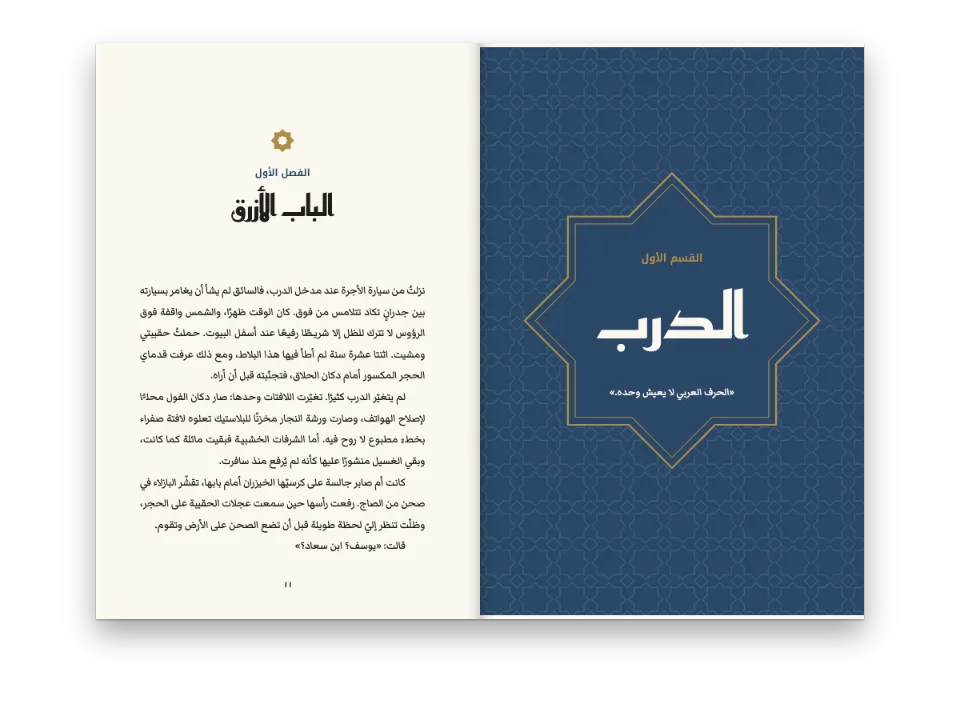
باختصار
قصة عربية قديمة مطبوعة بكل حركاتها الصغيرة فوق الحروف وتحتها. تتباعد الأسطر بما يكفي كي لا تصطدم حركات سطر بالسطر الذي تحته.
ما الذي ستنضده
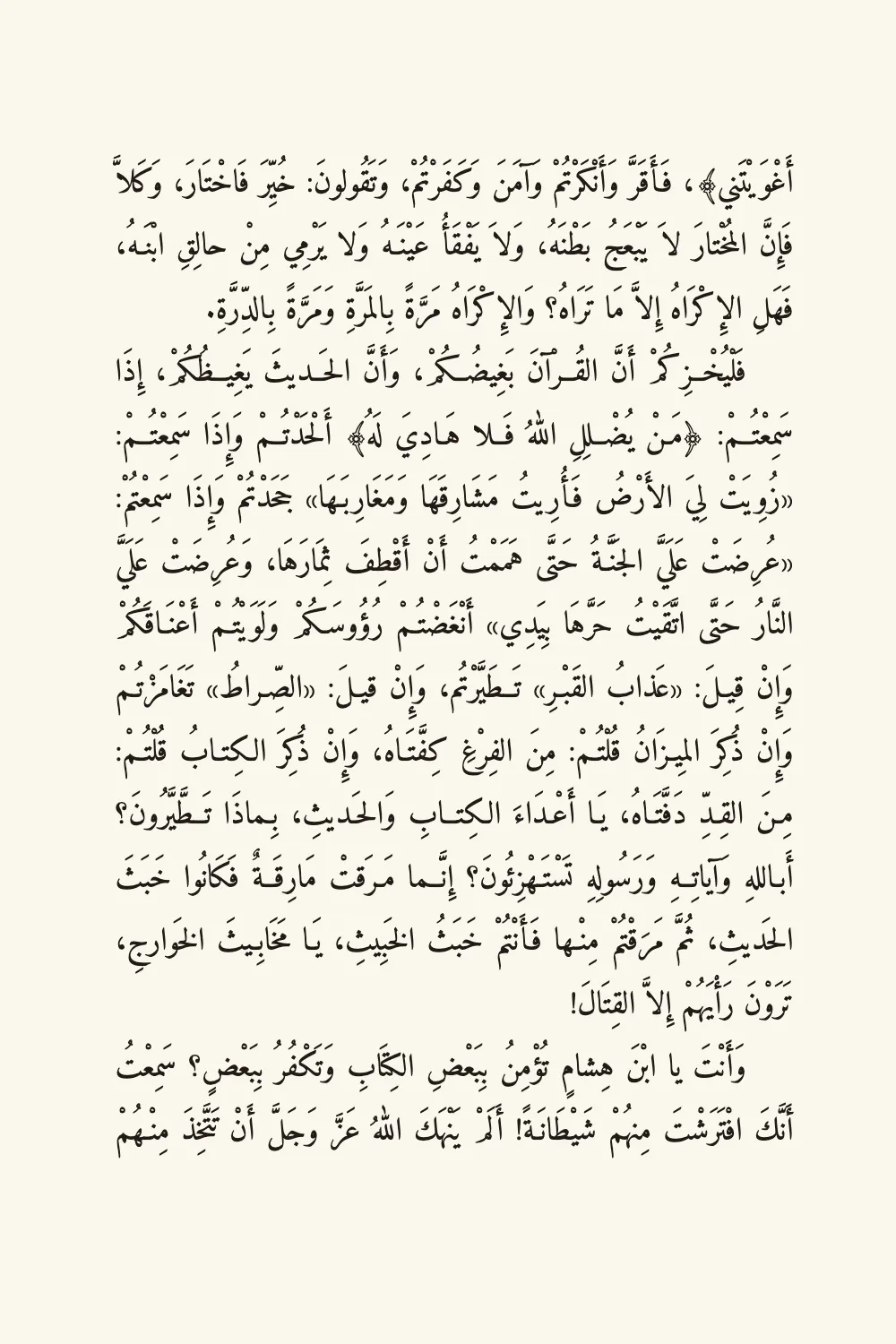
أربع صفحات من كتاب عربي تراثي يحمل كل حرف فيه حركته: المقامة المارستانية لبديع الزمان الهمذاني، وفيها مجنون في مارستان البصرة يُفحم متكلّمًا ثم يعرّف بنفسه شعرًا. النص المشكول كله يرصّ الفتحة والشدة فوق الحروف والكسرة تحتها، والحركات تسكن المسافة بين الأسطر. لذلك تُنضَّد الصفحة بخط Amiri بحجم 14 pt على 28 pt، أي ضعف الحجم، ولا شيء غير ذلك: تباعد الأسطر هو التصميم. النص مضبوط بالكشيدة، يبدأ بإزاحة 1.5 em على اليمين، ويضع آياته القرآنية الثلاث بين القوسين المزخرفين ﴿ ﴾ كما في المصحف المطبوع. ولا يتغير مع الطبعة إلا سطر العنوان اللاتيني والتعليق على النص.
تجيب هذه الوصفة عن
- كم يحتاج النص العربي المشكول كاملًا من تباعد الأسطر؟
الجواب المختصر
// Every letter of this maqāma carries its vowel: fatḥa and shadda over the letters, kasra
// and kasratān under them, often two marks on one letter. The marks sit in the leading,
// which never grows for them, so the leading is chosen for the most vocalised line of the
// book. Unvocalised prose sets well at 1.6 × the size; fully vocalised text needs
// 1.9–2.1 ×: here 14 pt on 28 pt, 2 ×, so a kasra hanging under one line clears a shadda
// standing on the line below. Any closer and the build reports the paragraph
// (arabicMarksExceedLeading) with the leading it would need.
const SIZE = 14; // pt
const LEAD = 2 * SIZE; // pt: 28
const bodyText = {
  fontFamily: NASKH, fontSize: pt(SIZE), lineHeight: pt(LEAD), color: col('ink'),
  boldColor: col('ink'), italicColor: col('ink'), referenceColor: col('ink'),
  // Justified with kashidas, the default in an Arabic book, written out to say so:
  // a line widens at its joins as well as at its spaces.
  textAlign: 'justify', kashida: 'auto', kashidaPatterns: 'naskh',
  firstLineIndent: em(1.5), indentAfterHeading: false, // on the start side, the right
  optimalLineBreaking: true, avoidWidows: true, avoidOrphans: true,
};
المكونات
- الميزات
- الخطوط العربيةخط المتنالنص من اليمين إلى اليسارالعربية لغةً للمستندالمسافات البادئة والمحاذاة والتباعد بين الفقراتالضبط بالكشيدةالشعر العربي (البيت بشطرين)كتب مجلّدة من اليمينفقرات بالاتجاه المعاكسمستويات العناوينمقاس القطعهوامش متناظرةلون الورقلوحة ألوان دلاليةصفحات على اللوحة (Canvas)
- الخطوط
- Amiri, Aref Ruqaa (SIL OFL 1.1)
- الأصول
- لا شيء: كل صورة مرسومة بالكود
طريقة التحضير
#1 · تباعد أسطر ضعف الحجم
الكود هو الجواب المختصر أعلاه. لا يزيد تباعد الأسطر أبدًا ليفسح للحركات: الكسرة تحت سطر والشدة فوق السطر التالي تتقاسمان الفراغ نفسه، فيُختار الفراغ على قدر أكثر أسطر الكتاب تشكيلًا (الحركات). في هذا النص يترك تباعد 1.6 مرة من الحجم ست فقرات تصطدم حركاتها، ويترك 1.9 فقرة واحدة؛ وعند الضعف لا تصطدم أي منها. والبناء يخبرك: إذا اصطدم سطران أبلغ عن arabicMarksExceedLeading للفقرة، مع التباعد الذي تحتاجه (النص العربي).
#2 · صفحة صغيرة بسطر عريض
// 166 mm of text block hold seventeen lines on the 28 pt pitch (9.88 mm). The measure is
// 106 mm, about twelve words of vocalised Naskh.
const page = {
  sizePreset: 'custom', width: mm(140), height: mm(210), dpi: 150,
  backgroundColor: col('paper'),
  // mirror: left is the inner margin, at the spine (the right edge of an odd page here)
  margins: { top: mm(22), bottom: mm(22), left: mm(18), right: mm(16), mirror: true },
};
صفحة 14 × 21 سم بهامشين جانبيين 16 و18 مم تترك سطرًا عرضه 106 مم، نحو اثنتي عشرة كلمة مشكولة، وسبعة عشر سطرًا على تباعد 28 pt. تجعل الحركات الأسطر رمادية المظهر، فتبقى الصفحة بسيطة: بلا ترويسات، على ورق كريمي، بعنوان أحمر واحد. ويضع mirror: true الهامش الأعرض عند الكعب، وهو في كتاب مجلّد على اليمين الحافة اليمنى من الصفحة الفردية (ترتيب الصفحات والتجليد على اليمين).
#3 · عناوين تحافظ على الشبكة
// The headings carry no design: the title's line box, three lines of the grid deep, lowers
// it on the page (a top margin is dropped at the head of a page), and the levels under it
// keep to the 28 pt pitch, so the text starts on a line of the grid.
const headings = {
  fontFamily: NASKH, color: col('ink'), textAlign: 'center',
  levels: [
    // Restated: any headings object drops the H1 break (gotcha: headings-drop-h1-break).
    { level: 1, fontFamily: RUQAA, fontWeight: 700, fontSize: pt(32), lineHeight: pt(LEAD * 3),
      color: col('rubric'), marginTop: pt(0), marginBottom: pt(0),
      breakBefore: { enabled: true, parity: 'odd' } },
    { level: 2, fontWeight: 700, fontSize: pt(15), lineHeight: pt(LEAD), color: col('ink'),
      marginTop: pt(0), marginBottom: pt(0) },
    { level: 3, fontWeight: 400, fontSize: pt(10), lineHeight: pt(LEAD), color: col('muted'),
      marginTop: pt(0), marginBottom: pt(LEAD) },
  ],
};
لا تصميم للعناوين: يقع عنوان الرقعة في صندوق سطر بعمق ثلاثة أسطر من الشبكة، ويأخذ المؤلف والسطر اللاتيني كلٌّ منهما سطرًا واحدًا من 28 pt، فيقع أول أسطر النص على الشبكة. والسطر اللاتيني {dir=ltr}، عنوان من اليسار إلى اليمين في كتاب من اليمين إلى اليسار (اتجاه المستند والكتلة والنص داخل السطر).
الوصفة كاملة
// ═══ Postext Cookbook · Nº 111 · Fully vocalised classical prose with Qur'anic brackets ═══ // https://postext.dev/en/cookbook/vocalised-classical-prose // Code: MIT · Text: al-Hamadhānī, Maqāmāt, ar.wikisource (PD) · Pictures: none // Fonts: Amiri, Aref Ruqaa (SIL OFL 1.1) · Needs postext ≥ 1.15.0 import { buildDocument, renderPageToCanvas, clearMeasurementCache } from 'https://esm.sh/postext'; const LANG = 'en'; // @lang: the language of the sample document ('en' | 'es') const RECIPE = 'vocalised-classical-prose'; // ─── 1 · Design ───────────────────────────────────────────────────────────── // Black text and a red title on a cream page, as the Beirut and Cairo editions of the // Maqāmāt print them. const palette = { ink: '#211b17', // text: a warm near-black rubric: '#94291d', // the accent: the title muted: '#6b6156', // the author's name, the Latin title line, the note on the text paper: '#fbf7ee', // a cream paper }; const col = (id) => ({ hex: palette[id], model: 'hex', paletteId: id }); const colorPalette = [ ...Object.entries(palette).map(([id, hex]) => ({ id, name: id, value: { hex, model: 'hex' } })), { id: 'main-color', name: 'rubric (defaults)', value: { hex: palette.rubric, model: 'hex' } }, ]; const NASKH = 'Amiri'; // the text: a Bulaq Naskh, with its own Latin for the note const RUQAA = 'Aref Ruqaa'; // display: the title // #region answer: a leading of 2 × the size for text with every vowel written // Every letter of this maqāma carries its vowel: fatḥa and shadda over the letters, kasra // and kasratān under them, often two marks on one letter. The marks sit in the leading, // which never grows for them, so the leading is chosen for the most vocalised line of the // book. Unvocalised prose sets well at 1.6 × the size; fully vocalised text needs // 1.9–2.1 ×: here 14 pt on 28 pt, 2 ×, so a kasra hanging under one line clears a shadda // standing on the line below. Any closer and the build reports the paragraph // (arabicMarksExceedLeading) with the leading it would need. const SIZE = 14; // pt const LEAD = 2 * SIZE; // pt: 28 const bodyText = { fontFamily: NASKH, fontSize: pt(SIZE), lineHeight: pt(LEAD), color: col('ink'), boldColor: col('ink'), italicColor: col('ink'), referenceColor: col('ink'), // Justified with kashidas, the default in an Arabic book, written out to say so: // a line widens at its joins as well as at its spaces. textAlign: 'justify', kashida: 'auto', kashidaPatterns: 'naskh', firstLineIndent: em(1.5), indentAfterHeading: false, // on the start side, the right optimalLineBreaking: true, avoidWidows: true, avoidOrphans: true, }; // #endregion // #region page: a 14 × 21 cm book page, seventeen lines of 28 pt // 166 mm of text block hold seventeen lines on the 28 pt pitch (9.88 mm). The measure is // 106 mm, about twelve words of vocalised Naskh. const page = { sizePreset: 'custom', width: mm(140), height: mm(210), dpi: 150, backgroundColor: col('paper'), // mirror: left is the inner margin, at the spine (the right edge of an odd page here) margins: { top: mm(22), bottom: mm(22), left: mm(18), right: mm(16), mirror: true }, }; // #endregion // #region titles: the maqāma's title in Ruqʿa, its author and a Latin line under it // The headings carry no design: the title's line box, three lines of the grid deep, lowers // it on the page (a top margin is dropped at the head of a page), and the levels under it // keep to the 28 pt pitch, so the text starts on a line of the grid. const headings = { fontFamily: NASKH, color: col('ink'), textAlign: 'center', levels: [ // Restated: any headings object drops the H1 break (gotcha: headings-drop-h1-break). { level: 1, fontFamily: RUQAA, fontWeight: 700, fontSize: pt(32), lineHeight: pt(LEAD * 3), color: col('rubric'), marginTop: pt(0), marginBottom: pt(0), breakBefore: { enabled: true, parity: 'odd' } }, { level: 2, fontWeight: 700, fontSize: pt(15), lineHeight: pt(LEAD), color: col('ink'), marginTop: pt(0), marginBottom: pt(0) }, { level: 3, fontWeight: 400, fontSize: pt(10), lineHeight: pt(LEAD), color: col('muted'), marginTop: pt(0), marginBottom: pt(LEAD) }, ], }; // #endregion const config = () => ({ // a factory: the engine caches resolved configs per object locale: 'ar', // right to left, bound on the right, digits ٠–٩ (gotcha: arabic-locale-tag) colorPalette, page, layout: { layoutType: 'single' }, // the default is two columns bodyText, headings, header: { elements: [] }, // a single maqāma: no running heads footer: { elements: [] }, }); // ─── 2 · Content ──────────────────────────────────────────────────────────── const markdown = String.raw`---نموذج Markdown · أسطر: 29 · content.en.md
title: "مقامات بديع الزمان الهمذاني" --- # المقامة المارستانية ## بديع الزمان الهمذاني ### Al-Maqāma al-Māristāniyya · The Maqāma of the Madhouse {dir=ltr} حَدَّثَنا عِيسَى بْنُ هِشَامٍ قَالَ: دَخَلْتُ مَارسْتانَ البَصْرَةِ وَمَعِي أَبُو داوُدَ المُتَكَلِّمُ، فَنَظَرْتُ إِلَى مَجْنُونٍ تَأْخُذُنِي عَيْنُهُ وَتَدَعُنِي فَقالَ: إِنْ تَصْدُقِ الطَّيْرُ فَأَنْتُمْ غُرَباءُ، فَقُلْنَا: كَذلِكَ، فَقَالَ: مَنِ القَوْمُ للهِ أَبُوهُمْ؟ فَقُلْتُ: أَنَا عِيسَى ابْنُ هِشامٍ وَهَذَا أَبُو دَاوُدَ المُتَكَلِّمُ فَقالَ: العَسْكَرِيُّ؟ قُلْتُ: نَعَمْ، فَقَالَ: شَاهَتِ الوُجُوهُ وَأَهْلُهَا إِنَّ الخَيْرَةَ للهِ لا لِعَبْدِهِ، وَالأُمُورَ بِيَدِ اللهِ لا بِيَدِهِ وَأَنْتُمْ يا مَجُوسَ هذِهِ الأُمَّةِ تَعِيشُونَ جَبْراً، وَتَمُوتُونَ صَبْراً وَتُسَاقُونَ إِلى المَقْدُورِ قَهْراً، وَ﴿لَوْ كُنْتُمْ في بُيُوتِكُمْ لَبَرَزَ الَّذينَ كُتِبَ عَلَيْهِمُ القَتْلُ إِلى مَضَاجِعِهِمْ﴾، أَفَلا تُنْصِفُونَ، إِنْ كَانَ الأَمْرُ كَمَا تَصِفُونَ؟ وَتَقُولونَ: خالِقُ الظُلْمِ ظَالِمٌ! أَفَلا تَقُولُونَ: خَالِقُ الهُلْكِ هَالِكٌ؟ أَتَعْلَمُونَ يَقِينَاً، أَنَّكُمْ أَخْبَثُ مِنْ إِبْليسَ دِيناً؟ قَالَ: ﴿رَبِّ بِمَا أَغْوَيْتَني﴾، فَأَقَرَّ وَأَنْكَرْتُمْ وَآمَنَ وَكَفَرْتُمْ، وَتَقُولونَ: خُيِّرَ فَاخْتَارَ، وَكَلاَّ فَإِنَّ المُخْتارَ لاَ يَبْعَجُ بَطْنَهُ، وَلاَ يَفْقَأُ عَيْنَهُ وَلا يَرْمِي مِنْ حالِقِ ابْنَهُ، فَهَلِ الإِكْرَاهُ إِلاَّ مَا تَرَاهُ؟ وَالإِكْرَاهُ مَرَّةً بِالمَرَّةِ وَمَرَّةً بِالدِّرَّةِ. فَلْيُخْزِكُمْ أَنَّ القُرْآنَ بَغِيضُكُمْ، وَأَنَّ الحَديثَ يَغِيظُكُمْ، إِذَا سَمِعْتُمْ: ﴿مَنْ يُضْلِلِ اللهُ فَلا هَادِيَ لَهُ﴾ أَلْحَدْتُمْ وَإِذَا سَمِعْتُمْ: «زُوِيَتْ لِيَ الأَرْضُ فَأُرِيتُ مَشَارِقَهَا وَمَغَارِبَهَا» جَحَدْتُمْ وَإِذَا سَمِعْتُمْ: «عُرِضَتْ عَلَيَّ الجَنَّةُ حَتَّى هَمَمْتُ أَنْ أَقْطِفَ ثِمَارَهَا، وَعُرِضَتْ عَلَيَّ النَّارُ حَتَّى اتَّقَيْتُ حَرَّهَا بِيَدِي» أَنْغَضْتُمْ رُؤُوسَكُمْ وَلَوَيْتُمْ أَعْنَاقَكُمْ وَإِنْ قِيلَ: «عَذابُ القَبْرِ» تَطَيَّرْتُم، وَإِنْ قيلَ: «الصِّراطُ» تَغَامَزْتُمْ وَإِنْ ذُكِرَ المِيزَانُ قُلْتُمْ: مِنَ الفِرْغِ كِفَّتَاهُ، وَإِنْ ذُكِرَ الكِتابُ قُلْتُمْ: مِنَ القِدِّ دَفَّتَاهُ، يَا أَعْدَاءَ الكِتابِ وَالحَديثِ، بِماذَا تَطَّيَّرُونَ؟ أَباللهِ وَآياتِهِ وَرَسُولِهِ تَسْتَهْزِئُونَ؟ إِنَّما مَرَقتْ مَارِقَةٌ فَكَانُوا خَبَثَ الحَديثِ، ثُمَّ مَرَقْتُمْ مِنْها فَأَنْتُمْ خَبَثُ الخَبِيثِ، يَا مَخَابِيثَ الخَوارجِ، تَرَوْنَ رَأْيَهُمْ إِلاَّ القِتَالَ! وَأَنْتَ يا ابْنَ هِشامٍ تُؤْمِنُ بِبَعْضِ الكِتَابِ وَتَكْفُرُ بِبَعْضٍ؟ سَمِعْتُ أَنَّكَ افْتَرَشْتَ مِنهُمْ شَيْطَانَةً! أَلَمْ يَنْهَكَ اللهُ عَزَّ وَجَلَّ أَنْ تَتَّخِذَ مِنْهُمْ بِطَانَةً؟ وَيْلَكَ هَلاَّ تَخَيَّرْتَ لِنُطْفَتِكَ، وَنَظَرْتَ لِعَقِبِكَ؟ ثُمَّ قَالَ: اللَّهُمَّ أَبْدِلْنِي بِهؤُلاءِ خَيْراً مِنْهُمْ، وَأَشْهِدْنِي مَلائِكَتَكَ. قَالَ عِيسَى بْنُ هِشَامٍ: فَبَقِيتُ وَبَقِي أَبُو دَاوُدَ لا نُحِيرُ جَوَاباً، وَرَجَعْنَا عَنْهُ بِشَرٍّ وإِنِّي لأَعْرِفُ فِي أَبي دَاوُدَ انْكِسَاراً، حَتَّى إِذَا أَرَدْنَا الافْتِراقَ قَالَ: يا عِيسَى هَذا وَأَبِيكَ الحَدِيثُ، فَمَا الَّذي أَرَادَ بِالشَّيْطَانَةِ؟ قُلْتُ: لاَ واللهِ مَا أَدْرِي، غَيْرَ أَنِّي هَمَمْتُ أَنْ أَخْطُبَ إِلَى أَحَدِهِمْ وَلَمْ أُحَدِّثْ بِما هَمَمْتُ بِهِ أَحَداً، وَاللهِ لا أَفْعَلُ ذَلِكَ أَبَداً، فَقَالَ: مَا هَذا وَاللهِ إِلاَّ شَيْطَانٌ فِي أَشْطَانٍ، فَرَجَعْنَا إِلَيْهِ، وَوَقَفْنَا عَلَيْهِ، فَابْتَدَرَ بِالْمَقَالِ، وَبَدَأَنَا بِالسُّؤَالِ، فَقالَ: لَعَلَّكُمَا آثَرْتُمَا، أَنْ تَعْرِفَا مِنْ أَمْرِي ما أَنْكَرْتُمَا، فَقُلْنَا: كُنْتَ مِنْ قَبْلُ مُطَّلِعَاً على أُمُورِنَا، وَلَمْ تَعْدُ الآنَ مَا في صُدُورِنَا، فَفَسِّرْ لَنَا أَمْرَكَ، وَاكْشِفْ لَنَا سِرَّكَ، فَقالَ: :::verse أَنَا يَنْبُوعُ العَجَائِبْ || فِي احْتِيَالِي ذُو مَرَاتِبْ أَنَا فِي الحَقِّ سَنَامٌ || أَنَا في البَاطِلِ غَارِبْ أَنَا إِسكَنْدَرُ دَارِي || فِي بِلادِ اللهِ سَارِبْ أَغْتَدِي فِي الدَّيْرِ قِسِّيساً || وَفي المَسْجِدِ رَاهِبْ ::: :::paragraphs{dir=ltr} **A note on the text.** Badīʿ al-Zamān al-Hamadhānī (968–1008) wrote the first maqāmāt, tales in rhymed prose in which the narrator ʿĪsā ibn Hishām meets the rogue Abū al-Fatḥ al-Iskandarī in one disguise after another. Here a madman in the asylum of Basra routs a theologian who holds that men choose their own acts. The text is that of ar.wikisource, every letter vocalised; twenty typing slips are corrected and the paragraphs are ours. The three Qurʾān quotations (3:154, 15:39, 7:186) stand between ornate brackets, the Prophet’s sayings between « ». Set in Amiri and Aref Ruqaa (SIL OFL) · Text: al-Hamadhānī, public domain, from ar.wikisource :::`; // content.<lang>.md, inlined by the Cookbook // ─── 3 · Fonts ────────────────────────────────────────────────────────────── const FONTS = { // every face the pages use, loaded before the build (gotcha: fonts-first) Amiri: ['400', '700'], // NASKH: the maqāma, the author, the note and its Latin 'Aref Ruqaa': ['700'], // RUQAA: the title }; // ─── 4 · Build & show ─────────────────────────────────────────────────────── await loadFonts(FONTS, markdown); // The arabic file of each face, which loadFonts leaves out (gotcha: arabic-fonts-subset). await loadArabicFonts(FONTS, markdown); const doc = await buildWithFonts(() => buildDocument({ markdown }, config()), markdown); showBook(doc, { title: t({ en: 'Fully vocalised classical prose', es: 'Prosa clásica con todas sus vocales' }) });العُدّة · core, fonts, viewer, arabic, book: نفسها في كل وصفة · أسطر: 371
// ─── Kit ── helpers shared by every Cookbook recipe · postext.dev/cookbook ───── // ─── Kit · core v1 ── the same in every recipe · postext.dev/cookbook ───────── function mm(value) { return { value, unit: 'mm' }; } function pt(value) { return { value, unit: 'pt' }; } function em(value) { return { value, unit: 'em' }; } /** The sample language's string: t({ en: 'Figure', es: 'Figura' }). */ function t(strings) { return strings[LANG] ?? Object.values(strings)[0]; } /** A file in this recipe's assets folder, served from the Postext repo by jsDelivr. */ function asset(file) { return `https://cdn.jsdelivr.net/gh/drnachio/postext@main/cookbook/${RECIPE}/assets/${file}`; } // ─── Kit · fonts v1 ── the same in every recipe · postext.dev/cookbook ──────── // Postext measures text with the faces the browser has loaded, and caches the // widths, so every face must be ready before the first build. Faces come from // Fontsource: the same static files the PDF embeds, so screen and PDF agree. /** faces = { 'Family Name': ['400', '400i', '700'] }. `text` is the sample: * letters beyond Latin-1 (č, ł, ő…) also load the latin-ext files. With * `optional`, a face Fontsource does not ship is skipped instead of failing. * Resolves to the number of faces added. */ async function loadFonts(faces, text = '', { optional = false } = {}) { kitStatus('Loading fonts…'); const ranges = { latin: 'U+0000-00FF,U+0131,U+0152-0153,U+02BB-02BC,U+02C6,U+02DA,U+02DC,U+0304,U+0308,U+0329,' + 'U+2000-206F,U+20AC,U+2122,U+2191,U+2193,U+2212,U+2215,U+FEFF,U+FFFD', 'latin-ext': 'U+0100-02BA,U+02BD-02C5,U+02C7-02CC,U+02CE-02D7,U+02DD-02FF,U+0304,U+0308,U+0329,' + 'U+1D00-1DBF,U+1E00-1E9F,U+1EF2-1EFF,U+2020,U+20A0-20AB,U+20AD-20C0,U+2113,U+2C60-2C7F,U+A720-A7FF', }; const subsets = /[Ā-˿Ḁ-ỿ]/.test(text) ? ['latin', 'latin-ext'] : ['latin']; const jobs = []; let added = 0; for (const [family, specs] of Object.entries(faces)) { const id = fontsourceId(family); const meta = optional ? await fontsourceMeta(family) : null; for (const spec of new Set(specs)) { const weight = parseInt(spec, 10); const style = spec.endsWith('i') ? 'italic' : 'normal'; if (hasFace(family, weight, style)) continue; if (optional && !(meta?.weights.includes(weight) && meta.styles.includes(style))) continue; for (const subset of subsets) { const url = `https://cdn.jsdelivr.net/npm/@fontsource/${id}@5/files/${id}-${subset}-${weight}-${style}.woff2`; const face = new FontFace(family, `url(${url}) format('woff2')`, { weight: String(weight), style, unicodeRange: ranges[subset] }); jobs.push(face.load().then((ready) => { document.fonts.add(ready); added++; }, () => { if (subset === 'latin' && !optional) throw new Error(`Fontsource has no ${family} ${weight} ${style}`); })); } } } await Promise.all(jobs).catch((error) => { kitFail(error); throw error; }); return added; } /** Runs `build` (a buildDocument or buildBundle call) and checks the faces * the pages use. A regular face missing from FONTS is loaded with a warning; * bold and italic variants are loaded when the family ships them. Then the * measurement caches are cleared and the build runs again. */ async function buildWithFonts(build, text = '') { const tried = new Set(); for (let round = 0; round < 3; round++) { kitStatus('Laying out…'); await new Promise(requestAnimationFrame); // let the status paint first const result = await Promise.resolve().then(build).catch((error) => { kitFail(error); throw error; }); const wanted = { base: {}, variants: {} }; for (const { font, base } of [result].flat().flatMap(fontStringsOf)) { const { family, weight, style } = parseFont(font); const key = `${family}|${weight}|${style}`; if (tried.has(key) || hasFace(family, weight, style)) continue; tried.add(key); (wanted[base ? 'base' : 'variants'][family] ??= []).push(`${weight}${style === 'italic' ? 'i' : ''}`); } if (Object.keys(wanted.base).length) { console.warn(`[cookbook] FONTS does not list ${JSON.stringify(wanted.base)}: loading them.`); } const added = await loadFonts(wanted.base, text) + await loadFonts(wanted.variants, text, { optional: true }); if (added === 0) return result; clearMeasurementCache(); } throw new Error('The fonts did not settle after three builds.'); } /** Every font string of the layout. `base` marks a block's own face; its * bold, italic and bold-italic variants are listed whether or not used. */ function fontStringsOf(doc) { const found = new Map(); const walk = (node) => { if (!node || typeof node !== 'object') return; if (Array.isArray(node)) { node.forEach(walk); return; } for (const [key, value] of Object.entries(node)) { if (typeof value === 'string' && /fontString$/i.test(key)) { found.set(value, found.get(value) || key === 'fontString'); } else if (value && typeof value === 'object') walk(value); } }; walk(doc.pages); walk(doc.blocks); return [...found].map(([font, base]) => ({ font, base })); } /** '700 37.5px Open Sans' / 'italic 400 13px "Source Serif 4"' → { family, weight, style }. * A string with no weight ('95.8px Young Serif', from a design text) is 400. */ function parseFont(font) { const m = /^(?:(italic|oblique)\s+)?(?:small-caps\s+)?(?:(\d+|bold|normal)\s+)?[\d.]+px\s+(.+)$/.exec(font.trim()); if (!m) throw new Error(`Unexpected font string: ${font}`); const weight = m[2] === 'bold' ? 700 : !m[2] || m[2] === 'normal' ? 400 : Number(m[2]); return { family: m[3].replace(/^["']|["']$/g, ''), weight, style: m[1] ? 'italic' : 'normal' }; } /** True when a loaded FontFace covers exactly this family, weight and style * (document.fonts.check() is also true for families nobody declared). */ function hasFace(family, weight, style) { for (const face of document.fonts) { if (face.status !== 'loaded' || face.style !== style) continue; if (face.family.replace(/^["']|["']$/g, '') !== family) continue; const [low, high = low] = face.weight.split(' ').map(Number); if (weight >= low && weight <= high) return true; } return false; } /** Fontsource's id for a family: 'Source Serif 4' → 'source-serif-4'. */ function fontsourceId(family) { return family.toLowerCase().replace(/\s+/g, '-'); } /** The weights and styles a family ships ({ weights: [400, 700], styles: ['normal', 'italic'] }), or null. */ function fontsourceMeta(family) { fontsourceMeta.cache ??= new Map(); const id = fontsourceId(family); if (!fontsourceMeta.cache.has(id)) { fontsourceMeta.cache.set(id, fetch(`https://api.fontsource.org/v1/fonts/${id}`) .then((res) => (res.ok ? res.json() : null), () => null)); } return fontsourceMeta.cache.get(id); } // ─── Kit · viewer v1 ── the same in every recipe · postext.dev/cookbook ─────── /** Shows the pages as facing spreads on a dark desk: the first page is a * recto on its own, then verso | recto pairs, as in a bound book. Pages * are painted when they scroll near the screen. */ function showPages(docs, { title, width = 460 } = {}) { const root = viewer(title); const pages = [docs].flat().flatMap((doc) => doc.pages.map((page) => ({ doc, page, n: (doc.pageIndexOffset ?? 0) + page.index }))); const spreads = []; let verso = null; for (const p of pages) { if (p.n % 2 === 1) { if (verso) spreads.push([verso, null]); verso = p; } else { spreads.push([verso, p]); verso = null; } } if (verso) spreads.push([verso, null]); const density = Math.min(window.devicePixelRatio || 1, 2); showPages.painter?.disconnect(); const painter = new IntersectionObserver((entries) => { for (const { isIntersecting, target } of entries) { if (!isIntersecting) continue; painter.unobserve(target); const { doc, page } = target.postext; renderPageToCanvas(page, doc, target, { scale: (width * density) / page.width }); } }, { rootMargin: '800px' }); showPages.painter = painter; root.replaceChildren(...spreads.map((pair) => { const spread = document.createElement('div'); spread.className = 'pt-spread'; for (const p of pair) { const figure = document.createElement('figure'); if (p) { const label = p.page.pageLabel || String(p.n + 1); const canvas = document.createElement('canvas'); canvas.postext = p; canvas.style.aspectRatio = `${p.page.width} / ${p.page.height}`; canvas.setAttribute('role', 'img'); canvas.setAttribute('aria-label', `Page ${label}`); const folio = document.createElement('figcaption'); folio.textContent = label; figure.append(canvas, folio); painter.observe(canvas); } else figure.className = 'pt-blank'; spread.append(figure); } return spread; })); kitStatus(`${pages.length} ${pages.length === 1 ? 'page' : 'pages'}`); document.documentElement.dataset.postext = 'ready'; return pages.length; } /** The desk, the bar and the error reporting, created once. */ function viewer(title) { if (!document.getElementById('pt-kit')) { document.head.insertAdjacentHTML('beforeend', `<style id="pt-kit"> :root { color-scheme: dark; } body { margin: 0; background: #0e1014; color: #b9bcc4; font: 13px/1.45 system-ui, sans-serif; } #pt-bar { position: sticky; top: 0; z-index: 1; display: flex; flex-wrap: wrap; align-items: center; gap: 6px 16px; padding: 10px 16px; background: rgb(14 16 20 / .92); backdrop-filter: blur(6px); border-bottom: 1px solid #23262d; } #pt-bar strong { color: #f4f1ea; font-weight: 600; } #pt-actions { display: flex; gap: 12px; margin-left: auto; } #pt-actions a, #pt-actions button { color: #d8a21a; font: inherit; background: none; border: 0; padding: 0; cursor: pointer; } #pages { display: grid; justify-items: center; gap: 48px; padding: 32px 16px 72px; } .pt-spread { display: flex; } .pt-spread figure { margin: 0; width: min(460px, 44vw); } .pt-spread canvas { display: block; width: 100%; background: #fff; box-shadow: 0 1px 2px rgb(0 0 0 / .5), 0 22px 44px -16px rgb(0 0 0 / .8); } .pt-spread figure:first-child canvas { box-shadow: inset -14px 0 14px -14px rgb(0 0 0 / .18), 0 1px 2px rgb(0 0 0 / .5), 0 22px 44px -16px rgb(0 0 0 / .8); } .pt-spread figcaption { margin-top: 10px; text-align: center; font: 600 10px/1 system-ui, sans-serif; letter-spacing: .18em; text-transform: uppercase; color: #6c7079; } .pt-blank { visibility: hidden; } @media (max-width: 760px) { .pt-spread { flex-direction: column; gap: 32px; } .pt-spread figure { width: min(460px, 92vw); } .pt-blank { display: none; } } </style>`); document.body.insertAdjacentHTML('afterbegin', '<header id="pt-bar"><strong id="pt-title"></strong><span id="pt-status" role="status"></span><span id="pt-actions"></span></header>'); document.getElementById('pt-title').textContent = document.title || 'Postext'; addEventListener('error', (event) => kitFail(event.error ?? event.message)); addEventListener('unhandledrejection', (event) => kitFail(event.reason)); } if (title) document.getElementById('pt-title').textContent = title; return document.getElementById('pages') ?? document.body.appendChild(Object.assign(document.createElement('main'), { id: 'pages' })); } function kitStatus(text) { viewer(); document.getElementById('pt-status').textContent = text; } function kitFail(error) { document.documentElement.dataset.postext = 'error'; kitStatus(`Error: ${error?.message ?? error}`); } // ─── Kit · arabic v1 ── Arabic-script faces · postext.dev/cookbook ─────────── // Fontsource ships an Arabic family as one file per subset and weight: the // `arabic` file holds the letters, the harakat, the Arabic-Indic digits, the // Arabic punctuation and the presentation forms; `latin` and `latin-ext` // hold the rest. loadFonts loads the latin files; this block adds the arabic // file of every Arabic family, for the canvas and for the PDF, which shapes // the letters with HarfBuzz from the same bytes. /** The code points of Fontsource's `arabic` subset, as its stylesheets * declare them (the same unicode-range the browser picks the file by). A * function, not a const: the kit is inlined after the recipe's top-level * awaits, and a const read before its line throws, where a function * declaration is hoisted. */ function arabicRange() { return 'U+0600-06FF,U+0750-077F,U+0870-088E,U+0890-0891,U+0897-08E1,U+08E3-08FF,' + 'U+200C-200E,U+2010-2011,U+204F,U+2E41,U+FB50-FDFF,U+FE70-FE74,U+FE76-FEFC,U+102E0-102FB,' + 'U+10E60-10E7E,U+10EC2-10EC4,U+10EFC-10EFF,U+1EE00-1EEFF'; } /** Whether code point `cp` is in the arabic file. */ function inArabicRange(cp) { inArabicRange.ranges ??= arabicRange().split(',').map((part) => { const [lo, hi = lo] = part.slice(2).split('-'); return [parseInt(lo, 16), parseInt(hi, 16)]; }); return inArabicRange.ranges.some(([lo, hi]) => cp >= lo && cp <= hi); } /** Whether Fontsource serves `family` with an `arabic` subset. Fails when * the API does not answer: an Arabic face taken for a Latin one would set * its letters in a system face. */ async function isArabicFamily(family) { const meta = await fontsourceMeta(family); if (!meta) throw new Error(`api.fontsource.org did not describe ${family}: reload to try again`); return !!meta.subsets?.includes('arabic'); } /** The arabic file of a face. */ function arabicFileUrl(family, weight, style) { const id = fontsourceId(family); return `https://cdn.jsdelivr.net/npm/@fontsource/${id}@5/files/${id}-arabic-${weight}-${style}.woff2`; } /** faces = { Amiri: ['400', '700'] }, as for loadFonts, after it: the whole * FONTS object may be passed, its families without an arabic subset are * left alone. Adds the arabic file of every listed weight of each Arabic * family (the latin files come from loadFonts) and loads it. `text` is * the sample: fails when it holds an Arabic-script character the arabic * file does not cover. List every weight the pages set in Arabic: a weight * left to buildWithFonts gets the latin file only, and its Arabic letters * fall back to a system face. Resolves to the number of files loaded. */ async function loadArabicFonts(faces, text = '') { kitStatus('Loading fonts…'); let loaded = 0; try { const outside = [...new Set(text)].filter((ch) => /\p{Script=Arabic}/u.test(ch) && !inArabicRange(ch.codePointAt(0))); if (outside.length) throw new Error(`Fontsource's arabic files have no ${outside.slice(0, 12).join(' ')}`); for (const [family, specs] of Object.entries(faces)) { if (!(await isArabicFamily(family))) continue; for (const spec of new Set(specs)) { const weight = parseInt(spec, 10); const style = spec.endsWith('i') ? 'italic' : 'normal'; const face = new FontFace(family, `url(${arabicFileUrl(family, weight, style)}) format('woff2')`, { weight: String(weight), style, unicodeRange: arabicRange() }); document.fonts.add(await face.load().catch(() => { throw new Error(`Fontsource has no arabic file for ${family} ${weight} ${style}`); })); loaded++; } } } catch (error) { kitFail(error); throw error; } return loaded; } /** The PDF font provider for recipes with Arabic faces: a family with an * arabic subset gets its arabic file when its pages set Arabic letters * (`request.codePoints`), then its latin file, and its latin-ext file for * the letters beyond latin (transliteration: ā ḥ ʿ). The arabic file comes * first: it also holds the space and the brackets, so a line of Arabic is * shaped as one run and not cut at every space. Any other family goes to * fontsourceProvider (the "pdf" block). */ async function arabicPdfProvider(family, weight, style, request) { if (!(await isArabicFamily(family))) return fontsourceProvider(family, weight, style); const meta = await fontsourceMeta(family); const weights = meta.weights?.length ? meta.weights : [400, 700]; const w = weights.reduce((a, b) => (Math.abs(b - weight) < Math.abs(a - weight) ? b : a)); const s = style === 'italic' && !meta.styles.includes('italic') ? 'normal' : style; const wanted = [...(request?.codePoints ?? [])]; const id = fontsourceId(family); const urls = []; if (!wanted.length || wanted.some(inArabicRange)) urls.push(arabicFileUrl(family, w, s)); urls.push(`https://cdn.jsdelivr.net/npm/@fontsource/${id}@5/files/${id}-latin-${w}-${s}.woff2`); if (meta.subsets.includes('latin-ext') && wanted.some((cp) => /[Ā-˿Ḁ-ỿ]/u.test(String.fromCodePoint(cp)))) { urls.push(`https://cdn.jsdelivr.net/npm/@fontsource/${id}@5/files/${id}-latin-ext-${w}-${s}.woff2`); } return Promise.all(urls.map(async (url) => { const res = await fetch(url); if (!res.ok) throw new Error(`Fontsource file ${url} (${res.status})`); return decompressWoff2(new Uint8Array(await res.arrayBuffer())); })); } // ─── Kit · book v1 ── books bound on either edge · postext.dev/cookbook ────── // A book bound on the right (Arabic, Hebrew or Persian text, vertical // Chinese, or page.binding 'right') opens from what a Latin reader calls // the back: page 1 lies alone on the left of the spine, then [3 | 2]. /** showPages for a book bound on either edge. A right-bound book (the * document says so: doc.binding is 'right' for page.binding 'right', for * text that runs right to left and for vertical text, when the binding is * left to 'auto') lies on the desk as it opens: page 1 alone on the left * of the spine, then [3 | 2], the spine shade on each page's inner edge. * `binding` ('left' | 'right') overrides the document's. */ function showBook(docs, { binding, ...options } = {}) { const count = showPages(docs, options); const right = (binding ?? [docs].flat()[0]?.binding) === 'right'; if (!document.getElementById('pt-kit-book')) { // The pages keep direction ltr, as in a left-bound book: a canvas takes // the direction its element inherits, and under the spread's rtl a run // painted for an ltr canvas would end where the engine starts it. document.head.insertAdjacentHTML('beforeend', `<style id="pt-kit-book"> .pt-spread[dir="rtl"] canvas { direction: ltr; } .pt-spread[dir="rtl"] figure:first-child canvas { box-shadow: inset 14px 0 14px -14px rgb(0 0 0 / .18), 0 1px 2px rgb(0 0 0 / .5), 0 22px 44px -16px rgb(0 0 0 / .8); } </style>`); } // Each pair stays [verso, recto] in the page; right to left, the verso // sits on the right. Phones stack the pages in reading order either way. for (const spread of document.querySelectorAll('#pages > .pt-spread')) spread.dir = right ? 'rtl' : 'ltr'; document.getElementById('pages').dataset.binding = right ? 'right' : 'left'; return count; } // ─── /Kit ───────────────────────────────────────────────────────────────────────
يعمل ملف script.js المجمّع كما هو: الصقه في سكربت الوحدة (module) لأي صفحة، أو افتح الوصفة على CodePen. مجلد الوصفة على GitHub ↗ (يفتح في تبويب جديد)
تنويعات
#انزع الحركات لطبعة للقراءة
يزيل tashkil: 'strip' الحركات القصيرة والشدة من الإخراج، فيمكن تنضيد النص نفسه بتباعد 1.6 مرة من الحجم؛ ويُبقي 'strip-vowels' الشدة.
-  textAlign: 'justify', kashida: 'auto', kashidaPatterns: 'naskh',
+ textAlign: 'justify', kashida: 'auto', kashidaPatterns: 'naskh', tashkil: 'strip',#شاهد التحذير
اضبط تباعد الأسطر على 1.6 مرة من الحجم، فيبلغ البناء عن ست فقرات بـ arabicMarksExceedLeading، لكل منها التباعد الذي تحتاجه، حتى 1.89 em في هذا النص.
-const LEAD = 2 * SIZE; // pt: 28
+const LEAD = 1.6 * SIZE; // pt: 22.4أخطاء شائعة
خطأ شائع
اوسم الكتاب العربي بـ 'ar'، لا بـ LANG
نسختا الوصفة هما en وes، لكن المثال العربي عربي في كلتيهما: `locale: LANG` سيجعله من اليسار إلى اليمين، ويجلّده على اليسار، ويرقّم صفحاته 1 2 3، ويسمّي أشكاله Figure أو Figura. اكتب الوسم بنفسك: 'ar' (الأرقام العربية المشرقية، عُرف المشرق)، أو منطقة مثل 'ar-EG' أو 'ar-SA'، أو 'ar-MA' أو 'ar-DZ' أو 'ar-TN' لنسخة مغاربية بالأرقام الأوروبية. أما الصفحة اللاتينية التي تقتبس العربية فقط فتحتفظ بلغتها. النص من اليمين إلى اليسار →
خطأ شائع
الخطوط العربية تحتاج إلى ملفها arabic، عبر الكتلة arabic
يقدّم Fontsource الخطوط Amiri وNoto Naskh Arabic وScheherazade New في ملف لكل مجموعة فرعية، والحروف العربية في ملف arabic. لا يجلب loadFonts إلا latin (وlatin-ext)، فيأتي النص العربي على الشاشة من خط النظام ويُقاس خطأً، ويسلّم fontsourceProvider ملف latin ذاك إلى PDF، فيطبع مربعات فارغة. اذكر كتلة الأدوات arabic، واستدعِ loadArabicFonts(FONTS, markdown) بعد loadFonts، مع ذكر كل وزن تضع به الصفحاتُ نصًا عربيًا في FONTS، وأعطِ renderToPdf القيمة fontProvider: arabicPdfProvider. الخطوط العربية →
خطأ شائع
أي كائن headings يُلغي فاصل الصفحة قبل H1
ينتقل H1 افتراضيًا إلى صفحة فردية (always-odd)، لكن تمرير أي كائن headings يعيد ضبط هذا الافتراض، فتتوالى الفصول دون فاصل ولا يفعل span: 'page' شيئًا. أعد كتابة headings.levels[0].breakBefore: { enabled: true, parity } في كل إعداد. فصول تبدأ في صفحة فردية →
خطأ شائع
حمّل كل أوجه الخط قبل الإخراج
يقيس الإخراج النص بأوجه الخط التي حمّلها المتصفح ويخزّن العروض مؤقتًا، فالوجه الذي يصل بعد البناء الأول يترك فواصل أسطر خاطئة وملف PDF لم يعد يطابق الشاشة. حمّل كل وزن وكل نمط أولًا، واستدعِ clearMeasurementCache() قبل إعادة البناء إذا تأخر وصول أحدها. الخطوط قبل الإخراج →
تحذير الإخراج · arabicMarksExceedLeading
الحركات تزاحم السطر التالي
السبب. فقرة من نص عربي مشكول تضع حركاتها (الفتحة، الكسرة، الشدة، التنوين…) في تباعد الأسطر، وهو لا يزيد من أجلها: فحيث تبلغ حركةٌ فوق كلمة من سطرٍ الحروفَ أو الحركاتِ النازلة تحت الكلمة التي فوقها، يتلامس السطران.
الحل. ارفع `bodyText.lineHeight` (من 1.7 إلى 1.85 em للنص المشكول جزئيًّا، ومن 1.9 إلى 2.1 em للشعر المشكول كاملًا)، أو أعطِ الفقرة نمط فقرة بتباعد أسطر أكبر، أو اضبط `bodyText.tashkil: 'strip-vowels'` لطبعة بلا حركات. التوثيق →
الحقوق
- الوصفة
- Ignacio Ferro
- النص
- Al-Maqāma al-Māristāniyya, fully vocalised, as ar.wikisource gives it (revision 601165), with twenty typing slips corrected, its paragraphs divided and its Qurʾān quotations set between ﴿ ﴾ · Badīʿ al-Zamān al-Hamadhānī · ملك عام
- The note on the text, the Latin title line and the colophon · Postext Cookbook · أصلي
- الخطوط
- Amiri (SIL OFL 1.1) · Aref Ruqaa (SIL OFL 1.1)
- الكود
- MIT، مثل Postext
حرّر هذا الشرح ↗ (يفتح في تبويب جديد)مجلد الوصفة على GitHub ↗ (يفتح في تبويب جديد)