Kurz gesagt
Fünf Seiten eines Arbeitshefts für Kinder über das Wasser. Jede Frage steht in einem farbigen Kasten mit Linien darunter. Ist die Frage länger, wird der Kasten höher und schiebt den Rest nach unten. Das Projekt geht weiter.
Was Sie setzen
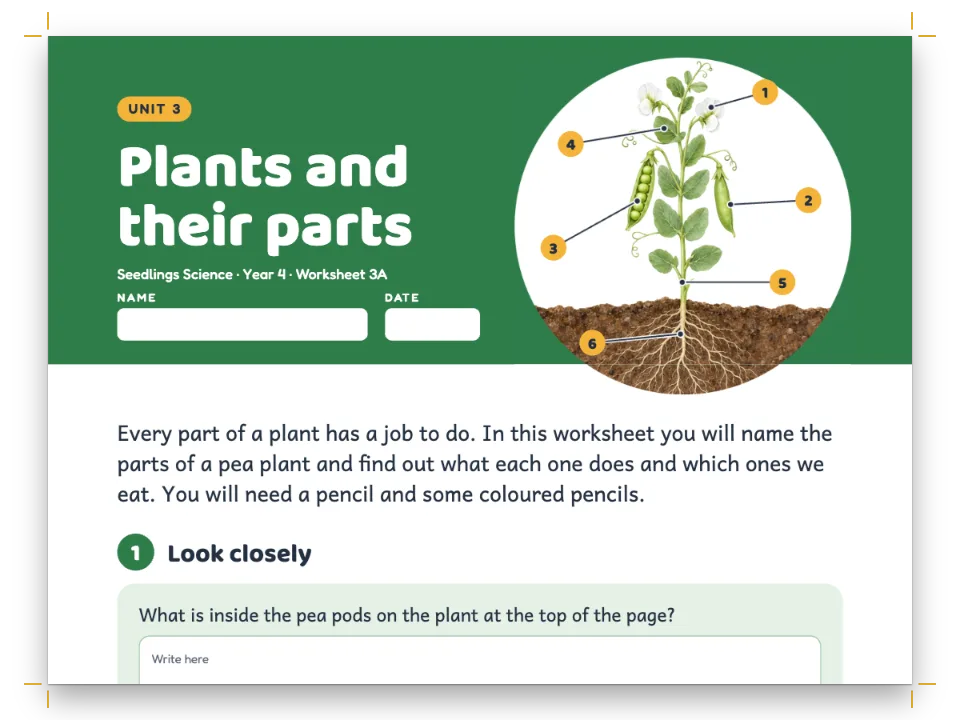
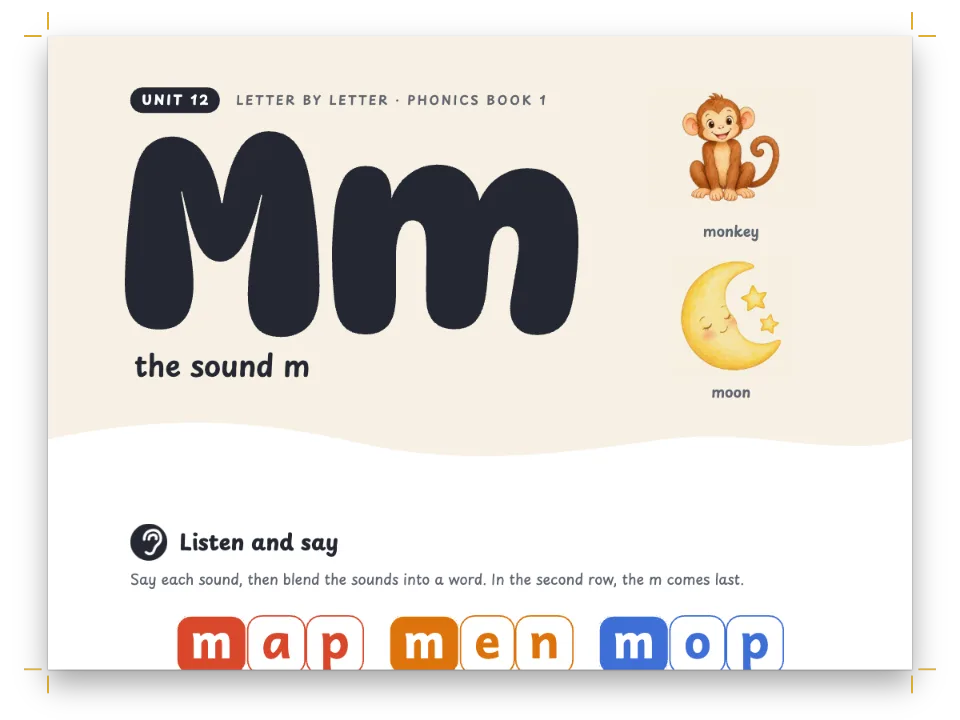
Fünf Seiten aus Water on the move, Einheit 3 eines erfundenen Sachkunde-Arbeitshefts für die vierte Klasse, im Format 210 × 280 mm. Auf dem Umschlag reicht eine flächige Zeichnung des Wasserkreislaufs bis in den Anschnitt, darunter ein Titel in 54 pt und eine Linie für den Namen. Jedes Arbeitsblatt kommt aus derselben Seitenvorlage: die Zeile der Einheit, ein blaues Titelband, ein kurzer Text neben einer Zeichnung und drei hellblaue Aufgabenkästen mit nummeriertem Reiter. Unter dem ersten und dem dritten Kasten stehen Linien für die Antwort. Jeder Kasten ist so hoch wie sein Text, deshalb schiebt das französische Blatt, hier und da eine Zeile länger, seine Linien weiter nach unten als das englische, ohne dass sich eine Position der Vorlage ändert. Das Projekt, ein Regenmesser aus einer Flasche, hat mehr Schritte, als auf eine Seite passen: Sein Kasten endet am Fuß mit Continued und läuft oben auf einer eingefügten Seite weiter, gefolgt von sechs Linien für die Beobachtungen. Jedes Wort, auch die der Reiter und die Überschrift der Beobachtungen, steht im Markdown.
Dieses Rezept beantwortet
- Wie lasse ich die Kästen einer Seite mit ihrem Text wachsen, sodass sie die Kästen darunter nach unten schieben?
- Wie lasse ich eine Aufgabe, die nicht passt, mit dem Vermerk „Wird fortgesetzt“ auf der nächsten Seite weiterlaufen?
- Wie baue ich eine Arbeitsblattseite: Schreiblinien, Antwortkästen, Wortspeicher, Checklisten?
Die kurze Antwort
// An empty frame is an answer space: the Markdown sends it nothing (optional: no slotEmpty).
// Its `rules` draw a line at the foot of every LINE mm of its height, so the lines are part
// of the frame and move with it when a box above grows. minHeight too: a box that runs out of
// room may not take the lines away from the child.
const answer = (name, lines) => ({ name, optional: true, width: mm(W), height: mm(LINE * lines),
  minHeight: mm(LINE * lines),
  rules: { every: mm(LINE), color: col('rule'), width: pt(0.75) } });
// A box is as tall as its text, never less than drawn: a longer text makes it taller and
// pushes everything after it in the group down the page.
const box = (name, style, minHeight) => ({ name, style, width: mm(W), minHeight: mm(minHeight) });
const sheet = {
  id: 'ficha',
  decoration: { elements: [kicker] },
  frames: [
    ...opening,
    // The group starts where its first box is placed: under the text, and runs down from there.
    { ...box('act-1', 'actividad', 22), placement: at('#texto', 'below', 0, 6) },
    answer('lineas-1', 3),
    box('act-2', 'actividad', 22),
    // The last box goes on overleaf, with the answer space after it, when its text outgrows
    // the page; the other two push it down instead.
    { ...box('act-3', 'actividad', 22), overflow: { continueIn: 'next-page' } },
    answer('lineas-3', 2),
  ],
  groups: [{ name: 'actividades', kind: 'stack', gap: mm(4.5),
    frames: ['act-1', 'lineas-1', 'act-2', 'act-3', 'lineas-3'] }],
};
Zutaten
- Funktionen
- Rahmen, die in einer Gruppe wachsenRahmen, die auf der nächsten Seite weiterlaufenZusammengesetzte SeitenExpliziter vertikaler AbstandInline-ChipsKästenNummerierte KastenreiterText, Linien und Kästen in SeitengestaltungenBilder in SeitengestaltungenÜberschriftenformateAufzählungen und ChecklistenNummerierte ListenGespiegelte RänderKolumnentitel und SeitenzahlenSemantische FarbpaletteSeiten auf einem CanvasPDF-Export
- Nutzt außerdem
- SpaltenausgleichAn Rahmen verankertes DekorÜberschriftenattributeAbbildungen genau hierIm PDF eingebettete SchriftenEigene RessourcentypenAbbildungen und Tabellen als RessourcenVerkettete Textrahmen
- Schrift
- Andika, Baloo 2, Lexend (SIL OFL 1.1)
- Dateien
- Keine: Jedes Bild wird im Code gezeichnet
Zubereitung
#1 · Jede Aufgabe über ihren Namen in ihren Kasten gießen
Die Vorlage ist die kurze Antwort oben. Im Markdown ist ein Blatt ein ::::page-Block: Die erste Überschrift geht in den Rahmen mit takes: 'h1', der Absatz in den Flussrahmen und jedes :::frame{slot="…"} in den Rahmen dieses Namens, die Worte des Reiters in label. Die Antwortrahmen bekommen nichts und tragen deshalb optional: true; ein leerer Rahmen würde sonst die Warnung slotEmpty auslösen. Eine Zeichenaufgabe behält ihren freien Platz im eigenen Kasten mit :::space{lines=3}, denn wie viel Platz eine Zeichnung braucht, gehört zur Aufgabe.
:::frame{slot="act-1" label="1 · Read and answer"}
Tom lives in Leeds. The water from his tap comes from a reservoir in the hills…
:::#2 · Den Stapel die Linien mit den Kästen verschieben lassen
Jeder Kasten hat eine minHeight von 22 mm, die Höhe, in der er gezeichnet ist, und darüber eine Höhe auto. Die Gruppe legt ihre fünf Rahmen mit 4,5 mm Abstand untereinander, ab der Stelle, an der act-1 unter den Text gesetzt ist; ein höherer Kasten schiebt also alles nach ihm nach unten. Die Linien gehören zum leeren Rahmen: Sein rules zeichnet am Fuß jedes 8-mm-Streifens seiner Höhe eine Linie, unter dem Text, sodass die Linien mit dem Rahmen wandern und ein längerer Antwortplatz ein höherer Rahmen ist. Geben Sie den Antwortrahmen eine minHeight gleich ihrer Höhe: Wird der Platz in einer Gruppe knapp, holt sich die Umbruchleiter Raum von den Rahmen der Gruppe bis zu deren Minimum zurück, und das Minimum eines leeren Rahmens ist null; die Linien lägen dann auf dem nächsten Kasten. Der letzte Kasten des Blatts, act-3, läuft auf der nächsten Seite weiter (overflow.continueIn: 'next-page'), wenn sein Text die Seite sprengt, und die Antwortlinien unter ihm gehen mit.
#3 · Das Projekt auf die nächste Seite tragen
const project = {
  id: 'proyecto',
  overflowTemplate: 'proyecto-sigue',
  decoration: { elements: [kicker] },
  frames: [
    ...opening,
    { ...box('material', 'material', 20), placement: at('#texto', 'below', 0, 9) },
    // As tall as its text, never past the foot of the page, at full size: the rest ends
    // with the language's mark (Continúa, Continued, À suivre) and goes on on an added page.
    { name: 'pasos', style: 'proyecto', width: mm(W), overflow: { continueIn: 'next-page' } },
  ],
  groups: [{ name: 'trabajo', kind: 'stack', gap: mm(9), frames: ['material', 'pasos'] }],
};
// The added page: the rest of the steps at the head, then lines for the child's notes,
// under a heading the page fence names (notas="…").
const projectGoesOn = {
  id: 'proyecto-sigue',
  decoration: { elements: [kicker,
    { kind: 'text', id: 'notas-titulo', content: '{attr.notas}', fontFamily: DISPLAY,
      fontSize: pt(15), fontWeight: 700, color: col('sea'),
      placement: { ...at('#notas', 'top-left', 0, -3), size: { width: mm(W) } } }] },
  frames: [
    { name: 'pasos', style: 'proyecto', width: mm(W),
      placement: at('container', 'top-left', 0, 9) },
    answer('notas', 6),
  ],
  groups: [{ name: 'trabajo', kind: 'stack', gap: mm(16), frames: ['pasos', 'notas'] }],
};
Der Kasten mit den Schritten hat keine feste Höhe: Er ist so hoch wie sein Text und endet am Fuß des Satzspiegels. Ein Rahmen, der auf einer anderen Seite weiterlaufen kann, läuft weiter, bevor sein Text kleiner gesetzt wird. Der Kasten wird deshalb in voller Größe zwischen zwei Zeilen geteilt, endet mit dem Vermerk der Sprache (Continúa, Continued, À suivre, aus locale) und läuft im gleichnamigen Rahmen einer Seite von proyecto-sigue weiter (wenn der Text weiterläuft). Die eingefügte Seite zeichnet die Beobachtungslinien unter den Rest des Kastens, mit der Überschrift, die der Seitenblock in notas="What I noticed" nennt; die Worte bleiben so im Markdown und wechseln mit jeder Ausgabe.
#4 · Den Umschlag bis in den Anschnitt zeichnen
const cover = {
  id: 'portada', header: false, footer: false,
  decoration: { elements: [
    { kind: 'image', id: 'cielo', resourceId: 'portada', decorative: true,
      placement: { ...at('bleed', 'top-left'), size: { width: 'fill', height: mm(178) } } },
    { kind: 'rule', id: 'nombre-linea', direction: 'horizontal', thickness: pt(1),
      color: col('sea'), placement: { ...at('#nombre', 'bottom-left', 0, 1),
        size: { width: mm(W) } } },
  ] },
  frames: [
    { name: 'titulo', takes: 'h1', width: mm(W), placement: at('container', 'top-left', 0, 162) },
    { name: 'subtitulo', flow: true, width: mm(W) },
    { name: 'nombre', style: 'campo', width: mm(W), minHeight: mm(12) },
    { name: 'colofon', style: 'colofon', width: mm(W), placement: at('container', 'bottom-left') },
  ],
  groups: [{ name: 'portada', kind: 'stack', gap: mm(4),
    frames: ['titulo', 'subtitulo', 'nombre'] }],
};
Auch der Umschlag ist eine zusammengesetzte Seite: Sein Bild ist Dekoration, am Anschnitt verankert, und Titel, Reihenzeile und Namensfeld bilden einen Stapel, der 162 mm unter dem Satzspiegelkopf beginnt. Die Namenslinie hängt am Fuß ihres Rahmens, sodass eine Beschriftung, die in einer anderen Sprache zwei Zeilen braucht, die Linie unter den Worten behält. header: false und footer: false halten die Seitenzahl vom Umschlag fern.
Das ganze Rezept
// ═══ Postext Cookbook · Nº 159 · Activity book with boxes that grow ══════════════ // https://postext.dev/en/cookbook/activity-book-growing-boxes // Code: MIT · Text: original (CC BY 4.0) · Pictures: drawn in code // Fonts: Andika, Baloo 2, Lexend (SIL OFL 1.1) · Needs postext ≥ 1.38.0 import { buildDocumentWithFonts, renderPageToCanvas, registerResourceImage, } from 'https://esm.sh/postext'; import { renderToPdf, decompressWoff2 } from 'https://esm.sh/postext-pdf'; const LANG = 'en'; // @lang: the language of the sample document ('en' | 'es' | 'fr') const RECIPE = 'activity-book-growing-boxes'; // ─── 1 · Design ───────────────────────────────────────────────────────────── // #region palette: one ink, the water blue, the sun, and the pale fields of the boxes const palette = { ink: '#1f2d38', // text sea: '#1d659c', // titles, tabs, list numbers sky: '#e2f0f9', // activity boxes, the cover's sky sun: '#f0a531', // the project's box, the sun leaf: '#4c8f55', // the cover's hills sand: '#fcf0d8', // the materials box rule: '#93bcd8', // answer lines, blanks paper: '#ffffff', }; const col = (id) => ({ hex: palette[id], model: 'hex', paletteId: id }); const colorPalette = [ ...Object.entries(palette).map(([id, hex]) => ({ id, name: id, value: { hex, model: 'hex' } })), { id: 'main-color', name: 'sea (defaults)', value: { hex: palette.sea, model: 'hex' } }, ]; // #endregion const [TEXT, DISPLAY, LABEL] = ['Andika', 'Baloo 2', 'Lexend']; // Andika: for early readers const W = 174; // mm: the width of the type area, and of every box const LINE = 8; // mm between two answer lines: room for a child's handwriting const at = (to, edge, x = 0, y = 0) => ({ anchor: { to, edge }, offset: { x: mm(x), y: mm(y) } }); // The head every sheet shares: the unit over the title band, the text with its drawing. const kicker = { kind: 'text', id: 'tema', content: '{attr.tema}', fontFamily: LABEL, fontSize: pt(8.5), fontWeight: 600, color: col('sea'), textTransform: 'uppercase', letterSpacing: pt(1.4), placement: at('container', 'top-left') }; const opening = [ { name: 'titulo', takes: 'h1', style: 'banda', width: mm(W), placement: at('container', 'top-left', 0, 6) }, { name: 'texto', flow: true, width: mm(W - 52), minHeight: mm(36), placement: at('#titulo', 'below', 0, 4) }, { name: 'dibujo', width: mm(44), placement: at('#titulo', 'below', W - 44, 4) }, ]; // #region answer: boxes in a stack grow with their text; empty ruled frames hold the answers // An empty frame is an answer space: the Markdown sends it nothing (optional: no slotEmpty). // Its `rules` draw a line at the foot of every LINE mm of its height, so the lines are part // of the frame and move with it when a box above grows. minHeight too: a box that runs out of // room may not take the lines away from the child. const answer = (name, lines) => ({ name, optional: true, width: mm(W), height: mm(LINE * lines), minHeight: mm(LINE * lines), rules: { every: mm(LINE), color: col('rule'), width: pt(0.75) } }); // A box is as tall as its text, never less than drawn: a longer text makes it taller and // pushes everything after it in the group down the page. const box = (name, style, minHeight) => ({ name, style, width: mm(W), minHeight: mm(minHeight) }); const sheet = { id: 'ficha', decoration: { elements: [kicker] }, frames: [ ...opening, // The group starts where its first box is placed: under the text, and runs down from there. { ...box('act-1', 'actividad', 22), placement: at('#texto', 'below', 0, 6) }, answer('lineas-1', 3), box('act-2', 'actividad', 22), // The last box goes on overleaf, with the answer space after it, when its text outgrows // the page; the other two push it down instead. { ...box('act-3', 'actividad', 22), overflow: { continueIn: 'next-page' } }, answer('lineas-3', 2), ], groups: [{ name: 'actividades', kind: 'stack', gap: mm(4.5), frames: ['act-1', 'lineas-1', 'act-2', 'act-3', 'lineas-3'] }], }; // #endregion // #region continue: the project's steps go on on a page of their own, after their mark const project = { id: 'proyecto', overflowTemplate: 'proyecto-sigue', decoration: { elements: [kicker] }, frames: [ ...opening, { ...box('material', 'material', 20), placement: at('#texto', 'below', 0, 9) }, // As tall as its text, never past the foot of the page, at full size: the rest ends // with the language's mark (Continúa, Continued, À suivre) and goes on on an added page. { name: 'pasos', style: 'proyecto', width: mm(W), overflow: { continueIn: 'next-page' } }, ], groups: [{ name: 'trabajo', kind: 'stack', gap: mm(9), frames: ['material', 'pasos'] }], }; // The added page: the rest of the steps at the head, then lines for the child's notes, // under a heading the page fence names (notas="…"). const projectGoesOn = { id: 'proyecto-sigue', decoration: { elements: [kicker, { kind: 'text', id: 'notas-titulo', content: '{attr.notas}', fontFamily: DISPLAY, fontSize: pt(15), fontWeight: 700, color: col('sea'), placement: { ...at('#notas', 'top-left', 0, -3), size: { width: mm(W) } } }] }, frames: [ { name: 'pasos', style: 'proyecto', width: mm(W), placement: at('container', 'top-left', 0, 9) }, answer('notas', 6), ], groups: [{ name: 'trabajo', kind: 'stack', gap: mm(16), frames: ['pasos', 'notas'] }], }; // #endregion // #region cover: a sky drawn to the bleed, the title, and a line for the child's name const cover = { id: 'portada', header: false, footer: false, decoration: { elements: [ { kind: 'image', id: 'cielo', resourceId: 'portada', decorative: true, placement: { ...at('bleed', 'top-left'), size: { width: 'fill', height: mm(178) } } }, { kind: 'rule', id: 'nombre-linea', direction: 'horizontal', thickness: pt(1), color: col('sea'), placement: { ...at('#nombre', 'bottom-left', 0, 1), size: { width: mm(W) } } }, ] }, frames: [ { name: 'titulo', takes: 'h1', width: mm(W), placement: at('container', 'top-left', 0, 162) }, { name: 'subtitulo', flow: true, width: mm(W) }, { name: 'nombre', style: 'campo', width: mm(W), minHeight: mm(12) }, { name: 'colofon', style: 'colofon', width: mm(W), placement: at('container', 'bottom-left') }, ], groups: [{ name: 'portada', kind: 'stack', gap: mm(4), frames: ['titulo', 'subtitulo', 'nombre'] }], }; // #endregion // A box with a tab: the tab's words come from the Markdown (label="…"). const tabbed = (id, fill, tab, tabInk, extra = {}) => ({ id, backgroundEnabled: true, background: col(fill), borderRadius: mm(3), border: { enabled: false }, padding: { top: mm(3), right: mm(5), bottom: mm(3.5), left: mm(5) }, label: { position: 'top-left', background: col(tab), color: col(tabInk), fontFamily: LABEL, fontSize: pt(9), fontWeight: 600, height: mm(6), paddingX: mm(3), offset: mm(6), inset: mm(4), rule: { enabled: false, color: col(tab) } }, body: { fontFamily: TEXT, fontSize: pt(11.5), lineHeight: pt(16), color: col('ink'), boldColor: col('ink'), italicColor: col('ink'), firstLineIndent: pt(0) }, ...extra, }); const plain = (id, size, lead, color, extra = {}) => ({ id, backgroundEnabled: false, border: { enabled: false }, padding: { top: mm(0), right: mm(0), bottom: mm(0), left: mm(0) }, body: { fontFamily: LABEL, fontSize: pt(size), lineHeight: pt(lead), color: col(color), boldColor: col(color), italicColor: col(color), firstLineIndent: pt(0) }, ...extra }); const folio = (id, parity, edge, x) => ({ kind: 'text', id, content: '{pageNumber}', parity, fontFamily: DISPLAY, fontSize: pt(11), fontWeight: 800, color: col('paper'), align: 'center', box: { backgroundColor: col('sea'), borderRadius: mm(4) }, placement: { ...at('page', edge, x, -9), size: { width: mm(8), height: mm(8) } } }); const bookTitle = (id, parity, edge, x) => ({ kind: 'text', id, content: '{title} · {subtitle}', parity, fontFamily: LABEL, fontSize: pt(7.5), fontWeight: 500, color: col('sea'), textTransform: 'uppercase', letterSpacing: pt(1.1), placement: at('page', edge, x, -11) }); const config = { locale: t({ es: 'es', en: 'en-gb', fr: 'fr' }), // hyphenation and the continuation mark resourceTypes: [{ id: 'dibujo', name: t({ es: 'Dibujo', en: 'Drawing', fr: 'Dessin' }), shortLabel: '', numberingTemplate: '', resetOn: 'never', counterFormat: 'decimal', captionPrefix: '', defaultPlacement: { position: 'here' } }], colorPalette, page: { sizePreset: 'custom', width: mm(210), height: mm(280), dpi: 150, margins: { top: mm(20), bottom: mm(22), left: mm(20), right: mm(16), mirror: true }, }, layout: { layoutType: 'single' }, bodyText: { fontFamily: TEXT, fontSize: pt(11.5), lineHeight: pt(16), color: col('ink'), boldColor: col('ink'), italicColor: col('ink'), referenceColor: col('ink'), textAlign: 'left', firstLineIndent: pt(0), paragraphSpacing: true, hyphenation: { enabled: true }, optimalLineBreaking: true, avoidWidows: true, avoidOrphans: true, avoidRunts: true, }, headings: { fontFamily: DISPLAY, color: col('sea'), fontWeight: 700, balancing: { enabled: false }, levels: [ // Every sheet is a composed page, which starts a page of its own. { level: 1, fontSize: pt(25), lineHeight: pt(30), fontWeight: 800, color: col('paper'), breakBefore: { enabled: false }, marginTop: pt(0), marginBottom: pt(0) }, { level: 3, fontSize: pt(13.5), lineHeight: pt(17), marginTop: pt(6), marginBottom: pt(2) }, ], }, headingStyles: [{ id: 'portada', fontSize: pt(54), lineHeight: pt(54), fontWeight: 800, color: col('sea'), marginTop: pt(0), marginBottom: pt(0) }], unorderedLists: { bulletChar: '•', color: col('sea'), fontWeight: 700, itemSpacing: pt(3) }, orderedLists: { numberFormat: 'arabic', fontFamily: DISPLAY, fontWeight: 800, color: col('sea'), itemSpacing: pt(4) }, chipStyles: [ // An empty chip, :chip[ ]{style="hueco"}, is a blank to write in: padding and an outline. { id: 'hueco', fontFamily: LABEL, background: col('paper'), borderColor: col('rule'), borderWidth: pt(0.9), borderRadius: mm(1.4), paddingX: mm(13), paddingY: em(0.1) }, { id: 'casilla', fontFamily: LABEL, background: col('paper'), borderColor: col('sea'), borderWidth: pt(0.9), borderRadius: mm(1), paddingX: em(0.55), paddingY: em(0.05), gap: em(0.5) }, ], calloutStyles: [ tabbed('actividad', 'sky', 'sea', 'paper'), tabbed('material', 'sand', 'sun', 'ink'), tabbed('proyecto', 'paper', 'sun', 'ink', { border: { enabled: true, color: col('sun'), width: pt(1.5) } }), { ...plain('banda', 25, 30, 'paper'), backgroundEnabled: true, background: col('sea'), borderRadius: mm(3), padding: { top: mm(2.5), right: mm(5), bottom: mm(3), left: mm(5) } }, plain('campo', 10, 14, 'sea', { padding: { top: mm(5), right: mm(0), bottom: mm(0), left: mm(0) } }), plain('colofon', 7.5, 10, 'ink'), ], header: { elements: [] }, footer: { elements: [ folio('folio-par', 'even', 'bottom-left', 20), bookTitle('titulo-par', 'even', 'bottom-left', 32), folio('folio-impar', 'odd', 'bottom-right', -20), bookTitle('titulo-impar', 'odd', 'bottom-right', -32), ] }, pageTemplates: [cover, sheet, project, projectGoesOn], }; // ─── 2 · Content ──────────────────────────────────────────────────────────── const markdown = String.raw`---Markdown-Beispiel · 100 Zeilen · content.en.md
title: "Water on the move" subtitle: "Activity book" --- ::::page{template="portada"} # Water on the move {style="portada"} Science activity book · Year 4 · Unit 3 :::frame{slot="nombre"} Name ::: :::frame{slot="colofon"} Set in Andika, Baloo 2 and Lexend (SIL OFL) · Text and drawings: original, CC BY 4.0 ::: :::: ::::page{template="ficha" tema="Unit 3 · Sheet 1"} # Where is the water? Almost three quarters of the Earth is covered by water. Most of it is **salt water**, in the seas and oceans. **Fresh water**, the kind we drink, is only a small part: it runs in rivers, rests in lakes, hides under the ground or lies frozen at the poles. ::resource{id="planeta" slot="dibujo"} :::frame{slot="act-1" label="1 · Read and answer"} Tom lives in Leeds. The water from his tap comes from a reservoir in the hills, goes through a treatment works and travels through pipes to his house. Where does the water from your tap come from? Why do you think it has to be cleaned before we drink it? ::: :::frame{slot="act-2" label="2 · Fill in the gaps"} - The water in the seas and oceans is :chip[ ]{style="hueco"} and we cannot drink it. - Rivers, lakes and the ground below us hold :chip[ ]{style="hueco"} water. - At the poles, nearly all the water is frozen into :chip[ ]{style="hueco"}. ::: :::frame{slot="act-3" label="3 · Draw and write"} Draw a place near your home where there is water: a fountain, a river, a reservoir or the beach. Then write its name on the lines and what people use it for. :::space{lines=3} ::: :::: ::::page{template="ficha" tema="Unit 3 · Sheet 2"} # Solid, liquid and gas Water changes state when it gets warmer or colder. Below zero degrees it turns into **ice**, which is a solid. When ice warms up it melts and becomes a **liquid** again. When water boils it turns into **steam**, a gas we cannot see. ::resource{id="estados" slot="dibujo"} :::frame{slot="act-1" label="1 · Observe"} Put an ice cube on a plate and leave it on the table. Look at it every ten minutes for half an hour. What happens to the ice cube? What is on the plate at the end? Write down why you think this happens. ::: :::frame{slot="act-2" label="2 · Tick the true sentences"} - :chip[ ]{style="casilla"} Ice is water in its solid state. - :chip[ ]{style="casilla"} You can pick up steam in your hand. - :chip[ ]{style="casilla"} A puddle dries up because the sun makes the water evaporate. - :chip[ ]{style="casilla"} Water in the freezer turns into steam. ::: :::frame{slot="act-3" label="3 · Explain"} When you cook pasta, steam rises from the pan. If you hold a cold lid over it, the lid fills with tiny drops. Where do those drops come from? ::: :::: ::::page{template="proyecto" tema="Unit 3 · Project" notas="What I noticed"} # Make a rain gauge A rain gauge measures how much rain falls in one place. Weather stations use very precise instruments, but you can make one from a bottle and keep a record of the rain for a whole week. ::resource{id="pluviometro" slot="dibujo"} :::frame{slot="material" label="You will need"} - A clean, empty two-litre plastic bottle. - Scissors, a 20-centimetre ruler and sticky tape. - A permanent marker and a handful of small stones. ::: :::frame{slot="pasos" label="Step by step"} 1. Ask an adult to cut the bottle where it starts to get narrower. Keep the top part: it will be your funnel. 2. Put the stones in the bottom. They stop the bottle blowing over in the wind. 3. Pour in water until the stones are covered and mark that level with the marker. That line is the zero of your rain gauge. 4. Tape the ruler to the outside of the bottle, so that the zero on the ruler sits exactly on the line you marked. 5. Turn the top part upside down and push it into the bottle, neck first. The funnel collects the rain and slows down evaporation. 6. Find an open spot in the playground or the garden, away from trees and roofs, which keep the rain off. 7. Every day at the same time, read how many millimetres the water has risen above the zero and write it in your record. Then pour the water out down to the zero line. ### My record for the week - Monday: :chip[ ]{style="hueco"} millimetres - Tuesday: :chip[ ]{style="hueco"} millimetres - Wednesday: :chip[ ]{style="hueco"} millimetres - Thursday: :chip[ ]{style="hueco"} millimetres - Friday: :chip[ ]{style="hueco"} millimetres ### Think Which day had the most rain? Add up the five days: how many millimetres fell in total? Compare your result with a classmate who put their rain gauge somewhere else. ::: ::::`; // content.<lang>.md, inlined by the Cookbook // #region art: the water cycle on the cover, the planet, the three states, the rain gauge const P = palette; const svgDoc = (w, h, body) => `<svg xmlns="http://www.w3.org/2000/svg" viewBox="0 0 ${w} ${h}" ` + `width="${w * 10}" height="${h * 10}">${body}</svg>`; const cloud = (x, y, s, fill = P.paper) => `<g transform="translate(${x} ${y}) scale(${s})" ` + `fill="${fill}">` + '<circle cx="0" cy="0" r="9"/><circle cx="11" cy="-5" r="11"/><circle cx="24" cy="0" r="9"/>' + '<rect x="-9" y="0" width="42" height="9" rx="4.5"/></g>'; const arrow = (x1, y1, x2, y2, color) => { const a = Math.atan2(y2 - y1, x2 - x1); const tip = (d, o) => `${(x2 - d * Math.cos(a + o)).toFixed(1)},` + `${(y2 - d * Math.sin(a + o)).toFixed(1)}`; return `<path d="M${x1} ${y1} L${x2} ${y2}" stroke="${color}" stroke-width="1.6" ` + `stroke-linecap="round" stroke-dasharray="3 3" fill="none"/>` + `<path d="M${x2} ${y2} L${tip(5, 0.45)} L${tip(5, -0.45)} Z" fill="${color}"/>`; }; const rain = (x, y) => [0, 6, 12, 18].map((dx, i) => `<path d="M${x + dx} ${y + (i % 2) * 3} ` + `l-2 7" stroke="${P.sea}" stroke-width="1.6" stroke-linecap="round"/>`).join(''); const ART = { portada: [210, 178, () => `<rect width="210" height="178" fill="${P.sky}"/>` + `<circle cx="168" cy="38" r="17" fill="${P.sun}"/>` + Array.from({ length: 12 }, (_, i) => { const a = (i * Math.PI) / 6; const p = (r) => `${(168 + r * Math.cos(a)).toFixed(1)} ${(38 + r * Math.sin(a)).toFixed(1)}`; return `<path d="M${p(22)} L${p(29)}" stroke="${P.sun}" stroke-width="2.4" ` + 'stroke-linecap="round"/>'; }).join('') + cloud(28, 40, 1.2) + cloud(86, 26, 0.9) + rain(30, 58) + `<path d="M0 132 L34 84 L52 104 L74 70 L112 132 Z" fill="${P.leaf}"/>` + `<path d="M74 70 L66 82 L72 80 L76 85 L81 80 L74 70 Z" fill="${P.paper}"/>` + `<path d="M58 132 C70 120 64 112 76 104" stroke="${P.sea}" stroke-width="3" fill="none"/>` + `<path d="M0 132 L210 132 L210 178 L0 178 Z" fill="${P.sea}"/>` + [140, 152, 164].map((y) => `<path d="M${y - 120} ${y} q8 -4 16 0 t16 0 t16 0" ` + `stroke="${P.sky}" stroke-width="1.4" fill="none"/>`).join('') + arrow(150, 126, 128, 66, P.paper) + arrow(176, 124, 160, 70, P.paper) + arrow(120, 30, 70, 34, P.paper)], planeta: [56, 46, () => `<circle cx="26" cy="23" r="20" fill="${P.sea}"/>` + `<path d="M14 10 q8 -2 10 6 q-2 7 -9 6 q-5 -4 -1 -12 Z" fill="${P.leaf}"/>` + `<path d="M30 26 q9 -3 11 4 q-1 8 -8 9 q-6 -5 -3 -13 Z" fill="${P.leaf}"/>` + `<path d="M20 5 q6 -3 12 0 q-6 3 -12 0 Z" fill="${P.sky}"/>` + `<path d="M48 18 q-5 8 0 12 q5 -4 0 -12 Z" fill="${P.sea}" stroke="${P.paper}" ` + 'stroke-width="1"/>'], estados: [56, 46, () => `<rect x="3" y="24" width="14" height="14" rx="2.5" fill="${P.sky}" ` + `stroke="${P.sea}" stroke-width="1.4"/>` + `<path d="M22 18 L24 42 L36 42 L38 18 Z" fill="${P.sky}" stroke="${P.sea}" ` + 'stroke-width="1.4"/>' + `<path d="M23 27 L37 27" stroke="${P.sea}" stroke-width="1"/>` + `<path d="M23.3 27 L24 42 L36 42 L36.7 27 Z" fill="${P.sea}"/>` + [44, 49, 54].map((x) => `<path d="M${x - 4} 40 q-3 -6 0 -12 t0 -12" stroke="${P.rule}" ` + `stroke-width="1.6" fill="none" stroke-linecap="round"/>`).join('')], pluviometro: [56, 46, () => `<path d="M18 10 L40 10 L40 42 Q40 44 38 44 L20 44 Q18 44 18 42 Z" ` + `fill="${P.sky}" stroke="${P.sea}" stroke-width="1.4"/>` + `<path d="M16 10 L42 10 L33 19 L25 19 Z" fill="${P.paper}" stroke="${P.sea}" ` + 'stroke-width="1.4"/>' + '<path d="M18.7 30 L39.3 30 L39.3 42 Q39.3 43.3 38 43.3 L20 43.3 Q18.7 43.3 18.7 42 Z" ' + `fill="${P.sea}"/>` + [22, 26, 30, 34, 38].map((y) => `<path d="M40 ${y} l5 0" stroke="${P.ink}" ` + 'stroke-width="1"/>').join('') + cloud(4, 4, 0.35, P.rule) + rain(6, 8).replaceAll('l-2 7', 'l-1 4')], }; const ALT = { portada: t({ es: 'El ciclo del agua: el sol calienta el mar, el vapor sube a las nubes y la lluvia cae ' + 'en la montaña y vuelve por el río', en: 'The water cycle: the sun warms the sea, vapour rises to the clouds, and rain falls on ' + 'the hills and runs back down the river', fr: 'Le cycle de l’eau : le soleil chauffe la mer, la vapeur monte aux nuages, la pluie ' + 'tombe sur la montagne et revient par la rivière' }), planeta: t({ es: 'La Tierra, casi toda azul, y una gota de agua', en: 'The Earth, mostly blue, and a drop of water', fr: 'La Terre, presque toute bleue, et une goutte d’eau' }), estados: t({ es: 'Un cubito de hielo, un vaso de agua y vapor', en: 'An ice cube, a glass of water and steam', fr: 'Un glaçon, un verre d’eau et de la vapeur' }), pluviometro: t({ es: 'Una botella cortada con una regla: el pluviómetro', en: 'A cut bottle with a ruler: the rain gauge', fr: 'Une bouteille coupée avec une règle : le pluviomètre' }), }; const resources = Object.entries(ART).map(([id, [w, h]]) => ({ id, typeId: 'dibujo', kind: 'svg', caption: '', altText: ALT[id], createdAt: 0, updatedAt: 0, svg: { fileId: `${id}.svg`, width: w * 10, height: h * 10 }, })); for (const [id, [w, h, draw]] of Object.entries(ART)) { await loadSvg(`${id}.svg`, svgDoc(w, h, draw())); } // #endregion // ─── 3 · Fonts ────────────────────────────────────────────────────────────── const FONTS = { // text, display and label faces, loaded before the build Andika: ['400', '400i', '700'], 'Baloo 2': ['700', '800'], Lexend: ['500', '600'], }; // ─── 4 · Build & show ─────────────────────────────────────────────────────── const doc = await buildDocumentWithFonts({ markdown, resources }, config, kitFonts(FONTS)); showPages(doc, { title: t({ es: 'El agua, de viaje', en: 'Water on the move', fr: 'L’eau en voyage' }) }); offerPdf(() => renderToPdf(doc, { fontProvider: fontsourceProvider, resourceBytes: imageBytes }), `${RECIPE}.pdf`);Kit · core, fonts, viewer, pdf, images: in jedem Rezept gleich · 315 Zeilen
// ─── Kit ── helpers shared by every Cookbook recipe · postext.dev/cookbook ───── // ─── Kit · core v1 ── the same in every recipe · postext.dev/cookbook function mm(value) { return { value, unit: 'mm' }; } function pt(value) { return { value, unit: 'pt' }; } function em(value) { return { value, unit: 'em' }; } /** The sample language's string: t({ en: 'Figure', es: 'Figura' }). */ function t(strings) { return strings[LANG] ?? Object.values(strings)[0]; } /** A file in this recipe's assets folder, served from the Postext repo by jsDelivr. */ function asset(file) { return `https://cdn.jsdelivr.net/gh/drnachio/postext@main/cookbook/${RECIPE}/assets/${file}`; } // ─── Kit · fonts v3 ── the same in every recipe · postext.dev/cookbook // Postext loads the faces a config asks for before layout (prepareFonts, // buildDocumentWithFonts) and asks the kit for the files: Fontsource's, the // files the PDF embeds too. /** The options of buildDocumentWithFonts / prepareFonts / withLoadedFonts: * the Fontsource resolver, and the faces of FONTS loaded with the ones the * config names. FONTS = { 'Family Name': ['400', '400i', '700'] }. */ function kitFonts(FONTS = {}) { const faces = Object.entries(FONTS).flatMap(([family, specs]) => specs.map((spec) => ({ family, weight: parseInt(spec, 10), style: spec.endsWith('i') ? 'italic' : 'normal' }))); return { resolve: fontsourceResolver, faces }; } /** A face's Fontsource files, in a fixed order: latin, then latin-ext and greek * when `text` needs them and the family ships them (kitSubsetsFor), each with * its unicode-range. Null for a weight or slant Fontsource does not ship. */ async function fontsourceResolver(family, weight, style, { text = '' } = {}) { const id = fontsourceId(family); const meta = await fontsourceMeta(family); if (meta && !(meta.weights.includes(weight) && meta.styles.includes(style))) return null; kitStatus('Loading fonts…'); const at = await fontsourceAt(id); return ['latin', ...kitSubsetsFor(text, meta)].map((subset) => ({ source: `${at}files/${id}-${subset}-${weight}-${style}.woff2`, unicodeRange: kitRanges()[subset], })); } /** The unicode-range of each Fontsource file the kit loads (a function: the * kit is inlined after the pen's code, which runs before a const would be set). */ function kitRanges() { return { latin: 'U+0000-00FF,U+0131,U+0152-0153,U+02BB-02BC,U+02C6,U+02DA,U+02DC,U+0304,U+0308,U+0329,' + 'U+2000-206F,U+20AC,U+2122,U+2191,U+2193,U+2212,U+2215,U+FEFF,U+FFFD', 'latin-ext': 'U+0100-02BA,U+02BD-02C5,U+02C7-02CC,U+02CE-02D7,U+02DD-02FF,U+0304,U+0308,U+0329,' + 'U+1D00-1DBF,U+1E00-1E9F,U+1EF2-1EFF,U+2020,U+20A0-20AB,U+20AD-20C0,U+2113,U+2C60-2C7F,U+A720-A7FF', greek: 'U+0370-03FF', }; } /** For the cjk, arabic and comics blocks, which add their own files: the * faces of `faces` = { 'Family Name': ['400', '400i', '700'] }. `text` is the sample: * č ł † α χ also load latin-ext and greek files (kitSubsetsFor). With * `optional`, a face Fontsource does not ship is skipped instead of failing. * The files are added once all have loaded, in the order asked (latin, then * latin-ext, then greek), whatever order they arrive in: the last one added * wins a character two files hold. Resolves to the number of faces added. */ async function loadFonts(faces, text = '', { optional = false } = {}) { kitStatus('Loading fonts…'); const ranges = kitRanges(); const jobs = []; for (const [family, specs] of Object.entries(faces)) { const id = fontsourceId(family); const todo = [...new Set(specs)].map((spec) => [parseInt(spec, 10), spec.endsWith('i') ? 'italic' : 'normal']) .filter(([weight, style]) => !hasFace(family, weight, style)); // before any await const at = fontsourceAt(id); const meta = optional || /[^\0-ÿ]/u.test(text) ? await fontsourceMeta(family) : null; const subsets = ['latin', ...kitSubsetsFor(text, meta)]; for (const [weight, style] of todo) { if (optional && !(meta?.weights.includes(weight) && meta.styles.includes(style))) continue; for (const subset of subsets) { const url = `${await at}files/${id}-${subset}-${weight}-${style}.woff2`; const face = new FontFace(family, `url(${url}) format('woff2')`, { weight: String(weight), style, unicodeRange: ranges[subset] }); jobs.push(face.load().catch(() => { if (subset === 'latin' && !optional) throw new Error(`Fontsource has no ${family} ${weight} ${style}`); })); } } } const ready = await Promise.all(jobs).catch((error) => { kitFail(error); throw error; }); return ready.filter((face) => face && document.fonts.add(face)).length; } /** A loaded FontFace covers this family, weight and style (fonts.check() would * also say yes for families nobody declared). */ function hasFace(family, weight, style) { for (const face of document.fonts) { if (face.status !== 'loaded' || face.style !== style) continue; if (face.family.replace(/^["']|["']$/g, '') !== family) continue; const [low, high = low] = face.weight.split(' ').map(Number); if (weight >= low && weight <= high) return true; } return false; } /** The files beyond latin `text` needs that `meta`'s family ships. */ function kitSubsetsFor(text, meta) { return [[/[Ā-˿ᴀ-ᶿḀ-ỿ†ℓⱠ-Ɀ꜠-ꟿ]/u, 'latin-ext'], [/[Ͱ-Ͽ]/u, 'greek']] .filter(([re, x]) => re.test(text) && meta?.subsets?.includes(x)).map(([, x]) => x); } /** Fontsource's id for a family: 'Source Serif 4' → 'source-serif-4'. */ function fontsourceId(family) { return family.toLowerCase().replace(/\s+/g, '-'); } /** A package's folder at the one version @5 names now (#766). */ function fontsourceAt(id, u = `https://cdn.jsdelivr.net/npm/@fontsource/${id}@`) { return (fontsourceAt.c ??= {})[id] ??= fetch(u + '5/package.json').then((r) => r.json()) .then((p) => p.version || 5, () => 5).then((v) => `${u}${v}/`); } /** The family's Fontsource metadata (weights, styles, subsets), or null. */ function fontsourceMeta(family) { fontsourceMeta.cache ??= new Map(); const id = fontsourceId(family); if (!fontsourceMeta.cache.has(id)) { fontsourceMeta.cache.set(id, fetch(`https://api.fontsource.org/v1/fonts/${id}`) .then((res) => (res.ok ? res.json() : null), () => null)); } return fontsourceMeta.cache.get(id); } // ─── Kit · viewer v2 ── the same in every recipe · postext.dev/cookbook /** The pages as spreads on a dark desk, page 1 alone, then verso | recto, * each painted when it scrolls near. Other options go to renderPageToCanvas. */ function showPages(docs, { title, width = 460, ...render } = {}) { const root = viewer(title); const pages = [docs].flat().flatMap((doc) => doc.pages.map((page) => ({ doc, page, n: (doc.pageIndexOffset ?? 0) + page.index }))); const spreads = []; let verso = null; for (const p of pages) { if (p.n % 2 === 1) { if (verso) spreads.push([verso, null]); verso = p; } else { spreads.push([verso, p]); verso = null; } } if (verso) spreads.push([verso, null]); const density = Math.min(window.devicePixelRatio || 1, 2); showPages.painter?.disconnect(); const painter = new IntersectionObserver((entries) => { for (const { isIntersecting, target } of entries) { if (!isIntersecting) continue; painter.unobserve(target); const { doc, page } = target.postext; renderPageToCanvas(page, doc, target, { ...render, scale: (width * density) / page.width }); } }, { rootMargin: '800px' }); showPages.painter = painter; root.replaceChildren(...spreads.map((pair) => { const spread = document.createElement('div'); spread.className = 'pt-spread'; for (const p of pair) { const figure = document.createElement('figure'); if (p) { const label = p.page.pageLabel || String(p.n + 1); const canvas = document.createElement('canvas'); canvas.postext = p; canvas.style.aspectRatio = `${p.page.width} / ${p.page.height}`; canvas.setAttribute('role', 'img'); canvas.setAttribute('aria-label', `Page ${label}`); const folio = document.createElement('figcaption'); folio.textContent = label; figure.append(canvas, folio); painter.observe(canvas); } else figure.className = 'pt-blank'; spread.append(figure); } return spread; })); kitStatus(`${pages.length} ${pages.length === 1 ? 'page' : 'pages'}`); document.documentElement.dataset.postext = 'ready'; return pages.length; } /** The desk, the bar and the error reporting, created once. */ function viewer(title) { if (!document.getElementById('pt-kit')) { document.head.insertAdjacentHTML('beforeend', `<style id="pt-kit"> :root { color-scheme: dark; } body { margin: 0; background: #0e1014; color: #b9bcc4; font: 13px/1.45 system-ui, sans-serif; } #pt-bar { position: sticky; top: 0; z-index: 1; display: flex; flex-wrap: wrap; align-items: center; gap: 6px 16px; padding: 10px 16px; background: rgb(14 16 20 / .92); backdrop-filter: blur(6px); border-bottom: 1px solid #23262d; } #pt-bar strong { color: #f4f1ea; font-weight: 600; } #pt-actions { display: flex; gap: 12px; margin-left: auto; } #pt-actions a, #pt-actions button { color: #d8a21a; font: inherit; background: none; border: 0; padding: 0; cursor: pointer; } #pages { display: grid; justify-items: center; gap: 48px; padding: 32px 16px 72px; } .pt-spread { display: flex; } .pt-spread figure { margin: 0; width: min(460px, 44vw); } .pt-spread canvas { display: block; width: 100%; background: #fff; box-shadow: 0 1px 2px rgb(0 0 0 / .5), 0 22px 44px -16px rgb(0 0 0 / .8); } .pt-spread figure:first-child canvas { box-shadow: inset -14px 0 14px -14px rgb(0 0 0 / .18), 0 1px 2px rgb(0 0 0 / .5), 0 22px 44px -16px rgb(0 0 0 / .8); } .pt-spread figcaption { margin-top: 10px; text-align: center; font: 600 10px/1 system-ui, sans-serif; letter-spacing: .18em; text-transform: uppercase; color: #6c7079; } .pt-blank { visibility: hidden; } @media (max-width: 760px) { .pt-spread { flex-direction: column; gap: 32px; } .pt-spread figure { width: min(460px, 92vw); } .pt-blank { display: none; } } </style>`); document.body.insertAdjacentHTML('afterbegin', '<header id="pt-bar"><strong id="pt-title"></strong><span id="pt-status" role="status"></span><span id="pt-actions"></span></header>'); document.getElementById('pt-title').textContent = document.title || 'Postext'; addEventListener('error', (event) => kitFail(event.error ?? event.message)); addEventListener('unhandledrejection', (event) => kitFail(event.reason)); } if (title) document.getElementById('pt-title').textContent = title; return document.getElementById('pages') ?? document.body.appendChild(Object.assign(document.createElement('main'), { id: 'pages' })); } function kitStatus(text) { viewer(); document.getElementById('pt-status').textContent = text; } function kitFail(error) { document.documentElement.dataset.postext = 'error'; kitStatus(`Error: ${error?.message ?? error}`); } // ─── Kit · pdf v3 ── the same in every recipe that exports a PDF /** The Fontsource files the screen used, as TrueType, with their range and * place: the nearest weight the family ships, upright with no italic; * latin, then what its letters need (kitSubsetsFor). */ async function fontsourceProvider(family, weight, style, request) { const id = fontsourceId(family); const meta = await fontsourceMeta(family); const weights = meta?.weights?.length ? meta.weights : [400, 700]; const w = weights.reduce((a, b) => (Math.abs(b - weight) < Math.abs(a - weight) ? b : a)); const s = style === 'italic' && meta && !meta.styles.includes('italic') ? 'normal' : style; const text = String.fromCodePoint(...(request?.codePoints ?? [])); const files = await Promise.all(['latin', ...kitSubsetsFor(text, meta)].map(async (subset, order) => { const res = await fetch(`${await fontsourceAt(id)}files/${id}-${subset}-${w}-${s}.woff2`); if (!res.ok) throw new Error(`Fontsource has no ${family} ${w} ${s} ${subset}`); return Object.assign(await decompressWoff2(new Uint8Array(await res.arrayBuffer())), { unicodeRange: kitRanges()[subset], order }); })); return files.length === 1 ? files[0] : files; } /** A "Build the PDF" button; then "Open the PDF" (a new tab: CodePen's frame * shows no PDFs) and a download link. */ function offerPdf(makePdf, filename) { viewer(); const button = Object.assign(document.createElement('button'), { type: 'button', textContent: 'Build the PDF' }); button.dataset.postextPdf = filename; button.addEventListener('click', async () => { button.disabled = true; button.textContent = 'Building the PDF…'; try { const bytes = await makePdf(); const url = URL.createObjectURL(new Blob([bytes], { type: 'application/pdf' })); const size = `${Math.max(1, Math.round(bytes.length / 1024))} KB`; button.replaceWith( Object.assign(document.createElement('a'), { href: url, target: '_blank', rel: 'noopener', textContent: 'Open the PDF ↗' }), Object.assign(document.createElement('a'), { href: url, download: filename, textContent: `Download ${filename} · ${size}` })); } catch (error) { button.disabled = false; button.textContent = 'Build the PDF'; kitFail(error); } }); document.getElementById('pt-actions').append(button); } // ─── Kit · images v3 ── recipes with pictures · postext.dev/cookbook /** Registers a photo or PNG for the canvas and keeps its bytes for the PDF. * fetch → ImageBitmap never taints the canvas (a plain cross-origin <img> would). */ async function loadImage(fileId, url) { const res = await fetch(url); if (!res.ok) throw new Error(`Image not found (${res.status}): ${url}`); const bytes = new Uint8Array(await res.arrayBuffer()); registerResourceImage(fileId, await createImageBitmap(new Blob([bytes]))); (loadImage.bytes ??= new Map()).set(fileId, bytes); } /** Registers SVG markup as a vector image, its fonts inside (inlineSvgFonts, ≥ 1.25). * `options` go to registerResourceImage: { singleInk: true } tints it on the canvas. */ async function loadSvg(fileId, svg, options) { if (typeof inlineSvgFonts === 'function') svg = await inlineSvgFonts(svg, svgFaces); const img = new Image(); img.src = `data:image/svg+xml;charset=utf-8,${encodeURIComponent(svg)}`; await img.decode(); registerResourceImage(fileId, img, options); (loadImage.bytes ??= new Map()).set(fileId, new TextEncoder().encode(svg)); } /** A face's Fontsource files: nearest weight; latin + what the SVG sets. */ async function svgFaces(family, weight, style, { codePoints = [] } = {}) { const [id, m] = [fontsourceId(family), await fontsourceMeta(family)]; const w = m?.weights.reduce((a, b) => (Math.abs(b - weight) < Math.abs(a - weight) ? b : a)) ?? weight; const s = m?.styles.includes(style) === false ? 'normal' : style; return Promise.all(['latin', ...kitSubsetsFor(String.fromCodePoint(...codePoints), m)].map(async (x) => new Uint8Array( await (await fetch(`${await fontsourceAt(id)}files/${id}-${x}-${w}-${s}.woff2`)).arrayBuffer()))); } /** renderToPdf({ resourceBytes: imageBytes }) */ function imageBytes(fileId) { return loadImage.bytes?.get(fileId); } /** renderToHtml({ resourceImageUrl: imageUrl }) */ function imageUrl(fileId) { const bytes = imageBytes(fileId); if (!bytes) return undefined; imageUrl.urls ??= new Map(); if (!imageUrl.urls.has(fileId)) { const type = /\.svg$/i.test(fileId) ? 'image/svg+xml' : /\.png$/i.test(fileId) ? 'image/png' : 'image/jpeg'; imageUrl.urls.set(fileId, URL.createObjectURL(new Blob([bytes], { type }))); } return imageUrl.urls.get(fileId); } // ─── /Kit ───────────────────────────────────────────────────────────────────────
Das zusammengesetzte script.js läuft unverändert: Fügen Sie es in das Modulskript einer beliebigen Seite ein, oder öffnen Sie das Rezept auf CodePen. Ordner des Rezepts auf GitHub ↗ (öffnet in neuem Tab)
Varianten
#Einer Aufgabe mehr Linien geben
Die Zahl der Linien ist die Höhe des Antwortrahmens: Sein rules zeichnet so viele Linien, wie hineinpassen. Ändern Sie sie in der Vorlage, und jedes Blatt, das sie nutzt, bekommt diese Linien.
-    answer('lineas-1', 3),
+ answer('lineas-1', 5),#Die Schritte vor dem Weiterlaufen kleiner setzen lassen
Ein Rahmen, der auf einer anderen Seite weiterlaufen kann, läuft weiter, bevor sein Text kleiner gesetzt wird. Mit fit.preferContinue: false setzt die Leiter die Schritte zuerst kleiner, bis fit.minScale (90 %), und schickt sie erst auf eine andere Seite, wenn das nicht reicht. In einem Kinderbuch zählt die Schriftgröße mehr als eine gesparte Seite, deshalb bleibt das Rezept beim Standard.
-      overflow: { continueIn: 'next-page' } },
+ fit: { preferContinue: false }, overflow: { continueIn: 'next-page' } },Häufige Fehler
- Ein Rahmen, der nichts bekommt, löst
slotEmptyaus, wenn er nichtoptional: trueträgt. Hier trägt es jeder Antwortrahmen. - In einem Stapel setzt die Gruppe die Kästen, nicht deren eigenes
placement, außer beim ersten: Setzen Sie den ersten Kasten der Gruppe, sonst beginnt der Stapel oben im Satzspiegel, über dem Titel.
Nachweise
- Rezept
- Ignacio Ferro
- Text
- Eigener Text, CC BY 4.0
- Schriften
- Andika (SIL OFL 1.1) · Baloo 2 (SIL OFL 1.1) · Lexend (SIL OFL 1.1)
- Code
- MIT, wie Postext
Diesen Text bearbeiten ↗ (öffnet in neuem Tab)Ordner des Rezepts auf GitHub ↗ (öffnet in neuem Tab)