Kurz gesagt
Ein kleines Buch mit drei Essays über das Gehen. Autor und Jahr jedes Essays werden einmal eingetippt und erscheinen dann überall, wo das Buch sie braucht, etwa im Inhaltsverzeichnis.
Was Sie setzen
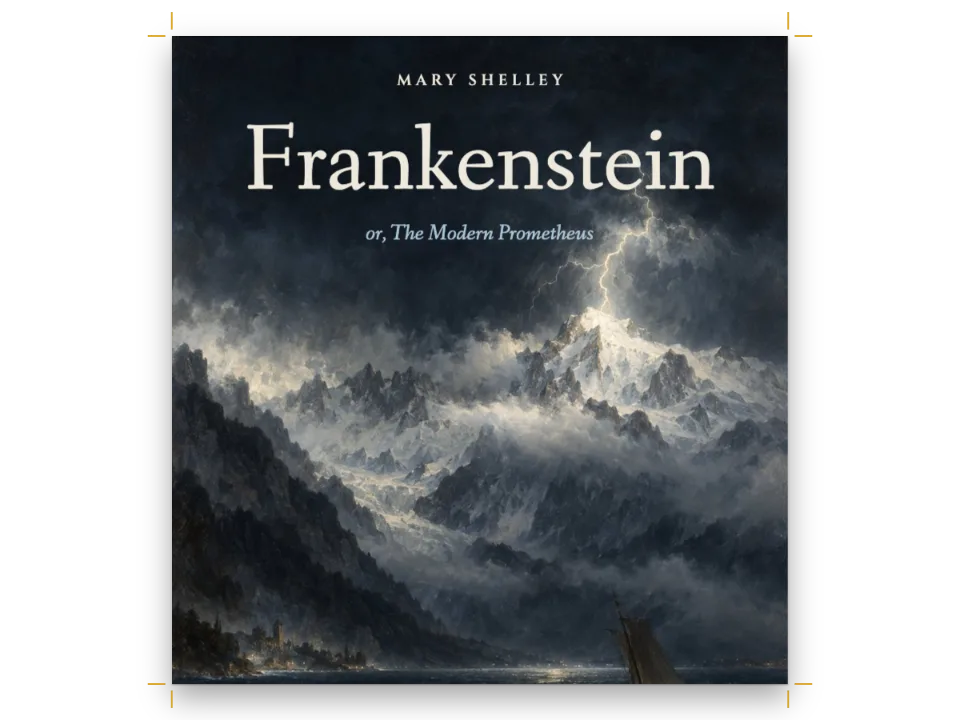
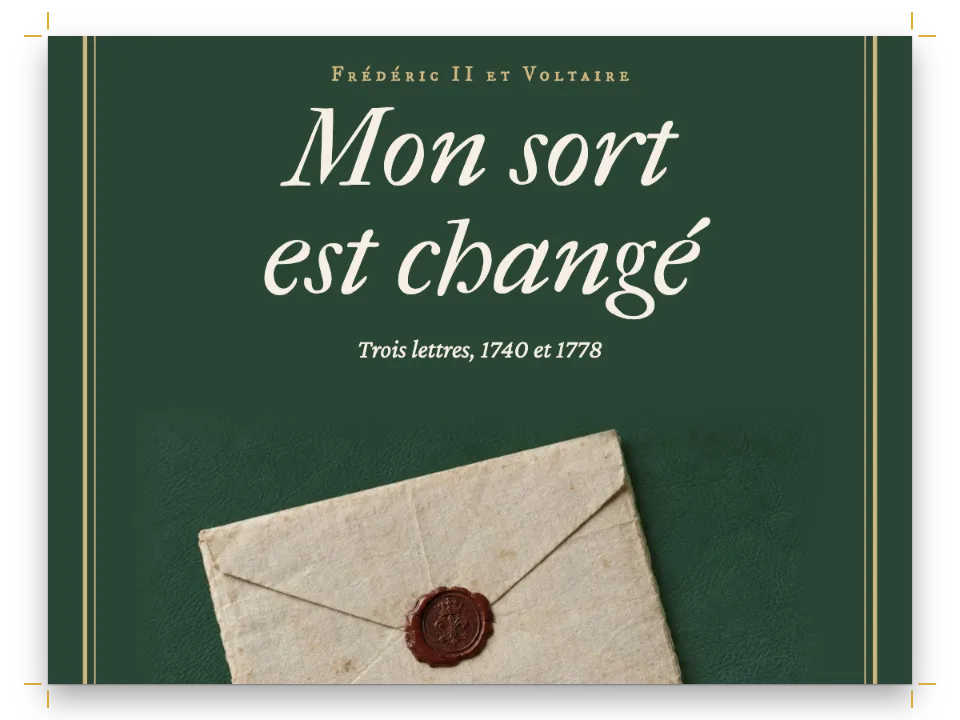
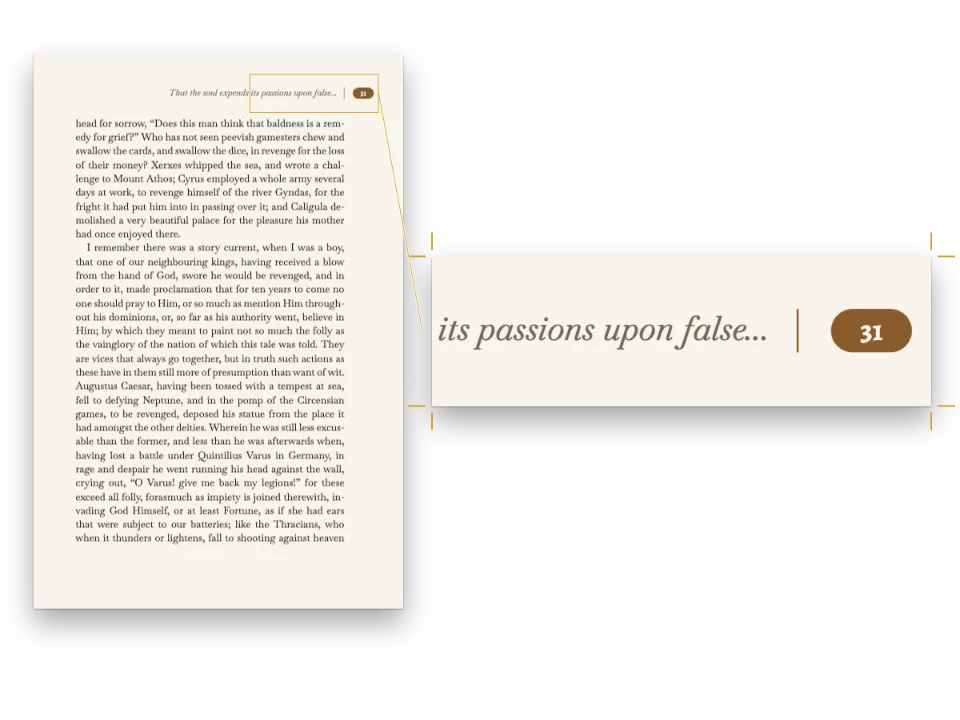
Neun Seiten aus Afoot, einer Taschenanthologie mit drei Essays über das Gehen von Hazlitt (1822), Thoreau (1862) und Stevenson (1876). Das Gemälde einer Heide in der Abenddämmerung füllt den Umschlag, ein mit Diffusionsmodellen erzeugtes JPEG. Das Inhaltsverzeichnis gibt jedem Essay eine rostrote Ziffer, einen Titel in Gloock, gesperrte Leitpunkte zu seiner Seite und darunter den Namen des Autors in heidefarbener Kursive. Jeder Essay beginnt mit Ziffer und Titel, einer Autorenzeile in gesperrten Versalien und einer Herkunftszeile mit Zeitschrift und Jahr des Erstdrucks. Die linken Seiten tragen den Namen des Autors, die rechten den Titel des Essays. Die Überschrift jedes Essays trägt Autor, Jahr und Quelle als Attribute, und Auftakt, Kolumnentitel und Inhaltsverzeichnis drucken sie von dort; ein vierter Essay verlangt also keine Änderung an der Konfiguration.
Dieses Rezept beantwortet
- Wie füge ich ein Inhaltsverzeichnis hinzu, das sich selbst aktualisiert (Führungspunkte, Seitenzahlen, Autoren, Teilzeilen)?
- Wie füge ich einem Auftakt eine Autorenzeile, einen Vorspann oder einen Einstieg mit Initiale hinzu?
- Wie setze ich Kolumnentitel: Buchtitel auf der linken Seite, Kapiteltitel auf der rechten, Seitenzahl außen?
Die kurze Antwort
// Each essay's heading carries its credits, and every {attr.…} below reads them:
//   # Walking {author="Henry David Thoreau" year="1862" source="The Atlantic Monthly"}
// (a value cannot hold { or }, and one with " goes in single quotes; gotcha: attr-values)
// 1 · The opener: inside a heading's design, {attr.author} is that heading's attribute.
const byline = [
  text('byline', '{attr.author}', { ...label, fontSize: pt(8), letterSpacing: pt(1.6),
    color: col('heather') }, below('title', 5)),
  text('dateline', '{attr.source}, {attr.year}', { fontFamily: 'Spectral', italic: true,
    fontSize: pt(9.5), color: col('muted'), align: 'left' }, below('byline', 1.2)),
];
// 2 · The verso running head (head() is in the running-heads region): in the page header,
//     {attr.author} is the attribute of the essay the page belongs to.
const versoAuthor = head('verso-author', '{attr.author}', 'even',
  at('page', 'top-left', MARGIN.outer + HEAD.gap, HEAD.y));
// 3 · The contents: toc.subtitle prints the attribute it names as a line under each title.
//     'author' and italic are the defaults; attr is written out so it can become 'source'.
const authorLine = { enabled: true, attr: 'author', fontFamily: 'Spectral', fontSize: pt(10),
  color: col('heather') };
// Hooked up below: byline → the opener, versoAuthor → header, authorLine → toc.subtitle.
// A heading without author="…" gets an empty byline and running head and no line in the
// contents, and the build gives no warning: check every heading.
Zutaten
- Funktionen
- InhaltsverzeichnisÜberschriftenattributeKolumnentitel und SeitenzahlenGestaltete AuftakteNummerierte ÜberschriftenÜberschriftenformateKapitel ohne NummerUmschläge, Titelseiten und ImpressumBilder in SeitengestaltungenGestaltungselemente verankernVerse Zeile für ZeileGespiegelte RänderAbsatzformateFixierte Kästen und PlakettenKästenExpliziter vertikaler AbstandDokument-MetadatenSemantische FarbpaletteAbbildungen und Tabellen als RessourcenSeiten auf einem Canvas
- Schrift
- Spectral, Gloock, Hanken Grotesk (SIL OFL 1.1)
- Dateien
cover-1200.jpg- The cover: a heath and hills at dusk, a painting (Generated With Diffusion Models, eigener Text)
Zubereitung
#1 · Die Essays nummerieren und ihren Text absenken
const opener = { enabled: true,
  // The hairline ends 7 mm above the foot of this reserve, so the text starts on the same grid
  // line under every opener whose title fits on one line (SINK = 14 holds a two-line title).
  minHeight: pt(SINK * LEAD),
  slot: { elements: [
    // {number} prints the essay's number as numberingTemplate '{1:I}' writes it: I, II, III.
    text('number', '{number}', { ...gloock, fontSize: pt(34), lineHeight: 1, color: col('rust') },
      at('container', 'top-left', 0, 8)),
    text('title', '{titleText}', { ...gloock, fontSize: pt(26), lineHeight: 1.08,
      color: col('ink') }, below('number', 3, { width: 'fill' })),
    ...byline,
    { kind: 'rule', id: 'rule', thickness: pt(0.5), color: col('rule'),
      placement: below('dateline', 6) }, // a horizontal rule runs to the column's edge
  ] } };
const essays = { level: 1, numberingTemplate: '{1:I}', advancedDesign: opener,
  marginBottom: pt(0), // the heading's default margin would add to minHeight
  // The cover and contents styles inherit this break (gotcha: style-inherits-break).
  breakBefore: { enabled: true, parity: 'any' } }; // 'any': each piece opens on the next page
numberingTemplate: '{1:I}' der Ebene nummeriert die Essays mit I, II und III, und {number} druckt die Ziffer über dem Titel (Span und erweiterte Gestaltung). minHeight reserviert 12 Zeilen zu 14 pt, und die Haarlinie endet 7 mm darüber; unter einem einzeiligen Titel beginnt der Text daher auf jedem Auftakt 79 mm unter der Oberkante. Eine zweite Titelzeile in 26 pt fügt 9,9 mm hinzu und schiebt den Text eine Rasterzeile tiefer; mit SINK = 14 beginnen ein- und zweizeilige Titel ihren Text auf derselben Zeile. marginBottom: pt(0) verhindert, dass der Standardabstand der Überschrift zur Reserve hinzukommt.
#2 · Das Inhaltsverzeichnis sich selbst füllen lassen
const ENTRY = 15; // pt: the essay titles in the contents
const contents = { // passed to the config as `toc`
  // An entry's numeral takes the title's face and size and stands on its baseline.
  levels: [{ level: 1, fontFamily: 'Gloock', fontSize: pt(ENTRY), color: col('ink'),
    numberFontWeight: 400, // Gloock has one weight
    numberColor: col('rust'), numberWidth: mm(8), numberGap: mm(3), marginBottom: pt(LEAD) }],
  pageNumber: { fontFamily: 'Hanken Grotesk', fontSize: pt(8.5), fontWeight: 600,
    color: col('muted'), width: mm(6) }, // the leader dots take this face and colour too
  leader: { char: '. ', gap: mm(2) }, // spaced dots, right-aligned so they line up
  subtitle: authorLine,
};
:::toc im Markdown druckt einen Eintrag pro aufgeführter Überschrift: Nummer, Titel, Leitpunkte, Seitenbezeichnung und über subtitle den Autor. buildDocument setzt das Buch erneut, bis sich die Seitenbezeichnungen nicht mehr ändern, sodass ein umbenannter oder verlängerter Essay das Inhaltsverzeichnis aktualisiert (Inhaltsverzeichnis). Die Ziffer eines Eintrags übernimmt Schrift und Größe des Titels, sofern numberFontFamily oder numberFontSize nichts anderes angeben, und sie steht in jeder Größe auf der Grundlinie der ersten Titelzeile. Ein Buch mit Teilen erhält außerdem eine Zeile für jeden :::part, gezeichnet von toc.parts.design, wie in Teile in Farbe.
#3 · Autor links, Essay rechts
// Each head: the label face, the pages of its parity, never an opener (pages: 'body'), where
// the byline names the author. A function declaration, so the answer above can call it.
function head(id, content, parity, placement, look = {}) {
  return { ...text(id, content, { ...label, fontSize: pt(7.5), letterSpacing: pt(1.3),
    color: col('muted'), ...look }, placement), parity, pages: 'body' };
}
const folio = { color: col('ink') };
const header = { elements: [
  head('verso-folio', '{pageNumber}', 'even', at('page', 'top-left', MARGIN.outer, HEAD.y), folio),
  versoAuthor,
  head('recto-title', '{chapterTitle}', 'odd',
    at('page', 'top-right', -(MARGIN.outer + HEAD.gap), HEAD.y), { align: 'right' }),
  head('recto-folio', '{pageNumber}', 'odd', at('page', 'top-right', -MARGIN.outer, HEAD.y),
    { ...folio, align: 'right' }),
] };
const footer = { elements: [{ ...head('drop-folio', '{pageNumber}', 'all', // an opener's folio
  at('container', 'top', 0, 9), { ...folio, align: 'center' }), pages: 'opener' }] };
Jeder Kolumnentitel ist an der Seite verankert, 11 mm unter der Oberkante, und parity wählt die Seite: Die Pagina fluchtet mit der Außenkante des Textes, Name oder Titel stehen 7 mm weiter innen. pages: 'body' in head() hält die Kolumnentitel von den Auftakten fern, wo die Autorenzeile den Autor bereits nennt, und pages: 'opener' der Fußzeile druckt dort stattdessen eine Pagina am Fuß (Textelemente). {chapterTitle} druckt den Titel des Essays ohne seine Ziffer.
#4 · Umschlag und Inhaltsverzeichnis aus der Zählung nehmen
// Unnumbered, so the first essay is I; unlisted; and with no running heads or folio. They
// inherit the level's page break, 'any' (gotcha: style-inherits-break).
const bare = { numbered: false, toc: false, header: { elements: [] }, footer: { elements: [] } };
const cover = { enabled: true, slot: { elements: [
  { kind: 'image', id: 'art', resourceId: 'cover',
    placement: { ...at('bleed', 'top-left'), size: { width: 'fill', height: 'fill' } } },
  text('title', '{titleText}', { ...gloock, fontSize: pt(80), lineHeight: 1, color: col('ink') },
    at('page', 'top-left', MARGIN.inner, 22)), // page 1 is a recto: the inner margin is left
  text('subtitle', '{subtitle}', { fontFamily: 'Spectral', italic: true, fontSize: pt(14),
    color: col('ink'), align: 'left' }, below('title', 1)),
  text('authors', '{attr.authors}', { ...label, fontSize: pt(8.5), letterSpacing: pt(2),
    color: col('heather') }, below('subtitle', 5)),
  text('imprint', '{attr.imprint}', { ...label, fontSize: pt(7.5), letterSpacing: pt(1.8),
    color: col('paper') }, at('page', 'bottom-left', MARGIN.inner, -12)),
] } };
// span: 'page' in a one-column book: a design kept in its column is cut at the column's foot,
// which would leave a band of paper under the dusk.
const coverStyle = { id: 'cover', ...bare, span: 'page', advancedDesign: cover };
const contentsOpener = { enabled: true, slot: { elements: [ // {title}, {subtitle}: frontmatter
  text('kicker', '{title} · {subtitle}', { ...label, fontSize: pt(8), letterSpacing: pt(1.6),
    color: col('heather') }, at('container', 'top-left', 0, 8)),
  text('title', '{titleText}', { ...gloock, fontSize: pt(26), color: col('ink') },
    below('kicker', 2.5)),
] } };
Mit numbered: false erhöhen Umschlag und Inhaltsverzeichnis den Zähler nicht, Hazlitt ist also I, und toc: false hält beide aus der Liste (Überschriftenformate). Beide Formate erben breakBefore der Ebene mit der Parität 'any'; deshalb folgt das Inhaltsverzeichnis dem Umschlag auf Seite 2 ohne :::pagebreak. Das Format des Umschlags reicht in einem einspaltigen Buch über die ganze Seite, denn eine Gestaltung, die in ihrer Spalte bleibt, wird am Fuß der Spalte abgeschnitten, und das ließe 22 mm Papier unter der Landschaft.
#5 · Jede Farbe mit ihrer Palettenverknüpfung ausschreiben
const palette = {
  ink: '#241f26', // text: a plum-tinted near-black
  paper: '#f7f2e8', // the page
  heather: '#6b4468', // the bylines and the authors in the contents
  rust: '#a4502a', // the essay numbers
  rule: '#d5cabd', // hairlines
  muted: '#6d6570', // running heads, datelines, page numbers in the contents
};
// col() links a colour to its palette entry; the hex is the value the entry holds.
const col = (id) => ({ hex: palette[id], model: 'hex', paletteId: id });
const colorPalette = [
  ...Object.entries(palette).map(([id, hex]) => ({ id, name: id, value: { hex, model: 'hex' } })),
  // The engine's defaults link to 'main-color': point it at the ink, so nothing prints blue.
  { id: 'main-color', name: 'ink (defaults)', value: { hex: palette.ink, model: 'hex' } },
];
col() schreibt den Hexwert jeder Farbe neben ihre paletteId, und die Engine folgt dieser Verknüpfung: Autorenzeilen, Kolumnentitel und Umschlag nehmen, was colorPalette unter der ID hält, sodass eine zweite Palette mit denselben IDs das ganze Buch umfärbt. Wenn main-color auf die Druckfarbe zeigt, sind alle Standardwerte abgedeckt, die die Konfiguration nicht neu angibt; sie würden sonst im Blau der Engine gedruckt, #295AA3.
Das ganze Rezept
// ═══ Postext Cookbook · Nº 030 · Anthology with bylines ═══════════════════════════════ // https://postext.dev/en/cookbook/anthology-with-bylines // Code: MIT · Text: Hazlitt, Thoreau, Stevenson (public domain) · Cover: diffusion models // Fonts: Spectral, Gloock, Hanken Grotesk (SIL OFL 1.1) · Needs postext ≥ 1.25.0 import { buildDocumentWithFonts, renderPageToCanvas, registerResourceImage, } from 'https://esm.sh/postext'; const LANG = 'en'; // @lang: the language of the sample document ('en' | 'es') const RECIPE = 'anthology-with-bylines'; // ─── 1 · Design ───────────────────────────────────────────────────────────── // #region palette: heather for the credits, rust for the numbers, plum ink on warm paper const palette = { ink: '#241f26', // text: a plum-tinted near-black paper: '#f7f2e8', // the page heather: '#6b4468', // the bylines and the authors in the contents rust: '#a4502a', // the essay numbers rule: '#d5cabd', // hairlines muted: '#6d6570', // running heads, datelines, page numbers in the contents }; // col() links a colour to its palette entry; the hex is the value the entry holds. const col = (id) => ({ hex: palette[id], model: 'hex', paletteId: id }); const colorPalette = [ ...Object.entries(palette).map(([id, hex]) => ({ id, name: id, value: { hex, model: 'hex' } })), // The engine's defaults link to 'main-color': point it at the ink, so nothing prints blue. { id: 'main-color', name: 'ink (defaults)', value: { hex: palette.ink, model: 'hex' } }, ]; // #endregion const TRIM = { width: 135, height: 180 }; // a pocket book, 3 : 4 const MARGIN = { top: 20, bottom: 22, inner: 19, outer: 15 }; // mirrored const LEAD = 14; // body leading in pt: the baseline grid const SINK = 12; // grid lines an essay opener reserves above its first line of text const HEAD = { y: 11, gap: 7 }; // running heads: mm from the top edge, folio to words const label = { fontFamily: 'Hanken Grotesk', fontWeight: 600, textTransform: 'uppercase', align: 'left' }; // design text is centred by default // One weight, no italic; 'wrap' breaks a long title onto a second line. const gloock = { fontFamily: 'Gloock', overflow: 'wrap', align: 'left' }; const at = (to, edge, x = 0, y = 0) => ({ anchor: { to, edge }, offset: { x: mm(x), y: mm(y) } }); const below = (id, y, size) => ({ ...at(`#${id}`, 'below', 0, y), ...(size && { size }) }); const text = (id, content, look, placement) => ({ kind: 'text', id, content, ...look, placement }); // #region answer: one set of heading attributes, read in three places // Each essay's heading carries its credits, and every {attr.…} below reads them: // # Walking {author="Henry David Thoreau" year="1862" source="The Atlantic Monthly"} // (a value cannot hold { or }, and one with " goes in single quotes; gotcha: attr-values) // 1 · The opener: inside a heading's design, {attr.author} is that heading's attribute. const byline = [ text('byline', '{attr.author}', { ...label, fontSize: pt(8), letterSpacing: pt(1.6), color: col('heather') }, below('title', 5)), text('dateline', '{attr.source}, {attr.year}', { fontFamily: 'Spectral', italic: true, fontSize: pt(9.5), color: col('muted'), align: 'left' }, below('byline', 1.2)), ]; // 2 · The verso running head (head() is in the running-heads region): in the page header, // {attr.author} is the attribute of the essay the page belongs to. const versoAuthor = head('verso-author', '{attr.author}', 'even', at('page', 'top-left', MARGIN.outer + HEAD.gap, HEAD.y)); // 3 · The contents: toc.subtitle prints the attribute it names as a line under each title. // 'author' and italic are the defaults; attr is written out so it can become 'source'. const authorLine = { enabled: true, attr: 'author', fontFamily: 'Spectral', fontSize: pt(10), color: col('heather') }; // Hooked up below: byline → the opener, versoAuthor → header, authorLine → toc.subtitle. // A heading without author="…" gets an empty byline and running head and no line in the // contents, and the build gives no warning: check every heading. // #endregion // #region opener: the essay's number and title, then the byline, over a sunk first line const opener = { enabled: true, // The hairline ends 7 mm above the foot of this reserve, so the text starts on the same grid // line under every opener whose title fits on one line (SINK = 14 holds a two-line title). minHeight: pt(SINK * LEAD), slot: { elements: [ // {number} prints the essay's number as numberingTemplate '{1:I}' writes it: I, II, III. text('number', '{number}', { ...gloock, fontSize: pt(34), lineHeight: 1, color: col('rust') }, at('container', 'top-left', 0, 8)), text('title', '{titleText}', { ...gloock, fontSize: pt(26), lineHeight: 1.08, color: col('ink') }, below('number', 3, { width: 'fill' })), ...byline, { kind: 'rule', id: 'rule', thickness: pt(0.5), color: col('rule'), placement: below('dateline', 6) }, // a horizontal rule runs to the column's edge ] } }; const essays = { level: 1, numberingTemplate: '{1:I}', advancedDesign: opener, marginBottom: pt(0), // the heading's default margin would add to minHeight // The cover and contents styles inherit this break (gotcha: style-inherits-break). breakBefore: { enabled: true, parity: 'any' } }; // 'any': each piece opens on the next page // #endregion // #region contents: the essays' numbers, titles, leaders and page labels, from the headings const ENTRY = 15; // pt: the essay titles in the contents const contents = { // passed to the config as `toc` // An entry's numeral takes the title's face and size and stands on its baseline. levels: [{ level: 1, fontFamily: 'Gloock', fontSize: pt(ENTRY), color: col('ink'), numberFontWeight: 400, // Gloock has one weight numberColor: col('rust'), numberWidth: mm(8), numberGap: mm(3), marginBottom: pt(LEAD) }], pageNumber: { fontFamily: 'Hanken Grotesk', fontSize: pt(8.5), fontWeight: 600, color: col('muted'), width: mm(6) }, // the leader dots take this face and colour too leader: { char: '. ', gap: mm(2) }, // spaced dots, right-aligned so they line up subtitle: authorLine, }; // #endregion // #region running-heads: author on the verso, essay title on the recto, folios outside // Each head: the label face, the pages of its parity, never an opener (pages: 'body'), where // the byline names the author. A function declaration, so the answer above can call it. function head(id, content, parity, placement, look = {}) { return { ...text(id, content, { ...label, fontSize: pt(7.5), letterSpacing: pt(1.3), color: col('muted'), ...look }, placement), parity, pages: 'body' }; } const folio = { color: col('ink') }; const header = { elements: [ head('verso-folio', '{pageNumber}', 'even', at('page', 'top-left', MARGIN.outer, HEAD.y), folio), versoAuthor, head('recto-title', '{chapterTitle}', 'odd', at('page', 'top-right', -(MARGIN.outer + HEAD.gap), HEAD.y), { align: 'right' }), head('recto-folio', '{pageNumber}', 'odd', at('page', 'top-right', -MARGIN.outer, HEAD.y), { ...folio, align: 'right' }), ] }; const footer = { elements: [{ ...head('drop-folio', '{pageNumber}', 'all', // an opener's folio at('container', 'top', 0, 9), { ...folio, align: 'center' }), pages: 'opener' }] }; // #endregion // #region front: the cover and the contents page, two headings kept out of the count // Unnumbered, so the first essay is I; unlisted; and with no running heads or folio. They // inherit the level's page break, 'any' (gotcha: style-inherits-break). const bare = { numbered: false, toc: false, header: { elements: [] }, footer: { elements: [] } }; const cover = { enabled: true, slot: { elements: [ { kind: 'image', id: 'art', resourceId: 'cover', placement: { ...at('bleed', 'top-left'), size: { width: 'fill', height: 'fill' } } }, text('title', '{titleText}', { ...gloock, fontSize: pt(80), lineHeight: 1, color: col('ink') }, at('page', 'top-left', MARGIN.inner, 22)), // page 1 is a recto: the inner margin is left text('subtitle', '{subtitle}', { fontFamily: 'Spectral', italic: true, fontSize: pt(14), color: col('ink'), align: 'left' }, below('title', 1)), text('authors', '{attr.authors}', { ...label, fontSize: pt(8.5), letterSpacing: pt(2), color: col('heather') }, below('subtitle', 5)), text('imprint', '{attr.imprint}', { ...label, fontSize: pt(7.5), letterSpacing: pt(1.8), color: col('paper') }, at('page', 'bottom-left', MARGIN.inner, -12)), ] } }; // span: 'page' in a one-column book: a design kept in its column is cut at the column's foot, // which would leave a band of paper under the dusk. const coverStyle = { id: 'cover', ...bare, span: 'page', advancedDesign: cover }; const contentsOpener = { enabled: true, slot: { elements: [ // {title}, {subtitle}: frontmatter text('kicker', '{title} · {subtitle}', { ...label, fontSize: pt(8), letterSpacing: pt(1.6), color: col('heather') }, at('container', 'top-left', 0, 8)), text('title', '{titleText}', { ...gloock, fontSize: pt(26), color: col('ink') }, below('kicker', 2.5)), ] } }; // #endregion const config = () => ({ locale: 'en-us', // the sample is in English colorPalette, page: { sizePreset: 'custom', width: mm(TRIM.width), height: mm(TRIM.height), dpi: 150, backgroundColor: col('paper'), margins: { top: mm(MARGIN.top), bottom: mm(MARGIN.bottom), left: mm(MARGIN.inner), right: mm(MARGIN.outer), mirror: true } }, // left = inner layout: { layoutType: 'single' }, bodyText: { fontFamily: 'Spectral', fontSize: pt(10), lineHeight: pt(LEAD), color: col('ink'), boldColor: col('ink'), italicColor: col('ink'), referenceColor: col('ink'), firstLineIndent: mm(4), indentAfterHeading: false, minWordSpacing: 0.7, maxWordSpacing: 1.6 }, // tighter than the 0.6–2 defaults // The hidden heading line is still measured, in this face; otherwise the build needs Open Sans. headings: { fontFamily: 'Gloock', fontWeight: 400, levels: [essays] }, headingStyles: [coverStyle, { id: 'contents', ...bare, advancedDesign: contentsOpener }], toc: contents, // Quoted verse is a :::verse block, a line of verse a line, 8 mm in; 'runon' resumes the // sentence after it. paragraphStyles: [{ id: 'verse', indent: mm(8) }, { id: 'runon', firstLineIndent: pt(0) }, // In the note, under a :::space of one line. It takes the note body's indent, 0. { id: 'colophon', fontSize: pt(7.5), lineHeight: pt(10.5), color: col('muted') }], calloutStyles: [{ id: 'note', placement: 'fixed', backgroundEnabled: false, // the page foot stripe: { enabled: true, side: 'top', width: pt(0.5), color: col('rule') }, padding: { top: mm(3), right: pt(0), bottom: pt(0), left: pt(0) }, titleStyle: { ...label, fontSize: pt(7.5), letterSpacing: pt(1.5), color: col('heather') }, body: { fontSize: pt(9), lineHeight: pt(12.5), firstLineIndent: pt(0) } }], header, footer, }); // #region art: the cover, a painting: a JPEG in assets/ cut to the trim's 3 : 4 // The design's image element names the resource by id; loadImage() below registers the file // under its fileId. A bitmap is declared at its pixels. const resources = [{ id: 'cover', typeId: 'figure', kind: 'bitmap', createdAt: 0, updatedAt: 0, bitmap: { fileId: 'cover-1200.jpg', format: 'jpeg', width: 1200, height: 1600 }, altText: 'Heath and hills at dusk under a pale apricot sky, a low sun on the horizon, three ' + 'trees on a ridge and a footpath winding up from the foot of the page through the ' + 'heather.' }]; // #endregion // ─── 2 · Content ──────────────────────────────────────────────────────────── const markdown = String.raw`---Markdown-Beispiel · 64 Zeilen · content.en.md
title: "Afoot" subtitle: "Three essays on walking" --- # Afoot {style="cover" authors="Hazlitt · Thoreau · Stevenson" imprint="The Fieldpath Library"} # Contents {style="contents"} :::toc :::callout{type="note" title="A note on the texts"} Each of these essays was first printed in a magazine, two in London and the third in Boston. Hazlitt’s appeared in *The New Monthly Magazine* in January 1822. Thoreau worked his up from a lecture he first gave in 1851, and *The Atlantic Monthly* printed it in June 1862, a month after his death. Stevenson’s came out in *The Cornhill Magazine* in 1876, and in its second paragraph he quotes Hazlitt by name. Each essay starts at its first line and stops well short of its last, in its author’s own spelling; […] marks a cut within a paragraph. :::space{lines=1} :::paragraphs{style="colophon"} Set in Spectral, Gloock and Hanken Grotesk (SIL Open Font License). The essays are in the public domain, from Project Gutenberg eBooks #3020, #1022 and #386; this note is CC BY 4.0; the cover is a painting. ::: ::: # On Going a Journey {author="William Hazlitt" year="1822" source="The New Monthly Magazine"} One of the pleasantest things in the world is going a journey; but I like to go by myself. I can enjoy society in a room; but out of doors, nature is company enough for me. I am then never less alone than when alone. :::verse{style="verse" align=start} *The fields his study, nature was his book.* ::: I cannot see the wit of walking and talking at the same time. When I am in the country I wish to vegetate like the country. I am not for criticising hedge-rows and black cattle. I go out of town in order to forget the town and all that is in it. There are those who for this purpose go to watering-places, and carry the metropolis with them. I like more elbow-room and fewer encumbrances. I like solitude, when I give myself up to it, for the sake of solitude; nor do I ask for :::verse{style="verse" align=start} *A friend in my retreat,* *Whom I may whisper solitude is sweet.* ::: The soul of a journey is liberty, perfect liberty, to think, feel, do, just as one pleases. We go a journey chiefly to be free of all impediments and of all inconveniences; to leave ourselves behind much more to get rid of others. It is because I want a little breathing-space to muse on indifferent matters, where Contemplation :::verse{style="verse" align=start} *May plume her feathers and let grow her wings,* *That in the various bustle of resort* *Were all too ruffled, and sometimes impair’d,* ::: :::paragraphs{style="runon"} that I absent myself from the town for a while, without feeling at a loss the moment I am left by myself. Instead of a friend in a postchaise or in a Tilbury, to exchange good things with, and vary the same stale topics over again, for once let me have a truce with impertinence. Give me the clear blue sky over my head, and the green turf beneath my feet, a winding road before me, and a three hours’ march to dinner—and then to thinking! It is hard if I cannot start some game on these lone heaths. I laugh, I run, I leap, I sing for joy. […] ::: # Walking {author="Henry David Thoreau" year="1862" source="The Atlantic Monthly"} I wish to speak a word for Nature, for absolute Freedom and Wildness, as contrasted with a freedom and culture merely civil,—to regard man as an inhabitant, or a part and parcel of Nature, rather than a member of society. I wish to make an extreme statement, if so I may make an emphatic one, for there are enough champions of civilization: the minister and the school committee and every one of you will take care of that. I have met with but one or two persons in the course of my life who understood the art of Walking, that is, of taking walks—who had a genius, so to speak, for sauntering, which word is beautifully derived “from idle people who roved about the country, in the Middle Ages, and asked charity, under pretense of going à la Sainte Terre,” to the Holy Land, till the children exclaimed, “There goes a Sainte-Terrer,” a Saunterer, a Holy-Lander. They who never go to the Holy Land in their walks, as they pretend, are indeed mere idlers and vagabonds; but they who do go there are saunterers in the good sense, such as I mean. Some, however, would derive the word from sans terre without land or a home, which, therefore, in the good sense, will mean, having no particular home, but equally at home everywhere. For this is the secret of successful sauntering. He who sits still in a house all the time may be the greatest vagrant of all; but the saunterer, in the good sense, is no more vagrant than the meandering river, which is all the while sedulously seeking the shortest course to the sea. But I prefer the first, which, indeed, is the most probable derivation. For every walk is a sort of crusade, preached by some Peter the Hermit in us, to go forth and reconquer this Holy Land from the hands of the Infidels. It is true, we are but faint-hearted crusaders, even the walkers, nowadays, who undertake no persevering, never-ending enterprises. Our expeditions are but tours, and come round again at evening to the old hearth-side from which we set out. Half the walk is but retracing our steps. We should go forth on the shortest walk, perchance, in the spirit of undying adventure, never to return,—prepared to send back our embalmed hearts only as relics to our desolate kingdoms. If you are ready to leave father and mother, and brother and sister, and wife and child and friends, and never see them again,—if you have paid your debts, and made your will, and settled all your affairs, and are a free man; then you are ready for a walk. To come down to my own experience, my companion and I, for I sometimes have a companion, take pleasure in fancying ourselves knights of a new, or rather an old, order—not Equestrians or Chevaliers, not Ritters or Riders, but Walkers, a still more ancient and honorable class, I trust. The chivalric and heroic spirit which once belonged to the Rider seems now to reside in, or perchance to have subsided into, the Walker—not the Knight, but Walker Errant. He is a sort of fourth estate, outside of Church and State and People. We have felt that we almost alone hereabouts practiced this noble art; though, to tell the truth, at least if their own assertions are to be received, most of my townsmen would fain walk sometimes, as I do, but they cannot. No wealth can buy the requisite leisure, freedom, and independence which are the capital in this profession. It comes only by the grace of God. It requires a direct dispensation from Heaven to become a walker. You must be born into the family of the Walkers. Ambulator nascitur, non fit. Some of my townsmen, it is true, can remember and have described to me some walks which they took ten years ago, in which they were so blessed as to lose themselves for half an hour in the woods; but I know very well that they have confined themselves to the highway ever since, whatever pretensions they may make to belong to this select class. No doubt they were elevated for a moment as by the reminiscence of a previous state of existence, when even they were foresters and outlaws. # Walking Tours {author="Robert Louis Stevenson" year="1876" source="The Cornhill Magazine"} It must not be imagined that a walking tour, as some would have us fancy, is merely a better or worse way of seeing the country. There are many ways of seeing landscape quite as good; and none more vivid, in spite of canting dilettantes, than from a railway train. But landscape on a walking tour is quite accessory. He who is indeed of the brotherhood does not voyage in quest of the picturesque, but of certain jolly humours—of the hope and spirit with which the march begins at morning, and the peace and spiritual repletion of the evening’s rest. He cannot tell whether he puts his knapsack on, or takes it off, with more delight. […] Now, to be properly enjoyed, a walking tour should be gone upon alone. If you go in a company, or even in pairs, it is no longer a walking tour in anything but name; it is something else and more in the nature of a picnic. A walking tour should be gone upon alone, because freedom is of the essence; because you should be able to stop and go on, and follow this way or that, as the freak takes you; and because you must have your own pace, and neither trot alongside a champion walker, nor mince in time with a girl. And then you must be open to all impressions and let your thoughts take colour from what you see. You should be as a pipe for any wind to play upon. “I cannot see the wit,” says Hazlitt, “of walking and talking at the same time. When I am in the country I wish to vegetate like the country,”—which is the gist of all that can be said upon the matter. There should be no cackle of voices at your elbow, to jar on the meditative silence of the morning. And so long as a man is reasoning he cannot surrender himself to that fine intoxication that comes of much motion in the open air, that begins in a sort of dazzle and sluggishness of the brain, and ends in a peace that passes comprehension.`; // content.<lang>.md, inlined by the Cookbook // ─── 3 · Fonts ────────────────────────────────────────────────────────────── const FONTS = { // text, display and label faces Spectral: ['400', '400i'], Gloock: ['400'], 'Hanken Grotesk': ['600'] }; // ─── 4 · Build & show ─────────────────────────────────────────────────────── await loadImage('cover-1200.jpg', asset('cover-1200.jpg')); const doc = await buildDocumentWithFonts({ markdown, resources }, config(), kitFonts(FONTS)); showPages(doc, { title: t({ en: 'Anthology with bylines', es: 'Antología con firmas de autor' }) });Kit · core, fonts, viewer, images: in jedem Rezept gleich · 270 Zeilen
// ─── Kit ── helpers shared by every Cookbook recipe · postext.dev/cookbook ───── // ─── Kit · core v1 ── the same in every recipe · postext.dev/cookbook function mm(value) { return { value, unit: 'mm' }; } function pt(value) { return { value, unit: 'pt' }; } function em(value) { return { value, unit: 'em' }; } /** The sample language's string: t({ en: 'Figure', es: 'Figura' }). */ function t(strings) { return strings[LANG] ?? Object.values(strings)[0]; } /** A file in this recipe's assets folder, served from the Postext repo by jsDelivr. */ function asset(file) { return `https://cdn.jsdelivr.net/gh/drnachio/postext@main/cookbook/${RECIPE}/assets/${file}`; } // ─── Kit · fonts v3 ── the same in every recipe · postext.dev/cookbook // Postext loads the faces a config asks for before layout (prepareFonts, // buildDocumentWithFonts) and asks the kit for the files: Fontsource's, the // files the PDF embeds too. /** The options of buildDocumentWithFonts / prepareFonts / withLoadedFonts: * the Fontsource resolver, and the faces of FONTS loaded with the ones the * config names. FONTS = { 'Family Name': ['400', '400i', '700'] }. */ function kitFonts(FONTS = {}) { const faces = Object.entries(FONTS).flatMap(([family, specs]) => specs.map((spec) => ({ family, weight: parseInt(spec, 10), style: spec.endsWith('i') ? 'italic' : 'normal' }))); return { resolve: fontsourceResolver, faces }; } /** A face's Fontsource files, in a fixed order: latin, then latin-ext and greek * when `text` needs them and the family ships them (kitSubsetsFor), each with * its unicode-range. Null for a weight or slant Fontsource does not ship. */ async function fontsourceResolver(family, weight, style, { text = '' } = {}) { const id = fontsourceId(family); const meta = await fontsourceMeta(family); if (meta && !(meta.weights.includes(weight) && meta.styles.includes(style))) return null; kitStatus('Loading fonts…'); const at = await fontsourceAt(id); return ['latin', ...kitSubsetsFor(text, meta)].map((subset) => ({ source: `${at}files/${id}-${subset}-${weight}-${style}.woff2`, unicodeRange: kitRanges()[subset], })); } /** The unicode-range of each Fontsource file the kit loads (a function: the * kit is inlined after the pen's code, which runs before a const would be set). */ function kitRanges() { return { latin: 'U+0000-00FF,U+0131,U+0152-0153,U+02BB-02BC,U+02C6,U+02DA,U+02DC,U+0304,U+0308,U+0329,' + 'U+2000-206F,U+20AC,U+2122,U+2191,U+2193,U+2212,U+2215,U+FEFF,U+FFFD', 'latin-ext': 'U+0100-02BA,U+02BD-02C5,U+02C7-02CC,U+02CE-02D7,U+02DD-02FF,U+0304,U+0308,U+0329,' + 'U+1D00-1DBF,U+1E00-1E9F,U+1EF2-1EFF,U+2020,U+20A0-20AB,U+20AD-20C0,U+2113,U+2C60-2C7F,U+A720-A7FF', greek: 'U+0370-03FF', }; } /** For the cjk, arabic and comics blocks, which add their own files: the * faces of `faces` = { 'Family Name': ['400', '400i', '700'] }. `text` is the sample: * č ł † α χ also load latin-ext and greek files (kitSubsetsFor). With * `optional`, a face Fontsource does not ship is skipped instead of failing. * The files are added once all have loaded, in the order asked (latin, then * latin-ext, then greek), whatever order they arrive in: the last one added * wins a character two files hold. Resolves to the number of faces added. */ async function loadFonts(faces, text = '', { optional = false } = {}) { kitStatus('Loading fonts…'); const ranges = kitRanges(); const jobs = []; for (const [family, specs] of Object.entries(faces)) { const id = fontsourceId(family); const todo = [...new Set(specs)].map((spec) => [parseInt(spec, 10), spec.endsWith('i') ? 'italic' : 'normal']) .filter(([weight, style]) => !hasFace(family, weight, style)); // before any await const at = fontsourceAt(id); const meta = optional || /[^\0-ÿ]/u.test(text) ? await fontsourceMeta(family) : null; const subsets = ['latin', ...kitSubsetsFor(text, meta)]; for (const [weight, style] of todo) { if (optional && !(meta?.weights.includes(weight) && meta.styles.includes(style))) continue; for (const subset of subsets) { const url = `${await at}files/${id}-${subset}-${weight}-${style}.woff2`; const face = new FontFace(family, `url(${url}) format('woff2')`, { weight: String(weight), style, unicodeRange: ranges[subset] }); jobs.push(face.load().catch(() => { if (subset === 'latin' && !optional) throw new Error(`Fontsource has no ${family} ${weight} ${style}`); })); } } } const ready = await Promise.all(jobs).catch((error) => { kitFail(error); throw error; }); return ready.filter((face) => face && document.fonts.add(face)).length; } /** A loaded FontFace covers this family, weight and style (fonts.check() would * also say yes for families nobody declared). */ function hasFace(family, weight, style) { for (const face of document.fonts) { if (face.status !== 'loaded' || face.style !== style) continue; if (face.family.replace(/^["']|["']$/g, '') !== family) continue; const [low, high = low] = face.weight.split(' ').map(Number); if (weight >= low && weight <= high) return true; } return false; } /** The files beyond latin `text` needs that `meta`'s family ships. */ function kitSubsetsFor(text, meta) { return [[/[Ā-˿ᴀ-ᶿḀ-ỿ†ℓⱠ-Ɀ꜠-ꟿ]/u, 'latin-ext'], [/[Ͱ-Ͽ]/u, 'greek']] .filter(([re, x]) => re.test(text) && meta?.subsets?.includes(x)).map(([, x]) => x); } /** Fontsource's id for a family: 'Source Serif 4' → 'source-serif-4'. */ function fontsourceId(family) { return family.toLowerCase().replace(/\s+/g, '-'); } /** A package's folder at the one version @5 names now (#766). */ function fontsourceAt(id, u = `https://cdn.jsdelivr.net/npm/@fontsource/${id}@`) { return (fontsourceAt.c ??= {})[id] ??= fetch(u + '5/package.json').then((r) => r.json()) .then((p) => p.version || 5, () => 5).then((v) => `${u}${v}/`); } /** The family's Fontsource metadata (weights, styles, subsets), or null. */ function fontsourceMeta(family) { fontsourceMeta.cache ??= new Map(); const id = fontsourceId(family); if (!fontsourceMeta.cache.has(id)) { fontsourceMeta.cache.set(id, fetch(`https://api.fontsource.org/v1/fonts/${id}`) .then((res) => (res.ok ? res.json() : null), () => null)); } return fontsourceMeta.cache.get(id); } // ─── Kit · viewer v2 ── the same in every recipe · postext.dev/cookbook /** The pages as spreads on a dark desk, page 1 alone, then verso | recto, * each painted when it scrolls near. Other options go to renderPageToCanvas. */ function showPages(docs, { title, width = 460, ...render } = {}) { const root = viewer(title); const pages = [docs].flat().flatMap((doc) => doc.pages.map((page) => ({ doc, page, n: (doc.pageIndexOffset ?? 0) + page.index }))); const spreads = []; let verso = null; for (const p of pages) { if (p.n % 2 === 1) { if (verso) spreads.push([verso, null]); verso = p; } else { spreads.push([verso, p]); verso = null; } } if (verso) spreads.push([verso, null]); const density = Math.min(window.devicePixelRatio || 1, 2); showPages.painter?.disconnect(); const painter = new IntersectionObserver((entries) => { for (const { isIntersecting, target } of entries) { if (!isIntersecting) continue; painter.unobserve(target); const { doc, page } = target.postext; renderPageToCanvas(page, doc, target, { ...render, scale: (width * density) / page.width }); } }, { rootMargin: '800px' }); showPages.painter = painter; root.replaceChildren(...spreads.map((pair) => { const spread = document.createElement('div'); spread.className = 'pt-spread'; for (const p of pair) { const figure = document.createElement('figure'); if (p) { const label = p.page.pageLabel || String(p.n + 1); const canvas = document.createElement('canvas'); canvas.postext = p; canvas.style.aspectRatio = `${p.page.width} / ${p.page.height}`; canvas.setAttribute('role', 'img'); canvas.setAttribute('aria-label', `Page ${label}`); const folio = document.createElement('figcaption'); folio.textContent = label; figure.append(canvas, folio); painter.observe(canvas); } else figure.className = 'pt-blank'; spread.append(figure); } return spread; })); kitStatus(`${pages.length} ${pages.length === 1 ? 'page' : 'pages'}`); document.documentElement.dataset.postext = 'ready'; return pages.length; } /** The desk, the bar and the error reporting, created once. */ function viewer(title) { if (!document.getElementById('pt-kit')) { document.head.insertAdjacentHTML('beforeend', `<style id="pt-kit"> :root { color-scheme: dark; } body { margin: 0; background: #0e1014; color: #b9bcc4; font: 13px/1.45 system-ui, sans-serif; } #pt-bar { position: sticky; top: 0; z-index: 1; display: flex; flex-wrap: wrap; align-items: center; gap: 6px 16px; padding: 10px 16px; background: rgb(14 16 20 / .92); backdrop-filter: blur(6px); border-bottom: 1px solid #23262d; } #pt-bar strong { color: #f4f1ea; font-weight: 600; } #pt-actions { display: flex; gap: 12px; margin-left: auto; } #pt-actions a, #pt-actions button { color: #d8a21a; font: inherit; background: none; border: 0; padding: 0; cursor: pointer; } #pages { display: grid; justify-items: center; gap: 48px; padding: 32px 16px 72px; } .pt-spread { display: flex; } .pt-spread figure { margin: 0; width: min(460px, 44vw); } .pt-spread canvas { display: block; width: 100%; background: #fff; box-shadow: 0 1px 2px rgb(0 0 0 / .5), 0 22px 44px -16px rgb(0 0 0 / .8); } .pt-spread figure:first-child canvas { box-shadow: inset -14px 0 14px -14px rgb(0 0 0 / .18), 0 1px 2px rgb(0 0 0 / .5), 0 22px 44px -16px rgb(0 0 0 / .8); } .pt-spread figcaption { margin-top: 10px; text-align: center; font: 600 10px/1 system-ui, sans-serif; letter-spacing: .18em; text-transform: uppercase; color: #6c7079; } .pt-blank { visibility: hidden; } @media (max-width: 760px) { .pt-spread { flex-direction: column; gap: 32px; } .pt-spread figure { width: min(460px, 92vw); } .pt-blank { display: none; } } </style>`); document.body.insertAdjacentHTML('afterbegin', '<header id="pt-bar"><strong id="pt-title"></strong><span id="pt-status" role="status"></span><span id="pt-actions"></span></header>'); document.getElementById('pt-title').textContent = document.title || 'Postext'; addEventListener('error', (event) => kitFail(event.error ?? event.message)); addEventListener('unhandledrejection', (event) => kitFail(event.reason)); } if (title) document.getElementById('pt-title').textContent = title; return document.getElementById('pages') ?? document.body.appendChild(Object.assign(document.createElement('main'), { id: 'pages' })); } function kitStatus(text) { viewer(); document.getElementById('pt-status').textContent = text; } function kitFail(error) { document.documentElement.dataset.postext = 'error'; kitStatus(`Error: ${error?.message ?? error}`); } // ─── Kit · images v3 ── recipes with pictures · postext.dev/cookbook /** Registers a photo or PNG for the canvas and keeps its bytes for the PDF. * fetch → ImageBitmap never taints the canvas (a plain cross-origin <img> would). */ async function loadImage(fileId, url) { const res = await fetch(url); if (!res.ok) throw new Error(`Image not found (${res.status}): ${url}`); const bytes = new Uint8Array(await res.arrayBuffer()); registerResourceImage(fileId, await createImageBitmap(new Blob([bytes]))); (loadImage.bytes ??= new Map()).set(fileId, bytes); } /** Registers SVG markup as a vector image, its fonts inside (inlineSvgFonts, ≥ 1.25). * `options` go to registerResourceImage: { singleInk: true } tints it on the canvas. */ async function loadSvg(fileId, svg, options) { if (typeof inlineSvgFonts === 'function') svg = await inlineSvgFonts(svg, svgFaces); const img = new Image(); img.src = `data:image/svg+xml;charset=utf-8,${encodeURIComponent(svg)}`; await img.decode(); registerResourceImage(fileId, img, options); (loadImage.bytes ??= new Map()).set(fileId, new TextEncoder().encode(svg)); } /** A face's Fontsource files: nearest weight; latin + what the SVG sets. */ async function svgFaces(family, weight, style, { codePoints = [] } = {}) { const [id, m] = [fontsourceId(family), await fontsourceMeta(family)]; const w = m?.weights.reduce((a, b) => (Math.abs(b - weight) < Math.abs(a - weight) ? b : a)) ?? weight; const s = m?.styles.includes(style) === false ? 'normal' : style; return Promise.all(['latin', ...kitSubsetsFor(String.fromCodePoint(...codePoints), m)].map(async (x) => new Uint8Array( await (await fetch(`${await fontsourceAt(id)}files/${id}-${x}-${w}-${s}.woff2`)).arrayBuffer()))); } /** renderToPdf({ resourceBytes: imageBytes }) */ function imageBytes(fileId) { return loadImage.bytes?.get(fileId); } /** renderToHtml({ resourceImageUrl: imageUrl }) */ function imageUrl(fileId) { const bytes = imageBytes(fileId); if (!bytes) return undefined; imageUrl.urls ??= new Map(); if (!imageUrl.urls.has(fileId)) { const type = /\.svg$/i.test(fileId) ? 'image/svg+xml' : /\.png$/i.test(fileId) ? 'image/png' : 'image/jpeg'; imageUrl.urls.set(fileId, URL.createObjectURL(new Blob([bytes], { type }))); } return imageUrl.urls.get(fileId); } // ─── /Kit ───────────────────────────────────────────────────────────────────────
Das zusammengesetzte script.js läuft unverändert: Fügen Sie es in das Modulskript einer beliebigen Seite ein, oder öffnen Sie das Rezept auf CodePen. Ordner des Rezepts auf GitHub ↗ (öffnet in neuem Tab)
Varianten
#Angeben, wo jeder Essay zuerst erschien
toc.subtitle druckt jedes Attribut der Überschrift, sodass dasselbe Markdown unter jedem Titel die Zeitschrift des Erstdrucks aufführen kann.
-const authorLine = { enabled: true, attr: 'author', fontFamily: 'Spectral', fontSize: pt(10),
+const authorLine = { enabled: true, attr: 'source', fontFamily: 'Spectral', fontSize: pt(10),#Den Buchtitel auf die linke Seite setzen
Viele Bücher setzen ihren eigenen Titel auf die linke Seite und den des Kapitels auf die rechte; {title} liest ihn aus dem Frontmatter des Markdowns und druckt AFOOT.
-const versoAuthor = head('verso-author', '{attr.author}', 'even',
+const versoAuthor = head('verso-author', '{title}', 'even',#Jeden Essay auf einer rechten Seite beginnen
Mit der Parität 'odd' rückt Stevenson hinter eine leere Seite 8 auf Seite 9. Die beiden Formate der Titelei brauchen dann ein eigenes 'any', sonst erbt das Inhaltsverzeichnis 'odd' und beginnt auf Seite 3 hinter einer leeren linken Seite.
-  breakBefore: { enabled: true, parity: 'any' } }; // 'any': each piece opens on the next page
+  breakBefore: { enabled: true, parity: 'odd' } };
-const bare = { numbered: false, toc: false, header: { elements: [] }, footer: { elements: [] } };
+const bare = { numbered: false, toc: false, breakBefore: { enabled: true, parity: 'any' },
+ header: { elements: [] }, footer: { elements: [] } };Häufige Fehler
Häufiger Fehler
Attributwerte: kein { oder }; einen Wert mit " in einfache Anführungszeichen setzen
Ein Attributwert endet an der schließenden geschweiften Klammer, kann also kein { oder } enthalten. Ein Wert, der ein doppeltes Anführungszeichen enthält, kommt in einfache Anführungszeichen; ein Dollarzeichen ist unproblematisch. Überschriftenattribute →
Häufiger Fehler
Ein Überschriftenformat erbt den Seitenumbruch seiner Ebene
Ein Eintrag in headingStyles übernimmt jedes Feld, das er auslässt, von seiner Überschriftenebene, breakBefore eingeschlossen. Ein Inhaltsverzeichnis oder Impressum, das nach einem :::pagebreak über eine H1 gestaltet wird, erbt die Parität 'odd' und landet hinter einer Vakatseite. Geben Sie einem solchen Format breakBefore: { enabled: false }. Überschriftenformate →
- Hazlitt zitiert Verse mitten in seinen Sätzen. Die Verszeilen gehören in einen Block
:::verse{style="verse" align=start}, eine Markdown-Zeile pro Verszeile, um 8 mm eingezogen, und der Satz, der danach weiterläuft, in ein Formatrunonohne Einzug. Ein Markdown-Blockzitat taugt nicht dafür: Seine Zeilen werden wie die eines Absatzes zusammengefügt, und die Verse liefen als Prosa weiter. - Ein Attribut, das einer Überschrift fehlt, druckt nichts und löst keine Warnung aus. Ohne
author="…"bleiben Autorenzeile und linker Kolumnentitel eines Essays leer, und seine Zeile unter dem Titel verschwindet aus dem Inhaltsverzeichnis.
Nachweise
- Rezept
- Ignacio Ferro
- Text
- “On Going a Journey” (1822), from its first line to “I sing for joy”, in Table Talk: Essays on Men and Manners · William Hazlitt · gemeinfrei
- “Walking” (1862), its first five paragraphs · Henry David Thoreau · gemeinfrei
- “Walking Tours” (1876), the opening of its first paragraph and the whole of its second, in Virginibus Puerisque · Robert Louis Stevenson · gemeinfrei
- The note on the texts and the colophon · Ignacio Ferro · CC BY 4.0
- Bilder
- The cover: a heath and hills at dusk, a painting · Generated With Diffusion Models · eigener Text
- Schriften
- Spectral (SIL OFL 1.1) · Gloock (SIL OFL 1.1) · Hanken Grotesk (SIL OFL 1.1)
- Code
- MIT, wie Postext
Diesen Text bearbeiten ↗ (öffnet in neuem Tab)Ordner des Rezepts auf GitHub ↗ (öffnet in neuem Tab)