Kurz gesagt
Ein vierseitiges Heft, das drei Schriften vorführt. Es zeigt, warum alle Schriften fertig geladen sein müssen, bevor die Seiten gesetzt werden, sonst brechen Zeilen an falschen Stellen um.
Was Sie setzen
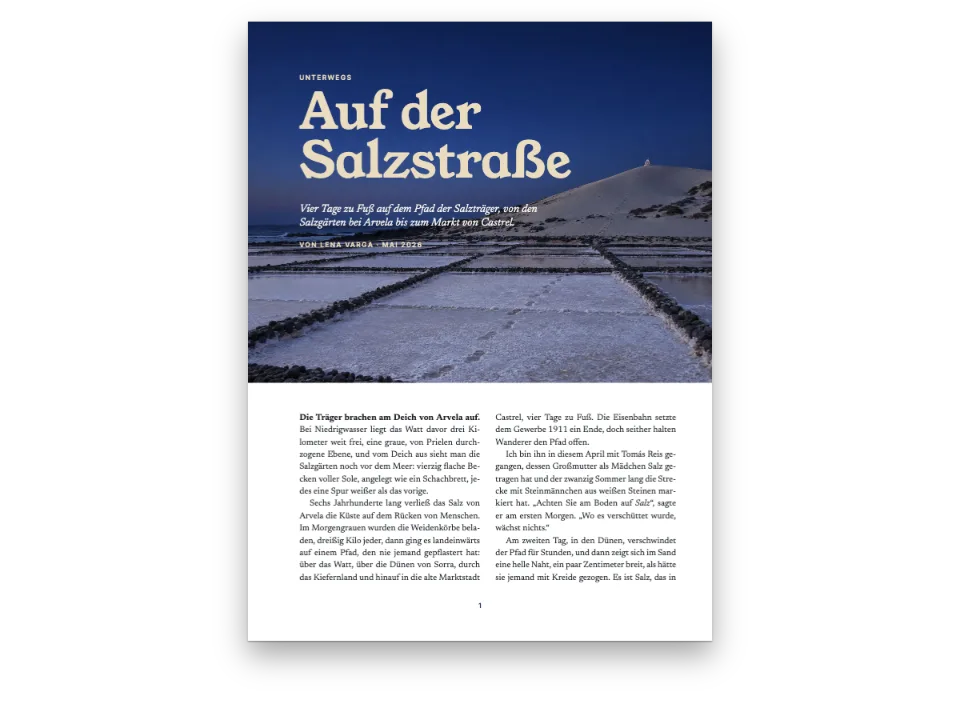
House Specimen Nº 3 aus der erfundenen Pellow Lane Press ist ein vierseitiges Schriftmuster für drei Schriften. Auf dem Umschlag trägt eine ultramarinblaue Fläche ein weißes kursives Ag in Noto Serif Display zu 240 pt und zwei Monospace-Zeilen, die die drei Schriften nennen; der Titel steht unter der Fläche. Seite 2 lässt die Ysabeau Office als Wasserfall von 7 bis 14 pt herablaufen und setzt dann spanische, polnische und tschechische Pangramme, deren ż, ř und ů eine zweite Schriftdatei brauchen. Seite 3 ist die Prüfung: eine Tabelle in IBM Plex Mono, vom Pen ausgefüllt, mit den zehn Schnitten, die das Heft deklariert, den sechs, in denen seine Seiten gesetzt sind, und den Dateien, die der Browser für jeden geladen hat. Seite 4 setzt den ersten Absatz von Seite 1 zweimal, aus einem frühen und aus dem letzten Build. Der frühe Build lief, bevor der Browser eine einzige Schriftdatei hatte; deshalb enden seine Zeilen an anderen Stellen, und einige laufen über die Satzbreite hinaus.
Dieses Rezept beantwortet
- Warum ändern sich meine Zeilenumbrüche oder überlappen Wörter im PDF, und wie lade ich Schriften richtig?
- Wie verwende ich meine eigenen Hausschriften oder lizenzierten Schriften im Layout und bette sie ins PDF ein?
- Wie finde ich heraus, was mit meinem Dokument nicht stimmt (Warnungen, Überlauf, nicht konvergierendes Layout)?
Die kurze Antwort
// buildDocumentWithFonts starts with prepareFonts: it reads the config and the text for every
// face they ask for (text, headings, chips, table, captions, opener, running heads), in each
// weight and slant, and loads them for the characters the document sets. The page declares its
// files (declareFaces), so they load through document.fonts; a face nothing declares would be
// asked of a resolve(family, weight, style) option. Then it builds, reads the faces the pages
// are set in, loads any that the config did not name and builds again.
let report; // { loaded, missing, synthesized }: lists of { family, weight, style }
const build = () => buildDocumentWithFonts(content(), config(),
  { onFonts: (found) => { report = found; } }); // what the last look at the pages found

kitStatus('Loading fonts…'); // the kit's bar: it also reports any error thrown below
const early = buildDocument(content(), config()); // on purpose: the page has no font yet (page 4)
declareFaces(FONTS);
const fitted = await build(); // every face loaded before a line is measured
audit = auditOf(fitted, report); // page 3's table
drawProof(early, fitted); // page 4's picture
const doc = await build(); // nothing left to load: the same pages, table and picture filled in
showPages(doc, { title: 'Load every font before layout' });
Zutaten
- Funktionen
- Schriften vor dem LayoutGrundschriftSeiten auf einem CanvasAbbildungen und Tabellen als RessourcenAbbildungen genau hierTabellen aus DatenTabellenformatFormat der BildunterschriftEigene RessourcentypenGestaltete AuftakteÜberschriftenattributeGestaltungselemente verankernAbsatzformateInline-ChipsEndformatGespiegelte RänderSemantische FarbpaletteKolumnentitel und SeitenzahlenKopfzeilen nach Seitenrolle
- Nutzt außerdem
- Abbildung und Tabelle in Ihrer SpracheKapitelband über die ganze BreiteSeiten- und Spaltenumbrüche
- Schrift
- Ysabeau Office, Noto Serif Display, IBM Plex Mono (SIL OFL 1.1)
- Dateien
- Keine: Jedes Bild wird im Code gezeichnet
Zubereitung
#1 · Jede Datei deklarieren, ohne sie zu laden
const SUBSETS = { // the characters each file covers, copied from the family's @font-face CSS
  latin: 'U+0000-00FF,U+0131,U+0152-0153,U+02BB-02BC,U+02C6,U+02DA,U+02DC,U+0304,U+0308,U+0329,'
    + 'U+2000-206F,U+20AC,U+2122,U+2191,U+2193,U+2212,U+2215,U+FEFF,U+FFFD',
  'latin-ext': 'U+0100-02BA,U+02BD-02C5,U+02C7-02CC,U+02CE-02D7,U+02DD-02FF,U+0304,U+0308,U+0329,'
    + 'U+1D00-1DBF,U+1E00-1E9F,U+1EF2-1EFF,U+2020,U+20A0-20AB,U+20AD-20C0,U+2113,U+2C60-2C7F,'
    + 'U+A720-A7FF' };
const FILES = new Map(); // FontFace → the subset its file covers, for the audit
function declareFaces(fonts) { // Fontsource's static files stand in for your own /fonts/ folder
  for (const { family, weight, style } of facesOf(fonts)) {
    const id = family.toLowerCase().replaceAll(' ', '-');
    for (const [subset, unicodeRange] of Object.entries(SUBSETS)) {
      const file = `${id}@5/files/${id}-${subset}-${weight}-${style}.woff2`;
      // Adding a face fetches nothing: the file downloads when a load or a line needs it.
      const face = new FontFace(family, `url(https://cdn.jsdelivr.net/npm/@fontsource/${file})`,
        { weight: `${weight}`, style, unicodeRange });
      FILES.set(face, subset);
      document.fonts.add(face);
    }
  }
}
Ein FontFace ist eine Datei, wie eine @font-face-Regel; ein Schnitt mit einer Latin- und einer Latin-ext-Datei wird also mit zwei FontFace-Objekten deklariert, die Familie, Stärke und Stil teilen und sich in unicodeRange unterscheiden, kopiert aus dem CSS der Familie. Sie zu document.fonts hinzuzufügen, lädt nichts herunter: Der Browser holt eine Datei erst, wenn ein Aufruf von load() oder eine Textzeile ihre Zeichen braucht. Postext lädt die Schriften, die eine Seite deklariert, über document.fonts; nach einer Schrift, die niemand deklariert, wird die Option resolve gefragt, und so holen sich die anderen Rezepte ihre Fontsource-Dateien aus dem Kit. customFonts in einer Konfiguration beschreibt nur die Dateien eines .postext-Pakets; eine Seite, die aus Markdown gebaut wird, deklariert also ihre eigenen Schriften oder übergibt ein resolve.
#2 · Erst die Schriften laden, dann bauen
Der Code steht oben in der kurzen Antwort. buildDocumentWithFonts beginnt mit prepareFonts, das Konfiguration und Text nach jeder Schrift durchsucht, die sie verlangen, in jeder Stärke und Lage, und sie mit den eigenen Zeichen des Dokuments als Probe lädt, sodass die Latin-ext-Dateien mit den polnischen und tschechischen Pangrammen eintreffen (Schriften vor dem Layout laden). Danach baut es, liest die Schriften, in denen die Seiten gesetzt sind, lädt alle, die die Konfiguration nicht genannt hat, und baut erneut. onFonts erhält den Bericht dieser letzten Durchsicht: die als loaded gefundenen Schriften, die missing, und die, die der Browser aus einer anderen Stärke oder Lage synthesized hätte. Der Pen baut dreimal, weil das Heft seine eigenen Beweise druckt: einmal zu früh, einmal mit den Schriften und ein letztes Mal mit ausgefüllter Tabelle und ausgefülltem Bild.
#3 · Die Prüfung aus dem Bericht aufbauen
const SET = { loaded: 'yes', synthesized: 'faked', missing: 'in a fallback' }; // the report
const nameOf = (f) => `${f.family.replaceAll('"', '')} ${f.weight} ${f.style}`; // or a FontFace
function auditOf(doc, report) {
  const found = Object.keys(SET).flatMap((kind) => report[kind].map((f) => [nameOf(f), kind]));
  const inPages = new Map(found);
  const loaded = [...FILES].filter(([face]) => face.status === 'loaded');
  const faces = new Map([...facesOf(FONTS), ...Object.keys(SET).flatMap((kind) => report[kind])]
    .map((f) => [nameOf(f), f])); // the declared faces, then any the pages set without a file
  const rows = [...faces].map(([name, f], i, all) => [
    i && all[i - 1][1].family === f.family ? '' : f.family, // each family named once
    `${f.weight}${f.style === 'italic' ? ' italic' : ''}`, SET[inPages.get(name)] ?? 'no',
    loaded.filter(([face]) => nameOf(face) === name).map(([, subset]) => subset).join(' · ')
      || 'none'].map((cell) => ({ content: cell })));
  // What else to read in a finished layout: its content warnings, its passes, its warnings.
  return { rows, note: `${report.loaded.length} of ${rows.length} faces set in the pages · `
    + `${loaded.length} of ${FILES.size} files fetched · fontFallback warnings: `
    + `${fallbacksIn(doc) || 'none'} · ${doc.converged ? '' : 'not '}converged · layout warnings: `
    + `${doc.warnings?.length || 'none'}` };
}
Die Tabelle geht von den Schnitten aus, die FONTS deklariert, und ergänzt, was der Bericht über jeden sagt: in den Seiten gesetzt, vom Browser vorgetäuscht oder in einer Ersatzschrift gesetzt. Die letzte Spalte führt die Dateien auf, deren FontFace den Zustand loaded erreicht hat. Sechzehn der zwanzig wurden geladen: Postext lädt alle vier Schnitte der Textfamilie, da ** und * sie in jedem Absatz verlangen können, und die beiden kursiven Monospace-Schnitte, die keine Einstellung nennt, wurden nie heruntergeladen. Die Notiz liest drei weitere Dinge aus dem fertigen Dokument: contentWarnings, wo eine in einer Ersatzschrift gemessene Schrift als fontFallback aufgeführt ist; converged, wahr, wenn sich die Durchläufe des Layouts eingependelt haben; und warnings. Prüfen Sie alle drei, bevor Sie eine Seite zeigen oder exportieren.
#4 · Einen frühen Build als Beweisstück aufheben
const STRIP = { lines: 8, overrun: 10 }; // page 1's first paragraph; mm shown past the measure
const PROOF = { // px: two strips a lead apart, cut at 300 dpi
  width: Math.round(((MEASURE + STRIP.overrun) / 25.4) * 2 * DPI),
  height: Math.round((((2 * STRIP.lines + 1) * LEAD) / 72) * 2 * DPI) };
const proof = { moved: 0, total: 0, faces: 0 }; // lines the early build broke elsewhere, of all
const fallbacksIn = (doc) => // a build lists each face its font set could not give
  (doc.contentWarnings ?? []).filter((w) => w.kind === 'fontFallback').length;
const proofFigure = () => ({ id: 'proof', typeId: 'figure', kind: 'bitmap', createdAt: 0,
  updatedAt: 0, placement: here,
  bitmap: { fileId: 'proof.png', format: 'png', width: PROOF.width, height: PROOF.height },
  caption: 'The first paragraph of page 1 as the early build set it, measured before the fonts '
    + 'had arrived (above), and as the last build set it (below). The early build broke '
    + `${proof.moved} of its ${proof.total} lines of text elsewhere, and its own warnings name `
    + `${proof.faces} faces set in a fallback. The rule marks the measure.`,
  altText: `Two strips of the same ${STRIP.lines} lines of text. In the upper strip the lines `
    + 'break in other places and some run past a vertical rule; in the lower one every line '
    + 'stops short of it.' });
function drawProof(first, last) {
  const linesOf = (doc) => doc.blocks.filter((b) => b.type === 'paragraph')
    .map((b) => b.lines.map((l) => l.text));
  const [before, after] = [first, last].map(linesOf);
  proof.total = before.flat().length;
  proof.faces = fallbacksIn(first);
  proof.moved = before.flatMap((lines, i) => lines.filter((t, j) => t !== after[i]?.[j])).length;
  const canvas = Object.assign(document.createElement('canvas'), PROOF);
  const ctx = canvas.getContext('2d');
  const strip = (PROOF.height * STRIP.lines) / (2 * STRIP.lines + 1);
  const edge = Math.round((PROOF.width * MEASURE) / (MEASURE + STRIP.overrun));
  // The renderer clips each column 2 pt past its edge, which would cut the early build's lines
  // at the measure: paint a copy of page 1 whose column reaches across the whole strip.
  const wide = (column) => ({ ...column,
    bbox: { ...column.bbox, width: column.bbox.width + (STRIP.overrun / 25.4) * DPI } });
  [first, last].forEach((doc, i) => {
    const page = document.createElement('canvas');
    renderPageToCanvas({ ...doc.pages[0], columns: doc.pages[0].columns.map(wide) }, doc, page,
      { scale: 2 }); // 300 dpi
    const { x, y } = doc.pages[0].columns[0].blocks.find((b) => b.type === 'paragraph').bbox;
    ctx.drawImage(page, 2 * x, 2 * y, PROOF.width, strip,
      0, i * (PROOF.height - strip), PROOF.width, strip);
  });
  ctx.fillStyle = `${palette.ultramarine}1f`; // a pale wash over the margin past the measure
  ctx.fillRect(edge, 0, PROOF.width - edge, PROOF.height);
  ctx.fillStyle = palette.ultramarine; // a hairline at the measure, and each strip's name
  ctx.fillRect(edge, 0, 2, PROOF.height);
  ctx.font = `700 ${(7 / 72) * 2 * DPI}px "IBM Plex Mono"`; // 7 pt, loaded by now
  ['early', 'last'].forEach((name, i) => // on the last line of each strip
    ctx.fillText(name, edge + 12, (i ? PROOF.height : strip) - 16));
  registerResourceImage('proof.png', canvas);
}
Der Pen ruft buildDocument einmal auf, bevor er eine einzige Schrift deklariert, sodass dieser Build jedes Wort in der Ersatzschrift des Browsers misst. Sobald die echten Schriften da sind, zeichnet der Pen ihn erneut und vergleicht ihn Zeile für Zeile mit dem letzten Build; die Zahl der Zeilen in der Bildunterschrift stammt aus diesem Vergleich, die Zahl der Schnitte aus den eigenen fontFallback-Warnungen des frühen Builds. Eine Zeile im Flattersatz, gemessen in einer schmaleren Ersatzschrift, läuft über die Satzbreite hinaus, bis der Zuschnitt der Spalte, 2 pt hinter ihrem Rand, ihre letzten Buchstaben abschneidet; deshalb zeichnet der Pen Seite 1 mit verbreiterter Spalte, um den ganzen Überlauf zu zeigen. Der Canvas und postext-pdf zeichnen jeden Abschnitt einer Zeile im Blocksatz oder mit gemischten Auszeichnungen dort, wo das Layout ihn gemessen hat; eine echte Schrift, die breiter ist als die Ersatzschrift, druckt also über das nächste Wort, und die Wörter eines PDF, das gebaut wurde, bevor seine Schriften da waren, überlappen sich. Vom frühen Build geht nichts in den nächsten über: prepareFonts findet die neuen Schriften in document.fonts und verwirft die in ihren Familien gemessenen Breiten, sodass kein Aufruf von clearMeasurementCache() nötig ist.
#5 · Ein Wasserfall im Rhythmus des Texts
const bodyText = () => ({
  fontFamily: TEXT, fontSize: pt(11), lineHeight: pt(LEAD), color: col('ink'),
  boldColor: col('ink'), italicColor: col('ink'), referenceColor: col('ink'),
  textAlign: 'left', firstLineIndent: pt(0), paragraphSpacing: true }); // ragged and spaced
// Every waterfall size and pangram is two leads (31 pt) deep, on the text's 15.5 pt rhythm.
const line = (size) => ({ fontSize: pt(size), lineHeight: pt(2 * LEAD) });
const paragraphStyles = () => [
  ...[7, 8, 9, 10, 11, 12, 14].map((size) => ({ id: `s${size}`, ...line(size) })),
  { id: 'pangram', ...line(13) },
  { id: 'colophon', fontSize: pt(7), lineHeight: pt(10), fontFamily: MONO, color: col('muted') }];
// Size labels: boxless mono chips. A Plex Mono letter is 0.6 em wide, so a one-digit label gets
// half a letter each side and the samples start on one edge.
const tag = { fontFamily: MONO, fontSize: pt(7), color: col('ultramarine'),
  backgroundEnabled: false, borderWidth: pt(0), paddingX: pt(0), gap: mm(2.5) };
const chipStyles = () => [{ id: 'size', ...tag }, { id: 'size-1', ...tag, paddingX: em(0.3) }];
Die Ysabeau Office setzt den Text in 11 pt auf 15,5 pt Zeilenabstand, mit einer Leerzeile statt eines Einzugs zwischen den Absätzen. Der Text steht im Flattersatz, daher behält jeder Wortzwischenraum seine natürliche Breite. Fett, kursiv und Verweise stehen in der Textfarbe; sich selbst überlassen, nähmen sie die Hauptfarbe an. Jede Größe des Wasserfalls und jedes Pangramm ist ein Absatzformat von zwei Zeilenabständen (31 pt) Höhe, sodass die Seite den Rhythmus von 15,5 pt des Texts behält. Die Größenangaben sind Monospace-Chips, und die einstelligen Größen bekommen auf jeder Seite einen halben Buchstaben Innenabstand, damit jede Probe an derselben Kante beginnt.
#6 · Drei Schriften auf einem Umschlag
const Y = { kicker: 14, glyphs: 17, label: FIELD - 12, title: FIELD + 10, // mm from the top edge
  end: FIELD + 42 }; // where the opener ends: under the title, the lead and a line of air
const ITALIC_FOOT = 5; // mm: the italic A's foot reaches this far left of the glyphs' origin
const at = (x, y, width) => ({ anchor: { to: 'page', edge: 'top-left' },
  offset: { x: mm(x), y: mm(y) }, ...(width && { size: { width: mm(width) } }) });
const text = (id, content, style, placement) => ({ kind: 'text', id, content, align: 'left',
  overflow: 'wrap', ...style, placement }); // a running head wraps too, never '…'
const cover = () => ({ level: 1, fontSize: pt(30), italic: true, // headings.levels[0]
  breakBefore: { enabled: true, parity: 'odd' }, // the cover is a recto
  span: 'page', // the heading is set across the page; its field hangs from the bleed
  advancedDesign: { enabled: true, minHeight: mm(Y.end - MARGIN.top), // from the top margin
    slot: { elements: [
      { kind: 'box', id: 'field', style: { backgroundColor: col('ultramarine') }, placement: {
        anchor: { to: 'bleed', edge: 'top-left' }, size: { width: 'fill', height: mm(FIELD) } } },
      text('kicker', '{attr.kicker}', { ...label, fontWeight: 700, color: col('paper') },
        at(MARGIN.inner, Y.kicker)),
      text('glyphs', '{attr.glyphs}', { ...display, fontSize: pt(240), lineHeight: 1,
        color: col('paper') }, at(MARGIN.inner + ITALIC_FOOT, Y.glyphs)),
      text('label', '{attr.label}', { ...label, color: col('mist') }, at(MARGIN.inner, Y.label)),
      text('faces', '{attr.faces}', { ...label, color: col('mist') },
        { anchor: { to: '#label', edge: 'below' }, offset: { y: mm(1.2) } }),
      text('title', '{titleText}', { ...display, fontSize: pt(30), lineHeight: 1.05,
        color: col('ink') }, at(MARGIN.inner, Y.title, PAGE.width - 2 * MARGIN.inner)),
      text('lead', '{attr.lead}', { fontFamily: TEXT, italic: true, fontSize: pt(12),
        lineHeight: 1.35, color: col('ink') }, { anchor: { to: '#title', edge: 'below' },
        offset: { y: mm(3) }, size: { width: mm(MEASURE) } }),
    ] } } });
Der Umschlag ist das Design der Ebene H1: die Buchstaben aus dem Attribut glyphs der Überschrift in der Auszeichnungsschrift zu 240 pt und darunter zwei Monospace-Zeilen, die diese Schrift sowie Text- und Labelschrift nennen, wie auf dem Musterblatt einer Schriftgießerei. span: 'page' setzt die Überschrift über die ganze Seitenbreite, und die Fläche hängt an der linken oberen Ecke des Anschnitts und läuft daher über die obere Kante hinaus. minHeight zählt ab dem Kopfsteg und reserviert den Raum bis Y.end, 42 mm unter der Fläche; ohne diese Einstellung beginnt der Text eine Zeile höher, eng unter dem Vorspann.
Das ganze Rezept
// ═══ Postext Cookbook · Nº 026 · Type specimen with every font loaded before layout ═════════ // https://postext.dev/en/cookbook/fonts-before-layout // Code: MIT · Text: original (CC BY 4.0) · Picture: cut from the pen's own early and last builds // Fonts: Ysabeau Office, Noto Serif Display, IBM Plex Mono (SIL OFL 1.1) · Needs postext ≥ 1.25.0 import { buildDocument, buildDocumentWithFonts, renderPageToCanvas, defaultResourceTypes, registerResourceImage } from 'https://esm.sh/postext'; const LANG = 'en'; // @lang: the language of the sample document ('en' | 'es') const RECIPE = 'fonts-before-layout'; // ─── 1 · Design ───────────────────────────────────────────────────────────── const PAGE = { width: 180, height: 240 }; // mm const MARGIN = { top: 22, bottom: 24, inner: 20, outer: 48 }; // mm: inner is the spine side const MEASURE = PAGE.width - MARGIN.inner - MARGIN.outer; // 112 mm: about 70 letters at 11 pt const FIELD = 122; // mm from the top edge: the ultramarine field of the opener const LEAD = 15.5; // pt: the body leading and the step of every vertical space const DPI = 150; // the page's resolution: the proof on page 4 is cut at twice this const [TEXT, DISPLAY, MONO] = ['Ysabeau Office', 'Noto Serif Display', 'IBM Plex Mono']; const palette = { ink: '#16161a', ultramarine: '#3246d3', mist: '#c9d0f6', // mist: 4.6:1 on rule: '#cfc9bd', muted: '#6b6a70', paper: '#ffffff' }; // ultramarine, for labels on the field // Every colour is linked to its palette entry; main-color catches any default left unstated. const col = (id) => ({ hex: palette[id], model: 'hex', paletteId: id }); const colorPalette = () => Object.entries({ ...palette, 'main-color': palette.ultramarine }) .map(([id, hex]) => ({ id, name: id, value: { hex, model: 'hex' } })); const label = { fontFamily: MONO, fontSize: pt(7.5), letterSpacing: pt(1.2), textTransform: 'uppercase' }; const display = { fontFamily: DISPLAY, fontWeight: 900, italic: true }; // #region type: the text face at 11 on 15.5 pt, and a waterfall of it on two leads a line const bodyText = () => ({ fontFamily: TEXT, fontSize: pt(11), lineHeight: pt(LEAD), color: col('ink'), boldColor: col('ink'), italicColor: col('ink'), referenceColor: col('ink'), textAlign: 'left', firstLineIndent: pt(0), paragraphSpacing: true }); // ragged and spaced // Every waterfall size and pangram is two leads (31 pt) deep, on the text's 15.5 pt rhythm. const line = (size) => ({ fontSize: pt(size), lineHeight: pt(2 * LEAD) }); const paragraphStyles = () => [ ...[7, 8, 9, 10, 11, 12, 14].map((size) => ({ id: `s${size}`, ...line(size) })), { id: 'pangram', ...line(13) }, { id: 'colophon', fontSize: pt(7), lineHeight: pt(10), fontFamily: MONO, color: col('muted') }]; // Size labels: boxless mono chips. A Plex Mono letter is 0.6 em wide, so a one-digit label gets // half a letter each side and the samples start on one edge. const tag = { fontFamily: MONO, fontSize: pt(7), color: col('ultramarine'), backgroundEnabled: false, borderWidth: pt(0), paddingX: pt(0), gap: mm(2.5) }; const chipStyles = () => [{ id: 'size', ...tag }, { id: 'size-1', ...tag, paddingX: em(0.3) }]; // #endregion // #region opener: the H1 as a bleed field, the display face at 240 pt, labels naming the faces const Y = { kicker: 14, glyphs: 17, label: FIELD - 12, title: FIELD + 10, // mm from the top edge end: FIELD + 42 }; // where the opener ends: under the title, the lead and a line of air const ITALIC_FOOT = 5; // mm: the italic A's foot reaches this far left of the glyphs' origin const at = (x, y, width) => ({ anchor: { to: 'page', edge: 'top-left' }, offset: { x: mm(x), y: mm(y) }, ...(width && { size: { width: mm(width) } }) }); const text = (id, content, style, placement) => ({ kind: 'text', id, content, align: 'left', overflow: 'wrap', ...style, placement }); // a running head wraps too, never '…' const cover = () => ({ level: 1, fontSize: pt(30), italic: true, // headings.levels[0] breakBefore: { enabled: true, parity: 'odd' }, // the cover is a recto span: 'page', // the heading is set across the page; its field hangs from the bleed advancedDesign: { enabled: true, minHeight: mm(Y.end - MARGIN.top), // from the top margin slot: { elements: [ { kind: 'box', id: 'field', style: { backgroundColor: col('ultramarine') }, placement: { anchor: { to: 'bleed', edge: 'top-left' }, size: { width: 'fill', height: mm(FIELD) } } }, text('kicker', '{attr.kicker}', { ...label, fontWeight: 700, color: col('paper') }, at(MARGIN.inner, Y.kicker)), text('glyphs', '{attr.glyphs}', { ...display, fontSize: pt(240), lineHeight: 1, color: col('paper') }, at(MARGIN.inner + ITALIC_FOOT, Y.glyphs)), text('label', '{attr.label}', { ...label, color: col('mist') }, at(MARGIN.inner, Y.label)), text('faces', '{attr.faces}', { ...label, color: col('mist') }, { anchor: { to: '#label', edge: 'below' }, offset: { y: mm(1.2) } }), text('title', '{titleText}', { ...display, fontSize: pt(30), lineHeight: 1.05, color: col('ink') }, at(MARGIN.inner, Y.title, PAGE.width - 2 * MARGIN.inner)), text('lead', '{attr.lead}', { fontFamily: TEXT, italic: true, fontSize: pt(12), lineHeight: 1.35, color: col('ink') }, { anchor: { to: '#title', edge: 'below' }, offset: { y: mm(3) }, size: { width: mm(MEASURE) } }), ] } } }); // #endregion // Running heads at the outer edge of the text; a drop folio there too on the opener (a recto). const HEADS = { top: 13, bottom: 12 }; // mm from the top and the bottom edge of the page const head = (id, content, parity, edge, x, pages = 'body') => text(id, content, { parity, pages, fontFamily: MONO, fontSize: pt(7.5), color: col('muted') }, { anchor: { to: 'page', edge }, offset: { x: mm(x), y: mm(edge.startsWith('top') ? HEADS.top : -HEADS.bottom) } }); const header = () => ({ elements: [ head('verso', '{pageNumber} · {title}', 'even', 'top-left', MARGIN.outer), head('recto', '{chapterTitle} · {pageNumber}', 'odd', 'top-right', -MARGIN.outer)] }); const footer = () => ({ elements: [ head('drop-folio', '{pageNumber}', 'all', 'bottom-right', -MARGIN.outer, 'opener')] }); const config = () => ({ locale: 'en-us', // the sample is in English // "Table 1", not "Table 1.1": the booklet has one chapter. Table captions sit above. resourceTypes: defaultResourceTypes(LANG).map((type) => ({ ...type, numberingTemplate: '{n}', ...(type.id === 'table' && { captionStyle: { position: 'above' } }) })), colorPalette: colorPalette(), layout: { layoutType: 'single' }, page: { width: mm(PAGE.width), height: mm(PAGE.height), dpi: DPI, margins: { top: mm(MARGIN.top), bottom: mm(MARGIN.bottom), left: mm(MARGIN.inner), right: mm(MARGIN.outer), mirror: true } }, bodyText: { ...bodyText(), paragraphContainerSpacing: 'add' }, // samples stay two leads apart paragraphStyles: paragraphStyles(), chipStyles: chipStyles(), headings: { fontFamily: DISPLAY, fontWeight: 900, color: col('ink'), levels: [cover(), { level: 2, fontSize: pt(16), lineHeight: pt(2 * LEAD), marginTop: pt(LEAD), marginBottom: pt(0) }] }, tableStyle: { rules: 'horizontal', borderColor: col('rule'), borderWidth: pt(0.5), headerBackground: col('ultramarine'), headerColor: col('paper'), headerFontFamily: MONO, headerFontSize: pt(7.5), bodyFontFamily: MONO, bodyFontSize: pt(7.5), cellPadding: mm(1) }, captionStyle: { fontFamily: MONO, fontSize: pt(7.5), labelColor: col('ultramarine'), note: { color: col('muted') } }, header: header(), footer: footer(), }); // ─── 2 · Content ──────────────────────────────────────────────────────────── // The table and the picture come from the builds themselves (section 4). let audit = { rows: [], note: '' }; const content = () => ({ markdown, resources: resources() }); // read again for each build const here = { position: 'here' }; // both sit where ::resource puts them const resources = () => [ { id: 'faces', typeId: 'table', kind: 'table', createdAt: 0, updatedAt: 0, placement: here, caption: 'Every face this booklet declares: whether Postext found it set in the pages, and ' + 'the files the browser fetched for it.', note: audit.note, table: { model: { headerRowCount: 1, columnWidths: [31, 19, 28, 34], rows: [ ['Family', 'Face', 'In the pages', 'Files fetched'] .map((cell) => ({ content: cell, isHeader: true })), ...audit.rows] } } }, proofFigure(), // drawn from the builds just below ]; // #region art-proof: page 1's first paragraph from the early build, over the same from the last const STRIP = { lines: 8, overrun: 10 }; // page 1's first paragraph; mm shown past the measure const PROOF = { // px: two strips a lead apart, cut at 300 dpi width: Math.round(((MEASURE + STRIP.overrun) / 25.4) * 2 * DPI), height: Math.round((((2 * STRIP.lines + 1) * LEAD) / 72) * 2 * DPI) }; const proof = { moved: 0, total: 0, faces: 0 }; // lines the early build broke elsewhere, of all const fallbacksIn = (doc) => // a build lists each face its font set could not give (doc.contentWarnings ?? []).filter((w) => w.kind === 'fontFallback').length; const proofFigure = () => ({ id: 'proof', typeId: 'figure', kind: 'bitmap', createdAt: 0, updatedAt: 0, placement: here, bitmap: { fileId: 'proof.png', format: 'png', width: PROOF.width, height: PROOF.height }, caption: 'The first paragraph of page 1 as the early build set it, measured before the fonts ' + 'had arrived (above), and as the last build set it (below). The early build broke ' + `${proof.moved} of its ${proof.total} lines of text elsewhere, and its own warnings name ` + `${proof.faces} faces set in a fallback. The rule marks the measure.`, altText: `Two strips of the same ${STRIP.lines} lines of text. In the upper strip the lines ` + 'break in other places and some run past a vertical rule; in the lower one every line ' + 'stops short of it.' }); function drawProof(first, last) { const linesOf = (doc) => doc.blocks.filter((b) => b.type === 'paragraph') .map((b) => b.lines.map((l) => l.text)); const [before, after] = [first, last].map(linesOf); proof.total = before.flat().length; proof.faces = fallbacksIn(first); proof.moved = before.flatMap((lines, i) => lines.filter((t, j) => t !== after[i]?.[j])).length; const canvas = Object.assign(document.createElement('canvas'), PROOF); const ctx = canvas.getContext('2d'); const strip = (PROOF.height * STRIP.lines) / (2 * STRIP.lines + 1); const edge = Math.round((PROOF.width * MEASURE) / (MEASURE + STRIP.overrun)); // The renderer clips each column 2 pt past its edge, which would cut the early build's lines // at the measure: paint a copy of page 1 whose column reaches across the whole strip. const wide = (column) => ({ ...column, bbox: { ...column.bbox, width: column.bbox.width + (STRIP.overrun / 25.4) * DPI } }); [first, last].forEach((doc, i) => { const page = document.createElement('canvas'); renderPageToCanvas({ ...doc.pages[0], columns: doc.pages[0].columns.map(wide) }, doc, page, { scale: 2 }); // 300 dpi const { x, y } = doc.pages[0].columns[0].blocks.find((b) => b.type === 'paragraph').bbox; ctx.drawImage(page, 2 * x, 2 * y, PROOF.width, strip, 0, i * (PROOF.height - strip), PROOF.width, strip); }); ctx.fillStyle = `${palette.ultramarine}1f`; // a pale wash over the margin past the measure ctx.fillRect(edge, 0, PROOF.width - edge, PROOF.height); ctx.fillStyle = palette.ultramarine; // a hairline at the measure, and each strip's name ctx.fillRect(edge, 0, 2, PROOF.height); ctx.font = `700 ${(7 / 72) * 2 * DPI}px "IBM Plex Mono"`; // 7 pt, loaded by now ['early', 'last'].forEach((name, i) => // on the last line of each strip ctx.fillText(name, edge + 12, (i ? PROOF.height : strip) - 16)); registerResourceImage('proof.png', canvas); } // #endregion const markdown = String.raw`---Markdown-Beispiel · 77 Zeilen · content.en.md
title: "House Specimen" author: "Pellow Lane Press" --- # Three faces, proofed {kicker="Pellow Lane Press · House specimen Nº 3" lead="Our text, display and label faces at work, and proof that each of them had arrived before these lines were set." glyphs="Ag" label="Noto Serif Display 900 italic · 240 pt" faces="Text: Ysabeau Office · Labels: IBM Plex Mono"} A compositor in a metal shop could only set a line in a face that was in the case. Postext measures every word with the fonts the browser holds at that moment, so a page built a second too early is broken for a fallback face. These pages were built three times: once too early, on purpose, with no font file in the browser; again once Postext had loaded every face the design asks for; and a last time to print their list on page 3 and, on page 4, what the early build got wrong. ## Seven sizes of the text face Ysabeau, drawn by Christian Thalmann, carries the letterforms of the Garamond tradition into a low-contrast sans serif. Its Office cut sets tabular lining figures and a level hyphen by default. :::paragraphs{style="s7"} :chip[7 pt]{style="size-1"} Credits and map legends, where small print needs open counters. ::: :::paragraphs{style="s8"} :chip[8 pt]{style="size-1"} Captions and table notes, where the tabular figures keep 1,048 and 2,096 in step. ::: :::paragraphs{style="s9"} :chip[9 pt]{style="size-1"} A reference column set close; the long ascenders keep the lines apart. ::: :::paragraphs{style="s10"} :chip[10 pt]{style="size"} Notes and asides, a size below the text they sit beside. ::: :::paragraphs{style="s11"} :chip[11 pt]{style="size"} The text of this booklet, eleven on fifteen and a half. ::: :::paragraphs{style="s12"} :chip[12 pt]{style="size"} A standfirst, or a first reader for children. ::: :::paragraphs{style="s14"} :chip[14 pt]{style="size"} A heading, or a line on a poster. ::: ## Beyond Latin-1 Spanish needs nothing beyond the latin file of each face. Polish and Czech need more: ż, ł, ř and ů live in a second file, latin-ext, which the browser fetches only when a load or a line asks for those letters. :::paragraphs{style="pangram"} :chip[es]{style="size"} El veloz murciélago hindú comía feliz cardillo y kiwi. :chip[pl]{style="size"} Zażółć gęślą jaźń. :chip[cs]{style="size"} Příliš žluťoučký kůň úpěl ďábelské ódy. ::: :::pagebreak ## The proof The table below is Postext’s own report. Before it measured a line of the second build, it read the design and the text for every face they ask for, in the text, headings, chips, table, captions, opener and running heads, and loaded each one for the letters these pages set. Once the pages were laid out it looked at the faces their lines were set in, and found none missing. ::resource{id="faces"} Some faces in the table set nothing in this booklet. Postext loads the regular, the italic, the bold and the bold italic of the text face, because any paragraph may ask for them with a pair of asterisks. The two italics of the mono face were declared and never asked for, so the browser fetched no file for them. A face with no file would not pass unnoticed. The browser sets a family nobody declared in a system face and fakes a missing bold by thickening the regular; Postext names both in its report and among the warnings of the finished document. :::pagebreak ## What the early build got wrong The early build ran before the browser had any of these files, so its words were measured in a fallback face. Drawn in the real faces, its lines no longer fit the measure. ::resource{id="proof"} When the faces arrived, Postext dropped every width it had measured in their families, and the next build measured each word again. :::paragraphs{style="colophon"} Set in Ysabeau Office, Noto Serif Display and IBM Plex Mono (SIL OFL 1.1) · Text: original, CC BY 4.0 · Pellow Lane Press is imaginary. :::`; // content.<lang>.md, inlined by the Cookbook // ─── 3 · Fonts ────────────────────────────────────────────────────────────── // Every face the design may ask for (page 3 lists them), each declared from two files. const FONTS = { 'Ysabeau Office': ['400', '400i', '700', '700i'], // text, waterfall, pangrams, lead 'Noto Serif Display': ['900', '900i'], // the glyphs, the title, the subheads 'IBM Plex Mono': ['400', '400i', '700', '700i'], // labels, chips, the table, captions }; const facesOf = (fonts) => Object.entries(fonts).flatMap(([family, specs]) => specs.map((spec) => ({ family, weight: parseInt(spec, 10), style: spec.endsWith('i') ? 'italic' : 'normal' }))); // #region declare: one FontFace per file, as a stylesheet has one @font-face rule per file const SUBSETS = { // the characters each file covers, copied from the family's @font-face CSS latin: 'U+0000-00FF,U+0131,U+0152-0153,U+02BB-02BC,U+02C6,U+02DA,U+02DC,U+0304,U+0308,U+0329,' + 'U+2000-206F,U+20AC,U+2122,U+2191,U+2193,U+2212,U+2215,U+FEFF,U+FFFD', 'latin-ext': 'U+0100-02BA,U+02BD-02C5,U+02C7-02CC,U+02CE-02D7,U+02DD-02FF,U+0304,U+0308,U+0329,' + 'U+1D00-1DBF,U+1E00-1E9F,U+1EF2-1EFF,U+2020,U+20A0-20AB,U+20AD-20C0,U+2113,U+2C60-2C7F,' + 'U+A720-A7FF' }; const FILES = new Map(); // FontFace → the subset its file covers, for the audit function declareFaces(fonts) { // Fontsource's static files stand in for your own /fonts/ folder for (const { family, weight, style } of facesOf(fonts)) { const id = family.toLowerCase().replaceAll(' ', '-'); for (const [subset, unicodeRange] of Object.entries(SUBSETS)) { const file = `${id}@5/files/${id}-${subset}-${weight}-${style}.woff2`; // Adding a face fetches nothing: the file downloads when a load or a line needs it. const face = new FontFace(family, `url(https://cdn.jsdelivr.net/npm/@fontsource/${file})`, { weight: `${weight}`, style, unicodeRange }); FILES.set(face, subset); document.fonts.add(face); } } } // #endregion // #region audit: page 3's table: every face declared or set, the report's word, its files const SET = { loaded: 'yes', synthesized: 'faked', missing: 'in a fallback' }; // the report const nameOf = (f) => `${f.family.replaceAll('"', '')} ${f.weight} ${f.style}`; // or a FontFace function auditOf(doc, report) { const found = Object.keys(SET).flatMap((kind) => report[kind].map((f) => [nameOf(f), kind])); const inPages = new Map(found); const loaded = [...FILES].filter(([face]) => face.status === 'loaded'); const faces = new Map([...facesOf(FONTS), ...Object.keys(SET).flatMap((kind) => report[kind])] .map((f) => [nameOf(f), f])); // the declared faces, then any the pages set without a file const rows = [...faces].map(([name, f], i, all) => [ i && all[i - 1][1].family === f.family ? '' : f.family, // each family named once `${f.weight}${f.style === 'italic' ? ' italic' : ''}`, SET[inPages.get(name)] ?? 'no', loaded.filter(([face]) => nameOf(face) === name).map(([, subset]) => subset).join(' · ') || 'none'].map((cell) => ({ content: cell }))); // What else to read in a finished layout: its content warnings, its passes, its warnings. return { rows, note: `${report.loaded.length} of ${rows.length} faces set in the pages · ` + `${loaded.length} of ${FILES.size} files fetched · fontFallback warnings: ` + `${fallbacksIn(doc) || 'none'} · ${doc.converged ? '' : 'not '}converged · layout warnings: ` + `${doc.warnings?.length || 'none'}` }; } // #endregion // ─── 4 · Build & show ─────────────────────────────────────────────────────── // #region answer: one call loads every face the config and the text ask for, then builds // buildDocumentWithFonts starts with prepareFonts: it reads the config and the text for every // face they ask for (text, headings, chips, table, captions, opener, running heads), in each // weight and slant, and loads them for the characters the document sets. The page declares its // files (declareFaces), so they load through document.fonts; a face nothing declares would be // asked of a resolve(family, weight, style) option. Then it builds, reads the faces the pages // are set in, loads any that the config did not name and builds again. let report; // { loaded, missing, synthesized }: lists of { family, weight, style } const build = () => buildDocumentWithFonts(content(), config(), { onFonts: (found) => { report = found; } }); // what the last look at the pages found kitStatus('Loading fonts…'); // the kit's bar: it also reports any error thrown below const early = buildDocument(content(), config()); // on purpose: the page has no font yet (page 4) declareFaces(FONTS); const fitted = await build(); // every face loaded before a line is measured audit = auditOf(fitted, report); // page 3's table drawProof(early, fitted); // page 4's picture const doc = await build(); // nothing left to load: the same pages, table and picture filled in showPages(doc, { title: 'Load every font before layout' }); // #endregionKit · core, fonts, viewer: in jedem Rezept gleich · 224 Zeilen
// ─── Kit ── helpers shared by every Cookbook recipe · postext.dev/cookbook ───── // ─── Kit · core v1 ── the same in every recipe · postext.dev/cookbook function mm(value) { return { value, unit: 'mm' }; } function pt(value) { return { value, unit: 'pt' }; } function em(value) { return { value, unit: 'em' }; } /** The sample language's string: t({ en: 'Figure', es: 'Figura' }). */ function t(strings) { return strings[LANG] ?? Object.values(strings)[0]; } /** A file in this recipe's assets folder, served from the Postext repo by jsDelivr. */ function asset(file) { return `https://cdn.jsdelivr.net/gh/drnachio/postext@main/cookbook/${RECIPE}/assets/${file}`; } // ─── Kit · fonts v3 ── the same in every recipe · postext.dev/cookbook // Postext loads the faces a config asks for before layout (prepareFonts, // buildDocumentWithFonts) and asks the kit for the files: Fontsource's, the // files the PDF embeds too. /** The options of buildDocumentWithFonts / prepareFonts / withLoadedFonts: * the Fontsource resolver, and the faces of FONTS loaded with the ones the * config names. FONTS = { 'Family Name': ['400', '400i', '700'] }. */ function kitFonts(FONTS = {}) { const faces = Object.entries(FONTS).flatMap(([family, specs]) => specs.map((spec) => ({ family, weight: parseInt(spec, 10), style: spec.endsWith('i') ? 'italic' : 'normal' }))); return { resolve: fontsourceResolver, faces }; } /** A face's Fontsource files, in a fixed order: latin, then latin-ext and greek * when `text` needs them and the family ships them (kitSubsetsFor), each with * its unicode-range. Null for a weight or slant Fontsource does not ship. */ async function fontsourceResolver(family, weight, style, { text = '' } = {}) { const id = fontsourceId(family); const meta = await fontsourceMeta(family); if (meta && !(meta.weights.includes(weight) && meta.styles.includes(style))) return null; kitStatus('Loading fonts…'); const at = await fontsourceAt(id); return ['latin', ...kitSubsetsFor(text, meta)].map((subset) => ({ source: `${at}files/${id}-${subset}-${weight}-${style}.woff2`, unicodeRange: kitRanges()[subset], })); } /** The unicode-range of each Fontsource file the kit loads (a function: the * kit is inlined after the pen's code, which runs before a const would be set). */ function kitRanges() { return { latin: 'U+0000-00FF,U+0131,U+0152-0153,U+02BB-02BC,U+02C6,U+02DA,U+02DC,U+0304,U+0308,U+0329,' + 'U+2000-206F,U+20AC,U+2122,U+2191,U+2193,U+2212,U+2215,U+FEFF,U+FFFD', 'latin-ext': 'U+0100-02BA,U+02BD-02C5,U+02C7-02CC,U+02CE-02D7,U+02DD-02FF,U+0304,U+0308,U+0329,' + 'U+1D00-1DBF,U+1E00-1E9F,U+1EF2-1EFF,U+2020,U+20A0-20AB,U+20AD-20C0,U+2113,U+2C60-2C7F,U+A720-A7FF', greek: 'U+0370-03FF', }; } /** For the cjk, arabic and comics blocks, which add their own files: the * faces of `faces` = { 'Family Name': ['400', '400i', '700'] }. `text` is the sample: * č ł † α χ also load latin-ext and greek files (kitSubsetsFor). With * `optional`, a face Fontsource does not ship is skipped instead of failing. * The files are added once all have loaded, in the order asked (latin, then * latin-ext, then greek), whatever order they arrive in: the last one added * wins a character two files hold. Resolves to the number of faces added. */ async function loadFonts(faces, text = '', { optional = false } = {}) { kitStatus('Loading fonts…'); const ranges = kitRanges(); const jobs = []; for (const [family, specs] of Object.entries(faces)) { const id = fontsourceId(family); const todo = [...new Set(specs)].map((spec) => [parseInt(spec, 10), spec.endsWith('i') ? 'italic' : 'normal']) .filter(([weight, style]) => !hasFace(family, weight, style)); // before any await const at = fontsourceAt(id); const meta = optional || /[^\0-ÿ]/u.test(text) ? await fontsourceMeta(family) : null; const subsets = ['latin', ...kitSubsetsFor(text, meta)]; for (const [weight, style] of todo) { if (optional && !(meta?.weights.includes(weight) && meta.styles.includes(style))) continue; for (const subset of subsets) { const url = `${await at}files/${id}-${subset}-${weight}-${style}.woff2`; const face = new FontFace(family, `url(${url}) format('woff2')`, { weight: String(weight), style, unicodeRange: ranges[subset] }); jobs.push(face.load().catch(() => { if (subset === 'latin' && !optional) throw new Error(`Fontsource has no ${family} ${weight} ${style}`); })); } } } const ready = await Promise.all(jobs).catch((error) => { kitFail(error); throw error; }); return ready.filter((face) => face && document.fonts.add(face)).length; } /** A loaded FontFace covers this family, weight and style (fonts.check() would * also say yes for families nobody declared). */ function hasFace(family, weight, style) { for (const face of document.fonts) { if (face.status !== 'loaded' || face.style !== style) continue; if (face.family.replace(/^["']|["']$/g, '') !== family) continue; const [low, high = low] = face.weight.split(' ').map(Number); if (weight >= low && weight <= high) return true; } return false; } /** The files beyond latin `text` needs that `meta`'s family ships. */ function kitSubsetsFor(text, meta) { return [[/[Ā-˿ᴀ-ᶿḀ-ỿ†ℓⱠ-Ɀ꜠-ꟿ]/u, 'latin-ext'], [/[Ͱ-Ͽ]/u, 'greek']] .filter(([re, x]) => re.test(text) && meta?.subsets?.includes(x)).map(([, x]) => x); } /** Fontsource's id for a family: 'Source Serif 4' → 'source-serif-4'. */ function fontsourceId(family) { return family.toLowerCase().replace(/\s+/g, '-'); } /** A package's folder at the one version @5 names now (#766). */ function fontsourceAt(id, u = `https://cdn.jsdelivr.net/npm/@fontsource/${id}@`) { return (fontsourceAt.c ??= {})[id] ??= fetch(u + '5/package.json').then((r) => r.json()) .then((p) => p.version || 5, () => 5).then((v) => `${u}${v}/`); } /** The family's Fontsource metadata (weights, styles, subsets), or null. */ function fontsourceMeta(family) { fontsourceMeta.cache ??= new Map(); const id = fontsourceId(family); if (!fontsourceMeta.cache.has(id)) { fontsourceMeta.cache.set(id, fetch(`https://api.fontsource.org/v1/fonts/${id}`) .then((res) => (res.ok ? res.json() : null), () => null)); } return fontsourceMeta.cache.get(id); } // ─── Kit · viewer v2 ── the same in every recipe · postext.dev/cookbook /** The pages as spreads on a dark desk, page 1 alone, then verso | recto, * each painted when it scrolls near. Other options go to renderPageToCanvas. */ function showPages(docs, { title, width = 460, ...render } = {}) { const root = viewer(title); const pages = [docs].flat().flatMap((doc) => doc.pages.map((page) => ({ doc, page, n: (doc.pageIndexOffset ?? 0) + page.index }))); const spreads = []; let verso = null; for (const p of pages) { if (p.n % 2 === 1) { if (verso) spreads.push([verso, null]); verso = p; } else { spreads.push([verso, p]); verso = null; } } if (verso) spreads.push([verso, null]); const density = Math.min(window.devicePixelRatio || 1, 2); showPages.painter?.disconnect(); const painter = new IntersectionObserver((entries) => { for (const { isIntersecting, target } of entries) { if (!isIntersecting) continue; painter.unobserve(target); const { doc, page } = target.postext; renderPageToCanvas(page, doc, target, { ...render, scale: (width * density) / page.width }); } }, { rootMargin: '800px' }); showPages.painter = painter; root.replaceChildren(...spreads.map((pair) => { const spread = document.createElement('div'); spread.className = 'pt-spread'; for (const p of pair) { const figure = document.createElement('figure'); if (p) { const label = p.page.pageLabel || String(p.n + 1); const canvas = document.createElement('canvas'); canvas.postext = p; canvas.style.aspectRatio = `${p.page.width} / ${p.page.height}`; canvas.setAttribute('role', 'img'); canvas.setAttribute('aria-label', `Page ${label}`); const folio = document.createElement('figcaption'); folio.textContent = label; figure.append(canvas, folio); painter.observe(canvas); } else figure.className = 'pt-blank'; spread.append(figure); } return spread; })); kitStatus(`${pages.length} ${pages.length === 1 ? 'page' : 'pages'}`); document.documentElement.dataset.postext = 'ready'; return pages.length; } /** The desk, the bar and the error reporting, created once. */ function viewer(title) { if (!document.getElementById('pt-kit')) { document.head.insertAdjacentHTML('beforeend', `<style id="pt-kit"> :root { color-scheme: dark; } body { margin: 0; background: #0e1014; color: #b9bcc4; font: 13px/1.45 system-ui, sans-serif; } #pt-bar { position: sticky; top: 0; z-index: 1; display: flex; flex-wrap: wrap; align-items: center; gap: 6px 16px; padding: 10px 16px; background: rgb(14 16 20 / .92); backdrop-filter: blur(6px); border-bottom: 1px solid #23262d; } #pt-bar strong { color: #f4f1ea; font-weight: 600; } #pt-actions { display: flex; gap: 12px; margin-left: auto; } #pt-actions a, #pt-actions button { color: #d8a21a; font: inherit; background: none; border: 0; padding: 0; cursor: pointer; } #pages { display: grid; justify-items: center; gap: 48px; padding: 32px 16px 72px; } .pt-spread { display: flex; } .pt-spread figure { margin: 0; width: min(460px, 44vw); } .pt-spread canvas { display: block; width: 100%; background: #fff; box-shadow: 0 1px 2px rgb(0 0 0 / .5), 0 22px 44px -16px rgb(0 0 0 / .8); } .pt-spread figure:first-child canvas { box-shadow: inset -14px 0 14px -14px rgb(0 0 0 / .18), 0 1px 2px rgb(0 0 0 / .5), 0 22px 44px -16px rgb(0 0 0 / .8); } .pt-spread figcaption { margin-top: 10px; text-align: center; font: 600 10px/1 system-ui, sans-serif; letter-spacing: .18em; text-transform: uppercase; color: #6c7079; } .pt-blank { visibility: hidden; } @media (max-width: 760px) { .pt-spread { flex-direction: column; gap: 32px; } .pt-spread figure { width: min(460px, 92vw); } .pt-blank { display: none; } } </style>`); document.body.insertAdjacentHTML('afterbegin', '<header id="pt-bar"><strong id="pt-title"></strong><span id="pt-status" role="status"></span><span id="pt-actions"></span></header>'); document.getElementById('pt-title').textContent = document.title || 'Postext'; addEventListener('error', (event) => kitFail(event.error ?? event.message)); addEventListener('unhandledrejection', (event) => kitFail(event.reason)); } if (title) document.getElementById('pt-title').textContent = title; return document.getElementById('pages') ?? document.body.appendChild(Object.assign(document.createElement('main'), { id: 'pages' })); } function kitStatus(text) { viewer(); document.getElementById('pt-status').textContent = text; } function kitFail(error) { document.documentElement.dataset.postext = 'error'; kitStatus(`Error: ${error?.message ?? error}`); } // ─── /Kit ───────────────────────────────────────────────────────────────────────
Das zusammengesetzte script.js läuft unverändert: Fügen Sie es in das Modulskript einer beliebigen Seite ein, oder öffnen Sie das Rezept auf CodePen. Ordner des Rezepts auf GitHub ↗ (öffnet in neuem Tab)
Varianten
#Die Dateien mit resolve übergeben
kitFonts(FONTS) in Von einem Markdown-String zur gestalteten Seite deklariert nichts: Postext fragt sein resolve nach den Dateien jeder Schrift und fügt sie selbst zu document.fonts hinzu.
#Einen Schnitt vergessen
Lassen Sie den fetten Schnitt der IBM Plex Mono weg, der die Dachzeile, den Tabellenkopf und die Legendenbezeichnungen setzt: Der Browser verdickt den normalen Schnitt, die Tabelle markiert den Schnitt als faked, und die Notiz zählt eine fontFallback-Warnung, die IBM Plex Mono 700 als synthesized nennt.
-  'IBM Plex Mono': ['400', '400i', '700', '700i'], // labels, chips, the table, captions
+ 'IBM Plex Mono': ['400', '400i', '700i'], // labels, chips, the table, captions#Dieselben Schriften in ein PDF einbetten
renderToPdf bettet die Bytes ein, die sein fontProvider für jede Schrift liefert, und der Provider in Ein echtes PDF mit denselben eingebetteten Schriften liefert die Latin-Dateien von Fontsource, die bei Latin-1 enden: Für ż, ł, ř und ů dieses Hefts lassen Sie ihn die vollständige Schriftdatei jedes Schnitts aus Ihrem eigenen Ordner zurückgeben.
Häufige Fehler
Häufiger Fehler
Fontsource-Dateien decken Buchstaben ab, keine Symbole
Das Kit bettet die latin-Datei einer Schrift von Fontsource ein, dazu ihre latin-ext-Datei für č, ł, † und ihre greek-Datei für α, χ (bei einer Familie, die eine mitliefert: Lora und Gelasio tun es nicht), wenn der Text diese Zeichen setzt, auf dem Bildschirm und im PDF. Symbole wie →, ≈, ✓ und ★ stehen in keiner dieser Dateien und fehlen im PDF: zeichnen Sie sie, setzen Sie sie als Mathematik oder wählen Sie eine Schrift, deren Dateien sie enthalten. Im PDF eingebettete Schriften →
Layoutwarnung · fontFallback
Ersatzschrift im Layout
Ursache. Ein Schnitt, in dem der Text gesetzt wurde, war beim Layout des Dokuments nicht im Schriftbestand (`reason: 'missing'`), oder der Familie fehlt die Datei für diese Schriftstärke oder Neigung und der Browser zeichnet sie aus einem anderen Schnitt (`'synthesized'`). Die Zeilenumbrüche wurden also mit einem anderen Schnitt gemessen als dem, den das PDF einbettet.
Lösung. Laden Sie die Schnitte vor dem ersten Build: `prepareFonts(content, config, { resolve })`, oder bauen Sie mit `buildDocumentWithFonts`, das auch jeden von den Seiten verwendeten Schnitt lädt und neu baut. Bei `synthesized` laden Sie diese Schriftstärke oder Neigung, oder setzen Sie eine Schriftstärke, die die Familie mitbringt. Doku →
Sandbox-Prüfung · missingFont
Fehlende Schrift
Ursache. Eine in der Konfiguration genannte Familie wurde im Browser nie geladen, der Text wurde also mit einer Ersatzschrift des Systems gemessen und gezeichnet.
Lösung. Korrigieren Sie den Familiennamen (eine Familie, kein CSS-Stack) und laden Sie jeden Schnitt vor dem ersten Build; in einem Pen führen Sie ihn in FONTS auf. Doku →
Sandbox-Prüfung · missingFontVariant
Fehlender Schriftschnitt
Ursache. Einer eigenen Familie fehlt die Datei für eine Schriftstärke und einen Stil, die das Dokument verwendet, etwa ihre Kursive oder ihr Fett.
Lösung. Laden Sie den fehlenden Schnitt hoch oder deklarieren Sie ihn, oder verwenden Sie diese Schriftstärke bzw. diesen Stil nicht mehr. Doku →
- Wenn Sie eine Schrift selbst laden, lädt
document.fonts.load(font)ohne Beispieltext nur die Datei, die ein Leerzeichen abdeckt, die Latin-Datei, und ż und ř fallen auf eine Systemschrift zurück.prepareFontsübergibt die eigenen Zeichen des Dokuments. renderPageToCanvasundpostext-pdfschneiden jede Spalte 2 pt hinter ihrem Rand ab, sodass eine Zeile, die mit einer schmaleren Ersatzschrift gemessen wurde, ihre letzten Buchstaben verliert. Der Build, der sie gemessen hat, nennt die Schrift indoc.contentWarningsalsfontFallback: Lesen Sie diese Liste, bevor Sie eine Seite zeigen oder exportieren.
Nachweise
- Rezept
- Ignacio Ferro
- Text
- Eigener Text, CC BY 4.0
- Schriften
- Ysabeau Office (SIL OFL 1.1) · Noto Serif Display (SIL OFL 1.1) · IBM Plex Mono (SIL OFL 1.1)
- Code
- MIT, wie Postext
Diesen Text bearbeiten ↗ (öffnet in neuem Tab)Ordner des Rezepts auf GitHub ↗ (öffnet in neuem Tab)