Kurz gesagt
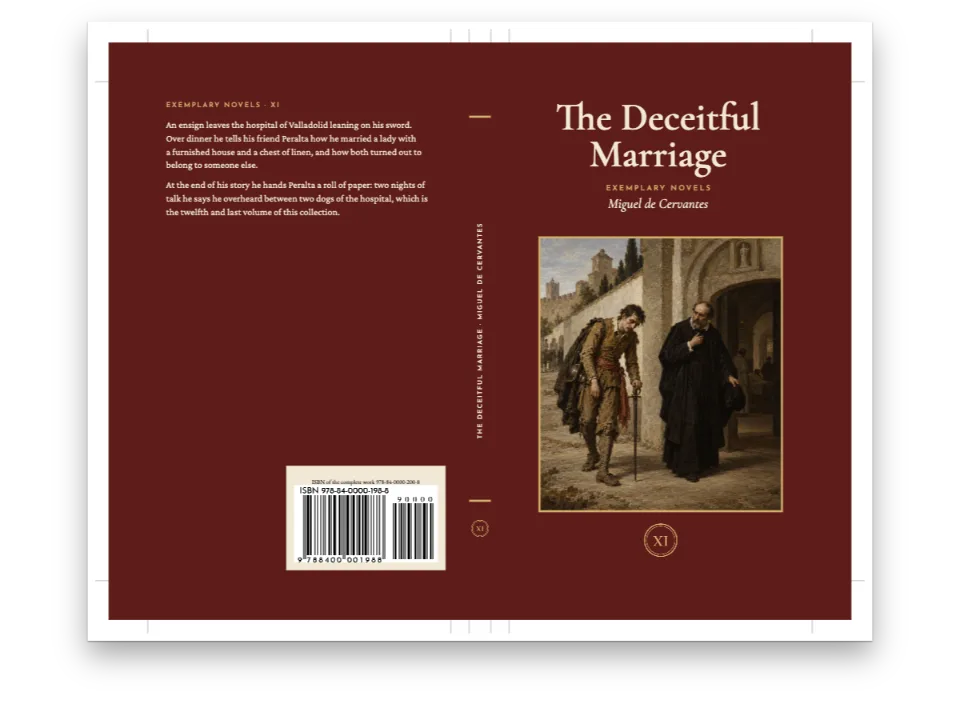
Ein Taschenbuch mit zwei Legenden von Bécquer und der Bogen für seinen Umschlag: Rückseite, Rücken, Vorderseite und beide Klappen in einem Stück. Der Rücken ist so breit wie die Seiten dick, also wird er aus dem Buch berechnet.
Was Sie setzen
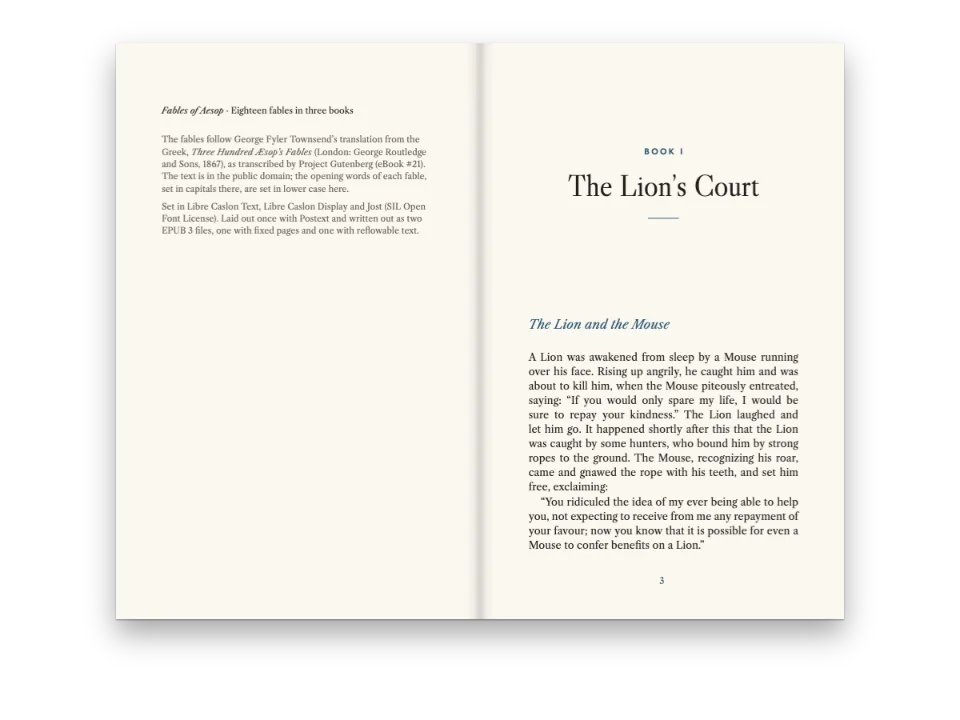
Zwei Legenden von Bécquer, The Spirits’ Mountain und The Emerald Eyes (El monte de las ánimas und Los ojos verdes), als Taschenbuch von 120 × 190 mm mit 60 mm breiten Klappen, dazu den Bogen, auf den sein Umschlag gedruckt wird. Postext setzt zuerst die 37 Seiten: Schmutztitel, Titelseite, Impressum, Inhalt, ein Titelblatt für jede Legende, dann den Text in Crimson Pro 11/15,2. Danach nimmt buildCover diese Seiten und baut den Bogen: hintere Klappe, Rückseite mit Klappentext und Strichcode, Rücken, Vorderseite mit dem Gemälde einer Kapellenruine am Fuß des Moncayo, vordere Klappe. Titel, Untertitel und Autor kommen aus den Metadaten des Buchs, der Text der Klappen aus einer eigenen Markdown-Datei.
Dieses Rezept beantwortet
- Wie mache ich den Umschlagbogen einer Klappenbroschur, mit dem Rücken aus der Seitenzahl berechnet?
Die kurze Antwort
// The book's own binding profile: PUR perfect binding in 16-page signatures, flaps of
// 60 mm whatever the trim. The spine is written nowhere: buildCover works it out from the
// laid-out pages, rounded up to whole signatures, on the paper of `folio.paper`.
const production = {
  bindings: [{ id: 'pur-flaps', name: 'PUR perfect binding, 60 mm flaps', style: 'perfect',
    signature: 16, measures: { flapWidth: 60, bleed: 3, spineAllowance: 0.5 } }],
  versions: [{ id: 'paperback', name: t({ en: 'Paperback', es: 'Rústica' }), binding: 'pur-flaps',
    flaps: true, isbn: '978-84-0000-196-4', isbnAddOn: '90000' }],
};
// 100 g/m² bulky cream wove at a bulk of 2.4: each leaf is 100 × 2.4 = 240 µm thick.
const folio = { paper: { type: 'bookWove', grammage: 100, bulk: 2.4, shade: '#f7f1e3' } };
// The design: a night ground over the whole sheet and the painting on the front, into the
// bleed at head and foot and up to the flap's fold. The texts come from the cover Markdown,
// the title, subtitle and author from the book's metadata.
const cover = {
  background: col('night'),
  elements: [{ id: 'art', kind: 'image', zone: 'front', x: 0, y: -3, width: 118, height: 196,
    resourceId: 'moncayo', fit: 'cover' }],
  verticalAlign: { back: 'middle' },
};
Zutaten
- Funktionen
- UmschlagbogenDruckausgaben, ISBN und BuchrückenUmschläge, Titelseiten und ImpressumÜberschriftenformateGestaltete AuftakteText, Linien und Kästen in SeitengestaltungenDokument-MetadatenAbsatzformateInhaltsverzeichnisKolumnentitel und SeitenzahlenAbbildungen und Tabellen als RessourcenSemantische FarbpalettePDF-ExportSeiten auf einem Canvas
- Nutzt außerdem
- Papier, Bindung, Tisch und Licht (Folio)ÜberschriftenattributePapierfarbeKopfzeilen nach SeitenrolleIm PDF eingebettete SchriftenKolumnentitel je AbschnittKapitel ohne Nummer
- Schrift
- Crimson Pro, Cormorant Garamond, Josefin Sans (SIL OFL 1.1)
- Dateien
moncayo-1100.jpg- The front cover: a ruined chapel under the Moncayo on All Souls’ Night, in oils (Generated With Diffusion Models, eigener Text)
Zubereitung
#1 · Die Bindung gibt die Klappen, das Papier den Rücken
Der Code steht oben in der kurzen Antwort. Das Bindungsprofil beschreibt, wie die Buchbinderei arbeitet: PUR-Klebebindung in Lagen zu 16 Seiten, 60 mm breite Klappen, 3 mm Anschnitt und ein halber Millimeter Zugabe am Rücken für den Leim. Die Ausgabe trägt die ISBN und ihren fünfstelligen Zusatz; die ISBN ist eine Beispielnummer, die keinem Buch gehört. Die Rückenstärke steht nirgends. Die 37 Seiten werden auf drei Lagen aufgerundet, 48 Seiten oder 24 Blatt, und jedes Blatt eines Papiers von 100 g/m² mit Volumen 2,4 ist 240 µm dick: 24 × 0,24 + 0,5 ergibt einen Rücken von 6,3 mm. Ein Rücken unter 6 mm bleibt standardmäßig unbeschriftet (spineText.minSpine), deshalb steht das Buch auf voluminösem Papier.
#2 · Zuerst die Seiten
const [W, H, TOP, FOOT, INNER, OUTER, LEAD] = [120, 190, 20, 22, 18, 15.5, 15.2]; // mm, pt
const at = (to, edge, x, y, size) => ({ anchor: { to, edge }, offset: { x: mm(x), y: mm(y) },
  ...(size && { size }) });
const text = (id, content, look, place) => ({ kind: 'text', id, content, align: 'center',
  overflow: 'wrap', placement: place, ...look });
const face = (fontFamily, size, color, extra) => ({ fontFamily, fontSize: pt(size), color,
  ...extra });
const label = (size, color = col('muted')) => face('Josefin Sans', size, color, caps(size / 5));
const none = { header: { elements: [] }, footer: { elements: [] }, numbered: false, toc: false };
const design = (minHeight, elements) => ({ enabled: true, minHeight: mm(minHeight),
  slot: { elements } });
const page = (parity) => ({ breakBefore: { enabled: true, parity } });
const rule = (id, y, to = 'page') => ({ kind: 'rule', id, direction: 'horizontal',
  thickness: pt(0.6), color: col('accent'), placement: at(to, 'top', 0, y, { width: mm(10) }) });
const folioAt = (y, pages) => ({ elements: [text('f', '{pageNumber}',
  { ...face('Crimson Pro', 9, col('ink')), pages }, at('page', 'bottom', 0, y))] });
const serif = (size, extra) => face('Cormorant Garamond', size, col('ink'), extra);
const headingStyles = [
  { ...none, id: 'half-title', advancedDesign: design(60, [
    text('t', '{title}', serif(17, { fontWeight: 500 }), at('page', 'top', 0, 62))]) },
  { ...none, ...page('odd'), id: 'title-page', advancedDesign: design(H - TOP - FOOT, [
    text('t', '{title}', serif(27, { fontWeight: 600 }), at('page', 'top', 0, 46)),
    text('s', '{subtitle}', serif(13, { italic: true }), at('page', 'top', 0, 58)),
    rule('r', 67),
    text('a', '{author}', label(8, col('accent')), at('page', 'top', 0, 72)),
    text('tr', '{attr.translators}', face('Crimson Pro', 9.5, col('muted'), { italic: true }),
      at('page', 'top', 0, 118, { width: mm(70) })),
    text('i', '{attr.imprint}', label(7), at('page', 'bottom', 0, -26)),
  ]) },
  // The rights at the foot of the verso, under a short rule.
  { ...none, ...page('even'), id: 'rights',
    advancedDesign: design(92, [rule('r', 86, 'container')]) },
  { ...none, ...page('odd'), id: 'contents', advancedDesign: design(34, [
    text('t', '{titleText}', label(8, col('accent')), at('container', 'top', 0, 14)),
    rule('r', 21, 'container')]) },
  // Each legend has a title leaf of its own (the contents point to it), then opens on the
  // next recto, sunk 40 mm.
  { ...none, ...page('odd'), id: 'tale-title', toc: true, advancedDesign: design(90, [
    text('k', '{attr.kicker}', serif(15, { fontWeight: 600, color: col('accent') }),
      at('page', 'top', 0, 58)),
    text('t', '{titleText}', serif(23, { fontWeight: 500 }), at('page', 'top', 0, 67)),
    text('p', '{attr.place}', face('Crimson Pro', 10.5, col('muted'), { italic: true }),
      at('page', 'top', 0, 79)),
    rule('r', 88)]) },
  { ...page('odd'), id: 'tale', toc: false, advancedDesign: design(40, [
    text('t', '{titleText}', serif(15, { fontWeight: 500, italic: true }),
      at('container', 'top', 0, 16)),
    rule('r', 25, 'container')]) },
  { ...none, ...page('any'), id: 'colophon', advancedDesign: design(70, [
    rule('r', 60, 'container')]) },
];
const head = (id, content, parity) => text(id, content, { ...label(6.8), parity, pages: 'body' },
  at('page', 'top', 0, 11));
Der Buchblock ist ein gewöhnliches Postext-Dokument, und jede seiner Seiten zählt für den Rücken. Die Titelei arbeitet mit Überschriftenstilen, deren Gestaltung Titel, Linie und Verlagszeile in festen Höhen auf die Seite stellt. Jede Legende hat ihr eigenes Titelblatt (auf das das Inhaltsverzeichnis verweist) und beginnt auf der nächsten rechten Seite neu, 40 mm tiefer. Ändern Sie Schriftgrad oder Ränder, ändert sich die Seitenzahl, und der Rücken folgt beim nächsten Satz.
#3 · Die Stile des Umschlags stehen bei denen des Buchs
const style = (id, fontFamily, size, lead, color, extra) => ({ id, fontFamily, fontSize: pt(size),
  lineHeight: pt(lead), color, italicColor: color, firstLineIndent: mm(0), textAlign: 'left',
  hyphenation: false, ...extra });
const caps = (tracking) => ({ fontWeight: 600, textTransform: 'uppercase',
  letterSpacing: pt(tracking) });
const coverStyles = [
  style('cover-title', 'Cormorant Garamond', 40, 40, col('bone'), { fontWeight: 600,
    textAlign: 'center', marginTop: mm(12) }),
  style('cover-subtitle', 'Cormorant Garamond', 15, 19, col('bone'), { italic: true,
    textAlign: 'center' }),
  style('cover-author', 'Josefin Sans', 8.5, 11, col('gold'), { ...caps(1.8),
    textAlign: 'center', marginTop: pt(16) }),
  style('cover-spine', 'Josefin Sans', 7.5, 9, col('bone'), { ...caps(1.2), textAlign: 'center' }),
  style('cover-blurb', 'Crimson Pro', 10.5, 14.5, col('bone'), { marginBottom: pt(7) }),
  style('cover-note', 'Crimson Pro', 10.5, 14.5, col('gold'), { italic: true }),
  style('flap-head', 'Josefin Sans', 7.5, 10, col('gold'), caps(1.4)),
  style('flap-text', 'Crimson Pro', 9.6, 13.2, col('bone'), { marginTop: pt(5) }),
];
Der Bogen wird mit der Konfiguration des Buchs gesetzt, seine Absatzstile stehen also in derselben Liste wie die des Impressums und des Kolophons. cover-title, cover-subtitle, cover-author und cover-spine sind die Namen, die buildCover den Metadaten gibt, die es platziert; cover-blurb, cover-note, flap-head und flap-text nennt das Markdown des Umschlags. Auf dem Nachtgrund steht der Text im Flattersatz, ohne Trennungen, im Knochenweiß und Gold der Palette.
#4 · Der Bogen entsteht aus den gesetzten Seiten
const built = buildCover({ config, version: 'paperback', pages: book.pages, markdown: coverText,
  metadata: book.metadata, resources });
if (!('config' in built)) throw new Error(built.issues.map((i) => i.kind).join(', '));
// The barcode is the cover's own picture. Its digits name OCR-B, which no font server
// has: they are set in the label face, which the PDF embeds like the rest.
for (const [id, bytes] of Object.entries(built.files)) {
  await loadSvg(id, new TextDecoder().decode(bytes)
    .replace(/font-family="[^"]*"/g, 'font-family="Josefin Sans"'));
}
const sheet = await buildDocumentWithFonts(built.content, built.config, kitFonts(FONTS));
buildCover bekommt die Seiten, die Metadaten und das Markdown des Umschlags, mit einem :::frame für die Rückseite und je einem für die Klappen. Es liefert ein Dokument, das buildDocumentWithFonts wie jedes andere setzt, dazu den Strichcode als SVG-Datei. Die Ziffern des Codes verlangen OCR-B, die kein Schriftserver anbietet; das Beispiel setzt sie deshalb in Josefin Sans, einer Schrift, die das PDF ohnehin einbettet. Das PDF enthält die 37 Seiten und danach den Bogen in seinem eigenen Format, die Datei, die eine Druckerei erwartet.
Das ganze Rezept
// ═══ Postext Cookbook · Nº 196 · A paperback cover with flaps, spine from the pages ═══
// https://postext.dev/en/cookbook/paperback-cover-with-flaps
// Code: MIT · Text: Bécquer, tr. C. F. & K. L. Bates (public domain) · Art: diffusion models
// Fonts: Crimson Pro, Cormorant Garamond, Josefin Sans (SIL OFL 1.1) · Needs postext ≥ 1.92.0
//
// Two of Bécquer's legends as a 120 × 190 mm paperback with 60 mm flaps. Postext lays the
// pages out first; buildCover then makes the cover sheet from them, its spine as thick as
// the pages on their paper.
import {
  buildDocumentWithFonts, renderPageToCanvas, registerResourceImage, inlineSvgFonts,
} from 'https://esm.sh/postext';
import { buildCover } from 'https://esm.sh/postext/production';
import { renderToPdf, decompressWoff2 } from 'https://esm.sh/postext-pdf';

const LANG = 'en'; // @lang: the language of the sample document ('en' | 'es')
const RECIPE = 'paperback-cover-with-flaps';

// ─── 1 · Design ─────────────────────────────────────────────────────────────
const palette = { ink: '#25221e', accent: '#86472a', muted: '#6b645a', paper: '#fbf7ee',
  night: '#16242a', gold: '#c99b4e', bone: '#eee5d1' }; // the last three: the cover's
const col = (id) => ({ hex: palette[id], model: 'hex', paletteId: id });
const colorPalette = [
  ...Object.entries(palette).map(([id, hex]) => ({ id, name: id, value: { hex, model: 'hex' } })),
  { id: 'main-color', name: 'accent (defaults)', value: { hex: palette.accent, model: 'hex' } },
];

// #region answer: the paperback: a printer's binding with 60 mm flaps, its ISBN, its paper
// The book's own binding profile: PUR perfect binding in 16-page signatures, flaps of
// 60 mm whatever the trim. The spine is written nowhere: buildCover works it out from the
// laid-out pages, rounded up to whole signatures, on the paper of `folio.paper`.
const production = {
  bindings: [{ id: 'pur-flaps', name: 'PUR perfect binding, 60 mm flaps', style: 'perfect',
    signature: 16, measures: { flapWidth: 60, bleed: 3, spineAllowance: 0.5 } }],
  versions: [{ id: 'paperback', name: t({ en: 'Paperback', es: 'Rústica' }), binding: 'pur-flaps',
    flaps: true, isbn: '978-84-0000-196-4', isbnAddOn: '90000' }],
};
// 100 g/m² bulky cream wove at a bulk of 2.4: each leaf is 100 × 2.4 = 240 µm thick.
const folio = { paper: { type: 'bookWove', grammage: 100, bulk: 2.4, shade: '#f7f1e3' } };
// The design: a night ground over the whole sheet and the painting on the front, into the
// bleed at head and foot and up to the flap's fold. The texts come from the cover Markdown,
// the title, subtitle and author from the book's metadata.
const cover = {
  background: col('night'),
  elements: [{ id: 'art', kind: 'image', zone: 'front', x: 0, y: -3, width: 118, height: 196,
    resourceId: 'moncayo', fit: 'cover' }],
  verticalAlign: { back: 'middle' },
};
// #endregion
Das zusammengesetzte script.js läuft unverändert: Fügen Sie es in das Modulskript einer beliebigen Seite ein, oder öffnen Sie das Rezept auf CodePen. Ordner des Rezepts auf GitHub ↗ (öffnet sich in einem neuen Tab)
Varianten
#Den Rücken von oben nach unten beschriften
Englische und amerikanische Bücher lesen den Rücken von oben nach unten; die Voreinstellung, von unten nach oben, folgt dem kontinentalen Brauch.
   versions: [{ id: 'paperback', name: t({ en: 'Paperback', es: 'Rústica' }), binding: 'pur-flaps',
-    flaps: true, isbn: '978-84-0000-196-4', isbnAddOn: '90000' }],
+    flaps: true, isbn: '978-84-0000-196-4', isbnAddOn: '90000',
+ spineText: { direction: 'topToBottom' } }],#Auf dünneres Papier drucken
Bei 80 g/m² und Volumen 2,2 ist ein Blatt 176 µm dick, der Rücken schrumpft auf 4,7 mm und verliert seine Beschriftung, die 6 mm braucht.
-const folio = { paper: { type: 'bookWove', grammage: 100, bulk: 2.4, shade: '#f7f1e3' } };
+const folio = { paper: { type: 'bookWove', grammage: 80, bulk: 2.2, shade: '#f7f1e3' } };Häufige Fehler
- In der Liste der erfassten Seiten folgt der Bogen auf die Seiten des Buchs; seine Nummer ist die Seitenzahl des Buchs plus eins. Bekommt das Buch eine Seite mehr, ändert sich die Nummer.
- Ein Strichcode, dessen Ziffern eine Schrift verlangen, die das PDF nicht findet, lässt den Export scheitern. Laden Sie sein SVG mit einer
font-family, die das Beispiel schon hat.
Nachweise
- Rezept
- Ignacio Ferro
- Text
- The Spirits’ Mountain and The Emerald Eyes, translated by Cornelia Frances Bates and Katharine Lee Bates, from Romantic Legends of Spain (1909), Project Gutenberg eBook #50044 · Gustavo Adolfo Bécquer · gemeinfrei
- El monte de las ánimas and Los ojos verdes, from the Obras (Madrid, Fernando Fe, 1885) as transcribed on Wikisource, accents modernised · Gustavo Adolfo Bécquer · gemeinfrei
- Bilder
- The front cover: a ruined chapel under the Moncayo on All Souls’ Night, in oils · Generated With Diffusion Models · eigener Text
- Schriften
- Crimson Pro (SIL OFL 1.1) · Cormorant Garamond (SIL OFL 1.1) · Josefin Sans (SIL OFL 1.1)
- Code
- MIT, wie Postext
Diesen Text bearbeiten ↗ (öffnet sich in einem neuen Tab)Ordner des Rezepts auf GitHub ↗ (öffnet sich in einem neuen Tab)