Kurz gesagt
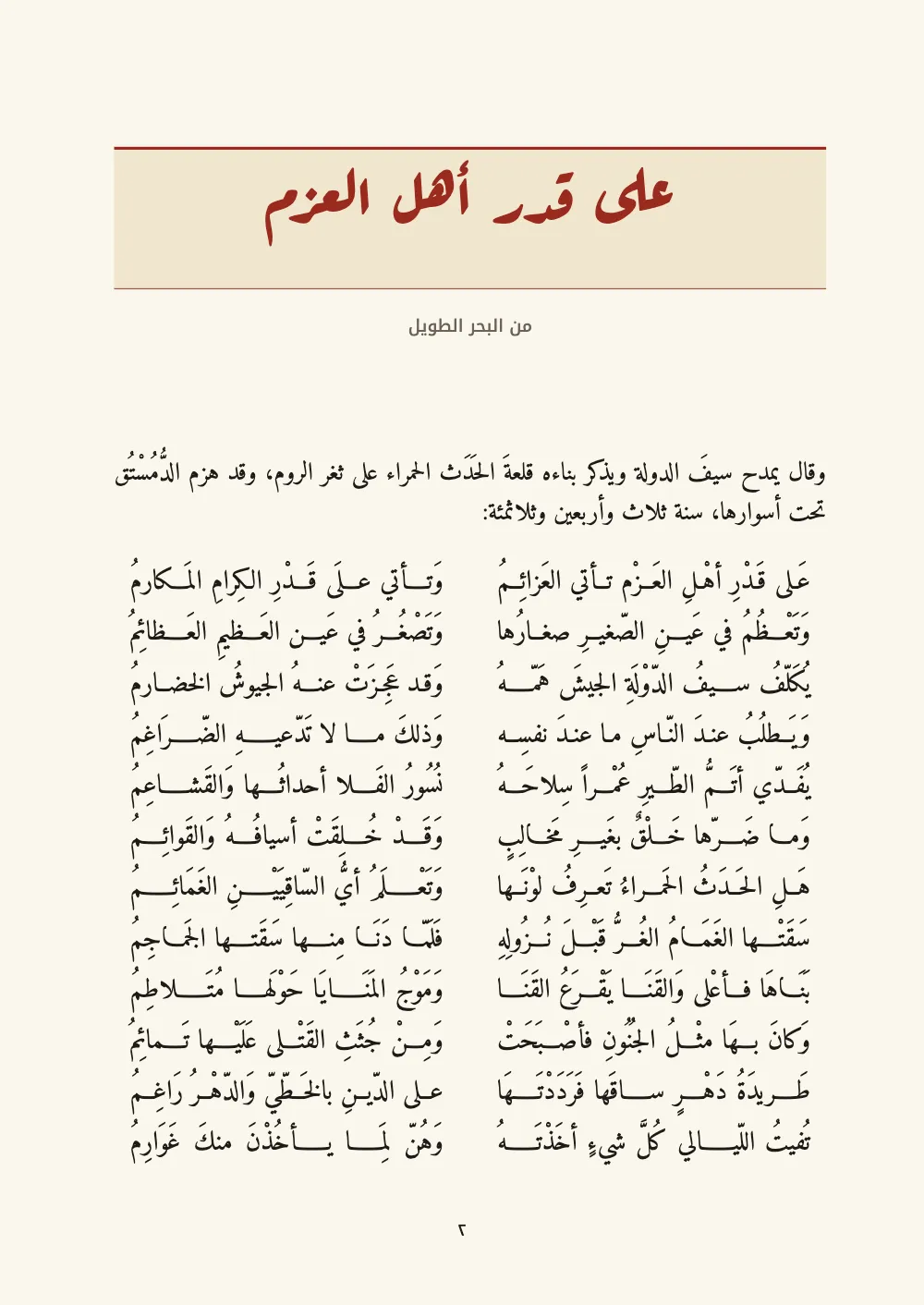
Ein klassisches arabisches Gedicht, gedruckt wie in alten Gedichtbänden: Jeder Vers ist in zwei Hälften geteilt, die nebeneinanderstehen, und beide Hälften sind auf dieselbe Breite gedehnt, sodass ihre Enden die Seite hinab fluchten.
Was Sie setzen
Vier Seiten eines Diwans, der gesammelten Gedichte von al-Mutanabbī, so gesetzt, wie Kairoer Drucker es vor einem Jahrhundert taten: ein Schmutztitel mit ديوان in roter Ruqʿa, dann die Qaṣīda, die er 954 vor Sayf ad-Daula vortrug, unter einer rot linierten Kopfleiste. Jeder der 46 Bayts ist eine Zeile aus zwei Halbversen, der ṣadr rechts und der ʿajuz links, beide mit Kaschidas auf eine Breite gedehnt, sodass die Reime auf ‑mu in gerader Linie den linken Rand hinablaufen. Das Buch ist rechts gebunden, und die Paginas zählen in arabisch-indischen Ziffern. Nur die Anmerkung zum Text am Ende ändert sich mit der Ausgabe. Tang-Gedichte gegenüber ihren englischen Versen setzt klassische chinesische Verse auf ihr eigenes Raster.
Dieses Rezept beantwortet
- Wie setze ich klassische arabische Verse mit jeder Zeile in zwei Halbversen?
Die kurze Antwort
// In the Markdown, a :::verse block takes one bayt a line, the ṣadr and the ʿajuz parted
// by ||:
//   :::verse{style="bayt"}
//   عَلى قَدْرِ أهْلِ العَزْم تأتي العَزائِمُ || وَتأتي علَى قَدْرِ الكِرامِ المَكارمُ
//   :::
// The ṣadr goes on the right, the ʿajuz on the left, both stretched to the width of the
// widest half with a gap of 2 em between them. The style gives the poem its face and a
// leading deep enough for the harakat: 1.9 × the size.
const bayt = { id: 'bayt', fontFamily: NASKH, fontSize: pt(14), lineHeight: pt(26.6),
  color: col('ink'), marginTop: pt(LEAD / 2), marginBottom: pt(LEAD) };
// Justified lines lengthen their words with kashidas (tatweel) before they open the
// spaces wide: 'auto' is the default in an Arabic document, written out here to say so.
// A hemistich may stretch a word twice as far as a line of prose does: 1.2 em.
const bodyKashida = { kashida: 'auto', kashidaPatterns: 'naskh', kashidaMaxLength: 0.6 };
Zutaten
- Funktionen
- Arabische Verse (Bait in zwei Halbversen)Blocksatz mit KaschidaText von rechts nach linksArabische SchriftenArabisch als DokumentspracheRechts gebundene BücherZiffern der erzeugten ZahlenGestaltete AuftakteÜberschriftenattributeÜberschriftenformateUmschläge, Titelseiten und ImpressumKolumnentitel und SeitenzahlenKopfzeilen nach SeitenrollePapierfarbeAbsatzformateAbsätze in der anderen RichtungSemantische FarbpalettePDF-ExportIm PDF eingebettete Schriften
- Nutzt außerdem
- Kolumnentitel je Abschnitt
- Schrift
- Amiri, Aref Ruqaa, Noto Kufi Arabic (SIL OFL 1.1)
- Dateien
- Keine: Jedes Bild wird im Code gezeichnet
Zubereitung
#1 · Ein Bayt pro Zeile, beide Hälften auf eine Breite
Der Code steht in der kurzen Antwort oben. In :::verse ist jede Zeile ein Bayt, und || trennt die beiden Halbverse, sodass sich das Markdown wie der Wikisource-Text liest, aus dem es stammt (:::verse). Das Gedicht misst jeden Halbvers, nimmt die breiteste Hälfte als Breite beider Spalten (höchstens die halbe Satzbreite abzüglich des Zwischenraums) und füllt jede Hälfte auf diese Breite, zuerst mit Kaschidas, danach mit den Wortabständen (Klassische Verse). Das Format bayt steht in 14 pt bei 26,6 pt Zeilenabstand, dem 1,9-Fachen der Größe, damit sich Schaddas und Kasras benachbarter Zeilen nicht berühren (Vokalzeichen). Das Endformat ist 17 × 24 cm: Bei 14 × 21 cm passte ein Drittel der Bayts nicht in seine Hälfte der 104 mm Satzbreite und fiel auf einen versetzten Satz zurück, ṣadr und ʿajuz jeweils auf eigener Zeile.
#2 · Eine Kopfleiste in Ruqʿa
const rule = (id, y, thickness) => ({ kind: 'rule', id, direction: 'horizontal',
  thickness: pt(thickness), color: col('rubric'),
  placement: { anchor: { to: 'container', edge: 'top' }, offset: { y: mm(y) },
    size: { width: 'fill' } } });
const opener = {
  enabled: true, minHeight: mm(46),
  slot: { elements: [
    { kind: 'box', id: 'band', reserve: false, style: { backgroundColor: col('tint') },
      placement: { anchor: { to: 'container', edge: 'top' }, offset: { y: mm(4) },
        size: { width: 'fill', height: mm(26) } } },
    rule('band-top', 4, 1.5), rule('band-foot', 30, 0.5),
    { kind: 'text', id: 'title', content: '{titleText}', fontFamily: RUQAA, fontWeight: 700,
      fontSize: pt(34), lineHeight: 1.1, align: 'center', color: col('rubric'),
      placement: { anchor: { to: 'container', edge: 'top' }, offset: { y: mm(7.5) } } },
    { kind: 'text', id: 'metre', content: '{attr.metre}', fontFamily: KUFI, fontWeight: 500,
      fontSize: pt(9), align: 'center', color: col('muted'),
      placement: { anchor: { to: 'container', edge: 'top' }, offset: { y: mm(35) } } },
  ] },
};
Die Überschrift der Ebene 1 wird von ihrer Gestaltung gezeichnet: ein getönter Kasten mit roten Linien oben und unten, der Titel mittig darüber in Aref Ruqaa und darunter das Versmaß aus einem Attribut der Überschrift, {metre="من البحر الطويل"}. Auszeichnungsschrift in Ruqʿa nimmt keine Kaschida, daher behält der Titel seine natürliche Breite (Blocksatz und Kaschida).
#3 · Kolumnentitel an den Seiten des Bogens
// Running heads stay on the sheet's sides: in a book bound on the right the verso (even)
// is the right-hand page, so its outer edge, where the folio goes, is the right one.
const head = (id, content, parity, edge, x, extra = {}) => ({ kind: 'text', id, content,
  parity, pages: 'body', fontFamily: KUFI, fontWeight: 500, fontSize: pt(8.5),
  color: col('muted'), placement: { anchor: { to: 'page', edge }, offset: { x: mm(x), y: mm(12) } },
  ...extra });
const header = { elements: [
  head('verso-folio', '{pageNumber}', 'even', 'top-right', -OUTER, { color: col('ink') }),
  head('verso-book', '{title}', 'even', 'top-right', -(OUTER + 10)),
  head('recto-rhyme', '{subtitle}', 'odd', 'top-left', OUTER + 10),
  head('recto-folio', '{pageNumber}', 'odd', 'top-left', OUTER, { color: col('ink') }),
] };
const footer = { elements: [head('drop-folio', '{pageNumber}', 'all', 'bottom', 0, {
  pages: 'opener', color: col('ink'),
  placement: { anchor: { to: 'page', edge: 'bottom' }, offset: { y: mm(-12) } } })] };
Der Grundtext läuft von rechts nach links, und sein Links und Rechts bedeuten Anfang und Ende. Kolumnentitel bleiben physisch. In einem rechts gebundenen Buch liegt die Verso-Seite, eine gerade Seite, rechts in der Doppelseite, also steht ihre Pagina oben rechts und die der Recto-Seite oben links: Beide sitzen am Außenrand (Seitenfolge und Bindung rechts). Das Tag locale: 'ar' allein legt Richtung, Bindung und arabisch-indische Ziffern fest.
#4 · Ein Schmutztitel ohne Inhalt im Textfluss
const at = (y) => ({ anchor: { to: 'page', edge: 'top' }, offset: { y: mm(y) } });
const line = (id, content, y, style) => ({ kind: 'text', id, content, align: 'center',
  overflow: 'wrap', color: col('ink'), placement: at(y), ...style });
const titlePage = {
  id: 'title', span: 'page', runningChapter: false,
  breakBefore: { enabled: true, parity: 'any' },
  header: { elements: [] }, footer: { elements: [] },
  advancedDesign: { enabled: true, slot: { elements: [
    line('diwan', 'ديوان', 52, { fontFamily: RUQAA, fontWeight: 700, fontSize: pt(64),
      lineHeight: 1.2, color: col('rubric') }),
    line('poet', '{titleText}', 84, { fontFamily: NASKH, fontWeight: 700, fontSize: pt(20) }),
    { kind: 'rule', id: 'rule', direction: 'horizontal', thickness: pt(0.75),
      color: col('rubric'), placement: { anchor: { to: 'page', edge: 'top' },
        offset: { y: mm(100) }, size: { width: mm(24) } } },
    line('rhyme', '{attr.rhyme}', 106, { fontFamily: KUFI, fontWeight: 500, fontSize: pt(11),
      color: col('rubric') }),
    line('latin', '{attr.latin}', 150, { fontFamily: NASKH, fontSize: pt(9.5),
      color: col('muted'), italic: true }),
  ] } },
};
Der Schmutztitel ist ein Überschriftenformat mit span: 'page' und eigener leerer Kopf- und Fußzeile. Der Text seiner Überschrift ist der Name des Dichters, daher ist das Wort ديوان Gestaltungstext, in 64 pt darüber gesetzt, und die lateinische Zeile unter der Linie kommt aus dem Attribut latin, das jede Ausgabe in ihrer Sprache schreibt.
Das ganze Rezept
// ═══ Postext Cookbook · Nº 110 · A qasida on a diwan page, in two hemistichs ═══════════ // https://postext.dev/en/cookbook/qasida-diwan-page // Code: MIT · Text: al-Mutanabbī, Dīwān, ar.wikisource (PD) · Pictures: none // Fonts: Amiri, Aref Ruqaa, Noto Kufi Arabic (SIL OFL 1.1) · Needs postext ≥ 1.28.0 import { buildDocument, withLoadedFonts, renderPageToCanvas } from 'https://esm.sh/postext'; import { renderToPdf, decompressWoff2 } from 'https://esm.sh/postext-pdf'; const LANG = 'en'; // @lang: the language of the sample document ('en' | 'es') const RECIPE = 'qasida-diwan-page'; // ─── 1 · Design ───────────────────────────────────────────────────────────── // Black text and red rubrics on a warm paper, as a Cairo diwan of the 1900s prints them. const palette = { ink: '#1f1a16', // text: a warm near-black rubric: '#9a2b1f', // the accent: titles, the metre, the headpiece rules tint: '#f1e6cf', // the headpiece band rule: '#b8a27c', // hairlines muted: '#6b6156', // running heads and the note on the text paper: '#fbf7ee', // a cream paper }; const col = (id) => ({ hex: palette[id], model: 'hex', paletteId: id }); const colorPalette = [ ...Object.entries(palette).map(([id, hex]) => ({ id, name: id, value: { hex, model: 'hex' } })), { id: 'main-color', name: 'rubric (defaults)', value: { hex: palette.rubric, model: 'hex' } }, ]; const NASKH = 'Amiri'; // the text: a Bulaq Naskh const RUQAA = 'Aref Ruqaa'; // display: the titles const KUFI = 'Noto Kufi Arabic'; // labels: metre, running heads, folios const [SIZE, LEAD] = [13, 21]; // pt: the prose, at 1.6 × for a lightly vocalised headnote const [OUTER, TOP] = [18, 23]; // mm: a 17 × 24 cm diwan // #region answer: one bayt a line, both hemistichs stretched to one width // In the Markdown, a :::verse block takes one bayt a line, the ṣadr and the ʿajuz parted // by ||: // :::verse{style="bayt"} // عَلى قَدْرِ أهْلِ العَزْم تأتي العَزائِمُ || وَتأتي علَى قَدْرِ الكِرامِ المَكارمُ // ::: // The ṣadr goes on the right, the ʿajuz on the left, both stretched to the width of the // widest half with a gap of 2 em between them. The style gives the poem its face and a // leading deep enough for the harakat: 1.9 × the size. const bayt = { id: 'bayt', fontFamily: NASKH, fontSize: pt(14), lineHeight: pt(26.6), color: col('ink'), marginTop: pt(LEAD / 2), marginBottom: pt(LEAD) }; // Justified lines lengthen their words with kashidas (tatweel) before they open the // spaces wide: 'auto' is the default in an Arabic document, written out here to say so. // A hemistich may stretch a word twice as far as a line of prose does: 1.2 em. const bodyKashida = { kashida: 'auto', kashidaPatterns: 'naskh', kashidaMaxLength: 0.6 }; // #endregion // #region opener: a headpiece band with the title in Ruqʿa and the metre under it const rule = (id, y, thickness) => ({ kind: 'rule', id, direction: 'horizontal', thickness: pt(thickness), color: col('rubric'), placement: { anchor: { to: 'container', edge: 'top' }, offset: { y: mm(y) }, size: { width: 'fill' } } }); const opener = { enabled: true, minHeight: mm(46), slot: { elements: [ { kind: 'box', id: 'band', reserve: false, style: { backgroundColor: col('tint') }, placement: { anchor: { to: 'container', edge: 'top' }, offset: { y: mm(4) }, size: { width: 'fill', height: mm(26) } } }, rule('band-top', 4, 1.5), rule('band-foot', 30, 0.5), { kind: 'text', id: 'title', content: '{titleText}', fontFamily: RUQAA, fontWeight: 700, fontSize: pt(34), lineHeight: 1.1, align: 'center', color: col('rubric'), placement: { anchor: { to: 'container', edge: 'top' }, offset: { y: mm(7.5) } } }, { kind: 'text', id: 'metre', content: '{attr.metre}', fontFamily: KUFI, fontWeight: 500, fontSize: pt(9), align: 'center', color: col('muted'), placement: { anchor: { to: 'container', edge: 'top' }, offset: { y: mm(35) } } }, ] }, }; // #endregion // #region title: the diwan's half-title, centred on the page const at = (y) => ({ anchor: { to: 'page', edge: 'top' }, offset: { y: mm(y) } }); const line = (id, content, y, style) => ({ kind: 'text', id, content, align: 'center', overflow: 'wrap', color: col('ink'), placement: at(y), ...style }); const titlePage = { id: 'title', span: 'page', runningChapter: false, breakBefore: { enabled: true, parity: 'any' }, header: { elements: [] }, footer: { elements: [] }, advancedDesign: { enabled: true, slot: { elements: [ line('diwan', 'ديوان', 52, { fontFamily: RUQAA, fontWeight: 700, fontSize: pt(64), lineHeight: 1.2, color: col('rubric') }), line('poet', '{titleText}', 84, { fontFamily: NASKH, fontWeight: 700, fontSize: pt(20) }), { kind: 'rule', id: 'rule', direction: 'horizontal', thickness: pt(0.75), color: col('rubric'), placement: { anchor: { to: 'page', edge: 'top' }, offset: { y: mm(100) }, size: { width: mm(24) } } }, line('rhyme', '{attr.rhyme}', 106, { fontFamily: KUFI, fontWeight: 500, fontSize: pt(11), color: col('rubric') }), line('latin', '{attr.latin}', 150, { fontFamily: NASKH, fontSize: pt(9.5), color: col('muted'), italic: true }), ] } }, }; // #endregion // #region heads: the book on the verso, the rhyme on the recto, folios outside // Running heads stay on the sheet's sides: in a book bound on the right the verso (even) // is the right-hand page, so its outer edge, where the folio goes, is the right one. const head = (id, content, parity, edge, x, extra = {}) => ({ kind: 'text', id, content, parity, pages: 'body', fontFamily: KUFI, fontWeight: 500, fontSize: pt(8.5), color: col('muted'), placement: { anchor: { to: 'page', edge }, offset: { x: mm(x), y: mm(12) } }, ...extra }); const header = { elements: [ head('verso-folio', '{pageNumber}', 'even', 'top-right', -OUTER, { color: col('ink') }), head('verso-book', '{title}', 'even', 'top-right', -(OUTER + 10)), head('recto-rhyme', '{subtitle}', 'odd', 'top-left', OUTER + 10), head('recto-folio', '{pageNumber}', 'odd', 'top-left', OUTER, { color: col('ink') }), ] }; const footer = { elements: [head('drop-folio', '{pageNumber}', 'all', 'bottom', 0, { pages: 'opener', color: col('ink'), placement: { anchor: { to: 'page', edge: 'bottom' }, offset: { y: mm(-12) } } })] }; // #endregion const config = () => ({ locale: 'ar', // right to left, bound on the right, digits ٠–٩ (gotcha: arabic-locale-tag) colorPalette, page: { width: mm(170), height: mm(240), dpi: 150, backgroundColor: col('paper'), margins: { top: mm(TOP), bottom: mm(22), left: mm(21), right: mm(OUTER), mirror: true } }, layout: { layoutType: 'single' }, bodyText: { fontFamily: NASKH, fontSize: pt(SIZE), lineHeight: pt(LEAD), color: col('ink'), boldColor: col('ink'), italicColor: col('ink'), referenceColor: col('ink'), textAlign: 'justify', firstLineIndent: em(1.5), indentAfterHeading: false, optimalLineBreaking: true, avoidWidows: true, avoidOrphans: true, ...bodyKashida }, // Each poem opens a page, on either side of the spine. headings: { fontFamily: RUQAA, fontWeight: 700, color: col('rubric'), levels: [{ level: 1, fontSize: pt(34), breakBefore: { enabled: true, parity: 'any' }, advancedDesign: opener }] }, headingStyles: [titlePage], paragraphStyles: [bayt, { id: 'note', fontFamily: NASKH, fontSize: pt(9.5), lineHeight: pt(14), color: col('muted'), boldColor: col('ink'), italicColor: col('muted'), textAlign: 'justify', firstLineIndent: pt(0), marginTop: pt(LEAD), hyphenation: { enabled: true, locale: LANG } }, { id: 'colophon', fontFamily: NASKH, fontSize: pt(8), lineHeight: pt(11), color: col('muted'), textAlign: 'left', firstLineIndent: pt(0), marginTop: pt(7) }, ], header, footer, }); // ─── 2 · Content ──────────────────────────────────────────────────────────── const markdown = String.raw`---Markdown-Beispiel · 66 Zeilen · content.en.md
title: "ديوان المتنبي" subtitle: "قافية الميم" --- # أبي الطيّب المتنبّي {style="title" rhyme="قافية الميم" latin="The Dīwān of al-Mutanabbī · poems rhyming in mīm"} # على قدر أهل العزم {metre="من البحر الطويل"} وقال يمدح سيفَ الدولة ويذكر بناءه قلعةَ الحَدَث الحمراء على ثغر الروم، وقد هزم الدُّمُسْتُق تحت أسوارها، سنة ثلاث وأربعين وثلاثمئة: :::verse{style="bayt"} عَلى قَدْرِ أهْلِ العَزْم تأتي العَزائِمُ || وَتأتي علَى قَدْرِ الكِرامِ المَكارمُ وَتَعْظُمُ في عَينِ الصّغيرِ صغارُها || وَتَصْغُرُ في عَين العَظيمِ العَظائِمُ يُكَلّفُ سيفُ الدّوْلَةِ الجيشَ هَمّهُ || وَقد عَجِزَتْ عنهُ الجيوشُ الخضارمُ وَيَطلُبُ عندَ النّاسِ ما عندَ نفسِه || وَذلكَ ما لا تَدّعيهِ الضّرَاغِمُ يُفَدّي أتَمُّ الطّيرِ عُمْراً سِلاحَهُ || نُسُورُ الفَلا أحداثُها وَالقَشاعِمُ وَما ضَرّها خَلْقٌ بغَيرِ مَخالِبٍ || وَقَدْ خُلِقَتْ أسيافُهُ وَالقَوائِمُ هَلِ الحَدَثُ الحَمراءُ تَعرِفُ لوْنَها || وَتَعْلَمُ أيُّ السّاقِيَيْنِ الغَمَائِمُ سَقَتْها الغَمَامُ الغُرُّ قَبْلَ نُزُولِهِ || فَلَمّا دَنَا مِنها سَقَتها الجَماجِمُ بَنَاهَا فأعْلى وَالقَنَا يَقْرَعُ القَنَا || وَمَوْجُ المَنَايَا حَوْلَها مُتَلاطِمُ وَكانَ بهَا مثْلُ الجُنُونِ فأصْبَحَتْ || وَمِنْ جُثَثِ القَتْلى عَلَيْها تَمائِمُ طَريدَةُ دَهْرٍ ساقَها فَرَدَدْتَهَا || على الدّينِ بالخَطّيّ وَالدّهْرُ رَاغِمُ تُفيتُ اللّيالي كُلَّ شيءٍ أخَذْتَهُ || وَهُنّ لِمَا يأخُذْنَ منكَ غَوَارِمُ إذا كانَ ما تَنْوِيهِ فِعْلاً مُضارِعاً || مَضَى قبلَ أنْ تُلقى علَيهِ الجَوازِمُ وكيفَ تُرَجّي الرّومُ والرّوسُ هدمَها || وَذا الطّعْنُ آساسٌ لهَا وَدَعائِمُ وَقَد حاكَمُوهَا وَالمَنَايَا حَوَاكِمٌ || فَما ماتَ مَظلُومٌ وَلا عاشَ ظالِمُ أتَوْكَ يَجُرّونَ الحَديدَ كَأنّمَا || سَرَوْا بِجِيَادٍ ما لَهُنّ قَوَائِمُ إذا بَرَقُوا لم تُعْرَفِ البِيضُ منهُمُ || ثِيابُهُمُ من مِثْلِها وَالعَمَائِمُ خميسٌ بشرْقِ الأرْضِ وَالغرْبِ زَحْفُهُ || وَفي أُذُنِ الجَوْزَاءِ منهُ زَمَازِمُ تَجَمّعَ فيهِ كلُّ لِسْنٍ وَأُمّةٍ || فَمَا يُفْهِمُ الحُدّاثَ إلاّ الترَاجِمُ فَلِلّهِ وَقْتٌ ذَوّبَ الغِشَّ نَارُهُ || فَلَمْ يَبْقَ إلاّ صَارِمٌ أوْ ضُبارِمُ تَقَطّعَ ما لا يَقْطَعُ الدّرْعَ وَالقَنَا || وَفَرّ منَ الفُرْسانِ مَنْ لا يُصادِمُ وَقَفْتَ وَما في المَوْتِ شكٌّ لوَاقِفٍ || كأنّكَ في جَفنِ الرّدَى وهْوَ نائِمُ تَمُرّ بكَ الأبطالُ كَلْمَى هَزيمَةً || وَوَجْهُكَ وَضّاحٌ وَثَغْرُكَ باسِمُ تجاوَزْتَ مِقدارَ الشّجاعَةِ والنُّهَى || إلى قَوْلِ قَوْمٍ أنتَ بالغَيْبِ عالِمُ ضَمَمْتَ جَناحَيهِمْ على القلبِ ضَمّةً || تَمُوتُ الخَوَافي تحتَها وَالقَوَادِمُ بضَرْبٍ أتَى الهاماتِ وَالنّصرُ غَائِبٌ || وَصَارَ إلى اللّبّاتِ وَالنّصرُ قَادِمُ حَقَرْتَ الرُّدَيْنِيّاتِ حتى طَرَحتَها || وَحتى كأنّ السّيفَ للرّمحِ شاتِمُ وَمَنْ طَلَبَ الفَتْحَ الجَليلَ فإنّمَا || مَفاتِيحُهُ البِيضُ الخِفافُ الصّوَارِمُ نَثَرْتَهُمُ فَوْقَ الأُحَيْدِبِ كُلّهِ || كمَا نُثِرَتْ فَوْقَ العَرُوسِ الدّراهمُ تدوسُ بكَ الخيلُ الوكورَ على الذُّرَى || وَقد كثرَتْ حَوْلَ الوُكورِ المَطاعِمُ تَظُنّ فِراخُ الفُتْخِ أنّكَ زُرْتَهَا || بأُمّاتِها وَهْيَ العِتاقُ الصّلادِمُ إذا زَلِقَتْ مَشّيْتَها ببُطونِهَا || كمَا تَتَمَشّى في الصّعيدِ الأراقِمُ أفي كُلّ يَوْمٍ ذا الدُّمُسْتُقُ مُقدِمٌ || قَفَاهُ على الإقْدامِ للوَجْهِ لائِمُ أيُنكِرُ رِيحَ اللّيثِ حتى يَذُوقَهُ || وَقد عَرَفتْ ريحَ اللّيوثِ البَهَائِمُ وَقد فَجَعَتْهُ بابْنِهِ وَابنِ صِهْرِهِ || وَبالصّهْرِ حَمْلاتُ الأميرِ الغَوَاشِمُ مضَى يَشكُرُ الأصْحَابَ في فوْته الظُّبَى || لِمَا شَغَلَتْهَا هامُهُمْ وَالمَعاصِمُ وَيَفْهَمُ صَوْتَ المَشرَفِيّةِ فيهِمِ || على أنّ أصْواتَ السّيوفِ أعَاجِمُ يُسَرّ بمَا أعْطاكَ لا عَنْ جَهَالَةٍ || وَلكِنّ مَغْنُوماً نَجَا منكَ غانِمُ وَلَسْتَ مَليكاً هازِماً لِنَظِيرِهِ || وَلَكِنّكَ التّوْحيدُ للشّرْكِ هَازِمُ تَشَرّفُ عَدْنانٌ بهِ لا رَبيعَةٌ || وَتَفْتَخِرُ الدّنْيا بهِ لا العَوَاصِمُ لَكَ الحَمدُ في الدُّرّ الذي ليَ لَفظُهُ || فإنّكَ مُعْطيهِ وَإنّيَ نَاظِمُ وَإنّي لَتَعْدو بي عَطَايَاكَ في الوَغَى || فَلا أنَا مَذْمُومٌ وَلا أنْتَ نَادِمُ عَلى كُلّ طَيّارٍ إلَيْهَا برِجْلِهِ || إذا وَقَعَتْ في مِسْمَعَيْهِ الغَمَاغِمُ ألا أيّها السّيفُ الذي لَيسَ مُغمَداً || وَلا فيهِ مُرْتابٌ وَلا منْهُ عَاصِمُ هَنيئاً لضَرْبِ الهَامِ وَالمَجْدِ وَالعُلَى || وَرَاجِيكَ وَالإسْلامِ أنّكَ سالِمُ وَلِمْ لا يَقي الرّحمٰنُ حدّيك ما وَقى || وَتَفْليقُهُ هَامَ العِدَى بكَ دائِمُ ::: :::paragraphs{style="note" dir=ltr} **A note on the text.** Abū al-Ṭayyib al-Mutanabbī (915–965) recited this qaṣīda before Sayf al-Dawla, the Ḥamdānid prince of Aleppo, in 954, after the prince had rebuilt the fortress of al-Ḥadath on the Byzantine frontier and driven off the army of the Domestikos Bardas Phokas beneath its walls. It runs to forty-six bayts in the ṭawīl metre, all on one rhyme, the letter mīm. The text is the one ar.wikisource gives, with its vowels; three typing slips are corrected, in bayts 12, 16 and 46. The two lines in prose above the poem are ours. ::: :::paragraphs{style="colophon" dir=ltr} Set in Amiri, Aref Ruqaa and Noto Kufi Arabic (SIL OFL) · Text: al-Mutanabbī, public domain, from ar.wikisource :::`; // content.<lang>.md, inlined by the Cookbook // ─── 3 · Fonts ────────────────────────────────────────────────────────────── const FONTS = { // every face the pages use, loaded before the build Amiri: ['400', '400i', '700'], // NASKH: the poem, the headnote, the poet; the note's Latin 'Aref Ruqaa': ['700'], // RUQAA: ديوان and the title 'Noto Kufi Arabic': ['500'], // KUFI: metre, rhyme, running heads and folios }; // ─── 4 · Build & show ─────────────────────────────────────────────────────── await loadFonts(FONTS, markdown); // The arabic file of each face, which loadFonts leaves out (gotcha: arabic-fonts-subset). await loadArabicFonts(FONTS, markdown); const doc = await withLoadedFonts(() => buildDocument({ markdown }, config()), { ...kitFonts(FONTS), text: markdown }); showBook(doc, { title: t({ en: 'A qasida on a diwan page', es: 'Una casida en una página de diván' }) }); offerPdf(() => renderToPdf(doc, { fontProvider: arabicPdfProvider }), `${RECIPE}.pdf`);Kit · core, fonts, viewer, pdf, arabic, book: in jedem Rezept gleich · 409 Zeilen
// ─── Kit ── helpers shared by every Cookbook recipe · postext.dev/cookbook ───── // ─── Kit · core v1 ── the same in every recipe · postext.dev/cookbook function mm(value) { return { value, unit: 'mm' }; } function pt(value) { return { value, unit: 'pt' }; } function em(value) { return { value, unit: 'em' }; } /** The sample language's string: t({ en: 'Figure', es: 'Figura' }). */ function t(strings) { return strings[LANG] ?? Object.values(strings)[0]; } /** A file in this recipe's assets folder, served from the Postext repo by jsDelivr. */ function asset(file) { return `https://cdn.jsdelivr.net/gh/drnachio/postext@main/cookbook/${RECIPE}/assets/${file}`; } // ─── Kit · fonts v3 ── the same in every recipe · postext.dev/cookbook // Postext loads the faces a config asks for before layout (prepareFonts, // buildDocumentWithFonts) and asks the kit for the files: Fontsource's, the // files the PDF embeds too. /** The options of buildDocumentWithFonts / prepareFonts / withLoadedFonts: * the Fontsource resolver, and the faces of FONTS loaded with the ones the * config names. FONTS = { 'Family Name': ['400', '400i', '700'] }. */ function kitFonts(FONTS = {}) { const faces = Object.entries(FONTS).flatMap(([family, specs]) => specs.map((spec) => ({ family, weight: parseInt(spec, 10), style: spec.endsWith('i') ? 'italic' : 'normal' }))); return { resolve: fontsourceResolver, faces }; } /** A face's Fontsource files, in a fixed order: latin, then latin-ext and greek * when `text` needs them and the family ships them (kitSubsetsFor), each with * its unicode-range. Null for a weight or slant Fontsource does not ship. */ async function fontsourceResolver(family, weight, style, { text = '' } = {}) { const id = fontsourceId(family); const meta = await fontsourceMeta(family); if (meta && !(meta.weights.includes(weight) && meta.styles.includes(style))) return null; kitStatus('Loading fonts…'); const at = await fontsourceAt(id); return ['latin', ...kitSubsetsFor(text, meta)].map((subset) => ({ source: `${at}files/${id}-${subset}-${weight}-${style}.woff2`, unicodeRange: kitRanges()[subset], })); } /** The unicode-range of each Fontsource file the kit loads (a function: the * kit is inlined after the pen's code, which runs before a const would be set). */ function kitRanges() { return { latin: 'U+0000-00FF,U+0131,U+0152-0153,U+02BB-02BC,U+02C6,U+02DA,U+02DC,U+0304,U+0308,U+0329,' + 'U+2000-206F,U+20AC,U+2122,U+2191,U+2193,U+2212,U+2215,U+FEFF,U+FFFD', 'latin-ext': 'U+0100-02BA,U+02BD-02C5,U+02C7-02CC,U+02CE-02D7,U+02DD-02FF,U+0304,U+0308,U+0329,' + 'U+1D00-1DBF,U+1E00-1E9F,U+1EF2-1EFF,U+2020,U+20A0-20AB,U+20AD-20C0,U+2113,U+2C60-2C7F,U+A720-A7FF', greek: 'U+0370-03FF', }; } /** For the cjk, arabic and comics blocks, which add their own files: the * faces of `faces` = { 'Family Name': ['400', '400i', '700'] }. `text` is the sample: * č ł † α χ also load latin-ext and greek files (kitSubsetsFor). With * `optional`, a face Fontsource does not ship is skipped instead of failing. * The files are added once all have loaded, in the order asked (latin, then * latin-ext, then greek), whatever order they arrive in: the last one added * wins a character two files hold. Resolves to the number of faces added. */ async function loadFonts(faces, text = '', { optional = false } = {}) { kitStatus('Loading fonts…'); const ranges = kitRanges(); const jobs = []; for (const [family, specs] of Object.entries(faces)) { const id = fontsourceId(family); const todo = [...new Set(specs)].map((spec) => [parseInt(spec, 10), spec.endsWith('i') ? 'italic' : 'normal']) .filter(([weight, style]) => !hasFace(family, weight, style)); // before any await const at = fontsourceAt(id); const meta = optional || /[^\0-ÿ]/u.test(text) ? await fontsourceMeta(family) : null; const subsets = ['latin', ...kitSubsetsFor(text, meta)]; for (const [weight, style] of todo) { if (optional && !(meta?.weights.includes(weight) && meta.styles.includes(style))) continue; for (const subset of subsets) { const url = `${await at}files/${id}-${subset}-${weight}-${style}.woff2`; const face = new FontFace(family, `url(${url}) format('woff2')`, { weight: String(weight), style, unicodeRange: ranges[subset] }); jobs.push(face.load().catch(() => { if (subset === 'latin' && !optional) throw new Error(`Fontsource has no ${family} ${weight} ${style}`); })); } } } const ready = await Promise.all(jobs).catch((error) => { kitFail(error); throw error; }); return ready.filter((face) => face && document.fonts.add(face)).length; } /** A loaded FontFace covers this family, weight and style (fonts.check() would * also say yes for families nobody declared). */ function hasFace(family, weight, style) { for (const face of document.fonts) { if (face.status !== 'loaded' || face.style !== style) continue; if (face.family.replace(/^["']|["']$/g, '') !== family) continue; const [low, high = low] = face.weight.split(' ').map(Number); if (weight >= low && weight <= high) return true; } return false; } /** The files beyond latin `text` needs that `meta`'s family ships. */ function kitSubsetsFor(text, meta) { return [[/[Ā-˿ᴀ-ᶿḀ-ỿ†ℓⱠ-Ɀ꜠-ꟿ]/u, 'latin-ext'], [/[Ͱ-Ͽ]/u, 'greek']] .filter(([re, x]) => re.test(text) && meta?.subsets?.includes(x)).map(([, x]) => x); } /** Fontsource's id for a family: 'Source Serif 4' → 'source-serif-4'. */ function fontsourceId(family) { return family.toLowerCase().replace(/\s+/g, '-'); } /** A package's folder at the one version @5 names now (#766). */ function fontsourceAt(id, u = `https://cdn.jsdelivr.net/npm/@fontsource/${id}@`) { return (fontsourceAt.c ??= {})[id] ??= fetch(u + '5/package.json').then((r) => r.json()) .then((p) => p.version || 5, () => 5).then((v) => `${u}${v}/`); } /** The family's Fontsource metadata (weights, styles, subsets), or null. */ function fontsourceMeta(family) { fontsourceMeta.cache ??= new Map(); const id = fontsourceId(family); if (!fontsourceMeta.cache.has(id)) { fontsourceMeta.cache.set(id, fetch(`https://api.fontsource.org/v1/fonts/${id}`) .then((res) => (res.ok ? res.json() : null), () => null)); } return fontsourceMeta.cache.get(id); } // ─── Kit · viewer v2 ── the same in every recipe · postext.dev/cookbook /** The pages as spreads on a dark desk, page 1 alone, then verso | recto, * each painted when it scrolls near. Other options go to renderPageToCanvas. */ function showPages(docs, { title, width = 460, ...render } = {}) { const root = viewer(title); const pages = [docs].flat().flatMap((doc) => doc.pages.map((page) => ({ doc, page, n: (doc.pageIndexOffset ?? 0) + page.index }))); const spreads = []; let verso = null; for (const p of pages) { if (p.n % 2 === 1) { if (verso) spreads.push([verso, null]); verso = p; } else { spreads.push([verso, p]); verso = null; } } if (verso) spreads.push([verso, null]); const density = Math.min(window.devicePixelRatio || 1, 2); showPages.painter?.disconnect(); const painter = new IntersectionObserver((entries) => { for (const { isIntersecting, target } of entries) { if (!isIntersecting) continue; painter.unobserve(target); const { doc, page } = target.postext; renderPageToCanvas(page, doc, target, { ...render, scale: (width * density) / page.width }); } }, { rootMargin: '800px' }); showPages.painter = painter; root.replaceChildren(...spreads.map((pair) => { const spread = document.createElement('div'); spread.className = 'pt-spread'; for (const p of pair) { const figure = document.createElement('figure'); if (p) { const label = p.page.pageLabel || String(p.n + 1); const canvas = document.createElement('canvas'); canvas.postext = p; canvas.style.aspectRatio = `${p.page.width} / ${p.page.height}`; canvas.setAttribute('role', 'img'); canvas.setAttribute('aria-label', `Page ${label}`); const folio = document.createElement('figcaption'); folio.textContent = label; figure.append(canvas, folio); painter.observe(canvas); } else figure.className = 'pt-blank'; spread.append(figure); } return spread; })); kitStatus(`${pages.length} ${pages.length === 1 ? 'page' : 'pages'}`); document.documentElement.dataset.postext = 'ready'; return pages.length; } /** The desk, the bar and the error reporting, created once. */ function viewer(title) { if (!document.getElementById('pt-kit')) { document.head.insertAdjacentHTML('beforeend', `<style id="pt-kit"> :root { color-scheme: dark; } body { margin: 0; background: #0e1014; color: #b9bcc4; font: 13px/1.45 system-ui, sans-serif; } #pt-bar { position: sticky; top: 0; z-index: 1; display: flex; flex-wrap: wrap; align-items: center; gap: 6px 16px; padding: 10px 16px; background: rgb(14 16 20 / .92); backdrop-filter: blur(6px); border-bottom: 1px solid #23262d; } #pt-bar strong { color: #f4f1ea; font-weight: 600; } #pt-actions { display: flex; gap: 12px; margin-left: auto; } #pt-actions a, #pt-actions button { color: #d8a21a; font: inherit; background: none; border: 0; padding: 0; cursor: pointer; } #pages { display: grid; justify-items: center; gap: 48px; padding: 32px 16px 72px; } .pt-spread { display: flex; } .pt-spread figure { margin: 0; width: min(460px, 44vw); } .pt-spread canvas { display: block; width: 100%; background: #fff; box-shadow: 0 1px 2px rgb(0 0 0 / .5), 0 22px 44px -16px rgb(0 0 0 / .8); } .pt-spread figure:first-child canvas { box-shadow: inset -14px 0 14px -14px rgb(0 0 0 / .18), 0 1px 2px rgb(0 0 0 / .5), 0 22px 44px -16px rgb(0 0 0 / .8); } .pt-spread figcaption { margin-top: 10px; text-align: center; font: 600 10px/1 system-ui, sans-serif; letter-spacing: .18em; text-transform: uppercase; color: #6c7079; } .pt-blank { visibility: hidden; } @media (max-width: 760px) { .pt-spread { flex-direction: column; gap: 32px; } .pt-spread figure { width: min(460px, 92vw); } .pt-blank { display: none; } } </style>`); document.body.insertAdjacentHTML('afterbegin', '<header id="pt-bar"><strong id="pt-title"></strong><span id="pt-status" role="status"></span><span id="pt-actions"></span></header>'); document.getElementById('pt-title').textContent = document.title || 'Postext'; addEventListener('error', (event) => kitFail(event.error ?? event.message)); addEventListener('unhandledrejection', (event) => kitFail(event.reason)); } if (title) document.getElementById('pt-title').textContent = title; return document.getElementById('pages') ?? document.body.appendChild(Object.assign(document.createElement('main'), { id: 'pages' })); } function kitStatus(text) { viewer(); document.getElementById('pt-status').textContent = text; } function kitFail(error) { document.documentElement.dataset.postext = 'error'; kitStatus(`Error: ${error?.message ?? error}`); } // ─── Kit · pdf v3 ── the same in every recipe that exports a PDF /** The Fontsource files the screen used, as TrueType, with their range and * place: the nearest weight the family ships, upright with no italic; * latin, then what its letters need (kitSubsetsFor). */ async function fontsourceProvider(family, weight, style, request) { const id = fontsourceId(family); const meta = await fontsourceMeta(family); const weights = meta?.weights?.length ? meta.weights : [400, 700]; const w = weights.reduce((a, b) => (Math.abs(b - weight) < Math.abs(a - weight) ? b : a)); const s = style === 'italic' && meta && !meta.styles.includes('italic') ? 'normal' : style; const text = String.fromCodePoint(...(request?.codePoints ?? [])); const files = await Promise.all(['latin', ...kitSubsetsFor(text, meta)].map(async (subset, order) => { const res = await fetch(`${await fontsourceAt(id)}files/${id}-${subset}-${w}-${s}.woff2`); if (!res.ok) throw new Error(`Fontsource has no ${family} ${w} ${s} ${subset}`); return Object.assign(await decompressWoff2(new Uint8Array(await res.arrayBuffer())), { unicodeRange: kitRanges()[subset], order }); })); return files.length === 1 ? files[0] : files; } /** A "Build the PDF" button; then "Open the PDF" (a new tab: CodePen's frame * shows no PDFs) and a download link. */ function offerPdf(makePdf, filename) { viewer(); const button = Object.assign(document.createElement('button'), { type: 'button', textContent: 'Build the PDF' }); button.dataset.postextPdf = filename; button.addEventListener('click', async () => { button.disabled = true; button.textContent = 'Building the PDF…'; try { const bytes = await makePdf(); const url = URL.createObjectURL(new Blob([bytes], { type: 'application/pdf' })); const size = `${Math.max(1, Math.round(bytes.length / 1024))} KB`; button.replaceWith( Object.assign(document.createElement('a'), { href: url, target: '_blank', rel: 'noopener', textContent: 'Open the PDF ↗' }), Object.assign(document.createElement('a'), { href: url, download: filename, textContent: `Download ${filename} · ${size}` })); } catch (error) { button.disabled = false; button.textContent = 'Build the PDF'; kitFail(error); } }); document.getElementById('pt-actions').append(button); } // ─── Kit · arabic v2 ── Arabic-script faces · postext.dev/cookbook // Fontsource ships an Arabic family as one file per subset and weight: the // `arabic` file holds the letters, the harakat, the Arabic-Indic digits, the // Arabic punctuation and the presentation forms; `latin` and `latin-ext` // hold the rest. loadFonts loads the latin files; this block adds the arabic // file of every Arabic family, for the canvas and for the PDF, which shapes // the letters with HarfBuzz from the same bytes. /** The code points of Fontsource's `arabic` subset, as its stylesheets * declare them (the same unicode-range the browser picks the file by). A * function, not a const: the kit is inlined after the recipe's top-level * awaits, and a const read before its line throws, where a function * declaration is hoisted. */ function arabicRange() { return 'U+0600-06FF,U+0750-077F,U+0870-088E,U+0890-0891,U+0897-08E1,U+08E3-08FF,' + 'U+200C-200E,U+2010-2011,U+204F,U+2E41,U+FB50-FDFF,U+FE70-FE74,U+FE76-FEFC,U+102E0-102FB,' + 'U+10E60-10E7E,U+10EC2-10EC4,U+10EFC-10EFF,U+1EE00-1EEFF'; } /** Whether code point `cp` is in the arabic file. */ function inArabicRange(cp) { inArabicRange.ranges ??= arabicRange().split(',').map((part) => { const [lo, hi = lo] = part.slice(2).split('-'); return [parseInt(lo, 16), parseInt(hi, 16)]; }); return inArabicRange.ranges.some(([lo, hi]) => cp >= lo && cp <= hi); } /** Whether Fontsource serves `family` with an `arabic` subset. Fails when * the API does not answer: an Arabic face taken for a Latin one would set * its letters in a system face. */ async function isArabicFamily(family) { const meta = await fontsourceMeta(family); if (!meta) throw new Error(`api.fontsource.org did not describe ${family}: reload to try again`); return !!meta.subsets?.includes('arabic'); } /** The arabic file of a face. */ async function arabicFileUrl(family, weight, style) { const id = fontsourceId(family); return `${await fontsourceAt(id)}files/${id}-arabic-${weight}-${style}.woff2`; } /** faces = { Amiri: ['400', '700'] }, as for loadFonts, after it: the whole * FONTS object may be passed, its families without an arabic subset are * left alone. Adds the arabic file of every listed weight of each Arabic * family (the latin files come from loadFonts) and loads it. `text` is * the sample: fails when it holds an Arabic-script character the arabic * file does not cover. List every weight the pages set in Arabic: a weight * left to the engine's later round gets the latin file only, and its Arabic letters * fall back to a system face. Resolves to the number of files loaded. */ async function loadArabicFonts(faces, text = '') { kitStatus('Loading fonts…'); let loaded = 0; try { const outside = [...new Set(text)].filter((ch) => /\p{Script=Arabic}/u.test(ch) && !inArabicRange(ch.codePointAt(0))); if (outside.length) throw new Error(`Fontsource's arabic files have no ${outside.slice(0, 12).join(' ')}`); for (const [family, specs] of Object.entries(faces)) { if (!(await isArabicFamily(family))) continue; for (const spec of new Set(specs)) { const weight = parseInt(spec, 10); const style = spec.endsWith('i') ? 'italic' : 'normal'; const face = new FontFace(family, `url(${await arabicFileUrl(family, weight, style)}) format('woff2')`, { weight: String(weight), style, unicodeRange: arabicRange() }); document.fonts.add(await face.load().catch(() => { throw new Error(`Fontsource has no arabic file for ${family} ${weight} ${style}`); })); loaded++; } } } catch (error) { kitFail(error); throw error; } return loaded; } /** The PDF font provider for recipes with Arabic faces: a family with an * arabic subset gets its arabic file when its pages set Arabic letters * (`request.codePoints`), then its latin file, and its latin-ext file for * the letters beyond latin (transliteration: ā ḥ ʿ), each marked with its * unicode-range and its place in the order the screen added them (latin * and latin-ext by loadFonts, then arabic): the arabic file also has a * space and brackets, which the browser takes from latin, the file whose * range holds them, and postext-pdf follows it. Any other family goes to * fontsourceProvider (the "pdf" block). */ async function arabicPdfProvider(family, weight, style, request) { if (!(await isArabicFamily(family))) return fontsourceProvider(family, weight, style, request); const meta = await fontsourceMeta(family); const weights = meta.weights?.length ? meta.weights : [400, 700]; const w = weights.reduce((a, b) => (Math.abs(b - weight) < Math.abs(a - weight) ? b : a)); const s = style === 'italic' && !meta.styles.includes('italic') ? 'normal' : style; const wanted = [...(request?.codePoints ?? [])]; const id = fontsourceId(family); const subsets = !wanted.length || wanted.some(inArabicRange) ? ['arabic', 'latin'] : ['latin']; if (meta.subsets.includes('latin-ext') && wanted.some((cp) => /[Ā-˿Ḁ-ỿ]/u.test(String.fromCodePoint(cp)))) { subsets.push('latin-ext'); } const at = await fontsourceAt(id); return Promise.all(subsets.map(async (subset) => { const url = `${at}files/${id}-${subset}-${w}-${s}.woff2`; const res = await fetch(url); if (!res.ok) throw new Error(`Fontsource file ${url} (${res.status})`); const bytes = await decompressWoff2(new Uint8Array(await res.arrayBuffer())); return Object.assign(bytes, { unicodeRange: subset === 'arabic' ? arabicRange() : kitRanges()[subset], order: ['latin', 'latin-ext', 'greek', 'arabic'].indexOf(subset) }); })); } // ─── Kit · book v1 ── books bound on either edge · postext.dev/cookbook // A book bound on the right (Arabic, Hebrew or Persian text, vertical // Chinese, or page.binding 'right') opens from what a Latin reader calls // the back: page 1 lies alone on the left of the spine, then [3 | 2]. /** showPages for a book bound on either edge. A right-bound book (the * document says so: doc.binding is 'right' for page.binding 'right', for * text that runs right to left and for vertical text, when the binding is * left to 'auto') lies on the desk as it opens: page 1 alone on the left * of the spine, then [3 | 2], the spine shade on each page's inner edge. * `binding` ('left' | 'right') overrides the document's. */ function showBook(docs, { binding, ...options } = {}) { const count = showPages(docs, options); const right = (binding ?? [docs].flat()[0]?.binding) === 'right'; if (!document.getElementById('pt-kit-book')) { // The pages keep direction ltr, as in a left-bound book: a canvas takes // the direction its element inherits, and under the spread's rtl a run // painted for an ltr canvas would end where the engine starts it. document.head.insertAdjacentHTML('beforeend', `<style id="pt-kit-book"> .pt-spread[dir="rtl"] canvas { direction: ltr; } .pt-spread[dir="rtl"] figure:first-child canvas { box-shadow: inset 14px 0 14px -14px rgb(0 0 0 / .18), 0 1px 2px rgb(0 0 0 / .5), 0 22px 44px -16px rgb(0 0 0 / .8); } </style>`); } // Each pair stays [verso, recto] in the page; right to left, the verso // sits on the right. Phones stack the pages in reading order either way. for (const spread of document.querySelectorAll('#pages > .pt-spread')) spread.dir = right ? 'rtl' : 'ltr'; document.getElementById('pages').dataset.binding = right ? 'right' : 'left'; return count; } // ─── /Kit ───────────────────────────────────────────────────────────────────────
Das zusammengesetzte script.js läuft unverändert: Fügen Sie es in das Modulskript einer beliebigen Seite ein, oder öffnen Sie das Rezept auf CodePen. Ordner des Rezepts auf GitHub ↗ (öffnet in neuem Tab)
Varianten
#Den Zwischenraum mit einem Ornament markieren
Manche Diwane drucken einen kleinen Stern zwischen die Halbverse. ornament setzt ein Zeichen in die Mitte des Zwischenraums, ohne es dem Text hinzuzufügen.
-:::verse{style="bayt"}
+:::verse{style="bayt" ornament="٭"}#Jedem Halbvers dieselbe Breite geben
Eine feste width setzt beide Spalten auf jeder Seite des Diwans auf ein Maß, gleich wie breit die breiteste Hälfte eines Gedichts ist.
-:::verse{style="bayt"}
+:::verse{style="bayt" width=58mm}Häufige Fehler
Häufiger Fehler
Zeichnen Sie ein arabisches Buch mit 'ar' aus, nicht mit LANG
Die Ausgaben eines Rezepts sind en und es, ein arabisches Beispiel ist aber in beiden Arabisch: `locale: LANG` würde es von links nach rechts setzen, links binden, seine Seiten 1 2 3 nummerieren und seine Abbildungen mit Figure oder Figura beschriften. Seit postext 1.30 ist die Auszeichnung auch die Sprache, in der der Text geformt wird (gemessen, gezeichnet und eingebettet). Unter einer englischen oder spanischen Auszeichnung zeichnet eine Schrift wie Markazi Text daher die arabischen Formen ihrer Guillemets und Satzzeichen nicht, und die Zeilen brechen an anderer Stelle um. Schreiben Sie die Auszeichnung selbst: 'ar' (arabisch-indische Ziffern, die Maschrek-Konvention), eine Region wie 'ar-EG' oder 'ar-SA', oder 'ar-MA', 'ar-DZ' bzw. 'ar-TN' für eine Maghreb-Ausgabe mit europäischen Ziffern. Eine lateinische Seite, die Arabisch nur zitiert, behält ihr eigenes Gebietsschema. Text von rechts nach links →
Häufiger Fehler
Arabische Schnitte brauchen ihre arabic-Datei, über den Block arabic
Fontsource liefert Amiri, Noto Naskh Arabic oder Scheherazade New als eine Datei pro Teilmenge aus, und die arabischen Buchstaben stehen in der Datei arabic. loadFonts holt nur latin (und latin-ext), am Bildschirm stammt das Arabische also aus einer Systemschrift und wird falsch gemessen, und fontsourceProvider gibt dem PDF diese latin-Datei, die leere Kästchen druckt. Führen Sie den Kit-Block arabic auf, rufen Sie loadArabicFonts(FONTS, markdown) nach loadFonts auf, mit jeder Schriftstärke, die die Seiten auf Arabisch setzen, in FONTS aufgeführt, und geben Sie renderToPdf fontProvider: arabicPdfProvider. Arabische Schriften →
Nachweise
- Rezept
- Ignacio Ferro
- Text
- The qasida ʿAlā qadri ahli l-ʿazmi taʾtī l-ʿazāʾimu, as ar.wikisource gives it (revision 447620), with its vowels · al-Mutanabbī · gemeinfrei
- The headnote in Arabic, the note on the text and the colophon · Postext Cookbook · eigener Text
- Schriften
- Amiri (SIL OFL 1.1) · Aref Ruqaa (SIL OFL 1.1) · Noto Kufi Arabic (SIL OFL 1.1)
- Code
- MIT, wie Postext
Diesen Text bearbeiten ↗ (öffnet in neuem Tab)Ordner des Rezepts auf GitHub ↗ (öffnet in neuem Tab)