In short
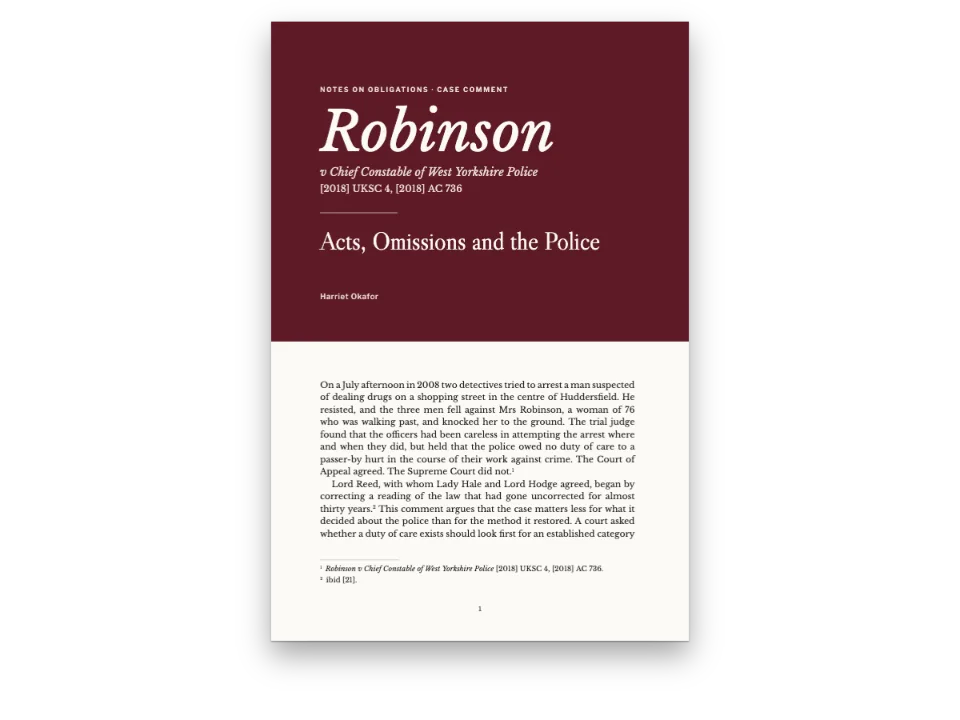
A short legislative print. It shows the old wording of a law with the removed words crossed out and the new words underlined, then the whole amended section in a shaded box.
What you'll build
A committee print of the kind that goes out with a bill: five pages that show what section 102 of the Sonny Bono Copyright Term Extension Act of 1998 did to title 17 of the United States Code. The Act only says "strike 'fifty' and insert '70'"; this print sets the law as it stood with each change marked in place, deletions struck through and insertions underlined, the coding legend that federal and state drafters print over such texts, and then section 302 as amended in a tinted box, each subsection letter at the edge and its lines hung under the text. The Spanish edition does the same for the three reforms of the Spanish Constitution, published in the BOE in 1992, 2011 and 2024.
This recipe answers
- How do I show an amendment with the deleted words struck through and the inserted words underlined?
The short answer
// In the text, ~~fifty~~ strikes a deleted word and :underline[70] underlines the new one.
// Both lines are painted from the face's own metrics and take no room, so the struck and
// the inserted words justify and hyphenate like any others. The amended text then sits in
// a box whose paragraphs hang: '(a)', a tab, and every turnover line under the text.
const label = { fontFamily: SANS, fontSize: pt(7.5), fontWeight: 700, letterSpacing: pt(1.1),
  textTransform: 'uppercase', color: col('accent') };
const clauses = { fontFamily: SERIF, fontSize: pt(9.5), lineHeight: pt(13), color: col('ink'),
  boldColor: col('ink'), italicColor: col('ink'), textAlign: 'left', // a box's measure is short
  hangingIndent: HANG, // every line but the first starts 7 mm in (postext ≥ 1.71)
  tabStops: [{ position: HANG }] }; // and the tab after the marker takes the text there
const pad = (v, h) => ({ top: mm(v), right: mm(h), bottom: mm(v), left: mm(h) });
const calloutStyles = [
  // The coding legend: a red rule down its side, the label face.
  { id: 'legend', backgroundEnabled: false,
    stripe: { enabled: true, side: 'left', width: pt(2.5), color: col('accent') },
    padding: pad(1.5, 3.5), body: { fontFamily: SANS, fontSize: pt(9), lineHeight: pt(12.5),
      color: col('ink'), boldColor: col('accent'), firstLineIndent: pt(0), textAlign: 'left' } },
  // The bill's own words: a red rule on top, clauses hung, no tint.
  { id: 'bill', backgroundEnabled: false,
    stripe: { enabled: true, side: 'top', width: pt(2.5), color: col('accent') },
    padding: pad(2.5, 0), body: clauses, keepTogether: false, // it may run on to the next page
    // its title keeps its case: "(b)" stays "(b)"
    titleStyle: { ...label, textTransform: 'none', letterSpacing: pt(0.2), fontSize: pt(8.5),
      color: col('ink') } },
  // The text as amended: a tint, the clauses hung the same way.
  { id: 'amended', background: col('tint'), padding: pad(3.5, 4.5), titleStyle: label,
    body: clauses },
];
The marks live in the Markdown; the boxes hang their clauses
Ingredients
- Features
- StrikethroughUnderlineHanging paragraphs in a boxTab stops and leadersCallout boxesBoxes that split or stay wholeSemantic colour paletteDesigned openersHeading attributesRunning heads and foliosHeads by page roleMirrored marginsParagraph stylesWidows, orphans and runtsPDF exportFonts embedded in the PDF
- Type
- Source Serif 4, Source Sans 3 (SIL OFL 1.1)
- Assets
- None: every picture is drawn in code
Method
#1 · Mark the change where it happens
The code is the short answer above. The marks themselves are Markdown: ~~fifty~~ :underline[70] strikes the old word and underlines the new one (strikethrough, underline). Neither line takes room, so a struck clause of six lines justifies and hyphenates like the text around it, and on page 3 the whole of the old subsection 304(b) is struck and its replacement underlined in one paragraph. Each line is drawn from the face's own strikeout and underline metrics, in the colour of the words, so the small capitals of a catchline get their own line at their own height.
#2 · Hang the clauses in the box
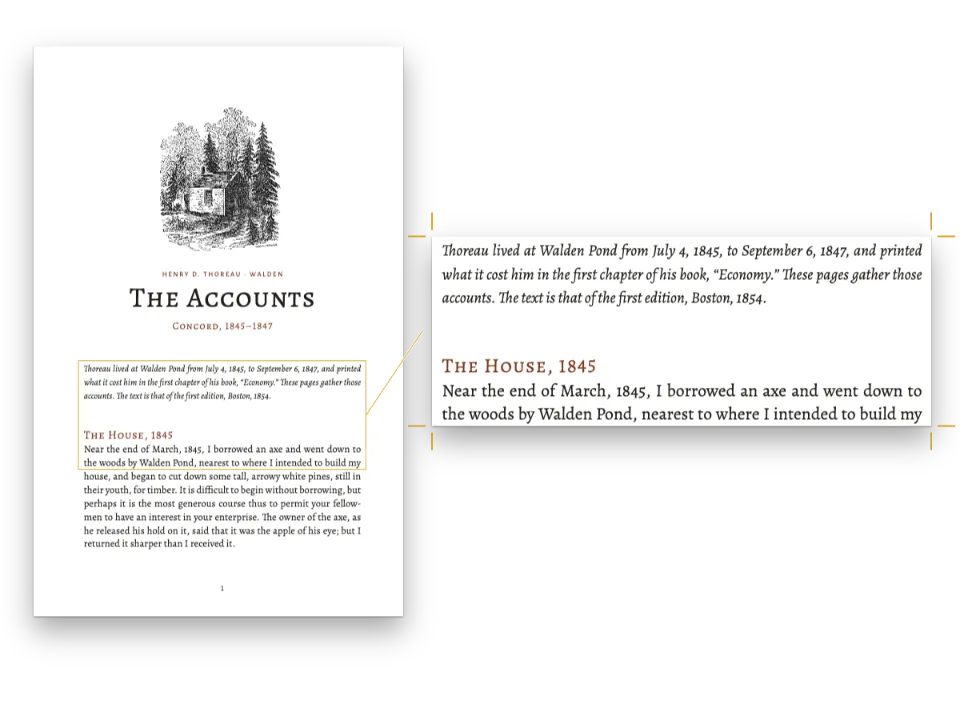
body.hangingIndent on a box style hangs every paragraph of the box (typography inside a box): the first line starts at the box's inner edge and the turnovers 7 mm in. A tab stop at the same 7 mm takes the text after "(a)" or "(c)" to that edge whatever the width of the letter, so you write (a):tab In General.—… in the Markdown. The bill's own clauses and the amended section share the typography and differ only in their frame: a red rule over the bill, a tint behind the law in force. The bill's box may split (keepTogether: false), so page 1 ends on its first two clauses.
#3 · A band for the opener
const at = (to, edge, x = 0, y = 0) => ({ anchor: { to, edge }, offset: { x: mm(x), y: mm(y) } });
const BAND = 66; // mm from the trim top to the foot of the band
const opener = { enabled: true, minHeight: mm(BAND - 22 + 6), marginBottom: pt(0), slot: {
  elements: [
    { kind: 'box', id: 'band', style: { backgroundColor: col('band') },
      placement: { ...at('bleed', 'top-left'), size: { width: 'fill', height: mm(BAND + 3) } } },
    { kind: 'text', id: 'kicker', content: '{attr.kicker}', ...label, color: col('pale'),
      placement: { ...at('container', 'top-left', 0, 6), size: { width: mm(112) } } },
    { kind: 'text', id: 'title', content: '{titleText}', fontFamily: SERIF, fontWeight: 700,
      fontSize: pt(30), lineHeight: 1.05, color: col('paper'), align: 'left',
      placement: { ...at('#kicker', 'below', 0, 3), size: { width: mm(112), height: 'auto' } } },
    { kind: 'text', id: 'dek', content: '{attr.dek}', fontFamily: SERIF, italic: true,
      fontSize: pt(10.5), lineHeight: 1.3, color: col('pale'), align: 'left',
      placement: { ...at('#title', 'below', 0, 3.5), size: { width: mm(104), height: 'auto' } } },
  ] } };
The navy band runs off the top and both sides of the page, and the kicker and the standfirst come from attributes on the heading line (heading attributes). minHeight sets where the legend starts, a few millimetres under the band.
#4 · Running heads by parity
const head = (id, content, parity, edge, x, extra = {}) => ({
  kind: 'text', id, content, parity, pages: 'body', fontFamily: SANS, fontSize: pt(7.5),
  fontWeight: 600, letterSpacing: pt(1.1), textTransform: 'uppercase', color: col('muted'),
  placement: { anchor: { to: 'page', edge }, offset: { x: mm(x), y: mm(13) } }, ...extra });
const folio = { fontWeight: 700, color: col('ink') };
const header = { elements: [
  head('verso-folio', '{pageNumber}', 'even', 'top-left', OUTER, folio),
  head('verso-title', '{title}', 'even', 'top-left', OUTER + 8),
  head('recto-title', '{firstMark.h2}', 'odd', 'top-right', -(OUTER + 8)),
  head('recto-folio', '{pageNumber}', 'odd', 'top-right', -OUTER, folio),
] };
const footer = { elements: [head('drop-folio', '{pageNumber}', 'all', 'top', 0,
  { ...folio, pages: 'opener', placement: at('container', 'top', 0, 9) })] };
The verso carries the print's title and the recto the part of the print the page opens in, read from the first second-level heading on it. pages: 'body' keeps them off the opener, which carries a drop folio instead.
The whole recipe
// ═══ Postext Cookbook · Nº 182 · An amendment shown struck through and underlined ═════
// https://postext.dev/en/cookbook/amendment-redline
// Code: MIT · Text: Pub. L. 105-298 and 17 U.S.C. (US Gov., PD); Constitución Española (BOE)
// Fonts: Source Serif 4, Source Sans 3 (SIL OFL 1.1) · Needs postext ≥ 1.73.0
// A comparative print: the law as it stood, each deletion ~~struck through~~ and each
// insertion :underline[underlined], then the amended text in a box whose clauses hang.
import { buildDocumentWithFonts, renderPageToCanvas } from 'https://esm.sh/postext';
import { renderToPdf, decompressWoff2 } from 'https://esm.sh/postext-pdf';

const LANG = 'en'; // @lang: the language of the sample document ('en' | 'es')
const RECIPE = 'amendment-redline';

// ─── 1 · Design ─────────────────────────────────────────────────────────────
// #region palette: a government-print navy, one red for rules and labels
const palette = {
  ink: '#1b1d22', // text: a cool near-black
  band: '#1f2b47', // the opener's band: navy
  accent: '#a1321f', // labels, stripes, the legend's rule
  tint: '#eef0f4', // the box of the amended text
  rule: '#c7ccd6', // hairlines
  muted: '#5d6370', // running heads, notes, colophon
  paper: '#ffffff',
  pale: '#c9d2e6', // the kicker and the standfirst on the band
};
const col = (id) => ({ hex: palette[id], model: 'hex', paletteId: id });
const colorPalette = [
  ...Object.entries(palette).map(([id, hex]) => ({ id, name: id, value: { hex, model: 'hex' } })),
  { id: 'main-color', name: 'accent (defaults)', value: { hex: palette.accent, model: 'hex' } },
];
// #endregion
const SERIF = 'Source Serif 4', SANS = 'Source Sans 3';
const TRIM = [152, 229], INNER = 20, OUTER = 17; // mm: a 6 × 9 in committee print
const LEAD = 14; // pt: the body leading
const HANG = mm(7); // how far the clauses of a box hang: the width of "(a)" and a space

// #region answer: the marks live in the Markdown; the boxes hang their clauses
// In the text, ~~fifty~~ strikes a deleted word and :underline[70] underlines the new one.
// Both lines are painted from the face's own metrics and take no room, so the struck and
// the inserted words justify and hyphenate like any others. The amended text then sits in
// a box whose paragraphs hang: '(a)', a tab, and every turnover line under the text.
const label = { fontFamily: SANS, fontSize: pt(7.5), fontWeight: 700, letterSpacing: pt(1.1),
  textTransform: 'uppercase', color: col('accent') };
const clauses = { fontFamily: SERIF, fontSize: pt(9.5), lineHeight: pt(13), color: col('ink'),
  boldColor: col('ink'), italicColor: col('ink'), textAlign: 'left', // a box's measure is short
  hangingIndent: HANG, // every line but the first starts 7 mm in (postext ≥ 1.71)
  tabStops: [{ position: HANG }] }; // and the tab after the marker takes the text there
const pad = (v, h) => ({ top: mm(v), right: mm(h), bottom: mm(v), left: mm(h) });
const calloutStyles = [
The composed script.js runs as it is: paste it into any page’s module script, or open the recipe on CodePen. Recipe folder on GitHub ↗ (opens in a new tab)
Variations
#Write insertions as ++text++
With plusUnderline on, ++70++ underlines like :underline[70], the spelling Pandoc and markdown-it use for inserted text.
     textAlign: 'justify', firstLineIndent: mm(4.5), indentAfterHeading: false,
+ plusUnderline: true, // ++text++ underlines; C++ in the text is then written C\+\+#Keep the bill's clauses together
Without keepTogether: false the box moves whole to page 2 and page 1 ends on the line that introduces it.
-    padding: pad(2.5, 0), body: clauses, keepTogether: false, // it may run on to the next page
+ padding: pad(2.5, 0), body: clauses,Pitfalls
- A paragraph that opens with a number and a full stop (
2. Solamente…) is read as a list item, and a backslash before the stop prints. The Spanish edition puts a word joiner (U+2060) between the digit and the stop in the running text, and in the box writes the tab straight after the stop,1.:tab, which no list marker matches. - Colour alone would not survive a photocopy, which is how such prints often travel; struck and underlined words read in black and white, which is why drafters chose them.
Credits
- Recipe
- Ignacio Ferro
- Text
- Section 102 of the Sonny Bono Copyright Term Extension Act (Pub. L. 105-298, 112 Stat. 2827, 1998) and sections 302–304 of title 17, United States Code, as in force in 1997 · United States Congress · public domain
- Articles 13.2, 49 and 135 of the Spanish Constitution in their 1978 wording and the reforms of 1992, 2011 and 2024 (official texts, not subject to copyright under art. 13 LPI) · Cortes Generales, Boletín Oficial del Estado · public domain
- The editor’s notes, the coding legends and the colophons · Ignacio Ferro · CC BY 4.0
- Fonts
- Source Serif 4 (SIL OFL 1.1) · Source Sans 3 (SIL OFL 1.1)
Edit this write-up ↗ (opens in a new tab)Recipe folder on GitHub ↗ (opens in a new tab)