In short
A chapter of a doctoral thesis. The author writes a short code for each source; Postext prints the citations and the list of references at the end in APA style.
What you'll build
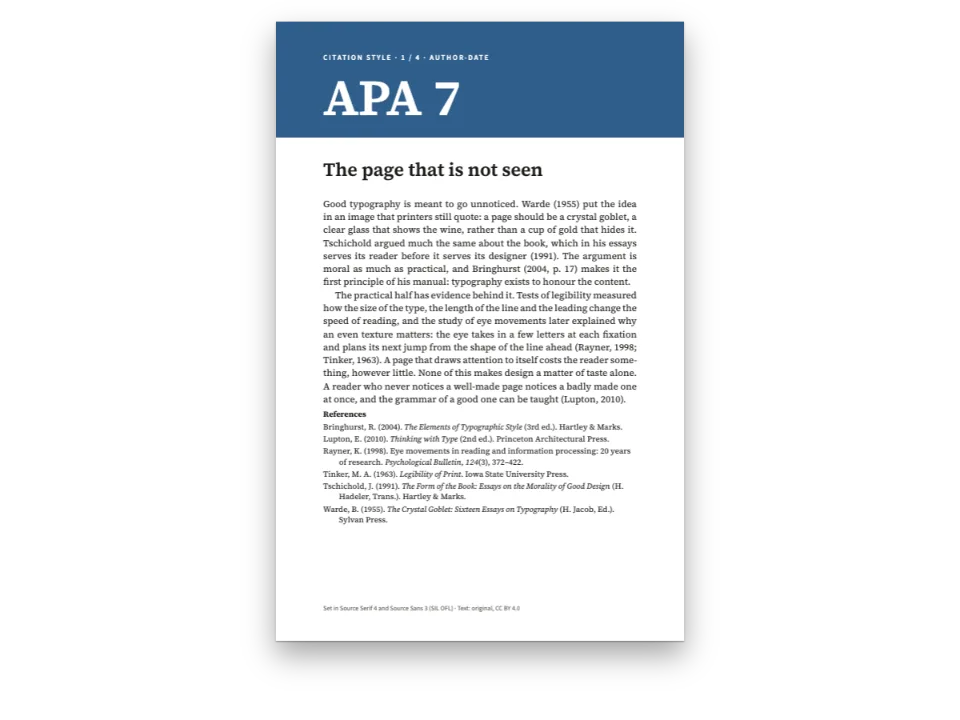
The second chapter of a doctoral thesis in education, the literature review: what twenty years of studies say about reading on paper and on screens. The chapter is set on an A4 page bound at the left, in Literata with a 16 pt lead, under a pale band in the university's blue. The author keeps the sources in Zotero and pastes the export as BibTeX; in the text, each source is a key. Postext formats every citation in APA 7, with the author, the year and the page where one is given, writes "Delgado et al. (2018)" when the name is part of the sentence, and builds the reference list in the order and form the style asks for. When the supervisor asks for Chicago, the style is the one line that changes.
This recipe answers
- How do I cite works and build the bibliography in APA, IEEE or another citation style?
The short answer
// Citations are written [@key, p. 33] and formatted by citeproc-js in the chosen CSL
// style; the references come from the BibTeX block at the end of the chapter. Register
// the engine once, before the first build, then the style is one setting.
registerCitationEngine(createCiteprocEngine({ styles: STYLES, locales: LOCALES }));
const citations = {
  style: 'apa', // 'chicago-author-date', 'ieee', 'vancouver'… change nothing else
  link: true, // each citation jumps to its entry in the PDF and on screen
  bibliography: {
    // APA asks for a half-inch hanging indent and keeps the list in the text size.
    fontSize: em(1), hangingIndent: mm(12.7), entrySpacing: pt(4),
    doi: 'link', // printed whole, as APA wants, and clickable
  },
};
The citation engine, APA 7 and how its references look
Ingredients
- Features
- Citations in a citation styleBibliography from the referencesCross-referencesNumbered headingsHeading stylesUnnumbered chaptersDesigned openersRunning heads and foliosSemantic colour palettePDF export
- Type
- Literata, Public Sans (SIL OFL 1.1)
- Assets
- None: every picture is drawn in code
Method
#1 · One engine, one style
The code is the short answer above. Postext reads the citations and leaves their wording to a citation engine, registered once before the first build; postext-citeproc wraps citeproc-js, the engine Zotero and Mendeley use, with sixteen CSL styles and their locale files. [@mangen2013] gives "(Mangen et al., 2013)", @delgado2018 without brackets puts the authors in the sentence, and [@ibanez2023, pp. 12–15] carries the page range into the parentheses. With the document in Spanish, the same keys take their connectives and abbreviations from the Spanish locale file, because the engine follows the document's locale.
#2 · The references come from a BibTeX block
The last block of the chapter is :::references{format=bibtex} with the Zotero export pasted inside, accents written as {\'a}. :::bibliography above it places the list under the References heading; without it, Postext appends the list at the end. Only cited works appear, sorted as APA sorts them, and every citation in the text links to its entry.
#3 · A heading without a number, references in words
  headingStyles: [{ id: 'references', numbered: false }],
  crossRefs: { section: t({ en: 'Section {n}', es: 'Sección {n}' }) },
The references heading takes the references style, which keeps it in the contents but outside the numbering, so the list does not become section 2.4. :ref{id="sec-speed"} prints "Section 2.2" from the crossRefs label and links to the heading; the numbers come from startAt=2 on the chapter title, the same counter the headings use.
#4 · The opener sits in a band
const BAND = 92; // mm from the trim's top
const opener = {
  enabled: true,
  minHeight: mm(BAND - 28 + 10), // the body starts 10 mm under the band
  slot: { elements: [
    { kind: 'box', id: 'band', style: { backgroundColor: col('tint') },
      placement: { anchor: { to: 'page', edge: 'top-left' },
        size: { width: 'fill', height: mm(BAND) } } },
    { kind: 'text', id: 'label', content: t({ en: 'Chapter', es: 'Capítulo' }),
      fontFamily: LABEL, fontSize: pt(9), fontWeight: 600, letterSpacing: pt(1.8),
      textTransform: 'uppercase',
      color: col('accent'), align: 'left',
      placement: { anchor: { to: 'container', edge: 'top-left' },
        offset: { x: mm(0), y: mm(2) } } },
    { kind: 'text', id: 'number', content: '{number}', fontFamily: TEXT, fontSize: pt(96),
      fontWeight: 300, lineHeight: 0.9, color: col('accent'), align: 'right',
      placement: { anchor: { to: 'container', edge: 'top-right' },
        offset: { x: mm(0), y: mm(-6) },
        size: { width: mm(40), height: 'auto' } } },
    { kind: 'text', id: 'title', content: '{titleText}', fontFamily: TEXT, fontSize: pt(24),
      lineHeight: 1.12, fontWeight: 600, color: col('ink'), align: 'left', overflow: 'wrap',
      placement: { anchor: { to: 'container', edge: 'top-left' },
        offset: { x: mm(0), y: mm(14) },
        size: { width: mm(108), height: 'auto' } } },
  ] },
};
The band is a box anchored to the trim and the body starts 10 mm below it. The number is set in Literata Light at 96 pt to the right, where it reads as a shape and leaves the title its full measure.
const palette = {
  ink: '#1b1b1f', accent: '#22406a', tint: '#e6ecf4', rule: '#b9bec8', muted: '#5d6370',
};
const col = (id) => ({ hex: palette[id], model: 'hex', paletteId: id });
const colorPalette = Object.entries({ ...palette, 'main-color': palette.accent })
  .map(([id, hex]) => ({ id, name: id, value: { hex, model: 'hex' } }));
The whole recipe
// ═══ Postext Cookbook · Nº 087 · A thesis chapter cited in APA 7 ═══════════════════ // https://postext.dev/en/cookbook/apa-thesis-with-bibtex // Code: MIT · Text: original (CC BY 4.0) · Pictures: none // Fonts: Literata, Public Sans (SIL OFL 1.1) · Needs postext ≥ 1.12.0 import { buildDocument, renderPageToCanvas, clearMeasurementCache, registerCitationEngine, } from 'https://esm.sh/postext'; import { renderToPdf, decompressWoff2 } from 'https://esm.sh/postext-pdf'; import { createCiteprocEngine, STYLES, LOCALES } from 'https://esm.sh/postext-citeproc'; const LANG = 'en'; // @lang: the language of the sample document ('en' | 'es') const RECIPE = 'apa-thesis-with-bibtex'; // ─── 1 · Design ───────────────────────────────────────────────────────────── // #region palette: a thesis prints in black; the one colour is the university's const palette = { ink: '#1b1b1f', accent: '#22406a', tint: '#e6ecf4', rule: '#b9bec8', muted: '#5d6370', }; const col = (id) => ({ hex: palette[id], model: 'hex', paletteId: id }); const colorPalette = Object.entries({ ...palette, 'main-color': palette.accent }) .map(([id, hex]) => ({ id, name: id, value: { hex, model: 'hex' } })); // #endregion const TEXT = 'Literata', LABEL = 'Public Sans'; const LEAD = 16; // pt: double spacing is a typewriter habit; 1.45 reads as well and fits more // #region answer: the citation engine, APA 7 and how its references look // Citations are written [@key, p. 33] and formatted by citeproc-js in the chosen CSL // style; the references come from the BibTeX block at the end of the chapter. Register // the engine once, before the first build, then the style is one setting. registerCitationEngine(createCiteprocEngine({ styles: STYLES, locales: LOCALES })); const citations = { style: 'apa', // 'chicago-author-date', 'ieee', 'vancouver'… change nothing else link: true, // each citation jumps to its entry in the PDF and on screen bibliography: { // APA asks for a half-inch hanging indent and keeps the list in the text size. fontSize: em(1), hangingIndent: mm(12.7), entrySpacing: pt(4), doi: 'link', // printed whole, as APA wants, and clickable }, }; // #endregion // #region opener: a pale band at the head of the page, the number large and light in it const BAND = 92; // mm from the trim's top const opener = { enabled: true, minHeight: mm(BAND - 28 + 10), // the body starts 10 mm under the band slot: { elements: [ { kind: 'box', id: 'band', style: { backgroundColor: col('tint') }, placement: { anchor: { to: 'page', edge: 'top-left' }, size: { width: 'fill', height: mm(BAND) } } }, { kind: 'text', id: 'label', content: t({ en: 'Chapter', es: 'Capítulo' }), fontFamily: LABEL, fontSize: pt(9), fontWeight: 600, letterSpacing: pt(1.8), textTransform: 'uppercase', color: col('accent'), align: 'left', placement: { anchor: { to: 'container', edge: 'top-left' }, offset: { x: mm(0), y: mm(2) } } }, { kind: 'text', id: 'number', content: '{number}', fontFamily: TEXT, fontSize: pt(96), fontWeight: 300, lineHeight: 0.9, color: col('accent'), align: 'right', placement: { anchor: { to: 'container', edge: 'top-right' }, offset: { x: mm(0), y: mm(-6) }, size: { width: mm(40), height: 'auto' } } }, { kind: 'text', id: 'title', content: '{titleText}', fontFamily: TEXT, fontSize: pt(24), lineHeight: 1.12, fontWeight: 600, color: col('ink'), align: 'left', overflow: 'wrap', placement: { anchor: { to: 'container', edge: 'top-left' }, offset: { x: mm(0), y: mm(14) }, size: { width: mm(108), height: 'auto' } } }, ] }, }; // #endregion const head = (id, content, edge, x) => ({ kind: 'text', id, content, pages: 'body', fontFamily: LABEL, fontSize: pt(7.5), letterSpacing: pt(0.8), color: col('muted'), placement: { anchor: { to: 'page', edge }, offset: { x: mm(x), y: mm(14) } }, }); const config = () => ({ // a factory: the engine caches resolved configs per object locale: t({ en: 'en-us', es: 'es' }), colorPalette, citations, page: { sizePreset: 'custom', width: mm(210), height: mm(297), dpi: 150, // one-sided, bound at the left margins: { top: mm(28), bottom: mm(28), left: mm(35), right: mm(25) }, }, layout: { layoutType: 'single' }, bodyText: { fontFamily: TEXT, fontSize: pt(11), lineHeight: pt(LEAD), color: col('ink'), boldColor: col('ink'), italicColor: col('ink'), referenceColor: col('accent'), textAlign: 'justify', firstLineIndent: mm(6), indentAfterHeading: false, hyphenation: { enabled: true }, optimalLineBreaking: true, avoidWidows: true, avoidOrphans: true, avoidRunts: true, }, headings: { fontFamily: TEXT, color: col('ink'), fontWeight: 600, levels: [ // Restated: any headings object drops the H1 break (gotcha: headings-drop-h1-break). { level: 1, numberingTemplate: '{1}', fontSize: pt(22), breakBefore: { enabled: true, parity: 'any' }, advancedDesign: opener }, { level: 2, numberingTemplate: '{1}.{2}', numberSeparator: ' ', fontSize: pt(13), lineHeight: pt(LEAD), marginTop: pt(LEAD), marginBottom: pt(LEAD / 2) }, ], }, // #region refs: the references heading goes unnumbered; section references read in words headingStyles: [{ id: 'references', numbered: false }], crossRefs: { section: t({ en: 'Section {n}', es: 'Sección {n}' }) }, // #endregion header: { elements: [ head('title', '{title}', 'top-left', 35), head('folio', '{pageNumber}', 'top-right', -25), ] }, footer: { elements: [] }, }); // ─── 2 · Content ──────────────────────────────────────────────────────────── const markdown = String.raw`---Markdown sample · 69 lines · content.en.md
title: "Reading on Paper and on Screens" author: "Marta Ibáñez Roca" --- # Reading on Paper and on Screens: The State of the Evidence {#ch-review startAt=2} The question this thesis takes up is older than the screens it is usually asked about. Long before the first e-reader, typographers measured how the size of a letter, the length of a line and the space between lines changed the speed and the comfort of reading [@tinker1963]. What changed with screens was the scale of the experiment: by the 2010s a large share of what students read for their courses reached them through a display, and the question of whether that mattered left the laboratory for the lecture hall [@baron2015]. This chapter reviews what is known. :ref{id="sec-comprehension"} gathers the studies of comprehension, :ref{id="sec-speed"} those of speed and line length, and :ref{id="sec-attention"} the arguments about attention that frame the rest of the thesis. The method of the study itself follows in Chapter 3. ## Comprehension {#sec-comprehension} The most cited early comparison asked Norwegian upper-secondary students to read two texts, one narrative and one expository, either on paper or as PDF files on a computer screen [@mangen2013]. Those who read on paper scored better on the comprehension test that followed. The difference was modest, but it pointed in the same direction as a growing number of studies, and it raised a question the authors could not settle: whether the advantage came from the medium, from the way readers navigated it, or from what they expected to do with it. Two meta-analyses later pooled the evidence. @delgado2018 combined 54 studies with more than 170,000 participants and found an advantage for paper in the comprehension of informational texts, larger when reading was done under time pressure and, unexpectedly, larger in the more recent studies than in the older ones. @clinton2019 reached a similar conclusion from a narrower set of experiments: reading from paper led to better comprehension, while the time spent reading did not differ between the media. Neither review found a reliable difference for narrative texts. A pilot study run for this thesis with forty first-year students found the same pattern [@ibanez2023, pp. 12–15], although its sample was too small to settle it. ## Speed and line length {#sec-speed} Speed is the measure readers notice first and researchers trust least. A reader can go faster by understanding less, and a gain in words per minute says nothing of what was retained [@rayner2016]. Studies that control for comprehension tell a more modest story than the claims of speed-reading courses: the eyes move in short jumps, take in a few letters on either side of the fixation, and cannot be trained to take in a whole line at once [@rayner2016]. Line length is the variable typographers have argued about longest. On screen, @dyson2001 measured speed and comprehension at several line lengths and found that the two do not always improve together, which warns against judging a layout by speed alone. Older work on print had already shown that the best length depends on the size of the type and the leading, not on a fixed count of characters [@tinker1963; see also @ibanez2023, sec. 2]. ## Attention and the reading brain {#sec-attention} The empirical studies leave room for a wider argument. @wolf2018 holds that the habits formed by reading on screens, quick and skimming, carry over to the reading of long texts and weaken the slower processes that comprehension of a demanding argument needs. @baron2015 reaches a similar view from surveys of students, many of whom reported that they concentrated better on paper even when they preferred screens for convenience. These are arguments rather than measurements, and this thesis treats them as hypotheses: Chapter 3 tests whether the advantage for paper reported in :ref{id="sec-comprehension"} holds when the screen layout is set with the care a printed page receives. ## References {style="references"} :::bibliography{title=""} :::references{format=bibtex} @book{tinker1963, author = {Tinker, Miles A.}, title = {Legibility of print}, publisher = {Iowa State University Press}, address = {Ames, IA}, year = 1963} @book{baron2015, author = {Baron, Naomi S.}, title = {Words onscreen: The fate of reading in a digital world}, publisher = {Oxford University Press}, address = {New York}, year = 2015} @article{mangen2013, author = {Mangen, Anne and Walgermo, Bente R. and Br{\o}nnick, Kolbj{\o}rn}, title = {Reading linear texts on paper versus computer screen: Effects on reading comprehension}, journal = {International Journal of Educational Research}, volume = 58, pages = {61--68}, year = 2013, doi = {10.1016/j.ijer.2012.12.002}} @article{delgado2018, author = {Delgado, Pablo and Vargas, Crist{\'o}bal and Ackerman, Rakefet and Salmer{\'o}n, Ladislao}, title = {Don't throw away your printed books: A meta-analysis on the effects of reading media on reading comprehension}, journal = {Educational Research Review}, volume = 25, pages = {23--38}, year = 2018, doi = {10.1016/j.edurev.2018.09.003}} @article{clinton2019, author = {Clinton, Virginia}, title = {Reading from paper compared to screens: A systematic review and meta-analysis}, journal = {Journal of Research in Reading}, volume = 42, number = 2, pages = {288--325}, year = 2019, doi = {10.1111/1467-9817.12269}} @article{dyson2001, author = {Dyson, Mary C. and Haselgrove, Mark}, title = {The influence of reading speed and line length on the effectiveness of reading from screen}, journal = {International Journal of Human-Computer Studies}, volume = 54, number = 4, pages = {585--612}, year = 2001, doi = {10.1006/ijhc.2001.0458}} @article{rayner2016, author = {Rayner, Keith and Schotter, Elizabeth R. and Masson, Michael E. J. and Potter, Mary C. and Treiman, Rebecca}, title = {So much to read, so little time: How do we read, and can speed reading help?}, journal = {Psychological Science in the Public Interest}, volume = 17, number = 1, pages = {4--34}, year = 2016, doi = {10.1177/1529100615623267}} @techreport{ibanez2023, author = {Ib{\'a}{\~n}ez Roca, Marta}, title = {Screen layouts and comprehension: A pilot study}, institution = {Reading Lab}, type = {Working paper}, number = 3, year = 2023} @book{wolf2018, author = {Wolf, Maryanne}, title = {Reader, come home: The reading brain in a digital world}, publisher = {Harper}, address = {New York}, year = 2018} :::`; // ─── 3 · Fonts ────────────────────────────────────────────────────────────── const FONTS = { Literata: ['300', '400', '400i', '600', '600i'], 'Public Sans': ['400', '600'], }; // ─── 4 · Build & show ─────────────────────────────────────────────────────── await loadFonts(FONTS, markdown); const doc = await buildWithFonts(() => buildDocument({ markdown }, config()), markdown); const title = t({ en: 'A thesis chapter in APA 7', es: 'Un capítulo de tesis en APA 7' }); showPages(doc, { title }); offerPdf(() => renderToPdf(doc, { fontProvider: fontsourceProvider }), `${RECIPE}.pdf`);Kit · core, fonts, viewer, pdf: the same in every recipe · 275 lines
// ─── Kit ── helpers shared by every Cookbook recipe · postext.dev/cookbook ───── // ─── Kit · core v1 ── the same in every recipe · postext.dev/cookbook ───────── function mm(value) { return { value, unit: 'mm' }; } function pt(value) { return { value, unit: 'pt' }; } function em(value) { return { value, unit: 'em' }; } /** The sample language's string: t({ en: 'Figure', es: 'Figura' }). */ function t(strings) { return strings[LANG] ?? Object.values(strings)[0]; } /** A file in this recipe's assets folder, served from the Postext repo by jsDelivr. */ function asset(file) { return `https://cdn.jsdelivr.net/gh/drnachio/postext@main/cookbook/${RECIPE}/assets/${file}`; } // ─── Kit · fonts v1 ── the same in every recipe · postext.dev/cookbook ──────── // Postext measures text with the faces the browser has loaded, and caches the // widths, so every face must be ready before the first build. Faces come from // Fontsource: the same static files the PDF embeds, so screen and PDF agree. /** faces = { 'Family Name': ['400', '400i', '700'] }. `text` is the sample: * letters beyond Latin-1 (č, ł, ő…) also load the latin-ext files. With * `optional`, a face Fontsource does not ship is skipped instead of failing. * Resolves to the number of faces added. */ async function loadFonts(faces, text = '', { optional = false } = {}) { kitStatus('Loading fonts…'); const ranges = { latin: 'U+0000-00FF,U+0131,U+0152-0153,U+02BB-02BC,U+02C6,U+02DA,U+02DC,U+0304,U+0308,U+0329,' + 'U+2000-206F,U+20AC,U+2122,U+2191,U+2193,U+2212,U+2215,U+FEFF,U+FFFD', 'latin-ext': 'U+0100-02BA,U+02BD-02C5,U+02C7-02CC,U+02CE-02D7,U+02DD-02FF,U+0304,U+0308,U+0329,' + 'U+1D00-1DBF,U+1E00-1E9F,U+1EF2-1EFF,U+2020,U+20A0-20AB,U+20AD-20C0,U+2113,U+2C60-2C7F,U+A720-A7FF', }; const subsets = /[Ā-˿Ḁ-ỿ]/.test(text) ? ['latin', 'latin-ext'] : ['latin']; const jobs = []; let added = 0; for (const [family, specs] of Object.entries(faces)) { const id = fontsourceId(family); const meta = optional ? await fontsourceMeta(family) : null; for (const spec of new Set(specs)) { const weight = parseInt(spec, 10); const style = spec.endsWith('i') ? 'italic' : 'normal'; if (hasFace(family, weight, style)) continue; if (optional && !(meta?.weights.includes(weight) && meta.styles.includes(style))) continue; for (const subset of subsets) { const url = `https://cdn.jsdelivr.net/npm/@fontsource/${id}@5/files/${id}-${subset}-${weight}-${style}.woff2`; const face = new FontFace(family, `url(${url}) format('woff2')`, { weight: String(weight), style, unicodeRange: ranges[subset] }); jobs.push(face.load().then((ready) => { document.fonts.add(ready); added++; }, () => { if (subset === 'latin' && !optional) throw new Error(`Fontsource has no ${family} ${weight} ${style}`); })); } } } await Promise.all(jobs).catch((error) => { kitFail(error); throw error; }); return added; } /** Runs `build` (a buildDocument or buildBundle call) and checks the faces * the pages use. A regular face missing from FONTS is loaded with a warning; * bold and italic variants are loaded when the family ships them. Then the * measurement caches are cleared and the build runs again. */ async function buildWithFonts(build, text = '') { const tried = new Set(); for (let round = 0; round < 3; round++) { kitStatus('Laying out…'); await new Promise(requestAnimationFrame); // let the status paint first const result = await Promise.resolve().then(build).catch((error) => { kitFail(error); throw error; }); const wanted = { base: {}, variants: {} }; for (const { font, base } of [result].flat().flatMap(fontStringsOf)) { const { family, weight, style } = parseFont(font); const key = `${family}|${weight}|${style}`; if (tried.has(key) || hasFace(family, weight, style)) continue; tried.add(key); (wanted[base ? 'base' : 'variants'][family] ??= []).push(`${weight}${style === 'italic' ? 'i' : ''}`); } if (Object.keys(wanted.base).length) { console.warn(`[cookbook] FONTS does not list ${JSON.stringify(wanted.base)}: loading them.`); } const added = await loadFonts(wanted.base, text) + await loadFonts(wanted.variants, text, { optional: true }); if (added === 0) return result; clearMeasurementCache(); } throw new Error('The fonts did not settle after three builds.'); } /** Every font string of the layout. `base` marks a block's own face; its * bold, italic and bold-italic variants are listed whether or not used. */ function fontStringsOf(doc) { const found = new Map(); const walk = (node) => { if (!node || typeof node !== 'object') return; if (Array.isArray(node)) { node.forEach(walk); return; } for (const [key, value] of Object.entries(node)) { if (typeof value === 'string' && /fontString$/i.test(key)) { found.set(value, found.get(value) || key === 'fontString'); } else if (value && typeof value === 'object') walk(value); } }; walk(doc.pages); walk(doc.blocks); return [...found].map(([font, base]) => ({ font, base })); } /** '700 37.5px Open Sans' / 'italic 400 13px "Source Serif 4"' → { family, weight, style }. * A string with no weight ('95.8px Young Serif', from a design text) is 400. */ function parseFont(font) { const m = /^(?:(italic|oblique)\s+)?(?:small-caps\s+)?(?:(\d+|bold|normal)\s+)?[\d.]+px\s+(.+)$/.exec(font.trim()); if (!m) throw new Error(`Unexpected font string: ${font}`); const weight = m[2] === 'bold' ? 700 : !m[2] || m[2] === 'normal' ? 400 : Number(m[2]); return { family: m[3].replace(/^["']|["']$/g, ''), weight, style: m[1] ? 'italic' : 'normal' }; } /** True when a loaded FontFace covers exactly this family, weight and style * (document.fonts.check() is also true for families nobody declared). */ function hasFace(family, weight, style) { for (const face of document.fonts) { if (face.status !== 'loaded' || face.style !== style) continue; if (face.family.replace(/^["']|["']$/g, '') !== family) continue; const [low, high = low] = face.weight.split(' ').map(Number); if (weight >= low && weight <= high) return true; } return false; } /** Fontsource's id for a family: 'Source Serif 4' → 'source-serif-4'. */ function fontsourceId(family) { return family.toLowerCase().replace(/\s+/g, '-'); } /** The weights and styles a family ships ({ weights: [400, 700], styles: ['normal', 'italic'] }), or null. */ function fontsourceMeta(family) { fontsourceMeta.cache ??= new Map(); const id = fontsourceId(family); if (!fontsourceMeta.cache.has(id)) { fontsourceMeta.cache.set(id, fetch(`https://api.fontsource.org/v1/fonts/${id}`) .then((res) => (res.ok ? res.json() : null), () => null)); } return fontsourceMeta.cache.get(id); } // ─── Kit · viewer v1 ── the same in every recipe · postext.dev/cookbook ─────── /** Shows the pages as facing spreads on a dark desk: the first page is a * recto on its own, then verso | recto pairs, as in a bound book. Pages * are painted when they scroll near the screen. */ function showPages(docs, { title, width = 460 } = {}) { const root = viewer(title); const pages = [docs].flat().flatMap((doc) => doc.pages.map((page) => ({ doc, page, n: (doc.pageIndexOffset ?? 0) + page.index }))); const spreads = []; let verso = null; for (const p of pages) { if (p.n % 2 === 1) { if (verso) spreads.push([verso, null]); verso = p; } else { spreads.push([verso, p]); verso = null; } } if (verso) spreads.push([verso, null]); const density = Math.min(window.devicePixelRatio || 1, 2); showPages.painter?.disconnect(); const painter = new IntersectionObserver((entries) => { for (const { isIntersecting, target } of entries) { if (!isIntersecting) continue; painter.unobserve(target); const { doc, page } = target.postext; renderPageToCanvas(page, doc, target, { scale: (width * density) / page.width }); } }, { rootMargin: '800px' }); showPages.painter = painter; root.replaceChildren(...spreads.map((pair) => { const spread = document.createElement('div'); spread.className = 'pt-spread'; for (const p of pair) { const figure = document.createElement('figure'); if (p) { const label = p.page.pageLabel || String(p.n + 1); const canvas = document.createElement('canvas'); canvas.postext = p; canvas.style.aspectRatio = `${p.page.width} / ${p.page.height}`; canvas.setAttribute('role', 'img'); canvas.setAttribute('aria-label', `Page ${label}`); const folio = document.createElement('figcaption'); folio.textContent = label; figure.append(canvas, folio); painter.observe(canvas); } else figure.className = 'pt-blank'; spread.append(figure); } return spread; })); kitStatus(`${pages.length} ${pages.length === 1 ? 'page' : 'pages'}`); document.documentElement.dataset.postext = 'ready'; return pages.length; } /** The desk, the bar and the error reporting, created once. */ function viewer(title) { if (!document.getElementById('pt-kit')) { document.head.insertAdjacentHTML('beforeend', `<style id="pt-kit"> :root { color-scheme: dark; } body { margin: 0; background: #0e1014; color: #b9bcc4; font: 13px/1.45 system-ui, sans-serif; } #pt-bar { position: sticky; top: 0; z-index: 1; display: flex; flex-wrap: wrap; align-items: center; gap: 6px 16px; padding: 10px 16px; background: rgb(14 16 20 / .92); backdrop-filter: blur(6px); border-bottom: 1px solid #23262d; } #pt-bar strong { color: #f4f1ea; font-weight: 600; } #pt-actions { display: flex; gap: 12px; margin-left: auto; } #pt-actions a, #pt-actions button { color: #d8a21a; font: inherit; background: none; border: 0; padding: 0; cursor: pointer; } #pages { display: grid; justify-items: center; gap: 48px; padding: 32px 16px 72px; } .pt-spread { display: flex; } .pt-spread figure { margin: 0; width: min(460px, 44vw); } .pt-spread canvas { display: block; width: 100%; background: #fff; box-shadow: 0 1px 2px rgb(0 0 0 / .5), 0 22px 44px -16px rgb(0 0 0 / .8); } .pt-spread figure:first-child canvas { box-shadow: inset -14px 0 14px -14px rgb(0 0 0 / .18), 0 1px 2px rgb(0 0 0 / .5), 0 22px 44px -16px rgb(0 0 0 / .8); } .pt-spread figcaption { margin-top: 10px; text-align: center; font: 600 10px/1 system-ui, sans-serif; letter-spacing: .18em; text-transform: uppercase; color: #6c7079; } .pt-blank { visibility: hidden; } @media (max-width: 760px) { .pt-spread { flex-direction: column; gap: 32px; } .pt-spread figure { width: min(460px, 92vw); } .pt-blank { display: none; } } </style>`); document.body.insertAdjacentHTML('afterbegin', '<header id="pt-bar"><strong id="pt-title"></strong><span id="pt-status" role="status"></span><span id="pt-actions"></span></header>'); document.getElementById('pt-title').textContent = document.title || 'Postext'; addEventListener('error', (event) => kitFail(event.error ?? event.message)); addEventListener('unhandledrejection', (event) => kitFail(event.reason)); } if (title) document.getElementById('pt-title').textContent = title; return document.getElementById('pages') ?? document.body.appendChild(Object.assign(document.createElement('main'), { id: 'pages' })); } function kitStatus(text) { viewer(); document.getElementById('pt-status').textContent = text; } function kitFail(error) { document.documentElement.dataset.postext = 'error'; kitStatus(`Error: ${error?.message ?? error}`); } // ─── Kit · pdf v1 ── the same in every recipe that exports a PDF ────────────── /** postext-pdf embeds TrueType bytes. Fetch the Fontsource file the screen * used, snapping to a weight the family ships and falling back to upright * when it has no italic: the PDF asks for every face a block could use. */ async function fontsourceProvider(family, weight, style) { const id = fontsourceId(family); const meta = await fontsourceMeta(family); const weights = meta?.weights?.length ? meta.weights : [400, 700]; const w = weights.reduce((a, b) => (Math.abs(b - weight) < Math.abs(a - weight) ? b : a)); const s = style === 'italic' && meta && !meta.styles.includes('italic') ? 'normal' : style; const res = await fetch(`https://cdn.jsdelivr.net/npm/@fontsource/${id}@5/files/${id}-latin-${w}-${s}.woff2`); if (!res.ok) throw new Error(`Fontsource has no ${family} ${w} ${s} (${res.status})`); return decompressWoff2(new Uint8Array(await res.arrayBuffer())); } /** A "Build the PDF" button in the bar. Once built: "Open the PDF" (a new * tab, since CodePen's preview frame cannot show PDFs) and a download link. */ function offerPdf(makePdf, filename) { viewer(); const button = Object.assign(document.createElement('button'), { type: 'button', textContent: 'Build the PDF' }); button.dataset.postextPdf = filename; button.addEventListener('click', async () => { button.disabled = true; button.textContent = 'Building the PDF…'; try { const bytes = await makePdf(); const url = URL.createObjectURL(new Blob([bytes], { type: 'application/pdf' })); const size = `${Math.max(1, Math.round(bytes.length / 1024))} KB`; button.replaceWith( Object.assign(document.createElement('a'), { href: url, target: '_blank', rel: 'noopener', textContent: 'Open the PDF ↗' }), Object.assign(document.createElement('a'), { href: url, download: filename, textContent: `Download ${filename} · ${size}` })); } catch (error) { button.disabled = false; button.textContent = 'Build the PDF'; kitFail(error); } }); document.getElementById('pt-actions').append(button); } // ─── /Kit ───────────────────────────────────────────────────────────────────────
The composed script.js runs as it is: paste it into any page’s module script, or open the recipe on CodePen. Recipe folder on GitHub ↗ (opens in a new tab)
Variations
#Change the style
The same chapter in Chicago author-date drops the comma after the name and lists the year after the authors.
-  style: 'apa', // 'chicago-author-date', 'ieee', 'vancouver'… change nothing else
+ style: 'chicago-author-date',#Keep the list smaller than the text
Many universities allow the reference list one size down and single-spaced.
-    fontSize: em(1), hangingIndent: mm(12.7), entrySpacing: pt(4),
+ fontSize: em(0.9), lineHeight: pt(13), hangingIndent: mm(12.7), entrySpacing: pt(3),Pitfalls
Pitfall
Any headings object switches off the H1 page break
By default an H1 breaks to a recto (always-odd), but passing any headings object resets that default, so chapters run on and span: 'page' does nothing. Restate headings.levels[0].breakBefore: { enabled: true, parity } in every config. Chapters that open on a recto →
Pitfall
Load every face before layout
Layout measures text with the faces the browser has loaded and caches the widths, so a face that arrives after the first build leaves wrong line breaks and a PDF that no longer matches the screen. Load every weight and style first, and call clearMeasurementCache() before rebuilding when one arrives late. Fonts before layout →
Pitfall
Quote every frontmatter value
YAML reads title: 1984 as a number and a date as a Date object, and non-string values print empty in placeholders and leave the PDF without a title. Quote every value: title: "1984". Document metadata →
Pitfall
A config is cached by identity: build a fresh object
The engine caches resolved configs by object identity, so changing a config in place and building again reuses the old result. Build a fresh object for every build, which is why a recipe's config is a factory: config(). Pages on a canvas →
- APA writes article and book titles in sentence case, and citeproc-js prints titles as the data gives them. Zotero stores most titles in title case, so correct them in Zotero or in the BibTeX before they reach the page.
Credits
- Recipe
- Ignacio Ferro
- Text
- Original prose, CC BY 4.0
- Fonts
- Literata (SIL OFL 1.1) · Public Sans (SIL OFL 1.1)
Edit this write-up ↗ (opens in a new tab)Recipe folder on GitHub ↗ (opens in a new tab)