In short
A book of essays by different authors. Each essay shows its author under the title and ends with its own list of references, as collected volumes do.
What you'll build
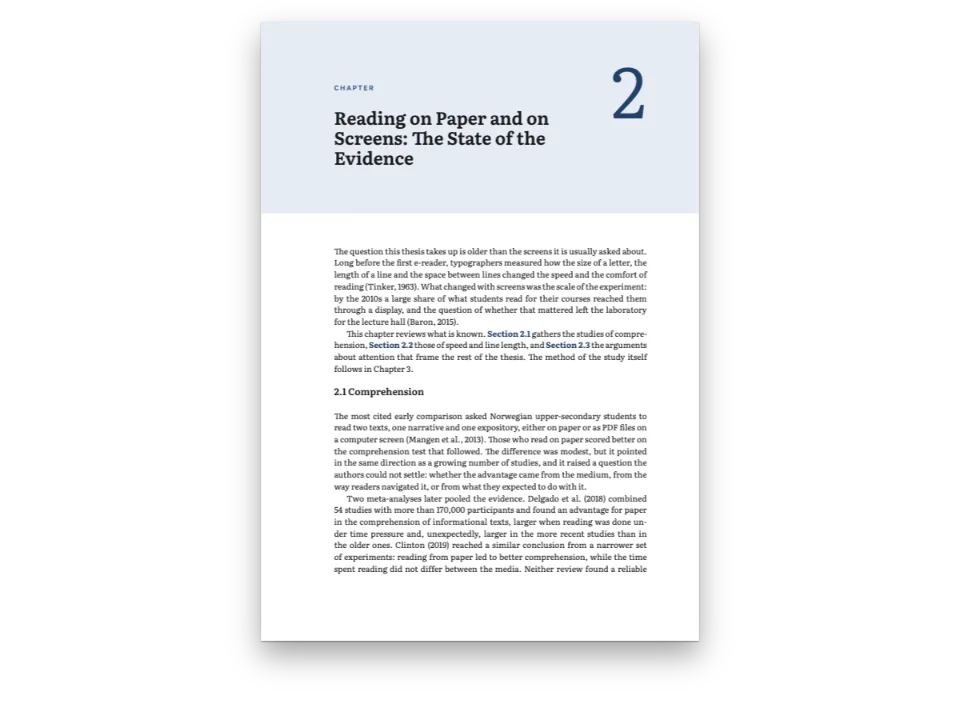
The Working Page, a small collection of essays on the history of printing, edited by two scholars and written by three. Each essay arrives from its contributor as a Markdown file with a BibTeX block of its own, and that is how the book keeps it: a 155 × 235 mm volume in Libre Caslon, a red title page, and chapters that open with a number, a title and the contributor's name. Each chapter closes on its own References list in Chicago author-date, holding only the works that essay cites. Eisenstein's Printing Press as an Agent of Change is cited by two contributors and so appears in both of their lists; Gaskell's New Introduction to Bibliography does the same in chapters 1 and 3.
This recipe answers
- How do I give each chapter of an edited volume its own author and its own bibliography?
- How do I cite works and build the bibliography in APA, IEEE or another citation style?
The short answer
// Citations are [@key] in the text; each contributor's BibTeX goes in a :::references block
// in their own chapter. Register the engine once, before the first build.
registerCitationEngine(createCiteprocEngine({ styles: STYLES, locales: LOCALES }));
const citations = {
  style: 'chicago-author-date', // the humanities' author-date: (Eisenstein 1979)
  bibliography: {
    // 'chapter': a :::bibliography lists the works its own document cites, so a work two
    // contributors cite appears in both lists. 'book' (the default) would print one list,
    // after the last chapter. The scope is per document, not per H1: each essay must be a
    // document of its own in buildBundle (see the chapters region).
    scope: 'chapter',
    title: '', // no bold title paragraph: each chapter has its own ## References heading
    fontSize: em(0.9), lineHeight: pt(12.4), hangingIndent: mm(5), entrySpacing: pt(2.6),
  },
};
// Numbering and disambiguation still see the whole book: two Smiths of 2001 in different
// chapters would print 2001a and 2001b, as one bibliography would.
One list per chapter: scope 'chapter' over a book of separate documents
Ingredients
- Features
- Bibliography from the referencesCitations in a citation styleBooks built chapter by chapterHeading attributesDesigned openersTable of contentsRunning heads and foliosHeads by page roleHeading stylesUnnumbered chaptersCovers, title pages and colophonsAnchoring design elementsFloated boxesMirrored marginsSemantic colour palettePDF export
- Also uses
- Callout boxesColumn balancingNumbered headingsPaper colourFonts embedded in the PDFRunning heads per section
- Type
- Libre Caslon Text, Libre Caslon Display, IBM Plex Sans Condensed (SIL OFL 1.1)
- Assets
- None: every picture is drawn in code
Method
#1 · One document per contributor
// A chapter's :::bibliography lists what that document cites; one Markdown file holding all
// three essays would make every list repeat the works of the chapters before it.
const chapters = [front, lowe, okafor, ferrer].map((markdown) => ({ markdown }));
const book = () => buildBundle({ chapters, config: config(), resources: [] });
The scope in the short answer is the scope of a document. buildBundle lays the four documents out as one book, so page numbers, chapter numbers and the contents run straight through, while each :::bibliography collects the citations of its own file. The references stay where the contributor wrote them: a key defined in any chapter counts for the whole book, so one shared entry would have been enough, but self-contained chapters can be swapped or reordered without breaking another essay's list.
#2 · The byline is a heading attribute
// # The Compositor's Day {author="Margaret Lowe" short="The Compositor's Day"}
const byline = text('byline', '{attr.author}', { fontFamily: TEXT, italic: true,
  fontSize: pt(12), color: col('ink'), align: 'left' }, below('title', 4));
const versoAuthor = head('verso-author', '{attr.author}', 'even',
  at('page', 'top-left', MARGIN.outer + 8, 13)); // in the running head
const tocAuthor = { enabled: true, attr: 'author', fontFamily: TEXT, fontSize: pt(9.5),
  color: col('muted') }; // a line under each title in the contents (italic by default)
Each essay's title carries author="…" and a short="…" title for the running head. The opener prints the author under the title, the verso running head names the author of the essay the page belongs to, and the contents print the name as a line under each entry. Nothing in the book's front matter lists the contributors twice.
#3 · The opener
const opener = { enabled: true, minHeight: mm(48), slot: { elements: [
  text('kicker', t({ en: 'Chapter {number}', es: 'Capítulo {number}' }), { ...label,
    fontSize: pt(8.5), letterSpacing: pt(1.7), color: col('accent') },
  at('container', 'top-left', 0, 4)),
  text('title', '{titleText}', { fontFamily: DISPLAY, fontSize: pt(28), lineHeight: 1.08,
    color: col('ink'), align: 'left', overflow: 'wrap' }, below('kicker', 3, { width: 'fill' })),
  byline,
  { kind: 'rule', id: 'rule', direction: 'horizontal', thickness: pt(1.2), color: col('accent'),
    placement: { ...below('byline', 6), size: { width: mm(16) } } },
] } };
Kicker, title and byline stack from the top of the text area, each anchored below the one before, so a two-line title such as chapter 3's pushes the byline and the rule down with it. The 48 mm reserve holds a two-line title; the text then starts on the same grid line in every chapter.
#4 · Running heads for a book with many authors
function head(id, content, parity, placement, look = {}) { // hoisted: the byline uses it
  return { ...text(id, content, { ...label, fontWeight: 500, fontSize: pt(7.5),
    letterSpacing: pt(1.1), color: col('muted'), ...look }, placement), parity, pages: 'body' };
}
const folio = { fontWeight: 600, color: col('ink') };
const header = { elements: [
  head('verso-folio', '{pageNumber}', 'even', at('page', 'top-left', MARGIN.outer, 13), folio),
  versoAuthor,
  head('recto-title', '{attr.short}', 'odd', at('page', 'top-right', -(MARGIN.outer + 8), 13),
    { align: 'right' }),
  head('recto-folio', '{pageNumber}', 'odd', at('page', 'top-right', -MARGIN.outer, 13),
    { ...folio, align: 'right' }),
] };
const footer = { elements: [{ ...head('drop-folio', '{pageNumber}', 'all',
  at('container', 'top', 0, 9), { ...folio, align: 'center' }), pages: 'opener' }] };
An edited volume names the contributor on the verso and the chapter on the recto, where a monograph would print the book's title and the chapter. The heads are filtered to pages: 'body', so the openers carry only a drop folio.
#5 · The front matter
const bare = { numbered: false, toc: false, header: { elements: [] }, footer: { elements: [] } };
const cover = { enabled: true, slot: { elements: [
  { kind: 'box', id: 'field', style: { backgroundColor: col('accent') },
    placement: { ...at('bleed', 'top-left'), size: { width: 'fill', height: mm(150) } } },
  text('title', '{titleText}', { fontFamily: DISPLAY, fontSize: pt(58), lineHeight: 1,
    color: col('paper'), align: 'left', overflow: 'wrap' },
  { ...at('page', 'top-left', MARGIN.inner, 64), size: { width: mm(118) } }),
  text('subtitle', '{subtitle}', { fontFamily: TEXT, italic: true, fontSize: pt(15),
    color: col('paper'), align: 'left' }, below('title', 5)),
  text('editors', '{attr.editors}', { ...label, fontSize: pt(9), letterSpacing: pt(1.8),
    color: col('accent') }, at('page', 'top-left', MARGIN.inner, 162)),
  text('contributors', '{attr.contributors}', { fontFamily: TEXT, italic: true, fontSize: pt(12),
    color: col('ink'), align: 'left' }, below('editors', 3)),
  text('imprint', '{attr.imprint}', { ...label, fontWeight: 500, fontSize: pt(7.5),
    letterSpacing: pt(1.5), color: col('muted') }, at('page', 'bottom-left', MARGIN.inner, -16)),
] } };
const contentsOpener = { enabled: true, minHeight: mm(40), slot: { elements: [
  text('kicker', '{title}', { ...label, fontSize: pt(8.5), letterSpacing: pt(1.7),
    color: col('accent') }, at('container', 'top-left', 0, 4)),
  text('title', '{titleText}', { fontFamily: DISPLAY, fontSize: pt(28), color: col('ink'),
    align: 'left' }, below('kicker', 3)),
] } };
const contents = {
  levels: [{ level: 1, fontFamily: TEXT, fontSize: pt(12.5), lineHeight: pt(LEAD),
    numberFontFamily: LABEL, numberFontSize: pt(10), numberFontWeight: 600,
    numberColor: col('accent'), numberWidth: mm(6), numberGap: mm(3), marginBottom: pt(LEAD) }],
  pageNumber: { fontFamily: LABEL, fontSize: pt(9), fontWeight: 600, color: col('ink'),
    width: mm(7) },
  leader: { char: '. ', gap: mm(2) },
  subtitle: tocAuthor,
};
The title page and the contents are two unnumbered headings in the first document, with no running heads and no entry in the contents. Their designs read {title} and {subtitle} from the front matter and the editors and contributors from the heading's own attributes.
The whole recipe
// ═══ Postext Cookbook · Nº 098 · An edited volume with a bibliography per chapter ═════ // https://postext.dev/en/cookbook/edited-volume-chapter-bibliographies // Code: MIT · Text: original (CC BY 4.0) · Pictures: none // Fonts: Libre Caslon Text & Display, IBM Plex Sans Condensed (OFL 1.1) · Needs postext ≥ 1.12.1 // Three essays by three contributors, each a Markdown document of its own with its own // BibTeX block, laid out by buildBundle as one volume: every chapter closes on its own list. import { buildBundle, renderPageToCanvas, clearMeasurementCache, registerCitationEngine, } from 'https://esm.sh/postext'; import { renderToPdf, decompressWoff2 } from 'https://esm.sh/postext-pdf'; import { createCiteprocEngine, STYLES, LOCALES } from 'https://esm.sh/postext-citeproc'; const LANG = 'en'; // @lang: the language of the sample document ('en' | 'es') const RECIPE = 'edited-volume-chapter-bibliographies'; // ─── 1 · Design ───────────────────────────────────────────────────────────── // #region palette: printer's red on a warm paper, the rest in ink const palette = { ink: '#211c19', // text: a warm near-black accent: '#8e2b1f', // printer's red: the cover field, kickers, the references heading rule: '#cdbfb2', // hairlines muted: '#6b5f57', // running heads, the contents' contributors, the colophon paper: '#fcfaf6', // the page, and the type on the red field }; const col = (id) => ({ hex: palette[id], model: 'hex', paletteId: id }); const colorPalette = Object.entries({ ...palette, 'main-color': palette.accent }) .map(([id, hex]) => ({ id, name: id, value: { hex, model: 'hex' } })); // #endregion const TEXT = 'Libre Caslon Text', DISPLAY = 'Libre Caslon Display'; const LABEL = 'IBM Plex Sans Condensed'; const MARGIN = { top: 23, bottom: 22, inner: 20, outer: 18 }; // mm, mirrored const LEAD = 13.8; // body leading in pt: the baseline grid const label = { fontFamily: LABEL, fontWeight: 600, textTransform: 'uppercase', align: 'left' }; const at = (to, edge, x = 0, y = 0) => ({ anchor: { to, edge }, offset: { x: mm(x), y: mm(y) } }); const below = (id, y, size) => ({ ...at(`#${id}`, 'below', 0, y), ...(size && { size }) }); const text = (id, content, look, placement) => ({ kind: 'text', id, content, ...look, placement }); // #region answer: one list per chapter: scope 'chapter' over a book of separate documents // Citations are [@key] in the text; each contributor's BibTeX goes in a :::references block // in their own chapter. Register the engine once, before the first build. registerCitationEngine(createCiteprocEngine({ styles: STYLES, locales: LOCALES })); const citations = { style: 'chicago-author-date', // the humanities' author-date: (Eisenstein 1979) bibliography: { // 'chapter': a :::bibliography lists the works its own document cites, so a work two // contributors cite appears in both lists. 'book' (the default) would print one list, // after the last chapter. The scope is per document, not per H1: each essay must be a // document of its own in buildBundle (see the chapters region). scope: 'chapter', title: '', // no bold title paragraph: each chapter has its own ## References heading fontSize: em(0.9), lineHeight: pt(12.4), hangingIndent: mm(5), entrySpacing: pt(2.6), }, }; // Numbering and disambiguation still see the whole book: two Smiths of 2001 in different // chapters would print 2001a and 2001b, as one bibliography would. // #endregion // #region byline: the contributor, from the heading, in three places // # The Compositor's Day {author="Margaret Lowe" short="The Compositor's Day"} const byline = text('byline', '{attr.author}', { fontFamily: TEXT, italic: true, fontSize: pt(12), color: col('ink'), align: 'left' }, below('title', 4)); const versoAuthor = head('verso-author', '{attr.author}', 'even', at('page', 'top-left', MARGIN.outer + 8, 13)); // in the running head const tocAuthor = { enabled: true, attr: 'author', fontFamily: TEXT, fontSize: pt(9.5), color: col('muted') }; // a line under each title in the contents (italic by default) // #endregion // #region opener: kicker, title and byline over a short red rule, sunk 48 mm const opener = { enabled: true, minHeight: mm(48), slot: { elements: [ text('kicker', t({ en: 'Chapter {number}', es: 'Capítulo {number}' }), { ...label, fontSize: pt(8.5), letterSpacing: pt(1.7), color: col('accent') }, at('container', 'top-left', 0, 4)), text('title', '{titleText}', { fontFamily: DISPLAY, fontSize: pt(28), lineHeight: 1.08, color: col('ink'), align: 'left', overflow: 'wrap' }, below('kicker', 3, { width: 'fill' })), byline, { kind: 'rule', id: 'rule', direction: 'horizontal', thickness: pt(1.2), color: col('accent'), placement: { ...below('byline', 6), size: { width: mm(16) } } }, ] } }; // #endregion // #region running-heads: contributor on the verso, short title on the recto, folios outside function head(id, content, parity, placement, look = {}) { // hoisted: the byline uses it return { ...text(id, content, { ...label, fontWeight: 500, fontSize: pt(7.5), letterSpacing: pt(1.1), color: col('muted'), ...look }, placement), parity, pages: 'body' }; } const folio = { fontWeight: 600, color: col('ink') }; const header = { elements: [ head('verso-folio', '{pageNumber}', 'even', at('page', 'top-left', MARGIN.outer, 13), folio), versoAuthor, head('recto-title', '{attr.short}', 'odd', at('page', 'top-right', -(MARGIN.outer + 8), 13), { align: 'right' }), head('recto-folio', '{pageNumber}', 'odd', at('page', 'top-right', -MARGIN.outer, 13), { ...folio, align: 'right' }), ] }; const footer = { elements: [{ ...head('drop-folio', '{pageNumber}', 'all', at('container', 'top', 0, 9), { ...folio, align: 'center' }), pages: 'opener' }] }; // #endregion // #region front: the title page on a red field, and the contents const bare = { numbered: false, toc: false, header: { elements: [] }, footer: { elements: [] } }; const cover = { enabled: true, slot: { elements: [ { kind: 'box', id: 'field', style: { backgroundColor: col('accent') }, placement: { ...at('bleed', 'top-left'), size: { width: 'fill', height: mm(150) } } }, text('title', '{titleText}', { fontFamily: DISPLAY, fontSize: pt(58), lineHeight: 1, color: col('paper'), align: 'left', overflow: 'wrap' }, { ...at('page', 'top-left', MARGIN.inner, 64), size: { width: mm(118) } }), text('subtitle', '{subtitle}', { fontFamily: TEXT, italic: true, fontSize: pt(15), color: col('paper'), align: 'left' }, below('title', 5)), text('editors', '{attr.editors}', { ...label, fontSize: pt(9), letterSpacing: pt(1.8), color: col('accent') }, at('page', 'top-left', MARGIN.inner, 162)), text('contributors', '{attr.contributors}', { fontFamily: TEXT, italic: true, fontSize: pt(12), color: col('ink'), align: 'left' }, below('editors', 3)), text('imprint', '{attr.imprint}', { ...label, fontWeight: 500, fontSize: pt(7.5), letterSpacing: pt(1.5), color: col('muted') }, at('page', 'bottom-left', MARGIN.inner, -16)), ] } }; const contentsOpener = { enabled: true, minHeight: mm(40), slot: { elements: [ text('kicker', '{title}', { ...label, fontSize: pt(8.5), letterSpacing: pt(1.7), color: col('accent') }, at('container', 'top-left', 0, 4)), text('title', '{titleText}', { fontFamily: DISPLAY, fontSize: pt(28), color: col('ink'), align: 'left' }, below('kicker', 3)), ] } }; const contents = { levels: [{ level: 1, fontFamily: TEXT, fontSize: pt(12.5), lineHeight: pt(LEAD), numberFontFamily: LABEL, numberFontSize: pt(10), numberFontWeight: 600, numberColor: col('accent'), numberWidth: mm(6), numberGap: mm(3), marginBottom: pt(LEAD) }], pageNumber: { fontFamily: LABEL, fontSize: pt(9), fontWeight: 600, color: col('ink'), width: mm(7) }, leader: { char: '. ', gap: mm(2) }, subtitle: tocAuthor, }; // #endregion const config = () => ({ // a factory: the engine caches resolved configs per object locale: t({ en: 'en-us', es: 'es' }), colorPalette, citations, page: { sizePreset: 'custom', width: mm(155), height: mm(235), dpi: 150, backgroundColor: col('paper'), margins: { top: mm(MARGIN.top), bottom: mm(MARGIN.bottom), left: mm(MARGIN.inner), right: mm(MARGIN.outer), mirror: true } }, layout: { layoutType: 'single' }, bodyText: { fontFamily: TEXT, fontSize: pt(9.6), lineHeight: pt(LEAD), color: col('ink'), boldColor: col('ink'), italicColor: col('ink'), referenceColor: col('ink'), textAlign: 'justify', firstLineIndent: mm(4.5), indentAfterHeading: false, hyphenation: { enabled: true }, optimalLineBreaking: true, maxWordSpacing: 1.7, avoidWidows: true, avoidOrphans: true, avoidRunts: true }, headings: { fontFamily: DISPLAY, fontWeight: 400, color: col('ink'), // A page that ends short may open at most one extra line above a subhead. balancing: { maxLinesPerHeading: 1 }, levels: [ // Restated: any headings object drops the H1 break (gotcha: headings-drop-h1-break). // 'any': an essay opens on the next page, recto or verso, as in most edited volumes. { level: 1, numberingTemplate: '{1}', marginBottom: pt(0), breakBefore: { enabled: true, parity: 'any' }, advancedDesign: opener }, { level: 2, fontFamily: TEXT, italic: true, fontSize: pt(11), lineHeight: pt(LEAD * 1.5), numberingTemplate: '', marginTop: pt(LEAD * 0.5), marginBottom: pt(0) }, ] }, headingStyles: [ { id: 'cover', ...bare, span: 'page', advancedDesign: cover }, { id: 'contents', ...bare, advancedDesign: contentsOpener }, // The references heading: the label face in red, out of the contents. { id: 'references', toc: false, fontFamily: LABEL, fontWeight: 600, italic: false, fontSize: pt(8.5), letterSpacing: pt(1.7), textTransform: 'uppercase', color: col('accent'), lineHeight: pt(LEAD * 2), marginTop: pt(LEAD), marginBottom: pt(0) }, ], toc: contents, calloutStyles: [{ id: 'colophon', placement: 'bottom', backgroundEnabled: false, stripe: { enabled: true, side: 'top', width: pt(0.5), color: col('rule') }, padding: { top: mm(2.5), right: pt(0), bottom: pt(0), left: pt(0) }, marginBottom: pt(0), body: { fontFamily: LABEL, fontSize: pt(7.5), lineHeight: pt(10.5), color: col('muted'), textAlign: 'left', firstLineIndent: pt(0) } }], header, footer, }); // ─── 2 · Content ──────────────────────────────────────────────────────────── const front = String.raw`---Markdown sample · 13 lines · content.en.md
title: "The Working Page" subtitle: "Essays on Printing, Type and Reading" --- # The Working Page {style="cover" editors="Edited by Helen Ashby and Tomás Ribera" contributors="Margaret Lowe · Daniel Okafor · Lucía Ferrer" imprint="Quire Editions · Edinburgh · 2026"} # Contents {style="contents"} :::toc :::callout{type="colophon"} Set in Libre Caslon Text, Libre Caslon Display and IBM Plex Sans Condensed (SIL OFL). Text: original, CC BY 4.0. The volume, its editors and its contributors are fictional; the works they cite are real. :::`; // title page and contents (content.<lang>.md) const lowe = String.raw`# The Compositor’s Day {author="Margaret Lowe" short="The Compositor’s Day"}Markdown sample · 44 lines · content.lowe.en.md
Every page printed by hand passed through a compositor before it reached the press. He stood at a pair of cases, the capitals in the upper one and the small letters in the lower, read a few words of his copy and picked the sorts one at a time into the composing stick in his left hand. When the stick was full he slid the lines onto a galley; when there were lines enough for a page he tied them up with cord and set the page aside until the whole forme could be imposed and locked into its chase. Joseph Moxon described the routine in his *Mechanick Exercises* of 1683–84, the first full manual of printing in English, and most of what bibliographers later wrote about the compositor starts from his account [@gaskell1972]. The work was paid by the piece. A compositor was credited with the number of ens he set, and his speed, his spelling and his care decided what the reader received. That is why the compositor matters to anyone who edits an early printed text: between the author’s manuscript and the printed sheet stood a man with his own habits, working against the clock, who could misread a word, run short of a letter or change the spelling to make a line fit. ## Reading the evidence of the type The type itself keeps a record of this work. A sort with a nicked serif or a broken stem prints the same flaw wherever it is used, and once the page has been printed the compositor distributes the type back into the case, so the damaged letter turns up again a few pages later. Charlton Hinman followed hundreds of such letters through the Shakespeare First Folio of 1623 and worked out the order in which its pages were set, which compositor set them and how the work moved between the cases [@hinman1963]. His method rested on patience and a Hinman collator, but its premise was simple: type is a finite stock, and its movements can be traced. Spelling gave a second kind of evidence. One compositor preferred *doe* and *goe*, another *do* and *go*; one set a colon where his partner set a comma. Where the copy did not dictate a form, the compositor’s preference showed through, and a page set by one man reads differently from a page set by another. Bibliographers assembled such preferences into profiles and used them to assign pages and to weigh the authority of a reading [@gaskell1972]. ## Printers of the mind The weakness of these methods lay in what they assumed about the printing house. Analyses of type recurrence often supposed that a shop worked through one book at a time, a compositor setting the pages in order and a press printing each forme as soon as it was ready. D. F. McKenzie tested that picture against the records of Cambridge University Press for the years 1696 to 1712, which survive in unusual detail, and found that it did not hold [@mckenzie1969]. Several books were in production at once. Compositors moved from one job to another as copy arrived; pressmen printed sheets of different books in the same week; work stopped and restarted as paper, money or the author’s revisions allowed. McKenzie’s conclusion was that bibliographers had built their arguments on “printers of the mind”, an orderly workshop that existed in their reasoning and not in the archive. A pattern found in the type could be explained by more than one sequence of work, and a single sequence could not be inferred from it without outside evidence. His essay did not end the study of compositors, but it changed its tone: inferences now came with the conditions under which they held. ## What the compositor made The compositor also produced something larger than any single page. Because the same setting of type printed every copy of a sheet, an edition of several hundred copies carried the same text, page for page, to readers who would never meet. Elizabeth Eisenstein made this repetition the centre of her account of early modern Europe: the identical copy, she argued, allowed scholars in different cities to compare the same tables, maps and texts, to correct them in later editions and to build on one another’s work [@eisenstein1979]. The second essay in this volume returns to her argument and to the objections it met. Yet the copies of an edition were never quite identical. Errors were often caught while a sheet was on the press, and the forme was unlocked and corrected without the sheets already printed being thrown away, so that corrected and uncorrected states were bound up together in the same edition [@gaskell1972]. Hinman found such press variants throughout the Folio [@hinman1963]. The compositor’s day, in other words, made both the stability that Eisenstein described and the small instabilities that bibliographers spend their careers collating. ## References {style="references"} :::bibliography :::references{format=bibtex} @book{gaskell1972, author = {Gaskell, Philip}, title = {A New Introduction to Bibliography}, publisher = {Clarendon Press}, address = {Oxford}, year = 1972} @book{hinman1963, author = {Hinman, Charlton}, title = {The Printing and Proof-Reading of the First Folio of Shakespeare}, publisher = {Clarendon Press}, address = {Oxford}, year = 1963} @article{mckenzie1969, author = {McKenzie, D. F.}, title = {Printers of the Mind: Some Notes on Bibliographical Theories and Printing-House Practices}, journal = {Studies in Bibliography}, volume = 22, pages = {1--75}, year = 1969} @book{eisenstein1979, author = {Eisenstein, Elizabeth L.}, title = {The Printing Press as an Agent of Change: Communications and Cultural Transformations in Early-Modern Europe}, publisher = {Cambridge University Press}, address = {Cambridge}, year = 1979} :::`; // content.lowe.<lang>.md: chapter 1, and so on const okafor = String.raw`# What Fixity Meant {author="Daniel Okafor" short="What Fixity Meant"}Markdown sample · 48 lines · content.okafor.en.md
Few books in the history of the book have been argued with as long as Elizabeth Eisenstein’s. *The Printing Press as an Agent of Change* appeared in two volumes in 1979 and proposed that the shift from script to print was itself a cause of the Renaissance revival of learning, of the Reformation and of the new science of the seventeenth century [@eisenstein1979]. Her case rested on a few features that print had and manuscript did not: dissemination in hundreds of copies at once, standardisation of text and image, and above all what she called typographical fixity, the capacity of an edition to preserve a text unchanged and to let it be corrected and improved in the next. The thesis was large, and its reception divided along a familiar line. Historians of ideas found in it an explanation of why scholarship became cumulative after 1500. Historians of printing pointed to the variety of what presses actually produced, from error-filled almanacs to pirated editions, and asked whether fixity was a property of print or a result that some printers achieved some of the time. ## Credit and piracy Adrian Johns gave the second answer its fullest form [@johns1998]. Studying the London book trade of the seventeenth century, he found that readers had good reason to distrust what they bought. Editions were reprinted without permission, attributed to authors who had not written them, or issued with the wrong date and imprint. The Stationers’ Company kept a register of titles to settle disputes among its members, but the register protected the trade’s own arrangements rather than the author’s text. A reader who wanted to know whether a printed book was what it claimed to be had to rely on the reputation of the printer and the bookseller, on the people who vouched for the edition, and on the conventions of the shop where it was sold. Fixity, in Johns’s account, was therefore something made. It took the work of authors who watched over their proofs, of booksellers who guarded their names, and of institutions such as the Royal Society, which licensed and supervised the books it sponsored. His most cited example is the Astronomer Royal, John Flamsteed, who saw his observations printed in 1712 in an edition he had not approved and spent years trying to recover and suppress it. Where Eisenstein saw a feature of the technology, Johns saw a set of practices that had to be learned, and that could fail. ## Circuits and models The debate between the two positions is easier to follow with a map of what a book passes through. Robert Darnton drew one in 1982: a communications circuit that runs from the author to the publisher, the printers, the shippers, the booksellers and the readers, and back to the author, with each stage shaped by economic, political and intellectual conditions [@darnton1982]. The model placed the history of books among the people who handled them, and many studies of the 1980s worked through it stage by stage. Thomas Adams and Nicolas Barker objected that Darnton’s circuit described the trade and lost sight of the object. They proposed a model built around the book itself and the events in its life: publication, manufacture, distribution, reception and survival [@adams1993]. The difference matters to the argument about fixity. In Darnton’s circuit, fixity belongs to the relations between printers, sellers and readers; in Adams and Barker’s model, it is also a question of which copies survived, where, and in what state. ## The form of the text D. F. McKenzie widened the question further in his Panizzi lectures, published in 1986 [@mckenzie1986]. Bibliography, he argued, should study texts as recorded forms and the processes of their transmission, including their production and their reception, and it should treat the form of a text as part of its meaning. His example was William Congreve, whose plays changed character when they were reset for the collected *Works* of 1710: the new layout divided the scenes differently, marked entrances in a new way and invited a different kind of reading. From McKenzie’s position the quarrel over fixity looks less like a quarrel. An edition can fix the words of a text and still change how it reads; a reprint can keep the meaning and lose the form that carried it. Eisenstein described what the press made possible, and Johns described what it took to make that possibility hold [@eisenstein1979; @johns1998]. Both are histories of the same pages, written from different ends of the circuit. ## References {style="references"} :::bibliography :::references{format=bibtex} @book{eisenstein1979, author = {Eisenstein, Elizabeth L.}, title = {The Printing Press as an Agent of Change: Communications and Cultural Transformations in Early-Modern Europe}, publisher = {Cambridge University Press}, address = {Cambridge}, year = 1979} @book{johns1998, author = {Johns, Adrian}, title = {The Nature of the Book: Print and Knowledge in the Making}, publisher = {University of Chicago Press}, address = {Chicago}, year = 1998} @article{darnton1982, author = {Darnton, Robert}, title = {What Is the History of Books?}, journal = {Daedalus}, volume = 111, number = 3, pages = {65--83}, year = 1982} @incollection{adams1993, author = {Adams, Thomas R. and Barker, Nicolas}, title = {A New Model for the Study of the Book}, booktitle = {A Potencie of Life: Books in Society}, editor = {Barker, Nicolas}, publisher = {British Library}, address = {London}, pages = {5--43}, year = 1993} @book{mckenzie1986, author = {McKenzie, D. F.}, title = {Bibliography and the Sociology of Texts}, series = {The Panizzi Lectures}, publisher = {British Library}, address = {London}, year = 1986} :::`; const ferrer = String.raw`# Punches, Matrices and the Name Garamond {author="Lucía Ferrer" short="Punches and Matrices"}Markdown sample · 45 lines · content.ferrer.en.md
Before a compositor could set a page, someone had to make the letters he picked from the case. Printing spread quickly: Lucien Febvre and Henri-Jean Martin estimated that fifteen to twenty million copies of books had been printed in Europe before 1500 [@febvre1976]. Every one of those copies was printed from type cast in a mould, and every typeface began as a set of steel punches cut by hand at the size the reader would see. The sequence of work is well documented, though the hand skills it required have mostly been lost [@carter1969]. The punchcutter shaped the end of a steel bar into the reversed form of a letter, filing and engraving it and checking it against smoke proofs. The enclosed spaces of the letter, the counters of *a*, *e* or *o*, were usually struck into the punch with a counterpunch, which let him repeat the same counter in several letters of the fount. Fred Smeijers, who has cut punches himself, argues that the counterpunch explains much of the consistency of sixteenth-century faces: the shapes were related because they were made with the same tools [@smeijers1996]. ## From punch to sort The hardened punch was driven into a bar of copper to make a matrix. The matrix had to be justified, filed so that the letter sat at the right depth and position, and then fitted into a hand mould, an adjustable box of steel and wood into which the caster poured an alloy of lead, tin and antimony. Each pour gave one sort, and the finished type, rubbed and dressed, was sold to printers by weight [@gaskell1972]. Punches were the founder’s capital. They could be used for decades, lent, inherited or sold, and a set of strikes from them allowed another foundry to cast the same face. This is why the faces of a few French punchcutters of the mid-sixteenth century spread across Europe within a generation. ## Whose letters It also made attribution difficult. A face appears in a printer’s book long after it was cut, under the printer’s name and not the cutter’s. Harry Carter’s survey of early typography set out the evidence available to sort these questions: specimen sheets, inventories, contracts and the books themselves [@carter1969]. Hendrik Vervliet spent decades applying it to the French Renaissance, comparing faces letter by letter across hundreds of books, and his catalogues redistributed many types long credited to Claude Garamont among his contemporaries, Robert Granjon and Pierre Haultin among them [@vervliet2008]. The name Garamond had a modern history of its own. When foundries in the early twentieth century revived “Garamond” for machine composition, several of them took as their model types that had been cut not by Garamont but by Jean Jannon, a printer at Sedan, some sixty years after Garamont’s death. Beatrice Warde pointed this out in 1926. The revivals kept the name, and many digital faces still carry it. ## What the reader sees None of this is visible on the page as a reader meets it. The reader judges a book by how easily it reads. The bibliographer sees, in the same page, the trace of a punchcutter’s files, the wear of a matrix and the habits of the caster who justified it. Early printers bought their type by size names, pica, english, long primer, and judged it as the reader did, by the page it made [@gaskell1972]. The history of type begins in steel, but it was always written for that page. ## References {style="references"} :::bibliography :::references{format=bibtex} @book{febvre1976, author = {Febvre, Lucien and Martin, Henri-Jean}, title = {The Coming of the Book: The Impact of Printing, 1450--1800}, translator = {Gerard, David}, publisher = {NLB}, address = {London}, year = 1976} @book{carter1969, author = {Carter, Harry}, title = {A View of Early Typography up to about 1600}, publisher = {Clarendon Press}, address = {Oxford}, year = 1969} @book{smeijers1996, author = {Smeijers, Fred}, title = {Counterpunch: Making Type in the Sixteenth Century, Designing Typefaces Now}, publisher = {Hyphen Press}, address = {London}, year = 1996} @book{gaskell1972, author = {Gaskell, Philip}, title = {A New Introduction to Bibliography}, publisher = {Clarendon Press}, address = {Oxford}, year = 1972} @book{vervliet2008, author = {Vervliet, Hendrik D. L.}, title = {The Palaeotypography of the French Renaissance: Selected Papers on Sixteenth-Century Typefaces}, publisher = {Brill}, address = {Leiden}, year = 2008} :::`; // #region chapters: one document per contributor, each with its own references // A chapter's :::bibliography lists what that document cites; one Markdown file holding all // three essays would make every list repeat the works of the chapters before it. const chapters = [front, lowe, okafor, ferrer].map((markdown) => ({ markdown })); const book = () => buildBundle({ chapters, config: config(), resources: [] }); // #endregion // ─── 3 · Fonts ────────────────────────────────────────────────────────────── const FONTS = { // text, display and label faces (gotcha: fonts-first) 'Libre Caslon Text': ['400', '400i', '700'], 'Libre Caslon Display': ['400'], 'IBM Plex Sans Condensed': ['400', '500', '600'], }; // ─── 4 · Build & show ─────────────────────────────────────────────────────── const all = chapters.map((chapter) => chapter.markdown).join('\n'); await loadFonts(FONTS, all); const docs = await buildWithFonts(book, all); // one VDTDocument per Markdown document showPages(docs, { title: t({ en: 'The Working Page', es: 'La página en obra' }) }); offerPdf(() => renderToPdf(docs, { fontProvider: fontsourceProvider }), `${RECIPE}.pdf`);Kit · core, fonts, viewer, pdf: the same in every recipe · 275 lines
// ─── Kit ── helpers shared by every Cookbook recipe · postext.dev/cookbook ───── // ─── Kit · core v1 ── the same in every recipe · postext.dev/cookbook ───────── function mm(value) { return { value, unit: 'mm' }; } function pt(value) { return { value, unit: 'pt' }; } function em(value) { return { value, unit: 'em' }; } /** The sample language's string: t({ en: 'Figure', es: 'Figura' }). */ function t(strings) { return strings[LANG] ?? Object.values(strings)[0]; } /** A file in this recipe's assets folder, served from the Postext repo by jsDelivr. */ function asset(file) { return `https://cdn.jsdelivr.net/gh/drnachio/postext@main/cookbook/${RECIPE}/assets/${file}`; } // ─── Kit · fonts v1 ── the same in every recipe · postext.dev/cookbook ──────── // Postext measures text with the faces the browser has loaded, and caches the // widths, so every face must be ready before the first build. Faces come from // Fontsource: the same static files the PDF embeds, so screen and PDF agree. /** faces = { 'Family Name': ['400', '400i', '700'] }. `text` is the sample: * letters beyond Latin-1 (č, ł, ő…) also load the latin-ext files. With * `optional`, a face Fontsource does not ship is skipped instead of failing. * Resolves to the number of faces added. */ async function loadFonts(faces, text = '', { optional = false } = {}) { kitStatus('Loading fonts…'); const ranges = { latin: 'U+0000-00FF,U+0131,U+0152-0153,U+02BB-02BC,U+02C6,U+02DA,U+02DC,U+0304,U+0308,U+0329,' + 'U+2000-206F,U+20AC,U+2122,U+2191,U+2193,U+2212,U+2215,U+FEFF,U+FFFD', 'latin-ext': 'U+0100-02BA,U+02BD-02C5,U+02C7-02CC,U+02CE-02D7,U+02DD-02FF,U+0304,U+0308,U+0329,' + 'U+1D00-1DBF,U+1E00-1E9F,U+1EF2-1EFF,U+2020,U+20A0-20AB,U+20AD-20C0,U+2113,U+2C60-2C7F,U+A720-A7FF', }; const subsets = /[Ā-˿Ḁ-ỿ]/.test(text) ? ['latin', 'latin-ext'] : ['latin']; const jobs = []; let added = 0; for (const [family, specs] of Object.entries(faces)) { const id = fontsourceId(family); const meta = optional ? await fontsourceMeta(family) : null; for (const spec of new Set(specs)) { const weight = parseInt(spec, 10); const style = spec.endsWith('i') ? 'italic' : 'normal'; if (hasFace(family, weight, style)) continue; if (optional && !(meta?.weights.includes(weight) && meta.styles.includes(style))) continue; for (const subset of subsets) { const url = `https://cdn.jsdelivr.net/npm/@fontsource/${id}@5/files/${id}-${subset}-${weight}-${style}.woff2`; const face = new FontFace(family, `url(${url}) format('woff2')`, { weight: String(weight), style, unicodeRange: ranges[subset] }); jobs.push(face.load().then((ready) => { document.fonts.add(ready); added++; }, () => { if (subset === 'latin' && !optional) throw new Error(`Fontsource has no ${family} ${weight} ${style}`); })); } } } await Promise.all(jobs).catch((error) => { kitFail(error); throw error; }); return added; } /** Runs `build` (a buildDocument or buildBundle call) and checks the faces * the pages use. A regular face missing from FONTS is loaded with a warning; * bold and italic variants are loaded when the family ships them. Then the * measurement caches are cleared and the build runs again. */ async function buildWithFonts(build, text = '') { const tried = new Set(); for (let round = 0; round < 3; round++) { kitStatus('Laying out…'); await new Promise(requestAnimationFrame); // let the status paint first const result = await Promise.resolve().then(build).catch((error) => { kitFail(error); throw error; }); const wanted = { base: {}, variants: {} }; for (const { font, base } of [result].flat().flatMap(fontStringsOf)) { const { family, weight, style } = parseFont(font); const key = `${family}|${weight}|${style}`; if (tried.has(key) || hasFace(family, weight, style)) continue; tried.add(key); (wanted[base ? 'base' : 'variants'][family] ??= []).push(`${weight}${style === 'italic' ? 'i' : ''}`); } if (Object.keys(wanted.base).length) { console.warn(`[cookbook] FONTS does not list ${JSON.stringify(wanted.base)}: loading them.`); } const added = await loadFonts(wanted.base, text) + await loadFonts(wanted.variants, text, { optional: true }); if (added === 0) return result; clearMeasurementCache(); } throw new Error('The fonts did not settle after three builds.'); } /** Every font string of the layout. `base` marks a block's own face; its * bold, italic and bold-italic variants are listed whether or not used. */ function fontStringsOf(doc) { const found = new Map(); const walk = (node) => { if (!node || typeof node !== 'object') return; if (Array.isArray(node)) { node.forEach(walk); return; } for (const [key, value] of Object.entries(node)) { if (typeof value === 'string' && /fontString$/i.test(key)) { found.set(value, found.get(value) || key === 'fontString'); } else if (value && typeof value === 'object') walk(value); } }; walk(doc.pages); walk(doc.blocks); return [...found].map(([font, base]) => ({ font, base })); } /** '700 37.5px Open Sans' / 'italic 400 13px "Source Serif 4"' → { family, weight, style }. * A string with no weight ('95.8px Young Serif', from a design text) is 400. */ function parseFont(font) { const m = /^(?:(italic|oblique)\s+)?(?:small-caps\s+)?(?:(\d+|bold|normal)\s+)?[\d.]+px\s+(.+)$/.exec(font.trim()); if (!m) throw new Error(`Unexpected font string: ${font}`); const weight = m[2] === 'bold' ? 700 : !m[2] || m[2] === 'normal' ? 400 : Number(m[2]); return { family: m[3].replace(/^["']|["']$/g, ''), weight, style: m[1] ? 'italic' : 'normal' }; } /** True when a loaded FontFace covers exactly this family, weight and style * (document.fonts.check() is also true for families nobody declared). */ function hasFace(family, weight, style) { for (const face of document.fonts) { if (face.status !== 'loaded' || face.style !== style) continue; if (face.family.replace(/^["']|["']$/g, '') !== family) continue; const [low, high = low] = face.weight.split(' ').map(Number); if (weight >= low && weight <= high) return true; } return false; } /** Fontsource's id for a family: 'Source Serif 4' → 'source-serif-4'. */ function fontsourceId(family) { return family.toLowerCase().replace(/\s+/g, '-'); } /** The weights and styles a family ships ({ weights: [400, 700], styles: ['normal', 'italic'] }), or null. */ function fontsourceMeta(family) { fontsourceMeta.cache ??= new Map(); const id = fontsourceId(family); if (!fontsourceMeta.cache.has(id)) { fontsourceMeta.cache.set(id, fetch(`https://api.fontsource.org/v1/fonts/${id}`) .then((res) => (res.ok ? res.json() : null), () => null)); } return fontsourceMeta.cache.get(id); } // ─── Kit · viewer v1 ── the same in every recipe · postext.dev/cookbook ─────── /** Shows the pages as facing spreads on a dark desk: the first page is a * recto on its own, then verso | recto pairs, as in a bound book. Pages * are painted when they scroll near the screen. */ function showPages(docs, { title, width = 460 } = {}) { const root = viewer(title); const pages = [docs].flat().flatMap((doc) => doc.pages.map((page) => ({ doc, page, n: (doc.pageIndexOffset ?? 0) + page.index }))); const spreads = []; let verso = null; for (const p of pages) { if (p.n % 2 === 1) { if (verso) spreads.push([verso, null]); verso = p; } else { spreads.push([verso, p]); verso = null; } } if (verso) spreads.push([verso, null]); const density = Math.min(window.devicePixelRatio || 1, 2); showPages.painter?.disconnect(); const painter = new IntersectionObserver((entries) => { for (const { isIntersecting, target } of entries) { if (!isIntersecting) continue; painter.unobserve(target); const { doc, page } = target.postext; renderPageToCanvas(page, doc, target, { scale: (width * density) / page.width }); } }, { rootMargin: '800px' }); showPages.painter = painter; root.replaceChildren(...spreads.map((pair) => { const spread = document.createElement('div'); spread.className = 'pt-spread'; for (const p of pair) { const figure = document.createElement('figure'); if (p) { const label = p.page.pageLabel || String(p.n + 1); const canvas = document.createElement('canvas'); canvas.postext = p; canvas.style.aspectRatio = `${p.page.width} / ${p.page.height}`; canvas.setAttribute('role', 'img'); canvas.setAttribute('aria-label', `Page ${label}`); const folio = document.createElement('figcaption'); folio.textContent = label; figure.append(canvas, folio); painter.observe(canvas); } else figure.className = 'pt-blank'; spread.append(figure); } return spread; })); kitStatus(`${pages.length} ${pages.length === 1 ? 'page' : 'pages'}`); document.documentElement.dataset.postext = 'ready'; return pages.length; } /** The desk, the bar and the error reporting, created once. */ function viewer(title) { if (!document.getElementById('pt-kit')) { document.head.insertAdjacentHTML('beforeend', `<style id="pt-kit"> :root { color-scheme: dark; } body { margin: 0; background: #0e1014; color: #b9bcc4; font: 13px/1.45 system-ui, sans-serif; } #pt-bar { position: sticky; top: 0; z-index: 1; display: flex; flex-wrap: wrap; align-items: center; gap: 6px 16px; padding: 10px 16px; background: rgb(14 16 20 / .92); backdrop-filter: blur(6px); border-bottom: 1px solid #23262d; } #pt-bar strong { color: #f4f1ea; font-weight: 600; } #pt-actions { display: flex; gap: 12px; margin-left: auto; } #pt-actions a, #pt-actions button { color: #d8a21a; font: inherit; background: none; border: 0; padding: 0; cursor: pointer; } #pages { display: grid; justify-items: center; gap: 48px; padding: 32px 16px 72px; } .pt-spread { display: flex; } .pt-spread figure { margin: 0; width: min(460px, 44vw); } .pt-spread canvas { display: block; width: 100%; background: #fff; box-shadow: 0 1px 2px rgb(0 0 0 / .5), 0 22px 44px -16px rgb(0 0 0 / .8); } .pt-spread figure:first-child canvas { box-shadow: inset -14px 0 14px -14px rgb(0 0 0 / .18), 0 1px 2px rgb(0 0 0 / .5), 0 22px 44px -16px rgb(0 0 0 / .8); } .pt-spread figcaption { margin-top: 10px; text-align: center; font: 600 10px/1 system-ui, sans-serif; letter-spacing: .18em; text-transform: uppercase; color: #6c7079; } .pt-blank { visibility: hidden; } @media (max-width: 760px) { .pt-spread { flex-direction: column; gap: 32px; } .pt-spread figure { width: min(460px, 92vw); } .pt-blank { display: none; } } </style>`); document.body.insertAdjacentHTML('afterbegin', '<header id="pt-bar"><strong id="pt-title"></strong><span id="pt-status" role="status"></span><span id="pt-actions"></span></header>'); document.getElementById('pt-title').textContent = document.title || 'Postext'; addEventListener('error', (event) => kitFail(event.error ?? event.message)); addEventListener('unhandledrejection', (event) => kitFail(event.reason)); } if (title) document.getElementById('pt-title').textContent = title; return document.getElementById('pages') ?? document.body.appendChild(Object.assign(document.createElement('main'), { id: 'pages' })); } function kitStatus(text) { viewer(); document.getElementById('pt-status').textContent = text; } function kitFail(error) { document.documentElement.dataset.postext = 'error'; kitStatus(`Error: ${error?.message ?? error}`); } // ─── Kit · pdf v1 ── the same in every recipe that exports a PDF ────────────── /** postext-pdf embeds TrueType bytes. Fetch the Fontsource file the screen * used, snapping to a weight the family ships and falling back to upright * when it has no italic: the PDF asks for every face a block could use. */ async function fontsourceProvider(family, weight, style) { const id = fontsourceId(family); const meta = await fontsourceMeta(family); const weights = meta?.weights?.length ? meta.weights : [400, 700]; const w = weights.reduce((a, b) => (Math.abs(b - weight) < Math.abs(a - weight) ? b : a)); const s = style === 'italic' && meta && !meta.styles.includes('italic') ? 'normal' : style; const res = await fetch(`https://cdn.jsdelivr.net/npm/@fontsource/${id}@5/files/${id}-latin-${w}-${s}.woff2`); if (!res.ok) throw new Error(`Fontsource has no ${family} ${w} ${s} (${res.status})`); return decompressWoff2(new Uint8Array(await res.arrayBuffer())); } /** A "Build the PDF" button in the bar. Once built: "Open the PDF" (a new * tab, since CodePen's preview frame cannot show PDFs) and a download link. */ function offerPdf(makePdf, filename) { viewer(); const button = Object.assign(document.createElement('button'), { type: 'button', textContent: 'Build the PDF' }); button.dataset.postextPdf = filename; button.addEventListener('click', async () => { button.disabled = true; button.textContent = 'Building the PDF…'; try { const bytes = await makePdf(); const url = URL.createObjectURL(new Blob([bytes], { type: 'application/pdf' })); const size = `${Math.max(1, Math.round(bytes.length / 1024))} KB`; button.replaceWith( Object.assign(document.createElement('a'), { href: url, target: '_blank', rel: 'noopener', textContent: 'Open the PDF ↗' }), Object.assign(document.createElement('a'), { href: url, download: filename, textContent: `Download ${filename} · ${size}` })); } catch (error) { button.disabled = false; button.textContent = 'Build the PDF'; kitFail(error); } }); document.getElementById('pt-actions').append(button); } // ─── /Kit ───────────────────────────────────────────────────────────────────────
The composed script.js runs as it is: paste it into any page’s module script, or open the recipe on CodePen. Recipe folder on GitHub ↗ (opens in a new tab)
Variations
#One list for the whole volume
Some publishers gather every work into a single bibliography at the back. Change the scope and drop the three ## References headings; the list then follows the last chapter.
-    scope: 'chapter',
-    title: '', // no bold title paragraph: each chapter has its own ## References heading
+    scope: 'book',
+ title: 'Bibliography',#Cite in APA instead
A volume in the social sciences changes the style and nothing else.
-  style: 'chicago-author-date', // the humanities' author-date: (Eisenstein 1979)
+ style: 'apa',Pitfalls
Pitfall
A key defined twice keeps its first entry, silently
References count for the whole book: a key written in two chapters keeps the first definition and the second is ignored with no warning. In a book by several authors, prefix each contributor's keys. Bibliography from the references →
Pitfall
Any headings object switches off the H1 page break
By default an H1 breaks to a recto (always-odd), but passing any headings object resets that default, so chapters run on and span: 'page' does nothing. Restate headings.levels[0].breakBefore: { enabled: true, parity } in every config. Chapters that open on a recto →
Pitfall
buildBundle passes no metadata between chapters; {totalPages} is per chapter
buildBundle passes no metadata from one chapter to the next: {title}, {author} and the rest come only from a chapter's own frontmatter, so every chapter without one prints them blank (and the Sandbox drops the frontmatter of every chapter after the first), and {totalPages} counts the pages of each chapter. Write the book title literally in the running heads. Books built chapter by chapter →
Pitfall
Attribute values: no { or }; single-quote a value with "
An attribute value ends at the closing brace, so it cannot hold { or }. A value that contains a double quote goes in single quotes; a dollar sign is fine. Heading attributes →
Pitfall
A heading style inherits its level's page break
A headingStyles entry takes every field it leaves out from its heading level, breakBefore included. A contents page or a colophon styled on an H1 after a :::pagebreak inherits parity 'odd' and lands behind a blank page. Give such a style breakBefore: { enabled: false }. Heading styles →
Pitfall
Load every face before layout
Layout measures text with the faces the browser has loaded and caches the widths, so a face that arrives after the first build leaves wrong line breaks and a PDF that no longer matches the screen. Load every weight and style first, and call clearMeasurementCache() before rebuilding when one arrives late. Fonts before layout →
Pitfall
Quote every frontmatter value
YAML reads title: 1984 as a number and a date as a Date object, and non-string values print empty in placeholders and leave the PDF without a title. Quote every value: title: "1984". Document metadata →
Pitfall
A config is cached by identity: build a fresh object
The engine caches resolved configs by object identity, so changing a config in place and building again reuses the old result. Build a fresh object for every build, which is why a recipe's config is a factory: config(). Pages on a canvas →
scope: 'chapter'lists what the document cites before the:::bibliography, not what its H1 section cites. With every essay in one Markdown file, the second list repeats the works of the first essay and the third repeats both.- The first definition of a key wins across the book. If two contributors both use
smith2001for different works, the later essay silently cites the earlier contributor's book: give each contributor's keys a prefix, or check the lists against the manuscripts. - Disambiguation is worked out for the whole book. Two different works by Smith from 2001 in different chapters can print as 2001a and 2001b, even when a chapter's own list holds only one of them.
Credits
- Recipe
- Ignacio Ferro
- Text
- Original prose, CC BY 4.0
- Fonts
- Libre Caslon Text (SIL OFL 1.1) · Libre Caslon Display (SIL OFL 1.1) · IBM Plex Sans Condensed (SIL OFL 1.1)
Edit this write-up ↗ (opens in a new tab)Recipe folder on GitHub ↗ (opens in a new tab)