What you'll build
The feature well of Boreal, a nature magazine's winter issue, on a 225 × 297 mm page. The story opens under a mountain lake bled across the top of the page. Below the picture, a tracked kicker tops a two-line headline, with an italic standfirst to its right and the byline under it; the photographer’s credit runs under the photo. The headline is the text of the Markdown heading, and the kicker, standfirst, byline and credit are its attributes. The story continues across a spread in two justified columns. The verso has a pull quote with a hanging quotation mark and a fact box at the head of the right-hand column; the recto, a band of pine wood at the top and a dark numbers panel at the foot. A small square ends the story. Overleaf, a field guide reuses the opener with a drawing and a rust kicker.
This recipe answers
- How do I add an author line, a standfirst or a lead with a drop cap to an opener?
- How do I give every chapter its own photo, colour or opener variant?
- How do I set an epigraph, a dedication, a signature, or a pull quote with a big quote mark?
The short answer
const TOP = 22; // top margin in mm: an opener's container starts here
const sans = { fontFamily: 'Instrument Sans', fontWeight: 600, textTransform: 'uppercase' };
const HEAD = 118; // mm: the headline's measure; the standfirst takes the rest of the line
// Empty padding paints nothing but counts: the story starts on the first grid line at least
// 5 mm under the lower of the headline and the byline, however many lines each one runs to.
const air = { padding: { bottom: mm(5) } };
const at = (id, edge, x, y, width) => ({ anchor: { to: id, edge },
  offset: { x: mm(x), y: mm(y) }, ...(width && { size: { width: mm(width) } }) });
const opener = (resourceId, depth) => ({ // depth: how far down the page the picture bleeds
  enabled: true, // no minHeight: the story starts under the headline and byline (see air)
  slot: {
    elements: [ // the photo is an element, not a float: no float reaches the trim
      { kind: 'image', id: 'photo', resourceId, placement: { anchor: { to: 'bleed',
        edge: 'top-left' }, size: { width: 'fill', height: mm(depth) } } },
      // The photo hangs from the page's top edge, the words from the container, TOP mm lower:
      // depth − TOP is the photo's foot, so the credit sits 2 mm under it and the kicker 9 mm.
      { kind: 'text', id: 'credit', content: '{attr.credit}', ...sans, fontWeight: 500,
        fontSize: pt(6.5), letterSpacing: pt(0.6), color: col('muted'), align: 'right',
        placement: at('container', 'top-right', 0, depth - TOP + 2) },
      { kind: 'text', id: 'kicker', content: '{attr.kicker}', ...sans, fontSize: pt(8.5),
        letterSpacing: pt(1.7), color: col('lake'), align: 'left',
        placement: at('container', 'top-left', 0, depth - TOP + 9) },
      { kind: 'text', id: 'headline', content: '{titleText}', fontFamily: 'Instrument Serif',
        fontSize: pt(58), color: col('ink'), align: 'left', overflow: 'wrap', box: air,
        lineHeight: 0.94, // a multiple of the size (gotcha: design-lineheight-multiple)
        placement: at('#kicker', 'below', 0, 2.5, HEAD) },
      { kind: 'text', id: 'standfirst', content: '{attr.standfirst}', italic: true,
        fontFamily: 'Instrument Serif', fontSize: pt(13.5), lineHeight: 1.22, // a multiple
        color: col('ink'), align: 'left',
        overflow: 'wrap', // gotcha: overflow-ellipsis-default
        placement: at('#headline', 'right-of', 7, 3.2) }, // wraps at the container's edge
      { kind: 'text', id: 'byline', content: '{attr.byline}', ...sans, fontSize: pt(7.5),
        letterSpacing: pt(1.3), color: col('ink'), align: 'left', box: air,
        placement: at('#standfirst', 'below', 0, 3.5) },
    ],
  },
}); // hook-up: headings.levels[0] = { level: 1, span: 'page', breakBefore, advancedDesign:
// opener('lake', 160) }. {titleText} prints the heading's text, {attr.<key>} its <key>="…":
// # The Lake That Keeps Time {kicker="…" standfirst="…" byline="…" credit="…"}
A bleed photo, then the heading's kicker, headline, standfirst, byline and credit
Ingredients
- Features
- Designed openersPictures in page designsHeading attributesFloated boxesColumns inside a boxInline chipsChapters that open on a rectoFull-width chapter bandRunning heads and foliosColumn balancingFigure placementAnchoring design elementsBox icons and corner badgesCallout boxesFigures and tables as resourcesHeading stylesSemantic colour paletteHeads by page roleSource and credit linesColours per part
- Type
- Literata, Instrument Serif, Instrument Sans (SIL OFL 1.1)
- Assets
lake-2000.jpgthaw-2000.jpg- Clouds mirrored in a mountain lake (the opener photograph) (Ales Krivec, CC0 1.0)
- Walk in a thawing forest (the photo band) (Hannah Donze, CC0 1.0)
Method
#1 · Build the opener from the heading line
The code is the short answer above. Each {attr.<key>} prints the <key>="…" value on the story’s # line and {titleText} prints the heading itself (heading attributes), so each story keeps its words in its own Markdown and every level-1 heading shares one design. The photo hangs from the page’s top edge and the container starts 22 mm lower, so depth - TOP is the photo’s lower edge measured from the container; the credit sits 2 mm below that line at the top-right and the kicker 9 mm below it at the top-left. The headline goes below the kicker, set to the 118 mm HEAD measure. The standfirst goes right-of the headline with no width of its own, so it wraps at the container’s edge, and the byline goes below the standfirst, so a longer standfirst pushes the byline down instead of running into it. The level has no minHeight. The headline and the byline each end in an empty 5 mm padding that counts toward the opener’s height, so the story starts on the first grid line at least 5 mm under whichever of the two ends lower, however many lines each runs to.
#2 · Declare the pictures once, by their real pixels
// The pictures are not numbered: their own type, with an empty caption prefix and template,
// keeps a figure number off the pine wood's caption.
const photoType = { id: 'photo', name: t({ en: 'Photograph', es: 'Fotografía' }),
  shortLabel: t({ en: 'photo', es: 'foto' }), captionPrefix: '', numberingTemplate: '',
  resetOn: 'never', counterFormat: 'decimal' };
const PX = 10; // the drawing's pixels per mm
const resources = [
  { id: 'lake', typeId: 'photo', kind: 'bitmap', createdAt: 0, updatedAt: 0, // never cited:
    // the opener fits it inside its box, so the JPEG is cropped to the box, 225 × 160 mm
    bitmap: { fileId: 'lake-2000.jpg', format: 'jpeg', width: 2000, height: 1422 },
    altText: t({ en: 'A still mountain lake mirroring clouds between autumn slopes.',
      es: 'Un lago de montaña en calma que refleja las nubes entre laderas otoñales.' }) },
  { id: 'thaw', typeId: 'photo', kind: 'bitmap', createdAt: 0, updatedAt: 0,
    // Pixels at the page's 150 dpi (gotcha: bitmap-print-size): 2000 px make 339 mm, so the
    // band shrinks to the 195 mm measure. At 300 dpi it would print 169 mm wide.
    bitmap: { fileId: 'thaw-2000.jpg', format: 'jpeg', width: 2000, height: 944 },
    // A top float opens the page after its ::resource line (gotcha: top-float-next-page):
    // the line sits on the verso, so the band heads the recto.
    placement: { position: 'top', span: 'page' },
    caption: t({ en: 'Early March in the pine wood above the shore: the snow goes first where '
      + 'the sun reaches the ground, weeks before the ice lets go of the lake.',
    es: 'Principios de marzo en el pinar sobre la orilla: la nieve se retira primero donde el '
      + 'sol llega al suelo, semanas antes de que el hielo suelte el lago.' }),
    note: t({ en: 'Photograph: Hannah Donze, CC0, via Wikimedia Commons',
      es: 'Fotografía: Hannah Donze, CC0, vía Wikimedia Commons' }),
    altText: t({ en: 'A walker on a snowy path between tall pines.',
      es: 'Un caminante en un sendero nevado entre pinos altos.' }) },
  { id: 'ice-art', typeId: 'photo', kind: 'svg', createdAt: 0, updatedAt: 0, // drawn below
    svg: { fileId: 'ice-art.svg', width: TRIM * PX, height: ART * PX },
    altText: t({ en: 'A lake in section: snow, white ice, black ice and water under a low sun.',
      es: 'Un lago en sección: nieve, hielo blanco, hielo negro y agua bajo un sol bajo.' }) },
];
A design element names its picture by resource id, so the opener’s photograph is declared like any figure but never cited: only the opener draws it, out to the trim, which no float reaches. Bitmaps are measured at the page’s 150 dpi, so the pine wood’s 2000 px make 339 mm and shrink to the 195 mm measure, about 260 dpi in print. The pictures get a type of their own, with an empty caption prefix and numbering template, so the pine wood’s caption carries no figure number. The band is a page-wide top float, and a top float opens the page after the one that cites it. Its ::resource line sits on the verso, after the 1944 paragraph, so the band heads the recto.
#3 · Hang the quotation mark in the margin
// The glyph is centred in an icon square that the box keeps as a column, size + gap wide,
// left of the text. A negative gap pulls the text back over the square's empty right side,
// and a left padding of −(size + gap) moves that column out into the margin, so the text
// starts on the column's edge and the mark hangs outside it. The frame stays on the column
// (a background would stop short of the mark). « sits lower and runs wider than “, so the
// Spanish mark is set smaller.
const MARK = t({ en: { glyph: '“', size: 50, column: 34 }, // pt; the column is 12 mm
  es: { glyph: '«', size: 28, column: 22.5 } });
// The paddings are optical: once the next paragraph snaps to the grid, the quote has
// the same air above and below it, in both languages.
const quote = { id: 'pullquote', backgroundEnabled: false, marginTop: pt(LEAD),
  marginBottom: pt(0), padding: { top: pt(8), right: pt(0), bottom: pt(7),
    left: pt(-MARK.column) }, // negative: the icon column starts out in the margin
  icon: { kind: 'glyph', glyph: MARK.glyph, fontFamily: 'Instrument Serif',
    size: pt(MARK.size), color: col('lake') },
  titleStyle: { gap: pt(MARK.column - MARK.size) }, // negative too: size + gap = column
  body: { fontFamily: 'Instrument Serif', fontSize: pt(19), lineHeight: pt(1.5 * LEAD),
    textAlign: 'left', hyphenation: false, color: col('lake'), // display type: no hyphens
    italicColor: col('lake'), firstLineIndent: pt(0) } };
A glyph icon takes a column of its own beside the text, which would indent the quote. The negative gap slides the text back over the empty right-hand side of the glyph’s square. A negative left padding as wide as what is left of that column (size + gap, 34 pt) then moves the column out into the margin, and the text starts back on the column edge. The box’s frame stays on the column, so a background would stop short of the mark. The square starts 12 mm out, and the mark, centred in it, hangs about 6 mm into the verso’s 14 mm outer margin. The Spanish edition sets its « smaller, because a guillemet sits lower and runs wider than a quotation mark.
#4 · Float the boxes to a column head and the page foot
// Floated boxes keep one body line from the text, so they need no margins of their own.
const glance = { id: 'glance', placement: 'top', // floats to the next column head: no hole
  backgroundEnabled: false, // one device, the stripe; the text keeps the column's edges
  stripe: { enabled: true, side: 'top', width: pt(2.5), color: col('lake') },
  padding: { top: mm(2.5), right: pt(0), bottom: pt(0), left: pt(0) },
  titleStyle: { ...sans, fontWeight: 700, fontSize: pt(7.5), letterSpacing: pt(1.5),
    color: col('lake'), gap: mm(2) },
  body: { fontFamily: 'Instrument Sans', fontSize: pt(8.6), lineHeight: pt(12.2),
    textAlign: 'left', hyphenation: false, firstLineIndent: pt(0) } }; // ink from bodyText
const numbers = { id: 'numbers', span: 'page', placement: 'bottom', // floats to a page foot
  background: col('ink'), columnGap: mm(8),
  padding: { top: mm(5), right: mm(6), bottom: mm(5.5), left: mm(6) },
  titleStyle: { ...sans, fontWeight: 700, fontSize: pt(7.5), letterSpacing: pt(1.5),
    color: col('ice'), gap: mm(1) },
  body: { fontFamily: 'Instrument Sans', fontSize: pt(9), lineHeight: pt(12.5),
    textAlign: 'left', hyphenation: false, color: col('ice'), firstLineIndent: pt(0) } };
// The panel's figures are level-4 headings (#### 31), a level the story never uses.
const figures = { level: 4, fontSize: pt(40), lineHeight: pt(40), color: col('ember'),
  marginBottom: pt(4) };
// The end mark is a chip with no visible text: a U+2060 inside, because a chip of spaces
// prints its markup (gotcha: empty-chip). Its lengths are in its own ems: paddingX makes
// the width, and the height is its font size's band (0.8 ascent + 0.25 descent). It is ink,
// not lake: the guide's palette would leave a lake chip teal on its rust page.
const endMark = { id: 'end', background: col('ink'), borderWidth: pt(0), borderRadius: pt(0),
  fontSize: em(0.62), paddingX: em(0.525), paddingY: em(0), gap: em(0.8) }; // 1.05 em square
With placement: 'top' the fact box floats: it leaves the flow and takes the next free column head, so the text runs on to the foot of the column instead of leaving a gap where the box did not fit. The numbers panel floats the other way, to the foot of the page, and spans both columns; its three figures are level-4 headings, a level the story never uses, placed by breaks="3,5", which counts child blocks, not lines. The end mark is a chip with no visible text. Its paddingX gives the square its width and the chip’s font size gives its height, both 1.05 em at the chip’s own size.
#5 · Running heads that name the issue and the story
const FOLIO_PT = 8.5; // the folio's size in pt
const LABEL_PT = 7.5; // the label's size in pt
const SQUARE = 2.1; // mm: the lake square's side, the folio's cap height
const label = { ...sans, fontSize: pt(LABEL_PT), letterSpacing: pt(1.3), color: col('muted') };
const folio = { fontFamily: 'Instrument Sans', fontWeight: 700, fontSize: pt(FOLIO_PT),
  color: col('ink') };
// A design text's baseline sits 0.8 down its line box, 1.2 × its size (the default lineHeight).
const baseline = (size) => size * 1.2 * 0.8 * 25.4 / 72; // mm from its box's top, size in pt
const HEAD_Y = 12; // mm from the top edge to the folio's box, inside the 22 mm top margin
const LINE = HEAD_Y + baseline(FOLIO_PT); // the heads' one baseline, from the top edge
const pin = (edge, x, y = HEAD_Y) => ({ anchor: { to: 'page', edge },
  offset: { x: mm(x), y: mm(y) } }); // in the margin (gotcha: header-paints-over-text)
const sides = [['even', 'left', 1], ['odd', 'right', -1]]; // 1: the outer edge is on the left
const header = { elements: sides.flatMap(([parity, edge, s]) => [
  { kind: 'text', id: `folio-${parity}`, content: '{pageNumber}', ...folio,
    placement: pin(`top-${edge}`, s * OUTER) },
  { kind: 'box', id: `square-${parity}`, style: { backgroundColor: col('lake') },
    placement: { ...pin(`top-${edge}`, s * (OUTER + 7.5), LINE - SQUARE), // on the line
      size: { width: mm(SQUARE), height: mm(SQUARE) } } },
  // The smaller label's baseline sits higher in its box (0.34 mm at 7.5 and 8.5 pt), so its
  // box goes that much lower: folio, square and label share one baseline at any size.
  { kind: 'text', id: `head-${parity}`, ...label,
    content: s > 0 ? '{title} · {subtitle}' : '{chapterTitle}',
    placement: pin(`top-${edge}`, s * (OUTER + 11.5), LINE - baseline(LABEL_PT)) },
].map((element) => ({ ...element, parity, pages: 'body' }))) }; // no running heads on openers
const footer = { elements: sides.map(([parity, edge, s]) => ({ kind: 'text', parity,
  id: `drop-folio-${parity}`, ...folio, content: '{pageNumber}', pages: 'opener', align: edge,
  placement: pin(`bottom-${edge}`, s * OUTER, -11) })) }; // an opener's only folio, at the foot
Header elements paint over the page and reserve no space, so every piece is anchored to the page in the top margin with millimetre offsets. The verso names the magazine and the issue from the frontmatter, the recto the feature’s title, and pages: 'body' keeps both off the openers, which carry only a folio, at the foot. A design text’s baseline sits 0.8 of the way down its line box, which is 1.2 times its size, so baseline() drops the 7.5 pt label 0.34 mm below the 8.5 pt folio and stands the square on the same line. If you change either size, the three pieces still share one baseline.
#6 · Reuse the opener for the next item
const ART = 126; // mm: the drawing bleeds less far down the page than the photograph
// On its pages, 'lake' turns rust in the opener, the headings and the boxes, but not in chips.
const guide = { id: 'guide', advancedDesign: opener('ice-art', ART),
  palette: { lake: palette.rust } };
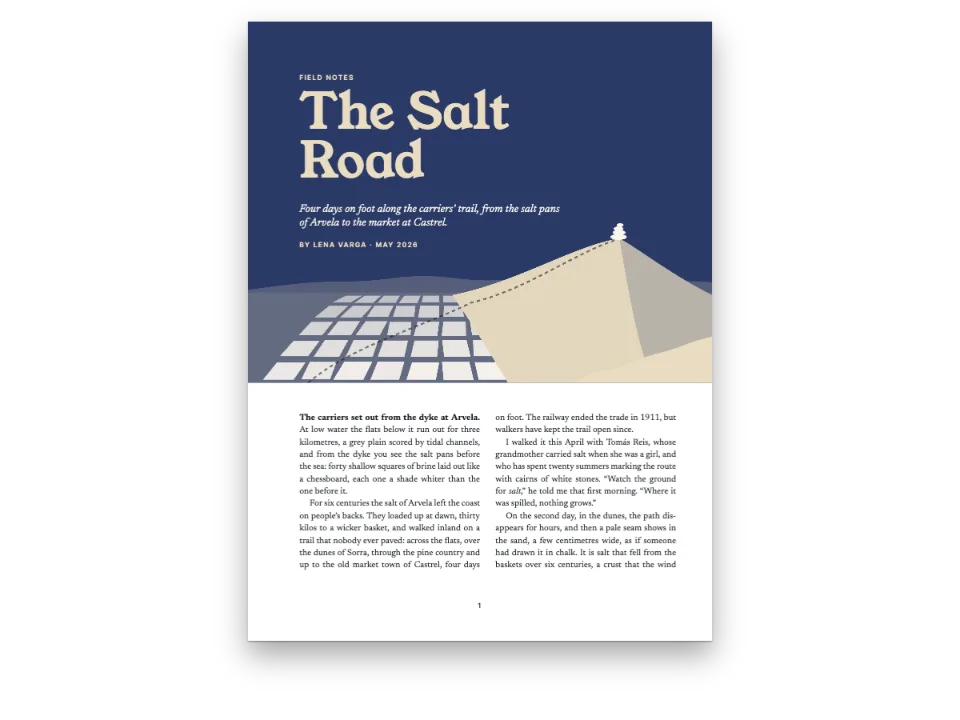
The opener is a function, so the field guide gets the same design with its own picture and depth through a heading style, # Five Kinds of Ice {style="guide" kicker="Field guide" …}. The drawing bleeds 126 mm down the page instead of 160; the credit and the kicker are measured from depth - TOP and the other words hang from the kicker, so they all move up 34 mm and the guide’s text starts higher. The style’s palette maps lake to rust on those pages, so the kicker, and any crosshead or box linked to lake, turns rust without a colour argument to opener(); chips do not follow the palette, which is why the end mark is ink.
The whole recipe
// ═══ Postext Cookbook · Nº 004 · Magazine feature: photo opener to end mark ═══════ // https://postext.dev/en/cookbook/magazine-feature-opener // Code: MIT · Text: original (CC BY 4.0) · Photos: Ales Krivec, Hannah Donze (CC0) // Fonts: Literata, Instrument Serif, Instrument Sans (SIL OFL 1.1) · Needs postext ≥ 1.4.1 // A nature feature from a winter issue. The level-1 heading carries its kicker, standfirst, // byline and photo credit as attributes, and one opener design lays them out under a bleed // photograph; the story runs on with a pull quote, a fact box, a photo band, a numbers panel // and an end mark, and the next item reuses the opener with a drawing in place of the photo. import { buildDocument, renderPageToCanvas, clearMeasurementCache, registerResourceImage, } from 'https://esm.sh/postext'; const LANG = 'en'; // @lang: the language of the sample document ('en' | 'es') const RECIPE = 'magazine-feature-opener'; // ─── 1 · Design ───────────────────────────────────────────────────────────── // Every colour below is linked to this palette by id. const palette = { ink: '#15191c', // text: a blue-black lake: '#2d6a7d', // the accent: kickers, crossheads, the quote, the fact box's stripe ember: '#c8773d', // the panel's figures: 5.2:1 on ink (only 3.4:1 on paper) rust: '#9a5a2e', // the field guide's accent, swapped in for 'lake' by its heading style ice: '#dbe8ec', // the type on the dark panel and the drawing's sky rule: '#c7cdd1', // the drawing's far ridge and air bubbles muted: '#66707a', // running heads, credits, the colophon paper: '#ffffff', }; const col = (id) => ({ hex: palette[id], model: 'hex', paletteId: id }); const colorPalette = [ ...Object.entries(palette).map(([id, hex]) => ({ id, name: id, value: { hex, model: 'hex' } })), // The engine's defaults link to 'main-color': point it at the accent, so nothing prints blue. { id: 'main-color', name: 'lake (defaults)', value: { hex: palette.lake, model: 'hex' } }, ]; const TRIM = 225; // page width in mm, shared with the drawing const INNER = 16; // inner margin in mm const OUTER = 14; // outer margin in mm: folios and running heads align to it const LEAD = 13.4; // body leading in pt: the baseline grid // #region answer: a bleed photo, then the heading's kicker, headline, standfirst, byline and credit const TOP = 22; // top margin in mm: an opener's container starts here const sans = { fontFamily: 'Instrument Sans', fontWeight: 600, textTransform: 'uppercase' }; const HEAD = 118; // mm: the headline's measure; the standfirst takes the rest of the line // Empty padding paints nothing but counts: the story starts on the first grid line at least // 5 mm under the lower of the headline and the byline, however many lines each one runs to. const air = { padding: { bottom: mm(5) } }; const at = (id, edge, x, y, width) => ({ anchor: { to: id, edge }, offset: { x: mm(x), y: mm(y) }, ...(width && { size: { width: mm(width) } }) }); const opener = (resourceId, depth) => ({ // depth: how far down the page the picture bleeds enabled: true, // no minHeight: the story starts under the headline and byline (see air) slot: { elements: [ // the photo is an element, not a float: no float reaches the trim { kind: 'image', id: 'photo', resourceId, placement: { anchor: { to: 'bleed', edge: 'top-left' }, size: { width: 'fill', height: mm(depth) } } }, // The photo hangs from the page's top edge, the words from the container, TOP mm lower: // depth − TOP is the photo's foot, so the credit sits 2 mm under it and the kicker 9 mm. { kind: 'text', id: 'credit', content: '{attr.credit}', ...sans, fontWeight: 500, fontSize: pt(6.5), letterSpacing: pt(0.6), color: col('muted'), align: 'right', placement: at('container', 'top-right', 0, depth - TOP + 2) }, { kind: 'text', id: 'kicker', content: '{attr.kicker}', ...sans, fontSize: pt(8.5), letterSpacing: pt(1.7), color: col('lake'), align: 'left', placement: at('container', 'top-left', 0, depth - TOP + 9) }, { kind: 'text', id: 'headline', content: '{titleText}', fontFamily: 'Instrument Serif', fontSize: pt(58), color: col('ink'), align: 'left', overflow: 'wrap', box: air, lineHeight: 0.94, // a multiple of the size (gotcha: design-lineheight-multiple) placement: at('#kicker', 'below', 0, 2.5, HEAD) }, { kind: 'text', id: 'standfirst', content: '{attr.standfirst}', italic: true, fontFamily: 'Instrument Serif', fontSize: pt(13.5), lineHeight: 1.22, // a multiple color: col('ink'), align: 'left', overflow: 'wrap', // gotcha: overflow-ellipsis-default placement: at('#headline', 'right-of', 7, 3.2) }, // wraps at the container's edge { kind: 'text', id: 'byline', content: '{attr.byline}', ...sans, fontSize: pt(7.5), letterSpacing: pt(1.3), color: col('ink'), align: 'left', box: air, placement: at('#standfirst', 'below', 0, 3.5) }, ], }, }); // hook-up: headings.levels[0] = { level: 1, span: 'page', breakBefore, advancedDesign: // opener('lake', 160) }. {titleText} prints the heading's text, {attr.<key>} its <key>="…": // # The Lake That Keeps Time {kicker="…" standfirst="…" byline="…" credit="…"} // #endregion // #region heads: magazine and issue on the verso, the story on the recto, a lake square const FOLIO_PT = 8.5; // the folio's size in pt const LABEL_PT = 7.5; // the label's size in pt const SQUARE = 2.1; // mm: the lake square's side, the folio's cap height const label = { ...sans, fontSize: pt(LABEL_PT), letterSpacing: pt(1.3), color: col('muted') }; const folio = { fontFamily: 'Instrument Sans', fontWeight: 700, fontSize: pt(FOLIO_PT), color: col('ink') }; // A design text's baseline sits 0.8 down its line box, 1.2 × its size (the default lineHeight). const baseline = (size) => size * 1.2 * 0.8 * 25.4 / 72; // mm from its box's top, size in pt const HEAD_Y = 12; // mm from the top edge to the folio's box, inside the 22 mm top margin const LINE = HEAD_Y + baseline(FOLIO_PT); // the heads' one baseline, from the top edge const pin = (edge, x, y = HEAD_Y) => ({ anchor: { to: 'page', edge }, offset: { x: mm(x), y: mm(y) } }); // in the margin (gotcha: header-paints-over-text) const sides = [['even', 'left', 1], ['odd', 'right', -1]]; // 1: the outer edge is on the left const header = { elements: sides.flatMap(([parity, edge, s]) => [ { kind: 'text', id: `folio-${parity}`, content: '{pageNumber}', ...folio, placement: pin(`top-${edge}`, s * OUTER) }, { kind: 'box', id: `square-${parity}`, style: { backgroundColor: col('lake') }, placement: { ...pin(`top-${edge}`, s * (OUTER + 7.5), LINE - SQUARE), // on the line size: { width: mm(SQUARE), height: mm(SQUARE) } } }, // The smaller label's baseline sits higher in its box (0.34 mm at 7.5 and 8.5 pt), so its // box goes that much lower: folio, square and label share one baseline at any size. { kind: 'text', id: `head-${parity}`, ...label, content: s > 0 ? '{title} · {subtitle}' : '{chapterTitle}', placement: pin(`top-${edge}`, s * (OUTER + 11.5), LINE - baseline(LABEL_PT)) }, ].map((element) => ({ ...element, parity, pages: 'body' }))) }; // no running heads on openers const footer = { elements: sides.map(([parity, edge, s]) => ({ kind: 'text', parity, id: `drop-folio-${parity}`, ...folio, content: '{pageNumber}', pages: 'opener', align: edge, placement: pin(`bottom-${edge}`, s * OUTER, -11) })) }; // an opener's only folio, at the foot // #endregion // #region quote: a pull quote whose mark hangs in the margin, outside the text's edge // The glyph is centred in an icon square that the box keeps as a column, size + gap wide, // left of the text. A negative gap pulls the text back over the square's empty right side, // and a left padding of −(size + gap) moves that column out into the margin, so the text // starts on the column's edge and the mark hangs outside it. The frame stays on the column // (a background would stop short of the mark). « sits lower and runs wider than “, so the // Spanish mark is set smaller. const MARK = t({ en: { glyph: '“', size: 50, column: 34 }, // pt; the column is 12 mm es: { glyph: '«', size: 28, column: 22.5 } }); // The paddings are optical: once the next paragraph snaps to the grid, the quote has // the same air above and below it, in both languages. const quote = { id: 'pullquote', backgroundEnabled: false, marginTop: pt(LEAD), marginBottom: pt(0), padding: { top: pt(8), right: pt(0), bottom: pt(7), left: pt(-MARK.column) }, // negative: the icon column starts out in the margin icon: { kind: 'glyph', glyph: MARK.glyph, fontFamily: 'Instrument Serif', size: pt(MARK.size), color: col('lake') }, titleStyle: { gap: pt(MARK.column - MARK.size) }, // negative too: size + gap = column body: { fontFamily: 'Instrument Serif', fontSize: pt(19), lineHeight: pt(1.5 * LEAD), textAlign: 'left', hyphenation: false, color: col('lake'), // display type: no hyphens italicColor: col('lake'), firstLineIndent: pt(0) } }; // #endregion // #region boxes: a fact box at a column head, a dark panel at the page foot, the end mark // Floated boxes keep one body line from the text, so they need no margins of their own. const glance = { id: 'glance', placement: 'top', // floats to the next column head: no hole backgroundEnabled: false, // one device, the stripe; the text keeps the column's edges stripe: { enabled: true, side: 'top', width: pt(2.5), color: col('lake') }, padding: { top: mm(2.5), right: pt(0), bottom: pt(0), left: pt(0) }, titleStyle: { ...sans, fontWeight: 700, fontSize: pt(7.5), letterSpacing: pt(1.5), color: col('lake'), gap: mm(2) }, body: { fontFamily: 'Instrument Sans', fontSize: pt(8.6), lineHeight: pt(12.2), textAlign: 'left', hyphenation: false, firstLineIndent: pt(0) } }; // ink from bodyText const numbers = { id: 'numbers', span: 'page', placement: 'bottom', // floats to a page foot background: col('ink'), columnGap: mm(8), padding: { top: mm(5), right: mm(6), bottom: mm(5.5), left: mm(6) }, titleStyle: { ...sans, fontWeight: 700, fontSize: pt(7.5), letterSpacing: pt(1.5), color: col('ice'), gap: mm(1) }, body: { fontFamily: 'Instrument Sans', fontSize: pt(9), lineHeight: pt(12.5), textAlign: 'left', hyphenation: false, color: col('ice'), firstLineIndent: pt(0) } }; // The panel's figures are level-4 headings (#### 31), a level the story never uses. const figures = { level: 4, fontSize: pt(40), lineHeight: pt(40), color: col('ember'), marginBottom: pt(4) }; // The end mark is a chip with no visible text: a U+2060 inside, because a chip of spaces // prints its markup (gotcha: empty-chip). Its lengths are in its own ems: paddingX makes // the width, and the height is its font size's band (0.8 ascent + 0.25 descent). It is ink, // not lake: the guide's palette would leave a lake chip teal on its rust page. const endMark = { id: 'end', background: col('ink'), borderWidth: pt(0), borderRadius: pt(0), fontSize: em(0.62), paddingX: em(0.525), paddingY: em(0), gap: em(0.8) }; // 1.05 em square // #endregion // #region guide: the next item reuses the opener with its own picture, depth and accent const ART = 126; // mm: the drawing bleeds less far down the page than the photograph // On its pages, 'lake' turns rust in the opener, the headings and the boxes, but not in chips. const guide = { id: 'guide', advancedDesign: opener('ice-art', ART), palette: { lake: palette.rust } }; // #endregion const config = () => ({ // a factory: the engine caches resolved configs per object locale: t({ en: 'en-us', es: 'es' }), // exact codes (gotcha: hyphenation-locales) resourceTypes: [photoType], // one unnumbered type for every picture (see the resources) colorPalette, page: { width: mm(TRIM), height: mm(297), margins: { top: mm(TOP), bottom: mm(20), left: mm(INNER), right: mm(OUTER), mirror: true }, // a magazine trim; left is the inner side dpi: 150 }, // the layout's pixels per inch, which bitmaps are measured in (see 'thaw') layout: { layoutType: 'double', gutterWidth: mm(6) }, bodyText: { fontFamily: 'Literata', fontSize: pt(9.6), lineHeight: pt(LEAD), color: col('ink'), boldColor: col('ink'), italicColor: col('ink'), referenceColor: col('ink'), textAlign: 'justify', firstLineIndent: mm(3.5), indentAfterHeading: false, minWordSpacing: 0.65, // a space never shrinks below 65 % (the default allows 60 %) runtMinCharacters: 40 }, // 40 spaces' width, about 20 letters: no one-word last lines // Hyphenation, optimal line breaking and widow control are on by default. headings: { fontFamily: 'Instrument Serif', fontWeight: 400, color: col('ink'), // Under a top photo band on a closing page, this lever can drop the shorter column a line, // out of line with the other (gotcha: float-stretch-closing-page). The switch covers every // page, not only closing ones; the shipped copy does not trip it, edited copy might. balancing: { stretchAfterFloats: false }, levels: [ // Restated: any headings object drops the H1 break (gotcha: headings-drop-h1-break); // 'any' lets the next item open on the following page, recto or verso. { level: 1, span: 'page', breakBefore: { enabled: true, parity: 'any' }, marginBottom: pt(0), advancedDesign: opener('lake', 160) }, { level: 2, fontSize: pt(15), lineHeight: pt(LEAD), italic: true, color: col('lake'), marginTop: pt(LEAD), marginBottom: pt(0) }, // crossheads, one grid line above figures, ], }, headingStyles: [guide], calloutStyles: [quote, glance, numbers], chipStyles: [endMark], captionStyle: { fontFamily: 'Instrument Sans', fontSize: pt(7.6), gap: mm(2), // ink: bodyText's note: { fontSize: pt(6.5), color: col('muted'), gap: mm(0.6) } }, paragraphStyles: [{ id: 'colophon', fontFamily: 'Instrument Sans', fontSize: pt(6.6), lineHeight: pt(9.4), color: col('muted'), textAlign: 'left', firstLineIndent: pt(0), marginTop: pt(2 * LEAD) }], header, footer, }); // ─── 2 · Content ──────────────────────────────────────────────────────────── // #region resources: two photographs and a drawing, declared once, by their real pixels // The pictures are not numbered: their own type, with an empty caption prefix and template, // keeps a figure number off the pine wood's caption. const photoType = { id: 'photo', name: t({ en: 'Photograph', es: 'Fotografía' }), shortLabel: t({ en: 'photo', es: 'foto' }), captionPrefix: '', numberingTemplate: '', resetOn: 'never', counterFormat: 'decimal' }; const PX = 10; // the drawing's pixels per mm const resources = [ { id: 'lake', typeId: 'photo', kind: 'bitmap', createdAt: 0, updatedAt: 0, // never cited: // the opener fits it inside its box, so the JPEG is cropped to the box, 225 × 160 mm bitmap: { fileId: 'lake-2000.jpg', format: 'jpeg', width: 2000, height: 1422 }, altText: t({ en: 'A still mountain lake mirroring clouds between autumn slopes.', es: 'Un lago de montaña en calma que refleja las nubes entre laderas otoñales.' }) }, { id: 'thaw', typeId: 'photo', kind: 'bitmap', createdAt: 0, updatedAt: 0, // Pixels at the page's 150 dpi (gotcha: bitmap-print-size): 2000 px make 339 mm, so the // band shrinks to the 195 mm measure. At 300 dpi it would print 169 mm wide. bitmap: { fileId: 'thaw-2000.jpg', format: 'jpeg', width: 2000, height: 944 }, // A top float opens the page after its ::resource line (gotcha: top-float-next-page): // the line sits on the verso, so the band heads the recto. placement: { position: 'top', span: 'page' }, caption: t({ en: 'Early March in the pine wood above the shore: the snow goes first where ' + 'the sun reaches the ground, weeks before the ice lets go of the lake.', es: 'Principios de marzo en el pinar sobre la orilla: la nieve se retira primero donde el ' + 'sol llega al suelo, semanas antes de que el hielo suelte el lago.' }), note: t({ en: 'Photograph: Hannah Donze, CC0, via Wikimedia Commons', es: 'Fotografía: Hannah Donze, CC0, vía Wikimedia Commons' }), altText: t({ en: 'A walker on a snowy path between tall pines.', es: 'Un caminante en un sendero nevado entre pinos altos.' }) }, { id: 'ice-art', typeId: 'photo', kind: 'svg', createdAt: 0, updatedAt: 0, // drawn below svg: { fileId: 'ice-art.svg', width: TRIM * PX, height: ART * PX }, altText: t({ en: 'A lake in section: snow, white ice, black ice and water under a low sun.', es: 'Un lago en sección: nieve, hielo blanco, hielo negro y agua bajo un sol bajo.' }) }, ]; // #endregion const markdown = String.raw`---Markdown sample · 107 lines · content.en.md
title: "Boreal" subtitle: "Winter 2026" --- # The Lake That Keeps Time {kicker="Climate · Field report" standfirst="For a hundred and fifteen winters, one family has written down the day their lake froze and the day it let go. Their notebooks are now one of the longest climate records in the mountains." byline="Words by Ingrid Solberg" credit="Late October, before the freeze · Photograph: Ales Krivec, CC0"} The notebook lives in a biscuit tin on the kitchen dresser, between the matches and the parish calendar. It is the fourth of its kind. The first three are in the regional archive now, wrapped in acid-free paper, but Hanna Brenner still prefers the tin. “The archive asked for this one as well,” she says, lifting the lid. “I told them we are still using it.” Her great-grandfather ran the ferry across the lake from 1906, and he began the record for a practical reason: a man who rows passengers over water needs to know when the water will carry a sledge instead. On the ninth of December 1911 he wrote, in pencil, *Frozen. All of it.* On the fourth of April he noted that the ice had gone out overnight, with a noise “like a door slammed somewhere in the mountains”. Every winter since, someone in the family has kept up the record, one line in pencil for every year. One hundred and fifteen lines in pencil do not look like much. Printed out, they fit on two sheets of paper. But the nearest weather station, in the next valley, opened only in 1931, and few lakes anywhere have an ice record as long as this one. The oldest, on Lake Suwa in Japan, was begun by Shinto priests in 1443 and notes the day a ridge of ice forms across the lake. ## A thermometer with a lid “A lake is a thermometer that you read once a year,” says Vera Lind, a limnologist who has spent six winters on the ice here. “The air changes from hour to hour. The lake averages all of that. When it freezes and when it thaws tells you what the whole season was like.” The reason lies in an odd habit of water. Most liquids grow denser as they cool. Fresh water does too, but only down to about 4 °C; below that it becomes lighter again, which is why a lake freezes from the top down; ice, lighter still, floats on it. In autumn, as the surface chills, the cold water sinks and warmer water rises to take its place. The lake turns over, again and again, for weeks. Only when the whole column has reached 4 °C can the surface cool further without sinking, and only then, on a still, clear night, can it skin over. :::callout{type="pullquote"} *A person stood on the same jetty and looked at the same water.* ::: That is why the freeze comes late and all at once. Hanna remembers standing on the jetty as a girl and watching the last open water close in the middle of the lake “like a pupil shrinking in the light”. By morning her father was walking out with an axe to measure the thickness. Ten centimetres will hold a person, the family rule went; twenty will hold the sledge; thirty, a horse. ## What the ice is made of The first ice to form is black ice, grown straight down from the water beneath it and so clear that you can see stones on the bottom through a hand’s width of it. It is the strongest ice a lake makes. Snow brings a second kind. A heavy fall presses the sheet down until water seeps up through the cracks and soaks the snow into slush, which freezes into white ice, cloudy with trapped air and barely half as strong. Lind drills through both every week of the winter. The cores come up banded like a tree trunk, and she reads them the same way: a thick black layer means a cold, dry December; a stack of white bands means storm after storm. Under the ice the lake goes on living. The water at the bottom stays close to 4 °C all winter. The trout slow down but keep feeding. Light still passes through clear ice, and algae grow in the green gloom beneath it, which surprised the first scientists who went looking. :::callout{type="glance" title="At a glance"} **Altitude** 1,540 m above sea level **Area** 3.2 km², deepest point 63 m **Record kept since** the winter of 1911–12 **Ice cover, 1911–1960** 118 days a year on average **Ice cover, 1991–2025** 87 days a year on average **Winters with no ice** 2007 and 2020 ::: ## Counting the days For the first fifty years of the record, the lake stayed frozen for an average of 118 days a winter. Since 1991 the average has been 87. The freeze now comes about a fortnight later than it did in the ferryman’s time, and the ice goes out more than two weeks earlier. The change has not been smooth. Some winters of the 1960s, and again the winter of 2010, were as long as any in the notebooks. But the open winters are new. In 2007 and again in 2020 the lake never froze across at all, and the family wrote a single word for the year: *open*. The winter of 1944 nearly went unrecorded. The ferryman’s son was away at the war, and the dates for that year are in another hand, small and upright, with a note in the margin: *kept by his mother*. She had written them on the back of a ration card and copied them in when he came home. Lind has checked them against the weather station in the next valley. They are, she says, as good as any in the notebooks. ::resource{id="thaw"} Lind is careful about what one lake can say. A single record is a local story: the valley has its own winds, and the lake its own depth and shape. But the notebooks agree with hundreds of other lakes across the northern hemisphere, from Finland to Japan, where the ice seasons have shortened by weeks over the past century. “I trust it because the method never changed,” she says. “A person stood on the same jetty and looked at the same water.” She has added instruments of her own. A chain of temperature loggers hangs from a buoy over the deepest part of the lake, reading every fifteen minutes from the surface to the floor, and a camera on the church tower photographs the ice at noon each day. But when she sets them beside the notebooks, the dates hold up: the family has never been more than a day or two from what the loggers record. ## Ice-out The ice rarely leaves quietly. Through March the sun works on it from above and warmer streams from below, and the black ice rots into long vertical crystals, candle ice, that chime against each other when the wind moves them. Then a warm rain or a south wind breaks the sheet, and within a day or two the surface is open. The old fishermen claimed they could hear it happen from the village. The date matters to more than the ferry. The spring bloom of algae, which feeds everything else in the lake, starts when the ice breaks up and sunlight pours into the water. Perch spawn in the shallows and midges hatch on a timetable that the ice sets. When ice-out moves earlier, those timetables can drift apart, and a young fish may hatch into water whose food has already come and gone. :::callout{type="numbers" title="In numbers"} :::columns{count=3 breaks="3,5"} #### 31 fewer days of ice each winter than in the first fifty years of the notebooks #### 115 winters recorded, in pencil, by five generations of one family #### 4 °C the temperature of the lake floor all winter, where water is densest ::: ::: There are human timetables too. The winter road across the lake, which once carried hay, timber and the doctor’s sleigh, has not been opened officially since 2014. The skating club moved its races to an artificial rink in the town. The ice fishermen still go out, but later in the season, and they carry ropes. Hanna’s grandfather remembered the other extreme. In the hard winter of 1963 the ice grew to sixty centimetres, and a baker from the next village drove his van straight across the lake to save the long road round. The entry for that year has a small drawing of the van in the margin, the only picture in all four notebooks. Hanna is not sentimental about any of this. She teaches mathematics at the valley school, and she has turned the notebooks into a lesson: every class plots the two dates of each winter and draws a line through the dots. “The children always find the trend by themselves,” she says. “I hand out graph paper and a ruler and say nothing about climate.” Some of her pupils have gone further. Two years ago a class set the notebooks beside the school’s own record of when the cherry trees in the yard came into flower, and found that both dates had moved by about the same number of days. Lind now shows their chart at conferences, with the children’s names in the corner. The record will go on. Hanna’s son, who is fourteen, has taken over the November walks to the jetty to watch for the morning when the last dark patch of water disappears. He keeps a spreadsheet now, and every night a copy goes to a server at the university, where Lind stores her logger readings. But on the day the lake freezes he does what his great-great-grandfather did in 1911 and writes the date in pencil, in the notebook in the tin. Last winter the lake froze on the twenty-first of December and opened again on the eighteenth of March: eighty-seven days, almost exactly the modern average. Hanna wrote *ordinary* beside the dates, then crossed the word out. “Ordinary for now,” she says. :chip[]{style="end"} # Five Kinds of Ice {style="guide" kicker="Field guide" standfirst="How to read a frozen lake before you trust it with your weight, from the clear black sheet of early winter to the rotten candles of March." byline="Text by the editors" credit="Illustration generated in code for Boreal"} **Black ice.** The first ice of the season grows straight down from calm water in long crystals that let the light through. It looks dark because you are seeing the lake beneath it. Ten centimetres of new black ice will bear a walker, and on a calm morning you can watch fish pass under your boots. **White ice.** When snow loads the sheet, water seeps up through the cracks, soaks the snow and freezes into a milky layer full of air. It is roughly half as strong as black ice, so count it at half its thickness when you judge a crossing. On a sunny afternoon it softens further. **Slush.** A heavy snowfall can push the ice below the waterline and leave a layer of wet snow on top, kept liquid under an insulating crust. It is heavy going on foot and treacherous on skis, and it is where most white ice begins. Grey patches on fresh snow are its warning sign. **Shore ice.** The ice along the edge is the first to form and the first to go. Springs, reeds and the warmth of the ground weaken it, and by March a strip of open water, the moat, often separates the sheet from the land. You can walk out on good ice and find that you cannot walk back. **Candle ice.** In spring the sun rots the black ice along the boundaries of its crystals. The sheet can still look solid while it has become a bundle of loose vertical rods that give way under a boot. When the surface turns grey and granular, and the rods chime in the wind, stay on the shore. Never judge ice by its colour alone. Measure it every few steps, carry a pair of ice picks round your neck, and ask the people who live by the shore. :chip[]{style="end"} :::paragraphs{style="colophon"} Set in Literata, Instrument Serif and Instrument Sans (SIL Open Font License) · Text: Postext Cookbook, CC BY 4.0 · Photographs: Ales Krivec and Hannah Donze, CC0, via Wikimedia Commons · The lake, the family, the scientists and the writer are fictional. :::`; // content.<lang>.md, inlined by the Cookbook // #region art: the guide's picture, a lake in section, drawn in code with a seeded PRNG function mulberry32(seed) { return () => { seed = (seed + 0x6d2b79f5) | 0; let r = Math.imul(seed ^ (seed >>> 15), 1 | seed); r = (r + Math.imul(r ^ (r >>> 7), 61 | r)) ^ r; return ((r ^ (r >>> 14)) >>> 0) / 4294967296; }; } function iceArt() { // in mm, TRIM × ART: sky, shore, snow, white ice, black ice, water const rand = mulberry32(14); const f = (id, a = 1) => `fill="${palette[id]}"${a < 1 ? ` fill-opacity="${a}"` : ''}`; const rect = (x, y, w, h, paint) => `<rect x="${x}" y="${y}" width="${w}" height="${h}" ${paint}/>`; const ridge = (base, amp, step, paint) => { // a mountain line, closed down to the shore let d = `M0 ${base}`; for (let x = 0; x <= TRIM; x += step) d += `L${x} ${(base - rand() * amp).toFixed(1)}`; return `<path d="${d}L${TRIM} 60L0 60Z" ${paint}/>`; }; const pines = Array.from({ length: 46 }, (_, i) => { // the far shore, a row of spruces const x = i * 5 + rand() * 3; const h = 4 + rand() * 5; return `<path d="M${x.toFixed(1)} ${60 - h}l${h * 0.28} ${h}h${-h * 0.56}Z" ` + `${f('ink', 0.85)}/>`; }).join(''); const bubbles = Array.from({ length: 70 }, () => { // air trapped in the white ice const r = 0.25 + rand() * 0.6; const [cx, cy] = [(rand() * TRIM).toFixed(1), (72 + rand() * 6).toFixed(1)]; return `<circle cx="${cx}" cy="${cy}" r="${r}" ${f('paper')} stroke="${palette.rule}" ` + 'stroke-width="0.15"/>'; }).join(''); // Black ice: a solid sheet on the winter side (left) that rots into candles towards spring, // ten rods evenly spaced, each shorter and thinner than the last. const candles = Array.from({ length: 10 }, (_, i) => rect(150 + i * 7.5, 79, (2.6 - i * 0.1).toFixed(2), (12.5 - i * 0.55 - rand() * 1.5).toFixed(1), f('ink'))).join(''); const clouds = [[18, 15, 52], [98, 8, 38], [146, 21, 30]].map(([x, y, w]) => [[x, y, w], [x + w * 0.22, y - 2.4, w * 0.42]].map(([cx, cy, cw]) => `<rect x="${cx}" y="${cy}" ` + `width="${cw}" height="4.4" rx="2.2" ${f('paper', 0.7)}/>`).join('')).join(''); const fish = (x, y, s) => `<path d="M${x} ${y}c${3 * s} ${-2 * s} ${7 * s} ${-2 * s} ${9 * s} 0` + `c${-2 * s} ${2 * s} ${-6 * s} ${2 * s} ${-9 * s} 0Z` // the body, then the tail + `m0 0l${-2.5 * s} ${-1.6 * s}v${3.2 * s}Z" ${f('ink', 0.55)}/>`; return `<svg xmlns="http://www.w3.org/2000/svg" width="${TRIM * PX}" height="${ART * PX}" ` + `viewBox="0 0 ${TRIM} ${ART}">` + rect(0, 0, TRIM, ART, f('ice')) + clouds // winter sky + `<g transform="translate(0 ${ART - 112})">` // the lake keeps to the foot of the picture + `<circle cx="188" cy="24" r="9" ${f('ember', 0.9)}/>` // a low March sun + ridge(38, 16, 9, f('rule')) + ridge(48, 12, 6, f('muted', 0.55)) + pines + rect(0, 60, TRIM, 11, f('paper')) + rect(0, 60, TRIM, 11, f('ice', 0.3)) // snow + rect(0, 71, TRIM, 8, f('ice', 0.75)) + bubbles // white ice, cloudy with air + rect(0, 79, TRIM, 33, f('lake')) // the water, 4 °C at the floor + rect(0, 79, 146, 13, f('ink')) + candles + fish(60, 101, 1) + fish(128, 106, 0.8) + '</g></svg>'; } // #endregion // ─── 3 · Fonts ────────────────────────────────────────────────────────────── const FONTS = { // text, display and label faces, loaded before the build (gotcha: fonts-first) Literata: ['400', '400i', '700'], 'Instrument Serif': ['400', '400i'], 'Instrument Sans': ['400', '500', '600', '700'] }; // ─── 4 · Build & show ─────────────────────────────────────────────────────── await loadFonts(FONTS, markdown); await Promise.all([loadImage('lake-2000.jpg', asset('lake-2000.jpg')), loadImage('thaw-2000.jpg', asset('thaw-2000.jpg')), loadSvg('ice-art.svg', iceArt())]); const continuation = { pageNumbering: { startAt: 57 } }; // pages 57–60 of the issue const doc = await buildWithFonts( () => buildDocument({ markdown, resources, continuation }, config()), markdown); showPages(doc, { title: t({ en: 'Magazine feature: photo opener to end mark', es: 'Reportaje de revista: de la foto de apertura al signo final' }) });Kit · core, fonts, viewer, images: the same in every recipe · 270 lines
// ─── Kit ── helpers shared by every Cookbook recipe · postext.dev/cookbook ───── // ─── Kit · core v1 ── the same in every recipe · postext.dev/cookbook ───────── function mm(value) { return { value, unit: 'mm' }; } function pt(value) { return { value, unit: 'pt' }; } function em(value) { return { value, unit: 'em' }; } /** The sample language's string: t({ en: 'Figure', es: 'Figura' }). */ function t(strings) { return strings[LANG] ?? Object.values(strings)[0]; } /** A file in this recipe's assets folder, served from the Postext repo by jsDelivr. */ function asset(file) { return `https://cdn.jsdelivr.net/gh/drnachio/postext@main/cookbook/${RECIPE}/assets/${file}`; } // ─── Kit · fonts v1 ── the same in every recipe · postext.dev/cookbook ──────── // Postext measures text with the faces the browser has loaded, and caches the // widths, so every face must be ready before the first build. Faces come from // Fontsource: the same static files the PDF embeds, so screen and PDF agree. /** faces = { 'Family Name': ['400', '400i', '700'] }. `text` is the sample: * letters beyond Latin-1 (č, ł, ő…) also load the latin-ext files. With * `optional`, a face Fontsource does not ship is skipped instead of failing. * Resolves to the number of faces added. */ async function loadFonts(faces, text = '', { optional = false } = {}) { kitStatus('Loading fonts…'); const ranges = { latin: 'U+0000-00FF,U+0131,U+0152-0153,U+02BB-02BC,U+02C6,U+02DA,U+02DC,U+0304,U+0308,U+0329,' + 'U+2000-206F,U+20AC,U+2122,U+2191,U+2193,U+2212,U+2215,U+FEFF,U+FFFD', 'latin-ext': 'U+0100-02BA,U+02BD-02C5,U+02C7-02CC,U+02CE-02D7,U+02DD-02FF,U+0304,U+0308,U+0329,' + 'U+1D00-1DBF,U+1E00-1E9F,U+1EF2-1EFF,U+2020,U+20A0-20AB,U+20AD-20C0,U+2113,U+2C60-2C7F,U+A720-A7FF', }; const subsets = /[Ā-˿Ḁ-ỿ]/.test(text) ? ['latin', 'latin-ext'] : ['latin']; const jobs = []; let added = 0; for (const [family, specs] of Object.entries(faces)) { const id = fontsourceId(family); const meta = optional ? await fontsourceMeta(family) : null; for (const spec of new Set(specs)) { const weight = parseInt(spec, 10); const style = spec.endsWith('i') ? 'italic' : 'normal'; if (hasFace(family, weight, style)) continue; if (optional && !(meta?.weights.includes(weight) && meta.styles.includes(style))) continue; for (const subset of subsets) { const url = `https://cdn.jsdelivr.net/npm/@fontsource/${id}@5/files/${id}-${subset}-${weight}-${style}.woff2`; const face = new FontFace(family, `url(${url}) format('woff2')`, { weight: String(weight), style, unicodeRange: ranges[subset] }); jobs.push(face.load().then((ready) => { document.fonts.add(ready); added++; }, () => { if (subset === 'latin' && !optional) throw new Error(`Fontsource has no ${family} ${weight} ${style}`); })); } } } await Promise.all(jobs).catch((error) => { kitFail(error); throw error; }); return added; } /** Runs `build` (a buildDocument or buildBundle call) and checks the faces * the pages use. A regular face missing from FONTS is loaded with a warning; * bold and italic variants are loaded when the family ships them. Then the * measurement caches are cleared and the build runs again. */ async function buildWithFonts(build, text = '') { const tried = new Set(); for (let round = 0; round < 3; round++) { kitStatus('Laying out…'); await new Promise(requestAnimationFrame); // let the status paint first const result = await Promise.resolve().then(build).catch((error) => { kitFail(error); throw error; }); const wanted = { base: {}, variants: {} }; for (const { font, base } of [result].flat().flatMap(fontStringsOf)) { const { family, weight, style } = parseFont(font); const key = `${family}|${weight}|${style}`; if (tried.has(key) || hasFace(family, weight, style)) continue; tried.add(key); (wanted[base ? 'base' : 'variants'][family] ??= []).push(`${weight}${style === 'italic' ? 'i' : ''}`); } if (Object.keys(wanted.base).length) { console.warn(`[cookbook] FONTS does not list ${JSON.stringify(wanted.base)}: loading them.`); } const added = await loadFonts(wanted.base, text) + await loadFonts(wanted.variants, text, { optional: true }); if (added === 0) return result; clearMeasurementCache(); } throw new Error('The fonts did not settle after three builds.'); } /** Every font string of the layout. `base` marks a block's own face; its * bold, italic and bold-italic variants are listed whether or not used. */ function fontStringsOf(doc) { const found = new Map(); const walk = (node) => { if (!node || typeof node !== 'object') return; if (Array.isArray(node)) { node.forEach(walk); return; } for (const [key, value] of Object.entries(node)) { if (typeof value === 'string' && /fontString$/i.test(key)) { found.set(value, found.get(value) || key === 'fontString'); } else if (value && typeof value === 'object') walk(value); } }; walk(doc.pages); walk(doc.blocks); return [...found].map(([font, base]) => ({ font, base })); } /** '700 37.5px Open Sans' / 'italic 400 13px "Source Serif 4"' → { family, weight, style }. * A string with no weight ('95.8px Young Serif', from a design text) is 400. */ function parseFont(font) { const m = /^(?:(italic|oblique)\s+)?(?:small-caps\s+)?(?:(\d+|bold|normal)\s+)?[\d.]+px\s+(.+)$/.exec(font.trim()); if (!m) throw new Error(`Unexpected font string: ${font}`); const weight = m[2] === 'bold' ? 700 : !m[2] || m[2] === 'normal' ? 400 : Number(m[2]); return { family: m[3].replace(/^["']|["']$/g, ''), weight, style: m[1] ? 'italic' : 'normal' }; } /** True when a loaded FontFace covers exactly this family, weight and style * (document.fonts.check() is also true for families nobody declared). */ function hasFace(family, weight, style) { for (const face of document.fonts) { if (face.status !== 'loaded' || face.style !== style) continue; if (face.family.replace(/^["']|["']$/g, '') !== family) continue; const [low, high = low] = face.weight.split(' ').map(Number); if (weight >= low && weight <= high) return true; } return false; } /** Fontsource's id for a family: 'Source Serif 4' → 'source-serif-4'. */ function fontsourceId(family) { return family.toLowerCase().replace(/\s+/g, '-'); } /** The weights and styles a family ships ({ weights: [400, 700], styles: ['normal', 'italic'] }), or null. */ function fontsourceMeta(family) { fontsourceMeta.cache ??= new Map(); const id = fontsourceId(family); if (!fontsourceMeta.cache.has(id)) { fontsourceMeta.cache.set(id, fetch(`https://api.fontsource.org/v1/fonts/${id}`) .then((res) => (res.ok ? res.json() : null), () => null)); } return fontsourceMeta.cache.get(id); } // ─── Kit · viewer v1 ── the same in every recipe · postext.dev/cookbook ─────── /** Shows the pages as facing spreads on a dark desk: the first page is a * recto on its own, then verso | recto pairs, as in a bound book. Pages * are painted when they scroll near the screen. */ function showPages(docs, { title, width = 460 } = {}) { const root = viewer(title); const pages = [docs].flat().flatMap((doc) => doc.pages.map((page) => ({ doc, page, n: (doc.pageIndexOffset ?? 0) + page.index }))); const spreads = []; let verso = null; for (const p of pages) { if (p.n % 2 === 1) { if (verso) spreads.push([verso, null]); verso = p; } else { spreads.push([verso, p]); verso = null; } } if (verso) spreads.push([verso, null]); const density = Math.min(window.devicePixelRatio || 1, 2); showPages.painter?.disconnect(); const painter = new IntersectionObserver((entries) => { for (const { isIntersecting, target } of entries) { if (!isIntersecting) continue; painter.unobserve(target); const { doc, page } = target.postext; renderPageToCanvas(page, doc, target, { scale: (width * density) / page.width }); } }, { rootMargin: '800px' }); showPages.painter = painter; root.replaceChildren(...spreads.map((pair) => { const spread = document.createElement('div'); spread.className = 'pt-spread'; for (const p of pair) { const figure = document.createElement('figure'); if (p) { const label = p.page.pageLabel || String(p.n + 1); const canvas = document.createElement('canvas'); canvas.postext = p; canvas.style.aspectRatio = `${p.page.width} / ${p.page.height}`; canvas.setAttribute('role', 'img'); canvas.setAttribute('aria-label', `Page ${label}`); const folio = document.createElement('figcaption'); folio.textContent = label; figure.append(canvas, folio); painter.observe(canvas); } else figure.className = 'pt-blank'; spread.append(figure); } return spread; })); kitStatus(`${pages.length} ${pages.length === 1 ? 'page' : 'pages'}`); document.documentElement.dataset.postext = 'ready'; return pages.length; } /** The desk, the bar and the error reporting, created once. */ function viewer(title) { if (!document.getElementById('pt-kit')) { document.head.insertAdjacentHTML('beforeend', `<style id="pt-kit"> :root { color-scheme: dark; } body { margin: 0; background: #0e1014; color: #b9bcc4; font: 13px/1.45 system-ui, sans-serif; } #pt-bar { position: sticky; top: 0; z-index: 1; display: flex; flex-wrap: wrap; align-items: center; gap: 6px 16px; padding: 10px 16px; background: rgb(14 16 20 / .92); backdrop-filter: blur(6px); border-bottom: 1px solid #23262d; } #pt-bar strong { color: #f4f1ea; font-weight: 600; } #pt-actions { display: flex; gap: 12px; margin-left: auto; } #pt-actions a, #pt-actions button { color: #d8a21a; font: inherit; background: none; border: 0; padding: 0; cursor: pointer; } #pages { display: grid; justify-items: center; gap: 48px; padding: 32px 16px 72px; } .pt-spread { display: flex; } .pt-spread figure { margin: 0; width: min(460px, 44vw); } .pt-spread canvas { display: block; width: 100%; background: #fff; box-shadow: 0 1px 2px rgb(0 0 0 / .5), 0 22px 44px -16px rgb(0 0 0 / .8); } .pt-spread figure:first-child canvas { box-shadow: inset -14px 0 14px -14px rgb(0 0 0 / .18), 0 1px 2px rgb(0 0 0 / .5), 0 22px 44px -16px rgb(0 0 0 / .8); } .pt-spread figcaption { margin-top: 10px; text-align: center; font: 600 10px/1 system-ui, sans-serif; letter-spacing: .18em; text-transform: uppercase; color: #6c7079; } .pt-blank { visibility: hidden; } @media (max-width: 760px) { .pt-spread { flex-direction: column; gap: 32px; } .pt-spread figure { width: min(460px, 92vw); } .pt-blank { display: none; } } </style>`); document.body.insertAdjacentHTML('afterbegin', '<header id="pt-bar"><strong id="pt-title"></strong><span id="pt-status" role="status"></span><span id="pt-actions"></span></header>'); document.getElementById('pt-title').textContent = document.title || 'Postext'; addEventListener('error', (event) => kitFail(event.error ?? event.message)); addEventListener('unhandledrejection', (event) => kitFail(event.reason)); } if (title) document.getElementById('pt-title').textContent = title; return document.getElementById('pages') ?? document.body.appendChild(Object.assign(document.createElement('main'), { id: 'pages' })); } function kitStatus(text) { viewer(); document.getElementById('pt-status').textContent = text; } function kitFail(error) { document.documentElement.dataset.postext = 'error'; kitStatus(`Error: ${error?.message ?? error}`); } // ─── Kit · images v1 ── recipes with pictures · postext.dev/cookbook ────────── /** Registers a photo or PNG for the canvas and keeps its bytes for the PDF. * fetch → ImageBitmap never taints the canvas (a plain cross-origin <img> would). */ async function loadImage(fileId, url) { const res = await fetch(url); if (!res.ok) throw new Error(`Image not found (${res.status}): ${url}`); const bytes = new Uint8Array(await res.arrayBuffer()); registerResourceImage(fileId, await createImageBitmap(new Blob([bytes]))); (loadImage.bytes ??= new Map()).set(fileId, bytes); } /** Registers SVG markup (drawn in code, or fetched) as a vector image. */ async function loadSvg(fileId, svg) { const img = new Image(); img.src = `data:image/svg+xml;charset=utf-8,${encodeURIComponent(svg)}`; await img.decode(); registerResourceImage(fileId, img); (loadImage.bytes ??= new Map()).set(fileId, new TextEncoder().encode(svg)); } /** renderToPdf({ resourceBytes: imageBytes }) */ function imageBytes(fileId) { return loadImage.bytes?.get(fileId); } /** renderToHtml({ resourceImageUrl: imageUrl }) */ function imageUrl(fileId) { const bytes = imageBytes(fileId); if (!bytes) return undefined; imageUrl.urls ??= new Map(); if (!imageUrl.urls.has(fileId)) { const type = /\.svg$/i.test(fileId) ? 'image/svg+xml' : /\.png$/i.test(fileId) ? 'image/png' : 'image/jpeg'; imageUrl.urls.set(fileId, URL.createObjectURL(new Blob([bytes], { type }))); } return imageUrl.urls.get(fileId); } // ─── /Kit ───────────────────────────────────────────────────────────────────────
The composed script.js runs as it is: paste it into any page’s module script, or open the recipe on CodePen. Recipe folder on GitHub ↗
Variations
#Open every item on a recto
With 'odd', the field guide moves to page 61, and page 60 stays blank.
- { level: 1, span: 'page', breakBefore: { enabled: true, parity: 'any' },
+ { level: 1, span: 'page', breakBefore: { enabled: true, parity: 'odd' },#Put the title on a band of colour
For a textbook chapter, where a colour band and a big number replace the photograph, see Chapter opener on a full-bleed band.
Pitfalls
Pitfall
Attribute values: no { or }; single-quote a value with "
An attribute value ends at the closing brace, so it cannot hold { or }. A value that contains a double quote goes in single quotes; a dollar sign is fine. Heading attributes →
Pitfall
Bitmaps are laid out in px at the document dpi: declare print size
A bitmap resource is sized from the width and height it declares, in pixels at the document's dpi, not from the file. Declare the print-size pixels (about 300 dpi at the printed width) so the figure lands at the right size and stays sharp. Figures and tables as resources →
Pitfall
A 'top' float never lands on its citing page
A float never goes above its own reference, so a page-wide 'top' float cited on page N opens page N+1. Cite it earlier, or use position 'auto' or 'bottom', which can take the foot of the citing page. Figure placement →
Pitfall
A whitespace-only chip prints its markup
A chip whose text is only spaces, no-break spaces included, prints :chip[ ] literally. For a blank answer chip put a word joiner (U+2060) inside it. Inline chips →
Pitfall
Load every face before layout
Layout measures text with the faces the browser has loaded and caches the widths, so a face that arrives after the first build leaves wrong line breaks and a PDF that no longer matches the screen. Load every weight and style first, and call clearMeasurementCache() before rebuilding when one arrives late. Fonts before layout →
Pitfall
Header and footer elements paint over text
Header and footer elements are painted over the page and the text area does not make room for them. Keep them within the margins, which are what reserve their space. Running heads and folios →
Pitfall
Design text overflow defaults to 'ellipsis-end'
A design text element that does not fit its width ends in an ellipsis by default. Set overflow: 'wrap' for titles that should break onto more lines. Text, rules and boxes in page designs →
Pitfall
Any headings object switches off the H1 page break
By default an H1 breaks to a recto (always-odd), but passing any headings object resets that default, so chapters run on and span: 'page' does nothing. Restate headings.levels[0].breakBefore: { enabled: true, parity } in every config. Chapters that open on a recto →
Pitfall
A top float can push the last column down on a closing page
In postext 1.4.1, when a chapter or story ends on a page that opens with a page-wide top float and its lines split unevenly between the columns, stretchAfterFloats adds a blank line under the float in the shorter column instead of letting it end short, so the two columns no longer start on the same line. Set headings.balancing.stretchAfterFloats to false, or fit the copy to an even number of lines. Column balancing →
Pitfall
Only 8 locales hyphenate, by exact code
Hyphenation ships for en-us, es, fr, de, it, pt, ca and nl, matched exactly: 'es-ES' or any other language silently falls back to American English. Hyphenation and document language →
Pitfall
A design text's lineHeight is a multiple, never a dimension
In a design slot, a text element's lineHeight multiplies its font size (lineHeight: 1.05). In postext 1.4.1 a dimension such as pt(15) is not rejected: the opener's height measures as NaN, the room it reserves, minHeight included, is dropped without a warning and the text runs under the title. Text, rules and boxes in page designs →
Pitfall
:::columns works only inside a box and never splits
:::columns is ignored outside a callout, and a box that splits never cuts inside a columns group. A breaks attribute counts child blocks, with a nested box as one. Columns inside a box →
Sandbox check · bitmapTooSmall
Low-resolution image
Why. A bitmap is drawn more than 1.5 times wider than its pixels, so it will look blurry in print.
Fix. Supply about 300 dpi at the printed size, and declare the bitmap's real width and height. Docs →
- An image element fits the picture inside its box and never crops it. Crop the JPEG to the proportions of the box, 225 × 160 mm here, or the photograph shrinks and leaves white strips at the edges of the page.
- The hanging mark needs a margin. If an edit moves the pull quote into a right-hand column, the mark fills the 6 mm gutter and touches the text of the left-hand column: move the quote a paragraph earlier or later.
- The story is fitted to end on page 59, above the numbers panel. A few more lines send its tail to a page of its own, so after an edit, fit the copy again in both languages.
runtMinCharacters: 40keeps one-word last lines out. When the line breaker cannot avoid a short last line, the engine sets the paragraph one line shorter, with tighter word spaces and, if that is not enough, up to 0.01 em less between letters. After an edit, look for a paragraph set that tight and trim or add a few words to it instead; the shipped copy needs the fix in neither language.
Credits
- Recipe
- Ignacio Ferro
- Text
- Original prose, CC BY 4.0
- Images
- Clouds mirrored in a mountain lake (the opener photograph) · Ales Krivec · CC0 1.0
- Walk in a thawing forest (the photo band) · Hannah Donze · CC0 1.0
- Fonts
- Literata (SIL OFL 1.1) · Instrument Serif (SIL OFL 1.1) · Instrument Sans (SIL OFL 1.1)
.jpg)
.jpg)