Lo que vas a componer
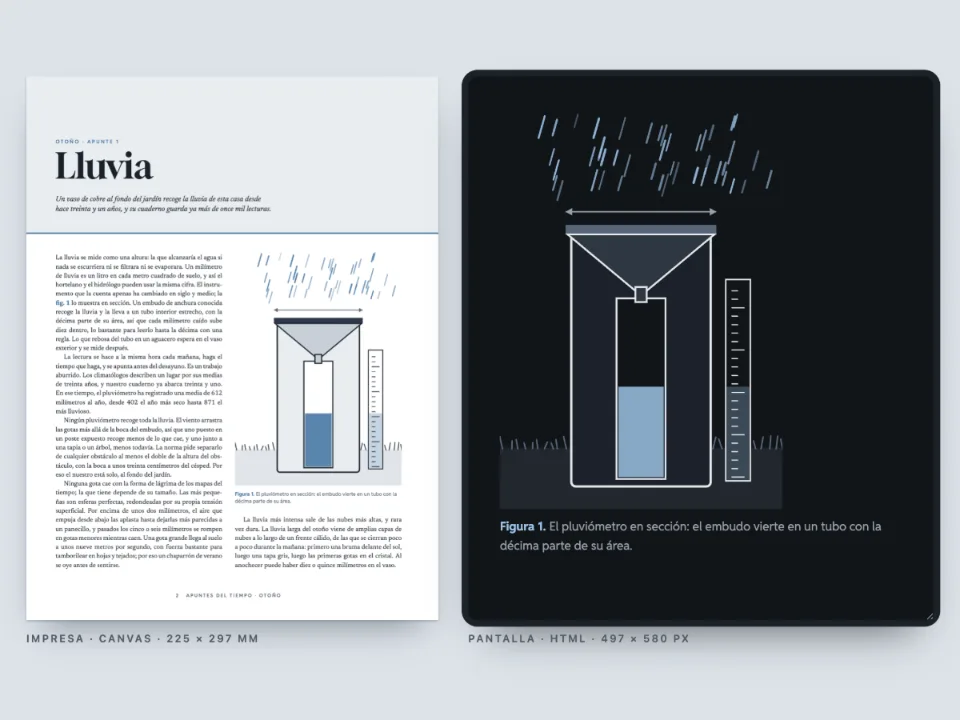
Las dos caras de un folleto DL de visita, de 99 × 210 mm, para un molino de mareas en una ría inventada. La portada es un solo dibujo: una rueda de molino en la línea del agua, con la mitad superior sobre la arena y la inferior pálida bajo el azul del agua, el título en DM Serif Display cursiva de 50 pt y una pestaña azul con el código de la edición, ES o EN. El dorso empieza con el molino en sección y sigue con el texto en DM Sans justificada, el horario en una tabla con la cabecera en azul, pies en Instrument Sans, un colofón y una franja azul con la fundación que lo edita. Cada edición se escribe en un archivo .postext, y cada página que ves se compone a partir de los bytes de ese archivo, con las fuentes y los dibujos que lleva dentro.
Esta receta responde a
- ¿Cómo abro un archivo .postext y lo pinto con sus propias fuentes, imágenes y configuración?
- ¿Cómo creo un paquete .postext desde el código para pasar un documento al Sandbox o a otro programa?
- ¿Cómo publico el mismo libro en dos idiomas desde un solo proyecto?
- ¿Cómo consigo las etiquetas «Figura» y «Tabla» en el idioma de mi documento?
La respuesta corta
// The writer: text, design, resources and every file they name, zipped. createBundle looks
// up each fileId (a drawing's svg.fileId, a face's variant fileId) in `files`.
const { bytes, warnings } = await createBundle({
  name: t({ en: 'The Tide Mill of Arenal', es: 'El molino de mareas de Arenal' }),
  locale: LANG, // one language per bundle: createBundle 1.4.1 writes no translations
  markdown, config: config(), resources,
  files: { ...drawings, ...faceFiles },
  thumbnail: { data: drawings['cover.svg'], mime: 'image/svg+xml' }, // the book's picture
});
if (warnings.length) console.warn(warnings); // what was left out, and why

// The reader has nothing but the bytes. Each fileId is now the file's path inside the zip:
// mill.svg is resources/mill.svg, and the faces sit under fonts/.
const bundle = await openBundle(bytes);
await loadBundleFonts(bundle); // one FontFace per face from the file, in place of loadFonts()
await registerBundleImages(bundle); // the drawings, for the canvas
const docs = buildBundle(bundle); // one VDTDocument per chapter: a leaflet has one
Ingredientes
- Funciones
- Paquetes .postextFigura y Tabla en tu idiomaTus propias fuentesSeparación silábica e idioma del documentoPies numeradosCitas que colocan las figurasFiguras justo aquíEspacio vertical explícitoLibros construidos capítulo a capítuloCubiertas, portadas y colofonesEstilos de títuloAtributos de títuloAperturas diseñadasTextos, filetes y cajas en los diseños de páginaImágenes en los diseños de páginaMetadatos del documentoEstilo de los piesEstilo de tablasExportación a PDFFuentes incrustadas en el PDF
- También usa
- Banda de capítulo a todo el anchoSaltos de página y de columnaCabeceras según el tipo de páginaEstilos de párrafoTipos de recurso propios
- Tipografía
- DM Sans, DM Serif Display, Instrument Sans (SIL OFL 1.1)
- Recursos
- Ninguno: todas las imágenes se dibujan en código
Elaboración
#1 · Escribe la edición y vuelve a leer solo los bytes
// The writer: text, design, resources and every file they name, zipped. createBundle looks
// up each fileId (a drawing's svg.fileId, a face's variant fileId) in `files`.
const { bytes, warnings } = await createBundle({
  name: t({ en: 'The Tide Mill of Arenal', es: 'El molino de mareas de Arenal' }),
  locale: LANG, // one language per bundle: createBundle 1.4.1 writes no translations
  markdown, config: config(), resources,
  files: { ...drawings, ...faceFiles },
  thumbnail: { data: drawings['cover.svg'], mime: 'image/svg+xml' }, // the book's picture
});
if (warnings.length) console.warn(warnings); // what was left out, and why

// The reader has nothing but the bytes. Each fileId is now the file's path inside the zip:
// mill.svg is resources/mill.svg, and the faces sit under fonts/.
const bundle = await openBundle(bytes);
await loadBundleFonts(bundle); // one FontFace per face from the file, in place of loadFonts()
await registerBundleImages(bundle); // the drawings, for the canvas
const docs = buildBundle(bundle); // one VDTDocument per chapter: a leaflet has one
createBundle comprime en un zip el capítulo, la configuración, los recursos y todos los archivos que nombran, y openBundle no recibe más que esos bytes. Las fuentes salen de loadBundleFonts, los dibujos de registerBundleImages y el diseño de bundle.config. Una fuente que no esté en files sale con la fuente de reserva del navegador, y un dibujo que falte se descarta con un aviso y su remisión se imprime como (?). Dentro del zip, cada fileId pasa a ser una ruta (mill.svg es ahora resources/mill.svg), y los recursos y el customFonts que devuelve openBundle ya usan los nombres nuevos (abrir un paquete).
#2 · Mete las fuentes en el archivo
const customFonts = Object.entries(FONTS).map(([name, specs]) => ({ name,
  variants: specs.map((spec) => ({ weight: parseInt(spec, 10), format: 'woff2',
    style: spec.endsWith('i') ? 'italic' : 'normal', fileId: `${fontsourceId(name)}-${spec}` })),
}));
// The bytes: Fontsource's static woff2 files, latin subset, which covers the Spanish text too.
const faceFiles = Object.fromEntries(await Promise.all(customFonts.flatMap(({ name, variants }) =>
  variants.map(async ({ weight, style, fileId }) => {
    const id = fontsourceId(name);
    const res = await fetch(`https://cdn.jsdelivr.net/npm/@fontsource/${id}@5/files/`
      + `${id}-latin-${weight}-${style}.woff2`);
    if (!res.ok) throw new Error(`Fontsource has no ${name} ${weight} ${style}`);
    return [fileId, new Uint8Array(await res.arrayBuffer())];
  }))));
Un paquete lleva una fuente cuando customFonts la nombra y files guarda sus bytes con el fileId de la variante; createBundle guarda la DM Sans 400 como fonts/dm-sans-400-normal.woff2. El pen descarga de Fontsource los siete woff2, pero no registra ninguno: loadBundleFonts añade a document.fonts las copias del paquete antes de que buildBundle mida una sola línea, y el PDF saca sus fuentes de esos mismos siete archivos.
#3 · Nombra cada archivo por su fileId
const svg = (id, w, h, altText, extra) => ({ id, typeId: 'figure', kind: 'svg', createdAt: 0,
  updatedAt: 0, altText, svg: { fileId: `${id}.svg`, width: w * 10, height: h * 10 }, ...extra });
const row = (...cells) => cells.map((content) => ({ content }));
const head = (...cells) => cells.map((content) => ({ content, isHeader: true }));
const resources = [
  svg('cover', PAGE.w, PAGE.h, t({ en: 'A mill wheel on the waterline, its lower half pale '
    + 'under the estuary', es: 'Una rueda de molino en la línea del agua, con la mitad '
    + 'inferior pálida bajo la ría' })),
  svg('mill', SECTION.w, SECTION.h, t({
    en: 'The mill in section: the pond at high level on the left, the mill house on the dam '
      + 'with its millstones, the horizontal wheel in the vaulted pit, and the estuary on the '
      + 'right below a dashed high-water line',
    es: 'El molino en sección: el estanque a nivel alto a la izquierda, la casa del molino sobre '
      + 'la presa con sus muelas, el rodezno en el cárcavo abovedado y la ría a la derecha, bajo '
      + 'una línea discontinua de pleamar' }), {
    placement: { position: 'here' },
    caption: t({ en: 'Two hours after high water: the pond turns the wheel, and the estuary '
      + 'has fallen below the dashed line.',
    es: 'Dos horas tras la pleamar: el estanque mueve el rodezno y la ría ha quedado por debajo '
      + 'de la línea discontinua.' }) }),
  { id: 'hours', typeId: 'table', kind: 'table', createdAt: 0, updatedAt: 0,
    placement: { position: 'here' },
    caption: t({ en: 'Opening hours. Last entry 45 minutes before closing.',
      es: 'Horario. Última entrada 45 minutos antes del cierre.' }),
    table: { model: { headerRowCount: 1, columnWidths: [1.55, 0.9, 1.55], rows: t({
      en: [head('Season', 'Days', 'Hours'),
        row('April–June', 'Tue–Sun', '10:00–14:00, 16:00–19:00'),
        row('July–August', 'Mon–Sun', '10:00–20:00'),
        row('September–March', 'Fri–Sun', '10:30–14:30')],
      es: [head('Temporada', 'Días', 'Horario'),
        row('Abril–junio', 'Mar.–dom.', '10:00–14:00 y 16:00–19:00'),
        row('Julio–agosto', 'Lun.–dom.', '10:00–20:00'),
        row('Septiembre–marzo', 'Vie.–dom.', '10:30–14:30')] }) } } },
];
Los dos dibujos son SVG que genera el propio pen y que se entregan en files con el svg.fileId de su recurso; la tabla son datos, así que viaja en preset.json con su pie. La sección y la tabla se colocan con position: 'here': la sección en la cabeza del dorso y el horario bajo el párrafo que lo cita. En la versión 1.4.1, un recurso en línea no lleva aire debajo, así que una línea :::space{lines=0.5} tras la tabla deja 3,7 mm bajo el pie; sin ella, el párrafo siguiente empieza a 1,4 mm del pie.
#4 · Escribe las etiquetas en el archivo
  // Hyphenation patterns and the PDF's /Lang, by exact code (gotcha: hyphenation-locales).
  locale: t({ en: 'en-us', es: 'es' }),
  // Figura and Tabla travel inside the Spanish file. Left out, they follow whoever opens it:
  // the Sandbox at /en/sandbox prints Figure 1.1 (gotcha: bundle-labels-reader-locale).
  // '{n}' numbers them 1, 2, 3: a leaflet has no chapters to number its figures by.
  resourceTypes: defaultResourceTypes(LANG).map((type) => ({ ...type, numberingTemplate: '{n}' })),
Cuando un archivo no trae resourceTypes, openBundle los crea en el idioma que pide quien lo abre, no en el del archivo: el folleto en español abierto con { locale: 'en' }, o importado en el Sandbox desde /en/sandbox, imprime Figure 1.1 sobre texto en español. Los tipos escritos en la configuración sustituyen a esos, así que el archivo en español imprime Figura 1 y Tabla 1 lo abra quien lo abra. '{n}' quita el número de capítulo, que un folleto de dos páginas no necesita (tipos de recurso). La misma función config() fija locale, que elige los patrones de separación silábica del español (compuer-tas en el dorso) y el idioma que declara el PDF.
#5 · Entrega los mismos bytes
const file = `tide-mill-${LANG}.postext`;
document.getElementById('pt-actions').append(Object.assign(document.createElement('a'), {
  href: URL.createObjectURL(new Blob([bytes], { type: 'application/zip' })), download: file,
  textContent: `Download ${file} · ${Math.round(bytes.length / 1024)} KB` }));
// The PDF embeds the faces the bundle carries, and draws the figures from its files.
offerPdf(() => renderToPdf(docs, {
  fontProvider: bundleFontProvider(bundle, { decodeWoff2: decompressWoff2 }),
  resourceBytes: bundleResourceBytes(bundle),
}), `${RECIPE}-${LANG}.pdf`);
El enlace ofrece los mismos bytes desde los que se compusieron las páginas: 132 KB con las fuentes. Al importarlo en el Sandbox (Libros → Nuevo → Abrir un archivo .postext…), el archivo se convierte en un libro en español o en inglés que lleva como imagen la rueda de thumbnail. El PDF toma sus fuentes de bundleFontProvider, que devuelve la del paquete más próxima en peso, con el mismo estilo si lo hay, y sus dibujos de bundleResourceBytes, así que no se descarga dos veces ninguna fuente ni imagen (componer y renderizar un paquete).
#6 · Dibuja la portada con un solo título
const at = (x, y, width, edge = 'top-left') => ({ anchor: { to: 'page', edge },
  offset: { x: mm(x), y: mm(y) }, size: { width: mm(width) } });
const text = (id, content, family, size, placement, look) => ({ kind: 'text', id, content,
  fontFamily: family, fontSize: pt(size), color: col('estuary'), overflow: 'wrap', // gotcha:
  placement, ...look }); // overflow-ellipsis-default
const caps = { fontFamily: LABEL, fontWeight: 700, textTransform: 'uppercase',
  letterSpacing: pt(1.15) };
const [MEASURE, EDGE] = [PAGE.w - 2 * PAGE.side, 17]; // mm; EDGE: trim to kicker and facts
const cover = { id: 'cover', advancedDesign: { enabled: true, slot: { elements: [
  { kind: 'image', id: 'art', resourceId: 'cover', placement: { anchor: { to: 'page',
    edge: 'top-left' }, size: { width: mm(PAGE.w), height: mm(PAGE.h) } } },
  text('kicker', '{attr.kicker}', LABEL, 7.5, at(PAGE.side, EDGE, MEASURE), caps),
  // The language tab: the edition's code on a blue flap hanging from the top edge.
  text('edition', '{attr.edition}', LABEL, 8, { anchor: { to: 'page', edge: 'top-right' },
    offset: { x: mm(-PAGE.side) } }, { ...caps, color: col('foam'), box: {
    backgroundColor: col('estuary'), padding: { top: mm(8), right: mm(2.4), bottom: mm(2.2),
      left: mm(2.4) } } }),
  text('title', '{titleText}', DISPLAY, 50, at(PAGE.side - 0.8, 25, MEASURE + 2),
    { italic: true, lineHeight: 0.96 }), // a multiple (gotcha: design-lineheight-multiple)
  text('lead', '{attr.lead}', TEXT, 11, at(PAGE.side + 2, WATER + 50, MEASURE - 4),
    { color: col('foam'), italic: true, lineHeight: 1.4 }),
  text('facts', '{attr.facts}', LABEL, 7.5, at(PAGE.side, -EDGE, MEASURE, 'bottom-left'),
    { ...caps, color: col('sand') }),
] } } };
La portada es el diseño del título de cubierta: el dibujo anclado a la página a tamaño completo, el texto del título con {titleText}, el antetítulo, la entradilla y la línea de datos, que salen de sus atributos, y un texto con caja para la pestaña del idioma. El nivel 1 de los títulos lleva span: 'page', así que el dibujo empieza en el borde del papel. Si se queda en la columna, el diseño se corta en los bordes superior e inferior de la caja de texto: el dibujo empezaría 12 mm más abajo y acabaría 13 mm antes del borde inferior, y la pestaña del idioma quedaría en una tira sin letras.
La receta completa
// ═══ Postext Cookbook · Nº 041 · .postext round trip in two languages ════════════ // https://postext.dev/en/cookbook/bundle-round-trip // Code: MIT · Text: original (CC BY 4.0) · Drawings: generated in code (CC BY 4.0) // Fonts: DM Sans, DM Serif Display, Instrument Sans (SIL OFL 1.1) · Needs postext ≥ 1.4.1 import { createBundle, openBundle, loadBundleFonts, registerBundleImages, buildBundle, bundleFontProvider, bundleResourceBytes, defaultResourceTypes, renderPageToCanvas, clearMeasurementCache } from 'https://esm.sh/postext'; import { renderToPdf, decompressWoff2 } from 'https://esm.sh/postext-pdf'; const LANG = 'es'; // @lang: the language of the sample document ('en' | 'es') const RECIPE = 'bundle-round-trip'; // ─── 1 · Design ───────────────────────────────────────────────────────────── const palette = { ink: '#172130', muted: '#56606c', // text; the colophon estuary: '#25476a', mud: '#8a6f4d', // the one accent; the wheel's wood in the drawings sand: '#e9dcc4', foam: '#eef2f3', rule: '#c4ced6', paper: '#ffffff' }; // The hex rides along: design elements read it, not the palette (gotcha: palette-skips-designs). const col = (id) => ({ hex: palette[id], model: 'hex', paletteId: id }); // The engine's defaults link to 'main-color': point it at the estuary blue. const colorPalette = Object.entries({ ...palette, 'main-color': palette.estuary }) .map(([id, hex]) => ({ id, name: id, value: { hex, model: 'hex' } })); const [TEXT, DISPLAY, LABEL] = ['DM Sans', 'DM Serif Display', 'Instrument Sans']; const PAGE = { w: 99, h: 210, top: 12, bottom: 13, side: 10 }; // mm: a DL leaflet, both sides const [BODY, LEAD] = [9.4, 13.4]; // pt const WATER = 98; // mm from the top of the cover: where the sand ends and the estuary begins // #region cover: the front of the leaflet, a heading drawn over one picture const at = (x, y, width, edge = 'top-left') => ({ anchor: { to: 'page', edge }, offset: { x: mm(x), y: mm(y) }, size: { width: mm(width) } }); const text = (id, content, family, size, placement, look) => ({ kind: 'text', id, content, fontFamily: family, fontSize: pt(size), color: col('estuary'), overflow: 'wrap', // gotcha: placement, ...look }); // overflow-ellipsis-default const caps = { fontFamily: LABEL, fontWeight: 700, textTransform: 'uppercase', letterSpacing: pt(1.15) }; const [MEASURE, EDGE] = [PAGE.w - 2 * PAGE.side, 17]; // mm; EDGE: trim to kicker and facts const cover = { id: 'cover', advancedDesign: { enabled: true, slot: { elements: [ { kind: 'image', id: 'art', resourceId: 'cover', placement: { anchor: { to: 'page', edge: 'top-left' }, size: { width: mm(PAGE.w), height: mm(PAGE.h) } } }, text('kicker', '{attr.kicker}', LABEL, 7.5, at(PAGE.side, EDGE, MEASURE), caps), // The language tab: the edition's code on a blue flap hanging from the top edge. text('edition', '{attr.edition}', LABEL, 8, { anchor: { to: 'page', edge: 'top-right' }, offset: { x: mm(-PAGE.side) } }, { ...caps, color: col('foam'), box: { backgroundColor: col('estuary'), padding: { top: mm(8), right: mm(2.4), bottom: mm(2.2), left: mm(2.4) } } }), text('title', '{titleText}', DISPLAY, 50, at(PAGE.side - 0.8, 25, MEASURE + 2), { italic: true, lineHeight: 0.96 }), // a multiple (gotcha: design-lineheight-multiple) text('lead', '{attr.lead}', TEXT, 11, at(PAGE.side + 2, WATER + 50, MEASURE - 4), { color: col('foam'), italic: true, lineHeight: 1.4 }), text('facts', '{attr.facts}', LABEL, 7.5, at(PAGE.side, -EDGE, MEASURE, 'bottom-left'), { ...caps, color: col('sand') }), ] } } }; // #endregion const config = () => ({ // a factory, never a shared object (gotcha: config-cache-identity) // #region labels: the edition's language, written into the file with the rest of the config // Hyphenation patterns and the PDF's /Lang, by exact code (gotcha: hyphenation-locales). locale: t({ en: 'en-us', es: 'es' }), // Figura and Tabla travel inside the Spanish file. Left out, they follow whoever opens it: // the Sandbox at /en/sandbox prints Figure 1.1 (gotcha: bundle-labels-reader-locale). // '{n}' numbers them 1, 2, 3: a leaflet has no chapters to number its figures by. resourceTypes: defaultResourceTypes(LANG).map((type) => ({ ...type, numberingTemplate: '{n}' })), // #endregion colorPalette, customFonts, page: { sizePreset: 'custom', width: mm(PAGE.w), height: mm(PAGE.h), dpi: 150, margins: { top: mm(PAGE.top), bottom: mm(PAGE.bottom), left: mm(PAGE.side), right: mm(PAGE.side) } }, // a flyer printed both sides: nothing to mirror layout: { layoutType: 'single' }, bodyText: { fontFamily: TEXT, fontSize: pt(BODY), lineHeight: pt(LEAD), color: col('ink'), boldColor: col('ink'), italicColor: col('ink'), firstLineIndent: mm(4), indentAfterHeading: false, minWordSpacing: 0.75, maxWordSpacing: 1.6 }, headings: { fontFamily: DISPLAY, fontWeight: 400, levels: [ // in main-color: the estuary // The H1 break, restated (gotcha: headings-drop-h1-break). In the column, the cover design // is cut at the text block's top and bottom edges; span: 'page' paints it from the trim. { level: 1, span: 'page', breakBefore: { enabled: true, parity: 'any' } }, { level: 2, fontSize: pt(15), lineHeight: pt(LEAD * 1.25), marginTop: pt(LEAD * 0.5), marginBottom: pt(LEAD * 0.25) }, ] }, headingStyles: [cover], captionStyle: { fontFamily: LABEL, fontSize: pt(7.8), labelColor: col('estuary'), gap: mm(1.8) }, tableStyle: { rules: 'horizontal', borderColor: col('rule'), borderWidth: pt(0.5), headerBackground: col('estuary'), headerColor: col('paper'), headerFontFamily: LABEL, headerFontSize: pt(7.6), bodyFontSize: pt(8.2), cellPadding: mm(1.3) }, paragraphStyles: [{ id: 'colophon', fontSize: pt(6.6), lineHeight: pt(8.8), color: col('muted'), textAlign: 'left', firstLineIndent: mm(0), marginTop: pt(LEAD) }], header: { elements: [] }, // The back's foot: a strip of estuary with the publisher, the frontmatter's author. footer: { elements: [ { kind: 'box', id: 'strip', pages: 'body', style: { backgroundColor: col('estuary') }, placement: { anchor: { to: 'page', edge: 'bottom-left' }, size: { width: 'fill', height: mm(7) } } }, text('foot', '{author}', LABEL, 7.5, { anchor: { to: 'page', edge: 'bottom-left' }, offset: { x: mm(PAGE.side), y: mm(-2.4) } }, { ...caps, color: col('foam'), pages: 'body', overflow: 'clip' }), ] }, }); // ─── 2 · Content ──────────────────────────────────────────────────────────── const markdown = String.raw`---Muestra en Markdown · 25 líneas · content.es.md
title: "El molino de mareas de Arenal" author: "Fundación Ría de Arenal" --- # El molino de mareas {style="cover" kicker="Ría de Arenal · Folleto de visita 3" lead="Durante 165 años, la marea movió sus cuatro rodeznos. Recorre la presa y asómate al cárcavo, por donde se vacía el estanque dos veces al día." facts="Abierto todo el año · Gratis los domingos" edition="ES"} :::pagebreak ::resource{id="mill"} ## Dos mareas al día Cuando la marea sube, el mar empuja las compuertas de la presa y llena el estanque, seis hectáreas de agua salada; cuando baja, el agua del estanque las cierra. Pasadas dos horas de la pleamar, la ría está lo bastante baja para que el molinero abra los saetines (:ref{id="mill" style="full" case="lower"}). El agua cae sobre un rodezno, una rueda horizontal que gira en el cárcavo, bajo el suelo, y un eje vertical mueve las muelas de arriba. El molino hizo harina de maíz y trigo para el valle desde 1791 hasta 1956. Restaurado en 2004, vuelve a moler los días de demostración, dos horas tras la pleamar (:ref{id="hours" style="full" case="lower"}). ::resource{id="hours"} :::space{lines=0.5} El camino de la presa es llano y apto para sillas de ruedas, y al cárcavo se baja por once peldaños. La entrada cuesta 3 euros y es gratuita los domingos. :::paragraphs{style="colophon"} Folleto 3, edición en español · Texto y dibujos CC BY 4.0 · Compuesto en DM Sans, DM Serif Display e Instrument Sans (SIL Open Font License). :::`; // content.<lang>.md, inlined by the Cookbook // #region art: the cover's wheel in the estuary, and the mill in section // No words in the drawings: an SVG drawn as an image cannot use web fonts (gotcha: // svg-no-webfonts). Every length is in millimetres of the printed page. const SECTION = { w: 79, h: 35 }; // the mill in section, as wide as the text const n = (v) => +v.toFixed(2); const svgDoc = (w, h, body) => `<svg xmlns="http://www.w3.org/2000/svg" width="${w * 10}" ` + `height="${h * 10}" viewBox="0 0 ${w} ${h}">${body}</svg>`; const circle = (x, y, r, fill, extra = '') => `<circle cx="${n(x)}" cy="${n(y)}" r="${n(r)}" ` + `fill="${fill}"${extra}/>`; const path = (d, fill, extra = '') => `<path d="${d}" fill="${fill}"${extra}/>`; const line = (d, color, width, extra = '') => path(d, 'none', ` stroke="${color}" ` + `stroke-width="${width}" stroke-linecap="round" stroke-linejoin="round"${extra}`); const group = (x, y, turn, body) => `<g transform="translate(${n(x)} ${n(y)}) ` + `rotate(${n(turn)})">${body}</g>`; // A wave line across the page: cubic arcs of wavelength `len`, `amp` high. const wave = (y, len, amp, phase, width) => { let d = `M${n(-phase)} ${n(y)}`; for (let x = -phase; x < width + len; x += len) { const [q, h] = [x + len / 4, x + 3 * len / 4]; d += `C${n(q)} ${n(y - amp)} ${n(q)} ${n(y - amp)} ${n(x + len / 2)} ${n(y)}` + `C${n(h)} ${n(y + amp)} ${n(h)} ${n(y + amp)} ${n(x + len)} ${n(y)}`; } return d; }; // The wheel: a hub and eighteen blades, each a spoon on a spoke, the spoon bent back against // the turn; the square end of the shaft at the centre. function wheel(cx, cy, r, color, extra = '') { const spoke = `M${n(r * 0.28)} ${n(-r * 0.018)}H${n(r * 0.54)}V${n(r * 0.018)}H${n(r * 0.28)}Z`; const spoon = `M0 0C${n(r * 0.1)} ${n(-r * 0.08)} ${n(r * 0.36)} ${n(-r * 0.12)} ${n(r * 0.46)} ` + `${n(-r * 0.05)}C${n(r * 0.5)} ${n(-r * 0.01)} ${n(r * 0.44)} ${n(r * 0.06)} ${n(r * 0.3)} ` + `${n(r * 0.06)}C${n(r * 0.18)} ${n(r * 0.06)} ${n(r * 0.06)} ${n(r * 0.03)} 0 0Z`; const blade = path(spoke, color) + group(r * 0.52, 0, -16, path(spoon, color)); let out = ''; for (let i = 0; i < 18; i++) out += group(cx, cy, i * 20, blade); const ring = ` stroke="${palette.sand}" stroke-width="${n(r * 0.03)}"`; return `<g${extra}>${out}${circle(cx, cy, r * 0.31, color)}` + `${circle(cx, cy, r * 0.22, 'none', ring)}` + `<rect x="${n(cx - r * 0.06)}" y="${n(cy - r * 0.06)}" width="${n(r * 0.12)}" ` + `height="${n(r * 0.12)}" fill="${palette.sand}"/></g>`; } function coverArt() { const [cx, r] = [PAGE.w / 2, 37]; let body = `<rect width="${PAGE.w}" height="${WATER}" fill="${palette.sand}"/>`; // The mud flat the ebb leaves: three bands above the waterline, darker towards the water. for (const [y, h, o] of [[WATER - 15, 3, 0.1], [WATER - 10, 4, 0.16], [WATER - 5, 5, 0.24]]) { body += `<rect y="${y}" width="${PAGE.w}" height="${h}" fill="${palette.mud}" ` + `fill-opacity="${o}"/>`; } body += wheel(cx, WATER, r, palette.estuary); body += `<rect y="${WATER}" width="${PAGE.w}" height="${PAGE.h - WATER}" ` + `fill="${palette.estuary}"/>`; // Under the water the wheel shows as a pale ghost: the same drawing, clipped to the water. body += `<clipPath id="under"><rect y="${WATER}" width="${PAGE.w}" height="${PAGE.h}"/>` + `</clipPath>${wheel(cx, WATER, r, palette.foam, ' clip-path="url(#under)" opacity=".2"')}`; for (const [dy, phase, o] of [[3, 0, 0.5], [10, 4, 0.3], [18, 8, 0.2], [28, 2, 0.12]]) { body += line(wave(WATER + dy, 11, 0.9, phase, PAGE.w), palette.foam, 0.7, ` stroke-opacity="${o}"`); } return svgDoc(PAGE.w, PAGE.h, body); } // A level mark: the surveyor's triangle standing on a water surface. const level = (x, y, fill) => path(`M${n(x - 1.4)} ${n(y - 2.2)}H${n(x + 1.4)}L${n(x)} ${n(y)}Z`, fill, fill === 'none' ? ` stroke="${palette.estuary}" stroke-width=".3"` : ''); const arrow = (d, tip, turn, color) => line(d, color, 0.55) + group(...tip, turn, line('M-1.6-1L0 0-1.6 1', color, 0.55)); function sectionArt() { const { w, h } = SECTION; const [HIGH, LOW, FLOOR, WHEEL] = [10, 26.5, 15.5, 27]; // mm: levels, floor and wheel heights const P = palette; let b = ''; // Water first: the pond held at high tide, the estuary fallen to low water. b += path(`M0 ${HIGH}H31V33H0Z`, P.estuary); b += path(`M52 ${LOW}H${w}V${h}H52Z`, P.estuary); b += line(`M52 ${HIGH}H${w - 1}`, P.estuary, 0.35, ' stroke-dasharray="1.4 1"'); // The ground: the pond's bed and the estuary's mud bank. b += path(`M0 33L31 32V${h}H0Z`, P.mud); b += path(`M52 32.5L${w} 34V${h}H52Z`, P.mud); // The dam and the mill house on it, in sand with a mud outline; the roof in mud. const stroke = ` stroke="${P.mud}" stroke-width=".45"`; b += path(`M30 ${h}V5.6H54V${h}Z`, P.sand, stroke); b += path('M28.5 6L42 0.4L55.5 6Z', P.mud); // The wheel pit: a vaulted opening through the dam, with the ebb running out of it. b += path(`M33.5 ${h}V25A8 8 0 0 1 49.5 25V${h}Z`, P.paper, stroke); b += path('M33.5 30.5H55V33.5H33.5Z', P.estuary); // The chute from the pond onto the wheel, and the gate lifted above its mouth. b += path(`M30 22L36.4 ${WHEEL - 1.2}`, 'none', ` stroke="${P.estuary}" stroke-width="1.8"`); b += `<rect x="29.2" y="16.8" width="1.6" height="4" fill="${P.ink}"/>`; // The horizontal wheel, and its shaft up through the floor to the runner stone. b += line(`M41.5 ${FLOOR}V${WHEEL + 1}`, P.ink, 0.6); b += `<rect x="35.8" y="${WHEEL - 0.8}" width="11.4" height="1.6" rx=".5" fill="${P.mud}"/>`; for (let x = 36.6; x < 47; x += 1.6) { b += line(`M${n(x)} ${WHEEL - 1.4}V${WHEEL + 1.2}`, P.mud, 0.45); // the blades, edge-on } // The milling floor, the runner stone on the bed stone, and the hopper above them. b += line(`M31 ${FLOOR}H53`, P.mud, 0.45); const stone = (x, y, sw) => `<rect x="${x}" y="${n(y)}" width="${sw}" height="1.6" ` + `fill="${P.rule}" stroke="${P.ink}" stroke-width=".3"/>`; b += stone(36.5, FLOOR - 3.2, 10) + stone(36, FLOOR - 1.6, 11); b += path(`M38.6 8H44.4L42.6 ${FLOOR - 4.2}H40.4Z`, P.mud); // Level marks, and the way the water goes. b += level(6, HIGH, P.estuary) + level(73, LOW, P.estuary) + level(73, HIGH, 'none'); b += arrow('M9 27C16 26 22 24.4 27.4 23', [27.4, 23], -15, P.foam); b += arrow('M50.5 32H63', [63, 32], 0, P.foam); return svgDoc(w, h, b); } // fileId → markup: the files the resources below name. const drawings = { 'cover.svg': coverArt(), 'mill.svg': sectionArt() }; // #endregion // #region resources: the drawings name their files by fileId; the table carries its own data const svg = (id, w, h, altText, extra) => ({ id, typeId: 'figure', kind: 'svg', createdAt: 0, updatedAt: 0, altText, svg: { fileId: `${id}.svg`, width: w * 10, height: h * 10 }, ...extra }); const row = (...cells) => cells.map((content) => ({ content })); const head = (...cells) => cells.map((content) => ({ content, isHeader: true })); const resources = [ svg('cover', PAGE.w, PAGE.h, t({ en: 'A mill wheel on the waterline, its lower half pale ' + 'under the estuary', es: 'Una rueda de molino en la línea del agua, con la mitad ' + 'inferior pálida bajo la ría' })), svg('mill', SECTION.w, SECTION.h, t({ en: 'The mill in section: the pond at high level on the left, the mill house on the dam ' + 'with its millstones, the horizontal wheel in the vaulted pit, and the estuary on the ' + 'right below a dashed high-water line', es: 'El molino en sección: el estanque a nivel alto a la izquierda, la casa del molino sobre ' + 'la presa con sus muelas, el rodezno en el cárcavo abovedado y la ría a la derecha, bajo ' + 'una línea discontinua de pleamar' }), { placement: { position: 'here' }, caption: t({ en: 'Two hours after high water: the pond turns the wheel, and the estuary ' + 'has fallen below the dashed line.', es: 'Dos horas tras la pleamar: el estanque mueve el rodezno y la ría ha quedado por debajo ' + 'de la línea discontinua.' }) }), { id: 'hours', typeId: 'table', kind: 'table', createdAt: 0, updatedAt: 0, placement: { position: 'here' }, caption: t({ en: 'Opening hours. Last entry 45 minutes before closing.', es: 'Horario. Última entrada 45 minutos antes del cierre.' }), table: { model: { headerRowCount: 1, columnWidths: [1.55, 0.9, 1.55], rows: t({ en: [head('Season', 'Days', 'Hours'), row('April–June', 'Tue–Sun', '10:00–14:00, 16:00–19:00'), row('July–August', 'Mon–Sun', '10:00–20:00'), row('September–March', 'Fri–Sun', '10:30–14:30')], es: [head('Temporada', 'Días', 'Horario'), row('Abril–junio', 'Mar.–dom.', '10:00–14:00 y 16:00–19:00'), row('Julio–agosto', 'Lun.–dom.', '10:00–20:00'), row('Septiembre–marzo', 'Vie.–dom.', '10:30–14:30')] }) } } }, ]; // #endregion // ─── 3 · Fonts ────────────────────────────────────────────────────────────── // Every face the pages use. They travel inside the bundle, so the reader loads them from // there, before the layout (gotcha: fonts-first). const FONTS = { 'DM Sans': ['400', '400i', '700'], 'DM Serif Display': ['400', '400i'], 'Instrument Sans': ['400', '700'] }; // #region faces: FONTS as customFonts, each face a woff2 file named by its fileId const customFonts = Object.entries(FONTS).map(([name, specs]) => ({ name, variants: specs.map((spec) => ({ weight: parseInt(spec, 10), format: 'woff2', style: spec.endsWith('i') ? 'italic' : 'normal', fileId: `${fontsourceId(name)}-${spec}` })), })); // The bytes: Fontsource's static woff2 files, latin subset, which covers the Spanish text too. const faceFiles = Object.fromEntries(await Promise.all(customFonts.flatMap(({ name, variants }) => variants.map(async ({ weight, style, fileId }) => { const id = fontsourceId(name); const res = await fetch(`https://cdn.jsdelivr.net/npm/@fontsource/${id}@5/files/` + `${id}-latin-${weight}-${style}.woff2`); if (!res.ok) throw new Error(`Fontsource has no ${name} ${weight} ${style}`); return [fileId, new Uint8Array(await res.arrayBuffer())]; })))); // #endregion // ─── 4 · Build & show ─────────────────────────────────────────────────────── // #region answer: write this edition to a .postext file, then lay it out from those bytes alone // The writer: text, design, resources and every file they name, zipped. createBundle looks // up each fileId (a drawing's svg.fileId, a face's variant fileId) in `files`. const { bytes, warnings } = await createBundle({ name: t({ en: 'The Tide Mill of Arenal', es: 'El molino de mareas de Arenal' }), locale: LANG, // one language per bundle: createBundle 1.4.1 writes no translations markdown, config: config(), resources, files: { ...drawings, ...faceFiles }, thumbnail: { data: drawings['cover.svg'], mime: 'image/svg+xml' }, // the book's picture }); if (warnings.length) console.warn(warnings); // what was left out, and why // The reader has nothing but the bytes. Each fileId is now the file's path inside the zip: // mill.svg is resources/mill.svg, and the faces sit under fonts/. const bundle = await openBundle(bytes); await loadBundleFonts(bundle); // one FontFace per face from the file, in place of loadFonts() await registerBundleImages(bundle); // the drawings, for the canvas const docs = buildBundle(bundle); // one VDTDocument per chapter: a leaflet has one // #endregion showPages(docs, { title: t({ en: 'The Tide Mill · English edition', es: 'El molino de mareas · edición en español' }) }); // #region handoff: the same bytes as a download for the Sandbox, and a PDF from the bundle const file = `tide-mill-${LANG}.postext`; document.getElementById('pt-actions').append(Object.assign(document.createElement('a'), { href: URL.createObjectURL(new Blob([bytes], { type: 'application/zip' })), download: file, textContent: `Download ${file} · ${Math.round(bytes.length / 1024)} KB` })); // The PDF embeds the faces the bundle carries, and draws the figures from its files. offerPdf(() => renderToPdf(docs, { fontProvider: bundleFontProvider(bundle, { decodeWoff2: decompressWoff2 }), resourceBytes: bundleResourceBytes(bundle), }), `${RECIPE}-${LANG}.pdf`); // #endregionKit · core, fonts, viewer, pdf: igual en todas las recetas · 275 líneas
// ─── Kit ── helpers shared by every Cookbook recipe · postext.dev/cookbook ───── // ─── Kit · core v1 ── the same in every recipe · postext.dev/cookbook ───────── function mm(value) { return { value, unit: 'mm' }; } function pt(value) { return { value, unit: 'pt' }; } function em(value) { return { value, unit: 'em' }; } /** The sample language's string: t({ en: 'Figure', es: 'Figura' }). */ function t(strings) { return strings[LANG] ?? Object.values(strings)[0]; } /** A file in this recipe's assets folder, served from the Postext repo by jsDelivr. */ function asset(file) { return `https://cdn.jsdelivr.net/gh/drnachio/postext@main/cookbook/${RECIPE}/assets/${file}`; } // ─── Kit · fonts v1 ── the same in every recipe · postext.dev/cookbook ──────── // Postext measures text with the faces the browser has loaded, and caches the // widths, so every face must be ready before the first build. Faces come from // Fontsource: the same static files the PDF embeds, so screen and PDF agree. /** faces = { 'Family Name': ['400', '400i', '700'] }. `text` is the sample: * letters beyond Latin-1 (č, ł, ő…) also load the latin-ext files. With * `optional`, a face Fontsource does not ship is skipped instead of failing. * Resolves to the number of faces added. */ async function loadFonts(faces, text = '', { optional = false } = {}) { kitStatus('Loading fonts…'); const ranges = { latin: 'U+0000-00FF,U+0131,U+0152-0153,U+02BB-02BC,U+02C6,U+02DA,U+02DC,U+0304,U+0308,U+0329,' + 'U+2000-206F,U+20AC,U+2122,U+2191,U+2193,U+2212,U+2215,U+FEFF,U+FFFD', 'latin-ext': 'U+0100-02BA,U+02BD-02C5,U+02C7-02CC,U+02CE-02D7,U+02DD-02FF,U+0304,U+0308,U+0329,' + 'U+1D00-1DBF,U+1E00-1E9F,U+1EF2-1EFF,U+2020,U+20A0-20AB,U+20AD-20C0,U+2113,U+2C60-2C7F,U+A720-A7FF', }; const subsets = /[Ā-˿Ḁ-ỿ]/.test(text) ? ['latin', 'latin-ext'] : ['latin']; const jobs = []; let added = 0; for (const [family, specs] of Object.entries(faces)) { const id = fontsourceId(family); const meta = optional ? await fontsourceMeta(family) : null; for (const spec of new Set(specs)) { const weight = parseInt(spec, 10); const style = spec.endsWith('i') ? 'italic' : 'normal'; if (hasFace(family, weight, style)) continue; if (optional && !(meta?.weights.includes(weight) && meta.styles.includes(style))) continue; for (const subset of subsets) { const url = `https://cdn.jsdelivr.net/npm/@fontsource/${id}@5/files/${id}-${subset}-${weight}-${style}.woff2`; const face = new FontFace(family, `url(${url}) format('woff2')`, { weight: String(weight), style, unicodeRange: ranges[subset] }); jobs.push(face.load().then((ready) => { document.fonts.add(ready); added++; }, () => { if (subset === 'latin' && !optional) throw new Error(`Fontsource has no ${family} ${weight} ${style}`); })); } } } await Promise.all(jobs).catch((error) => { kitFail(error); throw error; }); return added; } /** Runs `build` (a buildDocument or buildBundle call) and checks the faces * the pages use. A regular face missing from FONTS is loaded with a warning; * bold and italic variants are loaded when the family ships them. Then the * measurement caches are cleared and the build runs again. */ async function buildWithFonts(build, text = '') { const tried = new Set(); for (let round = 0; round < 3; round++) { kitStatus('Laying out…'); await new Promise(requestAnimationFrame); // let the status paint first const result = await Promise.resolve().then(build).catch((error) => { kitFail(error); throw error; }); const wanted = { base: {}, variants: {} }; for (const { font, base } of [result].flat().flatMap(fontStringsOf)) { const { family, weight, style } = parseFont(font); const key = `${family}|${weight}|${style}`; if (tried.has(key) || hasFace(family, weight, style)) continue; tried.add(key); (wanted[base ? 'base' : 'variants'][family] ??= []).push(`${weight}${style === 'italic' ? 'i' : ''}`); } if (Object.keys(wanted.base).length) { console.warn(`[cookbook] FONTS does not list ${JSON.stringify(wanted.base)}: loading them.`); } const added = await loadFonts(wanted.base, text) + await loadFonts(wanted.variants, text, { optional: true }); if (added === 0) return result; clearMeasurementCache(); } throw new Error('The fonts did not settle after three builds.'); } /** Every font string of the layout. `base` marks a block's own face; its * bold, italic and bold-italic variants are listed whether or not used. */ function fontStringsOf(doc) { const found = new Map(); const walk = (node) => { if (!node || typeof node !== 'object') return; if (Array.isArray(node)) { node.forEach(walk); return; } for (const [key, value] of Object.entries(node)) { if (typeof value === 'string' && /fontString$/i.test(key)) { found.set(value, found.get(value) || key === 'fontString'); } else if (value && typeof value === 'object') walk(value); } }; walk(doc.pages); walk(doc.blocks); return [...found].map(([font, base]) => ({ font, base })); } /** '700 37.5px Open Sans' / 'italic 400 13px "Source Serif 4"' → { family, weight, style }. * A string with no weight ('95.8px Young Serif', from a design text) is 400. */ function parseFont(font) { const m = /^(?:(italic|oblique)\s+)?(?:small-caps\s+)?(?:(\d+|bold|normal)\s+)?[\d.]+px\s+(.+)$/.exec(font.trim()); if (!m) throw new Error(`Unexpected font string: ${font}`); const weight = m[2] === 'bold' ? 700 : !m[2] || m[2] === 'normal' ? 400 : Number(m[2]); return { family: m[3].replace(/^["']|["']$/g, ''), weight, style: m[1] ? 'italic' : 'normal' }; } /** True when a loaded FontFace covers exactly this family, weight and style * (document.fonts.check() is also true for families nobody declared). */ function hasFace(family, weight, style) { for (const face of document.fonts) { if (face.status !== 'loaded' || face.style !== style) continue; if (face.family.replace(/^["']|["']$/g, '') !== family) continue; const [low, high = low] = face.weight.split(' ').map(Number); if (weight >= low && weight <= high) return true; } return false; } /** Fontsource's id for a family: 'Source Serif 4' → 'source-serif-4'. */ function fontsourceId(family) { return family.toLowerCase().replace(/\s+/g, '-'); } /** The weights and styles a family ships ({ weights: [400, 700], styles: ['normal', 'italic'] }), or null. */ function fontsourceMeta(family) { fontsourceMeta.cache ??= new Map(); const id = fontsourceId(family); if (!fontsourceMeta.cache.has(id)) { fontsourceMeta.cache.set(id, fetch(`https://api.fontsource.org/v1/fonts/${id}`) .then((res) => (res.ok ? res.json() : null), () => null)); } return fontsourceMeta.cache.get(id); } // ─── Kit · viewer v1 ── the same in every recipe · postext.dev/cookbook ─────── /** Shows the pages as facing spreads on a dark desk: the first page is a * recto on its own, then verso | recto pairs, as in a bound book. Pages * are painted when they scroll near the screen. */ function showPages(docs, { title, width = 460 } = {}) { const root = viewer(title); const pages = [docs].flat().flatMap((doc) => doc.pages.map((page) => ({ doc, page, n: (doc.pageIndexOffset ?? 0) + page.index }))); const spreads = []; let verso = null; for (const p of pages) { if (p.n % 2 === 1) { if (verso) spreads.push([verso, null]); verso = p; } else { spreads.push([verso, p]); verso = null; } } if (verso) spreads.push([verso, null]); const density = Math.min(window.devicePixelRatio || 1, 2); showPages.painter?.disconnect(); const painter = new IntersectionObserver((entries) => { for (const { isIntersecting, target } of entries) { if (!isIntersecting) continue; painter.unobserve(target); const { doc, page } = target.postext; renderPageToCanvas(page, doc, target, { scale: (width * density) / page.width }); } }, { rootMargin: '800px' }); showPages.painter = painter; root.replaceChildren(...spreads.map((pair) => { const spread = document.createElement('div'); spread.className = 'pt-spread'; for (const p of pair) { const figure = document.createElement('figure'); if (p) { const label = p.page.pageLabel || String(p.n + 1); const canvas = document.createElement('canvas'); canvas.postext = p; canvas.style.aspectRatio = `${p.page.width} / ${p.page.height}`; canvas.setAttribute('role', 'img'); canvas.setAttribute('aria-label', `Page ${label}`); const folio = document.createElement('figcaption'); folio.textContent = label; figure.append(canvas, folio); painter.observe(canvas); } else figure.className = 'pt-blank'; spread.append(figure); } return spread; })); kitStatus(`${pages.length} ${pages.length === 1 ? 'page' : 'pages'}`); document.documentElement.dataset.postext = 'ready'; return pages.length; } /** The desk, the bar and the error reporting, created once. */ function viewer(title) { if (!document.getElementById('pt-kit')) { document.head.insertAdjacentHTML('beforeend', `<style id="pt-kit"> :root { color-scheme: dark; } body { margin: 0; background: #0e1014; color: #b9bcc4; font: 13px/1.45 system-ui, sans-serif; } #pt-bar { position: sticky; top: 0; z-index: 1; display: flex; flex-wrap: wrap; align-items: center; gap: 6px 16px; padding: 10px 16px; background: rgb(14 16 20 / .92); backdrop-filter: blur(6px); border-bottom: 1px solid #23262d; } #pt-bar strong { color: #f4f1ea; font-weight: 600; } #pt-actions { display: flex; gap: 12px; margin-left: auto; } #pt-actions a, #pt-actions button { color: #d8a21a; font: inherit; background: none; border: 0; padding: 0; cursor: pointer; } #pages { display: grid; justify-items: center; gap: 48px; padding: 32px 16px 72px; } .pt-spread { display: flex; } .pt-spread figure { margin: 0; width: min(460px, 44vw); } .pt-spread canvas { display: block; width: 100%; background: #fff; box-shadow: 0 1px 2px rgb(0 0 0 / .5), 0 22px 44px -16px rgb(0 0 0 / .8); } .pt-spread figure:first-child canvas { box-shadow: inset -14px 0 14px -14px rgb(0 0 0 / .18), 0 1px 2px rgb(0 0 0 / .5), 0 22px 44px -16px rgb(0 0 0 / .8); } .pt-spread figcaption { margin-top: 10px; text-align: center; font: 600 10px/1 system-ui, sans-serif; letter-spacing: .18em; text-transform: uppercase; color: #6c7079; } .pt-blank { visibility: hidden; } @media (max-width: 760px) { .pt-spread { flex-direction: column; gap: 32px; } .pt-spread figure { width: min(460px, 92vw); } .pt-blank { display: none; } } </style>`); document.body.insertAdjacentHTML('afterbegin', '<header id="pt-bar"><strong id="pt-title"></strong><span id="pt-status" role="status"></span><span id="pt-actions"></span></header>'); document.getElementById('pt-title').textContent = document.title || 'Postext'; addEventListener('error', (event) => kitFail(event.error ?? event.message)); addEventListener('unhandledrejection', (event) => kitFail(event.reason)); } if (title) document.getElementById('pt-title').textContent = title; return document.getElementById('pages') ?? document.body.appendChild(Object.assign(document.createElement('main'), { id: 'pages' })); } function kitStatus(text) { viewer(); document.getElementById('pt-status').textContent = text; } function kitFail(error) { document.documentElement.dataset.postext = 'error'; kitStatus(`Error: ${error?.message ?? error}`); } // ─── Kit · pdf v1 ── the same in every recipe that exports a PDF ────────────── /** postext-pdf embeds TrueType bytes. Fetch the Fontsource file the screen * used, snapping to a weight the family ships and falling back to upright * when it has no italic: the PDF asks for every face a block could use. */ async function fontsourceProvider(family, weight, style) { const id = fontsourceId(family); const meta = await fontsourceMeta(family); const weights = meta?.weights?.length ? meta.weights : [400, 700]; const w = weights.reduce((a, b) => (Math.abs(b - weight) < Math.abs(a - weight) ? b : a)); const s = style === 'italic' && meta && !meta.styles.includes('italic') ? 'normal' : style; const res = await fetch(`https://cdn.jsdelivr.net/npm/@fontsource/${id}@5/files/${id}-latin-${w}-${s}.woff2`); if (!res.ok) throw new Error(`Fontsource has no ${family} ${w} ${s} (${res.status})`); return decompressWoff2(new Uint8Array(await res.arrayBuffer())); } /** A "Build the PDF" button in the bar. Once built: "Open the PDF" (a new * tab, since CodePen's preview frame cannot show PDFs) and a download link. */ function offerPdf(makePdf, filename) { viewer(); const button = Object.assign(document.createElement('button'), { type: 'button', textContent: 'Build the PDF' }); button.dataset.postextPdf = filename; button.addEventListener('click', async () => { button.disabled = true; button.textContent = 'Building the PDF…'; try { const bytes = await makePdf(); const url = URL.createObjectURL(new Blob([bytes], { type: 'application/pdf' })); const size = `${Math.max(1, Math.round(bytes.length / 1024))} KB`; button.replaceWith( Object.assign(document.createElement('a'), { href: url, target: '_blank', rel: 'noopener', textContent: 'Open the PDF ↗' }), Object.assign(document.createElement('a'), { href: url, download: filename, textContent: `Download ${filename} · ${size}` })); } catch (error) { button.disabled = false; button.textContent = 'Build the PDF'; kitFail(error); } }); document.getElementById('pt-actions').append(button); } // ─── /Kit ───────────────────────────────────────────────────────────────────────
El script.js compuesto funciona tal cual: pégalo como script de módulo en cualquier página o abre la receta en CodePen. Carpeta de la receta en GitHub ↗
Variantes
#Lee un paquete bilingüe
La guía de Postext lleva en un solo archivo sus capítulos, su configuración y sus pies en inglés y en español; { locale } elige la edición, que se abre como doce capítulos en 48 páginas en cualquiera de los dos idiomas, mientras el enlace sigue ofreciendo el archivo del folleto y el botón del PDF compone la guía.
-const bundle = await openBundle(bytes);
+const guide = await fetch('https://postext.dev/bundles/postext-guide.postext');
+const bundle = await openBundle(await guide.arrayBuffer(), { locale: LANG });#Deja que el lector elija las etiquetas
Sin los tipos, las etiquetas siguen el idioma con que se abre el archivo y las figuras cuentan desde el título de cubierta: la edición española imprime aquí Figura 1.1, y Figure 1.1 cuando la importa el Sandbox desde /en/sandbox.
- resourceTypes: defaultResourceTypes(LANG).map((type) => ({ ...type, numberingTemplate: '{n}' })),Errores frecuentes
Error frecuente
Carga todas las fuentes antes de componer
La composición mide el texto con las fuentes que el navegador ha cargado y guarda los anchos, así que una fuente que llega después de la primera composición deja cortes de línea erróneos y un PDF que ya no coincide con la pantalla. Carga antes todos los pesos y estilos, y llama a clearMeasurementCache() antes de recomponer si alguna llega tarde. Fuentes antes de componer →
Error frecuente
Un paquete sin resourceTypes rotula las figuras en el idioma de quien lo abre
Cuando un archivo .postext no trae resourceTypes, openBundle en postext 1.4.1 crea Figura y Tabla en el idioma que pide quien lo abre, no en el del archivo, y el Sandbox importa cada archivo en el idioma de su interfaz. Un paquete en español abierto con { locale: 'en' }, o importado desde /en/sandbox, imprime Figure 1.1 sobre texto en español aunque bundle.locale siga diciendo 'es'. Escribe resourceTypes: defaultResourceTypes(idioma) en la configuración que pasas a createBundle. Paquetes .postext →
Error frecuente
Solo 8 idiomas tienen separación silábica, con el código exacto
La separación silábica existe para en-us, es, fr, de, it, pt, ca y nl, con el código exacto: 'es-ES' o cualquier otro idioma pasa sin aviso al inglés americano. Separación silábica e idioma del documento →
Error frecuente
Cualquier objeto headings desactiva el salto de página del H1
Por defecto un H1 salta a una página impar (always-odd), pero cualquier objeto headings anula ese valor, así que los capítulos van seguidos y span: 'page' no hace nada. Vuelve a declarar headings.levels[0].breakBefore: { enabled: true, parity } en cada configuración. Capítulos que abren en página impar →
Error frecuente
Una figura en línea lleva aire encima, pero no debajo
En postext 1.4.1, una figura que ::resource coloca con la posición 'here' lleva una línea de la rejilla base de aire encima, pero debajo solo lo que sobra cuando la línea siguiente se ajusta a la rejilla: desde una línea entera hasta casi nada, así que el párrafo siguiente puede empezar pegado al pie. Pon :::space{lines=1} tras la línea ::resource; como todo :::space, se descarta en la cabeza de una columna. Figuras justo aquí →
Error frecuente
El texto dentro de un SVG <img> no puede usar fuentes web
Un SVG se dibuja como imagen, y una imagen no tiene acceso a las fuentes web de la página, así que sus rótulos salen con una fuente del sistema. Convierte el texto en trazados, incrusta un subconjunto @font-face en el SVG o lleva los rótulos al pie. Figuras y tablas como recursos →
Error frecuente
Una paleta cambiada no llega a los elementos de diseño ni al color de las remisiones
postext 1.4.1 aplica colorPalette a los estilos de texto (cuerpo, títulos, listas, pies, tablas, recuadros), pero no a los elementos de cabeceras, pies de página, aperturas y portadillas, ni a bodyText.referenceColor: conservan el hex escrito junto a su paletteId. Si cambias la paleta, para una edición de pantalla oscura o para recolorear, reescribe cada color enlazado a partir de colorPalette antes de componer. Paleta de color semántica →
Error frecuente
El lineHeight de un texto de diseño es un múltiplo, nunca una medida
En una ranura de diseño, el lineHeight de un elemento de texto multiplica su cuerpo (lineHeight: 1.05). En postext 1.4.1 una medida como pt(15) no da error: la altura de la apertura sale NaN, el espacio que reserva, minHeight incluido, se pierde sin aviso y el texto se superpone al título. Textos, filetes y cajas en los diseños de página →
Error frecuente
El desbordamiento del texto de diseño es 'ellipsis-end' por defecto
Un elemento de texto de diseño que no cabe en su ancho termina en puntos suspensivos por defecto. Pon overflow: 'wrap' en los títulos que deban pasar a más líneas. Textos, filetes y cajas en los diseños de página →
Error frecuente
Una configuración se cachea por identidad: crea un objeto nuevo
El motor guarda en caché las configuraciones resueltas según la identidad del objeto, así que modificar el mismo objeto y volver a componer reutiliza el resultado anterior. Crea un objeto nuevo en cada composición: por eso la configuración de una receta es una función, config(). Páginas en un canvas →
- En postext 1.4.1,
createBundleescribe un solo idioma por archivo. La entradalocalizedque describe Paquetes bilingües no está en esa versión, aunqueopenBundle1.4.1 ya lee esos archivos.
Créditos
- Receta
- Ignacio Ferro
- Texto
- Texto original, CC BY 4.0
- Fuentes
- DM Sans (SIL OFL 1.1) · DM Serif Display (SIL OFL 1.1) · Instrument Sans (SIL OFL 1.1)
- Código
- MIT, como Postext