En pocas palabras
Un artículo breve de investigación médica, compuesto como en una revista. Los autores citan con códigos; Postext imprime números pequeños volados y monta al final la lista numerada de referencias, con cada DOI como enlace.
Lo que vas a componer
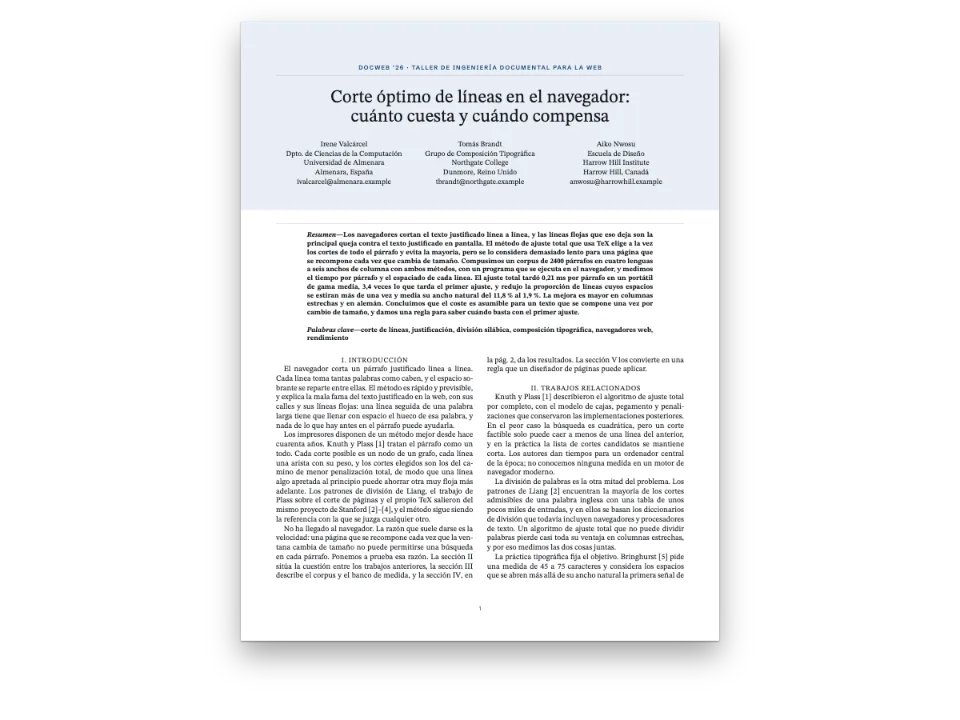
Tres páginas de una revista clínica: un artículo original que presenta un ensayo piloto, compuesto en A4 a dos columnas como lo imprimen las revistas que siguen las normas del ICMJE. Una banda verde azulado cruza la cabeza de la primera página sobre el tipo de artículo, un título de cuatro líneas, los autores con sus números de filiación volados y un resumen estructurado sobre un tinte pálido. Los autores citan con claves de BibTeX, y las páginas muestran lo que espera un editor médico: números pequeños volados, obras consecutivas agrupadas como 6–8 y una bibliografía numerada en la forma de la NLM, Lancet 2016;387(10022):957-67, que cierra cada entrada con su DOI. En el PDF cada número salta a su referencia y cada DOI abre el artículo. El ensayo es inventado; las once obras que cita son reales.
Esta receta responde a
- ¿Cómo pongo los números de cita en superíndice y hago que los DOI sean enlaces, como en las revistas médicas?
- ¿Cómo cito obras y compongo la bibliografía en APA, IEEE u otro estilo de cita?
La respuesta corta
// [@key] prints a raised number in order of first citation. English journals set it after
// the full stop, "control.[@ncdrisc2021]"; Spanish ones before it, "controlada[@ncdrisc2021].".
registerCitationEngine(createCiteprocEngine({ styles: STYLES, locales: LOCALES }));
// elsevier-vancouver is the bundled NLM/Vancouver style (citation-sequence). Two edits bring
// its list to the NLM sample references: "1." instead of "[1]", and the issue after the
// volume, 2015;373(22):2103-16.
const vancouver = STYLES['elsevier-vancouver']
  .replace('<text variable="citation-number" prefix="[" suffix="]"/>',
    '<text variable="citation-number" suffix="."/>')
  .replace('<text variable="volume"/>',
    '<group><text variable="volume"/><text variable="issue" prefix="(" suffix=")"/></group>');
const citations = {
  style: 'custom', customStyle: vancouver,
  marker: 'superscript', collapseRanges: true, // raised 1 and 6–8, not [1] and [6–8]
  link: true, // each number jumps to its reference, in the PDF and on screen
  bibliography: { fontSize: em(0.86), lineHeight: pt(10.4), entrySpacing: pt(1.6),
    labelWidth: mm(2.85), // the width of "1. " at 8 pt: the turnovers line up with the text
    doi: 'link' }, // https://doi.org/… printed whole and clickable
};
Ingredientes
- Funciones
- Citas en un estilo de citaBibliografía a partir de las referenciasSuperíndices y subíndicesEstilos de títuloAtributos de títuloAperturas diseñadasRecuadrosCabeceras y foliosEstilo de tablasEstilo de los piesColocación de figurasPaleta de color semánticaExportación a PDF
- También usa
- Citas que colocan las figurasFigura y Tabla en tu idiomaSalir de la rejilla a propósitoCabeceras según el tipo de páginaFuentes incrustadas en el PDFTipos de recurso propiosFiguras y tablas como recursosPreliminares en romanosTablas a partir de datosCapítulos sin número
- Tipografía
- PT Serif, Fira Sans, Fira Sans Condensed (SIL OFL 1.1)
- Recursos
- Ninguno: todas las imágenes se dibujan en código
Elaboración
#1 · Vancouver, volado y enlazado
El código es la respuesta corta de arriba. De los estilos que trae el motor, elsevier-vancouver es el que sigue el Citing Medicine de la NLM (orden de cita, autores como Ettehad D, Emdin CA, seis nombres y luego et al., títulos de revista abreviados), así que es el archivo del que conviene partir. Dos sustituciones de texto acercan su lista a los ejemplos de la NLM: el número se lee 1. y no [1], y el fascículo va tras el volumen. marker: 'superscript' compone las citas como números volados escriba lo que escriba el estilo, y doi: 'link' mantiene cada dirección https://doi.org/ como enlace. En inglés la llamada va tras el punto; en español va delante, como pide la ortografía académica, y basta con escribir [@clave] antes del punto. El estilo AMA también viene incluido y vuela sus números por sí mismo, pero su lista difiere de la de Vancouver en la puntuación y en los intervalos de páginas.
#2 · Un bloque de título a dos columnas
const text = (id, content, family, size, extra) => ({ kind: 'text', id, content, align: 'left',
  fontFamily: family, fontSize: pt(size), color: col('ink'), overflow: 'wrap', ...extra });
const at = (to, edge, x, y, width) => ({ anchor: { to, edge }, offset: { x: mm(x), y: mm(y) },
  ...(width && { size: { width: mm(width), height: 'auto' } }) });
const caps = { fontFamily: COND, fontWeight: 600, letterSpacing: pt(1.3),
  textTransform: 'uppercase' };
const titleBlock = { enabled: true,
  minHeight: mm(62), // the abstract and the text start under the note, on both columns
  slot: { elements: [
    { kind: 'box', id: 'band', style: { backgroundColor: col('accent') },
      placement: { anchor: { to: 'page', edge: 'top-left' },
        size: { width: 'fill', height: mm(15) } } },
    text('journal', t({ en: 'Almenara Medical Journal', es: 'Revista Médica de Almenara' }),
      COND, 9.5, { ...caps, color: col('paper'), placement: at('page', 'top-left', INNER, 6) }),
    text('issue', '2026 · 14(3) · 181–183', COND, 9.5, { ...caps, color: col('paper'),
      align: 'right', placement: at('page', 'top-right', -OUTER, 6, 60) }),
    text('kind', '{attr.kind}', COND, 9, { ...caps, color: col('accent'),
      placement: at('container', 'top-left', 0, 0, MEASURE) }),
    text('title', '{titleText}', SANS, 19.5, { fontWeight: 600, lineHeight: 1.16,
      placement: at('#kind', 'below', 0, 3, MEASURE - 20) }),
    text('authors', '{attr.authors}', SERIF, 10.5, { inlineMarks: true, // ^1^ → ¹
      placement: at('#title', 'below', 0, 4.5, MEASURE) }),
    text('affiliations', '{attr.affiliations}', SANS, 7.4, { inlineMarks: true,
      lineHeight: 1.35, color: col('muted'), placement: at('#authors', 'below', 0, 2, MEASURE) }),
    { kind: 'rule', id: 'rule', thickness: pt(0.5), color: col('rule'),
      placement: at('#affiliations', 'below', 0, 3, MEASURE) },
    text('note', '{attr.note}', SANS, 7.4, { fontStyle: 'italic', color: col('muted'),
      placement: at('#rule', 'below', 0, 1.6, MEASURE) }),
  ] },
};
El título del artículo es el único título de nivel 1, con el estilo article, que ocupa toda la página y lo dibuja con su diseño. El tipo de artículo, los autores, las filiaciones y la nota salen de atributos del título. inlineMarks convierte el ^1^ del atributo en un número de filiación volado, y el \n de las filiaciones abre una línea para cada centro. La banda está anclada al corte, así que llega hasta el borde superior del papel.
#3 · Un resumen estructurado y un recuadro de puntos clave
const box = (id, bold, more) => ({ id, border: { enabled: false }, snapToGrid: false,
  marginTop: pt(LEAD), marginBottom: pt(LEAD),
  titleStyle: { ...caps, fontSize: pt(8.5), color: col('accent') }, // run-in labels in bold
  body: { fontFamily: SANS, fontSize: pt(8.3), lineHeight: pt(11.2), textAlign: 'left',
    firstLineIndent: pt(0), paragraphSpacing: true, boldColor: col(bold) }, ...more });
const calloutStyles = [
  box('abstract', 'accent', { background: col('tint'), padding: mm(3.5), marginTop: pt(0) }),
  box('keypoints', 'ink', { backgroundEnabled: false, padding: { top: mm(2.5), right: mm(0),
    bottom: mm(1), left: mm(0) }, stripe: { enabled: true, side: 'top', width: pt(2.5),
    color: col('accent') } }),
];
Los dos recuadros comparten un estilo de texto: Fira Sans a 8,3 pt con etiquetas en negrita al comienzo del párrafo, la voz que el lector espera en el material de resumen. El resumen lleva un tinte y las etiquetas en verde azulado; los puntos clave van bajo un filete de 2,5 pt con las etiquetas en tinta. snapToGrid: false respeta el relleno exacto, de modo que el recuadro del resumen se ciñe al texto.
#4 · La Tabla 1 y la Figura 1 a la cabeza de una columna
const resources = () => [
  { id: 'tbl-baseline', typeId: 'table', kind: 'table', createdAt: 0, updatedAt: 0,
    placement: { position: 'top' },
    caption: t({ en: 'Characteristics of the patients at baseline.',
      es: 'Características de los pacientes al inicio.' }),
    note: t({ en: 'Values are mean (SD) or number (%). BP, blood pressure, in mm Hg.',
      es: 'Valores en media (DE) o número (%). PA, presión arterial, en mm Hg.' }),
    table: { model: { headerRowCount: 1, columnWidths: [2.2, 1.1, 1.1],
      rows: parseTSV(baseline).rows.map((row, r) => row.map(({ content }, c) => ({ content,
        ...(r === 0 && { isHeader: true }), ...(c > 0 && { align: 'center' }) }))) } } },
  { id: 'fig-home', typeId: 'figure', kind: 'svg', createdAt: 0, updatedAt: 0,
    placement: { position: 'top' }, svg: { fileId: 'home.svg', width: 850, height: 520 },
    caption: t({ en: 'Mean home systolic pressure by week in the telemonitoring group, with its '
      + '95% confidence interval. The dashed line is the home target of 135\u00a0mm\u00a0Hg.',
    es: 'Presión sistólica domiciliaria media por semana en el grupo de telemonitorización, con '
      + 'su intervalo de confianza del 95\u00a0%. La línea discontinua es el objetivo de '
      + '135\u00a0mm\u00a0Hg.' }),
    altText: t({ en: 'A line falling from 158 mm Hg in week 1 to 135 mm Hg in week 12.',
      es: 'Una línea que baja de 158 mm Hg en la semana 1 a 135 mm Hg en la semana 12.' }) },
];
La tabla se lee de un texto separado por tabuladores, como lo exporta una hoja de cálculo, y su fila de cabecera va rellena en verde azulado con las etiquetas en blanco y negrita. Los dos recursos flotan a la cabeza de una columna después del párrafo que los cita. Con shortLabel igual al nombre completo del tipo, :ref imprime (Tabla 1), como escriben las revistas, y el numbered: false del título deja la cuenta en 1 y no en 1.1.
const palette = { ink: '#1a1d21', accent: '#0d5c63', tint: '#e5eff0', rule: '#9fb4b6',
  muted: '#566065', paper: '#ffffff' };
const col = (id) => ({ hex: palette[id], model: 'hex', paletteId: id });
const colorPalette = Object.entries({ ...palette, 'main-color': palette.accent })
  .map(([id, hex]) => ({ id, name: id, value: { hex, model: 'hex' } }));
La receta completa
// ═══ Postext Cookbook · Nº 095 · A medical article in Vancouver style ══════════════ // https://postext.dev/en/cookbook/medical-article-vancouver // Code: MIT · Text: original (CC BY 4.0) · Chart: generated in code (CC BY 4.0) // Fonts: PT Serif, Fira Sans, Fira Sans Condensed (SIL OFL 1.1) · Needs postext ≥ 1.12.1 import { buildDocument, renderPageToCanvas, clearMeasurementCache, registerCitationEngine, registerResourceImage, defaultResourceTypes, parseTSV, } from 'https://esm.sh/postext'; import { renderToPdf, decompressWoff2 } from 'https://esm.sh/postext-pdf'; import { createCiteprocEngine, STYLES, LOCALES } from 'https://esm.sh/postext-citeproc'; const LANG = 'es'; // @lang: the language of the sample document ('en' | 'es') const RECIPE = 'medical-article-vancouver'; // ─── 1 · Design ───────────────────────────────────────────────────────────── // #region palette: black text, one clinical teal for the journal's own marks const palette = { ink: '#1a1d21', accent: '#0d5c63', tint: '#e5eff0', rule: '#9fb4b6', muted: '#566065', paper: '#ffffff' }; const col = (id) => ({ hex: palette[id], model: 'hex', paletteId: id }); const colorPalette = Object.entries({ ...palette, 'main-color': palette.accent }) .map(([id, hex]) => ({ id, name: id, value: { hex, model: 'hex' } })); // #endregion const [SERIF, SANS, COND] = ['PT Serif', 'Fira Sans', 'Fira Sans Condensed']; const [TRIM_W, TRIM_H, TOP, BOTTOM, INNER, OUTER, GUTTER] = [210, 297, 24, 22, 17, 17, 6]; const MEASURE = TRIM_W - INNER - OUTER; const LEAD = 12.8; // pt: 9.3 pt type, as journals set two columns of A4 // #region answer: Vancouver numbers as superscripts, a "1." list and DOIs that are links // [@key] prints a raised number in order of first citation. English journals set it after // the full stop, "control.[@ncdrisc2021]"; Spanish ones before it, "controlada[@ncdrisc2021].". registerCitationEngine(createCiteprocEngine({ styles: STYLES, locales: LOCALES })); // elsevier-vancouver is the bundled NLM/Vancouver style (citation-sequence). Two edits bring // its list to the NLM sample references: "1." instead of "[1]", and the issue after the // volume, 2015;373(22):2103-16. const vancouver = STYLES['elsevier-vancouver'] .replace('<text variable="citation-number" prefix="[" suffix="]"/>', '<text variable="citation-number" suffix="."/>') .replace('<text variable="volume"/>', '<group><text variable="volume"/><text variable="issue" prefix="(" suffix=")"/></group>'); const citations = { style: 'custom', customStyle: vancouver, marker: 'superscript', collapseRanges: true, // raised 1 and 6–8, not [1] and [6–8] link: true, // each number jumps to its reference, in the PDF and on screen bibliography: { fontSize: em(0.86), lineHeight: pt(10.4), entrySpacing: pt(1.6), labelWidth: mm(2.85), // the width of "1. " at 8 pt: the turnovers line up with the text doi: 'link' }, // https://doi.org/… printed whole and clickable }; // #endregion // #region title: the masthead band, article type, title, authors and affiliations const text = (id, content, family, size, extra) => ({ kind: 'text', id, content, align: 'left', fontFamily: family, fontSize: pt(size), color: col('ink'), overflow: 'wrap', ...extra }); const at = (to, edge, x, y, width) => ({ anchor: { to, edge }, offset: { x: mm(x), y: mm(y) }, ...(width && { size: { width: mm(width), height: 'auto' } }) }); const caps = { fontFamily: COND, fontWeight: 600, letterSpacing: pt(1.3), textTransform: 'uppercase' }; const titleBlock = { enabled: true, minHeight: mm(62), // the abstract and the text start under the note, on both columns slot: { elements: [ { kind: 'box', id: 'band', style: { backgroundColor: col('accent') }, placement: { anchor: { to: 'page', edge: 'top-left' }, size: { width: 'fill', height: mm(15) } } }, text('journal', t({ en: 'Almenara Medical Journal', es: 'Revista Médica de Almenara' }), COND, 9.5, { ...caps, color: col('paper'), placement: at('page', 'top-left', INNER, 6) }), text('issue', '2026 · 14(3) · 181–183', COND, 9.5, { ...caps, color: col('paper'), align: 'right', placement: at('page', 'top-right', -OUTER, 6, 60) }), text('kind', '{attr.kind}', COND, 9, { ...caps, color: col('accent'), placement: at('container', 'top-left', 0, 0, MEASURE) }), text('title', '{titleText}', SANS, 19.5, { fontWeight: 600, lineHeight: 1.16, placement: at('#kind', 'below', 0, 3, MEASURE - 20) }), text('authors', '{attr.authors}', SERIF, 10.5, { inlineMarks: true, // ^1^ → ¹ placement: at('#title', 'below', 0, 4.5, MEASURE) }), text('affiliations', '{attr.affiliations}', SANS, 7.4, { inlineMarks: true, lineHeight: 1.35, color: col('muted'), placement: at('#authors', 'below', 0, 2, MEASURE) }), { kind: 'rule', id: 'rule', thickness: pt(0.5), color: col('rule'), placement: at('#affiliations', 'below', 0, 3, MEASURE) }, text('note', '{attr.note}', SANS, 7.4, { fontStyle: 'italic', color: col('muted'), placement: at('#rule', 'below', 0, 1.6, MEASURE) }), ] }, }; // #endregion // #region abstract: the structured abstract in a teal tint, the key points under a teal stripe const box = (id, bold, more) => ({ id, border: { enabled: false }, snapToGrid: false, marginTop: pt(LEAD), marginBottom: pt(LEAD), titleStyle: { ...caps, fontSize: pt(8.5), color: col('accent') }, // run-in labels in bold body: { fontFamily: SANS, fontSize: pt(8.3), lineHeight: pt(11.2), textAlign: 'left', firstLineIndent: pt(0), paragraphSpacing: true, boldColor: col(bold) }, ...more }); const calloutStyles = [ box('abstract', 'accent', { background: col('tint'), padding: mm(3.5), marginTop: pt(0) }), box('keypoints', 'ink', { backgroundEnabled: false, padding: { top: mm(2.5), right: mm(0), bottom: mm(1), left: mm(0) }, stripe: { enabled: true, side: 'top', width: pt(2.5), color: col('accent') } }), ]; // #endregion const head = (id, content, parity, edge, x, extra) => text(id, content, COND, 8, { parity, pages: 'body', fontWeight: 500, letterSpacing: pt(0.4), color: col('muted'), overflow: 'clip', placement: at('page', edge, x, 13, 100), ...extra }); const folio = { fontWeight: 600, color: col('accent') }; const right = { align: 'right' }; // anchored top-right, an element ends at its offset const header = { elements: [ head('v-folio', '{pageNumber}', 'even', 'top-left', OUTER, folio), head('v-title', t({ en: 'Almenara Med J 2026;14(3)', es: 'Rev Med Almenara 2026;14(3)' }), 'even', 'top-left', OUTER + 9), head('r-title', t({ en: 'Ortega Ramos et al. · Telemonitoring after severe hypertension', es: 'Ortega Ramos et al. · Telemonitorización tras una crisis hipertensiva' }), 'odd', 'top-right', -OUTER - 9, right), head('r-folio', '{pageNumber}', 'odd', 'top-right', -OUTER, { ...folio, ...right }), ] }; const footer = { elements: [head('drop-folio', '{pageNumber}', 'all', 'bottom-right', -OUTER, { ...folio, ...right, pages: 'opener', placement: at('page', 'bottom-right', -OUTER, -13, 10) }), ] }; const sans = (size, weight) => ({ fontFamily: SANS, fontSize: pt(size), fontWeight: weight }); const config = () => ({ // a factory: the engine caches resolved configs per object locale: t({ en: 'en-gb', es: 'es' }), // "(Table 1)" in the text, not "Tab. 1"; Table 1, not 1.1, as the title is numbered: false resourceTypes: defaultResourceTypes(LANG).map((type) => ({ ...type, shortLabel: type.name, ...(type.id === 'table' && { captionStyle: { position: 'above' } }) })), colorPalette, citations, calloutStyles, header, footer, headingStyles: [ // No header: [] here, it would hold for the whole section; pages: 'body' spares page 1 { id: 'article', numbered: false, span: 'page', advancedDesign: titleBlock }, { id: 'back', numbered: false, fontSize: pt(9.5), color: col('ink') }, ], page: { sizePreset: 'custom', width: mm(TRIM_W), height: mm(TRIM_H), dpi: 150, pageNumbering: { startAt: 181 }, // the article opens on page 181 of the issue margins: { top: mm(TOP), bottom: mm(BOTTOM), left: mm(INNER), right: mm(OUTER), mirror: true } }, layout: { layoutType: 'double', gutterWidth: mm(GUTTER) }, bodyText: { fontFamily: SERIF, fontSize: pt(9.3), lineHeight: pt(LEAD), color: col('ink'), boldColor: col('ink'), italicColor: col('ink'), referenceColor: col('ink'), referenceBold: false, textAlign: 'justify', firstLineIndent: mm(4), indentAfterHeading: false, hyphenation: { enabled: true }, optimalLineBreaking: true, avoidWidows: true, avoidOrphans: true, avoidRunts: true }, headings: { fontFamily: SANS, color: col('accent'), fontWeight: 600, levels: [ { level: 1, breakBefore: { enabled: true, parity: 'any' } }, // gotcha: headings-drop-h1-break { level: 2, ...sans(11.5, 600), lineHeight: pt(LEAD), marginTop: pt(LEAD), marginBottom: pt(0) }, // a line above, the text straight under it { level: 3, ...sans(9.3, 600), color: col('ink'), lineHeight: pt(LEAD), marginTop: pt(LEAD / 2), marginBottom: pt(0) }, ] }, tableStyle: { rules: 'horizontal', borderColor: col('rule'), borderWidth: pt(0.5), headerBackground: col('accent'), headerColor: col('paper'), headerBold: true, headerFontFamily: SANS, headerFontSize: pt(7.6), bodyFontFamily: SANS, bodyFontSize: pt(7.6), bodyColor: col('ink'), cellPadding: mm(1.2) }, captionStyle: { fontFamily: SANS, fontSize: pt(7.8), color: col('ink'), labelBold: true, labelColor: col('accent'), gap: mm(2), note: { fontSize: pt(6.8), color: col('muted') } }, }); // ─── 2 · Content ──────────────────────────────────────────────────────────── const markdown = String.raw`---Muestra en Markdown · 129 líneas · content.es.md
title: "Telemonitorización domiciliaria de la presión arterial dirigida por farmacéuticos tras una visita a urgencias por hipertensión grave" author: "Lucía Ortega Ramos, Daniel Achterberg, Marta Quiroga Gil y Samuel Okafor" --- # Telemonitorización domiciliaria de la presión arterial dirigida por farmacéuticos tras una visita a urgencias por hipertensión grave: ensayo piloto aleatorizado {style="article" kind="Original" authors="Lucía Ortega Ramos^1^, Daniel Achterberg^2^, Marta Quiroga Gil^1^, Samuel Okafor^3^" affiliations="^1^ Servicio de Medicina Interna, Hospital General de Almenara\n^2^ Red de Farmacias Comunitarias, Área de Salud de Almenara\n^3^ Unidad de Investigación en Atención Primaria, Área de Salud de Almenara" note="Artículo ilustrativo escrito para el Recetario de Postext: el ensayo, sus autores y sus datos son inventados. Las obras citadas son reales."} :::callout{type="abstract" title="Resumen"} **Introducción** Los pacientes dados de alta en urgencias tras una visita por hipertensión grave suelen esperar semanas hasta la revisión, y muchos vuelven con las mismas cifras. **Métodos** En este ensayo piloto, 120 adultos atendidos con una presión sistólica de 180 mm Hg o más se asignaron al azar a telemonitorización domiciliaria con ajuste del tratamiento por un farmacéutico comunitario o a la atención habitual. La variable principal fue la presión sistólica en consulta a las 12 semanas. **Resultados** A las 12 semanas, la presión sistólica media fue de 136,2 mm Hg con telemonitorización y de 145,9 mm Hg con atención habitual (diferencia ajustada −9,4 mm Hg; IC del 95 %, −13,8 a −5,0). El 63 % y el 37 % de los pacientes, respectivamente, quedaron por debajo de 140/90 mm Hg. **Conclusiones** La telemonitorización dirigida por farmacéuticos redujo la presión arterial en las semanas siguientes a una visita a urgencias. Está justificado un ensayo mayor con variables cardiovasculares. **Palabras clave** hipertensión; telemonitorización; farmacéuticos; servicio de urgencias; automedida ::: ## Introducción La hipertensión arterial es la primera causa modificable de muerte cardiovascular. En 2019 la padecían unos 1280 millones de adultos de 30 a 79 años, y menos de una cuarta parte la tenía controlada[@ncdrisc2021]. Cada descenso de 10 mm Hg en la presión sistólica reduce alrededor de una quinta parte el riesgo de episodios cardiovasculares mayores[@ettehad2016], y en pacientes de alto riesgo un objetivo inferior a 120 mm Hg evitó más episodios que uno inferior a 140 mm Hg[@sprint2015]. Las guías europeas piden alcanzar el control en los tres meses siguientes al inicio del tratamiento[@williams2018], y las estadounidenses, una revisión mensual hasta lograrlo[@whelton2018]. Los pacientes que llegan a urgencias con hipertensión grave y sin daño agudo de órgano diana son un grupo del que las guías apenas se ocupan. La mayoría vuelve a casa con una receta y un volante para su médico de familia, y la primera revisión puede tardar semanas. La automedida de la presión arterial la reduce cuando se combina con un plan para actuar según las cifras[@tucker2017; @mcmanus2014; @mcmanus2018], y @margolis2013 demostraron que los farmacéuticos que ajustaban el tratamiento a partir de las lecturas transmitidas desde casa mejoraban el control durante un año en atención primaria. Nadie ha comprobado si el mismo modelo sirve en las semanas que siguen a una visita a urgencias. Diseñamos un ensayo piloto para estimar el efecto de la telemonitorización dirigida por farmacéuticos sobre la presión arterial a las 12 semanas en este grupo, y para medir el reclutamiento, la permanencia y la seguridad de cara a un ensayo mayor. :::callout{type="keypoints" title="Puntos clave"} **Qué se sabe** La automedida reduce la presión arterial cuando alguien actúa según las lecturas, y los farmacéuticos que gestionan lecturas telemonitorizadas mejoran el control en atención primaria. **Qué aporta este estudio** Tras una visita a urgencias por hipertensión grave, la telemonitorización con ajuste del tratamiento por un farmacéutico comunitario redujo la presión sistólica en consulta 9,4 mm Hg más que la atención habitual a las 12 semanas. ::: ## Métodos ### Diseño y participantes Ensayo piloto de grupos paralelos, abierto, con asignación 1:1, comunicado según la declaración CONSORT[@schulz2010]. Incluimos adultos de 18 a 80 años dados de alta en el servicio de urgencias de un hospital general de distrito tras una visita con una presión sistólica de 180 mm Hg o más, sin daño agudo de órgano diana, que vivieran cerca de una farmacia participante. Se excluyó a los pacientes con hipertensión secundaria, filtrado glomerular estimado inferior a 30 mL/min/1,73 m², embarazo o una esperanza de vida menor de un año. ### Intervenciones Cada paciente del grupo de telemonitorización recibió un monitor validado de brazo que enviaba cada lectura a un servidor seguro. Medían dos veces por la mañana y dos por la tarde, tres días a la semana. Un farmacéutico comunitario revisaba las lecturas cada semana y modificaba el tratamiento según un protocolo escrito, pactado con los médicos de familia del área, con el objetivo de una media domiciliaria inferior a 135/85 mm Hg. Los pacientes del grupo de atención habitual se remitieron a su médico de familia, como es costumbre. ### Variables y análisis La variable principal fue la media de la segunda y la tercera de tres lecturas sistólicas en consulta a las 12 semanas, tomadas por una enfermera que desconocía la asignación. Las variables secundarias fueron el control por debajo de 140/90 mm Hg, las nuevas visitas a urgencias y los efectos adversos. Los datos se recogieron en REDCap[@harris2009]. La diferencia entre grupos se estimó por regresión lineal ajustada por la presión sistólica basal. Con 60 pacientes por grupo, el ensayo tenía una potencia del 80 % para detectar una diferencia de 8 mm Hg, con una desviación típica supuesta de 15 mm Hg y un 10 % de pérdidas. ## Resultados Entre enero y junio se evaluó a 163 pacientes y se aleatorizó a 120; acudieron a la visita de las 12 semanas 57 del grupo de telemonitorización y 57 del de atención habitual. Los grupos eran similares al inicio (:ref{id="tbl-baseline"}). Los pacientes telemonitorizados enviaron una mediana de 31 series de lecturas, y los farmacéuticos hicieron una mediana de dos cambios de tratamiento por paciente. La presión sistólica domiciliaria del grupo de telemonitorización bajó sobre todo en las cuatro primeras semanas, y en la semana 10 ya estaba cerca del objetivo (:ref{id="fig-home"}). A las 12 semanas, la presión sistólica media en consulta fue de 136,2 mm Hg con telemonitorización y de 145,9 mm Hg con atención habitual, una diferencia ajustada de −9,4 mm Hg (IC del 95 %, −13,8 a −5,0). Quedaron por debajo de 140/90 mm Hg 36 de 57 pacientes (63 %) con telemonitorización y 21 de 57 (37 %) con atención habitual. Tres pacientes del grupo de telemonitorización y nueve del de atención habitual volvieron a urgencias por presión arterial elevada. Dos pacientes telemonitorizados refirieron mareo al ponerse de pie tras un aumento de dosis, y ambos se recuperaron al reducirla. Ningún efecto adverso grave se relacionó con la intervención. ## Discusión En este ensayo piloto, la telemonitorización con ajuste del tratamiento por un farmacéutico comunitario redujo la presión sistólica en consulta unos 9 mm Hg más que la atención habitual en las 12 semanas siguientes a una visita a urgencias por hipertensión grave. El efecto se acerca a los 10 mm Hg que los metaanálisis asocian con una quinta parte menos de episodios cardiovasculares[@ettehad2016], y se alcanzó dentro de los tres meses que conceden las guías europeas[@williams2018]. El resultado coincide con los ensayos de automedida en atención primaria, en los que el beneficio vino de actuar según las lecturas y no de tomarlas[@tucker2017]. Los farmacéuticos estaban en buena posición para actuar: veían las lecturas cada semana, conocían a los pacientes porque recogían sus recetas, y el protocolo les permitía cambiar el tratamiento sin esperar a una cita, como hicieron los farmacéuticos del ensayo de @margolis2013 en Minnesota. El ensayo tiene limitaciones. Era pequeño y abierto, se hizo en una sola área de salud, y 12 semanas son pocas para mostrar un efecto sobre los episodios. Las lecturas en consulta las tomó una enfermera ciega a la asignación, lo que reduce el sesgo propio de un diseño abierto. Que hubiera menos visitas a urgencias en el grupo telemonitorizado es alentador, pero son cifras demasiado pequeñas como para sacar conclusiones. El paso siguiente es un ensayo multicéntrico con potencia para detectar diferencias en las visitas a urgencias y en los episodios cardiovasculares. Las tasas de reclutamiento y de permanencia observadas, tres de cada cuatro pacientes evaluados y un 95 % de seguimiento, indican que es factible. ## Información del artículo {style="back"} **Financiación** Ninguna. **Conflicto de intereses** Ninguno. **Nota** Compuesto en PT Serif, Fira Sans y Fira Sans Condensed (SIL OFL). Texto: original, CC BY 4.0. El estudio, sus autores, sus centros y sus resultados son inventados para este ejemplo; la bibliografía remite a obras publicadas reales. ## Bibliografía {style="back"} :::bibliography{title=""} :::references{format=bibtex} @article{ncdrisc2021, author = {{NCD Risk Factor Collaboration (NCD-RisC)}}, title = {Worldwide trends in hypertension prevalence and progress in treatment and control from 1990 to 2019: a pooled analysis of 1201 population-representative studies with 104 million participants}, journal = {Lancet}, year = 2021, volume = 398, number = 10304, pages = {957--980}, doi = {10.1016/S0140-6736(21)01330-1}} @article{ettehad2016, author = {Ettehad, Dena and Emdin, Connor A. and Kiran, Amit and Anderson, Simon G. and Callender, Thomas and Emberson, Jonathan and Chalmers, John and Rodgers, Anthony and Rahimi, Kazem}, title = {Blood pressure lowering for prevention of cardiovascular disease and death: a systematic review and meta-analysis}, journal = {Lancet}, year = 2016, volume = 387, number = 10022, pages = {957--967}, doi = {10.1016/S0140-6736(15)01225-8}} @article{sprint2015, author = {{SPRINT Research Group}}, title = {A randomized trial of intensive versus standard blood-pressure control}, journal = {N Engl J Med}, year = 2015, volume = 373, number = 22, pages = {2103--2116}, doi = {10.1056/NEJMoa1511939}} @article{whelton2018, author = {Whelton, Paul K. and Carey, Robert M. and Aronow, Wilbert S. and Casey, Donald E. and Collins, Karen J. and Dennison Himmelfarb, Cheryl and DePalma, Sondra M.}, title = {2017 {ACC/AHA/AAPA/ABC/ACPM/AGS/APhA/ASH/ASPC/NMA/PCNA} guideline for the prevention, detection, evaluation, and management of high blood pressure in adults}, journal = {Hypertension}, year = 2018, volume = 71, number = 6, pages = {e13--e115}, doi = {10.1161/HYP.0000000000000065}} @article{williams2018, author = {Williams, Bryan and Mancia, Giuseppe and Spiering, Wilko and Agabiti Rosei, Enrico and Azizi, Michel and Burnier, Michel and Clement, Denis L.}, title = {2018 {ESC/ESH} guidelines for the management of arterial hypertension}, journal = {Eur Heart J}, year = 2018, volume = 39, number = 33, pages = {3021--3104}, doi = {10.1093/eurheartj/ehy339}} @article{tucker2017, author = {Tucker, Katherine L. and Sheppard, James P. and Stevens, Richard and Bosworth, Hayden B. and Bove, Alfred and Bray, Emma P. and Earle, Kenneth}, title = {Self-monitoring of blood pressure in hypertension: a systematic review and individual patient data meta-analysis}, journal = {PLoS Med}, year = 2017, volume = 14, number = 9, pages = {e1002389}, doi = {10.1371/journal.pmed.1002389}} @article{mcmanus2014, author = {McManus, Richard J. and Mant, Jonathan and Haque, M. Sayeed and Bray, Emma P. and Bryan, Stirling and Greenfield, Sheila M. and Jones, Miren I.}, title = {Effect of self-monitoring and medication self-titration on systolic blood pressure in hypertensive patients at high risk of cardiovascular disease: the {TASMIN-SR} randomized clinical trial}, journal = {JAMA}, year = 2014, volume = 312, number = 8, pages = {799--808}, doi = {10.1001/jama.2014.10057}} @article{mcmanus2018, author = {McManus, Richard J. and Mant, Jonathan and Franssen, Marloes and Nickless, Alecia and Schwartz, Claire and Hodgkinson, James and Bradburn, Peter}, title = {Efficacy of self-monitored blood pressure, with or without telemonitoring, for titration of antihypertensive medication ({TASMINH4}): an unmasked randomised controlled trial}, journal = {Lancet}, year = 2018, volume = 391, number = 10124, pages = {949--959}, doi = {10.1016/S0140-6736(18)30309-X}} @article{margolis2013, author = {Margolis, Karen L. and Asche, Stephen E. and Bergdall, Anna R. and Dehmer, Steven P. and Groen, Sarah E. and Kadrmas, Holly M. and Kerby, Tessa J.}, title = {Effect of home blood pressure telemonitoring and pharmacist management on blood pressure control: a cluster randomized clinical trial}, journal = {JAMA}, year = 2013, volume = 310, number = 1, pages = {46--56}, doi = {10.1001/jama.2013.6549}} @article{schulz2010, author = {Schulz, Kenneth F. and Altman, Douglas G. and Moher, David and {CONSORT Group}}, title = {{CONSORT} 2010 statement: updated guidelines for reporting parallel group randomised trials}, journal = {BMJ}, year = 2010, volume = 340, pages = {c332}, doi = {10.1136/bmj.c332}} @article{harris2009, author = {Harris, Paul A. and Taylor, Robert and Thielke, Robert and Payne, Jonathon and Gonzalez, Nathaniel and Conde, Jose G.}, title = {Research electronic data capture ({REDCap}): a metadata-driven methodology and workflow process for providing translational research informatics support}, journal = {J Biomed Inform}, year = 2009, volume = 42, number = 2, pages = {377--381}, doi = {10.1016/j.jbi.2008.08.010}} :::`; const baseline = String.raw`Característica Intervención \\ (n = 60) Atención habitual \\ (n = 60)Muestra en Markdown · 10 líneas · content.baseline.es.md
Edad, años 58,7 (11,2) 60,1 (10,4) Mujeres 27 (45) 29 (48) PA sistólica en urgencias 192,4 (10,8) 190,9 (9,6) PA sistólica en la aleatorización 161,3 (13,5) 160,2 (12,9) PA diastólica en la aleatorización 94,8 (10,1) 93,6 (9,7) Diabetes 14 (23) 12 (20) Enfermedad renal crónica 6 (10) 8 (13) Fármacos antihipertensivos, número 1,4 (1,0) 1,5 (1,1) Sin tratamiento antes de la visita 19 (32) 17 (28) Monitor domiciliario previo 11 (18) 13 (22)`; // TSV: characteristic, telemonitoring, usual care // #region resources: Table 1 from the TSV, Figure 1 drawn from the weekly means const resources = () => [ { id: 'tbl-baseline', typeId: 'table', kind: 'table', createdAt: 0, updatedAt: 0, placement: { position: 'top' }, caption: t({ en: 'Characteristics of the patients at baseline.', es: 'Características de los pacientes al inicio.' }), note: t({ en: 'Values are mean (SD) or number (%). BP, blood pressure, in mm Hg.', es: 'Valores en media (DE) o número (%). PA, presión arterial, en mm Hg.' }), table: { model: { headerRowCount: 1, columnWidths: [2.2, 1.1, 1.1], rows: parseTSV(baseline).rows.map((row, r) => row.map(({ content }, c) => ({ content, ...(r === 0 && { isHeader: true }), ...(c > 0 && { align: 'center' }) }))) } } }, { id: 'fig-home', typeId: 'figure', kind: 'svg', createdAt: 0, updatedAt: 0, placement: { position: 'top' }, svg: { fileId: 'home.svg', width: 850, height: 520 }, caption: t({ en: 'Mean home systolic pressure by week in the telemonitoring group, with its ' + '95% confidence interval. The dashed line is the home target of 135\u00a0mm\u00a0Hg.', es: 'Presión sistólica domiciliaria media por semana en el grupo de telemonitorización, con ' + 'su intervalo de confianza del 95\u00a0%. La línea discontinua es el objetivo de ' + '135\u00a0mm\u00a0Hg.' }), altText: t({ en: 'A line falling from 158 mm Hg in week 1 to 135 mm Hg in week 12.', es: 'Una línea que baja de 158 mm Hg en la semana 1 a 135 mm Hg en la semana 12.' }) }, ]; // #endregion // #region art: the weekly chart, its labels set in Fira Sans carried inside the SVG const HOME = [158.4, 153.1, 149.6, 146.2, 143.8, 141.5, 139.9, 138.6, 137.4, 136.1, 135.3, 134.6]; const n2 = (v) => +v.toFixed(2); // An SVG drawn as an image cannot see the page's web fonts (gotcha: svg-no-webfonts), so the // chart carries its face inline, as a data URL of the Fontsource file. async function inlineFace(family, weight) { const id = family.toLowerCase().replace(/\s+/g, '-'); const url = `https://cdn.jsdelivr.net/npm/@fontsource/${id}@5/files/${id}-latin-${weight}` + '-normal.woff2'; const bytes = new Uint8Array(await (await fetch(url)).arrayBuffer()); let bin = ''; for (const b of bytes) bin += String.fromCharCode(b); return `<style>@font-face{font-family:F;src:url(data:font/woff2;base64,${btoa(bin)}) ` + `format('woff2')}text{font-family:F}</style>`; } function homeChart(face) { // 85 × 52 mm: the width of a column const [W, H, L, R, T, B] = [85, 52, 11, 3, 4, 42]; const x = (week) => L + ((week - 1) / 11) * (W - L - R); const y = (v) => B - ((v - 125) / 40) * (B - T); // 125 to 165 mm Hg const label = (tx, ty, s, anchor = 'middle') => `<text x="${n2(tx)}" y="${n2(ty)}" ` + `font-size="2.7" text-anchor="${anchor}" fill="${palette.muted}">${s}</text>`; let grid = ''; for (const v of [130, 140, 150, 160]) { grid += `<path d="M${L} ${n2(y(v))}H${W - R}" stroke="${palette.rule}" stroke-width="0.2"/>` + label(L - 1.6, y(v) + 0.9, v, 'end'); } for (let w = 1; w <= 12; w++) grid += label(x(w), B + 4, w); const half = (i) => 4.6 - i * 0.18; // the interval narrows as readings accumulate const upper = HOME.map((v, i) => `${n2(x(i + 1))} ${n2(y(v + half(i)))}`); const lower = HOME.map((v, i) => `${n2(x(i + 1))} ${n2(y(v - half(i)))}`).reverse(); const line = HOME.map((v, i) => `${n2(x(i + 1))} ${n2(y(v))}`).join('L'); const dots = HOME.map((v, i) => `<circle cx="${n2(x(i + 1))}" cy="${n2(y(v))}" r="0.75" ` + `fill="${palette.accent}"/>`).join(''); const dash = [0, 1, 2, 3, 4, 5, 6, 7, 8, 9, 10, 11, 12, 13, 14, 15, 16, 17].map((k) => { const x0 = L + k * 4; return x0 + 2 > W - R ? '' : `M${x0} ${n2(y(135))}h2`; }).join(''); return `<svg xmlns="http://www.w3.org/2000/svg" width="850" height="520" ` + `viewBox="0 0 ${W} ${H}">${face}${grid}` + `<path d="M${upper.join('L')}L${lower.join('L')}Z" fill="${palette.tint}"/>` + `<path d="${dash}" stroke="${palette.ink}" stroke-width="0.3"/>` + `<path d="M${L} ${B}H${W - R}" stroke="${palette.ink}" stroke-width="0.35"/>` + `<path d="M${line}" fill="none" stroke="${palette.accent}" stroke-width="0.6"/>${dots}` + label(L - 1.6, T - 1.2, 'mm Hg', 'end') + label((L + W - R) / 2, H - 0.8, t({ en: 'Week', es: 'Semana' })) + '</svg>'; } // #endregion // ─── 3 · Fonts ────────────────────────────────────────────────────────────── const FONTS = { 'PT Serif': ['400', '400i', '700', '700i'], 'Fira Sans': ['400', '400i', '600'], 'Fira Sans Condensed': ['500', '600'] }; // ─── 4 · Build & show ─────────────────────────────────────────────────────── await loadFonts(FONTS, markdown); await loadSvg('home.svg', homeChart(await inlineFace(SANS, 400))); const content = { markdown, resources: resources() }; const doc = await buildWithFonts(() => buildDocument(content, config()), markdown); const title = t({ en: 'A medical article in Vancouver style', es: 'Un artículo médico en estilo Vancouver' }); showPages(doc, { title }); offerPdf(() => renderToPdf(doc, { fontProvider: fontsourceProvider, resourceBytes: imageBytes }), `${RECIPE}.pdf`);Kit · core, fonts, viewer, pdf, images: igual en todas las recetas · 310 líneas
// ─── Kit ── helpers shared by every Cookbook recipe · postext.dev/cookbook ───── // ─── Kit · core v1 ── the same in every recipe · postext.dev/cookbook ───────── function mm(value) { return { value, unit: 'mm' }; } function pt(value) { return { value, unit: 'pt' }; } function em(value) { return { value, unit: 'em' }; } /** The sample language's string: t({ en: 'Figure', es: 'Figura' }). */ function t(strings) { return strings[LANG] ?? Object.values(strings)[0]; } /** A file in this recipe's assets folder, served from the Postext repo by jsDelivr. */ function asset(file) { return `https://cdn.jsdelivr.net/gh/drnachio/postext@main/cookbook/${RECIPE}/assets/${file}`; } // ─── Kit · fonts v1 ── the same in every recipe · postext.dev/cookbook ──────── // Postext measures text with the faces the browser has loaded, and caches the // widths, so every face must be ready before the first build. Faces come from // Fontsource: the same static files the PDF embeds, so screen and PDF agree. /** faces = { 'Family Name': ['400', '400i', '700'] }. `text` is the sample: * letters beyond Latin-1 (č, ł, ő…) also load the latin-ext files. With * `optional`, a face Fontsource does not ship is skipped instead of failing. * Resolves to the number of faces added. */ async function loadFonts(faces, text = '', { optional = false } = {}) { kitStatus('Loading fonts…'); const ranges = { latin: 'U+0000-00FF,U+0131,U+0152-0153,U+02BB-02BC,U+02C6,U+02DA,U+02DC,U+0304,U+0308,U+0329,' + 'U+2000-206F,U+20AC,U+2122,U+2191,U+2193,U+2212,U+2215,U+FEFF,U+FFFD', 'latin-ext': 'U+0100-02BA,U+02BD-02C5,U+02C7-02CC,U+02CE-02D7,U+02DD-02FF,U+0304,U+0308,U+0329,' + 'U+1D00-1DBF,U+1E00-1E9F,U+1EF2-1EFF,U+2020,U+20A0-20AB,U+20AD-20C0,U+2113,U+2C60-2C7F,U+A720-A7FF', }; const subsets = /[Ā-˿Ḁ-ỿ]/.test(text) ? ['latin', 'latin-ext'] : ['latin']; const jobs = []; let added = 0; for (const [family, specs] of Object.entries(faces)) { const id = fontsourceId(family); const meta = optional ? await fontsourceMeta(family) : null; for (const spec of new Set(specs)) { const weight = parseInt(spec, 10); const style = spec.endsWith('i') ? 'italic' : 'normal'; if (hasFace(family, weight, style)) continue; if (optional && !(meta?.weights.includes(weight) && meta.styles.includes(style))) continue; for (const subset of subsets) { const url = `https://cdn.jsdelivr.net/npm/@fontsource/${id}@5/files/${id}-${subset}-${weight}-${style}.woff2`; const face = new FontFace(family, `url(${url}) format('woff2')`, { weight: String(weight), style, unicodeRange: ranges[subset] }); jobs.push(face.load().then((ready) => { document.fonts.add(ready); added++; }, () => { if (subset === 'latin' && !optional) throw new Error(`Fontsource has no ${family} ${weight} ${style}`); })); } } } await Promise.all(jobs).catch((error) => { kitFail(error); throw error; }); return added; } /** Runs `build` (a buildDocument or buildBundle call) and checks the faces * the pages use. A regular face missing from FONTS is loaded with a warning; * bold and italic variants are loaded when the family ships them. Then the * measurement caches are cleared and the build runs again. */ async function buildWithFonts(build, text = '') { const tried = new Set(); for (let round = 0; round < 3; round++) { kitStatus('Laying out…'); await new Promise(requestAnimationFrame); // let the status paint first const result = await Promise.resolve().then(build).catch((error) => { kitFail(error); throw error; }); const wanted = { base: {}, variants: {} }; for (const { font, base } of [result].flat().flatMap(fontStringsOf)) { const { family, weight, style } = parseFont(font); const key = `${family}|${weight}|${style}`; if (tried.has(key) || hasFace(family, weight, style)) continue; tried.add(key); (wanted[base ? 'base' : 'variants'][family] ??= []).push(`${weight}${style === 'italic' ? 'i' : ''}`); } if (Object.keys(wanted.base).length) { console.warn(`[cookbook] FONTS does not list ${JSON.stringify(wanted.base)}: loading them.`); } const added = await loadFonts(wanted.base, text) + await loadFonts(wanted.variants, text, { optional: true }); if (added === 0) return result; clearMeasurementCache(); } throw new Error('The fonts did not settle after three builds.'); } /** Every font string of the layout. `base` marks a block's own face; its * bold, italic and bold-italic variants are listed whether or not used. */ function fontStringsOf(doc) { const found = new Map(); const walk = (node) => { if (!node || typeof node !== 'object') return; if (Array.isArray(node)) { node.forEach(walk); return; } for (const [key, value] of Object.entries(node)) { if (typeof value === 'string' && /fontString$/i.test(key)) { found.set(value, found.get(value) || key === 'fontString'); } else if (value && typeof value === 'object') walk(value); } }; walk(doc.pages); walk(doc.blocks); return [...found].map(([font, base]) => ({ font, base })); } /** '700 37.5px Open Sans' / 'italic 400 13px "Source Serif 4"' → { family, weight, style }. * A string with no weight ('95.8px Young Serif', from a design text) is 400. */ function parseFont(font) { const m = /^(?:(italic|oblique)\s+)?(?:small-caps\s+)?(?:(\d+|bold|normal)\s+)?[\d.]+px\s+(.+)$/.exec(font.trim()); if (!m) throw new Error(`Unexpected font string: ${font}`); const weight = m[2] === 'bold' ? 700 : !m[2] || m[2] === 'normal' ? 400 : Number(m[2]); return { family: m[3].replace(/^["']|["']$/g, ''), weight, style: m[1] ? 'italic' : 'normal' }; } /** True when a loaded FontFace covers exactly this family, weight and style * (document.fonts.check() is also true for families nobody declared). */ function hasFace(family, weight, style) { for (const face of document.fonts) { if (face.status !== 'loaded' || face.style !== style) continue; if (face.family.replace(/^["']|["']$/g, '') !== family) continue; const [low, high = low] = face.weight.split(' ').map(Number); if (weight >= low && weight <= high) return true; } return false; } /** Fontsource's id for a family: 'Source Serif 4' → 'source-serif-4'. */ function fontsourceId(family) { return family.toLowerCase().replace(/\s+/g, '-'); } /** The weights and styles a family ships ({ weights: [400, 700], styles: ['normal', 'italic'] }), or null. */ function fontsourceMeta(family) { fontsourceMeta.cache ??= new Map(); const id = fontsourceId(family); if (!fontsourceMeta.cache.has(id)) { fontsourceMeta.cache.set(id, fetch(`https://api.fontsource.org/v1/fonts/${id}`) .then((res) => (res.ok ? res.json() : null), () => null)); } return fontsourceMeta.cache.get(id); } // ─── Kit · viewer v1 ── the same in every recipe · postext.dev/cookbook ─────── /** Shows the pages as facing spreads on a dark desk: the first page is a * recto on its own, then verso | recto pairs, as in a bound book. Pages * are painted when they scroll near the screen. */ function showPages(docs, { title, width = 460 } = {}) { const root = viewer(title); const pages = [docs].flat().flatMap((doc) => doc.pages.map((page) => ({ doc, page, n: (doc.pageIndexOffset ?? 0) + page.index }))); const spreads = []; let verso = null; for (const p of pages) { if (p.n % 2 === 1) { if (verso) spreads.push([verso, null]); verso = p; } else { spreads.push([verso, p]); verso = null; } } if (verso) spreads.push([verso, null]); const density = Math.min(window.devicePixelRatio || 1, 2); showPages.painter?.disconnect(); const painter = new IntersectionObserver((entries) => { for (const { isIntersecting, target } of entries) { if (!isIntersecting) continue; painter.unobserve(target); const { doc, page } = target.postext; renderPageToCanvas(page, doc, target, { scale: (width * density) / page.width }); } }, { rootMargin: '800px' }); showPages.painter = painter; root.replaceChildren(...spreads.map((pair) => { const spread = document.createElement('div'); spread.className = 'pt-spread'; for (const p of pair) { const figure = document.createElement('figure'); if (p) { const label = p.page.pageLabel || String(p.n + 1); const canvas = document.createElement('canvas'); canvas.postext = p; canvas.style.aspectRatio = `${p.page.width} / ${p.page.height}`; canvas.setAttribute('role', 'img'); canvas.setAttribute('aria-label', `Page ${label}`); const folio = document.createElement('figcaption'); folio.textContent = label; figure.append(canvas, folio); painter.observe(canvas); } else figure.className = 'pt-blank'; spread.append(figure); } return spread; })); kitStatus(`${pages.length} ${pages.length === 1 ? 'page' : 'pages'}`); document.documentElement.dataset.postext = 'ready'; return pages.length; } /** The desk, the bar and the error reporting, created once. */ function viewer(title) { if (!document.getElementById('pt-kit')) { document.head.insertAdjacentHTML('beforeend', `<style id="pt-kit"> :root { color-scheme: dark; } body { margin: 0; background: #0e1014; color: #b9bcc4; font: 13px/1.45 system-ui, sans-serif; } #pt-bar { position: sticky; top: 0; z-index: 1; display: flex; flex-wrap: wrap; align-items: center; gap: 6px 16px; padding: 10px 16px; background: rgb(14 16 20 / .92); backdrop-filter: blur(6px); border-bottom: 1px solid #23262d; } #pt-bar strong { color: #f4f1ea; font-weight: 600; } #pt-actions { display: flex; gap: 12px; margin-left: auto; } #pt-actions a, #pt-actions button { color: #d8a21a; font: inherit; background: none; border: 0; padding: 0; cursor: pointer; } #pages { display: grid; justify-items: center; gap: 48px; padding: 32px 16px 72px; } .pt-spread { display: flex; } .pt-spread figure { margin: 0; width: min(460px, 44vw); } .pt-spread canvas { display: block; width: 100%; background: #fff; box-shadow: 0 1px 2px rgb(0 0 0 / .5), 0 22px 44px -16px rgb(0 0 0 / .8); } .pt-spread figure:first-child canvas { box-shadow: inset -14px 0 14px -14px rgb(0 0 0 / .18), 0 1px 2px rgb(0 0 0 / .5), 0 22px 44px -16px rgb(0 0 0 / .8); } .pt-spread figcaption { margin-top: 10px; text-align: center; font: 600 10px/1 system-ui, sans-serif; letter-spacing: .18em; text-transform: uppercase; color: #6c7079; } .pt-blank { visibility: hidden; } @media (max-width: 760px) { .pt-spread { flex-direction: column; gap: 32px; } .pt-spread figure { width: min(460px, 92vw); } .pt-blank { display: none; } } </style>`); document.body.insertAdjacentHTML('afterbegin', '<header id="pt-bar"><strong id="pt-title"></strong><span id="pt-status" role="status"></span><span id="pt-actions"></span></header>'); document.getElementById('pt-title').textContent = document.title || 'Postext'; addEventListener('error', (event) => kitFail(event.error ?? event.message)); addEventListener('unhandledrejection', (event) => kitFail(event.reason)); } if (title) document.getElementById('pt-title').textContent = title; return document.getElementById('pages') ?? document.body.appendChild(Object.assign(document.createElement('main'), { id: 'pages' })); } function kitStatus(text) { viewer(); document.getElementById('pt-status').textContent = text; } function kitFail(error) { document.documentElement.dataset.postext = 'error'; kitStatus(`Error: ${error?.message ?? error}`); } // ─── Kit · pdf v1 ── the same in every recipe that exports a PDF ────────────── /** postext-pdf embeds TrueType bytes. Fetch the Fontsource file the screen * used, snapping to a weight the family ships and falling back to upright * when it has no italic: the PDF asks for every face a block could use. */ async function fontsourceProvider(family, weight, style) { const id = fontsourceId(family); const meta = await fontsourceMeta(family); const weights = meta?.weights?.length ? meta.weights : [400, 700]; const w = weights.reduce((a, b) => (Math.abs(b - weight) < Math.abs(a - weight) ? b : a)); const s = style === 'italic' && meta && !meta.styles.includes('italic') ? 'normal' : style; const res = await fetch(`https://cdn.jsdelivr.net/npm/@fontsource/${id}@5/files/${id}-latin-${w}-${s}.woff2`); if (!res.ok) throw new Error(`Fontsource has no ${family} ${w} ${s} (${res.status})`); return decompressWoff2(new Uint8Array(await res.arrayBuffer())); } /** A "Build the PDF" button in the bar. Once built: "Open the PDF" (a new * tab, since CodePen's preview frame cannot show PDFs) and a download link. */ function offerPdf(makePdf, filename) { viewer(); const button = Object.assign(document.createElement('button'), { type: 'button', textContent: 'Build the PDF' }); button.dataset.postextPdf = filename; button.addEventListener('click', async () => { button.disabled = true; button.textContent = 'Building the PDF…'; try { const bytes = await makePdf(); const url = URL.createObjectURL(new Blob([bytes], { type: 'application/pdf' })); const size = `${Math.max(1, Math.round(bytes.length / 1024))} KB`; button.replaceWith( Object.assign(document.createElement('a'), { href: url, target: '_blank', rel: 'noopener', textContent: 'Open the PDF ↗' }), Object.assign(document.createElement('a'), { href: url, download: filename, textContent: `Download ${filename} · ${size}` })); } catch (error) { button.disabled = false; button.textContent = 'Build the PDF'; kitFail(error); } }); document.getElementById('pt-actions').append(button); } // ─── Kit · images v1 ── recipes with pictures · postext.dev/cookbook ────────── /** Registers a photo or PNG for the canvas and keeps its bytes for the PDF. * fetch → ImageBitmap never taints the canvas (a plain cross-origin <img> would). */ async function loadImage(fileId, url) { const res = await fetch(url); if (!res.ok) throw new Error(`Image not found (${res.status}): ${url}`); const bytes = new Uint8Array(await res.arrayBuffer()); registerResourceImage(fileId, await createImageBitmap(new Blob([bytes]))); (loadImage.bytes ??= new Map()).set(fileId, bytes); } /** Registers SVG markup (drawn in code, or fetched) as a vector image. */ async function loadSvg(fileId, svg) { const img = new Image(); img.src = `data:image/svg+xml;charset=utf-8,${encodeURIComponent(svg)}`; await img.decode(); registerResourceImage(fileId, img); (loadImage.bytes ??= new Map()).set(fileId, new TextEncoder().encode(svg)); } /** renderToPdf({ resourceBytes: imageBytes }) */ function imageBytes(fileId) { return loadImage.bytes?.get(fileId); } /** renderToHtml({ resourceImageUrl: imageUrl }) */ function imageUrl(fileId) { const bytes = imageBytes(fileId); if (!bytes) return undefined; imageUrl.urls ??= new Map(); if (!imageUrl.urls.has(fileId)) { const type = /\.svg$/i.test(fileId) ? 'image/svg+xml' : /\.png$/i.test(fileId) ? 'image/png' : 'image/jpeg'; imageUrl.urls.set(fileId, URL.createObjectURL(new Blob([bytes], { type }))); } return imageUrl.urls.get(fileId); } // ─── /Kit ───────────────────────────────────────────────────────────────────────
El script.js compuesto funciona tal cual: pégalo como script de módulo en cualquier página o abre la receta en CodePen. Carpeta de la receta en GitHub ↗ (se abre en una nueva pestaña)
Variantes
#Usa el estilo AMA
El estilo AMA vuela sus números por sí mismo y escribe doi:10.1056/… en la lista; quita las sustituciones y el marcador.
-  style: 'custom', customStyle: vancouver,
-  marker: 'superscript', collapseRanges: true, // raised 1 and 6–8, not [1] and [6–8]
+ style: 'american-medical-association',#Imprime los DOI sin enlace
Para un PDF que solo se va a imprimir, deja las direcciones como texto negro.
-    doi: 'link' }, // https://doi.org/… printed whole and clickable
+ doi: 'text' },#Números entre corchetes
Algunas revistas Vancouver escriben los números en la línea, entre corchetes.
-  marker: 'superscript', collapseRanges: true, // raised 1 and 6–8, not [1] and [6–8]
+ marker: 'brackets', collapseRanges: true,Errores frecuentes
Error frecuente
La cabecera de un estilo de título rige toda su sección
header: { elements: [] } en el estilo del título quita las cabeceras hasta el siguiente título con estilo, no solo en la apertura. Para dejar libre solo la primera página, da a los elementos de la cabecera pages: 'body'. Cabeceras y folios →
Error frecuente
Cualquier objeto headings desactiva el salto de página del H1
Por defecto un H1 salta a una página impar (always-odd), pero cualquier objeto headings anula ese valor, así que los capítulos van seguidos y span: 'page' no hace nada. Vuelve a declarar headings.levels[0].breakBefore: { enabled: true, parity } en cada configuración. Capítulos que abren en página impar →
Error frecuente
El texto dentro de un SVG <img> no puede usar fuentes web
Un SVG se dibuja como imagen, y una imagen no tiene acceso a las fuentes web de la página, así que sus rótulos salen con una fuente del sistema. Convierte el texto en trazados, incrusta un subconjunto @font-face en el SVG o lleva los rótulos al pie. Figuras y tablas como recursos →
Error frecuente
Traduce Figura y Tabla con defaultResourceTypes(locale)
El locale de la configuración fija la separación silábica, no los pies: sin resourceTypes, los tipos de serie dicen Figure y Table en inglés. Pasa resourceTypes: defaultResourceTypes('es') para el español; para cualquier otro idioma, escribe tú los nombres en resourceTypes. Figura y Tabla en tu idioma →
Error frecuente
Carga todas las fuentes antes de componer
La composición mide el texto con las fuentes que el navegador ha cargado y guarda los anchos, así que una fuente que llega después de la primera composición deja cortes de línea erróneos y un PDF que ya no coincide con la pantalla. Carga antes todos los pesos y estilos, y llama a clearMeasurementCache() antes de recomponer si alguna llega tarde. Fuentes antes de componer →
Error frecuente
Entrecomilla cada valor del frontmatter
YAML lee title: 1984 como un número y una fecha como un objeto Date, y los valores que no son cadenas se imprimen vacíos en los marcadores y dejan el PDF sin título. Entrecomilla cada valor: title: "1984". Metadatos del documento →
Error frecuente
Una configuración se cachea por identidad: crea un objeto nuevo
El motor guarda en caché las configuraciones resueltas según la identidad del objeto, así que modificar el mismo objeto y volver a componer reutiliza el resultado anterior. Crea un objeto nuevo en cada composición: por eso la configuración de una receta es una función, config(). Páginas en un canvas →
- Cuando el texto cita a la vez dos obras cuyos números no son consecutivos, como 4 y 6, postext 1.12.1 escribe los números volados como 4, 6, y el espacio tras la coma se estira con la línea justificada. Este artículo cita esas obras en lugares distintos.
labelWidthfija la sangría de las líneas siguientes de cada entrada, no una columna para los números: la primera línea empieza tras el número y un espacio. Con 2,85 mm el texto de las entradas 1 a 9 queda alineado; las entradas 10 y 11 empiezan un poco más a la derecha.- La
headerde un estilo de título rige toda la sección que ese título abre, así queheader: { elements: [] }en el título del artículo quitaría las cabeceras de todas las páginas hasta el siguiente título con estilo. Para dejar libre la primera página basta conpages: 'body'en las cabeceras.
Créditos
- Receta
- Ignacio Ferro
- Texto
- Texto original, CC BY 4.0
- Fuentes
- PT Serif (SIL OFL 1.1) · Fira Sans (SIL OFL 1.1) · Fira Sans Condensed (SIL OFL 1.1)
- Código
- MIT, como Postext
Editar este texto ↗ (se abre en una nueva pestaña)Carpeta de la receta en GitHub ↗ (se abre en una nueva pestaña)