En pocas palabras
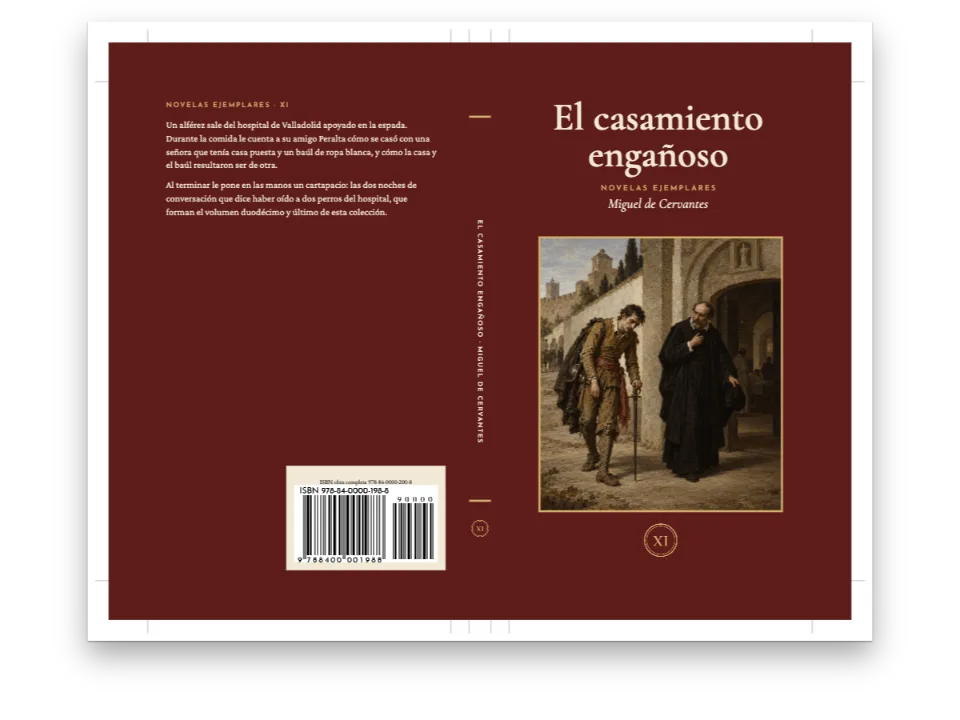
Un libro de bolsillo con dos leyendas de Bécquer y el pliego de su cubierta: contracubierta, lomo, cubierta y las dos solapas en una pieza. El lomo mide lo que abultan las páginas, así que se calcula a partir del libro.
Lo que vas a componer
El monte de las ánimas y Los ojos verdes, de Bécquer, en una rústica de bolsillo de 120 × 190 mm con solapas de 60 mm, y el pliego en que se imprime su cubierta. Postext compone antes las 37 páginas: anteportada, portada, créditos, índice, una hoja de título para cada leyenda y el texto en Crimson Pro de 11/15,2. Después buildCover toma esas páginas y monta el pliego: solapa trasera, contracubierta con el texto de presentación y el código de barras, lomo, cubierta con una pintura de una capilla en ruinas al pie del Moncayo y solapa delantera. Título, subtítulo y autor salen de los metadatos del libro, y el texto de las solapas, de un Markdown aparte.
Esta receta responde a
- ¿Cómo hago el pliego de cubierta de una rústica con solapas, con el lomo calculado a partir de las páginas?
La respuesta corta
// The book's own binding profile: PUR perfect binding in 16-page signatures, flaps of
// 60 mm whatever the trim. The spine is written nowhere: buildCover works it out from the
// laid-out pages, rounded up to whole signatures, on the paper of `folio.paper`.
const production = {
  bindings: [{ id: 'pur-flaps', name: 'PUR perfect binding, 60 mm flaps', style: 'perfect',
    signature: 16, measures: { flapWidth: 60, bleed: 3, spineAllowance: 0.5 } }],
  versions: [{ id: 'paperback', name: t({ en: 'Paperback', es: 'Rústica' }), binding: 'pur-flaps',
    flaps: true, isbn: '978-84-0000-196-4', isbnAddOn: '90000' }],
};
// 100 g/m² bulky cream wove at a bulk of 2.4: each leaf is 100 × 2.4 = 240 µm thick.
const folio = { paper: { type: 'bookWove', grammage: 100, bulk: 2.4, shade: '#f7f1e3' } };
// The design: a night ground over the whole sheet and the painting on the front, into the
// bleed at head and foot and up to the flap's fold. The texts come from the cover Markdown,
// the title, subtitle and author from the book's metadata.
const cover = {
  background: col('night'),
  elements: [{ id: 'art', kind: 'image', zone: 'front', x: 0, y: -3, width: 118, height: 196,
    resourceId: 'moncayo', fit: 'cover' }],
  verticalAlign: { back: 'middle' },
};
Ingredientes
- Funciones
- Pliego de cubiertaVersiones impresas, ISBN y lomoCubiertas, portadas y colofonesEstilos de títuloAperturas diseñadasTextos, filetes y cajas en los diseños de páginaMetadatos del documentoEstilos de párrafoÍndice generalCabeceras y foliosFiguras y tablas como recursosPaleta de color semánticaExportación a PDFPáginas en un canvas
- También usa
- Papel, encuadernación, mesa y luz (Folio)Atributos de títuloColor del papelCabeceras según el tipo de páginaFuentes incrustadas en el PDFCabeceras por secciónCapítulos sin número
- Tipografía
- Crimson Pro, Cormorant Garamond, Josefin Sans (SIL OFL 1.1)
- Recursos
moncayo-1100.jpg- La cubierta: una capilla en ruinas bajo el Moncayo la noche de difuntos, al óleo (Generated With Diffusion Models, original)
Elaboración
#1 · La encuadernación pone las solapas y el papel pone el lomo
El código es la respuesta corta de arriba. El perfil de encuadernación describe cómo trabaja el taller: fresado con PUR en cuadernillos de 16 páginas, solapas de 60 mm, 3 mm de sangrado y medio milímetro más de lomo para la cola. La versión lleva el ISBN y su complemento de cinco cifras; el ISBN es un número de muestra que no corresponde a ningún libro. El ancho del lomo no aparece escrito en ninguna parte. Las 37 páginas se redondean a tres cuadernillos, 48 páginas o 24 hojas, y cada hoja de papel de 100 g/m² con 2,4 de mano mide 240 µm: 24 × 0,24 + 0,5 da un lomo de 6,3 mm. Por omisión un lomo de menos de 6 mm no se rotula (spineText.minSpine), y por eso el libro va en un papel de mucha mano.
#2 · Primero, las páginas
const [W, H, TOP, FOOT, INNER, OUTER, LEAD] = [120, 190, 20, 22, 18, 15.5, 15.2]; // mm, pt
const at = (to, edge, x, y, size) => ({ anchor: { to, edge }, offset: { x: mm(x), y: mm(y) },
  ...(size && { size }) });
const text = (id, content, look, place) => ({ kind: 'text', id, content, align: 'center',
  overflow: 'wrap', placement: place, ...look });
const face = (fontFamily, size, color, extra) => ({ fontFamily, fontSize: pt(size), color,
  ...extra });
const label = (size, color = col('muted')) => face('Josefin Sans', size, color, caps(size / 5));
const none = { header: { elements: [] }, footer: { elements: [] }, numbered: false, toc: false };
const design = (minHeight, elements) => ({ enabled: true, minHeight: mm(minHeight),
  slot: { elements } });
const page = (parity) => ({ breakBefore: { enabled: true, parity } });
const rule = (id, y, to = 'page') => ({ kind: 'rule', id, direction: 'horizontal',
  thickness: pt(0.6), color: col('accent'), placement: at(to, 'top', 0, y, { width: mm(10) }) });
const folioAt = (y, pages) => ({ elements: [text('f', '{pageNumber}',
  { ...face('Crimson Pro', 9, col('ink')), pages }, at('page', 'bottom', 0, y))] });
const serif = (size, extra) => face('Cormorant Garamond', size, col('ink'), extra);
const headingStyles = [
  { ...none, id: 'half-title', advancedDesign: design(60, [
    text('t', '{title}', serif(17, { fontWeight: 500 }), at('page', 'top', 0, 62))]) },
  { ...none, ...page('odd'), id: 'title-page', advancedDesign: design(H - TOP - FOOT, [
    text('t', '{title}', serif(27, { fontWeight: 600 }), at('page', 'top', 0, 46)),
    text('s', '{subtitle}', serif(13, { italic: true }), at('page', 'top', 0, 58)),
    rule('r', 67),
    text('a', '{author}', label(8, col('accent')), at('page', 'top', 0, 72)),
    text('tr', '{attr.translators}', face('Crimson Pro', 9.5, col('muted'), { italic: true }),
      at('page', 'top', 0, 118, { width: mm(70) })),
    text('i', '{attr.imprint}', label(7), at('page', 'bottom', 0, -26)),
  ]) },
  // The rights at the foot of the verso, under a short rule.
  { ...none, ...page('even'), id: 'rights',
    advancedDesign: design(92, [rule('r', 86, 'container')]) },
  { ...none, ...page('odd'), id: 'contents', advancedDesign: design(34, [
    text('t', '{titleText}', label(8, col('accent')), at('container', 'top', 0, 14)),
    rule('r', 21, 'container')]) },
  // Each legend has a title leaf of its own (the contents point to it), then opens on the
  // next recto, sunk 40 mm.
  { ...none, ...page('odd'), id: 'tale-title', toc: true, advancedDesign: design(90, [
    text('k', '{attr.kicker}', serif(15, { fontWeight: 600, color: col('accent') }),
      at('page', 'top', 0, 58)),
    text('t', '{titleText}', serif(23, { fontWeight: 500 }), at('page', 'top', 0, 67)),
    text('p', '{attr.place}', face('Crimson Pro', 10.5, col('muted'), { italic: true }),
      at('page', 'top', 0, 79)),
    rule('r', 88)]) },
  { ...page('odd'), id: 'tale', toc: false, advancedDesign: design(40, [
    text('t', '{titleText}', serif(15, { fontWeight: 500, italic: true }),
      at('container', 'top', 0, 16)),
    rule('r', 25, 'container')]) },
  { ...none, ...page('any'), id: 'colophon', advancedDesign: design(70, [
    rule('r', 60, 'container')]) },
];
const head = (id, content, parity) => text(id, content, { ...label(6.8), parity, pages: 'body' },
  at('page', 'top', 0, 11));
La tripa es un documento de Postext como cualquier otro, y cada página que tenga cuenta para el lomo. Los preliminares usan estilos de título cuyos diseños colocan el título, el filete y el pie editorial a alturas fijas de la página. Cada leyenda tiene su propia hoja de título (la que señala el índice) y vuelve a empezar en la impar siguiente, 40 mm más abajo. Si cambias el cuerpo de letra o los márgenes, cambia el número de páginas, y el lomo lo sigue en la siguiente composición.
#3 · Los estilos de la cubierta van con los del libro
const style = (id, fontFamily, size, lead, color, extra) => ({ id, fontFamily, fontSize: pt(size),
  lineHeight: pt(lead), color, italicColor: color, firstLineIndent: mm(0), textAlign: 'left',
  hyphenation: false, ...extra });
const caps = (tracking) => ({ fontWeight: 600, textTransform: 'uppercase',
  letterSpacing: pt(tracking) });
const coverStyles = [
  style('cover-title', 'Cormorant Garamond', 40, 40, col('bone'), { fontWeight: 600,
    textAlign: 'center', marginTop: mm(12) }),
  style('cover-subtitle', 'Cormorant Garamond', 15, 19, col('bone'), { italic: true,
    textAlign: 'center' }),
  style('cover-author', 'Josefin Sans', 8.5, 11, col('gold'), { ...caps(1.8),
    textAlign: 'center', marginTop: pt(16) }),
  style('cover-spine', 'Josefin Sans', 7.5, 9, col('bone'), { ...caps(1.2), textAlign: 'center' }),
  style('cover-blurb', 'Crimson Pro', 10.5, 14.5, col('bone'), { marginBottom: pt(7) }),
  style('cover-note', 'Crimson Pro', 10.5, 14.5, col('gold'), { italic: true }),
  style('flap-head', 'Josefin Sans', 7.5, 10, col('gold'), caps(1.4)),
  style('flap-text', 'Crimson Pro', 9.6, 13.2, col('bone'), { marginTop: pt(5) }),
];
El pliego se compone con la configuración del libro, así que sus estilos de párrafo están en la misma lista que los de los créditos y el colofón. cover-title, cover-subtitle, cover-author y cover-spine son los nombres que buildCover da a los metadatos que coloca; cover-blurb, cover-note, flap-head y flap-text los nombra el Markdown de la cubierta. Sobre el fondo de noche el texto va en bandera, sin guiones, en el hueso y el oro de la paleta.
#4 · El pliego sale de las páginas compuestas
const built = buildCover({ config, version: 'paperback', pages: book.pages, markdown: coverText,
  metadata: book.metadata, resources });
if (!('config' in built)) throw new Error(built.issues.map((i) => i.kind).join(', '));
// The barcode is the cover's own picture. Its digits name OCR-B, which no font server
// has: they are set in the label face, which the PDF embeds like the rest.
for (const [id, bytes] of Object.entries(built.files)) {
  await loadSvg(id, new TextDecoder().decode(bytes)
    .replace(/font-family="[^"]*"/g, 'font-family="Josefin Sans"'));
}
const sheet = await buildDocumentWithFonts(built.content, built.config, kitFonts(FONTS));
buildCover recibe las páginas, los metadatos y el Markdown de la cubierta, con un :::frame para la contracubierta y otro para cada solapa. Devuelve un documento que buildDocumentWithFonts compone como cualquier otro, además del código de barras en un archivo SVG. Las cifras del código piden OCR-B, que no está en ningún servidor de fuentes, así que el ejemplo las pone en Josefin Sans, una fuente que el PDF ya incrusta. El PDF lleva las 37 páginas y detrás el pliego a su tamaño, que es el archivo que espera una imprenta.
La receta completa
// ═══ Postext Cookbook · Nº 196 · A paperback cover with flaps, spine from the pages ═══
// https://postext.dev/en/cookbook/paperback-cover-with-flaps
// Code: MIT · Text: Bécquer, tr. C. F. & K. L. Bates (public domain) · Art: diffusion models
// Fonts: Crimson Pro, Cormorant Garamond, Josefin Sans (SIL OFL 1.1) · Needs postext ≥ 1.92.0
//
// Two of Bécquer's legends as a 120 × 190 mm paperback with 60 mm flaps. Postext lays the
// pages out first; buildCover then makes the cover sheet from them, its spine as thick as
// the pages on their paper.
import {
  buildDocumentWithFonts, renderPageToCanvas, registerResourceImage, inlineSvgFonts,
} from 'https://esm.sh/postext';
import { buildCover } from 'https://esm.sh/postext/production';
import { renderToPdf, decompressWoff2 } from 'https://esm.sh/postext-pdf';

const LANG = 'es'; // @lang: the language of the sample document ('en' | 'es')
const RECIPE = 'paperback-cover-with-flaps';

// ─── 1 · Design ─────────────────────────────────────────────────────────────
const palette = { ink: '#25221e', accent: '#86472a', muted: '#6b645a', paper: '#fbf7ee',
  night: '#16242a', gold: '#c99b4e', bone: '#eee5d1' }; // the last three: the cover's
const col = (id) => ({ hex: palette[id], model: 'hex', paletteId: id });
const colorPalette = [
  ...Object.entries(palette).map(([id, hex]) => ({ id, name: id, value: { hex, model: 'hex' } })),
  { id: 'main-color', name: 'accent (defaults)', value: { hex: palette.accent, model: 'hex' } },
];

// #region answer: the paperback: a printer's binding with 60 mm flaps, its ISBN, its paper
// The book's own binding profile: PUR perfect binding in 16-page signatures, flaps of
// 60 mm whatever the trim. The spine is written nowhere: buildCover works it out from the
// laid-out pages, rounded up to whole signatures, on the paper of `folio.paper`.
const production = {
  bindings: [{ id: 'pur-flaps', name: 'PUR perfect binding, 60 mm flaps', style: 'perfect',
    signature: 16, measures: { flapWidth: 60, bleed: 3, spineAllowance: 0.5 } }],
  versions: [{ id: 'paperback', name: t({ en: 'Paperback', es: 'Rústica' }), binding: 'pur-flaps',
    flaps: true, isbn: '978-84-0000-196-4', isbnAddOn: '90000' }],
};
// 100 g/m² bulky cream wove at a bulk of 2.4: each leaf is 100 × 2.4 = 240 µm thick.
const folio = { paper: { type: 'bookWove', grammage: 100, bulk: 2.4, shade: '#f7f1e3' } };
// The design: a night ground over the whole sheet and the painting on the front, into the
// bleed at head and foot and up to the flap's fold. The texts come from the cover Markdown,
// the title, subtitle and author from the book's metadata.
const cover = {
  background: col('night'),
  elements: [{ id: 'art', kind: 'image', zone: 'front', x: 0, y: -3, width: 118, height: 196,
    resourceId: 'moncayo', fit: 'cover' }],
  verticalAlign: { back: 'middle' },
};
// #endregion
El script.js compuesto funciona tal cual: pégalo como script de módulo en cualquier página o abre la receta en CodePen. Carpeta de la receta en GitHub ↗ (se abre en una nueva pestaña)
Variantes
#Rotula el lomo de arriba abajo
Los libros ingleses y norteamericanos leen el lomo de arriba abajo; la opción por omisión, de abajo arriba, es la costumbre española y europea.
   versions: [{ id: 'paperback', name: t({ en: 'Paperback', es: 'Rústica' }), binding: 'pur-flaps',
-    flaps: true, isbn: '978-84-0000-196-4', isbnAddOn: '90000' }],
+    flaps: true, isbn: '978-84-0000-196-4', isbnAddOn: '90000',
+ spineText: { direction: 'topToBottom' } }],#Imprime en un papel más fino
Con 80 g/m² y 2,2 de mano la hoja mide 176 µm, el lomo baja a 4,7 mm y pierde el rótulo, que necesita 6 mm.
-const folio = { paper: { type: 'bookWove', grammage: 100, bulk: 2.4, shade: '#f7f1e3' } };
+const folio = { paper: { type: 'bookWove', grammage: 80, bulk: 2.2, shade: '#f7f1e3' } };Errores frecuentes
- En la lista de páginas capturadas el pliego va detrás de las del libro, así que su número es el de páginas del libro más uno. Si el libro gana una página, el número cambia.
- Un código de barras cuyas cifras piden una fuente que el PDF no encuentra hace fallar la exportación. Carga su SVG con un
font-familyque el ejemplo ya tenga.
Créditos
- Receta
- Ignacio Ferro
- Texto
- The Spirits’ Mountain y The Emerald Eyes, en la traducción de Cornelia Frances Bates y Katharine Lee Bates, de Romantic Legends of Spain (1909), libro electrónico n.º 50044 del Proyecto Gutenberg · Gustavo Adolfo Bécquer · dominio público
- El monte de las ánimas y Los ojos verdes, de las Obras (Madrid, Fernando Fe, 1885) según la transcripción de Wikisource, con la acentuación modernizada · Gustavo Adolfo Bécquer · dominio público
- Imágenes
- La cubierta: una capilla en ruinas bajo el Moncayo la noche de difuntos, al óleo · Generated With Diffusion Models · original
- Fuentes
- Crimson Pro (SIL OFL 1.1) · Cormorant Garamond (SIL OFL 1.1) · Josefin Sans (SIL OFL 1.1)
- Código
- MIT, como Postext
Editar este texto ↗ (se abre en una nueva pestaña)Carpeta de la receta en GitHub ↗ (se abre en una nueva pestaña)