En pocas palabras
Un libro de cartón para los más pequeños. Cada agujero de una página deja ver un trocito del dibujo siguiente, el texto hace una pregunta y al pasar la página se ve lo que era de verdad.
Lo que vas a componer
¡Cucú! ¿Quién hay en el jardín?, un libro de cartón de catorce páginas en un cuadrado de 160 mm con las cuatro esquinas redondeadas. Cada pintura tiene un agujero, y el agujero está justo donde la pintura siguiente guarda la parte que engaña al ojo: el lomo a rayas de un gato dormido que podría ser un tigre, la lana de una oveja que podría ser una nube, un farolillo que podría ser la luna. La ventana de la cubierta es más ancha que el agujero de detrás, así que la primera mirada llega dos páginas al fondo. El texto de la izquierda pregunta; al pasar la página llega la respuesta. El PDF de imprenta lleva la línea de troquel en una plancha propia.
Esta receta responde a
- ¿Cómo troquelo agujeros en las páginas de un libro para que cada uno deje ver parte del dibujo siguiente?
- ¿Cómo entrego al troquelador la línea de troquel en una plancha propia del PDF?
La respuesta corta
// Each painting is cut where the next one's telling part lies: the cat's striped flank, the
// sheep's wool, the lantern's glow. The cover's window is wider than the hedge's hole and
// holds it, so from the cover you see the hedge, and through the hedge the cat. A hole cuts
// both sides of its leaf, mirrored on the verso, and the words there run round it.
const circle = (id, name, cx, cy, d) => ({ id, name, shape: 'circle', x: mm(cx - d / 2),
  y: mm(cy - d / 2), width: mm(d), height: mm(d), wrap: { gap: mm(4) } });
const dieCuts = {
  shapes: [
    circle('window', t({ en: 'Cover window', es: 'Ventana de la cubierta' }), 112, 68, 60),
    circle('hedge', t({ en: 'Gap in the hedge', es: 'Hueco del seto' }), 112, 60, 36),
    { id: 'knot', name: t({ en: 'Knothole', es: 'Nudo de la valla' }), shape: 'ellipse',
      x: mm(102), y: mm(48), width: mm(32), height: mm(40), wrap: { gap: mm(4) } },
    circle('peephole', t({ en: 'Barn-door peephole', es: 'Mirilla del granero' }), 91, 29, 20),
  ],
  // By position in the book: page 1 is the cover, 3 the hedge, 7 the fence, 11 the door.
  pages: [{ pages: '1', die: 'window' }, { pages: '3', die: 'hedge' },
    { pages: '7', die: 'knot' }, { pages: '11', die: 'peephole' }],
  corners: { radius: mm(9), edges: 'all' }, // board books are rounded on all four corners
};
Ingredientes
- Funciones
- Agujeros troqueladosEsquinas redondeadas y libros con formaLínea de troquel en el PDFAgujeros a través de varias hojasVisor de libro en 3D (Folio)Estilos de títuloImágenes en los diseños de páginaAtributos de títuloEstilos de párrafoSangrado y marcas de cortePDF en CMYK y en escala de grisesExportación a PDFFiguras y tablas como recursosPaleta de color semánticaPáginas en un canvas
- También usa
- Papel, encuadernación, mesa y luz (Folio)Aperturas diseñadasColor del papelColores por parteFuentes incrustadas en el PDFGeometría por secciónCapítulos sin número
- Tipografía
- Andika, Fredoka, Nunito (SIL OFL 1.1)
- Recursos
cat.jpgcover.jpgdoor.jpgfence.jpghedge.jpglantern.jpgsheep.jpg- Pintura de cubierta: un jardín, un seto, malvarrosas y un petirrojo (Generated With Diffusion Models, original)
- Página 3: el seto (Generated With Diffusion Models, original)
- Página 5: el gato pelirrojo dormido (Generated With Diffusion Models, original)
- Página 7: la valla de madera (Generated With Diffusion Models, original)
- Página 9: la oveja (Generated With Diffusion Models, original)
- Página 11: la puerta del granero (Generated With Diffusion Models, original)
- Página 13: el abuelo con su farolillo al anochecer (Generated With Diffusion Models, original)
Elaboración
#1 · Agujeros donde el dibujo siguiente se delata
El código es la respuesta corta de arriba. Cada forma se coloca desde la esquina superior izquierda del corte y dieCuts.pages dice qué página corta, contando desde la primera del libro. Mide el agujero sobre la pintura que descubre, no sobre la página donde se corta: el seto, la valla y la puerta son texturas que admiten un agujero en cualquier sitio; el gato y el farolillo no.
#2 · Pinturas en registro con los agujeros
// Each painting hangs from the trim and runs BLEED past it on every side, so the holes hit it
// in the same place on screen and in print. A picture's section drops the foot margin, so its
// design reaches the foot of the page; the words on the verso behind it, in the same section,
// start TOP down.
const SHEET = { width: mm(TRIM + 2 * BLEED), height: mm(TRIM + 2 * BLEED) }; // trim + bleed
const painting = { kind: 'image', id: 'painting', resourceId: '{attr.picture}', fit: 'cover',
  placement: at('page', 'top-left', -BLEED, -BLEED, SHEET) };
const full = (elements) => ({ enabled: true, minHeight: mm(TRIM - TOP), slot: { elements } });
const flush = { margins: { top: mm(TOP), bottom: mm(0), left: mm(INNER), right: mm(OUTER) } };
const title = { kind: 'text', id: 'title', content: '{titleText}', fontFamily: DISPLAY,
  fontWeight: 600, fontSize: pt(40), lineHeight: 1, color: col('accent'), align: 'left',
  placement: at('page', 'top-left', 62, 8, { width: mm(88) }) };
const headingStyles = [
  { id: 'cover', numbered: false, toc: false, ...flush, advancedDesign: full([painting, title]) },
  { id: 'picture', numbered: false, ...flush, breakBefore: { enabled: true, parity: 'odd' },
    advancedDesign: full([painting]) },
  // The back cover: the board printed dusk blue (the section's palette), the type in cream.
  { id: 'back', numbered: false, toc: false, breakBefore: { enabled: true, parity: 'even' },
    color: col('cream'), palette: { paper: palette.dusk } },
];
Los agujeros van en milímetros desde el corte, así que cada pintura cuelga del corte y lo rebasa el sangrado por los cuatro lados, igual en pantalla que en imprenta. El estilo de las pinturas solo quita el margen inferior: su diseño llega al pie de la página, y el texto del verso de detrás conserva sus 44 mm de margen superior, que lo bajan por debajo de los agujeros pequeños.
#3 · La línea de troquel en su plancha
  // The die line is stroked on a Separation plate of its own ('Die'), overprinting, that the
  // press never inks. PDF/X-4 on coated stock: the board is printed on coated paper.
  print: { standard: 'pdfx4', outputProfile: 'fogra51', convertImages: false,
    dieLine: { output: 'page', ink: 'Die', width: pt(0.5) } },
El PDF imprime cada página entera y traza el contorno de cada agujero, y de cada hoja redondeada, en una separación Die en sobreimpresión que nunca se entinta. convertImages: false deja las pinturas como JPEG RGB etiquetados sRGB, que PDF/X-4 admite, y el archivo sigue siendo pequeño.
#4 · El libro en la mano
  folio: {
    tilt: 50, yaw: -32,
    paper: { type: 'board', shade: '#fbf5e8' },
    binding: { type: 'hardcover', cover: 'pages', coverMaterial: 'paper' },
    surface: { type: 'oak' },
    lighting: { environment: 'daylight', intensity: 1.05 },
  },
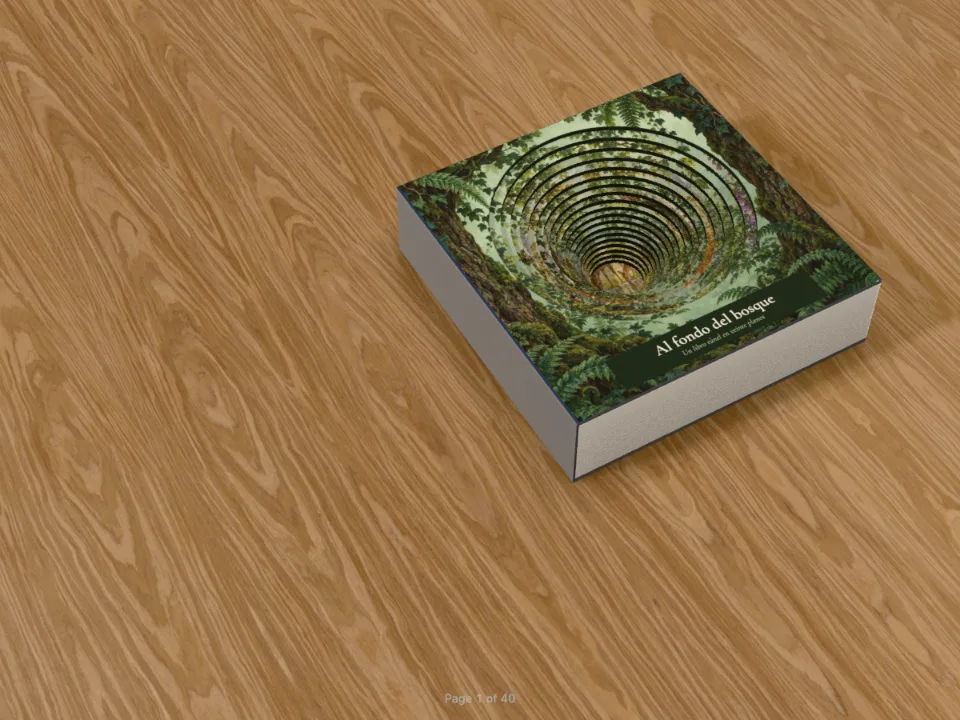
Folio corta los agujeros en cada hoja y enseña las páginas de debajo con las paredes del corte, así que la ventana escalonada se lee como profundidad. El cartón se pasa rígido y las esquinas redondeadas se cortan en todas las hojas.
#5 · Páginas planas que dejan ver
// renderPageToCanvas cuts the holes; `beneath` hands it the pages under them, painted here
// at a lower scale (the composite stretches them to the page), each with its own holes.
const under = new Map();
const beneath = (i) => {
  if (!under.has(i) && doc.pages[i]) {
    const canvas = document.createElement('canvas');
    under.set(i, canvas);
    renderPageToCanvas(doc.pages[i], doc, canvas, { scale: 1, beneath });
  }
  return under.get(i);
};
En el canvas, un agujero muestra lo que haya detrás del canvas si el renderizador no recibe las páginas de debajo. beneath las devuelve por índice, cada una pintada con sus propios agujeros, y así la cubierta deja ver el seto y, a través del seto, el gato.
La receta completa
// ═══ Postext Cookbook · Nº 193 · A peek-a-boo board book with holes in register ════════
// https://postext.dev/en/cookbook/peek-a-boo-board-book
// Code: MIT · Text: original (CC BY 4.0) · Paintings: generated with diffusion models
// Fonts: Andika, Fredoka, Nunito (SIL OFL 1.1) · Needs postext ≥ 1.84.0
//
// A fourteen-page board book for toddlers: on every other recto a hole is cut through the
// painting, and what shows through it is a scrap of the next picture. The words on the left
// make a guess from the scrap; the turned page shows what it really is. The leaves have
// rounded corners, the holes step down from the cover, and the PDF carries the die line.
import {
  buildDocumentWithFonts, renderPageToCanvas, registerResourceImage,
} from 'https://esm.sh/postext';
import { renderToPdf, decompressWoff2 } from 'https://esm.sh/postext-pdf';
import { createFolioFromDocument } from 'https://esm.sh/postext-folio';

const LANG = 'es'; // @lang: the language of the sample document ('en' | 'es')
const RECIPE = 'peek-a-boo-board-book';

// ─── 1 · Design ─────────────────────────────────────────────────────────────
// #region palette: a cream board, a robin red for the title and the guesses, a dusk blue
const palette = {
  ink: '#2a2420', // text: a warm near-black
  accent: '#b8432c', // the cover title and the guesses: the robin's breast
  paper: '#fbf5e8', // the board the words are printed on
  dusk: '#253a63', // the back cover, the blue of the last painting's sky
  cream: '#fff9ec', // type on the cover and the back
  muted: '#7a6f64', // the colophon
};
const col = (id) => ({ hex: palette[id], model: 'hex', paletteId: id });
const colorPalette = [
  ...Object.entries(palette).map(([id, hex]) => ({ id, name: id, value: { hex, model: 'hex' } })),
  { id: 'main-color', name: 'accent (defaults)', value: { hex: palette.accent, model: 'hex' } },
];
// #endregion
const [TRIM, BLEED] = [160, 3]; // mm: a square board book, and its bleed
const [TOP, FOOT, INNER, OUTER] = [44, 16, 18, 16]; // the words sit low, under the holes' tops
const [TEXT, DISPLAY, LABEL] = ['Andika', 'Fredoka', 'Nunito'];
const LEAD = 31; // pt: 24 pt type on a generous leading, for reading aloud
const at = (to, edge, x = 0, y = 0, size) => ({ anchor: { to, edge },
  offset: { x: mm(x), y: mm(y) }, ...(size && { size }) });

// #region answer: the dies, and the pages they cut
// Each painting is cut where the next one's telling part lies: the cat's striped flank, the
// sheep's wool, the lantern's glow. The cover's window is wider than the hedge's hole and
// holds it, so from the cover you see the hedge, and through the hedge the cat. A hole cuts
// both sides of its leaf, mirrored on the verso, and the words there run round it.
const circle = (id, name, cx, cy, d) => ({ id, name, shape: 'circle', x: mm(cx - d / 2),
  y: mm(cy - d / 2), width: mm(d), height: mm(d), wrap: { gap: mm(4) } });
El script.js compuesto funciona tal cual: pégalo como script de módulo en cualquier página o abre la receta en CodePen. Carpeta de la receta en GitHub ↗ (se abre en una nueva pestaña)
Variantes
#Redondea solo las esquinas del corte delantero
Un álbum ilustrado redondea las dos esquinas lejos del lomo y deja el lomo en escuadra.
-  corners: { radius: mm(9), edges: 'all' }, // board books are rounded on all four corners
+ corners: { radius: mm(6), edges: 'fore' },#Corta cada hoja con una forma
Un contorno en unidades de viewBox corta cada hoja, en espejo en los versos; manda sobre las esquinas.
   corners: { radius: mm(9), edges: 'all' }, // board books are rounded on all four corners
+ outline: { d: 'M0 0.35 L0.5 0 L1 0.35 L1 1 L0 1 Z', viewBox: [1, 1] }, // a houseCréditos
- Receta
- Ignacio Ferro
- Texto
- El texto del libro de cartón · Postext Cookbook · CC BY 4.0
- Imágenes
- Pintura de cubierta: un jardín, un seto, malvarrosas y un petirrojo · Generated With Diffusion Models · original
- Página 3: el seto · Generated With Diffusion Models · original
- Página 5: el gato pelirrojo dormido · Generated With Diffusion Models · original
- Página 7: la valla de madera · Generated With Diffusion Models · original
- Página 9: la oveja · Generated With Diffusion Models · original
- Página 11: la puerta del granero · Generated With Diffusion Models · original
- Página 13: el abuelo con su farolillo al anochecer · Generated With Diffusion Models · original
- Fuentes
- Andika (SIL OFL 1.1) · Fredoka (SIL OFL 1.1) · Nunito (SIL OFL 1.1)
- Código
- MIT, como Postext
Editar este texto ↗ (se abre en una nueva pestaña)Carpeta de la receta en GitHub ↗ (se abre en una nueva pestaña)