En bref
Indiquez jusqu’où chaque tableau va sur sa page, dans les marges, jusqu’à la coupe ou au-delà, et donnez au détail sa largeur en millimètres. Les pages se composent d’elles-mêmes.
Ce que vous allez composer
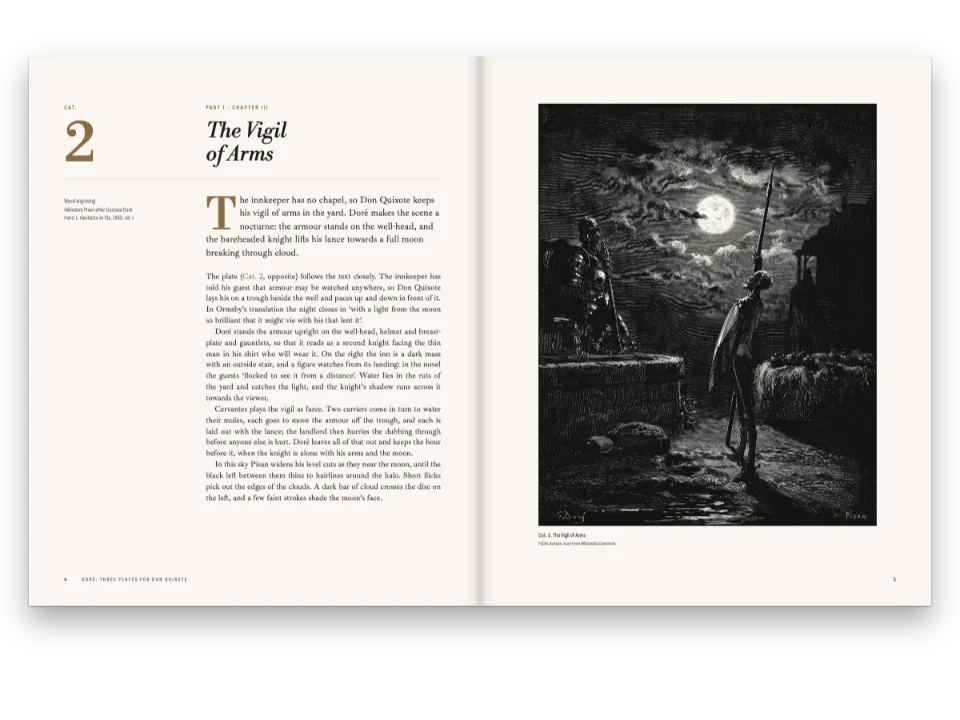
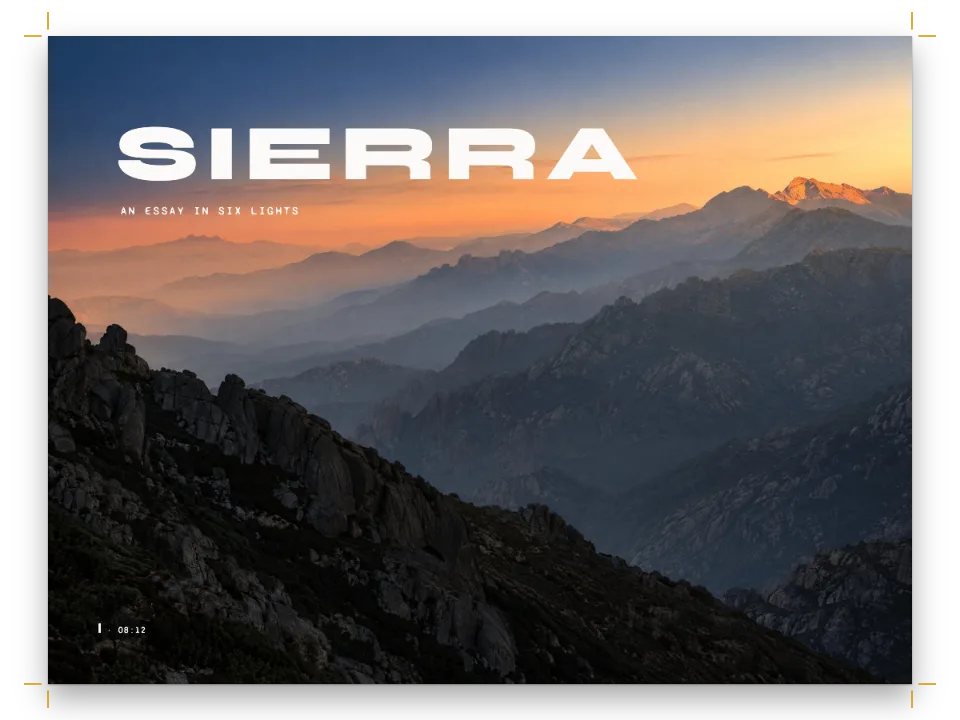
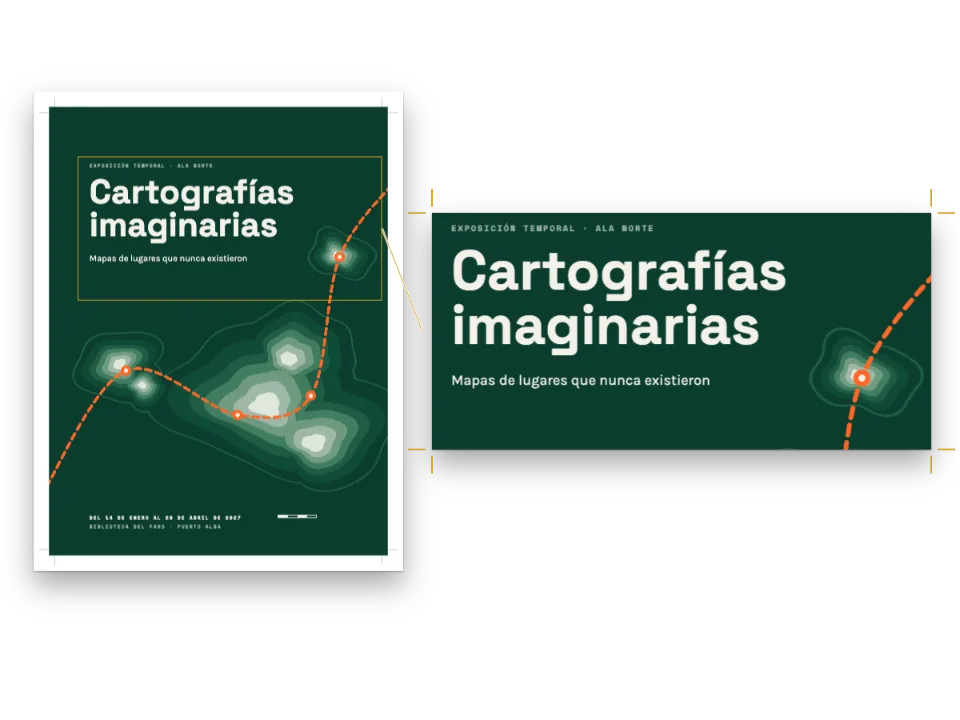
Sept pages d’un petit catalogue d’exposition, 160 × 195 mm, sur quatre intérieurs de Johannes Vermeer du Rijksmuseum, du Met et de la National Gallery of Art. L’essai s’ouvre sur une belle page, titre descendu. Chaque tableau qu’il cite occupe seul la page entière suivante : La Laitière, page 2, dans les marges et sous son titre courant ; la Jeune Femme à l’aiguière et la Femme lisant une lettre se font face pages 4 et 5, l’une arrêtée à la coupe, l’autre poussée dans le fond perdu au-delà des traits de coupe, toutes deux sans titre courant ni folio. Un détail de la balance s’imprime à 60 mm page 7, sa légende à côté. Le PDF porte les traits, une TrimBox et une BleedBox.
Cette recette répond à
- Comment imprimer un tableau en planche pleine page (dans les marges, jusqu’à la coupe ou à fond perdu) et un détail à une largeur fixée en mm ?
- Comment faire un catalogue d’art : notice sur la page de gauche, planche sur la page de droite en regard ?
- Comment produire un PDF prêt pour l’impression avec fond perdu, traits de coupe, signets, étiquettes de page et espace colorimétrique ?
La réponse courte
// Every plate stands alone on the first whole page after its citation, as large as the area
// allows. true (or 'content') keeps it inside the margins with its running heads; 'trim'
// covers the page to the cut, 'bleed' to the bleed. Those two crop the picture about its
// centre, put the caption on a band of paper at the foot, and drop the heads and the folio.
const plateType = { id: 'plate', name: t({ en: 'Plate', es: 'Lámina' }),
  shortLabel: t({ en: 'plate', es: 'lámina' }), captionPrefix: t({ en: 'Plate', es: 'Lámina' }),
  numberingTemplate: '{n}', resetOn: 'never', counterFormat: 'decimal',
  defaultPlacement: { plate: true, captionMeasure: 'body' } }; // the caption as wide as it
const REACH = { milkmaid: 'content', pitcher: 'trim', letter: 'bleed', balance: 'content' };
// A width as a length is measured against the slot, not shared out of it: the detail prints
// 60 mm wide in any layout, 1.25 times the 48 mm of canvas it shows. Its caption stands
// beside it in what is left of the column.
const DETAIL = { width: { value: 60, unit: 'mm' }, captionSide: 'inside', align: 'left' };
Ingrédients
- Fonctionnalités
- Planches pleine pageLargeurs de figure en millimètresFigures et tableaux comme ressourcesDes citations qui placent les figuresTypes de ressource personnalisésLégendes numérotéesStyle des légendesLignes de source et de créditLégendes latéralesFond perdu et traits de coupeTitres courants selon le rôle de la pageTitres courants et foliosMarges en miroirOuvertures composéesAttributs de titreStyles de paragraphePalette de couleurs sémantiqueExport PDF
- Typographie
- Spectral, Cormorant Garamond, Jost (SIL OFL 1.1)
- Ressources
balance-1700.jpgbalance-detail-1051.jpgletter-2400.jpgmilkmaid-1800.jpgpitcher-2400.jpg- Plate 1, Johannes Vermeer, The Milkmaid, c. 1660, Rijksmuseum SK-A-2344; the museum’s image reduced to 1,800 px high (Rijksmuseum, Amsterdam, CC0 1.0)
- Plate 2, Johannes Vermeer, Young Woman with a Water Pitcher, c. 1662, The Met 89.15.21; the museum’s image, its unpainted edges cut off, reduced to 2,400 px high (The Metropolitan Museum of Art, New York (Open Access), CC0 1.0)
- Plate 3, Johannes Vermeer, Woman Reading a Letter, c. 1663, Rijksmuseum SK-C-251; the museum’s image reduced to 2,400 px high (Rijksmuseum, Amsterdam, CC0 1.0)
- Plate 4, Johannes Vermeer, Woman Holding a Balance, c. 1664, National Gallery of Art 1942.9.97; the museum’s image reduced to 1,700 px high (National Gallery of Art, Washington (Open Access), CC0 1.0)
- Figure 1, a 48 × 63 mm detail of plate 4 cut from the museum’s full-resolution image and reduced to 800 px wide (National Gallery of Art, Washington (Open Access), CC0 1.0)
Préparation
#1 · Un type pour les planches, une portée par tableau
Le code est la réponse courte ci-dessus. Le type des planches met plate: true dans son placement par défaut : un tableau cité par l’essai passe à la première page qu’il peut avoir entière et grandit jusqu’à la zone de texte, sa légende dessous. REACH change cela tableau par tableau : 'trim' et 'bleed' couvrent la page et recadrent l’image autour de son centre, d’où l’intérêt de choisir des tableaux proches du format de la page (ceux-ci font de 0,85 à 0,89 de large pour 1 de haut, la page 0,82). captionMeasure: 'body' donne à la légende d’une planche intérieure la largeur de l’image.
#2 · Chaque fichier à la mesure de son impression
// JPEGs in assets/ at the pixels each needs for 300 ppi where it prints: 2,400 px high for
// the plates that cover the page (195 mm + 2 × 3 mm of bleed is 7.9 in), less for the rest.
const PAINTINGS = {
  milkmaid: [[1617, 1800], { en: 'Johannes Vermeer, *The Milkmaid*, c. 1660',
    es: 'Johannes Vermeer, *La lechera*, h. 1660' }, { en: 'Oil on canvas, 45.5 × 41 cm. '
    + 'Rijksmuseum, Amsterdam, SK-A-2344, purchased with the support of the Vereniging '
    + 'Rembrandt. Public domain.', es: 'Óleo sobre lienzo, 45,5 × 41 cm. Rijksmuseum, '
    + 'Ámsterdam, SK-A-2344, adquirido con el apoyo de la Vereniging Rembrandt. Dominio '
    + 'público.' }, { en: 'A kitchen maid in a yellow bodice and blue apron pours milk from '
    + 'a jug into a bowl beside a basket of bread, under a window on the left.', es: 'Una '
    + 'criada con corpiño amarillo y delantal azul vierte leche de una jarra en un cuenco, '
    + 'junto a un cesto de pan, bajo una ventana a la izquierda.' }],
  pitcher: [[2116, 2400], { en: 'Johannes Vermeer, *Young Woman with a Water Pitcher*, '
    + 'c. 1662', es: 'Johannes Vermeer, *Joven con una jarra de agua*, h. 1662' },
  { en: 'Oil on canvas, 45.7 × 40.6 cm. The Metropolitan Museum of Art, New York, 89.15.21, '
    + 'Marquand Collection, gift of Henry G. Marquand, 1889. Public domain.', es: 'Óleo sobre '
    + 'lienzo, 45,7 × 40,6 cm. The Metropolitan Museum of Art, Nueva York, 89.15.21, '
    + 'colección Marquand, donación de Henry G. Marquand, 1889. Dominio público.' },
  { en: 'A young woman in a white linen hood opens a window with one hand and holds a '
    + 'silver-gilt pitcher in a basin with the other; a map hangs behind her.', es: 'Una joven '
    + 'con toca de lino blanco abre una ventana con una mano y sujeta con la otra una jarra '
    + 'de plata dorada sobre una palangana; detrás cuelga un mapa.' }],
  letter: [[2039, 2400], { en: 'Johannes Vermeer, *Woman Reading a Letter*, c. 1663',
    es: 'Johannes Vermeer, *Mujer leyendo una carta*, h. 1663' }, { en: 'Oil on canvas, '
    + '46.5 × 39 cm. Rijksmuseum, Amsterdam, SK-C-251, on loan from the City of Amsterdam '
    + '(A. van der Hoop Bequest). Public domain.', es: 'Óleo sobre lienzo, 46,5 × 39 cm. '
    + 'Rijksmuseum, Ámsterdam, SK-C-251, en préstamo de la ciudad de Ámsterdam (legado '
    + 'A. van der Hoop). Dominio público.' }, { en: 'A woman in a blue jacket stands reading '
    + 'a letter in front of a map of Holland, between two chairs, lit from the left.',
  es: 'Una mujer con chaqueta azul lee una carta de pie ante un mapa de Holanda, entre dos '
    + 'sillas, con la luz a la izquierda.' }],
  balance: [[1502, 1700], { en: 'Johannes Vermeer, *Woman Holding a Balance*, c. 1664',
    es: 'Johannes Vermeer, *Mujer con una balanza*, h. 1664' }, { en: 'Oil on canvas, '
    + '39.7 × 35.5 cm. National Gallery of Art, Washington, 1942.9.97, Widener Collection. '
    + 'Public domain.', es: 'Óleo sobre lienzo, 39,7 × 35,5 cm. National Gallery of Art, '
    + 'Washington, 1942.9.97, colección Widener. Dominio público.' }, { en: 'A woman stands '
    + 'at a table spread with pearls and coins, holding up a small balance; a painting of the '
    + 'Last Judgment hangs behind her.', es: 'Una mujer, de pie ante una mesa con perlas y '
    + 'monedas, sostiene en alto una pequeña balanza; detrás cuelga un Juicio Final.' }],
  'balance-detail': [[800, 1051], { en: 'Detail of :ref{id="balance"}: the beam and its two '
    + 'empty pans. The 48 mm of canvas it shows print 60 mm wide, 1.25 times their size.',
  es: 'Detalle de la :ref{id="balance"}: el astil y sus dos platillos vacíos. Los 48 mm de '
    + 'lienzo que muestra se imprimen a 60 mm, 1,25 veces su tamaño.' }, { en: 'National '
    + 'Gallery of Art, Washington. Public domain.', es: 'National Gallery of Art, Washington. '
    + 'Dominio público.' }, { en: 'A hand holds a small balance by its loop between thumb '
    + 'and forefinger; both pans hang empty.', es: 'Una mano sostiene una pequeña balanza por '
    + 'el aro entre el pulgar y el índice; los dos platillos cuelgan vacíos.' }],
};
const resources = Object.entries(PAINTINGS).map(([id, [[w, h], caption, note, alt]]) => ({
  id, typeId: REACH[id] ? 'plate' : 'detail', kind: 'bitmap', createdAt: 0, updatedAt: 0,
  bitmap: { fileId: `${id}-${h > w ? h : w}.jpg`, format: 'jpeg', width: w, height: h },
  caption: t(caption), note: t(note), altText: t(alt),
  ...(REACH[id] && { placement: { plate: REACH[id] } }) }));
Le contrôle avant impression compte le recadrage : une planche à fond perdu mesure ici 201 mm de haut avec le fond perdu, son fichier doit donc avoir 2 400 px pour atteindre 300 ppp, et les deux planches dans les marges en demandent moins. Elles s’impriment entre 303 et 348 ppp. page.cutLines donne à la feuille ses 3 mm de fond perdu ; sans lui, 'bleed' s’arrête à la coupe comme 'trim'.
#3 · Des titres courants qui laissent les planches pleines tranquilles
// pages: 'body' keeps them off the opener; a plate set to the trim or the bleed takes the
// 'plate' role, which no element here names, so its page prints bare.
const head = (id, content, parity, edge, x, extra = {}) => ({ kind: 'text', id, content,
  parity, pages: 'body', fontFamily: LABEL, fontSize: pt(7.5), color: col('muted'),
  placement: at('page', edge, x, 11), ...caps(7.5), ...extra });
const folio = { color: col('ink'), letterSpacing: pt(0.6) };
const header = { elements: [
  head('verso-folio', '{pageNumber}', 'even', 'top-left', OUTER, folio),
  head('verso-title', '{title}', 'even', 'top-left', OUTER + 8),
  head('recto-title', '{chapterTitle}', 'odd', 'top-right', -(OUTER + 8)),
  head('recto-folio', '{pageNumber}', 'odd', 'top-right', -OUTER, folio),
] };
const footer = { elements: [head('drop-folio', '{pageNumber}', 'all', 'top', 0,
  { ...folio, pages: 'opener', placement: at('container', 'top', 0, 8) })] };
Une planche à la coupe ou à fond perdu donne à sa page le rôle 'plate'. Ces titres courants demandent pages: 'body' : ils s’impriment au-dessus des planches intérieures et disparaissent pages 4 et 5. Un élément qui doit y figurer malgré tout, un petit crédit dans le coin par exemple, nomme 'plate' dans son pages.
#4 · Un détail à une taille connue
Le type du détail met width: { value: 60, unit: 'mm' } avec captionSide: 'inside'. Une longueur se mesure contre son emplacement au lieu d’en prendre une part : les 48 mm de toile que montre le recadrage s’impriment à 60 mm, 1,25 fois leur taille, dans n’importe quelle colonne et n’importe quelle édition, et la légende peut le dire.
La recette complète
// ═══ Postext Cookbook · Nº 183 · Art plates to the margins, the trim and the bleed ═════
// https://postext.dev/en/cookbook/art-plates-to-the-bleed
// Code: MIT · Text: original (CC BY 4.0) · Paintings: Rijksmuseum, The Met, NGA (CC0)
// Fonts: Spectral, Cormorant Garamond, Jost (SIL OFL 1.1) · Needs postext ≥ 1.73.0
// An exhibition essay on four interiors by Vermeer. Each painting is a full-page plate: two
// inside the margins, one to the trimmed edge, one out to the bleed. A detail prints 60 mm wide.
import {
  buildDocumentWithFonts, renderPageToCanvas, registerResourceImage,
} from 'https://esm.sh/postext';
import { renderToPdf, decompressWoff2 } from 'https://esm.sh/postext-pdf';

const LANG = 'en'; // @lang: the language of the sample document ('en' | 'es')
const RECIPE = 'art-plates-to-the-bleed';

// ─── 1 · Design ─────────────────────────────────────────────────────────────
// #region palette: a warm paper and ink, and the ultramarine of the Delft jackets
const palette = {
  ink: '#22201c', // text: a warm near-black
  accent: '#2c4a7c', // kicker, caption labels: the blue of the reading woman's jacket
  rule: '#c9bfae', // the opener's hairline
  muted: '#6b6359', // running heads, folios, credit lines
  paper: '#fbf9f4', // the page, and the band under a caption set over a plate
};
const col = (id) => ({ hex: palette[id], model: 'hex', paletteId: id });
const colorPalette = [
  ...Object.entries(palette).map(([id, hex]) => ({ id, name: id, value: { hex, model: 'hex' } })),
  // The engine's defaults link to 'main-color': pointed at the accent, no default blue shows.
  { id: 'main-color', name: 'accent (defaults)', value: { hex: palette.accent, model: 'hex' } },
];
// #endregion
const [TEXT, DISPLAY, LABEL] = ['Spectral', 'Cormorant Garamond', 'Jost'];
const [PAGE_W, PAGE_H, TOP, BOTTOM, INNER, OUTER] = [160, 195, 20, 22, 18, 24]; // mm
const BLEED = 3; // mm of picture past the trim on the bleed plate, and the crop marks' offset
const LEAD = 13.5; // body leading in pt
const at = (to, edge, x, y, size) => ({ anchor: { to, edge }, offset: { x: mm(x), y: mm(y) },
  ...(size && { size }) });
const caps = (size) => ({ fontWeight: 500, textTransform: 'uppercase',
  letterSpacing: pt(size * 0.2) });

// #region answer: a plate type, and how far each picture reaches
// Every plate stands alone on the first whole page after its citation, as large as the area
// allows. true (or 'content') keeps it inside the margins with its running heads; 'trim'
// covers the page to the cut, 'bleed' to the bleed. Those two crop the picture about its
// centre, put the caption on a band of paper at the foot, and drop the heads and the folio.
const plateType = { id: 'plate', name: t({ en: 'Plate', es: 'Lámina' }),
  shortLabel: t({ en: 'plate', es: 'lámina' }), captionPrefix: t({ en: 'Plate', es: 'Lámina' }),
  numberingTemplate: '{n}', resetOn: 'never', counterFormat: 'decimal',
  defaultPlacement: { plate: true, captionMeasure: 'body' } }; // the caption as wide as it
Le script.js composé s’exécute tel quel : collez-le dans le script de module de n’importe quelle page, ou ouvrez la recette sur CodePen. Dossier de la recette sur GitHub ↗ (s’ouvre dans un nouvel onglet)
Variantes
#Toutes les planches à fond perdu
Donnez la même portée à tous les tableaux : chaque planche couvre alors sa page, sans titre courant ni folio, et seul le recadrage change.
-const REACH = { milkmaid: 'content', pitcher: 'trim', letter: 'bleed', balance: 'content' };
+const REACH = { milkmaid: 'bleed', pitcher: 'bleed', letter: 'bleed', balance: 'bleed' };#Le détail grandeur nature
Découpez 60 mm de toile dans le fichier du musée et gardez la largeur : la légende dira alors 1:1. L’original de ce tableau fait 1 666 ppp, si bien qu’un détail de quelques millimètres dépasse encore 300 ppp.
Erreurs fréquentes
- Une planche citée dans le même paragraphe qu’une autre attend la page suivante, car une page qui porte déjà un flottant est sautée, trois au plus.
- Les largeurs en
ptet enmmfonctionnent ;pxetemne sont pas lues comme une longueur, et la figure prend tout son emplacement. - Un tableau bien plus large que la page perd ses côtés sur une planche à la coupe ou à fond perdu. Gardez les formats à l’italienne dans les marges, où l’image se voit entière.
Crédits
- Recette
- Ignacio Ferro
- Texte
- The essay, the captions and the note on the plates · Postext Cookbook · CC BY 4.0
- Images
- Plate 1, Johannes Vermeer, The Milkmaid, c. 1660, Rijksmuseum SK-A-2344; the museum’s image reduced to 1,800 px high · Rijksmuseum, Amsterdam · CC0 1.0
- Plate 2, Johannes Vermeer, Young Woman with a Water Pitcher, c. 1662, The Met 89.15.21; the museum’s image, its unpainted edges cut off, reduced to 2,400 px high · The Metropolitan Museum of Art, New York (Open Access) · CC0 1.0
- Plate 3, Johannes Vermeer, Woman Reading a Letter, c. 1663, Rijksmuseum SK-C-251; the museum’s image reduced to 2,400 px high · Rijksmuseum, Amsterdam · CC0 1.0
- Plate 4, Johannes Vermeer, Woman Holding a Balance, c. 1664, National Gallery of Art 1942.9.97; the museum’s image reduced to 1,700 px high · National Gallery of Art, Washington (Open Access) · CC0 1.0
- Figure 1, a 48 × 63 mm detail of plate 4 cut from the museum’s full-resolution image and reduced to 800 px wide · National Gallery of Art, Washington (Open Access) · CC0 1.0
- Polices
- Spectral (SIL OFL 1.1) · Cormorant Garamond (SIL OFL 1.1) · Jost (SIL OFL 1.1)
Modifier ce texte ↗ (s’ouvre dans un nouvel onglet)Dossier de la recette sur GitHub ↗ (s’ouvre dans un nouvel onglet)