In breve
Un capitolo di un manuale sulle montagne, su due colonne con sette immagini numerate. Mostra come ogni immagine si sposta nel primo spazio libero dopo che il testo la nomina per la prima volta.
Che cosa comporrai
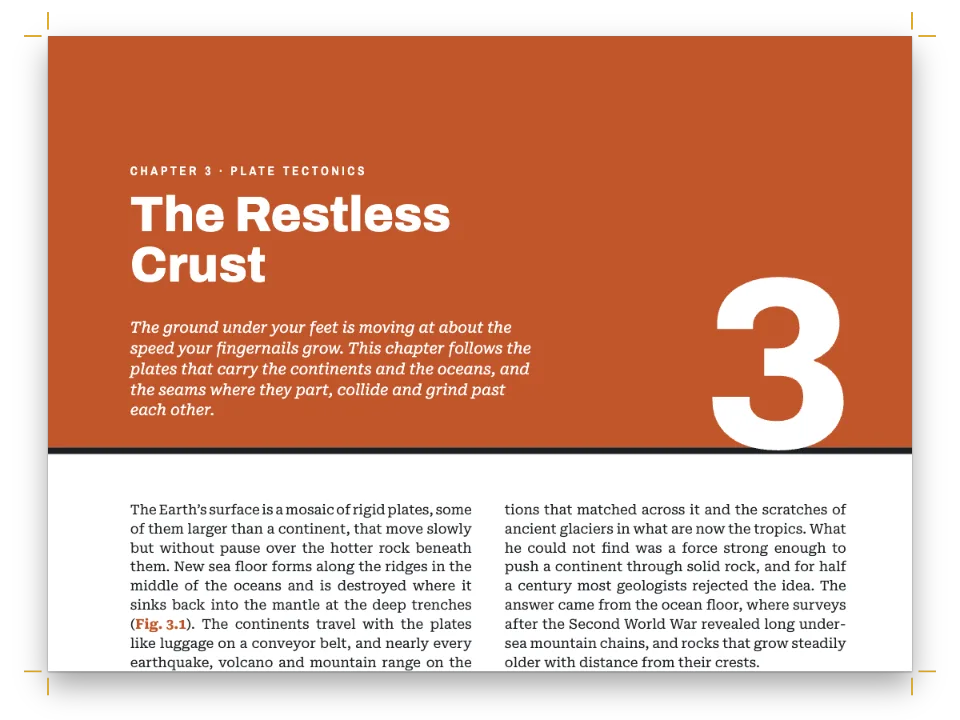
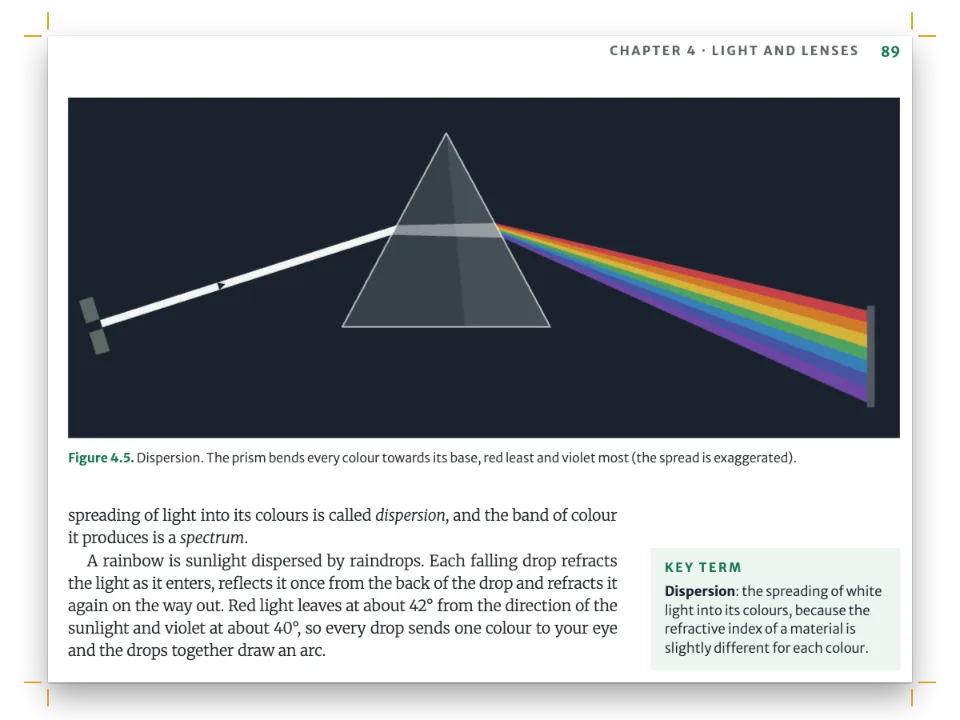
Il capitolo 2 di Mountain Landforms, un manuale di geomorfologia su una pagina di 200 × 250 mm. Un nastro blu con il numero del capitolo pende dalla testa dell’apertura, accanto alla lastra azzurro ghiaccio del titolo; seguono due colonne giustificate in Faustina. Le sette figure, dipinti generati con modelli di diffusione ed etichettati nel codice, sono numerate nell’ordine della prima citazione. Sei flottano nel primo posto libero che il loro placement consente, a partire dal paragrafo che le cita per primo. La figura 2.1, auto, finisce al piede dell’apertura; la 2.3 apre la colonna destra di pagina 28 e la 2.2 riempie il piede della stessa pagina; la 2.4 e la 2.5 aprono le due colonne di pagina 29. La figura 2.6 sta dove il testo la incorpora. La figura 2.7, un elemento flottante top citato a pagina 30, aspetterebbe pagina 31, ma un elemento flottante non può lasciare il suo capitolo, quindi va al piede di pagina 30.
Questa ricetta risponde a
- Come aggiungo una figura con didascalia numerata e la cito nel testo («vedi Fig. 3.2»)?
- Come decido dove va una figura: in testa alla pagina, su entrambe le colonne, esattamente qui o nel margine?
- Come ottengo le etichette «Figura» e «Tabella» nella lingua del mio documento?
- Come aggiungo immagini e tabelle dal codice (risorse) invece che con ![]() in Markdown?
La risposta breve
// In the Markdown, :ref{id="valleys" case="lower"} prints 'fig. 2.1' and places Figure 2.1.
// Captions, credits and alt texts come from content.figures.<lang>.md.
const figure = (id, height, placement) => {
  if (!TEXTS[id]) throw new Error(`content.figures has no caption block for "${id}"`);
  const [caption, note, altText] = TEXTS[id];
  // An SVG fills the width of its slot (a column or the text block, or a fraction of
  // either), so its width and height only give its shape.
  const width = (placement.span === 'page' ? MEASURE : COLUMN) * (placement.width ?? 1);
  return { id, typeId: 'figure', kind: 'svg', caption, note, altText,
    svg: { fileId: `${id}.svg`, width, height }, placement, createdAt: 0, updatedAt: 0 };
};
// In any order: the first mention of each one in the text, a :ref or a ::resource line,
// decides its number.
const resources = [
  // Cited on the opener page: 'auto' may take that page's foot band, where 'top'
  // could only open the next page (gotcha: top-float-next-page).
  figure('valleys', 56, { position: 'auto', span: 'page' }),
  // Across both columns, but only in a foot band: the page it is cited on, if both
  // columns still have room there, else the foot of the next page.
  figure('profile', 60, { position: 'bottom', span: 'page' }),
  // A column figure that takes only a column head: the next one still empty after its
  // citation, here the right column of the same page, above the text that follows it.
  figure('cirque', 48, { position: 'top' }),
  // Cited in the same sentence, the two take the next two column heads, side by side.
  figure('abrasion', 48, { position: 'top' }),
  figure('plucking', 48, { position: 'top' }),
  // No float: set exactly where ::resource{id="roche"} stands, with the same gap above it
  // and below it.
  figure('roche', 42, { position: 'here' }),
  // A band of its own, half the text width and centred. It is cited on the chapter's last
  // page, where a 'top' float would wait for the next page; a float cannot leave its
  // chapter, so this one goes to the foot of the last page.
  figure('moraines', 50, { position: 'top', span: 'page', width: 0.5, align: 'center' }),
];
Ingredienti
- Funzionalità
- Citazioni che collocano le figureCollocazione delle figureDidascalie numerateFigure proprio quiBarriere per gli elementi flottantiFigura e Tabella nella tua linguaStile delle didascalieRighe di fonte e creditiFigure e tabelle come risorseTipi di risorsa personalizzatiAperture progettateFascia di capitolo a tutta larghezzaAttributi dei titoliTitoli numeratiSillabazione e lingua del documentoTestatine e folioTestatine secondo il ruolo della paginaTavolozza di colori semanticaBilanciamento delle colonne
- Usa anche
- Stili di paragrafo
- Tipo
- Faustina, Montserrat, IBM Plex Sans Condensed (SIL OFL 1.1)
- Risorse
abrasion-1080.jpgcirque-1080.jpgmoraines-1080.jpgplucking-1080.jpgprofile-1400.jpgroche-1080.jpgvalleys-1536.jpg- Figure 2.1: a V-shaped river valley and a U-shaped glacial valley (Generated With Diffusion Models, originale)
- Figure 2.2: long profile of a valley glacier (Generated With Diffusion Models, originale)
- Figure 2.3: a glacial cirque in section (Generated With Diffusion Models, originale)
- Figure 2.4: abrasion at the base of the ice (Generated With Diffusion Models, originale)
- Figure 2.5: plucking on a rock step (Generated With Diffusion Models, originale)
- Figure 2.6: a roche moutonnée (Generated With Diffusion Models, originale)
- Figure 2.7: lateral, medial and terminal moraines in plan (Generated With Diffusion Models, originale)
Preparazione
#1 · Una sola tavolozza per le pagine e le figure
const palette = {
  ink: '#1b2227', // text: a cold near-black
  glacier: '#34729a', // the accent: kicker, ribbon, caption labels, references, folios, water
  ice: '#e3f1f8', // the opener slab
  rock: '#5b5a57', // bedrock in the drawings
  moss: '#7d8f4e', // valley floors and pines
  rule: '#c6d3db', // the hairline under the running heads
  muted: '#5d6a72', // running heads, credit notes, the colophon
  paper: '#ffffff',
};
// A linked colour carries its hex and the palette entry it follows.
const col = (id) => ({ hex: palette[id], model: 'hex', paletteId: id });
const colorPalette = [
  ...Object.entries(palette).map(([id, hex]) => ({ id, name: id, value: { hex, model: 'hex' } })),
  // The engine's defaults link to 'main-color' (#295aa3): pointing it at the accent keeps
  // that second blue off the page.
  { id: 'main-color', name: 'glacier (defaults)', value: { hex: palette.glacier, model: 'hex' } },
];
Ogni colore della configurazione rimanda a una di queste voci, e i dipinti sono stati generati negli stessi toni di ardesia, blu ghiacciaio e muschio, così le figure stanno nei colori della pagina. Un dipinto conserva i suoi colori: un nuovo valore di glacier cambia il nastro, la lastra e le etichette, non il ghiaccio nelle figure. L’accento è abbastanza scuro per il testo piccolo: 5,2:1 sul bianco per le etichette delle didascalie e le citazioni, 4,5:1 sulla lastra di ghiaccio per l’occhiello. Ogni figura è un SVG che incorpora il suo dipinto come data URL JPEG e vi sovrappone le etichette come testo, con un sottile alone bianco, così restano nitide e seguono la lingua dell’edizione. Le etichette indicano IBM Plex Sans Condensed nell’SVG, e il loadSvg del kit incorpora i due pesi che usano tramite inlineSvgFonts del motore, perché un SVG mostrato come immagine non può raggiungere da solo i font della pagina.
#2 · Dai un nome alle figure nella lingua del lettore
const captions = () => ({
  // The built-in types take their names from the locale: 'Figure 2.3' and 'fig. 2.3' with
  // 'en-us', 'Figura 2.3' with 'es', numbered {h1}.{n} per chapter. It sets hyphenation too.
  locale: t({ en: 'en-us', es: 'es' }),
  captionStyle: { // the text colour follows bodyText; the note is 0.85 × the caption size
    fontFamily: LABEL, fontSize: pt(8.3), gap: mm(2.2),
    labelColor: col('glacier'), descriptionItalic: true, // the label is bold by default
    note: { color: col('muted'), gap: mm(0.6) }, // the credit line
  },
});
locale dà il nome ai tipi predefiniti nella lingua del documento: qui le didascalie dicono Figure 2.3 e nell’edizione spagnola Figura 2.3, dove lo stesso 'es' sceglie anche i modelli di sillabazione spagnoli. Ogni citazione prende poi la forma che la sua frase richiede: case="lower" per (fig. 2.1) e, con style="full", per (figure 2.2); style="number" dopo un plurale (figures 2.4 and 2.5); e text="…" per una locuzione come the chapter’s first figure, che non stampa alcun numero. Quella locuzione rimanda a una figura già collocata; come prima citazione la numererebbe e la collocherebbe comunque.
#3 · Un nastro e una lastra di ghiaccio per l’apertura
const at = (to, edge, x, y, width, height) => ({ anchor: { to, edge },
  offset: { x: mm(x), y: mm(y) },
  ...(width && { size: { width: mm(width), height: height ? mm(height) : 'auto' } }) });
const text = (id, content, family, size, color, placement, extra) => ({ kind: 'text', id,
  content, fontFamily: family, fontSize: pt(size), color: col(color), placement,
  align: 'left', ...extra });
const caps = (size) => ({ fontWeight: 600, textTransform: 'uppercase',
  letterSpacing: pt(size * 0.18) }); // capitals tracked 0.18 em
const [SLAB, RIBBON, RIBBON_END] = [64, 30, 70]; // mm: slab height; ribbon width and length
const [TEXT_X, KICKER_Y] = [RIBBON + 8, 10]; // mm: the opener texts start 8 mm right of the ribbon
const [TITLE_W, LEAD_W] = [118, 112]; // mm: the title's measure, and a shorter standfirst
const opener = {
  enabled: true,
  // At least 5 mm under the slab; the reserve then rounds up to whole 13.4 pt grid lines,
  // so here 69 mm becomes 15 lines (70.9 mm) and the text starts about 7 mm under the slab.
  minHeight: mm(SLAB + 5),
  slot: { elements: [
    { kind: 'box', id: 'slab', style: { backgroundColor: col('ice') }, // runs off the fore-edge
      placement: at('container', 'top-left', 0, 0, MEASURE + OUTER, SLAB) },
    { kind: 'box', id: 'ribbon', style: { backgroundColor: col('glacier') }, // hangs from the head
      placement: at('page', 'top-left', INNER, 0, RIBBON, RIBBON_END) },
    text('numeral', '{chapterNumber}', DISPLAY, 80, 'paper', // an 80 pt line box is 28 mm tall:
      at('page', 'top-left', INNER, RIBBON_END - 31, RIBBON), // it ends 3 mm above the foot
      { fontWeight: 800, lineHeight: 1, align: 'center' }),
    text('kicker', t({ en: 'Chapter {chapterNumber} · {attr.topic}',
      es: 'Capítulo {chapterNumber} · {attr.topic}' }), LABEL, 8.5, 'glacier',
    at('container', 'top-left', TEXT_X, KICKER_Y), caps(8.5)),
    text('title', '{titleText}', DISPLAY, 27, 'ink', at('#kicker', 'below', 0, 2.6, TITLE_W),
      { fontWeight: 800, lineHeight: 1.06 }),
    text('lead', '{attr.lead}', TEXT, 10.6, 'ink', at('#title', 'below', 0, 4.2, LEAD_W),
      { italic: true, lineHeight: 1.38, hyphenate: true }),
  ] },
};
const HAIRLINE = TOP - 5; // mm from the top edge: the rule under the running heads
const HEAD_Y = HAIRLINE - 4.4; // the running heads' line box, 4.4 mm above the hairline
const head = (id, content, parity, edge, x, extra) => text(id, content, LABEL, 7.6, 'muted',
  at('page', edge, x, HEAD_Y), { ...caps(7.6), parity, pages: 'body', ...extra });
const folio = (id, parity, edge, x, extra) => text(id, '{pageNumber}', DISPLAY, 8.5, 'glacier',
  at('page', edge, x, HEAD_Y), { fontWeight: 800, parity, pages: 'body', ...extra });
const header = { elements: [ // outer corners, over a hairline; never on the opener
  folio('verso-folio', 'even', 'top-left', OUTER),
  head('verso-title', '{title}', 'even', 'top-left', OUTER + 8),
  head('recto-title', '{chapterTitle}', 'odd', 'top-right', -(OUTER + 8), { align: 'right' }),
  folio('recto-folio', 'odd', 'top-right', -OUTER, { align: 'right' }),
  { kind: 'rule', id: 'hairline', pages: 'body', direction: 'horizontal', color: col('rule'),
    thickness: pt(0.5), placement: { ...at('container', 'top-left', 0, HAIRLINE),
      size: { width: 'fill', height: 'auto' } } },
] };
const footer = { elements: [ // the drop folio: on the opener only, centred 9 mm under the text
  text('drop-folio', '{pageNumber}', DISPLAY, 8.5, 'glacier', at('container', 'top', 0, 9),
    { fontWeight: 800, align: 'center', pages: 'opener' })] };
L’apertura è fatta di due riquadri e quattro testi: un nastro che pende dalla testa con il numero del capitolo al piede, una lastra di ghiaccio che esce dal margine esterno, l’occhiello preso dall’attributo topic del titolo, e il titolo e il sommario concatenati sotto. minHeight riserva la lastra e almeno 5 mm sotto di essa, arrotondati per eccesso a righe intere della griglia (qui circa 7 mm), così la figura 2.1 entra ancora nella fascia di piede della stessa pagina. Le testatine stanno agli angoli esterni sopra un filetto sottile del colore rule, e pages: 'body' le tiene lontane dall’apertura, che riceve invece un folio a piè di pagina.
#4 · Fermati su un id sconosciuto o su una figura non citata
// The build lists every :ref and ::resource to an id no resource has in doc.contentWarnings
// (kind 'unknownResourceId'); each prints '?' on the page. A figure nobody names is never
// placed and raises no warning, so the pen reads the mentions with the engine's own parser;
// an embed needs double quotes (gotcha: resource-double-quotes).
function checkFigures(doc) {
  const [named, embedded] = [new Set(), new Set()];
  for (const block of parseMarkdown(markdown)) {
    if (block.type === 'resourceBlock' && block.resourceId) {
      named.add(block.resourceId);
      embedded.add(block.resourceId);
    }
    for (const span of block.spans) if (span.ref?.resourceId) named.add(span.ref.resourceId);
  }
  const unknown = (doc.contentWarnings ?? []).filter((w) => w.kind === 'unknownResourceId');
  const problems = [
    ...new Set(unknown.map((w) => `unknown id "${w.resourceId}"`)),
    ...resources.filter((r) => !named.has(r.id)).map((r) => `"${r.id}" is never cited`),
    ...resources.filter((r) => r.placement.position === 'here' && !embedded.has(r.id))
      .map((r) => `"${r.id}" is placed 'here' but no ::resource line embeds it`),
  ];
  if (problems.length) throw new Error(`Figures: ${problems.join('; ')}`);
}
Un :ref o un ::resource verso un id che nessuna risorsa ha stampa «?» e non colloca nulla; la build registra ciascuno in doc.contentWarnings come unknownResourceId, con l’id e la sua posizione nel sorgente. Una figura che nessuno nomina non viene mai collocata e non genera avvisi, quindi il controllo legge il Markdown con parseMarkdown, il parser del motore stesso, e confronta le citazioni con le figure. Un id sconosciuto, una figura non citata o una figura here senza riga ::resource diventano un errore prima che le pagine vengano mostrate.
#5 · Comincia il conteggio dal punto del libro in cui ti trovi
for (const { id, svg: { fileId, width, height } } of resources) { // each under its svg.fileId
  const art = await dataUrl(PAINTINGS[id]);
  await loadSvg(fileId, svg(width, height, `<image href="${art}" width="${n2(width)}" `
    + `height="${n2(height)}" preserveAspectRatio="none"/>${DRAWINGS[id](width, height)}`));
}
// One chapter came before: figures number 2.1, 2.2… and the folios start at 27.
const continuation = { pageNumbering: { startAt: 27 }, // odd, to match the recto of page 1
  headings: { h1: 1, h2: 0, h3: 0, h4: 0, h5: 0, h6: 0 } }; // the next # is chapter 2
const doc = await buildDocumentWithFonts({ markdown, resources, continuation }, config(),
  { ...kitFonts(FONTS), text: words });
checkFigures(doc); // a wrong id stops here, and the viewer's bar says why
showPages(doc, { title: t({ en: 'Figures that float to where you cite them',
  es: 'Figuras que flotan hasta donde las citas' }) });
Questo è il capitolo 2 di un libro più lungo, quindi la continuazione registra un capitolo prima di esso: le figure numerate {h1}.{n} partono da 2.1 e i folio da 27. A pagina 28 la figura 2.3 sta sopra la figura 2.2, che ha il numero più basso perché il testo la cita per prima. Il ![]() del Markdown viene eliminato, quindi ogni figura è una risorsa il cui SVG è registrato sotto il suo svg.fileId prima della build. Ogni placement dipende da dove la figura è citata: auto per la 2.1, perché la lastra riempie la testa dell’apertura; bottom per il profilo, che può ancora prendere il piede della pagina che lo cita; top per le figure di colonna, che aprono le successive teste di colonna libere; e top anche per la 2.7, che finisce al piede di pagina 30 perché un elemento flottante resta dentro il suo capitolo.
La ricetta completa
// ═══ Postext Cookbook · Nº 009 · Figures that float to where you cite them ═════════ // https://postext.dev/en/cookbook/figures-float-where-cited // Code: MIT · Text: original (CC BY 4.0) · Figures: diffusion models, labels in code // Fonts: Faustina, Montserrat, IBM Plex Sans Condensed (SIL OFL 1.1) · Needs postext ≥ 1.25.0 // // Chapter 2 of a geomorphology textbook. Six of its seven figures float, each to the first // free slot its placement allows, counting from the paragraph that first cites it. Figure 2.6 // is set where ::resource embeds it. The figures are numbered in order of first mention. import { buildDocumentWithFonts, prepareFonts, renderPageToCanvas, registerResourceImage, inlineSvgFonts, parseMarkdown, } from 'https://esm.sh/postext'; const LANG = 'en'; // @lang: the language of the sample document ('es' | 'en') const RECIPE = 'figures-float-where-cited'; // ─── 1 · Design ───────────────────────────────────────────────────────────── // #region palette: eight named colours; the paintings were made to match them const palette = { ink: '#1b2227', // text: a cold near-black glacier: '#34729a', // the accent: kicker, ribbon, caption labels, references, folios, water ice: '#e3f1f8', // the opener slab rock: '#5b5a57', // bedrock in the drawings moss: '#7d8f4e', // valley floors and pines rule: '#c6d3db', // the hairline under the running heads muted: '#5d6a72', // running heads, credit notes, the colophon paper: '#ffffff', }; // A linked colour carries its hex and the palette entry it follows. const col = (id) => ({ hex: palette[id], model: 'hex', paletteId: id }); const colorPalette = [ ...Object.entries(palette).map(([id, hex]) => ({ id, name: id, value: { hex, model: 'hex' } })), // The engine's defaults link to 'main-color' (#295aa3): pointing it at the accent keeps // that second blue off the page. { id: 'main-color', name: 'glacier (defaults)', value: { hex: palette.glacier, model: 'hex' } }, ]; // #endregion const TEXT = 'Faustina'; // one family each for text, display and labels const DISPLAY = 'Montserrat'; const LABEL = 'IBM Plex Sans Condensed'; const LEAD = 13.4; // body leading in pt: the grid every float band snaps to const [PAGE_W, PAGE_H, TOP, BOTTOM, INNER, OUTER, GUTTER] = [200, 250, 22, 20, 18, 14, 6]; // mm const MEASURE = PAGE_W - INNER - OUTER; // 168 mm: the text block, and a page-wide figure const COLUMN = (MEASURE - GUTTER) / 2; // 81 mm: a column, and a column figure // #region captions: the type name in the document's language; bold label, italic description const captions = () => ({ // The built-in types take their names from the locale: 'Figure 2.3' and 'fig. 2.3' with // 'en-us', 'Figura 2.3' with 'es', numbered {h1}.{n} per chapter. It sets hyphenation too. locale: t({ en: 'en-us', es: 'es' }), captionStyle: { // the text colour follows bodyText; the note is 0.85 × the caption size fontFamily: LABEL, fontSize: pt(8.3), gap: mm(2.2), labelColor: col('glacier'), descriptionItalic: true, // the label is bold by default note: { color: col('muted'), gap: mm(0.6) }, // the credit line }, }); // #endregion // #region furniture: an ice slab off the fore-edge, a ribbon from the head, running heads const at = (to, edge, x, y, width, height) => ({ anchor: { to, edge }, offset: { x: mm(x), y: mm(y) }, ...(width && { size: { width: mm(width), height: height ? mm(height) : 'auto' } }) }); const text = (id, content, family, size, color, placement, extra) => ({ kind: 'text', id, content, fontFamily: family, fontSize: pt(size), color: col(color), placement, align: 'left', ...extra }); const caps = (size) => ({ fontWeight: 600, textTransform: 'uppercase', letterSpacing: pt(size * 0.18) }); // capitals tracked 0.18 em const [SLAB, RIBBON, RIBBON_END] = [64, 30, 70]; // mm: slab height; ribbon width and length const [TEXT_X, KICKER_Y] = [RIBBON + 8, 10]; // mm: the opener texts start 8 mm right of the ribbon const [TITLE_W, LEAD_W] = [118, 112]; // mm: the title's measure, and a shorter standfirst const opener = { enabled: true, // At least 5 mm under the slab; the reserve then rounds up to whole 13.4 pt grid lines, // so here 69 mm becomes 15 lines (70.9 mm) and the text starts about 7 mm under the slab. minHeight: mm(SLAB + 5), slot: { elements: [ { kind: 'box', id: 'slab', style: { backgroundColor: col('ice') }, // runs off the fore-edge placement: at('container', 'top-left', 0, 0, MEASURE + OUTER, SLAB) }, { kind: 'box', id: 'ribbon', style: { backgroundColor: col('glacier') }, // hangs from the head placement: at('page', 'top-left', INNER, 0, RIBBON, RIBBON_END) }, text('numeral', '{chapterNumber}', DISPLAY, 80, 'paper', // an 80 pt line box is 28 mm tall: at('page', 'top-left', INNER, RIBBON_END - 31, RIBBON), // it ends 3 mm above the foot { fontWeight: 800, lineHeight: 1, align: 'center' }), text('kicker', t({ en: 'Chapter {chapterNumber} · {attr.topic}', es: 'Capítulo {chapterNumber} · {attr.topic}' }), LABEL, 8.5, 'glacier', at('container', 'top-left', TEXT_X, KICKER_Y), caps(8.5)), text('title', '{titleText}', DISPLAY, 27, 'ink', at('#kicker', 'below', 0, 2.6, TITLE_W), { fontWeight: 800, lineHeight: 1.06 }), text('lead', '{attr.lead}', TEXT, 10.6, 'ink', at('#title', 'below', 0, 4.2, LEAD_W), { italic: true, lineHeight: 1.38, hyphenate: true }), ] }, }; const HAIRLINE = TOP - 5; // mm from the top edge: the rule under the running heads const HEAD_Y = HAIRLINE - 4.4; // the running heads' line box, 4.4 mm above the hairline const head = (id, content, parity, edge, x, extra) => text(id, content, LABEL, 7.6, 'muted', at('page', edge, x, HEAD_Y), { ...caps(7.6), parity, pages: 'body', ...extra }); const folio = (id, parity, edge, x, extra) => text(id, '{pageNumber}', DISPLAY, 8.5, 'glacier', at('page', edge, x, HEAD_Y), { fontWeight: 800, parity, pages: 'body', ...extra }); const header = { elements: [ // outer corners, over a hairline; never on the opener folio('verso-folio', 'even', 'top-left', OUTER), head('verso-title', '{title}', 'even', 'top-left', OUTER + 8), head('recto-title', '{chapterTitle}', 'odd', 'top-right', -(OUTER + 8), { align: 'right' }), folio('recto-folio', 'odd', 'top-right', -OUTER, { align: 'right' }), { kind: 'rule', id: 'hairline', pages: 'body', direction: 'horizontal', color: col('rule'), thickness: pt(0.5), placement: { ...at('container', 'top-left', 0, HAIRLINE), size: { width: 'fill', height: 'auto' } } }, ] }; const footer = { elements: [ // the drop folio: on the opener only, centred 9 mm under the text text('drop-folio', '{pageNumber}', DISPLAY, 8.5, 'glacier', at('container', 'top', 0, 9), { fontWeight: 800, align: 'center', pages: 'opener' })] }; // #endregion const config = () => ({ ...captions(), colorPalette, page: { width: mm(PAGE_W), height: mm(PAGE_H), dpi: 150, // a compact textbook trim margins: { top: mm(TOP), bottom: mm(BOTTOM), left: mm(INNER), right: mm(OUTER), mirror: true } }, layout: { layoutType: 'double', gutterWidth: mm(GUTTER) }, bodyText: { // justified serif; first lines indented 4 mm, except after a heading fontFamily: TEXT, fontSize: pt(9.4), lineHeight: pt(LEAD), color: col('ink'), boldColor: col('ink'), italicColor: col('ink'), referenceColor: col('glacier'), // citations in the accent, like the caption labels they name firstLineIndent: mm(4), indentAfterHeading: false }, headings: { fontFamily: DISPLAY, fontWeight: 800, color: col('ink'), levels: [ // A chapter opens on a recto; 'odd' leaves a blank verso only when one is needed. { level: 1, fontSize: pt(27), span: 'page', breakBefore: { enabled: true, parity: 'odd' }, marginTop: pt(0), marginBottom: pt(0), advancedDesign: opener }, { level: 2, fontSize: pt(11.5), lineHeight: pt(LEAD), numberingTemplate: '{1}.{2}', marginTop: pt(LEAD), marginBottom: pt(0) }, // one grid line above, none below ], }, unorderedLists: { color: col('glacier'), marginTop: pt(0), marginBottom: pt(0) }, paragraphStyles: [{ id: 'colophon', fontFamily: LABEL, fontSize: pt(7.2), lineHeight: pt(10), color: col('muted'), textAlign: 'left', firstLineIndent: pt(0), marginTop: pt(LEAD) }], header, footer, }); // ─── 2 · Content ──────────────────────────────────────────────────────────── const markdown = String.raw`---Esempio Markdown · 65 righe · content.en.md
title: "Mountain Landforms" subtitle: "An Introduction to Geomorphology" --- # How glaciers carve mountain valleys {topic="Glacial geomorphology" lead="Ice creeps down a valley a few tens of metres a year, too slowly to watch, yet over a few glaciations it turns a river’s narrow V into a broad U. The rock keeps a record of every stage, from the cirque to the moraines."} Walk up a high mountain valley after walking up one cut by a river alone, and the difference is plain at once. The river valley is narrow and V-shaped: the water cuts down and the slopes crumble in after it. The valley a glacier has passed through is broad, flat-floored and steep-walled: it is shaped like a U (:ref{id="valleys" case="lower"}). Ice fills the valley from wall to wall, often hundreds of metres deep, and grinds its floor and its sides at the same time. Some twenty thousand years ago, when the last glaciation was at its greatest extent, ice covered much of northern Europe and ran down the valleys of the Pyrenees to below a thousand metres. There were glaciers in the Picos de Europa, the Sierra de Gredos and the Sierra Nevada too. Nearly all of them have gone, but the land keeps their marks so sharply that the size of a glacier that melted thousands of years ago can still be worked out. This chapter explains what those marks are and how to read them. ## Ice that flows A glacier is born where more snow falls than melts. Year after year each layer is buried under the next, and the weight squeezes the air out from between the flakes. Fresh snow weighs about a hundred kilograms per cubic metre; packed down, it turns into firn, a granular material, and then into dense, bluish glacier ice at more than eight hundred. In the Alps the change takes a few decades; in Antarctica, where so little snow falls that each year adds only a few centimetres, it can take centuries. Every glacier has two halves (:ref{id="profile" style="full" case="lower"}). In the upper part, the accumulation zone, each winter leaves more snow than the summer can melt. In the lower part, the ablation zone, the reverse is true: ice is lost, and the glacier survives only because ice keeps arriving from above. The boundary between them, the equilibrium line, shows at the end of summer as the edge of the year’s snow on the bare ice. If the climate cools, the line moves down and the front advances; if it warms, the line climbs and the front retreats. Once the ice in the cirque at the head of the valley (:ref{id="cirque" case="lower"}) is a few tens of metres thick, it begins to flow under its own weight. It deforms slowly without breaking, the way a mass of pitch creeps downhill, while the top thirty metres or so, too lightly loaded to flow, crack into crevasses. Where the bed is wet, the glacier also slides on a film of meltwater. Valley glaciers move this way at tens to hundreds of metres a year, faster in the middle and at the surface than along the walls, where friction holds them back. Louis Agassiz showed it in the 1840s with a line of stakes driven across the Unteraar glacier in Switzerland: over the years the line bent downstream in the middle. Even a retreating glacier keeps flowing downhill. Its snout, the point where the ice finishes melting, moves back because each summer it melts faster than the flow can replace it. ## Where glaciers are born A cirque is an armchair-shaped hollow carved into the head of a valley. Ice gathers in the hollow, rotates downhill as if in a spoon and deepens the floor below the rim; when the glacier melts, the basin fills with water and becomes a tarn. To deepen it, the ice works with two complementary tools, those of figures :ref{id="abrasion" style="number"} and :ref{id="plucking" style="number"}. Meanwhile the back wall retreats: two cirques growing back to back sharpen a knife-edged arête between them, and three or more attacking one summit leave it a pyramidal horn, like the Matterhorn in the Alps. In the Pyrenees most cirques face north or east, where the snow lasts longest, and many hold one of the small, deep tarns the Aragonese call *ibones*, frozen over from early winter until late spring. ## The tools of the ice Ice is softer than almost any rock and on its own would barely scratch it; it wears down its bed with two tools. The first tool is abrasion. Stones frozen into the base of the glacier scratch the bed like sandpaper and leave parallel striations that show, thousands of years later, which way the ice was moving; the dust they grind, rock flour, gives glacial lakes their milky turquoise. The second is plucking: meltwater seeps into cracks in the bed, freezes again and welds blocks to the ice, which carries them off as it moves. Both tools work at once on any knob of rock in the bed, and the result is one of the most characteristic forms of a glacial landscape, the roche moutonnée: ::resource{id="roche"} Its up-glacier face, polished by abrasion, is smooth and gentle; its down-glacier face, where the ice plucked blocks away, is steep and rough. Look at which way the rough face points and you know which way the ice was going. The Genevan naturalist Horace-Bénédict de Saussure gave it its French name at the end of the eighteenth century. ## Troughs The work of those tools, added up over tens of thousands of years, transforms the whole valley. The glacier straightens the river’s winding valley and truncates the spurs that separated its bends. It widens and deepens the floor into the U of :ref{id="valleys" text="the chapter’s first figure"}, stepped in basins and rock bars, and the Ordesa valley in the Aragonese Pyrenees is a textbook trough. Because a thick glacier cuts deeper than a thin one, the main valley sinks lower than its tributaries: when the ice goes, the side valleys are left hanging hundreds of metres above it and their streams leap down as waterfalls, as in Yosemite Valley, California. Where the sea has flooded a trough, it becomes a fjord; Norway’s Sognefjord reaches more than two hundred kilometres inland and is over thirteen hundred metres deep. ## What the glacier leaves behind Whatever a glacier plucks away ends up somewhere. Debris falling from the slopes rides along the edges of the ice and builds lateral moraines; where two glaciers join, their lateral moraines merge into a medial moraine that runs down the ice as a dark stripe. At the front, the glacier unloads like a conveyor belt and heaps up an arc of debris, the terminal moraine, which marks its furthest advance. Moraines are chaotic mixtures of clay, sand, stones and boulders of every size, without the sorting that water gives its sediments. Some boulders, the erratics, travelled tens of kilometres and now rest on rock of a quite different kind. Many terminal moraines hold back lakes (:ref{id="moraines" case="lower"}). Lake Sanabria in Zamora, the largest lake of glacial origin in the Iberian Peninsula, is dammed by the moraines of the glacier that came down from the Sierra Segundera. ## Reading a glacial landscape Four marks are enough to tell that a glacier once filled a valley that has no ice today: - **The profile.** A U-shaped trough with a flat floor and steep walls, like the one in :ref{id="valleys" style="full" case="lower"}. - **Hanging valleys.** Side valleys that end high on the slope, their streams falling as waterfalls. - **The rock.** Polished, striated surfaces and roches moutonnées, whose rough face looks down the valley (:ref{id="roche" case="lower"}). - **The deposits.** Unsorted moraines, erratic boulders and the lakes they dam. None of these marks is enough on its own: a river polishes stones too, and a rockfall leaves chaotic debris at the foot of a slope. Found together, valley after valley, they identify a former glacier, and on a map they give its outline and its size: the crests of the lateral moraines mark how high its surface reached, the terminal moraine its snout, and the floors of its cirques the snowline of a climate several degrees colder than today’s. ## Glaciers in retreat The glaciers left in the Iberian Peninsula are small, and all of them are in the Pyrenees, on the north faces of its highest summits: Aneto, Maladeta, Monte Perdido. They have lost most of their area since the middle of the nineteenth century, when the Little Ice Age ended, and several have shrunk to ice patches that no longer flow. In many summers the equilibrium line now climbs above their summits: the whole glacier lies in the ablation zone of :ref{id="profile" style="full" case="lower"}, and the ice it loses is never replaced. What survives clings to the shade of the north faces, fed as much by avalanches and wind-blown snow as by the snow that falls on it. Glaciologists follow the retreat with Agassiz’s methods and with new ones: ablation stakes that stand a little taller every summer, photographs repeated from the same viewpoints, and terrain models surveyed by laser and by drone, which compared year after year give the volume of ice lost. Many of the glaciers named on nineteenth-century maps are already gone. When the last of them melts, the Maladeta massif will look much as the Sierra de Gredos does now, more than ten thousand years after its glaciers disappeared, with tarns in its cirques and moraines across its valleys. :::paragraphs{style="colophon"} Set in Faustina, Montserrat and IBM Plex Sans Condensed (SIL Open Font License) · Text: CC BY 4.0 · Figures: diffusion models :::`; // content.<lang>.md, inlined by the Cookbook // Caption, credit note ('-' for none) and alt text of each figure, one block per figure. const figureTexts = String.raw`valleysEsempio Markdown · 33 righe · content.figures.en.md
A river cuts a V; a glacier widens the valley into a U. Dashed, the V the ice wore away. Schematic sections, not to scale. Two valley sections: left, a V-shaped river valley with a river at the bottom; right, a U-shaped glacial valley full of ice, with the old V profile dashed. profile Profile of a valley glacier: ice fed above the equilibrium line flows down to melt below it. Vertical exaggeration ×2. Long section of a glacier from the cirque to the snout, with the snowy accumulation zone, the equilibrium line, flow arrows and the terminal moraine. cirque A cirque in section. The ice rotates in the basin and deepens it below the rock lip. - Section of a cirque: a steep back wall, the bergschrund, ice rotating in a basin and a rock lip downstream. abrasion Abrasion: stones held in the base of the ice scratch the bed. - Detail of a glacier’s base: stones frozen into the ice scratch the bedrock, leaving striations and rock flour. plucking Plucking: water freezes in the joints and the ice carries blocks away. - Detail of the downstream side of a rock step: ice in the joints and a block being pulled away by the glacier. roche Roche moutonnée. The ice polished the gentle face and plucked the steep one. The ice moved from left to right. Profile of a roche moutonnée: a smooth, gentle face on the left and a stepped, steep face on the right. moraines Two glaciers join: their lateral moraines become a medial one, and the terminal moraine dams a lake. Plan view, not to scale. Plan of two ice tongues that join, with lateral and medial moraines; below the snout, a lake is held in by the arc of the terminal moraine, which only its outlet stream crosses.`; const TEXTS = Object.fromEntries(figureTexts.trim().split(/\n\s*\n/) .map((block) => block.split('\n').map((line) => line.trim())) .map(([id, caption, note, alt]) => [id, [caption, note === '-' ? undefined : note, alt]])); // #region answer: six figures float to the first slot their placement allows; one stays put // In the Markdown, :ref{id="valleys" case="lower"} prints 'fig. 2.1' and places Figure 2.1. // Captions, credits and alt texts come from content.figures.<lang>.md. const figure = (id, height, placement) => { if (!TEXTS[id]) throw new Error(`content.figures has no caption block for "${id}"`); const [caption, note, altText] = TEXTS[id]; // An SVG fills the width of its slot (a column or the text block, or a fraction of // either), so its width and height only give its shape. const width = (placement.span === 'page' ? MEASURE : COLUMN) * (placement.width ?? 1); return { id, typeId: 'figure', kind: 'svg', caption, note, altText, svg: { fileId: `${id}.svg`, width, height }, placement, createdAt: 0, updatedAt: 0 }; }; // In any order: the first mention of each one in the text, a :ref or a ::resource line, // decides its number. const resources = [ // Cited on the opener page: 'auto' may take that page's foot band, where 'top' // could only open the next page (gotcha: top-float-next-page). figure('valleys', 56, { position: 'auto', span: 'page' }), // Across both columns, but only in a foot band: the page it is cited on, if both // columns still have room there, else the foot of the next page. figure('profile', 60, { position: 'bottom', span: 'page' }), // A column figure that takes only a column head: the next one still empty after its // citation, here the right column of the same page, above the text that follows it. figure('cirque', 48, { position: 'top' }), // Cited in the same sentence, the two take the next two column heads, side by side. figure('abrasion', 48, { position: 'top' }), figure('plucking', 48, { position: 'top' }), // No float: set exactly where ::resource{id="roche"} stands, with the same gap above it // and below it. figure('roche', 42, { position: 'here' }), // A band of its own, half the text width and centred. It is cited on the chapter's last // page, where a 'top' float would wait for the next page; a float cannot leave its // chapter, so this one goes to the foot of the last page. figure('moraines', 50, { position: 'top', span: 'page', width: 0.5, align: 'center' }), ]; // #endregion // #region check: stop on an unknown id, and on a figure the text never places // The build lists every :ref and ::resource to an id no resource has in doc.contentWarnings // (kind 'unknownResourceId'); each prints '?' on the page. A figure nobody names is never // placed and raises no warning, so the pen reads the mentions with the engine's own parser; // an embed needs double quotes (gotcha: resource-double-quotes). function checkFigures(doc) { const [named, embedded] = [new Set(), new Set()]; for (const block of parseMarkdown(markdown)) { if (block.type === 'resourceBlock' && block.resourceId) { named.add(block.resourceId); embedded.add(block.resourceId); } for (const span of block.spans) if (span.ref?.resourceId) named.add(span.ref.resourceId); } const unknown = (doc.contentWarnings ?? []).filter((w) => w.kind === 'unknownResourceId'); const problems = [ ...new Set(unknown.map((w) => `unknown id "${w.resourceId}"`)), ...resources.filter((r) => !named.has(r.id)).map((r) => `"${r.id}" is never cited`), ...resources.filter((r) => r.placement.position === 'here' && !embedded.has(r.id)) .map((r) => `"${r.id}" is placed 'here' but no ::resource line embeds it`), ]; if (problems.length) throw new Error(`Figures: ${problems.join('; ')}`); } // #endregion // #region art: seven paintings (JPEGs in assets/) under vector labels in the book's language // Each figure is an SVG: the painting, embedded as a data URL at the figure's printed size in // mm, then its labels as text, so they stay sharp and follow the edition's language. const mix = (hex, other, k) => `#${[1, 3, 5].map((i) => Math.round(parseInt(hex.slice(i, i + 2), 16) * (1 - k) + parseInt(other.slice(i, i + 2), 16) * k).toString(16).padStart(2, '0')).join('')}`; const C = { ink: palette.ink, flow: mix(palette.glacier, palette.ink, 0.4), snow: palette.paper }; const n2 = (v) => +v.toFixed(2); // A hairline, drawn over a wider white one so it reads on rock and ice alike. const hairline = ([x1, y1], [x2, y2]) => [['#ffffff', 0.55], [C.ink, 0.18]].map(([c, w]) => `<path d="M${n2(x1)} ${n2(y1)}L${n2(x2)} ${n2(y2)}" stroke="${c}" stroke-width="${w}" ` + 'stroke-linecap="round"/>').join(''); // A label with a thin white halo, and an optional leader to the point it names. function label(x, y, words, { anchor = 'start', to, bold = false, color = C.ink } = {}) { const halo = color === C.snow ? C.ink : '#ffffff'; const leader = to ? hairline([to[0], to[1]], [to[2] ?? x, to[3] ?? y - 0.9]) : ''; return `${leader}<text x="${n2(x)}" y="${n2(y)}" text-anchor="${anchor}" fill="${color}"` + ` stroke="${halo}" stroke-width="0.5" stroke-linejoin="round" paint-order="stroke"` + `${bold ? ' font-weight="600"' : ''}>${words}</text>`; } const L = (en, es) => t({ en, es }); // The labels name their face on the SVG's root element, and loadSvg embeds the weights they // set in the drawing: an SVG shown as an image cannot reach the page's fonts by itself. const LABEL_MM = 2.45; // the label size in the drawings' millimetres: about 7 pt in print // The viewBox is the figure's printed size in mm; the SVG's own size is set in mm too. const svg = (w, h, body) => `<svg xmlns="http://www.w3.org/2000/svg" width="${n2(w)}mm" ` + `height="${n2(h)}mm" viewBox="0 0 ${n2(w)} ${n2(h)}" font-family="${LABEL}" ` + `font-size="${LABEL_MM}">${body}</svg>`; // The labels of each figure, in its millimetres, placed on its painting. const DRAWINGS = { valleys: () => label(14, 5, L('River valley', 'Valle fluvial'), { bold: true }) + label(100, 5, L('Glacial valley', 'Valle glaciar'), { bold: true }) + label(47, 50.4, L('river', 'río'), { to: [43.4, 46.6, 46.8, 49.4] }) + label(126, 21, L('ice', 'hielo'), { anchor: 'middle', bold: true }) + label(125.5, 53.2, L('earlier V-shaped valley', 'antiguo valle en V'), { anchor: 'middle', to: [125.5, 48, 125.5, 51.3] }), profile: () => label(48, 8, L('accumulation zone', 'zona de acumulación'), { anchor: 'middle', bold: true, color: C.flow }) + label(100, 20, L('ablation zone', 'zona de ablación'), { anchor: 'middle', bold: true, color: C.flow }) + label(57, 19.6, L('equilibrium line', 'línea de equilibrio'), { to: [52.8, 27, 56.6, 20.2] }) + label(108, 43.3, L('ice flow', 'flujo del hielo'), { bold: true, color: C.flow }) + label(166, 41.6, L('terminal moraine', 'morrena frontal'), { anchor: 'end', to: [146, 45.5, 150, 42.2] }) + label(4, 57.4, L('bedrock', 'lecho rocoso')), cirque: () => label(2.5, 30, L('back wall', 'pared')) + label(26, 6.6, L('bergschrund', 'rimaya'), { to: [20, 12.5, 25.6, 7.2] }) + label(30, 22.6, L('rotation', 'rotación'), { bold: true, color: C.flow }) + label(33, 40, L('basin', 'cubeta')) + label(66, 17.4, L('rock lip', 'umbral'), { anchor: 'middle', to: [60.5, 22.8, 64.4, 18.3] }), abrasion: () => label(55.5, 8.3, L('ice moves', 'el hielo avanza'), { bold: true, color: C.flow }) + label(24, 16.6, L('stones in the ice', 'cantos presos en el hielo'), { to: [38.5, 22.6, 38, 17.4] }) + label(20, 37, L('striations', 'estrías'), { anchor: 'end', to: [24, 29.5, 18, 35.8] }) + label(40.5, 37, L('rock flour', 'harina de roca'), { to: [32, 26, 40.5, 35.8] }), plucking: () => label(30, 9.3, L('ice moves', 'el hielo avanza'), { bold: true, color: C.flow }) + label(63.5, 18.5, L('plucked block', 'bloque arrancado'), { to: [60, 21, 63.3, 19.2] }) + label(4, 43, L('ice in the joints', 'hielo en las diaclasas'), { to: [25.2, 32, 14, 41.3] }), roche: () => label(4, 5, L('ice, long gone', 'el hielo, hoy fundido'), { bold: true, color: C.flow }) + label(25, 16.5, L('abrasion: smooth', 'abrasión: pulida'), { anchor: 'end', to: [30, 18.8, 25.5, 16.9] }) + label(63, 11.2, L('plucking: rough', 'arranque: rugosa'), { to: [57.5, 15.5, 63.2, 11.9] }), // Placed on a 100.8 × 60 mm drawing; k scales the positions, not the type, to the figure. moraines: (w) => { const k = w / 100.8; const at = (x, y, words, o = {}) => label(x * k, y * k, words, { ...o, ...(o.to && { to: o.to.map((v) => v * k) }) }); return at(4, 25.5, L('lateral moraine', 'morrena lateral'), { to: [37, 16, 21, 24.3] }) + at(62, 33, L('medial moraine', 'morrena central'), { to: [50.5, 33, 61.5, 32.3] }) + at(50, 45, L('lake', 'lago'), { anchor: 'middle', bold: true, color: C.snow }) + at(97.5, 55, L('terminal moraine', 'morrena frontal'), { anchor: 'end', to: [60, 49, 78, 54] }); }, }; // A painting as a data URL: an SVG drawn as an image cannot fetch anything itself. async function dataUrl(url) { const res = await fetch(url); if (!res.ok) throw new Error(`Painting not found (${res.status}): ${url}`); const bytes = new Uint8Array(await res.arrayBuffer()); let bin = ''; for (let i = 0; i < bytes.length; i += 8192) { bin += String.fromCharCode(...bytes.subarray(i, i + 8192)); } return `data:image/jpeg;base64,${btoa(bin)}`; } const PAINTINGS = { // each figure's painting, a file in assets/, named by its width in pixels valleys: asset('valleys-1536.jpg'), profile: asset('profile-1400.jpg'), cirque: asset('cirque-1080.jpg'), abrasion: asset('abrasion-1080.jpg'), plucking: asset('plucking-1080.jpg'), roche: asset('roche-1080.jpg'), moraines: asset('moraines-1080.jpg') }; // #endregion // ─── 3 · Fonts ────────────────────────────────────────────────────────────── const FONTS = { // every face the layout uses, loaded before the build Faustina: ['400', '400i', '700'], // text Montserrat: ['800'], // display: title, section heads, numeral, folios 'IBM Plex Sans Condensed': ['400', '400i', '600', '700'], // labels: kicker, heads, captions }; // ─── 4 · Build & show ─────────────────────────────────────────────────────── const words = `${markdown}\n${figureTexts}`; // captions too: their letters decide the subsets await prepareFonts(words, config(), kitFonts(FONTS)); // #region build: register the drawings, then set chapter 2 of a longer book for (const { id, svg: { fileId, width, height } } of resources) { // each under its svg.fileId const art = await dataUrl(PAINTINGS[id]); await loadSvg(fileId, svg(width, height, `<image href="${art}" width="${n2(width)}" ` + `height="${n2(height)}" preserveAspectRatio="none"/>${DRAWINGS[id](width, height)}`)); } // One chapter came before: figures number 2.1, 2.2… and the folios start at 27. const continuation = { pageNumbering: { startAt: 27 }, // odd, to match the recto of page 1 headings: { h1: 1, h2: 0, h3: 0, h4: 0, h5: 0, h6: 0 } }; // the next # is chapter 2 const doc = await buildDocumentWithFonts({ markdown, resources, continuation }, config(), { ...kitFonts(FONTS), text: words }); checkFigures(doc); // a wrong id stops here, and the viewer's bar says why showPages(doc, { title: t({ en: 'Figures that float to where you cite them', es: 'Figuras que flotan hasta donde las citas' }) }); // #endregionKit · core, fonts, viewer, images: uguale in ogni ricetta · 270 righe
// ─── Kit ── helpers shared by every Cookbook recipe · postext.dev/cookbook ───── // ─── Kit · core v1 ── the same in every recipe · postext.dev/cookbook function mm(value) { return { value, unit: 'mm' }; } function pt(value) { return { value, unit: 'pt' }; } function em(value) { return { value, unit: 'em' }; } /** The sample language's string: t({ en: 'Figure', es: 'Figura' }). */ function t(strings) { return strings[LANG] ?? Object.values(strings)[0]; } /** A file in this recipe's assets folder, served from the Postext repo by jsDelivr. */ function asset(file) { return `https://cdn.jsdelivr.net/gh/drnachio/postext@main/cookbook/${RECIPE}/assets/${file}`; } // ─── Kit · fonts v3 ── the same in every recipe · postext.dev/cookbook // Postext loads the faces a config asks for before layout (prepareFonts, // buildDocumentWithFonts) and asks the kit for the files: Fontsource's, the // files the PDF embeds too. /** The options of buildDocumentWithFonts / prepareFonts / withLoadedFonts: * the Fontsource resolver, and the faces of FONTS loaded with the ones the * config names. FONTS = { 'Family Name': ['400', '400i', '700'] }. */ function kitFonts(FONTS = {}) { const faces = Object.entries(FONTS).flatMap(([family, specs]) => specs.map((spec) => ({ family, weight: parseInt(spec, 10), style: spec.endsWith('i') ? 'italic' : 'normal' }))); return { resolve: fontsourceResolver, faces }; } /** A face's Fontsource files, in a fixed order: latin, then latin-ext and greek * when `text` needs them and the family ships them (kitSubsetsFor), each with * its unicode-range. Null for a weight or slant Fontsource does not ship. */ async function fontsourceResolver(family, weight, style, { text = '' } = {}) { const id = fontsourceId(family); const meta = await fontsourceMeta(family); if (meta && !(meta.weights.includes(weight) && meta.styles.includes(style))) return null; kitStatus('Loading fonts…'); const at = await fontsourceAt(id); return ['latin', ...kitSubsetsFor(text, meta)].map((subset) => ({ source: `${at}files/${id}-${subset}-${weight}-${style}.woff2`, unicodeRange: kitRanges()[subset], })); } /** The unicode-range of each Fontsource file the kit loads (a function: the * kit is inlined after the pen's code, which runs before a const would be set). */ function kitRanges() { return { latin: 'U+0000-00FF,U+0131,U+0152-0153,U+02BB-02BC,U+02C6,U+02DA,U+02DC,U+0304,U+0308,U+0329,' + 'U+2000-206F,U+20AC,U+2122,U+2191,U+2193,U+2212,U+2215,U+FEFF,U+FFFD', 'latin-ext': 'U+0100-02BA,U+02BD-02C5,U+02C7-02CC,U+02CE-02D7,U+02DD-02FF,U+0304,U+0308,U+0329,' + 'U+1D00-1DBF,U+1E00-1E9F,U+1EF2-1EFF,U+2020,U+20A0-20AB,U+20AD-20C0,U+2113,U+2C60-2C7F,U+A720-A7FF', greek: 'U+0370-03FF', }; } /** For the cjk, arabic and comics blocks, which add their own files: the * faces of `faces` = { 'Family Name': ['400', '400i', '700'] }. `text` is the sample: * č ł † α χ also load latin-ext and greek files (kitSubsetsFor). With * `optional`, a face Fontsource does not ship is skipped instead of failing. * The files are added once all have loaded, in the order asked (latin, then * latin-ext, then greek), whatever order they arrive in: the last one added * wins a character two files hold. Resolves to the number of faces added. */ async function loadFonts(faces, text = '', { optional = false } = {}) { kitStatus('Loading fonts…'); const ranges = kitRanges(); const jobs = []; for (const [family, specs] of Object.entries(faces)) { const id = fontsourceId(family); const todo = [...new Set(specs)].map((spec) => [parseInt(spec, 10), spec.endsWith('i') ? 'italic' : 'normal']) .filter(([weight, style]) => !hasFace(family, weight, style)); // before any await const at = fontsourceAt(id); const meta = optional || /[^\0-ÿ]/u.test(text) ? await fontsourceMeta(family) : null; const subsets = ['latin', ...kitSubsetsFor(text, meta)]; for (const [weight, style] of todo) { if (optional && !(meta?.weights.includes(weight) && meta.styles.includes(style))) continue; for (const subset of subsets) { const url = `${await at}files/${id}-${subset}-${weight}-${style}.woff2`; const face = new FontFace(family, `url(${url}) format('woff2')`, { weight: String(weight), style, unicodeRange: ranges[subset] }); jobs.push(face.load().catch(() => { if (subset === 'latin' && !optional) throw new Error(`Fontsource has no ${family} ${weight} ${style}`); })); } } } const ready = await Promise.all(jobs).catch((error) => { kitFail(error); throw error; }); return ready.filter((face) => face && document.fonts.add(face)).length; } /** A loaded FontFace covers this family, weight and style (fonts.check() would * also say yes for families nobody declared). */ function hasFace(family, weight, style) { for (const face of document.fonts) { if (face.status !== 'loaded' || face.style !== style) continue; if (face.family.replace(/^["']|["']$/g, '') !== family) continue; const [low, high = low] = face.weight.split(' ').map(Number); if (weight >= low && weight <= high) return true; } return false; } /** The files beyond latin `text` needs that `meta`'s family ships. */ function kitSubsetsFor(text, meta) { return [[/[Ā-˿ᴀ-ᶿḀ-ỿ†ℓⱠ-Ɀ꜠-ꟿ]/u, 'latin-ext'], [/[Ͱ-Ͽ]/u, 'greek']] .filter(([re, x]) => re.test(text) && meta?.subsets?.includes(x)).map(([, x]) => x); } /** Fontsource's id for a family: 'Source Serif 4' → 'source-serif-4'. */ function fontsourceId(family) { return family.toLowerCase().replace(/\s+/g, '-'); } /** A package's folder at the one version @5 names now (#766). */ function fontsourceAt(id, u = `https://cdn.jsdelivr.net/npm/@fontsource/${id}@`) { return (fontsourceAt.c ??= {})[id] ??= fetch(u + '5/package.json').then((r) => r.json()) .then((p) => p.version || 5, () => 5).then((v) => `${u}${v}/`); } /** The family's Fontsource metadata (weights, styles, subsets), or null. */ function fontsourceMeta(family) { fontsourceMeta.cache ??= new Map(); const id = fontsourceId(family); if (!fontsourceMeta.cache.has(id)) { fontsourceMeta.cache.set(id, fetch(`https://api.fontsource.org/v1/fonts/${id}`) .then((res) => (res.ok ? res.json() : null), () => null)); } return fontsourceMeta.cache.get(id); } // ─── Kit · viewer v2 ── the same in every recipe · postext.dev/cookbook /** The pages as spreads on a dark desk, page 1 alone, then verso | recto, * each painted when it scrolls near. Other options go to renderPageToCanvas. */ function showPages(docs, { title, width = 460, ...render } = {}) { const root = viewer(title); const pages = [docs].flat().flatMap((doc) => doc.pages.map((page) => ({ doc, page, n: (doc.pageIndexOffset ?? 0) + page.index }))); const spreads = []; let verso = null; for (const p of pages) { if (p.n % 2 === 1) { if (verso) spreads.push([verso, null]); verso = p; } else { spreads.push([verso, p]); verso = null; } } if (verso) spreads.push([verso, null]); const density = Math.min(window.devicePixelRatio || 1, 2); showPages.painter?.disconnect(); const painter = new IntersectionObserver((entries) => { for (const { isIntersecting, target } of entries) { if (!isIntersecting) continue; painter.unobserve(target); const { doc, page } = target.postext; renderPageToCanvas(page, doc, target, { ...render, scale: (width * density) / page.width }); } }, { rootMargin: '800px' }); showPages.painter = painter; root.replaceChildren(...spreads.map((pair) => { const spread = document.createElement('div'); spread.className = 'pt-spread'; for (const p of pair) { const figure = document.createElement('figure'); if (p) { const label = p.page.pageLabel || String(p.n + 1); const canvas = document.createElement('canvas'); canvas.postext = p; canvas.style.aspectRatio = `${p.page.width} / ${p.page.height}`; canvas.setAttribute('role', 'img'); canvas.setAttribute('aria-label', `Page ${label}`); const folio = document.createElement('figcaption'); folio.textContent = label; figure.append(canvas, folio); painter.observe(canvas); } else figure.className = 'pt-blank'; spread.append(figure); } return spread; })); kitStatus(`${pages.length} ${pages.length === 1 ? 'page' : 'pages'}`); document.documentElement.dataset.postext = 'ready'; return pages.length; } /** The desk, the bar and the error reporting, created once. */ function viewer(title) { if (!document.getElementById('pt-kit')) { document.head.insertAdjacentHTML('beforeend', `<style id="pt-kit"> :root { color-scheme: dark; } body { margin: 0; background: #0e1014; color: #b9bcc4; font: 13px/1.45 system-ui, sans-serif; } #pt-bar { position: sticky; top: 0; z-index: 1; display: flex; flex-wrap: wrap; align-items: center; gap: 6px 16px; padding: 10px 16px; background: rgb(14 16 20 / .92); backdrop-filter: blur(6px); border-bottom: 1px solid #23262d; } #pt-bar strong { color: #f4f1ea; font-weight: 600; } #pt-actions { display: flex; gap: 12px; margin-left: auto; } #pt-actions a, #pt-actions button { color: #d8a21a; font: inherit; background: none; border: 0; padding: 0; cursor: pointer; } #pages { display: grid; justify-items: center; gap: 48px; padding: 32px 16px 72px; } .pt-spread { display: flex; } .pt-spread figure { margin: 0; width: min(460px, 44vw); } .pt-spread canvas { display: block; width: 100%; background: #fff; box-shadow: 0 1px 2px rgb(0 0 0 / .5), 0 22px 44px -16px rgb(0 0 0 / .8); } .pt-spread figure:first-child canvas { box-shadow: inset -14px 0 14px -14px rgb(0 0 0 / .18), 0 1px 2px rgb(0 0 0 / .5), 0 22px 44px -16px rgb(0 0 0 / .8); } .pt-spread figcaption { margin-top: 10px; text-align: center; font: 600 10px/1 system-ui, sans-serif; letter-spacing: .18em; text-transform: uppercase; color: #6c7079; } .pt-blank { visibility: hidden; } @media (max-width: 760px) { .pt-spread { flex-direction: column; gap: 32px; } .pt-spread figure { width: min(460px, 92vw); } .pt-blank { display: none; } } </style>`); document.body.insertAdjacentHTML('afterbegin', '<header id="pt-bar"><strong id="pt-title"></strong><span id="pt-status" role="status"></span><span id="pt-actions"></span></header>'); document.getElementById('pt-title').textContent = document.title || 'Postext'; addEventListener('error', (event) => kitFail(event.error ?? event.message)); addEventListener('unhandledrejection', (event) => kitFail(event.reason)); } if (title) document.getElementById('pt-title').textContent = title; return document.getElementById('pages') ?? document.body.appendChild(Object.assign(document.createElement('main'), { id: 'pages' })); } function kitStatus(text) { viewer(); document.getElementById('pt-status').textContent = text; } function kitFail(error) { document.documentElement.dataset.postext = 'error'; kitStatus(`Error: ${error?.message ?? error}`); } // ─── Kit · images v3 ── recipes with pictures · postext.dev/cookbook /** Registers a photo or PNG for the canvas and keeps its bytes for the PDF. * fetch → ImageBitmap never taints the canvas (a plain cross-origin <img> would). */ async function loadImage(fileId, url) { const res = await fetch(url); if (!res.ok) throw new Error(`Image not found (${res.status}): ${url}`); const bytes = new Uint8Array(await res.arrayBuffer()); registerResourceImage(fileId, await createImageBitmap(new Blob([bytes]))); (loadImage.bytes ??= new Map()).set(fileId, bytes); } /** Registers SVG markup as a vector image, its fonts inside (inlineSvgFonts, ≥ 1.25). * `options` go to registerResourceImage: { singleInk: true } tints it on the canvas. */ async function loadSvg(fileId, svg, options) { if (typeof inlineSvgFonts === 'function') svg = await inlineSvgFonts(svg, svgFaces); const img = new Image(); img.src = `data:image/svg+xml;charset=utf-8,${encodeURIComponent(svg)}`; await img.decode(); registerResourceImage(fileId, img, options); (loadImage.bytes ??= new Map()).set(fileId, new TextEncoder().encode(svg)); } /** A face's Fontsource files: nearest weight; latin + what the SVG sets. */ async function svgFaces(family, weight, style, { codePoints = [] } = {}) { const [id, m] = [fontsourceId(family), await fontsourceMeta(family)]; const w = m?.weights.reduce((a, b) => (Math.abs(b - weight) < Math.abs(a - weight) ? b : a)) ?? weight; const s = m?.styles.includes(style) === false ? 'normal' : style; return Promise.all(['latin', ...kitSubsetsFor(String.fromCodePoint(...codePoints), m)].map(async (x) => new Uint8Array( await (await fetch(`${await fontsourceAt(id)}files/${id}-${x}-${w}-${s}.woff2`)).arrayBuffer()))); } /** renderToPdf({ resourceBytes: imageBytes }) */ function imageBytes(fileId) { return loadImage.bytes?.get(fileId); } /** renderToHtml({ resourceImageUrl: imageUrl }) */ function imageUrl(fileId) { const bytes = imageBytes(fileId); if (!bytes) return undefined; imageUrl.urls ??= new Map(); if (!imageUrl.urls.has(fileId)) { const type = /\.svg$/i.test(fileId) ? 'image/svg+xml' : /\.png$/i.test(fileId) ? 'image/png' : 'image/jpeg'; imageUrl.urls.set(fileId, URL.createObjectURL(new Blob([bytes], { type }))); } return imageUrl.urls.get(fileId); } // ─── /Kit ───────────────────────────────────────────────────────────────────────
Lo script.js composto funziona così com’è: incollalo nello script modulo di qualsiasi pagina, oppure apri la ricetta su CodePen. Cartella della ricetta su GitHub ↗ (si apre in una nuova scheda)
Varianti
#Numera le figure senza il capitolo
Togli il capitolo dai numeri e le figure stampano da 1 a 7; per un unico conteggio lungo tutto un libro, impagina i capitoli con buildBundle oppure passa a ogni capitolo il continuationAfter() del precedente.
-  inlineSvgFonts, parseMarkdown,
+  inlineSvgFonts, parseMarkdown, defaultResourceTypes,
@@
   locale: t({ en: 'en-us', es: 'es' }),
+  resourceTypes: defaultResourceTypes(LANG).map((type) => ({ ...type,
+ numberingTemplate: '{n}', resetOn: 'never' })),#Metti le didascalie sopra, su una barra
La didascalia passa sopra la figura su una barra nell’azzurro ghiaccio della tavolozza e la riga dei crediti resta sotto la figura; riadatta il testo, perché entrambe le edizioni finiscono allora su una quinta pagina.
   captionStyle: { // the text colour follows bodyText; the note is 0.85 × the caption size
+    position: 'above', backgroundEnabled: true, background: col('ice'),
fontFamily: LABEL, fontSize: pt(8.3), gap: mm(2.2),#Metti una figura nel margine
Una pagina a colonna e mezza dà alle figure e alle didascalie un canale esterno in cui il testo non entra mai: vedi il manuale con una colonna a margine.
#Fai flottare le tabelle allo stesso modo
Anche le tabelle sono risorse, citate e collocate con le stesse regole, e una tabella lunga si divide tra le pagine: vedi la scheda tecnica.
Errori frequenti
Errore frequente
Un elemento flottante 'top' va alla pagina dopo la sua citazione, a meno che non possa aprire la pagina che lo cita
Per impostazione predefinita un elemento flottante non va mai sopra il proprio riferimento, quindi un flottante 'top' a tutta larghezza citato a pagina N apre la pagina N+1. Imposta placement.citingPage: true sulla risorsa o sul defaultPlacement del suo tipo (o layout.floatsAtCitingPage per tutto il libro, da postext 1.25) e aprirà invece la pagina N, con il testo sopra il riferimento che scende sotto di esso, quando entra entro layout.maxTopFraction e la riga che lo cita resta su quella pagina. Non apre mai la prima pagina di un capitolo né una pagina dopo un’interruzione forzata: lì apre ancora la pagina successiva, e 'auto' o 'bottom' possono prendere il piede della pagina che lo cita. Collocazione delle figure →
Errore frequente
::resource{id="…"} accetta solo virgolette doppie
Un inserimento a blocco viene riconosciuto solo come ::resource{id="…"} con virgolette doppie; qualsiasi altra forma resta nel testo come riga visibile. Figure proprio qui →
Errore frequente
Niente <marker> né filtri nelle illustrazioni SVG (ripiego raster)
Una figura SVG resta vettoriale nel PDF solo senza <marker>, filtri e maschere; altrimenti ripiega su un raster, e filtri annidati in profondità possono farla sparire in Chrome. Disegna le punte delle frecce come tracciati. Figure e tabelle come risorse →
Verifica della Sandbox · unknownResourceId
Risorsa sconosciuta
Perché. Un :ref o un ::resource indica un id che nessuna risorsa ha; il rimando stampa «?» e non viene collocato nulla.
Soluzione. Correggi l’id (solo virgolette doppie) oppure aggiungi la risorsa. Documentazione →
Crediti
- Ricetta
- Ignacio Ferro
- Testo
- Testo originale, CC BY 4.0
- Immagini
- Figure 2.1: a V-shaped river valley and a U-shaped glacial valley · Generated With Diffusion Models · originale
- Figure 2.2: long profile of a valley glacier · Generated With Diffusion Models · originale
- Figure 2.3: a glacial cirque in section · Generated With Diffusion Models · originale
- Figure 2.4: abrasion at the base of the ice · Generated With Diffusion Models · originale
- Figure 2.5: plucking on a rock step · Generated With Diffusion Models · originale
- Figure 2.6: a roche moutonnée · Generated With Diffusion Models · originale
- Figure 2.7: lateral, medial and terminal moraines in plan · Generated With Diffusion Models · originale
- Font
- Faustina (SIL OFL 1.1) · Montserrat (SIL OFL 1.1) · IBM Plex Sans Condensed (SIL OFL 1.1)
- Codice
- MIT, come Postext
Modifica questo testo ↗ (si apre in una nuova scheda)Cartella della ricetta su GitHub ↗ (si apre in una nuova scheda)