In breve
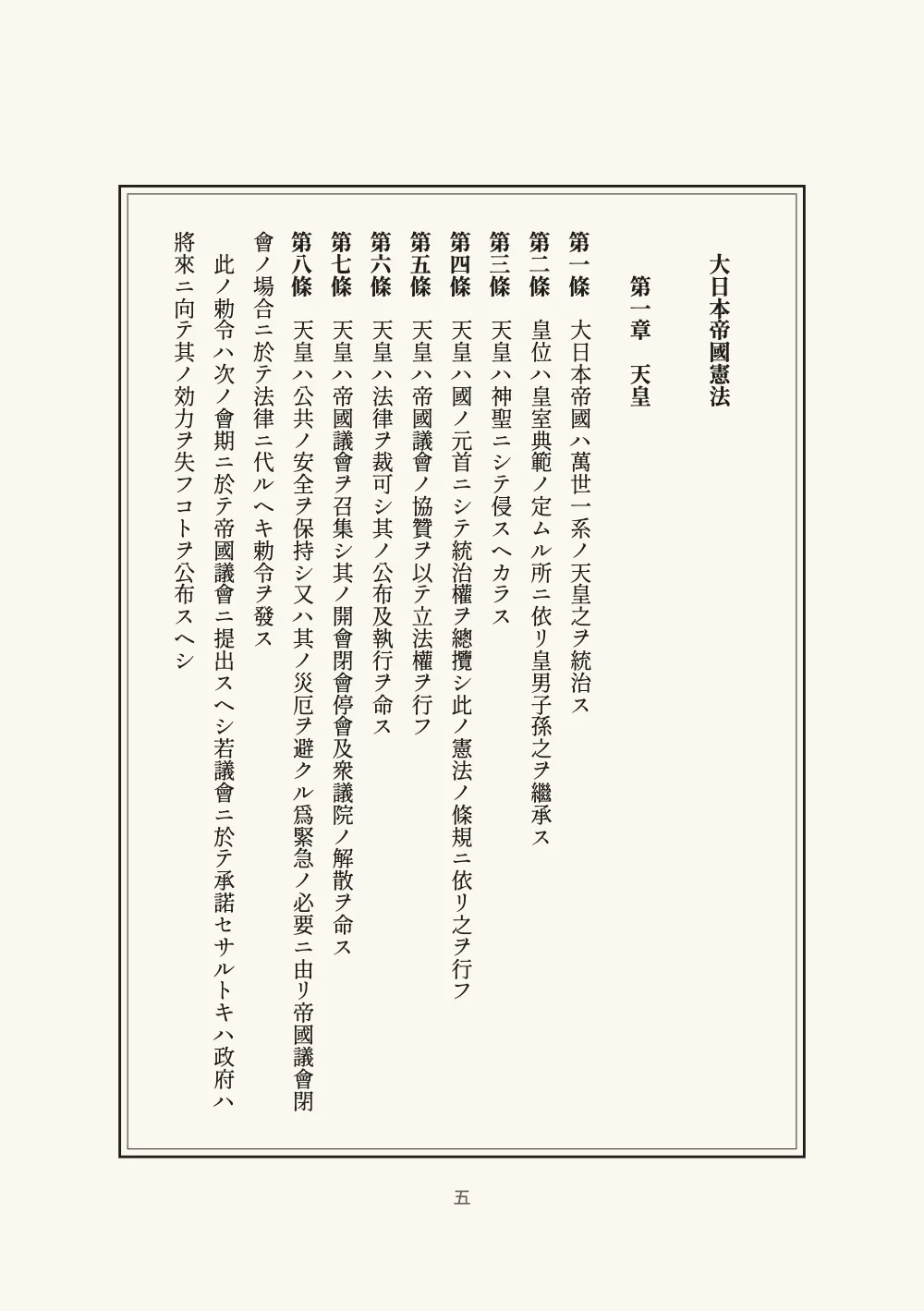
La costituzione giapponese del 1889, scritta in kanji e katakana, stampata in righe dall’alto in basso come la stampò la gazzetta ufficiale, con gli articoli numerati in kanji.
Che cosa comporrai
Una ristampa di otto pagine della Costituzione Meiji come la stampò la Gazzetta ufficiale (官報) l’11 febbraio 1889: l’editto imperiale, le controfirme dei ministri e i primi due capitoli, trentadue articoli. Il testo è 漢字カタカナ交じり文 (kanji-katakana majiri-bun), la lingua scritta del diritto Meiji: i kanji portano le parole, i katakana le desinenze, e non ci sono segni di sonorizzazione, kana piccoli né punteggiatura di alcun tipo. Le pagine sono A5, verticali e rilegate a destra, con una griglia di 40 × 15 caratteri dentro un filetto spesso e uno sottile. Gli articoli sono numerati da un contatore di elenco in kanji, da 第一條 a 第三十二條, e il sigillo e le controfirme stanno dove li mise la Gazzetta.
Questa ricetta risponde a
- Come compongo un testo Meiji in kanji e katakana, con le sue forme antiche, e numero i suoi articoli 第一條?
- Come numero i capitoli 第一章 in numeri kanji, o le voci di elenco あ い う e イ ロ ハ?
- Quali font compongono il giapponese, con i kanji nelle loro forme giapponesi, a schermo e nel PDF?
La risposta breve
const layout = { layoutType: 'single', writingMode: 'vertical-rl' }; // bound on the right
const cjk = { grid: { enabled: true, charsPerLine: CHARS, linesPerPage: LINES } };
// Each article is an item of an ordered list: the counter is japanese-informal (十八, not
// 一十八), the prefix 第 and the separator 條 wrap it, and the turnover lines go back to
// the head of the line, as in the Gazette. numberWidth 'item' starts the text of each
// article one gap after its own label: one full-width space follows 第九條 and 第十一條
// alike, and their texts start a character apart. Chapter two starts its list at 18.
const orderedLists = {
  numberFormat: 'japanese-informal', prefix: '第', separator: '條', gap: em(1),
  numberWidth: 'item',
  indent: em(0), hangingIndent: false, fontFamily: MINCHO, fontWeight: 800,
  color: col('ink'), marginTop: pt(0), marginBottom: pt(0), itemSpacing: pt(0),
};
// The chapters: 第{2:一}章 counts them in the same style, two characters down (字下げ).
const chapter = { level: 2, numberingTemplate: '第{2:一}章', numberSeparator: ' ',
  fontSize: pt(BODY), fontWeight: 800, indent: em(2), lineSpan: 2, // 二行取り
  breakBefore: { enabled: false } };
Ingredienti
- Funzionalità
- Kana, kanji e rōmajiNumeri giapponesi e contatori in kanaTesto verticaleLibri rilegati a destraGriglia dei caratteriFont cinesi, giapponesi e coreaniDivisione in righe del giapponese (kinsoku)Titoli su più righe di testo (gyōdori)Elenchi numeratiElenchi puntati e liste di controlloAperture progettateStili di titoloAttributi dei titoliStili di paragrafoTesto, filetti e riquadri nei progetti di paginaTestatine e folioColore della cartaTavolozza di colori semanticaEsportazione in PDFFont incorporati nel PDF
- Usa anche
- Divisione in righe del cineseTitoli numeratiTestatine secondo il ruolo della paginaPagine preliminari in numeri romaniCapitoli non numerati
- Tipo
- Shippori Mincho B1, Noto Sans JP (SIL OFL 1.1)
- Risorse
- Nessuna: ogni immagine è disegnata nel codice
Preparazione
#1 · Lascia che un contatore di elenco scriva 第十八條
Il codice è nella risposta breve qui sopra. Ogni articolo è una voce di un elenco ordinato Markdown, e orderedLists trasforma il suo numero nella forma della Gazzetta: numberFormat: 'japanese-informal' scrive 十八, non 一十八, prefix: '第' e separator: '條' lo racchiudono, e gap: em(1) lascia lo spazio a tutta larghezza dell’originale. numberWidth: 'item' fa cominciare il testo di ogni articolo uno spazio dopo la sua etichetta, così 第九條 e 第十一條 sono seguiti ciascuno da uno spazio a tutta larghezza, come nella Gazzetta, e i loro testi cominciano a un carattere di distanza. Con hangingIndent: false le righe successive tornano alla testa della riga invece di sporgere sotto il testo, come nella Gazzetta. Il capitolo secondo comincia il suo elenco da 18., così il contatore prosegue attraverso i capitoli, e i capitoli stessi sono numerati 第一章 e 第二章 dal modello di titolo 第{2:一}章, con lo stesso stile di contatore (elenchi ordinati).
#2 · Lascia i katakana come li scrisse la Gazzetta
locale: 'ja' imposta le regole giapponesi, e nessuna di esse riscrive il testo. 侵スヘカラス resta senza segni di sonorizzazione (si legge okasu bekarazu), 行フ conserva i suoi kana storici e 奪ハルヽ il suo segno di iterazione katakana. Senza kana piccoli né punteggiatura nel testo, le righe possono andare a capo tra due caratteri qualsiasi; le regole kinsoku tengono comunque ヽ e 々 lontani dalla testa della riga. Le note del curatore, in giapponese moderno con gli hiragana, stanno accanto all’editto a pagina 2, così i due modi di scrivere il giapponese si possono confrontare su una sola pagina.
#3 · Disegna la cornice su ogni pagina
// Header elements are placed on the sheet, not in the flow, so the frame is drawn in
// plain page millimetres: GAP outside the type area, then 1.4 mm to the thin rule.
const GAP = 6;
const rule = (id, out, thickness) => ({ kind: 'box', id, pages: 'all',
  style: { borderColor: col('ink'), borderWidth: pt(thickness) },
  placement: { anchor: { to: 'page', edge: 'top-left' },
    offset: { x: mm(SIDE - out), y: mm(HEAD - out) },
    size: { width: mm(AREA.across + 2 * out), height: mm(AREA.down + 2 * out) } } });
const header = { elements: [
  rule('outer', GAP + 1.4, 1.2), rule('inner', GAP, 0.4),
  // The folio in kanji, under the frame, in the middle of the page.
  { kind: 'text', id: 'folio', content: '{pageNumber}', pages: 'body', fontFamily: GOTHIC,
    fontSize: pt(8), color: col('muted'), align: 'center',
    placement: { anchor: { to: 'page', edge: 'top-left' },
      offset: { x: mm(0), y: mm(HEAD + AREA.down + GAP + 6) }, size: { width: mm(TRIM.w) } } },
] };
Lo slot dell’intestazione disegna in semplici millimetri della pagina, non nel flusso verticale, quindi la cornice è fatta di due riquadri collocati dagli stessi numeri che collocano la gabbia: HEAD dall’alto, SIDE da ciascun bordo. I margini sono calcolati dalla griglia, non lasciati a essa, così la gabbia sta esattamente 6 mm dentro il filetto sottile. Il folio, in kanji grazie a pageNumbering.format: 'japanese-informal', sta sotto la cornice.
#4 · Componi il frontespizio lungo l’asse
// In the flow frame of a vertical page x runs down the column, y leftward across it.
const at = (down, across) => ({ anchor: { to: 'container', edge: 'top-left' },
  offset: { x: mm(down), y: mm(across) } });
const MID = AREA.across / 2; // mm: the axis of the page, from the right of the type area
const cover = {
  id: 'cover', numbered: false, toc: false, span: 'page', runningChapter: false,
  breakBefore: { enabled: true, parity: 'any' },
  advancedDesign: { enabled: true, slot: { elements: [
    { kind: 'text', id: 'title', content: '{titleText}', fontFamily: MINCHO, fontWeight: 800,
      fontSize: pt(34), lineHeight: 1, letterSpacing: pt(10), color: col('ink'),
      placement: at((AREA.down - (7 * 34 + 6 * 10) * PT) / 2, MID - 34 * PT / 2) }, // centred
    { kind: 'text', id: 'date', content: '{attr.date}', fontFamily: MINCHO, fontSize: pt(11),
      lineHeight: 1, letterSpacing: pt(2), color: col('seal'), placement: at(30, MID + 18) },
    { kind: 'text', id: 'source', content: '{attr.source}', fontFamily: MINCHO,
      fontSize: pt(11), lineHeight: 1, letterSpacing: pt(4), color: col('ink'),
      placement: at(30, MID - 18 - 11 * PT) },
    // The edition's language, turned with the line, at the foot of the type area.
    { kind: 'text', id: 'latin', content: '{attr.latin}', fontFamily: GOTHIC, fontSize: pt(7.5),
      lineHeight: 1.5, color: col('muted'), overflow: 'wrap', align: 'right',
      placement: { ...at(0, AREA.across - 9), size: { width: mm(AREA.down), height: mm(9) } } },
  ] } },
};
In un flusso verticale x scende lungo il foglio e y va verso sinistra, quindi la colonna del titolo si colloca in base alla sua distanza dal bordo destro della gabbia. La data, nel colore d’accento, e il nome della Gazzetta stanno ai due lati del titolo, a 18 mm dall’asse.
#5 · Carica ogni carattere con il testo che compone
const notes = (markdown.match(/^- .*$/gm) ?? []).join('');
const gothicText = `${notes}凡例上諭一二三四五六七八九十${markdown.match(/latin="([^"]*)"/)[1]}`;
Shippori Mincho B1, un Mincho con le forme antiche 國, 條 e 權, carica i file per il testo e i titoli; Noto Sans JP carica solo le note del curatore, i folii e la riga inglese. Un carattere che riceve meno di ciò che compone fa fallire la cattura (C12).
La ricetta completa
// ═══ Postext Cookbook · Nº 128 · A Meiji proclamation in kanji and katakana ═════════ // https://postext.dev/en/cookbook/katakana-majiri-proclamation // Code: MIT · Text: Kanpō 1889, ja.wikisource (CC BY-SA 4.0); notes (CC BY 4.0) // Fonts: Shippori Mincho B1, Noto Sans JP (SIL OFL 1.1) · Needs postext ≥ 1.28.0 // The Meiji Constitution as the Official Gazette printed it: kanji and katakana, vertical. import { buildDocument, withLoadedFonts, renderPageToCanvas, loadVerticalAlternates, } from 'https://esm.sh/postext'; import { renderToPdf, decompressWoff2 } from 'https://esm.sh/postext-pdf'; const LANG = 'en'; // @lang: the language of the frame; the text is Japanese in both editions const RECIPE = 'katakana-majiri-proclamation'; // ─── 1 · Design ───────────────────────────────────────────────────────────── // #region palette: gazette black, one vermilion for the seal, toned paper const palette = { ink: '#211d1a', // the text and the frame seal: '#a8321f', // 御名御璽 and the cover's date: the one accent (5.5:1 on the paper) muted: '#6b6259', // the editor's notes, the folio, the colophon paper: '#fbf8f0', }; const col = (id) => ({ hex: palette[id], model: 'hex', paletteId: id }); const colorPalette = [ ...Object.entries(palette).map(([id, hex]) => ({ id, name: id, value: { hex, model: 'hex' } })), { id: 'main-color', name: 'seal (defaults)', value: { hex: palette.seal, model: 'hex' } }, ]; // #endregion const MINCHO = 'Shippori Mincho B1'; // 明朝 with Meiji type in its bones, old forms 國 條 權 const GOTHIC = 'Noto Sans JP'; // the editor's voice: notes, folios, colophon const [BODY, LEAD] = [10, 18]; // pt: line pitch 1.8 em const [CHARS, LINES] = [40, 15]; // the type area: 40 characters down, 15 lines across const PT = 25.4 / 72; // mm in a point const TRIM = { w: 148, h: 210 }; // mm, A5 const AREA = { down: CHARS * BODY * PT, across: LINES * LEAD * PT }; // 141.1 × 95.3 mm const HEAD = 37; // mm from the top edge to the head of the type area: 天 deeper than 地 const SIDE = (TRIM.w - AREA.across) / 2; // the same margin on both sides of the frame // #region answer: kanji with katakana, vertical, and articles numbered 第一條 in kanji const layout = { layoutType: 'single', writingMode: 'vertical-rl' }; // bound on the right const cjk = { grid: { enabled: true, charsPerLine: CHARS, linesPerPage: LINES } }; // Each article is an item of an ordered list: the counter is japanese-informal (十八, not // 一十八), the prefix 第 and the separator 條 wrap it, and the turnover lines go back to // the head of the line, as in the Gazette. numberWidth 'item' starts the text of each // article one gap after its own label: one full-width space follows 第九條 and 第十一條 // alike, and their texts start a character apart. Chapter two starts its list at 18. const orderedLists = { numberFormat: 'japanese-informal', prefix: '第', separator: '條', gap: em(1), numberWidth: 'item', indent: em(0), hangingIndent: false, fontFamily: MINCHO, fontWeight: 800, color: col('ink'), marginTop: pt(0), marginBottom: pt(0), itemSpacing: pt(0), }; // The chapters: 第{2:一}章 counts them in the same style, two characters down (字下げ). const chapter = { level: 2, numberingTemplate: '第{2:一}章', numberSeparator: ' ', fontSize: pt(BODY), fontWeight: 800, indent: em(2), lineSpan: 2, // 二行取り breakBefore: { enabled: false } }; // #endregion // #region frame: a thick and a thin rule round the type area, on every page // Header elements are placed on the sheet, not in the flow, so the frame is drawn in // plain page millimetres: GAP outside the type area, then 1.4 mm to the thin rule. const GAP = 6; const rule = (id, out, thickness) => ({ kind: 'box', id, pages: 'all', style: { borderColor: col('ink'), borderWidth: pt(thickness) }, placement: { anchor: { to: 'page', edge: 'top-left' }, offset: { x: mm(SIDE - out), y: mm(HEAD - out) }, size: { width: mm(AREA.across + 2 * out), height: mm(AREA.down + 2 * out) } } }); const header = { elements: [ rule('outer', GAP + 1.4, 1.2), rule('inner', GAP, 0.4), // The folio in kanji, under the frame, in the middle of the page. { kind: 'text', id: 'folio', content: '{pageNumber}', pages: 'body', fontFamily: GOTHIC, fontSize: pt(8), color: col('muted'), align: 'center', placement: { anchor: { to: 'page', edge: 'top-left' }, offset: { x: mm(0), y: mm(HEAD + AREA.down + GAP + 6) }, size: { width: mm(TRIM.w) } } }, ] }; // #endregion // #region cover: the title down the middle, the date and the source to its left // In the flow frame of a vertical page x runs down the column, y leftward across it. const at = (down, across) => ({ anchor: { to: 'container', edge: 'top-left' }, offset: { x: mm(down), y: mm(across) } }); const MID = AREA.across / 2; // mm: the axis of the page, from the right of the type area const cover = { id: 'cover', numbered: false, toc: false, span: 'page', runningChapter: false, breakBefore: { enabled: true, parity: 'any' }, advancedDesign: { enabled: true, slot: { elements: [ { kind: 'text', id: 'title', content: '{titleText}', fontFamily: MINCHO, fontWeight: 800, fontSize: pt(34), lineHeight: 1, letterSpacing: pt(10), color: col('ink'), placement: at((AREA.down - (7 * 34 + 6 * 10) * PT) / 2, MID - 34 * PT / 2) }, // centred { kind: 'text', id: 'date', content: '{attr.date}', fontFamily: MINCHO, fontSize: pt(11), lineHeight: 1, letterSpacing: pt(2), color: col('seal'), placement: at(30, MID + 18) }, { kind: 'text', id: 'source', content: '{attr.source}', fontFamily: MINCHO, fontSize: pt(11), lineHeight: 1, letterSpacing: pt(4), color: col('ink'), placement: at(30, MID - 18 - 11 * PT) }, // The edition's language, turned with the line, at the foot of the type area. { kind: 'text', id: 'latin', content: '{attr.latin}', fontFamily: GOTHIC, fontSize: pt(7.5), lineHeight: 1.5, color: col('muted'), overflow: 'wrap', align: 'right', placement: { ...at(0, AREA.across - 9), size: { width: mm(AREA.down), height: mm(9) } } }, ] } }, }; // #endregion const config = () => ({ locale: 'ja', // written out, never LANG (gotcha: ja-locale-tag) colorPalette, page: { sizePreset: 'custom', width: mm(TRIM.w), height: mm(TRIM.h), dpi: 150, backgroundColor: col('paper'), margins: { top: mm(HEAD), bottom: mm(TRIM.h - HEAD - AREA.down), left: mm(SIDE), right: mm(SIDE), mirror: true }, pageNumbering: { format: 'japanese-informal' }, // 一, 二, 三… }, layout, cjk, bodyText: { fontFamily: MINCHO, fontSize: pt(BODY), lineHeight: pt(LEAD), color: col('ink'), boldColor: col('ink'), italicColor: col('ink'), referenceColor: col('ink'), // A new clause of an article (項) starts one character down; the edict's paragraphs // start flush, as the Gazette sets them. textAlign: 'justify', firstLineIndent: em(1), indentAfterHeading: true, }, headings: { fontFamily: MINCHO, color: col('ink'), fontWeight: 800, levels: [ { level: 1, breakBefore: { enabled: true, parity: 'any' } }, chapter, ], }, headingStyles: [ cover, // 凡例 and 上諭: in the editor's gothic, one line, not counted as chapters. { id: 'notes', numbered: false, fontFamily: GOTHIC, fontWeight: 700, fontSize: pt(9), color: col('muted'), lineSpan: 1, indent: em(1) }, { id: 'edict', numbered: false, fontFamily: GOTHIC, fontWeight: 700, fontSize: pt(9), color: col('muted'), lineSpan: 2, indent: em(1) }, { id: 'law', numbered: false, indent: em(1), lineSpan: 2 }, ], unorderedLists: { bulletChar: '一', gap: em(1), indent: em(1), fontFamily: GOTHIC, color: col('muted'), marginTop: pt(0), marginBottom: pt(0), itemSpacing: pt(0) }, orderedLists, paragraphStyles: [ { id: 'flush', firstLineIndent: em(0) }, // 御名 御璽, larger, three characters down: where the Emperor signed and sealed. { id: 'seal', fontSize: pt(15), lineHeight: pt(2 * LEAD), color: col('seal'), indent: em(2), marginTop: pt(LEAD) }, // The ministers' countersignatures end at the foot of the line (地付き). { id: 'countersign', textAlign: 'end', marginTop: pt(LEAD) }, { id: 'colophon', fontFamily: GOTHIC, fontSize: pt(7), lineHeight: pt(LEAD), color: col('muted'), textAlign: 'left', marginTop: pt(2 * LEAD) }, ], header, footer: { elements: [] }, }); // ─── 2 · Content ──────────────────────────────────────────────────────────── const markdown = String.raw`---Esempio Markdown · 140 righe · content.en.md
title: "大日本帝國憲法" author: "明治二十二年二月十一日發布" --- # 大日本帝國憲法 {style="cover" date="明治二十二年二月十一日" source="官報號外" latin="The Constitution of the Empire of Japan · Official Gazette, 11 February 1889"} ## 凡例 {style="notes"} - 本書には、明治二十二年二月十一日の官報號外に載った大日本帝國憲法のうち、上諭と第一章、第二章を収めた。 - 本文は官報のとおり漢字カタカナ交じり文で組み、旧字体と歴史的仮名遣いを改めていない。原文には濁点も句読点もない。「侵スヘカラス」は「おかすべからず」、「行フ」は「おこなう」と読む。 - 官報は送り仮名のカタカナを漢字より小さく組んでいるが、本書では本文と同じ大きさにそろえた。 - 大臣の副署は、官報では官職名を均等に割り付けているが、本書では行末をそろえるだけにとどめた。 ## 上諭 {style="edict"} :::paragraphs{style="flush"} 朕祖宗ノ遺烈ヲ承ケ萬世一系ノ帝位ヲ踐ミ朕カ親愛スル所ノ臣民ハ即チ朕カ祖宗ノ惠撫慈養シタマヒシ所ノ臣民ナルヲ念ヒ其ノ康福ヲ増進シ其ノ懿徳良能ヲ發達セシメムコトヲ願ヒ又其ノ翼贊ニ依リ與ニ倶ニ國家ノ進運ヲ扶持セムコトヲ望ミ乃チ明治十四年十月十二日ノ詔命ヲ履踐シ茲ニ大憲ヲ制定シ朕カ率由スル所ヲ示シ朕カ後嗣及臣民及臣民ノ子孫タル者ヲシテ永遠ニ循行スル所ヲ知ラシム 國家統治ノ大權ハ朕カ之ヲ祖宗ニ承ケテ之ヲ子孫ニ傳フル所ナリ朕及朕カ子孫ハ將來此ノ憲法ノ條章ニ循ヒ之ヲ行フコトヲ愆ラサルヘシ 朕ハ我カ臣民ノ權利及財産ノ安全ヲ貴重シ及之ヲ保護シ此ノ憲法及法律ノ範圍内ニ於テ其ノ享有ヲ完全ナラシムヘキコトヲ宣言ス 帝國議會ハ明治二十三年ヲ以テ之ヲ召集シ議會開會ノ時ヲ以テ此ノ憲法ヲシテ有効ナラシムルノ期トスヘシ 將來若此ノ憲法ノ或ル條章ヲ改定スルノ必要ナル時宜ヲ見ルニ至ラハ朕及朕カ繼統ノ子孫ハ發議ノ權ヲ執リ之ヲ議會ニ付シ議會ハ此ノ憲法ニ定メタル要件ニ依リ之ヲ議決スルノ外朕カ子孫及臣民ハ敢テ之カ紛更ヲ試ミルコトヲ得サルヘシ 朕カ在廷ノ大臣ハ朕カ爲ニ此ノ憲法ヲ施行スルノ責ニ任スヘク朕カ現在及將來ノ臣民ハ此ノ憲法ニ對シ永遠ニ從順ノ義務ヲ負フヘシ ::: :::paragraphs{style="seal"} 御名 御璽 ::: :::paragraphs{indent=6} 明治二十二年二月十一日 ::: :::paragraphs{style="countersign"} 内閣總理大臣 伯爵 黒田清隆 樞密院議長 伯爵 伊藤博文 外務大臣 伯爵 大隈重信 海軍大臣 伯爵 西郷從道 農商務大臣 伯爵 井上 馨 司法大臣 伯爵 山田顯義 大藏大臣兼内務大臣 伯爵 松方正義 陸軍大臣 伯爵 大山 巖 文部大臣 子爵 森 有禮 遞信大臣 子爵 榎本武揚 ::: ## 大日本帝國憲法 {style="law"} ## 天皇 1. 大日本帝國ハ萬世一系ノ天皇之ヲ統治ス 2. 皇位ハ皇室典範ノ定ムル所ニ依リ皇男子孫之ヲ繼承ス 3. 天皇ハ神聖ニシテ侵スヘカラス 4. 天皇ハ國ノ元首ニシテ統治權ヲ總攬シ此ノ憲法ノ條規ニ依リ之ヲ行フ 5. 天皇ハ帝國議會ノ協贊ヲ以テ立法權ヲ行フ 6. 天皇ハ法律ヲ裁可シ其ノ公布及執行ヲ命ス 7. 天皇ハ帝國議會ヲ召集シ其ノ開會閉會停會及衆議院ノ解散ヲ命ス 8. 天皇ハ公共ノ安全ヲ保持シ又ハ其ノ災厄ヲ避クル爲緊急ノ必要ニ由リ帝國議會閉會ノ場合ニ於テ法律ニ代ルヘキ勅令ヲ發ス 此ノ勅令ハ次ノ會期ニ於テ帝國議會ニ提出スヘシ若議會ニ於テ承諾セサルトキハ政府ハ將來ニ向テ其ノ効力ヲ失フコトヲ公布スヘシ 9. 天皇ハ法律ヲ執行スル爲ニ又ハ公共ノ安寧秩序ヲ保持シ及臣民ノ幸福ヲ増進スル爲ニ必要ナル命令ヲ發シ又ハ發セシム但シ命令ヲ以テ法律ヲ變更スルコトヲ得ス 10. 天皇ハ行政各部ノ官制及文武官ノ俸給ヲ定メ及文武官ヲ任免ス但シ此ノ憲法又ハ他ノ法律ニ特例ヲ掲ケタルモノハ各々其ノ條項ニ依ル 11. 天皇ハ陸海軍ヲ統帥ス 12. 天皇ハ陸海軍ノ編制及常備兵額ヲ定ム 13. 天皇ハ戰ヲ宣シ和ヲ講シ及諸般ノ條約ヲ締結ス 14. 天皇ハ戒嚴ヲ宣告ス 戒嚴ノ要件及効力ハ法律ヲ以テ之ヲ定ム 15. 天皇ハ爵位勳章及其ノ他ノ榮典ヲ授與ス 16. 天皇ハ大赦特赦減刑及復權ヲ命ス 17. 攝政ヲ置クハ皇室典範ノ定ムル所ニ依ル 攝政ハ天皇ノ名ニ於テ大權ヲ行フ ## 臣民權利義務 18. 日本臣民タルノ要件ハ法律ノ定ムル所ニ依ル 19. 日本臣民ハ法律命令ノ定ムル所ノ資格ニ應シ均ク文武官ニ任セラレ及其ノ他ノ公務ニ就クコトヲ得 20. 日本臣民ハ法律ノ定ムル所ニ從ヒ兵役ノ義務ヲ有ス 21. 日本臣民ハ法律ノ定ムル所ニ從ヒ納税ノ義務ヲ有ス 22. 日本臣民ハ法律ノ範圍内ニ於テ居住及移轉ノ自由ヲ有ス 23. 日本臣民ハ法律ニ依ルニ非スシテ逮捕監禁審問處罰ヲ受クルコトナシ 24. 日本臣民ハ法律ニ定メタル裁判官ノ裁判ヲ受クルノ權ヲ奪ハルヽコトナシ 25. 日本臣民ハ法律ニ定メタル場合ヲ除ク外其ノ許諾ナクシテ住所ニ侵入セラレ及搜索セラルヽコトナシ 26. 日本臣民ハ法律ニ定メタル場合ヲ除ク外信書ノ祕密ヲ侵サルヽコトナシ 27. 日本臣民ハ其ノ所有權ヲ侵サルヽコトナシ 公益ノ爲必要ナル處分ハ法律ノ定ムル所ニ依ル 28. 日本臣民ハ安寧秩序ヲ妨ケス及臣民タルノ義務ニ背カサル限ニ於テ信教ノ自由ヲ有ス 29. 日本臣民ハ法律ノ範圍内ニ於テ言論著作印行集會及結社ノ自由ヲ有ス 30. 日本臣民ハ相當ノ敬禮ヲ守リ別ニ定ムル所ノ規程ニ從ヒ請願ヲ爲スコトヲ得 31. 本章ニ掲ケタル條規ハ戰時又ハ國家事變ノ場合ニ於テ天皇大權ノ施行ヲ妨クルコトナシ 32. 本章ニ掲ケタル條規ハ陸海軍ノ法令又ハ紀律ニ牴觸セサルモノニ限リ軍人ニ準行ス :::paragraphs{style="colophon"} Set in Shippori Mincho B1 and Noto Sans JP (SIL OFL) · Text: Official Gazette (官報) extra of 11 February 1889, from the Japanese Wikisource transcription (revision 244180, CC BY-SA 4.0) · Editorial notes: CC BY 4.0 :::`; // content.<lang>.md: the same Japanese text in both // ─── 3 · Fonts ────────────────────────────────────────────────────────────── const FONTS = { 'Shippori Mincho B1': ['400', '800'], 'Noto Sans JP': ['400', '700'] }; // #region voices: each face loads the files of the characters it sets const notes = (markdown.match(/^- .*$/gm) ?? []).join(''); const gothicText = `${notes}凡例上諭一二三四五六七八九十${markdown.match(/latin="([^"]*)"/)[1]}`; // #endregion // ─── 4 · Build & show ─────────────────────────────────────────────────────── await loadFonts(FONTS, markdown); await loadCjkFonts({ [MINCHO]: FONTS[MINCHO] }, markdown.replace(/^- .*$/gm, ''), { vertical: true }); await loadCjkFonts({ [GOTHIC]: FONTS[GOTHIC] }, gothicText, { vertical: true }); const doc = await withLoadedFonts(() => buildDocument({ markdown }, config()), { ...kitFonts(FONTS), text: markdown }); showBook(doc, { title: t({ en: 'The Meiji Constitution, 1889', es: 'La Constitución Meiji, 1889' }) }); offerPdf(() => renderToPdf(doc, { fontProvider: cjkPdfProvider }), `${RECIPE}.pdf`);Kit · core, fonts, viewer, pdf, cjk: uguale in ogni ricetta · 458 righe
// ─── Kit ── helpers shared by every Cookbook recipe · postext.dev/cookbook ───── // ─── Kit · core v1 ── the same in every recipe · postext.dev/cookbook function mm(value) { return { value, unit: 'mm' }; } function pt(value) { return { value, unit: 'pt' }; } function em(value) { return { value, unit: 'em' }; } /** The sample language's string: t({ en: 'Figure', es: 'Figura' }). */ function t(strings) { return strings[LANG] ?? Object.values(strings)[0]; } /** A file in this recipe's assets folder, served from the Postext repo by jsDelivr. */ function asset(file) { return `https://cdn.jsdelivr.net/gh/drnachio/postext@main/cookbook/${RECIPE}/assets/${file}`; } // ─── Kit · fonts v3 ── the same in every recipe · postext.dev/cookbook // Postext loads the faces a config asks for before layout (prepareFonts, // buildDocumentWithFonts) and asks the kit for the files: Fontsource's, the // files the PDF embeds too. /** The options of buildDocumentWithFonts / prepareFonts / withLoadedFonts: * the Fontsource resolver, and the faces of FONTS loaded with the ones the * config names. FONTS = { 'Family Name': ['400', '400i', '700'] }. */ function kitFonts(FONTS = {}) { const faces = Object.entries(FONTS).flatMap(([family, specs]) => specs.map((spec) => ({ family, weight: parseInt(spec, 10), style: spec.endsWith('i') ? 'italic' : 'normal' }))); return { resolve: fontsourceResolver, faces }; } /** A face's Fontsource files, in a fixed order: latin, then latin-ext and greek * when `text` needs them and the family ships them (kitSubsetsFor), each with * its unicode-range. Null for a weight or slant Fontsource does not ship. */ async function fontsourceResolver(family, weight, style, { text = '' } = {}) { const id = fontsourceId(family); const meta = await fontsourceMeta(family); if (meta && !(meta.weights.includes(weight) && meta.styles.includes(style))) return null; kitStatus('Loading fonts…'); const at = await fontsourceAt(id); return ['latin', ...kitSubsetsFor(text, meta)].map((subset) => ({ source: `${at}files/${id}-${subset}-${weight}-${style}.woff2`, unicodeRange: kitRanges()[subset], })); } /** The unicode-range of each Fontsource file the kit loads (a function: the * kit is inlined after the pen's code, which runs before a const would be set). */ function kitRanges() { return { latin: 'U+0000-00FF,U+0131,U+0152-0153,U+02BB-02BC,U+02C6,U+02DA,U+02DC,U+0304,U+0308,U+0329,' + 'U+2000-206F,U+20AC,U+2122,U+2191,U+2193,U+2212,U+2215,U+FEFF,U+FFFD', 'latin-ext': 'U+0100-02BA,U+02BD-02C5,U+02C7-02CC,U+02CE-02D7,U+02DD-02FF,U+0304,U+0308,U+0329,' + 'U+1D00-1DBF,U+1E00-1E9F,U+1EF2-1EFF,U+2020,U+20A0-20AB,U+20AD-20C0,U+2113,U+2C60-2C7F,U+A720-A7FF', greek: 'U+0370-03FF', }; } /** For the cjk, arabic and comics blocks, which add their own files: the * faces of `faces` = { 'Family Name': ['400', '400i', '700'] }. `text` is the sample: * č ł † α χ also load latin-ext and greek files (kitSubsetsFor). With * `optional`, a face Fontsource does not ship is skipped instead of failing. * The files are added once all have loaded, in the order asked (latin, then * latin-ext, then greek), whatever order they arrive in: the last one added * wins a character two files hold. Resolves to the number of faces added. */ async function loadFonts(faces, text = '', { optional = false } = {}) { kitStatus('Loading fonts…'); const ranges = kitRanges(); const jobs = []; for (const [family, specs] of Object.entries(faces)) { const id = fontsourceId(family); const todo = [...new Set(specs)].map((spec) => [parseInt(spec, 10), spec.endsWith('i') ? 'italic' : 'normal']) .filter(([weight, style]) => !hasFace(family, weight, style)); // before any await const at = fontsourceAt(id); const meta = optional || /[^\0-ÿ]/u.test(text) ? await fontsourceMeta(family) : null; const subsets = ['latin', ...kitSubsetsFor(text, meta)]; for (const [weight, style] of todo) { if (optional && !(meta?.weights.includes(weight) && meta.styles.includes(style))) continue; for (const subset of subsets) { const url = `${await at}files/${id}-${subset}-${weight}-${style}.woff2`; const face = new FontFace(family, `url(${url}) format('woff2')`, { weight: String(weight), style, unicodeRange: ranges[subset] }); jobs.push(face.load().catch(() => { if (subset === 'latin' && !optional) throw new Error(`Fontsource has no ${family} ${weight} ${style}`); })); } } } const ready = await Promise.all(jobs).catch((error) => { kitFail(error); throw error; }); return ready.filter((face) => face && document.fonts.add(face)).length; } /** A loaded FontFace covers this family, weight and style (fonts.check() would * also say yes for families nobody declared). */ function hasFace(family, weight, style) { for (const face of document.fonts) { if (face.status !== 'loaded' || face.style !== style) continue; if (face.family.replace(/^["']|["']$/g, '') !== family) continue; const [low, high = low] = face.weight.split(' ').map(Number); if (weight >= low && weight <= high) return true; } return false; } /** The files beyond latin `text` needs that `meta`'s family ships. */ function kitSubsetsFor(text, meta) { return [[/[Ā-˿ᴀ-ᶿḀ-ỿ†ℓⱠ-Ɀ꜠-ꟿ]/u, 'latin-ext'], [/[Ͱ-Ͽ]/u, 'greek']] .filter(([re, x]) => re.test(text) && meta?.subsets?.includes(x)).map(([, x]) => x); } /** Fontsource's id for a family: 'Source Serif 4' → 'source-serif-4'. */ function fontsourceId(family) { return family.toLowerCase().replace(/\s+/g, '-'); } /** A package's folder at the one version @5 names now (#766). */ function fontsourceAt(id, u = `https://cdn.jsdelivr.net/npm/@fontsource/${id}@`) { return (fontsourceAt.c ??= {})[id] ??= fetch(u + '5/package.json').then((r) => r.json()) .then((p) => p.version || 5, () => 5).then((v) => `${u}${v}/`); } /** The family's Fontsource metadata (weights, styles, subsets), or null. */ function fontsourceMeta(family) { fontsourceMeta.cache ??= new Map(); const id = fontsourceId(family); if (!fontsourceMeta.cache.has(id)) { fontsourceMeta.cache.set(id, fetch(`https://api.fontsource.org/v1/fonts/${id}`) .then((res) => (res.ok ? res.json() : null), () => null)); } return fontsourceMeta.cache.get(id); } // ─── Kit · viewer v2 ── the same in every recipe · postext.dev/cookbook /** The pages as spreads on a dark desk, page 1 alone, then verso | recto, * each painted when it scrolls near. Other options go to renderPageToCanvas. */ function showPages(docs, { title, width = 460, ...render } = {}) { const root = viewer(title); const pages = [docs].flat().flatMap((doc) => doc.pages.map((page) => ({ doc, page, n: (doc.pageIndexOffset ?? 0) + page.index }))); const spreads = []; let verso = null; for (const p of pages) { if (p.n % 2 === 1) { if (verso) spreads.push([verso, null]); verso = p; } else { spreads.push([verso, p]); verso = null; } } if (verso) spreads.push([verso, null]); const density = Math.min(window.devicePixelRatio || 1, 2); showPages.painter?.disconnect(); const painter = new IntersectionObserver((entries) => { for (const { isIntersecting, target } of entries) { if (!isIntersecting) continue; painter.unobserve(target); const { doc, page } = target.postext; renderPageToCanvas(page, doc, target, { ...render, scale: (width * density) / page.width }); } }, { rootMargin: '800px' }); showPages.painter = painter; root.replaceChildren(...spreads.map((pair) => { const spread = document.createElement('div'); spread.className = 'pt-spread'; for (const p of pair) { const figure = document.createElement('figure'); if (p) { const label = p.page.pageLabel || String(p.n + 1); const canvas = document.createElement('canvas'); canvas.postext = p; canvas.style.aspectRatio = `${p.page.width} / ${p.page.height}`; canvas.setAttribute('role', 'img'); canvas.setAttribute('aria-label', `Page ${label}`); const folio = document.createElement('figcaption'); folio.textContent = label; figure.append(canvas, folio); painter.observe(canvas); } else figure.className = 'pt-blank'; spread.append(figure); } return spread; })); kitStatus(`${pages.length} ${pages.length === 1 ? 'page' : 'pages'}`); document.documentElement.dataset.postext = 'ready'; return pages.length; } /** The desk, the bar and the error reporting, created once. */ function viewer(title) { if (!document.getElementById('pt-kit')) { document.head.insertAdjacentHTML('beforeend', `<style id="pt-kit"> :root { color-scheme: dark; } body { margin: 0; background: #0e1014; color: #b9bcc4; font: 13px/1.45 system-ui, sans-serif; } #pt-bar { position: sticky; top: 0; z-index: 1; display: flex; flex-wrap: wrap; align-items: center; gap: 6px 16px; padding: 10px 16px; background: rgb(14 16 20 / .92); backdrop-filter: blur(6px); border-bottom: 1px solid #23262d; } #pt-bar strong { color: #f4f1ea; font-weight: 600; } #pt-actions { display: flex; gap: 12px; margin-left: auto; } #pt-actions a, #pt-actions button { color: #d8a21a; font: inherit; background: none; border: 0; padding: 0; cursor: pointer; } #pages { display: grid; justify-items: center; gap: 48px; padding: 32px 16px 72px; } .pt-spread { display: flex; } .pt-spread figure { margin: 0; width: min(460px, 44vw); } .pt-spread canvas { display: block; width: 100%; background: #fff; box-shadow: 0 1px 2px rgb(0 0 0 / .5), 0 22px 44px -16px rgb(0 0 0 / .8); } .pt-spread figure:first-child canvas { box-shadow: inset -14px 0 14px -14px rgb(0 0 0 / .18), 0 1px 2px rgb(0 0 0 / .5), 0 22px 44px -16px rgb(0 0 0 / .8); } .pt-spread figcaption { margin-top: 10px; text-align: center; font: 600 10px/1 system-ui, sans-serif; letter-spacing: .18em; text-transform: uppercase; color: #6c7079; } .pt-blank { visibility: hidden; } @media (max-width: 760px) { .pt-spread { flex-direction: column; gap: 32px; } .pt-spread figure { width: min(460px, 92vw); } .pt-blank { display: none; } } </style>`); document.body.insertAdjacentHTML('afterbegin', '<header id="pt-bar"><strong id="pt-title"></strong><span id="pt-status" role="status"></span><span id="pt-actions"></span></header>'); document.getElementById('pt-title').textContent = document.title || 'Postext'; addEventListener('error', (event) => kitFail(event.error ?? event.message)); addEventListener('unhandledrejection', (event) => kitFail(event.reason)); } if (title) document.getElementById('pt-title').textContent = title; return document.getElementById('pages') ?? document.body.appendChild(Object.assign(document.createElement('main'), { id: 'pages' })); } function kitStatus(text) { viewer(); document.getElementById('pt-status').textContent = text; } function kitFail(error) { document.documentElement.dataset.postext = 'error'; kitStatus(`Error: ${error?.message ?? error}`); } // ─── Kit · pdf v3 ── the same in every recipe that exports a PDF /** The Fontsource files the screen used, as TrueType, with their range and * place: the nearest weight the family ships, upright with no italic; * latin, then what its letters need (kitSubsetsFor). */ async function fontsourceProvider(family, weight, style, request) { const id = fontsourceId(family); const meta = await fontsourceMeta(family); const weights = meta?.weights?.length ? meta.weights : [400, 700]; const w = weights.reduce((a, b) => (Math.abs(b - weight) < Math.abs(a - weight) ? b : a)); const s = style === 'italic' && meta && !meta.styles.includes('italic') ? 'normal' : style; const text = String.fromCodePoint(...(request?.codePoints ?? [])); const files = await Promise.all(['latin', ...kitSubsetsFor(text, meta)].map(async (subset, order) => { const res = await fetch(`${await fontsourceAt(id)}files/${id}-${subset}-${w}-${s}.woff2`); if (!res.ok) throw new Error(`Fontsource has no ${family} ${w} ${s} ${subset}`); return Object.assign(await decompressWoff2(new Uint8Array(await res.arrayBuffer())), { unicodeRange: kitRanges()[subset], order }); })); return files.length === 1 ? files[0] : files; } /** A "Build the PDF" button; then "Open the PDF" (a new tab: CodePen's frame * shows no PDFs) and a download link. */ function offerPdf(makePdf, filename) { viewer(); const button = Object.assign(document.createElement('button'), { type: 'button', textContent: 'Build the PDF' }); button.dataset.postextPdf = filename; button.addEventListener('click', async () => { button.disabled = true; button.textContent = 'Building the PDF…'; try { const bytes = await makePdf(); const url = URL.createObjectURL(new Blob([bytes], { type: 'application/pdf' })); const size = `${Math.max(1, Math.round(bytes.length / 1024))} KB`; button.replaceWith( Object.assign(document.createElement('a'), { href: url, target: '_blank', rel: 'noopener', textContent: 'Open the PDF ↗' }), Object.assign(document.createElement('a'), { href: url, download: filename, textContent: `Download ${filename} · ${size}` })); } catch (error) { button.disabled = false; button.textContent = 'Build the PDF'; kitFail(error); } }); document.getElementById('pt-actions').append(button); } // ─── Kit · cjk v2 ── Chinese, Japanese and Korean books · postext.dev/cookbook // Fontsource ships a CJK family as about a hundred files per weight, each // declared in its stylesheet with the unicode-range it covers. The screen // loads the files the sample touches; the PDF gets the same files for the // characters its pages set in each face, and embeds each as a subset. // A book bound on the right (vertical text) is shown with its spreads // mirrored: page 1 alone on the left of the spine, then [3 | 2]. /** The files of a Fontsource face, read from its stylesheet: { url, range, * ranges }, the last declared first (the order the browser tries them in). */ function cjkSlices(family, weight, style) { cjkSlices.cache ??= new Map(); const id = fontsourceId(family); const css = `${id}/${weight}${style === 'italic' ? '-italic' : ''}.css`; if (!cjkSlices.cache.has(css)) { let at; cjkSlices.cache.set(css, fontsourceAt(id).then((a) => fetch(at = a + css.slice(id.length + 1))) .then((res) => { if (!res.ok) throw new Error(`Fontsource has no ${family} ${weight} ${style} (${res.status})`); return res.text(); }) .then((text) => [...text.matchAll(/@font-face\s*{([^}]*)}/g)].map(([, rule]) => { const range = /unicode-range:\s*([^;]+);/.exec(rule)?.[1].trim() ?? 'U+0-10FFFF'; const ranges = range.split(',').map((part) => { const [lo, hi = lo] = part.trim().slice(2).split('-'); return [parseInt(lo, 16), parseInt(hi, 16)]; }); return { url: new URL(/url\(([^)]+?\.woff2)\)/.exec(rule)[1], at).href, range, ranges }; }).reverse())); } return cjkSlices.cache.get(css); } /** The file of `slices` the screen sets code point `cp` in, if any: the * last one loadCjkFonts adds whose range holds it. A numbered file that * repeats a letter of latin is added after latin, and wins it. */ function cjkSliceFor(slices, cp) { const holds = (slice) => slice.ranges.some(([lo, hi]) => cp >= lo && cp <= hi); return slices.reduce((last, slice) => (holds(slice) ? slice : last), undefined); } /** Whether Fontsource serves `family` as a Chinese, Japanese or Korean * family (its subsets name the script). Fails when the API does not * answer: a CJK face taken for a Latin one would paint in a system face. */ async function isCjkFamily(family) { const meta = await fontsourceMeta(family); if (!meta) throw new Error(`api.fontsource.org did not describe ${family}: reload to try again`); return !!meta.subsets?.some((subset) => /^(chinese|japanese|korean)/.test(subset)); } /** faces = { 'Noto Serif TC': ['400', '700'] }, as for loadFonts: the * whole FONTS object may be passed, its other families are left to * loadFonts. Adds one FontFace per file of each CJK face with its * unicodeRange, then loads the files `text` touches. `text` is what the * faces set: the sample for the text face; a book in several voices calls * it once per voice (loadCjkFonts({ 'LXGW WenKai TC': ['400'] }, quotes)), * so the heading and quotation faces fetch and check only their own * characters. Fails when a character of `text` is in no file of a face. * List every weight the pages use: a weight left to the engine's later round * gets the latin file only. With { vertical: true } it also loads each * family's vertical forms (brackets, quotes, pause marks) for the canvas, * which needs loadVerticalAlternates imported from postext. Resolves to * the number of files loaded. */ async function loadCjkFonts(faces, text, { vertical = false } = {}) { kitStatus('Loading fonts…'); let loaded = 0; try { if (vertical && typeof loadVerticalAlternates !== 'function') { throw new Error('loadCjkFonts(…, { vertical: true }) needs loadVerticalAlternates imported from postext'); } for (const [family, specs] of Object.entries(faces)) { if (!(await isCjkFamily(family))) continue; const twin = []; for (const spec of new Set(specs)) { const weight = parseInt(spec, 10); const style = spec.endsWith('i') ? 'italic' : 'normal'; const slices = await cjkSlices(family, weight, style); const missing = [...new Set(text)].filter((ch) => /\S/.test(ch) && !cjkSliceFor(slices, ch.codePointAt(0))); if (missing.length) { throw new Error(`${family} ${spec} has no file for ${missing.slice(0, 12).join(' ')}: ` + `give each face the text it sets (loadCjkFonts({ '${family}': ['${spec}'] }, text))`); } for (const slice of slices) { document.fonts.add(new FontFace(family, `url(${slice.url}) format('woff2')`, { weight: String(weight), style, unicodeRange: slice.range })); twin.push({ source: slice.url, weight: String(weight), style, unicodeRange: slice.range }); } const font = `${style === 'italic' ? 'italic ' : ''}${weight} 16px "${family}"`; loaded += (await document.fonts.load(font, text)).length; if (!document.fonts.check(font, text)) throw new Error(`${family} ${spec} did not load for the sample`); } // The same files under a twin name with the `vert` feature on: the // canvas paints the punctuation of vertical lines with it. if (vertical && twin.length) await loadVerticalAlternates(family, twin); } } catch (error) { kitFail(error); throw error; } return loaded; } /** The PDF font provider for recipes with CJK faces: a family whose * Fontsource subsets are Chinese, Japanese or Korean gets the files the * screen set its pages' characters in (`request.codePoints`), each marked * with its unicode-range and its place in the order loadCjkFonts added * them: postext-pdf sets a character two files hold in the one added * last, as the browser does. Any other family gets the latin file * fontsourceProvider fetches (the "pdf" block) and, when the face sets * letters only latin-ext has, that file too. */ async function cjkPdfProvider(family, weight, style, request) { if (!(await isCjkFamily(family))) return cjkLatinPdfFiles(family, weight, style, request); const meta = await fontsourceMeta(family); const weights = meta.weights?.length ? meta.weights : [400, 700]; const w = weights.reduce((a, b) => (Math.abs(b - weight) < Math.abs(a - weight) ? b : a)); const s = style === 'italic' && !meta.styles.includes('italic') ? 'normal' : style; const slices = await cjkSlices(family, w, s); const picked = new Set(); for (const cp of request?.codePoints ?? []) { const slice = cjkSliceFor(slices, cp); if (slice) picked.add(slice); } if (!picked.size) picked.add(slices[0]); return Promise.all(slices.map(async (slice, order) => { if (!picked.has(slice)) return null; const res = await fetch(slice.url); if (!res.ok) throw new Error(`Fontsource file ${slice.url} (${res.status})`); const bytes = await decompressWoff2(new Uint8Array(await res.arrayBuffer())); return Object.assign(bytes, { unicodeRange: slice.range, order }); })).then((files) => files.filter(Boolean)); } /** A Latin family set next to the CJK faces: its latin file, then its * latin-ext file when the face sets letters only latin-ext has (ō ū in * Hepburn rōmaji, ǎ in pinyin), the file loadFonts adds on screen for * them, each marked with its unicode-range and its place in that order: * the PDF sets a character in the file the browser took it from. A face * Fontsource ships without latin-ext, or whose file does not come, gets * latin alone, and the PDF names the letters it lacks. */ async function cjkLatinPdfFiles(family, weight, style, request) { const meta = await fontsourceMeta(family); const beyond = [...(request?.codePoints ?? [])].some(cjkLatinExtOnly); if (!beyond || !meta?.subsets?.includes('latin-ext')) return fontsourceProvider(family, weight, style); const weights = meta.weights?.length ? meta.weights : [400, 700]; const w = weights.reduce((a, b) => (Math.abs(b - weight) < Math.abs(a - weight) ? b : a)); const s = style === 'italic' && !meta.styles.includes('italic') ? 'normal' : style; const id = fontsourceId(family); const url = `${await fontsourceAt(id)}files/${id}-latin-ext-${w}-${s}.woff2`; const [latin, ext] = await Promise.all([fontsourceProvider(family, weight, style), fetch(url) .then(async (res) => (res.ok ? decompressWoff2(new Uint8Array(await res.arrayBuffer())) : null), () => null)]); const ranges = kitRanges(); return ext ? [Object.assign(latin, { unicodeRange: ranges.latin, order: 0 }), Object.assign(ext, { unicodeRange: ranges['latin-ext'], order: 1 })] : latin; } /** Whether code point `cp` is in Fontsource's latin-ext file and not in * its latin file: Latin Extended-A and -B, IPA, the spacing modifiers and * Latin Extended Additional (loadFonts's test for latin-ext), less the * few latin holds too (ı Œ œ ʻ ʼ ˆ ˚ ˜). */ function cjkLatinExtOnly(cp) { if (!((cp >= 0x100 && cp <= 0x2ff) || (cp >= 0x1e00 && cp <= 0x1eff))) return false; return ![0x131, 0x152, 0x153, 0x2bb, 0x2bc, 0x2c6, 0x2da, 0x2dc].includes(cp); } /** showPages for a book bound on either edge. A right-bound book (the * document says so: doc.binding is 'right' for page.binding 'right' and * for vertical text) lies on the desk as it opens: page 1 alone on the * left of the spine, then [3 | 2], the spine shade on each page's inner * edge. `binding` ('left' | 'right') overrides the document's. */ function showBook(docs, { binding, ...options } = {}) { const count = showPages(docs, options); const right = (binding ?? [docs].flat()[0]?.binding) === 'right'; if (!document.getElementById('pt-kit-cjk')) { // The pages keep direction ltr: a canvas draws text in the direction its // element inherits, and under rtl each run would end where the engine // starts it, its brackets mirrored. document.head.insertAdjacentHTML('beforeend', `<style id="pt-kit-cjk"> .pt-spread[dir="rtl"] canvas { direction: ltr; } .pt-spread[dir="rtl"] figure:first-child canvas { box-shadow: inset 14px 0 14px -14px rgb(0 0 0 / .18), 0 1px 2px rgb(0 0 0 / .5), 0 22px 44px -16px rgb(0 0 0 / .8); } </style>`); } // Each pair stays [verso, recto] in the page; right to left, the verso // sits on the right. Phones stack the pages in reading order either way. for (const spread of document.querySelectorAll('#pages > .pt-spread')) spread.dir = right ? 'rtl' : 'ltr'; document.getElementById('pages').dataset.binding = right ? 'right' : 'left'; return count; } // ─── /Kit ───────────────────────────────────────────────────────────────────────
Lo script.js composto funziona così com’è: incollalo nello script modulo di qualsiasi pagina, oppure apri la ricetta su CodePen. Cartella della ricetta su GitHub ↗ (si apre in una nuova scheda)
Varianti
#Fai sporgere le righe successive sotto il testo
I codici moderni compongono la seconda riga di un articolo sotto il suo primo carattere di testo, non sotto 第.
-  indent: em(0), hangingIndent: false, fontFamily: MINCHO, fontWeight: 800,
+ indent: em(0), hangingIndent: true, fontFamily: MINCHO, fontWeight: 800,#Numera gli articoli in daiji
Alcuni testi giuridici e finanziari scrivono 壱, 弐, 参: il token 壱 o lo stile japanese-formal danno 第壱條, 第弐條.
-  numberFormat: 'japanese-informal', prefix: '第', separator: '條', gap: em(1),
+ numberFormat: 'japanese-formal', prefix: '第', separator: '條', gap: em(1),Errori frequenti
Errore frequente
Assegna a un testo giapponese il tag 'ja', mai zh-Hans o LANG
Le edizioni di una ricetta sono en ed es, ma un esempio giapponese è giapponese in entrambe: `locale: LANG` gli darebbe il tag inglese o spagnolo, e un tag cinese lo comporrebbe con le regole cinesi (punteggiatura Kaiming, kana piccoli liberi di aprire una riga, 图 per 図, forme cinesi dei glifi nel PDF). Da postext 1.30 il tag è anche la lingua usata per lo shaping del testo (misura, disegno e incorporamento), quindi qualunque tag diverso da 'ja' dà forme dei glifi diverse da quelle giapponesi (quelle cinesi con un tag cinese) e altri a capo. Scrivi 'ja': sceglie la regione Giappone (divisione in righe e punteggiatura JLReq, segni d’enfasi a sesamo, spaziatura dei furigana, etichette 図 e 表) e disattiva la sillabazione. Il lint fa fallire un testo con kana sotto un tag zh o ko. Divisione in righe del giapponese (kinsoku) →
Errore frequente
Componi il giapponese in un carattere giapponese
Noto Serif SC e TC hanno i kana, ma disegnano i kanji in forme cinesi (直, 骨 e 角 sono diversi) e i kana con un disegno cinese. Componi il testo in Noto Serif JP o Shippori Mincho B1 e i titoli in Noto Sans JP, caricati con loadCjkFonts. I file giapponesi di Fontsource non contengono hentaigana né altri kana storici (U+1B000–1B16F): loadCjkFonts fallisce su di essi e il PDF stampa riquadri, quindi scrivi i kana moderni o includi negli asset della ricetta un carattere che li abbia. A Shippori Mincho mancano anche le vocali con macron ō e ū: componi il rōmaji in un carattere latino. Kana, kanji e rōmaji →
Errore frequente
I caratteri cinesi si caricano a fette, tramite il blocco cjk
Fontsource serve una famiglia cinese, giapponese o coreana come un centinaio di file per peso, ognuno dei quali copre un intervallo di caratteri. loadFonts scarica solo il file latin, così a schermo i caratteri Han vengono da un font di sistema e sono misurati male, e fontsourceProvider passa al PDF quel file latin, che li stampa come riquadri vuoti. Elenca il blocco cjk del kit, chiama loadCjkFonts(FONTS, markdown) dopo loadFonts (una volta per voce tipografica, con il testo che compone, quando il libro usa più caratteri CJK) e passa a renderToPdf fontProvider: cjkPdfProvider: entrambi prendono i file che contengono i caratteri del testo. Font cinesi, giapponesi e coreani →
- La Gazzetta compone i katakana delle desinenze più piccoli dei kanji, e spazia uniformemente i titoli dei ministri su un’unica larghezza (字取り). Postext compone ogni carattere nel corpo del testo, e la sua spaziatura uniforme,
jidori, si applica solo ai titoli, quindi qui le controfirme sono solo allineate al piede della riga. - Giapponese e cinese non concordano su questo contatore: in un documento
jail token一e{2:一}significanojapanese-informal(百一, 十八), in uno cinese significano lo stile cinese (一百零一, 十八). La raccolta cinese Date e sigle diritte nel testo verticale scrive a mano i suoi 第一條.
Crediti
- Ricetta
- Ignacio Ferro
- Testo
- The Constitution of the Empire of Japan, 11 February 1889: the imperial preamble (上諭) with its countersignatures, chapters 1 and 2, as printed in the Kanpō (Official Gazette) extra of that day · Government of Japan; transcription by Japanese Wikisource editors · CC BY-SA 4.0
- The editor's notes (凡例), written in Japanese for this recipe · Postext Cookbook · CC BY 4.0
- Font
- Shippori Mincho B1 (SIL OFL 1.1) · Noto Sans JP (SIL OFL 1.1)
- Codice
- MIT, come Postext
Modifica questo testo ↗ (si apre in una nuova scheda)Cartella della ricetta su GitHub ↗ (si apre in una nuova scheda)