In breve
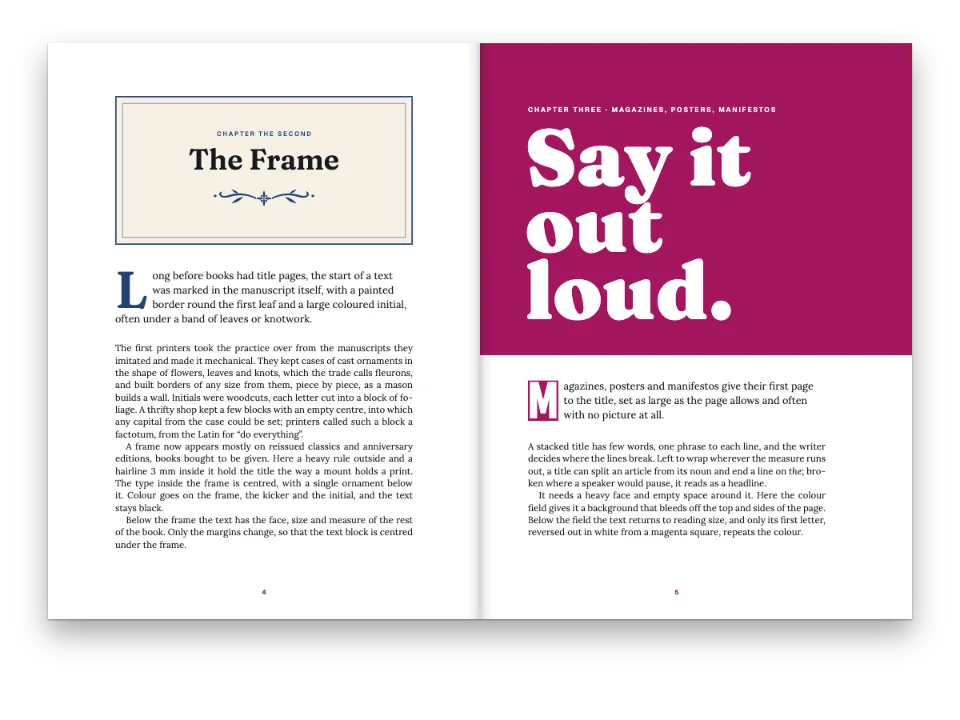
Un libro fotografico orizzontale che racconta una giornata in montagna in sei immagini. Mostra come riempire pagine intere di foto fino al bordo e stendere un’immagine su due pagine affiancate.
Che cosa comporrai
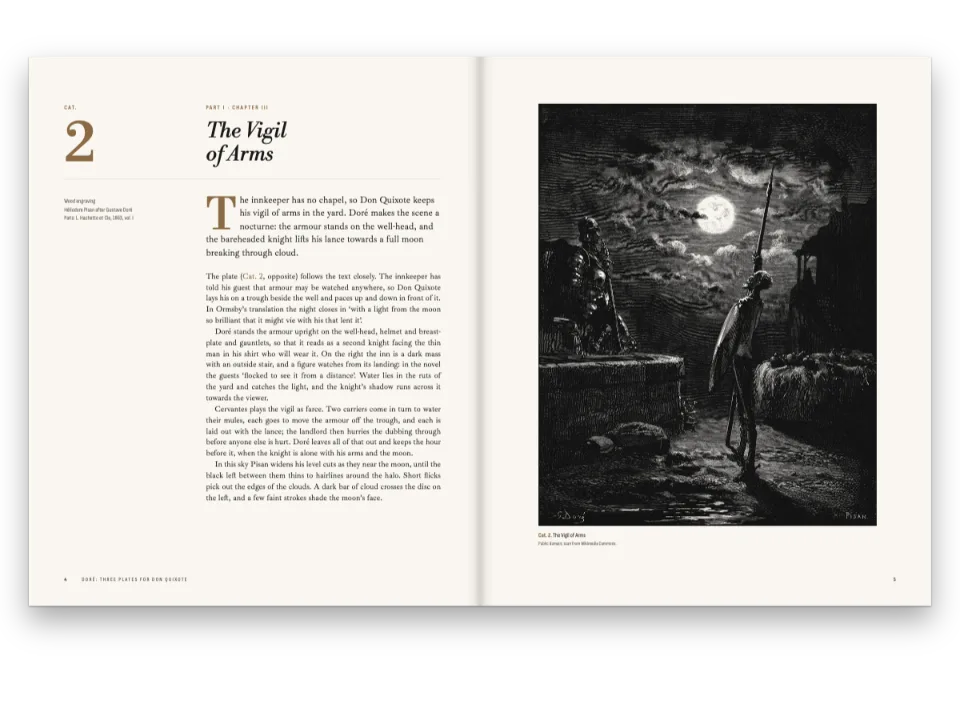
Sierra, un libro fotografico orizzontale su una pagina di 280 × 210 mm: una giornata in una catena di granito in sei tavole, dalla prima luce al mattino dopo la prima neve. Ogni tavola riempie la sua pagina fino al rifilo e porta soltanto un piccolo numerale e l’ora nell’angolo in basso a sinistra; la prima porta anche il titolo, SIERRA in Syne da 72 pt, in negativo sul cielo dell’alba. La tempesta attraversa la piega delle pagine 4 e 5 come un’unica immagine. Tre brevi testi, composti in una colonna di 100 mm vicino al dorso, stanno di fronte alle tavole che li seguono. Il testo della tempesta finisce su una tavola del crepuscolo più piccola che flotta sotto di esso, con il numerale nella didascalia. L’ultima tavola mostra il circo della seconda dallo stesso masso, sotto la neve. Le tavole sono fotografie generate con modelli di diffusione; la tavola della neve è stata ottenuta modificando la tavola di mezzogiorno, così le due vedute coincidono.
Questa ricetta risponde a
- Come do a ogni capitolo una foto, un colore o una variante di apertura propri?
- Come inserisco pagine bianche volute, o faccio cominciare una sezione su una nuova doppia pagina?
- Come nascondo le testatine nelle aperture e nelle pagine bianche, o coloro un verso bianco con il colore della parte?
- Come compongo illustrazioni non numerate: fregi, vignette, loghi?
La risposta breve
// '{attr.art}' is filled in per heading, so a plain plate names its picture on its line:
// # Noon {style="lamina" art="mediodia" …}. Only the cover and the last plate draw extras.
const PLATES = [ // the style id, its picture, the ink of its caption, anything extra it draws
  { id: 'alba', art: 'alba', extra: (colour) => cover(colour) }, // an arrow: cover() is below
  { id: 'lamina', art: '{attr.art}' }, // any plate on a page of its own
  { id: 'pliego', art: '{attr.art}', half: 'verso' }, // one picture across a spread:
  { id: 'pliego-recto', art: '{attr.art}', half: 'recto' }, // the left half, then the right
  { id: 'nieve', art: 'nieve', ink: 'ink', extra: (colour) => colophon(colour) },
];
const plate = ({ id, art, half, ink = 'white', extra = () => [] }) => ({
  id, span: 'page', // an opener: a span heading always starts a page of its own
  // The left half opens on an even page, a verso, so the right half faces it across the
  // gutter (gotcha: parity-page1-recto).
  ...(half === 'verso' && { breakBefore: { enabled: true, parity: 'even' } }),
  // The picture is as deep as the page, more than the column holds: the plate claims the
  // whole page, and what follows starts on the next one.
  advancedDesign: { enabled: true, slot: { elements: [
    { kind: 'image', id: 'picture', resourceId: art, // the recto half is the same picture,
      placement: at('page', 'top-left', half === 'recto' ? -PAGE.width : 0, 0, // moved left
        { width: mm(half ? 2 * PAGE.width : PAGE.width), height: mm(PAGE.height) }) },
    ...(half === 'recto' ? [] : caption(col(ink))), ...extra(col(ink)),
  ] } },
});
Ingredienti
- Funzionalità
- Immagini nei progetti di paginaStili di titoloAperture progettateAncoraggio degli elementi del progettoGeometria della sezioneAttributi dei titoliCapitoli che si aprono su un rectoTestatine secondo il ruolo della paginaCitazioni che collocano le figureTipi di risorsa personalizzatiStile delle didascalieCopertine, frontespizi e colophonColore della cartaMargini speculariTesto, filetti e riquadri nei progetti di paginaSillabazione e lingua del documentoTavolozza di colori semanticaFigure e tabelle come risorsePagine su un canvas
- Tipo
- Andada Pro, Syne, Syne Mono (SIL OFL 1.1)
- Risorse
alba-1600.jpgatardecer-2000.jpgmediodia-1600.jpgnieve-1600.jpgnoche-1600.jpgtormenta-2400.jpg- Plate I, dawn: ridges fading into a peach haze under a dark blue sky (Generated With Diffusion Models, originale)
- Plate II, noon: a granite cirque and its lake (Generated With Diffusion Models, originale)
- Plate III, storm: rain, lightning and a break of sun across a spread (Generated With Diffusion Models, originale)
- Plate IV, dusk: the crest lit orange under a violet sky (Generated With Diffusion Models, originale)
- Plate V, night: stars over the ridges and a lit refuge (Generated With Diffusion Models, originale)
- Plate VI, snow: the cirque of plate II the morning after (Generated With Diffusion Models, originale)
Preparazione
#1 · Uno stile di titolo per ogni tavola, costruito da un elenco
Il codice è la risposta breve qui sopra. plate() costruisce uno stile di titolo da ogni riga di PLATES, e il Markdown stabilisce l’ordine del saggio, una riga per tavola: # Night {style="lamina" art="noche" n="V" hora="22:10"}. Il resourceId dell’elemento immagine è '{attr.art}', un segnaposto come quello di un testo, quindi ogni tavola semplice condivide lo stile lamina e nomina la sua immagine sulla riga del titolo; solo la copertina e l’ultima tavola, che disegnano elementi in più, hanno uno stile proprio (elementi immagine). span: 'page' fa cominciare ogni tavola su una pagina propria. L’immagine è alta 210 mm, l’altezza della pagina, e un design riserva lo spazio fino al piede delle sue immagini. È più della colonna di 158 mm delle pagine di testo, quindi la tavola occupa l’intera pagina e ciò che la segue comincia sulla successiva, senza minHeight e senza margini propri.
I due stili della doppia pagina, pliego e pliego-recto, disegnano la stessa immagine di 560 mm, qui art="tormenta": la metà del verso al bordo sinistro della pagina, la metà del recto 280 mm più a sinistra, così ogni pagina mostra la sua metà e il canvas ritaglia il resto al rifilo. parity: 'even' tiene affiancate le due metà. Senza, togliere dal Markdown la tavola di mezzogiorno metterebbe la metà sinistra a pagina 3, un recto, e la metà destra sul retro, a pagina 4; con questa impostazione la pagina 3 resta bianca e la tempesta riempie comunque le pagine 4 e 5.
#2 · Il numerale e l’ora vengono dalla riga del titolo
const NUMERAL = { x: 16, y: PAGE.height - 21, size: 13 }; // mm from the top left; size in pt
// A design text's baseline sits 0.8 of its line box below its top: set a smaller label beside
// a larger one this much lower and the two share a baseline.
const dropTo = (big, small, lineHeight = 1.2) => (0.8 * lineHeight * (big - small) * 25.4) / 72;
const caption = (colour) => [
  { kind: 'text', id: 'numeral', content: '{attr.n}', fontFamily: 'Syne', fontWeight: 700,
    fontSize: pt(NUMERAL.size), color: colour, align: 'left',
    placement: at('page', 'top-left', NUMERAL.x, NUMERAL.y) },
  { kind: 'text', id: 'hour', content: '· {attr.hora}', fontFamily: 'Syne Mono', fontSize: pt(8),
    letterSpacing: pt(0.8), color: colour, align: 'left', // the dot: a lone I reads as a bar
    placement: at('#numeral', 'right-of', 1.6, dropTo(NUMERAL.size, 8)) },
];
Il numerale e l’ora sono attributi del titolo, quindi il contenuto resta nel Markdown e un solo design serve tutte le tavole. L’ora sta right-of del numerale, il che ne allinea le sommità. La linea di base di un testo di design sta a 0,8 del suo riquadro di riga sotto la sommità dell’elemento, e il riquadro di riga è per impostazione predefinita 1,2 volte il corpo, quindi dropTo(13, 8) abbassa l’ora di 0,8 × 1,2 × (13 − 8) pt e mette l’ora da 8 pt sulla linea di base del numerale da 13 pt, a 193,4 mm dalla testa della pagina. L’ora comincia con un punto mediano, come fa la didascalia della tavola IV, perché la I di Syne è una semplice barra e, da sola accanto all’ora, si leggerebbe come un filetto. La metà recto della tempesta non disegna didascalia, e la tavola della neve compone la sua didascalia in nero, perché il primo piano è bianco.
#3 · Un titolo e un colophon sulle tavole stesse
const cover = (colour) => [
  { kind: 'text', id: 'title', content: '{title}', fontFamily: 'Syne', fontWeight: 800,
    fontSize: pt(72), lineHeight: 1, letterSpacing: pt(6), textTransform: 'uppercase',
    color: colour, align: 'left', placement: at('page', 'top-left', 22, 26) },
  { kind: 'text', id: 'subtitle', content: '{subtitle}', fontFamily: 'Syne Mono',
    fontSize: pt(10), letterSpacing: pt(2), textTransform: 'uppercase', color: colour,
    align: 'left', placement: at('#title', 'below', 1.5, 3) },
];
// The colophon: one element per line, 10.5 pt apart, so the break falls after the licence, and
// the second line on the baseline of the plate's numeral.
const COLOPHON = { y: NUMERAL.y + dropTo(NUMERAL.size, 7.5), leading: (10.5 * 25.4) / 72 };
const colophon = (colour) => ['colofon', 'tipos'].map((key, line) => ({ kind: 'text', id: key,
  content: `{attr.${key}}`, fontFamily: 'Syne Mono', fontSize: pt(7.5), letterSpacing: pt(0.2),
  color: colour, align: 'right',
  placement: at('page', 'top-right', -16, COLOPHON.y - (1 - line) * COLOPHON.leading) }));
La prima tavola è la copertina. {title} e {subtitle} leggono il frontmatter, ed extra in PLATES aggiunge entrambi gli elementi al design di quella tavola, nel colore della sua didascalia. Il colophon va sull’ultima tavola allo stesso modo, in nero sulla neve: due elementi da 7,5 pt, uno per riga, dagli attributi colofon e tipos, allineati a destra, il secondo sulla linea di base del numerale. Un solo elemento con a capo automatico andrebbe a capo dove finisce la sua larghezza; con un elemento per riga, l’a capo cade dopo la licenza.
#4 · I testi seguono le loro tavole senza interruzione
const textOpener = { enabled: true, slot: { elements: [
  { kind: 'text', id: 'hours', content: '{attr.hora}', fontFamily: 'Syne Mono', fontSize: pt(8),
    letterSpacing: pt(0.8), color: col('accent'), align: 'left',
    placement: at('container', 'top-left', 0, 0) },
  { kind: 'text', id: 'title', content: '{titleText}', fontFamily: 'Syne', fontWeight: 700,
    fontSize: pt(28), lineHeight: 1.05, // a multiple of the size
    color: col('ink'), align: 'left', overflow: 'wrap',
    placement: at('#hours', 'below', 0, 2.5, { width: 'fill' }) },
] } };
// The folio and the book's title under the text block, flush with its left edge, on the
// baseline of the plates' numerals. Not on the plates: a span heading opens their pages, so
// they are opener pages, and 'body' leaves them out.
const foot = (id, content, extra) => ({ kind: 'text', id, content, pages: 'body',
  fontFamily: 'Syne Mono', fontSize: pt(7.5), letterSpacing: pt(0.8), color: col('muted'),
  align: 'left', ...extra });
const FOOT = NUMERAL.y + dropTo(NUMERAL.size, 7.5) - (PAGE.height - MARGIN.bottom); // from the foot
const footer = { elements: [
  foot('folio', '{pageNumber}', { color: col('ink'),
    placement: at('container', 'top-left', 0, FOOT) }),
  foot('book', '{title}', { textTransform: 'uppercase', placement: at('#folio', 'right-of', 5) }),
] };
La tavola che precede un testo riempie la sua pagina, quindi il testo comincia la pagina successiva senza un’interruzione propria. Una pagina il cui primo blocco è un titolo con interruzione è una pagina d’apertura, e il pages: 'body' del folio la esclude. Senza interruzione, le pagine di testo conservano il folio; le tavole, aperte da titoli a tutta larghezza, non ne hanno. breakBefore: { enabled: false } disattiva l’interruzione verso un recto che un titolo di livello 1 ha per impostazione predefinita; con quell’interruzione la pagina di ogni testo sarebbe una pagina d’apertura, senza folio. FOOT mette il folio sulla linea di base dei numerali delle tavole, a 193,4 mm dalla testa della pagina, così il folio di un testo e il numerale della tavola di fronte stanno sulla stessa riga.
#5 · Dichiara ogni tavola, cita solo quella che flotta
// Plate IV is the one plate that floats, so a counter of its type would number it 1. The type
// prints no number (no caption prefix, an empty template) and the caption carries the numeral.
// The text names the plate with :ref's text, since a bare :ref prints 'lámina' and nothing else.
const lamina = { id: 'lamina', name: t({ en: 'Plate', es: 'Lámina' }),
  shortLabel: t({ en: 'plate', es: 'lámina' }), numberingTemplate: '',
  resetOn: 'never', counterFormat: 'decimal' };
// JPEGs in assets/, cut to the page's shape: 1600 × 1200 px for 280 × 210 mm (145 dpi).
const picture = (id, [w, h], alt, extra = {}) => ({ id, typeId: 'lamina', kind: 'bitmap',
  bitmap: { fileId: `${id}-${w}.jpg`, format: 'jpeg', width: w, height: h },
  createdAt: 0, updatedAt: 0, altText: t(alt), ...extra });
const resources = [ // the five the heading styles draw, never cited, and plate IV
  picture('alba', [1600, 1200], { en: 'Eight ridges fading into a peach dawn haze.',
    es: 'Ocho crestas que se pierden en la bruma del alba.' }),
  picture('mediodia', [1600, 1200], { en: 'A granite cirque and its lake under a pale noon sky.',
    es: 'Un circo de granito y su laguna bajo el cielo pálido del mediodía.' }),
  picture('tormenta', [2400, 900], { en: 'A storm over the range: rain on the left, lightning '
    + 'and a break of sun on the right.', es: 'Una tormenta sobre la sierra: lluvia a la '
    + 'izquierda; un rayo y un claro de sol a la derecha.' }),
  picture('noche', [1600, 1200], { en: 'Stars over dark ridges and two lit windows at a refuge.',
    es: 'Estrellas sobre crestas oscuras y dos ventanas encendidas en un refugio.' }),
  picture('nieve', [1600, 1200], { en: 'The cirque the morning after, white with new snow.',
    es: 'El circo a la mañana siguiente, blanco de nieve nueva.' }),
  // 2000 px, 339 mm at the layout's 150 dpi, which the float fits to the 100 mm measure.
  picture('atardecer', [2000, 800], { en: 'A crest lit orange under strips of cloud, violet sky.',
    es: 'Una cresta encendida de naranja bajo franjas de nube, en un cielo violeta.' },
  { caption: t({ en: 'IV · Dusk · 19:41', es: 'IV · Atardecer · 19:41' }) }),
];
L’elemento immagine di un design disegna una risorsa dichiarata, quindi tutte e sei le immagini stanno in resources: JPEG nella cartella assets/ della ricetta, ciascuno tagliato sulla forma della pagina o della doppia pagina che riempie e dichiarato alla sua dimensione in pixel, che è tutto ciò che l’impaginazione legge. loadImage() registra ogni file prima della build. La tavola IV è l’unica citata con :ref, e quindi l’unica che flotta. Prende il primo posto libero dopo la citazione, sulla pagina del suo testo, una riga sotto l’ultimo paragrafo. Un tipo numerato le darebbe la didascalia Plate 1, poiché è l’unica risorsa del suo tipo che flotta. lamina ha invece un numberingTemplate vuoto, e la didascalia stessa comincia con IV. Nella frase, il text di :ref dà il nome alla tavola, perché un :ref nudo stampa solo la parola plate.
La ricetta completa
// ═══ Postext Cookbook · Nº 068 · Photo essay with full-bleed plates ═══════════════ // https://postext.dev/en/cookbook/photo-essay-full-bleed // Code: MIT · Text: original (CC BY 4.0) · Plates: diffusion models // Fonts: Andada Pro, Syne, Syne Mono (SIL OFL 1.1) · Needs postext ≥ 1.25.0 // Sierra, a landscape photobook: one day in a mountain range in six plates, each on a page of // its own and one across the gutter of a spread, with three short texts between them. import { buildDocumentWithFonts, renderPageToCanvas, registerResourceImage, } from 'https://esm.sh/postext'; const LANG = 'en'; // @lang: the language of the sample document ('en' | 'es') const RECIPE = 'photo-essay-full-bleed'; // ─── 1 · Design ───────────────────────────────────────────────────────────── // #region palette: the paper between the plates, the ink and one rust for the labels const palette = { ink: '#1c1f27', // text: the blue-black of the night plate paper: '#f3f0ea', // every page's ground: a pale stone, seen only between the plates accent: '#94462e', // the times over each text: the dusk plate's rust, dark enough for 8 pt muted: '#5f646d', // the running foot and the caption of the small plate white: '#fbfaf7', // type set on the plates }; // col() links a colour to its palette entry; the hex is the value the entry holds. const col = (id) => ({ hex: palette[id], model: 'hex', paletteId: id }); const colorPalette = Object.entries(palette) .map(([id, hex]) => ({ id, name: id, value: { hex, model: 'hex' } })); // #endregion const PAGE = { width: 280, height: 210 }; // a landscape photobook, in mm const MARGIN = { top: 28, bottom: 24, inner: 40, outer: 140 }; // text pages: a 100 mm measure const LEAD = 15; // body leading in pt const at = (to, edge, x = 0, y = 0, size) => ({ anchor: { to, edge }, offset: { x: mm(x), y: mm(y) }, ...(size && { size }) }); // #region answer: the plates' heading styles, generated from a list // '{attr.art}' is filled in per heading, so a plain plate names its picture on its line: // # Noon {style="lamina" art="mediodia" …}. Only the cover and the last plate draw extras. const PLATES = [ // the style id, its picture, the ink of its caption, anything extra it draws { id: 'alba', art: 'alba', extra: (colour) => cover(colour) }, // an arrow: cover() is below { id: 'lamina', art: '{attr.art}' }, // any plate on a page of its own { id: 'pliego', art: '{attr.art}', half: 'verso' }, // one picture across a spread: { id: 'pliego-recto', art: '{attr.art}', half: 'recto' }, // the left half, then the right { id: 'nieve', art: 'nieve', ink: 'ink', extra: (colour) => colophon(colour) }, ]; const plate = ({ id, art, half, ink = 'white', extra = () => [] }) => ({ id, span: 'page', // an opener: a span heading always starts a page of its own // The left half opens on an even page, a verso, so the right half faces it across the // gutter (gotcha: parity-page1-recto). ...(half === 'verso' && { breakBefore: { enabled: true, parity: 'even' } }), // The picture is as deep as the page, more than the column holds: the plate claims the // whole page, and what follows starts on the next one. advancedDesign: { enabled: true, slot: { elements: [ { kind: 'image', id: 'picture', resourceId: art, // the recto half is the same picture, placement: at('page', 'top-left', half === 'recto' ? -PAGE.width : 0, 0, // moved left { width: mm(half ? 2 * PAGE.width : PAGE.width), height: mm(PAGE.height) }) }, ...(half === 'recto' ? [] : caption(col(ink))), ...extra(col(ink)), ] } }, }); // #endregion // #region caption: the plate's numeral and hour, lower left, from the heading's attributes const NUMERAL = { x: 16, y: PAGE.height - 21, size: 13 }; // mm from the top left; size in pt // A design text's baseline sits 0.8 of its line box below its top: set a smaller label beside // a larger one this much lower and the two share a baseline. const dropTo = (big, small, lineHeight = 1.2) => (0.8 * lineHeight * (big - small) * 25.4) / 72; const caption = (colour) => [ { kind: 'text', id: 'numeral', content: '{attr.n}', fontFamily: 'Syne', fontWeight: 700, fontSize: pt(NUMERAL.size), color: colour, align: 'left', placement: at('page', 'top-left', NUMERAL.x, NUMERAL.y) }, { kind: 'text', id: 'hour', content: '· {attr.hora}', fontFamily: 'Syne Mono', fontSize: pt(8), letterSpacing: pt(0.8), color: colour, align: 'left', // the dot: a lone I reads as a bar placement: at('#numeral', 'right-of', 1.6, dropTo(NUMERAL.size, 8)) }, ]; // #endregion // #region cover: the book's title reversed out of the dawn sky of the first plate const cover = (colour) => [ { kind: 'text', id: 'title', content: '{title}', fontFamily: 'Syne', fontWeight: 800, fontSize: pt(72), lineHeight: 1, letterSpacing: pt(6), textTransform: 'uppercase', color: colour, align: 'left', placement: at('page', 'top-left', 22, 26) }, { kind: 'text', id: 'subtitle', content: '{subtitle}', fontFamily: 'Syne Mono', fontSize: pt(10), letterSpacing: pt(2), textTransform: 'uppercase', color: colour, align: 'left', placement: at('#title', 'below', 1.5, 3) }, ]; // The colophon: one element per line, 10.5 pt apart, so the break falls after the licence, and // the second line on the baseline of the plate's numeral. const COLOPHON = { y: NUMERAL.y + dropTo(NUMERAL.size, 7.5), leading: (10.5 * 25.4) / 72 }; const colophon = (colour) => ['colofon', 'tipos'].map((key, line) => ({ kind: 'text', id: key, content: `{attr.${key}}`, fontFamily: 'Syne Mono', fontSize: pt(7.5), letterSpacing: pt(0.2), color: colour, align: 'right', placement: at('page', 'top-right', -16, COLOPHON.y - (1 - line) * COLOPHON.leading) })); // #endregion // #region texts: a text between plates opens on the next page with its hours above it const textOpener = { enabled: true, slot: { elements: [ { kind: 'text', id: 'hours', content: '{attr.hora}', fontFamily: 'Syne Mono', fontSize: pt(8), letterSpacing: pt(0.8), color: col('accent'), align: 'left', placement: at('container', 'top-left', 0, 0) }, { kind: 'text', id: 'title', content: '{titleText}', fontFamily: 'Syne', fontWeight: 700, fontSize: pt(28), lineHeight: 1.05, // a multiple of the size color: col('ink'), align: 'left', overflow: 'wrap', placement: at('#hours', 'below', 0, 2.5, { width: 'fill' }) }, ] } }; // The folio and the book's title under the text block, flush with its left edge, on the // baseline of the plates' numerals. Not on the plates: a span heading opens their pages, so // they are opener pages, and 'body' leaves them out. const foot = (id, content, extra) => ({ kind: 'text', id, content, pages: 'body', fontFamily: 'Syne Mono', fontSize: pt(7.5), letterSpacing: pt(0.8), color: col('muted'), align: 'left', ...extra }); const FOOT = NUMERAL.y + dropTo(NUMERAL.size, 7.5) - (PAGE.height - MARGIN.bottom); // from the foot const footer = { elements: [ foot('folio', '{pageNumber}', { color: col('ink'), placement: at('container', 'top-left', 0, FOOT) }), foot('book', '{title}', { textTransform: 'uppercase', placement: at('#folio', 'right-of', 5) }), ] }; // #endregion const config = () => ({ // The English sample is British English: every English tag hyphenates with the US patterns. locale: t({ en: 'en-us', es: 'es' }), colorPalette, resourceTypes: [lamina], page: { width: mm(PAGE.width), height: mm(PAGE.height), dpi: 150, backgroundColor: col('paper'), // the ground of every page; the plates cover it margins: { top: mm(MARGIN.top), bottom: mm(MARGIN.bottom), left: mm(MARGIN.inner), right: mm(MARGIN.outer), mirror: true } }, // left is the inner margin layout: { layoutType: 'single' }, bodyText: { fontFamily: 'Andada Pro', fontSize: pt(10.5), lineHeight: pt(LEAD), color: col('ink'), boldColor: col('ink'), italicColor: col('ink'), // both default to blue referenceColor: col('ink'), referenceBold: false, // 'lámina IV' reads as a word of the text firstLineIndent: mm(4), indentAfterHeading: false, // justified and hyphenated by default minWordSpacing: 0.7, maxWordSpacing: 1.6 }, // a narrower range than the defaults, 0.6 to 2 // A heading's own line is measured even where its design paints the title: set it in a face // the page loads, or the kit fetches Open Sans for it. headings: { fontFamily: 'Syne', levels: [ // A text follows its plate with no break of its own, so the default H1 break is switched // off: the plate fills its page, the text still starts a page, and that page stays a body // page, with its running foot. { level: 1, breakBefore: { enabled: false }, advancedDesign: textOpener }, ] }, headingStyles: PLATES.map(plate), captionStyle: { fontFamily: 'Syne Mono', fontSize: pt(7.5), color: col('muted') }, header: { elements: [] }, footer, }); // ─── 2 · Content ──────────────────────────────────────────────────────────── const markdown = String.raw`---Esempio Markdown · 43 righe · content.en.md
title: "Sierra" subtitle: "An essay in six lights" --- # Dawn {style="alba" n="I" hora="08:12"} # The climb {hora="06:40–14:06 · 1770–2180 m"} We left the car park at 6:40 with head torches, on the paved track that climbs between the broom. At that hour the granite still holds the night’s cold, and our boots sound louder than they should. From the first bend we can see the lights of the village below, eleven of them, counted twice; from the second we can’t. At 8:12 the sun touches the highest point of the crest. It is a pink edge that lasts as long as it takes to get the camera out; then the light works its way down the gullies, slowly, and takes almost an hour to reach the path. The meadow grass is white with frost and crunches under our boots. An ibex watches us from a boulder and does not move, so we are the ones who go round. We stop at the pass to eat. There is a spring that is not on the map, an iron spout driven into the rock, and the water is cold enough to make our teeth ache. Andrés notes the time and the altitude of every photograph in a notebook; at one o’clock the thermometer hanging from his rucksack reads eleven degrees in the sun. Solar noon falls after two here, on summer time. By then the shadows have gone under the stones, and the lake, seen from the pass, looks like a sheet of tin someone has left behind between the walls. # Noon {style="lamina" art="mediodia" n="II" hora="14:06"} # Storm {style="pliego" art="tormenta" n="III" hora="16:40"} # Storm {style="pliego-recto" art="tormenta"} # Eleven seconds {hora="15:00–19:50 · 2180–1950 m"} At three o’clock the air grows heavy. A cloud that at first we take for another mountain is building in the west. We pack in a hurry. The first thunder comes eleven seconds after the flash: nearly four kilometres away, Andrés reckons, because he always counts. The next one comes after four. We take shelter under the overhang of a boulder as big as a house. First small hail, then rain; the wall opposite fades behind the curtain and comes back darker, washed. Nobody speaks for a good hour. Around half past seven the storm drifts away down the valley and leaves the sky broken into strips. For a moment the sun comes out below the cloud, low in the west, and turns the whole crest a colour that lasts less than three minutes (:ref{id="atardecer" text="plate IV"}). We go down to the refuge soaked through, beside the stream, which is running full. # Night {style="lamina" art="noche" n="V" hora="22:10"} # First snow {hora="22:10–09:00 · 1950 m"} At ten the sky is clear, and the refuge window cannot hold all its stars. At midnight somebody opens the door and says it is snowing. We go out in our socks. The snow falls straight down, with no wind, in large flakes that are slow to melt on our sleeves, and the torch lights only a cone of white points coming towards us. In the morning the thermometer at the window reads two below. There is a hand’s depth of snow at the door and a rim of thin ice along the lake. The ridges that were grey yesterday are white with black streaks, the ribs where the snow will not stick, and the sky is the same colour as the ground. Andrés takes the last photograph at 8:31, from the same boulder as at noon yesterday. It takes him some time to find it, because the stones he used as markers are now identical white mounds. In the end he places it by matching the crest to yesterday’s picture on the camera screen. It is the first snow of the autumn, two weeks early, the warden says. We set off at nine. The paved track is under the snow, so we go down from one cairn to the next. # Snow {style="nieve" n="VI" hora="08:31" colofon="Sierra. An essay in six lights · Plates generated with diffusion models · Text: CC BY 4.0" tipos="Set in Andada Pro, Syne and Syne Mono (SIL OFL)"}`; // content.<lang>.md, inlined by the Cookbook // #region plates: every picture is a resource; only plate IV is cited, so only it floats // Plate IV is the one plate that floats, so a counter of its type would number it 1. The type // prints no number (no caption prefix, an empty template) and the caption carries the numeral. // The text names the plate with :ref's text, since a bare :ref prints 'lámina' and nothing else. const lamina = { id: 'lamina', name: t({ en: 'Plate', es: 'Lámina' }), shortLabel: t({ en: 'plate', es: 'lámina' }), numberingTemplate: '', resetOn: 'never', counterFormat: 'decimal' }; // JPEGs in assets/, cut to the page's shape: 1600 × 1200 px for 280 × 210 mm (145 dpi). const picture = (id, [w, h], alt, extra = {}) => ({ id, typeId: 'lamina', kind: 'bitmap', bitmap: { fileId: `${id}-${w}.jpg`, format: 'jpeg', width: w, height: h }, createdAt: 0, updatedAt: 0, altText: t(alt), ...extra }); const resources = [ // the five the heading styles draw, never cited, and plate IV picture('alba', [1600, 1200], { en: 'Eight ridges fading into a peach dawn haze.', es: 'Ocho crestas que se pierden en la bruma del alba.' }), picture('mediodia', [1600, 1200], { en: 'A granite cirque and its lake under a pale noon sky.', es: 'Un circo de granito y su laguna bajo el cielo pálido del mediodía.' }), picture('tormenta', [2400, 900], { en: 'A storm over the range: rain on the left, lightning ' + 'and a break of sun on the right.', es: 'Una tormenta sobre la sierra: lluvia a la ' + 'izquierda; un rayo y un claro de sol a la derecha.' }), picture('noche', [1600, 1200], { en: 'Stars over dark ridges and two lit windows at a refuge.', es: 'Estrellas sobre crestas oscuras y dos ventanas encendidas en un refugio.' }), picture('nieve', [1600, 1200], { en: 'The cirque the morning after, white with new snow.', es: 'El circo a la mañana siguiente, blanco de nieve nueva.' }), // 2000 px, 339 mm at the layout's 150 dpi, which the float fits to the 100 mm measure. picture('atardecer', [2000, 800], { en: 'A crest lit orange under strips of cloud, violet sky.', es: 'Una cresta encendida de naranja bajo franjas de nube, en un cielo violeta.' }, { caption: t({ en: 'IV · Dusk · 19:41', es: 'IV · Atardecer · 19:41' }) }), ]; // #endregion // ─── 3 · Fonts ────────────────────────────────────────────────────────────── const FONTS = { // text, display and label faces, loaded before the build 'Andada Pro': ['400'], Syne: ['700', '800'], 'Syne Mono': ['400'] }; // ─── 4 · Build & show ─────────────────────────────────────────────────────── const files = resources.map((r) => r.bitmap.fileId); // a resource names a file: load each await Promise.all(files.map((f) => loadImage(f, asset(f)))); const doc = await buildDocumentWithFonts({ markdown, resources }, config(), kitFonts(FONTS)); showPages(doc, { title: t({ en: 'Sierra: a photo essay in landscape', es: 'Sierra: un ensayo fotográfico apaisado' }) });Kit · core, fonts, viewer, images: uguale in ogni ricetta · 270 righe
// ─── Kit ── helpers shared by every Cookbook recipe · postext.dev/cookbook ───── // ─── Kit · core v1 ── the same in every recipe · postext.dev/cookbook function mm(value) { return { value, unit: 'mm' }; } function pt(value) { return { value, unit: 'pt' }; } function em(value) { return { value, unit: 'em' }; } /** The sample language's string: t({ en: 'Figure', es: 'Figura' }). */ function t(strings) { return strings[LANG] ?? Object.values(strings)[0]; } /** A file in this recipe's assets folder, served from the Postext repo by jsDelivr. */ function asset(file) { return `https://cdn.jsdelivr.net/gh/drnachio/postext@main/cookbook/${RECIPE}/assets/${file}`; } // ─── Kit · fonts v3 ── the same in every recipe · postext.dev/cookbook // Postext loads the faces a config asks for before layout (prepareFonts, // buildDocumentWithFonts) and asks the kit for the files: Fontsource's, the // files the PDF embeds too. /** The options of buildDocumentWithFonts / prepareFonts / withLoadedFonts: * the Fontsource resolver, and the faces of FONTS loaded with the ones the * config names. FONTS = { 'Family Name': ['400', '400i', '700'] }. */ function kitFonts(FONTS = {}) { const faces = Object.entries(FONTS).flatMap(([family, specs]) => specs.map((spec) => ({ family, weight: parseInt(spec, 10), style: spec.endsWith('i') ? 'italic' : 'normal' }))); return { resolve: fontsourceResolver, faces }; } /** A face's Fontsource files, in a fixed order: latin, then latin-ext and greek * when `text` needs them and the family ships them (kitSubsetsFor), each with * its unicode-range. Null for a weight or slant Fontsource does not ship. */ async function fontsourceResolver(family, weight, style, { text = '' } = {}) { const id = fontsourceId(family); const meta = await fontsourceMeta(family); if (meta && !(meta.weights.includes(weight) && meta.styles.includes(style))) return null; kitStatus('Loading fonts…'); const at = await fontsourceAt(id); return ['latin', ...kitSubsetsFor(text, meta)].map((subset) => ({ source: `${at}files/${id}-${subset}-${weight}-${style}.woff2`, unicodeRange: kitRanges()[subset], })); } /** The unicode-range of each Fontsource file the kit loads (a function: the * kit is inlined after the pen's code, which runs before a const would be set). */ function kitRanges() { return { latin: 'U+0000-00FF,U+0131,U+0152-0153,U+02BB-02BC,U+02C6,U+02DA,U+02DC,U+0304,U+0308,U+0329,' + 'U+2000-206F,U+20AC,U+2122,U+2191,U+2193,U+2212,U+2215,U+FEFF,U+FFFD', 'latin-ext': 'U+0100-02BA,U+02BD-02C5,U+02C7-02CC,U+02CE-02D7,U+02DD-02FF,U+0304,U+0308,U+0329,' + 'U+1D00-1DBF,U+1E00-1E9F,U+1EF2-1EFF,U+2020,U+20A0-20AB,U+20AD-20C0,U+2113,U+2C60-2C7F,U+A720-A7FF', greek: 'U+0370-03FF', }; } /** For the cjk, arabic and comics blocks, which add their own files: the * faces of `faces` = { 'Family Name': ['400', '400i', '700'] }. `text` is the sample: * č ł † α χ also load latin-ext and greek files (kitSubsetsFor). With * `optional`, a face Fontsource does not ship is skipped instead of failing. * The files are added once all have loaded, in the order asked (latin, then * latin-ext, then greek), whatever order they arrive in: the last one added * wins a character two files hold. Resolves to the number of faces added. */ async function loadFonts(faces, text = '', { optional = false } = {}) { kitStatus('Loading fonts…'); const ranges = kitRanges(); const jobs = []; for (const [family, specs] of Object.entries(faces)) { const id = fontsourceId(family); const todo = [...new Set(specs)].map((spec) => [parseInt(spec, 10), spec.endsWith('i') ? 'italic' : 'normal']) .filter(([weight, style]) => !hasFace(family, weight, style)); // before any await const at = fontsourceAt(id); const meta = optional || /[^\0-ÿ]/u.test(text) ? await fontsourceMeta(family) : null; const subsets = ['latin', ...kitSubsetsFor(text, meta)]; for (const [weight, style] of todo) { if (optional && !(meta?.weights.includes(weight) && meta.styles.includes(style))) continue; for (const subset of subsets) { const url = `${await at}files/${id}-${subset}-${weight}-${style}.woff2`; const face = new FontFace(family, `url(${url}) format('woff2')`, { weight: String(weight), style, unicodeRange: ranges[subset] }); jobs.push(face.load().catch(() => { if (subset === 'latin' && !optional) throw new Error(`Fontsource has no ${family} ${weight} ${style}`); })); } } } const ready = await Promise.all(jobs).catch((error) => { kitFail(error); throw error; }); return ready.filter((face) => face && document.fonts.add(face)).length; } /** A loaded FontFace covers this family, weight and style (fonts.check() would * also say yes for families nobody declared). */ function hasFace(family, weight, style) { for (const face of document.fonts) { if (face.status !== 'loaded' || face.style !== style) continue; if (face.family.replace(/^["']|["']$/g, '') !== family) continue; const [low, high = low] = face.weight.split(' ').map(Number); if (weight >= low && weight <= high) return true; } return false; } /** The files beyond latin `text` needs that `meta`'s family ships. */ function kitSubsetsFor(text, meta) { return [[/[Ā-˿ᴀ-ᶿḀ-ỿ†ℓⱠ-Ɀ꜠-ꟿ]/u, 'latin-ext'], [/[Ͱ-Ͽ]/u, 'greek']] .filter(([re, x]) => re.test(text) && meta?.subsets?.includes(x)).map(([, x]) => x); } /** Fontsource's id for a family: 'Source Serif 4' → 'source-serif-4'. */ function fontsourceId(family) { return family.toLowerCase().replace(/\s+/g, '-'); } /** A package's folder at the one version @5 names now (#766). */ function fontsourceAt(id, u = `https://cdn.jsdelivr.net/npm/@fontsource/${id}@`) { return (fontsourceAt.c ??= {})[id] ??= fetch(u + '5/package.json').then((r) => r.json()) .then((p) => p.version || 5, () => 5).then((v) => `${u}${v}/`); } /** The family's Fontsource metadata (weights, styles, subsets), or null. */ function fontsourceMeta(family) { fontsourceMeta.cache ??= new Map(); const id = fontsourceId(family); if (!fontsourceMeta.cache.has(id)) { fontsourceMeta.cache.set(id, fetch(`https://api.fontsource.org/v1/fonts/${id}`) .then((res) => (res.ok ? res.json() : null), () => null)); } return fontsourceMeta.cache.get(id); } // ─── Kit · viewer v2 ── the same in every recipe · postext.dev/cookbook /** The pages as spreads on a dark desk, page 1 alone, then verso | recto, * each painted when it scrolls near. Other options go to renderPageToCanvas. */ function showPages(docs, { title, width = 460, ...render } = {}) { const root = viewer(title); const pages = [docs].flat().flatMap((doc) => doc.pages.map((page) => ({ doc, page, n: (doc.pageIndexOffset ?? 0) + page.index }))); const spreads = []; let verso = null; for (const p of pages) { if (p.n % 2 === 1) { if (verso) spreads.push([verso, null]); verso = p; } else { spreads.push([verso, p]); verso = null; } } if (verso) spreads.push([verso, null]); const density = Math.min(window.devicePixelRatio || 1, 2); showPages.painter?.disconnect(); const painter = new IntersectionObserver((entries) => { for (const { isIntersecting, target } of entries) { if (!isIntersecting) continue; painter.unobserve(target); const { doc, page } = target.postext; renderPageToCanvas(page, doc, target, { ...render, scale: (width * density) / page.width }); } }, { rootMargin: '800px' }); showPages.painter = painter; root.replaceChildren(...spreads.map((pair) => { const spread = document.createElement('div'); spread.className = 'pt-spread'; for (const p of pair) { const figure = document.createElement('figure'); if (p) { const label = p.page.pageLabel || String(p.n + 1); const canvas = document.createElement('canvas'); canvas.postext = p; canvas.style.aspectRatio = `${p.page.width} / ${p.page.height}`; canvas.setAttribute('role', 'img'); canvas.setAttribute('aria-label', `Page ${label}`); const folio = document.createElement('figcaption'); folio.textContent = label; figure.append(canvas, folio); painter.observe(canvas); } else figure.className = 'pt-blank'; spread.append(figure); } return spread; })); kitStatus(`${pages.length} ${pages.length === 1 ? 'page' : 'pages'}`); document.documentElement.dataset.postext = 'ready'; return pages.length; } /** The desk, the bar and the error reporting, created once. */ function viewer(title) { if (!document.getElementById('pt-kit')) { document.head.insertAdjacentHTML('beforeend', `<style id="pt-kit"> :root { color-scheme: dark; } body { margin: 0; background: #0e1014; color: #b9bcc4; font: 13px/1.45 system-ui, sans-serif; } #pt-bar { position: sticky; top: 0; z-index: 1; display: flex; flex-wrap: wrap; align-items: center; gap: 6px 16px; padding: 10px 16px; background: rgb(14 16 20 / .92); backdrop-filter: blur(6px); border-bottom: 1px solid #23262d; } #pt-bar strong { color: #f4f1ea; font-weight: 600; } #pt-actions { display: flex; gap: 12px; margin-left: auto; } #pt-actions a, #pt-actions button { color: #d8a21a; font: inherit; background: none; border: 0; padding: 0; cursor: pointer; } #pages { display: grid; justify-items: center; gap: 48px; padding: 32px 16px 72px; } .pt-spread { display: flex; } .pt-spread figure { margin: 0; width: min(460px, 44vw); } .pt-spread canvas { display: block; width: 100%; background: #fff; box-shadow: 0 1px 2px rgb(0 0 0 / .5), 0 22px 44px -16px rgb(0 0 0 / .8); } .pt-spread figure:first-child canvas { box-shadow: inset -14px 0 14px -14px rgb(0 0 0 / .18), 0 1px 2px rgb(0 0 0 / .5), 0 22px 44px -16px rgb(0 0 0 / .8); } .pt-spread figcaption { margin-top: 10px; text-align: center; font: 600 10px/1 system-ui, sans-serif; letter-spacing: .18em; text-transform: uppercase; color: #6c7079; } .pt-blank { visibility: hidden; } @media (max-width: 760px) { .pt-spread { flex-direction: column; gap: 32px; } .pt-spread figure { width: min(460px, 92vw); } .pt-blank { display: none; } } </style>`); document.body.insertAdjacentHTML('afterbegin', '<header id="pt-bar"><strong id="pt-title"></strong><span id="pt-status" role="status"></span><span id="pt-actions"></span></header>'); document.getElementById('pt-title').textContent = document.title || 'Postext'; addEventListener('error', (event) => kitFail(event.error ?? event.message)); addEventListener('unhandledrejection', (event) => kitFail(event.reason)); } if (title) document.getElementById('pt-title').textContent = title; return document.getElementById('pages') ?? document.body.appendChild(Object.assign(document.createElement('main'), { id: 'pages' })); } function kitStatus(text) { viewer(); document.getElementById('pt-status').textContent = text; } function kitFail(error) { document.documentElement.dataset.postext = 'error'; kitStatus(`Error: ${error?.message ?? error}`); } // ─── Kit · images v3 ── recipes with pictures · postext.dev/cookbook /** Registers a photo or PNG for the canvas and keeps its bytes for the PDF. * fetch → ImageBitmap never taints the canvas (a plain cross-origin <img> would). */ async function loadImage(fileId, url) { const res = await fetch(url); if (!res.ok) throw new Error(`Image not found (${res.status}): ${url}`); const bytes = new Uint8Array(await res.arrayBuffer()); registerResourceImage(fileId, await createImageBitmap(new Blob([bytes]))); (loadImage.bytes ??= new Map()).set(fileId, bytes); } /** Registers SVG markup as a vector image, its fonts inside (inlineSvgFonts, ≥ 1.25). * `options` go to registerResourceImage: { singleInk: true } tints it on the canvas. */ async function loadSvg(fileId, svg, options) { if (typeof inlineSvgFonts === 'function') svg = await inlineSvgFonts(svg, svgFaces); const img = new Image(); img.src = `data:image/svg+xml;charset=utf-8,${encodeURIComponent(svg)}`; await img.decode(); registerResourceImage(fileId, img, options); (loadImage.bytes ??= new Map()).set(fileId, new TextEncoder().encode(svg)); } /** A face's Fontsource files: nearest weight; latin + what the SVG sets. */ async function svgFaces(family, weight, style, { codePoints = [] } = {}) { const [id, m] = [fontsourceId(family), await fontsourceMeta(family)]; const w = m?.weights.reduce((a, b) => (Math.abs(b - weight) < Math.abs(a - weight) ? b : a)) ?? weight; const s = m?.styles.includes(style) === false ? 'normal' : style; return Promise.all(['latin', ...kitSubsetsFor(String.fromCodePoint(...codePoints), m)].map(async (x) => new Uint8Array( await (await fetch(`${await fontsourceAt(id)}files/${id}-${x}-${w}-${s}.woff2`)).arrayBuffer()))); } /** renderToPdf({ resourceBytes: imageBytes }) */ function imageBytes(fileId) { return loadImage.bytes?.get(fileId); } /** renderToHtml({ resourceImageUrl: imageUrl }) */ function imageUrl(fileId) { const bytes = imageBytes(fileId); if (!bytes) return undefined; imageUrl.urls ??= new Map(); if (!imageUrl.urls.has(fileId)) { const type = /\.svg$/i.test(fileId) ? 'image/svg+xml' : /\.png$/i.test(fileId) ? 'image/png' : 'image/jpeg'; imageUrl.urls.set(fileId, URL.createObjectURL(new Blob([bytes], { type }))); } return imageUrl.urls.get(fileId); } // ─── /Kit ───────────────────────────────────────────────────────────────────────
Lo script.js composto funziona così com’è: incollalo nello script modulo di qualsiasi pagina, oppure apri la ricetta su CodePen. Cartella della ricetta su GitHub ↗ (si apre in una nuova scheda)
Varianti
#Fai flottare le tavole di fronte alle loro schede
Per tavole che flottano sul recto di fronte a una scheda di catalogo, con la larghezza della figura ricavata dalle sue proporzioni, vedi Schede di catalogo di fronte alle loro tavole.
#Apri un articolo su una fotografia al vivo
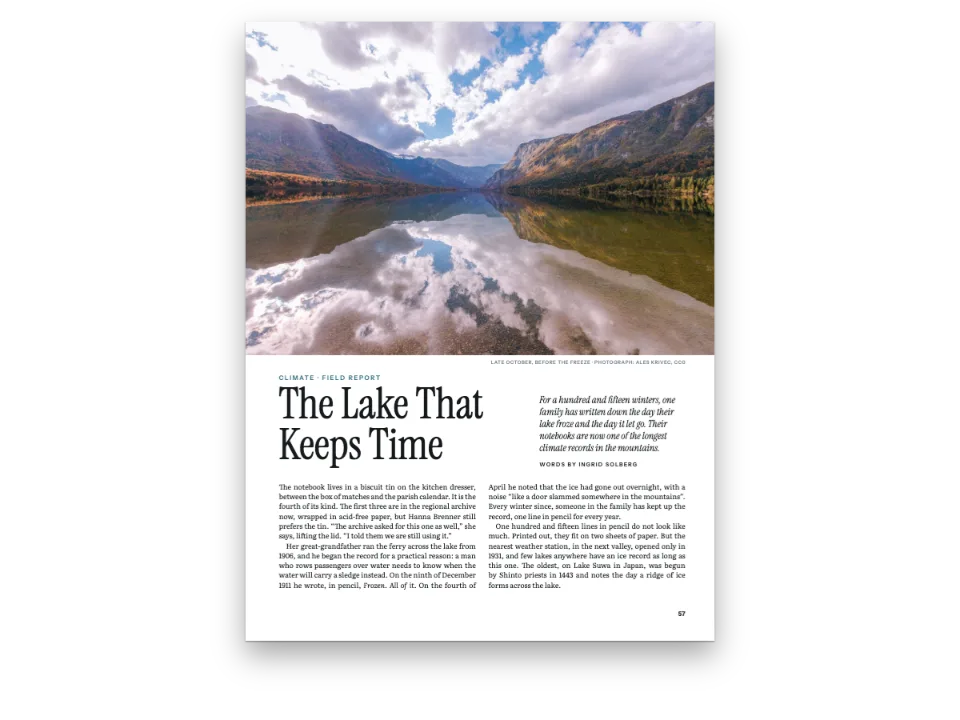
Per una fotografia al vivo sulla testa di un articolo, con il titolo e il sommario sopra, vedi l’articolo di rivista.
Errori frequenti
Errore frequente
La pagina 1 è un recto: pianifica le pagine con i numeri fisici
La pagina 1 è una pagina destra e la pagina 2 il primo verso, quindi pianifica le doppie pagine con i numeri di pagina fisici: un’apertura su una pagina pari sta di fronte alla pagina dispari che la segue. Interruzioni di pagina e di colonna →
Errore frequente
Niente <marker> né filtri nelle illustrazioni SVG (ripiego raster)
Una figura SVG resta vettoriale nel PDF solo senza <marker>, filtri e maschere; altrimenti ripiega su un raster, e filtri annidati in profondità possono farla sparire in Chrome. Disegna le punte delle frecce come tracciati. Figure e tabelle come risorse →
- Non citare mai una tavola che un design disegna. Se la citi, flotta anche come figura: un
:refalla tavola di mezzogiorno nel primo testo ne mette una seconda copia a pagina 3, e la tempesta si sposta di due pagine, dopo una pagina bianca. - La tavola del crepuscolo sta una riga sotto il suo testo, non al piede della pagina. Nella pagina conclusiva di un testo, un elemento flottante che si trova sotto il testo risale fino a esso (
layout.hugClosingFloats, attivo per impostazione predefinita), e lìposition: 'bottom'non cambia nulla. - Ogni testo è adattato a una sola pagina in entrambe le edizioni. Quando il primo prosegue a pagina 3, la tavola di mezzogiorno passa a pagina 4 e la tempesta alle pagine 6 e 7, dopo una pagina 5 bianca.
- La metà destra della tempesta è un secondo titolo
# Storm. La pagina non stampa alcun titolo per essa, ma un:::toccostruito dai titoli elenca la tempesta due volte, alle pagine 4 e 5. - Le tavole si fermano al rifilo, che è il bordo del canvas. Con
page.cutLinesattivo il canvas cresce attorno al rifilo, e l’abbondanza attorno a ogni tavola mostra il colore della carta. Per la stampa, ancora le tavole a'bleed'e rendi ciascuna più grande dell’abbondanza su ogni lato.
Crediti
- Ricetta
- Ignacio Ferro
- Testo
- The three texts, the captions and the colophon, in Spanish and English, and the six plates, drawn in code · Postext Cookbook · CC BY 4.0
- Immagini
- Plate I, dawn: ridges fading into a peach haze under a dark blue sky · Generated With Diffusion Models · originale
- Plate II, noon: a granite cirque and its lake · Generated With Diffusion Models · originale
- Plate III, storm: rain, lightning and a break of sun across a spread · Generated With Diffusion Models · originale
- Plate IV, dusk: the crest lit orange under a violet sky · Generated With Diffusion Models · originale
- Plate V, night: stars over the ridges and a lit refuge · Generated With Diffusion Models · originale
- Plate VI, snow: the cirque of plate II the morning after · Generated With Diffusion Models · originale
- Font
- Andada Pro (SIL OFL 1.1) · Syne (SIL OFL 1.1) · Syne Mono (SIL OFL 1.1)
- Codice
- MIT, come Postext
Modifica questo testo ↗ (si apre in una nuova scheda)Cartella della ricetta su GitHub ↗ (si apre in una nuova scheda)