In breve
Le prime pagine di un romanzo spagnolo del 1878 in formato tascabile. Mostra come tenere regolari gli spazi tra le parole, con le parole divise nelle sillabe spagnole giuste.
Che cosa comporrai
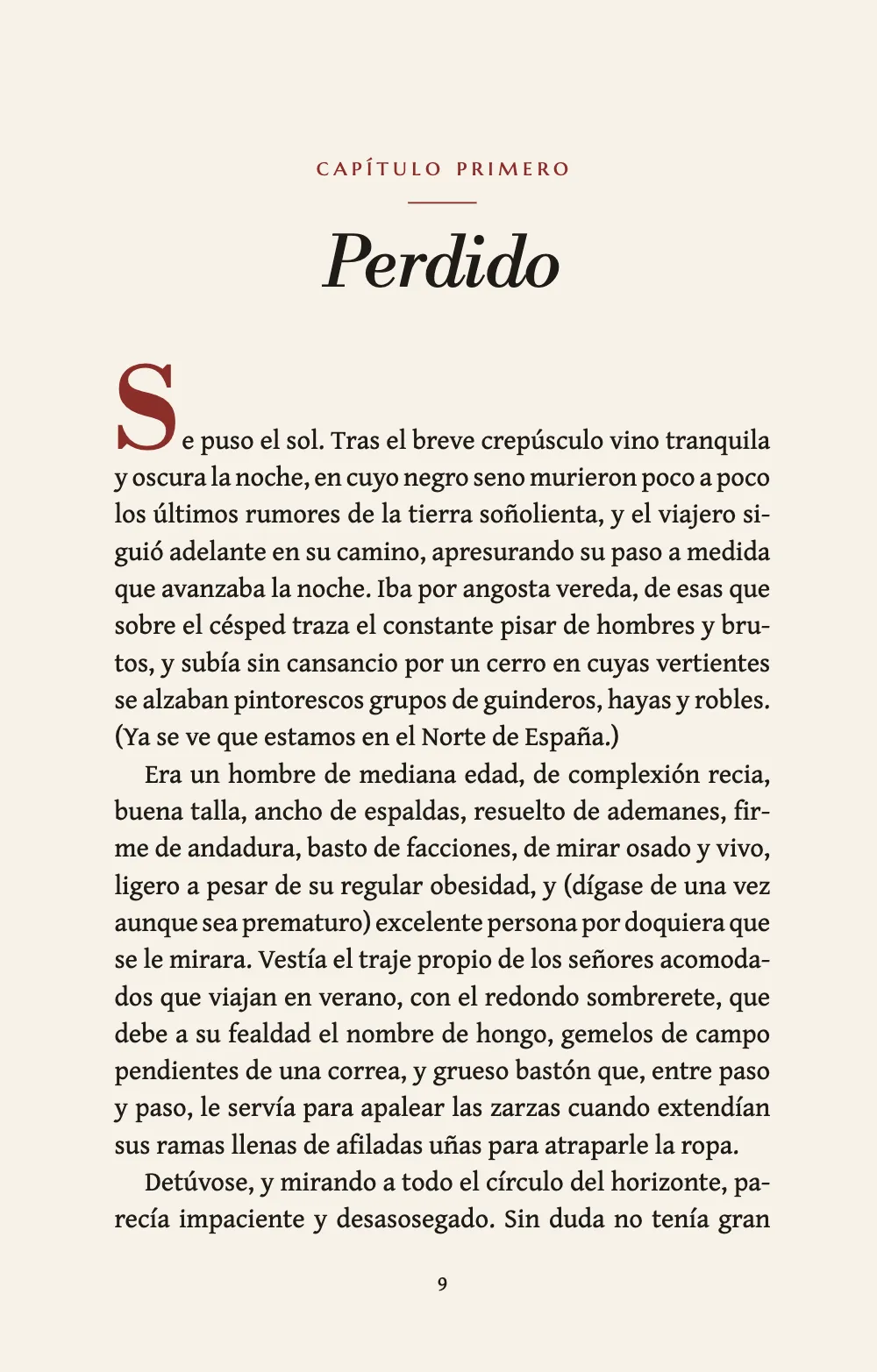
L’inizio di Marianela di Galdós (1878) in un’edizione tascabile di 11,5 × 18 cm, con una mappa congetturale delle miniere di Socartes di fronte al capitolo I. Sopra il titolo del capitolo in Libre Bodoni corsivo, capítulo primero è scritto per esteso in maiuscoletto; il testo, in Gentium Book Plus, comincia a un quarto dell’altezza con un’iniziale rialzata color sangue di bue. Le parole si dividono nelle sillabe spagnole (hie-rro, esta-blecimiento) e gli spazi tra le parole restano sotto 1,7 volte la loro larghezza normale; nessun paragrafo finisce sulla coda di una parola sillabata. Il dialogo è composto con le rayas, le lineette lunghe che aprono e chiudono anche gli incisos del narratore. La parola d’ordine del viaggiatore è tra «comillas latinas», e tra virgolette doppie inglesi dove la nota dell’edizione la cita dentro una citazione. La mappa è la Figura 1, citata nel testo come [fig. 1]. Le testatine in Marcellus SC nominano l’autore sui versi e il titolo sui recto.
Questa ricetta risponde a
- Come ottengo una buona giustificazione e sillabazione per testi in spagnolo, francese o tedesco?
- Come evito vedove, orfane e ultime righe di una sola parola (righe finali troppo corte), e tengo un titolo unito al suo testo?
- Come scrivo trattini di dialogo, anni a inizio paragrafo, prezzi e simboli letterali senza che il Markdown li interpreti male?
- Come ottengo le etichette «Figura» e «Tabella» nella lingua del mio documento?
- Come aggiungo a un’apertura una riga d’autore, un sommario o un attacco con capolettera?
La risposta breve
const LOCALE = 'es'; // config().locale: Spanish hyphenation, and Spanish caption labels
const bodyText = { // config().bodyText
  fontFamily: TEXT, fontSize: pt(BODY), lineHeight: pt(LEAD), color: col('ink'),
  boldColor: col('ink'), italicColor: col('ink'), referenceColor: col('ink'),
  referenceBold: false, // '[fig. 1]' reads in roman, like the words around it
  firstLineIndent: mm(4), indentAfterHeading: false, // a paragraph after a heading starts flush
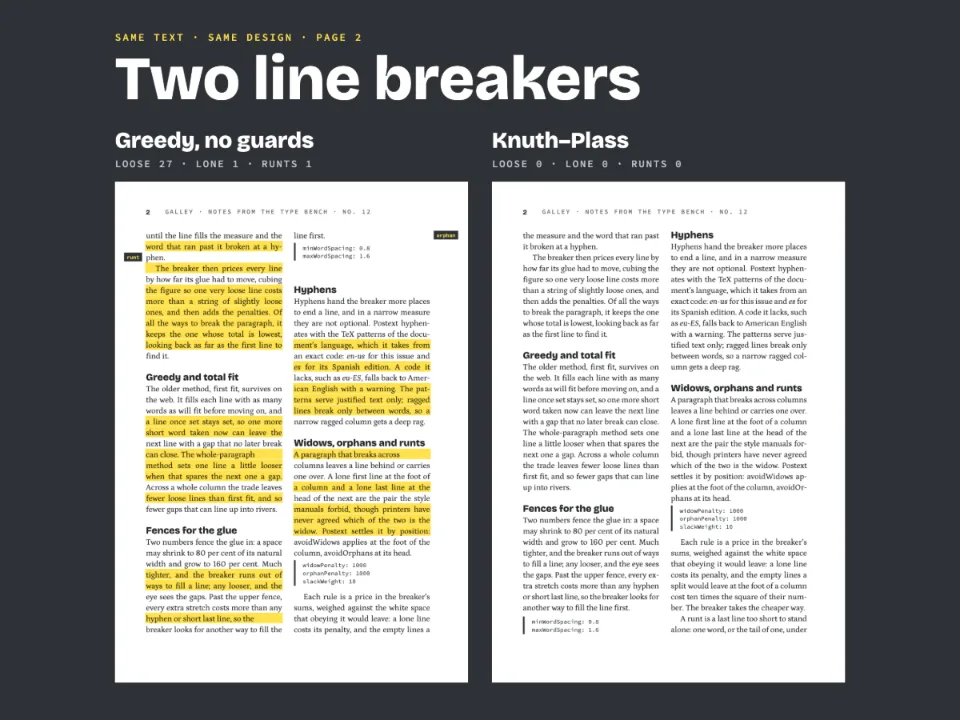
  // The defaults justify, hyphenate, break by Knuth–Plass and keep widows and orphans out.
  // Long Spanish words on an 86 mm measure need two more settings. Spaces under 1.7×: at
  // the default 2×, eight lines here open past 1.6×; at 1.7 it hyphenates hie-rro, ca-lles.
  // A last line under 26 space widths is a runt; at 20, 'siem- / pre adelante.' got through.
  maxWordSpacing: 1.7, runtMinCharacters: 26,
};
// config().resourceTypes: the built-in types, 'Figura' and 'Fig.' in Spanish, renumbered
// through the book (Figura 1) where the default counts by chapter (Figura 1.1).
const resourceTypes = defaultResourceTypes(LOCALE)
  .map((type) => ({ ...type, numberingTemplate: '{n}', resetOn: 'never' }));
Ingredienti
- Funzionalità
- Sillabazione e lingua del documentoDivisione in righe ottimale (Knuth–Plass)Capilettera nei paragrafi del testo correnteAperture progettateAttributi dei titoliTesto, filetti e riquadri nei progetti di paginaVedove, orfane e righe corteMargini speculariCapitoli che si aprono su un rectoTestatine secondo il ruolo della paginaTestatine e folioCitazioni che collocano le figureDidascalie numerateFigura e Tabella nella tua linguaFigure proprio quiStili di titoloSpazio verticale esplicitoStili di paragrafoEscape e caratteri letteraliColore della carta
- Tipo
- Gentium Book Plus, Libre Bodoni, Marcellus SC (SIL OFL 1.1)
- Risorse
- The conjectural map of the Socartes mines, drawn in code in the page’s palette (Ignacio Ferro, MIT)
Preparazione
#1 · Sillabe spagnole, spazi trattenuti
Il codice è nella risposta breve qui sopra. locale: 'es' sceglie i pattern di sillabazione spagnoli, come fa un tag regionale quale 'es-ES' o 'es-MX'; le regole americane del locale predefinito spezzerebbero cabal-los, hi-erro e establec-imiento (locale supportati). Giustificazione, Knuth–Plass e le regole su vedove e orfane sono attive per impostazione predefinita. La giustezza di 86 mm ha bisogno anche di spazi trattenuti: con il valore predefinito maxWordSpacing: 2, otto righe si aprono oltre 1,6× e la più larga arriva a 1,89×; con 1,7 la più larga è 1,65×, perché l’algoritmo di divisione sillaba invece hie-rro e ca-lles (limiti della spaziatura tra le parole). Oltre il limite una riga costa molto di più ma resta ammessa, quindi su una giustezza più stretta senza una divisione migliore può ancora superarlo. runtMinCharacters: 26 intercetta i resti sillabati che il valore predefinito di 20 larghezze di spazio lascia passare: siem- / pre adelante. diventa Adelante, / siempre adelante., e So- / cartes [fig. 1]. diventa de / Socartes [fig. 1]. (righe finali troppo corte).
#2 · Una pagina tascabile di righe intere
const TRIM = { width: 115, height: 180 }; // mm: 11.5 × 18 cm
const [TOP, INNER, OUTER] = [16, 15, 14]; // mm: a pocket page keeps its margins tight
const LINES = 30; // lines of LEAD per page, so every full page ends on the same line
const MEASURE = TRIM.width - INNER - OUTER; // 86 mm: about 57 characters of Gentium at 10 pt
const page = {
  width: mm(TRIM.width), height: mm(TRIM.height), dpi: 150, backgroundColor: col('paper'),
  margins: { top: mm(TOP), bottom: mm(TRIM.height - TOP - (LINES * LEAD * 25.4) / 72),
    left: mm(INNER), right: mm(OUTER), mirror: true }, // left is inner on a recto
};
Il margine inferiore è calcolato dal formato, dal margine superiore e da LINES, così la gabbia contiene esattamente 30 righe da 13,8 pt e ogni pagina piena finisce sulla stessa linea di base, come fanno le pagine 10 e 11. Con mirror: true il margine interno di 15 mm resta al dorso e quello esterno di 14 mm al taglio su entrambe le pagine di una doppia pagina (margini speculari), e la giustezza di 86 mm contiene circa 57 caratteri di Gentium Book Plus a 10 pt.
#3 · Il capitolo in lettere e un’iniziale rialzata
const [LABEL_Y, RULE_Y, TITLE_Y] = [4, 10.5, 13.5]; // mm below the top of the text block
const SINK = 8; // lines of LEAD above the text: the chapter drops a quarter of the page
const INITIAL = 3 * LEAD; // pt: the initial's size, three leads
const RISE = 2; // lines of LEAD the raised initial keeps clear above the first line
const centred = (y) => ({ anchor: { to: 'container', edge: 'top' }, offset: { y: mm(y) } });
const opener = {
  enabled: true,
  slot: { elements: [
    // The ordinal is written in the heading, # Perdido {ordinal="primero"}: the plate before
    // the chapter is a level-1 heading too, so the level carries no counter.
    { kind: 'text', id: 'chapter', content: 'capítulo {attr.ordinal}', ...smallCaps,
      placement: centred(LABEL_Y) },
    { kind: 'rule', id: 'rule', direction: 'horizontal', thickness: pt(0.6),
      color: col('oxblood'), placement: { ...centred(RULE_Y), size: { width: mm(9) } } },
    { kind: 'text', id: 'title', content: '{titleText}', fontFamily: DISPLAY, italic: true,
      fontSize: pt(26), lineHeight: 1.1, color: col('ink'), align: 'center',
      overflow: 'wrap', // a longer title takes a second line
      placement: centred(TITLE_Y) },
  ] },
  // The text starts SINK lines down; the initial's rise takes the last RISE of them.
  minHeight: pt((SINK - RISE) * LEAD),
};
// parity 'any': each chapter opens on the next page, as pocket books do.
// marginBottom replaces the level's default, a blank line of its own. The first paragraph
// of the chapter opens with a raised initial: lines: 1 stands it on the first baseline,
// three leads tall, and the paragraph keeps its rise clear above it.
const chapter = { level: 1, breakBefore: { enabled: true, parity: 'any' },
  marginBottom: pt(0), advancedDesign: opener,
  dropCap: { lines: 1, fontFamily: DISPLAY, fontWeight: 700, fontSize: pt(INITIAL),
    color: col('oxblood') } };
capítulo primero viene dall’attributo ordinal del titolo stesso (attributi del titolo). Un livello numerato con '{1:ordinal}' scriverebbe la parola per esteso da solo, ma anche la tavola prima del capitolo è un titolo di livello 1, quindi questo livello non porta contatore. L’iniziale appartiene al livello del capitolo: il suo dropCap apre il primo paragrafo dopo ogni titolo di livello 1, e il paragrafo si scrive nel Markdown così come si legge (capilettera). lines: 1 con un fontSize di tre interlinee ne fa un’iniziale rialzata, che poggia sulla prima linea di base; la prima riga si accorcia della sua larghezza e dello spazio predefinito, e si giustifica con il resto del paragrafo. La lettera sporge sopra la prima riga, e il paragrafo tiene libero quello spazio sopra di sé in righe intere: qui due (RISE), quindi minHeight chiude l’apertura a SINK - RISE righe e la prima riga del testo cade ancora sulla riga SINK, a un quarto dell’altezza. Il marginBottom: 0 del livello del capitolo sostituisce il margine predefinito, che aggiungerebbe una riga vuota. Un paragrafo con capolettera perde il rientro della prima riga.
#4 · La mappa sta di fronte al capitolo come Figura 1
const MAP_H = 112; // mm: a frontispiece map, the measure wide
const resources = [{
  id: 'plano', typeId: 'figure', kind: 'svg', createdAt: 0, updatedAt: 0,
  svg: { fileId: 'plano.svg', width: MEASURE, height: MAP_H }, // the ratio: set column-wide
  placement: { position: 'here' }, // where ::resource{id="plano"} stands, not a float
  caption: 'El camino de Golfín: de Villafangosa, por la pasadera y el cerro, al talud de '
    + 'las minas de Socartes.',
  note: 'Plano conjetural dibujado para esta edición a partir del capítulo primero.',
  altText: 'Plano: abajo, la villa, el río y la pasadera; en medio, un cerro arbolado; arriba, '
    + 'las minas en gradas. Un punteado lleva de la villa al talud de las minas.',
}];
// The plate's heading, # Las minas de Socartes {style="lamina"}, opens a page the heads skip.
const frontispiece = {
  id: 'lamina', // its own break, or it takes the chapter's (gotcha: style-inherits-break)
  breakBefore: { enabled: true, parity: 'any' }, marginBottom: pt(0),
  footer: { elements: [] }, // no drop folio
  advancedDesign: { enabled: true, slot: { elements: [{ kind: 'text', id: 'name',
    content: '{titleText}', ...smallCaps, // a line down: the plate centres on the page
    placement: { anchor: { to: 'container', edge: 'top' }, offset: { y: pt(LEAD) } } }] } },
};
const captionStyle = { fontFamily: TEXT, fontSize: pt(8.3), gap: mm(2),
  labelColor: col('oxblood'), descriptionItalic: true, note: { color: col('muted') } };
position: 'here' mette la mappa dove sta ::resource{id="plano"}, sotto un titolo suo. Quel titolo fa della pagina 8 del libro un’apertura, e le testatine saltano le aperture. Il suo stile svuota il piè di pagina e imposta una propria interruzione, che tiene la tavola di fronte al capitolo I, senza testatina né folio, anche quando i capitoli si aprono sui recto (stili dei titoli). I tipi spagnoli della risposta breve stampano Figura 1. sotto la mappa (senza resourceTypes diventa Figura 1.1, numerata per capitolo) e Fig. 1 nel testo, che il case="lower" nel :ref del Markdown trasforma in fig. 1. Il rimando sta tra parentesi quadre, che le edizioni spagnole usano per segnare ciò che il curatore aggiunge al testo dell’autore.
#5 · L’autore sul verso, il titolo sul recto
const [HEAD_Y, DROP_Y] = [9, -10]; // mm: heads from the top edge, drop folio from the foot
const head = (id, content, parity, edge, x, y = HEAD_Y, pages = 'body') => ({
  kind: 'text', id, content, parity, pages, // running heads skip the openers
  fontFamily: LABEL, fontSize: pt(8), letterSpacing: pt(1.2), color: col('muted'),
  placement: { anchor: { to: 'page', edge }, offset: { x: mm(x), y: mm(y) } },
});
const SHIFT = (INNER - OUTER) / 2; // mm: the text block's centre is off the page's centre
// Folios in the text face (Marcellus SC's 1 and 0 read as I and O), on the heads' baseline.
const folio = { fontFamily: TEXT, letterSpacing: pt(0), color: col('ink') };
const header = { elements: [
  { ...head('verso-folio', '{pageNumber}', 'even', 'top-left', OUTER), ...folio },
  head('verso-author', '{author}', 'even', 'top', -SHIFT),
  head('recto-title', '{title}', 'odd', 'top', SHIFT),
  { ...head('recto-folio', '{pageNumber}', 'odd', 'top-right', -OUTER), ...folio },
] };
const drop = (parity, x) => ({ ...head(`drop-${parity}`, '{pageNumber}', parity, 'bottom', x,
  DROP_Y, 'opener'), ...folio }); // a chapter can open on either side of the spread
const footer = { elements: [drop('odd', SHIFT), drop('even', -SHIFT)] };
parity: 'even' mette l’autore sui versi e 'odd' il titolo sui recto, e pages: 'body' li tiene entrambi lontani dall’apertura, dove l’unico elemento di servizio è il folio al piede impostato con pages: 'opener'. Ogni testatina è ancorata alla pagina e spostata di SHIFT al centro della gabbia, che sta mezzo millimetro fuori dal centro della pagina perché i margini interno ed esterno differiscono. Per lo stesso motivo il folio al piede viene in due parità. I folii sono composti in Gentium, perché Marcellus SC disegna 1 e 0 come I e O.
#6 · La punteggiatura spagnola nel Markdown
const paragraphStyles = [
  { id: 'asterismo', fontFamily: DISPLAY, fontSize: pt(11), color: col('oxblood'),
    textAlign: 'center' },
  // In ink: a muted note would need italicColor too, for its italic Marianela.
  { id: 'nota', fontSize: pt(8.3), lineHeight: pt(LEAD * 0.8), firstLineIndent: pt(0),
    marginTop: pt(LEAD) },
  { id: 'colofon', fontSize: pt(7.5), color: col('muted'), textAlign: 'center',
    firstLineIndent: pt(0), marginTop: pt(LEAD / 2) },
];
La pagina 12, l’ultima, finisce con tre stili di paragrafo. Gli asterischi, in Bodoni color sangue di bue, sono centrati dopo un :::space{lines=2}, dato che le righe vuote non aggiungono spazio. La nota dell’edizione è a 8,3 pt su 11 pt di interlinea, e il colophon a 7,5 pt nel grigio delle testatine. La nota resta nel colore dell’inchiostro; se la componi in grigio lo stile ha bisogno anche di un italicColor, altrimenti il corsivo Marianela si stampa più scuro delle parole attorno. Nel Markdown il dialogo si apre con una raya (—), mai con un trattino, perché un trattino e uno spazio all’inizio di una riga aprono un elenco. 1878. all’inizio della nota aprirebbe un elenco numerato, quindi prima dell’anno va un word joiner (U+2060). Gli asterischi sono preceduti da una barra rovesciata (\*); senza, il primo aprirebbe un elenco puntato e gli altri due un tratto in corsivo, e la riga sparirebbe.
La ricetta completa
// ═══ Postext Cookbook · Nº 016 · Justified Spanish in a pocket novel ═════════════════ // https://postext.dev/en/cookbook/spanish-pocket-novel // Code: MIT · Text: B. Pérez Galdós, Marianela, 1878 (PD, Gutenberg #17340) · Map: drawn in code // Fonts: Gentium Book Plus, Libre Bodoni, Marcellus SC (SIL OFL 1.1) · Needs postext ≥ 1.25.0 import { buildDocumentWithFonts, renderPageToCanvas, defaultResourceTypes, registerResourceImage, inlineSvgFonts, } from 'https://esm.sh/postext'; const LANG = 'es'; // @lang: the language of the sample document (this recipe is Spanish only) const RECIPE = 'spanish-pocket-novel'; // ─── 1 · Design ───────────────────────────────────────────────────────────── const palette = { ink: '#1e1b18', // text: a warm near-black oxblood: '#8b2e2a', // the one accent: chapter label, rule, initial, asterisks, route muted: '#6d645a', // running heads, the map's paths, the caption's credit paper: '#f7f2e8', // an ivory book paper slag: '#c8553d', moss: '#6f7a4f', water: '#58707f', // the map: mined earth, woods, river }; // col(id): a colour linked to its palette entry, in text styles and design slots alike. const col = (id) => ({ hex: palette[id], model: 'hex', paletteId: id }); const colorPalette = [ ...Object.entries(palette).map(([id, hex]) => ({ id, name: id, value: { hex, model: 'hex' } })), { id: 'main-color', name: 'oxblood (defaults)', value: { hex: palette.oxblood, model: 'hex' } }, ]; const TEXT = 'Gentium Book Plus'; // the text face const DISPLAY = 'Libre Bodoni'; // the chapter's title and the initial const LABEL = 'Marcellus SC'; // small capitals: chapter label, running heads, map names const [BODY, LEAD] = [10, 13.8]; // pt: the body size, and its leading: the grid's pitch const smallCaps = { fontFamily: LABEL, fontSize: pt(9), letterSpacing: pt(1.6), // 2 labels color: col('oxblood'), align: 'center' }; // #region page: a pocket paperback; the text block holds 30 whole lines const TRIM = { width: 115, height: 180 }; // mm: 11.5 × 18 cm const [TOP, INNER, OUTER] = [16, 15, 14]; // mm: a pocket page keeps its margins tight const LINES = 30; // lines of LEAD per page, so every full page ends on the same line const MEASURE = TRIM.width - INNER - OUTER; // 86 mm: about 57 characters of Gentium at 10 pt const page = { width: mm(TRIM.width), height: mm(TRIM.height), dpi: 150, backgroundColor: col('paper'), margins: { top: mm(TOP), bottom: mm(TRIM.height - TOP - (LINES * LEAD * 25.4) / 72), left: mm(INNER), right: mm(OUTER), mirror: true }, // left is inner on a recto }; // #endregion // #region answer: Spanish syllables, word spaces under 1.7×, captions that say Figura const LOCALE = 'es'; // config().locale: Spanish hyphenation, and Spanish caption labels const bodyText = { // config().bodyText fontFamily: TEXT, fontSize: pt(BODY), lineHeight: pt(LEAD), color: col('ink'), boldColor: col('ink'), italicColor: col('ink'), referenceColor: col('ink'), referenceBold: false, // '[fig. 1]' reads in roman, like the words around it firstLineIndent: mm(4), indentAfterHeading: false, // a paragraph after a heading starts flush // The defaults justify, hyphenate, break by Knuth–Plass and keep widows and orphans out. // Long Spanish words on an 86 mm measure need two more settings. Spaces under 1.7×: at // the default 2×, eight lines here open past 1.6×; at 1.7 it hyphenates hie-rro, ca-lles. // A last line under 26 space widths is a runt; at 20, 'siem- / pre adelante.' got through. maxWordSpacing: 1.7, runtMinCharacters: 26, }; // config().resourceTypes: the built-in types, 'Figura' and 'Fig.' in Spanish, renumbered // through the book (Figura 1) where the default counts by chapter (Figura 1.1). const resourceTypes = defaultResourceTypes(LOCALE) .map((type) => ({ ...type, numberingTemplate: '{n}', resetOn: 'never' })); // #endregion // #region opener: the chapter spelled out, its title, and a raised initial on the text const [LABEL_Y, RULE_Y, TITLE_Y] = [4, 10.5, 13.5]; // mm below the top of the text block const SINK = 8; // lines of LEAD above the text: the chapter drops a quarter of the page const INITIAL = 3 * LEAD; // pt: the initial's size, three leads const RISE = 2; // lines of LEAD the raised initial keeps clear above the first line const centred = (y) => ({ anchor: { to: 'container', edge: 'top' }, offset: { y: mm(y) } }); const opener = { enabled: true, slot: { elements: [ // The ordinal is written in the heading, # Perdido {ordinal="primero"}: the plate before // the chapter is a level-1 heading too, so the level carries no counter. { kind: 'text', id: 'chapter', content: 'capítulo {attr.ordinal}', ...smallCaps, placement: centred(LABEL_Y) }, { kind: 'rule', id: 'rule', direction: 'horizontal', thickness: pt(0.6), color: col('oxblood'), placement: { ...centred(RULE_Y), size: { width: mm(9) } } }, { kind: 'text', id: 'title', content: '{titleText}', fontFamily: DISPLAY, italic: true, fontSize: pt(26), lineHeight: 1.1, color: col('ink'), align: 'center', overflow: 'wrap', // a longer title takes a second line placement: centred(TITLE_Y) }, ] }, // The text starts SINK lines down; the initial's rise takes the last RISE of them. minHeight: pt((SINK - RISE) * LEAD), }; // parity 'any': each chapter opens on the next page, as pocket books do. // marginBottom replaces the level's default, a blank line of its own. The first paragraph // of the chapter opens with a raised initial: lines: 1 stands it on the first baseline, // three leads tall, and the paragraph keeps its rise clear above it. const chapter = { level: 1, breakBefore: { enabled: true, parity: 'any' }, marginBottom: pt(0), advancedDesign: opener, dropCap: { lines: 1, fontFamily: DISPLAY, fontWeight: 700, fontSize: pt(INITIAL), color: col('oxblood') } }; // #endregion // #region heads: the author on the verso, the title on the recto; a drop folio on the opener const [HEAD_Y, DROP_Y] = [9, -10]; // mm: heads from the top edge, drop folio from the foot const head = (id, content, parity, edge, x, y = HEAD_Y, pages = 'body') => ({ kind: 'text', id, content, parity, pages, // running heads skip the openers fontFamily: LABEL, fontSize: pt(8), letterSpacing: pt(1.2), color: col('muted'), placement: { anchor: { to: 'page', edge }, offset: { x: mm(x), y: mm(y) } }, }); const SHIFT = (INNER - OUTER) / 2; // mm: the text block's centre is off the page's centre // Folios in the text face (Marcellus SC's 1 and 0 read as I and O), on the heads' baseline. const folio = { fontFamily: TEXT, letterSpacing: pt(0), color: col('ink') }; const header = { elements: [ { ...head('verso-folio', '{pageNumber}', 'even', 'top-left', OUTER), ...folio }, head('verso-author', '{author}', 'even', 'top', -SHIFT), head('recto-title', '{title}', 'odd', 'top', SHIFT), { ...head('recto-folio', '{pageNumber}', 'odd', 'top-right', -OUTER), ...folio }, ] }; const drop = (parity, x) => ({ ...head(`drop-${parity}`, '{pageNumber}', parity, 'bottom', x, DROP_Y, 'opener'), ...folio }); // a chapter can open on either side of the spread const footer = { elements: [drop('odd', SHIFT), drop('even', -SHIFT)] }; // #endregion // #region figure: the map faces chapter I as Figura 1; the text cites it as [fig. 1] const MAP_H = 112; // mm: a frontispiece map, the measure wide const resources = [{ id: 'plano', typeId: 'figure', kind: 'svg', createdAt: 0, updatedAt: 0, svg: { fileId: 'plano.svg', width: MEASURE, height: MAP_H }, // the ratio: set column-wide placement: { position: 'here' }, // where ::resource{id="plano"} stands, not a float caption: 'El camino de Golfín: de Villafangosa, por la pasadera y el cerro, al talud de ' + 'las minas de Socartes.', note: 'Plano conjetural dibujado para esta edición a partir del capítulo primero.', altText: 'Plano: abajo, la villa, el río y la pasadera; en medio, un cerro arbolado; arriba, ' + 'las minas en gradas. Un punteado lleva de la villa al talud de las minas.', }]; // The plate's heading, # Las minas de Socartes {style="lamina"}, opens a page the heads skip. const frontispiece = { id: 'lamina', // its own break, or it takes the chapter's (gotcha: style-inherits-break) breakBefore: { enabled: true, parity: 'any' }, marginBottom: pt(0), footer: { elements: [] }, // no drop folio advancedDesign: { enabled: true, slot: { elements: [{ kind: 'text', id: 'name', content: '{titleText}', ...smallCaps, // a line down: the plate centres on the page placement: { anchor: { to: 'container', edge: 'top' }, offset: { y: pt(LEAD) } } }] } }, }; const captionStyle = { fontFamily: TEXT, fontSize: pt(8.3), gap: mm(2), labelColor: col('oxblood'), descriptionItalic: true, note: { color: col('muted') } }; // #endregion // #region styles: the asterisks that close the excerpt, the edition's note, the colophon const paragraphStyles = [ { id: 'asterismo', fontFamily: DISPLAY, fontSize: pt(11), color: col('oxblood'), textAlign: 'center' }, // In ink: a muted note would need italicColor too, for its italic Marianela. { id: 'nota', fontSize: pt(8.3), lineHeight: pt(LEAD * 0.8), firstLineIndent: pt(0), marginTop: pt(LEAD) }, { id: 'colofon', fontSize: pt(7.5), color: col('muted'), textAlign: 'center', firstLineIndent: pt(0), marginTop: pt(LEAD / 2) }, ]; // #endregion const config = () => ({ locale: LOCALE, resourceTypes, colorPalette, page, layout: { layoutType: 'single' }, bodyText, headings: { fontFamily: DISPLAY, // the designs paint the titles; this keeps Open Sans unloaded levels: [chapter], }, headingStyles: [frontispiece], paragraphStyles, captionStyle, header, footer, }); // ─── 2 · Content ──────────────────────────────────────────────────────────── const markdown = String.raw`---Esempio Markdown · 45 righe · content.es.md
title: "Marianela" author: "Benito Pérez Galdós" --- # Las minas de Socartes {style="lamina"} ::resource{id="plano"} # Perdido {ordinal="primero"} Se puso el sol. Tras el breve crepúsculo vino tranquila y oscura la noche, en cuyo negro seno murieron poco a poco los últimos rumores de la tierra soñolienta, y el viajero siguió adelante en su camino, apresurando su paso a medida que avanzaba la noche. Iba por angosta vereda, de esas que sobre el césped traza el constante pisar de hombres y brutos, y subía sin cansancio por un cerro en cuyas vertientes se alzaban pintorescos grupos de guinderos, hayas y robles. (Ya se ve que estamos en el Norte de España.) Era un hombre de mediana edad, de complexión recia, buena talla, ancho de espaldas, resuelto de ademanes, firme de andadura, basto de facciones, de mirar osado y vivo, ligero a pesar de su regular obesidad, y (dígase de una vez aunque sea prematuro) excelente persona por doquiera que se le mirara. Vestía el traje propio de los señores acomodados que viajan en verano, con el redondo sombrerete, que debe a su fealdad el nombre de hongo, gemelos de campo pendientes de una correa, y grueso bastón que, entre paso y paso, le servía para apalear las zarzas cuando extendían sus ramas llenas de afiladas uñas para atraparle la ropa. Detúvose, y mirando a todo el círculo del horizonte, parecía impaciente y desasosegado. Sin duda no tenía gran confianza en la exactitud de su itinerario y aguardaba el paso de algún aldeano que le diese buenos informes topográficos para llegar pronto y derechamente a su destino. —No puedo equivocarme —murmuró—. Me dijeron que atravesara el río por la pasadera… así lo hice. Después que marchara adelante, siempre adelante. En efecto, allá, detrás de mí queda esa apreciable villa, a quien yo llamaría *Villafangosa* por el buen surtido de lodos que hay en sus calles y caminos… De modo que por aquí, adelante, siempre adelante (me gusta esta frase, y si yo tuviera escudo no le pondría otra divisa) he de llegar a las famosas minas de Socartes [:ref{id="plano" case="lower"}]. Después de andar largo trecho, añadió: —Me he perdido, no hay duda de que me he perdido… Aquí tienes, Teodoro Golfín, el resultado de tu «adelante, siempre adelante». Estos palurdos no conocen el valor de las palabras. O han querido burlarse de ti, o ellos mismos ignoran dónde están las minas de Socartes. Un gran establecimiento minero ha de anunciarse con edificios, chimeneas, ruido de arrastres, resoplido de hornos, relincho de caballos, trepidación de máquinas, y yo no veo, ni huelo, ni oigo nada… Parece que estoy en un desierto… ¡qué soledad! Si yo creyera en brujas, pensaría que mi destino me proporcionaba esta noche el honor de ser presentado a ellas… ¡Demonio!, ¿pero no hay gente en estos lugares?… Aún falta media hora para la salida de la luna. ¡Ah!, bribona, tú tienes la culpa de mi extravío… Si al menos pudiera conocer el sitio donde me encuentro… ¿Pero qué más da? (Al decir esto, hizo un gesto propio del hombre esforzado que desprecia los peligros). Golfín, tú que has dado la vuelta al mundo, ¿te acobardarás ahora?… ¡Ah!, los aldeanos tenían razón: adelante, siempre adelante. La ley universal de la locomoción no puede fallar en este momento. Y puesta denodadamente en ejecución aquella osada ley, recorrió un kilómetro, siguiendo a capricho las veredas que le salían al paso y se cruzaban y se quebraban en ángulos mil, cual si quisiesen engañarle y confundirle más. Por grande que fuera su resolución e intrepidez, al fin tuvo que pararse. Las veredas, que al principio subían, luego empezaron a bajar, enlazándose; y al fin bajaron tanto, que nuestro viajero hallose en un talud, por el cual solo habría podido descender echándose a rodar. —¡Bonita situación! —exclamó sonriendo y buscando en su buen humor lenitivo a la enojosa contrariedad—. ¿En dónde estás, querido Golfín? Esto parece un abismo. ¿Ves algo allá abajo? Nada, absolutamente nada… pero el césped ha desaparecido, el terreno está removido. Todo es aquí pedruscos y tierra sin vegetación, teñida por el óxido de hierro… Sin duda estoy en las minas… pero ni alma viviente, ni chimeneas humeantes, ni ruido, ni un tren que murmure a lo lejos, ni siquiera un perro que ladre… ¿Qué haré?, hay por aquí una vereda que vuelve a subir. ¿Seguirela? ¿Desandaré lo andado?… ¡Retroceder! ¡Qué absurdo! O yo dejo de ser quien soy, o llegaré esta noche a las famosas minas de Socartes y abrazaré a mi querido hermano. Adelante, siempre adelante. Dio un paso y hundiose en la frágil tierra movediza. —¿Esas tenemos, señor planeta?… ¿Conque quiere usted tragarme?… Si ese holgazán satélite quisiera alumbrar un poco, ya nos veríamos las caras usted y yo… Y a fe que por aquí abajo no hemos de ir a ningún paraíso. Parece esto el cráter de un volcán apagado… Hay que andar suavemente por tan delicioso precipicio. ¿Qué es esto? ¡Ah! Una piedra; magnífico asiento para echar un cigarro, esperando a que salga la luna. El discreto Golfín se sentó tranquilamente como podría haberlo hecho en el banco de un paseo; y ya se disponía a fumar, cuando sintió una voz… sí, indudablemente era una voz humana que lejos sonaba, un quejido patético, mejor dicho, melancólico canto, formado de una sola frase, cuya última cadencia se prolongaba apianándose en la forma que los músicos llamaban *morendo*, y que se apagaba al fin en el plácido silencio de la noche, sin que el oído pudiera apreciar su vibración postrera. :::space{lines=2} :::paragraphs{style="asterismo"} \* \* \* ::: :::paragraphs{style="nota"} 1878. Galdós publica *Marianela* en Madrid, en la Imprenta y Litografía de La Guirnalda. Seguimos el comienzo de su capítulo primero en el texto de dominio público de Project Gutenberg (eBook 17340), con la ortografía y la puntuación actuales: raya en los diálogos y comillas latinas para la consigna del viajero, que se vuelven inglesas cuando la cita va dentro de otra: «el resultado de tu “adelante, siempre adelante”». Los corchetes señalan lo que añade el editor. ::: :::paragraphs{style="colofon"} Compuesto en Gentium Book Plus, Libre Bodoni y Marcellus SC (SIL OFL) :::`; // content.es.md, inlined by the Cookbook // #region art: the map of Socartes, in millimetres at its printed size, in the palette function mulberry32(seed) { // a seeded PRNG: the same drawing on every run return () => { seed = (seed + 0x6d2b79f5) | 0; let r = Math.imul(seed ^ (seed >>> 15), 1 | seed); r = (r + Math.imul(r ^ (r >>> 7), 61 | r)) ^ r; return ((r ^ (r >>> 14)) >>> 0) / 4294967296; }; } const mix = (hex, other, k) => `#${[1, 3, 5].map((i) => Math.round( parseInt(hex.slice(i, i + 2), 16) * (1 - k) + parseInt(other.slice(i, i + 2), 16) * k) .toString(16).padStart(2, '0')).join('')}`; const n2 = (v) => +v.toFixed(2); // A smooth path through the points (Catmull-Rom as cubic Béziers), open or closed. function smooth(list, close = false) { const p = close ? [list.at(-1), ...list, list[0], list[1]] : [list[0], ...list, list.at(-1)]; let d = `M${n2(p[1][0])} ${n2(p[1][1])}`; for (let i = 1; i < p.length - 2; i++) { const [a, b, c, e] = [p[i - 1], p[i], p[i + 1], p[i + 2]]; d += `C${n2(b[0] + (c[0] - a[0]) / 6)} ${n2(b[1] + (c[1] - a[1]) / 6)} ` + `${n2(c[0] - (e[0] - b[0]) / 6)} ${n2(c[1] - (e[1] - b[1]) / 6)} ${n2(c[0])} ${n2(c[1])}`; } return close ? `${d}Z` : d; } // The map's names are set in the label face, named on the root element: loadSvg embeds it. function drawMap(W, H) { // drawn for W 86 × H 112: the mines above, the town below const rnd = mulberry32(1878); const C = { ground: mix(palette.paper, palette.moss, 0.16), hill: mix(palette.moss, palette.paper, 0.45), wood: palette.moss, shade: mix(palette.moss, palette.ink, 0.35), earth: mix(palette.slag, palette.paper, 0.3), bench: palette.slag, deep: mix(palette.slag, palette.ink, 0.2), pit: mix(palette.slag, palette.ink, 0.45), edge: mix(palette.slag, palette.ink, 0.5), water: palette.water, ink: palette.ink, path: palette.muted, route: palette.oxblood, stream: mix(palette.water, palette.ink, 0.3), // the river's name: 5.7:1 on the ground }; const out = [`<rect width="${W}" height="${H}" fill="${C.ground}"/>`]; const fill = (d, color) => out.push(`<path d="${d}" fill="${color}"/>`); const stroke = (d, color, w, extra = '') => out.push(`<path d="${d}" fill="none" ` + `stroke="${color}" stroke-width="${w}" stroke-linecap="round" ` + `stroke-linejoin="round"${extra}/>`); // The names, set first so that no tree grows over them. const labels = [[33, 30.5, 'minas de', 'end'], [33, 34, 'Socartes', 'end'], [34.4, 19, 'talleres', 'end'], [43.6, 52.4, 'talud', 'end', C.route], [12, 70.5, 'cerro', 'middle'], [25.5, 96.4, 'pasadera'], [70, 94.5, 'río', 'middle', C.stream], [3, 109.6, 'Villafangosa'], [5, 11.4, 'N', 'middle']]; const box = ([x, y, text, anchor = 'start']) => { const w = text.length * 1.45; const left = anchor === 'end' ? x - w : anchor === 'middle' ? x - w / 2 : x; return [left - 0.8, y - 2.6, left + w + 0.8, y + 0.8]; }; const clear = (x, y) => labels.map(box).every(([a, b, c, d]) => x < a || x > c || y < b || y > d); // The mines: iron-stained earth cut in benches down to the pit, the "extinct crater". const mine = [[40, 6], [58, 3], [76, 5], [84, 17], [83, 35], [74, 47], [58, 52], [45, 50], [36, 40], [35, 20]]; [[1, C.earth], [0.76, C.bench], [0.52, C.deep], [0.28, C.pit]].forEach(([k, color], i) => { const [cx, cy] = [60 + i * 1.6, 27 - i * 1.4]; // each bench deeper, the pit off-centre const ring = mine.map(([x, y]) => [cx + (x - 60) * k + (rnd() - 0.5) * 2.4 * k, cy + (y - 27) * k + (rnd() - 0.5) * 2.4 * k]); out.push(`<path d="${smooth(ring, true)}" fill="${color}" stroke="${C.edge}" ` + 'stroke-width="0.25"/>'); }); fill('M28.4 11.6h6.5v3.2h-6.5zM33 7h0.9v4.7h-0.9z', C.ink); // workshops, chimney, by the rim // The hill of cherry, beech and oak, and the paths that cross it at a thousand angles. out.push(`<path d="${smooth([[19, 73], [23, 61], [36, 56], [50, 59], [55, 72], [49, 85], [35, 90], [23, 84]], true)}" fill="${C.hill}" stroke="${C.shade}" stroke-width="0.25"/>`); for (let i = 0; i < 100; i++) { const a = rnd() * Math.PI * 2; const r = Math.sqrt(rnd()) * 16; const [x, y] = [37 + Math.cos(a) * r, 73 + Math.sin(a) * r]; const [size, shade] = [0.55 + rnd() * 0.55, rnd() < 0.3 ? C.shade : C.wood]; if (clear(x, y)) { out.push(`<circle cx="${n2(x)}" cy="${n2(y)}" r="${n2(size)}" fill="${shade}"/>`); } } [[[22, 80], [30, 74], [28, 64], [38, 58]], [[26, 62], [36, 70], [46, 64], [52, 70]], [[27, 87], [33, 79], [42, 82], [50, 76]], [[38, 57], [40, 67], [33, 76], [37, 89]]] .forEach((path) => stroke(smooth(path), C.path, 0.3, ' stroke-dasharray="1 0.8"')); // The river, the footbridge, and the town the traveller left behind. stroke(smooth([[0, 92], [12, 93], [22, 99], [34, 100], [50, 96], [66, 98], [W + 1, 102]]), C.water, 2.4); stroke('M20.4 95.2L18.6 101.2', C.ink, 0.7); for (let i = 0; i < 18; i++) { const [x, y] = [3 + (i % 6) * 2.2 + rnd() * 0.5, 98.6 + Math.floor(i / 6) * 2.3 + rnd() * 0.5]; fill(`M${n2(x)} ${n2(y)}h1.5v1.2h-1.5z`, C.ink); } fill('M5.2 94.4h1v2.4h-1zM4 96.2h3.4v2h-3.4z', C.ink); // the church // Golfín's walk: over the footbridge, up the hill by its paths, down to the edge. stroke(smooth([[12, 101], [17, 99.4], [21, 94], [25, 88], [31, 84], [27, 78], [33, 72], [40, 75], [45, 68], [40, 62], [45.3, 53.6]]), C.route, 0.75, ' stroke-dasharray="0.05 1.3"'); out.push(`<circle cx="46.4" cy="51.6" r="1.4" fill="none" stroke="${C.route}" ` + 'stroke-width="0.6"/>'); // North, up: a half-inked arrowhead over an N. fill('M5 3.2L6.6 8.2L5 7.2Z', C.ink); out.push(`<path d="M5 3.2L3.4 8.2L5 7.2Z" fill="none" stroke="${C.ink}" stroke-width="0.2"/>`); labels.forEach(([x, y, text, anchor = 'start', color = C.ink]) => out.push(`<text x="${x}" ` + `y="${y}" text-anchor="${anchor}" fill="${color}">${text}</text>`)); out.push(`<rect x="0.2" y="0.2" width="${W - 0.4}" height="${H - 0.4}" fill="none" ` + `stroke="${C.ink}" stroke-width="0.4"/>`); return `<svg xmlns="http://www.w3.org/2000/svg" width="${W}mm" height="${H}mm" ` + `viewBox="0 0 ${W} ${H}" font-family="${LABEL}" font-size="2.35">${out.join('')}</svg>`; } // #endregion // ─── 3 · Fonts ────────────────────────────────────────────────────────────── const FONTS = { // every face the pages use, loaded before the build 'Gentium Book Plus': ['400', '400i', '700'], // text, captions (700: 'Figura 1.'), the note 'Libre Bodoni': ['400', '400i', '700'], // asterisks, the chapter's title, the initial 'Marcellus SC': ['400'], // chapter label, plate name, running heads }; // ─── 4 · Build & show ─────────────────────────────────────────────────────── await loadSvg('plano.svg', drawMap(MEASURE, MAP_H)); // The map is book page 8, a verso, facing chapter I: folios and parity follow the book. const continuation = { pageIndexOffset: 7, pageNumbering: { startAt: 8 } }; const doc = await buildDocumentWithFonts({ markdown, resources, continuation }, config(), kitFonts(FONTS)); showPages(doc, { title: 'Español justificado en una novela de bolsillo' });Kit · core, fonts, viewer, images: uguale in ogni ricetta · 270 righe
// ─── Kit ── helpers shared by every Cookbook recipe · postext.dev/cookbook ───── // ─── Kit · core v1 ── the same in every recipe · postext.dev/cookbook function mm(value) { return { value, unit: 'mm' }; } function pt(value) { return { value, unit: 'pt' }; } function em(value) { return { value, unit: 'em' }; } /** The sample language's string: t({ en: 'Figure', es: 'Figura' }). */ function t(strings) { return strings[LANG] ?? Object.values(strings)[0]; } /** A file in this recipe's assets folder, served from the Postext repo by jsDelivr. */ function asset(file) { return `https://cdn.jsdelivr.net/gh/drnachio/postext@main/cookbook/${RECIPE}/assets/${file}`; } // ─── Kit · fonts v3 ── the same in every recipe · postext.dev/cookbook // Postext loads the faces a config asks for before layout (prepareFonts, // buildDocumentWithFonts) and asks the kit for the files: Fontsource's, the // files the PDF embeds too. /** The options of buildDocumentWithFonts / prepareFonts / withLoadedFonts: * the Fontsource resolver, and the faces of FONTS loaded with the ones the * config names. FONTS = { 'Family Name': ['400', '400i', '700'] }. */ function kitFonts(FONTS = {}) { const faces = Object.entries(FONTS).flatMap(([family, specs]) => specs.map((spec) => ({ family, weight: parseInt(spec, 10), style: spec.endsWith('i') ? 'italic' : 'normal' }))); return { resolve: fontsourceResolver, faces }; } /** A face's Fontsource files, in a fixed order: latin, then latin-ext and greek * when `text` needs them and the family ships them (kitSubsetsFor), each with * its unicode-range. Null for a weight or slant Fontsource does not ship. */ async function fontsourceResolver(family, weight, style, { text = '' } = {}) { const id = fontsourceId(family); const meta = await fontsourceMeta(family); if (meta && !(meta.weights.includes(weight) && meta.styles.includes(style))) return null; kitStatus('Loading fonts…'); const at = await fontsourceAt(id); return ['latin', ...kitSubsetsFor(text, meta)].map((subset) => ({ source: `${at}files/${id}-${subset}-${weight}-${style}.woff2`, unicodeRange: kitRanges()[subset], })); } /** The unicode-range of each Fontsource file the kit loads (a function: the * kit is inlined after the pen's code, which runs before a const would be set). */ function kitRanges() { return { latin: 'U+0000-00FF,U+0131,U+0152-0153,U+02BB-02BC,U+02C6,U+02DA,U+02DC,U+0304,U+0308,U+0329,' + 'U+2000-206F,U+20AC,U+2122,U+2191,U+2193,U+2212,U+2215,U+FEFF,U+FFFD', 'latin-ext': 'U+0100-02BA,U+02BD-02C5,U+02C7-02CC,U+02CE-02D7,U+02DD-02FF,U+0304,U+0308,U+0329,' + 'U+1D00-1DBF,U+1E00-1E9F,U+1EF2-1EFF,U+2020,U+20A0-20AB,U+20AD-20C0,U+2113,U+2C60-2C7F,U+A720-A7FF', greek: 'U+0370-03FF', }; } /** For the cjk, arabic and comics blocks, which add their own files: the * faces of `faces` = { 'Family Name': ['400', '400i', '700'] }. `text` is the sample: * č ł † α χ also load latin-ext and greek files (kitSubsetsFor). With * `optional`, a face Fontsource does not ship is skipped instead of failing. * The files are added once all have loaded, in the order asked (latin, then * latin-ext, then greek), whatever order they arrive in: the last one added * wins a character two files hold. Resolves to the number of faces added. */ async function loadFonts(faces, text = '', { optional = false } = {}) { kitStatus('Loading fonts…'); const ranges = kitRanges(); const jobs = []; for (const [family, specs] of Object.entries(faces)) { const id = fontsourceId(family); const todo = [...new Set(specs)].map((spec) => [parseInt(spec, 10), spec.endsWith('i') ? 'italic' : 'normal']) .filter(([weight, style]) => !hasFace(family, weight, style)); // before any await const at = fontsourceAt(id); const meta = optional || /[^\0-ÿ]/u.test(text) ? await fontsourceMeta(family) : null; const subsets = ['latin', ...kitSubsetsFor(text, meta)]; for (const [weight, style] of todo) { if (optional && !(meta?.weights.includes(weight) && meta.styles.includes(style))) continue; for (const subset of subsets) { const url = `${await at}files/${id}-${subset}-${weight}-${style}.woff2`; const face = new FontFace(family, `url(${url}) format('woff2')`, { weight: String(weight), style, unicodeRange: ranges[subset] }); jobs.push(face.load().catch(() => { if (subset === 'latin' && !optional) throw new Error(`Fontsource has no ${family} ${weight} ${style}`); })); } } } const ready = await Promise.all(jobs).catch((error) => { kitFail(error); throw error; }); return ready.filter((face) => face && document.fonts.add(face)).length; } /** A loaded FontFace covers this family, weight and style (fonts.check() would * also say yes for families nobody declared). */ function hasFace(family, weight, style) { for (const face of document.fonts) { if (face.status !== 'loaded' || face.style !== style) continue; if (face.family.replace(/^["']|["']$/g, '') !== family) continue; const [low, high = low] = face.weight.split(' ').map(Number); if (weight >= low && weight <= high) return true; } return false; } /** The files beyond latin `text` needs that `meta`'s family ships. */ function kitSubsetsFor(text, meta) { return [[/[Ā-˿ᴀ-ᶿḀ-ỿ†ℓⱠ-Ɀ꜠-ꟿ]/u, 'latin-ext'], [/[Ͱ-Ͽ]/u, 'greek']] .filter(([re, x]) => re.test(text) && meta?.subsets?.includes(x)).map(([, x]) => x); } /** Fontsource's id for a family: 'Source Serif 4' → 'source-serif-4'. */ function fontsourceId(family) { return family.toLowerCase().replace(/\s+/g, '-'); } /** A package's folder at the one version @5 names now (#766). */ function fontsourceAt(id, u = `https://cdn.jsdelivr.net/npm/@fontsource/${id}@`) { return (fontsourceAt.c ??= {})[id] ??= fetch(u + '5/package.json').then((r) => r.json()) .then((p) => p.version || 5, () => 5).then((v) => `${u}${v}/`); } /** The family's Fontsource metadata (weights, styles, subsets), or null. */ function fontsourceMeta(family) { fontsourceMeta.cache ??= new Map(); const id = fontsourceId(family); if (!fontsourceMeta.cache.has(id)) { fontsourceMeta.cache.set(id, fetch(`https://api.fontsource.org/v1/fonts/${id}`) .then((res) => (res.ok ? res.json() : null), () => null)); } return fontsourceMeta.cache.get(id); } // ─── Kit · viewer v2 ── the same in every recipe · postext.dev/cookbook /** The pages as spreads on a dark desk, page 1 alone, then verso | recto, * each painted when it scrolls near. Other options go to renderPageToCanvas. */ function showPages(docs, { title, width = 460, ...render } = {}) { const root = viewer(title); const pages = [docs].flat().flatMap((doc) => doc.pages.map((page) => ({ doc, page, n: (doc.pageIndexOffset ?? 0) + page.index }))); const spreads = []; let verso = null; for (const p of pages) { if (p.n % 2 === 1) { if (verso) spreads.push([verso, null]); verso = p; } else { spreads.push([verso, p]); verso = null; } } if (verso) spreads.push([verso, null]); const density = Math.min(window.devicePixelRatio || 1, 2); showPages.painter?.disconnect(); const painter = new IntersectionObserver((entries) => { for (const { isIntersecting, target } of entries) { if (!isIntersecting) continue; painter.unobserve(target); const { doc, page } = target.postext; renderPageToCanvas(page, doc, target, { ...render, scale: (width * density) / page.width }); } }, { rootMargin: '800px' }); showPages.painter = painter; root.replaceChildren(...spreads.map((pair) => { const spread = document.createElement('div'); spread.className = 'pt-spread'; for (const p of pair) { const figure = document.createElement('figure'); if (p) { const label = p.page.pageLabel || String(p.n + 1); const canvas = document.createElement('canvas'); canvas.postext = p; canvas.style.aspectRatio = `${p.page.width} / ${p.page.height}`; canvas.setAttribute('role', 'img'); canvas.setAttribute('aria-label', `Page ${label}`); const folio = document.createElement('figcaption'); folio.textContent = label; figure.append(canvas, folio); painter.observe(canvas); } else figure.className = 'pt-blank'; spread.append(figure); } return spread; })); kitStatus(`${pages.length} ${pages.length === 1 ? 'page' : 'pages'}`); document.documentElement.dataset.postext = 'ready'; return pages.length; } /** The desk, the bar and the error reporting, created once. */ function viewer(title) { if (!document.getElementById('pt-kit')) { document.head.insertAdjacentHTML('beforeend', `<style id="pt-kit"> :root { color-scheme: dark; } body { margin: 0; background: #0e1014; color: #b9bcc4; font: 13px/1.45 system-ui, sans-serif; } #pt-bar { position: sticky; top: 0; z-index: 1; display: flex; flex-wrap: wrap; align-items: center; gap: 6px 16px; padding: 10px 16px; background: rgb(14 16 20 / .92); backdrop-filter: blur(6px); border-bottom: 1px solid #23262d; } #pt-bar strong { color: #f4f1ea; font-weight: 600; } #pt-actions { display: flex; gap: 12px; margin-left: auto; } #pt-actions a, #pt-actions button { color: #d8a21a; font: inherit; background: none; border: 0; padding: 0; cursor: pointer; } #pages { display: grid; justify-items: center; gap: 48px; padding: 32px 16px 72px; } .pt-spread { display: flex; } .pt-spread figure { margin: 0; width: min(460px, 44vw); } .pt-spread canvas { display: block; width: 100%; background: #fff; box-shadow: 0 1px 2px rgb(0 0 0 / .5), 0 22px 44px -16px rgb(0 0 0 / .8); } .pt-spread figure:first-child canvas { box-shadow: inset -14px 0 14px -14px rgb(0 0 0 / .18), 0 1px 2px rgb(0 0 0 / .5), 0 22px 44px -16px rgb(0 0 0 / .8); } .pt-spread figcaption { margin-top: 10px; text-align: center; font: 600 10px/1 system-ui, sans-serif; letter-spacing: .18em; text-transform: uppercase; color: #6c7079; } .pt-blank { visibility: hidden; } @media (max-width: 760px) { .pt-spread { flex-direction: column; gap: 32px; } .pt-spread figure { width: min(460px, 92vw); } .pt-blank { display: none; } } </style>`); document.body.insertAdjacentHTML('afterbegin', '<header id="pt-bar"><strong id="pt-title"></strong><span id="pt-status" role="status"></span><span id="pt-actions"></span></header>'); document.getElementById('pt-title').textContent = document.title || 'Postext'; addEventListener('error', (event) => kitFail(event.error ?? event.message)); addEventListener('unhandledrejection', (event) => kitFail(event.reason)); } if (title) document.getElementById('pt-title').textContent = title; return document.getElementById('pages') ?? document.body.appendChild(Object.assign(document.createElement('main'), { id: 'pages' })); } function kitStatus(text) { viewer(); document.getElementById('pt-status').textContent = text; } function kitFail(error) { document.documentElement.dataset.postext = 'error'; kitStatus(`Error: ${error?.message ?? error}`); } // ─── Kit · images v3 ── recipes with pictures · postext.dev/cookbook /** Registers a photo or PNG for the canvas and keeps its bytes for the PDF. * fetch → ImageBitmap never taints the canvas (a plain cross-origin <img> would). */ async function loadImage(fileId, url) { const res = await fetch(url); if (!res.ok) throw new Error(`Image not found (${res.status}): ${url}`); const bytes = new Uint8Array(await res.arrayBuffer()); registerResourceImage(fileId, await createImageBitmap(new Blob([bytes]))); (loadImage.bytes ??= new Map()).set(fileId, bytes); } /** Registers SVG markup as a vector image, its fonts inside (inlineSvgFonts, ≥ 1.25). * `options` go to registerResourceImage: { singleInk: true } tints it on the canvas. */ async function loadSvg(fileId, svg, options) { if (typeof inlineSvgFonts === 'function') svg = await inlineSvgFonts(svg, svgFaces); const img = new Image(); img.src = `data:image/svg+xml;charset=utf-8,${encodeURIComponent(svg)}`; await img.decode(); registerResourceImage(fileId, img, options); (loadImage.bytes ??= new Map()).set(fileId, new TextEncoder().encode(svg)); } /** A face's Fontsource files: nearest weight; latin + what the SVG sets. */ async function svgFaces(family, weight, style, { codePoints = [] } = {}) { const [id, m] = [fontsourceId(family), await fontsourceMeta(family)]; const w = m?.weights.reduce((a, b) => (Math.abs(b - weight) < Math.abs(a - weight) ? b : a)) ?? weight; const s = m?.styles.includes(style) === false ? 'normal' : style; return Promise.all(['latin', ...kitSubsetsFor(String.fromCodePoint(...codePoints), m)].map(async (x) => new Uint8Array( await (await fetch(`${await fontsourceAt(id)}files/${id}-${x}-${w}-${s}.woff2`)).arrayBuffer()))); } /** renderToPdf({ resourceBytes: imageBytes }) */ function imageBytes(fileId) { return loadImage.bytes?.get(fileId); } /** renderToHtml({ resourceImageUrl: imageUrl }) */ function imageUrl(fileId) { const bytes = imageBytes(fileId); if (!bytes) return undefined; imageUrl.urls ??= new Map(); if (!imageUrl.urls.has(fileId)) { const type = /\.svg$/i.test(fileId) ? 'image/svg+xml' : /\.png$/i.test(fileId) ? 'image/png' : 'image/jpeg'; imageUrl.urls.set(fileId, URL.createObjectURL(new Blob([bytes], { type }))); } return imageUrl.urls.get(fileId); } // ─── /Kit ───────────────────────────────────────────────────────────────────────
Lo script.js composto funziona così com’è: incollalo nello script modulo di qualsiasi pagina, oppure apri la ricetta su CodePen. Cartella della ricetta su GitHub ↗ (si apre in una nuova scheda)
Varianti
#Apri ogni capitolo su un recto
Con 'odd', un capitolo che comincerebbe su un verso riceve una pagina bianca prima di sé, come in un’edizione più ariosa. Il capitolo I si apre già su un recto, e la tavola mantiene la sua pagina perché il suo stile imposta una propria interruzione.
-const chapter = { level: 1, breakBefore: { enabled: true, parity: 'any' },
+const chapter = { level: 1, breakBefore: { enabled: true, parity: 'odd' },#Numera le figure per capitolo
Lasciati come sono, i tipi spagnoli predefiniti numerano le figure dentro ogni titolo di primo livello: la mappa diventa Figura 1.1 e il rimando fig. 1.1.
-const resourceTypes = defaultResourceTypes(LOCALE)
-  .map((type) => ({ ...type, numberingTemplate: '{n}', resetOn: 'never' }));
+const resourceTypes = defaultResourceTypes(LOCALE);Errori frequenti
Errore frequente
'1998. ' o '- ' a inizio paragrafo aprono un elenco
Un paragrafo che comincia con un numero, un punto e uno spazio, o con un trattino e uno spazio, diventa una voce di elenco. Metti un word joiner (U+2060) prima del numero, e scrivi i dialoghi con la lineetta. Escape e caratteri letterali →
Errore frequente
Valori degli attributi: niente { o }; virgolette semplici per un valore con "
Il valore di un attributo finisce alla graffa di chiusura, quindi non può contenere { o }. Un valore che contiene una virgoletta doppia va tra virgolette semplici; il simbolo del dollaro va bene. Attributi dei titoli →
Errore frequente
Uno stile di titolo eredita l’interruzione di pagina del suo livello
Una voce di headingStyles prende dal suo livello di titolo ogni campo che omette, breakBefore compreso. Un indice o un colophon con lo stile di un H1 dopo un :::pagebreak eredita parity 'odd' e finisce dietro una pagina bianca. Dai a uno stile del genere breakBefore: { enabled: false }. Stili di titolo →
- Un abbassamento di nove righe invece di otto lasciava la pagina 11 corta di una riga, perché
avoidWidowsnon avrebbe cominciato un paragrafo sull’ultima riga della pagina. Dopo ogni modifica alle impostazioni o al testo, controlla il piede di ogni pagina. RISEè il numero di righe che l’iniziale rialzata tiene libere sopra il testo. Un altro carattere o un altro corpo cambia quella sporgenza: un’iniziale più piccola può aver bisogno di una sola riga, e il testo comincia allora una riga più in alto, a meno cheminHeightnon cambi con lei.- Nessuno di questi caratteri ha l’asterismo ⁂ (U+2042) nel suo file latin di Fontsource, quindi il browser lo prenderebbe da un font di sistema. I libri spagnoli segnano comunque la pausa con tre asterischi spaziati.
Crediti
- Ricetta
- Ignacio Ferro
- Testo
- Marianela (1878), the opening of chapter I, “Perdido”, with today’s spelling and punctuation · Benito Pérez Galdós · pubblico dominio
- The edition’s note and the map’s caption · Postext Cookbook · originale
- Immagini
- The conjectural map of the Socartes mines, drawn in code in the page’s palette · Ignacio Ferro · MIT
- Font
- Gentium Book Plus (SIL OFL 1.1) · Libre Bodoni (SIL OFL 1.1) · Marcellus SC (SIL OFL 1.1)
- Codice
- MIT, come Postext
Modifica questo testo ↗ (si apre in una nuova scheda)Cartella della ricetta su GitHub ↗ (si apre in una nuova scheda)