In breve
Una guida tascabile alle passeggiate intorno a Lisbona. Ogni passeggiata ha un suo colore, mostrato in un’unghiatura sul bordo della pagina, così la trovi con il pollice.
Che cosa comporrai
Le prime sette pagine di Lisbon on Foot, una guida tascabile di 120 × 200 mm. La copertina è un muro di azulejos bianchi e blu con il titolo su un pannello incorniciato come una targa stradale di Lisbona, e pagina 2 presenta le tre passeggiate con una mappa dei loro percorsi. Ogni passeggiata ha un colore, terracotta per l’Alfama e giallo per la Baixa, e un’unghiatura sul margine esterno mostra quel colore e il numero della passeggiata alla stessa altezza su ogni sua pagina. La fascia dell’apertura, le tappe numerate, la testatina del recto e il fondo del riquadro «Don’t miss» cambiano con essa. Il verso bianco che manda la passeggiata 2 su un recto è dipinto nel giallo della passeggiata 2 e ne stampa il numero. Il testo è in Albert Sans, a bandiera; i nomi sono in DM Serif Display e le etichette in Asap Condensed.
Questa ricetta risponde a
- Come nascondo le testatine nelle aperture e nelle pagine bianche, o coloro un verso bianco con il colore della parte?
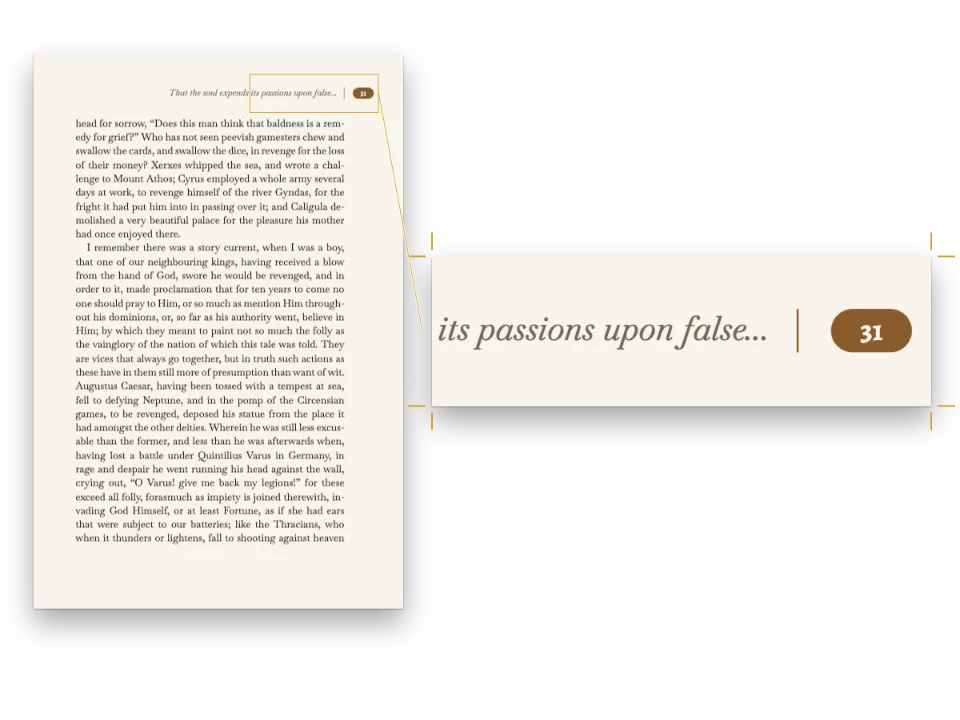
- Come imposto le testatine: titolo del libro sulla pagina sinistra, titolo del capitolo sulla destra, numero di pagina all’esterno?
- Come aggiungo una linguetta numerata («BOX 1-1»), un’icona d’angolo o un’icona a margine con un filetto?
- Come aggiungo campioni di colore come legenda nel testo, nelle didascalie o nelle note di tabella?
La risposta breve
// '# Alfama {style="alfama"}' opens a section that runs to the next level-1 heading. Its
// palette gives band, bandInk, onBand and wash the walk's values on the section's pages,
// in the page furniture and in the text alike.
const walkStyles = Object.keys(WALKS).map((id) => ({ id, palette: WALKS[id] }));
// The tab has one size and one place on every page, hanging from the foot of the opener
// band; only its colour and its number change from walk to walk.
const TAB = { y: BAND, width: 7, height: 24 }; // mm
const tab = (parity, edge) => text(`tab-${parity}`, '{chapterNumber}', {
  ...label, fontSize: pt(11), fontWeight: 700, color: col('onBand'), align: 'center',
  verticalAlign: 'middle', overflow: 'clip', box: { backgroundColor: col('band') },
  parity, pages: 'all', // the walk's first page is an 'opener' page: the tab goes there too
}, { ...at('bleed', edge, 0, TAB.y), ...size(mm(TAB.width), mm(TAB.height)) });
const tabs = [tab('odd', 'top-right'), tab('even', 'top-left')]; // on the fore-edge
// The blank verso that pushes a walk onto a recto belongs to that walk (gotcha:
// section-last-wins), so the field takes the next walk's colour and its numeral the number.
const blankPage = [
  box('field', { backgroundColor: col('band') },
    { ...at('bleed', 'top-left', 0, 0), ...size('fill', 'fill') }),
  tileImage('field-tiles', 'tiles-page', 'top-left', 'fill', 'auto'),
  text('field-number', '{chapterNumber}', { ...display, fontSize: pt(220), lineHeight: 1,
    color: col('onBand'), overflow: 'clip' }, at('page', 'bottom-left', MARGIN.outer, -24)),
].map((el) => ({ ...el, pages: 'blank' }));
Ingredienti
- Funzionalità
- Fasce al vivo e unghiatureColori per parteTestatine secondo il ruolo della paginaTestatine per sezioneStili di titoloAperture progettateAttributi dei titoliTitoli numeratiCapitoli che si aprono su un rectoTestatine e folioTavolozza di colori semanticaChip in lineaIcone dei riquadri e badge d’angoloCampioni di coloreFigure proprio quiTipi di risorsa personalizzatiImmagini nei progetti di paginaTesto, filetti e riquadri nei progetti di paginaCopertine, frontespizi e colophonPagine su un canvas
- Usa anche
- RiquadriBilanciamento delle colonneColore della cartaInterruzioni di pagina e di colonnaStili di paragrafoFigure e tabelle come risorseA capo nei titoliCapitoli non numerati
- Tipo
- Albert Sans, DM Serif Display, Asap Condensed (SIL OFL 1.1)
- Risorse
- The tiles, the map of the routes and its pins, drawn in code (Ignacio Ferro, CC BY 4.0)
Preparazione
#1 · Nomina i colori che una passeggiata cambia
const palette = {
  ink: '#1b2430', // text: a blue-black
  paper: '#fffdf8', // the page
  band: '#1f4e9c', // the section colour: tile blue until a walk replaces it
  bandInk: '#1d4a94', // the section colour for type on paper
  onBand: '#ffffff', // type set on the band
  wash: '#e8eef8', // the section's box tint
  muted: '#5e6875', // running heads, notes, chip outlines
};
// Each walk's values for those four. Baixa yellow is too light for white type, so its
// onBand is the ink. The text is recoloured by value, so the four base values must differ.
const WALKS = {
  alfama: { band: '#b9533a', bandInk: '#a1432b', onBand: '#ffffff', wash: '#f7e7e0' },
  baixa: { band: '#e2b23d', bandInk: '#7d5a0f', onBand: '#1b2430', wash: '#fbf0d5' },
  belem: { band: '#2b7a78', bandInk: '#236866', onBand: '#ffffff', wash: '#e1eeed' },
};
const NAMES = { alfama: 'Alfama', baixa: 'Baixa', belem: 'Belém' };
// A walk's palette follows the paletteId; the hex beside it is the colour's base value.
const col = (id) => ({ hex: palette[id] ?? WALKS[id].band, model: 'hex', paletteId: id });
const entry = (id, hex) => ({ id, name: id, value: { hex, model: 'hex' } });
const colorPalette = [
  ...Object.entries(palette).map(([id, hex]) => entry(id, hex)),
  ...Object.entries(WALKS).map(([id, w]) => entry(id, w.band)), // for :swatch{color="alfama"}
  entry('main-color', palette.ink), // the engine's defaults link here: nothing prints blue
];
La palette di uno stile di titolo sostituisce le voci per id sulle pagine della sua sezione (stili di titolo), quindi ogni colore che deve seguire la passeggiata è collegato a una di quattro voci: band per i campi, l’unghiatura e i cerchi delle tappe, bandInk per il testo sulla carta, onBand per il testo su un campo e wash per il riquadro. Il bianco sul giallo della Baixa misura 2:1, quindi l’onBand di quella passeggiata è il nero, a 8:1. Gli elementi del progetto grafico seguono l’id, mentre il testo si ricolora per valore: un colore uguale all’esadecimale di base di una voce prende il valore della passeggiata, ed è per questo che i quattro valori di base sono tutti diversi. Il titolo del riquadro a pagina 4 e la riga che rimanda alla passeggiata 2 a pagina 5 sono testo in bandInk, ed entrambi si stampano in terracotta.
#2 · Tieni le testatine sulle pagine di testo
const head = (id, content, parity, placement, style = {}) => ({ ...text(id, content, {
  ...label, fontSize: pt(7.8), letterSpacing: pt(1.3), color: col('muted'), overflow: 'clip',
  ...style }, placement), parity, pages: 'body' }); // never on openers or blank pages
const folio = { fontSize: pt(8.5), fontWeight: 700, color: col('ink') };
// Anchored to the page: from its top-right corner a negative x runs inwards
// (gotcha: negative-offsets).
const heads = [
  head('verso-folio', '{pageNumber}', 'even', at('page', 'top-left', MARGIN.outer, HEAD.y), folio),
  head('verso-title', '{title}', 'even', at('page', 'top-left', MARGIN.outer + HEAD.gap, HEAD.y)),
  head('recto-title', `${t({ en: 'Walk', es: 'Paseo' })} {chapterNumber} · {chapterTitle}`, 'odd',
    at('page', 'top-right', -(MARGIN.outer + HEAD.gap), HEAD.y), { color: col('bandInk') }),
  head('recto-folio', '{pageNumber}', 'odd', at('page', 'top-right', -MARGIN.outer, HEAD.y), folio),
];
// Array order is paint order: the blank page's field comes last and covers the tab there.
const header = { elements: [...heads, ...tabs, ...blankPage] };
// A walk's first page has no running head: its folio drops to the foot.
const footer = { elements: [{ ...head('drop-folio', '{pageNumber}', 'all',
  at('container', 'top', 0, 7), folio), pages: 'opener', align: 'center' }] };
// Page 2 comes before Walk 1, where {chapterNumber} is empty, so its header has no tabs. With
// the level's break off (gotcha: style-inherits-break), it is a 'body' page.
const introStyle = { id: 'intro', numbered: false, header: { elements: heads },
  breakBefore: { enabled: false }, advancedDesign: { enabled: false },
  fontSize: pt(24), lineHeight: pt(2 * LEAD), marginBottom: pt(LEAD / 2) };
Dopo l’impaginazione ogni pagina riceve un ruolo (elementi di testo). La prima pagina di una passeggiata è un’opener, perché il suo titolo interrompe la pagina; la pagina di riempimento prima di un recto è blank; le altre sono body. Le testatine prendono pages: 'body', quindi le aperture alle pagine 3 e 7 e la pagina bianca 6 non ne hanno, e il folio al piede prende 'opener'. Il verso stampa il {title} del frontmatter, il recto Walk {chapterNumber} · {chapterTitle} in bandInk, terracotta a pagina 5. Le unghiature della risposta breve prendono 'all'. Il campo della pagina bianca viene dopo di esse nell’array, e poiché l’ordine dell’array è l’ordine di pittura copre l’unghiatura a pagina 6. Pagina 2, l’introduzione, viene prima della passeggiata 1, quindi lì {chapterNumber} è vuoto, e il suo stile ha un header tutto suo con le quattro testatine e nessuna unghiatura. Senza, pagina 2 stamperebbe un’unghiatura blu vuota.
#3 · Apri ogni passeggiata sotto la sua fascia, e numera le tappe
const walkLevel = { level: 1, breakBefore: { enabled: true, parity: 'odd' }, // a recto
  // The band ends 30 mm into the text area; a floor of 8 grid lines, with nothing added
  // under it, starts the text 7.3 mm below the band.
  marginBottom: pt(0), advancedDesign: { enabled: true, minHeight: pt(8 * LEAD), slot: {
    elements: [
      box('band', { backgroundColor: col('band') },
        { ...at('bleed', 'top-left', 0, 0), ...size('fill', mm(BAND)) }),
      tileImage('tiles', 'tiles-band', 'top-right', 'auto', mm(BAND)),
      text('kicker', `${t({ en: 'Walk', es: 'Paseo' })} {chapterNumber}`, { ...label,
        fontSize: pt(9), letterSpacing: pt(2), color: col('onBand') },
      at('page', 'top-left', MARGIN.inner, 17)), // walks open on rectos: inner is left
      text('title', '{titleText}', { ...display, fontSize: pt(34), lineHeight: 1,
        color: col('onBand') }, { ...at('#kicker', 'below', 0, 1), ...size(mm(70), 'auto') }),
      text('route', '{attr.route}', { fontFamily: 'Albert Sans', italic: true, fontSize: pt(10),
        color: col('onBand') }, { ...at('#title', 'below', 0, 1.5), ...size(mm(70), 'auto') }),
    ] } } };
const STOP = 5.4; // mm: the diameter of a stop's circle
const stopLevel = { level: 3, numberingTemplate: '{3}', // restarts at every walk
  // A grid line above a stop and no margin under it, so the circle can sit 3.2 mm down its
  // two grid lines: about 8.3 mm of white above a stop and 2.1 under it, 6.4 between paragraphs.
  marginTop: pt(LEAD), marginBottom: pt(0), advancedDesign: { enabled: true, slot: { elements: [
    text('number', '{number}', { ...label, fontSize: pt(9), fontWeight: 700, align: 'center',
      verticalAlign: 'middle', color: col('onBand'), overflow: 'clip',
      box: { backgroundColor: col('band'), borderRadius: mm(STOP / 2) } },
    { ...at('container', 'top-left', 0, 3.2), ...size(mm(STOP), mm(STOP)) }),
    text('name', '{titleText}', { ...display, fontSize: pt(13.5), lineHeight: 1.1,
      color: col('ink') }, { ...at('#number', 'right-of', 2.4, 0.2), ...size('fill', 'auto') }),
  ] } } };
La fascia è ancorata all’abbondanza, che qui coincide con il rifilo, e scende per 30 mm nell’area del testo. Il progetto grafico finisce con la fascia e minHeight riserva otto righe di griglia, 37,3 mm; l’apertura prende la profondità maggiore, quindi alle pagine 3 e 7 il testo comincia 7,3 mm sotto la fascia. Ogni tappa è un titolo di livello 3 il cui progetto grafico compone {number} in un cerchio di 5,4 mm riempito di band. Il modello {3} ricomincia a ogni passeggiata, perché un titolo di livello 1 azzera i contatori più profondi, e i segnaposto sulla mappa portano gli stessi numeri. Una tappa ha una riga di griglia di margine sopra e nessuna sotto, e il suo cerchio sta 3,2 mm più in basso nelle due righe di griglia che il titolo occupa. Restano così circa 8,3 mm di bianco sopra il cerchio e 2,1 mm sotto; i paragrafi distano 6,4 mm.
#4 · Appendi una piastrella al riquadro, e tieni i chip in nero
const calloutStyles = [{ id: 'dontmiss', title: t({ en: 'Don’t miss', es: 'No te lo pierdas' }),
  background: col('wash'), // one device: the walk's tint
  // The tile hangs half off the box's outer side, flush with its top: the left side on a verso.
  // With 6.5 mm of padding on both sides the title stays in line with the box's text there too.
  // The tile's colours are drawn into the SVG, so it stays tile blue in every walk.
  padding: { top: mm(3.4), right: mm(6.5), bottom: mm(3.4), left: mm(6.5) },
  icon: { kind: 'resource', resourceId: 'tile', size: mm(10), position: 'corner',
    cornerSide: 'outer' },
  titleStyle: { ...label, fontSize: pt(8.5), fontWeight: 700, letterSpacing: pt(1.5),
    color: col('bandInk') },
  body: { fontSize: pt(9), lineHeight: pt(12.4), color: col('ink') } }];
// The facts are ink on paper in every walk: the walk's colour is kept for the tab, the stops
// and the box, and a chip linked to 'band' would follow it too.
const chipStyles = [{ id: 'fact', background: col('paper'), borderColor: col('muted'),
  borderWidth: pt(0.6), borderRadius: mm(0.8), paddingX: mm(1.4), paddingY: mm(0.5),
  fontFamily: 'Asap Condensed', fontSize: em(0.92), color: col('ink'), bold: true }];
Il riquadro non ha filetto né bordo, solo il fondo della passeggiata e una piastrella disegnata nel codice sul suo angolo (stili dei riquadri). cornerSide: 'outer' appende la piastrella per metà fuori dal lato esterno del riquadro, a filo con la sua testa; a pagina 4, un verso, è il lato sinistro, dove comincia il titolo. Con 6,5 mm di padding su entrambi i lati il titolo evita la piastrella e resta allineato al testo del riquadro su entrambe le pagine. La palette della passeggiata ricolora il fondo e il titolo, mentre la piastrella resta blu, perché i suoi colori sono disegnati dentro l’SVG. Anche un chip collegato a band prenderebbe il colore della passeggiata; qui le informazioni pratiche ne restano fuori, quindi i chip sono neri sulla carta con un contorno grigio in muted, uguali in ogni passeggiata.
#5 · Fai la legenda della mappa con i campioni delle passeggiate
const map = svg('routes', MAP.width, MAP.height, { placement: { position: 'here' }, ...t({ en: {
  caption: 'The three walks. The numbered pins are the stops in the text.',
  note: ':swatch{color="alfama"} Walk 1, Alfama · :swatch{color="baixa"} Walk 2, Baixa · '
    + ':swatch{color="belem"} Walk 3, Belém, 6 km west (inset)',
  altText: 'Map of central Lisbon north of the river: the yellow route runs from the '
    + 'waterfront up the Baixa grid to Rossio; the terracotta route climbs east from the '
    + 'cathedral through Alfama. An inset shows the teal Belém route.',
}, es: {
  caption: 'Los tres paseos. Los pines numerados son las paradas del texto.',
  note: ':swatch{color="alfama"} Paseo 1, Alfama · :swatch{color="baixa"} Paseo 2, Baixa · '
    + ':swatch{color="belem"} Paseo 3, Belém, 6 km al oeste (en el detalle)',
  altText: 'Plano del centro de Lisboa al norte del río: la ruta amarilla sube desde el '
    + 'muelle por la cuadrícula de la Baixa hasta el Rossio; la terracota sube hacia el este '
    + 'desde la catedral por Alfama. En un detalle, la ruta verde azulada de Belém.',
} }) });
La mappa è una risorsa SVG composta dove sta ::resource{id="routes"}, con un tipo di risorsa tutto suo perché la didascalia dica «Map 1». La nota fa la legenda dei percorsi con tre campioni di colore, :swatch{color="alfama"} e lo stesso per baixa e belem. Un campione di colore prende l’id di una voce di palette (formattazione in linea). La palette riceve una voce per passeggiata da WALKS, e il disegno prende i colori dei percorsi dallo stesso oggetto, così la legenda corrisponde ai percorsi e alle unghiature. I numeri nei segnaposto sono disegnati come tracciati, quindi la mappa non porta nessun font.
La ricetta completa
// ═══ Postext Cookbook · Nº 047 · Walking guide with thumb tabs ═══════════════════ // https://postext.dev/en/cookbook/walking-guide-thumb-tabs // Code: MIT · Text: original (CC BY 4.0) · Map and tiles: drawn in code (CC BY 4.0) // Fonts: Albert Sans, DM Serif Display, Asap Condensed (SIL OFL 1.1) · Needs postext ≥ 1.25.0 // A pocket guide to Lisbon. Each walk is a heading style that sets four colours, and the tab, // the stop numbers, the box's tint and title and the blank page before the walk take them. import { buildDocumentWithFonts, renderPageToCanvas, registerResourceImage, } from 'https://esm.sh/postext'; const LANG = 'en'; // @lang: the language of the sample document ('en' | 'es') const RECIPE = 'walking-guide-thumb-tabs'; // ─── 1 · Design ───────────────────────────────────────────────────────────── // #region palette: 'band' and three partners are the entries a walk overrides const palette = { ink: '#1b2430', // text: a blue-black paper: '#fffdf8', // the page band: '#1f4e9c', // the section colour: tile blue until a walk replaces it bandInk: '#1d4a94', // the section colour for type on paper onBand: '#ffffff', // type set on the band wash: '#e8eef8', // the section's box tint muted: '#5e6875', // running heads, notes, chip outlines }; // Each walk's values for those four. Baixa yellow is too light for white type, so its // onBand is the ink. The text is recoloured by value, so the four base values must differ. const WALKS = { alfama: { band: '#b9533a', bandInk: '#a1432b', onBand: '#ffffff', wash: '#f7e7e0' }, baixa: { band: '#e2b23d', bandInk: '#7d5a0f', onBand: '#1b2430', wash: '#fbf0d5' }, belem: { band: '#2b7a78', bandInk: '#236866', onBand: '#ffffff', wash: '#e1eeed' }, }; const NAMES = { alfama: 'Alfama', baixa: 'Baixa', belem: 'Belém' }; // A walk's palette follows the paletteId; the hex beside it is the colour's base value. const col = (id) => ({ hex: palette[id] ?? WALKS[id].band, model: 'hex', paletteId: id }); const entry = (id, hex) => ({ id, name: id, value: { hex, model: 'hex' } }); const colorPalette = [ ...Object.entries(palette).map(([id, hex]) => entry(id, hex)), ...Object.entries(WALKS).map(([id, w]) => entry(id, w.band)), // for :swatch{color="alfama"} entry('main-color', palette.ink), // the engine's defaults link here: nothing prints blue ]; // #endregion const TRIM = { width: 120, height: 200 }; // a pocket guide // Mirrored, and tighter than a book's at top and foot: a pocket guide keeps 164 mm of text. const MARGIN = { top: 18, bottom: 18, inner: 14, outer: 16 }; const MEASURE = TRIM.width - MARGIN.inner - MARGIN.outer; // 90 mm, about 55 characters const LEAD = 13.2; // body leading in pt: the baseline grid const BAND = 48; // mm: a walk opener's colour band, from the top edge const HEAD = { y: 10, gap: 7 }; // running heads from the top edge; folio to title (mm) const label = { fontFamily: 'Asap Condensed', fontWeight: 600, textTransform: 'uppercase' }; const display = { fontFamily: 'DM Serif Display', fontWeight: 400 }; const at = (to, edge, x, y) => ({ anchor: { to, edge }, offset: { x: mm(x), y: mm(y) } }); const size = (width, height) => ({ size: { width, height } }); const text = (id, content, style, placement) => ({ kind: 'text', id, content, overflow: 'wrap', align: 'left', ...style, placement }); const box = (id, style, placement) => ({ kind: 'box', id, style, placement }); const tileImage = (id, resourceId, edge, width, height) => ({ kind: 'image', id, resourceId, placement: { ...at('bleed', edge, 0, 0), ...size(width, height) } }); // #region answer: one tab and one blank-page field, coloured by the walk they belong to // '# Alfama {style="alfama"}' opens a section that runs to the next level-1 heading. Its // palette gives band, bandInk, onBand and wash the walk's values on the section's pages, // in the page furniture and in the text alike. const walkStyles = Object.keys(WALKS).map((id) => ({ id, palette: WALKS[id] })); // The tab has one size and one place on every page, hanging from the foot of the opener // band; only its colour and its number change from walk to walk. const TAB = { y: BAND, width: 7, height: 24 }; // mm const tab = (parity, edge) => text(`tab-${parity}`, '{chapterNumber}', { ...label, fontSize: pt(11), fontWeight: 700, color: col('onBand'), align: 'center', verticalAlign: 'middle', overflow: 'clip', box: { backgroundColor: col('band') }, parity, pages: 'all', // the walk's first page is an 'opener' page: the tab goes there too }, { ...at('bleed', edge, 0, TAB.y), ...size(mm(TAB.width), mm(TAB.height)) }); const tabs = [tab('odd', 'top-right'), tab('even', 'top-left')]; // on the fore-edge // The blank verso that pushes a walk onto a recto belongs to that walk (gotcha: // section-last-wins), so the field takes the next walk's colour and its numeral the number. const blankPage = [ box('field', { backgroundColor: col('band') }, { ...at('bleed', 'top-left', 0, 0), ...size('fill', 'fill') }), tileImage('field-tiles', 'tiles-page', 'top-left', 'fill', 'auto'), text('field-number', '{chapterNumber}', { ...display, fontSize: pt(220), lineHeight: 1, color: col('onBand'), overflow: 'clip' }, at('page', 'bottom-left', MARGIN.outer, -24)), ].map((el) => ({ ...el, pages: 'blank' })); // #endregion // #region running-heads: book title on the verso, walk on the recto, folios outside const head = (id, content, parity, placement, style = {}) => ({ ...text(id, content, { ...label, fontSize: pt(7.8), letterSpacing: pt(1.3), color: col('muted'), overflow: 'clip', ...style }, placement), parity, pages: 'body' }); // never on openers or blank pages const folio = { fontSize: pt(8.5), fontWeight: 700, color: col('ink') }; // Anchored to the page: from its top-right corner a negative x runs inwards // (gotcha: negative-offsets). const heads = [ head('verso-folio', '{pageNumber}', 'even', at('page', 'top-left', MARGIN.outer, HEAD.y), folio), head('verso-title', '{title}', 'even', at('page', 'top-left', MARGIN.outer + HEAD.gap, HEAD.y)), head('recto-title', `${t({ en: 'Walk', es: 'Paseo' })} {chapterNumber} · {chapterTitle}`, 'odd', at('page', 'top-right', -(MARGIN.outer + HEAD.gap), HEAD.y), { color: col('bandInk') }), head('recto-folio', '{pageNumber}', 'odd', at('page', 'top-right', -MARGIN.outer, HEAD.y), folio), ]; // Array order is paint order: the blank page's field comes last and covers the tab there. const header = { elements: [...heads, ...tabs, ...blankPage] }; // A walk's first page has no running head: its folio drops to the foot. const footer = { elements: [{ ...head('drop-folio', '{pageNumber}', 'all', at('container', 'top', 0, 7), folio), pages: 'opener', align: 'center' }] }; // Page 2 comes before Walk 1, where {chapterNumber} is empty, so its header has no tabs. With // the level's break off (gotcha: style-inherits-break), it is a 'body' page. const introStyle = { id: 'intro', numbered: false, header: { elements: heads }, breakBefore: { enabled: false }, advancedDesign: { enabled: false }, fontSize: pt(24), lineHeight: pt(2 * LEAD), marginBottom: pt(LEAD / 2) }; // #endregion // #region levels: a walk opens under a band in its colour; its stops are numbered circles const walkLevel = { level: 1, breakBefore: { enabled: true, parity: 'odd' }, // a recto // The band ends 30 mm into the text area; a floor of 8 grid lines, with nothing added // under it, starts the text 7.3 mm below the band. marginBottom: pt(0), advancedDesign: { enabled: true, minHeight: pt(8 * LEAD), slot: { elements: [ box('band', { backgroundColor: col('band') }, { ...at('bleed', 'top-left', 0, 0), ...size('fill', mm(BAND)) }), tileImage('tiles', 'tiles-band', 'top-right', 'auto', mm(BAND)), text('kicker', `${t({ en: 'Walk', es: 'Paseo' })} {chapterNumber}`, { ...label, fontSize: pt(9), letterSpacing: pt(2), color: col('onBand') }, at('page', 'top-left', MARGIN.inner, 17)), // walks open on rectos: inner is left text('title', '{titleText}', { ...display, fontSize: pt(34), lineHeight: 1, color: col('onBand') }, { ...at('#kicker', 'below', 0, 1), ...size(mm(70), 'auto') }), text('route', '{attr.route}', { fontFamily: 'Albert Sans', italic: true, fontSize: pt(10), color: col('onBand') }, { ...at('#title', 'below', 0, 1.5), ...size(mm(70), 'auto') }), ] } } }; const STOP = 5.4; // mm: the diameter of a stop's circle const stopLevel = { level: 3, numberingTemplate: '{3}', // restarts at every walk // A grid line above a stop and no margin under it, so the circle can sit 3.2 mm down its // two grid lines: about 8.3 mm of white above a stop and 2.1 under it, 6.4 between paragraphs. marginTop: pt(LEAD), marginBottom: pt(0), advancedDesign: { enabled: true, slot: { elements: [ text('number', '{number}', { ...label, fontSize: pt(9), fontWeight: 700, align: 'center', verticalAlign: 'middle', color: col('onBand'), overflow: 'clip', box: { backgroundColor: col('band'), borderRadius: mm(STOP / 2) } }, { ...at('container', 'top-left', 0, 3.2), ...size(mm(STOP), mm(STOP)) }), text('name', '{titleText}', { ...display, fontSize: pt(13.5), lineHeight: 1.1, color: col('ink') }, { ...at('#number', 'right-of', 2.4, 0.2), ...size('fill', 'auto') }), ] } } }; // #endregion // The cover: a wall of tiles, the title on a plaque like a Lisbon street sign, the walks' keys. const plaque = size(mm(94), 'auto'); // the width of the texts on the plaque const rim = (id, x, y, w, h, style) => box(id, { borderColor: col('band'), ...style }, { ...at('page', 'top-left', x, y), ...size(mm(w), mm(h)) }); const cover = { enabled: true, slot: { elements: [ tileImage('wall', 'tiles-cover', 'top-left', 'fill', 'auto'), rim('plaque', 13, 88, 94, 62, { backgroundColor: col('paper'), borderWidth: pt(1.6) }), rim('frame', 15.2, 90.2, 89.6, 57.6, { borderWidth: pt(0.5) }), // the inner frame line text('kicker', t({ en: 'A pocket guide', es: 'Guía de bolsillo' }), { ...label, align: 'center', fontSize: pt(8.5), letterSpacing: pt(2), color: col('bandInk') }, { ...at('page', 'top-left', 13, 96), ...plaque }), // as wide as the plaque, and centred on it text('title', '{titleText}', { ...display, fontSize: pt(46), lineHeight: 0.98, align: 'center', color: col('band') }, { ...at('#kicker', 'below', 0, 2), ...plaque }), text('subtitle', '{subtitle}', { fontFamily: 'Albert Sans', italic: true, fontSize: pt(10.5), color: col('ink'), align: 'center' }, { ...at('#title', 'below', 0, 3), ...plaque }), ...Object.keys(WALKS).flatMap((id, i) => [text(`key-${id}`, String(i + 1), { ...label, fontSize: pt(10), fontWeight: 700, align: 'center', verticalAlign: 'middle', overflow: 'clip', color: col(WALKS[id].onBand === palette.ink ? 'ink' : 'onBand'), box: { backgroundColor: col(id) } }, { ...at('page', 'top-left', 17 + i * 30, 166), ...size(mm(7), mm(7)) }), text(`name-${id}`, NAMES[id], { ...display, fontSize: pt(13), color: col('ink') }, at(`#key-${id}`, 'right-of', 2.2, 0.4))]), ] } }; // #region box-and-chips: a tile on the box's outer corner; chips that stay in ink const calloutStyles = [{ id: 'dontmiss', title: t({ en: 'Don’t miss', es: 'No te lo pierdas' }), background: col('wash'), // one device: the walk's tint // The tile hangs half off the box's outer side, flush with its top: the left side on a verso. // With 6.5 mm of padding on both sides the title stays in line with the box's text there too. // The tile's colours are drawn into the SVG, so it stays tile blue in every walk. padding: { top: mm(3.4), right: mm(6.5), bottom: mm(3.4), left: mm(6.5) }, icon: { kind: 'resource', resourceId: 'tile', size: mm(10), position: 'corner', cornerSide: 'outer' }, titleStyle: { ...label, fontSize: pt(8.5), fontWeight: 700, letterSpacing: pt(1.5), color: col('bandInk') }, body: { fontSize: pt(9), lineHeight: pt(12.4), color: col('ink') } }]; // The facts are ink on paper in every walk: the walk's colour is kept for the tab, the stops // and the box, and a chip linked to 'band' would follow it too. const chipStyles = [{ id: 'fact', background: col('paper'), borderColor: col('muted'), borderWidth: pt(0.6), borderRadius: mm(0.8), paddingX: mm(1.4), paddingY: mm(0.5), fontFamily: 'Asap Condensed', fontSize: em(0.92), color: col('ink'), bold: true }]; // #endregion const MAP_WORD = t({ en: 'Map', es: 'Plano' }); // the caption reads 'Map 1' const config = () => ({ colorPalette, locale: t({ en: 'en-us', es: 'es' }), // the language of each edition, and of its bundle page: { sizePreset: 'custom', width: mm(TRIM.width), height: mm(TRIM.height), dpi: 150, backgroundColor: col('paper'), margins: { top: mm(MARGIN.top), bottom: mm(MARGIN.bottom), left: mm(MARGIN.inner), right: mm(MARGIN.outer), mirror: true } }, layout: { layoutType: 'single' }, // Ragged text for short lines of directions, with no hyphens: ragged text is divided only // when bodyText.hyphenation.ragged asks for it. bodyText: { fontFamily: 'Albert Sans', fontSize: pt(9.4), lineHeight: pt(LEAD), color: col('ink'), boldColor: col('ink'), italicColor: col('ink'), referenceColor: col('ink'), textAlign: 'left', firstLineIndent: mm(0), paragraphSpacing: true }, // No lines added above the stops to fill a page: a guide's pages may end short. headings: { ...display, color: col('ink'), balancing: { enabled: false }, levels: [walkLevel, stopLevel] }, headingStyles: [ { id: 'cover', numbered: false, advancedDesign: cover, header: { elements: [] }, footer: { elements: [] } }, introStyle, ...walkStyles, ], resourceTypes: [{ id: 'map', name: MAP_WORD, shortLabel: MAP_WORD, captionPrefix: MAP_WORD, numberingTemplate: '{n}', resetOn: 'never', counterFormat: 'decimal' }], captionStyle: { fontFamily: 'Asap Condensed', fontSize: pt(8.6), color: col('ink'), labelColor: col('bandInk'), gap: mm(2), note: { fontSize: pt(8), color: col('muted') } }, calloutStyles, chipStyles, paragraphStyles: [{ id: 'colophon', fontFamily: 'Asap Condensed', fontSize: pt(7.8), lineHeight: pt(10.4), color: col('muted') }, // then the line that ends a walk, in its colour { id: 'onward', fontFamily: 'Asap Condensed', fontSize: pt(10), color: col('bandInk'), boldColor: col('bandInk'), marginTop: pt(2 * LEAD) }], header, footer, }); // #region art: the tiles, the map and its pins, drawn in code and seeded: every run the same let seed = 1755; // Mulberry32, a tiny seeded PRNG: never Math.random() in a recipe const rand = () => { let r = Math.imul((seed = (seed + 0x6d2b79f5) | 0) ^ (seed >>> 15), 1 | seed); r = (r + Math.imul(r ^ (r >>> 7), 61 | r)) ^ r; return ((r ^ (r >>> 14)) >>> 0) / 4294967296; }; const n = (v) => v.toFixed(2); const sheet = (w, h, body) => `<svg xmlns="http://www.w3.org/2000/svg" width="${w * 10}" ` + `height="${h * 10}" viewBox="0 0 ${w} ${h}">${body}</svg>`; const fill = (c, o = 1) => `fill="${c}"${o < 1 ? ` fill-opacity="${n(o)}"` : ''}`; const line = (c, w, o = 1) => `fill="none" stroke="${c}" stroke-width="${n(w)}" ` + `stroke-linecap="round" stroke-linejoin="round"${o < 1 ? ` stroke-opacity="${n(o)}"` : ''}`; const shape = (pts, paint) => `<path d="M${pts.map(([x, y]) => `${n(x)} ${n(y)}`).join(' L')} Z" ` + `${paint}/>`; const put = (x, y, turn, body) => `<g transform="translate(${n(x)} ${n(y)}) rotate(${turn})">` + `${body}</g>`; // A petal pointing up from the origin: `len` long, `wid` at its widest. const petal = (len, wid) => `M0 0C${n(wid)} ${n(-len * 0.3)} ${n(wid * 0.7)} ${n(-len * 0.8)} ` + `0 ${n(-len)}C${n(-wid * 0.7)} ${n(-len * 0.8)} ${n(-wid)} ${n(-len * 0.3)} 0 0Z`; const flower = (x, y, [axis, axisW, diag = 0, diagW = 0], paint) => [0, 45, 90, 135, 180, 225, 270, 315].filter((turn) => diag || turn % 90 === 0).map((turn) => put(x, y, turn, `<path d="${turn % 90 ? petal(diag, diagW) : petal(axis, axisW)}" ${paint}/>`)).join(''); // A pattern of s-mm tiles, as on a Lisbon façade: a circle round every corner where four // tiles meet, and a flower in the diamond each tile keeps between the circles. `glaze` // paints the tiles; without it only the motif is drawn, to lay over a colour. function tiles(w, h, s, ink, { glaze, tint, o = 1, x0 = 0, y0 = 0 } = {}) { const [cols, rows] = [Math.ceil((w - x0) / s), Math.ceil((h - y0) / s)]; let [back, front] = [glaze ? `<rect width="${w}" height="${h}" ${fill(glaze)}/>` : '', '']; for (let r = -1; r <= rows; r++) { for (let c = -1; c <= cols; c++) { const [x, y] = [x0 + c * s, y0 + r * s]; back += `<circle cx="${n(x)}" cy="${n(y)}" r="${n(s * 0.47)}" ` + `${fill(tint ?? ink, glaze ? 1 : o * 0.35)}/>`; front += `<circle cx="${n(x)}" cy="${n(y)}" r="${n(s * 0.47)}" ${line(ink, s * 0.035, o)}/>` + (glaze ? flower(x, y, [s * 0.2, s * 0.06], fill(ink, o)) : '') // glazed tiles only + flower(x + s / 2, y + s / 2, [s * 0.36, s * 0.075, s * 0.17, s * 0.05], fill(ink, o)) + `<circle cx="${n(x + s / 2)}" cy="${n(y + s / 2)}" r="${n(s * 0.06)}" ` + `${fill(glaze ?? ink, o)}/>`; } } return back + front; } const TILE = 15; // mm: one tile on the cover and on the bands const BLUE = { tint: '#dde6f3', glaze: '#f8f5ee' }; function coverTiles() { const [w, h] = [TRIM.width, 112]; let g = tiles(w, h, TILE, palette.band, { ...BLUE, y0: -4 }); // The joints, through the flowers where four tiles meet. for (let k = 1; k < 8; k++) { g += `<path d="M${k * TILE} 0V${h}M0 ${k * TILE - 4}H${w}" ${line('#a9a292', 0.2, 0.6)}/>`; } // At the fore-edge one tile is missing and the plaster shows, in the shadow of the tiles // round it; the tile beside it has lost a jagged strip along their joint. const [x, y] = [7 * TILE, TILE - 4]; const edge = [[x, y], [x - 2.6, y + 1.8], [x - 1.4, y + 4.6], [x - 3.4, y + 7.4], [x - 1.8, y + 10.2], [x - 2.4, y + 12.6], [x, y + 13.4], [x, y + TILE]]; const hole = (d) => [[x + TILE, y + d], ...edge.map(([a, b]) => [a + d, Math.max(b, y + d)]), [x + TILE, y + TILE]]; g += shape(hole(0), fill('#a89c83')) + shape(hole(0.8), fill('#d6ccb8')); for (let i = 0; i < 16; i++) { g += `<circle cx="${n(x - 2 + rand() * (TILE + 2))}" cy="${n(y + rand() * TILE)}" ` + `r="${n(0.12 + rand() * 0.3)}" ${fill('#b3a78f', 0.8)}/>`; } return sheet(w, h, g); } // The white motif laid over a walk's band, and over the page before a walk. const bandTiles = () => sheet(3 * TILE, BAND, tiles(3 * TILE, BAND, TILE, '#ffffff', { o: 0.3, y0: BAND - 3 * TILE })); const pageTiles = () => sheet(TRIM.width, TRIM.height, tiles(TRIM.width, TRIM.height, TILE, '#ffffff', { o: 0.2, y0: BAND - 3 * TILE })); // The corner badge of the 'Don't miss' box: one tile, framed. const tileIcon = () => sheet(TILE, TILE, tiles(TILE, TILE, TILE, palette.band, BLUE) + `<rect x="0.35" y="0.35" width="${TILE - 0.7}" height="${TILE - 0.7}" ` + `${line(palette.band, 0.7)}/>`); // Digits and capitals drawn as strokes in a 6 × 10 box, so the map carries no font. const GLYPH = { 0: 'M3 0C0.6 0 0 2.6 0 5S0.6 10 3 10 6 7.4 6 5 5.4 0 3 0Z', 1: 'M1.2 2.2L3.6 0V10', 2: 'M0.5 2.4C0.8 0.7 2 0 3.2 0C4.8 0 5.8 1.1 5.8 2.7C5.8 4.8 3.8 6 0.4 10H6', 3: 'M0.5 1.3C1.2 0.4 2.2 0 3.2 0C4.8 0 5.8 1 5.8 2.5C5.8 4 4.5 4.8 2.6 4.8C4.6 4.8 6 5.8 6 7.4' + 'C6 9.1 4.8 10 3 10C1.9 10 0.9 9.6 0.2 8.6', 4: 'M4.4 10V0L0 7H6.2', 5: 'M5.6 0H1.2L0.7 4.6C1.4 4 2.3 3.8 3.1 3.8C4.9 3.8 6 5 6 6.9S4.8 10 3 10C1.9 10 0.9 9.6' + ' 0.3 8.8', N: 'M0 10V0L6 10V0', B: 'M0 10V0H3.4C4.9 0 5.6 1 5.6 2.4S4.9 4.8 3.4 4.8H0M3.4 4.8C5.1 4.8 6 5.8 6 7.4' + 'S5.1 10 3.4 10H0', E: 'M5.6 0H0V10H5.8M0 4.8H4.4', 'É': 'M5.6 0H0V10H5.8M0 4.8H4.4M2.4 -1.6L3.8 -3.2', L: 'M0 0V10H5.6', M: 'M0 10V0L3 6.4L6 0V10', m: 'M0 10V4.6M0 5.6C0 4.6 0.8 4 1.6 4S3 4.6 3 5.6V10M3 5.6C3 4.6 3.7 4 4.5 4S6 4.6 6 5.6V10', ' ': '', }; const glyphs = (str, x, y, h, c, w) => [...str].map((ch, i) => `<path transform="translate(` + `${n(x + i * h * 0.8)} ${n(y)}) scale(${n(h / 10)})" d="${GLYPH[ch]}" ` + `${line(c, w / (h / 10))}/>`).join(''); // A pin: a disc in the walk's colour with its stop number, on a paper ring. const pin = ([x, y], num, w) => `<circle cx="${n(x)}" cy="${n(y)}" r="2.4" ${fill(palette.paper)}/>` + `<circle cx="${n(x)}" cy="${n(y)}" r="2" ${fill(w.band)}/>` + glyphs(String(num), x - 0.95, y - 1.3, 2.6, w.onBand, 0.42); const route = (pts, w) => { const d = `M${pts.map(([x, y]) => `${n(x)} ${n(y)}`).join(' L')}`; return `<path d="${d}" ${line(palette.paper, 1.9)}/><path d="${d}" ${line(w.band, 1.05)}/>`; }; // Central Lisbon, north up, at 1:20 000 (1 km = 50 mm): the Baixa's grid on the line of // Rua Augusta, Alfama's lanes round the castle hill, the river. Drawn on a 60 mm sheet // and cropped to 56 mm, 3 mm off the top. The routes measure 0.77 km and 1.38 km. const MAP = { width: MEASURE, height: 56 }; const SHORE = [[0, 57], [12, 56.5], [22, 55], [32, 51.5], [44, 46.5], [54, 41.5], [64, 35.5], [74, 29], [84, 23], [MAP.width, 20]]; const shoreY = (x) => { const i = Math.max(1, SHORE.findIndex(([sx]) => sx >= x)); const [[x0, y0], [x1, y1]] = [SHORE[i - 1], SHORE[i]]; return y0 + ((x - x0) / (x1 - x0)) * (y1 - y0); }; // The Baixa frame: u runs up Rua Augusta from its arch, v runs east across it. const ARCH = [21.7, 43.8]; const baixa = (u, v) => [ARCH[0] - 0.292 * u + 0.955 * v, ARCH[1] - 0.955 * u - 0.292 * v]; const inBaixa = ([x, y]) => { const [dx, dy] = [x - ARCH[0], y - ARCH[1]]; const [u, v] = [-0.292 * dx - 0.955 * dy, 0.955 * dx - 0.292 * dy]; return u > -10.5 && u < 44 && Math.abs(v) < 10.2; }; const STOPS = { baixa: [baixa(-4.8, 0), baixa(0.9, 0), baixa(32.2, -2.75)], alfama: [[35.2, 36.6], [49.4, 27.8], [51.6, 23], [65.6, 6.4], [78.6, 11.8]], belem: [[76.5, 44.2], [78.6, 53], [59.8, 54.9]], }; function mapArt() { const [w, h] = [MAP.width, 60]; const [block, water, green] = ['#e5dccb', '#d4e1ee', '#d3dcc3']; const paint = fill(block); let g = `<rect width="${w}" height="${h}" ${fill(palette.paper)}/>` + shape([...SHORE, [w, h], [0, h]], fill(water)); for (let i = 0; i < 44; i++) { // ripples on the river const x = rand() * w; const y = shoreY(x) + 1.6 + rand() * (h - shoreY(x)); g += `<path d="M${n(x)} ${n(y)} q0.9 -0.45 1.8 0" ${line('#b3c7da', 0.22)}/>`; } // The Baixa: blocks between parallel streets, Rua Augusta (v = 0) up the middle. for (const v0 of [-9.15, -5.95, -2.75, 0.45, 3.65, 6.85]) { for (let u0 = 2.2; u0 < 44; u0 += 2.7) { if (u0 > 25.5 && u0 < 37.5 && v0 > -6 && v0 < 0) continue; // Rossio g += shape([baixa(u0, v0), baixa(u0, v0 + 2.3), baixa(u0 + 2, v0 + 2.3), baixa(u0 + 2, v0)], paint); } } // Praça do Comércio: arcades on three sides, the river on the fourth. for (const [u0, u1, v0, v1] of [[-8.8, 0.3, -8.4, -6.3], [-8.8, 0.3, 6.3, 8.4], [-0.4, 1.5, -8.4, -0.55], [-0.4, 1.5, 0.55, 8.4]]) { g += shape([baixa(u0, v0), baixa(u0, v1), baixa(u1, v1), baixa(u1, v0)], paint); } // Everywhere else, the older town: small, uneven blocks. const castle = [[30, 12], [34, 9.5], [40, 11], [41, 16], [36, 18.5], [30.5, 17]]; for (let y = 1; y < h; y += 2.9) { for (let x = 0.5; x < w; x += 3) { const [bw, bh] = [1.3 + rand() * 1.3, 1.2 + rand() * 1.2]; const [cx, cy] = [x + rand() * 0.6, y + rand() * 0.6]; if (cy + bh + 0.8 > shoreY(cx + bw / 2) || inBaixa([cx + bw / 2, cy + bh / 2])) continue; if (Math.hypot(cx - 35.5, cy - 14) < 7) continue; // the castle's hill const j = () => (rand() - 0.5) * 0.5; g += shape([[cx + j(), cy + j()], [cx + bw + j(), cy + j()], [cx + bw + j(), cy + bh + j()], [cx + j(), cy + bh + j()]], paint); } } // São Jorge castle: its walls and towers among the pines. for (let i = 0; i < 26; i++) { const [a, d] = [rand() * Math.PI * 2, 5 + rand() * 1.8]; g += `<circle cx="${n(35.5 + Math.cos(a) * d)}" cy="${n(14 + Math.sin(a) * d * 0.8)}" ` + `r="${n(0.5 + rand() * 0.4)}" ${fill(green)}/>`; } g += shape(castle, `${fill('#ddd3bf')} stroke="#a89c83" stroke-width="0.35"`) + castle.map(([x, y]) => `<rect x="${n(x - 0.6)}" y="${n(y - 0.6)}" width="1.2" height="1.2" ` + `${fill('#a89c83')}/>`).join(''); // The two walks in town. const [a, b, c] = [WALKS.alfama, WALKS.baixa, WALKS.belem]; const [se, luzia, sol, vicente, pantheon] = STOPS.alfama; g += route([STOPS.baixa[0], baixa(0, 0), baixa(27, 0), baixa(29, -2.75), STOPS.baixa[2]], b) + route([se, [38.4, 37.8], [41.4, 36.6], [42.4, 33.4], [45.2, 32.8], [46.6, 30.2], [48.8, 30.4], luzia, sol, [55.2, 21.8], [55.8, 18.4], [59.6, 17.4], [61.6, 15.4], [60.6, 12.6], [62.8, 11.6], [63.4, 8.6], vicente, [69.8, 4.8], [74.2, 5.4], [77.2, 7.4], [77.4, 9.2], pantheon], a) + STOPS.baixa.map((p, i) => pin(p, i + 1, b)).join('') + STOPS.alfama.map((p, i) => pin(p, i + 1, a)).join(''); // Belém, 6 km west, in an inset on the river at 1:45 000: the monastery, its gardens, the // monument on the waterfront and the tower in the water. const inset = 'x="57" y="40.5" width="31" height="18"'; g += `<rect ${inset} ${fill(palette.paper)}/>` + `<rect x="57" y="53.2" width="31" height="5.3" ${fill(water)}/>` + `<rect x="71.5" y="42.4" width="12.5" height="3.2" ${fill(block)}/>` + `<rect x="74" y="47" width="8.5" height="3.6" ${fill(green)}/>` + `<path d="M57 51.6 H88" fill="none" stroke="#ffffff" stroke-width="0.8"/>` // square ends + `<path d="M59 55.6 L59.8 53.2" ${line(block, 0.6)}/><rect x="58.3" y="55" width="1.6" ` + `height="1.6" ${fill(block)}/>` + glyphs('BELÉM', 59, 42.9, 2.2, palette.ink, 0.3) + route([STOPS.belem[0], [77.6, 48.8], STOPS.belem[1], [70, 52.5], [63, 52.7], STOPS.belem[2]], c) + STOPS.belem.map((p, i) => pin(p, i + 1, c)).join('') // The frame goes on last, over the road and the river that run to its edges. + `<rect ${inset} fill="none" stroke="${palette.muted}" stroke-width="0.35"/>`; // North, and a scale bar of 200 m. g += `<path d="M5 4 L6.4 9 L5 8.2 L3.6 9 Z" ${fill(palette.ink)}/>` + glyphs('N', 3.95, 10.2, 2.2, palette.ink, 0.3) + `<path d="M3 56.8 V57.8 H13 V56.8" ${line(palette.ink, 0.3)}/>` + glyphs('200 m', 14.4, 56, 2, palette.ink, 0.28); return sheet(w, MAP.height, `<g transform="translate(0 -3)">${g}</g>`); } const drawings = () => ({ 'tiles-cover': coverTiles(), 'tiles-band': bandTiles(), 'tiles-page': pageTiles(), tile: tileIcon(), routes: mapArt(), }); // #endregion // ─── 2 · Content ──────────────────────────────────────────────────────────── const markdown = String.raw`---Esempio Markdown · 84 righe · content.en.md
title: "Lisbon on Foot" subtitle: "Three walks through the old city" author: "Postext Cookbook" --- # Lisbon \\ on Foot {style="cover"} :::pagebreak # Before you set out {style="intro"} Lisbon climbs from the Tagus over seven steep hills, and in Alfama many of the streets are flights of steps. The three walks in this guide keep the climbs short. Each starts at a tram or metro stop, takes between 45 minutes and two hours with time to look around, and passes only public places. Wear shoes with some grip: the limestone paving is worn smooth and turns slippery after rain. Each walk has a colour, and the tab on the edge of its pages is printed in it: terracotta for Alfama, yellow for the Baixa, teal for Belém. ::resource{id="routes"} :::paragraphs{style="colophon"} Set in Albert Sans, DM Serif Display and Asap Condensed (SIL Open Font License). Text, map and tiles: CC BY 4.0. ::: # Alfama {style="alfama" route="From the cathedral to the Pantheon"} :chip[1.4 km]{style="fact"} :chip[1 h 30]{style="fact"} :chip[Uphill start]{style="fact"} :chip[Tram 28]{style="fact"} Alfama is the oldest quarter of Lisbon and the one that came through the earthquake of 1755 best, so its lanes still follow the medieval plan. The walk climbs from the cathedral to two viewpoints, then follows the ridge east to São Vicente and the dome of the Pantheon. The steepest part is the first 400 metres. ### Sé de Lisboa Work on the cathedral began in 1147, the year Afonso Henriques took the city from the Moors, on the site of the main mosque. With its two squat towers and battlements it looks as much like a fort as a church. Earthquakes in 1344 and 1755 brought down parts of it, and a restoration in the twentieth century removed later additions to bring back the Romanesque front you see today. Stand across the street to take in the rose window above the door, then watch for tram 28 grinding round the corner of Rua Augusto Rosa. ### Miradouro de Santa Luzia Follow the tram tracks uphill for about 400 metres. The terrace beside the small church of Santa Luzia looks over the roofs of Alfama to the river, with the dome of the Pantheon and the towers of São Vicente on the ridge to the left. A pergola shades the benches, and in summer it is covered in bougainvillea. :::callout{type="dontmiss"} The two tile panels on the south wall of the church. One shows Praça do Comércio before 1755, with the royal palace on the waterfront; the other shows Christian soldiers storming the castle in 1147. Walk 2 starts in the square the first panel shows. ::: ### Largo das Portas do Sol A few steps on, this square takes its name from the Sun Gate, one of the gates in the Moorish city wall. The statue is São Vicente, patron saint of Lisbon, holding a boat with two ravens. The story goes that ravens kept watch over his body when it was brought to the city by sea in 1173; the boat and the birds are on Lisbon’s coat of arms to this day. The view here is wider than at Santa Luzia: the whole of Alfama drops away below you to the docks, and on a clear day you can see the far shore of the estuary. ### São Vicente de Fora Follow the tram tracks east along the ridge for about 500 metres. The white church ahead is Saint Vincent Outside the Walls, named for a monastery founded here in the twelfth century beyond the city wall. The building you see went up between 1582 and 1629. Its twin towers frame a plain front. The cloisters inside are lined with eighteenth-century azulejos, among them a series of panels illustrating the fables of La Fontaine, and the monastery holds the tombs of the Braganza kings, who ruled Portugal from 1640 to 1910. ### Panteão Nacional Walk down through Campo de Santa Clara, where the Feira da Ladra flea market fills the square on Tuesdays and Saturdays, to the domed church of Santa Engrácia. Building began in 1682 and the dome was finished only in 1966, which is why the Portuguese still call a job that never ends *obras de Santa Engrácia*. Presidents, writers and the fado singer Amália Rodrigues are buried here. Stairs inside the church climb to a terrace that runs right round the dome, with the river on one side and the roofs of Alfama on the other. From the Pantheon, Santa Apolónia station is five minutes downhill. :::paragraphs{style="onward"} **Walk 2 · Baixa.** It starts at Praça do Comércio, a little over a kilometre west along the river. ::: # Baixa {style="baixa" route="From the river to Rossio"} :chip[0.8 km]{style="fact"} :chip[45 min]{style="fact"} :chip[Flat]{style="fact"} :chip[Metro Terreiro do Paço]{style="fact"} An earthquake, a tsunami and five days of fire destroyed the lower town on 1 November 1755. The Marquis of Pombal rebuilt it on a grid of straight streets, in houses framed with timber against the next tremor. ### Praça do Comércio Until 1755 this was Terreiro do Paço, the yard of the royal palace, and many Lisboetas still call it that. Arcades run round three sides; on the fourth, the marble steps of Cais das Colunas go down into the river. ### Arco da Rua Augusta The arch on the north side was finished in 1873: Glory crowns Genius and Valour at the top, over statues of Vasco da Gama and the Marquis of Pombal. Beyond it, Rua Augusta runs north between Rua do Ouro and Rua da Prata, named for the goldsmiths and the silversmiths. ### Rossio Rua Augusta ends in Praça Dom Pedro IV, known to everyone as Rossio. The black and white waves of its paving were laid in the 1840s.`; // content.<lang>.md, inlined by the Cookbook // Every drawing is an SVG resource, sized in mm at 10 px per mm (as sheet() draws them). const svg = (id, w, h, more) => ({ id, typeId: 'map', kind: 'svg', createdAt: 0, updatedAt: 0, svg: { fileId: `${id}.svg`, width: w * 10, height: h * 10 }, ...more }); // #region map: the map in the text, keyed by swatches of the walks' colours in its note const map = svg('routes', MAP.width, MAP.height, { placement: { position: 'here' }, ...t({ en: { caption: 'The three walks. The numbered pins are the stops in the text.', note: ':swatch{color="alfama"} Walk 1, Alfama · :swatch{color="baixa"} Walk 2, Baixa · ' + ':swatch{color="belem"} Walk 3, Belém, 6 km west (inset)', altText: 'Map of central Lisbon north of the river: the yellow route runs from the ' + 'waterfront up the Baixa grid to Rossio; the terracotta route climbs east from the ' + 'cathedral through Alfama. An inset shows the teal Belém route.', }, es: { caption: 'Los tres paseos. Los pines numerados son las paradas del texto.', note: ':swatch{color="alfama"} Paseo 1, Alfama · :swatch{color="baixa"} Paseo 2, Baixa · ' + ':swatch{color="belem"} Paseo 3, Belém, 6 km al oeste (en el detalle)', altText: 'Plano del centro de Lisboa al norte del río: la ruta amarilla sube desde el ' + 'muelle por la cuadrícula de la Baixa hasta el Rossio; la terracota sube hacia el este ' + 'desde la catedral por Alfama. En un detalle, la ruta verde azulada de Belém.', } }) }); // #endregion // The other drawings are used by the designs, never placed in the text. const resources = [map, svg('tiles-cover', TRIM.width, 112), svg('tiles-band', 3 * TILE, BAND), svg('tiles-page', TRIM.width, TRIM.height), svg('tile', TILE, TILE)]; // ─── 3 · Fonts ────────────────────────────────────────────────────────────── // Every face the design uses, loaded before the first build. const FONTS = { 'Albert Sans': ['400', '400i'], // text, the route under a walk's name 'DM Serif Display': ['400'], // walk names, stops, the cover 'Asap Condensed': ['600', '700'], // labels, chips, tabs, folios, captions }; // ─── 4 · Build & show ─────────────────────────────────────────────────────── for (const [id, art] of Object.entries(drawings())) await loadSvg(`${id}.svg`, art); const doc = await buildDocumentWithFonts({ markdown, resources }, config(), kitFonts(FONTS)); showPages(doc, { title: t({ en: 'Lisbon on Foot', es: 'Lisboa a pie' }) });Kit · core, fonts, viewer, images: uguale in ogni ricetta · 270 righe
// ─── Kit ── helpers shared by every Cookbook recipe · postext.dev/cookbook ───── // ─── Kit · core v1 ── the same in every recipe · postext.dev/cookbook function mm(value) { return { value, unit: 'mm' }; } function pt(value) { return { value, unit: 'pt' }; } function em(value) { return { value, unit: 'em' }; } /** The sample language's string: t({ en: 'Figure', es: 'Figura' }). */ function t(strings) { return strings[LANG] ?? Object.values(strings)[0]; } /** A file in this recipe's assets folder, served from the Postext repo by jsDelivr. */ function asset(file) { return `https://cdn.jsdelivr.net/gh/drnachio/postext@main/cookbook/${RECIPE}/assets/${file}`; } // ─── Kit · fonts v3 ── the same in every recipe · postext.dev/cookbook // Postext loads the faces a config asks for before layout (prepareFonts, // buildDocumentWithFonts) and asks the kit for the files: Fontsource's, the // files the PDF embeds too. /** The options of buildDocumentWithFonts / prepareFonts / withLoadedFonts: * the Fontsource resolver, and the faces of FONTS loaded with the ones the * config names. FONTS = { 'Family Name': ['400', '400i', '700'] }. */ function kitFonts(FONTS = {}) { const faces = Object.entries(FONTS).flatMap(([family, specs]) => specs.map((spec) => ({ family, weight: parseInt(spec, 10), style: spec.endsWith('i') ? 'italic' : 'normal' }))); return { resolve: fontsourceResolver, faces }; } /** A face's Fontsource files, in a fixed order: latin, then latin-ext and greek * when `text` needs them and the family ships them (kitSubsetsFor), each with * its unicode-range. Null for a weight or slant Fontsource does not ship. */ async function fontsourceResolver(family, weight, style, { text = '' } = {}) { const id = fontsourceId(family); const meta = await fontsourceMeta(family); if (meta && !(meta.weights.includes(weight) && meta.styles.includes(style))) return null; kitStatus('Loading fonts…'); const at = await fontsourceAt(id); return ['latin', ...kitSubsetsFor(text, meta)].map((subset) => ({ source: `${at}files/${id}-${subset}-${weight}-${style}.woff2`, unicodeRange: kitRanges()[subset], })); } /** The unicode-range of each Fontsource file the kit loads (a function: the * kit is inlined after the pen's code, which runs before a const would be set). */ function kitRanges() { return { latin: 'U+0000-00FF,U+0131,U+0152-0153,U+02BB-02BC,U+02C6,U+02DA,U+02DC,U+0304,U+0308,U+0329,' + 'U+2000-206F,U+20AC,U+2122,U+2191,U+2193,U+2212,U+2215,U+FEFF,U+FFFD', 'latin-ext': 'U+0100-02BA,U+02BD-02C5,U+02C7-02CC,U+02CE-02D7,U+02DD-02FF,U+0304,U+0308,U+0329,' + 'U+1D00-1DBF,U+1E00-1E9F,U+1EF2-1EFF,U+2020,U+20A0-20AB,U+20AD-20C0,U+2113,U+2C60-2C7F,U+A720-A7FF', greek: 'U+0370-03FF', }; } /** For the cjk, arabic and comics blocks, which add their own files: the * faces of `faces` = { 'Family Name': ['400', '400i', '700'] }. `text` is the sample: * č ł † α χ also load latin-ext and greek files (kitSubsetsFor). With * `optional`, a face Fontsource does not ship is skipped instead of failing. * The files are added once all have loaded, in the order asked (latin, then * latin-ext, then greek), whatever order they arrive in: the last one added * wins a character two files hold. Resolves to the number of faces added. */ async function loadFonts(faces, text = '', { optional = false } = {}) { kitStatus('Loading fonts…'); const ranges = kitRanges(); const jobs = []; for (const [family, specs] of Object.entries(faces)) { const id = fontsourceId(family); const todo = [...new Set(specs)].map((spec) => [parseInt(spec, 10), spec.endsWith('i') ? 'italic' : 'normal']) .filter(([weight, style]) => !hasFace(family, weight, style)); // before any await const at = fontsourceAt(id); const meta = optional || /[^\0-ÿ]/u.test(text) ? await fontsourceMeta(family) : null; const subsets = ['latin', ...kitSubsetsFor(text, meta)]; for (const [weight, style] of todo) { if (optional && !(meta?.weights.includes(weight) && meta.styles.includes(style))) continue; for (const subset of subsets) { const url = `${await at}files/${id}-${subset}-${weight}-${style}.woff2`; const face = new FontFace(family, `url(${url}) format('woff2')`, { weight: String(weight), style, unicodeRange: ranges[subset] }); jobs.push(face.load().catch(() => { if (subset === 'latin' && !optional) throw new Error(`Fontsource has no ${family} ${weight} ${style}`); })); } } } const ready = await Promise.all(jobs).catch((error) => { kitFail(error); throw error; }); return ready.filter((face) => face && document.fonts.add(face)).length; } /** A loaded FontFace covers this family, weight and style (fonts.check() would * also say yes for families nobody declared). */ function hasFace(family, weight, style) { for (const face of document.fonts) { if (face.status !== 'loaded' || face.style !== style) continue; if (face.family.replace(/^["']|["']$/g, '') !== family) continue; const [low, high = low] = face.weight.split(' ').map(Number); if (weight >= low && weight <= high) return true; } return false; } /** The files beyond latin `text` needs that `meta`'s family ships. */ function kitSubsetsFor(text, meta) { return [[/[Ā-˿ᴀ-ᶿḀ-ỿ†ℓⱠ-Ɀ꜠-ꟿ]/u, 'latin-ext'], [/[Ͱ-Ͽ]/u, 'greek']] .filter(([re, x]) => re.test(text) && meta?.subsets?.includes(x)).map(([, x]) => x); } /** Fontsource's id for a family: 'Source Serif 4' → 'source-serif-4'. */ function fontsourceId(family) { return family.toLowerCase().replace(/\s+/g, '-'); } /** A package's folder at the one version @5 names now (#766). */ function fontsourceAt(id, u = `https://cdn.jsdelivr.net/npm/@fontsource/${id}@`) { return (fontsourceAt.c ??= {})[id] ??= fetch(u + '5/package.json').then((r) => r.json()) .then((p) => p.version || 5, () => 5).then((v) => `${u}${v}/`); } /** The family's Fontsource metadata (weights, styles, subsets), or null. */ function fontsourceMeta(family) { fontsourceMeta.cache ??= new Map(); const id = fontsourceId(family); if (!fontsourceMeta.cache.has(id)) { fontsourceMeta.cache.set(id, fetch(`https://api.fontsource.org/v1/fonts/${id}`) .then((res) => (res.ok ? res.json() : null), () => null)); } return fontsourceMeta.cache.get(id); } // ─── Kit · viewer v2 ── the same in every recipe · postext.dev/cookbook /** The pages as spreads on a dark desk, page 1 alone, then verso | recto, * each painted when it scrolls near. Other options go to renderPageToCanvas. */ function showPages(docs, { title, width = 460, ...render } = {}) { const root = viewer(title); const pages = [docs].flat().flatMap((doc) => doc.pages.map((page) => ({ doc, page, n: (doc.pageIndexOffset ?? 0) + page.index }))); const spreads = []; let verso = null; for (const p of pages) { if (p.n % 2 === 1) { if (verso) spreads.push([verso, null]); verso = p; } else { spreads.push([verso, p]); verso = null; } } if (verso) spreads.push([verso, null]); const density = Math.min(window.devicePixelRatio || 1, 2); showPages.painter?.disconnect(); const painter = new IntersectionObserver((entries) => { for (const { isIntersecting, target } of entries) { if (!isIntersecting) continue; painter.unobserve(target); const { doc, page } = target.postext; renderPageToCanvas(page, doc, target, { ...render, scale: (width * density) / page.width }); } }, { rootMargin: '800px' }); showPages.painter = painter; root.replaceChildren(...spreads.map((pair) => { const spread = document.createElement('div'); spread.className = 'pt-spread'; for (const p of pair) { const figure = document.createElement('figure'); if (p) { const label = p.page.pageLabel || String(p.n + 1); const canvas = document.createElement('canvas'); canvas.postext = p; canvas.style.aspectRatio = `${p.page.width} / ${p.page.height}`; canvas.setAttribute('role', 'img'); canvas.setAttribute('aria-label', `Page ${label}`); const folio = document.createElement('figcaption'); folio.textContent = label; figure.append(canvas, folio); painter.observe(canvas); } else figure.className = 'pt-blank'; spread.append(figure); } return spread; })); kitStatus(`${pages.length} ${pages.length === 1 ? 'page' : 'pages'}`); document.documentElement.dataset.postext = 'ready'; return pages.length; } /** The desk, the bar and the error reporting, created once. */ function viewer(title) { if (!document.getElementById('pt-kit')) { document.head.insertAdjacentHTML('beforeend', `<style id="pt-kit"> :root { color-scheme: dark; } body { margin: 0; background: #0e1014; color: #b9bcc4; font: 13px/1.45 system-ui, sans-serif; } #pt-bar { position: sticky; top: 0; z-index: 1; display: flex; flex-wrap: wrap; align-items: center; gap: 6px 16px; padding: 10px 16px; background: rgb(14 16 20 / .92); backdrop-filter: blur(6px); border-bottom: 1px solid #23262d; } #pt-bar strong { color: #f4f1ea; font-weight: 600; } #pt-actions { display: flex; gap: 12px; margin-left: auto; } #pt-actions a, #pt-actions button { color: #d8a21a; font: inherit; background: none; border: 0; padding: 0; cursor: pointer; } #pages { display: grid; justify-items: center; gap: 48px; padding: 32px 16px 72px; } .pt-spread { display: flex; } .pt-spread figure { margin: 0; width: min(460px, 44vw); } .pt-spread canvas { display: block; width: 100%; background: #fff; box-shadow: 0 1px 2px rgb(0 0 0 / .5), 0 22px 44px -16px rgb(0 0 0 / .8); } .pt-spread figure:first-child canvas { box-shadow: inset -14px 0 14px -14px rgb(0 0 0 / .18), 0 1px 2px rgb(0 0 0 / .5), 0 22px 44px -16px rgb(0 0 0 / .8); } .pt-spread figcaption { margin-top: 10px; text-align: center; font: 600 10px/1 system-ui, sans-serif; letter-spacing: .18em; text-transform: uppercase; color: #6c7079; } .pt-blank { visibility: hidden; } @media (max-width: 760px) { .pt-spread { flex-direction: column; gap: 32px; } .pt-spread figure { width: min(460px, 92vw); } .pt-blank { display: none; } } </style>`); document.body.insertAdjacentHTML('afterbegin', '<header id="pt-bar"><strong id="pt-title"></strong><span id="pt-status" role="status"></span><span id="pt-actions"></span></header>'); document.getElementById('pt-title').textContent = document.title || 'Postext'; addEventListener('error', (event) => kitFail(event.error ?? event.message)); addEventListener('unhandledrejection', (event) => kitFail(event.reason)); } if (title) document.getElementById('pt-title').textContent = title; return document.getElementById('pages') ?? document.body.appendChild(Object.assign(document.createElement('main'), { id: 'pages' })); } function kitStatus(text) { viewer(); document.getElementById('pt-status').textContent = text; } function kitFail(error) { document.documentElement.dataset.postext = 'error'; kitStatus(`Error: ${error?.message ?? error}`); } // ─── Kit · images v3 ── recipes with pictures · postext.dev/cookbook /** Registers a photo or PNG for the canvas and keeps its bytes for the PDF. * fetch → ImageBitmap never taints the canvas (a plain cross-origin <img> would). */ async function loadImage(fileId, url) { const res = await fetch(url); if (!res.ok) throw new Error(`Image not found (${res.status}): ${url}`); const bytes = new Uint8Array(await res.arrayBuffer()); registerResourceImage(fileId, await createImageBitmap(new Blob([bytes]))); (loadImage.bytes ??= new Map()).set(fileId, bytes); } /** Registers SVG markup as a vector image, its fonts inside (inlineSvgFonts, ≥ 1.25). * `options` go to registerResourceImage: { singleInk: true } tints it on the canvas. */ async function loadSvg(fileId, svg, options) { if (typeof inlineSvgFonts === 'function') svg = await inlineSvgFonts(svg, svgFaces); const img = new Image(); img.src = `data:image/svg+xml;charset=utf-8,${encodeURIComponent(svg)}`; await img.decode(); registerResourceImage(fileId, img, options); (loadImage.bytes ??= new Map()).set(fileId, new TextEncoder().encode(svg)); } /** A face's Fontsource files: nearest weight; latin + what the SVG sets. */ async function svgFaces(family, weight, style, { codePoints = [] } = {}) { const [id, m] = [fontsourceId(family), await fontsourceMeta(family)]; const w = m?.weights.reduce((a, b) => (Math.abs(b - weight) < Math.abs(a - weight) ? b : a)) ?? weight; const s = m?.styles.includes(style) === false ? 'normal' : style; return Promise.all(['latin', ...kitSubsetsFor(String.fromCodePoint(...codePoints), m)].map(async (x) => new Uint8Array( await (await fetch(`${await fontsourceAt(id)}files/${id}-${x}-${w}-${s}.woff2`)).arrayBuffer()))); } /** renderToPdf({ resourceBytes: imageBytes }) */ function imageBytes(fileId) { return loadImage.bytes?.get(fileId); } /** renderToHtml({ resourceImageUrl: imageUrl }) */ function imageUrl(fileId) { const bytes = imageBytes(fileId); if (!bytes) return undefined; imageUrl.urls ??= new Map(); if (!imageUrl.urls.has(fileId)) { const type = /\.svg$/i.test(fileId) ? 'image/svg+xml' : /\.png$/i.test(fileId) ? 'image/png' : 'image/jpeg'; imageUrl.urls.set(fileId, URL.createObjectURL(new Blob([bytes], { type }))); } return imageUrl.urls.get(fileId); } // ─── /Kit ───────────────────────────────────────────────────────────────────────
Lo script.js composto funziona così com’è: incollalo nello script modulo di qualsiasi pagina, oppure apri la ricetta su CodePen. Cartella della ricetta su GitHub ↗ (si apre in una nuova scheda)
Varianti
#Lascia il verso bianco senza colore
Senza il campo, pagina 6 mantiene la sua unghiatura: pages: 'all' la stampa anche sulla pagina bianca, nel giallo della passeggiata 2 con un 2.
-const header = { elements: [...heads, ...tabs, ...blankPage] };
+const header = { elements: [...heads, ...tabs] };#Aggiungi la terza passeggiata
WALKS contiene già i colori di Belém e walkStyles il suo stile, quindi la passeggiata ha bisogno solo del suo titolo nel contenuto. La passeggiata si apre a pagina 9, dopo una pagina 8 bianca dipinta di verde petrolio con un 3 bianco.
+# Belém {style="belem" route="From the monastery to the tower"}
+
+Tram 15 runs from Praça da Figueira to Belém along the river.Errori frequenti
Errore frequente
Una pagina prende l’intestazione dell’ultima sezione che comincia su di essa
Quando due stili di titolo cominciano sulla stessa pagina, la pagina prende l’intestazione, il piè di pagina e la tavolozza dell’ultimo. Una pagina bianca di separazione appartiene al capitolo che la precede, il riempimento di parità al capitolo che la segue. Testatine per sezione →
Errore frequente
Uno stile di titolo eredita l’interruzione di pagina del suo livello
Una voce di headingStyles prende dal suo livello di titolo ogni campo che omette, breakBefore compreso. Un indice o un colophon con lo stile di un H1 dopo un :::pagebreak eredita parity 'odd' e finisce dietro una pagina bianca. Dai a uno stile del genere breakBefore: { enabled: false }. Stili di titolo →
Errore frequente
Gli scostamenti negativi relativi al contenitore non mostrano nulla
Il testo del progetto a larghezza automatica è confinato nel suo contenitore, quindi uno scostamento negativo dal contenitore lo spinge fuori e non viene mostrato nulla. Ancora questi elementi alla pagina o all’abbondanza con scostamenti espliciti in mm, o dai loro una larghezza fissa. Ancoraggio degli elementi del progetto →
Errore frequente
La pagina 1 è un recto: pianifica le pagine con i numeri fisici
La pagina 1 è una pagina destra e la pagina 2 il primo verso, quindi pianifica le doppie pagine con i numeri di pagina fisici: un’apertura su una pagina pari sta di fronte alla pagina dispari che la segue. Interruzioni di pagina e di colonna →
- Pagina 6 esiste perché la passeggiata 1 finisce a pagina 5, un recto. Una passeggiata che finisce su un verso non lascia pagine bianche, e il colore della passeggiata successiva si vede allora solo sulle sue pagine.
- Prima della prima passeggiata numerata
{chapterNumber}è vuoto, quindi un elemento che lo stampa, come l’unghiatura, ha bisogno lì di uno stile che lo escluda.
Crediti
- Ricetta
- Ignacio Ferro
- Testo
- Testo originale, CC BY 4.0
- Immagini
- The tiles, the map of the routes and its pins, drawn in code · Ignacio Ferro · CC BY 4.0
- Font
- Albert Sans (SIL OFL 1.1) · DM Serif Display (SIL OFL 1.1) · Asap Condensed (SIL OFL 1.1)
- Codice
- MIT, come Postext
Modifica questo testo ↗ (si apre in una nuova scheda)Cartella della ricetta su GitHub ↗ (si apre in una nuova scheda)