かんたんな説明
月刊の旅行雑誌に載る6ページの特集を、幅の狭い3段で組みます。写真と大きな引用を2段やページ全体にまたがらせる方法と、実用情報の囲みを1段に置く方法を示します。
できあがり
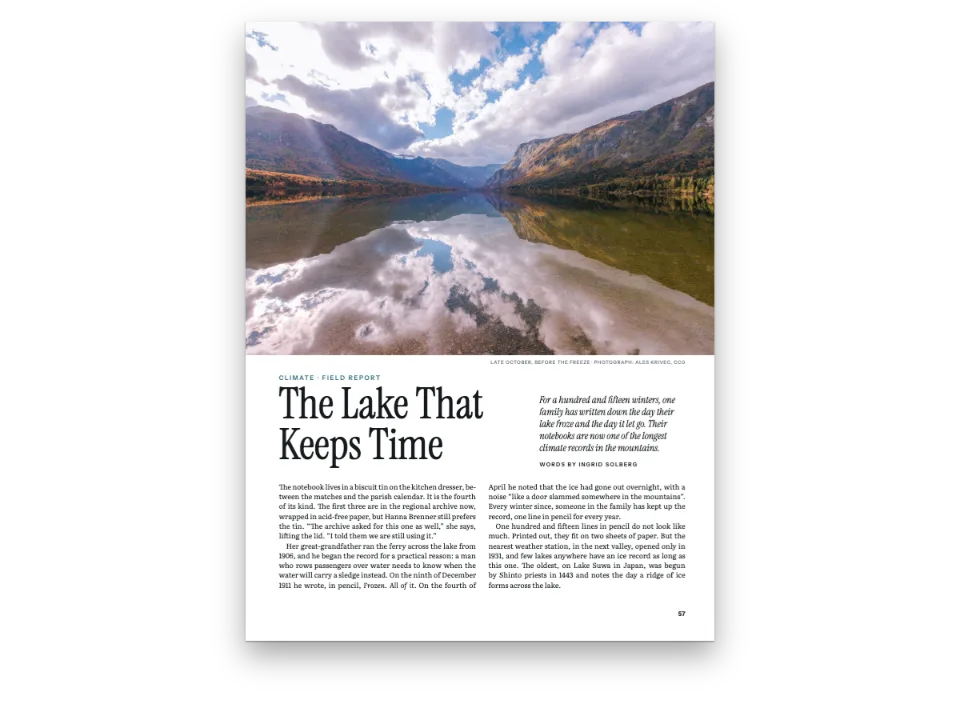
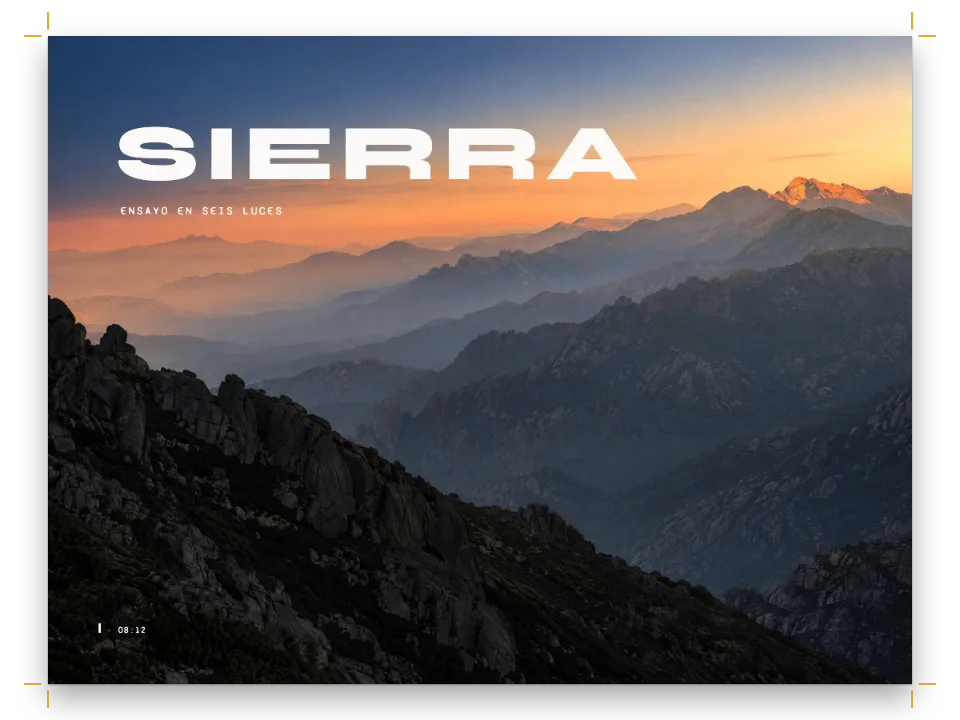
旅行月刊誌『Meridian』11月号の6ページを、225 × 297 mmのページに組みます。特集は見開きで始まります。日の出の塩田を写した1枚の写真が2ページにわたり、左ページでは見出しが水面に白抜きで載り、右ページでは写真の下にドロップキャップ付きの書き出し、リード、署名が並びます。その後、本文は61.7 mmの両端揃えの3段で続きます。写真は2段、ページ幅、1段のいずれかを占め、プルクオートは段落のあいだで2段にまたがり、島の地図の入った色地のサイドバーが結びのページを始めます。本文の最後は青い小さな四角で閉じます。
このレシピが答える質問
- Postextは3段以上の段組みや、画像の周りへの回り込みに対応していますか?
- 図の位置を制御するには(ページの上端、2段をまたぐ、まさにこの位置、余白)?
- 本文を流したまま、囲みをページの上端や下端にフロートとして配置するには?
- 章扉に著者名の行、リード文、ドロップキャップ付きの導入文を加えるには?
手短な答え
const GUTTER = 5; // mm between the columns
const WIDTH = TRIM.width - MARGIN.inner - MARGIN.outer; // the text block, 195 mm
const COLUMN = (WIDTH - 2 * GUTTER) / 3; // 61.7 mm: about 40 characters of 9.6 pt text
const layout = { layoutType: 'multiple', columnCount: 3, gutterWidth: mm(GUTTER) };
// A float takes `columns` adjacent columns and the gutters between them: the head (or foot)
// of the first run of columns that are still empty, on its page or the next. As many columns
// as the page has is a page-wide float, like span: 'page'.
const across = {
  raker: { position: 'top', columns: 2 }, // 128.3 mm wide, at the head of two columns
  pans: { position: 'top', span: 'page' }, // 195 mm, the whole text block
  flor: { position: 'bottom' }, // 61.7 mm: one column, the default
  sieve: { position: 'top', columns: 2 }, // cited in the first column: heads the other two
  quay: { position: 'top', columns: 2 }, // two columns again, on the closing page
};
// A floated box takes `columns` the same way: the style sets it, a fence may override it
// with :::callout{type="pull" columns="3"}. A box set in the flow ('here') keeps to its column.
const pull = { id: 'pull', placement: 'top', columns: 2, backgroundEnabled: false,
  stripe: { enabled: true, side: 'top', width: pt(2.5), color: col('sea') }, // one device
  padding: { top: mm(3), right: pt(0), bottom: mm(1), left: pt(0) },
  body: { fontFamily: 'Fraunces', fontSize: pt(19), lineHeight: pt(2 * LEAD - 3),
    italic: true, textAlign: 'left', hyphenation: false, color: col('sea'),
    firstLineIndent: pt(0) } };
const visit = { id: 'visit', placement: 'top', // one column, at the head of the next free one
  background: col('tint'), padding: { top: mm(4), right: mm(4), bottom: mm(4), left: mm(4) },
  titleStyle: { ...label, fontWeight: 700, fontSize: pt(8.5), letterSpacing: pt(1.4),
    color: col('sea'), gap: mm(2) },
  body: { fontFamily: 'Barlow Condensed', fontWeight: 500, fontSize: pt(9.6),
    lineHeight: pt(12.4), textAlign: 'left', hyphenation: false, boldColor: col('sea'),
    paragraphSpacing: true, firstLineIndent: pt(0) } };
材料
- 機能
- 3段以上の段組み複数段にまたがるフロートフロートする囲み囲み図の配置デザインした章扉ページデザインの画像章扉のドロップキャップ見出しの属性見出しスタイル柱とノンブルページの役割ごとの柱キャプションのスタイル出典とクレジットインラインのチップ独自のリソースの種類リソースとしての図と表セマンティックカラーパレット見開きの余白
- 種類
- Source Serif 4, Fraunces, Barlow Condensed (SIL OFL 1.1)
- 素材
flor-1200.jpgpans-1840.jpgquay-960.jpgraker-1500.jpgsieve-1500.jpgspread-left-1200.jpgspread-right-1200.jpg- Sunrise on the salt pans (the opening spread, in two halves) (Generated With Diffusion Models, CC BY 4.0)
- Sunrise on the salt pans, the recto's half (Generated With Diffusion Models, CC BY 4.0)
- A rake drawing up wet salt (Generated With Diffusion Models, CC BY 4.0)
- The salt flats from above (Generated With Diffusion Models, CC BY 4.0)
- A salt maker with a basket of flor de sal (Generated With Diffusion Models, CC BY 4.0)
- Skimming flor de sal with a sieve (Generated With Diffusion Models, CC BY 4.0)
- Salt sacks on a harbour quay at dusk (Generated With Diffusion Models, CC BY 4.0)
- The sidebar's map of Marisal, drawn in code (Ignacio Ferro, MIT)
作り方
#1 · ページを3段に分け、フロートに1段・2段・3段を取らせる
コードは上の手短な答えにあります。layoutType: 'multiple'とcolumnCount: 3で195 mmの版面を同じ幅の3段に分けます。段間を5 mmにすると1段は61.7 mmで、9.6 ptのSource Serifでおよそ40字です。画像のplacement.columnsは、その数だけ隣り合う段と、そのあいだの段間を占めます。塩をかく写真は幅128.3 mm、塩田の写真はspan: 'page'で195 mmいっぱいです。プルクオートのスタイルも囲みに同じことをします。placement: 'top'のスタイルにcolumns: 2と書くと、囲みは空いている2段の頭へフロートし、本文はそのまわりを流れます。3段のグリッドは写真の多い雑誌の特集に向いています。写真ごとに1段、2段、3段を選べるからです。写真が少なく文章の長い記事は、幅の広い2段のほうが読みやすくなります。
#2 · 見開きで始め、1枚の写真を2ページに渡す
const PHOTO = 165; // mm: how far down the recto the right half of the photograph bleeds
// The verso is its own heading style: the left half of the picture fills the page, and the
// kicker and headline are reversed out of the dark water at its foot. The picture reserves
// nothing, so nothing is pushed off the page; the recto's heading opens the next page.
const spread = { id: 'spread', span: 'page', advancedDesign: { enabled: true, slot: { elements: [
  { kind: 'image', id: 'photo', resourceId: 'spread-left', reserve: false,
    placement: { ...at('bleed', 'top-left'), size: { width: 'fill', height: 'fill' } } },
  { kind: 'text', id: 'kicker', content: '{attr.kicker}', ...label, fontSize: pt(10),
    letterSpacing: pt(2), color: col('paper'), // on a sea-blue tab: the water is too bright
    box: { backgroundColor: col('sea'), padding: { top: mm(1.2), right: mm(2.4),
      bottom: mm(1.2), left: mm(2.4) } },
    placement: at('page', 'top-left', 20, 188) },
  { kind: 'text', id: 'headline', content: '{titleText}', fontFamily: 'Fraunces',
    fontWeight: 600, fontSize: pt(66), lineHeight: 0.96, // a multiple of the size
    color: col('paper'), align: 'left', overflow: 'wrap', // gotcha: overflow-ellipsis-default
    placement: at('#kicker', 'below', 0, 3, 150) },
] } } };
// The recto: the right half of the picture, cut to PHOTO mm, then the lead with its drop cap
// in the first column and the standfirst (the heading's own text) across the other two.
const air = { padding: { bottom: mm(6) } }; // empty padding counts: the columns start lower
const deck = { id: 'deck', span: 'page', advancedDesign: { enabled: true, slot: { elements: [
  { kind: 'image', id: 'photo', resourceId: 'spread-right', // cropped to 225 × 165 mm
    placement: { ...at('bleed', 'top-left'), size: { width: 'fill', height: mm(PHOTO) } } },
  { kind: 'text', id: 'credit', content: '{attr.credit}', ...label, fontWeight: 500,
    fontSize: pt(6.8), letterSpacing: pt(0.5), color: col('muted'), align: 'right',
    placement: at('container', 'top-right', 0, PHOTO - MARGIN.top + 2) },
  { kind: 'text', id: 'lead', content: '{attr.lead}', fontFamily: 'Source Serif 4',
    fontSize: pt(9.6), lineHeight: LEAD / 9.6, color: col('ink'), align: 'justify',
    hyphenate: true, box: air, placement: at('container', 'top-left', 0, PHOTO - 10, COLUMN),
    dropCap: { lines: 4, fontFamily: 'Fraunces', fontWeight: 600, color: col('sea'),
      gap: mm(1.6) } },
  { kind: 'text', id: 'standfirst', content: '{titleText}', fontFamily: 'Fraunces', italic: true,
    fontSize: pt(16.5), lineHeight: 1.24, color: col('ink'), align: 'left', overflow: 'wrap',
    placement: at('container', 'top-left', COLUMN + GUTTER, PHOTO - 11, 2 * COLUMN + GUTTER) },
  { kind: 'text', id: 'byline', content: '{attr.byline}', ...label, fontSize: pt(8.5),
    letterSpacing: pt(1.5), color: col('sea'), box: air,
    placement: at('#standfirst', 'below', 0, 4) },
] } } };
写真の左右の半分は、それぞれspan: 'page'の見出しスタイルに属します。ページ幅の見出しは必ず新しいページを始めるので、見出しのページとリードのページが続けて並びます。左半分は左ページを埋め、高さを確保しません(reserve: false)。そのため見出しを下部の水面に重ねられます。右半分は165 mmで切り、書き出し、リード、署名をその下のコンテナーから吊ります。書き出しは4行のdropCapを持つデザインのテキスト要素で、幅は1段分です。下側の空のパディングが扉の高さに数えられるので、本文の3段はその6 mm下から始まります。continuation.pageIndexOffset: 83で84ページを左ページにし、写真の左右の半分を向かい合わせます。
#3 · 写真を宣言し、置きたい場所で引用する
// No figure numbers: the pictures get a type with an empty caption prefix and template.
const photoType = { id: 'photo', name: 'Photograph', shortLabel: 'photo', captionPrefix: '',
  numberingTemplate: '', resetOn: 'never', counterFormat: 'decimal' };
const CREDIT = 'Photograph generated with diffusion models';
// Pixels at the page's 150 dpi (gotcha: bitmap-print-size): each shrinks to its frame.
const photo = (id, [w, h], altText, caption) => ({ id, typeId: 'photo',
  kind: 'bitmap', createdAt: 0, updatedAt: 0, altText,
  bitmap: { fileId: `${id}-${w}.jpg`, format: 'jpeg', width: w, height: h },
  note: CREDIT, ...(caption && { caption, placement: across[id] }) });
const resources = [ // the two halves of the spread are drawn by the headings, never cited
  photo('spread-left', [1200, 1584], 'Salt pans at sunrise, the sky mirrored in still brine.'),
  photo('spread-right', [1200, 880], 'A salt raker at work below a row of white salt heaps.'),
  photo('raker', [1500, 1125], 'A wooden rake pushing a ridge of wet salt crystals.',
    'Raking the crystallisers at dawn. The salt rolls up in a ridge; a rake that digs in '
    + 'tears the clay floor and greys the harvest.'),
  photo('pans', [1840, 1150], 'Rectangular salt pans in pink, ochre and grey by the sea.',
    'The Alvarra flats from the lighthouse hill. The pink basins are nearly ready: an alga '
    + 'colours the brine once it holds more than 200 grams of salt a litre.'),
  photo('flor', [1200, 1488], 'An older woman in a straw hat holding a basket of salt.',
    'Amélia Sousa with an afternoon’s flor de sal, about four kilos from two pans.'),
  photo('sieve', [1500, 1125], 'Hands skimming a crust of salt crystals with a round sieve.',
    'Skimming the flower: the sieve works the downwind edge of the pan, where the breeze has '
    + 'drifted the crust.'),
  photo('quay', [960, 1200], 'Sacks of salt on a harbour quay beside a blue boat at dusk.',
    'Porto Velho, the last week of September: fifty-kilo sacks wait for the mainland boat.'),
  { id: 'map', typeId: 'photo', kind: 'svg', createdAt: 0, updatedAt: 0, // drawn below
    svg: { fileId: 'map.svg', width: MAP.width * 10, height: MAP.height * 10 },
    placement: { position: 'here' }, // in the sidebar, under its title
    caption: 'The Alvarra pans (pink) lie on the eastern flats, 6 km from Porto Velho (the '
      + 'squares) by the coast road. The lighthouse hill is the triangle; the ferry, dashed.',
    altText: 'A map of a long, low island with salt pans at its eastern end and a harbour '
      + 'town at the west.' },
];
フロートは、それを引用する行より後で、必要な段の頭(または地)が最初に空いたところへ入ります。そのため::resourceの行がページを決めます。ふるいの写真は5ページ目の1段目の上のほうで引用され、そのとき2段目と3段目はまだ空なので、同じページでその2段の頭を占めます。港の写真はそのページの終わりで引用され、次のページの2段の頭に入ります。同じ種類の写真は互いに追い越さないので、引用は記事の順に並べます。ビットマップはページの150 dpiで測られます。1500 pxは254 mmになり、2段分の128.3 mmに縮みます。
#4 · 柱とノンブルは扉の見開きの外に
const head = { ...label, fontSize: pt(7.5), letterSpacing: pt(1.3), color: col('muted') };
const folio = { fontFamily: 'Barlow Condensed', fontWeight: 700, fontSize: pt(9.5),
  color: col('ink') };
const pin = (edge, x, y) => ({ anchor: { to: 'page', edge }, offset: { x: mm(x), y: mm(y) } });
const sides = [['even', 'left', 1], ['odd', 'right', -1]]; // 1: the outer edge is on the left
// The label is 2 pt smaller, so it sits 0.68 mm lower in its box: one shared baseline.
const DROP = (0.8 * 1.2 * 2 * 25.4) / 72;
const header = { elements: sides.flatMap(([parity, edge, s]) => [
  { kind: 'text', id: `folio-${parity}`, content: '{pageNumber}', ...folio, align: edge,
    placement: pin(`top-${edge}`, s * MARGIN.outer, 12) },
  { kind: 'text', id: `head-${parity}`, ...head, align: edge,
    content: s > 0 ? '{title} · {subtitle}' : '{chapterTitle}',
    placement: pin(`top-${edge}`, s * (MARGIN.outer + 9), 12 + DROP) },
].map((element) => ({ ...element, parity, pages: 'body' }))) }; // none on the spread
const footer = { elements: [{ kind: 'text', id: 'drop-folio', content: '{pageNumber}', ...folio,
  align: 'right', parity: 'odd', pages: 'opener', // the recto of the spread: a folio at the foot
  placement: pin('bottom-right', -MARGIN.outer, -12) }] };
ヘッダーの要素はページの上に描かれ、場所を確保しません。そのためノンブルとラベルはページの天の余白に固定します。pages: 'body'は扉の見開きの2ページから柱を外します。どちらもページ幅の見出しで始まるので扉のページです。見開きの右ページにはpages: 'opener'とparity: 'odd'で地にノンブルを入れ、全面写真の左ページには入れません。
#5 · サイドバーの地図をコードで描く
function mulberry32(seed) {
  return () => {
    seed = (seed + 0x6d2b79f5) | 0;
    let r = Math.imul(seed ^ (seed >>> 15), 1 | seed);
    r = (r + Math.imul(r ^ (r >>> 7), 61 | r)) ^ r;
    return ((r ^ (r >>> 14)) >>> 0) / 4294967296;
  };
}
function islandMap() { // in mm: a long, low island lying south-west to north-east
  const rand = mulberry32(135);
  const f = (id, a = 1) => `fill="${palette[id]}"${a < 1 ? ` fill-opacity="${a}"` : ''}`;
  const [cx, cy, rx, ry, turn] = [28, 27, 23, 9.5, -0.5]; // centre, half-axes, radians
  const place = (u, v) => [cx + u * Math.cos(turn) - v * Math.sin(turn),
    cy + u * Math.sin(turn) + v * Math.cos(turn)]; // island frame to map
  const coast = Array.from({ length: 48 }, (_, i) => {
    const a = (i / 48) * 2 * Math.PI;
    const k = 0.9 + rand() * 0.16; // a ragged shore
    return place(rx * k * Math.cos(a), ry * k * Math.sin(a)).map((n) => n.toFixed(2)).join(' ');
  });
  const pans = []; // a grid of basins on the eastern flats, inside the shore
  for (let u = 6; u < 19; u += 2.4) {
    for (let v = -5; v < 5; v += 1.9) {
      if ((u / rx) ** 2 + (v / ry) ** 2 > 0.62) continue;
      const [x, y] = place(u, v);
      pans.push(`<rect x="${(x - 1).toFixed(2)}" y="${(y - 0.7).toFixed(2)}" width="2" `
        + `height="1.4" transform="rotate(${(turn * 180) / Math.PI} ${x.toFixed(2)} `
        + `${y.toFixed(2)})" ${f(rand() < 0.7 ? 'salt' : 'rule')}/>`);
    }
  }
  const [tx, ty] = place(-18, 3); // Porto Velho, on the south-west shore
  const town = [[0, 0], [1.3, 0.2], [0.4, 1.2], [1.7, 1.3], [-0.9, 0.9]].map(([dx, dy]) =>
    `<rect x="${(tx + dx).toFixed(2)}" y="${(ty + dy).toFixed(2)}" width="0.9" height="0.9" `
    + `${f('ink')}/>`).join('');
  const [lx, ly] = place(2, -6.5); // the lighthouse hill, on the north shore
  const ferry = `M${tx} ${ty + 1.5}C${tx - 6} ${ty + 6} 6 46 1.5 48`; // to the mainland, south-west
  return `<svg xmlns="http://www.w3.org/2000/svg" width="${MAP.width * 10}" `
    + `height="${MAP.height * 10}" viewBox="0 0 ${MAP.width} ${MAP.height}">`
    + `<rect width="${MAP.width}" height="${MAP.height}" ${f('sea', 0.16)}/>`
    + `<path d="M${coast.join('L')}Z" ${f('paper')} stroke="${palette.muted}" `
    + 'stroke-width="0.25"/>' + pans.join('') + town
    + `<path d="M${lx - 1.4} ${ly + 1.1}L${lx} ${ly - 1.3}L${lx + 1.4} ${ly + 1.1}Z" ${f('ink')}/>`
    + `<path d="${ferry}" fill="none" stroke="${palette.ink}" stroke-width="0.3" `
    + 'stroke-dasharray="1 0.8"/>'
    + `<path d="M0.4 46.4L1.5 48L2.9 47Z" ${f('ink')}/>` // the arrowhead, a path (no marker)
    + '</svg>';
}
地図はplacement: 'here'のSVGリソースで、サイドバーのフェンスの中で引用するので、囲みの題の下に囲みの幅で入ります。地図には文字を入れていません。SVGの中の文字はページのWebフォントを使えないため、図の説明で形を説明しています。フェリー航路の矢じりはパスで描きます。<marker>はPDFに書き出すと失われるからです。
レシピの全体
// ═══ Postext Cookbook · Nº 135 · Magazine feature on a three-column grid ═════════ // https://postext.dev/en/cookbook/magazine-three-column-feature // Code: MIT · Text: original (CC BY 4.0) · Photographs: generated with diffusion models // Fonts: Source Serif 4, Fraunces, Barlow Condensed (SIL OFL 1.1) · Needs postext ≥ 1.18.0 // A travel feature from a monthly magazine, pages 84–89 of the issue. The story opens on a // spread, a photograph bled across both pages, then runs on in three columns: pictures across // two of them, one across the page and one in a single column, a pull quote floated across // two columns, a sidebar in one, running heads, folios and an end mark. import { buildDocument, renderPageToCanvas, clearMeasurementCache, registerResourceImage, } from 'https://esm.sh/postext'; const LANG = 'en'; // @lang: the language of the sample document ('en' | 'es') const RECIPE = 'magazine-three-column-feature'; // ─── 1 · Design ───────────────────────────────────────────────────────────── // #region palette: an Atlantic blue for the one accent, a salt tint for the sidebar const palette = { ink: '#1c2024', // text: a blue-black sea: '#1d5470', // the accent: kickers, crossheads, the quote, the drop cap tint: '#edf1f2', // the sidebar's ground rule: '#c5ced3', // the map's resting pans muted: '#5c656d', // running heads, credits, the colophon paper: '#ffffff', // the page, and the headline reversed out of the photograph salt: '#dfa79c', // the pans on the sidebar's map, the pink of ripe brine }; const col = (id) => ({ hex: palette[id], model: 'hex', paletteId: id }); const colorPalette = [ ...Object.entries(palette).map(([id, hex]) => ({ id, name: id, value: { hex, model: 'hex' } })), // The engine's defaults link to 'main-color': point it at the accent, so nothing prints blue. { id: 'main-color', name: 'sea (defaults)', value: { hex: palette.sea, model: 'hex' } }, ]; // #endregion const TRIM = { width: 225, height: 297 }; // a magazine trim, in mm const MARGIN = { top: 22, bottom: 20, inner: 16, outer: 14 }; // mirrored const LEAD = 14; // body leading in pt: the baseline grid const MAP = { width: 54, height: 50 }; // mm: the sidebar's map, as wide as its measure const label = { fontFamily: 'Barlow Condensed', fontWeight: 600, textTransform: 'uppercase', align: 'left' }; // design text is centred by default const at = (to, edge, x = 0, y = 0, width) => ({ anchor: { to, edge }, offset: { x: mm(x), y: mm(y) }, ...(width && { size: { width: mm(width) } }) }); // #region answer: three equal columns, and floats that take one, two or all three of them const GUTTER = 5; // mm between the columns const WIDTH = TRIM.width - MARGIN.inner - MARGIN.outer; // the text block, 195 mm const COLUMN = (WIDTH - 2 * GUTTER) / 3; // 61.7 mm: about 40 characters of 9.6 pt text const layout = { layoutType: 'multiple', columnCount: 3, gutterWidth: mm(GUTTER) }; // A float takes `columns` adjacent columns and the gutters between them: the head (or foot) // of the first run of columns that are still empty, on its page or the next. As many columns // as the page has is a page-wide float, like span: 'page'. const across = { raker: { position: 'top', columns: 2 }, // 128.3 mm wide, at the head of two columns pans: { position: 'top', span: 'page' }, // 195 mm, the whole text block flor: { position: 'bottom' }, // 61.7 mm: one column, the default sieve: { position: 'top', columns: 2 }, // cited in the first column: heads the other two quay: { position: 'top', columns: 2 }, // two columns again, on the closing page }; // A floated box takes `columns` the same way: the style sets it, a fence may override it // with :::callout{type="pull" columns="3"}. A box set in the flow ('here') keeps to its column. const pull = { id: 'pull', placement: 'top', columns: 2, backgroundEnabled: false, stripe: { enabled: true, side: 'top', width: pt(2.5), color: col('sea') }, // one device padding: { top: mm(3), right: pt(0), bottom: mm(1), left: pt(0) }, body: { fontFamily: 'Fraunces', fontSize: pt(19), lineHeight: pt(2 * LEAD - 3), italic: true, textAlign: 'left', hyphenation: false, color: col('sea'), firstLineIndent: pt(0) } }; const visit = { id: 'visit', placement: 'top', // one column, at the head of the next free one background: col('tint'), padding: { top: mm(4), right: mm(4), bottom: mm(4), left: mm(4) }, titleStyle: { ...label, fontWeight: 700, fontSize: pt(8.5), letterSpacing: pt(1.4), color: col('sea'), gap: mm(2) }, body: { fontFamily: 'Barlow Condensed', fontWeight: 500, fontSize: pt(9.6), lineHeight: pt(12.4), textAlign: 'left', hyphenation: false, boldColor: col('sea'), paragraphSpacing: true, firstLineIndent: pt(0) } }; // #endregion // #region spread: one photograph across the opening spread, the headline on the verso const PHOTO = 165; // mm: how far down the recto the right half of the photograph bleeds // The verso is its own heading style: the left half of the picture fills the page, and the // kicker and headline are reversed out of the dark water at its foot. The picture reserves // nothing, so nothing is pushed off the page; the recto's heading opens the next page. const spread = { id: 'spread', span: 'page', advancedDesign: { enabled: true, slot: { elements: [ { kind: 'image', id: 'photo', resourceId: 'spread-left', reserve: false, placement: { ...at('bleed', 'top-left'), size: { width: 'fill', height: 'fill' } } }, { kind: 'text', id: 'kicker', content: '{attr.kicker}', ...label, fontSize: pt(10), letterSpacing: pt(2), color: col('paper'), // on a sea-blue tab: the water is too bright box: { backgroundColor: col('sea'), padding: { top: mm(1.2), right: mm(2.4), bottom: mm(1.2), left: mm(2.4) } }, placement: at('page', 'top-left', 20, 188) }, { kind: 'text', id: 'headline', content: '{titleText}', fontFamily: 'Fraunces', fontWeight: 600, fontSize: pt(66), lineHeight: 0.96, // a multiple of the size color: col('paper'), align: 'left', overflow: 'wrap', // gotcha: overflow-ellipsis-default placement: at('#kicker', 'below', 0, 3, 150) }, ] } } }; // The recto: the right half of the picture, cut to PHOTO mm, then the lead with its drop cap // in the first column and the standfirst (the heading's own text) across the other two. const air = { padding: { bottom: mm(6) } }; // empty padding counts: the columns start lower const deck = { id: 'deck', span: 'page', advancedDesign: { enabled: true, slot: { elements: [ { kind: 'image', id: 'photo', resourceId: 'spread-right', // cropped to 225 × 165 mm placement: { ...at('bleed', 'top-left'), size: { width: 'fill', height: mm(PHOTO) } } }, { kind: 'text', id: 'credit', content: '{attr.credit}', ...label, fontWeight: 500, fontSize: pt(6.8), letterSpacing: pt(0.5), color: col('muted'), align: 'right', placement: at('container', 'top-right', 0, PHOTO - MARGIN.top + 2) }, { kind: 'text', id: 'lead', content: '{attr.lead}', fontFamily: 'Source Serif 4', fontSize: pt(9.6), lineHeight: LEAD / 9.6, color: col('ink'), align: 'justify', hyphenate: true, box: air, placement: at('container', 'top-left', 0, PHOTO - 10, COLUMN), dropCap: { lines: 4, fontFamily: 'Fraunces', fontWeight: 600, color: col('sea'), gap: mm(1.6) } }, { kind: 'text', id: 'standfirst', content: '{titleText}', fontFamily: 'Fraunces', italic: true, fontSize: pt(16.5), lineHeight: 1.24, color: col('ink'), align: 'left', overflow: 'wrap', placement: at('container', 'top-left', COLUMN + GUTTER, PHOTO - 11, 2 * COLUMN + GUTTER) }, { kind: 'text', id: 'byline', content: '{attr.byline}', ...label, fontSize: pt(8.5), letterSpacing: pt(1.5), color: col('sea'), box: air, placement: at('#standfirst', 'below', 0, 4) }, ] } } }; // #endregion // #region heads: the magazine and the issue on the verso, the story on the recto const head = { ...label, fontSize: pt(7.5), letterSpacing: pt(1.3), color: col('muted') }; const folio = { fontFamily: 'Barlow Condensed', fontWeight: 700, fontSize: pt(9.5), color: col('ink') }; const pin = (edge, x, y) => ({ anchor: { to: 'page', edge }, offset: { x: mm(x), y: mm(y) } }); const sides = [['even', 'left', 1], ['odd', 'right', -1]]; // 1: the outer edge is on the left // The label is 2 pt smaller, so it sits 0.68 mm lower in its box: one shared baseline. const DROP = (0.8 * 1.2 * 2 * 25.4) / 72; const header = { elements: sides.flatMap(([parity, edge, s]) => [ { kind: 'text', id: `folio-${parity}`, content: '{pageNumber}', ...folio, align: edge, placement: pin(`top-${edge}`, s * MARGIN.outer, 12) }, { kind: 'text', id: `head-${parity}`, ...head, align: edge, content: s > 0 ? '{title} · {subtitle}' : '{chapterTitle}', placement: pin(`top-${edge}`, s * (MARGIN.outer + 9), 12 + DROP) }, ].map((element) => ({ ...element, parity, pages: 'body' }))) }; // none on the spread const footer = { elements: [{ kind: 'text', id: 'drop-folio', content: '{pageNumber}', ...folio, align: 'right', parity: 'odd', pages: 'opener', // the recto of the spread: a folio at the foot placement: pin('bottom-right', -MARGIN.outer, -12) }] }; // #endregion const config = () => ({ // a factory: the engine caches resolved configs per object locale: 'en-us', // an exact hyphenation code (gotcha: hyphenation-locales) colorPalette, resourceTypes: [photoType], page: { width: mm(TRIM.width), height: mm(TRIM.height), dpi: 150, margins: { top: mm(MARGIN.top), bottom: mm(MARGIN.bottom), left: mm(MARGIN.inner), right: mm(MARGIN.outer), mirror: true } }, // left is the inner side layout, bodyText: { fontFamily: 'Source Serif 4', fontSize: pt(9.6), lineHeight: pt(LEAD), color: col('ink'), boldColor: col('ink'), italicColor: col('ink'), referenceColor: col('ink'), textAlign: 'justify', firstLineIndent: mm(3), indentAfterHeading: false, // A 40-character measure: a line no break can set within twice the normal space takes up // to 0.015 em of tracking for the rest instead of spreading its spaces wider still. minWordSpacing: 0.7, maxJustifyTracking: 15 }, headings: { fontFamily: 'Fraunces', fontWeight: 600, color: col('sea'), levels: [ // Restated (gotcha: headings-drop-h1-break): the spread opens on the next page. { level: 1, span: 'page', breakBefore: { enabled: true, parity: 'any' } }, { level: 2, fontSize: pt(12.5), lineHeight: pt(LEAD), marginTop: pt(LEAD), marginBottom: pt(0) }, // crossheads, one grid line above ] }, headingStyles: [spread, deck], calloutStyles: [pull, visit], chipStyles: [{ id: 'end', background: col('sea'), borderWidth: pt(0), borderRadius: pt(0), fontSize: em(0.6), paddingX: em(0.5), paddingY: em(0), gap: em(0.6) }], // a square captionStyle: { fontFamily: 'Barlow Condensed', fontWeight: 500, fontSize: pt(8.6), lineHeight: pt(10.6), color: col('ink'), gap: mm(2), note: { fontSize: pt(7), color: col('muted'), gap: mm(0.5) } }, paragraphStyles: [{ id: 'colophon', fontFamily: 'Barlow Condensed', fontWeight: 500, fontSize: pt(7.4), lineHeight: pt(9.6), color: col('muted'), textAlign: 'left', firstLineIndent: pt(0), marginTop: pt(LEAD) }], header, footer, }); // ─── 2 · Content ──────────────────────────────────────────────────────────── // #region resources: the photographs, declared once by their real pixels // No figure numbers: the pictures get a type with an empty caption prefix and template. const photoType = { id: 'photo', name: 'Photograph', shortLabel: 'photo', captionPrefix: '', numberingTemplate: '', resetOn: 'never', counterFormat: 'decimal' }; const CREDIT = 'Photograph generated with diffusion models'; // Pixels at the page's 150 dpi (gotcha: bitmap-print-size): each shrinks to its frame. const photo = (id, [w, h], altText, caption) => ({ id, typeId: 'photo', kind: 'bitmap', createdAt: 0, updatedAt: 0, altText, bitmap: { fileId: `${id}-${w}.jpg`, format: 'jpeg', width: w, height: h }, note: CREDIT, ...(caption && { caption, placement: across[id] }) }); const resources = [ // the two halves of the spread are drawn by the headings, never cited photo('spread-left', [1200, 1584], 'Salt pans at sunrise, the sky mirrored in still brine.'), photo('spread-right', [1200, 880], 'A salt raker at work below a row of white salt heaps.'), photo('raker', [1500, 1125], 'A wooden rake pushing a ridge of wet salt crystals.', 'Raking the crystallisers at dawn. The salt rolls up in a ridge; a rake that digs in ' + 'tears the clay floor and greys the harvest.'), photo('pans', [1840, 1150], 'Rectangular salt pans in pink, ochre and grey by the sea.', 'The Alvarra flats from the lighthouse hill. The pink basins are nearly ready: an alga ' + 'colours the brine once it holds more than 200 grams of salt a litre.'), photo('flor', [1200, 1488], 'An older woman in a straw hat holding a basket of salt.', 'Amélia Sousa with an afternoon’s flor de sal, about four kilos from two pans.'), photo('sieve', [1500, 1125], 'Hands skimming a crust of salt crystals with a round sieve.', 'Skimming the flower: the sieve works the downwind edge of the pan, where the breeze has ' + 'drifted the crust.'), photo('quay', [960, 1200], 'Sacks of salt on a harbour quay beside a blue boat at dusk.', 'Porto Velho, the last week of September: fifty-kilo sacks wait for the mainland boat.'), { id: 'map', typeId: 'photo', kind: 'svg', createdAt: 0, updatedAt: 0, // drawn below svg: { fileId: 'map.svg', width: MAP.width * 10, height: MAP.height * 10 }, placement: { position: 'here' }, // in the sidebar, under its title caption: 'The Alvarra pans (pink) lie on the eastern flats, 6 km from Porto Velho (the ' + 'squares) by the coast road. The lighthouse hill is the triangle; the ferry, dashed.', altText: 'A map of a long, low island with salt pans at its eastern end and a harbour ' + 'town at the west.' }, ]; // #endregion const markdown = String.raw`---Markdownの見本 · 97行 · content.en.md
title: "Meridian" subtitle: "November 2026" --- # The Salt Rakers of Marisal {style="spread" kicker="Islands · The Atlantic"} ## On a flat island at the edge of the Atlantic, nine families still make salt by hand, with sun, wind and a wooden rake. Their season lasts eleven weeks, and every year it starts a little later {style="deck" byline="Words by Marta Quintal" credit="Sunrise on the Alvarra pans · Photographs generated with diffusion models" lead="At five in the morning the brine in the Alvarra pans is the colour of pewter, and João Brás is already standing in it up to his ankles. He works the way his father taught him, walking backwards down the pan and drawing the rake towards him in long, even strokes, so that the salt rolls up into a ridge without tearing the clay floor beneath it."} Brás is fifty-eight. He has raked these pans every summer since he was eleven, except for two years of military service and one summer, in 1994, when he broke his wrist falling from the roof of the salt store. The pan he is working this morning measures nine metres by twenty-two, and by half past seven he will have drawn about four hundred kilos of salt into a white ridge along its edge. Then the sun will be too high, and the salt too bright to look at. Marisal is fourteen kilometres long and nowhere higher than a two-storey house. It has no river and almost no trees, and the wind from the north-east blows on two days out of three between June and September. For most of its history the island had nothing to sell except what the sea and that wind could make together. The first salt works were dug on the eastern flats in the 1680s. At their peak, in the years before the Second World War, more than six hundred pans were worked on the island, by some 140 families. The decline came quickly. In the 1960s a plant on the mainland began to make salt by boiling brine under vacuum, cheaply and all year round, and the canneries that had bought Marisal’s salt for two centuries switched to it within a decade. Young men left for the merchant fleet and the building sites of the north. The pans they left behind silted up in a few winters, and their clay walls slumped into the brine like sandcastles after a tide. ## Water, sun and wind The method has not changed in three centuries. At high tide, sea water flows through a sluice into a large reservoir, the *viveiro*, where it settles for a few days and drops its sand. From there it is let down, a few centimetres at a time, through a chain of ever shallower basins. In each one the sun and the wind take a little more of the water, and the brine grows heavier. The basins are laid out so that the water never has to be lifted: the whole works falls about forty centimetres from the sluice to the last pan, and gravity does the rest. Sea water holds about 35 grams of salt in every litre. By the time it reaches the last basins, the crystallisers, it holds more than 250, and salt begins to form on the surface like frost on a window. The whole passage takes about three weeks. The salt makers measure it with a glass hydrometer that floats higher as the brine thickens, but most of them can judge it without one. “You can see it in the colour,” says Brás. “It goes pink first, then a sort of grey. When it shines like oil, the salt is coming.” The pink comes from a single-celled alga that thrives in water too salty for anything else. It is harmless, and it gives the pans their colours when you see them from the lighthouse hill. ::resource{id="raker"} The skill lies in the water level. Too deep, and the salt forms slowly, in small grains; too shallow, and it crusts over with the clay. A salt maker opens and closes the little wooden gates between his basins several times a day, by hand or with the side of his foot. Brás has 46 gates on his eleven pans, and he can tell you the height of the water behind each one without looking. At noon the rakers go home to sleep, and the flats belong to the wind. Brás eats with his wife under the vine at the back of the house: grilled mackerel, bread, a tomato cut in half and rubbed with the coarse grey salt from the bottom of the heap, the salt nobody buys. In the evening he walks back down to the pans to check the gates, and on still nights he sometimes stays until dark, sitting on the wall of the reservoir and listening to the brine tick as the crystals form. ## Eleven weeks The harvest runs from early July to the middle of September, when the first autumn rain usually arrives. It used to begin in June. Over the past twenty years the records of the salt makers’ cooperative show the first raking moving back by about nine days, because late spring storms now fill the basins with rainwater just when they should be concentrating. A single heavy shower in August can dissolve a week’s salt in an hour. The rakers watch the forecast on their phones, and on uncertain evenings they draw the salt into heaps and cover them with plastic sheets held down by stones. ::resource{id="pans"} The work is heavy and short. Raking starts before dawn, while the salt is cool and the light is low enough to show the ridges. By nine the crystallisers glare white and the air above them shimmers. Each pan is raked every three or four days. The wet salt is shovelled into wooden wheelbarrows and pushed along the clay walkways to the heaps at the end of each row, where it drains and dries for two weeks before it goes into the store. The store at the end of the flats was built in 1911, a long whitewashed shed with no windows and a floor of beaten earth. Inside it smells of seaweed and tar, and by the end of September the heaps rise to the roof beams. Nothing made of metal is kept there: in a year the salt eats a nail down to a rust stain in the wood. :::callout{type="pull"} The sea gives you the water. The sun and the wind do the work. All we do is stop it running away. ::: A good pan gives about 60 tonnes of coarse salt in a season. Sold in bulk to the canning factory on the mainland, it brings the salt maker around 90 euros a tonne, less than the diesel it takes to ship it. By the late 1990s fewer than twenty families were still working pans, and most of the eastern flats had been left to the herons. ## The flower of the salt What saved the pans was not the coarse salt. On hot, still afternoons a thin crust forms on the surface of the crystallisers, made of flat, brittle crystals that float on the brine like ice on a pond. This is the *flor de sal*, the flower of the salt. It is skimmed off by hand with a wide, fine-meshed sieve on a long handle, a few millimetres at a time, before the evening wind breaks it up and sinks it. The skimmer works along the downwind edge of the pan, where the breeze has pushed the crust into a drift, and lifts it in shallow passes that barely touch the water. Lift too deep and the sieve brings up brine and clay with the crystals; too slowly, and the crust folds and sinks before it reaches the mesh. A pan gives only one or two per cent of its harvest as flower, and it has to be gathered on every day that it appears. On Marisal it was always women’s work, and for generations it was not sold at all. Families kept it for the table and gave it as a present at weddings. Amélia Sousa, who is seventy-four, has skimmed the pans behind her house every summer since 1962. “My mother called it the salt for visitors,” she says. “The coarse salt was for the fish. The flower was kept for the days when the priest came to eat with us.” Chefs on the mainland describe the flower in the language of wine. The crystals are hollow pyramids a few millimetres across, and they break between the teeth instead of dissolving on the tongue. It tastes less sharply of salt than the coarse grain, because it holds a little more of the sea’s magnesium and calcium, and it is never cooked with: a pinch goes on at the table, over a fried egg or a slice of tomato. ::resource{id="sieve"} ::resource{id="flor"} In 2011 nine families formed a cooperative, the Salineiros de Alvarra, and began to sell the flower in small tins under their own name. A 250-gram tin sells for six euros on the island and for three times that in city delicatessens. The flower now brings in more than the rest of the harvest put together. It has paid for a new sluice, a shared drying shed and the repair of 38 abandoned pans, and this year, for the first time since 1971, the cooperative turned buyers away in August. ## The herons’ share Not everyone welcomed the restoration. By 2010 the abandoned pans on the eastern flats had become one of the largest resting places for wading birds on the island’s side of the ocean: black-winged stilts, avocets, little egrets and, every autumn, a few hundred flamingos on their way south. The birdwatchers who came to count them were the first visitors Marisal had had in years, and they were not pleased to see the walls rebuilt. The answer was a map. The cooperative and the island’s naturalists’ society agreed to leave twenty-two of the old pans flooded all year as a refuge, to keep the working pans free of plastic and lime, and to stop raking near the nesting walls between April and June. The birds seem content with the arrangement. Stilts now nest on the working walls as well, and the rakers step round their eggs. Each September the society’s volunteers count the birds from the lighthouse hill, as they have since 1998. Last year they recorded 41 species on the flats in a single morning, among them a spoonbill ringed as a chick on the far side of the ocean. ## Nine families The cooperative has eleven members under forty. One of them is Rita Brás, João’s niece, who studied marine biology on the mainland and came back in 2019 to work four pans her grandfather had abandoned in 1987. It took her two winters to rebuild their clay walls and floors, treading the wet clay flat with her bare feet as the old salt makers did. She logs the salinity of every basin three times a day and shares the figures with a university group that studies salt marshes. “My uncle thinks I am measuring what he already knows,” she says. “He is right. But when he stops, someone will have to know it from the numbers instead.” Rita’s pans are the smallest on the flats, and the most watched. She has fitted one of them with a floating thermometer and a camera on a pole, and every evening she posts its picture for the cooperative’s customers, who can watch the crust form on brine they will eat a year later. Orders from the mainland doubled in the first summer she did it. The older members were doubtful at first. Now they come round after supper to look at the screen with her and argue about the colour of the water. ::resource{id="quay"} :::callout{type="visit" title="Visiting Marisal"} ::resource{id="map"} **Getting there** The ferry from the mainland takes 2 hours 40 minutes and sails daily from June to September, three times a week in winter. **Getting round** Bicycles for hire at the ferry quay, €12 a day. The pans are six kilometres from Porto Velho by the coast road, which is flat all the way. **When to go** The harvest runs from July to mid-September. The cooperative shows visitors round the pans on weekday mornings at eight; book a day ahead. **Where to stay** Three guesthouses in Porto Velho, from €65 a night. Bring a hat: there is no shade on the flats. **Where to eat** Casa do Moinho, on the harbour, grills the morning’s mackerel and serves it with the coarse grey salt. Lunch for two, about €38. **What to bring home** Flor de sal in 250 g tins, €6 at the cooperative’s shed by the sluice. ::: The old salt makers are not sentimental about their trade. Brás will tell you that his back hurts from June to October and that he would not wish the work on his sons, who drive taxis in the island’s one town. He also says that he has never had a better morning than the first raking of a good year, when the salt comes up under the rake in a single unbroken roll and the whole pan smells of the sea. On the last Saturday of the season the cooperative weighs the year’s harvest on the old platform scale in the salt store, sack by sack, with a notebook and a pencil. Last year it came to 1,860 tonnes of coarse salt and a little under eleven tonnes of flower, the best year since the cooperative began. The figure is chalked on the door of the store, where it stays until the rain washes it off, some time in October. At the end of September the salt goes down to the quay at Porto Velho in linen sacks of fifty kilos each, and the last boat of the season carries it to the mainland. The pans are flooded with sea water for the winter, to protect the clay from the rain and the frost. By November, when the rakers start mending their gates, the flats look like a lake again, and the herons are back on the walls, waiting. :chip[]{style="end"} :::paragraphs{style="colophon"} Marisal, the Alvarra pans and everyone in this feature are fictional · Set in Source Serif 4, Fraunces and Barlow Condensed (SIL Open Font License) · Text: CC BY 4.0 · Photographs generated with diffusion models :::`; // content.<lang>.md, inlined by the Cookbook // #region art: the sidebar's map of Marisal, drawn in code with a seeded PRNG function mulberry32(seed) { return () => { seed = (seed + 0x6d2b79f5) | 0; let r = Math.imul(seed ^ (seed >>> 15), 1 | seed); r = (r + Math.imul(r ^ (r >>> 7), 61 | r)) ^ r; return ((r ^ (r >>> 14)) >>> 0) / 4294967296; }; } function islandMap() { // in mm: a long, low island lying south-west to north-east const rand = mulberry32(135); const f = (id, a = 1) => `fill="${palette[id]}"${a < 1 ? ` fill-opacity="${a}"` : ''}`; const [cx, cy, rx, ry, turn] = [28, 27, 23, 9.5, -0.5]; // centre, half-axes, radians const place = (u, v) => [cx + u * Math.cos(turn) - v * Math.sin(turn), cy + u * Math.sin(turn) + v * Math.cos(turn)]; // island frame to map const coast = Array.from({ length: 48 }, (_, i) => { const a = (i / 48) * 2 * Math.PI; const k = 0.9 + rand() * 0.16; // a ragged shore return place(rx * k * Math.cos(a), ry * k * Math.sin(a)).map((n) => n.toFixed(2)).join(' '); }); const pans = []; // a grid of basins on the eastern flats, inside the shore for (let u = 6; u < 19; u += 2.4) { for (let v = -5; v < 5; v += 1.9) { if ((u / rx) ** 2 + (v / ry) ** 2 > 0.62) continue; const [x, y] = place(u, v); pans.push(`<rect x="${(x - 1).toFixed(2)}" y="${(y - 0.7).toFixed(2)}" width="2" ` + `height="1.4" transform="rotate(${(turn * 180) / Math.PI} ${x.toFixed(2)} ` + `${y.toFixed(2)})" ${f(rand() < 0.7 ? 'salt' : 'rule')}/>`); } } const [tx, ty] = place(-18, 3); // Porto Velho, on the south-west shore const town = [[0, 0], [1.3, 0.2], [0.4, 1.2], [1.7, 1.3], [-0.9, 0.9]].map(([dx, dy]) => `<rect x="${(tx + dx).toFixed(2)}" y="${(ty + dy).toFixed(2)}" width="0.9" height="0.9" ` + `${f('ink')}/>`).join(''); const [lx, ly] = place(2, -6.5); // the lighthouse hill, on the north shore const ferry = `M${tx} ${ty + 1.5}C${tx - 6} ${ty + 6} 6 46 1.5 48`; // to the mainland, south-west return `<svg xmlns="http://www.w3.org/2000/svg" width="${MAP.width * 10}" ` + `height="${MAP.height * 10}" viewBox="0 0 ${MAP.width} ${MAP.height}">` + `<rect width="${MAP.width}" height="${MAP.height}" ${f('sea', 0.16)}/>` + `<path d="M${coast.join('L')}Z" ${f('paper')} stroke="${palette.muted}" ` + 'stroke-width="0.25"/>' + pans.join('') + town + `<path d="M${lx - 1.4} ${ly + 1.1}L${lx} ${ly - 1.3}L${lx + 1.4} ${ly + 1.1}Z" ${f('ink')}/>` + `<path d="${ferry}" fill="none" stroke="${palette.ink}" stroke-width="0.3" ` + 'stroke-dasharray="1 0.8"/>' + `<path d="M0.4 46.4L1.5 48L2.9 47Z" ${f('ink')}/>` // the arrowhead, a path (no marker) + '</svg>'; } // #endregion // ─── 3 · Fonts ────────────────────────────────────────────────────────────── const FONTS = { // text, display and label faces, loaded before the build (gotcha: fonts-first) 'Source Serif 4': ['400', '400i', '600'], Fraunces: ['400i', '600'], 'Barlow Condensed': ['500', '600', '700'] }; // ─── 4 · Build & show ─────────────────────────────────────────────────────── await loadFonts(FONTS, markdown); await Promise.all([...resources.filter((r) => r.bitmap).map(({ bitmap }) => loadImage(bitmap.fileId, asset(bitmap.fileId))), loadSvg('map.svg', islandMap())]); // Pages 84–89 of the issue: page 84 is a verso, so the opener lies open as a spread. const continuation = { pageIndexOffset: 83, pageNumbering: { startAt: 84 } }; const doc = await buildWithFonts( () => buildDocument({ markdown, resources, continuation }, config()), markdown); showPages(doc, { title: 'Magazine feature on a three-column grid' });キット · core, fonts, viewer, images:全レシピ共通 · 270行
// ─── Kit ── helpers shared by every Cookbook recipe · postext.dev/cookbook ───── // ─── Kit · core v1 ── the same in every recipe · postext.dev/cookbook ───────── function mm(value) { return { value, unit: 'mm' }; } function pt(value) { return { value, unit: 'pt' }; } function em(value) { return { value, unit: 'em' }; } /** The sample language's string: t({ en: 'Figure', es: 'Figura' }). */ function t(strings) { return strings[LANG] ?? Object.values(strings)[0]; } /** A file in this recipe's assets folder, served from the Postext repo by jsDelivr. */ function asset(file) { return `https://cdn.jsdelivr.net/gh/drnachio/postext@main/cookbook/${RECIPE}/assets/${file}`; } // ─── Kit · fonts v1 ── the same in every recipe · postext.dev/cookbook ──────── // Postext measures text with the faces the browser has loaded, and caches the // widths, so every face must be ready before the first build. Faces come from // Fontsource: the same static files the PDF embeds, so screen and PDF agree. /** faces = { 'Family Name': ['400', '400i', '700'] }. `text` is the sample: * letters beyond Latin-1 (č, ł, ő…) also load the latin-ext files. With * `optional`, a face Fontsource does not ship is skipped instead of failing. * Resolves to the number of faces added. */ async function loadFonts(faces, text = '', { optional = false } = {}) { kitStatus('Loading fonts…'); const ranges = { latin: 'U+0000-00FF,U+0131,U+0152-0153,U+02BB-02BC,U+02C6,U+02DA,U+02DC,U+0304,U+0308,U+0329,' + 'U+2000-206F,U+20AC,U+2122,U+2191,U+2193,U+2212,U+2215,U+FEFF,U+FFFD', 'latin-ext': 'U+0100-02BA,U+02BD-02C5,U+02C7-02CC,U+02CE-02D7,U+02DD-02FF,U+0304,U+0308,U+0329,' + 'U+1D00-1DBF,U+1E00-1E9F,U+1EF2-1EFF,U+2020,U+20A0-20AB,U+20AD-20C0,U+2113,U+2C60-2C7F,U+A720-A7FF', }; const subsets = /[Ā-˿Ḁ-ỿ]/.test(text) ? ['latin', 'latin-ext'] : ['latin']; const jobs = []; let added = 0; for (const [family, specs] of Object.entries(faces)) { const id = fontsourceId(family); const meta = optional ? await fontsourceMeta(family) : null; for (const spec of new Set(specs)) { const weight = parseInt(spec, 10); const style = spec.endsWith('i') ? 'italic' : 'normal'; if (hasFace(family, weight, style)) continue; if (optional && !(meta?.weights.includes(weight) && meta.styles.includes(style))) continue; for (const subset of subsets) { const url = `https://cdn.jsdelivr.net/npm/@fontsource/${id}@5/files/${id}-${subset}-${weight}-${style}.woff2`; const face = new FontFace(family, `url(${url}) format('woff2')`, { weight: String(weight), style, unicodeRange: ranges[subset] }); jobs.push(face.load().then((ready) => { document.fonts.add(ready); added++; }, () => { if (subset === 'latin' && !optional) throw new Error(`Fontsource has no ${family} ${weight} ${style}`); })); } } } await Promise.all(jobs).catch((error) => { kitFail(error); throw error; }); return added; } /** Runs `build` (a buildDocument or buildBundle call) and checks the faces * the pages use. A regular face missing from FONTS is loaded with a warning; * bold and italic variants are loaded when the family ships them. Then the * measurement caches are cleared and the build runs again. */ async function buildWithFonts(build, text = '') { const tried = new Set(); for (let round = 0; round < 3; round++) { kitStatus('Laying out…'); await new Promise(requestAnimationFrame); // let the status paint first const result = await Promise.resolve().then(build).catch((error) => { kitFail(error); throw error; }); const wanted = { base: {}, variants: {} }; for (const { font, base } of [result].flat().flatMap(fontStringsOf)) { const { family, weight, style } = parseFont(font); const key = `${family}|${weight}|${style}`; if (tried.has(key) || hasFace(family, weight, style)) continue; tried.add(key); (wanted[base ? 'base' : 'variants'][family] ??= []).push(`${weight}${style === 'italic' ? 'i' : ''}`); } if (Object.keys(wanted.base).length) { console.warn(`[cookbook] FONTS does not list ${JSON.stringify(wanted.base)}: loading them.`); } const added = await loadFonts(wanted.base, text) + await loadFonts(wanted.variants, text, { optional: true }); if (added === 0) return result; clearMeasurementCache(); } throw new Error('The fonts did not settle after three builds.'); } /** Every font string of the layout. `base` marks a block's own face; its * bold, italic and bold-italic variants are listed whether or not used. */ function fontStringsOf(doc) { const found = new Map(); const walk = (node) => { if (!node || typeof node !== 'object') return; if (Array.isArray(node)) { node.forEach(walk); return; } for (const [key, value] of Object.entries(node)) { if (typeof value === 'string' && /fontString$/i.test(key)) { found.set(value, found.get(value) || key === 'fontString'); } else if (value && typeof value === 'object') walk(value); } }; walk(doc.pages); walk(doc.blocks); return [...found].map(([font, base]) => ({ font, base })); } /** '700 37.5px Open Sans' / 'italic 400 13px "Source Serif 4"' → { family, weight, style }. * A string with no weight ('95.8px Young Serif', from a design text) is 400. */ function parseFont(font) { const m = /^(?:(italic|oblique)\s+)?(?:small-caps\s+)?(?:(\d+|bold|normal)\s+)?[\d.]+px\s+(.+)$/.exec(font.trim()); if (!m) throw new Error(`Unexpected font string: ${font}`); const weight = m[2] === 'bold' ? 700 : !m[2] || m[2] === 'normal' ? 400 : Number(m[2]); return { family: m[3].replace(/^["']|["']$/g, ''), weight, style: m[1] ? 'italic' : 'normal' }; } /** True when a loaded FontFace covers exactly this family, weight and style * (document.fonts.check() is also true for families nobody declared). */ function hasFace(family, weight, style) { for (const face of document.fonts) { if (face.status !== 'loaded' || face.style !== style) continue; if (face.family.replace(/^["']|["']$/g, '') !== family) continue; const [low, high = low] = face.weight.split(' ').map(Number); if (weight >= low && weight <= high) return true; } return false; } /** Fontsource's id for a family: 'Source Serif 4' → 'source-serif-4'. */ function fontsourceId(family) { return family.toLowerCase().replace(/\s+/g, '-'); } /** The weights and styles a family ships ({ weights: [400, 700], styles: ['normal', 'italic'] }), or null. */ function fontsourceMeta(family) { fontsourceMeta.cache ??= new Map(); const id = fontsourceId(family); if (!fontsourceMeta.cache.has(id)) { fontsourceMeta.cache.set(id, fetch(`https://api.fontsource.org/v1/fonts/${id}`) .then((res) => (res.ok ? res.json() : null), () => null)); } return fontsourceMeta.cache.get(id); } // ─── Kit · viewer v1 ── the same in every recipe · postext.dev/cookbook ─────── /** Shows the pages as facing spreads on a dark desk: the first page is a * recto on its own, then verso | recto pairs, as in a bound book. Pages * are painted when they scroll near the screen. */ function showPages(docs, { title, width = 460 } = {}) { const root = viewer(title); const pages = [docs].flat().flatMap((doc) => doc.pages.map((page) => ({ doc, page, n: (doc.pageIndexOffset ?? 0) + page.index }))); const spreads = []; let verso = null; for (const p of pages) { if (p.n % 2 === 1) { if (verso) spreads.push([verso, null]); verso = p; } else { spreads.push([verso, p]); verso = null; } } if (verso) spreads.push([verso, null]); const density = Math.min(window.devicePixelRatio || 1, 2); showPages.painter?.disconnect(); const painter = new IntersectionObserver((entries) => { for (const { isIntersecting, target } of entries) { if (!isIntersecting) continue; painter.unobserve(target); const { doc, page } = target.postext; renderPageToCanvas(page, doc, target, { scale: (width * density) / page.width }); } }, { rootMargin: '800px' }); showPages.painter = painter; root.replaceChildren(...spreads.map((pair) => { const spread = document.createElement('div'); spread.className = 'pt-spread'; for (const p of pair) { const figure = document.createElement('figure'); if (p) { const label = p.page.pageLabel || String(p.n + 1); const canvas = document.createElement('canvas'); canvas.postext = p; canvas.style.aspectRatio = `${p.page.width} / ${p.page.height}`; canvas.setAttribute('role', 'img'); canvas.setAttribute('aria-label', `Page ${label}`); const folio = document.createElement('figcaption'); folio.textContent = label; figure.append(canvas, folio); painter.observe(canvas); } else figure.className = 'pt-blank'; spread.append(figure); } return spread; })); kitStatus(`${pages.length} ${pages.length === 1 ? 'page' : 'pages'}`); document.documentElement.dataset.postext = 'ready'; return pages.length; } /** The desk, the bar and the error reporting, created once. */ function viewer(title) { if (!document.getElementById('pt-kit')) { document.head.insertAdjacentHTML('beforeend', `<style id="pt-kit"> :root { color-scheme: dark; } body { margin: 0; background: #0e1014; color: #b9bcc4; font: 13px/1.45 system-ui, sans-serif; } #pt-bar { position: sticky; top: 0; z-index: 1; display: flex; flex-wrap: wrap; align-items: center; gap: 6px 16px; padding: 10px 16px; background: rgb(14 16 20 / .92); backdrop-filter: blur(6px); border-bottom: 1px solid #23262d; } #pt-bar strong { color: #f4f1ea; font-weight: 600; } #pt-actions { display: flex; gap: 12px; margin-left: auto; } #pt-actions a, #pt-actions button { color: #d8a21a; font: inherit; background: none; border: 0; padding: 0; cursor: pointer; } #pages { display: grid; justify-items: center; gap: 48px; padding: 32px 16px 72px; } .pt-spread { display: flex; } .pt-spread figure { margin: 0; width: min(460px, 44vw); } .pt-spread canvas { display: block; width: 100%; background: #fff; box-shadow: 0 1px 2px rgb(0 0 0 / .5), 0 22px 44px -16px rgb(0 0 0 / .8); } .pt-spread figure:first-child canvas { box-shadow: inset -14px 0 14px -14px rgb(0 0 0 / .18), 0 1px 2px rgb(0 0 0 / .5), 0 22px 44px -16px rgb(0 0 0 / .8); } .pt-spread figcaption { margin-top: 10px; text-align: center; font: 600 10px/1 system-ui, sans-serif; letter-spacing: .18em; text-transform: uppercase; color: #6c7079; } .pt-blank { visibility: hidden; } @media (max-width: 760px) { .pt-spread { flex-direction: column; gap: 32px; } .pt-spread figure { width: min(460px, 92vw); } .pt-blank { display: none; } } </style>`); document.body.insertAdjacentHTML('afterbegin', '<header id="pt-bar"><strong id="pt-title"></strong><span id="pt-status" role="status"></span><span id="pt-actions"></span></header>'); document.getElementById('pt-title').textContent = document.title || 'Postext'; addEventListener('error', (event) => kitFail(event.error ?? event.message)); addEventListener('unhandledrejection', (event) => kitFail(event.reason)); } if (title) document.getElementById('pt-title').textContent = title; return document.getElementById('pages') ?? document.body.appendChild(Object.assign(document.createElement('main'), { id: 'pages' })); } function kitStatus(text) { viewer(); document.getElementById('pt-status').textContent = text; } function kitFail(error) { document.documentElement.dataset.postext = 'error'; kitStatus(`Error: ${error?.message ?? error}`); } // ─── Kit · images v1 ── recipes with pictures · postext.dev/cookbook ────────── /** Registers a photo or PNG for the canvas and keeps its bytes for the PDF. * fetch → ImageBitmap never taints the canvas (a plain cross-origin <img> would). */ async function loadImage(fileId, url) { const res = await fetch(url); if (!res.ok) throw new Error(`Image not found (${res.status}): ${url}`); const bytes = new Uint8Array(await res.arrayBuffer()); registerResourceImage(fileId, await createImageBitmap(new Blob([bytes]))); (loadImage.bytes ??= new Map()).set(fileId, bytes); } /** Registers SVG markup (drawn in code, or fetched) as a vector image. */ async function loadSvg(fileId, svg) { const img = new Image(); img.src = `data:image/svg+xml;charset=utf-8,${encodeURIComponent(svg)}`; await img.decode(); registerResourceImage(fileId, img); (loadImage.bytes ??= new Map()).set(fileId, new TextEncoder().encode(svg)); } /** renderToPdf({ resourceBytes: imageBytes }) */ function imageBytes(fileId) { return loadImage.bytes?.get(fileId); } /** renderToHtml({ resourceImageUrl: imageUrl }) */ function imageUrl(fileId) { const bytes = imageBytes(fileId); if (!bytes) return undefined; imageUrl.urls ??= new Map(); if (!imageUrl.urls.has(fileId)) { const type = /\.svg$/i.test(fileId) ? 'image/svg+xml' : /\.png$/i.test(fileId) ? 'image/png' : 'image/jpeg'; imageUrl.urls.set(fileId, URL.createObjectURL(new Blob([bytes], { type }))); } return imageUrl.urls.get(fileId); } // ─── /Kit ───────────────────────────────────────────────────────────────────────
組み立てたscript.jsはそのまま動きます。任意のページのモジュールスクリプトに貼り付けるか、レシピをCodePenで開いてください。 GitHub上のレシピのフォルダー ↗ (新しいタブで開きます)
アレンジ
#プルクオートを3段にまたがらせる
フロートする囲みは、スタイルのcolumnsよりフェンスのcolumns属性を優先するので、1つの引用だけをページ幅にできます。
- :::callout{type="pull"}
+ :::callout{type="pull" columns="3"}#特集を2段で組む
写真が少なく段落の長い特集には、doubleレイアウトの雑誌の特集:写真の扉からエンドマークまでを参照してください。
よくあるつまずき
つまずき
'top'のフロートは参照したページには入らない
フロートが自分の参照より上に置かれることはありません。そのため、Nページで参照したページ幅の'top'フロートはN+1ページの頭に置かれます。もっと前で参照するか、参照したページの下端に入れる位置'auto'または'bottom'を使ってください。 図の配置 →
つまずき
章扉の画像は確保する高さに数えられない
postext 1.4.1では、詳細デザインの見出しは、確保する高さを画像抜きで計測します。テキスト、罫、箱はページに固定していても数えられますが、ページの頭に裁ち落としで置いた写真のような画像は何も確保しないため、本文がその上から始まることがあります。minHeightを本文が始まるべき位置に設定してください。 デザインした章扉 →
つまずき
ページ幅の見出しは必ず新しいページを始める
階層やスタイルでspan: 'page'を設定した見出しは、breakBeforeの有無にかかわらず、ページの頭の章扉として組まれます。ほかのテキストのあとや、同じページの別の章扉のあとに置くと、次のページに移り、現在のページの残りは空になります。題字の下で両段(縦組みのページなら上下両段)にまたがる大見出しは、題字と並べて章扉自身のデザインに入れるか、spanを指定しない見出しとして:::callout{span="page"}の囲みに入れてください。newspaper-front-pageの大見出しはこの方法で組んでいます。 デザインした章扉 →
つまずき
1ページは奇数ページ。ページは物理的な番号で計画する
1ページは右ページで、2ページが最初の偶数ページです。見開きは物理的なページ番号で計画してください。偶数ページの章扉は、その次の奇数ページと向かい合います。 改ページと改段 →
つまずき
ビットマップは文書のdpiでのpxで配置される。印刷サイズを宣言する
ビットマップのリソースの大きさは、ファイルからではなく、宣言した幅と高さ(文書のdpiでのピクセル数)から決まります。印刷サイズのピクセル数(刷り上がりの幅で約300 dpi)を宣言すれば、図は正しい大きさに収まり、鮮明さも保たれます。 リソースとしての図と表 →
つまずき
空白だけのチップはマークアップがそのまま出る
テキストが空白(ノーブレークスペースを含む)だけのチップは、:chip[ ]がそのまま印字されます。空の解答用チップにはワードジョイナー(U+2060)を入れてください。 インラインのチップ →
つまずき
headingsオブジェクトを渡すとH1の改ページが消える
既定ではH1は奇数ページへ改ページします(always-odd)。ところがheadingsオブジェクトを渡すと中身にかかわらずこの既定がリセットされ、章は改ページせずに続けて組まれ、span: 'page'も効かなくなります。どの設定でもheadings.levels[0].breakBefore: { enabled: true, parity }を書き直してください。 奇数ページから始まる章 →
つまずき
デザインのテキストのlineHeightは倍率で、寸法ではない
デザインのスロットでは、テキスト要素のlineHeightはフォントサイズに掛ける倍率です(lineHeight: 1.05)。postext 1.4.1ではpt(15)のような寸法を指定しても拒否されず、章扉の高さがNaNと計測されて、minHeightを含め確保する高さが警告なしに失われ、本文がタイトルに重なって組まれます。 ページデザインのテキスト・罫・ボックス →
つまずき
デザインのテキストのoverflowの既定値は'ellipsis-end'
幅に収まらないデザインのテキスト要素は、既定では省略記号で終わります。複数行に折り返したいタイトルにはoverflow: 'wrap'を設定してください。 ページデザインのテキスト・罫・ボックス →
つまずき
ハイフネーションできるのは8つのロケールだけで、コードは完全一致
ハイフネーションが用意されているのはen-us、es、fr、de、it、pt、ca、nlで、コードは完全一致で照合されます。'es-ES'やほかの言語は、何の知らせもなくアメリカ英語にフォールバックします。 ハイフネーションと文書の言語 →
つまずき
レイアウトの前にすべてのフォントを読み込む
レイアウトはブラウザーが読み込んだフォントで文字を計測し、その幅をキャッシュします。最初のビルドのあとに届いたフォントがあると改行位置が狂い、PDFも画面と一致しなくなります。すべてのウェイトとスタイルを先に読み込み、遅れて届いたときは再ビルドの前にclearMeasurementCache()を呼んでください。 レイアウト前のフォント読み込み →
- 2段にまたがる写真は、まだ空いている2段の頭に入ります。2段目で引用すると、そのページには3段目しか残っていないので組になる2段が見つからず、次のページまで待ちます。
- この特集は、6ページ目の港の写真の下で3段がそろって終わるように調整してあります。文章を直したら、最後のページが埋まっているか確かめてください。数行減ると、写真だけが1ページに送られます。
- 1行40字では、両端揃えの段落に改行の候補が少なくなります。
maxJustifyTracking: 15は、通常の2倍の語間でも収まらない行に、最大0.015 emの字間を使わせます。最終行が1語だけになる段落は、このページのように文章を直して解消します。
クレジット
- 本文
- 書き下ろしの文章, CC BY 4.0
- 画像
- Sunrise on the salt pans (the opening spread, in two halves) · Generated With Diffusion Models · CC BY 4.0
- Sunrise on the salt pans, the recto's half · Generated With Diffusion Models · CC BY 4.0
- A rake drawing up wet salt · Generated With Diffusion Models · CC BY 4.0
- The salt flats from above · Generated With Diffusion Models · CC BY 4.0
- A salt maker with a basket of flor de sal · Generated With Diffusion Models · CC BY 4.0
- Skimming flor de sal with a sieve · Generated With Diffusion Models · CC BY 4.0
- Salt sacks on a harbour quay at dusk · Generated With Diffusion Models · CC BY 4.0
- The sidebar's map of Marisal, drawn in code · Ignacio Ferro · MIT
- フォント
- Source Serif 4 (SIL OFL 1.1) · Fraunces (SIL OFL 1.1) · Barlow Condensed (SIL OFL 1.1)