Em poucas palavras
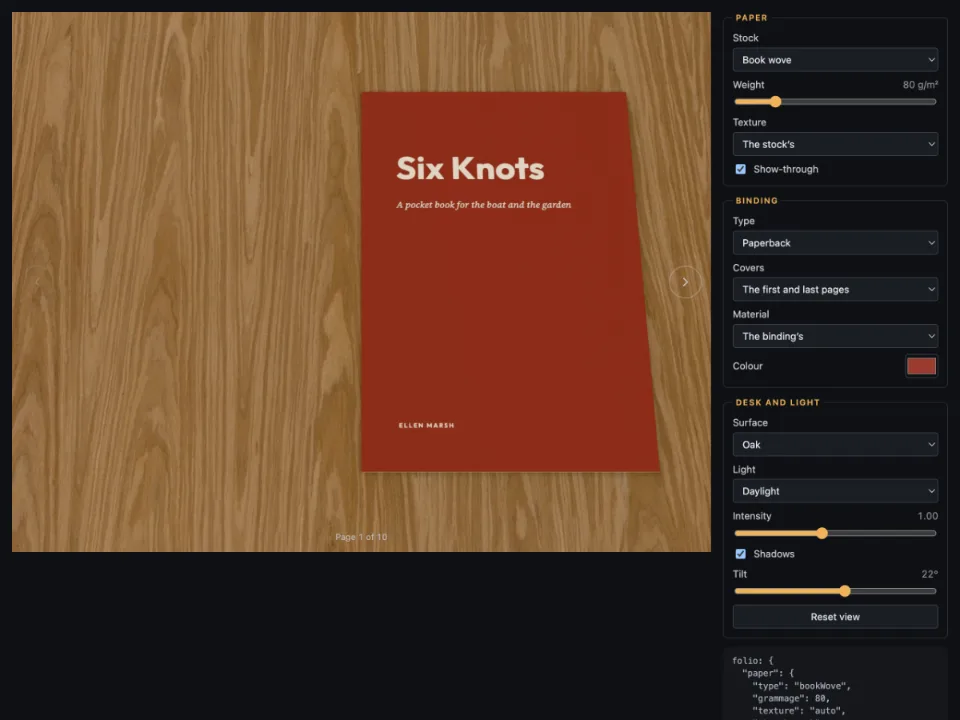
O primeiro capítulo de um romance curto, mostrado como um livro de verdade aberto sobre uma mesa. Você vira as páginas com o mouse, e o papel, a capa e a mesa são escolhidos nas configurações.
O que você vai compor
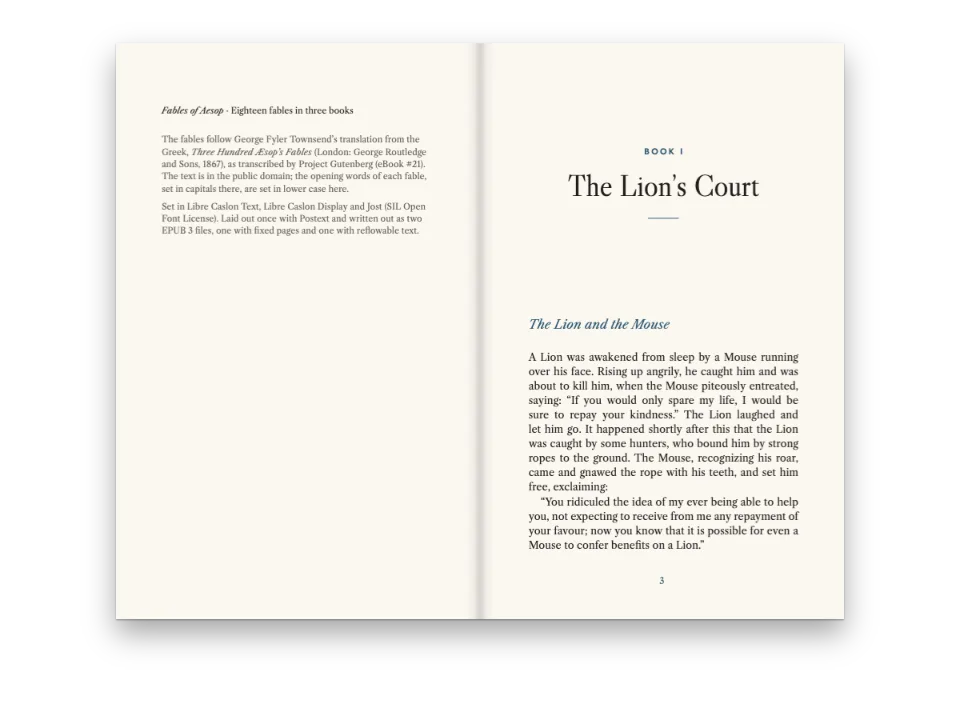
O primeiro capítulo de The Ferryman’s Ledger, um romance curto em página de 129 × 198 mm, aberto como um livro sobre uma mesa de nogueira. A capa é dura, revestida de tecido verde-garrafa, as páginas são de um papel creme encorpado de romance, e o leitor pega a página da direita pela borda e a vira: a folha se curva e projeta a sombra sobre a página de baixo. O texto é composto uma vez com buildDocument; uma chamada ao pacote postext-folio transforma essa diagramação no livro. Tudo aquilo de que o livro é feito (papel, encadernação, mesa, luz, o ângulo da vista) faz parte da configuração, então o mesmo documento leva sua aparência para a aba Folio do Sandbox.
Esta receita responde a
- Como mostro meu documento como um livro em 3D cujas páginas o leitor vira com a mão?
- Como visualizo a encadernação, a capa, o papel e a iluminação de um livro antes de mandá-lo para a gráfica?
A resposta curta
const stage = document.createElement('section');
stage.id = 'folio';
stage.ariaLabel = 'The book in 3D';
stage.style.cssText = 'height: min(78vh, 720px); margin: 0 auto; max-width: 1280px';
document.getElementById('pages').before(stage);
createFolioFromDocument(stage, doc, {
  // The paper, binding, desk and light come from doc.config.folio. Only the photographed
  // desk is the host's choice: without textureBaseUrl the walnut is drawn procedurally.
  appearance: { textureBaseUrl: 'https://postext.dev/folio/textures' },
  onChange: ({ pages }) => kitStatus(`${doc.pages.length} pages · open at `
    + pages.map((i) => doc.pages[i].pageLabel || i + 1).join('–')),
});
Ingredientes
- Funcionalidades
- Visualizador de livro em 3D (Folio)Papel, encadernação, mesa e luz (Folio)Páginas em um canvasAberturas desenhadasAtributos de títuloCabeços e fóliosCabeços por tipo de páginaMargens espelhadasViúvas, órfãs e linhas curtasEstilos de parágrafoPaleta de cores semânticaFontes antes da diagramação
- Tipografia
- Literata, Fraunces, Work Sans (SIL OFL 1.1)
- Materiais
- Nenhum: todas as imagens são desenhadas em código
Preparo
#1 · Diga de que o livro é feito
const folio = {
  tilt: 26, // degrees from straight above: enough to see the depth of the page block
  paper: { type: 'bookWove', grammage: 70, shade: col('cream') }, // a bulky cream novel paper
  binding: { type: 'hardcover', cover: 'case', coverMaterial: 'cloth',
    coverColor: col('accent') }, // the case wraps the pages; boards a little larger
  surface: { type: 'walnut' },
  lighting: { environment: 'studio', intensity: 1, shadows: true },
};
config.folio é lido pelo visualizador 3D e por mais nada: a diagramação, o canvas, o PDF e a saída HTML o ignoram, então trocar o papel não move uma linha. bookWove é um papel de romance encorpado, e 70 g/m² com esse volume dá uma folha de uns 112 µm de espessura; o visualizador multiplica isso pelo número de páginas para obter a espessura do miolo. A cor do tecido está ligada à cor de destaque da paleta, o mesmo verde do chapéu e dos fólios.
#2 · Uma abertura discreta e os cabeços
const opener = { enabled: true, minHeight: mm(50), slot: { elements: [
  { kind: 'text', id: 'kicker', content: '{attr.kicker}', fontFamily: 'Work Sans',
    fontSize: pt(7.5), fontWeight: 600, letterSpacing: pt(1.5), textTransform: 'uppercase',
    color: col('accent'), align: 'left',
    placement: { anchor: { to: 'container', edge: 'top-left' }, offset: { y: mm(10) } } },
  { kind: 'text', id: 'title', content: '{titleText}', fontFamily: 'Fraunces', fontSize: pt(28),
    lineHeight: 1.05, fontWeight: 600, color: col('ink'), align: 'left', overflow: 'wrap',
    placement: { anchor: { to: '#kicker', edge: 'below' }, offset: { y: mm(3) },
      size: { width: mm(90) } } },
  { kind: 'rule', id: 'rule', direction: 'horizontal', thickness: pt(1.25), color: col('accent'),
    placement: { anchor: { to: '#title', edge: 'below' }, offset: { y: mm(4.5) },
      size: { width: mm(12) } } },
] } };
O capítulo começa a um terço da altura de uma página ímpar, sob um chapéu tirado dos atributos do título. Em 3D, uma abertura rebaixada se lê como num romance impresso: o branco no alto da página é a primeira coisa que o leitor vê ao abrir a capa.
const head = (id, content, parity, edge, x, extra = {}) => ({ kind: 'text', id, content, parity,
  pages: 'body', fontFamily: 'Work Sans', fontSize: pt(7), fontWeight: 500,
  letterSpacing: pt(1.1), textTransform: 'uppercase', color: col('muted'),
  placement: { anchor: { to: 'page', edge }, offset: { x: mm(x), y: mm(11) } }, ...extra });
const folioNumber = { fontWeight: 600, color: col('accent') };
const header = { elements: [
  head('verso-folio', '{pageNumber}', 'even', 'top-left', OUTER, folioNumber),
  head('verso-author', '{author}', 'even', 'top-left', OUTER + 8),
  head('recto-title', '{title}', 'odd', 'top-right', -(OUTER + 8)),
  head('recto-folio', '{pageNumber}', 'odd', 'top-right', -OUTER, folioNumber),
] };
const footer = { elements: [head('drop-folio', '{pageNumber}', 'all', 'bottom', 0,
  { ...folioNumber, pages: 'opener', placement: { anchor: { to: 'page', edge: 'bottom' },
    offset: { y: mm(-11) } } })] };
#3 · Abra o documento como livro
O código está na resposta curta, mais acima. createFolioFromDocument recebe um contêiner e o documento diagramado: pinta cada página com renderPageToCanvas no tamanho exato de um espaço de página, só em volta da página dupla aberta, e encaixa o livro no contêiner. O contêiner precisa de uma altura própria, senão o livro não tem espaço. textureBaseUrl aponta para as mesas fotografadas em postext.dev; sem ele, a nogueira é desenhada com mapas procedurais.
A receita completa
// ═══ Postext Cookbook · Nº 100 · A laid-out book on the desk, in 3D ═══════════════════ // https://postext.dev/en/cookbook/folio-book-on-a-desk // Code: MIT · Text: original (CC BY 4.0) · Pictures: none // Fonts: Literata, Fraunces, Work Sans (SIL OFL 1.1) · Needs postext ≥ 1.13.4 // // A chapter of a short novel, laid out on a trade-book page and opened with postext-folio as a // cloth-bound book lying on a walnut desk. Take the right-hand page by its edge and drag it // over, click a page, or use the arrow keys. The flat pages follow under the book. import { buildDocument, renderPageToCanvas, clearMeasurementCache } from 'https://esm.sh/postext'; import { createFolioFromDocument } from 'https://esm.sh/postext-folio'; const LANG = 'en'; // @lang: the language of the sample document ('en' | 'es') const RECIPE = 'folio-book-on-a-desk'; // ─── 1 · Design ───────────────────────────────────────────────────────────── // #region palette: semantic colours, every one linked by id const palette = { ink: '#211d1a', // text: a warm near-black accent: '#2f5d50', // bottle green: kicker, rule, folios, and the cloth of the case rule: '#c9bfae', // the colophon's hairline muted: '#6d655c', // running heads and the colophon cream: '#f7f0e1', // the book wove the pages are printed on (the 3D paper only) }; const col = (id) => ({ hex: palette[id], model: 'hex', paletteId: id }); const colorPalette = [ ...Object.entries(palette).map(([id, hex]) => ({ id, name: id, value: { hex, model: 'hex' } })), { id: 'main-color', name: 'accent (defaults)', value: { hex: palette.accent, model: 'hex' } }, ]; // #endregion const [TRIM_W, TRIM_H, TOP, BOTTOM, INNER, OUTER] = [129, 198, 20, 22, 17, 15]; // mm: B-format const LEAD = 14; // pt: the body leading // #region folio: what the book is made of and where it lies; layout never reads it const folio = { tilt: 26, // degrees from straight above: enough to see the depth of the page block paper: { type: 'bookWove', grammage: 70, shade: col('cream') }, // a bulky cream novel paper binding: { type: 'hardcover', cover: 'case', coverMaterial: 'cloth', coverColor: col('accent') }, // the case wraps the pages; boards a little larger surface: { type: 'walnut' }, lighting: { environment: 'studio', intensity: 1, shadows: true }, }; // #endregion // #region opener: a sunk chapter opening, kicker, title and a short rule const opener = { enabled: true, minHeight: mm(50), slot: { elements: [ { kind: 'text', id: 'kicker', content: '{attr.kicker}', fontFamily: 'Work Sans', fontSize: pt(7.5), fontWeight: 600, letterSpacing: pt(1.5), textTransform: 'uppercase', color: col('accent'), align: 'left', placement: { anchor: { to: 'container', edge: 'top-left' }, offset: { y: mm(10) } } }, { kind: 'text', id: 'title', content: '{titleText}', fontFamily: 'Fraunces', fontSize: pt(28), lineHeight: 1.05, fontWeight: 600, color: col('ink'), align: 'left', overflow: 'wrap', placement: { anchor: { to: '#kicker', edge: 'below' }, offset: { y: mm(3) }, size: { width: mm(90) } } }, { kind: 'rule', id: 'rule', direction: 'horizontal', thickness: pt(1.25), color: col('accent'), placement: { anchor: { to: '#title', edge: 'below' }, offset: { y: mm(4.5) }, size: { width: mm(12) } } }, ] } }; // #endregion // #region running-heads: author on the verso, book title on the recto, folios outside const head = (id, content, parity, edge, x, extra = {}) => ({ kind: 'text', id, content, parity, pages: 'body', fontFamily: 'Work Sans', fontSize: pt(7), fontWeight: 500, letterSpacing: pt(1.1), textTransform: 'uppercase', color: col('muted'), placement: { anchor: { to: 'page', edge }, offset: { x: mm(x), y: mm(11) } }, ...extra }); const folioNumber = { fontWeight: 600, color: col('accent') }; const header = { elements: [ head('verso-folio', '{pageNumber}', 'even', 'top-left', OUTER, folioNumber), head('verso-author', '{author}', 'even', 'top-left', OUTER + 8), head('recto-title', '{title}', 'odd', 'top-right', -(OUTER + 8)), head('recto-folio', '{pageNumber}', 'odd', 'top-right', -OUTER, folioNumber), ] }; const footer = { elements: [head('drop-folio', '{pageNumber}', 'all', 'bottom', 0, { ...folioNumber, pages: 'opener', placement: { anchor: { to: 'page', edge: 'bottom' }, offset: { y: mm(-11) } } })] }; // #endregion const config = () => ({ // a factory: the engine caches resolved configs per object locale: 'en-us', colorPalette, page: { sizePreset: 'custom', width: mm(TRIM_W), height: mm(TRIM_H), dpi: 150, margins: { top: mm(TOP), bottom: mm(BOTTOM), left: mm(INNER), right: mm(OUTER), mirror: true } }, layout: { layoutType: 'single' }, bodyText: { fontFamily: 'Literata', fontSize: pt(9.8), lineHeight: pt(LEAD), color: col('ink'), boldColor: col('ink'), italicColor: col('ink'), referenceColor: col('ink'), textAlign: 'justify', firstLineIndent: mm(4), indentAfterHeading: false, hyphenation: { enabled: true }, optimalLineBreaking: true, avoidWidows: true, avoidOrphans: true, avoidRunts: true }, headings: { fontFamily: 'Fraunces', color: col('ink'), fontWeight: 600, levels: [ // Restated: any headings object drops the H1 break (gotcha: headings-drop-h1-break). { level: 1, fontSize: pt(28), breakBefore: { enabled: true, parity: 'odd' }, advancedDesign: opener }, { level: 2, fontSize: pt(11.5), lineHeight: pt(LEAD), fontWeight: 400, italic: true, color: col('accent'), marginTop: pt(LEAD), marginBottom: pt(0) }, ] }, paragraphStyles: [{ id: 'colophon', fontFamily: 'Work Sans', fontSize: pt(6.8), lineHeight: pt(9.5), color: col('muted'), textAlign: 'left', firstLineIndent: pt(0), marginTop: pt(LEAD) }], header, footer, folio, // the 3D book's materials, carried in the document as doc.config.folio }); // ─── 2 · Content ──────────────────────────────────────────────────────────── const markdown = String.raw`---Amostra em Markdown · 55 linhas · content.en.md
title: "The Ferryman’s Ledger" author: "Mara Ellison" --- # The Last Crossing {kicker="Chapter one"} **The ferry left the north bank at six** every evening, whatever the weather, and for thirty-one years Tobias Wren had written its passengers into a ledger bound in green cloth. He wrote the date, the hour, the state of the river, and then a line for every soul who came aboard: a name if they gave one, a description if they did not. *A woman with a cello case. Two boys and a dog that would not sit. A priest, reading.* The ledger lived in a drawer under the wheel, wrapped in oilskin, and nobody but Tobias had ever opened it. The river at Hallam is four hundred yards wide and never still. It comes down from the moors brown with peat, carrying branches and once, in the flood of the year his daughter was born, the roof of a barn with a goat standing on it. Tobias took the goat across for nothing and wrote it down as a passenger. He said afterwards that it had paid more attention to the crossing than most. On the evening of the last crossing the light was going early. October had turned cold all at once, and the willows on the south bank had dropped their leaves in a single night, so that the landing stage looked bare and new. Tobias came down the lane at half past five with his collar up and found a young man already waiting at the rail, a canvas bag at his feet and his hands deep in his pockets. “You’re early,” Tobias said. “I didn’t want to miss it. They told me in the village it was the last one.” “The last one I take,” said Tobias. “The council has a bridge now. You’ll have seen it.” Everyone had seen it. It stood a mile upstream on six concrete legs, grey and patient, and cars went over it in less time than it took Tobias to cast off. ## Six o’clock He let the young man aboard and went through the small rituals of the boat without thinking about them: the engine coaxed into life, the lamps lit fore and aft, the ropes looped and stowed. The ferry was a flat-bottomed thing of tarred oak, older than Tobias, with a wheelhouse no bigger than a wardrobe. It smelled of diesel and wet rope and, faintly, of the apples a farmer had carried across that morning. Nobody else came. At six exactly Tobias rang the bell, as he always did, once for the north bank and once for the south, and took the ferry out into the current. The young man stood at the bow and watched the far bank come slowly towards them. Halfway across, where the river runs deepest and the water turns from brown to black, Tobias cut the engine. He did it every night. The current took the boat and turned it gently downstream, and for a minute the only sounds were the water against the hull and the rooks going home over the woods. Passengers who knew the crossing waited for that minute; the ones who did not usually asked whether something had broken. The young man did not ask. He turned round and looked at Tobias through the wheelhouse window, and Tobias saw that he was holding a book against his chest, a thin book bound in green cloth, its corners worn white. ## The other ledger “My grandmother kept this,” the young man said when the engine was running again. “She crossed with you every Saturday for nine years, to see her sister in Calder. She wrote down the crossings too. I thought you would want to see it before it ends.” Tobias took the book in both hands. The cloth was the same green as his own, from the same stationer in the market square, which had closed a decade ago. Inside, in a small upright hand, were the Saturdays: the date, the weather, the colour of the river, and then a line about the ferryman. *He was whistling today. He has cut his hair. He gave the boy with the bicycle an apple and told him it was the fare.* He read for the rest of the crossing, and when the ferry bumped against the south landing he did not move to tie up. The young man did it for him, clumsily but well enough, and then sat on the rail and waited. “Ada Pell,” Tobias said at last. “Grey coat, a basket with a lid. She always stood on the left of the bow.” “The left was the side of the house she grew up in. You can see the chimney from the middle of the river, if you know where to look.” Tobias had never known that. He had written her into his own ledger more than four hundred times, and never once wondered why she stood where she did. He turned the pages of her book until he found the last entry, a Saturday in March eleven years ago. *River high and fast. He waited for me at the top of the lane, though I was late. I think he knows I won’t be coming back.* He had known. He remembered the day. He had not written down what he knew, only her name and the time, because the ledger was for the crossing and not for the people in it. He saw now that she had kept the better book. ## After The young man would not take the ledger back. “She wrote it about you,” he said. “It should be on the boat.” Then he shouldered his bag and walked up the lane towards the village, where a bus would take him to the station and the station would take him home. Tobias watched him out of sight. He did not go back across that night. The ferry stayed tied to the south landing with its lamps lit until the oil ran out, and in the morning the men from the council found Tobias asleep in the wheelhouse with two green ledgers open on his knees. They let him keep the boat. It sits on the bank now below the willows, and children climb in it and steer it across rivers that are not there. The ledgers went to the library in Hallam, where they are kept side by side in a glass case, open at the same Saturday in March: on the left page a name and an hour, and on the right a few lines that say everything the left page leaves out. :::paragraphs{style="colophon"} Set in Literata, Fraunces and Work Sans (SIL Open Font License) · Text: original, CC BY 4.0. :::`; // content.<lang>.md, inlined by the Cookbook // ─── 3 · Fonts ────────────────────────────────────────────────────────────── const FONTS = { Literata: ['400', '400i', '700'], Fraunces: ['400i', '600'], 'Work Sans': ['400', '500', '600'], }; // ─── 4 · Build & show ─────────────────────────────────────────────────────── await loadFonts(FONTS, markdown); const doc = await buildWithFonts(() => buildDocument({ markdown }, config()), markdown); showPages(doc, { title: 'The Ferryman’s Ledger · in Folio' }); // #region answer: the document opened as a book; the container gives it its size const stage = document.createElement('section'); stage.id = 'folio'; stage.ariaLabel = 'The book in 3D'; stage.style.cssText = 'height: min(78vh, 720px); margin: 0 auto; max-width: 1280px'; document.getElementById('pages').before(stage); createFolioFromDocument(stage, doc, { // The paper, binding, desk and light come from doc.config.folio. Only the photographed // desk is the host's choice: without textureBaseUrl the walnut is drawn procedurally. appearance: { textureBaseUrl: 'https://postext.dev/folio/textures' }, onChange: ({ pages }) => kitStatus(`${doc.pages.length} pages · open at ` + pages.map((i) => doc.pages[i].pageLabel || i + 1).join('–')), }); // #endregionKit · core, fonts, viewer: igual em todas as receitas · 236 linhas
// ─── Kit ── helpers shared by every Cookbook recipe · postext.dev/cookbook ───── // ─── Kit · core v1 ── the same in every recipe · postext.dev/cookbook function mm(value) { return { value, unit: 'mm' }; } function pt(value) { return { value, unit: 'pt' }; } function em(value) { return { value, unit: 'em' }; } /** The sample language's string: t({ en: 'Figure', es: 'Figura' }). */ function t(strings) { return strings[LANG] ?? Object.values(strings)[0]; } /** A file in this recipe's assets folder, served from the Postext repo by jsDelivr. */ function asset(file) { return `https://cdn.jsdelivr.net/gh/drnachio/postext@main/cookbook/${RECIPE}/assets/${file}`; } // ─── Kit · fonts v2 ── the same in every recipe · postext.dev/cookbook // Postext measures with the loaded faces and caches the widths: load every face // before the first build, from Fontsource, the files the PDF embeds too. /** faces = { 'Family Name': ['400', '400i', '700'] }. `text` is the sample: * č ł † α χ also load latin-ext and greek files (kitSubsetsFor). With * `optional`, a face Fontsource does not ship is skipped instead of failing. * Resolves to the number of faces added. */ async function loadFonts(faces, text = '', { optional = false } = {}) { kitStatus('Loading fonts…'); const ranges = { latin: 'U+0000-00FF,U+0131,U+0152-0153,U+02BB-02BC,U+02C6,U+02DA,U+02DC,U+0304,U+0308,U+0329,' + 'U+2000-206F,U+20AC,U+2122,U+2191,U+2193,U+2212,U+2215,U+FEFF,U+FFFD', 'latin-ext': 'U+0100-02BA,U+02BD-02C5,U+02C7-02CC,U+02CE-02D7,U+02DD-02FF,U+0304,U+0308,U+0329,' + 'U+1D00-1DBF,U+1E00-1E9F,U+1EF2-1EFF,U+2020,U+20A0-20AB,U+20AD-20C0,U+2113,U+2C60-2C7F,U+A720-A7FF', greek: 'U+0370-03FF', }; const jobs = []; let added = 0; for (const [family, specs] of Object.entries(faces)) { const id = fontsourceId(family); const todo = [...new Set(specs)].map((spec) => [parseInt(spec, 10), spec.endsWith('i') ? 'italic' : 'normal']) .filter(([weight, style]) => !hasFace(family, weight, style)); // before any await const meta = optional || /[^\0-ÿ]/u.test(text) ? await fontsourceMeta(family) : null; const subsets = ['latin', ...kitSubsetsFor(text, meta)]; for (const [weight, style] of todo) { if (optional && !(meta?.weights.includes(weight) && meta.styles.includes(style))) continue; for (const subset of subsets) { const url = `https://cdn.jsdelivr.net/npm/@fontsource/${id}@5/files/${id}-${subset}-${weight}-${style}.woff2`; const face = new FontFace(family, `url(${url}) format('woff2')`, { weight: String(weight), style, unicodeRange: ranges[subset] }); jobs.push(face.load().then((ready) => { document.fonts.add(ready); added++; }, () => { if (subset === 'latin' && !optional) throw new Error(`Fontsource has no ${family} ${weight} ${style}`); })); } } } await Promise.all(jobs).catch((error) => { kitFail(error); throw error; }); return added; } /** Runs `build` and loads any face the pages use that FONTS missed (a regular * one with a warning), then clears the measurement cache and builds again. */ async function buildWithFonts(build, text = '') { const tried = new Set(); for (let round = 0; round < 3; round++) { kitStatus('Laying out…'); await new Promise(requestAnimationFrame); // let the status paint first const result = await Promise.resolve().then(build).catch((error) => { kitFail(error); throw error; }); const wanted = { base: {}, variants: {} }; for (const { font, base } of [result].flat().flatMap(fontStringsOf)) { const { family, weight, style } = parseFont(font); const key = `${family}|${weight}|${style}`; if (tried.has(key) || hasFace(family, weight, style)) continue; tried.add(key); (wanted[base ? 'base' : 'variants'][family] ??= []).push(`${weight}${style === 'italic' ? 'i' : ''}`); } if (Object.keys(wanted.base).length) { console.warn(`[cookbook] FONTS does not list ${JSON.stringify(wanted.base)}: loading them.`); } const added = await loadFonts(wanted.base, text) + await loadFonts(wanted.variants, text, { optional: true }); if (added === 0) return result; clearMeasurementCache(); } throw new Error('The fonts did not settle after three builds.'); } /** Every font string of the layout; `base` marks a block's own face. */ function fontStringsOf(doc) { const found = new Map(); const walk = (node) => { if (!node || typeof node !== 'object') return; if (Array.isArray(node)) { node.forEach(walk); return; } for (const [key, value] of Object.entries(node)) { if (typeof value === 'string' && /fontString$/i.test(key)) { found.set(value, found.get(value) || key === 'fontString'); } else if (value && typeof value === 'object') walk(value); } }; walk(doc.pages); walk(doc.blocks); return [...found].map(([font, base]) => ({ font, base })); } /** '700 37.5px Open Sans' / 'italic 400 13px "Source Serif 4"' → { family, weight, style }. * A string with no weight ('95.8px Young Serif', from a design text) is 400. */ function parseFont(font) { const m = /^(?:(italic|oblique)\s+)?(?:small-caps\s+)?(?:(\d+|bold|normal)\s+)?[\d.]+px\s+(.+)$/.exec(font.trim()); if (!m) throw new Error(`Unexpected font string: ${font}`); const weight = m[2] === 'bold' ? 700 : !m[2] || m[2] === 'normal' ? 400 : Number(m[2]); return { family: m[3].replace(/^["']|["']$/g, ''), weight, style: m[1] ? 'italic' : 'normal' }; } /** A loaded FontFace covers this family, weight and style (fonts.check() would * also say yes for families nobody declared). */ function hasFace(family, weight, style) { for (const face of document.fonts) { if (face.status !== 'loaded' || face.style !== style) continue; if (face.family.replace(/^["']|["']$/g, '') !== family) continue; const [low, high = low] = face.weight.split(' ').map(Number); if (weight >= low && weight <= high) return true; } return false; } /** The files beyond latin `text` needs that `meta`'s family ships. */ function kitSubsetsFor(text, meta) { return [[/[Ā-˿ᴀ-ᶿḀ-ỿ†ℓⱠ-Ɀ꜠-ꟿ]/u, 'latin-ext'], [/[Ͱ-Ͽ]/u, 'greek']] .filter(([re, x]) => re.test(text) && meta?.subsets?.includes(x)).map(([, x]) => x); } /** Fontsource's id for a family: 'Source Serif 4' → 'source-serif-4'. */ function fontsourceId(family) { return family.toLowerCase().replace(/\s+/g, '-'); } /** The family's Fontsource metadata (weights, styles, subsets), or null. */ function fontsourceMeta(family) { fontsourceMeta.cache ??= new Map(); const id = fontsourceId(family); if (!fontsourceMeta.cache.has(id)) { fontsourceMeta.cache.set(id, fetch(`https://api.fontsource.org/v1/fonts/${id}`) .then((res) => (res.ok ? res.json() : null), () => null)); } return fontsourceMeta.cache.get(id); } // ─── Kit · viewer v1 ── the same in every recipe · postext.dev/cookbook /** The pages as spreads on a dark desk, page 1 alone, then verso | recto, * each painted when it scrolls near. */ function showPages(docs, { title, width = 460 } = {}) { const root = viewer(title); const pages = [docs].flat().flatMap((doc) => doc.pages.map((page) => ({ doc, page, n: (doc.pageIndexOffset ?? 0) + page.index }))); const spreads = []; let verso = null; for (const p of pages) { if (p.n % 2 === 1) { if (verso) spreads.push([verso, null]); verso = p; } else { spreads.push([verso, p]); verso = null; } } if (verso) spreads.push([verso, null]); const density = Math.min(window.devicePixelRatio || 1, 2); showPages.painter?.disconnect(); const painter = new IntersectionObserver((entries) => { for (const { isIntersecting, target } of entries) { if (!isIntersecting) continue; painter.unobserve(target); const { doc, page } = target.postext; renderPageToCanvas(page, doc, target, { scale: (width * density) / page.width }); } }, { rootMargin: '800px' }); showPages.painter = painter; root.replaceChildren(...spreads.map((pair) => { const spread = document.createElement('div'); spread.className = 'pt-spread'; for (const p of pair) { const figure = document.createElement('figure'); if (p) { const label = p.page.pageLabel || String(p.n + 1); const canvas = document.createElement('canvas'); canvas.postext = p; canvas.style.aspectRatio = `${p.page.width} / ${p.page.height}`; canvas.setAttribute('role', 'img'); canvas.setAttribute('aria-label', `Page ${label}`); const folio = document.createElement('figcaption'); folio.textContent = label; figure.append(canvas, folio); painter.observe(canvas); } else figure.className = 'pt-blank'; spread.append(figure); } return spread; })); kitStatus(`${pages.length} ${pages.length === 1 ? 'page' : 'pages'}`); document.documentElement.dataset.postext = 'ready'; return pages.length; } /** The desk, the bar and the error reporting, created once. */ function viewer(title) { if (!document.getElementById('pt-kit')) { document.head.insertAdjacentHTML('beforeend', `<style id="pt-kit"> :root { color-scheme: dark; } body { margin: 0; background: #0e1014; color: #b9bcc4; font: 13px/1.45 system-ui, sans-serif; } #pt-bar { position: sticky; top: 0; z-index: 1; display: flex; flex-wrap: wrap; align-items: center; gap: 6px 16px; padding: 10px 16px; background: rgb(14 16 20 / .92); backdrop-filter: blur(6px); border-bottom: 1px solid #23262d; } #pt-bar strong { color: #f4f1ea; font-weight: 600; } #pt-actions { display: flex; gap: 12px; margin-left: auto; } #pt-actions a, #pt-actions button { color: #d8a21a; font: inherit; background: none; border: 0; padding: 0; cursor: pointer; } #pages { display: grid; justify-items: center; gap: 48px; padding: 32px 16px 72px; } .pt-spread { display: flex; } .pt-spread figure { margin: 0; width: min(460px, 44vw); } .pt-spread canvas { display: block; width: 100%; background: #fff; box-shadow: 0 1px 2px rgb(0 0 0 / .5), 0 22px 44px -16px rgb(0 0 0 / .8); } .pt-spread figure:first-child canvas { box-shadow: inset -14px 0 14px -14px rgb(0 0 0 / .18), 0 1px 2px rgb(0 0 0 / .5), 0 22px 44px -16px rgb(0 0 0 / .8); } .pt-spread figcaption { margin-top: 10px; text-align: center; font: 600 10px/1 system-ui, sans-serif; letter-spacing: .18em; text-transform: uppercase; color: #6c7079; } .pt-blank { visibility: hidden; } @media (max-width: 760px) { .pt-spread { flex-direction: column; gap: 32px; } .pt-spread figure { width: min(460px, 92vw); } .pt-blank { display: none; } } </style>`); document.body.insertAdjacentHTML('afterbegin', '<header id="pt-bar"><strong id="pt-title"></strong><span id="pt-status" role="status"></span><span id="pt-actions"></span></header>'); document.getElementById('pt-title').textContent = document.title || 'Postext'; addEventListener('error', (event) => kitFail(event.error ?? event.message)); addEventListener('unhandledrejection', (event) => kitFail(event.reason)); } if (title) document.getElementById('pt-title').textContent = title; return document.getElementById('pages') ?? document.body.appendChild(Object.assign(document.createElement('main'), { id: 'pages' })); } function kitStatus(text) { viewer(); document.getElementById('pt-status').textContent = text; } function kitFail(error) { document.documentElement.dataset.postext = 'error'; kitStatus(`Error: ${error?.message ?? error}`); } // ─── /Kit ───────────────────────────────────────────────────────────────────────
O script.js montado funciona como está: cole-o como script de módulo em qualquer página ou abra a receita no CodePen. Pasta da receita no GitHub ↗ (abre em uma nova aba)
Variações
#Uma brochura sobre carvalho, com luz do dia
Mude três ajustes e o mesmo capítulo vira um livro de capa mole sobre uma mesa clara; nada é diagramado de novo.
-  binding: { type: 'hardcover', cover: 'case', coverMaterial: 'cloth',
-    coverColor: col('accent') }, // the case wraps the pages; boards a little larger
-  surface: { type: 'walnut' },
-  lighting: { environment: 'studio', intensity: 1, shadows: true },
+  binding: { type: 'paperback', cover: 'case', coverMaterial: 'paper',
+    coverColor: col('accent') },
+  surface: { type: 'oak' },
+ lighting: { environment: 'daylight', intensity: 1, shadows: true },#Cada folha num papel diferente
Um mostruário de papéis imprime cada folha no seu próprio papel com :::paper, e a bancada de ajustes muda todos os ajustes ao vivo com setAppearance.
Erros comuns
Erro comum
O visualizador Folio assume o tamanho do seu contêiner
createFolioFromDocument encaixa o livro no elemento que você passa, com os botões e o contador de páginas nas margens. Um elemento sem altura (um div vazio no fluxo normal) não mostra nada: defina uma altura para ele em CSS. Visualizador de livro em 3D (Folio) →
Erro comum
Carregue todas as fontes antes do layout
O motor de layout mede o texto com as fontes que o navegador carregou e guarda as larguras em cache, então uma fonte que chega depois da primeira composição deixa quebras de linha erradas e um PDF que não corresponde mais à tela. Carregue antes todos os pesos e estilos e chame clearMeasurementCache() antes de recompor quando alguma chegar atrasada. Fontes antes da diagramação →
Erro comum
Qualquer objeto headings desativa a quebra de página do H1
Por padrão, um H1 salta para uma página ímpar (always-odd), mas passar qualquer objeto headings redefine esse padrão, então os capítulos ficam emendados e span: 'page' não faz nada. Declare de novo headings.levels[0].breakBefore: { enabled: true, parity } em toda configuração. Capítulos que abrem em página ímpar →
Erro comum
A configuração fica em cache pela identidade: crie um objeto novo
O motor guarda em cache as configurações resolvidas pela identidade do objeto, então alterar uma configuração no próprio objeto e compor de novo reaproveita o resultado antigo. Crie um objeto novo a cada composição; por isso a configuração de uma receita é uma função, config(). Páginas em um canvas →
Créditos
- Receita
- Ignacio Ferro
- Texto
- Texto original, CC BY 4.0
- Fontes
- Literata (SIL OFL 1.1) · Fraunces (SIL OFL 1.1) · Work Sans (SIL OFL 1.1)
- Código
- MIT, como o Postext
Editar este texto ↗ (abre em uma nova aba)Pasta da receita no GitHub ↗ (abre em uma nova aba)